
 Ask ChatGPT


- Podcasts
- Political Currency
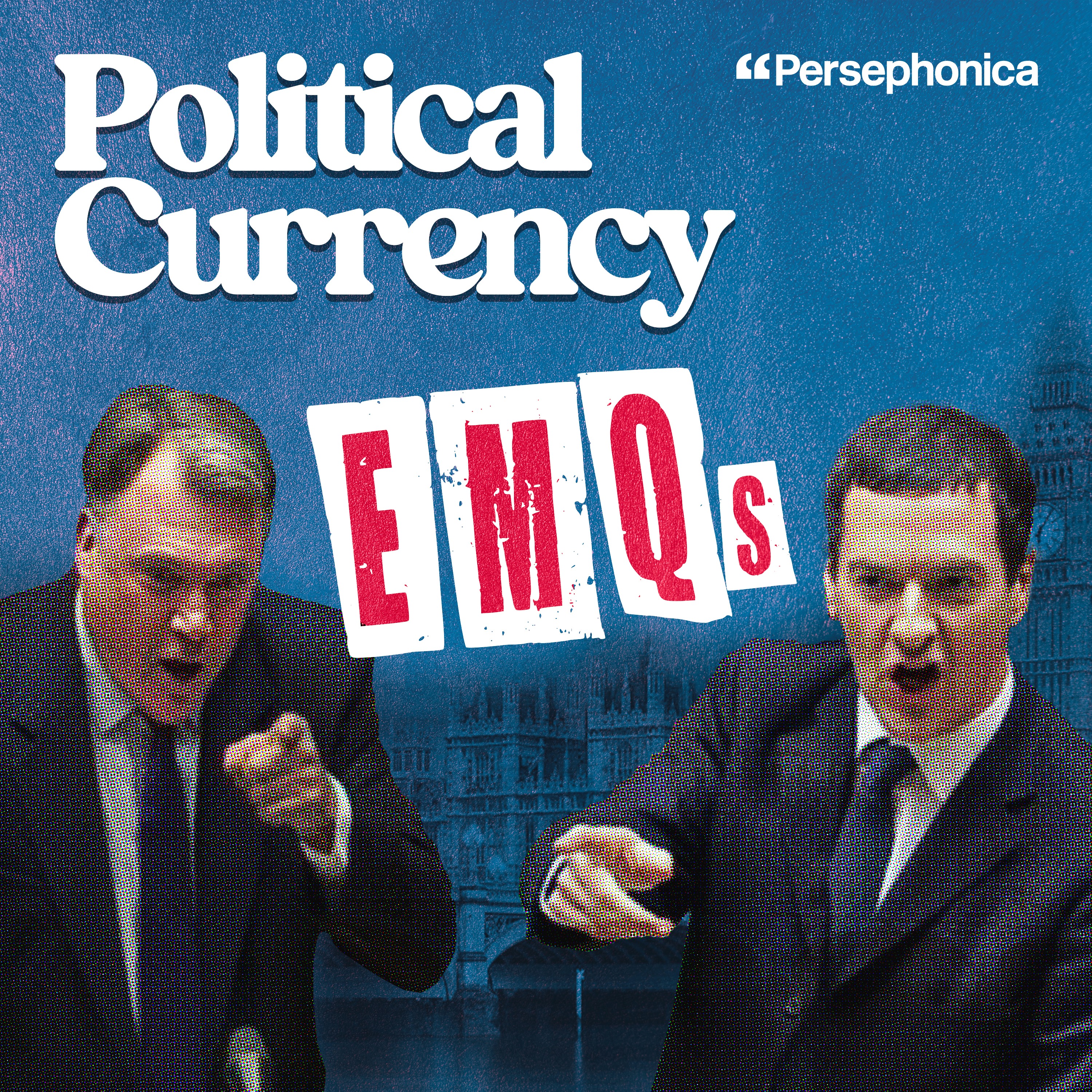
- EMQs: Should MPs drink in parliament?
In short
Debate on whether MPs should be allowed to drink alcohol in Parliament, plus wider political discussion and a later Q&A on AI policy and skills.
Guests (hosts)
Ed Balls (former UK Labour shadow chancellor; co-host) and George Osborne (former UK Conservative chancellor; co-host).
Guest background/roles mentioned
Hannah Spencer (Green MP for Gorton and Denton) criticizes Westminster drinking culture; Kemi Badenoch (Conservative leader) is discussed; William Hague, Jeremy Corbyn, Keir Starmer, Angela Rayner, Andy Burnham, Wes Streeting, Shabana Mahmood, and Eric Joyce (ex-Labour MP who punched someone in the Strangers’ Bar) are referenced.
Key claims
Alcohol with “work” should be regulated to avoid unprofessional/dangerous behavior, but “no alcohol at all” in Westminster is excessive; Parliament’s purpose includes camaraderie, not only legislation. Political culture has become more centrally controlled, making cabinet “vision” speeches riskier.
Notable examples
Eric Joyce’s Strangers’ Bar punch and its alleged political ripple effects; MPs smelling of alcohol between votes; comparisons to other workplaces (pilots, nurses, cleaners). AI segment: only 12% of managers feel confident leading AI; Sovereign AI is a £500m VC fund; training and market/VC partnership are needed.
Written by AI. May contain mistakes.
Chapters
1:00
Debate on Westminster's Drinking Culture
Explore the controversial drinking culture in the UK Parliament.
“Hello and welcome to EMQ's Ex Minister's Questions.”
2:14
Hannah Spencer's Concerns on Alcohol in Parliament
Discuss Hannah Spencer's views on MPs drinking in the workplace.
“I'm going to make a serious point first, which is when you have a woman MP coming to the Commons for the first time and worrying about the culture and the atmosphere, you should take that seriously.”
4:41
The Shift in Parliamentary Hours and Culture
Understand the changes in parliamentary hours and their implications.
“And I have to say, in my time, I saw that very, very rarely.”
6:04
The Role of Alcohol in Professional Environments
Analyze the appropriateness of alcohol in different professional settings.
“It was like you didn't actually go home until 11 o 'clock and that was nothing like as bad as it had been in the previous parliaments where often things wouldn't finish until 2 or 3 in the morning.”
7:28
The Butterfly Effect of Eric Joyce's Incident
Examine the far-reaching impacts of Eric Joyce's actions in Parliament.
“Right, Eric Joyce now disgraced ex-Labour MP, but he throws a punch.”
9:23
Kemi Badenoch and Keir Starmer's Political Strategies
Discuss the political strategies and dynamics involving Kemi Badenoch and Keir Starmer.
“I'm going to double down on your butterfly moment, because I actually did an event last week with William Hague.”
14:01
The Risks of Leadership Contests
Discussing the implications of party leadership decisions on government stability.
“At the moment, on the Labour side, they would think a leadership contest?”
15:38
AI Questions from Industry Leaders
Addressing key questions from experts about AI leadership and investment.
“One from Jackie Wright, senior person in the consulting world.”
17:47
The State of AI Adoption in the UK
Exploring the current landscape of AI adoption among businesses in the UK.
“because you're both pretty senior and engaged in this important debate in our country about AI.”
20:55
Government's Role in AI Development
Discussing the government's investment strategies in high-risk tech sectors.
“Just very quickly on James's point, it was a huge question about sovereign AI.”
Show all 15 chapters
23:22
Innovative Uses of AI in Personal Projects
Sharing personal experiences of using AI to enhance music learning and creativity.
“How do you manage to coordinate regulation across different jurisdictions when you're talking about like a global public good?”
28:05
Opening Thoughts on Training Benefits
Discussion on the importance and impact of training for political leaders.
29:22
Cabinet Members and Political Vision
Exploration of why cabinet members are not delivering big vision speeches.
“Welcome back to our final question today.”
35:01
The Need for Open Political Debate
Discussion on the importance of allowing cabinet members to express broader visions.
“But Ken Clarke also directed it against the Tory party chairman at the time, Brian Mawinney.”
37:44
Encouraging Diverse Questions from Listeners
Invitation for listeners to send a variety of questions for future episodes.
“I would love to hear back from you and from others on who is right on this one.”

Ask about this episode
Get the gist, explore an idea or ask about something said.
 Claude
On Political Currency, what are the key points of this episode?
Searching your listeningTranscript
Automatic transcript. May contain errors.
0:00Think you know where to go for happy hour? Think again. Benihana's 369 Happy Hour offers$6 pan-fried gyoza dumplings,$9 specialty sushi rolls, and signature cocktails like the Benihana Punch, mojitos, and more. It's unexpected, it's delicious, and it's perfect for meeting up with friends. Happy Hour done differently. Visit Benihana.com. That's Benihana.com.
0:32George Osborne: The Chancellor of the Exchequer. Getting a lesson from the Shadow Chancellor on how to balance the books is like getting a lesson from Dracula on how to look after a bloodbath.
0:41Ed Balls: Ed Balls. A steady as she goes budget. What kind of ship does he think he's on, the Titanic? Bermary, Celeste.
0:49George Osborne: Welcome to EMQs from Political Currency with Ed Balls and George Osborne.
1:00Ed Balls: Hello and welcome to EMQ's Ex Minister's Questions. While we're recording, it's had a very nice message from a very esteemed journalist. I'm not going to name her because I need to check first, but she says, I've been hiding political podcasts for a long time after stopping reporting on Westminster, but political currency has enticed me back. It's excellent. There we are. A tribute.
1:22George Osborne: Another satisfied customer. In fact, when I was flying out to San Francisco, we're recording this on the day I've got back. But when I was flying out, I was flying on Virgin and they have a little kind of bar area. If you get to fly business class, as I was, lucky me. And there was a guy sitting there with his laptop and he says, oh, my God, I'm actually listening to your podcast right now. So I'm all passed on my way to the loo. I said, oh, yeah, well, that's all part of the service. You know, I knew you'd be on this plane. So I've come on especially to say thank you as a he's a gold subscriber.
1:56George Osborne: So I said, thank you very much.
1:57Ed Balls: Well, look, I hope he wasn't sitting at the bar working. I hope you weren't working because in Westminster, while he'd been away, there's been a debate about whether or not work and alcohol and bars can mix. the new member of parliament for gorton and denton the green mp hannah spencer has slammed what she sees as the westminster drinking culture which she's suddenly arrived into here's what she said yeah because i'm really uneasy about um and i noticed this the other day when you can smell the alcohol when people are in between votes and everyone's going in to vote some people have been drinking in between like there's a room where i walk past and i've done my back and looked in because people are just sat having a drink but again that's a job like I can't imagine if a cleaner did that or someone working in a bank like had a few drinks and then went back to work like a bit you know like smelling of alcohol like that wouldn't happen and I think there's been so many cases recently of like questionable and dangerous behavior from you know allegedly from MPs with staff like because this culture of a really unprofessional and worrying setting where people can just drink alcohol and then while they're in work it's like life doesn't work like that i wonder what her green mp colleagues will be thinking of that contribution do they fancy a
3:20George Osborne: tipple i don't know you know i feel they may be a bit her hair shirt the green mps there was always a powerful tradition in the labor movement wasn't there of temperance I feel somewhat lost maybe over the decades.
3:39Ed Balls: I'm going to make a serious point first, which is when you have a woman MP coming to the Commons for the first time and worrying about the culture and the atmosphere, you should take that seriously. Because, you know, we don't want Parliament to be a place where people don't feel comfortable. if she perceives it as being kind of male or aggressive or bawdy or shouty in the evenings that is not welcoming then that's something that I think is to be taken seriously but I'm not sure that she is right to say that you can never have alcohol with any workplace environment look you certainly don't want nurses and airline pilots and train drivers and the Speaker of the House of Commons, the Government Minister doing the closing speech at 9.30 to be worse for wear.
4:34Ed Balls: And you absolutely don't want drunken, bawdy behaviour, alcohol-related in Parliament. And I have to say, in my time, I saw that very, very rarely. But to jump from that...
4:47George Osborne: Wasn't Alan Clarke drunk at the dispatch box, wasn't it?
4:52Ed Balls: But it's famous because it's so unusual. But to jump from that to no alcohol at all in the whole Palace of Westminster, I'm not sure that is the right response. We were talking about this on Good Morning Britain with Kevin Maguire, Kwasi Kwarteng. If ITV executives take advertisers out for dinner in the evening, talking about ITV's plans for the next two years and persuading them to advertise on ITV, that is a work environment. But does that mean that if you went out for dinner, you wouldn't have a glass of wine? If you are a Labour MP or Tory MP bringing your constituents down for dinner in the House of Commons, then you do that between votes.
5:30Ed Balls: Are you really saying that the bars and the restaurants should be teetotal? I just think it's not the same to equate a professional job of doing an operation in an operating theatre or even, as I said, making the speech with people not being able to, in the evening, have a drink in the bar before you go to vote.
5:52George Osborne: It goes to a much bigger question of what is your parliament? I remember when I became an MP in 2001, every single night the parliament finished after 10 o 'clock in the evening. It was like you didn't actually go home until 11 o 'clock and that was nothing like as bad as it had been in the previous parliaments where often things wouldn't finish until 2 or 3 in the morning.
6:14Ed Balls: and I remember I told this story George I've told this story before about 1997 when it was changing but the votes tended to start at 10 o 'clock and then go into the night and I can remember two three in the morning waking up a vet not having come home bringing the house of commons switchboard and say are they still voting yeah they're still voting and you just hang up and think so that's that's where they are and that was fine but that was like a regular occurrence at two three four in the morning and people were sitting around for hours and you know but it's changed you know
6:46George Osborne: it changed i mean i was a minor you know i was i was a new tory mp i voted with new labor to reduce the hours and there were a lot of tory mps i was in a very small minority of tory mps who voted for the changes to the hours the other sort of old boy tory mps were like no it's you know we're going to lose the club element of the house of commons the camaraderie the you know but it was seriously family unfriendly very hostile for you know a working mother to be in that environment where you have to stay up till midnight every night so i think hannah spencer is sort of you know putting i mean you're you're you're you're teasing out this like what is the parliament for is it an is it a place where people come together and are entertained and dined and you know people have a drink and there's a bit of team spirit building amongst the parliamentary parties or is it just to place a work to pass legislation and you know do the sort of serious business of government
7:42Ed Balls: quotes and i mean i think i mean are you going to breathalyze people if they've popped out to the um two chairmen between eight and nine does that disqualify them from coming back in you know i think if you're an airline pilot and you'd spent a couple of hours in the pub and then got on the
7:57George Osborne: plane that would be a terrible some people would say passing a serious law on you know whether to take away people's winter fuel payments is something that you know affects millions of people and you should be sober when you do it i mean i don't actually agree i'm slightly but are you defending this position no no i'm not i was never a big fan of the various commons bars and things but um there's a great what if meant we could do this whole episode on this couldn't we but isn't the great what if moment of british history recently eric joyce's punch in the bar Is it the strangers bar? I think it is.
8:30Ed Balls: It was the strangers bar, yeah.
8:31George Osborne: Right, Eric Joyce now disgraced ex-Labour MP, but he throws a punch. He essentially gets arrested. He's kicked out of Parliament. There's a by-election. Falkirk. In Falkirk. The by-election, this is the kind of butterfly in the Amazon theory of this, the sort of chaos theory. So the by-election happens. There's a big row about the role of the Unite Union in the by-election. This leads to kind of changes in the rules of the Labour leadership contest, which essentially leads to Jeremy Corbyn becoming Labour leader in a way he previously wouldn't have been able to. Maybe I've missed a step there.
9:06George Osborne: That then leads to Brexit, partly because we're having the referendum, but the Labour leader's in favour of Brexit. So it becomes even more of an uphill struggle. Essentially, like everything that's happened in British politics stems from the punch that Eric Joyce threw when he was undoubtedly drunk in the strangers bar.
9:23Ed Balls: I'm going to double down on your butterfly moment, because I actually did an event last week with William Hague. And I said to William Hague, you do realise you are responsible for the election of Jeremy Corbyn. And therefore, as you say, maybe for Brexit, what on earth do you mean? After the Fogcook by-election, when these rule changes were happening, Ed Miliband said to me, because I said, why are you taking away the power for MPs to choose the leader and handing it all over one member one vote to party members because of course in the 2010 election I think one MP's vote was worth 10 ,000 party members and the MPs were really the controlling who the leader was because they're the ones who have to get elected they're the ones in touch with the voters and he said to me how can we have a less democratic system than the one introduced by William Hague and of course it was William Hague as conservative leader after 1997 who changed the Conservative rules to move to one member, one vote.
10:22Ed Balls: Why did he do that? Arguably to stop Ken Clarke being elected by party members. And so it was William Hague who gave us Jeremy Corbyn.
10:31George Osborne: Maybe it was Ian McLeod back in the 60s because he complained about what was called the magic circle, deciding the Tory party leader. He was the shadow chancellor, he became the shadow chancellor. And it was the Queen who used to choose the leader of the Tory party. So it's all gone wrong since then.
10:47Ed Balls: We are supposed to be doing EMQs, but we're having such a good time. By the way, I think Hannah Spencer, I really hope that you enjoy being a member of Parliament. And I think it's a good debate. And I think that your underlying point, which is you don't want to feel as though Parliament is not a welcoming place for you, is a really serious point. And that should be listened to and respected.
11:07George Osborne: She could always send in a question if she would like to. She should. We have got a question, though, from Immy. Hi, Ed and George. Immy here. Given Starmer's unpopularity in the polls and troubles within the Labour Party,
11:21Ed Balls: is Kimi Baden-Ock's best strategy simply to let him stay in power rather than try to force him out? Many thanks. Isn't the truth in politics, you should never overthink it. It's always dangerous to be too clever. And if you are the opposition leader, it's your job to challenge the government. And if the provinces are unpopular, to bring them down. And Kimi Baden-Ock needs a win. and while this may be kind of smart for him, the truth is it's too clever by half. If she brought down Keir Starmer, that would be a win and she needs a win.
11:54George Osborne: Yes, I mean, I sort of basically agree with you in that it's not really for the opposition to determine who leads the government. Or in fact, I actually had to broaden the rule. There's always a, you know, when you have a weak opposition leader, there's often a debate inside the governing party. I remember this happening when Jeremy Corbyn was leader of the Labour Party, which was, we shouldn't do what we can to push him out. We shouldn't kind of essentially expose him as being hopeless because it suits our purposes to have him in. But that ultimately, as we were just discussing, came out to bite us because we didn't have a strong Labour leader during the Brexit referendum.
12:29George Osborne: And there are a lot of examples, aren't there? You know, Tony Blair went easy on Ian Duncan Smith in Prime Minister's questions because in Downing Street, they thought he's so weak. Don't crucify him every encounter. I think you can't, to your point. If you're the opposition in particular, your job is to hold the government to account, hold the prime minister to account, and to prove not only by doing that you are a good opposition, but also that you can become an alternative government. And that's actually often the hardest bit. But the first bit of just going full tilt at the government is what you've got to do.
13:04George Osborne: And frankly, whether Keir Starmer stays or not, has got precious little to do with Kimi Baden-Ock at the moment. It's not like Kimi Ben-Nocs are breathing down his neck. Sometimes the prime minister is got rid of by their party because the opposition leader is so popular that they need to change. But that's not the case here. So, you know, if I was Kimi Ben-Nocs, I'd just keep on doing what you're doing. And it's really up to the Labour cabinet and the very senior Labour MPs who were fired from the cabinet, like Angela Rayner, to decide what to do next.
13:36Ed Balls: There is also, I think, another point, which would be in Kevin Beinock's mind if she was thinking about this, which is what you might call the Liz Truss effect. Liz Truss, I think, made three very important contributions to British politics. One, she said we should have a debate about growth. Unfortunately, nobody listened to her. Secondly, she locked in tough fiscal rules and central bank independence for this generation because nobody's going to do a Liz Truss and have that kind of non-OBR budget. budget. But the third thing was, she showed how incredibly dangerous it is when the decision is made by party members for a political party in government to hand over the choice of Prime Minister to the members and then have a two or three month leadership contest in people's minds.
14:21Ed Balls: At the moment, on the Labour side, they would think a leadership contest? Goodness me, are we about to have another Liz Truss type process? You know, in that election campaign, leadership election campaign, fiscal discipline was dropped. They were competing on tax promises. If I was Kemi Badenock and I could remove Keir Starmer, I would then think the chances of Labour in government tearing itself apart in a leadership election are quite high and I might think bring it on. Good question.
14:54George Osborne: whether or not Camille Maidman wants to change the leader of the low body it might happen anyway over the next couple of months ok let's take a break
15:12Mother's Day is coming and Benny Hanna just made it easier to celebrate in style buy a$50 gift card and get$10 back buy$200 and get$60 back this deal won't last long So don't sleep on it. Treat mom to hibachi, sushi, handcrafted cocktails and a dinner table show she'll be talking about all year. Make the night unforgettable. Gift cards are available now at BennyHana.com. That's BennyHana.com.
15:48Ed Balls: So welcome back. We have two questions on AI. One from Jackie Wright, senior person in the consulting world. And secondly, from James Wise, who is chair of the new Sovereign AI unit. Let's hear Jackie and James and then we'll respond. Hello, George and Ed. Jackie Wright here. I've spent my career leading big tech and transformation programs at places like McKinsey, Microsoft and BP. I now chair the Chartered Management Institute's AI Council. George, in the Times, you've warned the UK risks being left behind on AI because of skill gap. And new research from the Chartered Management Institute shows why.
16:29On the ground, it is managers who have to make it deliver. But only 12 % feel very confident leading AI and 38 % say they don't have the training. My question is, are we trying to run an AI revolution with undertrained leaders? and what do businesses need to do right now to properly equip the people on the front line to deliver it? Hi Ed. Hi George. James Wise here, Chair of the new Sovereign AI Unit. This first day we launched Sovereign AI with an exciting event hosted by Alex Kendall at Wave. Sovereign AI is the government's new£500 million VC fund, bringing together the power of the state and venture capital.
17:07Our primary focus is on early stage AI companies and our offer to founders goes beyond cash and includes access to the UK's fastest AI supercomputers, fast-tracked access to talent visas, procurement routes, and much more. Our mission is simple, to support companies to start here, scale here, and win everywhere. We believe the UK needs to back its founders, and in doing so, this requires a government-wide effort, especially if we want our AI companies to be able to scale in the UK and win globally. So my question to you both is this. Do you believe government should be investing in high-risk, early-stage technologies like this?
17:40And if so, what else should we be doing to support British AI companies?
17:44George Osborne: Well, first of all, it's great to have both of you asking questions because you're both pretty senior and engaged in this important debate in our country about AI. Shall I take them in turn? So Jackie's question is actually about an article I wrote in the Times newspaper about the adoption of AI, particularly among small and medium-sized businesses. And it was a survey that showed two things. One, that there was a much bigger take-up of AI amongst small and medium-sized businesses in London and the Southeast than there was in the rest of the country. And second, there's a sort of demographic difference.
18:15George Osborne: So businesses owned or managed by older people tend to be less willing to use AI. And, you know, all the evidence is, we can have a big debate about the future of AI more generally and its impact on our society. But certainly for the evidence is, you know, if a small or medium-sized business adopts AI, it really powers a kind of productivity improvement and it can help them, you know, improve their marketing and their customer management and their account, you know, spot rooms for improvement and essentially reduce the cost of doing a load of things that they otherwise would have to pay for. The point I was making in the Times article is it's going to potentially entrench some already existing disparities in our country unless we deal with it.
18:58George Osborne: And the way to deal with it is in part, I'm not saying this is going to be the silver bullet, is to try and improve training and management and make AI skills more available to more people, which is what Jackie's doing. I'll just kind of, you know, I'll use one kind of personal example. Okay, so now I work with this huge AI company, OpenAI. You know, it has made a huge difference to me in the way I use technology just to have someone sit down with me in the company for an hour and say, look, have you thought of all these things you could do with the tools that are already available? Not just specifically to me because I'm inside OpenAI, but just generally available and freely available.
19:39George Osborne: You know, some of them you have to pay for sort of upgraded subscriptions. But most AI companies are making their basic service freely available. And it's quite amazing if you just take the time and trouble to spend 45 minutes saying, well, if I kind of link my inbox to my web browser and I do this and that and I just click a few permissions. If you do a few quite basic things, it's quite revolutionary. And you start to say, oh, I can see why this technology. Why are people making so much of this technology? And it was personally a real eye opener. So the one thing I'd say, and this is not a marketing pitch for OpenAI, because it's to apply to all the other companies as well, you know, just like if there's a sort of online tutorial you can follow or something that just says, you know, what can I do to improve the way I use this technology at home?
20:31George Osborne: Because it's much more than just a sort of new form of search. It links all the different things you're doing. And, you know, if you do it well, it can really reduce the time you spend on like trawling through emails or following up things that you don't need to follow up. In my own personal life, I've seen what a big, big difference it can make just to have a little bit of time and effort to improve your training. And Jackie's point is, I think, well made. Just very quickly on James's point, it was a huge question about sovereign AI. And the British government's made a big deal of this. Liz Kendall did a big speech this week on it.
21:05George Osborne: And I think there's a sort of distinction here between like no country in the world is entirely independent on AI, even the United States or China, in terms of like we build the chips, we build the models, you know, we have the data centers, we have all the companies and you only have to stick in our country essentially for AI. Even the United States and China are not able yet to achieve that, although they're both trying. I don't think it's possible for any other country in the world to get there, including the UK. So the question is really, how do you work in partnership with multinational companies, these frontier labs in the US or China?
21:44George Osborne: But I think in the UK, frankly, it's more to do with working with frontier labs in the US like OpenAI and Anthropic. And I think it's partly a question of infrastructure and data centers and like, but it's above all about having an ecosystem of people and companies that can work off those platforms. And I think it's really encouraging that London in particular has emerged as a place where all these companies want to found their European headquarters. That's what OpenAI has done. It's great that there's a kind of ecosystem. I'm all for VC funds and the like that James has talked about. But A, we've got a regional problem, which is my earlier point, that it's happening in London more than it's happening elsewhere.
22:25George Osborne: And then second, I don't think we should over claim. It's highly unlikely that the UK or France or Germany or Canada or whoever are going to be, you know, sovereign in quotes, ultimately sovereign in AI. And just like we're not ultimately sovereign in lots of other things that happen in our world.
22:44Ed Balls: So it's really interesting. I tend to come at these things with a kind of an economics mindset. And I think about what is the market failure. And I'm sure that in this area, as in others, when you're talking about new technology and supporting early stage and growing businesses, this is where you will often have a finance market failure. And that is why this kind of government backed sovereign AI, venture capital support and funding will really work. So that seems to me like a really good idea. You've also got a market failure potentially around a different kind of market failure. How do you manage to coordinate regulation across different jurisdictions when you're talking about like a global public good?
23:33Ed Balls: That's also something governments need to think about. You also have informational gaps. How do you see the future and understand what is possible? If the government is going to really succeed, as well as venture capital getting the regulation right, you also need to make sure the public sector is gearing up. And that is a question of leadership and of training, which is what Jackie is raising in the public and in the private sectors. But there was also another market failure, which is how do you make sure that you are not being manipulated by people who have a vested interest? And of course, the tech companies have a vested interest.
24:07Ed Balls: And so do the government departments, which are the champions of AI. And what you need is consultancies like McKinsey, but also kind of think tanks and academics who are saying, well, independent of what ChatGPT is saying or OpenAI or Anthropic, here's other things to think about. You need that kind of debate and challenge. And that's harder when you have a whole new technology which leaders don't understand. So I'm sure Jackie is right to say that the training of AI non-savvy leaders is an important part of this as well.
24:44George Osborne: What do you think of, as an economist and someone who works in the Treasury, this kind of knotty question? It's not very ideological because Rishi Sunak's government also did this. of should government be making specific investments into companies, into high-risk early-stage companies, or should that be left to the market? Because an alternative approach would be set up a tax regime that strongly encourages it, but don't try and pick those companies yourself with sort of government venture funds or wealth funds.
25:14Ed Balls: Well, I think that having partnership between the market and some government-supported investment through a kind of decision-making process, which is independent of government, can definitely work. And that's what venture capital funds have done in the past. So I don't think it's only about tax incentives. I also think it can be direct. I just don't think I particularly want government ministers or central government departments deciding that. I'd rather locate that kind of at arm's length in a sort of fundamentally market, private, experienced way. But within that, having an element of government VC funding to kind of get things moving, and overcome what would otherwise be a risk aversion with informational gaps in the market, that can definitely work.
25:58Ed Balls: And so if there's any case for venture capital type support, which we had in our country for decades, this is one of those areas. The other thing I want to say, because you were talking about your emails, I think the really interesting thing about AI is opening your mind to new things and new ways of using it. I've actually used AI quite a lot at the moment in music. I play the piano. I'm sort of bumping up against grade eight. I've been doing it for a long time. I've just cracked playing Debussy, the girl with the flaxen hair. And I thought to myself, what do I play next? And so I asked AI, I asked both ChatGPT and Claude, and I was asking them about, there's a piece called Reverie and a piece by Debussy called Claire de la Lune.
26:42Ed Balls: And I got back this really extensive analysis about how they were different and which one was more advanced and the different ways in which they were challenging and you know it's drawing upon stuff which is out there but stuff which i would never have been able to find and so it changes the way in which i am now learning the piano because maybe you can compose some original
27:08George Osborne: music for you you don't need debussy you can have a i don't personally feel at the moment i need original uh music i'm quite happy to move into composing ai assisted composing debussy's got
27:19Ed Balls: quite a big back catalogue but he was helping me to understand um and then i've been playing a piece called peace peace by bill evans uh miles davis's jazz uh pianist he was on kind of blue but he was also classically trained a big debussy fan and i asked about well they're a union leader called bill evans or am i different bill evans and did bill evans the great jazz pianist who did this improvisation debussy style improvisation um is a year before they recorded kind of blue he had never played it he only ever played it once again in his life because it was an improvisation and he didn't ever think he could repeat it the analysis that i got from jack gpt about what was happening with the music i mean utterly astonishing and so i think in a way to jackie's point it's for people who have not led but also haven't had deep experience you just need ways in which you can have your mind open to new avenues to make you think that's possible and maybe easier and a quick win and that's what training can do so I think it's a very very good idea there we are a little bit of musical diversion you could almost say it was a little bit of a an interlude and that's good interlude probably a piece by Debussy called that let's take a break and we've got time for one more question
28:46Ed Balls: The savings are stacked at Mattress Warehouse. Right now, save up to$800 warehouse-wide on top brands you know and trust. Plus, buy one, get one free deals so you can upgrade sleep for your entire family and get a free adjustable base with select mattress purchases. With 0 % interest financing and free delivery available, getting better sleep has never been easier. And with our exclusive lifetime price guarantee, you'll always know you've got the best deal. Save big today at Mattress Warehouse. We're more than a mattress store. We're Mattress Warehouse.
29:22George Osborne: Welcome back to our final question today. It comes from someone who knows Westminster, knows Whitehall, Ian. Ian Leslie. Hello, Ed and George. Ian Leslie here, author of the Ruffian newsletter and long-time listener to political currency. My question is about something that isn't happening. One of the classic political stories in my lifetime is Cabinet Minister makes far-ranging speech setting out their vision for the country, going way beyond their brief. It's always received, and usually intended, as an implicit challenge to the incumbent PM, or at least as laying down a marker in the event of their untimely demise.
29:59now we've known about the potential internal challenges to Keir Starmer in and out of the cabinet for ages now but other than the odd ad hoc intervention I don't recall any of them offering the kind of big national vision narrative that you might expect from someone who wants to be seen as the next prime minister I'm curious why do you think that is so Ian's got a good question
30:23George Osborne: here ed why why is uh why are members of the cabinet not sort of stretching their brief a bit doing those big vision speeches you sometimes get which are often a sort of preamble to a leadership campaign sort of thing number 10 gets really frustrated about but when number 10's weak they can't do a lot about either where's where's streeting's big speech on you know the future of the economy or shabana mahoud talking about the future of the health service i.e completely off their cabinet brief, but everyone saying, oh, okay, they're setting out their stall a bit. Why are they not doing that at the moment?
31:00Ed Balls: Well, I think our political culture has changed over the last five or six years. I think under the Conservatives and under Labour, I think there's more central control in Downing Street around speeches and interviews. The grid has become more controlling.
31:20George Osborne: I mean, they can't tell Wes Streeting what to do at the moment. Remember, they briefed against him and he had to go out there and defend himself on the Today programme.
31:28Ed Balls: Yeah, but he hadn't really done a speech or an interview. If you think about the kind of big speeches, when Gordon Brown was Chancellor, he was always doing these kind of big vision speeches. Boris Johnson was... And they loved them in Number 10. Well, I know, but they didn't seek to stop them. I'm just not sure. Because they couldn't. They couldn't. Well, I think at the moment, in the current environment, both because of the desire to control and because of huge sensitivities. If you are West Streeting or Shabana Mahmood and you went out and made such a speech, it would be seen and probably spoken about publicly as, you know, disloyal, a leadership challenge.
32:09Ed Balls: There'd be a big row about it. So in the last year, who has done those speeches? Well, we had one last week from Angela Rayner, two or three from Andy Burnham. in recent months. But you haven't seen that from other cabinet ministers. I think people are just quite risk averse, that they are worried that it would be seen as disloyal and setting out an alternative stall. And that's why they're keeping quiet.
32:35George Osborne: Is it also that you don't need to give some big speech to let people know what you think in this day and age? Because sort of short you know media content little clips and posts and whatnot means you know actually if you remember in fact West Streeting did this through releasing his WhatsApp messages with Peter Mandelson in which you know we discover that he doesn't think the government has an economic plan for example on some of the foreign policy things actually it's become quite clear what people like Siobhan and Mahmood or West Streeting or whatever think so they don't necessarily They need some big speech.
33:12George Osborne: The only problem is that still today a speech is the best way. I'm not seeing a better way, except maybe there's other some long form medium you use like an article. But, you know, speech is still the best way to put together a more sort of coherent argument. It's quite hard to do that in a leak or a little post or whatever. I mean, I still think Mark Carney's speech at Davos this year was the example of how a political leader can use a 20-minute speech to set out an entire philosophy, which people are still talking about a month later. And so I'm not saying that the cabinet members have the same kind of platform as he did, but it's quite noisy, Davos, to make any kind of impact.
33:55George Osborne: I'm surprised one of them doesn't go out and start to say, you know, look, I'm very loyal to Keir Starmer, but here's my view on the future of, you know, Labour and the progressive left.
34:06Ed Balls: It might be that speech making has gone out of fashion. Although, as I said, people who aren't in the cabinet do it. But under Keir Starmer, Rishi Sunak, Boris Johnson, there has been a lot less of it happening than used to happen before. And I think that reflects a desire at the centre to avoid that sort of broader, open intellectual debate, to want to approve everything well in advance, every sentence, and to move towards the more sceptical or risk-averse interpretation of what's in speeches and what's in words. And to do it without getting clearance from the centre would be seen as a front.
34:48Ed Balls: so I think it tells you that Downing Street under both parties has become a place where people are trying to control this kind of debate I think that is the the answer to Ian's question doesn't
35:01George Osborne: it reminds me of one of those great political comments that's often used in a rebuttal to a cabinet minister who does this kind of thing which is get your tanks off my lawn and I was just
35:12Ed Balls: looking it up we were talking about it was ken clark it was ken clark in 1996 aimed at
35:19George Osborne: malcolm rifkind in a lunch with john sopel no you sure i thought ken clark but it's first used by harold wilson in 1969 telling trade union leader hugh scanlan to stop interfering in government policy. I agree with you. You then think of it as Ken Clarke. But Ken Clarke also directed it against the Tory party chairman at the time, Brian Mawinney. I was like a junior person working for the Tory party at the time in Central Arthur. And he said, tell your people to get their scooters off my lawn, which was totally dismissive. You haven't even got tanks, you've only got scooters.
36:04Ed Balls: I personally think it would be better for the government if there were more thoughtful, reflective, big speeches about vision and direction. You know, what is Britain's relationship going to be with the European Union? How do we kind of forge an economic path for us into the future? And what you don't want is cabinet ministers popping up and saying, cut the corporation tax rate or change the asylum rules in this way if that's not their responsibility.
36:34George Osborne: I seem to remember Gordon Brown was always very forgiving when Alan Milburn or Stephen Byers popped up and had a view on economic policy or Charles Clark.
36:42Ed Balls: I think when they said we're going to join the euro, he would pop up immediately and say, hang on a sec. The five economic tests will be decided on the basis of a treasury assessment in the national economic interest. But I think back in those days, there was more intellectual debate about direction. And I don't think that is a bad thing. So we know West Streeting would like us to join the customs union because he said it in an interview. But what is West Streeting's vision for Britain's relationship with the European Union in the next 20 years? I'd be interested to know that. I don't think that is illegitimate for him to talk about in, as Ian says, broad vision and directional ways.
37:20Ed Balls: ways. And the idea that all has to be only in your policy area and bettered by number 10 in advance, I think that's too controlling and it ends up being stultifying of proper debate. And it means that the cabinet looks like it doesn't have views on things where it's been legitimate to have views.
37:36George Osborne: I think it's more a lack of people willing to put their head above the parapet at the moment rather than iron discipline for number 10. But anyway.
37:43Ed Balls: That might be right. That is a very good question, Ian. I would love to hear back from you and from others on who is right on this one.
37:49George Osborne: And Wes, you are, you know, I know you're a listener to this. There you go. Time for you to give your big EU speech.
37:57Ed Balls: Look, Wes knows what it's like to be slapped down by Downing Street, even when he wasn't making a big speech. So is he really going to go out there and make a big speech? I think he ended up slapping them down. He slapped their slap. That is all we've got time for. If you've got a question of your own, send it to us by emailing questions at politicalcurrency.co.uk, or you can always message us on our socials.
38:18George Osborne: Yeah, history, economics, quirky questions, serious questions, you name it, questions about drinking, questions about the customs union, whatever it happens to be. We love a variety of questions. Do get creative with them.
38:30Ed Balls: And we'll be back on Thursday with our main show, the day of voting in the local elections. See you then.
38:37George Osborne: Vote early and vote often. See you then.
38:46George Osborne: Thanks for listening to Political Currency. This has been a Persephoneca production.
38:59Right now at Mattress Warehouse, save up to$800 warehouse-wide. Get buy one, get one free deals, plus a free adjustable base on select mattresses,
39:08Ed Balls: 0 % interest financing, free delivery, and our exclusive lifetime price guarantee only at Mattress Warehouse. Think you know where to go for happy hour? Think again. Vinny Hanna's 369 Happy Hour offers$6 pan-fried gyoza dumplings,$9 specialty sushi rolls, and signature cocktails like the Vinny Hanna Punch, mojitos, and more. It's unexpected, it's delicious, and it's perfect for meeting up with friends. Happy Hour done differently. Visit VinnyHanna.com. That's VinnyHanna.com.
From the publisher
Before getting into questions this week, Ed Balls and George Osborne take on the big talk around Westminster: should MPs be allowed to drink? They respond to the criticism by new Green MP Hannah Spencer, who said MPs smelling of alcohol while voting made her uneasy. Ed and George offer the pros and cons of this, and even how drinking in parliament getting out of hand may have led to Jeremy Corbyn…
Is it in Kemi Badenoch’s best interest for Keir Starmer to stay on? The pair explain why this mindset is too clever by half, and how opposition leaders should always focus on their message and expose a PM’s weak points, rather than hope to gain by keeping a flawed leader in place.
They then receive a pair of questions on AI, looking at the lack of training among certain industry leaders and the idea of British sovereignty on AI. George brings his expertise to explain why training is important and the limits for any country on sovereignty, while Ed illuminates us on some of his own musical AI discoveries.
Finally, they answer just why cabinet ministers seem reluctant to lay out their own vision for government even when Starmer appears so weak. Is this a sign of No. 10 clamping down on ministers? The rise of soundbite social media? Or, does it demonstrate how no cabinet member is confident enough in their leadership ambitions to make a move?
We love hearing from you, so please don’t forget to send all your EMQs to questions@politicalcurrency and make sure to include a voice note of your question or send a question to our social media handles:
👉 X
👉 TikTok
Thanks for listening. To get episodes early and ad- free join Political Currency Gold or our Kitchen Cabinet. If you want even more perks including our exclusive newsletter, join our Kitchen Cabinet today:
👉 patreon.com/politicalcurrency
Please note: Kitchen Cabinet is only available via Patreon.
Credits:
Research: Sam Burton
Production: Caillin McDaid & Nasreen Arain
Video Editor: Carla Mercer & Ryan Finnigan
Executive Producer: Ellie Clifford & Henrietta Harrison
Political Currency is a Persephonica Production and is part of the Acast Creator Network.
Hosted on Acast. See acast.com/privacy for more information.
More from Political Currency
All episodes

We use cookies.They keep VO running smoothly and help us improve it. Privacy policy