
 Ask ChatGPT


- Podcasts
- Political Currency
- EMQs: Should retired politicians go on Question Time?
Political Currency25 May 2026 · 38m · 16 chapters
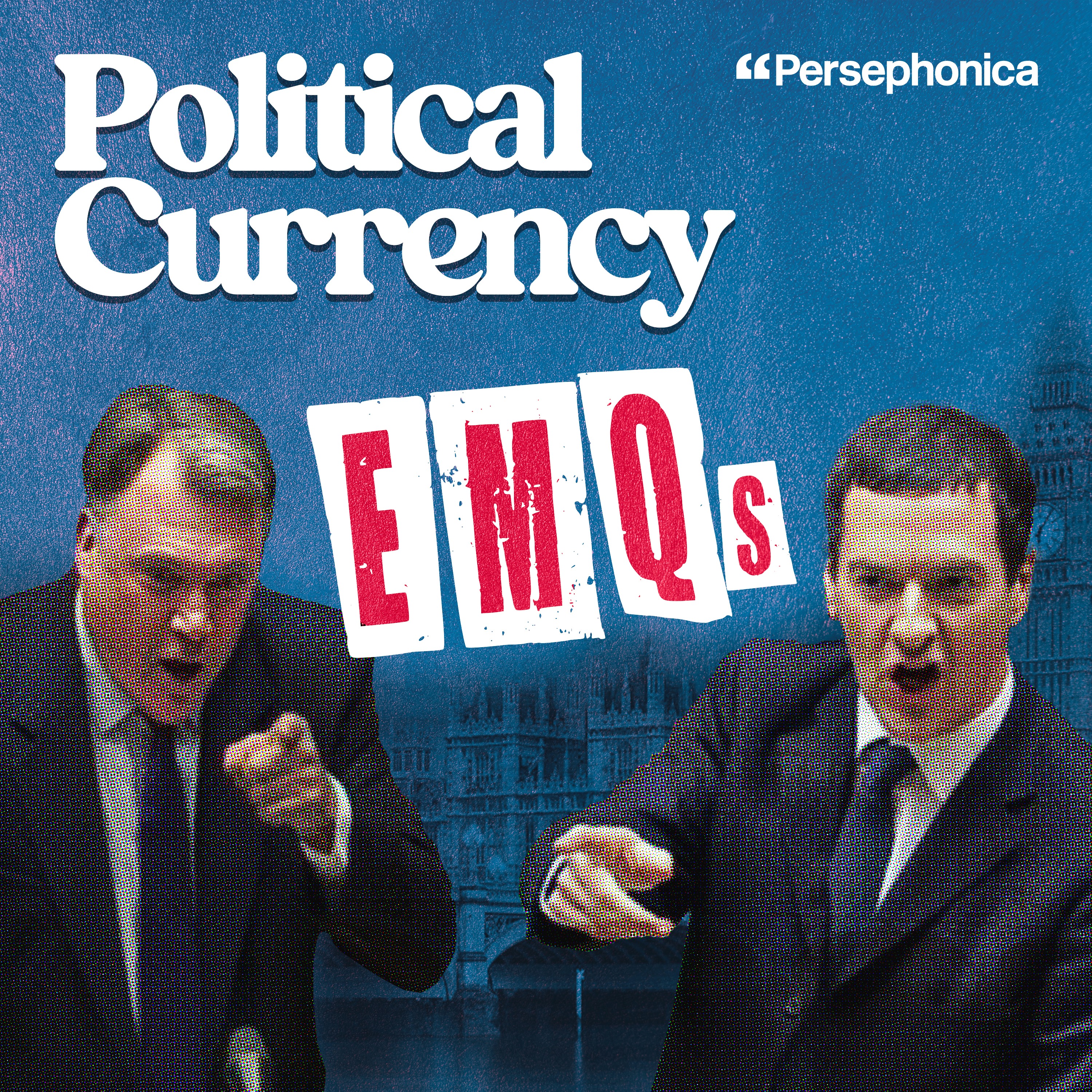
EMQs: Should retired politicians go on Question Time?
In short
Whether retired politicians should return to Question Time; also discusses how heckling/competition in Parliament affects accountability and outcomes, and debates Bank of England policy vs gilt-market backstops.
Guests
No episode guests. Hosts are Ed Balls and George Osborne (ex-ministers), plus callers’ questions from listeners (Phil Eden, Ashley, Paul from Stockport, Luke, and producer-voiced Ashley).
Key claims
Parliament’s “cut and thrust” (including heckling) can be important for holding ministers to account; removing conflict could just move accountability to media/street. Retired politicians may not benefit from Question Time due to reduced audience impact and harsher social-media scrutiny; Michael Gove is framed as uniquely able to speak freely. On fiscal paralysis, the hosts argue credibility of an independent Bank of England is essential to prevent inflation-driven debt relief; low growth is the main culprit.
Notable examples
Naz Shah’s unifying state-opening speech; Dennis Skinner heckling “not now, Andy”; Charlie Kennedy “murdered” George on Question Time; Andrew Bailey’s Truss-era gilt-market intervention; Seamus Heaney encounter at an Oxford ball.
Written by AI. May contain mistakes.
Chapters
2:53
FA Cup Final & Diggerland Experience
George shares his experience at the FA Cup final and a fun day at Diggerland with his kids.
“And George, I'm going to guess seeing Chelsea lose to Man City in the FA Cup final was not the highlight of your weekend.”
4:22
Discussing Diggerland's Uniqueness
A discussion about Diggerland's appeal and experiences of visiting with children.
“I have to say, this is the first time I've ever been jealous of you in your 50s, having young kids, because all of our kids are now in their 20s.”
6:31
Phil's Question on Parliamentary Behavior
Phil raises a question about the behavior in Parliament compared to professional settings.
“Let us move on to our first question and it comes from Phil.”
10:26
Defending Parliamentary Conduct
Discussion on the necessity of confrontational behavior in Parliament for accountability.
“I mean, you should have come with me to the FA Cup final.”
14:06
Kemi Badenoch's Political Performance
Explore Kemi Badenoch's effectiveness as an opposition leader and the challenges she poses to Keir Starmer.
“I mean, it's not, I don't think it's other things, particularly.”
15:28
The Role of the Speaker in Parliament
Discuss the importance of the Speaker's control in Parliament dynamics and how heckling influences debates.
“I think the one thing I would say, I mentioned the design of the parliament, and I don't think the physical design has a big impact.”
17:30
Personal Experiences on Question Time
Former politicians share their experiences and anecdotes from participating in Question Time.
“but we've not disagreed with you either.”
20:05
The Impact of Social Media on Political Discourse
Analyze the changing nature of Question Time and its audience engagement in the social media era.
“Because, I mean, it's such a fascinating bear pit.”
24:06
Fiscal Challenges and the Bank of England
Examine the fiscal challenges Britain faces and the role of the Bank of England in maintaining credibility.
“And unlike the previous two questions, which were good fun, this is actually to the heart of the conversation being had in British politics right now.”
28:14
Economic Confidence and Fiscal Policy
Learn how the Bank of England influences confidence in sterling and the broader economy.
“managing the public finances in a sensible way into meeting its fiscal rules.”
Show all 16 chapters
29:35
Lessons from the Eurozone Crisis
Discover the parallels between the Bank of England's actions and the European Central Bank during crises.
“But the Bank of England stepped in ultimately as the backstop.”
31:36
The Search for Economic Growth
Explore the importance of a coherent economic growth plan amidst low growth and political paralysis.
“What they want is a clear plan that you can coherently articulate.”
34:11
A Humorous College Ball Inquiry
Engage in a light-hearted discussion about an invitation to a college ball and a music gig.
“and use promo code POTEN to save 10 % now.”
36:40
Memorable Encounters and Recollections
Hear a nostalgic account of a meeting with poet Seamus Heaney during a college event.
“And they came to us and said, would we do a gig to help raise money for the very important work they do?”
39:45
Cultural Recommendations and Insights
Explore cultural recommendations and discussions about literature and television shows.
“I just, the whole thing is a bit embarrassing.”
42:02
Audience Engagement and Question Submission
Learn about how listeners can engage with the podcast by submitting questions and recommendations.
“If you have a question of your own, you can always send it to us by emailing questions at politicalcurrency.co.uk or messaging us on socials.”

Ask about this episode
Get the gist, explore an idea or ask about something said.
 Claude
On Political Currency, what are the key points of this episode?
Searching your listeningTranscript
Automatic transcript. May contain errors.
0:00Ed Balls: Hello podcast listener.
0:01George Osborne: Hello you.
0:02Ed Balls: It's me, Greg James.
0:03George Osborne: And me, Alice Levine.
0:05Ed Balls: Now look, I know that you're very much enjoying this podcast that you're listening to. And we're sorry to interrupt. We really are.
0:12George Osborne: And it genuinely might not be our place to say, but is it time to try something new?
0:17Ed Balls: We would like to steal you for our new podcast. It's called Bad Chat. And it sounds a bit like this. This one goes out to the walkers and the talkers and the late night. Stalkers. Maybe not that one. Alice is my best friend. I am not Alice's best friend. Do you know that horses' legs are their fingers? That is a bit of bad chat from me, Greg James. And me, famously, Alice Levine. Listen wherever you get your podcasts.
0:50Ed Balls: Buying furniture for your business can be full of compromises, confusing choices and little support. National Business Furniture is here to change all of that. We believe that every business deserves furniture that lasts, service that cares, and a partner who gets it at a budget that works. At National Business Furniture, that's our commitment to you. Find the right furniture for you and your team at National Business Furniture. Visit nbf.com and use promo code POTEN to save 10 % now. You stopped waiting for permission and started building yourself, your dreams, your credit. Experian Boost could turn your on-time payments into instant FICO score gains.
1:33Ed Balls: Every bill you paid could become proof of your power. Self-made? Absolutely. Self-funded? Experian could help you get there. Download the Experian app today. Results will vary. Not all payments are Boost eligible. Some may not see improved scores or approval odds. Not all lenders use credit information impacted by Experian Boost. See Experian.com for details. Experian. security program on spreadsheets new regulations piling up and audit dread it's time for vanta vanta automates security and compliance brings evidence into one place and cuts audit prep by 82 less manual work clearer visibility faster deals zero chaos call it compliance or call it compliance get it join the 15 000 companies using vanta to prove trust go to vanta.com
2:49slash com.
2:52Ed Balls: So hello and welcome to EMQ's Ex-Ministers Questions. And George, I'm going to guess seeing Chelsea lose to Man City in the FA Cup final was not the highlight of your weekend.
3:07George Osborne: But there is a bit about the FA Cup final. I mean, it's been a few years since I've been, a few years since Chelsea was in the final, of it being a kind of big British event, you know, big English event, I should say. you know like cup final day is a big deal and I took my son Beau and my son Luke who got a bit of an age difference but they both enjoyed it went with my dad and my nephews and you know we lost but actually Chelsea at least were in the kind of game until last 15 minutes but you know the day after the FA Cup final I did something that's even more English than the Cup final and that is I went to Diggerland and Diggerland is in Medway near Rochester basically on the Medway River in the sort of Thames Estuary area in Kent and I went with my kids and with Thea and this is where you get to basically drive or children get to drive diggers mini dumper trucks mini bulldozers I mean, the actual real, you know, you get to drive a real JCB.
4:10George Osborne: It is absolutely Britain's answer to Disneyland. And it is about as far from Disneyland as you can possibly imagine. But it's enormous fun. It is like really well done.
4:22Ed Balls: I have to say, this is the first time I've ever been jealous of you in your 50s, having young kids, because all of our kids are now in their 20s. And when they were little, we went to the York Railway Museum. We went to Halifax, to the Museum of Childhood, I think it was called. It was really fun and interactive. But Diggerland in Castleford opened after they were basically, you know, late teenagers. And therefore, I've never been to Diggerland. And the number of times I've driven past it, because I drive past it to kind of buy petrol on the way to the motorway. And I've thought to myself, could I just go to Diggerland on my own?
5:02Ed Balls: and I never have. I think you can.
5:06George Osborne: You can? Well, I've been to Digland twice, actually. This is my second visit because I went with my son Arthur last year.
5:13Ed Balls: So you didn't go on your own?
5:15George Osborne: No.
5:16Ed Balls: Could you go on your own?
5:17George Osborne: Could you? It's a bit of a kind of edge case, this, I would say. There are some adults by themselves. I mean, sorry, not by themselves. You're like usually in couples. It's overwhelmingly children. um but what you do see is basically a lot of adults i don't want to be too kind of gender stereotypical it tends to be the fathers who look like they're having more fun than the mothers but they driving around these you know these real diggers and it's great fun um anyway so i think you could go surely a better thing would be to go as the spouse of the local mp to open some new attraction at Diggerland.
5:58George Osborne: And that would be an excuse. That would be an excuse to ride all the things.
6:02Ed Balls: Trouble is you can't enjoy yourself if you've got an official capacity. You've got to go slightly in disguise and commit to the digger.
6:09George Osborne: Anyway, it is great fun. I'd thoroughly recommend it.
6:13Ed Balls: But if there's anybody in West Yorkshire who's got young kids or grandkids who really want to go to Diggerland, but they don't fancy it, just send us an EMQ and we'll sort it out. I'd love it.
6:25George Osborne: A strange man's going to take your children to Tiggerland.
6:29Ed Balls: Now we're getting weird. Let us move on to our first question and it comes from Phil. Hi there Ed and George.
6:35George Osborne: My name is Phil Eden and I'm just some semi-retired bloke from Sheffield in South Yorkshire. The other day you were discussing how Hannah Spencer, the new Green MP,
6:45Ed Balls: had said she felt some MPs were drinking excessively while working at Parliament. I used to work for an international bank and I've always thought it's strange how, even when sober there is jeering, heckling and throwing of insults in the House of Commons. It makes me chuckle every time I listen to the start of EMQs when the two of you are locking horns over George's budget. I couldn't imagine this type of behaviour when I worked for the bank. Of course you don't have an opposition whose job it is to criticise and oppose in a normal company although you would expect constructive feedback from colleagues.
7:18Ed Balls: My question is do you think if If parliamentary sessions were run more like a meeting in a professional company, without the insults, jeering and heckling, would this improve the outcomes or is this behaviour key to getting good results? Thanks both and take care. So this is a really interesting question, Phil, and I'm going to defend Parliament. But I want to start by saying this, that actually my experience with the House of Commons is that there were moments of kind of electric unity and commonality. There are times when there's been a tragedy or somebody's telling a personal story or they're raising a non-partisan issue or where the national interest is in danger when a backbench MP or the prime minister speaks and everybody listens.
8:10Ed Balls: And there is huge unity of purpose. And sometimes that can happen in a lighter way as well. I don't know whether you saw Naz Shah, the Yorkshire MP's speech at the state opening of Parliament, the debate after the king had done the king's speech a week or so ago. A brilliant, powerful, unifying, non-partisan speech. And there have been Labour and Conservative, Liberal Democrat speeches of a similar nature. But there are other times when a prime minister is on the back foot trying to bluster under pressure, not answering questions, when it's really important that there is noise and pressure and challenge because you can't be allowed to wriggle out of accountability.
8:57Ed Balls: And there's also times when you can use humour and a bit of pantomime and mockery in order to expose the ridiculousness of an opponent. And I don't think that is a bad thing. I think that's actually part of the way good parliaments work. And my final point is this. When parliaments have tried to design out that sense of conflict and challenge, I mean, if you think of the Scottish Parliament, which is not designed confrontationally between the government and the opposition benches with the Speaker right close, and it's much more broad and is designed to be not confrontational. In fact, the Scottish Parliament, if you ever see it in operation, especially at First Minister's questions, it's even more gnarky and aggressive and unruly.
9:49Ed Balls: But because it's not people being just a couple of metres away with the Speaker right in the middle of it, I think the Speaker equivalent in Scotland finds it harder to control and ends up being more wild and unruly. So in the end, it's inherent in the way in which parliaments work. And it has times when it's an important part of the accountability process, Phil. But it's not the only way it is. And it's not often like that. And so I'd say don't knock it.
10:22George Osborne: Yeah, I think, I mean, it's a very good question from Phil. I mean, I would say, first of all, you know, the idea that adults outside of parliament are always incredibly well behaved. I mean, you should have come with me to the FA Cup final. I mean, you get a bunch, you get 80 ,000 adults in a stadium and they're all screaming and swearing and chanting and cheering and booing and whatever. I mean, you know, it's not childish behavior. It's actually human behavior. And I think there are elements of a way a bank might operate since Phil says he operates in a bank. You know, if you look at it, think of a trading floor where people are shouting at each other and so on.
11:00George Osborne: But all of that said, I can see why it can be quite off-putting for people if they see the House of Governments. They don't really understand the context you're giving, which is, you know, this is about very powerful people. Because government ministers, prime ministers and the like, you know, they hold a lot of power on our behalf. And they're being held to account. And if you don't have that kind of rumbustious environment where people are challenging and people have to think on their feet, then what happens is you get systems where there's still accountability. It just doesn't happen inside the parliament.
11:35George Osborne: It happens on the media or it happens on the street. It's not that it doesn't happen. It's just in the British system and indeed in systems derived from it, like the Canadian system, the Australian system. It's kind of in the chamber, whereas in other countries where they've kind of taken it out of the chamber. If you think of that, like, you know, American politics, unbelievably, you know, divisive at times, aggressive. We were playing clips on our main podcast of Steve Hilton's gubernatorial debate in California. But the actual House of Representatives and the Senate floor, they're quite boring.
12:14George Osborne: You can't really think of kind of big clashes, big moments there.
12:18Ed Balls: And the president is not ever put under anything like the pressure a British prime minister is under by political opponents or by the media or really by in any forum other than the debates which happen at the very end of their term if they're standing for a second four years.
12:38George Osborne: Yeah, but that doesn't mean in American politics there's not, legislatures aren't very powerful and there's lots of skullduggery going on. It's just not, it's not in the open. So I would say, you know, the problem is if you got rid of, if you sort of tried to take all the heat out of the House of Governments, made it really boring, then people wouldn't pay much attention. It would be rather like a very quiet workplace, which is fine. I mean, people can get on with their work, but you don't get, there's not much of an atmosphere i've you know i've worked in places like that um so i think yes i i think i can conclude where you concluded which is be careful what you wish for because it's not a bad system however it does favor a certain type of person who may be good in that environment and others struggle although i think there are ways for people who aren't you know it used to be said that women in particular would found it very noisy and aggressive and male and environment but you know there's some very very effective female politicians um and they can you know the really really good politicians male or female can kind of set the tone a bit of parliament they can kind of take the temperature down if they're in command and they command the respect of the mps on both sides and people saying oh this person knows what they're doing they don't want to have a robust just debate that actually does kind of parliament responds to that and And it's not as rumbustious.
14:00Ed Balls: And the reality is, of the last nine to 12 months, Kemi Baden-Ock's political recovery, and there has been a political recovery for her as an opposition leader, even though it's not reflected hugely in results in elections, and the local elections is reflected in her ratings with the public, that is entirely based, I would say, on her performances in Parliament.
14:26George Osborne: Yes, I agree. I mean, it's not, I don't think it's other things, particularly. She's got a way to kind of get under Keir Starmer's skin. Although it would be interesting to see, you know, because Keir Starmer is frankly not very good, I don't think, in countering her. There are ways you could take her on. I would do to her in government what I tried to do to you across the dispatch box, which was to say, you are responsible for this because you were in the cabinet and you were in the treasury. and I don't hear Keir Starmer saying every week which is what I'd be doing if I was saying hold on Kemi Benoit you were in the cabinet up until two years ago and you are responsible for the high immigration numbers and you are responsible for you know the inflation in the economy or whatever happens to be you know and you'd just be relentless at pursuing that and maybe an Andy Burnham or a West Street or whatever I think are frankly more effective performers than Keir Starmer has turned out to be, although he's a pretty effective opposition leader, but it turned out not to be a very effective prime minister performer, will do that.
15:27Ed Balls: Anyway, we'll see. I think the one thing I would say, I mentioned the design of the parliament, and I don't think the physical design has a big impact. The Scotland case proves that.
15:38George Osborne: That's hemispherical, isn't it? That's what everyone, everyone keeps saying you should move away from this. It was all because it was a sort of old church originally, wasn't it? And people faced each other in pews.
15:46Ed Balls: But the Speaker has a great responsibility. I think Parliament works when the Speaker allows the cut and thrust, but is very tough on people who break with the rules. And that includes barracking from the backbenchers. So if the Speaker's really got grip, then Parliament works. If the Speaker loses control, and I've experienced all types of Speakers.
16:12George Osborne: What the parties do is they put their loudest shouters, the people who are going to put the other side off, they get them to, and they're often whips, and they get them to sit on the stairs between the benches that kind of tear down. The benches are teared, of course, and there's a set of stairs in the middle of the two benches, two banks of benches. And if you sit there in Prime Minister's questions, the speaker can't see you because you're sat down lower than the benches. and that is where you put your most aggressive hecklers.
16:45Ed Balls: Although some of the heckling works, not because it's loud and aggressive, because it's funny. Did you see, I think, I can't remember the name of the MP, I think it was a Labour MP, who in the state opening of Parliament, when everybody's in the packed chamber and the doors are shut and there is a big rapping on the door and this is the black rod coming into Parliament to invite everybody down to the King's speech as the door knocked. Backbencher yells out, not now, Andy. Yes, I do remember that.
17:15George Osborne: Very good. It was actually the role that Dennis Skinner used to play, wasn't it?
17:21Ed Balls: Absolutely. Dennis Skinner used to spend hours rehearsing those lines. All of that timing. Brilliant. Thank you very much indeed, Phil. And I'm afraid we've not totally agreed with you, but we've not disagreed with you either. Our next question is from Ashley, and her question has been voiced by one of our producers.
17:38George Osborne: Hi, Ed and George. Would you go on Question Time as a retired politician? I was never a fan of Michael Gove, but he showed willpower and sense on there. Maybe he could be an asset to Kemi and the Tories going forward. Keep up the great work and still a better podcast than the rest is politics. Bye. So I'm going to say I feel I'm a little bit cowardly here because Question Time have regularly asked me to go on and indeed asked me to go on in the last couple of weeks. And I just don't really want to do it. And I don't really want to do it partly because I'm not sure what I'm trying to achieve. I mean, obviously, I used to go on when I was a politician.
18:19George Osborne: You suddenly are in this bear pit and the public will have a go. And then, you know, someone's going to say from the outside, well, you know what, George Osborne, you're responsible for all the austerity, whatever. And they're all going to scream and shout. And I'm like, why do I need all that, frankly? You know, and what am I trying to achieve? But I always think to myself, well, yeah, but we'll see. It's a bit lame, isn't it, George? I mean, you used to be happy to go up there and do it. So I currently say no to them. What I don't know, and I, you know, apologies to the people who put the program together, is I just don't know how much sort of bite it has still with the judge.
18:53George Osborne: It used to be a big, big show that lots of people watched and particularly people watched in Westminster. But I don't know now in our very diffuse media age whether it matters whether you go on it and and the like it used to be a sort of trial of strength and i have lots of sort of stories and anecdotes from going on question time over the years i remember going on with charlie kennedy once i think i've told various stories about going with charlie kennedy he absolutely murdered me i mean i made some cheap point about um labor divisions on the iraq war and he said um well you know what george if you hadn't voted for the iraq war it wouldn't have happened and brought the house down but before he went on i remember we were all waiting in the kind of green room that when I say the green room, you sort of, it's like in a school or somewhere usually, and you're in the kind of staff common room waiting to go on.
19:40George Osborne: And he did down a pint of spirits before going on. He literally necked a pint of spirits. And then I was like, Jesus. And then he went on and performed brilliantly and cut me down to size.
19:56Ed Balls: Isn't the truth, George, we could do a whole episode of EMQs or a whole podcast in the summer, just talking about question time stories and anecdotes. Because, I mean, it's such a fascinating bear pit. I mean, to answer the question, first of all, from Ashley, I think if you're Michael Gove, you are liberated from the party line. You can finally go out there and say what you want to say. You can see why having the chance to speak your mind is great from his point of view. but I would say for you and me we have those chances all the time we do this podcast I'm on Good Morning Britain three times a week and I think if you and I went back onto question time people would say oh well you know what does this mean you know are they are they making a comeback is it a relaunch and I don't think personally either of us need that it's also as you said it's just even though it doesn't have the scale of audience back in the day when I first did it or was in the 2000s.
20:55Ed Balls: I mean, if you were on question time, then you had far more face recognition in the supermarket or on the trade or in the street the next day and the day after than you would in a normal week because the audience was huge and people see you in that way. I think these days, if it goes well, probably nobody notices, but if it goes wrong, social media would then kind of transmit it all around everywhere. I'm not sure. I think pre-social media, you had a fairer run on Question Time. I'm not sure whether social media makes it such an enjoyable and forgiving thing to do and do.
21:32George Osborne: All sorts of stories are flooding back, so maybe we'll save them for a special on Question Time and any questions as well. But have you ever asked a question on Question Time? Because I have asked a question on Question Time.
21:43Ed Balls: No, I've never asked a question.
21:44George Osborne: I was a young Tory researcher who asked John Prescott a question on Question Time. Oh my God. Wasn't my best question.
21:53Ed Balls: The very first time I went on Question Time, I had to then travel from Devon up to Yorkshire the next day. And I got up really early in the morning. And this was 2004, I think. And so very early days of the internet. And Question Time were just starting to put viewer comments on the website. And I looked at five in the morning, having got back from Devon before going up, these viewer comments. and there was no mention of me at all. It was all about Robert Cure Silk or whoever else was on, other than this one comment which said, congratulations to Ed Balls for getting this far against such adversity.
22:33And I thought, what is this about?
22:35Ed Balls: And it was signed by a guy from Preston called Bob Nipple. And I realised he was just taking the mickey out of my name. And I thought - No one would ever do that. This is my launchpad, is what I thought. Bob Nipple from Preston, praising Ed Balls from Castleford. Thank you very much indeed. We'll be back shortly after this break.
23:16Ed Balls: We believe that every business deserves furniture that lasts, service that cares, and a partner who gets it at a budget that works. At National Business Furniture, that's our commitment to you. Find the right furniture for you and your team at National Business Furniture. Visit nbf.com and use promo code POD10 to save 10 % now. you stopped waiting for permission and started building yourself your dreams your credit experian boost could turn your on-time payments into instant fico score gains every bill you paid could become proof of your power self-made absolutely self-funded experian could help you get there download the experian app today results will vary not all payments are boost eligible some may not see improved scores or approval odds not all lenders use credit information impacted by experian boost see experian.com for details
24:38Ed Balls: It's the end.
24:46George Osborne: Welcome back. Now, our next question is from Paul. And unlike the previous two questions, which were good fun, this is actually to the heart of the conversation being had in British politics right now.
24:59Ed Balls: Hi, Ed and George. This is Paul from Stockport. I've been a big fan of the podcast since the very beginning. keep up the good work. I was reading Adam Tooze's Substack this week, and he argued that our relatively recent fiscal and political paralysis is driven by fear of another gilt market crisis like that of the trust era, and that this fear is reinforced by the Bank of England's relatively hardline post-inflation stance and ongoing quantitative tightening. He suggested that the bank could instead take a more draggy era ECB approach, acting more clearly as a backstop to gilt markets and giving governments more room to pursue investment-led growth policies.
25:38Ed Balls: What I would like to ask you guys is, is that a realistic option for us, or would it risk undermining confidence in sterling, fueling inflation and damaging the bank's credibility and independence? Keep up the good work, and I look forward to hearing your response. So thank you, Paul. And I have to admit, I've not read the Adam Tooze substack, and I will go and do so. But I think I fundamentally disagree with this analysis. And I just think it's the wrong way to think about it. The fact is, there is a big fiscal challenge for Britain, because having had the financial crisis, and then the pandemic, and then the energy bailout, we have a high level of national debt in our country and a large part of our budget taken up by debt interest payments, much higher than it was in 1997 or 2005.
26:29Ed Balls: And we've also had a period where in key moments in the pandemic, and then with the energy price bailout, when under pressure politically, governments have spent large amounts of money to solve political problems and borrowed the money. So there is a scepticism and a worry in financial markets about whether governments are going to pay their way, whether they will actually get debt on a downward path rather on a rising path. And what is the thing they're worried about? And what is the guarantor? What financial markets are worried about is that governments will basically use inflation to inflate their way out of a problem.
27:07Ed Balls: The easiest way to deal with the high level of national debt is to have a big inflation, which essentially makes the value of that debt less in today's prices. And that's what kind of irresponsible governments always used to do in the past. And what is the guarantor against inflating yourself out of a debt crisis is having an independent central bank which says we are committed to meeting the inflation target and a government which backs the independent central bank in order to meet the inflation target. And if there was a doubt as to whether the Monetary Policy Committee and Andrew Bailey and the Bank of England were going to stand by the inflation target, then it would make it much, much harder for governments to manage fiscal policy, to manage the national debt, to sensibly borrow for investment, as the government is doing at the moment.
27:58Ed Balls: So far from the Bank of England and its stance making the gilt market challenge harder, I think the credibility of the Bank of England is essential in order to allow in a challenging environment the government to carry on managing the public finances in a sensible way into meeting its fiscal rules. So if we were to weaken that Bank of England commitment, that is what would undermine confidence in sterling, fuel inflation, damage and the credibility of the government and its fiscal policy. So I say in this environment, the Bank of England needs to carry on doing its job in a tough and credible and symmetric way.
28:38Ed Balls: And they are. And that's a good thing.
28:40George Osborne: Yeah, I mean, again, I think that's right. I think, you know, the problem is, Paul, I think everyone's looking for free money, aren't they? And here, you know, it's on the right, you say, well, if we cut taxes, they'll pay for themselves. And on the left, you say, well, if you spend a load of money, that will pay for itself because you'll have a more productive economy. So your investment led growth policies is basically spending money that in theory creates a bigger economy. But there's absolutely no agreement on what those might be, frankly. So, you know, should you be investing in old world infrastructure or new digital infrastructure or skills or training?
29:15George Osborne: I mean, there's a big debate about this. I've got a question. First of all, I mean, I think the Bank of England has acted as a backstop on the guilt market in the truss era. I mean, it was actually Andrew Bailey's intervention that kind of put a lid on the guilt market starting to go haywire after the mini budget. And so there was enough room for the government to kind of hang itself politically. But the Bank of England stepped in ultimately as the backstop. And my recollection of the Draghi era, and of course it was different, you know, it's the European Central Bank. First of all, Draghi was trying to invent the rules as he was going along because this was the first time the Eurozone had confronted a crisis like this.
29:54George Osborne: And certain members of the Eurozone, like particularly the Germans, but also the Dutch and the Finns and others, were saying, hold on, you can't just allow countries to borrow whatever they like and stand behind German taxpayers. There's got to be some discipline on the Greeks and the Italians and so on. And what Draghi did was, you know, he ultimately did, you know, you're right, he was a sort of backstop in the sense he said, we'll do whatever it takes to save the euro. That did provide a backstop that sort of made the market think there's no point betting on the breakup of the euro. But he provided enough room for governments to hang themselves.
30:34George Osborne: And there's not incredible argument that essentially the ECB allowed the Berlusconi government to fall or kind of prompted the Berlusconi government into falling because it didn't actually act as a sufficient backstop on Italian government bond yields. and it got to the point where Berlusconi was forced out because of the higher rates of interest that Italy was paying for its debt compared to Germany. So I'm even kind of questioning, anyway, I may be being unfair to the argument in the sub stack, but I think I'll fundamentally, you know, what markets want is a coherent plan to pay away in the world.
31:13George Osborne: It was actually a very good quote from someone we both know really well, Nick McPherson, who was permanent secretary at the Treasury when I was chancellor for most of the time and was permanent secretary when, or principal private secretary when you were there. And, you know, he's in the paper today quoted on the Andy Burnham story about Gill Market saying fundamentally markets don't care whether you're sort of centre-left or centre-right or, you know, Conservative or Labour. What they want is a clear plan that you can coherently articulate. And that is what's been missing. And I think it's perfectly possible that a new Labour prime minister will be able to articulate a plan And it might not be the plan I support, but it could be a plan that the bond market supports.
31:55Ed Balls: And why have we had a recent fiscal and political paralysis? It's not because the Bank of England has been too draconian. And it's not because governments in this period have been too austere. It's because in the end, if the economy is not growing and people feel they're not getting better off and the public finances are also under pressure and governments are constrained in doing what it wants to do to support families or public spending, you end up with political crisis and backlash. It all comes down to the credible plan for growth in the economy. And that is the culprit here. Low growth. Blaming the Bank of England is the wrong thing to do.
32:33Ed Balls: I don't think Paul's doing that, but I know people who do, and that would be the wrong thing to do. Andrew Bailey calling me. He's obviously agreeing with us.
32:41George Osborne: Oh, that other key bond market participant, Andrew Balls.
32:45Ed Balls: It was Andrew Bailey, not Andrew Balls. Actually, it wasn't. And it was an unknown number.
32:48George Osborne: Surely Andrew Bailey would call for an unknown number, though. So it could have been him.
32:52Ed Balls: I'm actually going up to Scotland in a couple of weeks ago with Stephanie Flanders, who the chief economist at Bloomberg, used to be the BBC economics editor. And Stephanie and I at the Adam Smith Festival in Fife, we are interviewing Andrew Bailey on the state of the world and the state of the British economy. So I'm looking forward to doing that. I'll give you reports of that.
33:14George Osborne: Don't you have a bit of a history with Stephanie?
33:16Ed Balls: Well, I'm just trying to, it's such the distant past. Are you sure you're not getting me mixed up with Ed Miliband?
33:24George Osborne: You will. We'll just leave it at that.
33:27Ed Balls: I think we should move on. I think we should move on. I think we should take a dad break.
33:45Ed Balls: compromises, confusing choices, and little support. National Business Furniture is here to change all of that. We believe that every business deserves furniture that lasts, service that cares, and a partner who gets it at a budget that works. At National Business Furniture, that's our commitment to you. Find the right furniture for you and your team at National Business Furniture. Visit nbf.com and use promo code POTEN to save 10 % now. Security program on spreadsheets, new regulations piling up, and audit dread? It's time for Vanta. Vanta automates security and compliance, brings evidence into one place, and cuts audit prep by 82%.
34:27Ed Balls: Less manual work, clearer visibility, faster deals, zero chaos. Call it compliance or call it compliance. Get it? Join the 15 ,000 companies using Vanta to prove trust. Go to V-A-N-T-A dot com slash com.
35:09Ed Balls: impacted by Experian Boost. See Experian.com for details.
35:20George Osborne: Welcome back. Our final question is from Luke. Hi, Ed and George. Love the podcast. I'm a first-year PPS at Trinity College, Oxford. Trinity has its commemoration ball in June, and I've noticed on Instagram that the ball account follows Centrist's dad, which has started some rumors. My question to Ed is, can he confirm or
35:39Ed Balls: deny these rumours and i'd like to extend an invite to george to be my plus one for the evening
35:43George Osborne: many thanks okay so here's the big question everyone wants to know the answer to our centrist dad the headline act at the trinity college ball look centrist dad look we get a lot of invites
35:55Ed Balls: and um and we love um playing kind of for charity or for events and you know birthday parties street parties work events weddings i mean we haven't done a wedding yet a birthday what do you mean We've done a couple of birthday parties where we've been the guest band. But unfortunately, it wasn't possible to do the Trinity Ball because we couldn't make the dates stack up. You were invited. You were asked.
36:20George Osborne: I mean, they tried to book you.
36:21Ed Balls: Unfortunately, we couldn't do it, but we'd have loved to. And part of the reason was we're actually on Thursday, the 2nd of July at the Water Rats. We are doing a summer gig and it's for all the funds go to the Joe Cox Foundation. 10th anniversary of the Joe Cox Foundation being set up after Joe's tragic murder during the Brexit campaign. And they came to us and said, would we do a gig to help raise money for the very important work they do? And so our pre-summer gig is for Joe Cox Foundation. 2nd of July, tickets on sale. We are doing Madonna and The Clash and The Beatles, as well as, of course, Pink Pony Club.
37:04George Osborne: course, Chapel Rhone. Surely you can do more than one gig before the summer. Your excuse is that's our pre-summer gig. It's like the next three months you're doing one night.
37:16Ed Balls: It's a busy time. We always like getting these invites and we never say no unless we really have to. But on this occasion, it just wasn't possible. So unfortunately, Luke, you can invite George to be your plus one, but you'll have to see another band.
37:31George Osborne: Yeah. Yeah. So when I was at Magdalen College, Oxford, the Kinks were the headline act. You know, so the Kinks, Centrist Dad, all the top bands.
37:42Ed Balls: When I was at Keyboard College in 1985, we had Katrina and the Waves walking on sunshine. The big dilemma of organising a summer ball or event like this is you either spend your money on a really good meal or loads of free drink or a decent band. But I don't think you can have all three of them. that year it was a really good band but i'm not sure there's i mean i'm not sure that there was enough booze and you know what's the choice there's definitely enough booze at the maudlin
38:09George Osborne: college ball because i have a memory not this is not my finest hour you know it was like the ball i mean it'd be a bit sad if you didn't have a drink anyway i had a drink or two maybe maybe a little bit too much and um i thought i would go and kind of sit down like at about one in the morning and just like you know collect my thoughts and uh recover did you sit down standing on a
38:33Ed Balls: table holding a bottle of champagne in white tie just i was in white tie because of course that was the dress for the ball and um not the one i went to but then you know ours wasn't ours was a different kind of ball yeah different kind of college yeah different kind of set yes i think all those things
38:47George Osborne: are true and anyway but i sat down on the some of the rooms in the college were open as sort of quieter rooms or places where people could talk and chat it wasn't all on the kind of lawn in the in the marquee and whatever anyway i sat down next to this uh older man who looked like you know a sort of teacher at the university or professor anyway i said that or it's johnson or johnson david cameron i go like no no quite a lot older and um i go like um or you know hello i'm george osborne and he goes hello i'm seamus heaney i was like no i said of all the moments of my life to Was he performing? No, he was a sort of visiting professor at Baudlin.
39:27George Osborne: I see. This was my moment.
39:30Ed Balls: I've got to say, poetry reading is not normal at a ball.
39:33George Osborne: No, and this was my moment to have my once, well, no, my once in a lifetime chance to have a conversation with one of the greatest poets. And I was absolutely not in a fit state to have that conversation.
39:44Ed Balls: What did you ask him? Do you remember?
39:47George Osborne: I just, the whole thing is a bit embarrassing. I just, I have in my head that like, my encounter with Seamus Heaney was not brilliant.
39:55Ed Balls: Did you say turning and turning in the gyre, the falcon, can I hear the falconer? You're right. Did you get him mixed up with WB Yeats?
40:02George Osborne: All right, Mr. Showoff.
40:07Ed Balls: It's the only bit I know, slouching his way towards Bethlehem to be born. Yeah. Gosh, it's gone all literary. Thanks for your question, Luke.
40:16George Osborne: It's gone a bit Oxbridge, hasn't it? We apologise. Recognise.
40:19Ed Balls: Although, if you are a Kitchen Cabinet subscriber, these are the kind of cultural updates you get in our weekly newsletter, which you can get if you subscribe.
40:29George Osborne: We don't want to put people off.
40:31Ed Balls: Yeah, but also, you know, novels. I've actually got a really good novel I'm going to recommend in our newsletter next week because I'm enjoying it at the moment. And I like the feedback from people who read them and say, that was great. Oh, I read you. I read Brooklyn on your recommendation. And is it good or what?
40:48George Osborne: It was very good, yeah.
40:48Ed Balls: Absolutely brilliant.
40:50George Osborne: She should have married the Irish guy, right?
40:52Ed Balls: Having watched, absolutely, having watched The Pit on HBO. It's good. I'm watching that. I've watched the first series. I've gone back and I started at the beginning of ER. And I think I first watched ER when Yvette was just getting elected in 1997. And I'm now midway through series two. Each series has 25 episodes and there are 13 series. I could be watching this until I die. But I'm loving it.
41:20George Osborne: What happened to that guy, George Clooney? Didn't he play one of the characters?
41:23Ed Balls: He's in it at the moment. He's in it every week. In fact, he's a dominant figure.
41:28George Osborne: I've been watching Legends on Netflix, which is really good, with Steve Coogan. A real life story about customs officers dealing with the heroin trade in 1990 or 1991. Really, it was very good.
41:38Ed Balls: Shouldn't all this be in our newsletter for Kegit Covenant members rather than shared with everybody? Because there's got to be a reason to subscribe.
41:45George Osborne: You obviously didn't read my contribution last week because it was in last week's newsletter.
41:50Ed Balls: Sorry about that. Anyway, I mean, I actually store them up. I store them up because I enjoy them so much.
41:57George Osborne: It's so good we don't even read it.
41:59Ed Balls: That is all we have time for for this episode of EMQs. If you have a question of your own, you can always send it to us by emailing questions at politicalcurrency.co.uk or messaging us on socials. And actually, we would take cultural recommendations too.
42:12George Osborne: We certainly would. As you can see, we do tackle a wide range of questions, everything from the bomb market to college balls. So no topic is too obscure. Really? Are we really saying no topic is too obscure? Well, obviously, there's a bit of...
42:28Ed Balls: There must be some topics which are too obscure.
42:31George Osborne: The selection process is, you know, shrouded in mystery, including to me.
42:36Ed Balls: What is your favourite shirt material?
42:39George Osborne: My favourite what? What?
42:40Ed Balls: Shirt material. Do you like your shirts to be cotton and do you like them to be iron or non-iron?
42:45George Osborne: Yeah. Well, as opposed to polyester.
42:48Ed Balls: I was just thinking the subject's so obscure that nobody cares at all. What shirt would you have other than a cotton shirt? Cotton polyester mix. Right. As you can see, there are topics which are too obscure, even for questions on EMQs, but we can still discuss them. And if you have an interesting question on history policy or how politics works, that would probably be preferable. And send us a voice note. We're going to be back on Thursday with our main show.
43:16George Osborne: See you then.
43:23George Osborne: Thanks for listening to Political Currency. This has been a Persephoneca production.
43:38Ed Balls: You stopped waiting for permission and started building yourself, your dreams, your credit. Experian Boost could turn your on-time payments into instant FICO score gains. Every bill you paid could become proof of your power. Self-made? Absolutely. Self-funded? Experian could help you get there. Download the Experian app today. Results will vary. Not all payments are Boost eligible. Some may not see improved scores or approval odds. Not all lenders use credit information impacted by Experian Boost. See Experian.com for details. Security program on spreadsheets, new regulations piling up, and audit dread?
44:11Ed Balls: It's time for Vanta. Vanta automates security and compliance, brings evidence into one place, and cuts audit prep by 82%. Less manual work, clearer visibility, faster deals. Zero chaos. Call it compliance, or call it compliance. Get it? Join the 15 ,000 companies using Vanta to prove trust. Go to Vanta.com slash com.
44:38Ed Balls: Hello podcast listener.
44:40George Osborne: Hello you.
44:41Ed Balls: It's me, Greg James.
44:42George Osborne: And me, Alice Levine.
44:44Ed Balls: Now look, I know that you're very much enjoying this podcast that you're listening to. And we're sorry to interrupt. We really are.
44:51George Osborne: And it genuinely might not be our place to say, but is it time to try something new?
44:56Ed Balls: We would like to steal you for our new podcast. It's called Bad Chat.
45:00George Osborne: And it sounds a bit like this.
45:02Ed Balls: This one goes out to the walkers and the talkers and the late night. stalkers maybe not that one Alice is my best friend I am not Alice's best friend do you know that horses legs are their fingers that is a bit of bad chat from me Greg James and me famously Alice Levine listen wherever you get your podcasts
From the publisher
Following Green MP Hannah Spencer’s comments on drinking culture at Westminster, Ed Balls and George Osborne answer whether MPs should be better behaved in general during Parliamentary sessions. They make the case for heckling and jeering, comparing it to more civilised Parliaments and systems to explain how it helps hold our leaders accountable.
They then reflect on their experience on Question Time, and whether they would follow Michael Gove’s move and go on as retired politicians. This sparks a trip down memory lane, and there may be more to come in the summer…
Things get serious with a listener posing Adam Tooze’s argument that the Bank of England is instilling fear in governments following the Truss fiasco. They explain their objections to this, and explain how the Bank of England has kept things in check for Britain, particularly post-2008.
Finally, they answer the ultimate question: are Centrist Dad playing the Trinity College Oxford ball? Ed reveals the process behind the band’s booking, and they recount the bands that played their own balls. George also recounts his encounter with a literary legend that he’d really rather forget…
We love hearing from you, so please don’t forget to send all your EMQs to questions@politicalcurrency and make sure to include a voice note of your question or send a question to our social media handles:
👉 X
👉 TikTok
Thanks for listening. To get episodes early and ad- free join Political Currency Gold or our Kitchen Cabinet. If you want even more perks including our exclusive newsletter, join our Kitchen Cabinet today:
👉 patreon.com/politicalcurrency
Please note: Kitchen Cabinet is only available via Patreon.
Credits:
Research: Sam Burton
Production: Caillin McDaid & Nasreen Arain
Video Editor: Avi Asher
Executive Producer: Ellie Clifford & Henrietta Harrison
Political Currency is a Persephonica Production and is part of the Acast Creator Network.
Hosted on Acast. See acast.com/privacy for more information.
More from Political Currency
All episodes

We use cookies.They keep VO running smoothly and help us improve it. Privacy policy