
 Ask ChatGPT


- Podcasts
- Political Currency
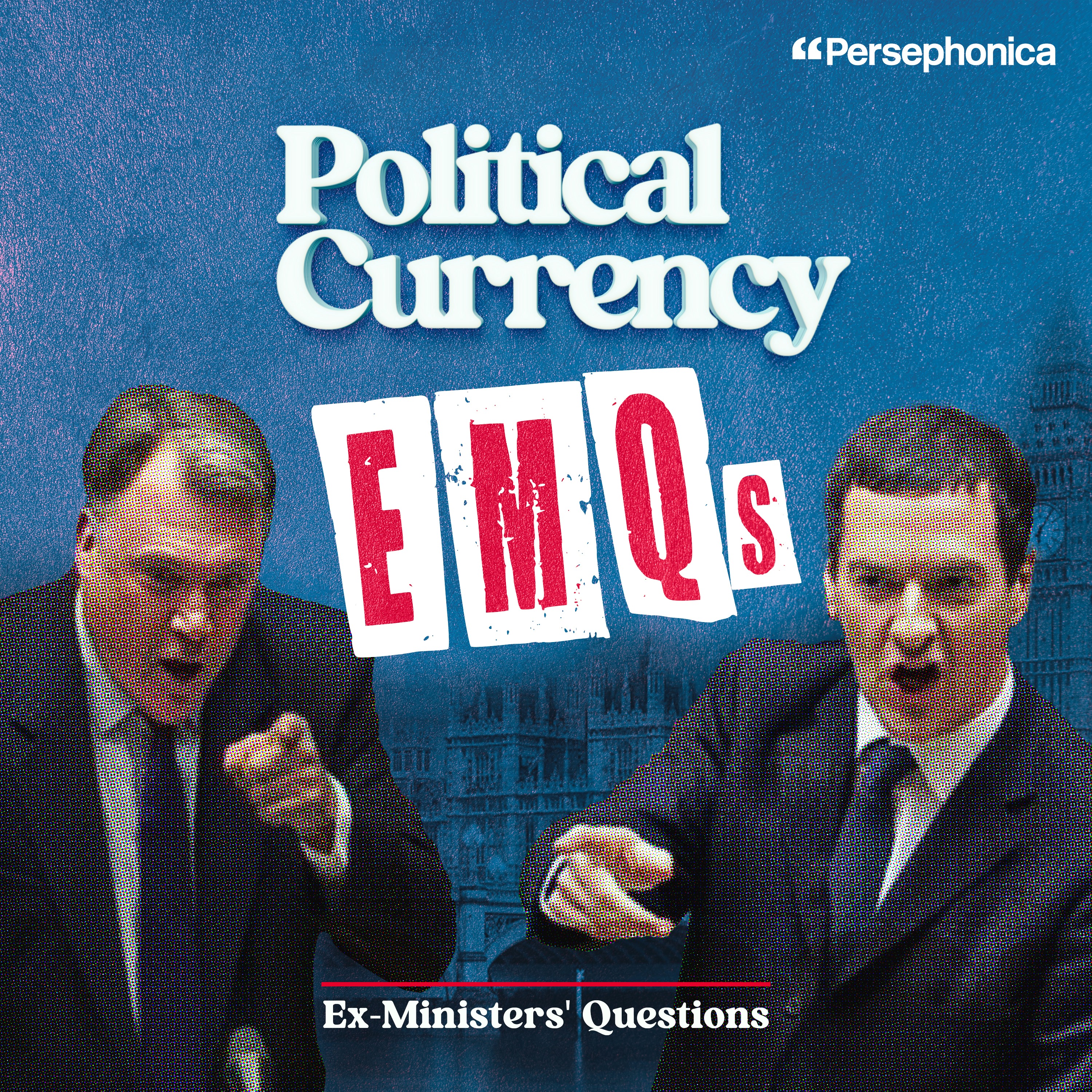
- EMQs: Was HS2 a complete waste of money?
In short
A listener Q&A episode on UK politics, focusing on whether HS2 was a “waste of money,” why UK infrastructure is so expensive, voting age limits, the role of the Liaison Committee, and memorable parliamentary heckles.
Guests
Ed and George (hosts of EMQs / “Ex-Ministers Questions”).
Guest backgrounds
both are former UK ministers and long-time MPs; they discuss their own experiences appearing before select committees and the Liaison Committee, and recount cabinet-level moments (e.g., George recalled being in the Royal Box; Ed/George recalled ministerial stammer and select committee appearances).
Key claims
HS2’s costs rose dramatically (from ~£35–40bn to over £100bn) and infrastructure in Britain is repeatedly overpriced versus countries like France/Norway; however, HS2 is defended as a sensible London–Birmingham project that reduces congestion and enables faster onward services.
Notable examples
comparison to cheaper/over budget projects abroad (e.g., Channel Tunnel controversy), road pricing/fuel duty replacement ideas, and heckles including Nick Clegg’s “no more than 30 women” story and Gwyneth Dunwoody’s “can’t even get his words out” heckle.
Written by AI. May contain mistakes.
Chapters
0:03
Political History Insights
Discussion about historic political figures and their impact on modern politics.
“it might be time to screen for colon cancer.”
3:00
Political History Insights
Discussion about historic political figures and their impact on modern politics.
“So it was the Attlee government, not the Wilson government and in fact Wilson, far from being in government, was put into the wilderness for his rebellion.”
10:30
Infrastructure Challenges in the UK
Exploration of the high costs and challenges associated with infrastructure development in the UK.
“I mean, I would pick something which I found kind of very frustrating in government and never really got to the bottom of.”
14:00
Discussing Road Pricing and HS2
The hosts discuss road pricing proposals and the implications of HS2.
17:59
Evaluating HS2 Funding and Its Impact
The conversation shifts to the effectiveness and funding of HS2 with listener questions.
“by the taxpayer as a result of them being displaced by the building of HS2.”
28:00
House Commons Dynamics
Explore how committee chairs in the House of Commons seek seriousness in discussions.
“And you know what the House Commons is like.”
30:08
Listener Reflection on Holidays
Discussion on the responsibilities of ministers during holidays highlighted by a listener's reflection.
“Now, one of our listeners, Barbara, she actually sent it.”
30:48
Duty of Cabinet Ministers
Understand the pressures cabinet ministers face regarding their duties during personal time.
“At the bottom of everyone's leaf slip, there was the phrase, subject to the contingencies of the service.”
32:08
Asking the Final Question
Engagement with a listener's question about a memorable moment in the House of Commons.
“Because you never know when something might just completely blow up in your area.”
33:40
Heckling and Humor in Parliament
Recollections of humorous heckles in Parliament and their impact on political figures.
“Absolutely love the podcast and always excited for the next podcast when it's available when I'm working.”
Show all 11 chapters
35:44
Significant Political Moments
Highlighting significant political moments and reactions to controversial statements in Parliament.
“Someone said, shouldn't you be in the office, George?”

Ask about this episode
Get the gist, explore an idea or ask about something said.
 Claude
On Political Currency, what are the key points of this episode?
Searching your listeningTranscript
Automatic transcript. May contain errors.
0:00Ed Balls: This message is brought to you by Cologuard. If you recorded songs off the radio for a mixtape, it might be time to screen for colon cancer. The Cologuard test is non-invasive, requires no special prep or time off, and you start screening right from your home. It's just three simple steps, set up, sample, and ship. If you're 45 or older and at average risk, ask your doctor about the Cologuard test, available by prescription only. Learn more or request a prescription at colaguard.com slash podcast. In a world where AI is changing every role in every industry, knowing who actually has deep expertise matters more than ever.
0:37Ed Balls: Upwork connects you with the highly skilled freelance professionals with proven track records so you can hire with confidence. Upwork gives your business fast access to highly skilled specialists with deep expertise so you can fill critical skill gaps, launch projects faster, and scale support up or down without committing to full-time headcount. With Business Plus, you can access the top 1 % of talent on Upwork. AI-powered shortlisting delivers a curated shortlist of top freelancers matched to your goals in under six hours. No endless searching required. Thousands of growing businesses already trust Upwork to hire highly skilled freelance professionals for everything from one-off projects to ongoing support.
1:15Ed Balls: It's free to sign up and posting a job is easy. Visit Upwork.com right now and post your job for free. That is Upwork.com to connect with top talent ready to help your business grow. That's U-P-W-O-R-K.com. Upwork.com. Hi, this is Kim and Penn Holderness from the Laugh Lines podcast. This episode is sponsored by Ollie, your wellness partner for back to school and beyond. Back to school season is here. Packed backpacks, packed lunches and packed schedules are officially back. Ollie Kids Sleep helps little dreamers wind down with a gentle blend of melatonin, L-theanine, and botanicals for restful sleep.
1:53Translation, an easy way to put those school night negotiations to bed.
1:57Ed Balls: And for the grown-ups, Ollie's Sleep helps you fall asleep, stay asleep, and wake up feeling refreshed. Because as you know, the morning mayhem comes early. Visit ollie.com and stock up on back-to-school must-haves today. That's O-L-L-Y dot com. These statements have not been evaluated by the Food and Drug Administration. This product is not intended to diagnose, treat, cure or prevent any disease.
2:49Ed Balls: so hello and welcome to emq's ex-ministers questions um had a kind of great um set of questions sent to us uh this week so we're really looking forward to getting on and answering them yeah and also i um i've been picked up on a bit of my history um i'm gonna claim it was a slip of the tongue but i think it was i thought it was so sean has um got in touch and said that i was wrong to say that nye bevan resigned from harold wilson's government over prescription charges of course he is quite right that i got that wrong because harold it wasn't harold wilson's government it was clement atlee's government nye bevan resigned from clement atlee's government in 1951 but of course harold wilson resigned with nye bevan um and arguably sort of set himself up to become subsequently the labor prime minister but he had to spend years in the wilderness as a result of this resignation.
3:44So it was the Attlee government, not the Wilson government and in fact Wilson, far from being in government, was put into the wilderness for his rebellion.
3:54Ed Balls: Totally right. And I think it was a slip of the tongue. It wasn't getting the history wrong. Are you more a Bevan or a Bevin man? I think in the end, in my view, Bevan was actually the first truly new Labour figure. he was the figure who was he was he was both credible and radical he was a pragmatist with principle he set up the national health service but then backed the leadership over a sensible approach to nuclear uh weapons um he was um i mean bevan was a hard man of the right this is ernest bevan we should say the foreign secretary wasn't he but bevan i think bevan is a is a great reforming hero.
4:39Ed Balls: But, you know, Bevan was not a Benite. Bevan wanted power to implement kind of good Labour policies. And if you think of, I don't know, John Prescott or Gordon Brown, in some ways Keir Starmer and Angela Rayner, you know, as leaders, I think there's quite a lot of Bevan in them as well as some Bevan. So I don't really want to choose, but I think Bevan is a great hero. Isn't Ernie Bevan, doesn't he have that great quote when someone says that Herbert Morrison, who was Peter Mandelson's grandfather, I think, and deputy leader of the Labour Party, and someone says, Herbert Morrison is his own worst enemy.
5:24And Ernie Bevan says, not while I'm around, he isn't.
5:28Ed Balls: Very good. We should get on with questions, shouldn't we? Good biography of Bevin by Andrew Donis just a couple of years ago. Really worth reading. Our first question is from Liz. Hi, Ed and George. Love the podcast, listen every week and find the discussions fascinating. My question is, my sons were both too young to vote in the Brexit referendum, although they would have both voted Remain, as did the large majority in a mock Brexit election held in their Cornish secondary school. At the time, my eldest son suggested there should be an upper voting age limit. He said that people older than 70 should not be allowed to vote, as long-term generational issues such as Brexit will not ultimately affect them.
6:17Ed Balls: What do you both think of this idea? Thank you. So I think my answer to Liz is, first of all, there is no way that any government is going to ban over 17-year-olds from voting. So sorry about that to your eldest son. The reality is that people who are 70, 75, 80, they may not be thinking about the world 100 years ahead, but they're certainly worrying about the next five years. And in politics, the next five years is first and foremost what your manifesto is about. Also, I think older people, they don't just care about themselves. They'll care about their children and their grandchildren. So this idea that the young care about young people's issues and older people only care about older people's issues.
7:02Ed Balls: i think the third thing i would say is that in our politics one of the strengths of having a two-party system with first past the post where our parties become big coalitions is you can't become um sectional you can't simply be you know the regional party or the um the young people's party or the older person's party you can't win in our political system unless you find ways to unite and form a consensus between the interests of the young and the old. And that's one of the strengths of British politics. And so I'm afraid, Liz, nope, we're not going to be excluding older people from voting. No, we're not.
7:43Although I do wish on the Brexit referendum, we had included 16 and 17 year olds, as we had on the Scottish referendum. And as we said on the podcast last week, we very much welcome, and certainly I very much welcome, I think you do as well, that the vote's going to be given to 16 and 17-year-olds, and it would be foolish for the conservatives to oppose that. I don't think it would necessarily made the difference, but that Brexit referendum was close. So who knows? One thing you can't presume, though, is that younger people all have much more progressive opinions and older people have much more conservative opinions.
8:20I mean, we were talking on our main podcast about this, But anyone who's seen the Just Stop Oil activists when they've turned up in court, they're often pensioners, aren't they? Whereas, you know, it's often younger people on the right who get all worked up on kind of right wing conspiracies and, you know, get all caught up in the kind of manosphere. But I think, you know, Ed's right. We're not going to ban 70 year olds from voting or over 70 year olds voting. Although it is interesting that societies have introduced in the past age limits so that, for example, judges or bishops have to step down at a certain age.
8:59And I think there is a proposal, isn't there, in the House of Lords to introduce a cap on the age at which people can be in the House of Lords. So you may actually see it in our legislature rather than in our electorate.
9:14Ed Balls: And just to reinforce your point, I'm referred in the main podcast to that July Ipsos report on what are the big salient issues in British politics. And if you look at the issue of immigration, which has risen up the political agenda over the last couple of years, it is the biggest issue amongst 18 to 34 year olds and 35 to 54 year olds and 55 plus people as well. And it's true that more 55 plus people will say it's a big issue for them than for 18 to 34 year olds. But there is no 18 to 34 year old issue bigger than immigration. So the idea that younger and older people have very different views about what are priorities and issues doesn't always work out that way.
10:02Ed Balls: Thank you for that question, Liz. Our next question is from Grace. Hi, Ed and George. Grace here from London. Sir John Cunliffe has just wrapped up a huge review of the water industry and the government is on board to pay his ideas into action. So what should they get him to tackle next? Is there another area that's crying out for a deep dive like this? Maybe energy, transport, housing or something else? So here's a good challenge. What would you send the ultimate Whitehall fixer, John Cunliffe, in to sort out next? I mean, I would pick something which I found kind of very frustrating in government and never really got to the bottom of.
10:36and the then cabinet secretary jeremy hayward also tried to get to the bottom of but it's really said again and that is the cost of getting infrastructure built in the uk so we're told this week that the cost of the new nuclear power plant in somerset uh hinckley point that is under construction is going to end up costing three times as much as uh reactors or at least three also in places like France and Finland. And when it comes to HS2, for example, the cost of high speed lines in Britain are many times higher than the cost of high speed lines in France. So we're not comparing ourselves with China, where they do all these things much more cheaply.
11:26But why is it that these pretty advanced Western democracies seem to be able to get infrastructure built more cheaply than we can? Why is it that the planning permission for the Thames Lower Crossing that the government's urging on is going to cost several hundred million pounds? And in Norway, they managed to build a tunnel of the same length for that cost, not just the cost of getting the planning permission. Again, Norway, France, these are countries with strong environmental movements complicated messy democracies powerful courts so i would send cunliffe into this because it is clearly a big big problem for britain and it it just raises the bar on what we can do to improve the capital infrastructure of the country
12:14Ed Balls: interesting i mean they both have much lower population density outside of big urban areas which is um is a difference but um i agree with you john cunliffe could do good report on that I think he's done an excellent job on the water report within the constraints set for him. Although I don't think John Cunliffe would have been advocating water nationalisation anyway. He could have been asked to do the social care review. At the moment that's been done by Louise Casey, but he'd be a good candidate to do that. He could be brought in to do... He could join the queue. Yeah. Probably about 10 people have done social care reviews in the last 20 years.
12:48Ed Balls: He could be brought in to do the review of how to actually get a proper diagnosis and proper plan for growth in the UK. But in our main podcast last week, we allocated that job to John Kingman. So it's already gone. One thing I thought of, given our podcast last week, is a proper review of how Britain should regulate and contribute to the global debate about the regulation of crypto currencies, given your desire to back innovation and to be globally competitive. but also to have a stable financial system. And having been the deputy governor of the Bank of England with a big track record in international negotiations, the other thing I thought of was if I was the chancellor or the shadow chancellor at the moment, I'd be thinking about what am I going to do to break out of the crazy way in which we have pretended and not delivered on increases in fuel duty at a time when it is clear there's going to be a big move away from the consumption of taxed petrol and diesel in cars?
13:52Ed Balls: And is there going to be an alternative to taxing that kind of travel without losing all that revenue? Is road pricing technologically feasible now? Maybe to get Cunliffe to look at the successor to the fuel duty regime and how you might price the consumption of roads and travel, that might be um a good review to him for him to do but i'm sure he's certainly the quickest way to get labor ejected out of office well i know but sometimes people have to sacrifice themselves for the greater good you know that's not john cunless job i remember re-elected i remember the well yeah but it is the job of the person commissioning his reviews so i remember those treasury meetings on road user pricing um you know i'm in switzerland at the moment and i drove here and of course you pay tolls as you go through france and indeed in switzerland um in switzerland you pay a kind of annual charge for using the motorways but um i remember sitting those meetings and we did kind of make some noises towards it but i remember thinking this is this is like the poll tax on wheels it is a literally it is a day it is a dangerous game um is john kind of looking for a new review he's probably wanting a break but um after oh he loves it he loves he loves the fact we're talking about him after our ad break we'll be back with another question
15:22hi this is kim and pen holderness from the laugh lines podcast this episode is sponsored by ollie
15:27Ed Balls: your wellness partner for back to school and beyond back to school season is here packed backpacks pack lunches and packed schedules are officially back ollie kids sleep helps little dreamers wind down with a gentle blend of melatonin, L-theanine, and botanicals for restful sleep. Translation, an easy way to put those school night negotiations to bed. And for the grown-ups, Ollie's Sleep helps you fall asleep, stay asleep, and wake up feeling refreshed. Because as you know, the morning mayhem comes early. Visit ollie.com and stock up on back-to-school must-haves today. That's O-L-L-Y dot com. These statements have not been evaluated by the Food and Drug Administration, this product is not intended to diagnose, treat, cure, or prevent any disease.
16:15Ed Balls: Back to school is busy enough. The last thing you need is shopping that makes it harder. Whether you're moving into a dorm, your first apartment, or just getting organized for the semester, Wayfair makes it easy to get everything you need in one place. Furniture, bedding, storage, decor, study essentials, all at prices you'll love with fast shipping before move-in day. Get everything you need for back-to-school season. Shop Wayfair.com today.
17:05Ed Balls: socks. For another pro, you. Go to bombas.com slash audio and use code audio for 20 % off your first purchase. That's bombas.com and use code audio.
17:18Ed Balls: So welcome back. Our next question is from Ashley, and this has been voiced by one of our producers. Hello, Ed and George. Love the podcast. Didn't realise politicians had a sense of humour with all the bickering and rowdy House of Commons. Has the money used on HS2 been wasted? It could have been used to help and improve the NHS and military upgrades and infrastructure. Keep up the good work on the Best Politics Pod going. So HS2 has all been wasted. Not wasted, I have to say, if you are a member of the rugby club in Warwickshire, the old Sultanians who have had a whole new clubhouse on new pitches, all paid for by the taxpayer as a result of them being displaced by the building of HS2.
18:03Ed Balls: So there are some people who had some big bonuses from HS2, not to mention all of the engineers and business people who've been paid huge amounts of money by the taxpayer to not build it. And the bats, they've had a hundred million pound bat tunnel built for them, courtesy of English nature. Well, look, I think what's worth remembering is HS2 is going ahead from London to Birmingham. That's right. There'll be a high speed line between two of Britain's biggest cities, which... And I think the old Sultanians may have been on that part of the lake. So they weren't moved for no purpose at all. Well, almost every other European country has high-speed rail links between its main cities.
18:45And, of course, the trains that then go on to Manchester and the northwest will be able to continue, and indeed trains up to Yorkshire and up the east coast, they will be able to run more quickly on the Birmingham to London bit. So general journey times will be reduced and the government are actually building the line, I think, out to Crewe on the northwest side. So you will have a much faster rail network and you also ease a lot of congestion. Anyone who travels on the West Coast main line will know it's often packed. And that's now, not in 15, 20 years time, where if you didn't take this action, it would be impossible.
19:24So I remain, you know, maybe I'm the last person left in the country supporting HS2, but I think it was a sensible project. i think it begs this question of why uh these infrastructure projects are so expensive to build in britain and we did commission a very specific study into why the the new toulouse leg of the hgv the french high-speed dream was so much cheaper than the high-speed rail we were building even on the original estimates um but no it's i think it'll be one of those things it is I came through the Channel Tunnel, of course, on my driving in Switzerland. And I think people forget how controversial the Channel Tunnel was, how it was vastly over budget, how all the local MPs objected, how the company that originally financed it because the Thatcher government wanted a private company involved went bust.
20:15And yet today, you would think it would be madness not to have the Channel Tunnel and all the freight and the passengers who go through it. and indeed they're expanding the routes across europe aren't they to places like germany and
20:26Ed Balls: like i'm afraid that we needed your review of how to manage the cost of these projects done before we actually ended up spending the money i think at the point a shadow chancellor when i said there is no blank check for hs2 at the time the total cost projection was about 35 to 40 billion and by the time they um abolished it with it less than half built it was already well over 100 billion so the cost just went up and up but that is true of a lot of these very big infrastructure projects in the uk including things like the nuclear power stations and and the new nuclear submarines um to the point but you don't think however much you spend no it's still not wasted no there's a certain point where you have to say well hang on a sec what's going on yeah but it's interesting with the original hs2 delivery mechanism we were trying to copy the delivery mechanism of the Olympic Games, which was heralded as a huge success and was delivered on time and on budget.
21:23I mean, it had to be on time because it was an opening ceremony. Maybe you need something like that. You need a kind of opening ceremony to make sure these things actually get built. Anyway, very good question. Thank you very much. Our next question is from Fraser. Hi, I'm George. Fraser here. My question to you both is about the liaison committee with the Prime Minister, which happened on Monday this week. How important are these meetings for the Prime Minister, and how does the PM and his team go about preparing for such meetings? To me, this committee is one of the most informative opportunities to understand what the government is doing across a range of topics, with much more detailed scrutiny from the chairs of the different select committees compared to the questions and answers we get in weekly PMQs.
22:05Maybe an additional question, can you think of any Prime Ministers that were particularly good at these liaison committee meetings.
22:11Ed Balls: Thanks. So good question Fraser. I think I'm right in saying that neither George or I have ever appeared before the liaison committee even though we've appeared before very many select committees in our time. The liaison committee is different. It was actually first set up in 1980 as a reform in the House of Commons when they were kind of revamping and increasing the reach of committees and it was a coordinating committee to look across house business where you had the chairs of individual committees coming together to look across the piece but it didn't start to in its modern manifestation where the liaison committee the chairs of the committees take collectively hearings from the prime minister of the day that didn't start until 2002 with um tony blair and has continued since and i think it does actually provide value, the liaison committee.
23:06Ed Balls: It's a different kind of committee than an individual select committee where you're really drilling down into the detail and where you'll have some party political gotcha, either from your own side or the opposition trying to catch you out on a particular detail. The liaison committee is much more strategic. It's about the big questions and the big sense of direction and i think that um if i think of my time tony blair gordon brown david cameron in different ways they were all very good at appearing before the liaison committee because they were good at that sort of um thoughtful um reflective answering of big strategic questions about kind of direction and i guess maybe less david cameron but blair and Brown had also grown up in that era of politics where you had the big Walden style long form interview on the television where you had to be able to do kind of more thoughtful reflective political interviews and the liaison committee like a big press conference is a little bit like that I think that the um the politician who clearly badly at it was Boris Johnson um I remember in particular um yvette um when she was chair the home affairs select committee kind of catching him out very many times in that committee and the reason is if you're going to do thoughtful reflective long form style answers to big thoughtful um questions what you can't do is not know your subject and not know your facts and if you get caught out because you don't actually know what you're talking about you get into quite big trouble and i think that was the to answer Fraser's question.
24:50Ed Balls: And the ones who are bad at it are the ones who are on top of the detail and can't talk strategically. Whereas Blair, Brown, Cameron, in very different ways, different styles, were all good at handling the liaison committee. Yeah, but I guess to the question, I'm not sure any of it made much difference. Both Boris's, you know, being ill-prepared, not being able to kind of answer the detail, nor Blair and Brown and Cameron all handling it in their stride. And I think the liaison committee is, I think when it was sort of not in its original creation, I didn't know that back in 1980. I guess that's why it's called the liaison committee.
25:32Never thought of it like that. But in its kind of questioning the prime minister format, since the Blair era, it kind of promised a lot. And I think when it started, everyone thought, oh, this is going to be the new Star Chamber. But it hasn't really turned into that. And I think the individual select committees, the Home Affairs Select Committee, the Foreign Affairs, the Treasury Select Committee, have still kind of been the tougher forer. And I think it's partly because the Liaison Committee is a sort of set of very strong-willed individuals who don't much coordinate, probably, in the way they ask their questions.
26:10Ed Balls: And they don't get that much time, do they? Because they're all competing to have their moment, which means that nobody quite gets a big moment. Yeah, because you see, I remember when I used to appear before the Treasury Select Committee, you know, the Labour MPs on it would all or pretty much all coordinate. And I had people like Rachel Reeves and Wes Streeting as new MPs on that committee. And so it was tough and they would kind of they could kind of come one after another. Actually, I remember also with Gordon Brown used to get wound up by David Ruffley and Michael Fallon, who were the kind of two conservative members of the Treasury Select Committee doing a great job as well.
26:47There's a kind of more coordinated attack from the opposition, whereas the Leiazio Committee is like turning now from, you know, foreign affairs to welfare reform. Prime Minister sees a huge sigh of relief because now, you know, OK, changing topic, that's fine. But it's not a bad thing. I just, I'm not sure it's turned out to be quite the kind of star billing that people thought it might have.
27:11Ed Balls: And to answer your question, Fraser, if you're a cabinet minister, you'd spend a lot more time preparing to appear before your departmental select committee than if you're the prime minister preparing to appear before the liaison committee. Because you probably think it's a bit like PMQs, but a bit easier, would be my guess. my advice to any minister appearing for a select committee i'm not this isn't advice i particularly took myself but you know do you remember tony blair's first appearance before the ladies of the very first time he met in this format and he didn't turn up with any people sitting behind him he just turned up by himself as the prime minister and he didn't have all those people passing him notes and i did actually i think when i did various select committees i tried to keep it to an absolute minimum and certainly not have anyone next to me directly kind of passing notes anyway It was just like cool as a cucumber.
27:59I don't need some big team to deal with you guys.
28:02Ed Balls: And you know what the House Commons is like. These liaison committee chairs, they all want it to be taken seriously. So they want a few notes passed and all that kind of stuff. We'll take a break and then we've got another question.
28:20Ed Balls: Think about how you describe your ideal car to a friend. Good on gas, highly reliable, nothing over 20 grand. Now describe it to CarGurus the same way. With Guru, you search in your own words and get real listings that match. No endless filters, just the car that fits your life. It's no wonder CarGurus is the number one most visited car shopping site, according to SimilarWeb's estimated traffic data. Buy or sell your next car today with CarGurus at CarGurus.com. Go to CarGurus.com to make sure your big deal is the best deal. That's C-A-R-G-U-R-U-S.com. CarGurus.com. This message is brought to you by today's sponsor, Walden University.
29:00Set a course for change. Now is the time to make a real change in your life, career, and community. At Walden University, we give you the support and flexibility to get the W. Walden's online programs are designed for working professionals like you. You'll gain hands-on skills to take on real-world challenges and succeed. Your future is waiting, and Walden is here to help you achieve it. Take the first step to make your impact. Visit waldenu.edu. Walden University. Set a course for change. Certified to operate by Shev.
29:32Ed Balls: You're a pro at running your life, at committing to your workout, at showing up every day. At Bombas, we're pros too. Pros at making socks. Our sport assortment has specialized socks for whatever sport you're committed to. Running, hiking, golf, Pilates, and so much more. Made with sweat-wicking yarns, blister-fighting details, and targeted art support. Bombas Sport is pro-level socks from the pros of socks. For another pro, you. Go to bombas.com slash audio and use code audio for 20 % off your first purchase. That's bombas.com and use code audio.
30:08Ed Balls: Welcome, Mac. Now, one of our listeners, Barbara, she actually sent it. It's less of a question. This is more of just a follow-up reflection on something we talked about last week. If you remember, one of our gold subscribers asked about whether ministers should be expected to come back from holiday. if there was a problem they had to deal with in their department, or whether they should be able to trust their teams to handle it. And we were saying that it is routine or important, fine. But if it's a crisis, then you have to come back. And Barbara got in touch with us to say this. Hello, Ed and George.
30:40Ed Balls: Thank you for a fascinating podcast. In response to Hayley's holiday question, I thought you'd like to know that I worked in an NHS hospital in the mid-70s to 80s. At the bottom of everyone's leaf slip, there was the phrase, subject to the contingencies of the service. This clause was never invoked for me, but made me very nervous to book my two foreign holidays that I had in those 12 years. So it wasn't just for the great and the good. It went for everybody. Keep up the good work. Best wishes, Barbara. I just thought that was a really nice reflection, Barbara. Subject to the contingencies of the service.
31:22Ed Balls: Another way to say that is if you're a professional, there's times when your duty and your accountability means you've got to come back and sort the thing for which you are ultimately responsible. And that's what we were saying when we were talking on the podcast last week. I was thinking about this. It's not just holidays, is it? If you are a cabinet minister and you are going out for dinner or to, I don't know, go to a concert or you're going to a football match or if it's simply even going to church on a Sunday morning, you always know that at any point there might be a phone call or a message or a tap on the shoulder to say there's a problem.
32:03Ed Balls: I don't think if you're a cabinet minister you ever feel that you are truly off duty. I think that's right? Yeah, I think that's right. Because you never know when something might just completely blow up in your area. um but there's a big difference between something that blows up that's you know not your not directly your fault and it's just a big issue you have to deal with i remember i being i think i was out at the theater when i was told by the kind of police protection that there had been that attack in the on the batter clan in paris and i was and and sort of various attacks on restaurants you know it's part of sort of people um spraying bullets into restaurants and there was a kind of emergency discussion in the british government about whether something like that might happen in london um and i was sort of recalled from the theater but um that's that's the kind of job of the cabinet minister being on top of it it's very different and it's quite exciting when you're doing those jobs you're having to deal with these big issues and complex issues it's very different from when it's a kind of scandal that's starting to engulf you and is becoming all-consuming.
33:13And that's a very different, and you're having to kind of come back from holiday because you're basically messing it up or, you know, having to not be, you can't go out and go to the theatre or go to restaurants because people could be saying like, what on earth is he doing that when he's got this problem to solve? What about, let's have our final question, which is from Ash. This question has been voiced by our producer. Hey, Ed and George. Absolutely love the podcast and always excited for the next podcast when it's available when I'm working. I'm a landscape gardener to your previous episode where you were asking people where
33:50Ed Balls: they listen to the podcast. My question is about when Jeremy Corbyn was speaking in the House of Commons, referring to his meeting with heads of government and leaders of European socialist parties. He told a story and he said, and one said to me, which was quite brilliantly replied to by someone from the Conservative Party saying, who are you? Last week, like him, I was in Brussels meeting with heads of government and leaders of European socialist parties, one of whom said to me.
34:26No, no. I would love to know who that MP was.
34:33Ed Balls: And am I correct in thinking, George, you were on the front benches when that was said? Are there any other famous heckles you remember or responses that were so perfectly timed? Well, I certainly remember the Corbyn, the intervention on Corbyn, and it was brilliant. It was one of those, you know, House Commons, there's moments of silence and then someone says something and it just sort of catches the moment. It's beautifully timed. It has to be short usually. And in the case of the Jeremy Corbyn intervention, flattened him. The only one I can remember against me that was similar was not actually in the House of Commons, but in Wimbledon where I was invited as chancellor to go to the Royal Box for one of the games, one of the days.
35:18And I took my dad along. It was like a plus one. It was my father's birthday. And so I was sitting there in the Royal Box I think it was like the men's quarterfinals. And there's a kind of, and I was in the front row of the Royal Box. Now that's, or that, by the way, the seating's done by the Royal Box people. Not by, I didn't like hog the front row. And in one of those sort of pauses where they could say, come on Federer, come on Nadal, that kind of thing. Someone said, shouldn't you be in the office, George? Because it was like mid-afternoon. and the whole place burst into laughter i don't know how many people there are at central court like maybe 20 000 people or something and uh they all laughed and i had to just sit there you know i i should have probably just laughed with it but i i was like you know took myself too seriously then and uh and then i of course had this sort of dilemma do i do i sort of get up and go not not immediately but at some point or do i because i was planning on spending the whole afternoon there with my dad you know enjoying the tennis so that that was the that was the best
36:25Ed Balls: heckle ever delivered against me the one i remember is actually a nick clegg story do you remember when he um i think he was by this point leader of the liberal democrats before the 2010 election and um he decided rather strangely to do an interview with piers morgan i know where you're going with in which he chose to share rather more details of his life than was sensible and that's right, he tells Piers Morgan that he had slept with no more than 30 women I don't know why I'm getting involved in this but Piers Morgan he's trying to appear like bloke-ish for GQ magazine and he's trying to appear not a kind of weedy lib dem leader and uh pierce morgan says you know rather unexpectedly in the interview so you know um how many women have you slept with and he goes well i'm not gonna answer that he goes what just one and he goes no no you know a bit more than that like what two three five eight then and he goes well you know and then he got 20 30 and then nick i think makes the mistake not of saying yes but just sort of winking or sort of nodding at morgan at that point i mean i agree it's a disaster but you know not not a route you should go down but i don't think it was sort of immediately volunteered by him in the way that you're suggesting i'm sure it wasn't i'm sure it wasn't and this is all all totally unfair um but then you know kind of days after he's in the house of commons at the dispatch box and he's you know in a sort of hushed and very serious voice this had lots of publicity there's no more than 30 women hushed and serious voice he kind of makes a reference to the fact that you know last Friday he'd had you know an important meeting in his constituency office at his surgery with a young single parent woman who'd come to see him to ask for advice and at that point one of the Labour backbenchers just yelled out number 31 and and and it totally brought the house down and of course you know it's completely inappropriate and a terrible story and it would never happen now and it's not something you and i would ever have done but it was you know um nick clegg had brought this upon himself and having done no more than 30 and he's having this important meeting with a young single woman and somebody do you remember i think i was there for that that's very funny good question but it was what i mean it totally i mean it's one of those moments where the house starts laughing and it doesn't stop for quite a long time if you're on your feet and it's directed at you it's really hard to know what to do it's a um you just have to sort of you just have to kind of in the end roll with it i remember there wasn't sort of funny like that but calling this whole opposition day debate when i was shadow chancellor against gordon brown who was chancellor about his pension raid and it was all based on something frank field had kind of said there was a you know labor mp at the time ex pensions minister and it was sort of devastating for gordon brown so we called this opposition debate and i opened it and i was only about 33 34 at the time and uh frankfiel got up within about two send two or three minutes of me doing my whole speech based around what he had said and he just said well the shadow chancellor is just getting this completely wrong this is not at all what i meant or said that was the complete collapse of my entire opposition day debate and it was a yeah a fiasco really the worst heckle which happened to me i say the worst i'm going to say it's the worst um in my very first questions as a cabinet minister children's schools and families questions i got up to speak i'd never done it as a cabinet minister before and i had to read out the first question had a written answer you read out the answer and then you then do the supplementary and i just really stammered and halted on trying to read out these words and Gwyneth Dunwoody, the former Labour MP for Crew and Namwich, she said incredibly loudly, he's supposed to be the Secretary of State and he can't even get his words out.
40:37Ed Balls: And it hung in the chamber. And I sat down and afterwards I went back to the department and said, you know, what is this thing? And actually, three days later, they told me it's an interiorised stammer, totally life transforming. So, you know, in a way, thank you, Gwyneth Dunwoody, but it was a terrible moment for me. In a way, thank you. It was a terrible, upsetting, very stark moment for me. And so there we are. That is it for this episode of EMQs. Please keep sending in your voice notes and your emails via questions at bluebookcurrency.co.uk. Do make sure you review our show as the way these algorithms work, it means that other people can find us.
41:16Ed Balls: And give us a good review if you can. But any review is better than no review. Is that true? probably is true on the algorithm i don't know it might be but you know but we know from these heckles we're we're both quite vulnerable yeah we're both quite sensitive but play safe and give us a five-star review exactly and we'll be back next week with another episode yes see you then
41:43thanks for listening to political currency this has been a persifonica production
41:56Ed Balls: Hi, this is Monica Reinagle of Nutrition Diva. Today's show is sponsored by Nature Raised Farms. Grocery shopping can be a little overwhelming, especially if you're reading labels. And in my opinion, chicken shouldn't be complicated, which is why I appreciate Nature Raised Farms. It's chicken that's just chicken, and their lightly breaded chicken nuggets are free from gluten, dairy, and soy. Look for nature-raised farms on your next grocery trip and feel more confident about your choices. Your team just added its 67th AI tool and also your 67th security blind spot. The good news? The Vanta agent works like a GRC engineer in the background, finding every app your team uses, scoring the risk, and drafting fixes for you.
42:41Ed Balls: Vanta is the platform used by over 16 ,000 fast-moving companies like Ramp, Cursor, and Harvey, who are shaping the future with AI and staying ahead of AI risk. Get started at Vanta.com. This message is brought to you by Cologuard. If you recorded songs off the radio for a mixtape, it might be time to screen for colon cancer. The Cologuard test is non-invasive, requires no special prep or time off, and you start screening right from your home. It's just three simple steps, set up, sample, and ship. If you're 45 or older and at average risk, ask your doctor about the Cologuard test, available by prescription only.
43:18Ed Balls: Learn more or request a prescription at colaguard.com slash podcast.
From the publisher
The UK’s high speed railway has been plagued with cost blowouts, delays and scale-backs - so Ed Balls and George Osborne consider: has it all just been a big waste of money? Couldn’t those funds have been put to better use? Perhaps for the NHS, for example?
The pair also consider the concept of age limits on voting. We’ve got a minimum age - recently lowered by Labour to 16 years old - so why not a maximum too? A listener asks: was it fair for those over 70 to have a say in the Brexit referendum, for example, while many people who were set to inherit a departure from Europe were at the time too young to make their voice heard?
Plus - heckling moments of brutality and brilliance. A listener recalls a well-timed response to Jeremy Corbyn in the House of Commons - and asks Ed and George to reflect on memorable moments of perfect comedic timing at their own, or other politicians’ expense.
To get episodes early and ad-free, join Political Currency Gold or the Kitchen Cabinet:
👉 patreon.com/politicalcurrency
👉 Apple Podcasts
Please note: Kitchen Cabinet is only available via Patreon.
Credits:
Producer: Miriam Hall
Senior Producer: Silvia Maresca
Video Editors: Danny Pape & Maha Albadrawi
Political Currency is a Persephonica Production and is part of the Acast Creator Network.
Hosted on Acast. See acast.com/privacy for more information.
More from Political Currency
All episodes

We use cookies.They keep VO running smoothly and help us improve it. Privacy policy