
 Ask ChatGPT


- Podcasts
- Political Currency
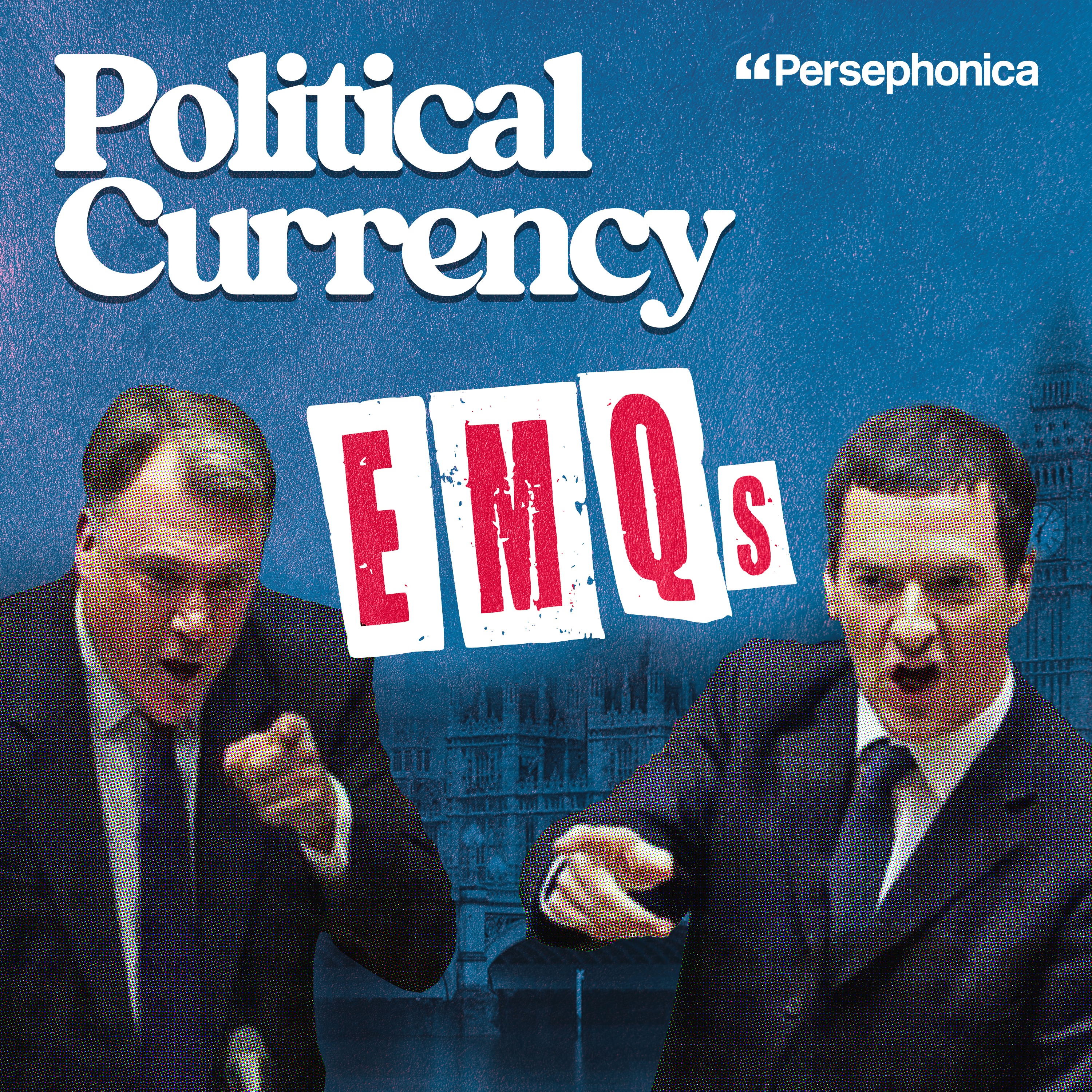
- EMQs: What do the public think of Ed and George?
In short
Ed Balls and George Osborne answer listener questions about: (1) public views of ex-PMs, (2) UK vs US school preparedness for attacks, (3) whether a multilateral “defence, security and resilience bank” could boost defence spending, and (4) whether PMQs questions are pre-warned.
Guests
Tamara Finkelstein (former Defra permanent secretary; Institute for Government board member; UK Jewish community/synagogue chair; describes Heaton Park Synagogue security and drills). Alex Baker (Labour MP for Aldershot; campaigns on defence industry; “Home of the British Army”). James (listener; asks about Kemi Badenoch giving Keir Starmer advance sight of PMQs). Cameron (More in Common polling staff; shares survey results).
Key claims
Jewish schools already prepare for attacks; “gun violence” drills differ from UK norms; a DSR bank may not solve procurement/order and fiscal-rule constraints; PMQs usually don’t get forewarning except conventions; Gordon Brown and John Major are most “worth listening to,” Liz Truss least, with Sunak/Cameron/May/Boris/Blair mixed. Examples: Heaton Park Synagogue evacuation; ambulances attack; Kemi Badenoch’s pre-sight tactic; Jerry.ai car-insurance quotes; Warby Parker frame shopping.
Written by AI. May contain mistakes.
Chapters
2:00
Lunch Plans and Restaurant Recommendations
Ed and George discuss a recent dining experience and restaurant recommendations.
“Welcome to EMQs from Political Currency.”
4:32
Tamara's Perspective on School Safety
Tamara shares her insights on safety drills in Jewish schools versus UK schools.
“I sit with her on the board of the Institute for Government.”
7:04
Rising Anti-Semitism and Community Safety
Ed and George discuss the current climate of fear in the Jewish community and anti-Semitism.
“I mean, it is so worrying to me that you have, even online now, you don't just have anti-Semitism.”
10:15
Defense and Security Collaborative Ideas
Alex Baker discusses a proposed multilateral defense bank and its implications.
“for us to hear and listen to and reflect upon.”
14:03
Investment in Defense Ecosystem
Explore the current investment trends in defense and security, including venture capital's role and technological advancements.
“there's often a problem with creating kind of stable revenue streams and, you know, state banks can step in and provide the kind of long-term financing at lower rates and so on.”
18:32
PMQs Insights and Tactics
Delve into the tactics used during Prime Minister's Questions and the dynamics of political questioning.
“And how on earth does the PM know accurate answers to every question if asked on the spot?”
25:51
Polling Insights on Former Prime Ministers
Examine public opinions on former prime ministers and their perceived relevance today.
“So our final question today comes from Cameron, who works for the not-for-profit organisation More In Common, and they do polling and research.”
28:00
Public Perception of Politicians
Learn how public opinion varies among different politicians and their influence.
“It just kind of people know the prime ministers even more.”
28:35
Analyzing Poll Results
Discover the nuances behind poll results and public sentiment towards former leaders.
“They also, by a couple of points, think you're...”
29:23
Comparative Analysis of Leaders
Explore the contrasts between recent UK Prime Ministers and their public reception.
“Tony Blair still, you know, loads of people really, really don't like him.”
Show all 11 chapters
30:28
Engaging with Public Questions
Learn how the hosts plan to interact with their audience and answer questions.
“We're only going to reveal it if it's good.”

Ask about this episode
Get the gist, explore an idea or ask about something said.
 Claude
On Political Currency, what are the key points of this episode?
Searching your listeningTranscript
Automatic transcript. May contain errors.
0:00My wife won't stop talking about Jerry. Jerry. Says he saved us money on car insurance. Mine too. Found her a better rate and didn't waste her time. Who is this guy? Babe, Jerry checked again and found us an even better rate. Pulled 20 quotes from top insurers, showed them side by side, and helped me switch policies in the app. It's a car insurance app. Yep. Let's just... Never happened. Do yourself a favor. Visit jerry.ai slash acast. If your eyes are the windows to your soul and your glasses are the windows to your eyes, then it's pretty important to find your perfect frames. That's why at Warby Parker, we've made shopping for eyewear as easy and fun as can be.
0:44Peruse endless styles in our stores or use our app to virtually try on frames and get personalized recommendations. To find your next favorite pair of glasses, sunglasses, or contact lenses, or to locate your nearest Warby Parker store, head over to WarbyParker.com. That's WarbyParker.com. Here's a tip for you. There's a podcast out there with fans waiting to be your next customer. They tune in every week. They trust the host. And that host wants to talk about brands like yours in their own words to their audience. The problem is you just haven't been introduced yet. We're Acast, where that introduction happens.
1:20As the world's largest podcast marketplace, we let you browse shows, see who's listening, and book host-read sponsorships or run your own ads all from one platform. Transparent pricing, real-time data, complete control. Start advertising on podcasts by visiting acast.com slash advertise.
1:42George Osborne: The Chancellor of the Exchequer. Getting a lesson from the Shadow Chancellor on how to balance the books is like getting a lesson from Dracula on how to look after a bloodbath.
1:51Ed Balls: Ed Balls. A steady as she goes budget. What kind of ship does he think he's on, the Titanic? Hello Mary Celeste.
2:00George Osborne: Welcome to EMQs from Political Currency. With Ed Balls and George Osborne.
2:10Ed Balls: Hello and welcome to EMQs, Ex-Ministers Questions. We are remote, although George is in London rather than California or Tokyo or South Africa or Dubai, the Straits of Hormuz, Pakistan. Have you had a good week?
2:25George Osborne: Do you know, I have had a nice week and, you know, I was taken to lunch at somewhere I think you would love. And I'm proposing to take you out on a date, Ed. I'm going to take you to Simpsons in the Strand.
2:41Ed Balls: Oh, the new Simpsons.
2:42George Osborne: Yes. so i was taken there by a wonderful guy called ewan venters you might have come across now running the paul smith empire but used to run fortman the masons and simpsons in the strand has been um renovated it's the like it's a really old kind of classic restaurant isn't it um in london did you go there in the old days i did go once in the old days and was not that impressed i used to
3:09Ed Balls: go for breakfast they used to do an absolutely brilliant breakfast when i worked at the financial times i'd have to be at work until like midday go for breakfast there at 9 30 i remember going in once and seeing nicholas soames in there who ate a bigger breakfast than i've ever seen ever well
3:25George Osborne: anyway there's this brilliant legendary restaurateur which you know many people will have heard of called jeremy king who you know created the wolsey and all sorts of amazing restaurants in london anyway he's taken on this sort of beer moth of a restaurant called simpsons and renovate it there are two great restaurants in there and it was just the most brilliant meal and the whole thing had kind of real class to it the restaurant i was in which was called romano's which apparently is an old old restaurant used to be on the strand 100 years ago had all these things you know these are modern takes on like the scotch egg and a pork pie and i want to i don't want to put people off because they've also got lots of other sort of lighter things but they've got kind of classic British things and but done obviously really well and in a kind of light and tasty way and I was actually thinking while I was having lunch you know Ed Balls would love this place there you go are you coming on a date with me I'm not sure it'd be a date but I'll come for lunch
4:22Ed Balls: with you and it'd be very very nice look we should uh you know I can't wait but we should get on with it our first question today comes from Tamara Finkelstein former permanent secretary at uh Defra. I sit with her on the board of the Institute for Government. She got in touch, actually, following our discussion in last week's EMQs. We were talking about the way Britain prepares for worst case scenarios. And we were talking about the fact that in the US, it's routine for schools to prepare for, you know, a gun person coming onto the site and how the school would cope with that kind of lockdown.
5:00Ed Balls: And I would say that makes sense in America, wouldn't make sense in British schools. And that sparked Tamara to send us this. Hi, Ed and George. Tamara Finkelstein here, wearing my hat as an active member of the UK Jewish community. Last week on EMQs, you discussed resilience and the fact that US schools do drills for school shootings, but that doesn't happen in the UK. Having had three children at Jewish schools and having chaired a large Jewish synagogue community I can tell you that is sadly not the case. I remember the first evacuation that my then primary school-aged children took part in was at least 15 years ago, hiding under desks and learning what to do in case of attack.
5:46And the synagogue community, including a nursery and children's classes, similarly prepares. That sort of preparation at Heaton Park Synagogue was critical to saving lives. The community has good police support and values the allyship of our political leaders. Thank you both for your longstanding support for the community, which is needed now more than ever.
6:09Ed Balls: Tamar is so right. It's such an important point that for children in Jewish schools, it's a very, very different environment for the rest of kids across UK schools. It's so important that we remember what is going on in the Jewish community at the moment and the climate of fear, which currently exists. Just imagine what it is like for parents sending their kids off to school every day. The Community Security Trust, Jewish school leaders do such a vital job. But we actually had on our programme this week in Good Morning Britain, a rabbi saying that, I know, George, you'll have heard people say this from the community many times over the last year.
6:53Ed Balls: We don't want protection. We just want to feel safe. and we just want to be able to live in Britain as British Jews without thinking we have to play by different rules and have a different set of fear. I mean, it is so worrying to me that you have, even online now, you don't just have anti-Semitism. You have people saying, well, you know, these attacks, maybe this is the Israeli deep state putting up false flags. It's so shocking. Actually, Zach Polanski got into that talk on Twitter this week talking about how maybe it wasn't real fear, it was just fear in the minds of Jewish people. Shocking.
7:34George Osborne: Yeah, well, I think Palancey is going to be exposed on all sorts of fronts, rightly so on this, by the sounds of it. I mean, it's great to hear from Tamara. I know she sent us a question before and she's been a very fine public servant. And I think she is quite right to remind us. What we said is about gun violence, very sadly, does not apply. to the Jewish community. You have to be alert to it the whole time. We had that terrible attack that were on the ambulances a couple of weeks ago and so on. And I do think it's the case, you know, I mean, it's maybe not time or place to kind of completely unpack it.
8:10George Osborne: You know, there'll be many people who disagree with the sort of policy positions of the Netanyahu government on things like the war in Iran, which we discussed. But, you know, that has sort of blurred, I think the line, blurred the sort of space in some people's minds that seems to accept it's okay as a result that the Jewish community in Britain live in fear. And that is just absolutely outrageous and unacceptable and indeed anti-Semitic and racist. Therefore, you know, there are times in our history where other communities have felt ostracized or threatened. And quite rightly, kind of progressive politics has been outraged by that and said, no, we're not prepared to tolerate racism against black people or racism against Muslims and have called out when forces in our politics have in some ways fueled that.
9:04George Osborne: I remember Sajid Javid, my kind of friend and colleague in parliament, being pretty tough on Islamophobia a few years ago when he was a conservative MP. And I just think there's a sort of blind spot about the threat and the fear that Jewish people live under in the moment in Britain. And it's more than just being called names in the street. It's a very, very real threat and fear, as Tamara points out, of being attacked and killed. And we live in a country that absolutely, first and foremost, stands by the rule of law and the protection of life. And there should be more than zero tolerance. there should be an aggressive police and intelligence operation against those who are threatening the Jewish community.
9:49George Osborne: I actually thought it was a good thing right at the beginning of PMQs that Keir Starmer, and it was like he was under a lot of pressure at PMQs because the man lost an appointment, but he actually said right at the beginning of PMQs he pointed to his concern about rising anti-Semitic attacks in Britain. And so full credit to him for pointing at that.
10:09Ed Balls: And thank you to Tamara for her question and for her correction. That's very, very important for us to hear and listen to and reflect upon. Our next question is from a current member of Parliament. Hi, Ed and George. Alex Baker here. I'm the Labour MP for Oldshot. Your podcast is essential listening in our house. So thank you for all you do. I enjoyed your conversation about Mark Carney's first year in office. And my question to you is about an idea he is championing. Canada is leading the founding of a multilateral defence, security and resilience bank, something I have been campaigning for the UK to join for over a year.
10:45I believe it's the key way to get money moving to support our defence industry, something close to my heart as the MP for the Home of the British Army. It would give UK banks credit guarantees so they could lend much more freely to the many small and medium-sized businesses that prop up our defence industry. I'm interested particularly in what your experiences were working with multilateral banks in the Treasury. Do you agree that ideas like the DSR Bank could be part of the solution for greater defence spending? And what advice would you have for me and other MPs trying to convince the government to put Britain at the top table of this new World Bank for Defence?
11:26Ed Balls: So thank you, Alex, for that question. And look, as the older shot MP, it's quite right that you are championing the British defence industry. And I've got to say, George, I'm torn on this one because there's the economist in me and then the politics. There is a lot of scepticism, I know, in the Treasury and in the government about whether this idea, this idea for a defence, security and resilience bank, which Mark Carney has championed, really kind of adds up and makes sense economically. People talk about the parallel with the European Investment Bank. But of course, that was an institution which was backing projects which would then deliver a rate of return, economic flow of money, which could then be used to repay the loan.
12:15Ed Balls: That isn't the case in defence. You don't get an economic return in the same way. I know the IMF is rather sceptical that you get even value for money in wider economic terms. But if the constraint on companies was they couldn't get the finance, this idea can make sense. But the real constraint on private companies is are they getting the orders from governments? And the real constraint on governments isn't that they can't get the finance. It's whether or not getting the finance by borrowing contradicts their fiscal rules. Where does the money actually come from? And I'm not sure this proposal solves those problems.
12:52Ed Balls: On the other hand, for Britain at the moment, outside the European Union, at such a kind of dangerous time with NATO under pressure, surely we should be with key European allies, Mark Carney, the Canadians, working on ways in which we can deeper defence collaboration, procurement collaboration. I know that there's been some bumps along the way in our relationship with the French. But, you know, I would rather we were in this, shaping it and seeing whether or not we could make it work rather than standing outside it, which is, I fear, where we are at the moment. That's the tension I feel.
13:29George Osborne: Alex, great to hear from you. And congratulations on, I think Aldershot was one of those, it was a bit like Basildon for an earlier generation. is when we saw that Labour had taken all the shot, we knew it was going to be a landslide and a very bad night for the Tories. Yeah, I'm actually with you, Ed. We haven't talked about this in advance, but I think I almost exactly share your opinion. Why would a state provide funding? It's where there's a kind of market failure or some externality that's not being properly priced. So in infrastructure, you know, there's often a problem with creating kind of stable revenue streams and, you know, state banks can step in and provide the kind of long-term financing at lower rates and so on.
14:15George Osborne: I would say in the kind of defense ecosystem, there's a lot of venture money at the moment. You know, there's a huge boom in financing for startups in the defense and security space. It's one of the areas where the Silicon Valley venture capital firms have been most active. And of course, it's partly driven by a more dangerous world, but it's also driven by changing defense technology and the application of drones and AI and so on to the battlefield, which we've seen in Ukraine. So there's not a shortage of money. It's two things, isn't it? There's first of all, a real skepticism about defense procurement, that our military, our Department of Defense, Ministry of Defense here, but it's true of like every Western defence establishment, you know, is flexible enough, supple enough to kind of adapt to this new technology and sort of stop its, you know, 20-year plan to design the next aircraft carrier and actually get with the new technology.
15:14George Osborne: And so therefore, these companies, you know, which after all don't have many customers, it's not like other kind of tech companies which have, you know, a world of businesses, consumers, you know, it's only a few defence departments which will ever buy this stuff and will ever be allowed to buy it. So that's the big gap. I guess, you know, if you had a kind of multilateral bank or a treasury backed bank of some kind, it might give the seal of approval that says this company is likely to get procurement support and it has the sort of favour of the British state. So it might work in that sense of kind of sending a signal.
15:47George Osborne: And then I think what Carney is probably seeking to do, I haven't spoken to her about it directly. He's also sort of established non-US links onto French procurement because, you know, at the moment, all roads have led to Washington or the Pentagon or whatever. And so, you know, he's trying to prove out his Davos speech, isn't he? And this is a kind of big question for the UK because I think in recent years, we've moved away from kind of European collaborations that gave us things like the Eurofighter typhoon and moved towards things like the F-35 program. If we're moving away from the US again.
16:23George Osborne: That's quite a big deal.
16:24Ed Balls: Very good question, Alex. And look, you are sparking a debate for us and we're engaging with this. And we'd love to have somebody else come with an EMQs next week. Maybe we should discuss it on the main show at some point, because if we're missing the argument, then we'd love to hear it. Let's take a break and we're back with another question.
16:52Every idea starts with a problem. Warby Parker's was simple. Glasses are too expensive. So they set out to change that. By designing glasses in-house and selling directly to customers, they're able to offer prescription eyewear that's expertly crafted and unexpectedly affordable. Warby Parker glasses are made from premium materials like impact-resistant polycarbonate and custom acetate. And they start at just$95, including prescription lenses. Get glasses made from the good stuff. Stop by a Warby Parker store near you. My wife won't stop talking about Jerry. Jerry. Says he saved us money on car insurance.
17:28Mine too. Found her a better rate and didn't waste her time. Who is this guy? Babe. Jerry checked again and found us an even better rate. Pulled 20 quotes from top insurers. Showed them side by side. And helped me switch policies in the app. It's a car insurance app. Yep. Let's just... Never happened. Do yourself a favor. visit jerry.ai slash ACAST.
18:19attention buy it with a cast learn more by visiting a cast.com slash advertise
18:32Ed Balls: welcome back this next question is from james hi ed and george ed i saw you cycling very slowly through sunny north london on sunday so it prompted me to drop in a question on monday Kemi Bednock gave Keir Starmer advanced sight of her questions for him to answer. Does this happen at all PMQs? And how on earth does the PM know accurate answers to every question if asked on the spot? Are they simply across every possible topic in their government at any given time? Seems tough to do. I hope to listen to your answers when I'm running the London Marathon on Sunday. Wish me luck. Thank you, James.
19:10Ed Balls: Now, James, it was actually really interesting on Monday in Parliament that Kemi Badenoch chose not only to set out six questions in her response to Keir Starmer, but she gave those six questions about Peter Mandelson and the vetting and the row with Ollie Robbins to Keir Starmer in advance to try and pin him down to get him to answer them. But the answer to your question is that I would say that it never happens that way in Prime Minister's questions, where the leader of the opposition gives forewarning of the questions they're going to ask. Sometimes the Prime Minister might give forewarning to the leader of the opposition.
19:52Ed Balls: Let's say they're going to make a reference to the loss of soldiers' lives abroad serving our country, and he would tell the leader of the opposition and give them the names. There is a convention in the House of Commons. If you're going to personally question somebody's integrity, you should give them forewarning. But I don't think generally in PMQs it happens, although you could see if you want to pin down the prime minister, telling them, I'm going to ask this question could be quite powerful. There was a really good moment earlier in the week with Sophie Ridge giving Pat McFadden a hard time about whether he had asked Downing Street in advance of their interview about the supposed appointment of Matthew Doyle.
20:37Ed Balls: She was trying to stop Pat McFadden just saying, well, you know, I don't know the details of this. I'll come back to you. You can imagine a leader of the opposition doing that to a prime minister. But can you remember that happening?
20:49George Osborne: No, it's a very good question. You've missed actually the key thing that James was telling us there, is that you cycle extremely slowly through North London. And we should also wish it well in the marathon, which you've run. I have three times.
21:07Ed Balls: You think I cycle slowly. I was the slowest member of parliament ever to run the marathon. but the biggest fundraiser by far. I raised£160 ,000 for Whiz Kids and Action for Stamming Children, but my fastest time was 4.56. We had Sophie Raworth, the BBC News at 10 presenter on GMB this week. She's going for 3.20 this year, which is like, you know, superhuman if you ask me, unless you're sort of 21 and an Olympian. But I think I would cycle slowly to take in the views.
21:40George Osborne: Yeah, it was a sunny day as we're here. I think Mark Carney, didn't Mark Carney do a three-hour marathon as governor of the Bank of England? And I think Matthew Paris holds the record for an MP running the fastest marathon.
21:52Ed Balls: But not for fundraising.
21:54George Osborne: No, you made that point, don't worry. We all heard you. Younger people were called flexing, I think.
22:04Ed Balls: Right. George, answer the question. Yeah, yeah, yeah. Do you think that...
22:08George Osborne: You didn't give me prior notice of it. actually changed it yeah so listen it's a good question it's a tactic of course it's a tactic from kemi badenock to say i've given you advance warning so don't say you're coming back to me because i've told you um you wouldn't normally do it uh and it's quite a clever device um and i don't think we'll catch on he says because normally you want to kind of catch the prime minister out william haig um used to have this thing which is you need to get your first serve in it was like tennis, you know, the Prime Minister has lots of advantages, both in the statement and in PMQs.
22:42George Osborne: They have the last word for a start, and they have most supporters in the chamber. You know, you need to kind of catch them off guard. That's what he meant by getting the kind of first serving. But I think Kemi Bainard did very well on that statement on Monday. It's interesting, you know, actually, and you're right, by the way, the Prime Minister's do give advance warning if they're going to mention things at PMQs at the beginning to the leader of the opposition. I mean, government ministers are supposed to send their statements in advance to the opposition spokespeople. This is not for PMQs, but for general statements of kind that happened on Monday.
23:17George Osborne: I mean, that was kind of pretty widely abused. And I used to basically hardly ever send the shadow chancellor anything in advance. And shadow chancellors, no doubt yourself included, used to bitterly complain. And I would always say, this is what Gordon Brown used to send me when I was shadow chancellor. and I'm simply following his example.
23:38Ed Balls: I had very low expectations. It was all redacted when it arrived, but there we are.
23:43George Osborne: Yeah, yeah, it was basically Mr Speaker. You'd see that and then it would be all sort of pages and pages of blacked out things and then it'd be like, and I commend this statement to the house.
23:53Ed Balls: Anyway, interesting question, James, but we think it won't catch on. We'll be back after the break with one more question.
24:09If your eyes are the windows to your soul and your glasses are the windows to your eyes, then it's pretty important to find your perfect frames. That's why at Warby Parker, we've made shopping for eyewear as easy and fun as can be. Peruse endless styles in our stores or use our app to virtually try on frames and get personalized recommendations. To find your next favorite pair of glasses, sunglasses, or contact lenses, or to locate your nearest Warby Parker store, head over to warbyparker.com. That's warbyparker.com. We asked you here because we care. And your car insurance doesn't. They've raised your rate every year and you haven't even checked.
24:50I thought that was normal. A lot of people do. That's why there's Jerry. Jerry pulls up to 20 quotes from top insurers in minutes, shows them side by side, and lets you switch in the app. No jumping sites, no re-entering info, no spam calls. It helps you cancel your old policy and keep checking for better rates. We want better for you. Jerry does too. Don't settle. Visit jerry.ai slash ACAST. Quick question. When was the last time a display ad changed your mind? Now think about the last time a friend told you about something they loved. Different feeling, right? That's how podcast advertising works.
25:25A host who's built real trust with their audience talks about your brand in their own words, in their own voice. It doesn't interrupt the experience. It's part of it. With Acast, you can access the world's largest podcast marketplace. Choose the right shows, the right audiences, the right format. Then watch the data tell you it worked. You're not buying impressions. You're buying influence. Learn more by visiting acast.com slash advertise.
25:58Ed Balls: So our final question today comes from Cameron, who works for the not-for-profit organisation More In Common, and they do polling and research. And this is fabulous to have somebody polling on one of our previous EMQs. Let's take a listen. Hi Ed and George, I'm Cameron, big fan of the podcast and work for the pollsters More In Common. We were inspired by a conversation you had to ask the public which former prime ministers the government should be listening to. Gordon Brown and John Major come out on top as the only ex-PMs who more think they should be listened to than not. Rishi Sunak and David Cameron split opinion, but it leans negative, while majorities don't want to hear from May, Johnson or Blair.
26:38And a whopping 72 % say no to Liz Truss. For healthy competition, we added you both in. The public are very slightly more likely to say Ed is worth listening to than George, but you'll be glad to hear that you both beat Rory Stewart. What do you think? Are the public correct in their assessments, or are they undervaluing the advice and expertise
26:55Ed Balls: that can come from experience? So I think first thing to say, Cameron, is that the polling stands up the main point that we were making, which is that of past prime ministers, the two who have the strongest approval, definitely worth or probably worth listening to, are Gordon Brown and John Major. Those are the two who in their post-Prime Minister career have done the best at establishing their contributions to current debates. Bottom of the table is Liz Truss, miles behind. That is no surprise. I think it slightly shocks me at first sight, but now I understand it when I've looked at it. But you and I, I mean, I'm slightly above you, George.
27:37Ed Balls: There's no surprise. Hold on. We're not letting you get away with that.
27:41George Osborne: Hold on.
27:42Ed Balls: I am. But both of us are behind Rishi Sunak, David Cameron, Theresa May, Boris Johnson, Tony Blair. When you dig into it, the reason is this. If you've been prime minister, you get a much bigger recognition. And even if you've been chancellor or shadow chancellor, in my case, cabinet minister, the don't knows are greater. It just kind of people know the prime ministers even more. That gives them an advantage, although not in the case of Liz Truss. But both of us storm it against Rory Stewart. And my question to you is, George, where's Alistair Campbell? He's not even on the grid. He didn't even make the poll.
28:23George Osborne: It's a dodgy dossier. Can I just point out that whilst generally people think, I think by a couple of points that you are more worth listening to. Yes. They also, by a couple of points, think you're... There are more people who don't think you're listening to as well. So you have more detractors than me as well as more supporters.
28:47Ed Balls: That's partly because I have two more don't knows than you. No, you don't. No, I don't. No, you have more don't knows than me. And I'm reading that wrong. You have more don't knows than me. That's surprising, isn't it?
28:56George Osborne: Well, I didn't, you know, make a fool of myself. I'm strictly come dancing.
29:00Ed Balls: I thought you were more Marmite than me, but actually it turns out not.
29:03George Osborne: Yeah, well, I didn't do Gangnam Style on primetime, did I?
29:06Ed Balls: No, that's a good point.
29:07George Osborne: I'm not in light entertainment.
29:09Ed Balls: Do you have any serious points to make about this, Paul?
29:12George Osborne: Not really, except that I tell you what, it is worth noting, isn't it? That normally, you know, you'd say Gordon Brown and John Major, you know, it's been a while since they were in charge. I think some surprising things here. Tony Blair still, you know, loads of people really, really don't like him. and you would think you know given his period of you know office the elections he won he'd be higher up at the list of promises people think should be listened to i thought it was also you know it's fair to to be give credit to rishi sunak usually the recently ex-prime minister is at the bottom of these lists everyone goes well we don't want to hear from him or her again and it takes a while for them but to be fair to him he's like number three after gordon brown john major writing
29:55Ed Balls: a column in the sunday times on the today program this morning reflecting on big policy debates of our time. Rishi Sunak, Liz Truss, in so many ways, a contrast, a fortunes style.
30:10George Osborne: If Rishi Sunak had done the job before Liz Truss, he just reversed it. That would have been quite interesting.
30:15Ed Balls: I think we should encourage more of this. We would like people to poll issues we discuss. And then I'm not sure if they need to poll us, but they could poll issues, don't you think?
30:23George Osborne: I mean, they can poll us, but we only want to hear if it's good.
30:26Ed Balls: And more importantly, whether we hear it or not, We're only going to reveal it if it's good. And I thought these numbers were pretty good for us. Well, look, you know, who's our competition? Are we competing with John Major? Or are we competing with Roy Stewart? I mean, maybe we're not.
30:38George Osborne: I was just messaging him today, actually. I get on very well with Roy Stewart.
30:42Ed Balls: Did you message him to tell him he was behind us in the poll? Thank you for your question, Cameron. That's all we've got time for in this episode of EMQs.
30:48George Osborne: I think he would say the only poll that counts is the listeners. A bit like politicians, isn't it? George, quality over quantity. I certainly agree with that. right listen thank you anyway for all those questions if you've got other questions you've got questions we haven't answered or things that you know prompted by this session then send them
31:08Ed Balls: into questions at politicalcouncil.co.uk politics economics history anything quirky fun you name it you want to ask it we'll do our best to answer it and we'll be back on Thursday with our main show
31:20George Osborne: and we're going to see you then see you then
31:30George Osborne: Thanks for listening to Political Currency. This has been a Persephoneca production.
31:43Quick question. When was the last time a display ad changed your mind? Now think about the last time a friend told you about something they loved. Different feeling, right? That's how podcast advertising works. A host who's built real trust with their audience talks about your brand in their own words, in their own voice. It doesn't interrupt the experience. It's part of it. With Acast, you can access the world's largest podcast marketplace. Choose the right shows, the right audiences, the right format. Then watch the data tell you it worked. You're not buying impressions. You're buying influence.
32:16Learn more by visiting acast.com slash advertise.
From the publisher
Off the back of last week’s EMQs, Tamara Finkelstein sends in a correction to the idea that UK schools don’t prepare for attacks like those in the US. She highlights that Jewish schools have to prepare and feel threatened in this current environment. Ed Balls and George Osborne highlight the worrying trend of antisemitism in the UK and the need for public figures to actively combat it.
Aldershot MP Alex Baker then chimes in with a proposal to adopt a multilateral defence, security and resilience bank, much like Mark Carney is championing in Canada. This poses a challenge for the pair, who recognise the necessity of improving defensive relations with our allies but see the economic challenges
How do prime ministers prepare for PMQs? Is it usual for the opposition to send questions in advance, as Kemi Badenoch did last week? George explains the procedure and conventions in the chamber, and how the opposition aims to catch out PMs.
And finally, pollsters from More in Common reached out following the discussion of ex-PMs, on the main show, with some fascinating insight into who the public most wants to hear from. Ed and George are included for good measure, and even rival podcasters get a mention…
We love hearing from you, so please don’t forget to send all your EMQs to questions@politicalcurrency and make sure to include a voice note of your question or send a question to our social media handles:
👉 X
👉 TikTok
Thanks for listening. To get episodes early and ad- free join Political Currency Gold or our Kitchen Cabinet. If you want even more perks including our exclusive newsletter, join our Kitchen Cabinet today:
👉 patreon.com/politicalcurrency
Please note: Kitchen Cabinet is only available via Patreon.
Credits:
Research: Sam Burton
Production: Caillin McDaid & Nasreen Arain
Video Editor: Carla Mercer
Executive Producer: Ellie Clifford & Henrietta Harrison
Political Currency is a Persephonica Production and is part of the Acast Creator Network.
Hosted on Acast. See acast.com/privacy for more information.
More from Political Currency
All episodes

We use cookies.They keep VO running smoothly and help us improve it. Privacy policy