
 Ask ChatGPT


- Podcasts
- Political Currency
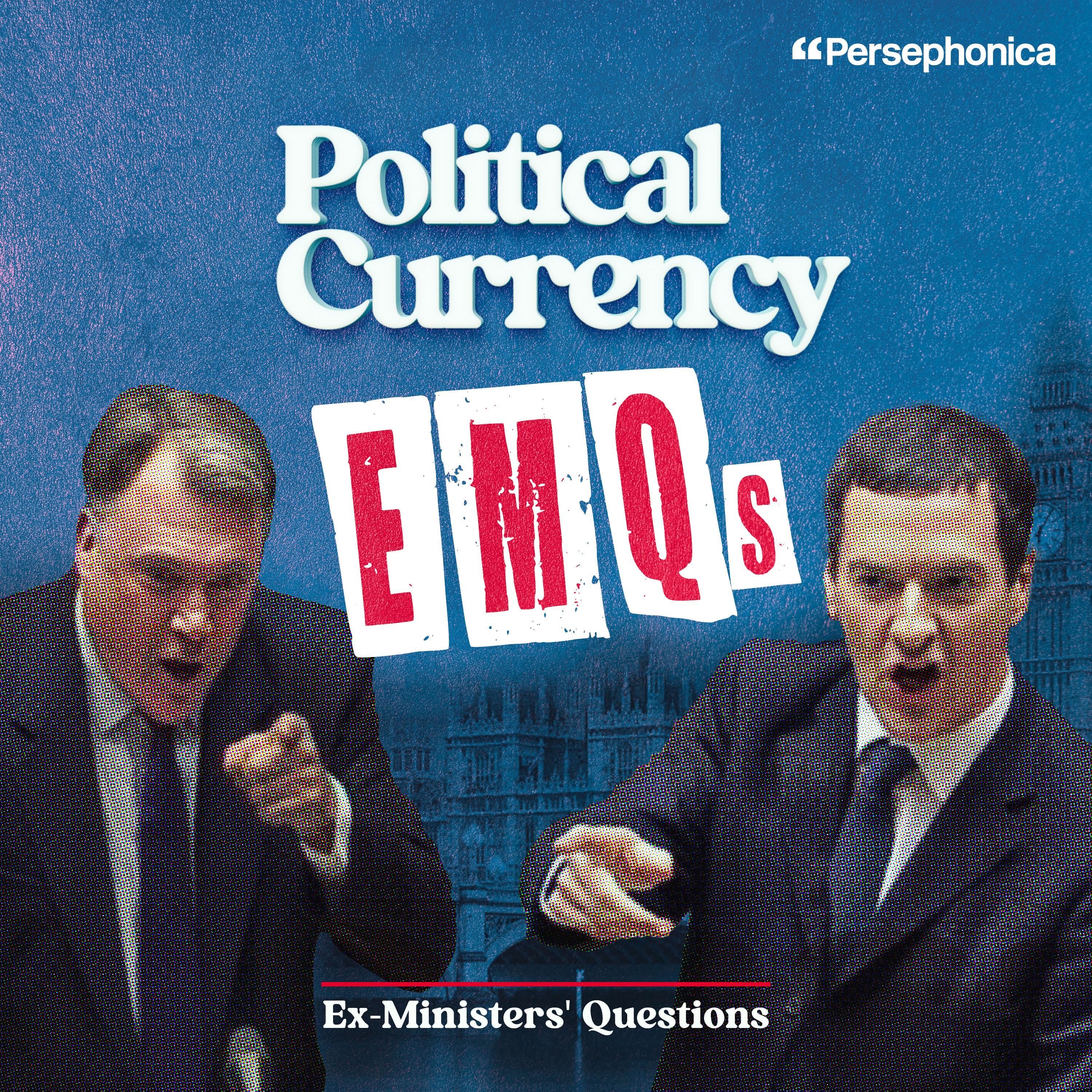
- EMQs: What does 'fairness' actually mean in politics?
In short
Hosts: Ed Balls and George Osborne
Description
A deep dive into political decisions affecting economics and the nation’s finances, exploring the relationships between market forces and political currents.
- Discussion on political rivalries and long-haul flight companions.
- Exploration of how a leader's image impacts government policies.
- Examining the meaning of 'fairness' in the political context.
- Introduction of Ed's role as a "Lifelong Learning Ambassador" and the challenges of adult skills in governance.
Written by AI. May contain mistakes.

Ask about this episode
Get the gist, explore an idea or ask about something said.
 Claude
On Political Currency, what are the key points of this episode?
Searching your listeningTranscript
Automatic transcript. May contain errors.
0:00The Chancellor of the Exchequer. Getting a lesson from the Shadow Chancellor on how to balance the books is like getting a lesson from Dracula on how to look after a bloodbath. Ed Balls. A steady-as-she-goes budget. What kind of ship does he think he's on, the Titanic? Bermere, Celeste. Welcome to EMQs from Political Currency with Ed Balls and George Osborne.
0:27welcome to emqs ex-ministers questions you know i was in one of your old haunts this week because i went to the almeida theater just off upper street in islington and i went to see a very good adaptation of the famous alan hollinghurst novel the line of beauty which is really a kind of commentary on Thatcher's Britain in the middle of the 1980s. I think it's set in like 1983. So it's set in the household of a Tory MP. It's set in Notting Hill. And it's about also the kind of gay subculture and to some degree underworld, because even though homosexuality is legal, people can't really talk about it, or it's much harder to talk about than it would be today.
1:10So maybe not the kind of gay subculture, but the Notting Hill and Tory MP bits struck a resonance with me. And there's a great scene, which I was wondering how they're going to do, in the book, the kind of hero of the book, who's sort of outsider. He's a bit like Charles Ryder in Brideshead. He's called Nick Guest, and he's come to stay with his friend who's the son of this Tory MP. Anyway, he ends up, this guy Nick Guest, ends up dancing with Margaret Thatcher at a party. And I was wondering how they can do that on stage without it looking absolutely ridiculous. And you basically only see Margaret Thatcher from behind.
1:44So she's got the sort of blue suit and the big boof hair. And then just as she's about to turn around, they kind of cut the lights and it's the intermission. Anyway, I really enjoyed it. It was really, really good. You were worried that you were going to be heckled? No, I think these days they just love me for this podcast. No. What have I done? I have people came up at the theatre to say I really love the podcast. But the reason I was in one of your old haunts was that just around the corner from the Almeida Theatre, of course, was the restaurant Granita, where three people sat down to determine the fate of the Labour Party and therefore the nation.
2:25People forget it was three. They think it was only two. There was one Tony Blair. There was one Gordon Brown. There was one Edward Balls. I know, and the rest is history. Yeah. But I think it's... Handed over the keys at number 10 to Tony Blair. What were you doing? I think it already happened. No longer a restaurant, though, is it? No. I'm not sure what it is. It did become a Mexican restaurant called Desperados because I remember using it as a joke as Shadow Chancellor. Anyway, it was good to be back in Islington. Maybe now again the epicentre of Labour's high command. The poor man's Notting Hill.
2:56Well, there's some truth in that. I thought you'd agree with that. We should get on with it. Our first question is from Jan. And her question has been voiced by one of our producers. This is Jan from North Yorkshire. I came across political currency by accident at the beginning of the year, and it's rapidly becoming my favourite podcast. I'm impressed by the depth and breadth of knowledge you both bring to the various topics, and by how you can disagree profoundly but amicably with humour and grace. This has come as a somewhat of a surprise because, to put it politely, I wasn't a fan of either of you in your former political lives.
3:28With this in mind, I'd like your views on how much in politics is the impact of the message influenced by a favourable or unfavourable opinion of the messenger? Well, I think Jan's a very good example of what I was just talking about, which is, thankfully, this podcast is changing people's views of us both. It's also true that when you're no longer at the heart of politics having to make these difficult decisions, frankly, it's easier for people to have a more benign view of you. I went out trick-or-treating last week with my little children. Most of the houses, there's, you know, they've got pumpkins outside, so you know they're going to kind of give sweets out and whatever.
4:05People are dressed as witches and mummies and ghouls and all this kind of thing. And then there was one house where the couple were dressed as Keir Starmer and Rachel Reeves wearing masks. And I did think like, oh, welcome to government, you know, that Rachel or Keir would have ever imagined 10 years ago that they would be, you know, feature on Halloween night. That is the nature of government. And you have to make difficult decisions and quite often unpopular decisions. And people obviously take against you. Jan, however, has got this very good question, which is to what degree is the messenger the key thing rather than the message?
4:43and certainly kind of i think classic political theory would be here that the messenger is so important because you can have things that people agree with policies that people agree with statements that people agree with but if they come out of the mouth of someone who the public doesn't like then they're just not heard and there's often therefore an attempt when you've got an unpopular leader and obviously for a party you can maybe ditch the leader but that's pretty hard to do so particularly the team around the leader is thinking, how can we kind of better get our message across? You can do two things, which is you can either directly say it, of which the best example I could think of was the 2005 Tory campaign, where the Tory party wasn't popular, Michael Howard wasn't particularly popular, although he was seen as a grown-up.
5:33And that message, are you thinking what we're thinking, which was Lyndon Cosby's campaign, was an attempt to say, you agree with our message, even if you don't particularly like us. I would always say in politics, you shouldn't let your leader, your candidate for prime minister, be the person who delivers the negative political message. I think they should always be the sort of sunshine person. And the direct attack on your political opponents should come from the mouths of people around the leader, not the leader themselves. It's interesting. I mean, often, Jan, these things go together. So So if you take Tony Blair in 1997, popular leader with a popular message about change, by the time you get to 2005, I mean, he kind of limped through the general election campaign.
6:16He was continuing to say the Iraq war was right and that he was right. But by that point, he was less popular and that message was unpopular at the same time. So you sort of see that evolution happening. If you take, I've said this before, 2010, the only thing more popular than Nick Clegg in British politics was the idea of a coalition. By the time we get to 2015, the only thing more unpopular than the idea of a coalition was Nick Clegg. So a big turnaround. But you could say that in 2010, David Cameron still had enough popularity with you to drive through an unpopular message. Because austerity wasn't welcome, but people thought, I'm going to go with that.
6:55Go back to John Major in 1992. even though there was a long recession and interest rates were high he was sufficiently popular and neil kinnock at the time not sufficiently popular for him to get through an election with a difficult message but actually you know to win a majority by the time you get to 1997 that's all unraveled for um john major hard to think of an example of an unpopular leader successfully delivering a message successfully. Whereas I think the other way around... Maybe I was thinking in America, in 1968, Richard Nixon, rather surprisingly, makes this great comeback because he'd been defeated by John F.
7:40Kennedy and then he'd lost, I think, the governor race in California, hadn't he? And he was seen as an unpopular person. But he wins with a kind of hard-nosed message because America's in a real mess by 1968. 1968, the Vietnam War, riots in the cities, and his kind of tough message, which is actually, he literally calls it the silent majority, which I think is a bit like the, are you thinking what we're thinking? You might not like me, but I'm speaking for the silent majority. Anyway, that's my, off the top of my head, that's an American example. And also at the time, television was becoming important politically.
8:13Kennedy was clearly winning on television, on the radio. Nixon had won that was years that was in 1960 I'm talking about 1968 when he actually wins the presidency anyway maybe was Margaret Thatcher talking about her earlier I mean by the end she's seen as pretty tough and uncompromising and but maybe that is also popular obviously some people were wildly in favour of her but there were lots of people who absolutely hated her but sort of respected the message didn't they that is an interesting example I mean she had definitely lost popularity but even then the Conservatives were still winning the argument against Labour?
8:47I think actually the word here is respect. It's once you lose respect as a leader. You may be unpopular, you may be saying unpopular things, but if people respect you and they think you're kind of delivering the necessary cod liver oil, that's one thing. It's when you've lost the respect as well that things are really difficult. Do you want to Jan's question? In politics, is the impact of the message influenced by a favourable or unfavourable opinion of the messenger? And the answer is yes. Yes, absolutely. Right, our next question is from Stephen Evans and he is the chief executive of the Learning and Work Institute.
9:22Hi Ed, hi George. I always enjoy listening to the podcast and wanted to ask you about lifelong learning. Ed, you were recently recognised as a lifelong learning ambassador at the Get the Nation Learning Awards, a campaign led by the Learning and Work Institute to raise the priority given to learning and skills for adults. This is increasingly important to update skills during longer working lives, to improve health and well-being and to promote social cohesion. Yet public investment in skills in England is down a billion pounds since 2010 and employers are spending 30 % less training their employees.
10:00The reality isn't matching the rhetoric despite lots of new policies including the apprenticeship levy introduced when George was Chancellor. So my question is, would you agree that lifelong learning is increasingly important and how can we make it a bigger priority for politicians, mayors, employers and others? Thanks both. Keep up the great work. Well, ambassador. Lifelong ambassador. My God. It was actually very moving. I was invited down to the Barbican for this award ceremony. It was the sort of adult further education world come together. The Learning and Work Institute is actually 100 years old.
10:40It goes right back to post-First World War movements around the promotion of adult education and adult learning and the emancipation of the working class through opportunity. And I was given this award. Is this all Beatrice Webb and Toynbee and all? And Howe Dane, all of that. That's right, the WEA. I think at the time this was the British Institute for Adult Education. but I was given it for being somebody who through City Lit and my therapist Jan Logan got support throughout education around my stammer and then I've talked about it a lot on Good Morning Britain and more widely around promoting adult learning but in particular on that stammering issue but I think there was a broader point do I have to call you your excellency no but I think we can say that you didn't get your ambassadorship and I got mine so I think ambassador balls it's on a slightly smaller terrain but still but still and for life although you know don't take that for granted if you screw up they can take it away from you but to go to um steven's thinking of some ambassadors who've lost their job recently yeah to go to steven's question i think it's not only about money and he hints at this i would say the one place i am certainly disappointed by the government so far is that when you're talking about the growth agenda we've kind of worried have they set that out clearly enough have they really gone for tackling regional divides are they backing northern powerhouse style investment in local transport but the one place that they still have not made a move is around skills in particular devolving skills we know that the expansion of university education in the last 25 years has meant that general shortages of graduates are not the problem in the big non-London cities but having the right kind of STEM skills and also the right kind of intermediate skills which employers are demanding we don't do enough to deliver that and I would say we ought to be getting mayors and combined authorities shaping that agenda much more through passing budgets down to work with local employers something that we tried to do in government and didn't succeed in doing because we faced resistant from the education establishment.
12:47I think something you tried to do when you were at the Treasury and faced resistance from the educational establishment, Keir Starmer, Rachel Reeves, sort it out. Steve Reid, sort it out. Bridget Philipson. It's actually now Pat McFadden. That's where the adult skills budgets lie. So embrace lifelong learning with mayors, employers and politicians, and don't try and run the whole thing from the centre. Well, I totally agree with that as a policy that people have talked about a lot, but never actually delivered if you devolve the skills budget the mayors can work much more closely with the local business community to tailor those skills to what is likely to be the local job market presumably when you were i know it wasn't called education secretary but i'm gonna say that education secretary you had the adult skills budget in your department or was that no because i was children schools and families so i was up to 18 right so i had fe colleges up doing sixth form And then John Denham was the new department for science, technology, adult skills.
13:47And I think that for a period did have more of a focus on the adult skills agenda and devolution. But not enough was done in that period. And then once you put adult skills back in the education budget, then everybody says, I know, but it's got to be run from the education department. Here's a question which I don't really have an answer to. Everyone says, you know, adult skills are incredibly important. right everyone says further education is the kind of cinderella service it doesn't have the political sexiness that school education has schools have and university education has and it's always overlooked but everyone says this and everyone says that britain's not very good at this and other countries like germany have been much better at it over the last you know 100 years or so so if everyone says that why despite the kind of best efforts of all sorts of different governments has that not really been solved?
14:35I mean, if we all kind of know what the problem is, and have sort of diagnosed it, and we've all got variations of a similar solution, which is a bit more devolution and a raising of the status of further education, why has it not worked? I think employers complain about skill shortages, but we haven't found a way to actually translate that into employer action around tackling those skill shortages and a labour market which is more decentralized and more flexible is one where it's harder for people to get and hold on to the rewards from investment in adult skills and didn't you kind of introduce a whole new apprenticeship levy which was an attempt to address that in part i would hope it's worked in some respects but as steven says you know it certainly didn't solve the problem which is why we've still got a problem if you believe in any of the you know even if you believe in 10 percent of the rhetoric of what AI is going to do to the jobs market, this lifelong learning is going to become even more important.
15:36Because, OK, people say it's similar to the sort of deindustrialization of the 1980s, but it's probably going to happen at a much faster pace and be much more widespread. I mean, that had problems because it was so concentrated in industrial towns. This lifelong learning is going to become an urgent priority for anyone who's in government. Definitely. And I think we should come back to this. Maybe we should do this on the main podcast, because I think we could talk about why it hasn't worked and what needs to be done in this new world. That would be a really good subject. We need to take an ad break because we've got to get some more questions in.
16:06Yes, Ambassador.
16:16So welcome back. This next question comes from Jenny. Hi, George and Ed. I love the podcast and really enjoyed your last episode, Can Starmer Survivors PM? I agreed with much of what you both said. I'd like to ask a question about fairness. Ed mentioned in the podcast that emphasising fairness should be a focus from a communications perspective, helping to create a coherent narrative around the government. I'd like to tentatively suggest that fairness is part of Labour's problem at the moment. What does fairness actually mean? Surely any communications package needs to answer that question. Is it shorthand for we think there's too much inequality or does it mean something else?
16:56I'd love to hear what Ed specifically means by fairness. Yeah, so although you know, Jenny's main question is sort of thrown to you, Ed, but I mean, I would agree here, which is, I think, with the underlying theme of this question, which I think the sort of Labour assumes fairness is its territory, but it's got a quite specific definition of fairness. And I think where Labour governments have sometimes got offside with people is when people think it's not fair, that although someone may be very poor, they are getting money and they don't seem to be doing much in return for that money. And I would, you know, we've debated welfare a lot on this podcast over last year, but I would make a prediction that because the parliamentary Labour Party won't allow the government to reform welfare and restrict access, for example, to certain incapacity benefits, I can imagine in three or four years' time a very big problem for the Labour government is going to be perceptions of fairness.
17:52People getting money for sort of sitting at home doing nothing will be the way the political opponents are going to present it. And that is going to be seen as unfair. Whereas if you take a more kind of classic left-wing view of fairness, people will say, no, no, it's a redistribution of income from better off people to poorer people. I think you have to start, if you're going to talk about fairness, with philosophy, and then move from philosophy into the real world. And in philosophy, there's two different, quite separate notions of fairness and what you mean by fairness. On the left, there's a Rawlsian view, which is it's about inequality.
18:27This is John Rawls, the philosopher, saying you should direct policy towards if you were randomly put on this planet, what system of government would you want or what system of welfare would you want? That's right. And the way you'd say it is behind the veil of ignorance, which means I don't know whether I'm going to be rich or poor. what is the rational thing for me to say and i would say in case i'm poor i want to maximize the outcomes for the worst off because that means i'm least likely to be one of the people who's really disadvantaged and that's another way of saying the right thing to do is to make sure everybody has a good income and that you minimize kind of inequalities there's you know a variation on that which says it's about characteristics so if you are somebody who comes from a poor background or you have a disability or you have you know a different kind of challenge in your life we ought to be doing more to give you the same chance to do well as other people and that's about kind of outcomes and you could call that a left-wing version of fairness which is that inequality is bad because people in poverty are disadvantaged and we should stop that there's a tory version of it which is we should give people ladders of opportunity which should be skewed towards people who have not had those opportunities.
19:44But I mean, yes, although I wouldn't call that a Tory view. I would say that that is a versions of kind of outcomes and fairness in chance to get outcomes. There's a separate view of fairness, which you could call in philosophy a Nozick view about what you earn and what your entitlement is. And people would call that justice in transfer, which is if I've worked hard and I have earned this money in a fair way, that is mine and I should be allowed to spend that how I want and to pass that on in the way I want onto my children or my grandchildren and it would be unfair to deny me the thing which I have earned which is rightfully mine and that would be why people say inheritance tax is bad because you are penalising people's kind of entitlement and then the nuance on that is you should make welfare conditional that's conditional on effort right the nuance of that becomes about the how so if you work hard you should be rewarded for that and if you don't work hard and just free ride and everybody else you oughtn't to be rewarded from that by simply being given money for which you're not entitled to which is why people talk about about rights and responsibilities your rights in the welfare state come along with responsibilities you shouldn't get support if you're not willing to go out and look for work and do your bit.
21:08And I think that in reality and politics, whether you are Labour or Conservative, you always end up with a blend of both. So Tony Blair and Gordon Brown would say that we want rights and responsibilities in the welfare state. We want to tackle poverty, but it should be in a way which is conditional on people doing the right thing. And the truth is, Ken Clarke or you would say, I want to make sure that we tackle poverty, but I want to do so in a way which requires people to do the right thing and look for work but you might say I want to be more tough on conditionality or I want to be more rewarding of inheritance and a labour person might say well but actually I don't want the children to be disadvantaged in a house where the father doesn't work and inheritance look to be quite honest that rich person has done nothing to really earn that and therefore it's fine to have an inheritance tax the truth is to answer jenny's question it's always a blend and how you blend justice in outcome and justice in transfer rules and nozick probably decides whether you're on the left of the spectrum or on the right of the spectrum but i mean a labor person who said i just want the same outcome for everybody independent of whether you work hard or not That would be politically disastrous, economically disastrous, totally blunts incentives.
22:30I mean, I mean, crackers in the same way. If you were to say I'm a conservative and I should keep what I earn. And if somebody else is destitute, hard luck on them. People would say, well, hang on a sec. That's ridiculous because that poor child shouldn't be in abject poverty because their dad was disabled. So in the end, it's always a blend. But the balance you put on it will determine where you are on the political spectrum. I mean, you know, an idea which we've discussed before, but still has a lot of traction on the more radical left is a universal basic income. And that removes some conditionality.
23:04The idea is everyone gets it, whether they work or not. You don't put requirements on people. And therefore, I guess in the old days, people would say is you're rewarding the feckless poor. Obviously, a very unattractive phrase, but that would be the way it would be sort of. There has got a lot of traction on the radical left, hasn't there? It does. But if you think about the triple lock, the triple lock in the pension system is saying that the pensioner's basic income, which is the state pension, will rise in line with inflation or earnings, whichever is highest. And that is something that you introduced.
23:38So in a way, what you do is you lock in a rising basic income for pensioners. But on the other hand, we also incentivise people to save more, to have a higher pension in their lives. And I think the problem with the basic income… On pensions, it's always presented as you've worked all your life, you've put in. It's not like you've done nothing all your life and you haven't put in. Although, of course, in practice, people quite often have not paid nearly as much in taxes as they later draw out in state benefits. That's right. I think if you took the basic income idea, some form of basic income can work.
24:16Child benefit was a form of basic income for families who had children. The moment you start saying we're going to have a basic income, which is actually something upon which you can live and would stop you being in poverty, it has two problems. One is in order to deliver that basic income for everybody, you have to raise huge amounts of tax from all of us in order to pay for that basic income. And in a world in which there's only 20 tech entrepreneurs who are multi-trillionaires and they have all the money and we tax them like mad, well, okay. But in the real world, a 70, 80 % marginal tax rate in order to give you and me the basic income is never going to make any sense.
24:53And then also it blunts the incentive for somebody to work hard and earn for themselves, which we not only think is a good economic incentive, but we also think is morally right. because if you work hard, you ought to get a reward from that. But that's a key thing. That's a distinct strand in the left, isn't it? It's a sort of Christian socialist. Obviously, there are other religions that would support this, but there's a work ethic rather than... Because there is a kind of contemporary form of the left, which is we shouldn't be trying to impose morality. We shouldn't be telling people how to live their life.
25:26I think that people who say, I'd like a basic income, but also would want to win seats in the Red Wall. We're talking about the non-university inner city London seat would immediately come up against the reality, which is the Labour voters who might want to vote Labour would be, you know, quite morally horrified by the idea that we give everybody the same independent of whether they work hard or not. Because actually that idea of justice in transfer of entitlement and worth and what I am owed by my effort. That is not a conservative value. It's a Labour value too. In the same way, as you said earlier, conservatives wouldn't want to see people left destitute because they would think that is wrong.
26:15So in the end, to reduce this down to left values or right values, the Labour thing is outcomes and the Tory thing is what I deserve. Actually, it's always a hybrid. but how you balance the hybrid in the end. I think you're on the side of what your friend Nick Clegg called alarm clock Britain. Well, I mean, of course I am, but how could you succeed politically? I mean, you know, there were loads of people in my constituency when I was an MP who voted Labour and got up when the alarm clock went off. Although some of them, George, had an alarm clock which went up at five o 'clock and some of them on shift work were in bed at nine o 'clock with the curtains closed because they'd been working till midnight.
26:50So the rhetoric about people going to work while others had their curtains drawn. I think the assumption was that those curtains are not often been open. Well, which is, I think, obviously for them a bit of an issue. But in the end, the difference between left and right in politics comes down to two things. It comes down to how much do you think the state can be a force for good or could be damaging? And secondly, how far are you willing to go in spending money to give chances and more income to those who otherwise would be poorer? And that's a spectrum. and you tend to be more left if you believe more in the state and you're willing to go further on outcomes.
27:30But the reality is left and right will always use the word fairness, which is a hybrid of outcomes and justice in transfer. And that is, I think, a complicated answer to Jenny's simple question. Anyway, let's take a break at that point and we'll come back for one more question.
27:56right our final question today is from chris who's one of our listeners in stockholm in sweden hi ed and george chris here a brit in sweden and actually a fellow podcaster who just wanted to say first that i really love the show i really enjoy listening and keeping in touch with british politics through your guys show and mine's a flat pack history of sweden if you're interested you were talking the other week about being on long flights and i really have to say i agree with Ed's comments about it being a good opportunity to turn off devices and do something different for a change even if it's a long flight to somewhere like South America where I've been going back and forth to quite a bit recently but if you had to be away from your devices and stuck on a plane next to a political rival or a former political rival for 12 hours or so and you could only talk to them who would you choose to sit next to and you can't choose each other cheers What a great question, Chris.
28:53A Flat Pack History of Sweden is a chronological history podcast that covers Swedish history from the arrival of the first humans to the modern day in a lighthearted and conversational style. And I'm definitely going to listen. I mean, I know nothing about Swedish history, but I'd love to learn about it. It's a key moment when Sweden is basically the most powerful power, certainly in Northern Europe. So there's an interesting moment. It's got a very different history, for example, from Norway, which used to be part of Sweden, or from Finland, which was part of Russia. You know, it has a kind of great power past.
29:21And I think it still has some of that muscle memory in the way it thinks about things. Anyway, yes. George reveals his knowledge of Swedish history, which is ahead of mine. Maybe you've been listening to a Flatpak history of Sweden as a podcast listener. I haven't, but I will now. And Flatpak presumably referenced to IKEA, I'm guessing. Yes. I've put up an IKEA cabinet. I feel that's a rite of passage in my life. It's so painful. I've done very many. I actually had a person who cut my hair years ago who was a brilliant young woman from Sweden. She'd come over to train. She had another friend who was also Swedish in the same hair salon.
29:53And I remember talking to her once about what it was like living in Britain and being Swedish. And they had a great time. But every now and then they would feel really nostalgic about home. And do you know what they would do? They would go to Ikea on the North Circular, go to the cafe and have meatballs. That was the closest to authentic Sweden in the UK, in London at that time. Ikea cafe. The thing I remember is you could get a really, really cheap hot dog after you've been shopping. Do you remember that? No, I don't remember. I don't think I ever did take a hot dog from Ikea. Oh, my God. I went to the Ikea in, I think it was Warrington, and I don't remember the hot dogs.
30:31Really good hot dogs. Very, very good value for money. but you always have to have it at the end. We are going so off the subject. Yeah. I mean, look, if you and I were sitting on the plane together for 12 hours... I'd send a glass of champagne back. Oh my God. That is such, such a revealing, such a revealing answer. I stupidly assumed for a second there that we'd be sitting together in economy, but I now realise... The thing is, though, I wouldn't be able to talk to you. There's a sort of flat pack approach to the bed. You'd be too busy on your phone. because you wouldn't be willing to turn it off in the way I would.
31:07Which political rival? Have you got an answer? I've got a good answer. I've got two answers. So the first one is I did have a real conversation, which I've talked about before on the podcast we did on the Scottish referendum with Nicola Sturgeon. I sat next to Alex Salmond. It wasn't a long-haul flight, but it was a flight to Edinburgh, and it was such an interesting conversation about, I was in opposition at the time, about Gordon Brown's prospects as prime minister and whether there'd be an independence referendum and so on. So I did have a real conversation with, I guess he was a former political rival, but it actually leads me to my answer.
31:39And you will laugh, I think, and maybe I wouldn't wish this on myself. But the person who was my big political rival, who dominated my time in politics, well, there were two people who dominated my time in politics as rivals in the sense of being in another party rather than rivals in my own party. They were Tony Blair and Gordon Brown. And I didn't know either when I was an opposition MP or shadow chancellor. And after I came into government, and indeed, since I've left politics, I've got to know Tony Blair. And I've had many conversations with him. Very, very interesting person to talk to. So the person I don't know at all is Gordon Brown, even though he absolutely defined my professional career.
32:20And I would love to have. He's obviously an incredibly talented politician, as I know to my cost, because I often had to think about how on earth to kind of deal with him. I was his shadow at the age of 33, which was about the most frightening thing I did in my career. But I never, ever saw anything. He never gave me anything. There was never any bon on me. there was never a kind of private conversation, which you do get between political rivals. George Osborne. George Osborne. Right. So I think maybe on a plane. Gordon's great on a plane. Right. Because he'd like to have, you know, phones off, planes taken off, glass of champagne, sit down, seats next to each other.
33:03I spent many hours with Gordon on a plane. Yeah, you told that story about the Concorde flight, didn't you? The Concorde flight. But we won't tell that again. I won't tell that again. So that is the person. You would actually have a really good time. You could talk to Gordon about fairness and justice and transfer and Nozick and Rawls for hours. Yeah, but also he's, well, I could do that. I might turn to the in-flight entertainment at some point. Or send him back down to Mid-World Traveller Plus. I think he's up in first class these days, isn't he? He's the, you know, because I also, there aren't that many people I say really respect their kind of political judgment and calculation.
33:37And his I always did, had a healthy respect for. So yes, that's my answer. Gordon Brown. I am going to seek to arrange that for you. Okay. I don't know where this 12-hour flight will be to. We both love America, don't we? Gordon and I. So we'd send us somewhere in the United States. And he likes California as well. So that's a proper 11, 12-hour flight. And what you could do is you could soften him up to do an inside the room for us. I think that doing inside the room with Gordon for the September 2008 all around a Lehman into Royal Bank of Scotland would be absolutely fascinating. So let us think about that.
34:09this is so interesting because we hadn't as always coordinated on this at all but i'm going to go to in a way a very similar place i mean not the same because i didn't directly um shadow in the way in which you did but uh in our king's class i teach at um king's done for 11 years with nick mcpherson and we always have former chancellors as a guest and about five years ago we had this event for our class ended at six in the evening it was actually in the treasury and our guest was nigel lawson talking about his time in government. And we got to the end of this class, which he, by the way, had said he needed a bottle of red wine.
34:44So he drank red wine throughout the class while our 40 students and all of us had this conversation with him. And then he got to the end and he said, right, he said, are we going for dinner? And it turned out that Professor John Davis couldn't and Nick McPherson couldn't, but I could. And so Nigel Lawson in this massive great black cape and I walked out of the treasury, got into a cab. I didn't know where we were going. and he said, to Pratt, please. So we went to Pratt Club. Gentleman's club in the best sense of the word, in St. James's. Which I think is called Pratt because Pratt was the name of the butler of the Duke of Devonshire who looked after this abode in order that Duke of, was it Devonshire or Westminster?
35:22It was Devonshire. Could keep his mistress. Anyway, but they now have a big one table and we arrived and Nigel lost... All the staff are called George. The people can't be bothered to learn anyone's name. So they're just called George. Male and female staff at the place. I've only been once. And we went and sat at this big round table. And somebody came over and said after about 10 minutes, excuse me, Mr. Lawson, but could your guest Ed Balls address the table on the state of the British economy? Nigel Lawson said, don't be ridiculous, man. He's my guest. Leave him alone. And so that didn't happen.
35:58But because we were on this big public table, I would love to have had the conversation. I couldn't quite have with him because there's too many people there. so but of course he's passed away now so i've missed that moment so much would be much fun sitting right now so the alternative i would then choose is ken clark oh yeah because ken clark i think is also somebody who i mean he would be great on a flight he'd like to have a drink and kind of and not put his wi-fi on you know i could talk to him about nottingham and football and cricket and but also about politics and but go and see him do you know i was asking after him recently of someone and he's much more physically infirm than he used to be but he's 100 % there.
36:36I had lunch with him at Rules with Nick McPherson and I a year or so back. He was still at the time, I don't know if he still is, driving up and down himself to the Lords. But I think 12 hours with Ken Clarke to talk about the 60s, the 70s, the 80s, being in the cabinet with Margaret Thatcher, all those challenges with John Major, but then also coming back into the coalition government. I mean, amazing. so Ken Clark's my choice. Me and Ken Clark, you and... Gordon Brown. Not a bad dinner, would it? I think I actually could talk to Ken Clark about Inside the Room as well. What would we choose? What would Ken Clark be?
37:15The election campaign of 97? I mean, he wasn't chancellor, but he was in the small group that... He was. And you could, yeah. Let's ponder that. Anyway, we shouldn't muse about that on the podcast because it's up to us to come up with the ideas and then we'll deliver them. But thank you for your question, Chris. Good luck with your fabulous podcast. That's all we've time for in this episode of EMQs. Yeah, please do keep sending us your voice notes, your emails via questions at politicalcurrency.co.uk. And please make sure you review the show as it helps us reach more listeners. And we'll be back next week with another episode.
37:50See you then.
37:59Thanks for listening to Political Currency. This has been a Persephoneca production.
From the publisher
What political rival would you share a 12-hour flight with? Ed Balls and George Osborne dive into this very question, revealing the old foes and opposite numbers who would make the best long-haul companions.
And can an unpopular leader tank a popular policy? The pair debate how a leader’s image affects a government, and whether an unpopular messenger will derail a popular message no matter what. They also examine the meaning of 'fairness' in politics, and whether Labour or the Tories can truly lay claim to the term.
Finally, Ed’s new title as a "Lifelong Learning Ambassador" sparks a discussion on the 'Cinderella service' of adult skills and why no government can seem to get it right.
Thanks for listening. To get episodes early and ad-free join Political Currency Gold. If you want even more perks including our exclusive newsletter, join our Kitchen Cabinet today:
👉 patreon.com/politicalcurrency
👉 Apple Podcasts
Please note: Kitchen Cabinet is only available via Patreon.
Credits:
Assistant Producer: Caillin McDaid
Senior Producer: Silvia Maresca
Video Editor: Maha Al-Badrawi
Executive Producer: Ellie Clifford
Political Currency is a Persephonica Production and is part of the Acast Creator Network.
Hosted on Acast. See acast.com/privacy for more information.
More from Political Currency
All episodes

We use cookies.They keep VO running smoothly and help us improve it. Privacy policy