
 Ask ChatGPT


- Podcasts
- Political Currency
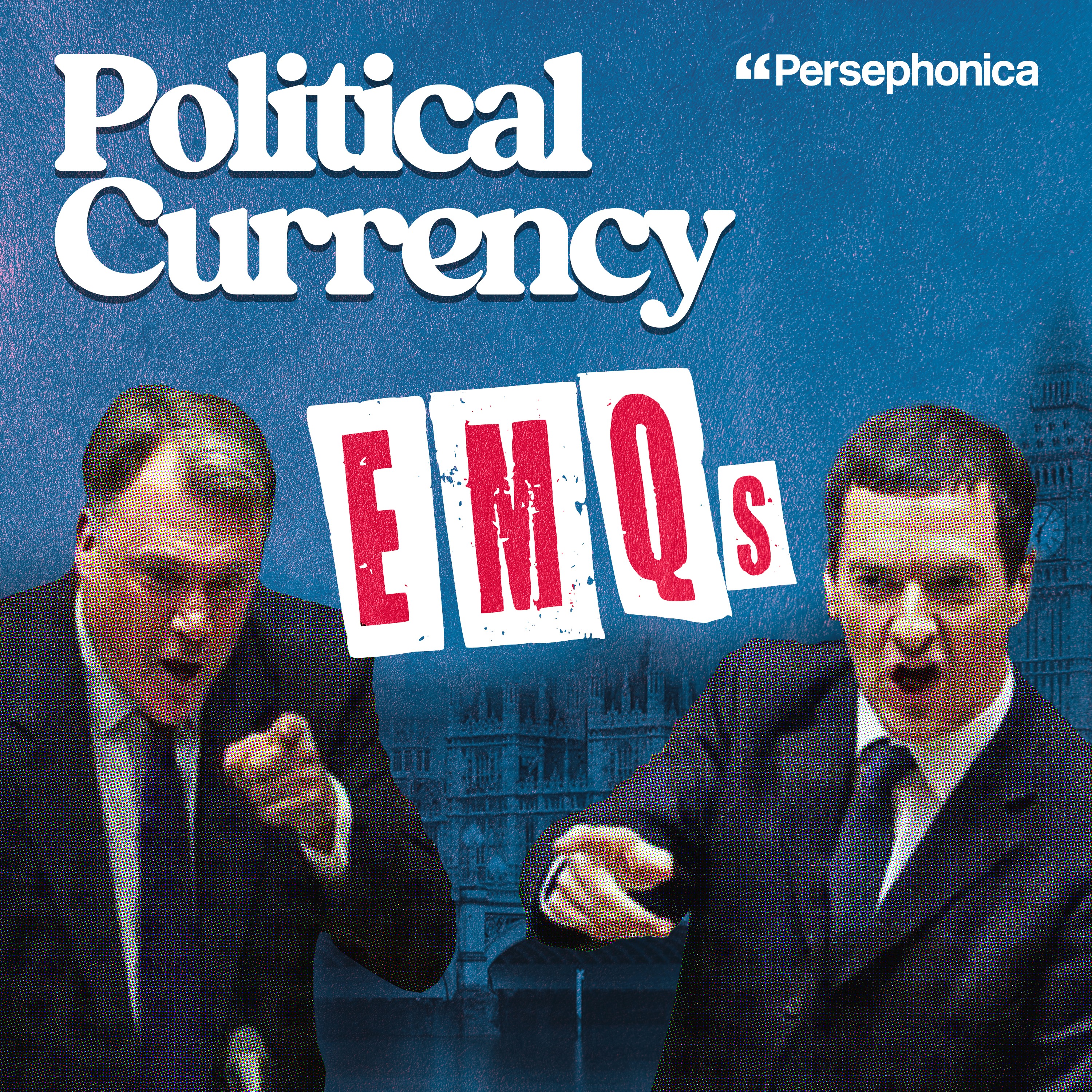
- EMQs: What if a PM is incapacitated?
In short
In this episode of Political Currency, hosts Ed Balls and George Osborne delve into several political and economic topics, including:
Main points
- The implications of a Prime Minister's incapacitation.
- The student loan repayment crisis.
- The civil service reform debate.
- Training for new MPs in essential policy areas.
Written by AI. May contain mistakes.
Chapters
0:28
Musical Discussion and Gigs
Hosts discuss their musical engagements and upcoming gigs, including charity performances.
“I was commenting on our main podcast that Ed had had a haircut and it certainly makes him look very smart and the TV presenter he is.”
2:29
Student Loan System Overview
Discussion on the student loan system, focusing on interest rates and repayments.
“Student loans have been receiving a lot of coverage in the media lately with the interest rates charged being one of the sources of debate.”
3:29
Fairness in Student Loans
Exploration of the fairness and implications of the current student loan system.
“I'll make a kind of general observation.”
10:29
Deputy Leadership in Labour Party
Analysis of the Labour Party leadership structure and implications of incapacitation.
“Love the podcast, which I listen to on my way to the driving range every week in Abu Dhabi.”
14:00
The Powers of an Incapacitated Prime Minister
Explore what happens politically and constitutionally if a Prime Minister becomes incapacitated.
“I think this actually happened, didn't it, with Tony Blair, where he, didn't he have an operation for 24 hours?”
19:21
Civil Service Reform Discussion
A detailed examination of the necessary reforms in the civil service and its challenges.
“And this, I think, is one for you, George, because it looks like it's one of your neighbours in a challenging circumstance.”
28:00
Challenges of Incorporating Outsiders in Civil Service
Learn about the struggles of integrating outsiders into the civil service and historical efforts to improve diversity in experience.
28:44
The Need for Training New MPs
Explore the importance of basic training for new MPs and the potential curriculum necessary for their success.
“I may be wrong, but at the moment I don't think there is any training for new MPs on essential policy areas.”
30:19
Induction Processes for New MPs
Discover what current induction processes exist for new MPs and how they have evolved over time.
“Unlike MPs generally, you're already separating yourself.”
33:17
Proposal for a New MP Training Course
Discuss the proposal for offering a shortened version of an economics course to new MPs as part of their training.
“You know, get them to come and do, you know, a shortened version of the course.”
Show all 11 chapters
34:22
Reflections on Treasury Operations
Reflect on the criticisms of Treasury operations during financial crises and the implications for current practices.
“Sounds like a good PFI contract you could land.”

Ask about this episode
Get the gist, explore an idea or ask about something said.
 Claude
On Political Currency, what are the key points of this episode?
Searching your listeningTranscript
Automatic transcript. May contain errors.
0:00The Chancellor of the Exchequer. Getting a lesson from the Shadow Chancellor on how to balance the books is like getting a lesson from Dracula on how to look after a bloodbath. Ed Balls. A steady-as-she-goes budget. What kind of ship does he think he's on, the Titanic? The Mary Celeste. Welcome to EMQs from Political Currency with Ed Balls and George Osborne.
0:27Welcome to EMQs, Ex-Ministers Questions. I was commenting on our main podcast that Ed had had a haircut and it certainly makes him look very smart and the TV presenter he is. Thank you. But it's not really a kind of rock star haircut I would say quite the reverse so I don't know how well it's going to go down or will have gone down depending when you're listening to these EMQs at your next live gig with Centrist's dad in Camden right? Well the good thing is I sit in the background you know I'm sort of on the drums and I'm not the front man. Peston has a slightly more floppy fringe, which is sort of, you know, something Jarvis Cocker style.
1:05New romantic. Exactly. Aren't you like the, is it the drummer in the Muppets? I'm not sure. Animal. Do you remember him? No. And I don't know what you're talking about. This is what he looked like. I'm going to show you, this is what the drummer in the Muppets looks like. That's what drummers should be. Yes. He's got wild orange hair. That is not my approach. I just underpin things. I'm not the showman. But we are doing Human League, Don't You Love Me Baby, Soft Cell Tainted Love. Picture This by Blondie. And those are our new songs. This is my childhood. I know. Has Pink Pony Club survived or not?
1:40Pink Pony Club has absolutely made the cut. And also Charlie XCX, I love it. It's for Great Ormond Street Hospital at Dingwalls in Camden. We are playing alongside Ken Follett's band called Vintage with Floella Benjamin. She's also from my play school. She's also from my childhood. She absolutely is. Blondie and Fluella so anyway if you're listening to this because you are a gold subscriber tickets are still available and if it's on Monday I will put a clip on Instagram so you can get the highlights some people would say the establishment has been rocked this week by Epstein, Manelson and so on I feel like this gig is not going to not going to add to the shaking the foundations of the British establishment I don't know about the establishment but Camden is going to be rocked Saturday night rocked and rolled Shall we get on to our questions?
2:28Our first question is from Adam. Hi both, Adam here. Student loans have been receiving a lot of coverage in the media lately with the interest rates charged being one of the sources of debate. Plan 2 loans charge interest rates of up to RPI plus 3 % depending on income and that means that many graduates in the top half of the income distribution will end up paying back much more than their initial loan even after adjusting for inflation. So my question to you both is whether you think that's fair. Personally, I can see that the above inflation interest helps reduce the cost of the overall system for the government by offsetting some of the losses it makes on loans to students who don't earn enough to repay their loan.
3:04But I also struggle to see why middle to high income graduates with Plan 2 loans in particular should be relied upon to offset such losses, any more so than the 5-10 % of their peers who were able to pay tuition fees up front, or even any other taxpayer who either went to university at a different time or not at all. I'd be really intrigued to hear your thoughts, especially given George's role in establishing the Plan 2 system in the first place. All the best and keep up the good work. Adam's got a very good question here about what has happened to the student loan system. I'll make a kind of general observation.
3:35I think the introduction of tuition fees has been a really good thing for universities. First done by the Labour government, then the top-up fees that were introduced by the Labour government as well, And then the coalition government, which was part of decision to allow the cap on those top up fees to go up in 2012. And it was, you know, highly controversial. People might remember there was a big riot in Parliament Square with students who were complaining about it. But, you know, it has done two things. One is it's kept money flowing into our higher education system, which any view on Britain's economy and productivity would say, you know, is really important.
4:15the universities were not then put alongside hospitals and the like and when it came to decisions on what budgets to squeeze and second it's been really progressive and this is going to come on to sort of the point adam raises because it has increased access to university and the way the system operates it is the case that people from poorer backgrounds do get more financial support in practice and those who have poorer outcomes in life don't earn as much are supported by the student loan system. And the student loan system was always supposed to be, and certainly as we worked on it in the coalition government, an approximation of a graduate tax, which is now the kind of allegation against it.
4:59But I also think it's a risk of breaking down, that this very good work of Labour, Conservative and Liberal Democrat ministers in government over 20 years is about to fall apart because I think governments, and it's not just this government, because this is what also some recent Tory governments have been doing, have sort of milked the cow too much. And it's a classic mistake in politics. You have a system that's working and you think, OK, as each budget comes along, I'm just going to squeeze a little bit more money out of this thing. I'm not going to allow things like the thresholds, at which point you start paying back your student loan to keep pace with inflation because that gives me some money in the scorecard, the budget, no one's going to notice it.
5:44It's an easy way to raise money. All of that has happened over recent years. And as a result, you've now got some very odd outcomes where you have graduates paying essentially a 9 % tax on their income for many decades. Three quarters of the student loans will never be paid back in full. The richer people buy their way out of the system by just paying the tuition fees up front, which is, you know, if you've got the money, clearly the financially sensible thing to do, rather than pay these very, very high extortionate rates. And Rachel Reeves' last budget was the, you know, straw that breaks the already laden camel's back when she freezes the thresholds again.
6:27So it's a real shame to see it happening. And I would kind of urge the Treasury and the education department and so on to just like before it's too late and the whole thing collapses under its own weight do what should have happened right from the 2012 onwards which is operate everything with inflation and not let things get so out of kilter i think you are right that this is a coming storm and we've had lots of questions to um our podcast about it and lots of labor backbench mps have been raising this in different uh ways against the government because of that most recent change. Standing back, first of all, yes, asking graduates to pay a tuition fee or make a financial contribution to finance their higher education is the right thing to do.
7:09It shouldn't be paid by general taxpayers and people who don't go to university. I always preferred going down the graduate tax route rather than a loan and repayment system. De facto, that's kind of where we've got to because most people don't repay their student loans most people stop paying after 30 years during which they've essentially paid a tax and the problem with it is in the meantime although you never actually repay it your loan goes up and up and up if you aren't earning enough then your loan gets bigger and people see that before their eyes and therefore that feels like a growing burden and unfair, even though it's not going to.
7:52It's compounded by the fact that unusually they use the RPI to set the interest rate. Ironically, given only the richest ever repay their tuition fees in full, if you cut the interest rate, perversely, that helps the more affluent because they're the ones who end up paying less. Whereas if you cut the interest rate, it doesn't make any difference to most people because they're not going to repay their loan over the 30 years. Anyway, the problem is the fairness of the system was that you don't pay until you earn a certain level. And as you said, in the last budget, Rachel Reeve decided to freeze that threshold, which means more people are paying hundreds of pounds more a year than they would otherwise have been.
8:33And she's going to freeze it until 2030, draw more people into those payments. the difficulty he's got is that martin lewis itv's martin lewis has decided to launch a campaign he says that this is not a moral thing to do he says when you take out essentially a loan you take out the loan on the basis of the terms that you sign up to at the beginning within which there is an interest rate which moves with interest rates but if you suddenly start changing the threshold and therefore increasing people's debt that is a reneging on the initial contract And that is not fair. And this is hitting lower income graduates at a time when lots of lower income graduates are worrying about whether they're going to get jobs.
9:17And so this, as you said, looks like a classic example of the Treasury thinking we could raise some money without anybody noticing. And unfortunately, Martin Lewis has noticed and without wanting to make a firm prediction after pubs and farmers and the winter allowance and disability benefit, what are the chances of the Treasury needing to do something to deal with this unfairness of the change they've made, even if the overall system is a good system, I think quite high. Yeah, no, by the way, also, when I say you should be operating the thresholds, they should also have been operating the total amount of the loan that can be taken out.
9:57Because you've also got this problem that the university sector, having been well-funded for the last 20 years, is starting to struggle because successive governments, since those reforms in 2012, have sort of capped, essentially. I think that was maybe one year when they didn't. But basically, they've capped at£9 ,500 what universities can charge. Until recently, Bridget Phillips had announced, the Education Secretary, that the cap will now rise in line with inflation. And I think that has eased the pressure for a lot of universities, but definitely not for all. Thank you for your question, Adam.
10:28We'll move on to our next question from Chris. Hi, Ed. Hi, George. Love the podcast, which I listen to on my way to the driving range every week in Abu Dhabi. I have a question about the deputy leadership of the Labour Party. David Lammy is now the deputy prime minister, but Lucy Powell is the deputy leader of the Labour Party. If something were to happen to Keir Starmer and he was incapacitated, similar to when Boris Johnson had COVID, who would become acting prime minister? Lucy Powell as the acting leader of the largest party in the House of Commons, or David Lammy as the deputy prime minister?
11:02Thank you. So this is a fabulous question, Chris, and allows us to get into the reality of our parliamentary democracy in which we don't govern by a written constitution, we govern by convention. and convention and precedent and consent, in that world, exactly what happens is quite fluid. So it is true to say when Boris Johnson was incapacitated, he remained the prime minister. He had COVID, remember, didn't he? One of the early victims and he was in hospital on life support. That's right. But he was still the prime minister. But the taking over of the chairing of the cabinet was taken by the deputy prime minister, Dominic Raab.
11:48But there is nothing in our constitution which says that that should happen. That is just what happened because the cabinet was willing to go along with that. If in fact, the cabinet had not wanted Dominic Raab to be the chair, then I think he would have not been able to be the chair. I mean, they could have had a vote in the cabinet to say, no, in fact, we want the cabinet to be chaired by the Chancellor Rishi Sunak. And Rishi Sunak would have chaired the cabinet. There is nothing in our constitution which says that the deputy prime minister should take on that role. Certainly nothing in any constitution to say that the deputy leader of a party should take on that role.
12:30I think there'd be no question if Keir Starmer was suddenly in a short term incapacitated and remained prime minister, it might be David Lammy. because that's the simplest thing to do. It certainly would not be Lucy Powell as deputy leader of the largest party, but it would depend upon consent in the cabinet. And if the cabinet said, actually, David, we don't think you should be the person who does PMQs and chairs the cabinet. It should be Rachel Reeves. Then it would be Rachel Reeves. And then similarly, if the prime minister started to become incapacitated for a long period of time, and it was clear that they weren't coming back, It would be for the cabinet to decide who should take over as acting prime minister.
13:10No expectation it's a deputy prime minister. The cabinet would tell the palace and the palace would say, OK, on that basis, that is the person who becomes the acting prime minister. But if it then became clear in parliament that the person the cabinet was choosing was not going to have the consent of a majority in parliament, well, then the palace would have to reconsider. And I don't know whether that would happen necessarily through a vote. The threat of a vote may be enough for the palace to make a decision. So this is very fluid. And I think the answer is it entirely depends upon the balance of power and consent within the governing cabinet and in the governing party rather than any rules.
13:54yes i think i agree almost almost all that but not entirely so you're certainly right that the prime minister in britain is the person who can command a majority of the house of commons that's it usually that's the leader of the largest party but not always and actually i think we referred on a previous podcast recently to winston churchill who was prime minister but not leader of the conservative party in 1940 partly because the torii mps didn't trust him so there are kind of odd exceptions but that's generally been the rule i think if a prime minister's incapacitate is like goes into for an operation.
14:23I think this actually happened, didn't it, with Tony Blair, where he, didn't he have an operation for 24 hours? He did. So during that period, or Boris Johnson, where it wasn't a planned operation because he was rushed to hospital, the easiest thing is the powers of the prime minister. But I'm going to come on, this is where I'm going to slightly take odds with you. The powers of the prime minister to pass to the ranking member of the cabinet. Sometimes that's a person called deputy prime minister. Sometimes that's a person called first secretary of state. And sometimes you don't have either of those things.
14:52But there is a cabinet order of precedence, which is published. It is established who's like the number two. And then you go to like, well, what are the powers of the prime minister? And as you say, they're chairing the cabinet. But if the prime minister is incapacitated for a bit, well, you don't chair the cabinet. You just don't call the cabinet. And in fact, in the coalition, William Haig would have chaired the cabinet in that situation, even though Nick Clegg was the deputy prime minister. but we just made sure there never was a cabinet when david cameron couldn't be around you can imagine some situations where like you have to we were talking you know our main podcast you you know you have these sometimes scandals and you might have to fire a cabinet minister that would be really complicated in this situation where the prime minister is only temporarily incapacitated there are some really direct powers of the prime minister in military terms like the ability to launch nuclear weapons is an entirely prime ministerial power not a cabinet decision since 9-11, shooting down passenger planes that could be a threat that require kind of authority of the prime minister.
15:51Although that is shared. Yes, but the prime minister lists the people who take those powers on. But if the prime minister was incapacitated, those people would still play that role on shooting down airplanes. I think on nuclear, I think the prime minister would have to designate it. I'm sure they designate ex ante ready for that moment. Yeah, they do. So the the Prime Minister does designate, and that wouldn't necessarily be a Deputy Prime Minister. It could be like the Defence Secretary or something, right? So there are very specific powers of a Prime Minister, usually in the national security and defence space.
16:22And the other powers, the Prime Minister, as I say, could kind of wait. They're like powers to point people to positions and powers to chair the Cabinet and decide the Cabinet agenda and so on. But you're right that the longer it went on, this would all quickly degenerate into a kind of leadership contest because people go, well, the guy's not coming back. I think it's a little bit more complicated than Labour Party because there's an elected deputy leader, which the Tory party doesn't have. So there's a sort of potentially a situation where you might have a deputy prime minister and elected deputy leader like you do at the moment.
16:52But I think it's pretty clear David Lammy would take it. If Keir Starmer was rushed into hospital, God forbid, today, David Lammy would be the acting prime minister in effect. I think that's right. Of course, in 2004, John Prescott was both the deputy prime minister and the elected deputy leader. and he was the person designated by Tony Blair to chair the cabinet in his absence to take control. Although whether John Prescott was the person Tony Blair had designated to be in charge of the nuclear codes, I don't know. That's a state secret, that list. Yes, exactly. On the grounds that, you know, your opponent might try and knock out the people who can act.
17:30It's to avoid a situation where, you know, you can incapacitate our nuclear retaliation by getting rid of the prime minister. I think the one thing we can say definitively is that Lucy Powell would not become the Prime Minister. Acting. Was Dominic Raab, by the way, the acting Prime Minister or was he just Deputy Prime Minister? I think he might even, I don't know if you get called acting Prime Minister. Oh, I should have done more research on this. We'll have an answer to that. I kept saying chairing the Cabinet because I think you sort of, you take charge. But that's a little bit like saying when the Prime Minister goes on holiday, somebody takes charge.
18:03That isn't the same as becoming. But Ed, what would happen if the chance exchequer has some massive scandal? You know, turns out to have been emailing foreign financiers financially sensitive information to take a kind of contemporary example. And this is all while the Prime Minister's under general anaesthetic or something like in an operation. Do you think the chair of the cabinet has the power to fire the chance exchequer and appoint a new chance exchequer? I think that in those circumstances, you'd have a constitutional crisis. That's not an answer. You are totally right. Because, you know, would the chief secretary take charge?
18:41What would the permanent secretary to the Treasury do? The cabinet could decide to express no confidence. But I don't think the deputy prime minister would have the power to sack them. No. If the cabinet voted to suspend them. We could spend all day talking about this. Why don't we find out the answer to that? But we will see if anybody can send us an EMQ in for next week. What would happen if there was a massive scandal for the Chancellor while the Prime Minister was incapacitated? We'd love to know the answer. We won't get that answer immediately, so we'll take a break.
19:21Welcome back. Our next question is from Annie. And this, I think, is one for you, George, because it looks like it's one of your neighbours in a challenging circumstance. Hi George and Ed, messaging you from a very soggy, slightly flooded house in Somerset. My question is about civil service reform. Previous ministers often have a dig at the civil service whilst praising the civil servants they worked closely with when they were in office. What exactly needs reforming? Is it the size of the civil service? Is it the efficiency and effectiveness? Is it the quality of the people that are civil servants?
19:57Disclaimer, I'm a former civil servant myself, and I was always incredibly proud to be part of an impartial civil service. But I could see how incredibly inefficient and slow we were and risk averse. But a lot of that comes from the ministers themselves. I'd be really interested in your opinions as to what actually needs reforming and also who's responsible for making it happen. Thank you. Yes, well, hopefully, Annie, you're coping with all the wet weather and your slightly flooded house in Somerset. And of course, large parts of Somerset are on very flat, low grounds, the Somerset levels. So there's often an issue with flooding.
20:33In fact, I remember several weeks of my life as chancellor, there were lots of meetings about what to do with the flooded levels. And Oliver Letwin beavered away on buying machines that could pump the water out. But there was some relevance there, which was it was all trying to get the civil service to come up with some innovative answers to the situation in Somerset. This is a kind of big question, isn't it, about civil service reform, the adequacy of the civil servants. You know, are we getting the right high caliber people into the civil service and so on? And I'm a bit, yeah, I guess people would say this is a bit of a traditional view.
21:08And I don't really think that the problem in Britain is the civil service. It's certainly the case that it feels like the civil service has got more bureaucratic, if that's not a truism. I found it staggering to discover today that the Treasury had 2 ,000 civil servants. When I stopped being chancellor, it had 1 ,000 civil servants. That was only 10 years ago. I don't know what all those so-called small state Tories were doing after me, racking up the size of the government. and you find this with other professions you know that there are now many other kinds of walks of life and work that people graduates can go into so there's more opportunities for people to do other things and maybe there's a kind of you know i don't think there's a caliber issue but you know it's certainly true that you it would have been the case that the kind of brightest people from well people with the highest grades from a university may have gone into sort of stuff maybe that's not so much the case anymore but then you'd also say that's probably a good thing for the country.
22:06There's a wider pool of people that they can draw on and people from different social backgrounds go into the civil service and so on. So, you know, I would say that generally the problem, and I speak from someone who, you know, dealt with the elite of the civil service in the treasury and number 10, rather than maybe some of its more far-flung departments and parts, is lack of direction from lack of kind of clear ministerial direction, constant changes of administration and premierships. You know, I feel if there was a kind of government that knew what it wanted to do and a prime minister knew what it wanted to do and had the political authority to deliver it and was able to communicate to the country what they wanted to do, that the civil service would kind of click into gear.
22:48I think if you look at a couple of kind of crises, some self-inflicted, others external, if you look at the speed with which the civil service acted to provide economic support during COVID and devise large schemes to help millions of people. That was the kind of the British Civil Service at its best. If you look at the innovation around vaccine delivery and process that would have taken years and years to get vaccine approval, let alone get the country inoculated during COVID, that was done really quickly. If you look at Brexit, which obviously I thought was an entirely self-inflicted wound by the British political classes, the public in that referendum, In fact, the civil service got on and did it and disentangled Britain from 50 years of relationships with their European neighbours.
23:36Why? Because the political masters told them to do that and the House of Commons voted for that. You know, I'm all for like, you know, we've got to keep the country innovative and I hope civil servants are learning about AI and, you know, all this kind of stuff. But fundamentally, I think the complaint leveled at the civil service is normally a complaint you should level at the politicians and their advisors. I agree with that, but I'll give you just one other dimension to think about. But first of all, I totally agree that when politicians say the civil service just aren't delivering, they're an obstacle, they're a roadblock, as I think Annie says in her question, that is often reflecting a lack of leadership and clarity and drive amongst the ministerial and political class about what they want to do, making good decisions.
24:23and the civil service is then sort of hampered by that lack of political leadership. So anytime prime ministers say, I've got the scars on my back from fighting with bad civil servants, you should be sceptical about the prime minister saying that. And the second thing is, of course, pay matters in any profession. But the kind of people who become senior civil servants or go to be elected as members of parliament, they don't fundamentally do it for the money because they could almost certainly get paid more doing other jobs. they do it because of the purpose, but also the value. And I worry at the moment, we don't have enough young people going into politics because it is a devalued profession.
25:03I'm not sure paying them more would solve that. And similarly, paying more civil servants, it's actually whether or not the role of the senior civil servant and the civil servants in general is properly respected. And if not, then that becomes demoralising. So again, I think politicians attacking the civil servants don't help their cause. But this is my third point. When you think about the civil servant, there are so many different roles and different capacities you need under that umbrella. At the most senior level, a permanent secretary, they're managing organisations, but they're also managing complex accountability between ministers and parliament and departments.
25:46And that is something It's very hard to, I think, come in from, say, business or academia and become a senior civil servant unless you're steeped in the complexity of that accountability management. There's a separate role, which is about making policy and understanding policy and being able to kind of work out the right thing to do. Then there's another thing, which is delivery, which is completely different. And how do you run a system of tax offices around the country to manage a complex tax system? That isn't about kind of accountability and political relations, nor is it simply about policy.
26:22It's actually about delivery. And then you have another thing, which is about expertise, which is, do you have people who totally understand in a cutting edge way, things which are changing? So somebody who might be really knowledgeable in AI at the moment, may not be somebody who's got much experience in delivery, and they certainly will have no experience in managing political accountability. But if you say, well, in that case, we're going to value accountability first and have generalists, and there's no space for high stature experts in cutting edge technologies, you don't get the best people.
26:58So the challenge for civil service reform, I think, is to find a way in which you can have a voice and prestige and value for these different roles. One of the reasons I've always liked arm's length organisations, having the HMRC with somebody in charge of it to deliver that service reporting into the treasury with a permanent secretary who then manages the accountability relations is a better way than to try to put the whole delivery organisation under and within the management of the department and same in the health service as well. So decentralising and having accountable units where you can focus on delivery and take the policy function to somewhere else, but also make space for the expertise, that is a complex thing to do.
27:49And I think a lot of civil service reform is actually about whether we're getting the balance right between delivery, expertise, policy, and accountability. And I guess the kind of worst features, I mean, having praised officials, the worst feature of the civil service is when they kind of squeeze out outsiders. You know, they find no space for the person who's had a different kind of career, you know, who brings in experience from the private sector or some other, you know, public realm there is an aspect of the kind of top of the civil service that is not great at welcoming people from the outside but there have been lots of efforts over the last 20 years to improve that i remember in my time francis moore doing a lot to try and get people with outside experience in so thank you annie uh let's take a break and then we've got time for one more question
28:44welcome back our final question today is from oliver hi ed and george my name is oliver i'm a kitchen cabinet member and also studied on ed's economic history course at king's college london last year, although in my day job I'm an employment law barrister. Ed's economics course got me thinking. I may be wrong, but at the moment I don't think there is any training for new MPs on essential policy areas. This is even though many new MPs will know nothing at all about the foundations of the UK state, like basic economic policy, for example, or human rights law. Do you think this kind of basic training for new MPs would be a good idea?
29:24I can see that there would always be arguments about what should or should not be included, but that's separate. An intro course for new MPs on the fundamentals of the UK state still strikes me as sensible. I'll be interested to hear your thoughts. Thanks for taking my question. So that is a really interesting question, Oliver. We're not just saying it's a really interesting question, Oliver, because you're a kitchen cabinet member, or indeed you sat at the feet of Professor Balls, although I think both of those things help. Well, maybe they're the reason why you ask such good questions you were well taught and because we have well taught informed people as kitchen cabinet members it's a natural that you should be one look uh oliver was great in our class and um wouldn't surprise me if he's goes on to be a member of parliament with you know the appropriate training for having done our king's class but also he's got interested in finding out whether the appropriate training will be in place to be ready for this question i actually did a bit of research this morning.
30:19Unlike MPs generally, you're already separating yourself. I sent a message to somebody who's been in contact with us before, asked us a question in EMQs and what snapped his question into us a few months back. Jake Richards, the son of Steve Richards, the brother of Amy Richards, who is now the political secretary to the prime minister. And he's actually was appointed as a minister back in September in the reshuffle. He's actually a parliamentary undersecretary at the Ministry of Justice. So well done, Jake. I asked Jake whether or not there was training in policy or personnel or procedure of the House.
30:59And he came back and said actually, he said, there is a pretty thorough induction process and the whips ensure you go to the critical courses, though they can't force you. It includes ethics, it includes propriety. And he said that older MPs he's spoken to say the process has actually been transformed more recently compared to how it used to be in our day. Whether they actually do policy and economics, I'm not so sure, but the kind of things you'd expect. Yeah, because Oliver's question is, do you get a kind of grounding in basic economics or how the British state functions or how your health service is organised?
31:34The broader policy stuff, they kind of think you probably should know quite a lot of that already. But if you come in as a teacher, you might know about the education system, I mean, you might have not a clue how the military is organised or the police service or how tax works, you know, tax law works. I didn't ask Jake. He did say it covered policy, but I didn't ask him how much detail it gets sent into. I mean, in our day, did you have anything like that? I think I was actually the first intake. I was in 2001. And in 1997, there had been a huge influx of Labour MPs, including Yvette, for example.
32:05And I think the feeling at the time was Parliament was totally ill-equipped for handling all these new people. And so in 2001, there was a kind of rudimentary training course about how to use the IT system and how to, you know, operate around parliament. There's still an element of, you know, the kind of history because you're given a locker key and a coat peg with a kind of silk ribbon to hang your sword up with. The main thing I remember about our training thing was apparently in 97, one of the issues had been the MPs didn't have anywhere to work for weeks until they were allocated offices. so a big innovation was that the i think it was 26 new tory mps were put into two big committee rooms so committee rooms were taken over as a sort of communal working space for the new mps while offices could be found for them because the allocation of offices is a really political thing and a kind of gift to the whip so they didn't want to do the sensible thing which is just have an office ready for you when you arrive but they put us into these two big rooms up on the committee room corridor what i remember is that 25 of the mps myself included all clustered in one of the rooms and david cameron and we didn't have secretaries organized or researchers or anything so we were all in that one room and suddenly you get all these letters saying congratulations on the election or i'm your local health commissioner you know anyway we were all sort of doing that and then in the other room it was entirely colonized by boris johnson who had brought his staff from the spectator where he was editing into the house of commons so he already had a kind of secretary and a team and whatever which would none of us did and they basically took over one room and the 25 mbs were in the other room i remember thinking i need to watch this guy very interesting i now realize listening to you and thinking about this what ollie is onto here What he's saying is he was so impressed by the Treasury and Economic Policy since 1945 course at King's College London taught by me, Nick McPherson and Professor John Davis, that he thinks we ought to offer this to all new MPs as an induction.
34:11You know, get them to come and do, you know, a shortened version of the course. And I think we'd be up for that. Maybe you and I should go in and do a sort of. We did that for some civil servants recently, didn't we? We did. Yeah. Maybe we should offer our services. Sounds like a good PFI contract you could land. What about, did you notice, we didn't cover this in our main podcast, the very waspish comment from Lord McPherson about number 10 operations during the financial crisis and Peter Manilson? He would not have been impressed by Shreeti Vidira's note to the Prime Minister and Jeremy Hayward, in which she makes some rather pointed criticisms about the Treasury's approach to banks and the financial services more widely during the global financial crisis.
34:53I mean, that was clearly intended to be a private note. And for some reason, Peter Mandelson decided to share it with Jeffrey Epstein. And now, therefore, with the world. Clearly unpicked old wounds. I laughed out loud when I read it, actually. Anyways, that's all a bit of an in. Most people listening won't know what we're really talking about. But for those who know and love Lord McPherson, that was true to form. The only thing I would say to you, George, is most people wouldn't have noticed. No. But Gordon Brown did. Thanks for your question, Oliver. And I did. That's all we've time for in this episode of EMQs.
35:28If you want to answer your burning question, just send them to us, questions at politicalcurrency.co.uk. And do please attach a voice note to your question as we like to hear from you directly. We'll be back on Thursday with another episode of our main podcast, our award-winning podcast. And we'll see you then.
35:52Thanks for listening to Political Currency. This has been a Persephoneca production.
From the publisher
What would happen if Keir Starmer were incapacitated? Who would be acting prime minister - David Lammy, Lucy Powell, or someone else entirely? And how does scandals and replacing cabinet ministers work with no clear line of succession? Ed and George debate the uncertainties of the parliamentary system in this week’s EMQs.
They also look at the burgeoning crisis around student loan repayments, reflecting on their own roles in governments that helped get us here, and and on the consequences of successive governments ignoring an issue of such magnitude. A civil servant asks just what MPs mean when they talk about ‘civil service reform’, and the reveal why ministers are always complaining about it.
Finally, one of Ed’s former students puts them to the test - why do new MPs not receive training on essential policy areas when they arrive in Westminster. They use the experience of new MP Jake Richards and compare it to their own from 20 years ago.
We love hearing from you, so please don’t forget to send all your EMQs to questions@politicalcurrency and make sure to include a voice note of your question.
Thanks for listening. To get episodes early and ad- free join Political Currency Gold or our Kitchen Cabinet. If you want even more perks including our exclusive newsletter, join our Kitchen Cabinet today:
👉 patreon.com/politicalcurrency
Please note: Kitchen Cabinet is only available via Patreon.
Credits:
Research: Sam Burton
Production: Caillin McDaid & Caitlin Hanrahan
Video Editor: Avi Asher
Executive Producer: Ellie Clifford
Political Currency is a Persephonica Production and is part of the Acast Creator Network.
Hosted on Acast. See acast.com/privacy for more information.
More from Political Currency
All episodes

We use cookies.They keep VO running smoothly and help us improve it. Privacy policy