
 Ask ChatGPT


- Podcasts
- Political Currency
- EMQs What If: Ed and George had never entered politics?
Political Currency24 Aug 2026 · 41m · 13 chapters
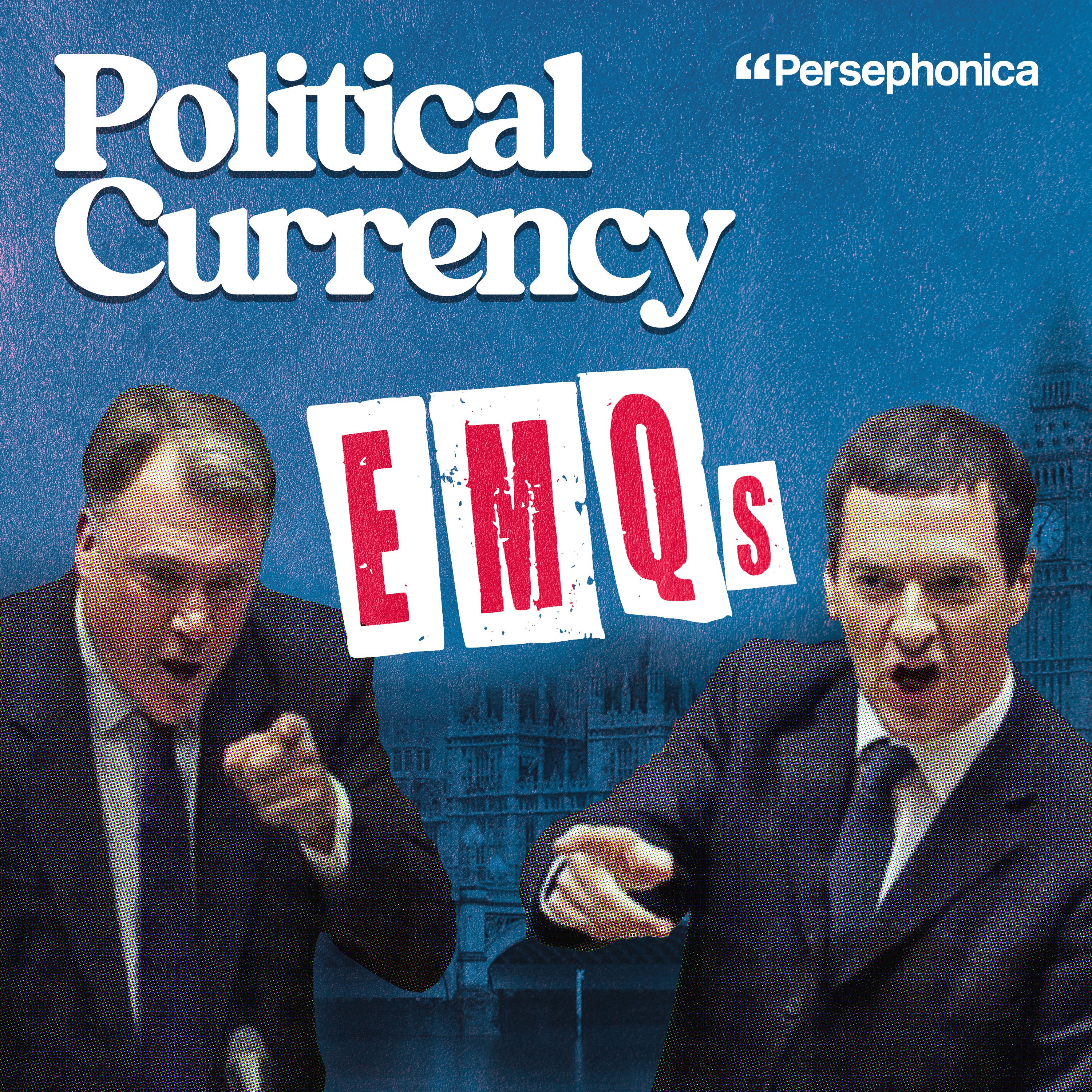
EMQs What If: Ed and George had never entered politics?
In short
“What If” counterfactuals about British politics, focusing on how different individuals or decisions might have altered governments and major events from 1997–2016, plus scenarios involving Trump-era diplomacy, 1974 coalition talks, and whether the 2016 Brexit referendum was worth it.
Guests/hosts
Ed Balls (Labour politician; Shadow Chancellor; later involved in Labour’s economic policy discussions) and George Osborne (Conservative Chancellor; key role in austerity-era fiscal strategy; later discussed as a potential Trump-facing UK interface).
Key claims
Individual relationships and timing can matter more than specific policies (e.g., coalition cohesion; Downing Street/Treasury trust). Major policy shifts like Bank of England independence and inheritance tax messaging are treated as contingent on specific people. Even if personalities change, structural economic forces (inflation, cost-of-living shocks) likely still drive political instability.
Notable examples
Inheritance tax speech (Tory conference) shifting polls; Bank of England independence “day one” surprise; possible Osborne-as-ambassador scenario for Trump trade/tariffs/Iran bases; Heath–Thorpe coalition after Feb 1974; Cameron’s Brexit referendum strategy to neutralize UKIP and Lib Dem dynamics.
Written by AI. May contain mistakes.
Chapters
0:32
The 'What If' Questions
Ed and George discuss the relevance of hypothetical historical questions.
2:24
The 'What If' Questions
Ed and George discuss the relevance of hypothetical historical questions.
“They're pretty popular with the listeners from what we can judge by the feedback.”
3:39
Impact of Individual Decisions
The hosts explore how individual decisions shape historical events.
“And it's partly asking, are there particular sort of butterfly wing moments, which just changed the course of events?”
5:36
Consequences of Political Decisions
Discussion on how their political decisions might have altered events.
“But we are going to challenge ourselves on this question.”
7:48
Relationships in Politics
Examining the importance of relationships in political functioning.
“I think, well, I would argue any chancellor, including a Labour chancellor, would have introduced some form of austerity.”
9:56
Key Policies and Their Origins
Analyzing key policies and the roles they played in government.
“But I don't think they ever doubted I knew what I was talking about.”
11:41
Speculative Scenarios
Exploring speculative scenarios regarding political appointments and their implications.
“The Blairites say it was really a Tony Blair idea.”
14:01
Reflecting on Political Appointments
Exploration of potential differences in political outcomes had key figures not taken their roles.
“I mean, goodness me, these questions, they are challenging both of us, aren't they?”
20:44
Reflecting on Political Appointments
Exploration of potential differences in political outcomes had key figures not taken their roles.
“Mod.com is changing the way people battle excessive fatigue.”
23:28
What If: Coalition Talks in 1974
Discussion on the historical implications of Heath and Thorpe's coalition talks in 1974.
“My question is, what if the coalition talks between Heath and Thorpe after the February 1974 election hadn't fallen through?”
Show all 13 chapters
28:00
Political Chaos: The Impact of Jeremy Thorpe
Explore the potential political upheaval that could have arisen from the exposure of Jeremy Thorpe's scandal.
“I mean, basically, the liberal leader is...”
35:32
The Brexit Referendum: A Hypothetical Analysis
Delve into the consequences of David Cameron's referendum pledge and the complexities of UK politics.
“it might be time to screen for colon cancer.”
42:05
The Dynamics of the SNP and Labour Partnership
Explore the complexities of the SNP's relationship with Labour and its implications for Brexit.
“They certainly complicate your foreign policy if you want to go and let Trump use your air bases.”

Ask about this episode
Get the gist, explore an idea or ask about something said.
 Claude
On Political Currency, what are the key points of this episode?
Searching your listeningTranscript
Automatic transcript. May contain errors.
0:00Hi, this is Brooke DeVard from Naked Beauty. I am always looking for ways to elevate our daily rituals, and the Kohler Smart Toilet is proof that design changes everything. It's this stunning sculptural piece that feels like quiet luxury for your bathroom. It totally transforms your daily ritual into something elevated, with customizable cleansing and touchscreen controls. It's functional art that makes your space feel cleaner and more intentional. A modern home deserves a modern toilet. Experience the difference of Kohler smart toilets. Find more at Kohler.com.
0:58When every second counts, count on ADT. Visit ADT.com to learn more. This episode is sponsored by Aerie. If you know me, you know that my philosophy is all about looking good and feeling good every single day. And that honestly comes down to the first layer. I'm talking about bras. If your bra is digging into your shoulder or maybe it's riding up in the back or you are dying to take it off at the end of the day, then that bra is not the right fit. And what I love about Aerie is that they have 59 different sizes in really soft fabrics and really good fits. Because at the end of the day, your bra should hold you in and not hold you back.
1:35Visit Aerie.com to find the right bra and your perfect fit.
1:55on the Titanic. Welcome to EMQs from Political Currency with Ed Balls and George Osborne.
2:08Welcome to Ex-Ministers Questions. We are in the depths of the summer. Let's full disclosure, we recorded this before we headed off to the beach or the pool or the hills or wherever. In my case, overnight ferry in a train. Right. Midnight train to Georgia. scandinavia to italy right assuming you've made it maybe it's all been cancelled by the time we record this but this is broadcast anyway we so we're doing these summer questions these are questions that have been sent to us over the recent months and uh we didn't get a chance to answer in our kind of regular emqs but this episode is well it's a particular favorite of mine i think it's a particular favorite of yours isn't it ed these are the what if questions these These are what if something had happened in politics that didn't happen and what would the consequences be?
2:56And we've done these before. They're pretty popular with the listeners from what we can judge by the feedback. But I've made the observation in the past that I'm only basing this on my undergraduate degree in history. I'm not a professional historian. But I remember as an undergraduate that sort of professors who taught me history were very snooty about what if questions. The modern kind of historical profession doesn't like asking the question, well, what would have happened if Adolf Hitler never existed? Or what would have happened if the Cold War hadn't ended? They don't like these what-if questions, often because they think it's too much about personalities and it doesn't deal with the big, broad trends in history.
3:38But I think they're very relevant because I think they throw a focus on what matters and what doesn't matter and what's transitory. It's true. And it's partly asking, are there particular sort of butterfly wing moments, which just changed the course of events? But it is asking the question whether individuals or decisions are the significant thing. And there is one view of history, which is that things are driven by big economic, social, political forces. And to produce it down to the individual in the moment is to underestimate the sweep of history. But what it does is it forces you to ask those questions, to challenge yourself about what was really driving things.
4:24What were those big sweeping events and how much of it was down to chance or personality? We're going to start with our first question, actually from a professor of modern British history at Durham University, Richard Hussey. He has decided to ask us a what-if question because I think he, as a historian, thinks we may be onto something. This is Richard Hussey and I teach history at Durham University. George is right that many professional historians dislike what-ifs, which jump ahead many steps to fictionalise the consequences of what changed. But I do think that what-ifs are really helpful in helping us identify when individuals or structures matter in history, what's contingent and what has got long-term causes.
5:09So my question to both of you is, what if each of you hadn't gone into politics? Would the faces and the timing of things that happened in 1997 to 2016 just look a little bit different? Or would the governments and the big events be completely different, perhaps not even happened at all? If it makes you less cringy, you can answer on behalf of the other one rather than blowing your own trumpets. So we're not going to write the answers to these questions, Richard. We don't need calculators. But we are going to challenge ourselves on this question. Although I think it's quite hard when it comes to particular kind of policy moments.
5:48I could think to myself, if it wasn't for me, would we have had Bank of Independence? Might we have joined the euro? Would we have had tax credits? But the truth is that those decisions were all based upon conversations which I had, Gordon Brown had, and Ed Miliband had, Tony Blair had over months and years. It's very hard to kind of take out the one individual from those moments and say, if they hadn't been there, I know the course would have been different. I mean, in your case, you would, as a Conservative Chancellor, even if it wasn't George Osborne, have set out to make difficult decisions about public spending and taxation because you wanted to pin the blame for the global financial crisis and the fiscal impact of that on the last Labour government.
6:36And I'm not sure whether it would have been, I mean, it would have been different. But fundamentally, that's what that Conservative Chancellor was going to do. Yeah, it's a good question. Well, I might come back to your record. because I think you're being a little bit unfair on yourself, because I think there probably were significant moments that if you hadn't been there, things wouldn't have panned out in the way they did. As our professor has warned us, this is a bit marking our own homework. But if I was to try and think of the moments in my career where maybe someone else wouldn't have done this, one of the big unknowns is if I hadn't given the inheritance tax speech at the Tory conference as shadow chancellor.
7:17I don't think someone else would have necessarily done the same thing. You know, would Gordon Brown have called the general election in 2007? There's no doubt that speech, I'm not saying I anticipated in any way. I mean, I thought it was going to have an impact, but I had no idea it would have had the impact it did. And it did seem to shift the opinion polls in a pretty dramatic way and was, you know, definitely then burnished and added onto by David Cameron's speech without notes. So it was not a single effort, but that single policy did have a massive impact, that policy announcement. On the austerity stuff, you're right.
7:50I think, well, I would argue any chancellor, including a Labour chancellor, would have introduced some form of austerity. In fact, Alistair Darling was already starting to do that. And Gordon Brown had lost his own cabinet on the issue of public expenditure cuts. It was what James Purnell resigned from the cabinet over. It was, Darling was already moving on this stuff. His memoir reveals that he was planning to introduce an increase in VAT if he'd been reelected and so on. Though whether he wouldn't have happened. But I wonder, you know, would another Tory chancellor or any chancellor have had the kind of relationship with the prime minister, David Cameron, that I had in a coalition that enabled us to form a plan?
8:33I think broadly speaking, you're right, it wouldn't have made a much difference. I think ultimately on the kind of fiscal numbers, probably another Chancellor would have followed a pretty similar course. But I think you are onto something there. And in some ways, it takes us to the... It's not the policy, therefore, it's more the relationships in Downing. Exactly. And that takes us to the last couple of years and the conversations we've had about Keir Starmer and Rachel Reeves in number 10 and in the treasury I think part of the Keir Starmer problem was he never had a chief of staff who he was close to who he trusted who could grip politics and strategy and media and policy and the truth is for David Cameron you played that role in the way that nobody else played in that period.
9:26And, you know, the question is, would it have made any difference to the policies ultimately? Well, but it makes a difference to whether or not the government is cohesive and effective and functioning and drives the agenda and therefore has the political strength to make important decisions. And I think, you know, it may be that the role you played in number 10 was not just important, but the thing which was as kind of personally distinctive as any decision you made in the in the treasury and then and then i think you could say a similar thing about me that aside from any individual decisions the thing i did in the year before 97 and in the years i was there i had a relationship with gordon brown and with the treasury which i built very carefully which was based upon trust and respect.
10:18But I don't think they ever doubted I knew what I was talking about. And therefore, I was able to make the Gordon Brown Treasury function. And it was something that I was very invested in and spent a lot of time doing. And it wasn't as easy for him when he went to number 10, not having somebody who could play that same role. And so it might be that the impact you have in terms of how you govern may be more important than any individual policy. Although we're only one ingredient in quite a large number of ingredients put together in administration. Of course. I think we also have to both accept that neither of us were, you know, we certainly had our detractors, people who didn't like us.
11:01And we turned out both to be dispensable. I've got one thing I think this wouldn't have happened. i'll come into i didn't i'm not sure um gordon brown uh would have gone for bank independence in the first week of a labor government if without you because you had the idea you wrote the paper and then you had the kind of political skill to put it all together as a package and then if it's not done in the first week of a government it's bloody difficult to do anytime because there's always then looks like a reason why you're making the bank independent you know and it's something to do with trying to avoid you know an unpopular interest rate decision or whatever it was certainly a huge surprise to Tony Blair when he found out on election day.
11:41I thought he claims to... The Blairites say it was really a Tony Blair idea. I know. But there we are. I thought you... I'm sorry. It was a huge surprise to him on election day when he found out we were about to make the Bank of England independent. He was fully in favour of it. He totally supported it. But there is no way Tony Blair thought that was what we were doing on day one. But actually, it was Gordon who said to me on the Monday before the Thursday, you're right. if we're doing this let's do it straight away and you know i'd been going on about this for like five years and we've done all the work but he was the one who said straight away i've got and i've got one on my one that's very topical i am pretty convinced no one would have created a mayor for greater manchester other than me i and so i'm i'm sorry that is very and that's because richard leakes didn't want it the labor leadership in manchester wanted so no labor prime minister or chancellor or local government secretary would ever have done it and i don't think the tories who came after me were that much interested in manchester had the relationships in manchester without that andy burnham wouldn't be prime minister so since we're presumably in the early weeks of the burnham premiership osborne we're pre-recording this but we're wife we're so who knows although i think andy burnham had his eye on the job even before he became hang on a sec he had the eyes he had the job in 2010 and in 2015 maybe in 2005 and but until he was the mayor um he lost okay i don't know where lots of people you can feel free to because this is all a bit uh self-referential it is but richard has he thank you for your endorsement of our methodology we love it and we hope that your students up at durham enjoy our podcast as well and if they if they don't they definitely should our next question is from joseph inspired by the highly speculative what if question you recently had on george becoming prime minister i have a slightly more realistic one assuming lord mandelson hadn't been appointed u.s ambassador and prime minister starmer opted for the other candidate or mr george osborne how would george have approached handling president trump and what advice would he have given to his majesty's government on such tricky issues as the US-UK trade deal, tariffs, and of course, the Iran conflict.
13:59Thank you. I mean, goodness me, these questions, they are challenging both of us, aren't they? First one's about, did we make a difference? Which we concluded we did. We did, yeah. The second one, would it have been different if Peter Mandelson hadn't been the ambassador? And I was. They didn't appoint Bear Grylls, who they were clearly thinking about. I saw Bear Grylls at the tennis, actually, when I went to him with him. Did he say, dodged a bullet, George? I mean, so this is more likely than people imagine, because ultimately I was on the shortlist. And David Lammy, the foreign secretary we now know, was very much pushing my appointment.
14:42It got closer than I thought personally at the time it was ever going to get. And imagine if some of the Mandelson revelations had come out during those weeks when his appointment was being considered. I know. You were a bit slow with your media operation. I wonder whether… I lost my… yeah. I mean, you would have had to… Opposition research was my first job in politics. You would have had to cope with being told no by Keir Starmer. I mean, I guess at times you would have wanted to pursue things as ambassador. I'm sure Peter was the same, gave advice. And if you are like a public servant, a civil servant, and you are in that sense, you know, a functioning part of the system, but you aren't the decision maker.
15:31It's interesting to know how you would have coped with being told your advice wasn't being taken. But what do you think you would have been – I mean, I think on trade or on technology, you would have been pursuing similar things to Peter. Where would you have been different? What would you have wanted to achieve which would have been distinctive? No, I think Peter did a pretty good job as ambassador. I mean, this is not, you know, commentary on all the other things that have subsequently emerged about the relationship with Epstein. I think as ambassador, you can't really fault what he did because he turns up.
16:05It's really hard for the British ambassador or indeed the ambassador of any other country to make any kind of mark in Washington at the top of the administration. Would you have crashed the Donald Trump press conference in that way? You know, I think I've told this story before. He arrived uninvited, blagged his way in, walked to the front and ended up next to Donald Trump while Keir Starmer was a car plant in the West Midlands. Right. and um so i don't know i would have had quite that chutzpah but i think the um i bet you would no but i think his approach let's be honest you've taught yourself into quite a lot of jobs over the last few years yeah and um taught my way into the white house a few times i think the way he did it was the way i would have done it and i think his priorities which were get britain exempt from the tariffs or get um try and form a tech partnership which is you know a piece of unfinished business but he was working very strongly on.
16:55And get yourself kind of known to the senior administration figures, which, as I say, is pretty hard for any ambassador to do in Washington, because, you know, why are they interested in the foreign embassies? I think all of those things are true. But the big reservation I had about doing the job, and I, you know, I talked to Morgan McSweeney about this when we were, you know, and I'm revealing this because Morgan's talked about it before the select committee. The question I had, and I think I would have been in a different category to Peter Mandelson, is whether the Parliamentary Labour Party and the Cabinet would have accepted former Conservative Chancellor George Osborne as the interface with Donald Trump's administration.
17:39And that some of the things that Keir Starmer decided were necessary in that first year, which is play along with Trump, get Britain exempted, invite Trump on the state visit and to Balmoral and all that, whether there would have been much more blowback than there was against Peter Madison. Because Peter Madison, this is pre all these revelations, at the time everyone thought, okay, well, Peter Madison is fundamentally a Labour guy. He was a Labour cabinet minister. He's part of the Labour red aristocracy as Herbert Morrison and so on. Whereas George Osborne, he's that Tory who many Labour MPs are like architect of austerity.
18:19We really don't like him and his policies. And therefore, I would have become a kind of lightning rod for the policy that Keir Starmer did want to pursue of alignment with Trump. And there would have been a campaign, get rid of Osborne. Instead of saying, sometimes in politics, particularly in a new administration with a prime minister with a big majority, if you're a Labour MP, you're not going to want to have a go at Keir Starmer. So you want to have a go at the king's advisors, not the king. That's the sort of general rule of politics, isn't it? If you don't want to have a go, it's all the president's men, not the president himself.
18:52And you have a go at. And so people would have had a go at me saying I was the wrong appointment. He doesn't have the Labour Party's or the left's best interests at heart. And I think that I was always worried that that would have been a really hard aspect of the job as the political conservative appointment to the role, which was different from the political labor appointment is there one thing you would though have gone after which peter didn't go after what a part of the world an american british angle relationship issue um no i think he did have the broadly the right priorities which were the trade deal the defense relationship the relationship with the senior members of the truck because it's such an unusual i mean that's why the original thinking behind having a political appointment you've got to get in with this family this court of Donald Trump and we know because of what you said in this podcast that on the the issue of Iran and the use of UK bases you would have been advising Keir Starmer to allow the use of those bases for offensive reasons you wouldn't have agreed with where Keir Starmer ended up with could you have coped with being told by number 10 that we're not going to do what you advise.
20:11Sorry, to pick up on what you said earlier, I have never had a problem with accepting that the Prime Minister makes the decisions. I mean, that was the nature of the relationship with David Cameron. He's the Prime Minister, ultimately he's going to make the decision. So in this case... As you know, there have been moments where I've said you should have had more problem than you did. EU referendum. Yeah. Very good question. Thank you, Joseph. We'll take a break and then we'll be back.
20:44Mod.com is changing the way people battle excessive fatigue. Ever hit a wall in the middle of the day, and a third coffee just doesn't do it anymore? Here's what's actually happening. Coffee only briefly blocks adenosine, the chemical that tires you out. When it stops working, your system is flooded, and you crash. Modafinil is a prescription treatment that works in a completely different way. Modafino works by stimulating multiple receptors in the brain associated with wakefulness, including dopamine, serotonin, norepinephrine, histamine, glutamate, and orexin. It's a more complete solution that gives you 10 to 12 hours of steady focus and energy.
21:26To learn more, go to mod.com. Fill out your intake form, meet with a licensed provider, and if approved, ModAlert ships straight to your door. Go to mod.com to get started. That's M-O-D dot com.
22:09or request a prescription at colaguard.com slash podcast. This is Hannah Berner, the co-host of Giggly Squad. We could all just stay in bed scrolling through other people's vacations forever, but where is the fun in that? The best memories come from stepping outside of your little bubble and being open to the unexpected. And what better way to be open to the unexpected than finally booking that trip to Europe? You guys know I'm a Delta girly. Every time I go, I get my Delta headphones. and when I fly to Europe, Delta treats me like a queen and they'll treat you too. I was always a little nervous about navigating a foreign country, but then I realized it's so important to grow and see different cultures and to put yourself in different situations and Delta held my hand the whole time.
22:56Being away just helps you put life into perspective and your little worries are not so bad. Travel really is the best way to discover something new about yourself and grow from the experience. Step outside your comfort zone this summer, get some Delta headphones and fly with Delta Airlines. They truly are the best way to get to Europe and they just make the whole journey feel so comfortable and seamless. Go book your next chapter right now at delta.com.
23:27Welcome Mac, here's a question from Lauren and this is a proper historical what if. Hi Ed and George. My question is, what if the coalition talks between Heath and Thorpe after the February 1974 election hadn't fallen through? What would that have looked like and would it have lasted? And what would that have meant for Thatcher's leadership prospects? Now, are you an expert on 1974? Well, more than some and less than others. I know enough to know that there were talks. Yeah. And they founded. They founded because Jeremy thought the liberal leader was demanding electoral reform, partial representation.
24:04But to be honest, they didn't have the numbers, did they? Well, they just about did. I mean, this is the February 1974 election. So Ted Heath calls the election. He thinks it's a kind of referendum on who governs the country. and it's in the face of union unrest and so on. The three-day week. I mean, it had been terrible. Yeah. The three-day week was, for those of you, they'd had to reduce, basically, they'd had to tell factories that they could only open for three days. Because of power strikes. Because of the coal miners' strikes and the power workers. I'm not sure if you're old enough. I remember this.
24:40We used to sit at home in the evenings with candles. But do you think... No electricity. Yes, I remember that. It was just, I mean... But I think that's... Okay, so here's a good question. You're a little bit older than me, but I remember that. I think what I remember are the power strikes, the power workers, i.e. the power stations, workers' strikes in 1978, 79, the winter of discontent, when they would basically, and I guess I would have been seven or eight years old, they would turn the lights off. Everyone would know there was a strike coming that night. They would turn the lights off for five minutes.
25:14The power would all go off for five minutes. i literally all your everything i mean it's it's a world before iphones or whatever so there would be no bleeping alarms there were it wasn't a world where everything was run off the plug so none of us had freezers yeah so the main thing was that the basically people have freezers but you just kept the door shut and not in the early 70s did they yeah chest freezers was like a late 70s maybe they were just arriving but i'm talking about the late 70s and okay um you the lights would go off for five minutes and then they'd come on for five minutes and you had five minutes to basically get the candles out and light the candles and then they go off the whole night right wouldn't they but i think that's not the three-day week i think that's the power strikes of the late 70s so the three-day week is a government mandated you can only run your factories no but i mean i was six at that time right the three-day week was because yeah power was going off but i thought they were also rationing power and they're rationing coal So they were telling the big factories, like the car plants, they could only operate for three days.
26:14But we at home had no power. But those were doing on strike days, weren't they? I guess so. Not three days of the week or four days a week. On the days when the work wasn't happening, it was the power was going off. Is that right? I thought so. No, I think the three-day week is just rationing when the big nationalised industries can operate their factories. But I think we were rationed in private power as well. Yeah, okay. Quite possibly. We would go to school without any heating in the schools. Apart from the ready brick you were eating. But the ready brick kept his warm because he played. Central heating for kids.
26:44Anyway, I think, so Heath, we're going a long way from Lauren's question. This is all a bit like a Hovis ad. Heath calls the election. He loses his majority. Wilson, the opposition leader at Labour, get a couple of seats more. But it's only a couple of seats. And Heath, crucially, gets many more votes or thousands of votes. It's one of those elections where the person who got the most votes didn't get the most seats. And Heath wonders if he can do a deal with Thorpe, who's only got a handful of liberal MPs. And Jeremy thought, these are like an old Deuteronian, isn't he? He's a kind of patrician liberal leader.
27:18And there's a thought, well, you know, if the two of them can do a deal, I think they do have the numbers to stay, but it never amounts to anything. But let's imagine that they do do a deal. That's Lauren's question. Well, I think essentially it would have changed. This is a very good example of where a what if question works, because that was presumably down to impart the personal chemistry between Ted Heath and Jeremy Thor, that a different Tory leader, or maybe a different Liberal leader, could have formed an arrangement that maybe a different Tory leader would have been more generous in what they were offering to the Liberal leader, and made it a kind of deal he couldn't turn down, and used the point that more people had voted for the Tories than Labour, so it was democratically fair, and come up with some compromise on voting reform and what as we did with the liberals in 2010 like let's have a referendum on the alternative so then that government would have limped on with us it's it's fate would have been i think pretty similar to the wilson callaghan until 1975 when the jeremy thorpe scandal breaks jeremy thorpe that amazing scott this is rink of the dog yes for those who don't remember this Actually, there's a very good TV drama.
28:33Great British Scandal. I mean, basically, the liberal leader is... The BBC drama is brilliant. He's basically involved in an attempted murder. That's right. Because of a past homosexual affair, which had been covered up from the 1960s. And then it goes to trial. And the judge does this absolutely shocking summing up. Yes, that kind of basically defends the establishment. But the government would have been in chaos. Well, except that I guess you just... By 75. Well, hold on. But surely the – I'm not sure – okay, so the liberal leadership would have changed to David Steele, probably. He was the guy who ended up being the nice kind of clean-cut young Scottish guy who takes over.
29:11But the government would have been in the travails of the economic chaos of the 1970s and the oil crisis and so on. But don't you think the political chaos of Thorpe suddenly being exposed in that way would have been huge? It would have ruptured the coalition. I wonder whether Margaret Thatcher wouldn't have become – Well, what happens at that point? Well, so presumably Labour's chosen a new leader because Wilson's out and probably doesn't continue as leader of the opposition, right? Yeah. So maybe Callaghan's won or Foote has won. I don't know who the other candidates were. You know, Crosland.
29:46I mean, any of these characters. Maybe it needed a couple of years of Callaghan cemented because at that point, he still just remembered as the, isn't he, the chancellor who had to devalue the pound. Is that right? That's right. 67. But he's sort of, he's fought his political passage back internally. Anyway, Labour's got a new Labour. I think there's another general election and Labour wins. And then you maybe don't know, Margot Thatcher. And when does the economic crisis occur, though? Because, you know... Well, it's all happening. Maybe that Labour government... 1976 economic crisis. No, but Labour's in no state to govern anyway at that point, because they haven't really had the fundamental reckoning of, like, their relationship with the unions and all that kind of thing.
30:23So you end up with... By the way, no EU referendum. No. Although maybe that Labour government would have had to, you know, remember Harold Wilson had promised a referendum in order to keep the Labour Party together. Maybe Roy Jenkins becomes the Prime Minister. I don't think it stops Margaret Thatcher becoming Prime Minister. Right. In the end. I'm not sure about the timing. But I think that the Tories are in travail. So Heath is the Prime Minister? I just think that that... All that unique set of circumstances that led to Heath being deposed by Thatcher. Keith Joseph, you know, who was the favorite candidate to take over from the right, but he has to withdraw because he says some unsavory things.
31:03Aerie Neve is the person who organizes Margaret Thatcher. I mean, that all happens because Heath's in opposition, not because he's prime minister. And you would have got Willie Whitelaw or someone like that as prime minister. Yeah, but well, don't you think, though? Well, sorry, in this circumstance, the Heath government collapses. and because the liberals withdraw. The economic travails of the 70s deepen through the IMF crisis and two inflation shocks. And whether it's the Conservative or Labour government, they are limping on and it ends up in a crisis moment. You probably, I think in the big scheme of things, I think we're a historian who says personalities don't matter.
31:46because that kind of historian says Margaret Thatcher ultimately doesn't matter. Yes. Because fundamentally, Britain would have had to reckon with its sort of post-war industrial legacy, that it was bankrupt, that it couldn't run these heavy industries anymore, that it was fundamentally uncompetitive. And they point, I think, to France, which essentially undergoes a not dissimilar deindustrialization under Francois Mitterrand. And he's elected as a socialist and he has to kind of come to terms with a reality. And so there would have been a Thatcher revolution just without Thatcher. Now, I don't buy all that because I do think personalities matter and events matter.
32:28But if you are right that her path to the leadership, and even in 78, she was not secure at all. if that had been destabilized by a different Heath path with Thorpe in 74, maybe things wouldn't have just fell into place in the way they did. Yeah. And Joseph doesn't become the Tory leader because he says something stupid at some Tory event, doesn't he? I think on this one, Lauren, you are proving that what-ifs are both interesting and sometimes inconclusive. I don't think I know the answer to this one. Normally, I have a pretty clear view of what the what if is on this one. It's so complicated.
33:07Okay, but don't you also fast forward to the modern era and you'd say, okay, you've had this. I think there was a sort of labor view, which was, you know, the Tories were incompetent. You've had the string of Tory, you know, prime ministers. And now you have a labor government. But now Keir Starmer's gone. I think you have to say, why is it we've gone through this period of all these prime ministers? And it's because of some fundamentals. and one of those fundamentals is the economic shock of inflation and the cost of living, which has destabilized governments around the world and was doing so in the 1970s.
33:40We're going to be back after the break with one more What If.
33:52Hey, it's Hannah and Paige from Giggly Squad, and we all know finding the perfect pet treat for your cat can be as tricky as dating in the city, but we've got you. Try Temptations Cat Treats, America's number one cat treat brand. Their Temptations Crunchy Cat Treats are the crunchy outside, soft inside treat your cat will love. Butter and Daphne are obsessed. Plus, they're 100 % complete and balanced and under 2 calories per treat. Seriously, 9 out of 10 cats find Temptations Treats irresistible. Make bonding easier with Temptations cat treats. Cats can't resist. Hi, it's Paige from Giggly Squad, and this episode is sponsored by Experian Boost.
34:35Summer glow up? Check. Credit glow up? Even better. Boost your credit scores instantly by getting credit for bills you're already paying. Your phone, utilities, rent, and insurance. I wish dating kind of worked like that. Connect your bank account, add those on-time payments to your Experian credit file, and your FICO score updates right away. You could instantly raise your FICO score by an average of 14 points with Experian Boost. Download the Experian app for free today. Results will vary. Users who received a boost improved their FICO score 8 from Experian by an average of 14 points. See App Store or Experian.com for details.
35:13Results will vary. Not all payments are Boost eligible. Users who received a boost improved their FICO score 8 from Experian by an average of 14 points. Some may not see improved scores or approval odds. Not all lenders use Experian credit files. and not all lenders use scores impacted by Experian Boost. See Experian.com for details. This message is brought to you by Cologuard. If you recorded songs off the radio for a mixtape, it might be time to screen for colon cancer. The Cologuard test is non-invasive, requires no special prep or time off, and you start screening right from your home. It's just three simple steps, set up, sample, and ship.
35:47If you're 45 or older and at average risk, ask your doctor about the Cologuard test, Available by prescription only. Learn more or request a prescription at colaguard.com slash podcast.
36:05So welcome back. Our last what if comes from Alan. Hi, Ed and George. This is Alan. I'm a Canadian, but I've been living in the UK for about 20 years, mainly in Hampstead here in London. I've got a hypothetical for you. David Cameron called the Brexit referendum partly to neutralise UKIP, who were threatening to split the Tory vote and hand Labour a win under Ed Miliband. Given how close the referendum was, would the Conservatives have been better off just risking that election defeat instead of gambling on the referendum? Which outcome, a Labour government then or Brexit now, would have been better for the country long term and which would have been easier to recover from?
36:47so i think i feel on stronger ground on this one we've had versions of this as a what if before let's say if um the conservatives had lost okay but i want to break this down before you even get to that point because you were in the shadow you were shadow chance at the time yeah does it matter that david cameron offers the referendum in the manifesto to the overall result because there's a theory that no one really cared or noticed it definitely mattered and it brings ukip voters into the tory fold in my constituency in molly and outward two things were going on first of all the ukip vote turned out to be much lower than we expected because the conservative and in our case andrea jenkin was a sort of very brexit-y um candidate even then they definitely brought over the referendum-seeking UKIP vote to the Conservatives.
37:44And the second thing which happened... And those UKIP voters, you know, sometimes people say it's not that they really care about the EU, they're just, like, angry at everything and... I think they cared about the EU. So they wanted, they had noticed the referendum pledge. And the second thing which happened was that Liberal Democrat voters who had voted Liberal Democrat in 2010 didn't like the coalition hugely, but were destabilized by the idea of a Labour coalition with the SNP. And therefore, a chunk of them went into the Conservatives as well. And those two things happened at the same time.
38:20And I don't think... So if Cameron had not pledged a referendum, who would have been the Prime Minister after Election Day? Would it have been Cameron in a coalition with Liberals? It could have been. In which case, I'm not sure we would have had the referendum. on that timetable. It could have been... Although Cameron had promised, David had promised that he wouldn't be prime minister. He wouldn't accept a coalition agreement and he wouldn't be... It was the only thing in the manifesto he said, essentially over my dead body, politically dead body. And don't forget in 2010, the Liberal Democrats under Nick Clegg had campaigned with a manifesto commitment to a referendum on the European Union.
39:00They wanted a referendum in order to secure our place in the European Union. But, you know, I think by that time It was difficult for Nick Clegg, but the Lib Dems were not… 100 % opposed. No, they weren't 100 % opposed. Cameron would have made it the non-negotiable bit of the coalition discussion. On the other hand, people like you, Michael Gove, would have been saying… Oh, let's ditch that. Yeah. But maybe what that does is just accelerates the leadership election, where David Cameron stands aside and you fight Boris Johnson. Boris Johnson wins and goes for Brexit. Because he's promising a referendum.
39:36He's promising a referendum by that point. With a kind of Brexit lean. If, on the other hand, the Conservatives don't just lose the chance of a majority, but you have a hung parliament with Labour and the SNP, this is a very, very messy situation. I'm not sure. Alex Salmond calling the shots. Yeah, I mean. So, yes, Ed Miliband with Alex Salmond. I mean, the problem with. I mean, he's under huge pressure from lots of us saying you can't do deals with the SNP. But if you remember that whole election campaign of 2015, he didn't want to rule it out. Because he has to keep his options. That's what party leaders have to do.
40:13I mean, there isn't going to be a coalition with the SNP, but you are definitely going to be negotiating budget votes with the SNP to get your budget through because the SNP are suddenly a big force in parliament. And that was going to be the case. But does that matter? I mean, in some ways, the SNP have the advantage of it. I mean, this is going to sound a bit strange. is it's like their asks are contained to scotland they're not going to care really about your education bill in england or your nhs reforms in england or your you know each budget is like how much money are you giving scotland but we think about it's in terms of a negotiation is some in some sense is easier than having a kind of uk party you're negotiating a supply and confidence arrangement this is what you're talking about not a coalition because the pressure is on The pressure is not on the governing party, which has a minority of seats.
41:04It's on the party that's lending them votes for budgets and for no confidence motions when they come up. Because it's like, you know, and the no confidence motion is only going to happen when there's some terrible event. And by definition, the government's in trouble. At that point, your SNP is quite reliable because you go, also, they don't really have the option of backing the Tories, let's be honest. So they're kind of captives of Labour because they can't put in the Tories. The last time they did, actually, the reason why Callaghan goes in 1979 is because the SNP don't support Labour in a no-confidence motion.
41:39And it took them a decade to live that down in Scotland, right? Or more. So they have to support a Labour prime minister. Having secured the Barnett formula. Right. And the only price that they're really extracting, how many billions are you going to give to Scotland, which I know is irritating, but in the great kind of scheme of a government is entirely negotiable. But there's a what if question that may well apply in 2029, right? I think the SNP are easy partners for Labour. They're not interfering in most issues. They just want some more money. They certainly complicate your foreign policy if you want to go and let Trump use your air bases.
42:17There's no doubt about that. But they also fundamentally have nowhere else to go because they can't put a taurian but if you think about for us these days what is the thing that david cameron says the moment after he wins the referendum in 2014 yeah england first england first yeah and you think of boris johnson and the brexit argument as being about kind of the eu but it was also about english nationalism so what would have happened in in that period yeah that labor being dependent upon the smp even if you're right you can do the individual deals it would have fueled that English nationalist pressure.
42:52Oh, yeah, no doubt. And I think that that... But that's only over time. I mean, that's only over several years. So I think you're listening. But the question we're asking is, does it in the end change the path to Brexit? Well, I think... And I'm saying that the English nationalism stuff is fueled alongside the anti-EU stuff by the Labour-SMP relationship. And that would have been very uncomfortable for us. I think you've made this argument before that the Brexit referendum was inevitable, even if it wasn't going to happen in 2016, because it was a kind of an issue that had to ultimately be confronted.
43:26And the Conservatives were going to end up there. Yes. So I think the strongest argument for why it ultimately doesn't matter is that you could not have become leader of the Tory party after 2015 without promising a Brexit referendum. And Labour would be denying you it by being in government with the SNP and the SNP keeping Labour and government denying you it would also have fuelled the English nationalist grievance against Scotland and Europe. It would have been Scotland and Europe rather than just Europe. And a very, let's be clear, very unstable government. And all the problems emerging in the, you know, it turns out the Labour Party had a block of hard left MP, 30 or 40 hard left MPs who also, you know, the Corbynistas who would have, as they subsequently became, who would have made government hard.
44:13And so eventually you would have had a Tory government and that Tory prime minister would have been elected leader of the Tory party on a promise to have a Brexit referendum. I think so. Now, I just think the trouble with all this is you don't know about events. No. But that is the point where in my what-if-ary, I shift from being that sometimes it's about personalities to thinking that sometimes there's economic social forces which are happening. And it may have been – it wasn't impossible that you or we could have stood against that. But I think it was very difficult. And I'm not sure at that time, Ed Miliband running a minority government with the SNP was the way to win the argument for the UK and Europe.
44:59Although, interestingly, if you had a Tory prime minister campaigning to leave the EU in a referendum, it might have meant that people voted yes to stay in because they wanted to stick it to the government. But I tell you one thing, I reckon you've been slightly changing your view looking at you the S &P are not are not a hard partner I mean they definitely cause you long term damage in terms of your relationship with England but in terms of the transactional nature of getting your votes through quite straightforward that may have been true in 1976 that may even be true in 2029 but in 2015 a year after you had a very close referendum but then at least they're going to ask for another referendum well which is probably it will be their price in 2029 that would be the one thing they ask for they'll say okay we'll support anti-burnham but he has to give us another referendum although fundamentally as i say they don't have anywhere to go i think what are they going to do keep put kemi baden knocking i mean i just think english nationalism could weaponize um scotland in 2015 more powerfully than they could in 2026 2029 yeah but they you don't have this central problem, which is in 2029, a Labour prime minister is going to have to grant a second referendum, which I guess they'll say, well, we'll cross that bridge when we get to it.
46:17Do you think they will? Well, otherwise, well, or you call the SNP's bluff. You say, fine, put the Tories in, put Farage and the Tories in. I'm not sure anybody feels hugely enthusiastic about granting referendums. No. Maybe a pardon for the SNP's general secretary would also be part of the package. thank you to alan for your question that's all we've got time for this what if i'm not sure i'm sure whether we we've kind of clarified things but i've quite enjoyed it no we haven't really that's the problem with what it's much easier to do history with hindsight as our professor at the beginning told us but but hopefully he will conclude that it was worth it yeah that is it if you have any what if ideas for the future if you like them or hate them do let us know and you can always send us questions and views on questions of political currency.co.uk or by messaging us on our socials right now go back to the pool get back in the sea take to the mountains happy holidays
47:22thanks for listening to political currency this has been a persifonica production
47:36this is hannah burner from giggly squad opil is the first over-the-counter daily birth control pill available in the u.s let's be real getting a birth control prescription is not always easy and it's so much admin in fact about a third of women face barriers to access prescription birth control between scheduling appointments missing work class or just trying to exist it's a lot But now Opill is putting birth control in our control. Opill is a daily birth control that's FDA approved, full prescription strength and estrogen free and 98 % effective when used as directed. Grab it online or at most major retailers, no prescription or doctor's appointment needed.
48:14So if you're thinking about birth control, check out Opill to see if it's right for you. Use code Giggly for 25 % off your first month of Opill at O-P-I-L-L dot com. That's code Giggly at O-P-I-L-L dot com. Birth control in your control. We love to see it. I'm Jake Stouck, co-founder and CEO of Serval. We built Serval to automate the IT work that slows companies down. Onboarding, password resets, access to applications. My laptop stopped working. While employees wait for help, their real work is put on hold. IT desperately wants to automate this work, and that's why they need Serval. You just tell Serval what you want to automate in plain English and it's built.
48:55No drag and drop workflows, no expensive consultants. Employees get unblocked and IT teams go from drowning in tickets to building what actually matters. With Serval, IT becomes the AI engine powering the entire company. This is a new way to run IT. We guarantee you'll automate 50 % of all tickets and we'll prove it to you in a free four-week pilot. Go to serval.com slash tickets. That's S-E-R-V-A-L dot com slash tickets.
49:48crunchy outside soft inside treat your cat will love butter and daphne are obsessed plus they're 100 complete and balanced and under two calories per treat seriously nine out of ten cats find temptations treats irresistible make bonding easier with temptations cat treats cats can't resist
From the publisher
For our third summer EMQs we’re returning to our What Ifs. Ed Balls and George Osborne first consider how Britain would change had they never entered politics? Would the Bank of England become independent? Would there be a Manchester mayoralty? Or, would it have had no impact?
What if George got the US Ambassador gig over Peter Mandelson? The pair consider how George would approach the job differently, blowback from within Labour, and whether Keir Starmer would still be in post without the controversy of Mandelson.
They then go back in time to February 1974, where a hung Parliament saw Labour form a minority government. What if negotiations between the Conservatives and Liberals panned out? How long would this coalition survive? Would it stop Margaret Thatcher becoming PM? Who leads Labour after Harold Wilson?
Finally, what if Labour were the largest party in 2015? If it’s a hung Parliament who do they go into coalition with? Can they work with the SNP? Does it stop Brexit? What happens with the Tories and UKIP?
We love hearing from you, so please don’t forget to send all your EMQs to questions@politicalcurrency and make sure to include a voice note of your question or send a question to our social media handles:
👉 X
👉 TikTok
Thanks for listening. To get episodes early and ad- free join Political Currency Gold or our Kitchen Cabinet. If you want even more perks including our exclusive newsletter, join our Kitchen Cabinet today:
👉 patreon.com/politicalcurrency
Please note: Kitchen Cabinet is only available via Patreon.
Credits:
Production: Sam Burton
Producer: Caillin McDaid
Video Editor: Sam Gruet
Executive Producer: Henrietta Harrison
Political Currency is a Persephonica Production and is part of the Acast Creator Network.
Hosted on Acast. See acast.com/privacy for more information.
More from Political Currency
All episodes

We use cookies.They keep VO running smoothly and help us improve it. Privacy policy