
 Ask ChatGPT


- Podcasts
- Political Currency
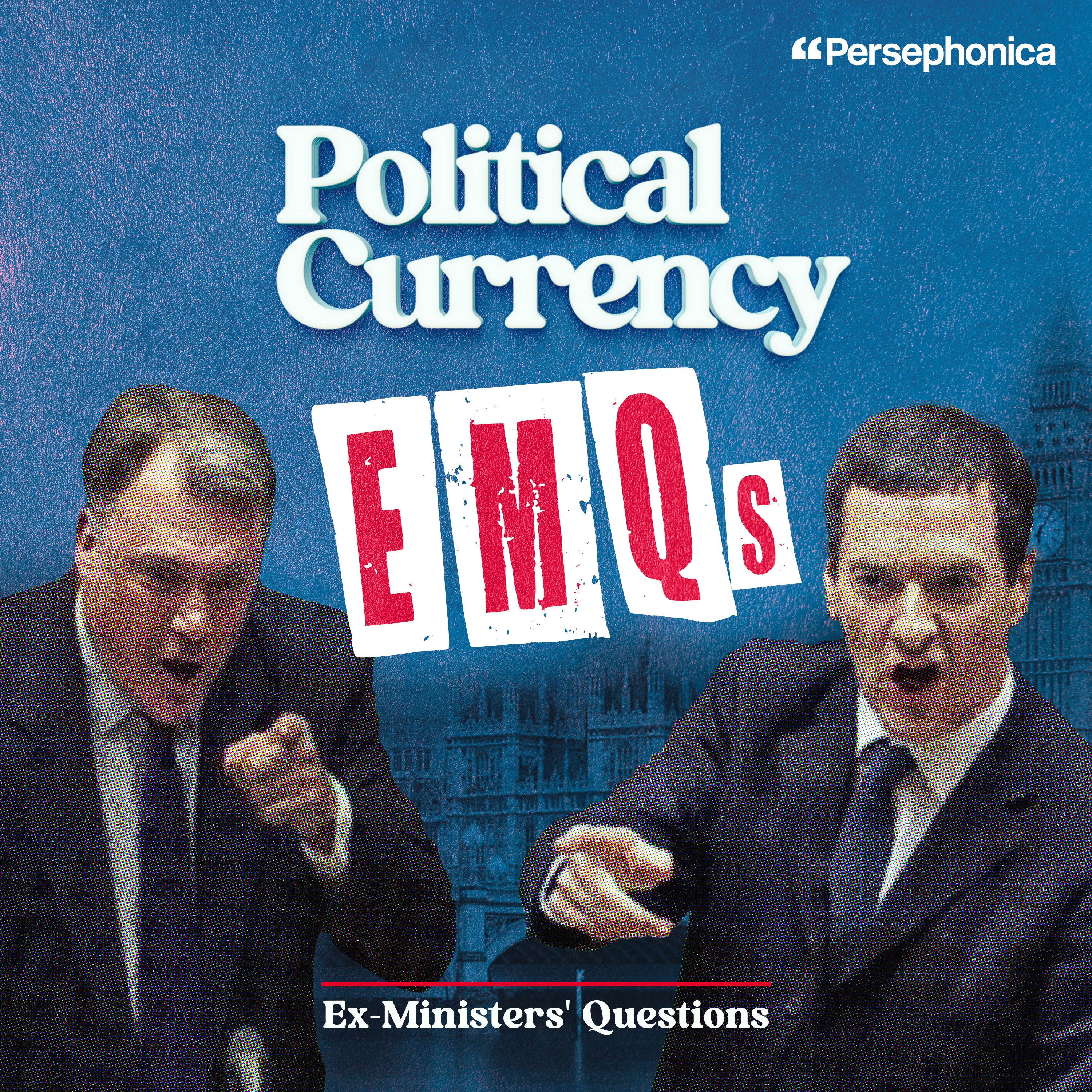
- EMQs: What’s the hardest question you’ve had to answer?
In short
Hosts: Ed Balls & George Osborne
Description
In this episode, Ed Balls and George Osborne reflect on their experiences with tough questions from school children, discuss the political implications of leadership after electoral losses, and analyze Labour's current strategies regarding trade and economic policy.
Written by AI. May contain mistakes.

Ask about this episode
Get the gist, explore an idea or ask about something said.
 Claude
On Political Currency, what are the key points of this episode?
Searching your listeningTranscript
Automatic transcript. May contain errors.
0:00The Chancellor of the Exchequer. Getting a lesson from the Shadow Chancellor on how to balance the books is like getting a lesson from Dracula on how to look after a bloodbath. Ed Balls. A steady-as-she-goes budget. What kind of ship does he think he's on, the Titanic? The Mary Celeste. Welcome to EMQs from Political Currency with Ed Balls and George Osborne.
0:26Hello and welcome to EMQ's Ex-Ministers Questions. Now, in my old life as a Member of Parliament, at this point, I'd have been gearing up on a Thursday, ready, Friday and Saturday, to go and give out mince pies in Asda to constituents. Every year I did it. Nice way to have a chat, give people a calendar for the coming year, find out their issues and just have a nice Christmas time. Did you used to do that? Yeah, I used to visit. There was a lovely charity Christmas card pop-up shop, essentially, above the library in Wilmslow. So that was always part of the constituency regime, which Hayley and Jane, who both helped me in the constituency, would help organize.
1:07And then I'd also go to a kind of Christmas tree farm or place where you can cut your own Christmas tree near Knutsford. That was always quite fun. There was a kind of routine. And then in the House of Commons, I seem to remember the highlight was Father Christmas would visit. And of course, Father Christmas gets around a lot. But the Father Christmas who visited the House of Commons quite often bore a striking resemblance to the Shadow Chancellor, Ed Balls. I did it for 11 years. I've actually got a great story, which is totally true. Unlike all your other stories on this podcast. No, but it's totally true.
1:43First time I did it, and Yvette came and brought our two daughters to see Father Christmas. And I'm the Father Christmas, and there's a long line of MPs and their kids, and she waits, and they come up. I say to the two of them, you know, have you been good this year? and our son actually says what he wants. The youngest daughter says what she wants and our oldest daughter bursts into tears. I mean, it's quite upsetting. But, you know, I've got a staying character. I can't reveal who it is. So I say, oh, you know, don't worry. You know, Father Christmas isn't scary. We'll bring you what you want.
2:09And I was just kind of quite worried about what had happened. Then afterwards, as we were walking away, our oldest daughter, who must have been at the time, eight, Yvette says, you know, it's fine. Don't be upset. It's just Father Christmas. He comes down all the way from Lapland to give out presents, nothing to be scared of. And she says, Mum, she says, Be serious. There are 150 other kids here. Why did it have to be my dad? I can see your point, yeah. I think you're supposed to laugh at that. I mean, honestly, I'm so generous to you. When you tell your stories, I laugh when they're not funny.
2:38That's actually quite a funny story. You sat there completely impassive, like you weren't listening to a word I said. That was a good one. It was a good story. 150 other kids there. Why didn't it have to be my dad? I was feeling a bit for her, you know, embarrassment. Look, all I can say is, as the years went on, it got worse. The embarrassment. My older children, I think, came and got presents from you. They did. If you want to come round to our house and hand out some more presents now to the younger kids, that would be more than welcome. As people who listen to our main episode will know all they're getting is a political currency mug, so I'll come and hand them out.
3:07Ho, ho, ho. And an e-card. But it's not too late to buy that special Christmas subscription of gold or kitchen cabinet membership. Shall we get on to EMQs? We should. Our first question is from Jamie. Hi, Ed and George. Am I the only one that can see Starmer's vision for the country? I'm constantly confused why the media can't see the transformative policies that the government is delivering. So does the media have a blind spot? From my perspective, they're delivering clean power by 2030, which is re-industrialising with green jobs and energy independence. Defence spending is up with manufacturing jobs and tens of billions of pounds in export contracts.
3:42Healthcare modernisation is delivering millions of extra appointments and AI investment is flooding in its tens of billions into data centres and high-tech jobs. They're pushing for 1.5 million new homes, and we're getting trade deals with the US, India and the EU. And didn't we hear recently in the budget that we achieved 1.5 % growth? But a lot of the commentary was talking about where is the growth and the potential for stagflation. And for those that care, immigration is down from almost a million under the Conservatives to just over 200 ,000 this year. So is this not Starmer's positive vision for the country?
4:14And perhaps his low poll writings because the media has a blind spot and focus on style over substance. Interesting thoughts? Give him a job. Do you remember when members of parliament ask questions at PMQs, which are a little bit sycophantic? All the other side shouts, give him a job or give her a job. But I think, you know, Jamie, maybe Jamie could, you know, be the next director of communications that the Labour prime minister hires. Look, George, Jamie might need to be the next health secretary. Let me tell you why. because an interview has dropped while we're recording this podcast from West Streeting on this very subject we're talking about.
4:53The New Statesman kind of headline on X is, I'm pretty frustrated, West Streeting. And he says, Labour's done lots of good things, but there's not a story about what Labour's doing and where it's taking the country. And he says, Labour is in danger of presenting itself as the maintenance department for the country. And doesn't that go to the heart of this question and this challenge? Because, you know, I think that Keir Starmer would totally agree with Jamie's point. Look, so many good things being done on the economy and on waiting lists and night crying down and trade deals. And why aren't we getting credit?
5:30And there may be people who will be thinking, is it a media plot? Is the media being unfair? But as Wes Streeting says, it's not just about the individual policies. It's about the story. and the way in which in politics you measure this in opinion polls is you ask the public, is the country going in the right direction or the wrong direction? And, you know, in a direct YouGov poll, it's not the media answering that question, it's individual voters. And if you haven't got a compelling narrative about what we're for, where we're going, what it's all about, which make people say, yes, I see that, I support it, going in the right direction.
6:06And the problem that the government's got at the moment is on right direction, wrong direction is doing badly. And so it's not enough just to have policies here and there to be the maintenance department of the country. You've also got to have a vision for the country. And I don't think that is something that you can blame the media for. Yeah, I mean, I agree that it's normally a red herring to say, we're doing so many good things, but we're just not getting the credit in the media. And we need a better media story and media plan. or the truth is directly to Jamie's point. Now, I would agree that like some of these things that he lists, you know, are things that a Labour government or indeed any government could be proud of.
6:43But at the same time, the kind of underlying economic situation is real income growth is next to nothing. Jamie says the economy is growing one and a half percent. Well, OK, but that is quite close to stagflation, actually, with the above target inflation. and in lots of these things like clean power by 2030 there's real policy confusion about whether you know they're going to come off that target healthcare modernization well maybe but at the same time the doctors are on strike so it's a bit selective the underlying economic situation isn't great i mean it wasn't that was an inherited position from the last government but the treasury would say but hang on george hang on george france and germany are doing even worse and therefore we're doing better and you think i know but our growth has been downgraded for the next three years and the fact they're doing even worse than us doesn't make you feel some of the fun i would just say to jamie some yeah you're right and some of the so some of the fundamentals aren't great and then to your point it's not just it's not really you're right it's not about having kind of the best spin doctors and you know there's a pretty effective communicators running the operation now tim allen and david dinsmore you've got to have you know the leader has to lead the day the leadership has to provide a compelling that's what leadership is you have to compel people with your vision of the country and your capability to lead people into that future.
8:04You know, as we have discussed on the podcast, and it sounds like where Streeting has been discussing with the new statesman is what has been lacking. But I'm going to make a prediction, which is, I suspect, this is not the last we've heard of Jamie Rich, and he is going to pop up at some future point as a Labour candidate and maybe a Labour MP, because that sounded to me like a question from someone who was correctly got their eye on the top yeah i think i think what he needs to do is go and work in the treasury because i think the one thing you can say is the budget is your biggest moment of the year to sell this story i think they need to find a way to sell it in 2026 yes our next question comes from john uh who's a canadian and his question has been voiced by one of our non-canadian producers hi and george i'm writing to you from the province of nova scotia in canada i enjoy your podcast very much my question is whether a leader of any party in the uk can survive an election loss after leading for months with 20 to 30 point leads in the pools this concerns the election loss of the conservatives here led by pierre poliev as a liberal i said that election was the conservatives to win unless they completely messed it up i look forward to your podcast every week keep up the excellent work so i think the background to this is you have to rewind just over a year.
9:21Justin Trudeau, the Prime Minister of Canada, had been leading the Liberals in a Liberal government for many, many years. And it looked like he was heading for certain defeat. And the winner of the election, the next Canadian Prime Minister, was going to be Pierre Poliev, who was this somewhat sort of populist and, you know, he's a pretty charismatic leader of the Conservatives in Canada. All that changed with essentially three things. First of all, Trudeau resigned, so the liberals had to choose a new leader. Mark Carney put his name into the ring, and he wasn't in Canadian politics, although of course he's a very prominent Canadian and had been governed in the Bank of England.
10:01And then crucially, the third player in all this was Donald Trump, who started saying that Canada should be the 51st state. And Pierre Polo looked a bit like a kind of mini Trump, and Mark Carney looked like the kind of grown-up who could help Canada at this moment of patriotic need. That's the backdrop. But what John is pointing out is that Pierre Polyev lost his own seat in the election, but he has come back and he is once again leading the Conservatives, despite the fact that he led them to defeat. And so John is asking, how on earth is that possible? And would that be possible in Britain? And I guess there are examples of not of, I mean, I guess the most sort of two kind of quite striking examples, and maybe you can explain why it's the case, Ed, are Neil Kinnock and Jeremy Corbyn.
10:50So both are leaders of the Labour Party. In both cases, they go down to an election defeat. Jeremy Corbyn, you know, narrowly loses in 2017 and then is hugely defeated in 2019. Neil Kinnock, which actually may be kind of closer, I think, to this case here, you know, loses the 1987 general election and yet Labour hold on to him and he loses again the 1992 general election. I think the Conservatives essentially would not tolerate that. They would ditch a leader who's lost an election. I'm trying to think of when the Conservatives last sort of held on to some. I mean, Ted Heath tried to stay on after 1974, but Margaret Thatcher from the Shadow Cabinet challenged him for the leadership and he fell.
11:36Could this happen again? Why has it happened in Britain? Are these reasonable examples? Why is the Labour Party more loyal to its unsuccessful leaders? So the question we are asking here is about an opposition leader who is clearly ahead in the polls and then loses. And you picked the two exceptions, Kinnick 87, Corbyn 2017. If you look through history of the last 30, 40 years in Britain, those are exceptions to the rule. So actually, Michael Foote, Kinnick 92, Haig 2001, Howard 2005, Miliband 2015, Corbyn 2019, all of those are opposition leaders who lose an election, then go as the party leader.
12:20So it's unusual to stay on. Well, hold on. Well, I've just thought of one. What about Harold Wilson, losers in 70? Now, he has been the prime minister, but he loses. He then stays as opposition leader and wins again in, there are two elections in 74, but he merges as the winner, right? Yes, although that is where he loses from government rather than losing from opposition. But I do agree with you, that's unusual. It is generally the case. Labour is seen as more loyal to its leaders, isn't it? Or more reluctant to get rid of them. So that might be. Although I think in all of these cases, so in Kinnick 87 and Corbyn 2017, they've only been the leader for a short period.
12:59They were seen to have a better election campaign than expected and a better result than expected. So it is true to say that Neil Kinnock had been ahead of Margaret Thatcher for a period in 1986 by, you know, 10 percentage points, maybe slightly more than that. But frankly, going into the 87 election, nobody thought Labour was going to win that election, I don't think. And actually, Kinnock did better. And the view was, he's on the right path, give him a chance. And in 2017, nobody thought Jeremy Corbyn was going to do well in that election. He actually did better than expected. And he was given a second chance.
13:38And then in 92, when people thought, of course, he should win, and Neil Kinnick, and he lost, but then he was out. So I don't think there's examples of Labour or Tory opposition leaders where the expectation from the polls and the politics is that against an unpopular incumbent government, they should win. They don't win and stay on. There aren't examples of that, which is why I think that John is right to say it wouldn't happen in Britain. And it's surprising that Pierre is still hanging on. Yeah, although I think it's such a particular situation. If it hadn't been for Trump getting elected president, sort of picking on Canada in particular with this rhetoric about the 51st state, Carney entering the race, you know, I can see why you might say, well, OK, it was just unbelievably sort of from the Conservative point of view in Canada, an unbelievably sort of bad luck and bad timing.
14:29And I think it's also true, you know, obviously Mark is a good friend of mine. I think it's important that he, you know, as you lead the Liberal Party in the future, you know, There's always a temptation when you're on a new person to say, well, I'm so completely different from the last guy. People can see that. But some of the underlying kind of issues for why the Liberal Party was becoming unpopular, why it felt like it had been in office for too long, those are things he has to challenge rather than just saying, well, we've solved that by choosing a new leader. I think your Wilson example is interesting.
14:57And actually, of course, the other example is Winston Churchill, who loses in 45 and then wins again in 51. Maybe if you're doing it from government and it's close, and you have standing and reputation. Ramsey McDonald, he wins, doesn't he? He wins, loses, wins. That is true as well. Baldwin. I, though, wonder whether that would happen in modern politics. No. That losing office as prime minister, whether it would be as easy to come back now as it was, that they managed to do it then. Do you know that, Gray? I love that Harold Wilson quote. I might have done it on the podcast before, which I apologise.
15:29But when he loses the election in 1970, there's obviously quite a lot of people inside the Labour Party who say, well, why on earth are we holding on to him as our leader? and there are these big characters like Roy Jenkins angling for the leadership at the time. So there's lots of speculation about the Labour leadership and Harold Wilson's asked by a kind of journalist at the time and he goes, shall I attempt a Harold Wilson accent? It's a bit like a William Hague accent, isn't it? People think, people think I don't know what's going on. I'll tell you what's going on. I'm going on. That's how he deals with it.
16:02That's actually very good. I'm going to commend that impression. It does sound like William Hague doing an impression of Harold Wilson. No, but they do sound very, very similar. But they actually grew up within a few miles of each other, actually. I wasn't criticising. Wilson's from Huddersfield, isn't he? That's it. And Hague grew up on Roth on Dern near Rotherham. They're pretty close to each other. There's actually a rather good statue of Harold Wilson outside Huddersfield train station, if you want to go there. Where's the Hague statue in Roth on Dern? I got that wrong, actually. It's not rock.
16:35It's a waff undone. That's right. I remember now. I wrote enough speeches about William Higgs. You know, where I come from. I think we should take a break and let's have another question. Yes, let's do that.
16:57Welcome back. Our next question is from John. Hi, Ed. Hi, George. Loving the podcast. In light of the most recent bout of Europhobia from the White House in this week's national security strategy, would it not be prudent for Britain to lean away from the US and towards Europe by rejoining the customs union, as a Davey suggested in PMQs? Keir Starmer argued that the US trade deal was too valuable to sacrifice to do this. Is he right? and perversely might not such a display of European common purpose be welcomed by a White House seemingly obsessed with European decline and enfeeblement. Thanks. Thank you very much indeed, John.
17:39And look, it's not just Ed Davey who has been advocating rejoining the Customs Union, something he didn't want to say before the 2024 election, but is now saying. It was reported at the Sunday Times that Manoush Shafiq, the new economic advisor, Takir Starmer, was advocating this behind the scenes. David Lammy then, while speaking to the News Agents podcast, ruminated on rejoining the customs union. And then when asked repeatedly whether the UK should rejoin, said that is not currently our policy. That's not currently where we are. We set some hairs running. And then in PMQ's... We should explain in politics, if you say that's not currently our policy, that implies it might change, right?
18:19If you're a member of the cabinet, when you reply like that. That is what is called setting a hair running. I mean, it was a big hair and it didn't run very fast. And then it got caught by number 10, who contradicted David Lammy. But then Ed Davey raised this. Enough with the hair-coursing analogies. I know. Then Ed Davey raised it in PMQs this week. Shall we have a listen? There's the premise of fear that if he keeps opposing a customs union, in 12 months' time, he will not be standing there.
18:52Mr Speaker, we have got a close relationship with the EU through our reset earlier this year. And yes, I do want a closer relationship with the one we have got at the moment. We are moving towards that. We do have manifested commitments on issues such as single market, customs union and freedom of movement. But I would gently point this out. that having now done significant trade deals with other countries, including the US and India, which are hugely important to the JLR workforce and on pharma, it is not now sensible to unravel what is effectively the best deal with the US that any country has got.
19:31Can I gently point out to the Prime Minister that given we do 20 % of our trade with America, 4 % of our trade with India, and 50 % of our trade with the EU. The idea that you would not rejoin the customs union with the EU because you might lose the India trade deal or even the American trade deal economically makes no sense at all. I mean, there may be a very good reason not to rejoin the customs union, but to lose the American and Indian free trade agreements in order to get a better deal with by far our biggest trading partner, I mean, it doesn't make any economic sense. There's a bit of the inner Liz trust there, wasn't there?
20:09because I don't mean Liz Truss of quasi-quarting mini-budget fame. I'm talking about Liz Truss as trade secretary. And of course, she was a Remainer and campaigned pretty vigorously during the referendum stay in the EU. But when she was trade secretary, she would go around trumpeting these trade deals that she struck. And it was very successful. It was one of the reasons she then won the Tory leadership contest. And it's a sort of Brexit argument that you wouldn't want to rejoin the Customs Union because we've got all these great trade deals around the world. even though all the evidence are that they don't really amount to that much and certainly nothing like the benefits of being inside the EU customs union or indeed the loss of trade with the EU as a result of leaving it.
20:51I mean that's true on the government's own figures the government's own estimates for the impact on the India trade deal and the American trade deal are tiny compared to the government's estimates of the loss of growth and trade from a less good trading arrangement of the European Union. So it's good to have an India trade deal. Yeah. And it'd be good if Europe did. And it's good to have an American trade deal. It'd be good if Europe did. But that is not a compelling economic argument. You know, we should also give the Prime Minister credit for, in the context of being outside the Customers Union, landing those two things.
21:21And although, you know, he says the best deal with the US, of course, what that means is it's the least worst deal with the US, because still high tariffs. But no, anyway, come on, what is Lammy up to? Well, I don't know what David Lammy was up to at that point. Oh, go on. Speculate. No, no. Maybe he got kind of trapped into things there. However, stand back and think about the politics of what's going on. Think about Keir Starmer in 2020 when he became leader of the Labour Party. What preceded Keir Starmer's election as leader of the Labour Party against, you know, a rather kind of Corbyn-y, sceptic backdrop?
21:59he campaigned for a second referendum to rejoin the European Union. And he campaigned for a return to free movement, because he judged that in the Labour Party at the time, those were two very popular positions. Now, I would say compared to 2025, most Labour Party members would think leaving the European Union was even worse than they thought in 2020. They would think that getting back into a closer relationship is a good thing. They would think that a free trade deal with India or America is no compensation for being outside the European Union. I would think if you were any politician at the moment who was thinking to themselves, is my audience not the country, but the Labour Party selectorate, I might think a bit of a lean into pro-Europeanism and soft support for the customs union is good politics.
22:53In fact, you might say that you would be following the Keir Starmer example when he was seeking to be the Labour leader five years ago. Now, I'm not saying that's what David Lammy did because he may have just been... No, because he's utterly loyal to Keir Starmer. He's the Deputy Prime Minister. He may just have been misspeaking, but you could absolutely see how people might think in the current environment this is a sensible, forward-looking, I think in politics you'd call it a soft lean. Well, I agree with David Lammy and I don't agree with Keir Starmer. I think Britain should rejoin the customs union.
23:24I understand that, But I think the actual question is how you could seek to rejoin the customs union. I personally am very sceptical this is possible because I don't think the European Union will want to have us back other than on terms that we wouldn't want to sign up to. And I don't think we will return to the customs union as a non-EU member without them demanding free movement. Look at the route which is currently going on on youth mobility. If the price of rejoining the customs union was free movement, then there's no way we're going to do it. Is there a way to get to a closer trading relationship, a customs union type arrangement, which doesn't require you to sign up to free movement?
24:01If that is on the table as a new arrangement, then you're in business. But I think unless you get to something which is new and different, I think it's very hard. I certainly agree you can kind of dress it up as something bespoke, you know, and the Swiss arrangements are quite kind of unique to Switzerland. But you could dress it up as, OK, Britain's new trade deal with the EU, which looks suspiciously like being a member of the Customs Union. And I think you could concede even with, you know, I'm not blind to all the problems of trying to sell free movement again to the public. But, you know, I have long thought the youth mobility scheme under 30 would be broadly welcomed.
24:36It's not entirely clear to me, even if you're kind of skeptical of immigration, that it's been a great idea of Boris Johnson and co. that we swap hundreds of thousands of immigrants or people coming in from Europe or people coming in from Nigeria and India and so on. I'm not sure why that made much sense. So anyway, I think what it does show, Ed Davies' question in Parliament, David Lammy's intervention, this issue is not at all settled in British politics. Anyone who thinks like Brexit was it, we're not revisiting these issues, decision taken fundamentally because it's been so economically damaging.
25:13as that study showed that was done in America, you know, making Britain 6 % to 8 % of GDP poor than it otherwise would be, and the impact on trade, the question remains very much open. And the Brexiters should have gone for a settlement that more reflected the vote, right? If they'd gone for a, like, 48 % of the country voted to remain, we respect that, so we're going to leave the EU, but we're going to stay in some of the economic arrangements that people want. They would have had a more settled settlement. In the months after the vote, I think it was expected we would stay in the customs union.
25:43The hard Brexit leaving the customs union only happened later. It was hardly mentioned during the campaign and prominent Brexiteers were saying we were going to stay in the single market. Anyway, we're not going to refight that, are we? Let's take our final question after the break from Millie.
26:10Welcome back. So our final question today is from Millie. Hi, Ed and George. I'm a big fan of your podcast and I've got a couple of questions for you. I'm a primary school teacher in North Yorkshire and we recently had a visit from our local MP who came and did a Q &A session with our Year 6 class and school council. They asked him a whole range of questions from whether the Elgin Marble should be returned to Greece to what life was really like as an MP. Perhaps, though, the most awkward moment was when a child asked him, how did you feel when Rishi Sunak sacked you? To which he replied, to be honest, I didn't really mind because I didn't like him anyway.
26:43Interesting answer. So my questions to you are these. One, what is the most awkward question you've been asked by a child on a school visit? And two, do you know of any cases where an MP's career has been effectively destroyed or they've been brought down because of the answer they've given to a question from a child? Thanks very much and keep up the good work. Yeah, well, first of all, I wonder how many North Yorkshire Tory MPs were set by Rishi Sunak. It's presumably got a small group so we can work out. As soon as I was saying, I didn't really mind because I didn't like him anyway. In retrospect, we ought to have worked that out before we recorded this podcast.
27:20We're going to do some scrabbling to answer this. Ellie's going to make her case for Producer of the Year in the 2026 Podcast of the Year Awards by finding the answer to that while we muse on. Do you remember Dan Quayle? Yes. when he was vice president of the United States on a school visit, seeing a child write the word potato, and then he added an E at the end to correct their spelling. On camera. On camera. I don't think that destroyed his vice presidency, but it was a bit of a blow. I mean, that is an example, I thought. I think that's the most famous case of the kind of... Do you remember Tony Blair in 2005 on a school visit just before the election to the Lillian Bayless Technology School in South London?
27:58And there was a chance of out, out, out. It was reported that he had been booed. And Dave Hill, the veteran Labour spin doctor, said, no, no, it wasn't boo. It was boom. That's what they were saying. They were going, boom, boom. And he said, and that is what young people say when they're celebrating a great leader. I don't think he succeeded in that piece of spin, fine spin doctor as he was. But that's another example of a school visit not quite going right. Now, have you heard of Sam Raddings? So he was seven years old at the time. and this was in 2014 so i guess he must be like 18 or so now he asked me a question and i wasn't in a classroom but it was a bunch of school children on a sky interview and i was chancellor and he asked me what seven times eight was oh my gosh and 56 yes well done give him a sticker former education secretary you know i practice those things so often at the time and what i did i didn't say i didn't give the answer i said i'm not going to answer that question right because he just literally asked what's sometimes and i had in my head stephen byers getting the sum wrong do you remember stephen byers i do i do i think he actually was asked that and said 54 or something i can't remember what he was exactly but anyway he got the sum wrong i learned from that that my strategy was to say i will answer that question if you tell me the square root of 15 right square is 15 yeah any old just any random number i know exactly so you say i know they say i don't know i say well in that case if you're not going to answer it neither am i and then we move on yeah because um because you you have to have a way to get out of it without looking like you're not answering the question but so i did i did do a sort of version of like oh no i'm not you know i know that these math questions are you know if i get it wrong anyway but then the you know the questioner kind of went on and said, hold on, you've just been asked by a seven-year-old boy what's seven times eight is Chancellor of the Exchequer and you can't answer it.
29:58And I got absolutely pinned him. Of course, the more I got into it, I then started in my head going, well, it is 56. I could just say 56. Well, is it? Oh no, but was it 50? Anyway, at which point I was like... Is it 54? You're in panic. Anyway, it was brought back. Happy memories of that. Thanks, Millie. The thing I learned on school business, and obviously I did tons of them because I did the education job that you have to have a strategy for the difficult questions but also for how you manage a big assembly and the best thing to do is ask them questions and what i would find is if you ask them questions about you know different things and then you say what is the best thing about your school you could guarantee they put their hands up primary or secondary school definitely in primary school the second child who put their hand up would say the teachers and the teachers the head teacher, they would glow.
30:48Why the second child? They might say at the first, or they might say, you know, the sports field or, you know, something else. But you knew that in the first one or two would be the teachers and the teachers would love it. It's like a massive glow moment. But then I also found that if you said, what else is good about the school? Tell us about the school food. What are the lunches like? Always they would say, they're brilliant. That's what the kids say. And generally that's what they think. I went to the Jack Petchy Academy and I'd done this whole routine in front of, you know, the secondary school, 500 of them.
31:20And I then said, and what's the school food like? And they all went, ah, it's awful. Oh no. I had a letter from the chair of governors saying, how dare I come to their school and embarrass them in front of all of the children by exposing. Anyway, so you have to be careful. The other one, Yvette taught me, she went to a school early on, the primary school early on when she became an MP to pull a cord for a plaque for like a new wing of the school. And she's standing up there doing her speech. And as she's saying, I'm so pleased to be here to pull the cord for my first time as a member of parliament to open this new school building.
31:58This little 70-year-old boy ran up and pulled the cord for her. And she missed her moment because it was already done. Sometimes you can pull the whole thing off the wall by mistake, not the plaque, but the little curtain, if you're not careful. She said to me, if you are ever doing that, hold the cord during your speech. That's a bit like Boris Johnson's rugby tackle, I mean, on the little kid. It's like, push away the children who are trying to... Hold the cord while you're speaking so nobody can nick it off you before you get your moment to pull it. It's a bit like always make sure somebody's got the scissors if you're cutting a ribbon.
32:32The most embarrassing thing is when you get up there and you're about to cut the ribbon and there's no scissors. I mean, what are you supposed to do? And actually, ribbons are quite hard to cut with scissors, aren't they? You have to get the kind of angle right. You're completely right. And that's why as a good new member of parliament, You need to do ribbon cutting practice. You need to make them tauter and then you need to cut them at an angle. Oh my God, the advice you get on this show is invaluable. It is totally invaluable. Thank you for your question, Billy. That's all we've got time for this episode of EMQs.
32:57Oh, hang on. Oh my gosh, Ellie's talking to us. What is it? Alex Shelbrook. Alex Shelbrook. Of course I know Alex. Was he, where was the MP4? Was he Selby? Weatherby, Weatherby. Sacked by Rishi Sudak. When did he get sacked, Ellie? Yeah, Alex Shelbrook's great. We're just hearing in our ears. What was he sacked for? September 22. Part of the Truss administration. MOD minister. And then gets immediately sacked by... So he was appointed by Liz Truss and immediately sacked by Richie Sinek. Oh my goodness. Millie. I'm a big fan of Alex Shelbrook, anyway. And I've just become an even bigger fan when I hear about his answer to the school kids in North Yorkshire.
33:39Very well done. Almost certainly is. That's all we have time for this episode of EMQs. And don't forget, if you haven't already, please vote for us as a people's choice in the Political Podcast of the Year Awards 2026. We won it last year. We're up for it again. Yes, we're up for re-election, aren't we? We are. You know, in these challenging times where it's hard for incumbents, we need your support. You wouldn't want anyone else to. We don't want to do a Kinnick or a Corbyn. No, we don't want to lose. We want to go and win it. We're in the Thatcher-Blair model here of getting re-elected, right?
34:09That is exactly right. Because then we'd have to resign. Yeah. We don't want to do that. All podcast careers end in failure, don't they? You can find the links to how to vote in the show notes. Yeah, and please do keep sending us your voice notes, your emails to questions at politicalcurrency.co.uk. Make sure you review the show as it helps us to reach more listeners. And don't forget, you can still give the gift of political currency mug, card, newsletter, the whole caboodle. Ad-free listening, all that. Remember, early episodes. Kitchen cabinet, ad-free, gold kitchen cabinet. It's fabulous. Why would you want anything else for Christmas?
34:43Why would you? And we'll be back next week with another episode. Yeah. See you then just before Christmas. Merry Christmas. See you soon.
34:57Thanks for listening to Political Currency. This has been a Persephoneca production.
From the publisher
George Osborne and Ed Balls reminisce on their most challenging interviewers…school children. George recalls being asked what seven times eight was, while Ed recounts misfires over school lunches. They also speculate on which Tory MP was glad to be sacked by Rishi Sunak…
Elsewhere, they look at the peculiar case of the Canadian Conservatives where election loser Pierre Poilievre has continued on as leader, and wonder if there are any British equivalents. This allows George to show off his unexpected Harold Wilson impression.
They also question Labour’s continued refusal to consider rejoining the Customs Union, and whether the US/India trade deals are an acceptable substitute. Finally, they give Keir Starmer some benefit of the doubt, as a passionate listener makes the case for Labour’s vision and successes from their first year in government.
We love hearing from you, so please don’t forget to send all your EMQs to questions@politicalcurrency and make sure to include a voice note of your question.
EXCLUSIVE NordVPN Deal ➼ https://nordvpn.com/politicalcurrency Try it risk-free now with a 30-day money-back guarantee!
Thanks for listening. Remember Kitchen Cabinet members get exclusive access to live EMQs recordings, briefings from the team, and an exclusive Political Currency mug PLUS a very special Christmas card from Ed and George: tr.ee/gift-pc
Credits:
Research: Sam Burton
Production: Caillin McDaid & Ellie Jay
Video Editor: Danny Pape
Executive Producer: Ellie Clifford
Political Currency is a Persephonica Production and is part of the Acast Creator Network.
Hosted on Acast. See acast.com/privacy for more information.
More from Political Currency
All episodes

We use cookies.They keep VO running smoothly and help us improve it. Privacy policy