
 Ask ChatGPT


- Podcasts
- Political Currency
- EMQs: What’s your snakiest political move?
In short
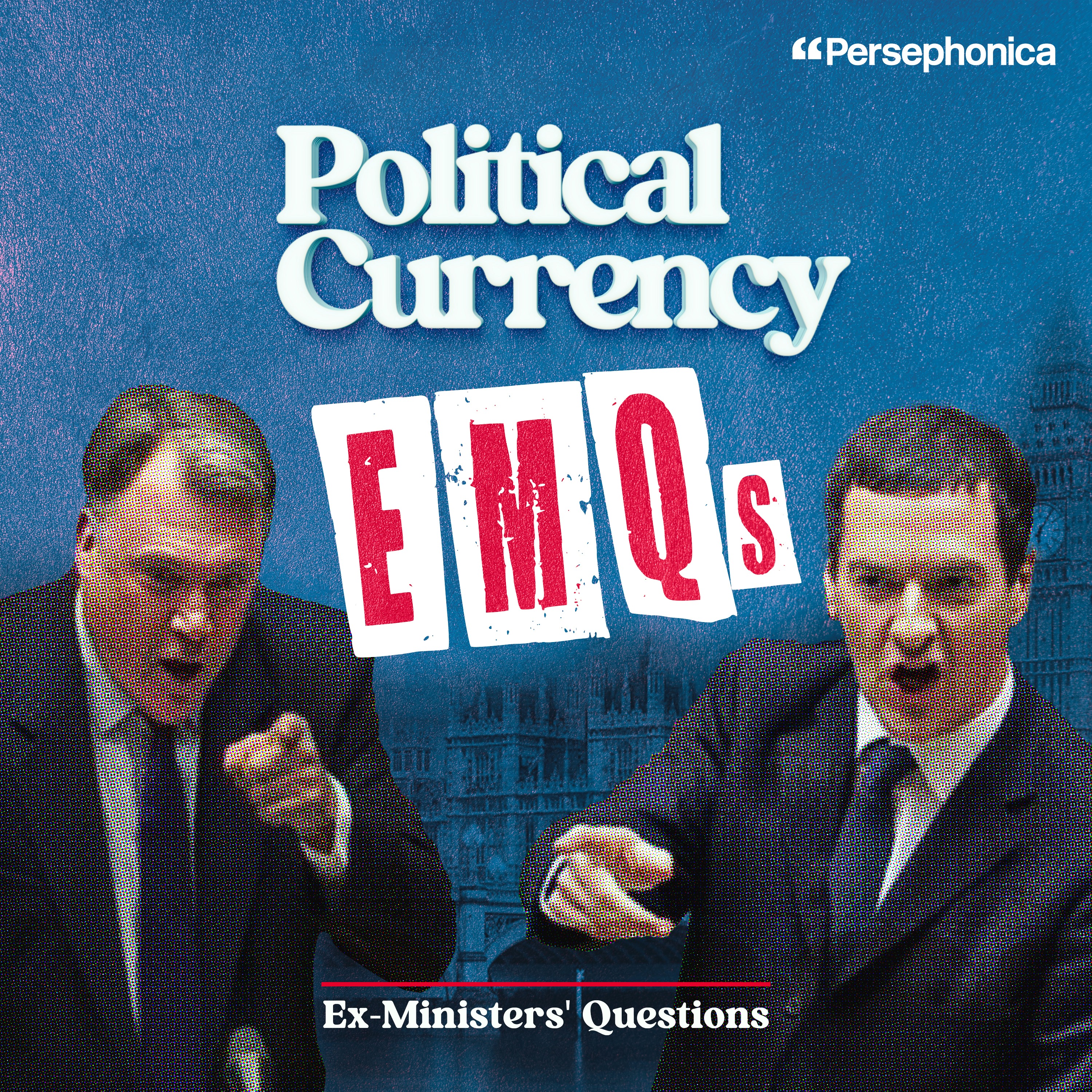
In this episode of Political Currency, hosts Ed Balls and George Osborne engage in a lively discussion about the political landscape, focusing on their "snakiest moves" in politics and reflecting on pivotal moments in their careers. The episode also tackles hypothetical questions about historical political figures and contemporary issues, particularly the gap between public opinion and establishment views on artificial intelligence (AI).
Written by AI. May contain mistakes.
Chapters
0:45
Bacon, Oatmeal, and Show Previews
A humorous exchange about breakfast choices and upcoming gigs.
“where the future is being forged, and having a little bit of, you know, a refueling stop and some nice crispy American bacon.”
1:59
The Snakiest Political Moves
The hosts discuss the nature of being 'snaky' in politics and share personal anecdotes.
“But the good news is, George, we are back on stage Saturday the 7th of February at Dingwalls in Camden for Great Ormond Street Hospital.”
4:15
A Memorable Leadership Contest
George recounts a leadership campaign and the strategies involved in switching allegiances.
“And I've previously been at Ed's gig at the Water Rats.”
10:50
What If John Smith Had Lived?
A fascinating exploration of the hypothetical scenario of John Smith's survival and its political implications.
“It came in in the autumn from a very loyal listener, an old friend of both of ours.”
14:02
The Hypothetical Smith Premiership
Discussion on the potential impact of John Smith's leadership on Labour's success.
“Clement Attlee, I think, got re-elected, but almost immediately fell and so on.”
18:20
Public Sentiment and Leadership Disconnect
Examination of the gap between public opinion and establishment views on key issues.
“And the truth is that that sort of Tony Blair, Middle England touch or his reforming zeal, much harder to do that from the position of Home Secretary than Prime Minister or Chancellor.”
21:31
AI's Role in Economic Growth
Exploration of artificial intelligence as a potential driver for economic progress and living standards.
“And that traces all the way back to the global financial crisis.”
26:15
Democracy's Resilience
Discussion on the strength of democratic powers in the context of global politics.
“democratic power, and it's holding the democratic order.”
27:34
Craig's Report and Its Implications
Reflection on Craig Oliver's report and its potential impact on public discourse.
“provoke conversations like the one we've just had from everybody who reads it.”
28:01
Concert Experiences and Political Reflections
The hosts discuss their experiences at a Taylor Swift concert and its connection to political milestones.
“Any favourite songs, pictures and videos?”
Show all 12 chapters
29:51
Centrist Dad Concerts and Musical Moments
A humorous take on centrist dad concerts and their setlist, including Taylor Swift references.
“Although you had the chance to do it in government, didn't you?”
31:08
Family Outings and Musical Preferences
The hosts share anecdotes about family outings to performances and their children's musical tastes.
“No because, you know, it's a centrist dad version Pink Pony Club is also a gay anthem, isn't it?”

Ask about this episode
Get the gist, explore an idea or ask about something said.
 Claude
On Political Currency, what are the key points of this episode?
Searching your listeningTranscript
Automatic transcript. May contain errors.
0:00The Chancellor of the Exchequer. Getting a lesson from the Shadow Chancellor on how to balance the books is like getting a lesson from Dracula on how to look after a bloodbath. Ed Balls. A steady as she goes budget. What kind of ship does he think he's on, the Titanic? Welcome to EMQs from Political Currency with Ed Balls and George Osborne.
0:27So hello and welcome to EMQ's Ex-Ministers Questions. I've been wanting to get on with this podcast and our EMQ's edition, but George has been eating bacon in such a sort of unsightly and messy manner that we just had to wait. But, you know, is it finally clear? I'm sorry. It's the early hours of the morning here in Silicon Valley, where the future is being forged, and having a little bit of, you know, a refueling stop and some nice crispy American bacon. You know, Americans do that crispy bacon in a way that no one else does. You know, I don't know if you've ever tried doing it properly in Britain.
1:02It's just not as crispy. And I've got some what's called steel cut oatmeal. I mean, I'm not sure what other way there is to cut oatmeal, but my steel cut oatmeal is also very nice. Thank you very much. I'm touched for your concern. Eggs, is the over sunny side up? No, I decided I thought the eggs would be a bit messy whilst also trying to record this thing perched in my hotel bedroom. Look, it's been pretty messy watching the bacon, I've got to tell you. Anyway. You know, I would have thought as a rock star, you know, you're used to eating at all hours. And, you know, you finish up in the early hours of the morning after the after show party.
1:39Do you not grab yourself some crispy bacon as you come down from the post gig high? Look, you missed our last gig, so you have no idea quite what a triumph it was. In particular, Chapel Row and Pink Pony Club was really good and sold out. A load of our Political Currency kitchen cabinet and gold subscribers came along, which was great. But the good news is, George, we are back on stage Saturday the 7th of February at Dingwalls in Camden for Great Ormond Street Hospital. and give you a little preview. New songs coming up include Human League and Soft Cell. We're going to do Tainted Love. A bit more retro than Pink Pony Club.
2:19Yes, but, you know, that's what we do. I mean, they'll all have a centrist dad take. We're also going to do some Blondie, which is also retro. But, you know, alongside some Smiths and Charlie XCX. So don't worry. The music from your era will all be in there too. Right. You were telling me about this and I couldn't work out whether you are the support band or you are being supported by that legendary other group that has Floella Benjamin as the lead singer and Ken Follett, the writer, isn't it? That's right. Ken Follett, the writer, is a brilliant bass player, and he's had a series of bands over the years.
2:57And Ken and I were chatting. A bit like Paul McCartney, I was thinking. A bit like Paul McCartney, except for Ken writes novels rather than kind of songs. But even so, in different bands he's played in over the years, he's had Floella Benjamin, famous for Play School and Play Away, and now a Liberal Democrat peer as their singer. Baroness Benjamin. Baroness Benjamin. And so, you know, these rock stars, they always they always sell out and take a title, don't they? So you can come along on the 7th of February and see Centrist Dad and Vintage. We're going to play first. I don't know whether that makes us the support band or not.
3:30We are definitely supporting them, but they're also supporting us. And it will be a great evening for a great cause. And I hope you will come. And if our listeners want to come along, we'd love to see you. I don't think the Rolling Stones go first on the evening, do they? I know but honestly George it's okay it's okay it doesn't have to be all about kind of ego I mean you know no I spent my entire political career being number two it's fine I know I'm just hoping that we're not going to get sacked by the venue we have got some EMQs to do haven't we and the first question comes from Will who actually was at the gig you did before Christmas hi both it's Will from London and as a Kitchen Cabinet member I was at the South by Southwest live podcast in Shoreditch.
4:17And I've previously been at Ed's gig at the Water Rats. I'm both a big fan of the pod and the band. In politics, how snaky do you have to be to get to the top? And what are both your individual snakiest moves you've made, either in politics or, in George's case, during one of his many jobs? Thank you both. Goodness. Your snakiest move. Don't you think that the key thing to say here to Will is that everybody in politics who gets to the top probably has snaky moments. But what you don't want to do is be seen to be a snaky politician. If you are, on the one hand, a bruiser, or if you are, on the other hand, a pushover, or if you are somebody who is distrustful and a bit snaky and snarky, then probably that is limiting for your career.
5:02What you need to be is authentic and have clarity of purpose and be a team builder. You might have the odd snaky moment in secret, but I don't think you ever admit to them. Okay, but you haven't actually answered the question that will, who, to be fair to him, has put this question at our South by Southwest event and came to your gig. So come on, I think you own. What's your snakiest move? Well, see, I know what you're doing here. I mean, you've got so many. I know what you're doing here, not answering the question. You've got so many snaky moments in your list you try to work out which is your snakiest.
5:34And so you're buying time. Let me think. here was a story I think I've mentioned on the podcast before 2001 I didn't want to go into parliament because I wanted to see through the euro assessment from the treasury Once again putting nation above I mean you know may I just say what a good decision it was not to join the single currency in 2003 but the next door seat to Yvette was a Labour MP called Bill O 'Brien very lovely man, expert in local government just passed away last year And he was getting on. He was well beyond retirement age. And he and his wife thought it was time for him to retire.
6:12So Gordon Brown and I had to invite him into Downing Street. It was the opposite of what normally happens. Normally, people get invited in for you to say to them, Bill, it's time for you to stand aside, go into the Lords and serve in a different way. we had to say to him, Bill, it's much too early for you to retire. It may be what you want to do, but the nation needs you. And we had to persuade him to stay as an MP for four more years, between 2001 and 2005, by which time we'd done the euro assessment and I could leave the Treasury. So that was a bit snaky, don't you think, persuading him not to stand down as an MP?
6:42Yeah, but I bet there have been some snakier moves, which you're not telling me about. Yeah, but not that I'm going to admit to. I referred to you my answer a moment ago. I mean, I had various manoeuvres to get people into seats and stuff. I don't think they were, I'm not sure I'd call them snaky. There was one very nice Conservative MP who became a member of the House of Lords so that one of the seats could be vacated. I think you're doing what I was doing now and not answering the question. No, no, I was thinking of something which was quite mean. I was actually pretty junior. This was during the Tory leadership contest of 2005 when I was chairing David Cameron's leadership campaign.
7:22And when I say chair, I mean, David chaired his own leadership campaign, really. He was very much, you know, driving the campaign. But I was chair of the campaign and I was, you know, one of his key MPs were backing him. At the start, there were only six of us, famously. I mean, famously, if you remember back then. So you were his top snake. Well, we were trying to get the numbers. We had a really good whip on the campaign, Andrew Robufan. And he was doing the counting and there were only six MPs to start. And David Davis was the opponent and he had all the momentum to begin with. And, you know, it looked like he was going to win.
7:54And David and the other candidates in that contest, Liam Fox and I, looked like they were going to be also runs. And therefore, a lot of people have kind of signed up to David Davis. I should say I've got a lot of time for David Davis. And in fact, I was speaking to him on the phone just a few weeks ago. So this is not really a criticism of him. He just had the momentum. And so people were attaching themselves to his campaign who weren't kind of true believers, really. They just thought the guy's going to win. Anyway, then the momentum shifted dramatically at the Tory party conference. David Cameron gave the speech and, you know, there were some focus groups on television that suggested Cameron was a better candidate for the Tories and so on.
8:30And therefore people started to kind of switch back. And my job was to get people to kind of come off the Davis campaign onto the Cameron campaign. And of course, that's a double win. That's like Davis's campaign's falling apart, the Cameron campaign's powering on. And there was one particular MP who I was quite friendly with and still am. And he came to me privately and said, I'm going to switch back to Cameron. And he'd been a pretty prominent supporter of Davis and an unlikely supporter of Davis, you know. And he says, you know, I've made a huge mistake. I should never have supported David Davis.
9:03I was always more naturally a David Cameron supporter. Can I switch back? but I don't want to make a big noise about it. And I said, no, no, no, of course not. We won't make any noise about it at all. You know, we'll let it all be done quietly. So I had that conversation. And overnight, he phones me up and he goes like, oh, I've had such a change of heart. I'm going to look like so awful if I switch sides. And I know I've made the wrong choice, but I'm just going to have to live with it. And I get, well, yeah, but unfortunately, you have told me that you are switching back. And now I'm in a really difficult position because I'm going to have to go and tell everyone that you've been talking to our camp about switching back.
9:38You're kind of caught on the wire. You were trying to escape from the prison and now you're on the wire and the searchlight's on you. So unless you come over to us, I'm going to tell everyone that you've been talking to us about coming over to us. He was pretty distraught about this, I'm afraid to say. But, you know, all's fair in love, war and leadership contests. And so in the end, he said, oh, I better go right. I'm coming over to you. Is he a friend or an ex-friend? I'm still a friend of mine. In fact, I was messaging him the other day. I don't think it would be fair to say who it is. Could you explain why it's not fair?
10:07Because it doesn't seem to me to be, I mean, it's you the one who's being snaky. He was being honourable and principled. Well, he wasn't really. He was trying to switch from, he'd backed a candidate he thought was going to win and then the momentum changed and he tried to switch and then had second thoughts about it. Having considered it, he then decided to do the honourable thing rather than the self-interested thing and you stopped him doing the honourable thing. So in that sense, I think it paints him in quite a good light. I think you should name him. No, I can't. Give us a clue. It's called David.
10:35They're all called David in this story. He's called Daisy. Oh, he's not David Gork. I'm not going to go further into that. No, I mean, we love David Gork anyway. He wouldn't be David Gork. But that doesn't mean we're going to go through a list. Shall we go on to the second question? OK, the next question. This is partly my fault. It came in in the autumn from a very loyal listener, an old friend of both of ours. And it was for the What If episode, which came out just after Christmas. And I hope you enjoyed that if you've listened to it. And if not, go back and have a listen. But this what if question inadvertently didn't make the cut.
11:09And so we're going to answer it today. G'day, Ed and George. Chris Bowen, Australia's Minister for Climate Change and Energy. A very old buddy of Ed's. And George and I were briefly overlapping as finance ministers. When George was Chancellor, I was briefly Treasurer of Australia, which is what we call Finance Minister here. And we interacted then. That was before I moved on to better things to become climate change and energy minister of Australia. Anyway, my what if is what if John Smith had survived his heart attack in 1994? What would that have meant for Gordon Brown and Tony Blair? I have a theory that John Smith still would have won the 1997 election with a reduced majority and that presumably Gordon Brown would have been Chancellor, Tony Blair would have been Home Secretary.
12:00And John Smith probably would have served a term and a half or two. And Gordon Brown would have been in a much stronger position to take over as Prime Minister at that point. And Tony Blair would have had to wait a lot longer. Or maybe the Blair Prime Ministership never would have been. What do you think? What if John Smith had lived? Well, it's great to know that we're being listened to in the Australian Cabinet as well as the British Cabinet. And fantastic to hear from Chris. We weren't partners in the finance community for that long, but I absolutely remember some good conversations with him.
12:34This is a really good question, isn't it? And I basically agree with his proposition with one qualification. So he's saying if John Smith hadn't died, John Smith would have won the 97 election. I think that's true. I mean, he was already way ahead. Black Wednesday had happened. The major government was finished. But probably it would not have been such a convincing, massive win. But who knows? You know, maybe they wouldn't have got such a big majority in 97. Gordon Brown would have been the chancellor because he was shadow chancellor. And Tony Blair would have been the home secretary. But you can well see that once a sort of change of leadership happened, you know, maybe the party wouldn't want to move in a more rightward direction, if that's the correct way of characterising it.
13:16Often parties in office, when they change leader, head more towards their base. So if you think of like the kind of contest in the Labour party. At the moment of who might take over, there's lots of talk of who's playing to the kind of Labour base. Now, Tony Blair wouldn't have been averse to doing that, but I think Gordon Brown would have been in a kind of probably a stronger position to do that. All that said, here are some qualifications. First of all, having had a kind of Scottish bank manager, prime minister, they might not have wanted another Scottish bank manager, prime minister. So Gordon Brown might have looked too similar to John Smith.
13:47Second, I query whether John Smith would have won re-election, which is kind of Chris's proposition here. Because of course, until Tony Blair wins re-election in 2001, no Labour prime minister has ever successfully got re-elected and served more than a year or two afterwards. Clement Attlee, I think, got re-elected, but almost immediately fell and so on. And, you know, there's a sort of proposition here that that Smith government would have been a success and Smith would have made a success of being prime minister and would have been re-elected. But, you know, you can definitely see a scenario in which that would be the case.
14:19And then I guess my third question is, you know, if the Smith premiership had been a success, then, you know, when it came to a change, maybe that would have happened later in opposition when he's defeated in an election. Or even if it's some time down the track, maybe the party would have gone for a kind of very much younger generation as often is the case. And Gordon Brown and Tony Blair would have been these very prominent senior members of the cabinet who may well have fallen by the wayside by then, as often is, you know, Quite often, Home Secretaries and Chancellors and whatever have been fired by that point.
14:51Certainly by the point that a Prime Minister is having to resign and be replaced. So I think there's quite a lot of qualifications there. I would say it would have been much more likely that Tony Blair wouldn't have been Prime Minister if John Smith had lived. I think I largely agree with you and with Chris's scenario. I have some counters and they're slightly different from yours. I think if you talk to Tony Blair and Gordon Brown in 1994, both of them were very worried that John Smith's strategy was much too steady as she goes. If we just carry on as we are, we'll win in 1997. There was deep frustration that there wasn't enough of a modernising drive, what you would call after 94, a new Labour approach.
15:38And that was something that Tony Blair and Gordon Brown both felt. And if you remember, the autumn of 1993, John Smith was talking about trade union rights from day one and all the levers of economic policy to deliver full employment. And Gordon Brown and Tony Blair were worried about that positioning. So I think the best counter to Chris is that does John Smith not win in 1997? However, you know, a bit like Rishi Sunak in 2024, it was an election that the Conservatives were going to lose in 97 rather than necessarily Labour were going to win. I don't think Tony Blair and Gordon Brown were expecting a landslide, but I think it really happened because of a rejection of the Conservatives in 1997.
16:19So I do think John Smith would have won and won with a big majority. Once you take that as a given, the economy was strong in 97 to 2001. Gordon Brown, all the way through to 2005, was always comfortably in the public's mind in poll position to take over from Tony Blair. There's no reason to think that he wouldn't have been in poll position to take over from John Smith in that period. And John Smith, who is markedly older than Gordon Brown and Tony Blair, I mean, it's hard to see John Smith serving for three terms as Prime Minister. So I think there would have been a transition in government. I think the one thing you can markedly say is that I don't think John Smith would have taken Britain into the Iraq War in 2002-03, which was probably the thing which was mostly stabilising for Labour's election chances in 2005.
17:08So I don't really believe that Labour would have been less likely to win in 2001 and 2005, unless you think somehow that William Hague would have done better or Ian Duncan Smith would have been chosen as Conservative leader. Yeah, but hold on, John Smith did not have that appeal to the Tory heartlands that Tony Blair did. And, you know, Tony Blair locked up Middle England for a decade, didn't he? And I don't think John Smith was ever going to do that. But neither did Keir Starmer in 2024. And he still won a landslide majority. Yeah, but the Keir Starmer premiership might be more of akin to what might have happened to the John Smith.
17:40If you say that Tony Blair won in 2001, despite the performance of Gordon Brown, the economy and the Labour government. No, no, I think that all helped enormously. Yeah, yeah. But I also think Blair's appeal made it extremely hard for the Conservatives to get in. I think that's right, which is why I think it was a better outcome for Labour to have Tony Blair fighting the election in 2001 than it would have been to have had John Smith. But I do think John Smith would have won in 97 and 2001. So that's not an anti-Tony Blair thing. The other interesting question to ask is, if Tony Blair had not been the prime minister and John Smith had been the prime minister instead, would that have made it harder for Gordon Brown to be chanced?
18:17Would he have taken a different path? I don't think so. So then the other question is, would Tony Blair have been more popular than Gordon Brown if he had been the Home Secretary under John Smith in 97 to 2001 to 2005? And the truth is that that sort of Tony Blair, Middle England touch or his reforming zeal, much harder to do that from the position of Home Secretary than Prime Minister or Chancellor. So it's hard to see how Tony Blair would have found it easy to displace Gordon Brown once you get beyond 1997. I think that the time for Tony Blair to become the leader was 94. And that's what happened.
18:57Although you don't think there would have been a bit of like too Scottish. Look, I think that is your best argument or the best argument. But I just think that Gordon Brown standing in that first parliament with the public was very strong. I mean, as it happens, by the way, Tony Blair was Scottish as well. and had been to a Scottish private school. But put that to one side. I like the way you get the private school. No, I don't think that, you know, I think it would have been a factor, but I don't think it would have been a decisive factor. I think Gordon Brown at that point was just too strong.
19:29Do you think John Smith would have allowed Gordon Brown to make the bank independent? He was much more cautious. By that point, there was a kind of new labour. We can do anything. Let's be radical. I can imagine a much more cautious John Smith saying, well, you know what, Gordon, let's just settle in a bit. Yeah, but I was close to John Smith and I'd have persuaded him. The real voice of Middle England in the new Labour movement. I actually was invited to a Fabian event with David Ward, who was John Smith's economic advisor, while John Smith was the leader, where I advocated making the Bank of England independent.
20:02I don't remember getting a big blowback from David Ward or John Smith. He was already in the public domain, that argument, at the time. So, no, I'm not sure about that. It was not Browns, it was Balls, as Michael Helfstein said. Come on. So fundamentally, what I'm saying is I agree with Chris. Chris Bowen, you're right. Yep. I think we both basically agree with him. So let's take a break and we're going to be back again with another question for someone we both know.
20:34Welcome back. Now, our next question comes from someone I work very closely with in government, Craig Oliver. Hi Ed and George, Happy New Year and good to have you back. I've been working on FGS Global Radar, a big report looking at the key themes of the year ahead. We spoke to 175 top opinion formers in business, politics and media. We also did representative polls in the US, Canada, UK, the EU and Japan, a total of 20 ,000 people. Two things stuck out. The wide gap between establishment opinion, where there's broad agreement we should let AI flourish, cut public spending and incentivise entrepreneurs, and the public, who are diametrically opposed to those things.
21:13Second, pessimism in the public feels like it's reaching crisis levels. 89 % of people say the UK is divided. 73 % believe life will be harder for the next generation. And 69 % believe democracy is weakening. My question is simple. What can we do about this? I think Craig is right, both about pessimism and about that dislocation happening between publics and leaders. And that traces all the way back to the global financial crisis. But so does the underlying problem, which is the stagnation of living standards, which has gripped Europe and for most of those years, the United States back since 2007-8.
21:53And so I think the answer is leaders, political leaders, rebuilding confidence amongst publics that they will feel better off. And that all does come back to economic growth and how we drive growth in our economies individually and together. Now, in the last few years, America's bucked the trend and had stronger growth. We haven't seen that in Britain and across Europe. It worries me that the global trading system is fracturing and becoming more contested and uncooperative because that will hamper growth. But maybe the one place where elites are right compared to the public is around AI. Maybe AI is going to be the thing which even though publics are worried about it, what it will mean for jobs, what it will mean for social media and their lives, for their security, maybe AI is going to deliver the productivity boost which will drive growth and therefore make people feel better off and less pessimistic.
22:55So how does that look for Silicon Valley? Yeah, I mean, I think it's interesting. I mean, I've just started working at the big AI company, OpenAI. I think if you take, you know, a classic view of economic progress is lasting economic growth is driven by productivity gains. I don't think anyone doubts that AI represents an incredible kind of productivity moment for human beings in all sorts of fields, medicine, education, professional services, and so on. One way of thinking about it is it is putting information and power into the hands of the many in a way that has not been seen before in history.
23:31That would suggest that your economy is going to do much better in the years ahead. And there are some pretty stunning projections for the US economy in the next 10, 15 years, where some people are predicting, now personally, I think this is the very top end of optimism, that the American economy might in some years grow like 10-15 % as the AI revolution really takes hold. But even if you get like a 1 % or 2 % increase in economic performance, that would be really marked and deliver substantial improvements in living standards. And that should kind of solve the issue to a degree of like, is the economy delivering?
24:09But of course, one of the great challenges for AI is, you know, where are the gains going to be felt? And so the mission statement of OpenAI is that the benefits of AI are widely shared and felt by all. And that's going to be a big challenge for policymakers because this technological change is also going to bring a big dislocation in jobs, as other technological changes before have brought. And the period of transition, particularly if it's rapid, can be quite difficult for people. I think also AI is the solution to this kind of problem, which I think a lot of Western countries are facing, which is how do you get our public services on limited budgets and debted economies to deliver what people expect And, you know, here people like the Tony Blair Institute have done lots of work on, you know, how really the solution is in education and healthcare systems and the like is to try and get artificial intelligence more into them.
24:59And quite interesting to see various countries around the world signing agreements with the Silicon Valley companies on their education systems and AI. So all of that should lead you to some optimism that economies are going to be able to sustain higher living standards. Clearly leads to policy questions about where the benefits are going to be felt. And then on the question of democracy, I've got a slightly controversial response to Craig here. When it comes back to our main podcast on Venezuela, there is no country in the world other than the United States that could have done in Venezuela what the US did.
25:31You know, the Chinese do not have, the Russians do not have, let alone any other country, the power to shut down the electricity of an entire city, suppress its air defences, send in an elite special force squadron, seize the president of a foreign country who knows it's coming. And you remember the action that they took over Iran as well to get rid of its nuclear facilities and so on, or cripple them. You know, the United States remains the absolute preeminent military power, quite a long way ahead of its main competitors. And for all the pain of American domestic politics and division and controversy, it is a democracy.
26:09So for people who feel like democracy is getting less of a grip in the world. I would still say the preeminent power is the democratic power, and it's holding the democratic order. And I don't see at the moment, I think 10 years ago, you would have said, oh, I don't know, 10 years time, it'll be the US and China kind of going toe to toe. I don't think that's how it feels at the moment, particularly on the kind of military front. And as we were discussing our main podcast, it's that US military might that is essentially underpinning the democratic order. I don't disagree with your big point, although just to say there is a counter argument on Venezuela, which is, you know, was this an American operation or fundamentally, was it actually the Venezuelan political system saying to America, do you mind cooperating with us to remove this corrupt and failing president?
27:00I mean, do we know that the vice president, Delcy Rodriguez, and her brother, who's a powerful political player in Venezuela and who was reportedly speaking to the White House a year ago about whether or not the president should be removed. Are we sure that senior politicians and the senior military in Venezuela didn't cooperate with the Americans to have Maduro removed? And so, you know, but I'm still saying that the strongest power in the world is a democratic power. Sure. Anyway, as I said, I agree with your big point. And it would be a very different world if the strongest military power in the world was not a democratic power.
27:33It feels to me as though Craig Oliver's report from FGS Radar is something which is going to be provoke conversations like the one we've just had from everybody who reads it. So thank you for that question, Craig. Shall we take an ad break and then have one more question?
27:57Welcome back. Our final question is from Jasleen. Ever since I found out George Osborne and David Cameron went to the Airers tour together last year, I've been dying for more information. Any favourite songs, pictures and videos? Also, I need to know if you guys went crazy for the Let Me See Your Hands part of You Need to Calm Down as members of the first government to legalise gay marriage in the UK. Love the podcast. Did you go crazy in the Airers tour on your David Cameron freebie for the Let Me See Your Hands part of You Need to Calm Down? The first thing I need to say, Jasleen, is that there are limitations still to AI.
28:30Because in the automatic transcribing of your question, which we get, the ERAs tour has come out as aerosol. If you look at the script. That's true. It says George and David Cameron went to the aerosol together last year. Yeah. But you and I, Jasleen, know we're talking about the ERAs tour. We knew what it was. I have to admit, I was at the ERAs tour. I have to admit. I know. I seem to remember it was on the front page of the ERAs. It was. I know. I know. I have to remember. By the way, I took the foreign secretary at the time. And it's so unfair, isn't it? No one seemed to care about that. Well, I also took the foreign secretary to be.
29:05I mean, it was a great concert. I have personally no memory of singing along to You Need to Calm Down. And I certainly didn't know the words. But I do know that it is a LGBT anthem and sung by the songwriter of this generation. and in a concert. I was at Wembley, which demonstrated that she is the live performer of this generation. And whether you knew it was a tribute to your work on gay marriage, I've no idea. I didn't, although it's very nice of Jasleen to remind us of that landmark legislation. Got through with Labour votes despite hostility from many Conservatives in Parliament? Yeah, sure.
29:48So it was a cooperative effort. It was a centrist dad moment. Yeah. Although you had the chance to do it in government, didn't you? Well, hang on a sec. I have a feeling that when we came into government in 1997, we were still dealing with Section 28. And I think civil partnerships may have been quite a big step forward on the road. I voted to get rid of Section 28. And I was one of the small number of Tory MPs who joined a very large number of Labour MPs doing that. I'll tell you what my highlight was. I mean, I thought it was brilliant and fantastic. And actually, I went with my son and he was a bit like I was going to go with my daughter and she couldn't make it.
30:22And then my son was like, oh, do I want to go to a Taylor Swift concert? And I said, yeah, come and see the big show. And he loved it. I loved it. David loved it. And David's daughter loved it. A love story was the best moment for me. That was, you know, pulled out a ring and said, marry me, Juliet. Why have you not got a Taylor Swift song in your Centrist Dad hit? We do. You didn't turn up to the water routes before Christmas. is we do Shake It Off and shake it off, shake it off and if you come to Dingwall's on the 7th of February, we will again do Taylor Swift Robert Peston as Taylor Swift and Chaperone, I mean and Blondie.
31:06Does he wear a pink cowboy hat and cowboy boots and all that? No because, you know, it's a centrist dad version Pink Pony Club is also a gay anthem, isn't it? Absolutely It's also just a great great song so um thank you jasmine for that brilliant question i took uh my my much younger son beau to uh jack and the beanstalk just before christmas a pantomime and they ended at this was the lyric theater in hamsworth really good production actually and um an unusual production and uh they ended with pink pony club at the end of that as well i mean bring him along to dingwalls he'll love it you might have to wear those little you know the kids at the concerts where they wear those little headsets to kind of protect their...
31:48Because your pest and singing is so loud, the drumming of yours is so loud. Yeah. I think it might raise child protection. It's a wall of noise. Thank you for your question, Gensley. That's all we've got time for in this episode of EMQs. Yes, please do keep sending in your voice notes, your emails, questions at politicalcurrency.co.uk. Make sure you review the show as it helps other people find us. I'm laughing because the only bit of our podcast which is scripted is the first four sentences and the last four sentences. And every time we do this podcast, which we now have done well over 100 times, at the point when I do the final read, George shuffles around, you know, trying to move the bacon and the steel cut oats off his desk to find the thing he's supposed to say.
32:33Anyway, please do keep sending us your voice notes. Did you say that bit? Yes, I did. You're not even paying attention. Stick to the script, balls. We will be back next week with another episode of our main podcast. and EMQs. We will see you then. See you.
32:54Thanks for listening to Political Currency. This has been a Persephoneca production.
From the publisher
In the first EMQs of 2026 Ed Balls and George Osborne answer the most important question for any politician: what was your snakiest move? The pair share each of their proudest (and least proud) moments of cunning, as well as some hard-won advice on when being snakey can pay off.
They then turn to a question missed from our last ‘What If’ episode from Australian cabinet member Chris Bowen, who wonders what would happen if John Smith had lived. What would have become of Tony Blair, Gordon Brown, and, most importantly, Ed?
George’s old Downing Street colleague Craig Oliver also asks a question concerning the gap between establishment and public opinion on AI which allows George to flex his new OpenAI knowledge. Finally, they answer the question on everyone’s minds: what was their favourite song from the Eras Tour?
We love hearing from you, so please don’t forget to send all your EMQs to questions@politicalcurrency and make sure to include a voice note of your question.
Thanks for listening. To get episodes early and ad- free join Political Currency Gold or our Kitchen Cabinet. If you want even more perks including our exclusive newsletter, join our Kitchen Cabinet today:
👉 patreon.com/politicalcurrency
Please note: Kitchen Cabinet is only available via Patreon.
Credits:
Research: Sam Burton
Production: Caillin McDaid and Caitlin Hanrahan
Video Editor: Avi Asher
Executive Producer: Ellie Clifford
Political Currency is a Persephonica Production and is part of the Acast Creator Network.
Hosted on Acast. See acast.com/privacy for more information.
More from Political Currency
All episodes

We use cookies.They keep VO running smoothly and help us improve it. Privacy policy