
 Ask ChatGPT


- Podcasts
- Political Currency
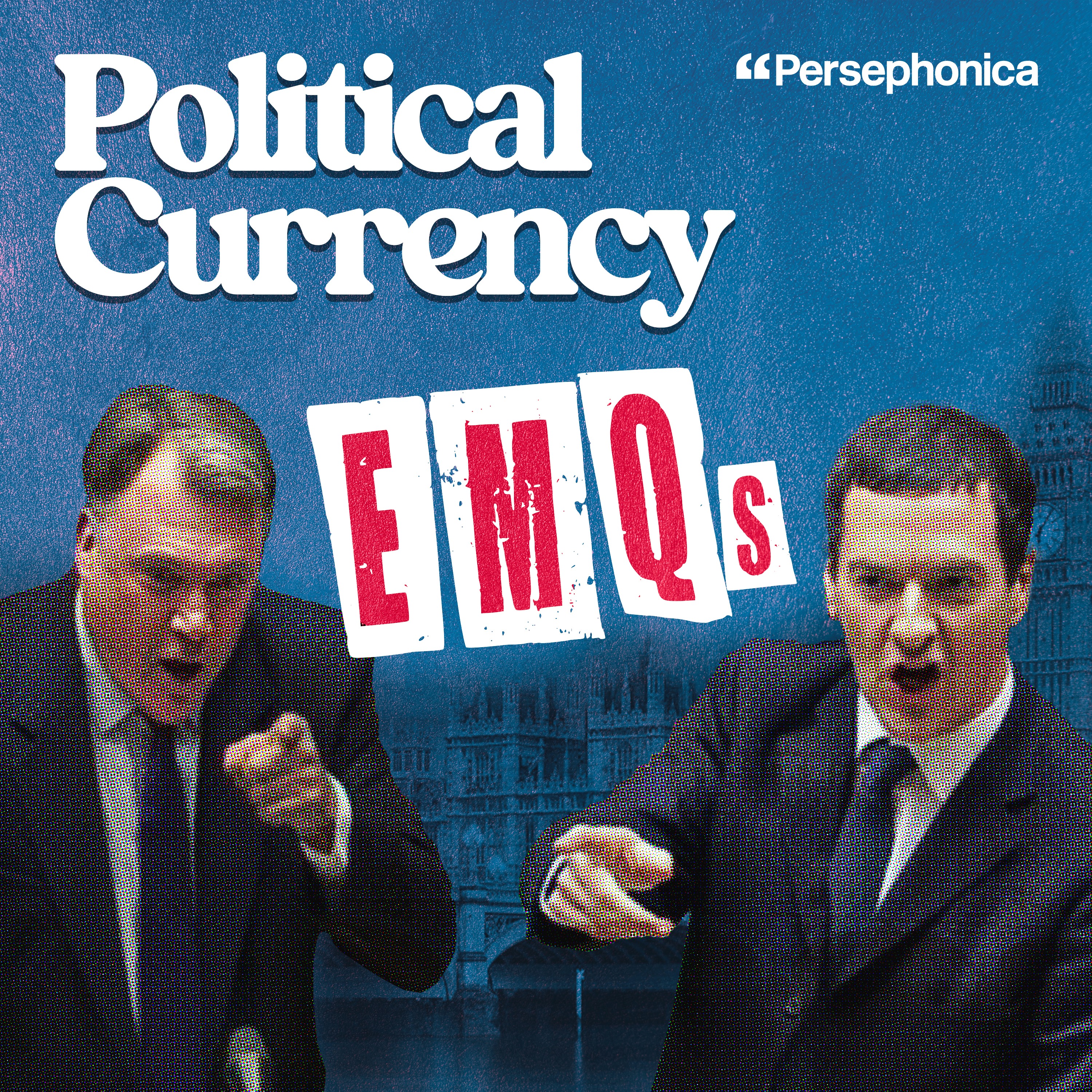
- EMQs: Who Lifts Heavier, Ed or George?
In short
EMQs (Ex-Minister’s Questions) episode mixing politics and public policy with health/fitness and a listener Q&A. Main segments: (1) UK energy security and the 1973 oil embargo—could Britain survive a modern diesel/oil shock? (2) Weight training and “ripped” politicians—who lifts/looks best? (3) Inheritance tax—responding to a divorced mum’s fear of selling a family home; discussing Kemi Badenoch’s proposals and behavioural effects. (4) Westminster Abbey Choral Evensong—favourite hymn/choral piece.
Guests/backgrounds
No studio guests; questions come from listeners. Mentioned figures: Philip Delves-Broughton (journalist/writer; wrote Embargo on the 1973 oil crisis); Graham Ambrose (investment banker; co-host of Lift for Life); Sarah (divorced mum in SE England; modest semi worth £500k+); Adrian (listener who asked about hymns; Abbey communications/digital team contact); Martin Lewis (money guru; Small Ideas Initiative).
Key claims
Britain could face rapid disruption if diesel exports are blocked (citing past fuel depot blockades). Inheritance tax affects far more than “only the rich” (4% of estates; broader electorate impact). Tax policy could incentivize downsizing avoidance/“buy bigger” behaviour.
Notable examples
1973-74 three-day week; OPEC/Saudi-led embargo over Yom Kippur War; 1999 UK petrol shortages after fuel depot protests; Tony Blair “jacked” photo; Gordon Brown’s treadmill/bananas-and-Mars bar; William Hague karate; Jimmy Carter marathon dehydration.
Written by AI. May contain mistakes.
Chapters
2:44
Swimming with David Cameron
Ed and George share humorous anecdotes about David Cameron's beach experience.
“So hello and welcome to EMQ's Ex-Ministers Questions.”
4:50
Small Ideas Initiative
Discussion about Martin Lewis's Small Ideas Initiative and related feedback.
“And so worth going back and seeing that conversation again.”
5:48
Oil Crisis and Energy Supply
Exploring Philip Delves-Broughton's book on the oil crisis and its implications for today's energy supply.
“So you were going to have refundable air flights now as well.”
12:30
Comparing Past and Present Crises
Analyzing the parallels between the 1970s energy crisis and modern challenges.
“And we were actually wargaming the 1976 IMF cabinet.”
14:00
The British 70s Crisis and Its Modern Parallels
Explore the similarities between the British 70s economic crisis and today's global trade challenges.
“And so you had all at the same time, a big inflationary surge from oil prices, an inflationary shock from floating exchange rates, and industrial conflict and competition to push up wages or to keep them down.”
15:50
Book Recommendations and Academic Opportunities
Learn about Philip Delves Broughton's book and related courses at King's College London.
“And maybe you should sign up to do the master's course through the Strand Group at King's College London with me, Nick McPherson, John Davis, Chetan Patel, because, you know, that's where you learn it all.”
16:59
Weight Training and Fitness Regimes of Politicians
A humorous discussion on the fitness habits of politicians, including weight training and personal anecdotes.
“I'm Graham Ambrose and alongside being a 57 year old investment banker I co-host the Lift for Life health and fitness podcast as a side hustle a bit like you guys.”
25:56
Inheritance Tax Perspectives and Misconceptions
Discuss the complexities of inheritance tax and its implications for different demographics.
“You fell into the trap that most commentators do, rather assuming that everyone who dies and is liable for inheritance tax is old and rich and married.”
28:00
Inheritance Tax: A Complex Political Issue
Explore the complexities of inheritance tax and its political implications.
“And then finally on the numbers, you see, I think this is also, you've pointed to an important point here.”
36:34
Favorite Hymns: A Personal Reflection
Hosts share their favorite hymns and discuss their significance.
“The Night Pack helps you wind down and supports a calm, relaxed state.”
Show all 12 chapters
42:01
Discussion on Choral Music and Hymns
The hosts engage in a lively discussion about their favorite choral music and hymns, sharing personal stories and opinions.
“the young organ scholars are off fighting.”
45:31
Listener Engagement and Future Topics
The discussion shifts to listener engagement, encouraging audience participation in sharing their favorite hymns and music.
“You've set in train, we think, a whole set of future questions.”

Ask about this episode
Get the gist, explore an idea or ask about something said.
 Claude
On Political Currency, what are the key points of this episode?
Searching your listeningTranscript
Automatic transcript. May contain errors.
0:00Bad news travels fast, and bad AI conversations can travel even faster. Because one mistake can happen again and again and again. Parloa Lens helps you spot those problems across every conversation. And Navigator helps you figure out why they're happening and what to do next. So your AI agents don't just handle more conversations, they get better at handling them. That's the power of Parloa. Find problems before they find your customers at Parloa. P-A-R-L-O-A dot com. Some days, getting the work done isn't the problem. Staying locked in is. AlphaBrain is Onnit's daily nootropic formula for cognitive support, designed to support memory, focus, attention, and mental clarity.
0:41Its formula with science-driven ingredients include theanine and Hooperzine A to support focus and memory, and it's caffeine-free. So when you're deep in the work, AlphaBrain helps support enhanced productivity and tune out distractions. Get focused on what matters. Shop Alphabrain now at onnit.com. Do you snore? Did somebody hand you a CPAP and did you quietly stop using it? The mask that never quite seals? The hose tugging at you every time you roll over? A machine sitting abandoned in a closet? Excite OSA works a different way. It treats a root cause instead of managing the noise, and you use it while you're awake.
1:2320 minutes a day, while the coffee brews, while you set your fantasy lineup. An FDA-cleared prescription device for primary snoring and mild obstructive sleep apnea. Then you go to bed like a person. Nothing strapped on, nothing plugged in. In clinical studies, 90 % of patients saw a reduction in snoring. No sleep study required. Prescribed online, shipped to your door. Excite OSA at springsleep.com slash sleep20. Code sleep20 for 20 % off. Excite OSA is an FDA-cleared prescription-only device for primary snoring and mild obstructive sleep apnea. Not for everyone. Individual results vary. Risks and benefits at springsleep.com.
2:14George Osborne: Welcome to this week's Ex-Minister's Questions. I think you're really going to like this episode. We are in the big issues around oil embargoes, the war in the Middle East, but we're also into health, fitness regimes. How do you look as ripped as Tony Blair? We're going to find out how much weight Ed and I press. I think you'll find I win that one. All that and more next.
2:44Ed Balls: So hello and welcome to EMQ's Ex-Ministers Questions. And this week, George is in Oxford where he's at a conference. But I have a feeling last weekend he may have been down in the southwest. Disappointed, though, not to see you in your bathing trunks alongside David Cameron with his surprisingly small towel. Do you remember that joke?
3:07George Osborne: I do remember that joke, yes. Oh, no. This was when David Cameron tried to change on the beach, didn't he? I think he was Prime Minister at the time, was he? That's right. Yeah.
3:18Ed Balls: And I said this at the Labour conference. I said, Yvette said to me, Cameron looks a bit younger than you. And I said, I just thought he had a surprisingly small towel, which he did.
3:31George Osborne: Was it a Mickey Mouse towel as well?
3:35Ed Balls: Anyway, I thought he looked, you know.
3:39George Osborne: Well, he was, it's his 60th birthday. And yeah, he was in Cornwall. I was in Cornwall. He said, he said, come swimming. And I was like, I think I'm just going to stay in bed. But because I'm not a massive fan of swimming in the English waters, at least without a wetsuit. Can you swim? Well, I can certainly swim, but...
4:04Ed Balls: I just thought I needed to ask that on behalf of the listeners. Yeah, of course.
4:08George Osborne: Although a surprisingly large number of people can't swim as adults. No, but, you know, I mean, I've enjoyed sometimes in the past in Cornwall going in the you know wearing that you wear the kind of um wetsuit don't you or the half wetsuit and do bodyboarding but no he just said come and swim and for anyone who saw the um the kind of baywatch style photos in the daily mail yeah anyway i was glad i was not part of the team for that for that um for being snapped by the paparazzi and if you want to go onto youtube and
4:39Ed Balls: see our conversation with david cameron about you know the first months of being prime minister it It was a really good conversation and very emotional, actually, and had big YouTube audience. And so worth going back and seeing that conversation again. I also was in touch this week with Martin Lewis because last week we had a question for Martin. The money guru. The money guru about his new venture. It's a charity thing he's doing with a very high-powered board, the Small Ideas Initiative. And his question was, what were our small ideas which we could contribute? I actually had quite a lot of feedback on this.
5:14Ed Balls: Lots of different people mentioned the ideas that you and I had about driving tests and about, mine was about line bikes, but in particular about getting compensation for railway tickets if you buy them to go to the football and then the league changes the time. There was actually one comment we had about somebody saying that their partner's business, they bought 10 flights from people coming around the world to a business meeting to see a manu game, and they then changed the day. And that was the end of it. I mean, it was a complete waste of money. Anyway, I was in touch with Martin Lewis to find out.
5:49George Osborne: So you were going to have refundable air flights now as well.
5:51Ed Balls: I'm not saying that, but I am saying it's an issue.
5:53George Osborne: So actually your idea wouldn't have helped these poor people?
5:56Ed Balls: No, because it was a small idea for the Small Ideas initiative.
5:59George Osborne: I should correct my record because I said there was a problem with driving tests and that you could, you know, basically driving instructors were getting kind of places in the queues and being able to sell them. That has been stopped, to be fair, I think, by the Starmer government. But the problem is still massive. I was talking to someone who was trying to book a driving test in the last couple of days. And they went on, the website opens at like 7am or something, when they release the new tests for, you know, a month's time or whatever. And they were all set, ready to go. And by the time they were like online in the queue, there were 30 ,000 people trying to book a driving test.
6:40George Osborne: A driving test is a government piece of regulation that says you can't drive unless you have our test. And the government, the state, this started under the Tories during COVID and was never solved. This government imposed thing, which is you cannot use this life skill unless you pass our test. I mean, for understandable reasons. the state cannot administer so it's absolute chaos and people are desperate to get driving tests and there's all sorts of reasons about why you know the system's broken down and how they're not fixing it so get a grip transport secretary that is an even tougher experience than buying
7:17Ed Balls: tickets for glastonbury or for the bay of tapestry at the british museum and um you know the queues are even shorter and you know that's glastonbury even without centrist dad being on the bill i'd I think that's announced yet. Actually, I'm not sure it's happening. But if we were asked, we'd go. I was in touch with Martin. Is that you asking? Just in passing.
7:36George Osborne: You're asking that family you own, Blassovry. Is that a subtle?
7:40Ed Balls: Look, my agents can speak to their agents and we'll sort it out. I was in touch with Martin Lewis to ask whether our ideas made the cut. Are we going to be in their manifesto? And Martin reported back that it was still much too early to tell. And he said, we have had 30 ,000 suggestions so far. People have got another four weeks to submit. So if we made it, it would be a triumph. I don't know how many of you have.
8:04George Osborne: Are you sure I haven't confused this with the DVLA website, by mistake?
8:06Ed Balls: It sounds like there's the same number of ideas as people trying to get a driving test. Anyway, it sounds as though Martin's new Small Ideas Institute initiative is taking off.
8:18George Osborne: He's off to a big start.
8:20Ed Balls: And hopefully we made our contribution to that and EMQs. What do we need?
8:26George Osborne: Small ideas. When do we need them now?
8:28Ed Balls: Yeah. He said, I'm not going to tell you what he said, because you're a nice guy. So first question, George. Actually, this is one you have procured.
8:39George Osborne: Well, this is actually, this is a question from someone I was at university with, this university, Oxford, more than 30 years ago. A very smart journalist and writer called Philip Dells-Brotner, but I'll let him ask his question. Hi, Ed and George. This is Philip Delves-Broughton. I've just written a book, Embargo, which is about the 1973-74 oil crisis, when the Arab countries led by Saudi Arabia stopped the exports of oil to Israel's allies following the Yom Kippur War. That winter, Britain experienced terrible shortages, a three-day week compounded by the miners' strikes, and it ultimately led to the fall of the Heath government.
9:16My question for you is, do you think the UK is in a position today to survive a similar period of massive disruption to global energy supplies?
9:24George Osborne: So this is the book. He sent me a copy, an advanced copy. It's not out yet. It's called Embargo, How the 1973 Oil Crisis Changed the World. And it is a cracking read. Who's it published by? It's published by Hutchinson. Brilliant. And it's one of those, Phillips actually spent a lot of time in the States and lives there. And it's got that kind of American way of writing nonfiction, which is just a very pacey and these big characters like Henry Kissinger, the Saudi oil negotiator, Zaki Yamani, King Faisal of Saudi Arabia. It's a great way. And of course, this is basically when the oil producers realize that they can get together in OPEC and essentially use that economic power.
10:11George Osborne: And what they were doing there is, interestingly, they were protesting against very current, given everything that's happening in the world today. They were protesting against American support for Israel in the Yom Kippur War. And they basically blocked the oil exports to America for six months. and led by the saudis um and i think his question anyway i thoroughly recommend it you do enjoy it and it's you know very well timed given everything going on in the moment in the middle east i mean i think his question is an interesting one which is you know it seems fanciful doesn't it that suddenly britain could be back to a three-day week the three-day week was mandated by the government at the time and it and it was literally that factories had to close for four days a week because there just wasn't enough power in the country.
10:59George Osborne: There wasn't enough oil and there wasn't enough electricity because of the coal miner strikes as well. And you just think that's impossible. That would never happen today. But it does beg the question, let's imagine the price of diesels going up and up and up. And that's what we talked about in the main podcast. Let's imagine that America does block diesel exports, which they've been threatening to do, to the UK. Let's imagine you can't get diesel exports from elsewhere in the world because the Straits of All News, you know, are closed and so on, then we'd run out of diesel. And that would happen very, very quickly.
11:37George Osborne: And, of course, we did have, you know, you all remember this even more than I do because you were a government advisor at the time. You know, in, I think it was like 1999, wasn't it, from memory, the protesters blockaded the fuel depots in the UK and suddenly Britain ran out of petrol. and it's not fanciful and I think the problem for government is it is a catastrophe because it because it just speaks to chaos and you can't run the country and why didn't you secure the fuels you know you if you're John Healy on Andy Burnham getting up or saying oh well you know unfortunately Donald Trump's done this or unfortunately the Iranians have done that or the Saudis you know everyone will go like well who cares because you should have anticipated all of this and maybe we are secretly stockpiling diesel and oil and the like although i think we've just actually had to release it at the demand of donald trump if we have been building
12:33Ed Balls: up stockpiles and i don't think we have big stockpiles compared to other um european countries or the us as well really i mean i'm actually going to get this book onto our reading list um because by chance last friday at the class i teach at king's economic policy in the treasury since 1945, we were discussing the 1970s. And we were actually wargaming the 1976 IMF cabinet. But I think the thing which is really interesting about this, and this is my parallel to today, if you go back to the 70s, it was a perfect storm for the Britain, because you had a whole series of big kind of consensual assumptions and practices breaking down.
13:20Ed Balls: So you had, as Philip says, this breaking down of the OPEC cartel and a huge spike in oil prices. You had alongside that, the ending of the Bretton Woods system of fixed exchange rates driven by the US, which meant floating exchange rates, injecting inflation into economies. Then you also had in Britain in particular, the sort of breakdown of the post-war, more cooperative social partnership style approach to industrial relations between the unions and the employers, embodied by NEDI, the National Economic Development Council. And so you had all at the same time, a big inflationary surge from oil prices, an inflationary shock from floating exchange rates, and industrial conflict and competition to push up wages or to keep them down.
14:19Ed Balls: And that together was the British 70s crisis. And many countries had the same kind of thing. And then if you come to 2026, I think you can make a similar point. You do have in the Straits of Hormuz, and as a consequence, as you were describing around the world, this big energy shock. But it's happening alongside the breakdown of what was essentially a post-war consensus around open trade and the introduction of tariffs and friction in the global trading system. And then, as we discussed on our main podcast, you have fractures in the post-war Western defence alliance and Donald Trump questioning the purpose of NATO.
15:06Ed Balls: And I think you can make a similar argument that it's not simply the energy shock, it's the energy shock at a time when the global trading and defence system is under huge pressure. And that is why, you know, it's not fanciful to say the kind of perfect storm you're seeing in 1970s world and Britain, as Philip kind of chronicles in his book, you could see a similar kind of perfect storm of fracturing assumptions and relationships and therefore economic shocks in the world and for Britain in 26, 27. So I would think if you want to understand global politics and how it can impact on Britain today, you should go and read Philip Delves Broughton's book.
15:50Ed Balls: And maybe you should sign up to do the master's course through the Strand Group at King's College London with me, Nick McPherson, John Davis, Chetan Patel, because, you know, that's where you learn it all.
16:00George Osborne: I can't help but notice my friend Philip, when he was kind of searching for someone to plug the book on the front cover didn't come to me, but came to someone called Rory Stewart, who's given it a big generous plug on the front cover.
16:13Ed Balls: Yeah, well, that's probably because Rory was willing to, you know, to write whatever Philip drafted for him.
16:19George Osborne: And Lise Doucette and Ed Conway.
16:22Ed Balls: Oh, well, you know, then...
16:24George Osborne: I feel Lise Doucette would be quite hard to...
16:25Ed Balls: I think all three are credible endorsers.
16:29George Osborne: But no Ed Bowles or George Osborne. Despite, anyway, we're making up for it on our podcast, aren't we?
16:35Ed Balls: It's called in the trade, and you wouldn't know this because you've never got around to writing a book, and I've done too. It's called a blurb. A blurb. And so that is a blurb from Rory and a blurb from Lisette and a blurb from Ed.
16:46George Osborne: Anyway, unlike them, I've read the book. I think it's great.
16:49Ed Balls: And we've done a long blurb on our podcast, which, and, you know, just to say, Philip, we're happy to be quoted on the cover for the paperback.
16:56George Osborne: Yes. So let's take our next question. I'm Graham Ambrose and alongside being a 57 year old investment banker I co-host the Lift for Life health and fitness podcast as a side hustle a bit like you guys. Tony Blair was recently photographed looking pretty jacked in the gym. I lift weights at least five times a week so my question is do either of you weight train and if not given the evidence for its benefits for health span and quality of life why not and finally which politicians you've known have had
17:36Ed Balls: the most impressive fitness regimes so to answer graham's question his first question yes i do
17:42George Osborne: weight train do you george i do actually yes i mean i'm not sure i call it weight why do you look
17:47Ed Balls: surprised do you i'm surprised you do are they quite small weights you lift bro are they quite
17:52George Osborne: small weights i get something called barry's boot camp i've been going for years and um what size
17:59Ed Balls: dumbbells do you use?
18:01George Osborne: Well, it depends on the... You see, it just shows you no nothing, because it depends on what exercise you're undertaking.
18:06Ed Balls: I've got a set of dumbbells at home here. Right.
18:09George Osborne: More dumb than bells, maybe?
18:11Ed Balls: A couple of 8 kgs.
18:13George Osborne: 8? I do 15. You do not do 15. I do, I swear. To do what? About my head, yeah. Now, that's science, Steve, for the first time in years.
18:24Ed Balls: The thing is, George, you're supposed to lift them above your head more than once.
18:27George Osborne: Yeah, yeah. It's about repetition. barry's they make you lift them above your head many times um i did go i for a couple years i went or several years i went to um one of the matt robert the matt roberts gym which was great it was right close to where i lived sorry very close to where i worked and then i got this new job and i can't go there because it's just like way out of my way so i've rejoined barry's and well you don't join barry's you join each class do you go in a group you do in a group and do you wear like leg warmers and um and you can go anywhere they've got do you wear lycra you can do it in san francisco london dublin i did it the other day uh i did it once you actually alternate with um you know someone's on the treadmill and someone else is doing the weight training and then they switch over and early on this was some years ago when i did it the person who was on the out who was in the other you know my poor partner that had been picked by the computer was um was david
19:19Ed Balls: beckham can you imagine can you imagine turning up to your hot yoga or your kind of aerobic pilates
19:26George Osborne: and finding david beckham and george osborne yeah well you might have been pleased by more
19:31Ed Balls: pleased by one than the other as as role models yeah you know barry would say yummy mummies might have been more excited about one if you do this course for six months this is what you could look like yeah i don't know why i thought you didn't do weight training because i have to revise my my my view entirely now. What about politicians with an impressive fitness regime? I can tell you about the Gordon Brown fitness regime.
19:53George Osborne: Right.
19:54Ed Balls: Is this going to take long? He had a running machine in number 11 Downing Street, which he ran on very fast and then would come off exhausted and have to have two bananas and a Mars bar. So that was his fitness regime. He was a person who famously when asked whether he would run a marathon because of course I ran three marathons while I was Shadow Chancellor. Gordon didn't run a marathon as Chancellor. Did you run them
20:16George Osborne: Or walked them. I can't remember.
20:17Ed Balls: I ran them. And yeah, I mean, I got all the way around. And Gordon said he couldn't do a marathon because he wouldn't be able to run slow enough.
20:28George Osborne: I'm not quite sure what that meant, actually. He couldn't pace himself is what he's really saying, isn't he?
20:33Ed Balls: I suppose that's what he means.
20:34George Osborne: Jimmy Carter. Do you remember Jimmy Carter ran a marathon as president and then collapsed? He was actually a seasoned marathon runner. And he wanted to show, you know, he'd done lots of marathons and ran as president with the bodyguards around him. And then unfortunately he collapsed for dehydration, which was one of the reasons, we're talking about the oil crisis. It was the second oil crisis later in the 70s that did for Carter.
20:59Ed Balls: So we had Hamza Youssef on the Good Morning Britain this week. He's got a book out, former leader of the SNP. The book is all about his in-laws being trapped in Gaza a couple of years ago while he was the Scottish leader. But he was talking about the pressures of leadership and he was saying it's all very well focusing on your physical fitness and Andy Burnham going for his runs but you also need to think about your mental fitness and he was saying that he thought that actually having regular therapy was an important part of leadership to de-stress and
21:30George Osborne: get get support I thought I was getting a lot of free advice from the British press about my state of mind I didn't need to pay for the um I'll tell you the person who was an absolute fitness fanatic when I was in government and indeed in opposition, was William Hague, who I'm seeing later today. I'm in Oxford. I know he's, of course, Chancellor of Oxford. And so I'm looking forward to seeing him later. I will report back on that.
21:55Ed Balls: I thought his fitness regime was to sit at the bar and drink vodka martinis. No, pints, please. No, he liked it. It was the... 14 pints. Yeah, yeah. I know, but that was in his youth. I thought he'd moved on to martinis.
22:08George Osborne: No, he was really into his fitness training as leader of the opposition. And he also took up karate. And he did this karate training all the time. And he used to pick on Seb Coe. He'd go running with Seb Coe, where Seb Coe would have a significant natural advantage. But... That was 30 years ago. No, but then he'd do karate with Seb Coe, where actually William Haig... Does he still...
22:35Ed Balls: I know, but we're talking about fitness regimes now. I don't know.
22:37George Osborne: Well, I know he's very keen. Am I allowed to say he's ripped? He's quite ripped. Is he? But how do you know?
22:44Ed Balls: Was he swimming with David Cameron? No, he was not.
22:48George Osborne: But yeah, so William Hague was very key. And it was all about kind of wellness and, you know, being able to. Have you ever been ripped? Ripped off, maybe.
23:01Ed Balls: Has anybody ever said to you, you look ripped?
23:03George Osborne: Well, I think there was a time when my weight loss became, you know, a national story, showed self-discipline.
23:11Ed Balls: So I'm just asking about the word ripped. Nobody's ever accused me of being ripped.
23:16George Osborne: No. And they're not going to again. Don't worry about that.
23:20Ed Balls: We should take a break.
23:21George Osborne: Particularly with your eight kilo weights you're lifting.
23:24Ed Balls: Eight kilos each. We'll be back in a moment.
23:34The youth mental health crisis is growing and social media is a major driver. Kids are spending up to nine hours a day on screens, often unsupervised, and studies show a direct link to anxiety, depression, and even suicidal thoughts. That's where Gab comes in. Gab offers safer phones and watches for kids with no social media, tailored to every age, offering the right tech at the right time, or tech in steps. From GPS tracking enabled watches for younger kids to phones with parent enabled apps for teens, each device allows kids to more safely grow their independence. Visit gab.com slash getgab and use code getgab for an exclusive offer.
24:16That's g-a-b-b dot com forward slash getgab. Gab, tech in steps, independence for them, peace of mind for parents. This is Hannah Berner from Giggly Squad. Opil is the first over-the-counter daily birth control pill available in the U.S. Let's be real. Getting a birth control prescription is not always easy, and it's so much admin. In fact, about a third of women face barriers to access prescription birth control. Between scheduling appointments, missing work, class, or just trying to exist, it's a lot. But now Opil is putting birth control in our control. Opil is a daily birth control that's FDA-approved, full prescription strength, and estrogen-free, and 98 % effective when used as directed.
25:00Grab it online or at most major retailers, no prescription or doctor's appointment needed. So if you're thinking about birth control, check out Opill to see if it's right for you. Use code Giggly for 25 % off your first month of Opill at O-P-I-L-L.com. That's code Giggly at O-P-I-L-L.com. Birth control in your control. We love to see it. When you're running a growing business, the right systems can unlock your full sales potential and make fulfilling every order effortless. Switch to ShipStation before peak season so you're prepped and ready before the rush hits. ShipStation connects Shopify, Amazon, TikTok Shop, and over 200 more marketplaces with one platform that does it all.
25:36You can manage orders, sync inventory, track returns, all automatically. Everything your operation needs, all in one place. Upgrade your shipping operations to stress-proof your biggest sales days and capture every bit of potential revenue. Go to ShipStation.com and use code AUDIO and get 30 days free.
25:56Ed Balls: So our next question is from Sarah. You fell into the trap that most commentators do, rather assuming that everyone who dies and is liable for inheritance tax is old and rich and married. As a divorced mum of teenagers living in a modest three-bedroom semi, which happens to be in the South East and is worth more than£500 ,000, I, along with everyone else in my position in the South East, is going to be well on the hook for inheritance tax. I live in dread that if I die, my children, on top of coping with their mum's death, will be forced to sell their only home to pay IHT. I've taken out life assurance to help because there's currently no exemption for dependents.
26:37And it makes me furious to hear commentators repeating you only pay IHT if you're rich and it only applies to 4 % of estates. Kemi's proposal would be such a relief for people in my position.
26:49George Osborne: Well, shall I go first here? because I'm certainly I'd say to Sarah, if I gave the impression of falling into the trap you described, or if I did fall, I'm very, very sorry. And that's certainly not what I intended, because I've always thought inheritance tax, for the reasons that you spell out is a very, very potent political issue. And it's, it's completely misunderstood on the left of British politics on the left British politics is hold on, this is, you know, why should someone inherit money? Why should they start with a better kind of platform in life than anyone else? And it's, I think it sort of fundamentally offends some people on the left's sense of equity and fairness in society.
27:30George Osborne: But there's another sense of fairness in society, which is I've worked all my life and I've saved and I'm invested in a home and I didn't squander the money. And I want to leave something to my children. That's the most natural instinct, which you can hear there in Sarah's question. and why should the state take it away, not least because they taxed me on it already when I earned it. And that's a different kind of, it's a different conception of fairness. And that's why inheritance tax is the single most hated tax of all the taxes in Britain. It's consistently top of the list of taxes people dislike most.
28:01George Osborne: And then finally on the numbers, you see, I think this is also, you've pointed to an important point here. So, and again, the commentators get this wrong, and certainly if I made that mistake last time, I apologise. but I remember doing this when I made something similar to Kemi Baden-Koch's announcement at my party conference years ago and that is yeah okay four percent of estates paid every year that means four percent of people who die paid every year but of course not everyone dies every year thankfully and so over over many years that's like people think forward and think well when I die in 20 years time or 30 years time or 10 years time, I'm going to be paying inheritance tax.
28:43George Osborne: So that 4 % accumulates a lot. It aggregates amongst the current living population. And then the 4 % is just the people who die, the estates. Whereas, of course, there are many beneficiaries. So you have several children there you're talking about, aren't you, Sarah? And what happens there is that they all are, in effect, the people who feel they're paying for inheritance tax. so it's a much larger portion of the population who are basically touched by the inheritance tax regime it's something like i'm from memory i'm i'll you know i'll correct this if i got it wrong it's something like a quarter of all people and given like 75 percent of people roughly vote that's potentially like and probably people paying inheritance tax are more likely to vote than some people in the population it's a big portion of the electorate and there's a whole other set of people who may never pay inheritance tax, but fear they may.
29:38George Osborne: In other words, they have expectations that their house might go up in value. They're aspirational people that feel they might earn more in life. So it's a very, very potent issue. And there's a reason why it's been played as a kind of political tool repeatedly in politics in recent decades, of which I was one. And so I will certainly correct if I gave the impression that it's not a potent issue or that only the rich pay it, that's a mistake.
30:10Ed Balls: It's definitely a potent issue. And also sometimes it can be simply seen as a left-right issue. So we discussed this a couple of weeks ago. You fight the 2010 election on a big inheritance tax cut. And then when you go into the coalition with the Liberal Democrats, who are to the left of you, they essentially refuse to go along with that. And therefore, for the whole of that parliament, you can't enact that change. But it's more complicated than left-right. If you listen, for example, to Andy Burnham talking about social care reform and his parents and grandparents potentially having to lose their home to pay for social care rather than passing that on, It is the same blunting of that aspirational instinct, which upsets him.
31:00Ed Balls: And I don't think Andy Burnham, given what I see of his politics, would think of him as being somebody who would be an inheritance tax, soak the richer. On the other hand, there are right-wing people who have, or right of centre, who also have a philosophical view that you shouldn't be inheriting. I mean, I may be wrong about this. So if I am, I'm going to apologise in retrospect. But Erwin Steltzer, the writer-centred journalist and thinker and big supporter of Rupert Murdoch back in the day, I remember Erwin kind of railing against inheritance tax and how it was wrong that you would have inherited wealth through the generations as opposed to people being able to keep more of what they earned.
31:47Ed Balls: So it doesn't simply fall left-right. When we were discussing this in response to your reform, because of course, Alice Denining then did a similar kind of reform in terms of transferability, the problem you always get into is that the average or the easy example isn't always the universal example, as Sarah says. And if, for example, you are a married couple and one of you loses their life or you get divorced. The example I remember discussing was the war widow. If the war widow is then penalised in their inheritance tax liability because of the loss of their partner who's serving his country, why are they getting half the allowance?
32:35Ed Balls: Therefore, this is always complex.
32:36George Osborne: They had to be exempted, didn't they? When someone pointed that out, they were exempted from you know, they were able to keep their husband, dead husband's allowance, yeah.
32:45Ed Balls: But Sarah doesn't benefit from that exemption. And I understand that argument, especially if you're living in the Southeast. And of course, the clear majority of people who would benefit from the Conservative proposal live in London, the Southeast, where house prices are, you know, of a materially different level. And therefore the inheritance tax bites in a different kind of way. The one thing just to throw in, given that we're talking about this, the one thing I'm not sure the Conservatives has quite thought through is the behavioural impact. Some interesting stuff put out by Dan Needle, the tax advisor, pointing out that, you know, as well as thinking about the difficult cases, the war widow, you've also got to think how it will change behaviour.
33:20Ed Balls: What this proposal does is it incentivises people as they get older not to downsize their home and move to a smaller house where the children move out. In fact, it probably incentivises them to do the opposite, as they get closer to the end of their life.
33:38George Osborne: Buy a bigger home.
33:39Ed Balls: Buy a bigger home, because that maximises their inheritance tax reduction. It allows them to shift taxable wealth into non-taxable wealth.
33:51George Osborne: That's because we should say under the proposal, a house gets a higher allowance than shares or money or art or something else. Something else you might pass on.
34:04Ed Balls: And in terms of costing this, I'm not sure whether I've seen what the Conservative Party answer is to this yet, but they'll need to have an answer to that. Because the special cases or the non-standard case in the war widow, but also the behavioural impacts, the things you always have to think through within tax policy. But anyway, I certainly don't think that this is, you know, an easy thing to do to just increase the tax liability from inheritance tax either, Sarah. And we appreciate your question. Give us a chance to talk it through. So let's go to a break and we've got time for one more question.
34:48If you're still sleeping on cotton or satin, that could be the reason for frizzy hair, sleep creases, overheating, and even breakouts. Dermatologists actually recommend switching to silk because it's naturally cooling and much gentler on your skin and hair. That's exactly why over 3 million people have made the switch to Blissey. Blissey pillowcases are made from 100 % pure mulberry silk, the highest quality silk you can get. It's breathable, hypoallergenic, and surprisingly machine washable, so it's easy to care for. People love waking up with smoother hair, calmer skin, and no sleep lines. Plus, Blissey makes the perfect gift.
35:25And you can even complete the set with matching sleep masks, silk bonnets, and crease-preventing scrunchies. Blissey is offering 60 nights risk-free, plus 30 % off when you shop at blissey.com slash rest easy. Your skin and hair will thank you. This is Hannah Berner from Giggly Squad. O-Pill is the first over-the-counter daily birth control pill available in the U.S. Let's be real, getting a birth control prescription is not always easy and it's so much admin. In fact, about a third of women face barriers to access prescription birth control between scheduling appointments, missing work, class, or just trying to exist.
36:01It's a lot. But now Opil is putting birth control in our control. Opil is a daily birth control that's FDA approved, full prescription strength, and estrogen free, and 98 % effective when used as directed. Grab it online or at most major retailers, no prescription or doctor's appointment needed. So if you're thinking about birth control, check out Opil to see if it's right for you. Use code GIGLY for 25 % off your first month of Opil at O-P-I-L-L. That's code Giggly at O-P-I-L-L dot com. Birth control in your control. We love to see it.
36:57The Night Pack helps you wind down and supports a calm, relaxed state. Less time managing your supplements, more support for your day and night. Shop Total Human now at onnit.com.
37:15George Osborne: Welcome back. And this question, our final question, comes from someone you, it looks like you met last week, Ed. It was great to meet Ed at a special live service at Westminster Abbey to mark the 100th anniversary of the BBC broadcasting Choral Evensong. The BBC first broadcast Choral Evensong from the Abbey in 1926. I run the Abbey's communications and digital team and mention to Ed at the reception afterwards that I'm a fan of your podcast and have listened to it from the start. Evensong is a wonderful service and the live broadcast is yet another reminder of the importance of the BBC. My question for you both is, what is your favourite hymn or piece of choral music?
37:55George Osborne: And why? Ooh, that's a good question. Your favourite hymn. I mean, you're probably going to have about 500 hymns you like, so shall I go first in the interest of time? Come on then. So first of all, there were some wonderful hymns that I had at my wedding to Thea a few years ago, like the Battle Hymn of the Republic and Jerusalem.
38:20Ed Balls: Didn't you also have a European anthem?
38:22George Osborne: yes Beethoven's Ninth choral um uh no that that was good uh that was great uh an amazing grace I'm not sure amazing grace counts as a hymn um but it was absolutely beautiful and so anyway those are great hymns but I was trying to think of one that takes me back to my childhood and it's a hymn that I just don't really hear very often when I hear you know there are wonderful hymns like um uh to be a pilgrim and guide me out of the great redeemer and obviously the carols and so on but the one i remember i used to love at school when they played was what it's called when a knight won his spurs and it was written i only i looked this up when a knight won his
39:02Ed Balls: spurs in the stories of old he was gentle and brave he was gallant and bold with a shield on his arm and a lance in his hand he rode through the no for god and for valor he rode through the
39:15George Osborne: land oh my gosh it's got dragons in it and ogres and that is a real like secondary school song isn't it yes i haven't really heard it since but i used to really like it when it came on i've looked it up because i didn't i certainly didn't know this but the music is by ralph vaughan williams yeah that's pretty comes with it and someone that someone called jan but i've not really heard it since it's just not a regular i don't think yeah i mean i'm not saying i go to church every week but i do go i do go to church periodically and and i just that hymn which I really remember. So that is going to be, it's only my favourite hymn in the hope that Radio 3, now we've got, you know, key people we know are fans of the podcast in Radio 3.
39:58George Osborne: That puts that on. Maybe it'll be on Choral Evensong.
40:01Ed Balls: Well, or sung in Westminster Abbey in the next few weeks if Adrian, I mean, isn't it great to have Adrian as a regular listener from the beginning? And I did meet him when I was down there at, you know, at the 100th anniversary. It was, so I'm actually going to choose Something which was sung that day as one of my absolute favorites they um as I said it was the 100th anniversary of Call Even Song they actually had an opening intro by um a new a young woman composer called Carenza Briggs I mean I say young woman she's um you know younger than you she's younger than you and me she probably doesn't think she's I mean she's kind of she's she's a great but it was the world premier anyway you're tying yourself in knots about her age so let's just move on no but the reason I said that was because I don't think in 1926 you'd have had anything sung at an even song composed by a woman.
40:48Ed Balls: And that's a huge revolution. And also the presenter, the person doing the singing as the priest, as the vicar, was also a woman. So that was also a big change from 1926. But the...
41:01George Osborne: Anyway, come on, get on with your choice.
41:02Ed Balls: The Magnificat and Nunc de Mitter's was composed by Herbert Howes from his Gloucester service. And this is possibly my best piece of music. And I don't know whether you saw Matthew Paris, presented for years, Great Lives, which I think you and I have both done. He's finally finishing. Such a great show. I did mine on Herbert Howells. The reason I would tell you the story, George, because I think it's actually relevant for you.
41:26George Osborne: I did mine on Henry VII. Yeah, so, yeah. And invented the United Kingdom and the Treasury and the modern state. Very good. I can explain it at length.
41:36Ed Balls: I did on that show. We're talking about a call even song here. And we're talking about music. And Herbert Howells, Herbert Howells comes from a Ford Ford background, trains at Gloucester. He then, in his 20s and 30s, he wants to be like a composer of symphonies and concertos. It doesn't quite work for him. And then towards the end of the Second World War, it becomes clear that, you know, the young organ scholars are off fighting. And so he gets asked in his late 40s to go and be the temporary kind of director of music organist at Sir John's College, Cambridge. And he goes there and suddenly, later in his life, he composes the Gloucester Service and the King's College Service, St Paul's Service.
42:25Ed Balls: They're all composed for different places. And it is the best core music of the 20th century. What it tells you, George, is that even if you don't quite make it in your chosen career to be prime minister, to be chancellor, you can have something come along and suddenly you can end up, you know, doing a podcast, working for ChatGPT. Have you ever tried to compose music? Have I? Sure.
42:51George Osborne: Compose an original piece?
42:53Ed Balls: Well, I now, as a jazz pianist, in some sense, everything I play is original. Jazz pianist? What are you talking about? I do jazz piano. Right.
43:05George Osborne: So therefore you improvise. Let's get you back to something you do know about, which is, so, okay, choral music. He said the favourite, Adrian asked, favourite hymn or choral music. I think my favourite piece of choral music is Ode to Joy by Beethoven's Ninth. I think that counts as choral music.
43:19Ed Balls: And I've chosen the Gloucester service by Heather House.
43:21George Osborne: What about your favourite hymn though?
43:23Ed Balls: Well, that is a really good one. I think the hymn that Howells composed, which in memory of his son who died of polio when he was only eight, nine years old, is, and he wrote the music, is All Our Hope in Thee Is Founded. All our hope in thee is founded. Maybe stick to the jazz piano. Great hymn. I really like that. I actually like, I actually quite like I Vow to Thee, My Country and those sort of, you know, those Dear Lord and Father of Mankind, Forgive Our Foolish Ways, all of those kind of more traditional hymns that you sang in church every weekend in school.
44:07George Osborne: Do you not get... But when the vicar says, you know, turn to like hymn 321 and it's some hymn no one knows and no one knows. It's like, why have you done that? I know, sing a banger. It's just, I mean, there are enough hymns. There's quite a big selection of hymns that audiences do.
44:24Ed Balls: Do you remember? A Jesus I have promised to serve thee to the end. It's a bit happy. I will not fear the battle if thou art by my side I think you're just demonstrating there are quite a lot of hymns. If there will be my guide. Boo, boo, boo, boo-dee-dee-dee-boo.
44:42George Osborne: If there's a vicar listening who puts up for their weekly service hymns that the congregation don't know, I'd like to have them come in onto the show and explain why they do that. Maybe they're challenging the audience or they want them to introduce new... Anyway, I would sit there going like, oh, why have you done that?
45:00Ed Balls: I know. And if you don't know the tune, it's really hard to enjoy singing it fundamentally. And actually, for some of us, even if you do know the tune, it can be quite hard for other people. No one cares about that. No one's listening. Thank you for your question, Adrian. We would love to know from listeners and viewers whether you've got a favourite hymn or piece of core music. Because if you've got one and you can tell us why, and there's got to be a story behind it, then we'll play it next week.
45:29George Osborne: Okay. Adrian, thank you for that. You've set in train, we think, a whole set of future questions. Thank you for that. Thanks to everyone who asked a question. You can ask a question by emailing questions at politicalcurrency.co.uk or messaging us on our socials.
45:44Ed Balls: Thank you to the BBC for 100 years of Call Evensong. We love variety and tone, era, subject. Get creative. Send us a voice note. You can do it by email. You can go to the comments on YouTube and send it in there.
45:57George Osborne: And we're going to leave you this week with a little plug for another podcast, aren't we? change we need to see in workplace culture so that women feel that they can talk about you know the health challenges that they're experiencing from the menopause to endometriosis or challenges around juggling you know work and family life we've got a system and a culture that's built for men I don't want to see women stepping away from brilliant careers and jobs because they're not being properly supported that isn't just damaging to that individual woman it's a tragedy for all of us like we lose out as a society where we don't value and recognize the contribution of women government's got a role to play um we all of us have a role to play but actually i think we need men to step up as well and provide us with the support not it always falling to us to have to campaign for the change that we want to see too bridget phillipson who i think you interviewed
46:45Ed Balls: did you interview bridget last year was it christmas or in the summer you interviewed it was the summer wasn't it yeah that's right she she was the education secretary for the first two years of the Labour government. She's now the Labour chair in the cabinet and also the Minister for Women and Equalities.
46:59George Osborne: Yeah, and she's appearing on Dig It with Joe Wiley and Zoe Ball. And she guests alongside the brilliant Mariella Frostrop, who I think is fantastic. And she is the government's women's employment ambassador to spotlight Menopause Awareness Day.
47:15Ed Balls: That is right. And it's a good listen, a very powerful listen, because I've heard Bridget talking about the huge struggles that she had with period pain. And it's one of those things where Vicky Patterson was on Good Morning Britain this week, the kind of TVX Strictly star, who's been a great champion around misogyny in the National Health Service and people not taking seriously, men and women actually, GPs not taking seriously women when they deal with the issues Bridget talks about on the grounds that, you know, this is just a woman's thing and kind of put up with it. But that's not right because you've got to listen.
47:53Ed Balls: There's things that can be done. But so often people get fobbed off and it takes years for them to get the help that they need. And Bridget and Mariella are highlighting that, as Vicky was doing with us on GMB, with Joe Wiley and Zoe Ball. Great cause. And let's hope the Secretary of State for Health is listening.
48:09George Osborne: Oh, yes, whoever that is. Now, have a listen to that. And hopefully you'll have a listen to us next Thursday when we're back with our regular podcast.
48:17Ed Balls: See you then.
48:25Your daily supplement routine doesn't need to be managing a handful of different bottles. Onnit's Total Human brings key research-based vitamins, minerals, herbs, and amino acids together in convenient day and night packs, one all-in-one product designed to make supplementation easier. The day pack supports cognition, focus, and cellular energy production. At night, the night pack helps you wind down and supports a calm, relaxed state. Less time managing your supplements, more support for your day and night. Shop Total Human now at onnit.com. This is Hannah Berner from Giggly Squad. O-Pill is the first over-the-counter daily birth control pill available in the U.S.
49:08Let's be real, getting a birth control prescription is not always easy and it's so much admin. In fact, about a third of women face barriers to access prescription birth control. Between scheduling appointments, missing work, class, or just trying to exist, it's a lot. But now Opill is putting birth control in our control. Opill is a daily birth control that's FDA approved, full prescription strength, and estrogen free, and 98 % effective when used as directed. Grab it online or at most major retailers, no prescription or doctor's appointment needed. So if you're thinking about birth control, check out Opill to see if it's right for you.
49:42Use code Giggly for 25 % off your first month of OPILL at O-P-I-L-L dot com. That's code Giggly at O-P-I-L-L dot com. Birth control in your control. We love to see it. The youth mental health crisis is growing, and social media is a major driver. Kids are spending up to nine hours a day on screens, often unsupervised, and studies show a direct link to anxiety, depression, and even suicidal thoughts. That's where Gab comes in. Gab offers safer phones and watches for kids with no social media, tailored to every age, offering the right tech at the right time, or tech in steps. From GPS tracking-enabled watches for younger kids to phones with parent-enabled apps for teens, each device allows kids to more safely grow their independence.
50:30Visit gab.com slash getgab and use code getgab for an exclusive offer. That's G-A-B-B dot com forward slash get Gab. Gab, tech in steps, independence for them, peace of mind for parents.
From the publisher
Author Philip Delves Broughton asks Ed Balls and George Osborne whether Britain could survive an energy shock like the 1973–74 oil crisis, which ended with a three-day week and the fall of the Heath government. George warns of voters blaming the government while Ed argues that the real danger, like in the ‘70s, is the energy shock landing alongside other collapsing post-war assumptions.
They then debate who is more of a gym bro, and reveal which politicians are the most ripped. Ed shares Gordon Brown’s fitness regime as chancellor, while George reveals an unexpected training partner - David Beckham!
A listener challenges Ed and George’s stance on Kemi Badenoch's proposed inheritance tax. As a divorced mum in a modest home in the South East, she explains why the tax isn’t just for the wealthy.
Finally, off the back of Ed attending the 100th anniversary of the BBC broadcasting Choral Evensong, the pair share their favourite hymns and choral music. They even perform a few renditions of their own…
Make sure to listen to Bridget Phillipson on Dig It with Jo Whiley and Zoe Ball, alongside Mariella Frostrup, here:
👉 EXCLUSIVE Bridget Phillipson MP & Mariella Frostrup: Menopause, Misogyny & Missing School
We love hearing from you, so please don’t forget to send all your EMQs to [email protected] and make sure to include a voice note of your question or send a question to our social media handles:
👉 X
👉 TikTok
Thanks for listening. To get episodes early and ad- free join Political Currency Gold or our Kitchen Cabinet. If you want even more perks including our exclusive newsletter, join our Kitchen Cabinet today:
👉 patreon.com/politicalcurrency
Please note: Kitchen Cabinet is only available via Patreon.
Credits:
Production: Sam Burton & Annie Ackerman
Producer: Caillin McDaid
Video Editor: Oliver Geraghty & Sam Gruet
Executive Producer: Henrietta Harrison
Political Currency is a Persephonica Production and is part of the Acast Creator Network.
Hosted on Acast. See acast.com/privacy for more information.
More from Political Currency
All episodes

We use cookies.They keep VO running smoothly and help us improve it. Privacy policy