
 Ask ChatGPT


- Podcasts
- Political Currency
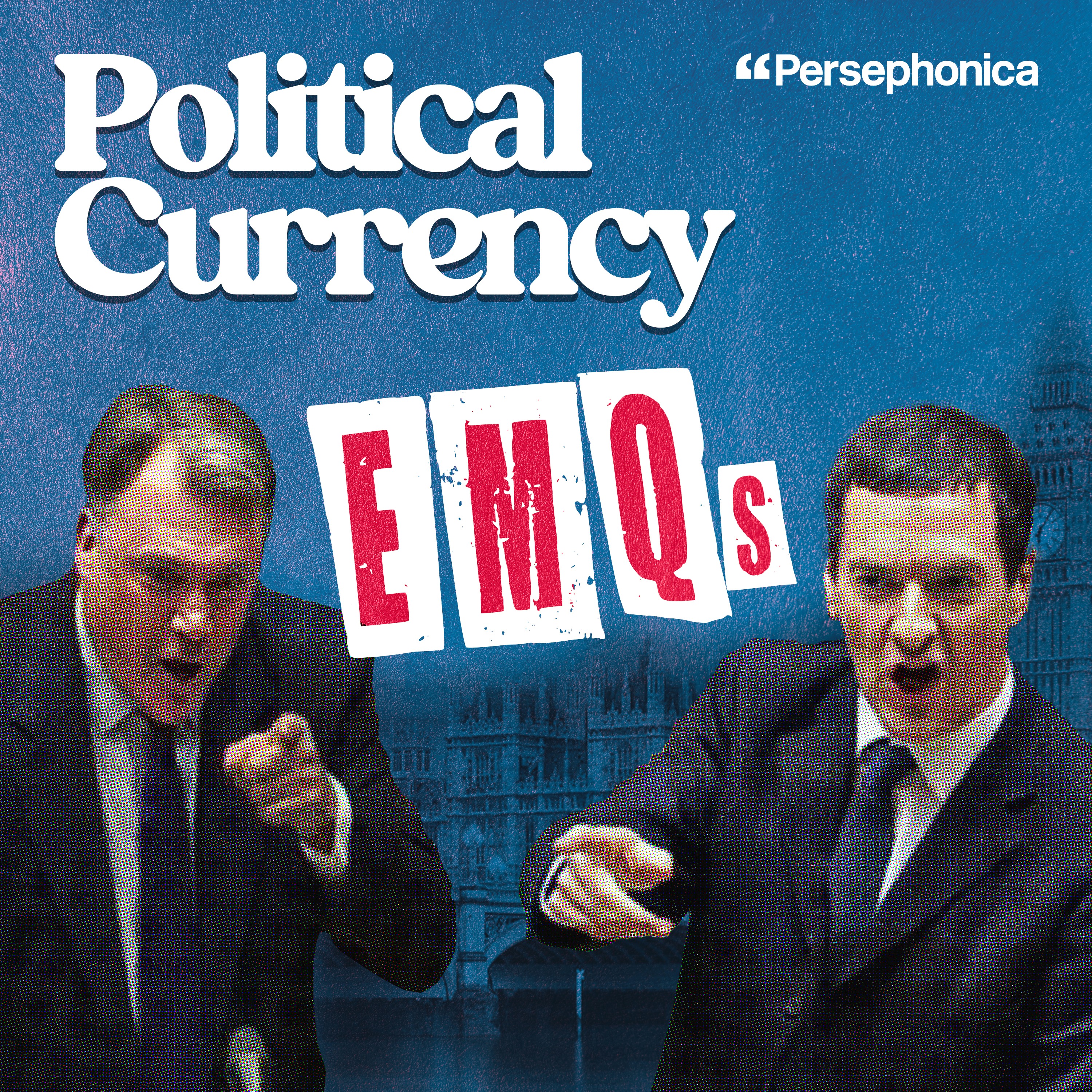
- EMQs: Why don’t politicians apologise?
In short
The episode of EMQs (Political Currency) is a wide-ranging discussion mixing politics, policy, and personal anecdotes. Hosts Ed Balls and George Osborne debate why politicians don’t apologize, using examples like Nick Clegg’s apology clip (“I’m a sugar”) to argue apologies for central judgment errors rarely satisfy voters. They also discuss London bike-share regulation: Lime bikes banned by councils due to exclusive contracts; boundary problems; and a case where a child hit by a stolen hired e-bike had no compensation because hired cycles fall outside the insurance pooling rules that apply to uninsured drivers and e-scooters. They then discuss a “youth triple lock” proposal from Labour MP John Slinger (youth maintenance loans/free bus travel/vouchers; youth minister/advisors) and critique youth advisors as lacking authority. They also cover devolution and “growth in every postcode” with former cabinet minister Greg Clark, arguing for growth poles economically but universal political coverage.
Guests
John Slinger (Labour MP for Rugby) and Greg Clark (former cabinet minister/business secretary).
Written by AI. May contain mistakes.
Chapters
0:06
Discussion on Movies and Directors
A light-hearted conversation about upcoming movies, directors, and personal anecdotes.
“Over 4 million businesses have skipped the line with Stamps.com.”
1:07
Discussion on Movies and Directors
A light-hearted conversation about upcoming movies, directors, and personal anecdotes.
“because you're not a gold or kitchen cabinet member you um still probably don't know which job you're going to get if you get a job at all how do you spend the weekend maybe the thing to do go to the movies.”
5:11
Cabinet Job Offers and Political Positions
Ed and George discuss their experiences with cabinet job offers and political appointments.
“I mean because the call is to go to Downing Street to find out what job you've got right?”
8:01
Local Council Issues and Devolution
A detailed examination of local council issues, bike rental regulations, and the effects of devolution.
“for making their counties and their cities better places to live.”
14:01
Regulatory Challenges with Electric Bikes
Learn about the regulatory issues surrounding electric bikes and potential solutions.
“But currently in the regulatory framework, they're outside.”
14:59
John Slinger's Youth Triple Lock Proposal
Explore the proposal for a youth triple lock aimed at supporting younger generations.
“I know, I'm sorry, I'm not belittling Jane's injuries.”
17:09
Debate on Youth Policy Implementation
Discuss the effectiveness of having youth ministers and advisors in government.
“And this is a very practical and communicable plan from John Slinger.”
22:02
Debate on Youth Policy Implementation
Discuss the effectiveness of having youth ministers and advisors in government.
“We're going to be back after this break.”
22:47
Reflections on Early Career Skills
Hear insights on important skills for young professionals from personal experiences.
“and I'm on the Chartered Management Institute Future Leaders program, which is helping young Gen Zers like me prepare for work, while also helping managers become better leaders for our generation.”
28:00
Facing Challenges Openly
Learn the importance of addressing personal challenges openly rather than concealing them.
“Would have helped Odysseus in the movie if he had faced up to the curse of Poseidon.”
Show all 19 chapters
28:50
Job Interview Insights
Discover valuable advice on handling job interviews effectively.
“There is a book of the movie I was about to say.”
29:40
Growth and Devolution Discussions
Explore the significance of regional growth and devolution in politics.
“obviously, but when you're interviewing for jobs, I've interviewed so many people for jobs in my life, as well as interviewed for jobs, and people use the job process.”
31:20
Addressing Left Behind Towns
Understand the challenges faced by towns left behind in economic discussions.
“Over the last two years, I would say that there's been a concentration on relatively few places.”
39:40
Sponsorship Transition
Transition to a sponsorship segment
“And thanks for all you've done on this agenda over the decades.”
40:35
The Politics of Apologizing
Examine why politicians often resist apologizing and the impact of effective apologies.
“I'm talking about Wagner here the ring cycle we're back to opera, can I just say Handel, yes, Puccini every day I think you should give Wagner a chance No way.”
42:02
The Nature of Political Apologies
Explore the effectiveness and context of political apologies.
“Because you can go on the ferries and it's a huge river.”
43:46
Learning from Mistakes in Politics
Discuss the importance of learning from political decisions without necessarily apologizing.
“So I think that's a very good example of where the apology doesn't work.”
45:21
Debate on the Value of Apologies
Examine the differing views on whether politicians should apologize and the implications.
“Or indeed, you know, I was an MP who voted for the Iraq War and I kept being told, apologise for it.”
47:12
Debate on the Value of Apologies
Examine the differing views on whether politicians should apologize and the implications.
“This has been a Persephoneca production.”

Ask about this episode
Get the gist, explore an idea or ask about something said.
 Claude
On Political Currency, what are the key points of this episode?
Searching your listeningTranscript
Automatic transcript. May contain errors.
0:00Still waiting in line? Again? That's time you'll never get back. Save time and money with Stamps.com. Over 4 million businesses have skipped the line with Stamps.com. Join them to save up to 90 % off carrier rates from your computer or phone right now. Print postage for certified mail, registered mail, and packages in seconds. Then schedule a pickup right from your home or office. For a limited time, go to Stamps.com and use code PODCAST for a free welcome gift. Taxes and fees apply.
0:32George Osborne: the chancellor of the exchequer getting a lesson from the shadow chancellor how to balance the books it's like getting a lesson from dracula and how to look after a bloodbath
0:41Ed Balls: as steady as she goes budget what kind of ship does he think he's on the titanic welcome to emqs from political currency with ed balls and george osby
0:59Ed Balls: so hello and welcome to emq's ex-minister's questions and if you are a current or aspirational cabinet minister this weekend whether you listen to our podcast on friday evening or monday morning because you're not a gold or kitchen cabinet member you um still probably don't know which job you're going to get if you get a job at all how do you spend the weekend maybe the thing to do go to the movies.
1:25George Osborne: Yes. Well, there's a great movie to see, The Odyssey. But before we get on... It's not out yet, is it? When is it out? It's coming out this Friday.
1:30Ed Balls: Is it? Oh, my gosh. Yes. With Zendaya. Yeah. Tom Holland. Yeah. Matt Damon. Yes. And the director is... Anne Hathaway. Anne Hathaway is not the director. No. Who's the director? Christopher Nolan. Christopher Nolan. Christopher Nolan is the director of this generation. It's really quite long, this film, isn't it?
1:50George Osborne: No, but I think if you think of... Well, it's almost three hours. but you know it's quite a big the clues in the title it's an odyssey I would say isn't it I mean if you would think of you know when we were growing up and then when we were a bit younger you know there were kind of directors obviously Steven Spielberg was the director of our childhood like E.T. and so on and then you know Martin Scorsese you know there were certain directors you would go and see the movie of. I'm a bit older than you I think for me it was still Alfred Hitchcock right George Lucas anyway Francis Ford Coppola I mean Christopher Nolan is the undisputed director of our generation in the sense that they actually sell the movie as a Christopher Nolan movie and although that cast list is very starry that's not why people are going to see it and I am fascinated because the Odyssey is a great foundational story of western civilization and yet it's a pretty complicated story when you get into it in any kind of detail.
2:54George Osborne: People remember bits of it like the Cyclops but the whole thing is quite complicated. But the reviews are out and it's also, it's the first film, I mean, in years that I've been thinking I've got to see that in the cinema actually. I've got to somehow get myself to a cinema rather than wait for it, you know, to just come to my laptop or whatever.
3:16Ed Balls: Well, it's all filmed, isn't it? on IMAX cameras, which means that it has this, the idea is to kind of create the kind of real immersion feeling. But it was very complicated to film as a consequence.
3:28George Osborne: And cast of thousands. I mean, it's a real kind of old-fashioned Hollywood epic.
3:31Ed Balls: Did you enjoy Oppenheimer?
3:33George Osborne: I thought it was okay. It's not my favourite.
3:36Ed Balls: It did well at the box office because it came out at the same time as Barbie and you could go to the Barbie Oppenheimer doubleheader. Although I have to say, Barbie I never got to the end of. I didn't like Barbie at all. I thought it was really dull.
3:45George Osborne: Yeah.
3:46Ed Balls: Great song. Great look. Which was the song? I can't remember. It's about, you know, the song about... You're thinking Barbie. Ken. So the song was all about Ken, wasn't it? I don't remember. I mean... You obviously didn't... Although we love Margot Robbie. But you didn't play with Barbies when you were little? No, I didn't, no. Action Man? Yes, of course. You're kind of so stereotypical. Have I told you my story about my Action Man submarine? No. I think I've made it, actually. For those people who listen to our podcast regularly, I apologise. We had a goldfish.
4:16George Osborne: You do not tell me that.
4:18Ed Balls: We had a goldfish, which was downstairs in the kitchen in our house. And every now and then, I think it was overfed, every now and then the goldfish would turn upside down. And it was obviously on its last legs. And somebody would yell, goldfish allure. But I had an action man submarine, where if you put it in the bath and it pumped, it would go down to the bottom. And then if you unpumped it, it would go up to the top. And what we realized was if you ran downstairs with the action man pump, plunged it in the goldfish bowl and pumped, it would inject oxygen into the tank. And the fish would then turn the right way around and then be firing for the next couple of months.
4:47Ed Balls: So every month or two, we'd have an emergency and an actual man would come to the rescue.
4:51George Osborne: Right. Literally a lifesaver.
4:54Ed Balls: Literally. I mean, that goldfish. In the end, it wasn't enough for it.
5:01Ed Balls: I sadly apologise for having told that story once. But if it was the second time, I'm even more apologetic.
5:06George Osborne: I think I've never heard that before. Anyway, I'm looking forward to seeing the Odyssey. That's the main point. and if you were waiting to find out if you were going to be
5:16Ed Balls: you know the Secretary of State for Education
5:18George Osborne: I had a question for you I'm a bit out of date, in the old days the famous thing you sort of stand by your phones you know you wait for the call so people would literally sit by the landline for hours and hours presumably these days it's all done by a kind of WhatsApp message isn't it? I mean because the call is to go to Downing Street to find out what job you've got right? Well these days It's presuming that, you know, well, maybe that you do get a phone call from Switch. Don't forget, Keir Starmer quite often didn't bother to call anyone.
5:48Ed Balls: Didn't call anyone. Yeah, okay, someone does. Somebody did. Stand by your WhatsApp. I got mine job offers both on the phone. Right. Did you get a phone call?
5:58George Osborne: No, I must have told this story. You knew already. No, I was in Downing Street. Yeah. So it was the first day, well, sorry, the first kind of proper morning of the Cameron government. We got into Downing Street the night before after Gordon Brown had left at dusk. And we discussed the cabinet. And in fact, there was this, you know, strong civil servant in the room, one Sue Gray, who said to the prime minister, new prime minister, you've got too many people. And everyone was like, oh, who's this, you know, tough woman laying down the law? And then the next morning, it's all underway. The cabinet reshuffles underway.
6:32George Osborne: I'm in Downing Street already, so I don't get to walk up Downing Street or anything like that. and I said to David there's got to be some moment where you say would you like to be the Chancellor Exchequer and I go yes and I go are you going to do that he says well would you like to be the Chancellor Exchequer I went yes and that was it well I never got I never got I bet I got I did the I got fired but even then I didn't walk up Downing Street to see Theresa May I was already in Downing Street
7:00Ed Balls: I when I went to the cabinet so I've never done the walk also I didn't do the walk I was very close to Gordon Brown, of course, and I was doing a live interview on BBC Radio Leeds and my phone rang, and I had to put it on silent and it said on it, Gordon Brown and the interviewer said who is it? And I said, it's Gordon Brown and he said, answer it I said, I can't answer it, I'm live on BBC Radio Leeds he said, well, and then it rang off and I thought oh my goodness, that was when he was going to make you Chancellor I missed my moment, I know he had changed his mind on that a couple of days before yeah, I don't know
7:33George Osborne: we've discussed that oh the therapy now listen our first question today comes from sean my local council in london has banned lime bikes it turns out the councils signed an exclusive contract with another provider i only discovered this once i'd lime biked all the way home and ended up having to cycle back to the local authority boundary once i'd discovered where it was i guess this is what devolution means, and in past lives I've wanted councils to take more responsibility for making their counties and their cities better places to live. But I noticed how annoyed I was, and how incongruous it was, to have a phone that lets me hire a bike or book a taxi or order a pizza or FaceTime my mother, now saying no to me because the council said so as opposed to more manchesterism might and more devolution mean more petty fogging nimbyish counselors in an age when google maps can take me anywhere now this is a really interesting question from sean this is exactly happened to me oh i got on i think it was like a forest i think is it called forest these bikes right and i'm cycling along and suddenly the thing kind of stops working i thought oh well maybe i've like you know cycled through i was second through the park and uh but i was on a cycle path just uh i checked i thought maybe i've gone off the cycle path and sort of geo located and it turns out i got into the wrong local authority and it was like an absolute nightmare i was in the end i just abandoned the bike and because i what was i supposed to do that you know it was a heavy electric bike and kind of paid the five pound charge of course they actually waive it on the first go you use it because i go just as a warning in future park it where you should park it and i did so i didn't but so though before i get like a load of people saying that's utterly irresponsible of you i did leave it with a bunch of all other kind of rental bikes but it was not in the right zone for this company because apparently westminster council you know didn't allow forest bikes but only allowed line bikes so the opposite i guess of what you're talking about with line bikes my answer to this sean is quite straightforward which is the reason why in Manchester and in Liverpool and in West Yorkshire, we went for a bigger area for devolution, which covered many local councils.
10:03George Osborne: So in the case of Liverpool, it covers all the Merseyside councils. In the case of Manchester, 10 local authorities, including Bolton and Bury and Rochdale and Wigan and so on. It's precisely so you've got more of a joined up approach rather than the kind of balkanized. The individual local urban councils in our cities, I think, are too small to make any kind of strategic decision on things like transport. And there's even an argument that they're too small, full stop. They're partly in London, I think, a hangover of the Greater London Council abolition from Margaret Thatcher and the creation of the boroughs.
10:36George Osborne: And then when they create the elected mayor, the mayor of London, the Blair government doesn't want to get rid of kind of get into reorganizing the local councils. But certainly when we did devolution to Manchester and other places, we wanted to do it on a bigger scale and give the transport powers to the bigger area and try and create this. Talk about saying it does work rather than saying it doesn't. See, if you look at Transport for London, that's actually an amazing creation because, you know, you can tap in, tap out over a huge area in which maybe 10 million people live. And Transport for London is making decisions about, you know, we'll repair something right over in Essex, you know, using money from rate payers or fee payers or ticket payers in West London because ultimately everyone knows they benefit from an integrated transport network.
11:26George Osborne: I would say transport for the north, which I did create, has not worked quite as well. It has not created the kind of integrated travel area and ticketing system. So it's big work in progress. But I have personal experience, like you do, of this, what's going on with these cycle companies in London and the local authorities. And I agree it needs sorting, Sadiq Khan. It does.
11:51Ed Balls: And I think, I mean, look, it tells you that there are limits to full devolution. And there are some things you have to coordinate. And, you know, one of the big frustrations in the railways, Andy Burnham's talked about this, that people who have to buy different tickets, it's not probably coordinated between the train companies. And, you know, the same thing is true here in terms of local transport. There's always going to be boundary effects. But I used to use, until they went out of business in the UK, Zipcar quite a lot. Zipcar was basically where you would kind of rent cars on the road. But Camden was outside of it.
12:23Ed Balls: So if you drove into Camden and tried to park, you then had to turn around and drive out and go back to Islington or back to Hackney. It's really annoying. In the case of line bikes, though, I mean, they are now ubiquitous and they are everywhere. And there is going to have to be a regulatory framework which really works for them. And here's another example of where it's not working. They are great, though. I mean, they are great. However, there are issues, and not just as…
12:49George Osborne: Drug people's careering around the capital. but also getting them you know their heads knocked yeah when you have those those those huge
12:57Ed Balls: piles of um bikes on boundaries we had a really um awful issue on good morning britain this week a woman called jane oartsey she was walking across the london square with her husband having been out for lunch a lad on a bike who'd stolen the bike 10 year old hits her devastating injuries hospital for weeks and weeks. Turns out that if you are hit by an uninsured driver by a car, then the insurance companies have a pooling mechanism to compensate you even if the individual can't take liability. The same thing is true if you are hit by an e-scooter. The same thing is true if you are hit by a privately owned electric bike.
13:41Ed Balls: But for some reason, hired electric cycles are outside that regulation She has no recourse at all to any compensation.
13:51George Osborne: E-scooters do have that system.
13:52Ed Balls: E-scooters do. Rented. Because they're counted as motorized. But the cycles are within the regulatory framework outside of that.
14:00George Osborne: They've got a motor. They're electric bikes.
14:03Ed Balls: But currently in the regulatory framework, they're outside. So Lime can offer a voluntary payment, but they have no obligation at all. They can't get to the individual who is a child. So they're outside of it. I think the only way in which we're going to make the line bike system work really well, and I'm a supporter of it, is if the regulation catches up. Because at the moment, it's so easy to dump bikes anywhere. If you dump a bike on a pavement, which means a blind person bumps into it, there's no recourse to the individual cyclist. But actually, there should be a fine for that. Because people have to become responsible for how they ride line bikes.
14:41Ed Balls: At the moment, it's slightly like they're not responsible, and therefore it's a bit of a wild west. This is an area where Andy Burnham, with his transport experience in Manchester, needs to get a grip. Although I wouldn't say this is the top priority of the incoming Labour government. For Jane, it's a big... I know, I'm sorry, I'm not belittling Jane's injuries. Very, very good. Our next question is from a current Member of Parliament and in response to our last EMQs. Hi Ed. Hi George. It's John Slinger here. I'm the Labour MP for Rugby. I really enjoy the banter at the start of your podcast. It's excruciating and hilarious in equal measure.
15:19I really enjoyed the discussion you had about the pension triple lock. And I wonder if you agree with my suggestion that we have a youth triple lock. It's a phrase that I coined and I've been speaking about since early 2025 in Parliament and beyond. What would you put in a youth triple lock if there were to be one? I would suggest something like above inflation maintenance loans for students or free bus travel, some kind of voucher scheme for them to get involved in constructive activities. But this could go much further, perhaps something on housing. I would also suggest that we have a minister for younger and future generations sitting in the cabinet.
15:57I would also throw in for good measure that we could have youth advisors in every single government department. Do you agree? Well, so John Slinger.
16:06Ed Balls: Tell me about John Slinger. Well, I don't know John Slinger well, but he's been an ultra-loyalist to Keir Starmer. He's been willing to go out and defend the Prime Minister, but actually, good on him. Here, though, I think what he's doing is talking about something important. As opposed to defending Keir Starmer. No, I didn't mean that. Something important about the future. And he's talking about it in a very... Unlike Keir Starmer. I'm not going to be drawn into... He's talking about it in a very serious way. And it has sort of echoes, I think, of the old Department of Children, Schools and Families, that you need to think about children and young people and all of their needs.
16:45Ed Balls: And he's coming up with, I don't know whether they're the right three policies, but it's smart to think about taking the triple lock language and turning that into a triple lock for young people. And I hope he gets some credit for this. And I hope that the new I hope, by the way, it's a new secretary of state for children, schools and families rather than just education takes up John Slinger's idea. Because, you know, it is important that we the politics is seen to be engaging in the lives of young people. And this is a very practical and communicable plan from John Slinger. So good on John.
17:18George Osborne: yeah john i i like well you know one of the things that's generally lacking in politics even in in in good times is um members of parliament coming up with interesting original policy ideas there's a huge shortage of them in the system and uh so i give you definitely an a here for coming up with some original thinking and thinking about how you might sell it even though you marked him down for being lord to kirsten i didn't mark him down for being lord to kirsten um i was just saying you know there's a new king in there's a new sheriff in town so come he represents rugby the ball has come loose at the back of the scrum um the um there's only one team yeah um only one um whatever it is fly half now um scrum half actually but don't worry yeah i didn't enjoy rugby much when i played it um the um he preferred wall games sorry wrong school yeah on the specific ideas like well we've we've discussed um before the whole kind of student loan system you're here talking about maintenance loans first of all i i'm glad you're talking about maintenance loans rather than maintenance grants because i think again it was a sort of for a period labor said we're going to move back to maintenance grants and in a tight budget situation that means just more and more of those grants would be squeezed out of existence whereas loans are a sensible way forward you're right though that both the student loans and the maintenance loans that's the money loaned to students to help them live while they're at university you know should be at least well at least inflation linked and maybe above and all sorts of problems have arisen because recent chancellors have been trying to squeeze money out of the loan system free bus travel i mean i'm not in you know one of the problems in britain is not that too many things are for free it's just we don't know how to pay for when you said recent chances did you include yourself in that no i didn't no okay although i think i did for the very first year i think you did yeah yeah yeah let's be fair i had introduced it and jacked up the fee and whatever i'm just just reminding people that when you said recent chances yeah um even some not so recent ones but it was my system free bus i mean i look as i said anti burnham was was on to sort of free things wasn't he because there was free museum entry there was free swimming lessons you know there's something about free and free bus show i still remember we've been talking about riding around london as a kid uh ken livingston's fares fair which wasn't actually free it was i think it was five pence or something for there was there was basically a kind of much reduced bus fare for young people i i think i would go for something much reduced rather than entirely free and i also think the pensioner past now is becoming a little bit it's for a start it hasn't been age linked has it so that you get people now the moment they turn 60 is it 60 i think i think in london but in other parts of the country it's retirement right i think the 60 is like pretty young to have free transport ridiculously young and it was 65 but then they look 60 is a new 35 well it certainly is if you're 55 i tell you if you're 59 60 is definitely going to get your bus it's a new So I like the policies, actually.
20:34George Osborne: Good. But where I kind of will take issue with you, John, I am a big sceptic of having kind of the youth minister in government or youth advisors in every department. I just don't think those things work in government. These people, the jobs don't bring with them enough authority and they don't bring with them budgets. and they don't. You can have a minister for youth services. That's a different thing. You know, minister for...
21:03Ed Balls: In a department for children, schools and families up to 18. Maybe.
21:06George Osborne: But you know what, I don't... Like a youth... What do you think of that kind of thing? A youth advisor in every department?
21:11Ed Balls: I think that what you want to do is tie it to ministerial responsibility.
21:15George Osborne: It's too gimmicky, isn't it?
21:16Ed Balls: But you can have people who champion across government, across departments, but it should be a minister.
21:21George Osborne: What about... You know, there's an interesting argument about the Equalities Act, which came in just before the 2010 election. which was, you know, you have to judge everything against, you know, equality questions. And people, you know, critics say that of it, say it did have a big impact or supporters of it say. Do things like youth, would a youth test work or is that just, again, you've got to give government flexibility to get on and govern for the whole country? You're nodding.
21:48Ed Balls: I'm just sort of thinking, I don't, yes, I mean, I'm not, I think you are right to say they should be a ministerial youth champion. I'm not sure a youth test in law helps. Yeah. I feel that will get in the way.
21:58George Osborne: OK, John, thank you for your question. Keep the thinking going. We're going to be back after this break.
22:12Shipping, billing, admin, payroll, marketing. You're managing all the things. So why waste time sending important documents the old-fashioned way? Mail and ship when you want, how you want with Stamps.com. Print postage on demand 24-7 and schedule pickups from your office or home. Save up to 90 % with automated rate shopping. That's why over 1 million small businesses trust Stamps.com. Go to Stamps.com and use code PODCAST to try Stamps.com risk-free for 60 days.
22:46Ed Balls: Welcome back. Here's a question from Amelia. Hi, Ed and George. Amelia here. I'm 21 years old and from Lincoln. and I'm on the Chartered Management Institute Future Leaders program, which is helping young Gen Zers like me prepare for work, while also helping managers become better leaders for our generation. With Alan Milbourne's review putting so much focus on young people and work, I'd love to get your perspective. If you could go back and meet your 18 year old self on the first day of your first proper job, what's the one skill you'd tell yourself to learn sooner? And on the flip side, what do you wish your first boss had done differently or been trained to do that would have made the biggest difference to your confidence and success now how interesting have you got answers to this i think we should answer it in terms of politics no i want no come on what would
23:33George Osborne: you are you gonna answer a question if you were to meet your 18 year old self on your first day of a job what well your first proper job yeah i mean to be fair my first proper job was i mean i I was working in the towel department at Sainsbury's when I was 18 and at Foyle's bookshop. But my first proper job.
23:52Ed Balls: Exactly. I was on a mill ground, worked in the post office.
23:55George Osborne: Was when I was 21. I mean, I'm afraid to say my first proper job was at the Conservative Research Department.
24:01Ed Balls: And my first proper job was at the Financial Times. Then I then went to work for Gordon Brown in 1994.
24:07George Osborne: So I'm going to talk about, there's someone here who almost no one will have heard of. But if you were in kind of conservative circles and certainly if you spent if you came through this thing called the Conservative Research Department, which was a post-war creation. And David Cameron was there and Michael Portillo and Andrew Neal, all sorts of people have been through the Conservative Research Department. It was an attempt to bring kind of rigor and new thinking to the Conservative Party. um when i joined there was a there was a the director was andrew lansley who you know people remember later was the health secretary um and um and he followed in a long line of um well-known directors including chris patten and andrew was actually a very very good director of the research department and um i learned a lot from him but i learned a lot in particular from his deputy who was a quite eccentric character who's still very much with us in the house of lords called Alistair Cook.
25:05George Osborne: And Alistair Cook taught me essentially how to write properly. And there will be about 15 people listening to this podcast to go, you're absolutely spot on, George. And everyone else will go, I have no idea what you're talking about. But this guy, you know, I remember I'd done my degree, I'd done my A-levels, and yet he taught me and he was absolutely ruthless at kind of going through the press releases we draft and the briefs we draft for conservative ministers at the time because it was the John Major government. This does not make sense. Why are you phrasing like this? This word is redundant.
25:41George Osborne: The exclamation mark is overused. You should be using a semicolon here. I mean, I know it sounds completely pedantic and it had a pedantic element to it, but it taught me how to express myself very clearly in writing. And it taught me a political art of what is the essential line to take. What are you trying to communicate here? What is the central political message? And I'm going to mention someone called Rachel Whetstone, who is married to Steve Hilton, the candidate to be governor of California. Rachel has held a string of top, top jobs in U.S. tech companies. She has run policy and global communications for Google.
26:21George Osborne: She's done the same for in Facebook. She's done the same at Netflix. She's done it at Uber. she's in an exciting startup now and she will say to you because she went through the same training this guy alistair cove taught me the skills that i've been able to apply in these big tech companies now the question is then what would would have been good trained differently what's the one skill
26:44Ed Balls: you should tell yourself to learn sooner if you could speak to your younger self
26:50George Osborne: that's a good question isn't it i mean i think it is um
26:55Ed Balls: do you want me to answer it while you're thinking yeah go on so i actually wrote a book and when i came out of politics called speaking out which was deliberately the lessons i wish that i'd been told when i was 27 when i started in politics so it was um my advice to my younger self and there's lots in there and there's advice in there to um bosses as well and um you know i think i'll probably say to to gordon brown and to myself that actually work-life balance is really important and i'm not sure I kind of that any of us understood that properly back in that time mine though is and there's a chapter in my book on this is about stammering because I had a stammer and I didn't know what it was to begin with and I covered it up and I tried to conceal it and I tried not to talk about it and I tried to compensate for it and that was a mistake and when I finally realized much later on when I was in the cabinet that the talking about it and being open about it both relieved pressure and helped other people to understand and also made it you know actually it made me better at what i did including communication so the advice i wish i had been given and the advice i would give to other young people is if there's something for you which is a challenge and pretty much everybody has something which is a challenge don't think that if you bury it away that you can conceal it and that will make you better actually being open about it and talking about it and managing it and having a boss who helps you to do that will end up being better for you not worse and i think that is the big lesson i wish i'd just kind of got to the point i got to in 2009 10 years before and that would have been better for me and it may have changed the course of how things have worked out for me and it may not have done who knows but i just know that that would have been better so if there's an issue face up to it and be public about it earlier because that will work to your advantage.
28:45George Osborne: Would have helped Odysseus in the movie if he had faced up to the curse of Poseidon.
28:50Ed Balls: That is the kind of point I was making, but one could make the same point in a slightly more relatable way, especially for those who have not seen the movie or are not like you and Boris Johnson, students of Greek mythology.
29:02George Osborne: There is a book of the movie I was about to say.
29:05Ed Balls: There's nothing which winds up George Moore than me saying that people like you and Boris Johnson, this is not company he seeks to keep. No. and nor did he keep to seek it with me um go on then have you thought of something is there something
29:17George Osborne: you know there's a very good piece of job advice i was given by um uh someone called nikesh aurora who's a top now top executive in silicon valley um but it's a very it's more about getting a job than once you have a job it's like it's very straightforward and it's deceptively simple when you say it's you can't turn down a job you haven't been offered which sounds like well obviously, but when you're interviewing for jobs, I've interviewed so many people for jobs in my life, as well as interviewed for jobs, and people use the job process. Many of them, I'm not sure I want to work at this company.
29:52George Osborne: Tell me more about it. And, you know, they use the interview as a sort of iterative. That's not the point. The point is land the job and then decide whether you want it or not. Oh, no. Right? So get the job offer before you can't turn down a job you haven't been offered. And so you do.
30:08Ed Balls: I just think George Osborne, you know, his aim was, do I want to be ambassador to the United States on behalf of the British government? Do I want to? See, I was a bit speculative about that. But you... In the conversation. Oh, so you think you made... That was the problem. I mean, I don't think it was never going to happen. I'm not sure I want it, Kit.
30:24George Osborne: No, I was asking too many questions. I'm like, well, what about, you know. Whereas I should have just said, yeah, it'd be brilliant. I'll do it 100%. Yes, yes. And then work out once it's offered. And by the way... I'm not sure I would have made a difference. And by the way, I don't know Jeffrey Epstein. Thank God I don't know Jeffrey Epstein.
30:40Ed Balls: Maybe we should kind of end this one there. Yeah. Let's move on. Our next question is from a former cabinet minister. Hi, Ed and George. It's Greg Clark here. Ed, I much enjoyed your final report from the Harvard King's College project on regional growth, for which you interviewed George and me. I've always believed that growth doesn't happen in the abstract at a national level, but always and everywhere in particular places where firms locate, expand and hire people. And those places must be made conducive to growth. So it would be positive, in my view, if this agenda is given a shot in the arm over the next few years.
31:21Over the last two years, I would say that there's been a concentration on relatively few places. But in his Manchester speech, Andy Burnham promised good growth in every postcode. Do you think, as I do, that this was a significant take on the devolution agenda? And do you think it's attainable? And if so, how best can it be brought about?
31:45Ed Balls: Tell us about Greg Clark, because, of course, you and he were both champions of the devolution in the second half of the parliament in 2010.
31:52George Osborne: Greg Clark is a brilliant guy. I love, you know, if you think like good people don't go into politics, he, I promise you, will prove you wrong if you spend five minutes with him. He's an interesting guy. He actually comes from a, you know, quite ordinary upbringing in the northeast of England, but doesn't kind of wear that on his sleeve. You know, he was a policy thinker before he went into become a frontline politician. He was then a cabinet minister. He ended up as business secretary. And he was absolutely critical with Michael Heseltine and me in driving devolution forward. I would say that was the triumvirate of sort of Michael Heseltine went to work for him as his special adviser.
32:32George Osborne: I mean, literally spad Michael, the former deputy prime minister, you know, king of the Tory party or not enough of a king of the Tory party. You know, he turned up as Greg hired him as a spad and he went to work when he turned up in the department. the department where he had been president of the board of trade they were like what are we going to do with michael herstein and and he said where's the special advisors office and they were like oh and he said no no i just want and he went to this little office next to the big secretary of state office which he'd once occupied and he beefed away and it was massively to greg's credit that he was able to harness michael's views and ideas work with me as chancellor and get these deals done and he did a lot of the kind of heavy slog of negotiating with the local councillors um now what about his well because i think you don't agree with him do you on this one
33:21Ed Balls: when he says the growth in every postcard code is a significant take no i i mean where i think
33:29George Osborne: he's right and we've discussed it before is you know the if there was an undone work of uh our evolution and kind of Northern Bauhaus agenda. It was that we didn't really have an answer for the kind of left behind towns. If they're towns around cities like Bolton or Bury in the Manchester area or, you know, places around Leeds, you can kind of connect them into the metro area. I'm thinking of places like Huddersfield. You can connect them into, you can have better commuting into the cities. which is a bit like if you think of the community towns around London, around the M25, you know, they are connected in and they're not dormitory towns because they've ended up being places where also people want to work these days.
34:17George Osborne: The problem is what do you do with kind of find a solution for kind of Grimsby, for, you know, Great Yarmouth, for Carlisle, for towns that are very significant distances for major cities? And we didn't really have a solution. But a lot of the politics of this country, and it's true also in Europe and in the United States, has been driven by these kind of left behind towns. So if Andy Burnham is saying, let's try and work out things for those communities, too. Great. But it's very hard to do because, you know, what is the sort of the original purpose that created these towns has often gone away, like the fishing industry.
34:55George Osborne: But if it's just like we want growth everywhere, it becomes, talking about our friend Boris Johnson, just a version of his like levelling up. Like we want everywhere to be. If you want everywhere to be better and you don't have any way of doing it other than some pots of money that Treasury dribbles out, then it's not going to succeed. It's not going to, well, it's not going to succeed. It's not going to be transformative.
35:17Ed Balls: See, I think there is an inevitable tension between the economics and the politics here. But that's okay. you have to think it through and work out how your strategy passes both tests. And an analogy for this is if you were to say we're going to tackle knife crime, what you'd want to do is identify the hotspot areas in the country where knife crime is the biggest problem and where you could have the biggest difference, and you'd focus some resources on those. But you wouldn't say, as a consequence, we're only going to have neighbourhood policing and a strategy for knife crime in those areas, because actually knife crime, wherever it happens, is a problem and you'd want to do something about it.
35:59Ed Balls: So you'd want your neighbourhood policing map to be universal, even if you focus resources. When you come to the issue about growth, there is no doubt that the places where you'll get most bang for your buck is in the places where you have deep, rich, agglomerating city regions. And you're going to want to make sure that that is where you focus resource you're going to want to make sure that your innovation spend isn't only going in Cambridge or Oxford but you're not going to want to have innovation spend going to every university equally you're going to want to focus it on your growth poles and as you say you're going to want to make sure that you then connect in as much as you can big travel to work areas into those big growth poles so it's fine to think I'm really going to think about Manchester or Leeds or Newcastle or Birmingham or Bristol.
36:49But the moment you say those are the only places which matter
36:53Ed Balls: and therefore you know our map of combined authorities and mayors is only going to be for the places which have the biggest growth potential then you exclude big parts of the country and that is alienating and divisive and also it makes it harder. I mean you are right about Bury or Salford But if you think about Burnley or Blackburn, they're not in the Greater Manchester or the West Yorkshire combined authority. But actually, the big significant towns where people can commute, what you want them to do is be in a combined authority with a mayor. And where the relations between those combined authorities, those areas are being strengthened, then you want your transport and your housing work to cross the boundaries, which is why you start thinking about something like the Northern Powerhouse or Northern Rail.
37:43Ed Balls: So Greg came to the launch of our paper last week at King's. And we're very clear the economics says drive the agglomerating growth poles. But we said from the beginning, you need to make sure that the map of mayors and combined authorities is going to cover the whole of the country. I think for a Labour government, if it doesn't, that is very problematic. And I think it's where you would have got to as well with a bit more time for the reason that you said. The moment you say Grimsby, you don't count. I mean, politically, that's a nightmare. And actually, there is a sort of a Grimsby economy, which may not be going to generate the depth of high skilled jobs as the centre of Manchester.
38:23Ed Balls: But it's also got great potential, which you need to tap into and exploit as far as you possibly can.
38:28George Osborne: The question is, can Whitehall work out what's going to work for Grimsby? Does it need some?
38:34Ed Balls: because that's why you have a mayor and a combined authority because you say that's partly they for what they've got to own themselves with flexibility and resource in the past what
38:43George Osborne: governments have done you know right back to the 60s and 70s is they've often sort of secured anchor tenants like government departments have been sent to grimsby or you know you get a big japanese car manufacturer to open which in some places has worked spectacularly like nissan in sunderland and other places like some of the welsh valleys you know the plants ended up closing down because the subsidies used to get them there were drawn, you know, and there was no economic reason for them to be there anymore.
39:12Ed Balls: I guess what I'm saying is it's not going to be the same amount of growth in every postcode. And actually, you have to focus your resources to get the best bang for your buck in the places with the greatest potential. But the moment you say there's some postcodes where we don't care about the growth, then you've lost the political argument. And that is, I think, why I think Andy Burnham and Greg Clark are right to talk about growth in every postcode. But that can't be sort of a, you know, an arithmetic test. Or just a slogan. Exactly. That's a great question, Greg. And thanks for all you've done on this agenda over the decades.
39:50Ed Balls: And we'll be back after the break with one more question.
40:01Shipping, billing, admin, payroll, marketing. You're managing all the things. So why waste time sending important documents the old-fashioned way? Mail and ship when you want, how you want with Stamps.com. Print postage on demand 24-7 and schedule pickups from your office or home. Save up to 90 % with automated rate shopping. That's why over 1 million small businesses trust Stamps.com. Go to Stamps.com and use code PODCAST to try Stamps.com risk-free for 60 days.
40:35our final question today is from dean and dean is one of our international listeners and we always like to hear from them on our podcast hello ed and george dean pallant here from cologne in germany i enjoy the podcast each week often riding my bicycle alongside the rhine here's my question why do politicians resist apologizing i find it helps to build credibility and repair relationships if i apologize as soon as possible obviously with sincerity but it seems politicians use weasel words rather than admit to their mistakes can you recall any examples of politicians using apologies effectively many thanks oh don't you like this is like the opening of rhinegold
41:25George Osborne: we're on the river Rhine you know the Rhine maidens are in the depth of the river
41:31Ed Balls: you're not selling this yet, come on, give me more we started with Odyssey I'm not sure I'm going to this film yet there's maidens in the Rhine, what's going on? I'm talking about Wagner here the ring cycle we're back to opera, can I just say Handel, yes, Puccini every day I think you should give Wagner a chance No way. Really, it's just not my thing.
41:55George Osborne: Anyway, I'm just thinking of like, isn't it great riding along the bicycle? It's a great trip down the Rhine if you've never done it. It's really fun. Because you can go on the ferries and it's a huge river. It's such a kind of central artery of European issues.
42:09Ed Balls: Can you choose your music of your choice?
42:11George Osborne: There's also some great wine you can try in different towns along the way. So I think, you know, Dean, it's a good question this, but I'm going to give you an answer which normally people say, politicians don't apologize enough so there are two types of political apologies one works and one doesn't um and the one that works is when you're apologizing for someone else's mistakes so you go i mean you see it historically you go i apologize for the irish famine or you know i apologize for the infected blood scandal something that keir starmer did recently um these apologies mean something uh to the communities uh affected so they're not meaningless at all.
42:51George Osborne: And I think it also, if you apologize for things that your party has got wrong recently, you know, Andy Burnham should definitely apologize for some of the mistakes that Labour have made. He's already started doing that kind of thing. But they're kind of easy because they're not your apologies. But they nevertheless will mean taking on potentially people in your own party or a movement who won't like the fact you're apologizing. So they're not to be dismissed and they can be very effective. Where I think it's very hard for a politician and I couldn't think of an example therefore of one that is effective to your question is where you have to apologize for a central judgment that you have got wrong it's quite hard if you're the prime minister or president to survive that or the deputy prime minister well so you're thinking of Nick Clegg I'm just I'm just remembering yeah
43:41Ed Balls: should we should we play a little clip okay I'm sorry, I'm a sugar.
44:16George Osborne: So I think that's a very good example of where the apology doesn't work. You cannot say sorry for something which is a central judgment you made and then expect that people will just accept that and say, OK, fair enough, it's refreshingly honest. Because leadership is about people trusting that your judgments are going to be correct. Does that mean that you can't admit to mistakes? Well, I think you can say I've changed my mind about things. Can't you learn? Can't you say it?
44:45Ed Balls: I mean, if you think, the way I think about this, if you're an airline pilot or a surgeon, things don't always work. You learn. That's how you are a better airline pilot or a better surgeon next time around. That's how it works.
44:58George Osborne: But if you crash the plane, remember for a politician, the people you're apologizing to are the people on the plane, not the people on the next plane. And to the surgeon, you know, apologizing to the person you've kind of killed on the day of surgery.
45:12Ed Balls: I'm not disagreeing with you. I'm saying that I think the apology doesn't buy you very much, but that doesn't mean that you can't learn from mistakes and talk about things which went wrong.
45:20George Osborne: But don't you think when people say, like, Tony Blair should have apologised for the Iraq War, if he had said, I'm sorry. Or indeed, you know, I was an MP who voted for the Iraq War and I kept being told, apologise for it. And I thought, you know, that is such disrespect to the soldiers who've died, their families, which is, you know, you're paid to make these judgment calls. I agree.
45:43Ed Balls: the idea that the sorry buys you very much is not true but that doesn't mean you can't say this is what we did and this is why it didn't work this is what we've learned, here's how we do it differently and you could even say I regret in retrospect we didn't do it this but saying I'm sorry I actually did say I'm sorry in a party political broadcast about financial regulation but I mean it didn't take you
46:11George Osborne: only way really i mean you know surely i leapt on it did i i'm sure you did um but i mean you know
46:16Ed Balls: yeah it was one of those things where people thought it was a good idea but i'm not sure it made any difference yeah i however there was learning to be had you know don't say sorry well look i mean as i said at the time when george osborne said to me you've been too heavy-handed in your regulation of the financial services industry and you should line up in 2005-6 i should have ignored you so in that sense i've definitely learned you didn't apologize for
46:38George Osborne: rigging LIBOR, did you?
46:40Ed Balls: Rigging LIBOR? Well, for God's sake. Unfortunately, I'm going to have to revive my legal action. We are out of time.
46:50George Osborne: Thanks for listening to the MQs. You can always send us a question at questions at politicalcurrency.co.uk.
46:55Ed Balls: We love variety in tone, era, subject, anything creative. Just send us a voice note. See you soon.
47:10George Osborne: Thanks for listening to Political Currency. This has been a Persephoneca production.
47:42We'll be right back. That's why over 1 million small businesses trust stamps.com. Go to stamps.com and use code podcast to try stamps.com risk-free for 60 days.
From the publisher
This week, Ed Balls and George Osborne hear from a current and former Member of Parliament. Former Tory minister Greg Clark asks if Andy Burnham’s pledge for ‘devolution in every postcode’ is attainable, while Starmer loyalist John Slinger puts forward his proposals for a ‘youth triple lock’ to improve prospects for young people in the UK. Should there be guarantees on above-inflation maintenance loans and free bus travel? And should there be youth advisors in all government departments? Ed and George praise the initiative behind the idea.
The pair also hear from a London cyclist frustrated by a council's ban on Lime bikes, the question is: has some devolution given away too much control? George recalls his approaches to devolution during the coalition government, while Ed evaluates the regulation of e-bike rentals.
And lastly, Ed and George explain why politicians resist apologising - citing Nick Clegg’s now infamous apology on student loans as an example. Can senior politicians ever recover from apologising about a decision they have made?
We love hearing from you, so please don’t forget to send all your EMQs to questions@politicalcurrency and make sure to include a voice note of your question or send a question to our social media handles:
👉 X
👉 TikTok
Thanks for listening. To get episodes early and ad- free join Political Currency Gold or our Kitchen Cabinet. If you want even more perks including our exclusive newsletter, join our Kitchen Cabinet today:
👉 patreon.com/politicalcurrency
Please note: Kitchen Cabinet is only available via Patreon.
Credits:
Research: Sam Burton
Production: Caillin McDaid & Nasreen Arain
Video Editor: Sam Gruet
Executive Producer: Ellie Clifford & Henrietta Harrison
Political Currency is a Persephonica Production and is part of the Acast Creator Network.
Hosted on Acast. See acast.com/privacy for more information.
More from Political Currency
All episodes

We use cookies.They keep VO running smoothly and help us improve it. Privacy policy