
 Ask ChatGPT


- Podcasts
- Political Currency
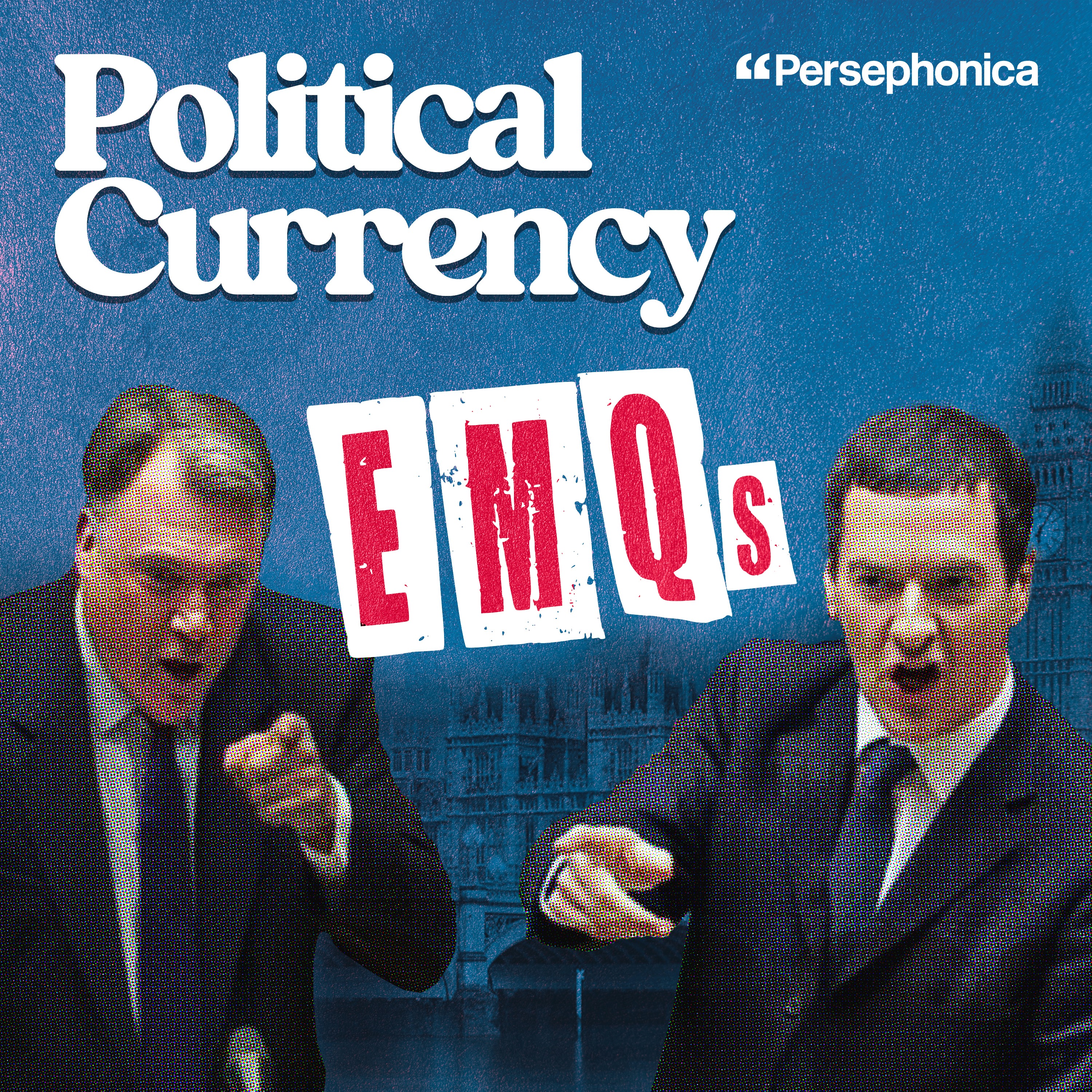
- EMQs: Why no one will end the triple lock
In short
EMQs Ex-Ministers Questions episode. Main discussion: why the UK state pension “triple lock” is politically hard to end; plus advice for junior MPs seeking promotion under a likely Andy Burnham government; and how Westminster should devolve power quickly.
Guests (questioners)
Douglas Law (Kitchen Cabinet member) asks about junior MPs’ promotion; Lucinda Clayton asks about triple lock affordability and alternatives; Chris Boardman (Olympic gold medalist; former Transport Commissioner in Greater Manchester for Andy Burnham; now National Commissioner for Active Travel England) asks about Westminster devolving at pace; Nick Robinson (not the broadcaster) asks about benefits for former prime ministers; Laura Trott (mentioned as a questioner, not the Olympic gold-winning Laura Kenny).
Key claims
triple lock is effectively a “double lock” now (2.5% floor irrelevant); scrapping it risks pensioners falling behind; OBR projections show ageing-driven spending pressures, and even switching to earnings link saves limited GDP; consensus and pension-age increases are more politically feasible than uprating changes.
Notable examples
OBR 50-year fiscal risk figures (state pension spending rising 5% to 9% of GDP under triple lock); 2008 earnings collapse; inflation-at-10% political backlash scenario; Manchester devolution improving active-travel delivery time by half and boosting local capability ~12%.
Written by AI. May contain mistakes.
Chapters
0:05
Exploring Indonesia: Culture and Cuisine
Hosts share their experiences and thoughts about Indonesia's diverse culture and food.
“Boost your credit scores instantly by getting credit for bills you're already paying.”
3:22
Exploring Indonesia: Culture and Cuisine
Hosts share their experiences and thoughts about Indonesia's diverse culture and food.
“And, you know, I was there for work, working with OpenAI.”
7:30
History and Language of Indonesia
Discussion about Indonesia's historical figures and the uniqueness of its language.
“I love the food, and it's a fascinating place.”
10:04
Advice for Junior MPs in Politics
Hosts provide insights on how junior MPs can position themselves for promotion.
“And we're very much looking forward to your next show.”
14:00
Understanding Junior Ministerial Appointments
Learn about the reasons behind junior ministerial appointments and their implications.
“So it's hard for you to make much of an impact.”
18:00
Audience Interaction: A Listener's Question
Hear a listener's thoughts on the state pension triple lock and its sustainability.
“Obviously, I also very much enjoy the podcast.”
19:00
The Triple Lock Debate: Issues and Implications
Explore the complexities surrounding the pension triple lock and its potential reforms.
“than any other kind of group at our gig.”
28:01
The Challenges of the Triple Lock
Exploration of the political challenges surrounding the triple lock and pension age reforms.
“But the pain of trying to establish a consensus to shift it may not be worth the money, because we've just said there's not a lot of money and it's not clear that you would actually make the savings anyway.”
30:04
Chris Boardman's Impact on Active Travel
Discussion about Chris Boardman's role in promoting active travel and local government engagement.
“See App Store or Experian.com for details.”
35:47
The Role of Former Prime Ministers
Examining the privileges and benefits of former prime ministers in the UK.
“bringing these metro mares from across the political spectrum.”
Show all 13 chapters
39:20
Re-evaluating Prime Minister Benefits
Discussion about the need to re-evaluate the benefits received by former prime ministers.
“Right, our final question is from Nick Robinson.”
42:04
The Debate on Prime Ministerial Stipends
Explore the historical context and implications of stipends for former prime ministers in the UK.
“Keir Starmer decided he wouldn't do that because it would be petty.”
48:19
The Debate on Prime Ministerial Stipends
Explore the historical context and implications of stipends for former prime ministers in the UK.
“This has been a Persephoneca production.”

Ask about this episode
Get the gist, explore an idea or ask about something said.
 Claude
On Political Currency, what are the key points of this episode?
Searching your listeningTranscript
Automatic transcript. May contain errors.
0:00Hi, it's Paige from Giggly Squad, and this episode is sponsored by Experian Boost. Summer glow-up? Check. Credit glow-up? Even better. Boost your credit scores instantly by getting credit for bills you're already paying. Your phone, utilities, rent, and insurance. I wish dating kind of worked like that. Connect your bank account, add those on-time payments to your Experian credit file, and your FICO score updates right away. You could instantly raise your FICO score by an average of 14 points with Experian Boost. Download the Experian app for free today. Results will vary. Users who received a boost improved their FICO score 8 from Experian by an average of 14 points.
0:39See App Store or Experian.com for details.
0:42Ed Balls: Results will vary. Not all payments are boost eligible. Users who received a boost improved their FICO score 8 from Experian by an average of 14 points. Some may not see improved scores or approval odds. Not all lenders use Experian credit files. And not all lenders use scores impacted by Experian Boost. See Experian.com for details. Still waiting in line? Again? That's time you'll never get back. Save time and money with Stamps.com. Over 4 million businesses have skipped the line with Stamps.com. Join them to save up to 90 % off carrier rates from your computer or phone right now. Print postage for certified mail, registered mail, and packages in seconds.
1:19Then schedule a pickup right from your home or office. For a limited time, go to Stamps.com and use code PODCAST for a free welcome gift. Taxes and fees apply. Finding great candidates to hire can be like, well, trying to find a needle in a haystack. Sure, you can post your job to some job board, but then all you can do is hope the right person comes along. Which is why you should try ZipRecruiter for free at ZipRecruiter.com slash zip. ZipRecruiter doesn't depend on candidates finding you. It finds them for you. Its powerful technology identifies people with the right experience and actively invites them to apply to your job.
1:56You get qualified candidates fast. So while other companies might deliver a lot of hay, ZipRecruiter finds you what you're looking for.
2:04Ed Balls: The needle in the haystack. See why four out of five employers who post a job on ZipRecruiter get a quality candidate within the first day. ZipRecruiter, the smartest way to hire. And right now, you can try ZipRecruiter for free. That's right, free at ZipRecruiter.com slash zip. That's ZipRecruiter.com slash zip. ZipRecruiter.com slash zip.
2:57Ed Balls: So hello and welcome to EMQ's Ex-Ministers Questions. We're in the studio, but George is looking quite jet-lagged because he's been in Jakarta. To you know, it's my first time to Indonesia, I'm embarrassed to say. I thought Jakarta was extraordinary. It's now the biggest city in the world. I mean, obviously, it depends a bit how you count the boundaries of these cities. But its population is bigger than Tokyo, bigger than, you know, San Paolo, bigger than Mexico City. Massive, kind of sprawling metropolis. And, you know, I was there for work, working with OpenAI. But I had to get time to go and look at this very small part, right in the old part of the city, that's the sort of old Dutch quarter.
3:36That's all that's left. It's not like some of these other kind of cities around the world where you can see the remnants of, you know, the former colonial era. There's basically one square with some Dutch architecture. Other than that, it's a kind of massive, sprawling modern metropolis. But the one thing I would say, the food was fantastic. I had a string of really good Indonesian meals. And there's so many. I guess I don't, I mean, I hadn't really thought about it before. And again, I'm embarrassed. But Indonesia is this huge country. It's the fourth largest population in the world. And you kind of think of it as a string of islands.
4:12But it's dozens or hundreds of different languages and different ethnicities. Amazing, an amazing, amazing story. I don't know, are you open to Indonesia before?
4:23Ed Balls: I've been lots of times, actually. Lots of times? Lots of times. I went in government three or four times. First went in 1990 when a friend of mine, girlfriend of mine was working out there doing a PhD. Yvette and I went there in 98 for a kind of summer honeymoon. You had your honeymoon in India. There was a financial crisis. Unrelated to you being in the country. I mean, you know, it already started. We had a financial crisis in Britain because you were around. It was called the Asian financial crisis. I know. Thank you. You weren't responsible for that crisis. It was 10 years before, 1998. And the Indonesian...
5:01Ed Balls: It was a global crisis. It was a global financial crisis. Not a crisis made in Indonesia. This was the Asian financial crisis. And the Indonesian currency had collapsed, as other countries had in Asia at the time, against the dollar. So it suddenly meant there was all these really big fancy hotels and we went to Bali. But if you paid in dollars, I mean, it was so cheap. Did you see a Komodo dragon? Because they live in Indonesia. They do. I think what I really want to see, an orangutan in Borneo. There are lots of pictures of orangutans in the airport and things. I was thinking, I've got to come back and I've never been to Bali.
5:39Anyway, I'll definitely be back to Indonesia.
5:41Ed Balls: I've been to Bali and to Lombok and to Sulawesi. The food is amazing. Yeah, great. Especially, there's a particular type of food, regional food. I think it's called Padong, where they have restaurants where you go and they put on the table like 20 dishes in front of you. And then you eat what you want and then you pay for what you've eaten. Amazing food. Nazi goreng. Basically a buffet. Like a buffet. The time I thought was really exciting. And the other thing which is really interesting about it is, I think it was Sakana after the Second World War, the kind of independence revolution. He was the Mahatma Gandhi.
6:15Well, more than that, because he became the... He was like the Nero of India.
6:18Ed Balls: That is right. And he unites these islands into this nation with huge numbers of languages. I mean, hundreds of languages. Yeah, I think there are like 700 or 800 languages. So they come up with a language called Bahasa Indonesian, which is the uniting language everybody has to learn. But how do you make it easy? And the answer is you only have one tense. So everything is, I think, in the present tense. And there are words which can modify. So you can say past or future, but you don't have complex verbs with different tenses. It's all basically present tense. And who knew you were an expert in the Indonesian language?
6:55Ed Balls: And then Gordon Brown and I, Gordon was the last international figure to see President Saharto in 1998. He'd been around for decades. He'd been around since 90. Not the same as Saharto. Sorry, I got that wrong, didn't I? Not the same as Saharto. No, it's Saharto takes over from Sukarno. Beginning of March 1967, so just like a week after I was born, goes all the way through to 1998. And Gordon and I went to see him. Meat and balls, and there's a theme here, isn't there? And a week later he's gone. Yes. So I don't know what to say. But no, so I love Indonesia. I love the food, and it's a fascinating place.
7:34Ed Balls: And if you go to Amsterdam, there are lots of Indonesian restaurants, And there's a particular meal you can have called, I think it's called a wrist apple, which is a 13 dish normally meal. And you start with less spicy food and it ends up getting spicy and spicy as it goes on. Do you think Dutch food is a bit like English food? Massively benefited from the influx of foreign influences. Anyway, we're not here to do a travel show. We are here to do EMQs. Let's take our first question. Well, the first question is from the person, the Kitchen Cabinet member, who won the free tickets to the Centrist Dad gig, that's your band, that you played last week.
8:19Which you came to. I did come to. This is what Douglas Law, the winner of our prize, congratulations, what Douglas and I were subjected to, sorry, enjoyed when we went along last week.
8:44That wasn't a karaoke bar in Jakarta. That was you live. But a lot of people singing along in the audience. Can you hear that? Yes, that was one of them.
8:53Ed Balls: That was our final number. Pink Plony Club by Chapel Roan. I thought your Madonna was pretty good, actually. Like a prayer. Did you? Yeah. Thank you. That was your new song, wasn't it? That was one of the new songs. We also did Our House by Madness. I would say, I mean, lots of people said this to me. I'm not sure if they're right, but they say. You're a genius. No, they say they think they don't say that. They think our version of Poop Pony Club may be better than Chapel Rose. Yeah, I think they're wrong about that. Distinctive. Here's Douglas's question. Hey, Ed and George, Doug from the Kitchen Cabinet here.
9:24Ed Balls: First off, thanks so much for your hospitality at the Water Rats the other day. It was great to meet you both in person. And Centrist's dad, as expected, were fantastic. and all of course in aid of such a good cause, the Joe Cox Foundation. As for the question, you've spoken a lot about contenders for top jobs in the likely Andy Burnham government, but I'm curious what advice you might have for more junior MPs who might be trying to secure a place in the new regime. What can they do in the time left before his ascension to position themselves for a role? And indeed, what should they have been doing over the past weeks and months?
9:59Ed Balls: And what separates MPs who do end up getting promoted from those who don't? Thanks again for the tickets. And we're very much looking forward to your next show. Well, we talked about the importance of continuity in the main podcast and James Pennell kind of talking to the junior ministers and telling them that they want people who are doing the jobs to carry on doing the job. And I was saying a few days ago in the main podcast, why that might well be in the interests of Andy Burnham, because what he needs to do is make judgments, he and his team, about who are the junior ministers who are going to really rise up.
10:32Ed Balls: Very hard for him to do that on day one. There are different dimensions to what makes a good junior minister and your reputation. And I guess if you are one of the junior ministers who's trying to be noticed at the moment, These are the things which matter. Do other ministers, number 10, the civil servants, rate you for your judgment, your ability to make decisions, the way in which you go about managing the policy process? Are you somebody who, on the media, can go out there and do good media performances? is we had Jake Richards on this week on a very sticky wicket around dreaming gangs and lots of Andy Burnham questions.
11:14Ed Balls: But, you know, if you can do the difficult interviews and hold your own, that is a good thing. And then the other question is, have you got champions in the cabinet, in politics? Well, at the moment it will be Andy Burnham, but there are always other powerful figures in cabinets who want to support and bring on junior ministers. And so if you have people who are backing you politically that also helps and i guess if you're a junior minister at the moment you're thinking uh can i establish that reputation as a policymaker can i show them my media performances or at least get that known are my champions speaking up for me at the moment you want your champion to be andy burnham well definitely because it's his decision although junior minister posts quite often the the prime minister doesn't get involved too much in the junior minister i mean some prime ministers did and some prime ministers didn't uh and david cameron david cameron was definitely interested in junior minister gordon brown was always very interested i think tony blair would be as well no i think i'm not sure was blair more kind of standoffish or maybe not i think i think sometimes i think there are people really well look i mean people who are advising you of course but no no prime but some prime ministers have sort of left it to their chief whips and things like that to the junior ministers or their it's kind of number 10 stuff the question In some ways, your question, Douglas, is sort of a generic one, which is like, how do you get promoted in politics?
12:38But it is such an unusual and unique situation, this, because normally all this advice applies when you are, you know, basically setting out your wares before a party leader who knows you well, or at least they may not know you well, but they've, you know, they're in parliament. They've been seeing people perform. they've been sitting watching how someone does at the dispatch box they might have caught it the you know as they come in to do prime minister's questions who's been answering questions for the last five minutes before and so on and in opposition of course there's a shadow cabinet and shadow ministerial team that largely becomes the ministerial front bench and in normally when there's a transfer of premiership within a government there's been a leadership contest So that person who becomes the prime minister has been talking to everyone and they've been sitting around as home secretary or foreign secretary or chancellor watching people perform.
13:32Andy Burnham arrives and he doesn't know a load of these people. He's never met them. He may have now met them once at the Makerfield by-election when they presumably came up to campaign. If they didn't come up and campaign and put their name on the board they all had to write on in the working men's club in Makerfield, I think they can rule themselves out for promotion. But as he did that, you know, he might have met them once briefly then. He'll probably have met them either individually or in a group once before becoming prime minister. So it's hard for you to make much of an impact. I think broadly speaking, people get junior ministerial jobs for one of three reasons.
14:10The first is that they can be kind of essentially a representative of a particular wing of the party. and you know prime ministers try and construct governments that have roughly equal numbers of men and women you know a diversity of ethnicities the diversity of geographic you know you want to have some ministers from the north ministers from the west country ministers from london you know and in fact andy burnham in his kind of leaked message he sent the mps says i want something that's representative of the party so people do get get it because of that there are like known left-winger or prominent in the London Labour Party, let's say.
14:49That's one reason. Second, you can have a particular specialism. Ken Burnham says, I want ministers who know what they're talking about in this most recent message he's put out. So, you know, maybe you've been campaigning on, you know, youth justice. So you become the justice minister or you're an expert on special education needs. You become like the junior education minister. And then there's a third category which i suspect jake richards is in and there are a few others who are basically kind of rising stars and deployable in many different departments don't come with a particular specialism don't represent a particular area of the country or rather that's only secondary and these are the rising stars these are the people who you think this person i'm going to make them a junior minister now then there'll be a minister i can see their path to the there are potential kind of future cabinet member i remember you know if you look at the kind of early appointments of the kind of cameron government you know there were people who were getting onto the rung of the ladder i remember like sajid javid was a sort of obvious early star and you just wanted him in the team because you're thinking actually this guy could be in my cabinet by the time we get to the next general election how do you create that aura around you that you're a future star i mean all sorts of things communications ability to handle tough interviews on the tv as you were just alluding to your ability to connect within the party including to the staff in number 10 the kind of key advisors and a general you know politics is a future game unlike the indonesian language it does have a future tense is this person a player in the future the only thing i'd
16:29Ed Balls: say because we talked about the access talks Andy Burnham is having at the moment the civil service will have a view on the ministers who are doing a good job and that will be fed in through Antonio Romeo but don't underestimate because I'm not sure this is fully understood on the the outside we did talk about it last week or the week before that the Keir Starmer reshuffle in September of last year only just over a year into government where they changed more than half of people's jobs was so disruptive and the civil service hated it and also it becomes well do you really want to commit to working with that cabinet minister or that minister because you know if kirsten was going to change it once a year they won't be here for very long there will be a real desire to keep people who are in jobs good at them and halfway through solving a problem dealing with legislation a consultation where they've just had the responses come in to keep people in jobs and delivering because if you blight delivery with a massive turmoil um halfway through a parliament makes it much harder to be delivering by the time you get to the next general election and that's already happened once in this parliament so i think probably to answer douglas's question doggedly get along with your job and being good at it and the civil service saying keep them actually that will be quite influential anyway our next question also turns out to come from somebody who was at the the gig and uh this is lucinda hi ed and george my name's lucinda clayton and i just wanted to say how much i enjoyed the centrist dad performance at the water rats it was a great evening and in aid of a very worthwhile clause.
18:13Ed Balls: Obviously, I also very much enjoy the podcast. I have a question about the state pension triple lock. Looking at the actual cost rather than what was originally anticipated, is it becoming financially unsustainable, especially at a time when other areas of public spending, such as disability benefits, are being cut back? Secondly, at the same time, lots of people argue that the triple lock should be scrapped, but I rarely hear anyone suggest a realistic alternative that would protect pensioners' living standards. is there a credible replacement? And finally, has the politics simply become impossible?
18:44Ed Balls: With an ageing electorate, has the triple lock become one of those policies that no major politician is willing to challenge, regardless of the fiscal pressures? I'd be really interested to hear whether either of you thinks there's a politically realistic way to reform it. Thanks very much and keep up the excellent work. Bye. You know, there were more people from political currency than any other kind of group at our gig. Robert Peston came over to me. who has, you know, rest his money, very successful podcast, and said, how come everybody here seems to be a political currency listener? I said, Robert, I said, just reflect.
19:18I know. I think he was a little bit peeved about that, to be honest. Well, I mean, you know. Because he's the front man. He's like the Mick Jagger of the band. And Charlie Watts had turned up with more fans.
19:29Ed Balls: Tell people and they will come, as somebody said in a film once. No, I think they said, build it and they'll come. Well, okay. In that field of dreams. I tell you, in Pete Panic Club, we were building it. So I'll go first as the person who introduced the triple lock. I mean, I just think there's just so much confusion around this question. I mean, it comes up again and again at the moment in politics that what the government needs to do is come off the triple lock. And it's supposed to be a sort of sign of being serious about the problems the country faces. I just think that everyone who debates this, including lots of people I know and have a high regard for, are being a little bit disingenuous.
20:08And because what is the triple? Let's start with what is the triple lock? And the triple lock is that the state pension should rise either by the rate of inflation or by the rate of earnings growth in the economy, i.e. by how much everyone else's wages are going up, or by two and a half percent. whichever is the highest. And the 2.5 % is kind of irrelevant now, because it was introduced at a time when inflation was very low. And you got periods when earnings growth was very low. During the financial crash in 2008, earnings growth actually goes down. And so you had very low inflation, earnings growth, zero.
20:53And then for you get no increase in the state pension. And so that's the two and a half percent. But it's irrelevant now. So it's not. So forget about the triple lock it because these days, inflation and earnings growth are above two and a half percent. So it's actually these days a double lock. It's either inflation or earnings. Which one's higher? Now, this was the big thing. Margaret Thatcher came off the earnings link. And then there were lots of campaigns around pensioner poverty. And Barbara Castle led these during Labour's period in government. And it was the Tories and the Liberal Democrats and coalition that reestablished that you could have an earnings operating to the pension.
21:30so unless you are prepared to come off that again to do what margaret thatcher did and as a result accept that pensioners are going to become progressively poorer relative to the rest of the population because in most years in most times earnings grow faster than inflation unless your country really is in trouble because it's kind of year after year getting poorer and poorer unless you're prepared to go back to that period which some people will be but i don't think the political classes are remotely ready to see again over a long period of time pensioners become the poorest part of the population and the flip side of the triple lock or the double lock which in practice it is these days is that pension of poverty is not anything like the issue it was in british politics a generation ago doesn't mean it doesn't i'm not saying they're not pensioners who are struggling but it is it was a huge issue and i just think everyone's being disingenuous they call it the triple lock and it's shorthand but what they should actually say is it's time for the government to accept that pensioners are going to become poorer and poorer relative to the rest of the population because we can't afford in an aging society any other thing and i don't think people are prepared to say that so i hear the argument you are making but would you agree with me at least before we come on to the merits that that is the real choice that people duck a bit when they just talk about the triple lock a bit on you know when you're interviewing people on gmb you go the brave thing to do be to come off the triple lock without spelling out what that
23:00Ed Balls: means see the problem with your argument is that any time you have even one year inflation higher than earnings that goes permanently into the pension yeah and so therefore you pay the costs of that that that one-off year permanently increases the pension which is sure when inflation was 10 % under Rishi Sunak. But that would have been always the case. There's never been a time when the pension didn't go up with inflation. So the Office of Budget Responsibility this week published their long-term 50-year look fiscal risks and sustainability report in which they warn of a big potential public debt crisis coming up over the next 50 years.
23:46Ed Balls: And so the reports are OBR says public finance is unsustainable, debt's going to rise out of control. When you look at their forecasts, they have tax essentially staying level as a percentage of GDP. That is their assumption, income tax, VAT, inheritance tax, couple gains tax, kind of around the average in the OECD G7, slightly lower than other European countries, markedly lower than other European countries. The reason why they say there's a debt problem is on spending, and it's mainly to do with ageing. So they say in their projections, health spending goes from 8 % to 13 % over the next 50 years.
24:28Ed Balls: Big driver of increased spending. Unless you're going to raise taxes, borrowing is going to go up. Adult social care a little bit, defence significant. they say state pension spending on the basis of the triple lock goes from 5 % in 2030 to 9 % in 2075. But that's because the population is getting older. But they say if the triple lock was replaced by the earnings link, it would still go up, not from 5 % to 9%, but from 5 % to 7%. But they're not including the inflation link. They are saying as a percentage of GDP. If it only went up with earnings. If triple lock went up by earnings, not the triple lock, it would still be 7%.
25:15Ed Balls: So they aren't proposing or comparing it to, as you said, back to price indexation. That would be much lower. Even if you simply replace the triple lock with the earnings link, it would still save you 2 % of GDP by 2075. That must be because then... Because they're saying that there will be enough periods in the next 50 years when inflation is higher than earnings that it ratchets up. So your point is right. You can make big savings by going to price indexation, but that would give you a pension or poverty problem because pensions fall behind. But even if you went from triple lot to earnings link, you would still save 2 % of GDP, which is decent money.
25:59All right. You've got to imagine the politics of the year in which inflation is 10 percent. I agree. Which existed under Boris Johnson, Liz Truss, Rishi Sunak because of the Ukrainian conflict. Right. Goes up by 10 percent. And what happens? Massive pressure on the cost of living. Government introduces billions and billions of pounds worth of fuel subsidies. And you're saying in that day, in that in that year, the chance exchequer gets up and says, oh, well, remember, we we've now changed the triple. and we're only going to increase the pension by earnings. And earnings only have gone up by 2 % this year.
26:34I know inflation is 10%. So your state pension is only going up by 2%. There would be a massive outcry in the political system. You wouldn't win the vote in Parliament with your own MPs on the uprating of the pension. And you'd say, OK, well, this year, exceptionally, we're going to have a pensioner supplement. Pension will go up by 10%. This is why it's a nonsense debate, this.
26:58Ed Balls: So you and I discussed this, I think the last time we talked about this, a year or two years ago, we both said that the idea there is this big pot of cold called getting rid of the triple lock isn't real. And it would get you into exactly that problem or the pension or poverty problem. And, you know, in the end, the big driver is health demography. It's not really about pensions and defence, it now seems. And the reason you've got a debt problem is spending rising, not losing the tax revenue. and the triple lock as big easy solution you know doesn't really add up but you can still keep increasing the pension age because although people say oh george osborne introduced the triple lock that's not fiscally very prudent i did building on the work that had been done by the previous labor government increased the pension age and that's you know you get all those rows which randy burnham dipped his toe into didn't he around like oh i'm going to compensate uh people have lost out because of increases in the pension age and then backs off immediately but if you can keep increasing the pension age in line with life expectancy then you know the whole thing remains broadly affordable that is right and the interesting thing look once you've introduced a triple lock it's very hard to go back and to build a consensus to do so and that's probably drop the two and a half percent floor but that would make as you said that doesn't make much difference so it becomes a double lock it's only when you're in a sort of total kind of um earnings uh desert that that makes a difference.
28:23Ed Balls: But the pain of trying to establish a consensus to shift it may not be worth the money, because we've just said there's not a lot of money and it's not clear that you would actually make the savings anyway. Whereas the interesting thing about the pension age is we've managed to raise it consensually without there being a big political backlash. So I think probably that explains, Lucinda, why politicians haven't really touched this. We'll take a break and then we'll have another question.
29:19Transcription by CastingWords over 1 million small businesses trust stamps.com. Go to stamps.com and use code podcast to try stamps.com risk-free for 60 days. Hi, it's Paige from Giggly Squad, and this episode is sponsored by Experian Boost. Summer glow up? Check. Credit glow up? Even better. Boost your credit scores instantly by getting credit for bills you're already paying. Your phone, utilities, rent, and insurance. I wish dating kind of worked like that. Connect your bank account, add those on-time payments to your Experian credit file and your FICO score updates right away. You could instantly raise your FICO score by an average of 14 points with Experian Boost.
30:00Download the Experian app for free today. Results will vary. Users who received a boost improved their FICO score 8 from Experian by an average of 14 points. See App Store or Experian.com for details.
30:12Ed Balls: Results will vary. Not all payments are boost eligible. Users who received a boost improved their FICO score 8 from Experian by an average of 14 points. Some may not see improved scores or approval odds. Not all lenders use Experian credit files and not all lenders use scores impacted by Experian Boost. See Experian.com for details.
30:34Ed Balls: Welcome back. Here is someone, this is really exciting, somebody who's worked with Andy Burnham, new prime minister, designate many times. Also, So I believe I'm right in saying the first time we've ever had an Olympic gold medal winner ask a question on our podcast. Hi Ed and George, Chris Boardman here. Topically, I was Transport Commissioner in Greater Manchester for Andy Burnham. I'm now National Commissioner for Active Travel England. Now, I think we are the first government body to have adapted to devolution. Last year, we convened all of the metro mayors from across the political spectrum, Labour, Conservative and Reform, to make joint delivery commitments.
31:17Ed Balls: And we put two Metro mayors on our board to join up local and national decision-making. In less than two years, the approach has halved the delivery time for schemes of this type and increased local capability by about 12%. At just over 100 people, we are a small organisation, but I think we've trailblazed some pragmatic methods that have proven to work in a politically fractured landscape. I posit these could be scaled and applied across government. So my question is, how can Westminster revolve at pace from being architect and arbiter to enabler and convener for local government? Hugely exciting to have Chris Bourdon.
31:57Ed Balls: Won a Pursuit gold medal in 1992 in Barcelona. This was in the days when, you know, every gold medal really counted. I mean, it doesn't count now, but Britain's actually got better at winning gold medals. So everyone, if you're in my generation, you absolutely remember Chris Boardman winning gold yeah and then gone on to be a great champion of walking and cycling and a public policy maker worked closely with Andy Burnham in Manchester now national role leading the government's cycling walking body active travel England I was talking to Kim McGuinness who's the northeast mayor at our event a few days ago about regional growth and she says that Chris Boardman is is really really having a big impact across all of the mayors in the work he is doing.
32:46Ed Balls: So I guess all power to your elbow, Chris. And if you are Andy Burnham and you're wanting this agenda taken forward, well, you know, doing this through devolution is almost certainly the way to go. I think we talk a lot about mayors around growth and jobs and skills, but actually the mayors can also be innovators in public service reform, different ways of trialing things out. One of the great things you've always seen in America is different states changing rules, laws, regulation in order to experiment, to see how you can do things differently. And if it works in one place, others copy. And I guess that is something which Chris and his partnerships with different mayors can deliver.
33:31I think Chris has done a pretty amazing job, first in Manchester and then more broadly. Because I think there's a general consensus, which has held together on this issue in a way it hasn't held together on some other i'm going to kind of loosely define these as sort of green issues where there's now quite a row in the political world about norsey oil drilling and net zero and so on but i think there's a broad agreement that promoting active lifestyles is a good thing promoting cycling is a good thing you know although this will not be popular with every black cab driver in london and no doubt their equivalents elsewhere in cities.
34:11I think the kind of proliferation of cycle lanes has been a really good thing. I think if you cycle, and you know, I do occasionally take a line bike and here in London, and I used to cycle much more, it actually feels so much safer being in a kind of protected cycle lane. And there are definitely a load more cyclists on the road than there used to be when I was younger. It's both the availability of bicycles through, you know, originally the, I hate calling it this, but the Boris Bike Initiative and then similar schemes in other cities, but also these new companies that have come in. So it's a proliferation of bicycles, but I think it's also just feels a lot safer.
34:50And, you know, actually, Chris, he brings to it not just his experience of winning gold for Britain, but also he's, you know, he had a personal tragedy. His mother was killed on a bicycle by a driver. So he's, you know, that has animated him and it brings conviction. But, you know, with all these things, it's not enough to have a passion. You've got to know how to handle the politics. And as you say, you know, he's learned that absolutely critical lesson, which Andy Burnham says he's going to learn. And I feel Keir Starmer never did. And there are Tory prime ministers before him who didn't either, which is you've got to find some way of binding the other side, either by consensus and reaching out to them or by making it impossible for them to reverse what you've done.
35:35Some kind of cross-party political consensus, or else your achievements don't last. The things you set up and do just get abolished by your successor. And he appears to be doing that by, as he says in his question, bringing these metro mares from across the political spectrum. And I, you know, it's a big challenge for Burnham in the current setup in Westminster, but he did do it in Manchester. You know, I saw that firsthand as a conservative politician. up there can he find some way of achieving some kind of consensus but the prize is big and we were just you know by coincidence we just were talking about it on the last question there was a consensus established around pensions actually in britain not just the pension age but also auto enrollment in private pensions which is another big success story and those things are only success stories and britain is only a standout example in western democracies of how to handle some of those issues because there was a cross-party consensus established
36:33Ed Balls: so thank you chris for um your question and for being our first ever gold medalist questioner we've never had a question from sebastian co maybe we should get william haig to sort that out we we did actually i know i know you've said pretty well yeah i was i was in the i used to share a tiny office with him which is literally about the size of this studio we're in at the moment and I was in the room when he took a phone call and he'd been told that his 800 meters world record which had stood for 18 years had just been broken yeah and uh I didn't really know what to say because he was um he put on a brave face on it but it was not a great moment we have had we should just say a question from Laura Trott the conservative um shadow company member who always scores very highly in YouGov recognition, public recognition and support polls.
37:20Ed Balls: But I think the important thing to say is... She's not the Laura Trott who won all the gold. No, who's now called Laura Kenny. And I think Laura Trott may actually, I don't know, maybe she's just brilliant, but she also may slightly ride, cycle on the coattails of the other Laura Trott. No, I think she does it under her own steam. Of course she does. We'll take a break. We've got time for one more question.
37:51Hi, it's Paige from Giggly Squad, and this episode is sponsored by Experian Boost. Summer glow up? Check. Credit glow up? Even better. Boost your credit scores instantly by getting credit for bills you're already paying. Your phone, utilities, rent, and insurance. I wish dating kind of worked like that. Connect your bank account, add those on-time payments to your Experian credit file, and your FICO score updates right away. You could instantly raise your FICO score by an average of 14 points with Experian Boost. Download the Experian app for free today. Results will vary. Users who received a boost improved their FICO score 8 from Experian by an average of 14 points.
38:31See App Store or Experian.com for details.
38:34Ed Balls: Results will vary. Not all payments are Boost eligible. Users who received a boost improved their FICO score 8 from Experian by an average of 14 points. Some may not see improved scores or approval odds. Not all lenders use Experian credit files, and not all lenders use scores impacted by Experian Boost. See Experian.com for details. Shipping, billing, admin, payroll, marketing. You're managing all the things, so why waste time sending important documents the old-fashioned way? Mail and ship when you want, how you want, with Stamps.com. Print postage on demand 24-7 and schedule pickups from your office or home.
39:07Save up to 90 % with automated rate shopping. That's why over 1 million small businesses trust Stamps.com. Go to Stamps.com and use code PODCAST to try Stamps.com risk-free for 60 days.
39:56Right, our final question is from Nick Robinson. Not the Nick Robinson, who I know is a fan of this podcast.
40:04Ed Balls: He might even send us a question one day. Yeah. We're always quoting him, aren't we? We're always doing clips from him. But, you know, I bumped into him the other day and had a chat with him, and he was saying how much he enjoys the podcast. So he is a listener, and we've enjoyed his broadcasting over the decades. But anyway, it isn't that Nick Robinson. It's another Nick Robinson. And, Nick, you are equally valued in the Burnham age. So here's your question. Hi, Ed and George. Nick Robinson here. No relation. In the past, you have mentioned the privileges a former prime minister enjoys. From memory, along with security, they can stay in all the embassies around the world.
40:50Ed Balls: I'm obviously hoping that all 10 don't turn up at once for their summer holidays. Anyhow, my question, what other benefits do they get? and more recently, with so many incompetent prime ministers, should the system be re-evaluated? Thanks a lot. Always enjoy the podcast. So shall I let you into a little secret? Somebody was telling me this a couple of weeks ago, and I hadn't realised it would be relevant for answering this question. Because of course, you know, there are now, with Keir Starmer having left Downing Street, 10 former prime ministers alive. And they all get security. Some of them, I think, get armed security.
41:30They all get armed security.
41:32Ed Balls: I think it's... I mean, what? Sorry, they all get security, which, you know, there's an assessment made of when they need fully armed security or not. But it's basically they all, it's there available. They all get invited to the senator. Yes. They all get a stipend to maintain an office for their public duties. Do you know who also gets a stipend? It's all the former prime ministers plus Nick Clegg. He doesn't. Yes. Because he needs the money.
42:03Ed Balls: austerity backing nick clegg however what i was told was yeah that um i think this was in the in the newspapers and somebody remembered it that back in opposition there was a discussion in keir starmer's team about you know reforming politics that um and this was around the time that list trust had only done her like 47 whatever it was days um but having been promised for such a short time she was then going to get the stipend and the protection and all of that and so they were it's also a pension so they were considering whether kirstarmer should announce that in future the invitation to the cenotaph would be discretionary and that you'd have to be prime minister for two years before you qualified for the stipend and for It's a close running, isn't it?
42:56Ed Balls: Keir Starmer decided he wouldn't do that because it would be petty. He decided that on the advice of Sue Gray, who said it would seem vindictive. Now, as it happens, I think Keir Starmer would have just slipped in by a week and a half. The election was 4th of July and he would have been leaving and he left office on the 20th of July. So he would have just made the cut. But can you imagine having been the leader of the opposition who, as prime minister, enacted what would be, amongst the others, so controversial? And then, as well as Liz Truss, the only other nose you cut off despite a face was your own.
43:36Ed Balls: It would have been funny. It would have been terrible. Anyway, you didn't do it. It's a good question, though, from Nick. I've got several things to say. So the history of this goes back to actually the 1960s, 70s, when two things happened. One was Alec Douglas Hume resigned as prime minister, went to the palace as prime minister, resigned to the late queen, comes out of the palace and there's no car for him because it's gone. At that point, they thought, we're taking this kind of immediate withdrawal of all the services around the prime minister. Of the palace. He was actually at the palace and the car had gone and had to walk back.
44:15And then in the 1980s, it was brought to Margaret Thatcher's attention that Harold Wilson had fallen into real poverty and illness. I mean, he'd run out of money, basically, and it was a really desperate situation. And friends of Harold Wilson petitioned Margaret Thatcher. And she introduced this thing that you would there would be stipends run an office. There'd be a sort of allowance, basically a sort of form of salary, and they'd get the car. So it stems from actually an act of charity towards Harold Wilson. Of course, they hadn't really anticipated all these current large numbers of prime ministers.
44:48The argument for the money for the offices is that they have to sort of endlessly deal with queries about their time in office and they get lots more correspondence. I would say one thing.
44:59Ed Balls: Although the idea that Tony Blair needs the money. Well, I think you'll find that some of these prime ministers don't take the money or give it to charity. I don't know that for sure, by the way. I don't know if it's the case of Tony Blair. And certainly, I think in the case of Tony Blair, it was public, wasn't it, that he shared the cost of some of the security as he traveled, certainly after the first few years. But I think there's an interesting challenge here. I remember this actually came up, which was – it was around – about Tony Blair. David Cameron was in number 10. There was a meeting about whether Tony Blair should continue to have the facilities of the British embassies used for him.
45:38You know, British embassies would service him. And ex-prime ministers were treated as the equivalent of a minister of state. They'd get the same treatment that an embassy would provide to a junior minister, not to a cabinet minister. And I remember it being proposed, they downgraded it in a bit like Sue Gray and Keir Starmer. David Cameron hearing Jeremy Hayward's advice and they said well thank you Jeremy but I think I'm not going to reduce the amount of support that ex-prime ministers get I think anticipating you know what might happen to him in the future when he would become an ex-prime minister there is there is a kind of question here which is really hard for the British state to deal with these ex-prime ministers do have not all of them some of them you know will have much less of this than others.
46:24But they do bring kind of not only experience and all that, but networks in these countries. So they will often turn up and they will meet the president, the prime minister, leading business figures and so on. And the British state, the current British state, the current British administration will get no benefit from that at all if there's no link to the embassy on the ground. If that, you know, let's take Gordon Brown. If Gordon Brown flew into to Paris, you know, goes to see Emmanuel Macron, meets members of the French government, which he might well do. And then there's no connection to the British embassy at the time.
47:05Britain's kind of losing out a bit on piggybacking on the networks and experience of these ex-prime ministers. And so I think it's a bit sort of bean counting, because in the scheme of things, these are not huge sums of money to just say you don't want you want to suffer all connections definitely i'm not saying it's straightforward and there's obviously something that greats about having 10 next prime ministers all getting this money and standing there at the cenotaph and so on um although even the cenotaph you'd think you know there are soldiers who will have died during their term of office who maybe their families would like to see that prime minister there at the cenotaph you see even that scene which to most people looks ridiculous i'd imagine And if you're one of the families of the war dead, you might want.
47:49So anyway, it's a long way of saying it's more complicated than it looks. And it's not just and this trust is not the best case upon which to test the system.
47:58Ed Balls: That is right. Thank you to Nick Robertson for that question. That's all we've got time for. You can always send us questions, email questions at political currency dot co.uk or message us on our socials. And we're going to be back on Thursday with our main show. See you then.
48:18Thanks for listening to Political Currency. This has been a Persephoneca production.
48:31Hi, it's Paige from Giggly Squad, and this episode is sponsored by Experian Boost. Summer glow up? Check. Credit glow up? Even better. Boost your credit scores instantly by getting credit for bills you're already paying. Your phone, utilities, rent, and insurance. I wish dating kind of worked like that. Connect your bank account, add those on-time payments to your Experian credit file, and your FICO score updates right away. You could instantly raise your FICO score by an average of 14 points with Experian Boost. Download the Experian app for free today. Results will vary. Users who received a boost improved their FICO score 8 from Experian by an average of 14 points.
49:11See App Store or Experian.com for details.
49:14Ed Balls: Results will vary. Not all payments are Boost eligible. Users who received a boost improved their FICO score rate from Experian by an average of 14 points. Some may not see improved scores or approval odds. Not all lenders use Experian credit files, and not all lenders use scores impacted by Experian Boost. See Experian.com for details. Shipping, billing, admin, payroll, marketing. You're managing all the things, so why waste time sending important documents the old-fashioned way? Mail and ship when you want, how you want, with Stamps.com. Print postage on demand 24-7 and schedule pickups from your office or home.
49:47Save up to 90 % with automated rate shopping. That's why over 1 million small businesses trust Stamps.com. Go to Stamps.com and use code PODCAST to try Stamps.com risk-free for 60 days.
From the publisher
Hot off Centrist Dad’s sellout show last week, two listeners at the gig have sent in questions. Our Kitchen Cabinet winner, Douglas Law, asks a question on the mind of every junior Labour MP right now: will Burnham promote them? Ed Balls and George Osborne explain what ministers must do to secure a promotion in government, and what Burnham will look for.
Then, they answer a question that has plagued every recent government: can you end the triple lock? Despite its salience amongst some, George argues why it is neither politically or fiscally sensible to do so. Ed more or less agrees, though proposes a possible path to reducing the burden on public finances.
Former Olympic gold medalist, and mind behind the Bee Network, Chris Boardman then asks how the work in Manchester and across devolved administrations can be scaled in order to replicate things like the Bee Network. The pair explain why Chris and Andy Burnham’s work was successful, and how cross-party collaboration is key for long-term viability.
Finally, they look at the perks received by former PMs. As Keir Starmer becomes the ninth living ex-prime minister, and with Burnham eventually taking it to ten, many wonder if the expense paid to these leaders is becoming too much of a strain. George explains why they were brought in to begin with, and why they can still prove beneficial long after each person has left Downing Street.
We love hearing from you, so please don’t forget to send all your EMQs to questions@politicalcurrency and make sure to include a voice note of your question or send a question to our social media handles:
👉 X
👉 TikTok
Thanks for listening. To get episodes early and ad- free join Political Currency Gold or our Kitchen Cabinet. If you want even more perks including our exclusive newsletter, join our Kitchen Cabinet today:
👉 patreon.com/politicalcurrency
Please note: Kitchen Cabinet is only available via Patreon.
Credits:
Research: Sam Burton
Production: Caillin McDaid
Executive Producer: Henrietta Harrison
Political Currency is a Persephonica Production and is part of the Acast Creator Network.
Hosted on Acast. See acast.com/privacy for more information.
More from Political Currency
All episodes

We use cookies.They keep VO running smoothly and help us improve it. Privacy policy