
 Ask ChatGPT


- Podcasts
- Political Currency
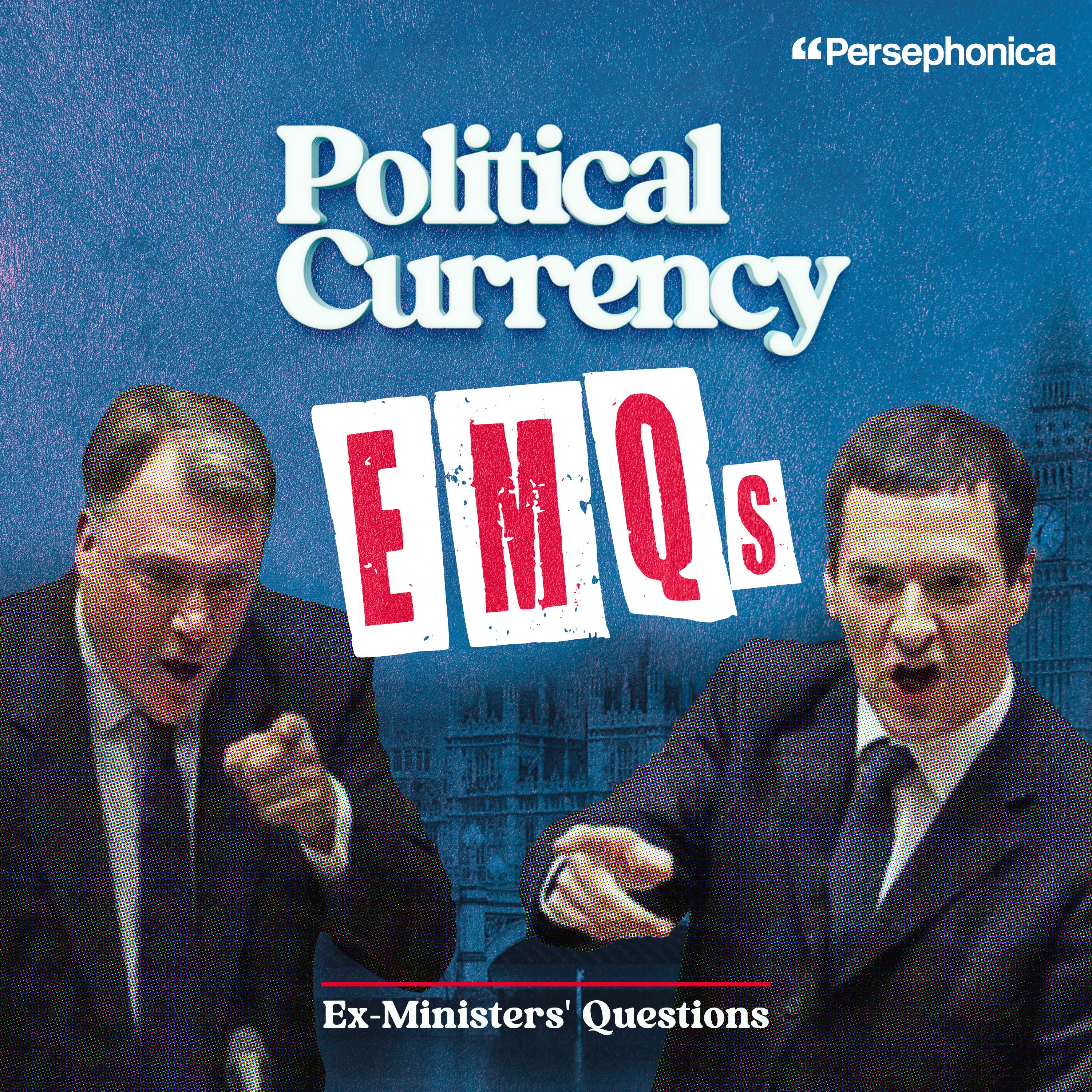
- EMQs: Would you serve in your political rival’s cabinet?
In short
Main points
- Hosts: Ed Balls and George Osborne
- Theme: Discussion of political dilemmas and the current state of UK politics, focusing on coalition governments and their implications.
- Key Question: Would either host consider crossing the floor to serve in a rival party’s cabinet?
Written by AI. May contain mistakes.

Ask about this episode
Get the gist, explore an idea or ask about something said.
 Claude
On Political Currency, what are the key points of this episode?
Searching your listeningTranscript
Automatic transcript. May contain errors.
0:00The Chancellor of the Exchequer. Getting a lesson from the Shadow Chancellor on how to balance the books is like getting a lesson from Dracula on how to look after a bloodbath. Ed Balls. A steady-as-she-goes budget. What kind of ship does he think he's on, the Titanic? Bemarie, Celeste. Welcome to EMQs from Political Currency with Ed Balls and George Osborne.
0:28So hello and welcome to EMQs, Ex-Ministers. questions we are back answering your um your questions and as we said on our main podcast last week this is you know the most important part of the the show for us i mean you know the main podcast you know whatever but emqs is where we really get down and um you know answer your most difficult and interesting revealing questions have you had a um good week i i think did i did i Did I hear that you were doing some kind of on-stage Q &A, a kind of EMQs-style event with the former Deputy Prime Minister and Tech Bro? Yes. I was, it was televised. I was on a platform with Nick Clegg, Sir Nicholas Clegg, I should say.
1:17And, you know, it was the first. Where did he get his knighted from? What did he get that for? We got it. David Cameron gave it to him as a sort of consolation prize because we won his seat in the 2015 general election. Having turned him over on all his 2010 manifesto promises, including all his referenda. Yeah. No, that's not true. I think we delivered a large part of the Liberal Democrat manifesto in the coalition. Disgust. Disgust. Do you know, I've stayed in touch with him and I quite regularly see him. but this was the first time we'd shared a stage and of course we didn't really share a stage much in government because he would share a stage more with David Cameron than with me as Chancellor but you know it was great and he's written this good book interesting book on the future well I say people tell me it's interesting and I'm actually going to read it you did a stage show with him Q &A and he didn't read his book in advance well I said to him where's my free copy and he said you've got to go and buy one George he'd done quite well out of Facebook stock over the last five years.
2:22But anyway, he wasn't going to give me a free book. Anyway, I've told it's actually very interesting on the future of the internet and how it's splintering essentially into kind of different nationalist jurisdictions. And I was reminded, you know, he's a very smart and interesting individual with this new perspective on Silicon Valley. But we always had a kind of slightly prickly relationship in government, because, you know, I think he always thought like, you know, how's Osborne trying to outmaneuver us and screw us in some way? And I think his wife would often say, Miriam would say, you know, you watch out for George and what he's up to.
2:57But didn't he fundamentally think you weren't right-wing enough and that your public spending cuts weren't deep enough and that he felt a bit let down, that you weren't, you know, as much of a toy as him? Well, we did have an interesting question on this panel this week, which was what were the biggest successes and failures of the coalition. So his biggest failure, he thought, was housing, where we didn't do enough on housing. But his biggest success was the economic plan. He said sorting out the public finances, getting the British economy growing after the crash, all that, which I obviously agree with, but I wasn't necessarily expecting him to come forward with.
3:40And then my... It was just the Lib Dems who didn't agree with it when it came to the 2015 election. Well, it was... No, quite the reverse. You're forgetting the election. It was Lib Dem voters were nervous that they would get into bed with you and Ed Miliband and therefore wanted to be sure they were going to get Conservative policies, so they voted Conservative. Anyway, it was good to see him. And it did remind me of... I did, you know, when I was in government, I was thinking of this story. I went round for dinner once as Chancellor to his house in Putney. He didn't move into some grand government residence.
4:14He stayed in his nice house in Putney. And we had a kind of takeaway. Miriam left us to it. It was just me and him. And then at the end, he said, you know. So she didn't stay for dinner? She didn't stay for dinner. I don't think she particularly wanted to break bread with me. But he then said, like, do you mind if I have a kind of sneaky fag? but we need to go into the garden because um you know if miriam catches me smoking in the house so um we ended up standing in this kind of little garden you know nice garden it's a sort of suburban garden in putney um at the end of the garden with the deputy prime minister having a little cigarette and the chancellor stood alongside him by this point i had stopped speaking so I was not partaking.
5:08Tobacco? It was tobacco even though this was a Liberal Democrat.
5:15Exactly. All I'd say to you is if you think it was bad for Nick Clegg being married to Miriam think how much worse it was if you fancied a cheeky fag when you were married to the public health minister. I mean goodness me. Find all sorts of nooks and crannies. Of course Barack Obama was... Furtive or what? Barack Obama would have a secret cigarette, wouldn't he, when he was president? And David Cameron wasn't completely a versatile one either. But anyway, they've all stopped because it's very bad for your health, kids. So we would strongly encourage you not to take it up. If you have, just stop it.
5:47I think we should get on with the MQs. Yes, actually, the reason why we've been talking about Nick was partly because I saw him this week. But also, we have had this question from Tim. And it's a bit of continuity here. So here's the question from Tim Robertson. Hi, Ed and George. It's Tim here, a Gold subscriber from Seattle. A quick question for you both about your old friend Nick Clegg and a fellow Brit on the West Coast up until he recently quit his job at Meta and about coalition governments particularly. particularly. George, you were involved in the coalition government, which I think most fair-minded people would say was quite successful.
6:22If your main podcast was right and the conservatives are right that the multi-party system is more likely to come to fruition in the UK rather than the two parties we've had in the past, much more like the European systems, is this a good thing for the UK? What does this mean for us? Will there be more compromises? Will this be a way of the centre underground coming back. What do you think if that is the future for us? And will it be a good thing? And will our politicians need to adapt to that? So appreciate it. Thank you. Tim, thank you. Wow, we've got sleepless in Seattle. We've literally got our listener in Seattle.
7:00And thank you very much for tuning in. I think this is a genuine kind of matter of opinion here. Because I think some people would argue that the development of a multi-party system, as you've seen on the continent of Europe, where most of these countries like France and Germany and Italy and the like, after the war did have a kind of center-left party like the Labour Party and a Conservative Party like the Christian Democrat Party was quite like the Conservatives. And they've all splintered in recent years, and you've got many, many more coalitions. And that that can lead to a more consensual politics, a more grown-up politics.
7:36And certainly I think we found with the Liberal Democrats, I would say, people may disagree, that we achieved a lot in terms of sort of public service reform, economic reform and the like, and social reform partly because we had to put it all down in paper in advance and then hold ourselves to this coalition agreement. And so it did work. By the way, my answer to that question about the biggest successes and failures of the coalition were the biggest success was making it work, the first coalition in 60 years. And the biggest failure was that that kind of politics didn't continue after our demise.
8:13But the only thing I'd say in kind of direct answer to Tim is that we were in some ways innocent because of the lack of history of coalitions. So we came up with a coalition agreement very quickly. It didn't take months to negotiate and was not as painful as you see in some other countries where they like the Dutch political system at the moment. And, you know, there is still, I guess, and you may accuse me of being a little bit kind of old-fashioned in this view. I think the advantage of the British system is that it does usually deliver a kind of decisive winner who then has the agency to make change.
8:55So, you know, we often talk about some of the problems of the current Labour government, but it certainly has the big majority that could deliver change. if it managed better its internal coalition with different parts of the labor movement. And so I still sort of favor the current system and still would lean into wanting more of a, you know, more of a two-party system than a multi-party system. I think the biggest challenge, and we discuss this on our main podcast, is if we are into a multi-party system, it's going to be this question of how to work with reform, because it'll be a multi-party system by definition, because they've done well, and how they fit into this and whether it feels undemocratic if they're excluded.
9:45So we don't know yet whether we are moving towards a multi-party system in the sense that you're going to have a series of coalitions because elections don't throw up a majority. which is less likely but possible in a first-past-the-post voting system like ours, inevitable in a proportional representation system. We don't know if that's going to happen yet. But I think the question Tim's asking is, should it? And I think the answer is you always have to think about not what ideally or theoretically you'd like, but how things will develop from where they are today. and is it possible or desirable from where we start?
10:29The important thing to say is, I think, that we do have and have always had in our mainly two-party system, there's always been lots of other parties as well, the Lib Dems and the SNP and other parties as well, but in a system dominated by two parties, we've always had coalitions. There's always been coalition forming, but the coalitions happened within the parties rather than between the parties. Labour has always been a coalition of different interests and the Conservatives, a coalition of different interests. And politics works when the parties function and they're good at coalition building and they act in a coherent way.
11:04And actually the public hates it when the main parties become divided and fractious. A divided party is always seen as being politically very bad when it comes to the polls because people don't like to see division and antagonism and party interests or party fractional interests coming before the national interest. But that history then shapes the public view, I think, of how our politics operates. And if you go back to 2010 to 2015, in 2010, I've said this before, the only thing more popular in 2010 than Nick Clegg was the idea of having a coalition government. And by the time you got to 2015, the only thing less popular than Nick Clegg in British politics was the idea of having another coalition, because people didn't like the idea that the parties were elected on a manifesto and then went into a negotiation in order to renegotiate that manifesto and in order to reach a deal.
12:06And that sort of open coalition making was not something which was popular amongst the public. Nick Clegg famously very damaged, I think, against your advice by saying I fought the election on a manifesto commitment to abolish tuition fees but I'm going to agree to raise them for the coalition and people thought I know but what do you stand for that's not what we voted for and I think in our political system because of our history and because of the antipathy to division and factualism within parties when you come to that continental style process of government making where everything's on the table for negotiation I think that is actually quite alien to our political culture and people don't like it.
12:50So even if you have an election which throws up next time, a hung parliament, and you have a deal, it's not clear to me that that will be lastingly popular. And you actually may see as a reaction to that a return to single party majority government, as happened in 2015. As you said, after the experience of the coalition, people voted for a majority conservative government because they didn't want another coalition. So I'm not sure whether a multi-party system is more desirable than our system. I think it is much less likely to last because of our history. I think it's quite contrary to our political culture.
13:28And I think the experience of the last 15 years proved that. Yeah, although interesting, you know, in our main podcast, we talked about Scotland and Wales. And there, there has been much more of a history since the evolution of coalitions of various kinds and working with other parties. And of course, Ed Davey, who sent us a question on our last episode, if you're him, you do need to start thinking, well, what happens if Labour lose its majority and I'm asked to be in some way support a Labour prime minister? That was, you know, if you think that's kind of the situation Nick Clegg faced, which is, OK, I now hold the balance of power.
14:07And do I, you know, what do I expect in return? And do I want to enter into a coalition at all? Or do I just want to provide some kind of loose agreement to support a government? Anyway, these, you know, if you're Ed Davey. Don't you think they would be much more wary of that next time? Yes, but they may, they will be more wary. But the logic of, it's probably for a longer conversation, but the logic of if you are going to support, say you're the Liberal Democrats and you're giving a supply and confidence arrangement to Keir Starmer right now, that means when this budget, supply is the budget, budget is highly political.
14:44So it's like, well, are you going to support this budget? And when it comes to confidence, you might disagree with something he does with Donald Trump. Davey is often quite critical of Keir Starmer's approach to Donald Trump. So people go like, well, you're going to bring this government down. In other words, I think the Clegg judgment was it's better to be in the room trying to shape these things as government ministers. Although I wonder whether, you know, they might take a decision. This is getting all a bit arcane. They did consider taking whole ministries rather than having. So you would have, as you do, I think more in the German system, like the whole of DEFRA has got liberal Democrat ministers in it rather than some conservative, some liberal Democrat.
15:24back then. The thing is, George, there is a fundamental sort of inconsistency in the argument you make. You say the coalition was a great achievement and how disappointing it was that the coalition didn't last. And, you know, I take that face value. However, in 2015, the election campaign you fought was, if you vote Labour and they end up in coalition with the SNP, then you'll have the SNP setting your tax policy. Don't run the risk of a coalition of Labour and the SNP vote Conservative. And you persuade the Lib Dems not to vote Lib Dem, but to vote Tory to stop another coalition, but a coalition of Labour and the SNP.
16:03I mean, I think you ran against coalition in 2015. I completely agree. Now, this is absolutely with hindsight and reflection. But, you know, the demise of the coalition in 2015 was not good for David Cameron and George Osborne, right, and our brand of conservatism, because we were then ejected a year later. And I think... And you also had to have a referendum, which you might have voiced. Although, you know, David Cameron had promised that he wouldn't serve as prime minister in a coalition if they didn't have a referendum. But the... You should have stopped that as well. But I do think, you know, there's a kind of open question in 2015.
16:40Could we have run as a coalition for re-election? Job not quite done. We're running again as a coalition. Very hard to deliver in practice because as party leaders, Nick and David would have had to persuade Tory and Liberal Democrat candidates not to stand in certain seats. But certainly, you know, anyway, I think there's a, for all of our political interests at the time, and that's obviously a very narrow way of looking at it, it would have been better if we'd run as a coalition. Although then Nick wouldn't have gone off to Silicon Valley and made his millions. So maybe from the Clegg's finances point of view, it was a good outcome.
17:18I wonder whether the Liberal Democrats would have survived as a party or whether they would have split. We're turning into a what if episode here, but it's a good one, isn't it? I think we should come back to a what if, maybe around Christmas. Let's do a what if around the 2015 election. That'd be really good. Shall we take another question? This next question comes from Peter. He is a gold subscriber in Manchester. Hi guys, loving the podcast. I'm a gold member. My name is Peter from Manchester and I'm a filmmaker. I particularly love the podcast for two reasons. Firstly, I think you go into the nuts and bolts of how government and the world works and look at the nuances that often get ignored elsewhere.
17:58Often people focus on clickbait sexy politics, but I think you give us the real stuff. And secondly and most importantly for me, it's entertaining and uplifting. I never leave an episode feeling depressed or down even if the subject matter is heavy, which is a rare feat for a political podcast. Even my sister who is an anyone but a Tories voter refers to it lovingly as the redemption of George Osborne. So there you go. anyway my question is often I found that the lines between conservatives and labor historically have become blur you know with new labor versus one nation tourism etc etc when you do a blind test and you take say five policies and then you ask someone well was that John Major or Tony Blair often people get it wrong because they have a perceived idea of what the person is versus actually how they voted and the policies they implemented.
18:52So my question is, could you see yourselves doing a Winston Churchill and crossing the floor? For example, could we see a very liberal left-leaning Ed Balls in a new wave of one nation small c conservatism? Or could George Osborne be a fiscally conservative right-leaning member of parliament for Labour? I often hear him talking in support of the current chancellor so he doesn't seem a million miles away is this something that goes against your personal ethics or for the good of country and actually to get your hands on power could you find yourself joining the opposition love to hear your answer keep up the good work best political podcast out there the rest is just not quite as good so well first of all peter uh thank you very much you've you haven't just like repeated the mantra i love the podcast you've um You've given us some reasons why and reasons to reflect on.
19:51And I'm glad that your sister believes that I'm undergoing a process of redemption as a result of appearing on this podcast. But let me let's go straight to this thing. Could I imagine crossing the floor as an MP or standing as a Labour MP? I guess you know I'm not as tribal as many and you know I get you know I think the point in my politics in the 1990s when Tony Blair was Labour leader when I remember asking myself well what is it about this new Labour opposition that I don't support I wasn't an MP then yet but I was by then a member of the Conservative Party and working for the Conservative government I you know what put me off was actually the tribalism of labor the the link to the union movement it all seems quite arcane and old-fashioned i thought actually the conservative body carried less of that baggage and i sort of fundamentally thought then and i did you feel more comfortable with the tribalism of big business and the landed interest i think you'll find back then big business was supporting new labor and uh you know i seem to remember they were incredibly relaxed about people becoming filthy rich to quote our former sorry i i just got a bit down to nabby there i'm sorry well we all know you know who really loves the the big houses it's labor isn't it that's where they always get into trouble um but no i just don't have them i think they don't start by having them but they always end up having them um the um this question is um i think the basic answer to peter's question i think you can um uh it's always quite uncomfortable to switch party And it's generally a better approach, if you're not happy with where your party is, to try and change it from the inside.
21:43And you can undergo quite dramatic changes. If you think of the Labour Party in the last 20 years has been led by Tony Blair, Gordon Brown, Jeremy Corbyn and Keir Starmer, all very different. And the Conservative Party has been led by David Cameron, Boris Johnson, Liz Truss, Rishi Sunak, and now Kemi Badenok, all again very different. And in the conservative context, we've been in favor of being pro being in the EU to being anti being in the EU to being pro immigration to anti immigration to, you know, smaller government to bigger government to lower taxes to higher taxes. So, you know, there's a lot of scope within the party, partly because it is, to pick up on the last question we answered, a coalition within it to change things from the inside.
22:29And I think that's generally, certainly in the kind of British political tradition, probably a better route. I think that's right. And I think you are right to argue that it flows from our political tradition and our two party system. And the fact that coalition building has been in British politics, mainly what happens within parties. I mean, there are examples. Peter mentions Winston Churchill, but that was from a very different political time. him. Hard to think. And by the way, Ed, he was never really forgiven until the Second World War. I mean, he was always regarded with deep distrust by the Conservative Party.
23:07He was elected as a Conservative MP. He switched to the Liberals when the Conservatives lost power, so it looked somewhat opportunistic, became the Liberal Home Secretary, then switched back to the Conservatives and was then the Conservative Chancellor, but then was in the wilderness partly because people didn't trust him because he had been switching parties. And it's only the Second World War that kind of massively rehabilitates him. And it's hard to think of examples of people who really successfully switched parties while they were a member of parliament or who had been a member of parliament and then went on to have very successful senior careers.
23:48I mean, there was people who switched parties and were in the cabinet but it's um but it's a hard thing to do sean woodward is the one i was thinking of who was a conservative he switched to support uh tony blair and then ended up in the i think gordon brown cabinet it's a hard thing and that that is partly about um as you say um kind of authenticity and trust if you change sides do people just distrust the fact that you change sides and might do it again. But it also goes to our system. I think if you have a more PR continental system, where you have lots of parties negotiating for coalitions, those are systems where also you quite often have new parties are formed, people do change sides.
24:34In our system, where coalition building within the party is really important, in that world, tradition and history, I mean, you could call it tribalism, but I'm going to call it tradition and history, become very important. Because if you are Tony Blair, who's trying to bring together people who are urban Labour voters and supporters and members in London, but also the traditional working class of um of jarrow or um or sedgeville or whatever the way you do that is you you talk about the things as a party as a movement you achieved together you go back to you know the march for jobs or the creation of the national health system or the challenges that we that we faced and saw off together the thing which you use politically and rhetorically to bind is past achievements, past struggles, past challenges, where you brought people together.
25:38And if you change parties, then you're cut off from that. It's very hard for somebody who's switched from being Labour to Conservative to appeal to Conservatives about what we have achieved together, because you didn't, because you're on the other side. And if your coalition building is between parties, I think that's much less important. But I think in our system, because it's so, too important drawing upon the past, if you switch sides, then the oxygen of coalition building is cut off from you. Do you know, there was an absolutely lovely, delightful MP who I served alongside, who's still very much with us and in the House of Lords, John Horham.
26:21And he had been a Labour MP in the 1970s and a Labour minister in the Callaghan government. And then he was a minister in the John Major government as a conservative, having went first to the STP, and then when that collapsed, the conservatives. And I remember talking to him. I was sitting, I was a special advisor, and we were sitting in this room, which you will know about, but I doubt many of our listeners will, called the Large Ministerial Conference Room, which is this rather sort of soulless, windowless room that's literally underneath the chamber of the House of Commons. And it's where sort of ministerial meetings happen when all the ministers have to be in parliament for votes.
27:02And I was sitting there as a special advisor. He said, you know, every time I'm in this room, I think about the winter of discontent. Because I was a minister, I was a transport minister, and we used to sit here. We had to be here because we had no parliamentary majority. So we were basically stuck in parliament the whole time. And there was a committee here that met to run the winter of discontent. And it was all like, this hospital's run out of petrol, so we need to get petrol delivered from here to this hospital. This town is running out of food. And he said, every time I sit here, I just think of the absolute chaos of those meetings.
27:37And he must be one of the very rare examples of someone who was a minister in both a Conservative and a Labour government. Anyway, if you're listening, John, it brings back fond memories of my friendship with you. Thank you so much to Peter and also to Tim, two very kind of complimentary excellent questions which have allowed us to kind of talk and muse at length um we'll take a break and then we'll be back with some more questions
28:11so welcome back our next question is from leone hi ed and george my name is leone love the podcast have been listening since the start. I had a question for you with regards to how Rachel Reeves and Keir Starmer can think about getting the economy moving. So one thing I was reflecting on was whether or not they could try and boost the housing market by doing something like a stamp duty freeze or to completely remove stamp duty for certain groups. In particular, I was thinking about whether or not over 65s who are downsizing, so the empty nesters really, might be more incentivised to move if they didn't have to pay stamp duty and would this actually free up larger homes for young families who are struggling to afford and access to larger homes.
28:57I'm also interested to know if there are unintended consequences of doing something like this for example pushing up the house prices of smaller homes and what else I might not have thought of. Would also love to know if this is a policy that's ever been considered before and I'm not aware of. Looking forward to hearing your thoughts. Thanks. Now, this is a really hard question because I've not thought about this a lot, but at this point, you suddenly have to start thinking about your economics and your incidence of taxation because stamp duty is levied on the buyer, not the seller. Yes, absolutely.
29:39So it's when you buy the house, you pay it. So you might say at first sight, well, how's that going to incentivize somebody who's old to sell their house? Yeah, but I guess they've got to buy a new house and they might be put off, to Leonie's point, they might be put off downsizing because they don't want to pay stamp duty as well as downsizing on the new property. That is right. That's part of the answer. but it's also the case if you were to say that you were going to have lower stamp duty for over 65 year olds who buy houses although i mean what's to stop them buying another big house bigger than they need in in in an area um the thing which you really want to do is incentivize the over 65 person to be to be selling the house rather than buying another one and maybe they're going to go live in a flat or with with a relative but if you take my example the 40 something family if they can buy a house from somebody who's over 65 they're going to get it much cheaper than if they buy a house from somebody who is under 65 so the demand for younger people to buy houses from older people will will increase they'll be looking to buy those houses more if the demand goes up you'd expect the price to go up so you'd expect it to be the case that the price of houses owned by people over 65 will rise relative to the price of houses owned by people under 65, which means that rather than the young family getting all the benefit of the stamp duty cut, they share part of that benefit or maybe all of that benefit, depending upon elasticities, with the older person.
31:21So even if I'm over 65 and you're getting the stamp duty cut, I will benefit because I will get a higher house price. You'd expect that to capitalise. so it might work this incentive uh leone um you've got a big problem around avoidance what is to stop everybody um who is um get your parents to who owns a house handing it over to your parents so that when it comes to sell it then you are so you'd have to have kind of try and make sure that you um that you're avoiding uh that there may be a whole bunch of reasons why over 65 rolls don't like moving out of their their family home which is unrelated to money but you think it would make a difference the problem with this one is in the end um if it's a transaction tax and the transactions happen not that often it's quite an inefficient way to um to drive behavior but um i think i'm not totally sure it would work but it's um interesting to think about i bet you the fiscal studies have written a a um a working paper on whether stamp duty cuts for um different age groups would make a difference you know first-time buyers you can understand but for a particular age group you know i'm a bit cautious that this would work leone yeah um i'm more than a bit cautious so i'm afraid leone i don't think it would um but that doesn't mean that the the policy objective is not is isn't a very good one of encouraging people to move uh later in life when they don't need the space and that frees up housing for younger people.
32:54So you could, an area which is not touched on here is social housing. And this is very complicated and sensitive. I remember looking at this as chancellor and essentially backing off. But there is a concept in social housing of tenure. So, you know, you wait a long time to get your house often. There are long waiting lists. We have a debate about that and the availability of social housing. But once you get the house you are in or the apartment you are that's yours so you have tenure on that piece of social housing and you might get like a you know three-bedroomed council house and then you know your children leave home but you remain entitled to that house you have the tenure on that house till you pass away and people therefore do stay in their homes and it's often identified as a kind Both a block on, particularly as there's an absence of social housing, or a lack of enough social housing is the argument.
33:51So you've got people sitting in homes who don't want to give up this right to their home, because they've got no incentive to do so, by the way. It's not like they get money. It's not like in the private market where you get the proceeds of the house sale. You just lose your right to this particular larger home. And it also is often identified as a problem generally with labor mobility in Britain, that people don't want to move for a job, unlike in the US, quite so much because they give up their tenure on a house in wherever it happens to be, like in the north of England. And they won't then get council housing in the south of England, let's say, if you take all the other way around.
34:31So this is a problem that could be more easily addressed. I'm not saying more easily in terms of people's attitudes towards this, and it could be very difficult to persuade people of it politically. But in terms of policy tools, ministers could do more around tenure of larger houses for older people in the social sector. Of course, you did have a go at this with your bedroom tax, or as it's known, the cruel and iniquitous bedroom tax. That's how it was generally referred to. I can't remember. Has the Labour government got rid of it? I've forgotten. No. Oh, that's funny, isn't it? What's the point of having that big majority, big progressive government?
35:13I actually have no idea what's happening with the budget tax. Has it actually stayed exactly the same? It's performed a bit over recent years, but it fundamentally stays the same, which is, you know, fundamentally it was like, you know, a higher charge on people. or basically not giving people enough housing benefit to cover the rent of a larger house when they didn't need that larger house or apartment. But I agree. It's a bit like those Tory ministers who used to say, it's not called the poll tax, it's called the community charge. I think even we ended up just saying, okay, well, it's the bedroom tax.
35:51But that doesn't mean, by the way, it was not unpopular with the public. It's a classic thing. it's a bit like without reopening discussion we're bound to have again on the two child benefit like you know lots of people can't afford lots of additional rooms in their houses and uh so anyway we will my memory is if for my postbag as an mp you would have cases of um of people who couldn't move for whatever reason and living in a house with three bedrooms and there was two of them there and kind of like terrible, terrible stories of income suffering. But as you say, we can come back to that when we discuss the two-child policy and then run up to the budget.
36:33Shall we take another break? We'll get Nick Clegg on to explain the benefits of the bedroom tax. Or indeed, Ed Davey, of course, who supported it as well in government. And then you can pop out for a smoke with him after. We'll take a break and then we've got a couple more questions.
36:57so welcome back our next question is from ted who is a gold subscriber and um we've done seattle in this podcast and now we are going to new york city hi georgian ed my name is ted i'm the founder of a startup in new york city and longtime gold subscriber i often listen to you guys while walking through the streets of Manhattan on my way to work. And the question today I have is for George. I think the Tories only hope of winning the next election is to regain credibility on the economy. In my mind, there is no one that the British public associate fiscal prudence with more than you, George. So if I were Kemi, I would ask you to come in and run an economic commission focused on building a British economy fit for the future.
37:42One, do you think this is a good idea. Two, would you ever consider it? Right. Thanks, Ted. So I absolutely agree with you that the Tory party's central objective must be to gain economic credibility and hold it and the niche, and it's a big niche, so maybe niche is the wrong word, the big gap in the market in British politics right now is credibility on the economy, credibility on the public finances, and a plan for growth. And the Tory party should be occupying that. And they clearly made an effort at their last party conference to do exactly that. In terms of like, should I, would I kind of chair a commission?
38:26Well, I'm always kind of keen to help in public life. By the way, I'm quite un-possed, so I'm happy to help whoever has got a problem. And I, of course, have a lot of affection for the party that gave me such an opportunity, the Conservatives. But I don't know. I mean, they haven't asked is the short answer. There is a quite interesting, there is a commission that's been undertaken that I gave an interview for. I don't know if you gave an interview for this, Ed, but they did interview lots of former policymakers, including Labour ones. And this was headed up by Art Laffer, Art Laffer of the Laffer curve.
39:06Yeah. He said, you know, there's a maximum point you can raise taxes before you start losing revenue. Anyway, Art Laffer, who's a very genial guy, and I'd never met before, so it was actually quite interesting meeting him. There's a very successful financier called Michael Hintze, who's been a big philanthropist and also a supporter of the Conservative Party. Matthew Elliott, who helped run Vote Leave, and Doug McWilliam, an economist. they have they came together and they um they've produced a report recently called prosper or a book i think it is prosperity through growth um and um that's a sort of economic commission which i think since they're mainly connected with the conservative movement those people is meant to be advice for the conservatives although they did interview former i think they may even have interviewed tony blair anyway they they definitely interviewed come labor figures and they interviewed me as part of the research for that.
40:03Well, I thought it was very interesting to hear your sort of rather cab rank, principle-like kind of offering to be available for whoever is willing to hire you. I'm not sure when they say hire, they're not actually offering to pay here. Well, that might be right. I think for Keir Starmer to ask you to be the American ambassador is one thing. I mean, it would not be without controversy, but in the end they... Not as controversial as the choice they ultimately made. They went for the safe choice. They went for the safe choice over you. Although whether... I think there might be a tension for Rachel Reeves in her message on the front of The Guardian last week, no return to austerity and appointing you to do her economic commission.
40:47That might be challenging. It might be challenging for Kemi Badenock as well. But we were discussing the multi-party system and Wales and we were discussing reform. And of course, Nigel Farage, you know, I don't think he's said... who would be his chance exchequer if there was a reform government. Although he has said that he wants Donald Trump-like not to have to be bound by, you know, these jobbing establishment politicians in Westminster. He wants Donald Trump to bring in the experts, the best experts. And so I wonder whether Nigel Farage, rather than asking Richard Tice or, I don't know. You can't think of anyone else in reform.
41:30I can't think of the names of the others. For my, Lee Anderson. Yeah. Or to Danny Kruger to be his chancellor. I wonder whether, if Nigel Farage rings up George Osborne and says, George, will you come back and be Charles the Exchequer in my reform government? You haven't got to go and be elected as a MP because I'm scrapping all of that nonsense. And come and do the job. What are you going to say? hmm um it's not really my brand of politics no but you said you were open to all parties you said you open to all parties you did you did open the door i didn't i don't um the short answer is the short answer to this question is no just before we get any hairs running yeah um but i i think our listeners and viewers should see it never has george osborne been so flawed and dissembled in such an incoherent way.
42:28The broader point I make is I do, I'm not, you know, if there's a British government and I think I can help the British government do something good for Britain, which I wouldn't necessarily think I could of a reform government, but anyway, would I be, would I try and help that government if they asked? I don't see why I wouldn't, but I don't think the situation would really arise with reform. and look when the Labour Prime Minister asked me or via his team whether I consider being ambassador to America I didn't say no because you're a Labour Prime Minister I'm not going to consider it. But you see this is so revealing isn't it?
43:06George Osborne, former Conservative Charles the Exchequer is saying that he would be more inclined to take up an offer from a Labour Prime Minister than a reformed Prime Minister even though Kemi Badenock and Robert Jenrick are clearly politically reaching over, not towards Labour or the centre ground, but to reform and reform voters and trying to kind of get as close as they can. It's an interesting reflection on what's happened to the Conservative Party, that you would lean one way or not the other. I'm not particularly partisan anymore. That's the truth of it. And it doesn't mean I don't wish my former colleagues well, But I'm not – I'm kind of just a bit more interested in, you know, like helping whoever's the government if I can in any way.
43:59I agree with you, by the way. I don't think you should go and be Chancellor of the Chekhov and Nigel Friage. Chancellor of the Chekhov is one job where you need to be an MP anyway. So we'll – But, yeah. And if you're offered the American ambassador, you should take it. It's a bit like Tony Blair, isn't it? It was a good question, wasn't it? It's like my political hero, Tony Blair, you know. That's, by the way, also a little bit of a joke. But, you know, he was happy to help conservative governments and come in and give advice. Even to Boris Johnson's government, he gave advice on COVID, didn't he?
44:29I thought Margaret Thatcher was your political hero and she would have not approved of that at all. Well, I think you'll find, actually, you know, Tony Blair was able to sort of attract, you know, remember she went around to see him on the first week he was prime minister. And he did manage to, and that caused all sorts of problems for the Conservative opposition at the time. Margaret Thatcher would not have accepted an appointment from a later Prime Minister. Yeah, but Chris Patton did accept the Commission on Policing in Northern Ireland under Tony Blair, for example. I mean, I think that would be a good example.
45:07Yeah, that is just less political. Yeah, yeah, that's what I mean. I mean, the Economic Commission is pretty hard. And it's not realistic. And I'm talking about something that's more specific. You know, like, I don't know, I mean, I'm making this up, but something on like the future of airports or policy or whatever, that kind of thing, which is a bit more technocratic. Anyway, when are we going to get the Bulls Commission? I think history suggests it's always a bad idea to accept a commission on airports because whatever the government today says at the time they set it up, you know they're going to...
45:34Howard Davis, toilet away. You don't want to answer the question of why on earth the Labour government haven't appointed the Bulls Commission on something. But why haven't they? Why haven't they? Because they don't want to hear the truth. They can't. The truth is they can't take the truth. They can hear it twice a week on our podcast. And talking about the truth, we have time for one more question today. And actually, it's from the president of the National Farmers Union, Tom Bradshaw. Hi, Ed. Hi, George. Tom Bradshaw here, president of the National Farmers Union. For anyone at the Labour Party conference, you'll have seen images of rural Britain splashed all across the conference branding with the slogan, Renew Britain.
46:18However, the farming businesses at the heart of these communities are feeling far from renewed with the threat of the family farm tax looming. Logic would suggest that if Labour are looking to capture the hearts of rural Britain, as their conference branding would suggest, then Treasury should be looking to move on this critical issue. The policy is holding back growth and, let's face it, support for the Labour Party in the countryside. Joined up thinking and cross-departmental working is something that governments of all colours seem to struggle with. But is the Treasury the most difficult and impenetrable silo, particularly ahead of the budget?
46:55So this is a really interesting question. And there was a straw in the wind at the weekend. I don't know if you saw this. There was a piece written by Caroline Wheeler, political editor of the Sunday Times, and her deputy, Harry York, in which they speculate changes to inheritance tax relief for farmers are being explored by ministers before next month's budget. Rachel Reeves under pressure to alter proposals that have been derived as a family farm tax, talking about whether the threshold might be raised from a million to five million pounds for estates, which are being hit with this pretty tough inheritance tax.
47:37And it's clear that ministers or at least sources at DEFRA, the farming ministry, think there is a case for some action here. And you thought they might have to U-turn a year ago, but it feels like the heat's kind of gone, isn't it? I mean, I know everyone's going to scream at me at this point and you do drive around the countryside and there are signs and so on, but it's not, you know, it's far from being on the front pages anymore. Well, I'm not sure Tom Bradshaw, the president of the NFU, agrees with you that the heat's gone out of it. And if you look at the, you know, why is Labour doing less well in Wales than in England?
48:16I mean, I don't know. Is the kind of farming... Possibly. I might be wrong about that. But I'm not saying it's a good tax, by the way. I mean, it was given to me as an option in every budget that I gave, and I always said no to it. So, you know, I don't think it's a good thing. But I just wonder whether the, you know, if you're sitting in the Treasury, you know, are you really under the... You know, as you approach this budget, and not thinking I must do something about the farming tax. I think, though, that Tom gets to a point about understanding. And it is true that you and I might have considered this when you were the Chancellor, I was advisor to Gordon Brown, and we didn't.
48:57I think one of the things which I found very revealing, somebody said to me that the problem was the Treasury thought that this wasn't going to affect tenant farmers because they were all, you know, wouldn't be affected without kind of working out that if tenant farmers are all tenants for a bigger interest, which is going to be hit by the tax. That is the thing which then is destabilising for the tenants because either the farms get sold or the rents have to go up to pay for the inheritance tax hit. And so maybe there's not kind of sufficient understanding about how actually this was going to work in practice.
49:37Back in the day when I was in the Treasury, We had, you know, Robert Culpin or Colin Mole in charge of the budget. We had officials like Phil Winnowin or Alex Gibbs. I think that they kind of always made sure that by the time these kind of proposals arrived with us, they did so with sufficient health warnings about what the impact was going to be, that you understood exactly what you were going to be doing. I'm not sure if the Treasury fully was across quite what the impact was going to be. So we'll see. I mean, if they're going to make a change, the thing they should do, Tom, is they should explain why they got it wrong and why they're changing and take that on the chin.
50:18Because I think the lesson of the winter fuel allowance is if you try to make the change without it appearing like a change, then you don't get the benefit. So that's the advice I would give them. But maybe you're right. Maybe they aren't going to move on this. Well, I guess you could take this thing out of it possibly. But, you know, she's got to raise taxes. I mean, if you're sitting in that meeting, it's like, hold on. If we backtrack on this thing, A, we've got to fill the gap that that U-turn is going to create or that semi-U-turn. And B, we're going to set a precedent that we can be pushed off these tax rises.
50:52I mean, in the context of this budget, it's the sort of thing you might do if things had gone better than expected. And you could, and as you've got more money coming in and you go, now let's remove some of the kind of irritants we've got politically. I don't think that's the kind of contact they're going to have to do some really difficult new things I think generally I was a special advisor at the Ministry of Agriculture it was my first job in government and I think it's true and I remember having an argument with the NFU at the time the NFU was campaigning for the abolition of MAF as it was called, the Ministry of Agriculture, Fisheries and Food and his replacement by a Department of the Environment which was Labour opposition policy at the time.
51:38And I always said to the NFU, like, why, you know, at the moment there's like a minister for farming sitting around the cabinet table, and that is different from a Secretary of State for the Environment. And I don't know why you're one of the very few professions that actually got someone representing, or maybe the only profession that's got someone actually representing you at the cabinet table. And maybe that, you know, the demise of the much-loved ministry I was in has sort of removed that sort of direct, I'm not saying there aren't parts of DEFRA that are very focused on farming, but it's not the same as the Ministry of Agriculture.
52:10I think my answer to Tom is I don't think the Treasury is an impenetrable silo. And I think they will be listening. And I think probably ministers will think, and I'm sure environment ministers think in retrospect, they went harder on this than they should have done and didn't fully understand exactly how it was going to work in practice. I think the reality is that a small change, which doesn't cost a huge amount of money, could buy back quite a lot of goodwill. And I think good chancellors know when a small course correction can buy back goodwill. And Rachel Reeves has already done that around the detail of her non-DOM tax reforms as well.
52:56So, you know, I think if I were you, Tom, I'd keep the pressure on, but do so in a constructive way on the basis that Treasury is listening and they care about the future prosperity of the farming industry. I wouldn't go to war with an impenetrable silo because I think it makes it harder for you to get the outcomes that you want. That would be how I would answer it. And thank you for your question, Tom. That's all we've time for in this episode of EMQs. Please do keep sending us in your voice notes, your emails to questions at politicalcurrency.co.uk. Make sure you review the show. It helps us reach much more listeners.
53:31And it also, you know, we like seeing good reviews, don't we? Let's be honest. That's right. And we'll be back next week with another episode. See you then.
53:47Thanks for listening to Political Currency. This has been a Persephoneca production.
From the publisher
Could Ed Balls ever be tempted to become a Tory? And would George Osborne ever consider joining the Labour Party? The pair are forced to confront the ultimate political taboo after a listener asks if they could “pull a Winston Churchill” and cross the floor.
George also recounts his recent on-stage reunion with Sir Nick Clegg, discussing with Ed whether the UK is destined for a multi-party system and if coalition governments are a recipe for success or instability.
Plus, the President of the National Farmers' Union directly challenges the hosts on the 'family farm tax,' asking whether the Treasury has become an impenetrable silo; could a stamp duty holiday solve the housing crisis; and why one listener has dubbed the podcast 'The Redemption of George Osborne'.
Thanks for listening. To get episodes early and ad-free join Political Currency Gold. If you want even more perks including our exclusive newsletter, join our Kitchen Cabinet today:
👉 patreon.com/politicalcurrency
👉 Apple Podcasts
Please note: Kitchen Cabinet is only available via Patreon.
Credits:
Senior Producer: Silvia Maresca
Video Editor: Maha Al-Badrawi
Executive Producer: Ellie Clifford
Political Currency is a Persephonica Production and is part of the Acast Creator Network.
Hosted on Acast. See acast.com/privacy for more information.
More from Political Currency
All episodes

We use cookies.They keep VO running smoothly and help us improve it. Privacy policy