
 Ask ChatGPT


- Podcasts
- Political Currency
- Inside The Room - The Libya Conflict: The Aftermath (Part Three)
Political Currency9 Apr 2026 · 35m · 15 chapters
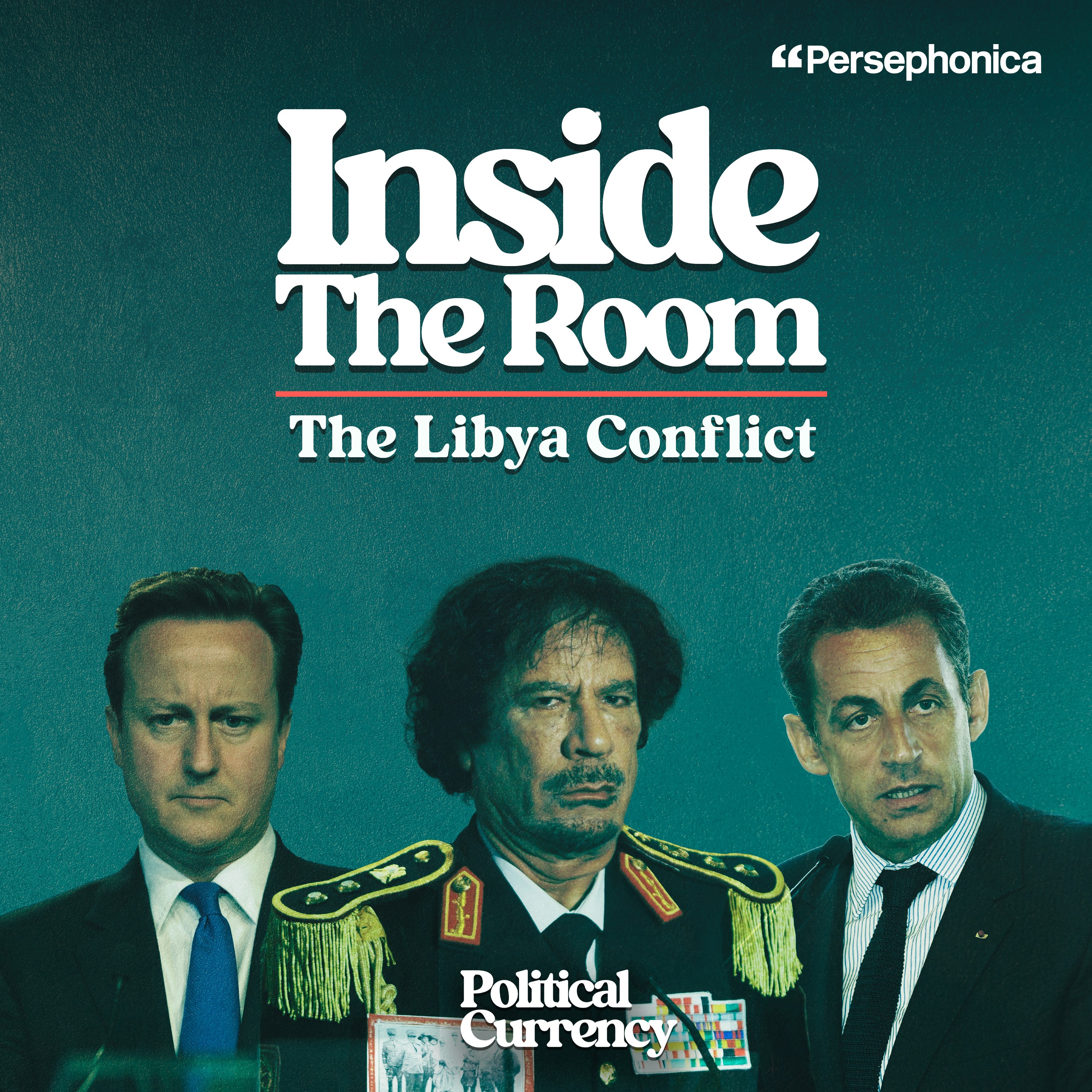
Inside The Room - The Libya Conflict: The Aftermath (Part Three)
In short
The Libya conflict’s aftermath after Muammar Gaddafi’s fall in 2011, focusing on post-war chaos, security failures, UN/NATO transition, militia power, and lessons for future interventions.
Guests
Sir John Sawyer, former MI6/SIS chief, and other contributors including Cathy Ashton (EU High Representative for Foreign Security Policy) plus Hugh Powell (discussing intelligence). The episode also references Abdul Jalil and Abdulrahim El-Keeb (National Transitional Council leadership) and Mustafa Abushagor (prime minister).
Key claims
Gaddafi’s death ended the conflict; Western planning underestimated security needs; UN political efforts lacked traction because militias controlled armed power; intelligence wasn’t a “silver bullet,” and the real issue was fragmented security and power vacuums. Intervention outcomes may be messy, but doing nothing could also be worse.
Notable examples
Gaddafi’s death reported on Libyan TV/Al Jazeera; Benghazi consulate attack and Obama’s “plan for the day after” critique; Libya’s first free election in 4 decades; Libya’s split security regimes (east vs west); comparisons to Iraq, Afghanistan, Syria, Tunisia, and later Iran.
Written by AI. May contain mistakes.
Chapters
1:17
The Fall of Gaddafi and Its Impact
Discussion on the moment Gaddafi fell and its significance for Libya.
“Now, in the last episode, we got to the point where, you know, the protests in Libya, the civil war in Libya had prompted the military intervention that had taken a long period of time, eight months.”
4:26
Reflections on the Aftermath
Exploring the aftermath of Gaddafi's fall and the chaos that ensued.
“government, you have to pretend that you're all-knowing in government, that you get information ahead of anyone else.”
6:49
Challenges of Post-Gaddafi Libya
Analyzing the issues of governance and security in post-Gaddafi Libya.
“Transitional Council said he wanted NATO to stay longer.”
12:23
The Need for Security in Governance
The necessity of a security framework for effective governance in Libya.
“Although she was giving the impression that we'd learned the lessons and that we had the plans in place.”
14:08
Framework for Security and Power Dynamics
Discusses the relationship between security frameworks and political institutions in Libya.
“You can't produce economic development, you cannot produce political institutions, unless you've got a framework of security.”
15:37
Intelligence Failures and Misunderstandings
Explores the impact of intelligence failures on the understanding of the Libyan civil war.
“We'll come back to that after the break.”
16:45
The Libyan Opposition and Internal Conflicts
Analyzes the composition and challenges faced by the Libyan opposition during the conflict.
“And the idea that if we had just sort of sat back and let Gaddafi do to Benghazi what Assad later did to Homs, that somehow that would have put a on conflict in Libya, that's as wrongheaded as it was in Syria.”
18:54
Challenges of Ground Presence and Peacekeeping
Discusses the feasibility and implications of deploying troops on the ground in Libya.
“But actually, the militias trumped them, and it wasn't a question of Islamists against secular.”
20:51
The Political Consequences of Intervention
Examines the political ramifications of intervening in Libya and its comparison to other conflicts.
“it doesn't mean there would have been no fighting.”
23:07
Reflections on Military Commitment and Outcomes
Reflects on the long-term military commitments and their potential outcomes in Libya and elsewhere.
“I don't want to claim that I had a clearly articulated theory about how all this was going to develop at the time, because obviously our thinking evolved over the weeks and months.”
Show all 15 chapters
27:50
Counterfactuals and Global Consequences
Discusses the hypothetical scenarios regarding intervention outcomes and global impacts of regime changes.
“Look, there's one question about whether or not if you had conducted the war in a different way, you might have had different outcomes.”
28:00
The Chaos of Intervention: Lessons from Libya
Explore the unintended consequences of foreign intervention in Libya and its wider impact.
“So then you get into a counterfactual, which is, would it have been worse if we hadn't done what we'd done?”
29:22
Geopolitical Shifts and Autocratic Allies
Analyze how the aftermath of the Libya conflict has influenced global power dynamics.
“And even if there's quite a lot of criticism of the attention paid to the post-war settlement, that didn't have any kind of domestic blowback into politics.”
31:30
Changing Focus of Intelligence Services
Understand the new priorities for intelligence agencies in a shifting global landscape.
“That's not a new point, but certainly the Russian invasion of Ukraine is aware of them asserting their control of what they think should be their sphere of influence.”
34:06
Navigating Modern Political Challenges
Discuss the complexities facing today's political leaders, including economic and defense issues.
“It's a world which is happening to Europe and we have to respond to that.”

Ask about this episode
Get the gist, explore an idea or ask about something said.
 Claude
On Political Currency, what are the key points of this episode?
Searching your listeningTranscript
Automatic transcript. May contain errors.
0:00Think you know where to go for happy hour? Think again. Benihana's 369 Happy Hour offers$6 pan-fried gyoza dumplings,$9 specialty sushi rolls, and signature cocktails like the Benihana Punch, mojitos, and more. It's unexpected, it's delicious, and it's perfect for meeting up with friends. Happy Hour done differently. Visit Benihana.com. That's Benihana.com.
0:57Ed Balls: Hello and welcome back to Inside the Room, the Libya conflict. We've still got former MI6 chief, SIS chief, as he probably described himself, Sir John Sawyer, here with us in Hoxton in our studio as we come to the conclusion of the Libya conflict and we look at the aftermath. Thank you for being with us, John. Pleasure. Nice to be here. Now, in the last episode, we got to the point where, you know, the protests in Libya, the civil war in Libya had prompted the military intervention that had taken a long period of time, eight months. But Tripoli has fallen. David Cameron, Nicolas Sarkozy, they've actually visited Tripoli and indeed Benghazi.
1:35And Gaddafi is still alive. We were talking about him right at the end of the last episode, even though Tripoli fell a couple of months earlier. We're in October 2011. But then the news comes through that that has changed and he is probably dead. Let me remind you of what you were listening to if you were paying attention to the news at the time. Jubilation in Libya, as it's reported on Libyan television that Colonel Gaddafi has been killed.
2:11Confirmed in the Al Jazeera and there was tears in my eyes. I mean, they just came. I mean, I couldn't even. It was joy, tears of joy.
2:28This marks the end of a long and painful chapter for the people of Libya, who now have the opportunity to determine their own destiny in a new and democratic Libya. For four decades, the Qadhafi regime ruled the Libyan people with an iron fist. Today we can definitively say that the Qadhafi regime has come to an end. have an even greater chance after this news of building themselves a strong and democratic future. I'm proud of the role that Britain has played in helping them to bring that about. And I pay tribute to the bravery of the Libyans who've helped to liberate their country. We will help them, we will work with them, and that is what I want to say today.
3:10So the warplanes flying from Europe and elsewhere to Libya will soon be replaced with ones carrying either business people, aid or other expressions of humanitarian assistance. If Western countries believe Libya's future belongs to Libyans, then they'll want to step back and help only where they're asked.
3:26Ed Balls: So let me ask both of you, do you remember the moment you found out that Gaddafi had fallen and how did you learn of it? We knew that Gaddafi was holed up in his hometown of Seirte on the coast, which was a regime stronghold. And we knew that the net was closing in on him and that he was likely to be captured shortly. When the news came through and it was reported to me by my Libya operations team that this had happened, I don't think we had it from intelligence sources. We got it from the media like everybody else. And the vivid way in which Gaddafi was killed with a bayonet shoved up his ass, it was a pretty brutal way of going.
4:04I felt a sense of quiet relief because that meant the regime really was gone. There was no prospect of this regime coming back or the regime forces actually being able to put up a rear guard resistance. So I felt that whilst the capital fell back in August, the death of Gaddafi actually marked the end of the conflict. You know, what John's saying there is like so often the case government, you have to pretend that you're all-knowing in government, that you get information ahead of anyone else. But the truth is, Gaddafi was, I remember I was in Downing Street with David Cameron, we were watching the television.
4:42We didn't have any more notice than anyone else. And there was this sort of picture of this body, this person being dragged out of a tunnel or It was a sort of pipe under a road. And, you know, of course, when you turn up in the House of Commons, you go, you know, we've had reports, SAS and the Foreign Office. But the truth is, it was like Sky News. But, you know, it was the and, you know, politicians hate to claim, you know, that they've found out about everything at the same time as everyone else. Part of the mystery of the job is, you know, in advance things that other people don't know. I think I remember just David being very relieved.
5:21I think we haven't talked enough about this on this. There's a huge burden on him personally. He had got us into this campaign. British personnel had put their lives at risk in flying those sorties. There would have been periods when it looked like it's never ending. It's a quagmire. And for him, I think there was a huge sense of closure. And frankly, it was by far the easiest solution that this man was dead rather than captured and then what was going to happen. So there was a bit of like, okay, it's done.
5:55Ed Balls: The same was true for us in 2003, the day before the budget. I was working at the Treasury. We were going to publish the assessment of the five tests, Britain joining the euro or not. And the day before the budget, I was with Gordon Brown watching the television and we saw in Baghdad, we saw the statue of Saddam Hussein falling in Baghdad. And Gordon Brown turned to me and says, I'm not sure we'll be doing the US assessment tomorrow or even or even the budget as we imagine it and that was also how we found out about um that unfolding Barack Obama famously afterwards calls this whole period a shit show um he's not talking I think about the period up to the fall of um Gaddafi he's talking about what then transpires in the months and years which follows and that's what we're going to move on to now.
6:48Earlier this week, chairman of the National Transitional Council said he wanted NATO to stay longer. Abdul Jalil said he was worried about retaliatory attacks from Gaddafi loyalists. NATO's decision to put an end to its mission brings to the fore the question of whether Libya's interim leadership is capable of handling security, controlling the borders and repelling any attack by Gaddafi's loyalists. Libya's National Transitional Council has elected a new interim prime minister, Abdulrahim El-Keeb, won more than half of the NTC votes. Holding its first election since Muammar Gaddafi was ousted last year.
7:29It's the country's first free national election in more than four decades, and people across the country have been turning out in the scorching heat for a chance to participate. They're choosing representatives for a national assembly which will appoint a transitional government and craft a constitution. The mood in Tripoli is optimistic. With a local connection, a former professor at the Rochester Institute of Technology now has Libya's top job. Mustafa Abushagor has been elected prime minister of Libya's parliament. ... is out as Libya's prime minister less than a month after being elected. it.
8:04The aftermath of an attack on the U.S. consulate building in Benghazi, an attack that eventually claimed the lives of the U.S. ambassador to Libya and three other embassy staff. Asked on U.S. TV program Fox News Sunday what his biggest mistake in office has been, U.S. President Barack Obama said this. Probably failing to plan for the day after what I think was the right thing to do in intervening in Libya.
8:37Ed Balls: So we've been hearing from Cathy Ashton, who was the EU high representative of foreign security policy throughout this series. She was there in Tripoli after the fall of Gaddafi. And she describes how chaotic things were developing. It wasn't that in this case that we hadn't got things ready because we had learned all the lessons. We were ready to go in many areas in support of them, and the UN even more so. I remember sitting with the UN team on the ground. I'd opened the new offices. First time the EU had an office in Libya. We got the plaque opened with a little curtain and all the rest of it, and sitting with them.
9:15They were being completely frustrated. They couldn't get permission to do anything. And that meant that the place was descending into chaos. Prior to across the whole region, what you had was a failure often to understand and talk to the people who really understood what these countries were like. The problem when you remove an oppressor is that you release a letter of energy from different groups who see this as an opportunity. And there was a sort of sense that from a European perspective, what we felt about being able to develop democracy and what I call deep democracy, where you think institution-wide, you don't just think about elections and all the rest of it.
9:55You think about how do you create civil society, a police force that works for you, a judiciary that's independent, and all of those elements that create democracy. We sort of, in a way, kind of hoped that they would spring up. But what happened and what we increasingly know and knew was that lots of things get released and lots of people see it as an opportunity that think well we've got rid of him it's my turn and that is something that we should have known and should have been understood better so john you know you were alluding to this earlier when you were saying that just sending a few diffed people department of international development no longer rip because that no longer exists um you know to triple e was never going to be it But of course, what's actually happening here, isn't it?
10:40There's an attempt that the UN is given control of this. Control passes from NATO to the UN. I guess, I think, and Kathy there refers to it early on, you know, there's an attempt to learn the lessons of Iraq. The post-war planning has started. There's not going to be kind of American governors in provinces. We're going to hand this to the UN. The aid is ready to flow. But it all goes wrong and these militias end up being the kind of power brokers and there's no sort of central authority. What did go wrong, in your view, in this immediate period after the death of Gaddafi? The fundamental problem is we didn't have control of security.
11:21A lot of criticism of the way Iraq was handled, but at least we had forces on the ground that held the ring. They became a target themselves, but they provided a basis in which the politics could be managed. And everybody recognized that the international forces, especially the Americans, were there to control security and to deal with threats to the system. In Libya, we had none of that. What you had is a wide range of militias, each looking after their own interests and not really working in a concerted way on behalf of the Libyan people. They were there for their tribe, for their community, for their militia, for their own personal advantage.
11:59And so it wasn't the least bit surprising to me that the UN political efforts, very well-meaning, good people on the ground trying to deal with it, they just never got traction because the political leaders they were dealing with didn't control the militias.
12:13Ed Balls: So it was an ungoverned space. There was a power vacuum. As you said, people come into those spaces for their own ends. Cathy was saying that as well. Although she was giving the impression that we'd learned the lessons and that we had the plans in place. But I don't feel that that's what you think. I mean, in fact, we'd done the opposite of the lesson we should have learned from Afghanistan and from Iraq. I do remember having some difficult conversations in the margins of the National Security Council on precisely the score that the prime minister had rather left it to a few government departments to see what they could do, especially the Department for International Development, just to put in place some planning.
12:54Now, it was sensible to have some planning, but it was not based on how do you actually put this country back together again, which would have required much more of a security presence on the ground. It didn't have to be British troops or French troops, but it needed to be some force which could assert itself on the ground. And we never really paid attention to that.
13:12Ed Balls: And in his biography, David Cummins says it was a UN failure. Is that fair? Well, the UN failed in their task, but they failed in their task not because they were responsible for it, because there wasn't a framework for security on the ground. You could blame the Libyan people, you could blame these various militias. But it was very likely that that was what was going to be the outcome in Iraq. And you ended up with it polarizing in the end between two or maybe three units within the country, one based around Benghazi, one based around Tripoli, one at the south. And the country has been divided really ever since into these various factions, but they have competing institutions.
13:51I'm afraid in these war zones, what it takes a while for people to understand, it took me a while to understand in my career, is that you cannot achieve anything politically unless there's some security basis or unless there's a security platform and a framework in which to build. You can't produce economic development, you cannot produce political institutions, unless you've got a framework of security. I detect, correct me if I'm wrong, this is the hard-bitten man from SIS laying down the law, which is fine to have DFID officials running vaccination programs and whatever. It's fine to have these UN diplomats come in.
14:34I'm all in favor of that. And trying to create sort of processes and, you know, hold elections and local, you know, councils and whatever. But, you know, the truth is power is where power goes. And I guess, you know, was the answer not to try and bring everyone together? And of course, I also remember the efforts in Afghanistan. Or should we just have backed one side and then thrown the security behind them? That would certainly have been one approach. And politically, we did that. The provisional institutions that were set up in Tripoli, we backed with political support. The ones set up in Benghazi, we saw as having some validity in the east, but needed to be absorbed into a national framework.
15:14We talked earlier about the role of the Gulf states here. Part of the problem was that the Emiratis and the Qataris were supporting different parts of this spectrum. And so the various militias didn't feel the need to come together and make concessions to one another because they had their own backers.
15:30Ed Balls: The security issues, clearly a massive problem. Many people have noted that. But were there other problems? We'll come back to that after the break.
15:54Ed Balls: so welcome back john in the home affairs foreign affairs committee look at this they took evidence they say the policy was not informed by accurate intelligence it was intelligence failures which were partly why people were misunderstanding what was really happening on the ground. We asked Hugh Powell whether he thought the intelligence wasn't up to scratch. I mean, let's nail this idea that intelligence is some sort of silver bullet or crystal ball in these sorts of situations. It never is. There are always unknowns and risks. And you don't have the luxury of saying, I'm going to wait for better intelligence.
16:35You have to react to events on the ground. I mean, somehow there's this idea that we made the civil war happen. We didn't. The civil war had started. And the idea that if we had just sort of sat back and let Gaddafi do to Benghazi what Assad later did to Homs, that somehow that would have put a on conflict in Libya, that's as wrongheaded as it was in Syria. So we did know a fair amount about the Libyan opposition, the National Transitional Council. I mean, this was by far and away the most credible opposition in any Arab Spring state at the time. It combined serious ex-regime figures with representatives from the key city-states, the sort of more traditional leaderships.
17:30And yes, there was a Muslim Brotherhood element, but it never dominated. And more important than that was, you know, this was a functioning political body where at the time the sort of the art of compromise existed. All these groups were clearly demonstrably balancing out interests. The point I'm trying to make is nobody anticipated at the time the degree to which that spirit of compromise would degenerate so quickly at the end of the conflict. And that how so many of these groupings, not just the Muslim Brotherhood ones, would revert to this winner takes all approach.
18:17Ed Balls: So Hugh Powell defending the intelligence, saying that wasn't the problem. Well, he's right. Intelligence contributes to the picture. The Joint Intelligence Committee is the one that provides the overall framework, which puts together both diplomatic and intelligence and open source reporting. And it was very hard, as I said at the outset of this discussion, to put together an accurate picture of the tribal complexities of a country like Libya when we had very little involvement there. But I think what happened was Hugh points to the willingness of the civilian leaders, the political figures in Libya to try to come together to find a common approach.
18:54But actually, the militias trumped them, and it wasn't a question of Islamists against secular. It was a question of tribal militias dominating their space and having more firepower than those who were represented by those in the political process.
19:09Ed Balls: Although, was it a surprise subsequently, the extent to which you had Islamist extremists getting hold of the weapons, taking power, taking control? I wouldn't put it that way. it wasn't a surprise that the various groups that emerged would do that. And it's not surprising that when a secular regime lifts, that the opposition adopts Islamist approaches. And in fact, in Tunisia, next door to Libya, they'd had a more successful transition where the most responsible party was the local Islamist, local branch of the Muslim Brotherhood. And they were eventually crushed and swept aside by a new military dictator.
19:47And that was the end of democracy in Tunisia. So I wouldn't paint it as Islamist against non-Islamist. It's more, the country was so fractured, so fragmented, that there was no single security framework. And to some extent, that was consolidated over the years, but you've still got basically a divided country with two separate security regimes, one in the East, one in the West.
20:10Ed Balls: And I remember back to the conversation we had in episode one about the concerns of General David Richards, about whether you needed a presence, whether you could simply do this from the air. And we asked you whether actually you needed boots on the ground. The first thing to say about having a very, very large force on the ground, basically a traditional peacekeeping operation, is that it was never remotely a realistic option. Politically, Nobody in the UK or France or Europe was prepared to do it. Nobody in the African Union was prepared to do it. There were no other contributors. It was never an option.
20:50So when I say inevitable, I mean, even if you had had bigger forces on the ground, it doesn't mean there would have been no fighting. It means our forces could easily have become a target for a lot of that fighting. The point I'm trying to make is, and you see this elsewhere in Arab Spring countries, there's a sense that people had to go through their own Lebanon-like experience to fully understand and internalise the point that the only option is power sharing. Okay, so was it ever a realistic option to provide the security that you said was so essential in this situation by deploying troops onto the ground?
21:31I don't think it was ever a political option. I think the memories of Iraq were so strong that it meant that the coalition government was just not prepared to really contemplate that sort of level of commitment. And one of David Cameron's mantras through this was just because we can't do everything doesn't mean we should do nothing. He said that dozens of times over the course of this conflict. The trouble is, if you do just enough that's politically bearable in the UK, what's the impact on the ground? What you do is you create a conflict that you don't actually end up resolving. And we had that problem in Syria, that we were willing to do certain things, but there was a limit to what we prepared to do.
22:05And the civil war went on and on and on. We're seeing some of this in Iran at the moment, that the forces that hold the ring on the ground are the ones which control the guns. If there is a collapse of the regime, which is possible, then you'll end up with various armed groups around the country. You're not going to see a nice civilian liberal democratic leadership coming forward. It's not like Poland after the collapse of the Berlin Wall, where a society will come together and try and rebuild itself. And that was after foreign occupation, of course, effectively occupation by the Russians. Libya and most of these Arab states have ended up shedding themselves of a brutal, longstanding dictatorship.
22:46But they haven't really succeeded in replacing that with something better. With, curiously, the sole exception of Iraq. But it took 20 years to get there.
22:53Ed Balls: So do you feel vindicated that your initial advice that this had great risks was correct? Because if you weren't willing to put a security presence on the ground, it was always going to end badly. Or do you agree with Hugh that even if it ended badly, it was better than it would have been if we hadn't done anything? I don't want to claim that I had a clearly articulated theory about how all this was going to develop at the time, because obviously our thinking evolved over the weeks and months. But this was a war of choice. This was Sarkozy and Cameron deciding to intervene in an issue which was not a core British or French interest.
23:33We did it because of concern about civilians being killed by their regime, a sort of a hangover of what in the UN was called the responsibility to protect. The idea that international communities should intervene when governments are crushing their own people. Trouble is, it's always done selectively. You can only do that in weak countries. You can't do that in Russia or in North Korea. And it's difficult enough to do it in Iran. So I'm not saying there's an easy solution here. I understand why David Cameron was so keen to avoid the images, as George put it, of Srebrenica and Rwanda. But just because you want to avoid those doesn't mean you're going to avoid other problems either.
24:12It's hard to identify an autocratic regime which is then removed and is replaced by something which is anything other than fractious, violent, with power going to the group most willing to use force. But I think, isn't there, you point to the sort of big question, which is, what does the world do when a civilian massacre is underway? And I don't believe you can say we should have intervened in Rwanda, but we were wrong to intervene in Libya. And there are a lot of people who, by the way, hold that view. Because I think every time you intervene, it's very complicated, very messy. I'm extremely skeptical of all this talk of we need an exit strategy.
24:51And once events start to unfold, it's incredibly hard to predict where things are going to go. But that doesn't necessarily mean it's wrong to try and prevent what you can prevent. And, you know, to come back to where we were at the beginning, the civil war was already underway. We saw civil wars play out elsewhere, like in Syria. Maybe many more Libyans could have died. Maybe the situation could be even more chaotic. I think it's quite easy to just say we should never intervene anywhere. I'm not saying that. No, but sometimes these interventions do work and sometimes they don't. But I think if David Cameron was here, he would say, yes, I know because of what I did and Nicolas Sarkozy, I stopped thousands of people losing their lives in Benghazi and I would not have been able to live myself because I would not have had perfect foresight of what later would have happened.
25:43you know, I could have stopped it, and I did stop it. Well, I think there's some argument there. I was not opposed to the Libya intervention. I saw it as justified by the scale of the threats that Gaddafi was posing to his own people. But you have to be realistic from the outset that the outcome may not be vastly better. And we've just witnessed two months ago, the massacre of tens of thousands of people in Iran. And there was no pressure here for us to intervene on that. And the purpose of Trump and Netanyahu intervening in Iran. It's nothing to do with the fate of ordinary Iranians. It's about the security of Israel.
26:16So I think we've got a bit more hard-nosed about this now. And if you really want to transform a country, it takes a massive commitment and you have to be prepared to sustain a major military commitment over decades, as we did in Afghanistan. And that ended up in failure because the Americans got bored and walked away when they didn't need to do so. And it did in Iraq, because the Americans then, with support from us, lasted at least 10 years on the ground. And Iraq has got a terrible record in this country, but it is the one country that's emerged in the last 25 years in better shape than it was beforehand.
26:50And we'll see what happens in Iran. I think we're going to be dealing with the consequences of Trump's war in Iran for the next 15 years.
26:56Ed Balls: Very interesting. We'll be back with John Soyers after this.
27:10You don't need a passport to taste the world's most luxurious beef. Just head to Benihana. Introducing the Wagyu of the World menu. From the rich flavor of American masami ribeye, to the bold Australian New York strip, to the legendary melt-in-your-mouth A5 Japanese Wagyu, this is the finest beef on the planet, expertly grilled right at your table. Why settle for an ordinary steak dinner when you can taste the world in one bite? Only at Benihana. Book your table at benihana.com.
27:50Ed Balls: So welcome back. Look, there's one question about whether or not if you had conducted the war in a different way, you might have had different outcomes. But then the bigger question is whether it could ever have been conducted in a way which led to good outcomes. So then you get into a counterfactual, which is, would it have been worse if we hadn't done what we'd done? Now, we know that what were billions of dollars worth of missiles and weaponry bought by Gaddafi spread across the region. We end up with ISIS training camps in Libya. But would that have happened anyway? I mean, was that just inevitable or did we contribute to the creating of a chaos which then led to worse outcomes for citizens around the world?
28:34Ed Balls: I mean, but I don't know the answer to that. But that is the question, isn't it? Very hard question to answer. I mean, one thing that definitely flowed from the Arab Spring and the civil wars in these various countries, and that had a huge impact on our country and its everlasting relationship with Europe, was that the removal of those dictatorships unplugged the wall that was preventing immigration coming up from Africa and from Asia into the southern Mediterranean countries because they were autocratic regimes. And I think it is an interesting thing about the Libyan conflict that it certainly does David Cameron no harm.
29:11I mean, it's quite early on in the government. The government, you know, it's not at all like Iraq. It doesn't sit there as a huge controversy that hangs over his premiership. And even if there's quite a lot of criticism of the attention paid to the post-war settlement, that didn't have any kind of domestic blowback into politics. But the huge blowback into politics, not just of Libya, but Libya was an important kind of part of the Mediterranean war, was that it did lead to the mass immigration and the boats crossing the Mediterranean that ultimately created the backdrop to the Brexit referendum some years later.
29:50Yeah. And there's a relationship here with what happened in Syria as well, where we were even more reluctant to get involved in Syria than we were in Libya. I remember having this discussion with David Richards and with Hugh Powell and others that the only way we could really achieve our goal in Syria was by having a no-fly zone and a ground zone, which we controlled from the air in order to support the opposition. That was too much, too much for the politicians to stomach. And that's the judgment politicians have to make. I think the big lesson of everything from Afghanistan through to the conflict in Iran today is you have to be careful what you wish for when you remove an ugly, brutal regime, because chaos is likely to follow.
30:36Interesting.
30:38Ed Balls: One issue we just mentioned in passing was the Russian decision to abstain in the Security Council, not something they've done very many times since. Do you think that that decision by the Russians and then the aftermath in what happened in Libya changed the course more widely of geopolitics? I wouldn't go that far. I think Putin felt vindicated in his criticism of Medvedev about allowing the West to do this, allowing the West to have legal cover for what they did in Libya. And what the Russians have witnessed over the last 10 years is the loss of some of their allies, Assad in Syria, now Khamenei and the Iranians, the removal of Maduro in Venezuela.
31:22They don't like this picking off of their autocratic friends around the world. And I think what we're seeing is a reversion to hard power. That's not a new point, but certainly the Russian invasion of Ukraine is aware of them asserting their control of what they think should be their sphere of influence. And what we're seeing with Trump's actions in the Western Hemisphere, in Venezuela, God knows what will happen next in Cuba or in Greenland, is an assertion of a spheres of influence approach. The trouble with the Middle East is it's not in any sphere of influence. And, you know, I look back at 2011 and the Arab Spring, and I guess there was a comeback to the kind of motivations of some of the key players and, you know, the fall of the Berlin Wall, Srebrenica, Romand.
32:03You know, there was definitely a kind of glad, confident, mauling feeling. We can make a difference. Britain can be a force for good. We can act with our European allies. You know, I guess if you fast forward now, a lot of that has gone and that optimism. And I'd be interested, you know, just for a final reflection on, you know, the service that you led during that time. I would guess now MI6 is hugely more focused on China, Russia, these big state actors. And that sort of period of nation building in the Middle East, even though we've got a war underway in Iran, belongs to a previous generation.
32:44It does. The highest priority of MI6 when I was chief was counterterrorism, keeping the London Olympics free and safe. That was the biggest single task I had in 2012, for example. But it's also a reminder that the successes can go unnoted. Well, the most fantastic thing about the London Olympics wasn't Mo Farah winning the 10 ,000 metres. It was that there was no terrorist attack. And sometimes nothing happening is a great success. It was only George who had a bad time. But in terms of the service, I think we've moved beyond some of the difficulties we had at the beginning of this century about maltreatment of detainees and faulty intelligence on Iraq and so on.
33:23And the service is more action oriented. I think we have to respond to the fact that the Russians are not just collecting intelligence, they're disrupting. And we have to be able to counter that disruption by actions ourselves. And Blaise Metrueli, the new chief of MI6, is very clear about that in the direction she wants to take the service in. And I'm sure she's right on that. And the technology environment in which we're operating is completely transformed as well. So there are huge challenges for intelligence services coming up. But you're right. We're in a world where traditional alliances, especially with the United States, are less reliable than they were before.
33:57Great powers, especially China, emerging to challenge the United States and Russia threatening Europe and Europe flatlining on the economy and in its security and institutional capability. This is no longer a European-led world. It's a world which is happening to Europe and we have to respond to that.
34:13Ed Balls: So do you have some sympathy with the complexity of the task that Keir Starmer, the Prime Minister, is currently trying to navigate? I do. I think Keir Starmer has been quite effective on the international stage, despite his difficulties with President Trump. His difficulties, of course, the real difficulties, is running his own backbenches and getting them to recognise there has to be a structural change in the British budget and the British economy away from welfare and support and towards hard things like creating the environment for economic growth and defending our nation. You are taking us, John, into a different room and a different debate there.
34:46Ed Balls: But thank you so much for joining us today. You know, I, listening to the two of you who were both inside the room during the 2011 Libyan conflict. It's been absolutely fascinating. And I've not only learned a lot, but it makes you think harder about kind of issues which we are facing here in 2026. So thank you. Thank you very much. Yes, and made me nostalgic for those moments when I was listening to this very, very sage advisor and servant of the British people. John, thank you so much for giving us your time. Pleasure. Thanks very much. Thanks also to Hugh Powell and Cathy Ashton for their contributions.
35:18If you enjoyed all these episodes and you're not yet a member of our kitchen cabinet, you are missing out. And we have an exclusive reflection, Ed and I, on this series, which is available to our members.
35:28Ed Balls: Plus, you get access to all sorts of other perks that make it worthwhile. So do join us. And thank you, John Sawyers. You've been Inside the Room, the Libya conflict. Thank you.
36:15Thank you. Think you know where to go for happy hour? Think again. Benihana's 369 Happy Hour offers$6 pan-fried gyoza dumplings, $9 specialty sushi rolls, and signature cocktails like the Benihana Punch, mojitos, and more. It's unexpected, it's delicious, and it's perfect for meeting up with friends. Happy Hour done differently. Visit benihana.com. That's benihana.com. Thank you.
From the publisher
How can it be ensured countries will face a better future after a large-scale military intervention? It’s a question which applies to both politicians dealing with the war in Iran today, and for politicians dealing with the aftermath of Muammar Gaddafi’s killing in 2011.
In this third and final part of this series, Ed Balls, George Osborne, and Sir John Sawers reflect on the fallout of the 42-year regime in Libya coming to an end. Who was responsible for post-war failures? Was there a case for putting boots on the ground? And what were the unexpected repercussions for geopolitics?
They also discuss their immediate reactions to Gaddafi’s death and the shocking way in which he was killed.
Ed and George then press Sir John on what this all could mean for the ongoing situation in Iran, plus what he really thinks of how Keir Starmer has handled it.
Thanks for listening. To listen to all three parts of Inside the Room: The Libya Conflict now, join Political Currency Gold or our Kitchen Cabinet. You will also get early and ad-free access to our regular episodes of EMQs. For even more perks, including our exclusive newsletter, join our Kitchen Cabinet today:
👉 patreon.com/politicalcurrency
Please note: Kitchen Cabinet is only available via Patreon.
Credits:
Research: Monica Lillis, Ayla Krachai, and Sam Burton
Production support: Tom Jackson
Production: Caillin McDaid and Nasreen Arain
Video Editor: Avi Asher and Oliver Geraghty
Executive Producer: Ellie Clifford and Henrietta Harrison
Hosted on Acast. See acast.com/privacy for more information.
More from Political Currency
All episodes

We use cookies.They keep VO running smoothly and help us improve it. Privacy policy