
 Ask ChatGPT


- Podcasts
- Political Currency
- Inside The Room - The Libya Conflict: The Build Up (Part One)
Political Currency2 Apr 2026 · 41m · 13 chapters
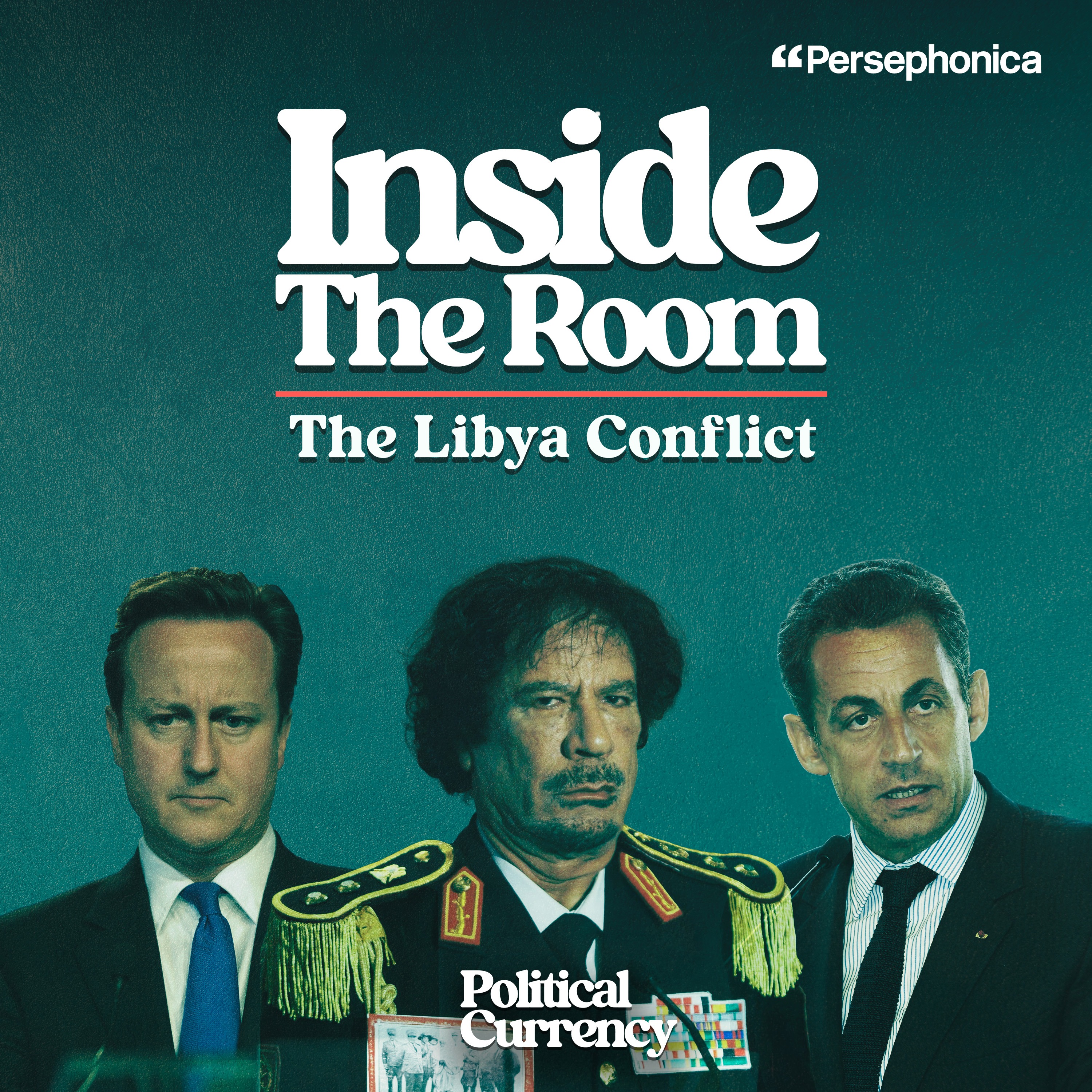
Inside The Room - The Libya Conflict: The Build Up (Part One)
In short
Inside the Room: The Libya Conflict—how the UK, France, and the US built up to the 2011 intervention after Arab Spring unrest, focusing on the decision-making process and the case for/against a no-fly zone.
Guests and backgrounds
Sir John Sawyers, former head of MI6 (SIS) and former UK ambassador in Egypt; Ed Balls (former UK politician, in opposition during the period); George Osborne (Chancellor during the period, involved in war-room discussions); Cathy Ashton (EU High Representative for Foreign Security Policy); Hugh Powell (Deputy National Security Advisor to the Coalition Government; previously led the Foreign Office Security Policy Department).
Key claims
Libya was poorly understood in Britain; the intervention was framed as preventing an impending massacre and was backed by UN authorization; politicians emphasized “inaction has consequences,” while officials worried about limited aims; Americans were reluctant to lead but provided enablers (refueling, intelligence, air defense removal).
Notable examples
Tunisia/Egypt uprisings; Gaddafi forces moving toward Benghazi; Omar Suleiman’s early claim Egypt had “complete control”; Sarkozy’s Paris meeting where French jets were already airborne within two hours.
Written by AI. May contain mistakes.
Chapters
3:18
Setting the Scene: The Arab Spring
Discussion on the Arab Spring and its impact leading to the Libya conflict.
“We're going to go back to at the beginning of the 2010s as an uprising brought out across much of the Arab world.”
4:52
Inside MI6: Insights from Sir John Sawyers
Sir John Sawyers shares his experiences as head of MI6 during the conflict.
“I'm just going to start with, you know, you at the time were the head of MI6.”
7:40
The Political Climate: Arab Spring's Impact
Exploration of the political atmosphere during the onset of the Arab Spring.
“And in some ways, being chief of MI6 is different from any other permanent secretary job.”
11:36
The Libya Conflict: Planning and Response
Discussion on the response and planning for military action in Libya.
“I was rereading David Cameron's memoirs, the chapter on Libya, and literally his first sentence is, I didn't see it coming.”
14:01
Generational Perspectives on Intervention
Explore how generational differences shaped attitudes towards military intervention.
“up under his kind of premiership as in my case as a politician but in your case in the kind of official service you served in Afghanistan which was obviously one of his you know key conflicts he gets Britain involved in.”
16:49
Caution vs. Action in Military Decisions
Discuss the balance between caution and taking action in response to conflicts.
“give the opposition a chance, but not do their job for them.”
20:09
Understanding Libya: A Lack of Knowledge
Analyze the limited understanding of Libya's complexities leading to intervention.
“And were you one of the cautioning voices?”
23:28
The Role of European Politics in Intervention
Examine how European dynamics influenced the decision to intervene in Libya.
“And so our relationship was with the regime rather than actually understanding the country.”
26:41
UN Resolution and Moral Obligation to Act
Discuss the legal and moral justifications for the military intervention in Libya.
“But Barack Obama was always, and is as a character, are a more kind of distant person.”
28:00
The Abstention of Germany in the UN Security Council
Discover the dynamics of European powers during the Libya conflict and the significance of Germany's abstention.
“And Nicolas Sarkozy was his partner in this action.”
Show all 13 chapters
30:42
Obama's Reluctance and European Leadership
Understand the complexities of Obama’s decisions and the role of Europe in the military campaign against Gaddafi.
“I don't remember us caring particularly about the position of the European Council.”
36:49
The Crucial Meeting in Paris
Explore the pivotal meeting where Sarkozy announced military action in Libya and its implications for European and American relations.
“I'm going to liberate the people of Benghazi.”
42:01
Using No-Fly Zones in Conflict
Learn about the strategic use of no-fly zones in military operations.
“okay we've got to be able to do what we did in Iraq in after 1990 and that's use a no-fly zone to protect movement on the ground.”

Ask about this episode
Get the gist, explore an idea or ask about something said.
 Claude
On Political Currency, what are the key points of this episode?
Searching your listeningTranscript
Automatic transcript. May contain errors.
0:00Hey, it's Paige from Giggly Squad and you know those moments when you just want to slow down and actually treat yourself. That's exactly where Haagen-Dazs comes in. Haagen-Dazs just launched a brand new flavor, coffee almond toffee ice cream. It's rich, smooth, creamy, indulgent, and honestly too good to rush through. Take your sweet time. That's Daz. Find Haagen-Dazs new coffee almond toffee ice cream at retailers nationwide.
0:53so welcome to another series of inside the room with me ed balls and george osborne yes this is the series where we take a deep dive into some of the big moments in our recent political history. And we talk to the decision makers and we take you inside the room where these decisions were actually made. That's right. Over the last few years, we've had David Cameron, Michael Gove, Nicola Sturgeon. You can catch up on all of those more on YouTube. And up to now, they've been about domestic politics. But today, we're going to do something a little different. Yeah. In light of the recent conflict in the Middle East, of course, the American and Israeli action in Iran has got us thinking about conversations that will be going on inside war rooms, inside cobras, inside cabinets across the world, and working out how you conduct military interventions and are they always doomed to be messy.
1:41So we're going to take you back to a period that I was involved in. I was in the cabinet at the time. This is 2010 and 2011 in particular, and it's the outbreak of the Arab Spring, and that leads to the intervention in Libya. As you say, George, I was in parliament, but not in the room anymore. Sadly, we were in opposition. You, George, were there with David Cameron in the war room throughout this conflict. And of course, it wasn't just a story about what was going on in Britain or indeed in Libya. The French dimension was incredibly important. So we'll talk a bit about what was going on in Paris.
2:13And of course, you couldn't ignore and you never can ignore Washington, D.C. So we're going to be talking also about the Obama administration. It's a complex story. We've got voices from inside many rooms to help us. We're going to hear from Cathy Ashton, who is the first EU High Representative for Foreign Security Policy. Also Hugh Powell, who is the Deputy National Security Advisor to the Coalition Government, previously headed the Foreign Office's Security Policy Department. But we are unbelievably fortunate and grateful to be joined here in person, here in East London, by Sir John Sawyers, who at the time was the head of the Secret Intelligence Service, SIS, which to everyone else in the world is MI6.
2:53Thanks. John, thank you so much. You're a very busy person and you were absolutely in the room at that moment in the Libyan conflict. So thank you for coming all the way here to Hoxton and joining us in our studio. Thank you. It's a great pleasure to be here. Thanks for inviting me. We hope you're looking forward to a trip down memory lane, back into some very important rooms that you were in those years ago. Before we get to Libya, though, we're going to start by setting the scene that led to that conflict. We're going to go back to at the beginning of the 2010s as an uprising brought out across much of the Arab world.
3:30An outbreak of protests in Tunisia Saturday night after raids by government forces. It's now spread to the capital. Now hundreds gather outside the city's labour union. Friday the 14th of January began much like many other mourning over the last four weeks. But the day will go down in Tunisia's history as the culmination of unprecedented protests. Protests which ultimately forced the president from power, an office he had held firmly for 23 years. Part of Cairo's concrete jungle, police fired tear gas and rubber bullets to break up what is now the biggest challenge to Hosni Mubarak's 30-year rule.
4:09There's extraordinary anger here mixing with the smell of tear gas. Either this is the first Arab revolution of the 21st century, or it will be brutally suppressed. Inspired by the unrest that has shaken Tunisia and Egypt, tens of thousands have taken to the streets of Yemen. President Hosni Mubarak has stepped down. That was the demand for weeks now from anti-government protesters, demonstrating today for the 18th straight day. The news, as you can see, now has crowds cheering wildly. John, hopefully that takes you back to that quite extraordinary period in the history of the Middle East and North Africa.
4:52I'm just going to start with, you know, you at the time were the head of MI6. And of course, that is a job, you know, steeped in kind of folklore and mythology. And, you know, people have seen the James Bond movies and read the John le Carré books and so on. You know, tell us as much as you can about what is it actually like being the chief of the Secret Intelligence Service? What is the sort of day-to-day job? Well, first of all, you're CEO of a government agency. So you've got all the responsibilities of being in charge of an organization of several thousand people, a budget of, you know, over half a billion pounds.
5:26Back then, it would be more now. And the transformation that you have to affect, mobilize and motivate people and to get the right technology and so on. So it's all the elements of a CEO job. Plus, you have this extraordinary history and capacity to do things that no other government agency can do. You're licensed under law to break certain standards and laws that you would expect, like bribing government officials or breaking and entering into premises. And so you're licensed to do things which no other agency is able to do. And thirdly, you have a sort of network of relationships around the world with other chiefs of intelligence.
6:03that is a sort of privileged route because quite often my counterparts were the second most powerful people in the government. They were like you were George when you were chancellor. The head of security oversees the security of the regime, the security of the country and many aspects of its foreign policy. And one good example we were just talking about Egypt was Omar Suleiman who was the head of intelligence in Egypt up to the fall of Mubarak in 2011. I knew him quite well because I'd been ambassador in Egypt 10 years earlier. And so I had all the relationships in place in Egypt and an understanding of the place.
6:37But what was most striking to me, I was in Egypt in the first week of January in 2011, just two weeks before the demonstrations opened up. And I asked Omar Suleiman, what will happen if the demonstrations in Tunisia spread to Egypt and come to Cairo? He said, no, no, no, it won't happen. That won't happen. We've got complete control over everything here. Don't worry. And of course, that just goes to show that, especially in an autocratic system, you can lose touch with what's happening. But I think those are the three aspects of being chief. I also remember of you, and I was always, not just saying this because you're here, because I wouldn't have invited you here if I didn't think this.
7:14I was very impressed by you in the room. And we're going to come on and talk about the conversation because you were doing all those things. You were leading this important agency. But you're also a participant. You were a key advisor, ultimately, to the British Prime Minister. You had a view. And I think it was particularly the case, you've just alluded to it, that you knew this region pretty well. You had been the ambassador in Egypt. I just remember you being in a kind of an authoritative voice. And I also felt maybe because you were head of MI6, rather than maybe the permanent undersecretary of the Foreign Office, you felt more empowered to have a view rather than on the one hand, this, on the other hand, this prime minister?
7:55Well, that's right. And in some ways, being chief of MI6 is different from any other permanent secretary job. You go into the treasury, they say, but who's in charge here? They'll say the chancellor, who's in charge in the foreign office of the foreign secretary, who's in charge in MI6? It's the chief. So you have a real leadership role and a sort of political role, as well as a sort of permasec, sort of leading an agency type role. And I think it is part of the job of MI6 chief just to caution about the downsides. When I was a diplomat, I was a glass half full merchant. When I was an intelligence chief, I was a glass half empty merchant.
8:28You have to watch out for the dangers here. When you had an enthusiastic prime minister in his first year in office, about to use military force for the first time, which was where David Cameron was in 2011, you do have to calm things down a little bit with some cautionary words. Chances are often also a glass half full of merchants. And I'm not sure if George was one of those, but quite unusual to be a chancellor in the room at the centrepiece of conversations about foreign policy and military policy. It's not always the case. What do you remember, George, about being there as this Arab Spring was ricocheting across the region?
9:02Did it feel exciting or did it feel unstable? table? I mean, to be honest, we were still in the flush of being in government. Certainly speaking for David and myself, I know we were enjoying it. I mean, we were enjoying the jobs. I mean, there was a lot of pressure. And certainly by the time you get to the end of 2010, we'd had student riots in London over some of the decisions we'd taken. And so things were beginning to get more difficult domestically. But in terms of inside number 10, here were a bunch of political leaders who were close friends, who had actually formed a close relationship with our unexpected coalition partners, the Liberal Democrats.
9:39And I think it's sort of taken well to government. Certainly David Cameron was a very comfortable prime minister six months into office. I was his, you know, not only his chancellor, but I was his close friend. I was sort of kind of his chief whip and various other things as well. And so he did something very unusual, I think, which is he brought me in to decisions on foreign policy and security policy, which a chancellor wouldn't normally, or certainly by right, be in the room. And often he would ask me for a sort of second opinion privately. And of course, that was part of our relationship that, I had his back and he had my back.
10:16But to be honest, I remember the beginning of the Arab Spring, it sort of was happening on my television screen rather than... I was sort of leaving it to David Cameron to John William Hague who I you know was a you know had mentored me and I you know worked for him in the past um and and Ed Llewellyn who was an important element in all of this the chief of staff who came from a foreign policy background as well um so to be honest it wasn't you know it wasn't yet on my radar very interesting we'll be back with Sir John Sawyers after this
11:00Hey, it's Paige from Giggly Squad. And you know those moments when you just want to slow down and actually treat yourself? That's exactly where Haagen-Dazs comes in. Haagen-Dazs just launched a brand new flavor, coffee almond toffee ice cream. It's rich, smooth, creamy, indulgent, and honestly too good to rush through. Take your sweet time. That's Da's. find Haagen-Dazs new coffee almond toffee ice cream at retailers nationwide.
11:35Welcome back. I was rereading David Cameron's memoirs, the chapter on Libya, and literally his first sentence is, I didn't see it coming. That's the first sentence. And he's talking about Libya. And we're about to spend the rest of this show talking about Libya. But it comes really out of the blue. This is not a country that we ever thought we'd be spending all this amount of time on. But we soon found that things did turn to Libya. And here's a reminder of the news at the time. Political turmoil that started in Tunisia and then of course spread to Egypt is now reaching across the region into Libya at this point, a country long ruled by Muammar Gaddafi.
12:19140 people were killed in Libya overnight as dictator Muammar Gaddafi sent a sniper to crush protesters. There are also reports that women and children jumped from bridges to escape the roofless crackdown in this North African country.
12:47I think now we have got to prepare for what we might have to do if he goes on brutalizing his own people. And I had a phone call with President Obama this afternoon to talk about the planning we have to do in case this continues and in case he does terrible things to his own people. You have it, Richard. Ten votes. That means the no-fly zone is approved. Resolution demands an immediate ceasefire. Left unchecked, we have every reason to believe that Gaddafi would commit atrocities against his people. many thousands could die. Gaddafi does not comply with the resolution. The international community will impose consequences, and the resolution will be enforced through military action.
13:27So as you said, George, early on in the Conservative government, suddenly you are into a high-stakes moment, the British machine revving into action with the potential for conflict with Libya. as we said we're going to speak to Hugh Powell deputy national security advisor you were asking him what it was like for your generation facing um these new challenges this wasn't Iraq but that was a you know an older generation Tony Blair's generation but we were obviously you know a grown up under his kind of premiership as in my case as a politician but in your case in the kind of official service you served in Afghanistan which was obviously one of his you know key conflicts he gets Britain involved in.
14:13I mean, to what degree are we kind of products at the time, including David Cameron, who you know well, you know, we're products of Srebrenica, of Rwanda, of the failure to intervene. If you read David Cameron's memoirs on the Libyan chapter, you know, it's full of the Berlin Wall, Srebrenica, you know, we can't let this thing happen again. No, I mean, you're absolutely right. And it was very striking. I mean, two things on that. At first, as you say, the extent to which not just David Cameron, but Nick Clegg too, and others in that 40-something generation around the table, always referred to no Srebrenica on my watch.
14:55That it was more formative for the 40-somethings than, how should I put it, the 50-somethings around the table. But there was a generational split in attitude, which was quite marked. And this was as much a split, I would say, between the senior politicians around the table and the senior military and officials. It comes down to this, how you approach the balance of risks between inaction versus action. David Cameron would start so many of these NSC meetings, not just on Libya, but on Syria too, saying, always remember that inaction has consequences. somebody tell me how doing this will make things worse than they're otherwise set to be.
15:43Now, you know, as an attitude, that is very different to what you're getting from senior officials whose starting position tends to be it is always safer not to be blamed for acting. And General Richards, the chief of the defence staff, was always cautious and subsequently distances himself from the whole operation, didn't he? To some extent, yes. So when you say cautious, David Richards, in his own way, obviously the sort of product of the previous 20 years of intervention, had a very clear view that we had learned how to do intervention in 20 years, and that it involved large forces taking ownership of the ground, doing it properly, you know, relatively unlimited commitment.
16:34He was never comfortable with the strategic decision at the very beginning to limit the amount that we were prepared to risk, that we would never commit to having ground forces, that we would never take ownership of the problem at the end of the conflict, that what we were there to do was give the opposition a chance, but not do their job for them. And again, George will remember this point in the campaign in about early May, where the first stage of the campaign, we had succeeded in stopping Gaddafi, but nothing more. The campaign was essentially stalemated. And David Richards was definitely saying, Prime Minister, we have culminated.
17:19And it was noticeable that it was very much the politicians around the table who were still comfortable with the uncertainty of that position, taking the risk to just keep going. I've got a couple of questions for you, John. So the first is, you know, I felt at the time, and I wasn't the lead decision maker on the political side, that I was with people like David Cameron, Ed Llewellyn, Nick Clegg, people who'd sort of grown up somewhat in the shadow politically of the Iraq war a decade earlier. So we were in this sort of extraordinary position where we're going to be going into conflict in a country in the Middle East of which we don't know that much.
18:00But behind that, it was a generation whose sort of early formative kind of moments had been the non-intervention in Rwanda, the failure to stop the massacre in Srebrenica. I guess also, you know, if you had David here and Ed Llewellyn here, they'd also talk about the 1989 revolutions in Eastern Europe, which were seen to have some parallels with what at the time was going on in the Middle East, as was sort of yearning for freedom. I mean, did you feel, you know, you're the experienced hand, you're the head of MIC, you've been the ambassador to the UN as well as in Egypt? I'm not going to put it in a pejorative way, but here are the kind of kids.
18:37The young punks. The young punks starting up with their somewhat naive view of how complicated this all was. I think especially younger, new politicians can simplify the problem. And we're seeing, not that he's young, we're seeing Trump simplifying his view of Iran at the moment, that if only you deploy military force, then everything will turn out right in the end. And in some ways, leaders get used to the military being involved or directed to intervene and it working. It happened with Tony Blair first in Kosovo and then in Sierra Leone. And that gave him confidence, which led to the overreach of Iraq.
19:16And I think we're seeing something similar with Trump at the moment. I think you and David Cameron and William Haig, I think William was a bit more cautious about all this than David was in the sense that there are real risks here. There are risks of not intervening. As you mentioned, Rwanda was the one scarred on my memory. I was in the Foreign Secretary's office at that time. And you felt a helplessness that you couldn't intervene in a place where UN peacekeepers were being brushed aside. Ditto in Srebrenica, although I'd moved on from then at that stage. And then, of course, we had Iraq and Afghanistan when we went in full-blooded, whole hog, took the blast, the grenade blast of the system blowing up and incurred a lot of casualties.
19:59And there was a sort of civil conflict going on around us. So neither the standing off and doing nothing nor the full-fledged intervention were straightforward. And so there was a bit of caution. And were you one of the cautioning voices? We know General David Richards was a cautioning voice. He said that publicly since. were you somebody saying hold back were you unpersuaded that a military intervention a no-fly zone was the right thing to do i i supported some of david richard's reservations my point was you've got to do enough to make a difference on the ground when hugh powell and others came up with a sort of the bright idea of the no-fly zone we did raise questions about it because you know a no-fly zone on its own isn't going to help the massacres are taking place on the ground with ground forces with with kalashnikovs they're not taking place with helicopter gunships or F-16s or something.
20:48This is a different type of conflict. So you've got to be able to do what we did, in a sense, in Iraq after 1991, and that's use a no-fly zone to protect movement on the ground. The initial response from David Cameron was a great reservation about that. Fortunately, the Americans, particularly Susan Rice in the US representative in the Security Council, the senior people in the National Security Council in Washington, they shared those reservations. They said, look, some of the things you're proposing, oh Brits, are just not going to do the trick. And therefore, you need to do more than what you're doing.
21:18My main word, I wasn't anti this at all, but I was very keen to ensure that we had the means and the measures commensurate with the scale of the task. And we didn't start out on something and fail at halfway stage. I remember you in one of the, this was actually in the cabinet room and you just explaining that Libya was a country which we actually didn't know very much about. I remember John explaining and showing this map of Libya where the Gaddafi forces were moving towards the rebels and saying, General Rommel built this road. The last time Britain had any involvement in Libya was with Bernard Montgomery.
22:02At this point when the Arab Spring has morphed into this sort of increasing focus on Libya. What again is happening inside MI6? And you can also speak to the Foreign Office because you've been a senior. But I mean, are we sort of scrambling to find out? The odd thing about Libya is, of course, it was sort of seared in our memory, if you're my age, of Semtex to the IRA, the Lockerbie bombing. Gaddafi was a bogeyman when I was a teenager. But as a country, and this will come on to some of the criticism later, this was like a country we did not know much about. And that's right. We dealt with the regime doing the really bad stuff like following up on Lockerbie.
22:43Lockerbie, of course, was the Libyan response to the American bombings in 1986. There's a history of all this. The Libyans had been sponsoring terrorist groups around Europe. There was a terrible attack in Berlin, which were the Libyan responsibility. And we'd had a successful engagement with the regime in 2003, 2004, where in the wake of the invasion of Iraq, the Libyans finally decided that their weapons of mass destruction program was not going anywhere. Unlike the Iraqis, they did actually have a weapons of mass destruction program. And they engaged with us in a way to take out the biological toxins that they had and their beginnings of a nuclear program, which they were starting on.
23:28They gave all that up. And so our relationship was with the regime rather than actually understanding the country. It's not as if we ever had a very big embassy there or a very big MI6 presence there. It was never a high priority for intelligence gathering on the country itself. It was more, how do you deal with this regime in the context of dealing with its support for terrorism and dealing with its wish to develop highly dangerous weapons? Now, it wasn't only within the British government that there were kind of concerns and caution being raised within the European Council, a number of member states, in particular Germany and Chancellor Merkel, very cautious about this indeed.
24:07And we spoke to Cathy Ashton, who was Europe's most senior diplomat at the time, about the nature of the European debate, and in particular, the European Council, which preceded the UN vote. Sarkozy really wanted to show that he was up for the fight with Gaddafi, and that Cameron was a little bit the junior partner in this. And so he went to the European Council to get agreement that they should go ahead, not because he saw Europe as a military power, because it's not, but because it mattered to have European support from individual member states, which he was going to draw upon, but also to widen out into support, especially from the US.
24:51There's no doubt in particular Germany, Chancellor Merkel, were very, very uneasy about any form of military intervention at all. I think if you spoke to French or British officials now, they would say that we were going to do this anyway. And the European Council either made themselves irrelevant or had to find a way to make it possible for this to look like Europe was united. I mean, how much was this a European decision and how much of this was essentially Europe allowing France and Britain to drive this? You have to remember that at this point, the United States was not in the fight. No military action over Libya was going to be in the least bit possible without getting the US, and the US had not yet made a decision.
25:43It was the beginning of the process. And indeed, the European Council, and you're completely right, Angela Merkel was very worried about where this was going to go and very reluctant to put German assets into this. But I don't think it's right for officials to say now, well, they were going to do it anyway, because they couldn't have done it anyway on their own. And the more European support they got, the more that this did not look like some maverick action by two states. So is Cathy right that Sarkozy was in the lead? Do you think for your conversations in the British government, George, that the European Council mattered?
26:18I mean, you needed support within NATO. You needed the Americans who were kind of publicly cautious. Did you need Europe? Well, I think we thought of it as a European action, even if we weren't directing it through the European Council and the mechanisms of the EU, because the French were the key allies. And David Cameron had a strong relationship with Nicolas Sarkozy. And he built up an important relationship with Barack Obama. But Barack Obama was always, and is as a character, are a more kind of distant person. And I think we thought at the time, we're doing this by the book, we've learned the lessons of Iraq and the lessons of Srebrenica and Rwanda.
26:56There is an impending massacre going to happen in Libya, which we have the power to stop because Gaddafi's forces are moving along this road towards the second city of Benghazi. So we have a moral obligation to do something about it. We're not going to rely on the Americans entirely. We'll come on to their involvement in the campaign subsequently. But Britain and France can do this together. And we are the two big military powers of the EU, because of course we were in the EU at the time. We've got a UN resolution, which Blair had failed to secure over Iraq. So this is all legal. And in fact, it was one of the great kind of sort of mysteries that the Russians hadn't vetoed the resolution.
27:33And so I think at that point, we think this is a different kind of intervention from Iraq. This is authorised by the UN. It's European-led, even if not EU-led. You know, we weren't really worrying about the Germans because the Germans are, you know, these days, the kind of military power in Europe. And we can stop this. You know, if you read David's memoirs, and I very much remember it at the time, he felt, I can stop people being killed. And Nicolas Sarkozy was his partner in this action. Absolutely. Absolutely. I don't know when that meeting took place that Cathy was talking about, but Germany was a member of the UN Security Council at the time, and it abstained on that resolution.
28:16But it wanted to have a sense of European backing that it could at least go along with the resolution, even if it wasn't going to vote in favor of it. And the European Council was before the UN meeting. That's what I rather assume. As you say, George, their actual big surprise was that the Russians abstained on the resolution. That was a consequence of quite a big argument between Putin, who was then Prime Minister rather than President, and Medvedev, who was the President, with Medvedev trying to appeal to a sort of softer edge of Russian opinion and join in with the West on this. Things have changed a bit since then.
28:50But Europeans were relevant. I think, again, on the military side, David Richards was right to point out that we would need American enablers, we would need the American air-to-air refueling items. We would need their reconnaissance and intelligence feeds as well. And we were getting that from the CIA too. So what Barack Obama talked of leading from behind, that involved a lot of support elements, which back then we didn't have, and in many ways we still don't have. So I think there was a European front to this, there was a European presence. The Germans were never going to take part in the actual military action, but it wasn't an EU-led one.
29:29It was a NATO-led exercise. It started as an American-commanded operation with the French and British planes out in front. It then became a NATO-led operation under the UN Security Council authorization. So I think the EU as an entity was a part of sort of validating and giving political approval or go-ahead for this, but it wasn't an actual player in the operations. Although, you know, I think if you cast forward to today, when people say, can't Europe assume more responsibility for its defence and its neighbourhood. Of course, these were the two, Britain and France, doing precisely that. But we're going to take an ad break now because what we quickly discover is that despite the reluctance of the Americans and Barack Obama's reluctance to get drawn into it, he of course has been elected on a post-Erault war ticket and he's facing re-election the next year, unlike David Cameron and myself.
30:24we actually discover we need the americans and we'll turn to that after this break
30:42hey it's page from giggly squad and you know those moments when you just want to slow down and actually treat yourself that's exactly where haagen-dazs comes in haagen-dazs just launched a brand new flavor coffee almond toffee ice cream it's rich smooth creamy indulgent and honestly too good to rush through take your sweet time that's da's find haagen-daz's new coffee almond toffee ice cream at retailers nationwide so welcome back i mean in 2016 a few years later when Barack Obama is looking back on this period he says he was running an anti-free rider campaign he said in order to prevent the Europeans and the Arab states from holding our coats while we did all the fighting that we by design insisted that they lead during the mission to remove Gaddafi from power in Libya and we ask Hugh Powell I mean did he think that the European Council position mattered in the British National Security Council, or was it all about the Americans?
31:53I don't remember us caring particularly about the position of the European Council. Even within NATO, it's easier within NATO to take something forward without the full-throated support of all members of the alliance. The Americans were always very clear. There was a phrase that they subsequently didn't like, but used, which was, you know, leading from behind or being a sort of backseat driver. They were very, very clear that they were prepared to do no more than take out the Libyan air defences, to do the stuff that only America could do, but then leave the detailed fighting of the campaign to British and French leadership within NATO.
32:41So John, I mean, the relationship with the Americans is obviously always critical. And I assume if you're the head of MI6, the relationship with the CIA is the central relationship with another country. To what degree were we trying to suck the Americans in or were we trying to prove we could do it? My sense was that David Cameron and Nicolas Sarkozy wanted to show the Americans that we didn't have to rely on them, that Britain and France and Europe had agency. But, you know, as you were just describing, the truth was that when it came to kind of raw military power, there were just some things we needed from the Americans.
33:20Was it just the things we could see, the kind of refueling planes and the anti-aircraft weapon systems we could deploy? Well, I kept in very close touch with Leon Panetta, who was the director of the CIA at the time, up until the middle of 2011. He was with us in recognizing the dangers that Gaddafi posed, not just the dangers to his own people, but the wider dangers of concern to both us and the Americans of support for terrorism and risks of proliferation of weapons of mass destruction and so on. So American deep state was quite sympathetic to what we were trying to do. The White House was trying to restrict American involvement, was my recollection.
34:03And Hillary Clinton, as Secretary of State, was with Panetta and the deep state trying to persuade the White House to come on board. I think that's right. I mean, Obama, who, of course, was one of the few senators who voted against the Iraq war, was very reserved about what was going on in Afghanistan as well, did not want to find himself drawn into a war of his own making during his term. And as you say, George, a year before his re-election campaign. So when I read that quote from Obama from 2016 about, you know, avoiding the free rider problem, it was a strategic thing to get France and Britain to lead.
34:39That is an ex post justification. A little bit. obviously politicians will always look back and put a wonderful sort of theory around their actions at the time but speak for yourself i i think there was a a reluctance on on obama an instinctive reluctance on obama's part to be drawn in on this and yes that manifested itself in wanting the europeans to take the the political weight here if you're providing enablers providing the intelligence and so on, as we see in Ukraine at the moment, American support on this is unrivaled and unmatched by anything the Europeans can provide. We're going to end this episode by going to the crucial meeting.
35:19This is after the UN resolution, which actually was based on really rather tough American language. They sort of emerged as supporters in the UN. As you said, so interesting that Russia, as well as China, abstained rather than blocking that resolution. but then the vital meeting of the coalition of the willing if you like is then not in um brussels or in in washington but in paris hosted by uh sarkozy and he makes a very striking announcement at the end of that 90 minute meeting in front of hillary clinton um as well as um you know david cameron and other leaders that um the french planes are already in the air on the way to libya and would be over Libyan airspace within two hours.
36:03And Cathy Ashton, who was in that meeting, she describes what the mood was like. I can remember the room very well. I can remember the look on everyone's face. They hadn't tipped the Americans off, or at least the Americans would say that they knew about it. And that's probably true. But everybody else's face was a picture because suddenly this was a real, rather than a meeting to discuss the possibility of what was going to happen. It was real. And B, those planes had already taken off when the meeting, which was not a long meeting, had begun. I think a sense that Sarkozy was determined that France was going to lead this.
36:41It wasn't British planes and French planes, it was French planes in the air. And there's no question that this was Sarkozy saying to the world, I, Nicolas Sarkozy, I'm going to liberate the people of Benghazi. David Cameron, though, was strikingly mature in this period. He never seemed to object to the fact that all the meetings happened in Paris, you know, Sarkozy in the lead. I mean, am I right to say he was strikingly mature or was he boiling inside? I remember the day when the French jets went in, we were definitely caught by surprise. There was no advance warning, certainly I was aware of.
37:16And I remember, you know, David going, they're doing what? So they started. But I think, you know, remember that we haven't talked about this aspect so far, and we don't have to dwell on it, but he was also leading a coalition government with Liberal Democrats. And he had to hold that government together. And although we now know it lasted for five years, this is still the first year and there were a lot of people predicting the coalition government would fall apart. And a lot of people predicting that it would be precisely unforeseen foreign events that would put a stress on the coalition. So I think to some degree, you know, he didn't want to be out in front.
37:55He was quite happy to be in a partnership, he would say a partnership of equals, with Nicolas Sarkozy. And he had a European Council support and a UN mandate. So this was not a position Tony Blair had found himself in 10 years before. No, I think if we hadn't got the UN resolution, there's a big question of what we would have done because that might have fractured the coalition with the Liberal Democrats. But there is no doubt, I'd love to get John's view on this because, you know, I always think the French and British are like kind of brothers, aren't they? They're sort of siblings. There's a sort of sibling rivalry.
38:25We're two similar to each other. And I think that's probably true of the intelligence agencies. My recollection is they absolutely jumped the gun on us. And we did not know that those French planes were. We knew it was all about to start. Yeah. But they got there first. They stole a march on us. It was so crazy. George, you can never expect the head of MI6 or the former head of MI6 ever to admit that anybody jumped the gun on him. You just did. I just did. Well, at Novi, surely you knew, really. You just didn't tell the Prime Minister and the Chancellor. On the contrary. Had I known, I would have passed it on.
38:53But I think the first people who would have known would have been the NATO watchers in Brussels, who would have been monitoring the flights over Europe, heading towards Libya. But anyway, word did not come back. And I think, like George, it was relatively, we were relatively sanguine about it. We just rolled our eyes that the French were doing this. I think one of the great strengths, going back to George's point about the coalition, is one of the best things David Cameron did when he came into office was form the National Security Council. That was partly a reaction to criticisms of Tony Blair and sofa government.
39:24And I was on that sofa when we were discussing difficult things like Mike Jackson's position in Kosovo or the early preparations and responses to 9-11. What David Cameron did was create a National Security Council so that, first of all, you had ministers and officials and intelligence chiefs and the armed forces all around the table, forming a sort of a college, really, of people with responsibilities here. And secondly, it helped manage the coalition because Liberal Democrat ministers had the same basic information, the same basic analysis and input as the Conservative ministers had. So it was a really good management of issues and also management of the coalition that has survived.
40:04And this is a great place to end this episode because we're going to start our next episode with the war underway in the National Security Council and how that operated. This is no longer 40-somethings shooting the breeze. This is Britain in a military conflict. And we're going to move on to the conduct of that conflict in our next episode. Yeah, that's right. So we're going to be talking through how does Britain fight a war or an air campaign and how does it actually unfold? So you'll definitely want to hear that. If you are a Kitchen Cabinet political currency gold subscriber, you're going to be able to hear all that right now.
40:40In fact, the next two episodes, because we also talk about the aftermath, of course. So make sure you subscribe. And if you want to hear mine and George's reflections on the series, you'll need to make sure you join our Kitchen Cabinet and gold subscribers. But in the meantime, that's the end of episode one. And next episode, we're on to the conflict. See you then.
41:09Thank you.
42:01okay we've got to be able to do what we did in Iraq in after 1990 and that's use a no-fly zone to protect movement on the ground. Hey, it's Paige from Giggly Squad, and you know those moments when you just want to slow down and actually treat yourself? That's exactly where Haagen-Dazs comes in. Haagen-Dazs just launched a brand new flavor, coffee almond toffee ice cream. It's rich, smooth, creamy, indulgent, and honestly too good to rush through. Take your sweet time, that's Da's, find Haagen Dahl's new coffee almond toffee ice cream at retailers nationwide.
From the publisher
As renewed violence erupts across the Middle East, governments have been forced into crisis mode... but when is the right time to intervene, how involved should you get and when, if ever, is it time for 'boots on the ground'?
It's these dilemmas and more that are currently facing Keir Starmer and other world leaders, but it's not the first time a UK government has had to find answers for such big questions about international intervention.
Fifteen years ago the civil unrest of the Arab Spring spread to Libya. The violent crackdowns against anti-government protestors that followed sparked seven months of NATO military intervention and led to the killing of Muammar Gaddafi, putting an end to his 42-year dictatorship.
In this special mini series, Ed Balls and George Osborne are joined by former MI6 Chief Sir John Sawers to discuss the key decisions, missteps, and aftermath of the Libya crisis. We take you inside the war rooms and hear unique insights from John, George and two other officials who saw key decisions being made first-hand: former EU High Representative for Foreign and Security Policy, Cathy Ashton, and deputy national security adviser to the coalition government, Hugh Powell.
What can the wars of the past can teach us lessons for the wars of today?
In part one, we look at how the UK government reacted to the escalating situation, why David Cameron and then-French President Nicolas Sarkozy pushed for military action, and the steps that led to the first bomb being dropped… and how it managed to surprise Britain.
Thanks for listening. In our next episode we take you right behind the scenes of the military action and hear about all of the drama that ensued, including the moment Sir John Sawyers took an informant for a secret dinner…
Can’t wait? Subscribe now to get all three parts of Inside the Room: The Libya Conflict. You will also get access to our debrief episode The Inquiry, as well as early and ad-free access to our regular episodes of EMQs.
👉 patreon.com/politicalcurrency
Please note: Kitchen Cabinet is only available via Patreon.
Credits:
Research: Monica Lillis, Ayla Krachai, and Sam Burton
Production support: Tom Jackson
Production: Caillin McDaid and Nasreen Arain
Video Editor: Avi Asher and Oliver Geraghty
Executive Producer: Ellie Clifford and Henrietta Harrison
Hosted on Acast. See acast.com/privacy for more information.
More from Political Currency
All episodes

We use cookies.They keep VO running smoothly and help us improve it. Privacy policy