
 Ask ChatGPT


- Podcasts
- Political Currency
- Inside The Room - The Libya Conflict: The Campaign (Part Two)
Political Currency6 Apr 2026 · 35m · 15 chapters
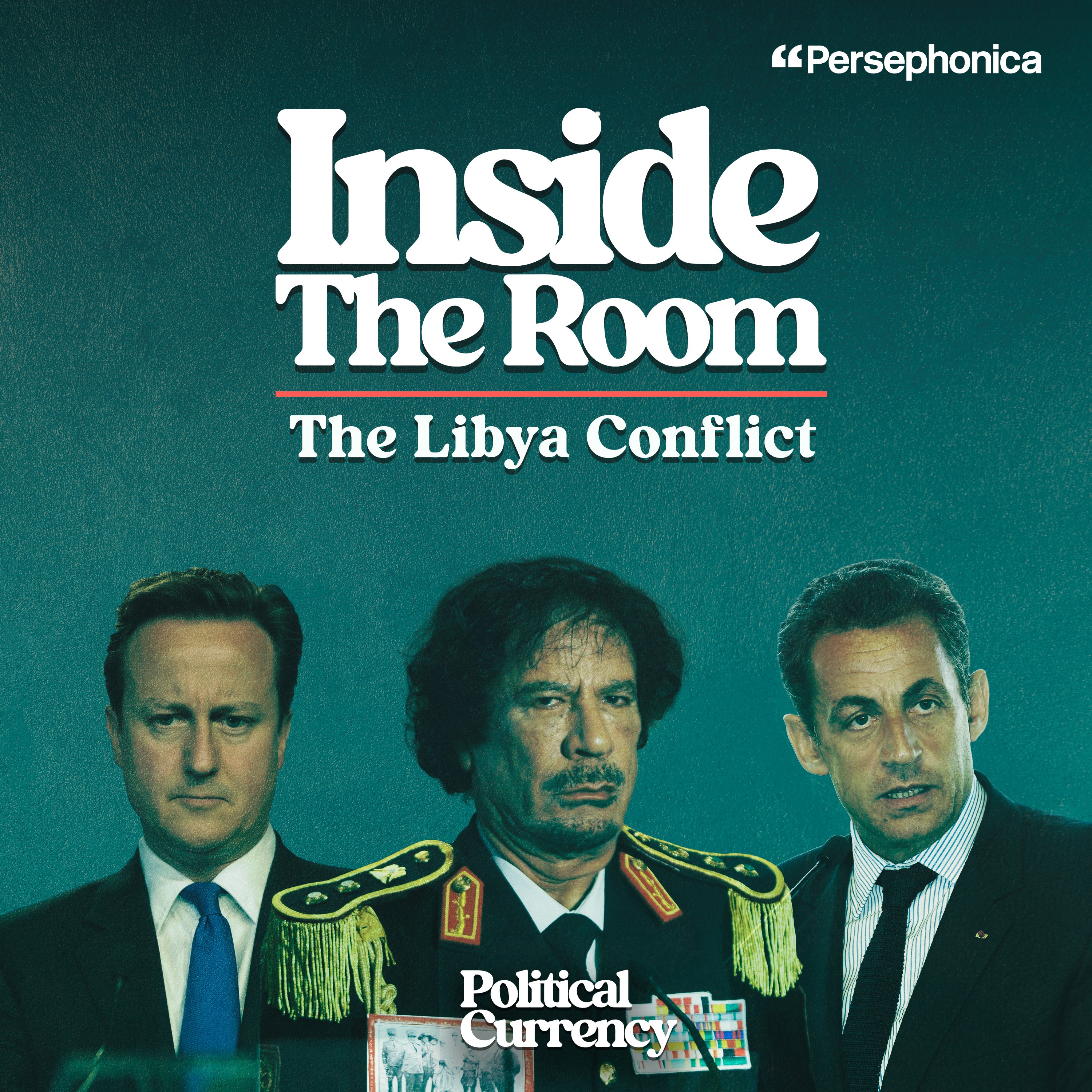
Inside The Room - The Libya Conflict: The Campaign (Part Two)
In short
Inside the Room: The Libya Conflict (Part Two) recounts the 2011 NATO/coalition campaign against Muammar Gaddafi, focusing on how fighting unfolded and how intelligence and political decision-making shaped operations.
Guest
John Sawyers, former MI6 chief, explains MI6’s role in mapping regime vs opposition strengths (e.g., Misrata, Sirte, Western mountains Jebunafusa) using limited assets and partners like Italy and Egypt.
Key claims
the campaign aimed at a political settlement, not total victory; Gaddafi was a “totemic” obstacle; restricting targeting and Gaddafi’s tradecraft (avoiding mobile phones) delayed attempts to kill him; diesel/petrol interdiction was crucial.
Notable examples
Musa Kusa’s defection (end of March 2011) provided opposition/weakness intelligence; Tripoli fell after shifting tactics to support rebels in the mountains south of Tripoli; Cameron’s daily “long screwdriver” involvement in targeting decisions; UAE backing Haftar while Qatar backed Islamist-leaning groups.
Written by AI. May contain mistakes.
Chapters
0:45
Setting the Scene: The Arab Spring and Libya
Overview of the Arab Spring and the escalation of conflict in Libya.
“you will know that we were talking about the Arab Spring.”
1:29
News Medley: International Reaction
A news compilation detailing international military actions in Libya.
“I authorised the armed forces of the United States to begin a limited military action in Libya in support of an international effort to protect Libyan civilians.”
3:30
Inside the National Security Council
Insight into the operations and dynamics of the National Security Council during the conflict.
“And a meeting room that you will remember well, George, the Cobra one, which, yes, had one big screen.”
5:28
MI6's Role in Understanding the Conflict
Discussion on MI6's challenges in gathering intelligence amid the conflict.
“Maybe just explain to us, again, what's the kind of role?”
7:33
The Impact of Musa Kusa's Defection
Exploration of the significance of Musa Kusa's defection for the conflict.
“he was really the securocrat within the system who we'd worked with in the past to defang their weapons programs in Libya back in 2003.”
9:27
Interrogation and Intelligence Extraction
Details on the process of interrogating Musa Kusa to gain intelligence.
“Is this Just like when we've watched our Le Carre, he's sitting across in some sort of bare room, a table, and he's got a packet of cigarettes in front of him.”
10:36
The Role of the Prime Minister in Military Conflict
Analysis of David Cameron's leadership style during military operations.
“And in many ways, this is the approach that chiefs of the defence staff, certainly General Richards, would prefer.”
14:01
Military Targeting Decisions
Learn about the complexities of military targeting decisions in conflict zones.
“and I'd have to, I had a broad sort of remit from Prime Minister about things that he was concerned about.”
14:52
Leadership Dynamics in the Conflict
Explore how different leaders influenced the decisions during the Libya conflict.
“I mean, in those meetings, did it feel as though the General Richards was requiring David Cameron to take the responsibility?”
16:06
Gulf States' Role in the Libya Conflict
Understand the strategic involvement of Gulf states in the Libyan uprising.
“I think, speaking for him, I would have the daily conversations with him.”
Show all 15 chapters
19:27
The Fall of Tripoli
Review the pivotal moments surrounding the capture of Tripoli by rebel forces.
“So Britain, France, America, with the UAE and Qatar making progress, a united effort.”
24:37
Aftermath and Future Challenges
Discuss the challenges faced after Gaddafi's regime fell in Libya.
“Although the intelligence you are getting from the ground, I mean, at this point, there are also things to be worried about.”
27:09
Negotiation Attempts with Gaddafi
Learn about the negotiation strategies employed regarding Gaddafi's exit.
“Take the offer to leave the country or be killed.”
29:52
Assassination and International Law
Explore the ethical implications and realpolitik surrounding attempts to assassinate Gaddafi.
“So Hugh, of course, is referring to you there, John.”
31:37
The Delusion of Gaddafi's Power
Understand Gaddafi's unrealistic aspirations and the deep-rooted resentment against him in Libya.
“I presume that's complicated while Britain is also a protagonist in the conflict.”

Ask about this episode
Get the gist, explore an idea or ask about something said.
 Claude
On Political Currency, what are the key points of this episode?
Searching your listeningTranscript
Automatic transcript. May contain errors.
0:24Ed Balls: So hello and welcome back to Inside the Room, the Libya conflict.
0:27George Osborne: Yeah, in this episode, we have former MI6 chief John Sawyers back with us in the studio, and we are going to be recounting the actual fighting of the Libyan conflict in 2011. Thanks so much for joining us, John. Pleasure. Now, for those who haven't listened to our last episode, I can't believe it's anyone who hasn't listened to our last episode, but if you weren't listening to our last episode, you will know that we were talking about the Arab Spring. It broke out in late 2010 in Tunisia, spread across the Middle East and North Africa, but focus has turned to Libya. and there's a civil war underway.
0:59George Osborne: Gaddafi is the long-term leader and dictator essentially of Libya. He is sending his army along this road, along the coast to the second city of Libya, Benghazi, from Tripoli. And there's going to be a massacre. That's the assumption when the soldiers arrive. Britain and France, with some American help, have decided to intervene. And where we left the last episode was the French jumping the gun on everyone and the French jets are in the air. So this is just to take us all back to that moment. Here's a news medley from the time.
1:39I authorised the armed forces of the United States to begin a limited military action in Libya in support of an international effort to protect Libyan civilians. So what we are doing is necessary, it is legal, and it is right.
1:56George Osborne: Allied airstrikes have hit at the heart of Muammar Gaddafi's compound in Tripoli. Extensive damage was wrought on the four-story building, a justifiable target, says the coalition, as it contained the means of controlling Libya's forces. Today, the deputy commander of NATO's Libya operation said he would not apologize for airstrikes that hit Libyan rebels Thursday. Rear Admiral Russell Harding told reporters that NATO officials were unaware the rebels were using tanks. Britain, which continues to be a major force in the NATO air campaign over Libya, has now moved further than previously in helping the fighters.
2:31George Osborne: No new weapons, but military brains to help the command.
2:34Ed Balls: The chamber hereby issues one, a warrant of arrest for Muammar Mohammed Abu Minyan Gaddafi. They've heard NATO airstrikes in recent days. They'll have heard from the rebels because the front line isn't far from here. Colonel Gaddafi, who sometimes addresses these rallies by phone, hasn't been seen for a long time. So the planes are in the air, the military campaign is underway. At the end of our last episode, John explained how the National Security Council was a big change from the way in which military conflicts were conducted under the previous Tony Blair administration. And we asked Hugh Powell, Deputy National Security Advisor, whose job was to run that war room, just to explain to us what it was like, how it worked in practice.
3:29So it's basically a large room with staff working on rotor 24-7, you know, getting their feed and news largely from computer screens. And a meeting room that you will remember well, George, the Cobra one, which, yes, had one big screen. Almost every day starts with a meeting of the National Security Council, the key ministers, the key generals, the key military figures, the key senior officials from SIS, GCHQ and others. And you run that first meeting. It's an operational update. You get the intelligence briefing, you get the campaign assessment. And my job would have been to prepare in advance the sort of decisions that the prime minister should be looking to get out of that.
4:22What do we need to tell the machine to do today? Whether that is pressing the NATO command chain on particular target sets or realising that, for instance, you'll remember this, George, a major problem is brewing up in Benghazi, which is running out of oil and therefore running out of electricity and then therefore running out of the ability to stay in the fight. And the question
4:50George Osborne: is, go away and find a fix. So, John, I mean, I'm casting my mind back. We'd actually set up a subcommittee, hadn't we, of the National Security Council. And in normal times, that National Security Council would have met once a week, it was now meeting on a daily basis. And I think for people listening to this, all other things in the government have started to be suspended. I mean, all the focus is now on this campaign. When you're actually committing troops, certainly for a prime minister and his or her top team, this becomes the focus of all the tension. Maybe just explain to us, again, what's the kind of role?
5:32George Osborne: So the conflict's underway. What is the role of MI6 at this point now? With the conflict underway, our job in MI6 was to provide the best possible understanding of the array of forces on the ground, how to measure and assess the most important nodes of regime power and where the opposition needed support. That was quite difficult when we had very little picture of the array of forces within Libya, who was in favor of the regime, who was not. We were talking about cities like Misrata on the coast to the east of Tripoli, which became a very central place. And we were learning about Misrata and its traditional ties with Turkey as we went along.
6:16We hadn't really focused on the fact that Sirte was a center regime stronghold a bit further along the coast. So building up a patchwork understanding of where the regime had its strengths and where it had its weaknesses was really important for guiding.
6:30George Osborne: How are you doing that? Do you have agents? You're obviously working with GCHQ, intercepting communications. You're coordinating with other intelligence agencies, presumably not just Western intelligence agencies, but others. I mean, how are you collecting all that information? Well, we would have relied heavily on people like the Egyptians, but the Egyptians themselves were in a state of turmoil, so there weren't much help at that time. The Italians were probably the European country with best understanding of what was happening in Libya. So we were drawing on our contacts with the Italians, which were very good.
7:04We had a few sort of old, longstanding assets that we could revive, but we were never quite sure because we hadn't used them for a decade or so, how valid and what their access was like.
7:15George Osborne: This is clue for human beings. You're not talking about like ships or... No, no, no. I'm talking about people, about intelligence assets, either intercepts or human agents.
7:25Ed Balls: George, keep up with the tradecraft. So that was important, but it was uncertain. The actual turning point, in my mind, of the whole campaign on the military side was the defection of Musa Kusa at the end of March in 2011. He was nominally the foreign minister. he was really the securocrat within the system who we'd worked with in the past to defang their weapons programs in Libya back in 2003. And when he said to us that he wanted a defect, wanted to come to Britain, it was a bit of a nightmare back home because we managed to get a visa for him to come to the UK. William Haig, when I told him, was a bit aghast that we'd done this without prior clearance with him.
8:12George Osborne: You don't have to actually line up at the passport office. When MI6 wants a visa, do you know? We had the facilities to do it on the ground. We still had an embassy in Tripoli at the time before it had been evacuated. Anyway, we flew him to Farnborough Air Base in the UK. After a lot of resistance from the Home Office, we managed to get him into the country. And he gave us the best possible lowdown on where the opposition was strongest, what the weak points of the regime were. We've been focusing, as you said, George, about this coastal road between Benghazi and Tripoli. Actually, the most important source of resistance after Benghazi was in the Western mountains, Jebunafusa, just the south of Tripoli.
8:53And they were the people who we ended up liaising with, who were crucial and determining in the outcome of the military battle. And also there were pinch points on the regime side. We should have worked this out ourselves, but Musa Kousa said very clearly the biggest dependency for Gaddafi was imported diesel and petrol because they had plenty of oil, but they had to export it in order to refine it and bring it back into the country. So simple things like that to interdicting the petrol and diesel that was flowing back to Libya became a crucial part of strangling the Gaddafi regime.
9:26George Osborne: Can you just paint the scene? Is this Just like when we've watched our Le Carre, he's sitting across in some sort of bare room, a table, and he's got a packet of cigarettes in front of him. How do you actually have this... I'm not going to ask you exactly where you put him, but you put him somewhere and then what, a team of MI6 and Foreign Office people will interrogate him? It was MI6 and military people who were extracting from him what we needed to know. We had him in a secure location outside London, which you visited, so you know what I'm talking about, which was a place where he could have a relaxed time and a drawn out conversation.
10:06It wasn't a bright light in his eyes saying, tell us this, that and the other. He was more of a partner because he wanted to have long term security here, long term access to be in the UK. I went down and had dinner with him one evening as an opportunity. When he was singing like a canary, it was something you wanted to encourage. And so flattering him with a dinner with the chief was one way to do that.
10:26Ed Balls: We're going to come back to the intelligence issues and its reliability, but also the very important role that you personally played as this conflict is developing. But we're going to turn next to a quick conversation about within that National Security Council, the role the prime minister plays. And we'll do that after the break.
11:00Ed Balls: welcome back now one of the key players david cameron different ways in which the prime minister can be a leader at a time of military conflict and we asked hugh powell to describe how he thought this prime minister david cameron played it when you have some prime ministers who see themselves as a chairman. And in many ways, this is the approach that chiefs of the defence staff, certainly General Richards, would prefer. This idea that the prime minister and his National Security Council exist to give something broadly defined as strategic intent, and then you just leave it to the military largely to find ways to execute it.
11:43But that's not at all how David Cameron in particular envisaged his role both in this crisis, but in general, I think, as prime minister. I mean, he saw himself far more as a chief executive officer than a chairman. The person responsible week in, week out for the performance of the government. He had no compunction about what military officers dismissively referred to as using the long screwdriver, drilling down into the details of operations on a daily basis, you know, in order really
12:19George Osborne: to chase progress. So I've got to look at it. I mean, obviously, all prime ministers are different. But I think one of the things that struck me once I became a member of the government was, you know, how many kind of military decisions are referred up to a prime minister? I sort of knew it. I mean, I always remember when I was a child that Margaret Thatcher had authorized the sinking of the Belgrano thousands of miles away. You know, the message had been communicated to the British submarine at the time. And of course, if you read anything about the Second World War, Winston Churchill's endlessly kind of meddling in quite detailed things about military operations.
12:54George Osborne: And I guess they would all say in their defense, well, I'm ultimately the person responsible. I'm ultimately the person who's going to have to answer for these decisions. What do you think is the sort of ideal role for a prime minister in a situation like this? Well, as Hugh Powell says, David Cameron was very much an enthusiast. He was a driver of this and other ministers and military chiefs and some officials, including myself, were trying to make sure that he knew the consequences of his decisions and his intent. But he was definitely a driver of the process. and I was working in number 10 as we said in the last episode during the Kosovo conflict and there the military wanted to get Tony Blair's sign off on all the targets that they were striking in Kosovo in Serbia Tony Blair did it once and said that's that's enough for the of this John you do it from now on and and I think that was a wise decision he shouldn't be you in home every night or sitting up late in the office and they give you a list of they would come around about half nine in the evening and say this is the RAF or the military whatever it is the RAF targeters in the J5 targeters in the MOD.
13:56They were the ones who were, and they come around with a list of targets and I'd have to, I had a broad sort of remit from Prime Minister about things that he was concerned about. And I had to make sure that the targets the military wanted to hit were within the criteria, the political criteria that Prime Minister set.
14:13George Osborne: And how much detail do you get on each target? Is it like this police station, but we actually think it's being used for this? Yes, it wouldn't be a police station, but it would have been a military target. This is where they're keeping their missiles. This is where they've got a store of tanks. This is where their command and control systems are. And they didn't always work. I mean, the MOD in Kosovo days had never used the Tomahawk missile in anger. And the first time we used them, they all went AWOL because the path that they'd been directed on was too complicated. The military don't always get these things right, but they are always keen to share the responsibility for targeting at the political level.
14:49And David Cameron, of course, loved this and lapped it up. Whereas Tony Blair took a step back away from it.
14:54Ed Balls: Although we talked in our first episode about General David Richards' reluctance to get into this conflict, when he gives evidence to the Foreign Affairs Select Committee a couple of years later, he makes it very clear these were David Cameron's decisions, not his. I mean, in those meetings, did it feel as though the General Richards was requiring David Cameron to take the responsibility? I wouldn't go that far. I mean, in Western democracies, officials advise and ministers decide. It's an obligation on the ministers to listen to the professional advice. It's an obligation on the professional advisors to accept the decisions and to go ahead and implement them.
15:31And that was very much the approach I took, was just to make sure that the prime minister and those other ministers around the table knew the consequences of their actions. and it wasn't based on a rose-tinted outlook. And we're seeing what's happening in Iran at the moment when a leader directs military action on a completely sort of flawed basis without a proper intelligence assessment, without the words of caution ringing in his ears about things that could go wrong. Now, David Cameron is a completely different figure. I'm not comparing him with Donald Trump, but he did need to be held back on some things simply because they were unrealistic in terms of delivery.
16:08George Osborne: I think, speaking for him, I would have the daily conversations with him. I think he was sort of frustrated that he was having to provide the drive. He was having to say, surely we can find some new solutions to this thing. Why am I keep being told we can't do anything? And of course, I know we're speaking to Hugh in this series, but he's the deputy national security advisor. But I think there's widespread understanding in the system. He's also like a friend of David Cameron's. And that's kind of slightly, correct me if I'm wrong, but that sort of creates a frisson in the room when Hugh's talking because it's all, oh my God.
16:42George Osborne: And he's also gone, probably gone behind our back and gone to dinner in Downing Street last night. He was a mate of Dave's and he was also a bit of a maverick figure. And so he was always out there trying to give shape to what the prime minister was instinctively wanting. And so it was left to others to spell out the bad news and some of the difficulties that might unfold here.
17:02Ed Balls: Thank goodness you were there, John. I don't want to inflate my own role.
17:05George Osborne: So, you know, there's various points during the campaign when things look like they've stalled and then a sort of new initiative is undertaken. And one is like pretty well documented. There's a kind of attempt to get money from oil exports to the rebels and a company called Vitol is involved. And, you know, that's actually quite well reported. But I thought one would be interesting to get you to talk about, not least because of what's going on in Iran as we record this, is the role of the kind of Gulf states. because it seems to me, correct me if I'm wrong, that the United Arab Emirates and Qatar come into this small group with Britain and France.
17:43George Osborne: There's just four of them. And I guess the Americans are dotted lines, the Americans. And am I fair in saying that, you know, essentially we're getting the UAE and Qatar to do the things we can't do, that they have a freedom and a flexibility, partly because they're autocratic regimes who are also Arab regimes and have money and they're not as constrained by parliaments in quite the same way that we are, that increasingly we kind of are using them as proxies to do what we can't ourselves do. There's a bit of that. I think they also were very active in Arab Spring issues across the board. They could see that the Arab Spring was going to transform the Arab world and would land on their doorstep at some point as well.
18:31They did, however, take different approaches. The Qataris recognized that as these political systems opened up, the political Islam would play an important part, and they were not too disturbed by that. The Emiratis, on the other hand, were very fearful of political Islam and saw it as a long-term threat to their stability of their own regime. And so they ended up backing different parties, different groups inside Libya. The opposition to Gaddafi was very broad ranging and was not homogenous in any sense. And so you ended up with the UAE backing people like General Haftar in Benghazi. The Qataris were more interested in backing some of the more Islamist groups in the area around Tripoli.
19:13So they played different roles and they were pursuing their own political analysis in the region. But I think you're probably right, George, that there were things that they could do and a speed with which they could do them, which was a nice compliment in battlefield terms to what Britain and France could do. So Britain, France, America, with the UAE and Qatar making progress, a united effort.
19:34Ed Balls: The Gaddafi forces are being forced back towards Tripoli again. And after the break, we will turn to the fall of Tripoli.
20:00Ed Balls: So welcome back. The rebels capturing Tripoli was seen as a pivotal moment in this campaign. And let us just remind ourselves of how that happened. Celebrations in the streets of cities across Libya as rebel troops claim to hold most of the capital of Tripoli. It appears the future of that country is now in the hands of the rebels.
20:24George Osborne: Anti-Gaddafi Libyans celebrate Britain's recognition of the rebel-led National Transitional Council as their country's legitimate government. 42 years, enough is enough. 42 years, enough. For the Gaddafi regime, this is the final chapter. The end is near and events are moving fast. What's clear to everybody is that Gaddafi is history, and the sooner he realizes it, the better. He can wait! That's right, he can wait! This revolution has been taken six months, but for many it is a matter of waiting their entire lives, 41 years of the Gaddafi regime, and it is over, crumbling as we speak. Gaddafi, bye bye.
21:13Gaddafi, ciao Gaddafi. On the ground, the reality is, there are still pockets of resistance from rusted-on Gaddafi loyalists.
21:20George Osborne: The Gaddafi regime is coming to an end, and the future of Libya is in the hands of its people. We have no confirmation of Gaddafi's whereabouts, but at least two of Gaddafi's sons have been detained. His regime is falling apart and is in full retreat. Now is the time to create a new Libya, a state based on freedom, not fear, democracy, not dictatorship, the will of the many, not the whims of a few.
21:54Ed Balls: And in the wake of the fall of Tripoli, David Cameron and Nicolas Sarkozy together visited Libya, which was probably the high point of optimism in this campaign. Kathy Ashton was there and she also remembers when Cameron and Sarkozy visited Tripoli.
22:12George Osborne: It was lovely. I mean, the stories were, you know, people on bicycles pretending to be French. There were people, you know, shouting their names and people felt a sense of that these two leaders had been, above anyone, the liberators that had actually helped them and being willing to go out on a limb to try and help them because people in Tripoli and Benghazi were following very closely all the conversations and machinations that were going on. So they should have, I'm sure, both of them. They did feel that sense of that they'd got this right, I think, that they'd actually done something that was really important.
22:48George Osborne: And when you're prime minister and president, you don't often get the chance to really do something that you feel is groundbreaking and changes lives.
22:56Ed Balls: There aren't very many politicians who have a moment like that where you are feted in another capital as liberators. I mean, in the National Security Council in those days, I don't know whether you were there or whether you were kind of observing the pictures, but what was the mood when Tripoli fell?
23:12George Osborne: Well, my mood was I was a little bit jealous of David Cameron, I thought. Frankly, we've been doing this thing for six months. We've compressed it all for the purposes of this program. But there are lots of periods where it felt like things weren't going to change. And then, John, you alluded to it earlier. It was actually a switch of tactics and a support of rebels in the mountains south of Tripoli that led to the fall of Tripoli rather than progressing along this coastal road. No, I was jealous in a good way for my friend. I just thought, what an amazing day he's had. And I was like everyone else.
23:43George Osborne: I was just watching it on television and him and Nicolas Sarkozy there with crowds cheering. And I guess we thought at that point, although Gaddafi was still at large, it's over. Yeah, I remember it was, what, 21st of August? It was the middle of the summer holidays that the regime fell. And David Cameron was in Downing Street. He'd come back for it, I think. And he invited a group of us to have dinner with him that night. And so we also came up from our country, ran places. and he was in a very buoyant mood because it was definitely a culmination of a lot of hard graft. And as you said earlier, George, when as prime minister you deploy armed forces, that consumes well over half your time and squeezes out a lot of the domestic policy priorities.
24:26So it was with a sense of relief, I think, as well as celebration that we got to this point. He could go back to being sort of prime minister of the UK rather than the leader of a campaign against Libya.
24:37Ed Balls: Although the intelligence you are getting from the ground, I mean, at this point, there are also things to be worried about. What's happening in terms of funding militia, splits in the opposition, where the arms which are in Libya are going. I mean, how nervous are you when all these politicos are celebrating? Well, very anxious about the future. Having been in Iraq in summer of 2003, as it all fell apart then after the joyous celebrations of toppling Saddam's statue, I knew how badly this could go wrong. And I knew that Barack Obama was dead wrong when he said that Libya is now in the hands of its people.
25:12It wasn't. It was in the hands of a disparate group of militias who were at each other's throats. The only thing that united them was opposition to Gaddafi. Gaddafi was still alive at this point. He didn't die. He wasn't killed until October. So two months later. but there was a huge challenge ahead and we'll get on to talk about the aftermath but the preparation for the aftermath in Libya was didn't really learn the lessons of the lack of preparation of the aftermath in Iraq I knew there's a massive uphill struggle and a few sort of kindly diffed people going out to Tripoli was not going to restore order and stability to the country.
25:47Ed Balls: We're going to come to the aftermath in episode three although you know the fact that is already in your mind and worrying makes sense. But there was before that an important task for you which was going on. This all relates to Gaddafi because the original mandate for the European Council from the UN is not for regime change, it's not for the removal of Gaddafi, although that becomes part of the conversation. We ask you whether taking out Gaddafi had become a goal of the policy. This was never about a campaign for total victory. This was always about trying to get as quickly as possible to a political settlement between the two fighting sides.
26:29And the person, the totemic figure, standing in the way of getting that political settlement was Gaddafi, the same way that in Syria later, Assad was the totemic problem. and you could not get a political settlement that involved Gaddafi still being an active player. Killing him is one way to take him off the table. The other way was as we were constantly offering him ways out, leaving his sons with a certain role in the country, leaving his supporters with a role, but he himself having to leave the country and trying to negotiate that. So that's stick and carrot, isn't it? Take the offer to leave the country or be killed.
27:12And why did it take so long to find him and kill him? I mean, it took six months, didn't it? Well, two reasons. First, we had set ourselves, and in retrospect, I think this was a bit of a mistake, incredibly restrictive rules on targeting, limiting the risk of collateral damage. The level of intelligence required in order to take a shot at him was such that you could never, as it were, do it quickly enough before he had moved on. The second point is, I mean, once he realised he was being targeted, he was incredibly adept at the business of hiding. He never used a mobile phone or had people known to be close to him use mobile phones.
27:59So that's why. And the truth is, when he was eventually killed, it was as much luck as anything.
28:06Ed Balls: So it wasn't always the case taking out Gaddafi was seen as an essential part of the strategy. Throughout the process, there was a secret track of trying to engage Gaddafi and those nearest to him in negotiations. John personally was part of that on at least one, if not two occasions. I remember him seeing, I think it was Sunusi, essentially his counterpart in the Qaddafi regime, discussing setting out, in a sense, what was on offer. But, I mean, the problem, and again, we saw this in other conflicts in Syria and elsewhere, where even these very senior figures were far too terrified to actually even suggest to their leader that, you know, Prime Minister at the time has come to resign, that sort of thing.
29:03They would never put it in front of him, which is why we then moved on to this idea that you had to get an ex-leader, somebody that Gaddafi would almost feel obliged to see face to face in order to get the proposition in front of him. I think we ended up with regime change because the regime, in a sense, refused over eight months all overtures and towards the end just couldn't see the writing on the wall. But I can tell you that 24 hours before Gaddafi was actually killed, we'd lined up Asnar, the previous prime minister of Spain, to try and be this negotiator, this somebody who Gaddafi would actually see and listen to, to offer terms.
29:52George Osborne: So Hugh, of course, is referring to you there, John. And I think this conversation is going to be very colored by recent events. I mean, Donald Trump goes out and assassinates the leaders, or the Israelis do in the case of Iran, or in the case of Venezuela, extradites and extracts the head of state in these conflicts. I've got sort of two questions for you. I mean, to what degree were we comfortable at the time in kind of trying to find Gaddafi to kill him and assassinate him? I mean, I guess sort of classic James Bond stuff, or is that all fiction? And then second, I absolutely remember this part of it, and I remember it also in Syria with Assad, also trying to find a track where you find some other regime that's going to take this person and house them.
30:48George Osborne: And of course, it offends international law and the International Criminal Court, and These people should be made to be held to account for their crimes. But the real politic is, you know, I remember talking to the Saudis about trying to get Assad there. I think we talked to someone like Equatorial Guinea as a place we could send Gaddafi. What's going on here? So A, is MI6 obviously trying to find Gaddafi to kill him? And at the same time, you're trying to also develop this. yeah but let's find another off-ramp which is some place that's going to take him. MI6 contrary to popular belief does not have a license to kill.
31:28We are an intelligence collection organization and we run important networks and we were involved in the effort to try to persuade Gaddafi to recognize that the game is up that he had to go. I remember having various conversations with Tony Blair and see if he might be willing to become an emissary because he knew Gaddafi in the aftermath of the successful work that the service did to get rid of their chemical and biological and nascent nuclear work.
31:57Ed Balls: I presume that's complicated while Britain is also a protagonist in the conflict. Well, Tony was not warming to the idea. And I think he was one of those who suggested that Athnarr, the former president of Spanish government, should take that role. My own sense, and those in my service, was there was an inexorable drift here of the mission. That once you decide that the only way to resolve this is to defeat the regime forces, there isn't a sort of what we might call now a Venezuela option. There's no sort of figure within the regime who's going to be willing to take over and keep the structure of the regime in place with just Gaddafi leaving.
32:34So I think there was a bit of false hope. Certainly extracting Gaddafi and sending him off to Jeddah or Equatorial Guinea or wherever would have sped up the process of the regime collapse. And that was the main reason for seeking his extradition. But he didn't realize even 24 hours before he was killed in Sirte, he was still trying to find a way to stay in the country and become a, he wanted to be like the Queen of England, he said. He wanted to be a constitutional leader of the country and let others govern it. All that was completely unrealistic because the hatred amongst ordinary Libyans of Gaddafi and what he'd done over the previous 40 odd years was so deep, so entrenched that it was never an option.
33:15Ed Balls: The grandeur and delusion of power. Things not yet resolved. You'll have to join us next time to hear about the actual fall of Gaddafi.
33:22George Osborne: Yeah, unless, of course, you are a kitchen cabinet or political currency gold subscriber, in which case you'll be able to hear our final episode right now with John Sawyers here. And we talk about the aftermath of the conflict because, of course, there's a huge controversy about whether it was the right thing to do and the mess that ensued, whether that was preventable. and of course if you are a kitchen cabinet or gold subscriber you will also get ed and i reflecting after all this on these episodes and the lessons learned see you for episode three see you then
34:12Thank you.
34:41Thank you.
From the publisher
Planes are in the air and the military intervention in Libya has now begun. But how does the operation progress from here? And what actually happens in a war room?
In the second part of this mini series, Ed Balls and George Osborne ask Sir John Sawers about how MI6 gathered intelligence to guide the path forwards. He tells the story of leaving William Hague "aghast" by securing a visa for the Libyan foreign minister, who he then flattered with dinner at one of the service’s secure locations in return for crucial information…
The pair also speak to former deputy national security adviser Hugh Powell about why David Cameron always felt that action was better than inaction, and hear from Cathy Ashton about why the fall of Tripoli was a moment of success for the PM and Nicolas Sarkozy.
However, with Gaddafi still alive and the UN mandate not accounting for regime change, there was still reason to be apprehensive about the “huge challenge ahead”. Sawers and Powell discuss Gaddafi's skill of staying hidden, why MI6 doesn’t actually have a “license to kill”, and their approaches to negotiations with the dictator in his final weeks – including asking Tony Blair for help.
Thanks for listening. In our third episode we take you right behind the scenes of the day Gaddafi was killed, and ask who was responsible for the post-war failures… Can’t wait? Subscribe now to get all three parts of Inside the Room: The Libya Conflict. You will also get access to our debrief episode The Inquiry, as well as early and ad-free access to our regular episodes of EMQs.
For even more perks, including our exclusive newsletter, join our Kitchen Cabinet today:
👉 patreon.com/politicalcurrency
Please note: Kitchen Cabinet is only available via Patreon.
Credits:
Research: Monica Lillis, Ayla Krachai, and Sam Burton
Production support: Tom Jackson
Production: Caillin McDaid and Nasreen Arain
Video Editor: Avi Asher and Oliver Geraghty
Executive Producer: Ellie Clifford and Henrietta Harrison
Hosted on Acast. See acast.com/privacy for more information.
More from Political Currency
All episodes

We use cookies.They keep VO running smoothly and help us improve it. Privacy policy