
 Ask ChatGPT


- Podcasts
- Political Currency
- Kemi Badenoch: Why she won’t make a deal with 'woke' Reform
Political Currency6 Aug 2026 · 53m · 26 chapters
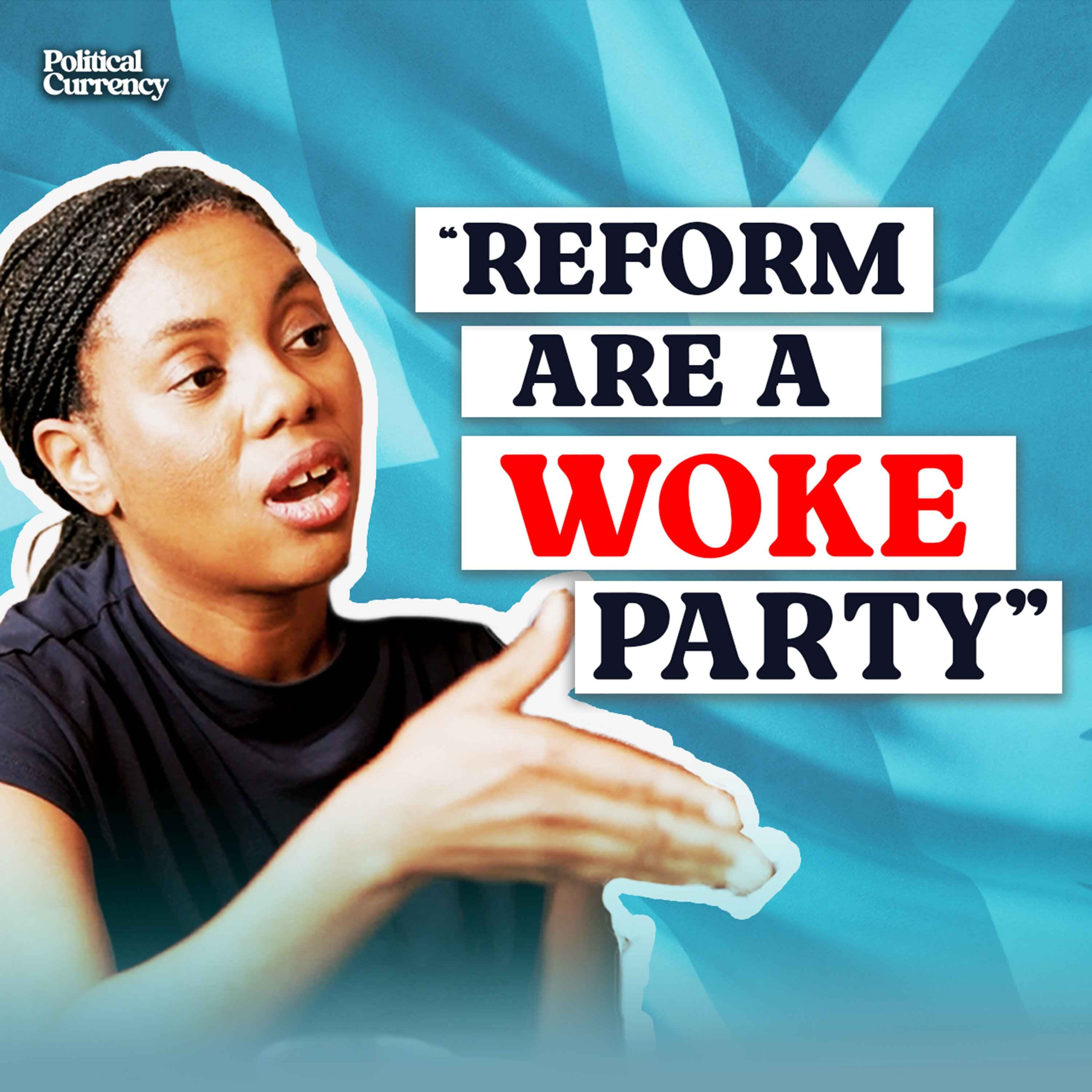
Kemi Badenoch: Why she won’t make a deal with 'woke' Reform
In short
Interview with Conservative Party leader Kemi Badenoch about climate/immigration/economic policy, her “no deals with Reform” stance, and how she would approach government after Andy Burnham.
Guest backgrounds
Kemi Badenoch—born to Nigerian academic/doctor parents; childhood in Lagos; lived in the US; moved to the UK at 16 (1996) without parents to study; worked at McDonald’s; studied engineering at Sussex, later law; joined Conservative Party in 2005; met husband Hamish during 2010 campaign against Labour minister Tessa Jowell; MP for Saffron Walden (2017); served in ministerial/cabinet roles under Boris Johnson, Liz Truss, and Rishi Sunak; first black leader of a British political party; Conservative leader for nearly two years.
Key claims
She won’t do pre- or post-election deals with Nigel Farage/Reform; Reform is “woke” in the sense of grievance/victim narratives and power-seeking without solutions; her approach is “common sense” and “get Britain working,” with plans before announcements; net zero plans are worsening climate outcomes and harming businesses.
Notable examples
Women’s single-sex spaces/trans rights debate; grooming gangs task force (she says she didn’t know how bad it was until 2024); trade secretary role (CPTPP signing, WTO/G7/G20 exposure); Makerfield/Aberdeen South by-election strategy; she cites Darlington nurses and “women’s privacy and dignity” arguments.
Written by AI. May contain mistakes.
Chapters
0:57
Introduction of Kemi Badenoch
Meet Kemi Badenoch and learn about her background and political journey.
“Think of a toilet as just an everyday object?”
2:45
Kemi's Political Outlook
Kemi discusses her current mood going into the summer and her political strategy.
“that George and I will be speaking to you over the course of this month.”
4:25
Kemi's Perspective on Change
Kemi shares her views on being a disruptor in politics and her vision for fixing issues.
“I remember, I think it was about two weeks in, and people were writing articles about how I'd already failed, and I thought I haven't even got going yet.”
6:31
Insights on Nigeria and Optimism
Exploring the dynamic nature of Nigeria and how it shapes Kemi's views.
“And I think that there is a lot that's not working in the country.”
8:19
The Role of Cynicism in Politics
Kemi reflects on the balance of optimism and cynicism in British politics.
“And you've been critical of Nigeria, of course, you grew up there, you live there.”
10:39
Challenges for Young Immigrants Today
Kemi discusses the challenges facing young immigrants in the current UK climate.
“and there's an acceptance that when things are wrong, they need to be fixed.”
14:00
The Changing Landscape of Immigration
Explore the impact of immigration on societal perspectives and policies.
“And just the way that their lives had changed between 1979, when I was being conceived, born in 1980, to 1996, where they had nothing.”
17:16
Kemi Badenoch's Political Journey
Discussing Kemi Badenoch's rise in politics and her experiences with prime ministers.
“So, I'm going to fast forward all the way through your career and your different jobs in IT and in banking.”
23:06
Lessons from Political Leadership
Insights from Kemi Badenoch on leadership challenges and experiences with cabinet.
“I'd never been to, you know, that part of the world before.”
28:00
Kemi Badenoch on Identity Politics and Conservative Party Change
Kemi discusses her views on identity politics, her past experiences with Michael Gove, and how the Conservative Party has evolved.
“could have written that speech because I was very, very much on the side of no identity politics.”
Show all 26 chapters
29:18
Polling Insights and Strategic Direction
Badenoch analyzes her improved poll ratings and critiques George Osborne's advice to move to the center.
“Let's go to that because I think the thing people will say is that your poll ratings have improved.”
30:21
Women's Rights and Left vs Right Perspectives
Badenoch explains her stances on women's rights and how support crossed traditional political lines.
“I, I would say, got noticed during the battle between women's single sex spaces, trans rights, gender critical theory, all of that stuff.”
31:28
Climate Change and Net Zero Debate
The discussion shifts to Badenoch's beliefs about climate change and net zero policies, emphasizing common sense solutions.
“I do think so, because a lot of Liberal Democrats, you know, we've looked at what they're saying are concerned about immigration.”
32:44
Inclusivity in the Conservative Party
Badenoch addresses the importance of inclusivity within the Conservative Party and discusses the standards of behavior needed.
“A year ago in your interview with Tim Shipwant, you were saying how how much you wanted people like Penny Mordaunt to come back into the Conservative Party.”
34:06
Rhetoric Evolution and Political Accountability
The conversation explores Badenoch's shift in rhetoric and her view on political accountability and criticism.
“It's not the time for you to be freelancing and deciding that you're going to help Labour.”
39:41
Stance Against Deals with Reform Party
Badenoch firmly states her position against making deals with the Reform Party, emphasizing her vision for uniting the country.
“You cannot run a country with just one half of it.”
42:03
The Mindset of Reform and Victim Mentality
Learn about the victim mentality present in politics and its impact on coalitions.
“If you look at the way that they do things, it's it's it seeps through all of them.”
43:16
Reflections on Opposition Leadership
Explore the challenges and strategies of opposition leadership in politics.
44:06
Lessons from Political History
Discuss the significance of historical political events and their influence on future governance.
“But when I say nothing, it's less a reflection of him and it's more a reflection of me that I kind of know my own mind and I know what I want to do and everything everybody else does is their thing rather than my thing.”
45:28
Navigating Climate Change Policies
Understand the complexities of climate change policies and their economic implications.
“you what I'm thinking on the on the podcast but what do you say in circumstances where really nobody has won and I think that's a lot more more challenging.”
47:36
The Importance of Personality in Politics
Learn about the balance between professionalism and personality in political leadership.
“how to do the personality side rather than just doing the work.”
48:56
Support Systems in Political Life
Discover how personal relationships can provide support and guidance in politics.
“And then a very strong cohort of people who hated me.”
50:24
The Challenge of Truth in Politics
Explore the struggle against dishonesty and its impact on political integrity.
“with Yvette, the thing that she would often say to me is just stop and think and just feel whether or not, whether or not.”
52:02
Balancing Family Life and Political Career
Learn about the challenges of maintaining family connections while pursuing a political career.
“But a lot of people, but I couldn't prove it.”
56:01
Reflections on Family and Politics
Insights on how political life impacts family and personal relationships.
“and point to the television and there should be on breakfast TV.”
58:09
Reflections on Family and Politics
Insights on how political life impacts family and personal relationships.
“you know that feeling too many updates too many meetings Too many things falling through the cracks.”

Ask about this episode
Get the gist, explore an idea or ask about something said.
 Claude
On Political Currency, what are the key points of this episode?
Searching your listeningTranscript
Automatic transcript. May contain errors.
0:00This week on Outrage and Optimism, we look at the remarkable summer we've been having in Western Europe with heatwave after heatwave that has now translated into wildfires in France, in Spain and even in Scotland. There has been a conspiracy of silence in the media that is preventing us from seeing what is really happening. This week on Outrage and Optimism, we cut through to understand what's going on and how our society can and should change to deal with these issues.
0:30Your team just added its 67th AI tool and also your 67th security blind spot. The good news? The Vanta agent works like a GRC engineer in the background, finding every app your team uses, scoring the risk, and drafting fixes for you. Vanta is the platform used by over 16 ,000 fast-moving companies like Ramp, Cursor, and Harvey, who are shaping the future with AI and staying ahead of AI risk. Get started at Vanta.com. Think of a toilet as just an everyday object? Your entire perspective shifts the moment you experience a Kohler Smart Toilet. Design changes everything, transforming a basic routine into something extraordinary.
1:10With standout aesthetics and intuitive controls, these are functional works of art. Stunning design that never sacrifices performance. Enjoy customizable features for elevated comfort and convenience. It's more than a fixture. It's a cleaner routine and a more refined space. Experience the difference of Kohler Smart Toilets. Find more at Kohler.com. Hi, this is Mark Bittman from the podcast Food with Mark Bittman. Have you ever considered how the smallest details can create real emotion? Lexus does. At Lexus, master craftsmen called Takumi are involved not just in physical craftsmanship, but in sensory details.
1:51Things like how a door closes, the click of a switch, the acoustic feedback of controls. Because a car that doesn't make you feel something is a car that stops short of amazing. Experience amazing at your Lexus dealer.
2:08So reform are a woke party. But a lot of people who've come to our country have come here not to make a home, but to treat it as a dormitory or a hotel or just a place where they can exploit and make money from. But I have very young children and I don't want to travel. She said, what Joel do you want? I was like, just give me something small like DCMS. And she gave me international trade. I want people to know that I'm not doing any deals with Nigel Farage. So we're in our studio in Hoxton today, but no George Osborne. He's off on his summer travels. Instead today, we have the first of four very special guests that George and I will be speaking to you over the course of this month.
2:49My guest today is the daughter of Nigerian academics and doctors. she spent her childhood in Lagos with a period in the United States before coming to the UK aged 16 without her parents to live with one of her mother's friends and pursue her education. She worked at McDonald's, didn't get the A-level grade she wanted, went to study engineering at Sussex University, later law. She joined the Conservative Party in 2005, met her husband Hamish while fighting Labour Cabinet Minister Tessa Jowell in 2010, she lost, and after a spell in the London Assembly was elected as MP for Saffron Walden in 2017.
3:25She went on to serve in ministerial and cabinet roles during the governments of Boris Johnson, Liz Truss and Rishi Sunak, the first black leader of any British political party. She's now been at the helm of the Conservative Party for almost two years and is preparing to face her second Prime Minister, Andy Burnham, at the dispatch box when Parliament returns in September. Kevin Badenock, thank you for joining me on Political Currency. Thank you for having me. And we are sliding into August. You'll be thinking about your summer holidays, that political dilemma. If you're a party leader, do you go on the beach or have you got to write your conference speech for September?
4:03But over the last year, you've seen off the British ambassador to Washington, Peter Mendelsohn. You've seen off a prime minister. your personal poll ratings have really improved compared to July 2025 you must be going into this summer in a much much better mood well you say that but I'm the sort of person who's always thinking what's the next thing I need to worry about but you are right it's a lot better now than this time last year because the strategy is working there was a plan and quite often what you need from people is patience. I remember, I think it was about two weeks in, and people were writing articles about how I'd already failed, and I thought I haven't even got going yet.
4:51So I'm looking forward to the next parliamentary year, because I love my job. And you know what they say, when you love your job, it's not work. My husband thinks I'm a workaholic. I'm doing politics from the minute I wake up literally to my, you know, putting my head on the pillow. I'm even dreaming about it, which is probably not very healthy as well. But but no, things are in a better place. But for me, it's a lot better than for the party. I'm very, very concerned about the Conservative Party. I know for political geeks, this this makes sense for everybody else. It doesn't. But I love the Conservative Party.
5:29It is a family to me. And it is important for me that it continues to do well. I think it is an institution of this country and it must survive if we're going to get the UK into a better place. We're going to come back to the next year and to the state of the Conservative Party now. As you said, your polling has been improving faster than the Conservative Party. But the good thing about this podcast is we have time and space. And so I want to reflect a bit about what shaped you and also your time in government beforehand. I think it struck me reading your biography. Which is the unauthorised biography.
6:09Well, no, I was just reading, you know. Emphasis on unauthorised. I didn't read the unauthorised biography, but I read lots of profiles. When you think about Andy Burnham or Nigel Farage, you know, they want to be the outsiders, you know, taking on Westminster, the disruptors, the agitators. you have so much better claim to being a an outsider a disruptor somebody who can come in and shake things up because of that amazing backstory i read out at the start well i think the backstory is actually one of the reasons why i don't want uh people to see me as someone who is coming into well i would say blow things uh blow things up i want people to see me as uh someone who fixes things i do very much lean into my training as an engineer that i like to see things that are broken, fixed.
7:00And I think that there is a lot that's not working in the country. And that's why my strapline is, is get Britain working. But it's also, you know, growing up in a country where absolutely nothing worked. And I tell people about, you know, socialist policies, they weren't called socialist policies, but it was government running everything, and so on and so forth. I am just instinctively against all of that. But I also saw that lots of people saying we're going to shake things up and they made things worse, that it's very easy to say you're going to disrupt, but the downside risk is almost not considered.
7:36It's just the upside risk. I don't want to do anything that could possibly make things worse. I think that we are at a crossroads in the country. I don't think Britain is broken, but I think there's a lot that is not working and a lot that we can fix. So I'm very optimistic. But when I see Andy Burnham and Nigel Farage what I see are people who are making announcements but don't actually have the plans I'm doing the plans first and making the announcements after I spent quite a lot of time in Nigeria in the early 1990s my first job was with the Financial Times and I wrote Economic Leaders but I travel around the world writing about economies and went to to Lagos and Abuja and down to the oil fields, you know, a number of times.
8:21And you've been critical of Nigeria, of course, you grew up there, you live there. And we know about the corruption and the state failure. But also, it is the most dynamic, exciting entrepreneurial place. I always felt there was an energy in Lagos. And what is it the Owallowa Road? Yeah, I mean, it's, there is something that there is a drive and an optimism amongst Nigerians who all kind of shrug at the state they have to deal with, but they still keep going. I just wonder whether, do we need a little bit of Nigerian spirit in Britain? So it's very interesting. When people talk about Nigeria, I actually tell them I don't know Nigeria very well.
9:05I know Lagos very well. I know the UK much better than I knew the place where I spent my childhood because I actually lived a relatively sheltered childhood. And my parents were middle class, very wealthy, lost all the money. So it's those experiences are the things that formed me. And I think that optimism on its own, without actually a lot of critical analysis of what's going wrong, can be very destructive. Nigerians are culturally some of the most optimistic people that you would ever meet. But it also meant, and this was one of the reasons why I never fit in there, it meant that people just accepted the way things were.
9:52God has a plan. You know, it was meant to be all of that sort of, almost a fatalism that went along with the optimism. I could never sit and see things that were broken and not try to fix them. And as a child, people would tell me, you know, into my early to mid-teens just before I moved back to London, people would say, you don't belong here. and it wasn't meant in a positive way that you don't act like everybody else and being back in South London that was where I belonged and I think that there is an optimism in the British spirit that goes very much hand in hand with a cynicism which is much more me I do think that we are quite cynical in the UK but it means that there's a self-awareness and there's an acceptance that when things are wrong, they need to be fixed.
10:45I think some politicians are not interested in the fixing. They're interested in the popularity. That's what worries me about both Nigel Farage and Andy Burnham. We've always been very sceptical, haven't we, about people who become too big in their own minds, about their standing and their clout. But I think that if you get politicians who are trying to fill their own void, of wanting to be liked, wanting to be popular. You know, those types of voids never get filled and they keep doing more and more things which are in the long term unhelpful and then they start becoming very unpopular indeed.
11:21I'm not doing this to be popular. I'm doing what I think is right. I know people won't agree with everything that I say and do. Some people might disagree viscerally, but you know that I say what I believe. I'm not saying it because someone's given me a script or a speech has been written for me. My staff find it extremely painful. I write my own speeches. We've got a speechwriter in now who feels like I don't let him do the job. But it's all coming from inside my head. And I want people to know what I think. I'm not asking what they think so I can repeat it back to them. I want them to hear what I'm saying and decide whether they like it or not.
11:57And I think that's the contrast between me and Andy Burnham in particular. It was such a brave thing for you, age 16, to come to the UK. And your life, your adult life, is a fabulously British story of success and progress. And I just wonder, do you think today, a 16-year-old coming to the UK, as you came in 1996, do you think they'd have the same opportunity? Would it be possible? I mean, we've had such changes in our country, the hostile environment, Shabana Mahmood, toughening up the rules. Our culture feels to me more defensive. Do you think that Kemi Bainot could arrive in 2026? Well, first of all, I should say I would never let my child do that, do what I did.
12:47Now that I have three children, I've got a 13 year old. And the idea of letting my 13 year old go to another country where I wouldn't be supervising everything. my 13 year old becoming 16 I can't even imagine but I didn't think it was they did because things were really bad at the time you know my mother was working at the University of Lagos and the University had been on strike she wasn't getting paid and I tell people that my father gave me his last 100 pounds of course it wasn't a it was in Naira but there was so much inflation it was a bag of money It was your bank of money to be£100 says this is all I've got left.
13:29But they wanted me to have a better life. But I was a British citizen almost by accident, really. My mother, I was conceived here. I tell people that I wouldn't exist without Britain. She was having trouble conceiving. She had endometriosis and her doctor was a Harley Street doctor, you know, Nigerian oil money, and he treated her. So that's why my brother and I were born here. My parents would rent flats at Knightsbridge and so on. And just the way that their lives had changed between 1979, when I was being conceived, born in 1980, to 1996, where they had nothing. That was that's one of the things that's really formed.
14:14It's really formed me. But there is a difference, I think, between people coming here who have no links to the country at all and and having citizenship. But you are right. Things have changed. Things have changed. And I think it is because this is such a wonderful, accepting country. We assume that everybody shares our mindset, our viewpoint, that people will play by the rules. But what's happened is that a lot of people have not been playing by the rules. Other countries have not been playing by the rules. I'm sure you've heard me talk about China a lot. But a lot of people who've come to our country have come here not to make a home, but to treat it as a dormitory or a hotel or just a place where they can exploit and make money from.
14:57And that has made that's what has created the hostility. I still think that anyone coming here will find so much opportunity. I mean, this is a country where people literally land on the beach and they get put up in hotels and given free food and so on. It's costing us billions of pounds. This is something I do want to address with with our immigration policy, which I'm sure you've read read all about in our borders plan. But I think that this is still an amazing country. We just need to stop being naive. We need to stop being naive about immigration. We need to stop being naive about a lot of economic policy.
15:32You know, when I talk about net zero, it's actually making climate change worse, not better. the naivety worries me. We need to bring a little bit more of that cynicism, more of that challenging politicians on the offer which they're putting forward and making sure people are actually working, not just talking. But the 16-year-old Kemi Badenock would still be welcome in 2026. Absolutely. The 16-year-old Kemi Badenock had a British passport. That is true. That is true. That is true.
16:05Hey, I've got the campaign brief ready, built from last quarter's data and the competitive landscape. Approved? Oh, agents, where would we be without you? Somewhere with a lot more tabs open. Create your first Monday agent in minutes at monday.com. Your team just added its 67th AI tool and also your 67th security blind spot. The good news? The Vanta agent works like a GRC engineer in the background, Finding every app your team uses, scoring the risk, and drafting fixes for you. Vanta is the platform used by over 16 ,000 fast-moving companies like Ramp, Cursor, and Harvey, who are shaping the future with AI and staying ahead of AI risk.
16:44Get started at Vanta.com. Back to school is busy enough. The last thing you need is shopping that makes it harder. Whether you're moving into a dorm, your first apartment, or just getting organized for the semester, Wayfair makes it easy to get everything you need in one place. Furniture, bedding, storage, decor, study essentials, all at prices you'll love. With fast shipping before move-in day. Get everything you need for back-to-school season. Shop wayfair.com today. Wayfair, every style, every home. So, I'm going to fast forward all the way through your career and your different jobs in IT and in banking.
17:27you make a maiden speech in 2017 where you say that you are a first generation immigrant to this country that is part of your pitch you then have a meteoric rise to all intents and purposes yes a meteoric rise and you make your mark as a junior minister with Boris Johnson but then with Liz Truss and Rishi Sunak I guess in politics you're always learning and especially when you're on the up when you're on the rise when you look back at those um three prime ministers you work with what is the thing which you take from them and you think that is what i need to channel and what are the things where you think actually that wasn't the way to do it um i think i would say if i was looking at what to channel and what not to channel it was less the prime ministers and more the secretaries of states that I was working with at the time.
18:25And they were Liz Truss, Rishi Sunak, and the final Secretary of State I worked under before I became a capital minister myself was Michael Gove. I think looking at the prime ministers, there's so much going on. I see more of what went wrong than what went right. But I have learned from them. So the lesson I learned from the Theresa May era was that everybody has to be on board with the agenda when you have a minority government, which is a possibility for the next election. Having people who want to do their own thing really undermined her in a way that I thought was so inappropriate and unfair.
19:07Under Boris, the lesson I think I learned there was that you have less time than you think. And I remember, you know, 2019 election, I just had a baby. So I was on maternity leave and I couldn't believe that he'd made me a minister. The first time I made a minister, I was very heavily pregnant. I said, are you sure I'm going away? So I was only children's minister for a very brief period before I went off on maternity leave. And the 2019 election happened. I thought, oh, we've got 10 years and there's so much that we can do. I wasn't happy with everything in the manifesto, but, you know, we can fix this along the way.
19:43but within two three months you know covid uh started and that was that was in my view the beginning of the end of the boris johnson government you have less time than you than you realize and a lot of the things we wanted to do you know i was a big advocate of more prison building um i fought some local battles on on that we didn't even get started you know the plans were there um you know some you know the money was found i think we sold some prison but we just never got going and I would say that to every um everyone who's in a position of leadership you have less time than you think so I'm always in a hurry and with Rishi I think the lesson I learned was that you cannot um try and divide two sides and and go through the middle um and he kept trying to do that I and I could see he was he he thought he was keeping everybody on side by going halfway with things but actually he was upsetting both sides so he wasn't able to bring the party together you've got to you've got to just decide on something and fight and fight the battle and and that's what i'm doing now so all of those things have influenced um i feel as though my leadership i feel that you don't feel any need to even go into the lessons from liz truss no no you say that but um i liz truss was um so so when i worked under rishi i saw and in the treasury and Liz was actually at the same time and I saw them up close and personal I saw their strengths and I saw their their flaws Rishi if he if he was if he had a good idea you know he would make it happen if someone else had a good idea I think he was less if it wasn't his thing he was less interested in changing his mind or taking on other people's ideas Liz was very good at spotting other people's good ideas.
21:35If you had a good idea, she'd steal it and make it happen. And that was why she won the leadership contest. It's not really noticed because we didn't go to a final two, but more MPs supported Liz because they thought they'd get things done with her. And she was right to talk about growth. Yes, yes, she was absolutely right to talk about growth, but she didn't let the civil service in a lot of areas, when she had the bit between her teeth, She didn't let the civil service say, oh, no, you can't do this. Now, both of those things can end up, you know, strengths become weaknesses. Weaknesses become strengths because it meant that when people brought bad ideas, Rishi didn't take them.
22:17But when Liz had bad ideas, she still had the bit between her teeth and she kept going. I think quasi-quarting is pretty clear now that they were Liz's bad ideas. I know he is telling the truth on that because I spoke to him. You know, Liz was the person who put me in cabinet as trade secretary. It's very funny. I said that I have very young children and I don't want to travel. She said, what do you want? I was like, just give me something small like DCMS. And she gave me international trade, which is, you know, and it was the making of me. Actually, I just thought she's trying to keep me out of the country.
22:53but it meant that I got experience on the world stage in a way that no other ministerial job would have given me. I went everywhere into Australia. I signed CPTPP in New Zealand. You know, I was in Japan. I'd never been to, you know, that part of the world before. I had some very difficult conversations with India who, in my view, were not always wanting the UK to be successful. it was not that sort of that sort of partnership you know i went to the world trade organization and and i would just never have have understood you know what is a g7 what is a g20 what do we do there how does it work and so which meant that when i was um opposing kia starmer i knew what was going on behind the scenes in a way that i think many people don't learn until they actually get into the job and foreign foreign affairs takes up more time for a leader than um than you realize and I'm glad that I got the experience of doing that, of travelling, of representing our country.
23:53Of course, the thing people do say about you is that some of the things you are very critical of the government about now, you mentioned early release policies for prison pressure, but you could say the same about immigration and human rights for people coming to our country. You could say that about grooming gangs. When there were opportunities in your different ministerial jobs, you didn't really take the opportunities or put them in in lights i mean i think the um the the example people give was when i was a children's minister i had one outing as children's minister oral questions where i asked two questions and john burko stole the whole uh show because it was one of the moments when he was um he was doing a scene so i didn't i didn't talk about it then But also, from my perspective, we were working on it.
24:43You know, we had the J inquiry. There was the grooming gangs task force and it was it was a home office issue. And, you know, there was a national inquiry. Yeah, yes, exactly. There was a there was a national inquiry was too broad. It wasn't specifically on on grooming gangs. I wasn't actually aware that the inquiry was going to be as broad as it as it was. But it was very clear that so much of what we were doing was not working. And so my criticism hasn't been that no one's done anything. It's that this stuff was clearly worse. The grooming gang scandal was worse than we thought it was. And the things we were doing were not enough.
25:15I think the grooming gang's task force. You didn't know that at the time. No, I didn't know that. I didn't know that at the time. I just thought, well, you know, we're looking into this. And to be honest, it wasn't really until about 2024 that I realized just how bad it had got. The task force, I think it was Rishi who set up the grooming gang's task force. I think that that was one of the better things we did. Found about 500 new perpetrators. but just because you haven't talked about something doesn't mean you're not interested and you keep learning new facts emerge but what people don't tend to understand is that if you're a minister in a government you can't just randomly talk about somebody else's brief and say well if I were in the home office this is what I'd be doing it's disrespectful it's not collective responsibility but when I hear politicians who do know that that was the case pretending that they don't know I think it's quite dishonest I feel the name Robert Jenrick popping into our minds at that point one thing which is really striking to me in the profiles of you Fraser Nelson editor of the Spectator I think when you were working there is said to have written your maiden speech, Michael Gove said to have shaped your career, even when you've done so much better in Promises Questions, people say well is it David Cameron or is it Henry Newman what is it about politics which means that when a woman does things really well, people think, well, it must have been a man.
26:40It is absolutely maddening. So my maiden speech, I spent ages, ages writing this speech. I think I was the last person in the 2017 intake on the Tory side to give her maiden speech because I was writing it and I was thinking, this is no good. And then I'd hear other people's speeches. I think, oh, that's so good. I can't, you know, or I can't say this anymore. And I got the inspiration from my speech, actually, from a Labour MP. I don't know if you remember her a woman called Laura Pidcock and I happened to be in the chamber when she gave her maiden speech and I thought this is appalling what on earth is this it was just railing against everything about how parliament is terrible and the country is terrible and I just thought I think everything opposite of this woman and I'm going to So it was an unusual inspiration she inspired you to do the opposite and I said actually what I'm going to do in this speech is I'm going to talk about why I love this country and why it's great and why I think Parliament is great.
27:37And that was the inspiration. And, no, I get this all the time. It wasn't just, oh, Fraser Nelson wrote it or Michael Gove did this or that. One of the interesting things, it's stopped now, a white person wrote this for her. And this was less major commentators. But, you know, in the comments, I know one Labour MP, I won't name her, but she did tweet that only a white person could have written that speech because I was very, very much on the side of no identity politics. This is not a racist country. And people would say white people are writing her speeches. White men. Yes. Yes. White men are writing her speeches for her.
28:14And I also I get quite annoyed when people say that Michael Gove writes things for me because I actually disagree with him on so on so much. What I learned from him was actually how to be effective as a secretary. of State. He was the most effective Secretary of State I ever saw or ever worked for. He was effective when he was doing good things. He was also, sadly, very effective when he was doing bad things. So policy disagreements when I was in the department with him, I'd have stand up rounds. Give us one bad thing. Oh, the Renters Rights Act makes life much worse, both for renters and for landlords.
28:55and we went round and round the houses. I was like, what are you doing? You are just going to disrupt the entire housing market. I think even now he will say that he probably overdid it. But I want people to know that this is a different Conservative Party now, that this is not the Conservative Party of all of those people. This is Kemi's Conservative Party. Let's go to the current Conservative Party. I want people to understand that. Let's go to that because I think the thing people will say is that your poll ratings have improved. And that's mainly because reform and Tory voters are much more positive about you.
29:31You've not seen the same shift in Labour, Lib Dem, Green, Lib Dem in particular. George Osborne, I think, if he was here, would say, I keep urging Kemi to go towards the centre ground on the economy because that's what she's got to do to win. And the reason why her ratings are improving is because she's doubling down on the reform conservative right. and that that's the wrong strategy. What do you say? I would say, George, you are wrong. And also, I don't think he understands what it is that I am trying to do. I don't think that this modern era of politics is as much about left or right as it is about right and wrong.
30:11What I am is common sense. And many of the things that I do believe in are things that even people on the left agree with. So I'll give you an example. I, I would say, got noticed during the battle between women's single sex spaces, trans rights, gender critical theory, all of that stuff. And it was the women of the left who supported me. It wasn't the people on the right. It wasn't the men on the right. They were all libertarian, live and let live. When I was talking about women's privacy and dignity, the women of the left were the ones who got it. And that was because issues like men in women's prisons or women having a private changing space.
30:52You look at the Darlington nurses, Sandy Peggy. This was common sense. It's not it's not about being centrist or being left or right. So it's the men who didn't get it. No, no, no, no. I don't know. I don't remember any men on the left being supportive. I remember a lot of women on the left being supportive and men and women on the right being supportive. But they didn't rush out immediately. There was a big strand of libertarianism on the right that said, oh, she's just focusing on culture wars. And actually, what I was focusing on was people who didn't have a voice. It's the same true on the ECHR leaving the Convention of Human Rights.
31:27Do you think there are Lib Dems who may have voted Tory and didn't vote Tory at the last election who can come back to you because of that? I do think so, because a lot of Liberal Democrats, you know, we've looked at what they're saying are concerned about immigration. I think a more obvious one is on net zero. So one of the frustrating things is that people think that being against net zero means you don't believe in climate change. Far from it. I really believe in climate change. And what I see is that these net zero plans are actually making things a lot worse. So, you know, even Unite thinks that we should, or is it Unison?
32:01I can't remember. I'm not that good on my unions. Which one is Sharon Graham? Unite. Unite. They think we should drill our oil and gas in the North Sea. This is not a left or right issue. It is common sense. And so does Gary Smith at the GMB. Well, there you go. My position, this Chemies Conservative Party is a common sense party that's got plans to get Britain working and can unite the country, which I don't think Nigel Farage can do. And I'm quite surprised that Andy Burnham doesn't seem to be starting with that because it seems to be Manchester versus the world, which is not it's not really a unity message the way the way that he's going about it.
32:35Although there are so many announcements day by day, he may have announced it by the time this podcast comes out.
32:43Two things to put to you. A year ago in your interview with Tim Shipwant, you were saying how how much you wanted people like Penny Mordaunt to come back into the Conservative Party. party you want into parliament you wanted returners and a year on Gavin Barwell Theresa May's former chief whip hasn't got the whip I think Grant Chapps isn't going to be a candidate at least that's what I read and is rumoured have you decided I mean have you shifted a bit from wanting some of these more centrist conservatives back so I want conservatives of all stripes in the conservative party so this isn't about not wanting people who have different views I like debates I I even like disagreement.
33:25So Remainers are still welcome. Of course, of course. Well, I was, let's remember, I was not even in Parliament when the EU referendum happened. I voted leave like 17 million other people in the country. My husband voted Remain and we didn't disagree on anything. There was purely risk appetite. I thought we can do this. I still think that we can. We've not seized the opportunities. And he thought, well, it'll probably get messed up. It's not worth the risk. That was the main difference. So I don't have, I have friends in the party who are very much to the right of me, and I think I'm pretty on the right, but I have friends in the party who are on the left.
34:00But the standards of behaviour, that is the thing that we need to fix. Where there is a party leader who's got an agenda, you've got to get behind that person. It's not the time for you to be freelancing and deciding that you're going to help Labour. So this isn't about removing people who disagree. It's about removing people who will not back the agenda. Because if I have MPs who won't back the agenda, then how can I tell the public, oh, this is what we're going to do when they have no idea because the MPs might decide to do something different? That's really what I'm concerned about. Another thing I think people have noticed in the last six months, and this has gone along with your poll rating improving, is that your rhetoric has become harsher, that you play the person rather than the policy a bit more.
34:47When you talk about Bridget Phillipson being a spiteful class warrior or Rachel Reeves being utterly incompetent, I mean, two senior women who you are going for in a very personal way. Now, that might work for, you know, the Tory reform switcher. Is that different from the Kemi-Bainock of two years ago? So I find it fascinating that people are concerned about this. the parliament as I have always seen it has been an arena and I never got any kid gloves when I was on the other side I was called the black face of white supremacy all sorts of crazy things Labour MPs didn't remember when they were saying those things in fact I'll tell you something I don't think I said this publicly before when Rachel Reeves gave her first budget you know the look at me aren't I wonderful first female chancellor she had a pop at me I wasn't even the leader of the party then but she took time out to say something rude about me and I sat there thinking I'm gonna get this and when I do I will be the one who'll be doing the talking and you won't be able to say anything and that's all that happened I think um uh Rachel is um afraid is the architect of her own misfortune I call it I you know I call out what I see I did think she was incompetent uh I did think that uh Bridget was spiteful and I don't I don't say things uh about people that I wouldn't say to their faces.
36:13I'm not saying I'm not saying anything worse behind the scenes. And I don't mind if people are critical of whether they think my capabilities or my policies, but I don't stray into personal abuse. What I find is that people on the left want you to treat them nicely, but they think that people on the right are fair game. And for me, doesn't matter whether you're on the left or right. I was pretty harsh on people in my own party as well when I thought they were doing the wrong thing. I will always tell it like it is. It's not about whether they're political opponents or not. It's about what is right and what is wrong.
36:52You know that feeling. Too many updates. Too many meetings. Too many things falling through the cracks. Monday.com was built for that gap. The AI work platform designed from the ground up for people and agents to work side by side and deliver more together. drafting the brief, flagging risks, running a competitive scan. Your agent can do it all. And the best part, anyone can build one. Even you. Try it. Create your first Monday agent today at monday.com. This podcast is brought to you by Thomson Reuters. The best don't just do their work. They change what's possible. Cases won, audits completed, jobs saved.
37:32Behind every one of those moments is a professional who needed to get it right and did. Thomson Reuters builds the technology that sharpens insights, speeds up decision-making, and powers the outcomes that matter. So when professionals act, the impact is felt by everyone. Be a changemaker. Visit tr.com forward slash changemakers. Back to school is busy enough. The last thing you need is shopping that makes it harder. Whether you're moving into a dorm, your first apartment, or just getting organized for the semester, Wayfair makes it easy to get everything you need in one place. Furniture, bedding, storage, decor, study essentials, all at prices you'll love.
38:14With fast shipping before move-in day. Get everything you need for back-to-school season. Shop wayfair.com today. Wayfair, every style, every home. The other shift you've made, I think I'm right on saying, you've always been very anti a deal with reform. not on the agenda. But, you know, as you said early on in our conversation, it could be a hung parliament. You don't rule out there being some kind of post-election deal or understanding. That's just the nature of politics. And I thought the 2015 election when the Conservative Party were brilliant at putting Ed Miliband in Alex Salmon's pocket and saying, if you vote Labour in 2015, you're going to let the Scottish nationalists come in and take control.
39:02Is that a risk that you just have to take at the next election? People will say, well, if you vote Conservative, are you actually letting Nigel Farage into the back door? So I want people to know that I'm not doing any deals with Nigel Farage. Pre-election. So pre-election, I don't even see how we could do any kind of deal post-election. In my view, I think even deals post-elections are stitched up. So I just say no to everything. and the reason why is because people who talk about deals are usually not thinking about the public they're just thinking about how they can get jobs themselves but it is very important that people know what they're going to get with me do you remember when people uh were saying or certain commentators were saying the conservatives should stand down in makerfield and then reform can stand down in aberdeen and uh and and then you will unite the rights and i said i'm not trying to unite the right.
39:57I'm trying to unite the country. I'm trying to unite the country. You cannot run a country with just one half of it. It's just so divisive. And in the end, of course, I didn't stand down because I don't stand down for anybody. Hang on. I think Count Binface you stood down for. I didn't know Count Binface was going to be running when I did that. But also, don't make me laugh on the podcast. I did not know that Count Binface was going to be running. And you not really stood down for him. you've kind of stood down for Nigel in the sense that it is very entertaining because reform had been asking us to stand down stand down, stand down conservatives and when we did they complained that we were standing down so it just goes straight, doesn't matter what we do they'll be unhappy about it but no, the reason why we're not standing a candidate in Clacton is because I think that this is a fake by-election I think looking at the rules there'll be another one the thing I'm more interested in is whether there is an Alex Salmon risk to you So, yes, but you saw what happened.
40:57Farage did not win the Maker Fiat by-election. We won the Aberdeen South by-election with 50 % of the vote. That is the strategy bearing fruit. That's what I'm going to do. I don't want people to be confused about what this Conservative Party stands for. We are not just different from Labour or even different from the old Conservative Party. We're also different from reform. And when I see reform... The biggest difference is... So reform reform are a woke party. And I know a lot of people don't understand, you know, the word woke is used to mean many things. And a lot of people assume it's it's a left wing thing.
41:33But when I talk about woke, I talk about people who it's all grievance. It's victim narratives. People are doing this to us. Oppressor narratives. This is the oppressor class. And on the left, it's, you know, whites of the oppressors or men of the oppressors with on the right. So this is the establishment of the oppressors. Look at what they're doing to us. It's all moaning and whinging and not proper solutions. It's about it's about power dynamics and how to get power, not actually solutions and how to fix things. That is their mindset. If you look at the way that they do things, it's it's it seeps through all of them.
42:08And it is also the thing that they have in common with those people who left the Conservative Party to go to to reform. It's always there's a huge victim mentality. I'm not a victim and I will never, ever play the victim, even when I probably have grounds to do so. I am somebody who is saying the United Kingdom, Great Britain is at a crossroads. We can fix things. We have a lot of stuff to fix. Let's bring down energy costs. You know, our five point economic plan. We need an economic revolution. Let's get business going. But I'm not going to do is demonize certain groups, whether it's billionaires or immigrants or the wealthy or NHS workers or the public sector.
42:50We're not doing that. We're not setting groups against each other. And reform does that. And I don't see how I could possibly have people like that in some kind of coalition. How do we go into a coalition with people like Rob Jenrick and Suella Braverman, who have spent their time trying to destroy and undermine the Conservative Party, first from inside and then and then leaving it doesn't make any sense yeah exactly so so it's it's a non-starter it's a non-starter we are different from reform very different from reform we're very different from labor but this is also a very different conservative party than the one people said no to in 2024 if you're leader of the opposition um you have to think about next pmqs that's going to be anti-burnham in september but you also think i think about um the potential to take over to come into to downing street um what would be your first words what would be your first week and we've just witnessed andy burnham while you're the leader of the opposition going through that first uh week and so when you've watched it thinking about you and what you do have there been some things he's done in his first days as prime minister where you think actually that's smart that's what i'd like to have done yeah nah i don't think so i think nothing well i the thing is how about not having the lectern and doing it without notes i mean i quite like lecterns thank you very much they give me something to hold on to um honestly there was nothing in the first week where you thought actually that's quite smart i wouldn't mind borrowing a bit of that or i'd thought of that first so what i find very interesting about andy burnham is how different he is from Keir Starmer.
44:29But when I say nothing, it's less a reflection of him and it's more a reflection of me that I kind of know my own mind and I know what I want to do and everything everybody else does is their thing rather than my thing. It's not a criticism of anything that Andy Burnham does, although, of course, I don't agree with all that he has done. If you were to ask me, what do I think I would do? It depends on the situation. I would love to do what Tony Blair did in 97. Obviously, he had a huge majority, but he had a plan. And within the first few days, it's Bank of England, Independence, all sorts of stuff is happening in the first week or two.
45:08That is what being ready for government looks like. I think if you look at 2010, obviously, nobody had an overall majority. So it's much more difficult in that sort of scenario. that that's a that's a probable scenario for the next election given given where the polls are and I have to think about well what do you say in those circumstances I'm not going to say I tell you what I'm thinking on the on the podcast but what do you say in circumstances where really nobody has won and I think that's a lot more more challenging. When you talk about you Andy talked quite a lot about him and how he feels about the job and where he lives and what he's learned in the last 40 years um what will you say about about about about you in that in that moment in that in that first speech i am for britain a prime minister who so i am a prime minister who's going to bring the country together we don't have to agree all the time on everything i mean even families don't agree all the time on on everything but we all know that we've got to give a better future to our children we had a great inheritance from previous generations and we owe it to the next generation to deliver for them whether that's on the economy on the environment on security defense we owe it to them and that's what I'm dedicating my life to because I have three children and I worry about the kind of world that they are going to inherit and I think with them So that's what I would say.
46:43And I think my biggest challenge now is making sure people understand what it is I'm saying. So, for instance, on net zero, I think a lot of people think I don't care about the environment. That's not my critique of net zero. These plans are not working and we're spending a lot of money on them. We're running out of money. Businesses are closing and yet we're making climate change worse. And we need to do more on the natural, on the nature side of things. biodiversity habitat what are we doing on flood defences what exactly are we funding to make sure that we can um keep our our environment as sane as possible and where we do think it's it is something like carbon emissions how do we make sure it's actually working rather than we're cutting hours and china's building a new coal-fired power station every other week those are the things that um that drive me mad and um i think my biggest challenge um has been having to learn how to do the personality side rather than just doing the work.
47:42And I think that's where people thought, oh, she's very offish or she's very combative. Or technocratic. Yeah, I don't actually think that people have accused me of being technocratic. Although your critique on climate change is not about goal or diagnosis, it's about the how. So I think people thought that I was... So people who knew me really liked me. People who weren't working with me didn't see it. So all of my ministers supported me for the leadership contest. You know, all the home office ministers were running separate. They were all running separate leadership campaigns. And they had to tell people she's actually really nice to work for.
48:19But I think that when when people didn't see that, it was because I wasn't spending time on the personality side. I wasn't going to the tea room or drinking in the bars or hugging everyone or trying to be their friends because I actually have a lot of friends. You know, I have a lovely family. I have a huge family. I have lots of friends. I didn't feel the need to court people. And I wasn't really thinking about leadership contests at the time. But of course, when you when you do have a leadership contest, you do have to do that. And the first time I did it in 2022, I was quite struck by a strong cohort of people who really liked me.
48:54And which meant that I did quite well, relatively speaking. And then a very strong cohort of people who hated me. and it was all sorts of things. Oh, she's a bigot. She doesn't like gay people. Everybody who works in my office is gay. Like, where are they getting these things from? And it was all weird vibes, which I didn't even know were being projected. So I've had to think about that. And it's one of the hardest things, having to project a personality rather than just be yourself. So I'm just going around being myself, doing the work and actually... Are you a little bit shy? No, no, I'm not shy.
49:28But I just don't feel a need to pander. I'm having to learn that I don't have to say everything that I'm thinking because things which I don't mind hearing other people find very difficult hearing so I weirdly I love criticism usually because it means people are being honest and it means that there's something I can do better and I love to improve many people don't like criticism and how you give criticism really really matters I'm very blunt so those are some things that I've that I've had to that I've had to manage can i end on a um personal note because you talked about your your family your husband hamish you met in a um election campaign and he's a banker but he's also very political he was political well before he um he met you what is the thing that he can do in your relationship for you as a politician and a leader of the opposition when i think about my relationship with Yvette, the thing that she would often say to me is just stop and think and just feel whether or not, whether or not.
50:33In fact, that is the right thing to do now. Listen to your gut and then worry. She was in some ways kind of restraining. What does Hamish leave you? So he is very restraining. And it's great to have a partner who restrains you from either your worst instincts or, you know you rushing into something so he's the person who's pulling back saying wait just wait let's have a think about what's actually happening because um you know when um as much so so i should couch my first um i like i like criticism i don't like lies so quite a lot of the things that annoy me are when people say something that's not true i don't mind if people criticize what i'm saying or what i'm doing what i really dislike is when people say things that aren't truth.
51:20And Hamish is good at being honest, is he? No, yes, he's very good at being honest. But usually when I see that something untrue has been written in the papers or, you know, someone has said something that is categorically false, that is when, you know, the red mist descends. And he's the one saying, leave it, it's not worth it. That is very helpful. Although when you removed Robert Jenrick from the Conservative Party, that was one of those moments, but actually very important. No, no, we'd had about 50 of those moments. Oh, I see. It was leave it. So Hamish wasn't holding you back that day? No, no.
51:54And then by the end of it, I was saying, can everybody see what I've been talking about? Or, you know, it's time. And it was actually, it was good that I didn't sack him earlier because I knew what was going on. But a lot of people, but I couldn't prove it. You know, there are things you know, but you can't prove. and if I had done that people would have assumed that I was removing him from the party because I was trying to stop a rival rather than because he was undermining all of us I mean he was actually hurting some of the shadow cabinet more than me, he was really destabilising. And what did Hamish say to you that day?
52:35He was like yeah yeah no go for it It was just it was I was quite shocked at the level of deception that had been taking place where we were asking him, is this happening? And he would say no to the chief whip. And it was just dishonest. Because I just hate lies so much, I find it extraordinary that people will say things that are just not true. And maybe I don't need to say everything just because it is true. But I think that dishonesty is a poison in politics. It really is. And you also have young children. I do. And we both know how complex it is to protect your children when you're in very exposed public life positions.
53:21And different people do that differently. And some people have, you know, every now and then I'll see a candidate with their children on their kind of election leaflet and think, you know, I just I wouldn't do that because you never know where it's going to end up. But in politics, we all like to think when we're politicians that we've got a thick skin. You have to have a thick skin. To be good at politics, you have to have a thick skin, but also always be listening.
53:50But there are also things which kind of make us afraid or worry us. What are the things which you really worry about? So not being there. my mother worked a lot but my father was there oddly because he had he was a GP and his clinic was downstairs we lived in the in the flat upstairs although age 16 neither of them were there that's true that's true but I but I don't know whether comparing me age 16 is is fair I mean you said I was brave I didn't know I was being brave I just thought I'm on my own and I can do what I like and I learned very quickly that actually a lot of my academic success you said at the start that you wouldn't have wanted that for you no I wouldn't have wanted that for my children but but a lot of you know I told you I was very good at um at school until um I came here a lot of my academic success was having parents who were there saying you're going to do this homework you're going to just to study we're getting you a tutor when I was left on my own I was just so so but my parents being there made me you know brilliant so when you say being there So not being there, I keep wondering that am I taking away from my children the thing that my parents actually did do?
55:06You know, my dad, I had, you know, I had aunts as well who were coming in and helping me with them with studying and so on. That, you know, Hamish is there. I do have a nanny as well because the younger ones that need someone to to pick them up and so on. but I do worry I do worry that will I look back and think that they were the ones who made the sacrifice not me. At the moment I feel like Hamish is the one making the sacrifice because he has to do a lot more at home and I'm very grateful for that but I'm trying to make sure that the children don't feel like they're making a sacrifice the six year old and the nine year old I don't think they see me on TV and they're like oh she's on TV again and I think I've told everyone about how my six-year-old wishes I worked at McDonald's and couldn't believe I gave up such a fantastic job I think the 13-year-old is understanding what's going on and that's the age when children get into their teens, that's the age I think when they're being formed as people and I want to be around for that We had moments when our children were young when I wasn't elected and the kids would say in the morning, where's mum?
56:19and point to the television and there should be on breakfast TV. And it's inevitable in so many careers, but it's true in politics, especially if you're the opposition, that you aren't going to be there all the time. However, I think that your kids will be really proud of having a mum who did these things. I hope so. And I think this of everyone, no matter what their politics, whether they're on their left or the right, families are sacred and they are a no-go zone and I thought it was actually really sweet of Keir Starmer to let people know that I had been messaging him behind the scenes I thought that the whole thing with his house being firebombed was absolutely horrific no one deserves that I had many disagreements with him but I did think a lot of the rage and loathing that was directed at him was excessive for me it was on the policy it was on the policies but to know that people are trying to target your home or your family it's just not right and it's not fair and I'm glad that Parliament does take our security very seriously but our families are the ones who feel it and no one sees the stress on their side Kaby Beidok, thank you very much indeed for joining us today on Political Currency Thank you for having me thanks very much indeed to kemi and her team for making that possible we'll be back next week with another interview and you can join us on monday of course for ex-minister's questions emqs where we'll be answering all your biggest political queries and ideas see you then
58:09you know that feeling too many updates too many meetings Too many things falling through the cracks. Monday.com was built for that gap. The AI work platform designed from the ground up for people and agents to work side by side and deliver more together. Drafting the brief, flagging risks, running a competitive scan, your agent can do it all. And the best part, anyone can build one. Even you. Try it. Create your first Monday agent today at Monday.com. Your team just added its 67th AI tool. and also your 67th security blind spot. The good news? The Vanta agent works like a GRC engineer in the background, finding every app your team uses, scoring the risk, and drafting fixes for you.
58:54Vanta is the platform used by over 16 ,000 fast-moving companies like Ramp, Cursor, and Harvey, who are shaping the future with AI and staying ahead of AI risk. Get started at Vanta.com.
From the publisher
In the first of our summer interviews, Ed Balls sits down with Kemi Badenoch, leader of Conservative Party and Leader of the Opposition. The wide ranging interview begins with her Nigerian upbringing, coming to the UK at 16, and how that informs her immigration policy.
Badenoch also details just how different her Conservative party is from not only Labour and Reform, but also the party that lost the 2024 election. How has watching the fall of four Tory prime ministers shaped her leadership? And how does it stand apart from the ‘victim mentality of Farage and the left?
She goes on to explain why the last Tory government didn’t grip the grooming gang issue, the build up to sacking Robert Jenrick, and her strategy to bring the Conservatives back to power at the next election.
We love hearing from you, so please don’t forget to send all your EMQs to questions@politicalcurrency and make sure to include a voice note of your question or send a question to our social media handles:
👉 X
👉 TikTok
Thanks for listening. To get episodes early and ad- free join Political Currency Gold or our Kitchen Cabinet. If you want even more perks including our exclusive newsletter, join our Kitchen Cabinet today:
👉 patreon.com/politicalcurrency
Please note: Kitchen Cabinet is only available via Patreon.
Credits:
Production: Sam Burton
Producer: Caillin McDaid
Video Editor: Oliver Geraghty
Executive Producer: Henrietta Harrison
Political Currency is a Persephonica Production and is part of the Acast Creator Network.
Hosted on Acast. See acast.com/privacy for more information.
More from Political Currency
All episodes

We use cookies.They keep VO running smoothly and help us improve it. Privacy policy