
In short
Post Reports Podcast Episode Summary
Episode Title
A Mysterious Death Inside ICE's Largest Detention Center
Episode Overview In this episode of Post Reports, investigative reporter Douglas MacMillan delves into the death of Geraldo Lunas Campos, a detainee at the largest ICE detention center in the U.S. Located in El Paso, Texas, the detention facility has been the subject of scrutiny regarding its treatment of detainees. The episode investigates the circumstances surrounding Lunas Campos's death and highlights broader issues within the immigration detention system.
Key Themes and Discussions
- Context of ICE's Actions
- Increased Enforcement: The episode begins with a discussion of President Trump's aggressive immigration policies, resulting in increased ICE operations across the U.S., including major cities like Minneapolis.
- Detention System: Families often struggle to find information about detained loved ones, emphasizing the opaque nature of the immigration detention system.
- The Death of Geraldo Lunas Campos
- Initial Announcement: ICE announced the death of Lunas Campos without providing a cause, stating only that he was observed in distress.
- Family's Search for Answers: His family, particularly his daughter, sought clarification from the El Paso County Medical Examiner, which indicated the preliminary cause of death as asphyxia due to neck and chest compression, likely to be classified as homicide.
- Lunas Campos's Background
- History: Lunas Campos emigrated from Cuba in the 1990s and had a complicated immigration history, including detention at Guantanamo Bay.
- Criminal Record: His past convictions were highlighted, with ICE noting his status as a "criminal illegal alien," which the family and advocates viewed as a tactic to diminish his humanity.
- Conditions Inside the Detention Center
- Camp East Montana: Described as a makeshift tent encampment with reports of abysmal living conditions, including inadequate medical care and allegations of mistreatment by guards.
- Detainee Experiences: Testimonies from detainees reveal a harsh environment where complaints for medical assistance can lead to violence.
- Eyewitness Account
- Santos Flores: A fellow detainee provided a harrowing eyewitness account of Lunas Campos's final moments, claiming that he was choked by guards after complaining about medication.
- Contradictory ICE Statements: ICE's narrative shifted to suggest Lunas Campos attempted self-harm, a claim met with skepticism by his family and advocates.
- Ongoing Legal and Ethical Concerns
- Calls for Accountability: Lunas Campos's family and community members demand justice and accountability for his death, questioning ICE's transparency and treatment of detainees.
- Civil Litigation: Lunas Campos's former partner has engaged a lawyer to explore potential civil litigation surrounding the circumstances of his death.
Key Takeaways
- Deaths in Detention: The episode highlights a troubling trend, with over 280 deaths reported in ICE detention since 2004, indicating systemic issues.
- Critique of ICE Practices: The narrative presents a critical view of ICE's claims regarding the quality of care within detention centers and the increasing number of deaths attributed to the surging detainee population.
- Human Rights Issues: Advocates stress the need to reconsider ICE's operations and the humanitarian implications of detaining immigrants, regardless of their legal status or past.
Conclusion This episode of Post Reports serves as a poignant investigation into the complexities and tragedies within the U.S. immigration detention system, urging listeners to critically examine the treatment of detainees and the need for systemic reform.
Written by AI. May contain mistakes. Listen to the episode to check what was said.
Chapters
Tap a time to open that second in VOThe Story of Geraldo Lunas Campos
0:45 to 2:54
Exploring the circumstances surrounding the death of Geraldo Lunas Campos in ICE custody.
“Just to note, today's episode contains some discussion of violence, including suicide.”
Conditions at Camp East Montana
2:54 to 6:50
Discussion on the conditions at the largest ICE detention center and its impact on detainees.
“sending them on a search for answers about how he died and why.”
Family's Quest for Answers
6:50 to 10:49
The emotional journey of Lunas Campos' family seeking truth about his death.
“It is now the largest ice detention center in the country with more than 3 ,800 detainees.”
Witness Accounts and Allegations
10:49 to 14:21
A witness describes the events leading to Lunas Campos' death from his perspective.
“So now she knew more about how Lunas Campos had died, but she needed to know more.”
Circumstances of Luna's Campos Death
14:21 to 15:10
Discover the details surrounding the death of Geraldo Lunas Campos in ICE custody.
“Flores said they tried to revive him with a defibrillator for about an hour.”
Contradictions in Suicide Claims
15:10 to 16:04
Explore the conflicting views on whether Campos took his own life.
“The security staff immediately intervened to save his life.”
Recent Trends in Deaths in ICE Detention
16:04 to 16:43
Learn about the alarming frequency of deaths in ICE facilities in recent months.
“The Trump administration was moving to deport two men who spoke to me for my story, including Santos Flores, the guy who described to me in excruciating detail the last moments of Lunas Campos' life.”
Government's Response to Deaths
16:43 to 17:43
Understand the government's narrative regarding deaths in custody and healthcare quality.
“In recent months, these deaths have become a lot more frequent.”
Search for Justice by Campos' Family
17:43 to 18:29
Hear about the family's pursuit of justice following Campos' death.
“Many see this as a crisis, one that government does not want to acknowledge or reckon with.”
Transcript
Automatic transcript. May contain errors.0:01In recent weeks, President Donald Trump's fervor for immigration enforcement has been extremely visible. Immigration and customs enforcement agents have surged into cities across the country, Minneapolis and otherwise, seeking people to detain and deport. But what happens after people are detained? It can be hard to know. Family members of those arrested are sometimes left scrambling to find out where their loved ones have been taken and what will happen to them next. Investigative reporter Doug McMillan has been trying to look inside of that black box. And today, he's going to tell a story of what happened to one man after he was scooped up by ICE and taken to the largest detention camp in the country.
0:51Just to note, today's episode contains some discussion of violence, including suicide. All right, Doug will take it from here.
1:16Earlier this month, a young woman in Rochester, New York, made a phone call to the office of the medical examiner in El Paso, Texas. The information she hoped to get was important to her, so she recorded the call. For the chief investigator, please press 3. She had recently received very upsetting news. Her father had died at a detention camp for immigrants. And she had a lot of questions. U.S. Immigration and Customs Enforcement didn't initially provide any details about how 55-year-old Geraldo Lunas Campos had died. They said only that staff observed him in distress. Okay, let me see if I can connect you with an investigator.
1:58Give me one second.
2:04That didn't sit right with his family. And now his daughter was sitting on hold, hoping that the person on the other end of the line could shed some light on her father's death.
2:17Okay, so what our doctors are advising of right now, and this is just preliminary information, okay? so everything is still under investigation. We are still awaiting some additional documentation as well. However, the doctor is listing the preliminary cause of death as asphyxia due to neck and chest compression. Right now, our doctor is believing that we're going to be listing the manner of death as homicide right now.
2:53That word, homicide, jolted the members of Lunas Campos' family into action, sending them on a search for answers about how he died and why. And it also sent me on a journey to find out what happened in those final moments of his life.
3:12From the newsroom of The Washington Post, this is Post Reports. I'm Doug McMillan, an investigative reporter here at The Post. It's Wednesday, January 21st. Today, what happened to Geraldo Lunas Campos? At first, ICE didn't say much about how he died in their custody. Then, when they did say more, that story was very different from the version of events described by a man who says he witnessed the death. We're going to try to figure out the truth and examine what this story tells us about the conditions for ICE detainees all around the country.
3:56For the past year, I've been reporting on President Donald Trump's push to expand immigrant detention all over the country. He's been reopening private prisons as detention centers, creating these large-scale camps to hold immigrants. And he's been partnering with red state governors and facilities all over the country to just expand the amount of bed space available to hold immigrants. I've been curious to know what's happening behind the scenes in these places because we are not allowed in. There's no cameras. There's no reporters. How are detainees being treated there and what's happening to them after they're being put in these facilities and held there sometimes for days, weeks, or months at a time?
4:35So when I heard about this death at a detention center in El Paso, I was really curious to figure out exactly what had happened. I spent some time talking to Lunas Campos' friends. They call him Amici. They told me that he emigrated from Cuba in the mid-1990s. He had a son in Cuba, and he would send money back to him. One of the friends told me that Luna's campus was detained for more than a year in Guantanamo Bay, among the thousands of Cuban migrants who were held there in the mid-1990s. He was paroled into the U.S. in 1996, but a few years later, an immigration judge ordered his removal. The government couldn't deport him, probably because Cuba accepts very few deportees from the United States.
5:17So Lunas Campos made a life here. For years, Lunas Campos lived in Rochester, New York, where he had three kids and a grandchild. His family told me that he worked on and off as a roofer or delivering furniture, but it was hard for him to find work because of his immigration status and because he had a criminal record. Last July, ICE arrested Lunas Campos in an enforcement operation in Rochester. In a news release about that operation, they emphasized that he was a criminal. Court records we reviewed show that Lunas Campos was convicted of several crimes, including an aggravated assault with a weapon and, in 2003, first-degree sexual abuse involving a child under 11 years old.
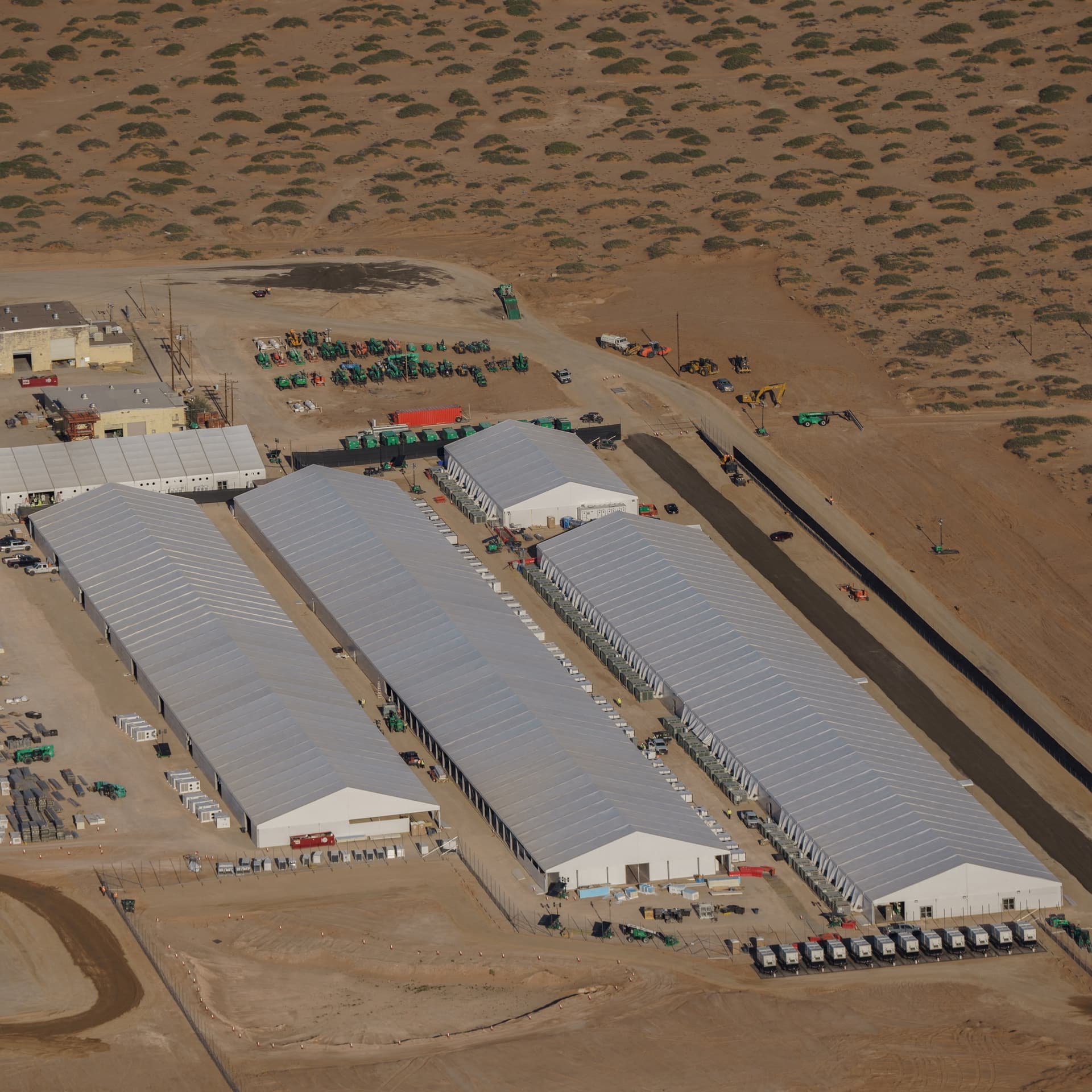
5:58In the release about his arrest, I said that, quote, his luck has finally run out. They plan to deport him. In September, he was taken to this huge detention center on the Mexican border. It's in El Paso, Texas, but it's called Camp East Montana. The largest federal migrant detention center in American history has opened its doors. In the summer heat of the Chihuahuan Desert, a city made of tents is springing up. Today, dozens gathered outside Fort Bliss, urging the Trump administration to close this facility. Camp East Montana is a sprawling makeshift tent encampment that President Trump built over the past six months out of an empty patch of desert.
6:40Detainees and people who have visited the site say it's like an active construction site with dust swirling and excavators humming. The tents are loud, a cacophony of hundreds of voices all day long. And they are not fully waterproof. So when it rains, water seeps in. The camp opened in August. It is now the largest ice detention center in the country with more than 3 ,800 detainees. And the goal is to hold up to 5 ,000 people there. Migrants there have reported abysmal conditions. They said that they've been beaten by guards for complaining or for demanding medical treatment. They say that the place isn't cleaned on a regular basis.
7:21They say that the food is terrible, that they don't get to go outside to have recreation time, as ICE standards dictate that they should be allowed to. As I previously reported, ICE's own inspectors have cited dozens of violations of federal standards there. and we don't know if ICE has taken any action to address those violations. ICE has said that all of its detention centers meet or exceed federal standards and that all detainees are given access to high-quality medical care. So this is where Luna's campus found himself last fall. Over the next few months, his family would hear from him every now and then, but they never knew when they might get a call, so they really didn't know what was happening to him.
8:03Then, right after the new year, his family got a call from ICE. Lunas Campos was dead.
8:15Jeanette Pagan Lopez is the mother of two of Lunas Campos' children. They separated when their kids were young, but they've stayed in close contact. I reached out to her after learning about this incident. The government needs to understand that these are human beings regardless of what it is. They could be illegal, they could be whatever, but they still are human beings. A few days after Lopez got that call, ICE released a statement about Lunas Campos. It said he had died, quote, after experiencing medical distress and that, quote, his cause of death was under investigation. Lopez said the statement felt like a cover-up to her.
8:52How could ICE employees not know how someone died in one of their own facilities? She felt like it was important for her to find out what happened. I feel like the people that physically harm him should be a hold accountable. Lopez also objected to the fact that ICE emphasized Lunas Campos' criminal record in their statement about his death, calling him an aggravated felon. I feel like it's unfair. It makes me feel like they're covering their a**hole, and I'm sorry for saying it like that. Lunas Campos does have very serious criminal convictions, and we are still working on learning more about his background and more about the crimes that he committed by seeking court records and by talking to people that knew him.
9:37But whatever you think about his background, it is important to remember that ICE detention is not meant to be punitive. It's supposed to be a place where the U.S. holds immigrants in a safe and humane way until they can be deported or have their immigration cases resolved. Lopez started making calls, trying to get as much information as she could about what really happened. She and Luna's Campos' daughter, who asked us not to share her name, both called the El Paso medical examiner to get an official cause of death. That was the call you heard at the top of this episode. The medical examiner's office said that the doctor there listed the preliminary cause of death as asphyxia due to neck and chest compression.
10:20I talked to a forensic pathologist who told me that that usually means someone died because they couldn't get enough oxygen because of pressure on their neck and chest. The El Paso medical examiner said they're likely to list the manner of death as a homicide. That means a death caused by another person, though not necessarily with the intent to kill. For Lopez, it was one of the first moments of real clarity since he died. I know for a fact that it was a, I know it's a homicide. So now she knew more about how Lunas Campos had died, but she needed to know more. What led up to that moment? And why wasn't ICE telling her anything?
11:04After the break, Jeanette Lopez goes searching for more answers. We'll be right back.
11:21After ICE told Jeanette Lopez that her former partner, Geraldo Lunas Campos, had died in their custody, she needed to know more, and she wasn't the only one. Lopez started getting calls from other men being held at Camp East Montana who said that they had seen everything. One of those people was a man named Santos Flores. S-N-O-R-E-S Okay. Thank you for the call. How long have you been there?
11:53He was being held in the part of the camp where Lunas Campos died. He's the only person I spoke to who says he saw the death. So we haven't been able to independently verify his account. Tell me more in more detail about what happened. It was a Saturday afternoon. Lunas Campos was complaining to guards about needing to get his medication. ICE later said that he was being disruptive. Guards then brought him to the segregation unit. That's an area of the camp where people are held in isolated cells for hours or days at a time.
12:38Flores was inside a cell in the segregation unit at the time. He says that he saw and heard what happened next from a window in his cell. He saw Lunas Campos handcuffed and wearing shackles around his ankles, surrounded by guards.
12:58The audio is a little bit hard to hear because the phone systems in ICE detention are not that great. But what he was telling me is that Lunas Campos refused to enter the segregation unit, and he just kept asking for his medication. We haven't been able to find exactly what medication he was trying to get a hold of. Another detainee told us that he thought that Lunas Campos had asthma, but we haven't been able to verify that.
13:34Flores told me that he saw a group of at least five guards struggling with Lunas Campos. They grabbed him like that and shot him. Just to repeat that, Flores says they grabbed him and started choking him. Then, he says, he and some other detainees heard Lunas Campos yelling in Spanish. No puedo respirar. No puedo respirar. That was the last thing when he said, I cannot breathe. He said, I cannot breathe. I cannot breathe. After that, we don't hear his voice anymore and that's it.
14:21Flores said they tried to revive him with a defibrillator for about an hour.
14:34initially when i asked ice about luna's campos death and about flora's version of these events they declined to comment after i published my story including his account the department of homeland security sent me a statement i immediately called lopez to read it to her like i said this is going to be a little bit um upsetting to hear but i want to just read it to you um on january 3rd, Geraldo Lunas Campos, a criminal illegal alien and convicted child sex predator, attempted to take his own life while he was detained at the Camp East Montana detention facility. The security staff immediately intervened to save his life.
15:15Campos violently resisted the security staff and continued to attempt to take his life. During the ensuing struggle, Campos stopped breathing and lost consciousness medical staff was immediately called and responded after repeated attempts to resuscitate him emts declared him deceased on the scene well first of all i know that he will never take his own life because he was planning on what to do next with about how to stay in contact with his kids once he was deported how he's going to take his own life and he's handcuffed his hands and feet. I know for a fact that he didn't take his own life.
16:03The next day, there was more news. The Trump administration was moving to deport two men who spoke to me for my story, including Santos Flores, the guy who described to me in excruciating detail the last moments of Lunas Campos' life. DHS has declined to comment on whether those moves had anything to do with the government's response to Lunas Campos' death. And as of this week, the men are still in detention in El Paso. It's hard for me to check in with them because they have limited phone access.
16:37More than 280 people have died in ICE detention since 2004. In recent months, these deaths have become a lot more frequent. it. At least 30 people died in detention last year, the highest number in two decades. Shortly after we published my story, another ICE press release came out saying another person had died, this time at a detention center in Georgia. Two days later, they reported yet another death, a quote, presumed suicide at Camp East Montana in El Paso, the same place where Luna's Campos had died. That means six people have already died in ICE custody since this year began. ICE has attributed the increase in deaths to the surging numbers of people that they're arresting.
17:23When you account for the higher number of people in detention, ICE says, the rate at which people are dying in ICE detention is actually the lowest it's ever been. Even as they expand detention, ICE says it's maintained high quality care, which they say is, quote, the best health care many aliens have received in their entire lives. Lunas Campos' family would disagree. And many of the people who have been held in ICE detention or visited these facilities over the past year say the growing number of detainees is putting a strain on their resources, like guard staff and medical personnel. Many see this as a crisis, one that government does not want to acknowledge or reckon with.
18:06Instead, they keep opening new facilities and adding more and more people to this system, testing it even more.
18:18Meanwhile, Lopez continues to search for justice. She hired a lawyer recently to explore potential civil litigation around Luna's campus death. Like, I can't bring him back. I need, like, justice of what happened to him and maybe, hopefully, that it won't happen to nobody else.
18:51Doug McMillan is an investigative reporter for The Post. That's it for Post Reports. Thanks for listening. Today's episode was produced by Emma Talcoff. It was edited by Ariel Plotnik, Dennis Funk, and myself, and mixed by Sean Carter. Thanks also to Juliet Alprin. For more on this investigation and other stories about immigration enforcement around the country, head to WashingtonPost.com. Our reporters are closely watching how ICE operations continue to unfold and how they're changing life in U.S. cities. Again, keep following at WashingtonPost.com. I'm Martine Powers. We'll be back tomorrow with more stories from The Washington Post.
From the publisher
When U.S. Immigration and Customs Enforcement announced the death of a detainee at a Texas detention camp this month, the agency initially gave no cause of death. A fellow detainee said he witnessed Geraldo Lunas Campos being choked to death by guards; ICE said “staff observed him in distress.”
Seeking answers, Lunas Campos’s family called El Paso County’s Office of the Medical Examiner, and an employee told them that – subject to the result of a toxicology report – the office is likely to classify Lunas Campos’s death as a homicide.
Today on “Post Reports,” investigative reporter Douglas MacMillan tries to find out what really caused the death of a detainee – and takes us inside the black box of the largest detention camp in the United States.
Today’s show was produced by Emma Talkoff. It was edited by Ariel Plotnick, Dennis Funk and Martine Powers and mixed by Sean Carter.
Thanks also to Juliet Eilperin.
Subscribe to The Washington Post here.