
In short
Post Reports: Bacon: The Best-Kept Secret in Washington
Episode Summary In this episode of Post Reports, Shane Harris delves into the fascinating story of "Vangie’s bacon," a legendary candied bacon recipe tied to an influential Washington socialite, Evangeline Bruce. The narrative intertwines themes of politics, social gatherings, and the unifying power of food in a city often divided by partisan lines.
---
Key Themes
- Vangie Bruce and the Georgetown Set
- Evangeline (Vangie) Bruce was a prominent socialite and wife of David K.E. Bruce, a significant figure in U.S. diplomacy and intelligence.
- The Georgetown Set was a group of influential individuals, including journalists, diplomats, and politicians, who gathered for dinner parties where major political discussions occurred.
- Vangie’s parties were known for their exclusivity and the legendary candied bacon she served.
- The Allure of Bacon
- The episode opens with Shane recalling his first encounter with Vangie’s bacon at a party, igniting a long-standing curiosity about the recipe.
- Bacon is portrayed as more than just food; it symbolizes social status and political connection in Washington.
- The Quest for the Recipe
- Shane’s journey to uncover the recipe leads him to Odette Pereira, Vangie's former cook, who initially refuses to divulge the secret behind the candied bacon.
- The episode documents Shane's persistent attempts to reverse engineer the recipe, highlighting the challenges of recreating a dish that holds deep personal and historical significance.
- Political Context and Social Dynamics
- The narrative explores how food, especially during gatherings, influences political relationships and discussions.
- Guests at these dinner parties included a mix of political ideologies, showcasing a more collaborative era in Washington politics compared to today's divisive landscape.
---
Key Takeaways
- Candied Bacon as a Cultural Artifact: Vangie's bacon represents a bygone era where influential figures connected over meals, impacting U.S. foreign policy and political discourse.
- Secrecy and Tradition: The recipe's secrecy reflects a broader theme of elitism in Washington's social circles, where culinary secrets were closely guarded.
- Odette's Contribution: While Vangie is credited with the bacon, it's evident that Odette's skill and experience were crucial in creating the dish, bringing to light the often-overlooked contributions of kitchen staff in elite gatherings.
- Food as Diplomacy: The episode illustrates how food serves as a medium for diplomacy, enabling conversations and relationships that shape political outcomes.
---
Pivotal Moments
- Shane’s realization of the bacon's significance during Ben Bradley's after-party.
- The moment Odette recalls how Vangie tasked her with perfecting the bacon recipe after being inspired by a dish she tasted in London.
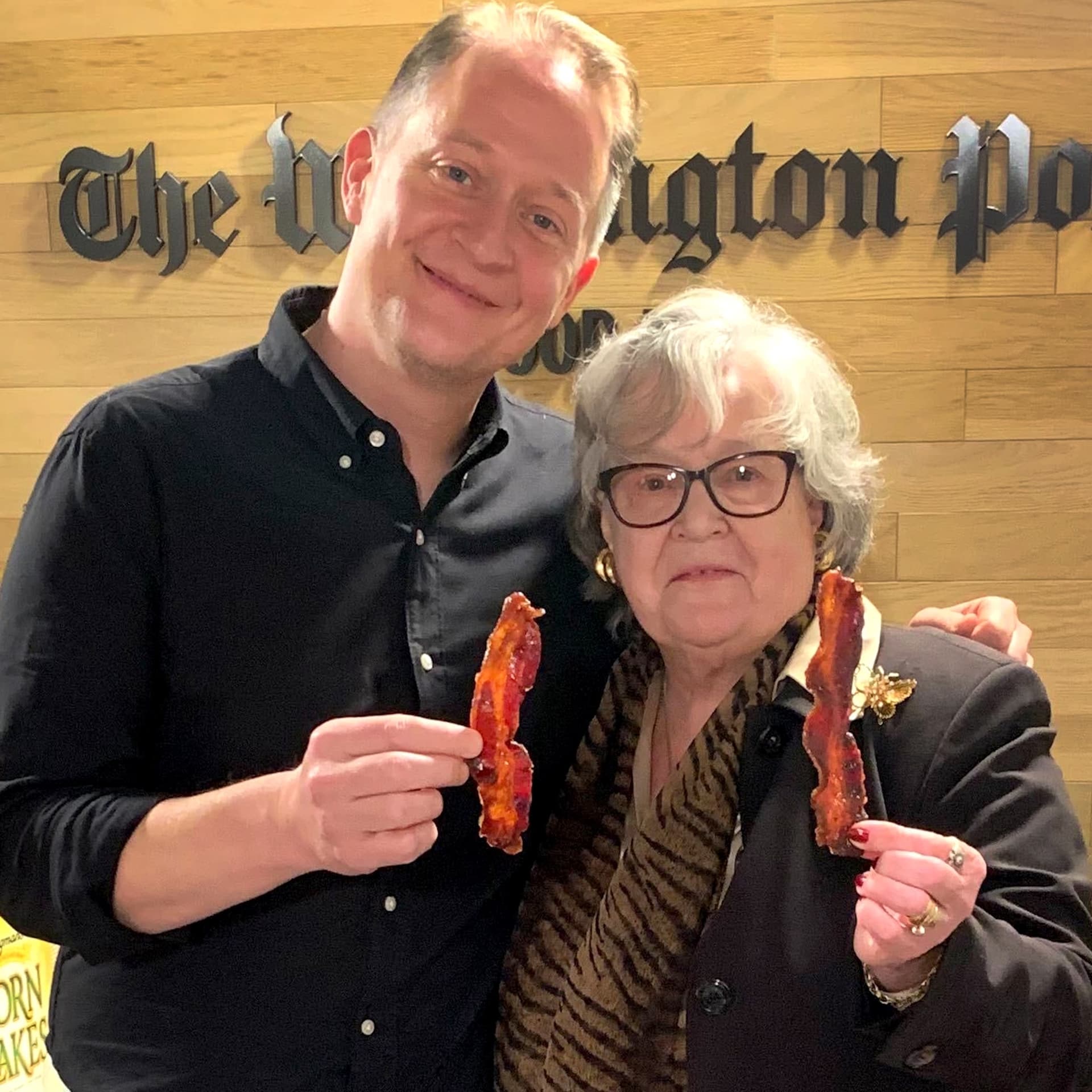
- The final cooking session at The Washington Post where Shane, Odette, and the food writer collaborate to recreate the bacon.
---
Conclusion The episode not only highlights a specific culinary delight but also reflects on the interplay between food, social dynamics, and politics in Washington. Vangie's bacon, emblematic of a significant social tradition, leads to questions about the current state of political engagement and the importance of fostering relationships beyond partisan divides.
---
Credits
- Reported by: Shane Harris
- Produced by: Ted Muldoon
- Edited by: Maggie Penman, Renita Jablonski
- Special Thanks: Ariel Plotnick, Ariella Markowitz, Harry S. Truman Presidential Library and Museum
---
This episode serves as both an entertaining narrative and a critical reflection on the cultural fabric of Washington, D.C., reminding us of the power of food to bridge gaps and connect people across divides.
Written by AI. May contain mistakes. Listen to the episode to check what was said.
Transcript
Automatic transcript. May contain errors.0:28Hey there, it's Colby. It's a story about a sweet, meaty treat that had been at the center of American power for decades. It's about politics, loyalty, and finally giving credit where credit is due. Okay, we hope you enjoy the show. Shane's going to take it from here.
0:52Okay, so setup is, it's October 2014. and Ben Bradley, the legendary editor of The Post, has just died.
1:05And I'm reading an article in the paper, not about his funeral, but about the after party to his funeral. So like Ben had an after party and it was like an A-list party. And where are you in your life? Where are you working? I am working as the senior writer for Washingtonian Magazine. So I had worked, I've been working as a journalist in D.C. at that point for about 14 years, writing on national security, policy, and politics. And I'm reading a story about the party by Roxanne Roberts, who used to write the Post's Reliable Source column. And, I mean, Ben's funeral is a huge event. The After Party is a huge event.
1:39And, like, everybody wanted to go to the After Party. Like, I think the After Party was more exclusive than the funeral. And she's writing this column that is very much, like, with that kind of vibe. But also it's framed as this kind of last hurrah where Sally Quinn, who is also a Post writer, who was Ben's wife, is giving Ben Bradley this final send-off because Ben and Sally famously threw parties, especially big dinner parties that were often quite exclusive. They very much serve this function of social cohesion and influence among a very influential set of people in this town. And so I'm reading it, and the column is describing the food that's being served underneath these tents, I guess, on the back lawn.
2:16And it says, like, you know, there were ham and biscuits. There was chicken. There were chocolate brownies and bacon. And it just says, and bacon, period. And there's no description of the bacon, which makes me think, like, okay, well, there's bacon strips being sent around? Or, like, so I go over and talk to my friend Carol Joint, who I was working with at Washington at the time. I either called or walked across to your office and said, Carol. What's the thing with bacon? Yeah. And she is my trail guide for all things social and strange about Washington. And I think he said to me, oh, you don't know about bacon.
2:53And I was like, Shane, what do you mean? What's this thing about bacon? There's so much I did not know about bacon.
3:04As Carol explained to me, bacon meant candied bacon. It's not a breakfast food. And it goes beautifully with cocktails. Now, a lot of people might be familiar with candied bacon. You might even know it by the name pig candy or hog candy. But this wasn't any candied bacon recipe. This is a recipe with a unique story and a legacy in Washington, D.C.
3:31And as it turned out, it was only something that an elite group of people in D.C. would know about. The reason why Carol knew about the bacon was that she had written professionally about parties and society for years. The kind of events where rich and powerful people would get together, rub elbows, drink champagne, try to look very important. At the time that I worked with her and she told me about bacon, she was the author of this regular column on Washington for a site called New York Social Diary. Which I approached like it was the police beat. And I got to go to all these parties. I mean, everybody wanted me at their parties because they wanted to be in New York Social Diary.
4:13So it was at one of these kinds of parties in Washington that Carol was actually attending as a friend, by the way, and not as a reporter, where she first learned about bacon. This was in the late 1990s. I had my own epiphany with bacon, too. It was not like I was to the bacon born, you know. It was like I had very dear friends, and they'd have great parties.
4:38Carol's friends were of the bacon born, as she put it. They came from this wealthy and powerful family in Washington, D.C., called the Bruces. So I went to this party around the corner, not knowing what to expect. And as I'm standing there with all kinds of people coming and going and everybody very glamorous, I see one of the staff go by with a tray with these little squares, you know, and a woman across the way goes, oh, they're serving the bacon. This is so great. And I'm like, she's serving the bacon? What's with the bacon? So I start following the bacon through the party and I grab one and it's just insanely delicious.
5:19It's bacon and it's savory, but it's a little bit sweet and it's crunchy, but it's not too sweet. It doesn't taste like candy. It tastes more savory. And it's got this incredible texture. So I keep following this server through the party and getting another piece of bacon. Finally, Carol found her friend and she asked, what's with the bacon? And she said, well, that's Vanjie's bacon. She would always serve this bacon. And so we have the same person who made the bacon for her make the bacon for us. The bacon recipe being served at the party belonged to the mother of the guy who was throwing the party.
5:56Her name was Evangeline Bruce, or Vangie for short. Vangie's Bacon.
6:05Vangie's Bacon was once legendary in D.C. In her day, Vangie Bruce and her husband, David K.E. Bruce, were among the most influential and powerful people in Washington. David was an ambassador who served all over the world. He was a very prominent diplomat. The Bruce's belonged to this Camelot era of Washington just after World War II, when the most powerful people in the country, Democrats and Republicans, people who did not necessarily agree with each other, would sit down together at dinner and sometimes, quite literally, were deciding U.S. foreign policy. Well, it was a collection of journalists, publishers, and spies and diplomats who lived in a small area, basically an enclave of Washington, D.C., called Georgetown.
6:53who is an American historian and author of a book called The Georgetown Set, which focuses on people like Evangeline Bruce. They got together very often on Sunday nights and what's called the Sunday night supper and discussed the current events in American foreign policy. And oftentimes, because they were journalists and publishers and spies and diplomats, had a disproportionate influence upon American foreign policy. The heyday of this group of people, this Georgetown set, was really in the 1950s and the 60s, but their influence and the parties they threw rolled on into the 70s and the 80s as well.
7:33The Georgetown set included some of the most notable people of the era. You had people like the Grams, who had once owned the Washington Post, families whose members were associated with setting up the CIA, people like the Wisners and the Dulleses. You had the Alsops, Joe Alsop, a hugely influential journalist, through some of the most famous Sunday suppers that Greg Herkin was talking about. The Kennedys were a fixture in this mix. And of course, you also had the Bruces. These people threw parties like no one throws parties anymore. And when Vanjie Bruce threw a party, she served bacon. It was her thing.
8:11It was like a kind of marker. And if you were eating Vanjie's bacon, you were somebody. You belonged. So this was all the backdrop for that famous bacon. that I asked my friend Carol about. She remembered trying it at her friend's party and following the tray around all night, eating more of it. Now, Vanjie Bruce had died in the mid-1990s, and her husband had died years before that. So I asked Carol to try calling her friend to get the recipe. And she said, well, that was made by Odette Pereira, who worked for Vanjie, and she was her cook. Odette Pereira. The potential true source of the bacon recipe.
8:55And I said, well, do you know how to reach her? And she said, let me see if I have a phone number. I called it. I got Odette, and she was this very lively person and knew exactly what I was talking about and told me she was still making the bacon. I said, what's the secret? Odette refused to tell her. She would not give Carol the recipe. Evangeline Bruce had made Odette swear that she would never reveal it. And almost 20 years after Vanjie had died, Odette was keeping her vow of silence. But she said she'd make it for me. And she made me bacon and brought it to the house. And I think you even ordered some from her too.
9:36Well, you got some for me. I got some for you. Okay.
9:42So Carol brings over this bacon to my house in this like tin. and I open it up and it's these shards of like shellacked meat. Like you can tell it's bacon and it is coated in this shiny candy exterior. And when I bite into this, it is like Dorothy seeing everything in color. I mean, it is like fatty and savory and it's a little bit chewy, but it has this amazing crunchy exterior. It is the perfect balance between salty and sweet and savory. You eat one piece of this and you just want to eat another. And then you want to eat another. You can absolutely see why Carol is just following this tray around through the party all night.
10:27This is now 10 years ago when I first tasted Vanjie's bacon. I have not stopped thinking about it. Now, all this time, mind you, I am covering the Donald Trump administration.
10:44I'm put the bacon story down for a while and I would try to come back to it. And then like life in the world would just sort of get in the way. I mean, I have cracked a lot of stories. I have still not been able to figure out how to replicate this candied bacon recipe. I mean, I go online, I would Google the words candied bacon. And there are a ton of recipes and tutorials on how to make candied bacon. And I would try all of them. Nothing tasted like Vanjie's bacon that I had tried all those years ago. And I know how to cook. Like I know what I'm doing. I could not nail this. And it suddenly felt like everywhere I went, candied bacon was just on the menu.
11:17I was being haunted by bacon. And none of it was as good as Vanjie's bacon. Now, over the years, I would bring this up with people in the city who had been to her parties and they remembered this bacon. There is actually a Vanity Fair article that mentions this. It's a profile of Evangeline Bruce written in the 1990s. And it opens up with this sweeping scene of all the guests at her house for this brunch on a Sunday. and there's a congressman and there's a network TV anchor over here. And the article describes these freshly shucked oysters being set out on a white linen tablecloth and like trays of miniature steak tartare floating around the party.
11:56And then there's a quote that they're also serving, the famous Bruce Bacon. And it says in parentheses, unfailingly crisp, sweet, and greaseless. Which it is! so that is vanjie's bacon now sometimes when you're reporting a difficult story if someone isn't ready to give you some information you give them some time 10 years seemed like long enough to try again what i'm looking at is who can tell us how to make vanjie bruce's bacon odette she's the key she's the key think she'll ever give us the recipe i don't know i mean i suppose The argument to be made is it deserves to be known. And let me just say, I am very accustomed to making difficult phone calls, trying to get information out of people who are paid to keep secrets.
12:50But when I sat down in the audio booth with post-producer Ted Muldoon to call Odette, I was really stressed. That's it. Deep breath. We do it? You're so nervous. I'm nervous. You do national security coverage. I know. But this is like, I mean, what if she's going to be like, piss off you weirdo why are you calling me I know I don't want to buy a subscription to the Washington Post all right let's see what happens all right okay
13:34hello hi my name is shane harris i'm a reporter with the washington post i'm trying to reach odette perera she's not here oh okay later okay could i leave a message for her yeah what do you So I'm working on a story about someone who I think that she used to work for named Evangeline Bruce. Yes. And I was hoping to talk with her about that. I'm working on a podcast. And believe it or not, it's actually about a special recipe that Evangeline Bruce used to serve at parties that I think Miss Pereira used to cook. Listen, can you hold this for a minute? It's myself. So that is myself. I don't know who it's called.
14:16but I can go back talk to you because I'm in another phone for something okay can you just hold it for a minute yeah hold on Odette is myself if that wasn't clear this is Odette on the phone even though she initially disguised her identity not the first source to do that in my experience so Odette puts me on a brief hold because she was on the other line with somebody else okay you hold it thank you yeah oh yeah yes I I cook for 35 years for Evangeline Bruce. Oh, my God. So I've been looking to talk to you for a long time, actually. I have been working on a story about, believe it or not, all things, candied bacon.
15:00Evangeline Bruce and the candied bacon. Bacon, yeah. Yeah, yeah. The same bacon. So I explained a bit about how I learned about the bacon, and then Odette explained a bit about how she first started cooking for Evangeline Bruce. I learned cook when I came to the States in 72. Where did you come from? I came from Portugal. Odette had lost her parents when she was quite young, and she followed her sister to the States. When she first got here from Portugal, her sister got Odette a job at the Italian embassy as a cook, even though Odette didn't know how to cook at the time. So she started learning on the job by experimenting with different recipes.
15:41I'm very curious, and I like to start to do something new all the time. And they like this. How did you first start working for Evangeline Bruce? Well, Mrs. Bruce, this is in the 70s, around 75. Odette became Evangeline's personal cook, which of course included cooking for her dinner parties full of rich and powerful people. Always all the states, like Rick Ken Chazier, Vice President, and Mrs. Reagan, all the people who work with the president. Wow. So like people from the White House and like really powerful political figures. Oh, yes. Oh, yes. Oh, yes. Sometimes the security comes for seeing the cooking and stay in the kitchen looking what I cook.
16:27So like the Secret Service would come watch you cook? Oh, yeah. Oh, yeah.
16:34Odette especially loved whenever the First Lady, Nancy Reagan, would come over. She, of course, was the wife of then-Republican President Ronald Reagan. And after the meal, Nancy would often come back and visit with Odette. She's all the time. She comes. She say, come to say thank you. One time she's there and she let me take her picture with my kids. Odette still remembers the first time that Vanjie asked her to try to make the candied bacon. She find out in London in some place. I think it's in Queen's house, I think. In the Queen's house, you said? It is in the Queen's house. Like as in Buckingham Palace?
17:11Yeah, oh yes. That's where she said she remembered eating it? Yes, I think she said it's in the palace, I think. But she didn't know how they do it. Bacon literally fit for a queen. Hmm. But Evangeline didn't know how to make it. So one day Odette says, Vanjie comes to her and asks her to replicate this allegedly royal bacon recipe. And she just tell me, Odette, I don't know. I know it's bacon and sugar. You have to find out. And she tell me, you have to try. I mean for a week, every day, for a try to eat the right bacon, what she eats in London. For a week, Odette made batch after batch of bacon.
17:54And Vanjie would come in and she'd try it and she'd say, no, this isn't quite right yet. You have to try again more. And I would try one day and say, oh, yes, this is exactly what I ate. And said, Odette, you keep the secret. Now, this is important. According to Odette, there is a reason to keep this recipe secret. Everyone loved it and everyone wanted it. People would come over to the house. They would expect it. They'd come to the brunches. she told me that Princess Margaret, as in the queen's sister, actually came and ate the bacon. And, like, I don't know if this bacon really came from Buckingham Palace, but, like, somebody who's been there quite a lot ate this bacon and loved it.
18:33So you probably wouldn't tell me the recipe, would you? No. I can tell you it's bacon and sugar. That's it. Yeah, you can try it. Do you still make it on request? Oh, yeah. Like, could you make me some? Yeah, if I have time, if I don't know what you need, maybe for the winter. Maybe for the winter or something, yeah. Yeah, I can make it in the winter. You can call me late in the winter, and I'm sure I can do it.
19:13Okay, so I was not able to get the bacon recipe out of Odette either. But I did come away from our call with two promising leads. One, Odette was willing to make the bacon for me again. This would be the first time I've tasted it in 10 years. Maybe with a sample, I could do what she had originally done and, I don't know, try to reverse engineer it. Two, according to Odette, I might have a lead on the original recipe. It might belong to Queen Elizabeth, which would be a very exciting development, right? My instinct would be correct. This bacon recipe went straight to the top.
19:50After the break, my 10-year quest for bacon continues.
20:18After your first six months, it'll cost$19 every four weeks. You can cancel anytime. Head over to WashingtonPost.com slash subscribe and get premium access to The Washington Post today. That's WashingtonPost.com slash subscribe.
20:37All right, so Odette is not giving up the recipe, but I'm not giving up on her. So I'm going to give her some more time to see if she might be ready to talk later. and in the meantime, I started looking into Evangeline Bruce some more to try and figure out how she might have ended up eating bacon in Buckingham Palace in the first place. Now, I have reached out to Buckingham Palace for a comment on whether or not bacon has ever been on the royal family's menu and whether Evangeline Bruce might have tasted it there. I am shockingly still waiting for a reply. Evangeline Bruce did move around in some very rarefied circles throughout her life, So it's possible.
21:14She was the daughter of an American diplomat. She grew up all over the world, moving between Italy, Sweden, France, Holland, Great Britain, China, Switzerland. Later on in her life, she married David K. E. Bruce. I understand they met when they were both working for the OSS, the Office of Strategic Services, the precursor to the CIA, during the war. I was born in Baltimore, Maryland on February 12th, 1898. This is David K. E. Bruce. He died in 1977, and this is from an oral history that he gave just a few years before. It's part of President Truman's archive. At various times, I was in the United States Army during the First World War from 1917 to 1920, during the Second World War from 1942 until 1945.
22:01Bruce became a high-ranking official during World War II in the Office of Strategic Services, which, as Greg Hurkin mentioned, was the precursor to the Central Intelligence Agency. You know, the agency that I cover for a living. I was eventually director of the European Theater of Operations under the Office of Strategic Services. At the height of World War II, David was running operations in the European Theater for the OSS. So you can think of him as like acting as an American spymaster fighting the Nazis. The OSS was supporting resistance efforts behind enemy lines in occupied France. They were sending people in via parachute to set up roving bands of intelligence operators to try and foil Nazi plans.
22:44And David was Evangeline's boss while they were both working at the London office of the OSS. This is how their love story began, according to Evangeline's 1995 obituary in the New York Times. Quote, One day her boss began questioning her about the languages that she spoke. I suppose you speak Italian, he said. She said yes. German? She nodded. French? Again, yes. Well, you certainly don't speak Japanese and Chinese, he said. Well, she said, it happens that I do, sir, because my father was stationed in both countries. With that, David K. E. Bruce invited her to lunch.
Read the full transcript
23:26So Evangeline became David's assistant. And in that job, she did some really interesting things working with spies behind the lines in Europe. For instance, she was called upon to forge passports and papers for these spies who would often move around on bicycles. And she had to develop these elaborate backstories in case they were ever stopped by the Nazis. And someone wanted to know, why are you carrying a bicycle registered in one place when you're riding to another? She once told a Washington Post staff writer that it all seemed very romantic at the time.
24:04Now, after the war, David became one of the most important diplomats of the 20th century. He was deeply involved in the Marshall Plan, which helped to rebuild Europe. He held all sorts of important posts. David Bruce would become a roving ambassador to several countries, including in London. He was in Paris. He was at Bond. American ambassador to France, undersecretary of state, special United States observer, the United States ambassador to the Federal Republic of James, the United States ambassador to the Great Britain, for the United States delegation for the parish. And everywhere David went, so did Evangeline.
24:37Evangeline traveled with him and was at these embassies, not as a hostess. She hated the term hostess, by the way, but as someone who could aid his career. She told Vanity Fair in 1995 about her husband and his work. Quote, I know it's a tired old cliche, but we were partners in every sense of the word.
25:03Diplomats don't just sit in a room and have talks. They get people together in embassies and throw parties. For the work of diplomacy to happen, there has to be this convivial setting, this social place where everyone comes together. So these parties were incredibly important. Evangeline was the one responsible for creating that scene. It was her responsibility. And it was in her capacity as the wife of the American ambassador, socialite, and diplomatic entertainer, that Evangeline would have allegedly had the opportunity to try bacon at Buckingham Palace.
25:36The Bruces and people like them are the establishment. It's at dinner parties and cocktail parties in their home and in others like them where powerful people who make decisions about the fate of the nation get together and drink and eat. And that was one of the ways that people communicated the most, was at the parties. That's the journalist and author Sally Quinn. She's the widow of Ben Bradley, the former executive editor of The Post, who I mentioned at the very beginning of this episode. Sally was also well known for throwing parties, and she was really part of the next generation after that original Georgetown set.
26:16She started throwing parties in the 70s and then into the 80s and 90s. And she's still very much a fixture on the scene today, bringing people together for dinner at her home in Georgetown. Even though they're meant to be fun, they were always working parties. I'm talking about the embassy crowd. I'm talking about journalists, White House people, people on the Hill. You know, they needed a way to exchange information and to meet each other. You know, and you sit next to somebody that you didn't know and you get up from the table and know perfectly well that I, as a reporter, for instance, sitting next to somebody in the administration could call them the next day and get them on the phone and vice versa.
26:58Because you'd spent time together. He established a relationship, and it was non-denominational. I mean, Republicans, Democrats were all together all the time. And I had a lot of Republican friends and really close friends. Dinner parties really were the nexus of this informal power Washington. That's Roxanne Roberts. It was her column about Ben Bradley's memorial party that turned me on to bacon. Roxanne has been covering Washington's social and political and philanthropic power brokers for the Post since 1988, which means she has been to a lot of these kinds of parties. The reason that my beat was so interesting to me is that everybody else was writing about what happened from 9 to 5, and I was writing about what happened from 5 to 9 or 10 or 11, where people who came together, many with different ideologies, without any of the kind of bitchiness and cruelty that exists now, would sit down and they would argue and they would drink.
28:04And as people got to know each other as human beings rather than a policy position, they were in a better place to then trade votes, negotiate during the day. The fact of the matter is that it is impossible even for a president to do anything alone in this town. And everybody needed other people, whether it was advice or friends of friends. You needed other people to be able to accomplish something big. If you look at the big policy decisions that were being made in Washington of yesterday, particularly following the end of World War II, This town really functioned and found consensus in a way that seems unthinkable today.
28:51It's kind of remarkable that in the space of a year, the Marshall Plan was voted and accepted. The Truman Doctrine was voted and accepted. The whole containment strategy toward the Soviet Union was established. Things got done pretty well and pretty rapidly. All the things that Greg Herkin mentions here, the Marshall Plan, the Truman Doctrine, these were the defining actions that created the post-war democratic world order. This is the system of agreements and alliances like NATO that makes the West, and chiefly the United States, the world's leader for the next 80 years. And these decisions that are going to determine the fate of the U.S.
29:32world order for the next century are being hashed out around a dinner table in Georgetown. One time Susan Mary Alsop said to a gathering, what are we going to do about the Italian election? This is in 1947. What are we going to do? Yeah, what are we going to do? Because we are the ones who should advise on this. Alan Dulles was always invited to these parties. Alan Dulles, again, director of the CIA. With the hope that Alan would spill some secrets. And Alan Dulles knew that very well. So he would launch off on a big story and go on for some time until he got to the interesting part, you know, where the secret was.
30:14And then he'd look at his watch and say, oh, look at the time. You know, we have to leave.
30:23So it was in this context where women like Evangeline Bruce would need to plan the menu. And sometimes their recipes were treated like state secrets. They would keep their own recipes. That's Carol Joint again, my trusted guide through Social Washington. Other hostesses would covet, you know, so-and-so's beef stew or so-and-so's chicken this or so-and-so's shrimp that. Or how did you get that salad dressing? You know, there was a certain elitism in who your chef was, who your cook was, and the secrets that they kept of your special recipes.
31:04So Washington hosts often served a trademark dish or something that they were known for. And for Evangeline Bruce, it was the secret candied bacon recipe that she'd asked Odette to spend that week perfecting. According to Odette and others that I tracked down, Vanjie's recipe was the first one to make candied bacon trendy in Washington. It became widely imitated and remained popular well into the 80s and the 90s. I've met lots of people who have their own bacon recipe, and it's bipartisan. Dick Cheney serves a bacon that's actually made with chili pepper in it. The idea of people from across the aisle gathering with certain nonpolitical but very powerful people, influential people, that's changed.
31:49There's a reason the Georgetown Dinner Party has sort of been elevated to a unique and important thing because it doesn't happen in the same way. Is Washington better off now not having people like Evangeline Bruce convening in that way? Is it more egalitarian? Is it more democratic? Or have we lost something, an important function that those parties served? I am going to say that in column A, you have a bunch of wealthy white people, for the most part, attempting to solve the problems of the world from a very elite perch. And you can find quite easily all the things wrong with that. On the other hand, you have a city full of people who are making both national and international policy that have decided to declare war on each other.
32:51They have no interest in working together. They see that as a sign of weakness. They have no interest in getting to know each other. There is virtually no respect for each other as human beings. or fellow patriots. There's a lot of performance and theater and not much governing. So I would say, and I'm going to sound old, but at least these dinner parties, as flawed as they were, had a goal, and the goal was to make the country better. And I'm not sure that throwing a tantrum on the floor of the House in our new version of egalitarian politics is better.
33:45I think today you have to wonder if the best version of that diplomacy and its promise is actually lost. And, you know, I've had to wonder by this point if I'm ever going to be able to reverse engineer this bacon. After trying for so long, so hard, and learning so much about this era, I had a new idea. That instead of asking Odette to just make a batch for me, I would invite her over to the post as some of us attempted to recreate it together. Hi, Marina. Hi, I'm Shayne. Very nice to meet you. Hi, nice to meet you. I'm Odette. Come on I've never been in a wash and wash. Oh, hey. I met Odette and her daughter, Marina Kuko, outside the post, and we went up to the food lab.
34:27That's where we met our post food writer, Aaron Hutcherson. He was with us. I figured, hey, if Odette wasn't willing to reveal the recipe outright, you know, maybe she'd give us some tips. A little, you know, wink and a nudge here and there. So, all right. So we have bacon and we have brown sugar. You can put your purse down, make yourself comfortable. Okay. You're just watching. Yeah. No pressure. No pressure. None whatsoever. So Aaron starts cooking, and we start talking to Odette. Aaron's got a pack of bacon, a jar of dark brown sugar, an aluminum sheet pan, and then a baking rack in the pan to elevate the bacon over it.
35:06Odette starts reminiscing again about Evangeline eating candied bacon in London, but as she's telling the story, she's keeping an eye on Aaron as he starts to put the bacon on a rack to put it in the oven. You don't do it the right. You don't use... You need to put sugar first. Sugar first? Okay. Yes. It was clear that Odette was not just going to stand by while bacon was being made. You don't need the rack? No. Okay. Odette makes Aaron throw the rack off to the side. So now do you put the brown sugar on the tray? Yes. So put the sugar all over the tray? All over the place, yes. With your hands, yes.
35:45Yes, you put it all over there. Before putting the bacon down, Odette has Aaron cover the bottom of the sheet pan with brown sugar. Now, yes. Now you put the bacon. There you go. And it's a lot of sugar again in the top. So this is like a layer of brown sugar, a layer of bacon, and more sugar on top of the bacon. Yes, yes. Wow. So it's going to be like cooking in a sandwich of brown sugar almost. Yes, yes, yes. Like a sandwich, yes. Oh, wow. And oven, they can be higher. They can be around 300, depending on the ovens, you know. 300? The gas, I do with 300. So again, if you didn't catch this, there's a layer of dark brown sugar on the bottom, then a layer of bacon, and then more brown sugar on top of the bacon.
36:34More and more, and you have to... Pat it down? Yes. So you're actually packing sugar around the bacon and pressing it down with your hands. Oh. Oh, okay. See, Odette, I never would have imagined doing it this way. Well, she told me that you never ever give the recipe until I lie. I'm not allowed to give out the recipe. As long as she was alive. Now go to the oven. You have the oven on? Yes. Okay. You said 300 degrees. Around 300, yes. Okay. So that's pretty, that's like a low and slow kind of thing. Slow. Okay. Because they have to melt the sugar until they make the caramel. I see. Sometimes it takes more than one hour.
37:14So you have to keep an eye on it. Yes, you have to keep an eye on it. And it's more than one hour. It depends how they do it. And soon they start to bubble. Soon the sugar starts bubbling, is what Odette says here. But it's becoming clear that this is really a feel thing for her. It also depends on the oven, since not all ovens heat the same way. In our recipe, it took about an hour cooking the bacon at 300 degrees. You're watching and waiting for the sugar to bubble and caramelize on that bacon. And Odette is watching for two particular things. The color of the bacon and the smell. She's really using her nose here to know when it's ready.
37:55It smells. You see it? They start to melt. Because you have, well, I'm not supposed to tell you everything, but you have to turn over. Turn it over? You have to turn the bacon over when they melt in the top. When they run. You have to use your nose. It's not. Yes. Most people use a toothpick or something to see if it's ready. No, you have to just look and smell it. Okay, so this is important. If I were to point out one secret to Odette's recipe, this would be the big one. We've probably been cooking the bacon at this point for about 35 minutes, and Odette tells us to turn it over. And at this point, the sugar has entirely melted, and it is mixed with the fat that has rendered off of the bacon.
38:41So everything has become this delicious smelling brown syrup on the bottom of the tray. Wow, this is absolutely like, it's like a caramel bath. You have to put this sugar back on it. Oh, I see. So you got to like really get it back on. Exactly. You have to do this. Aaron is picking up each strip of bacon with a pair of tongs and dredging it through the caramelized syrup as he flips it over. He then even used tongs to put some more syrup on top of the bacon, kind of ladling it over. The point here is to create consecutive layers of caramelized sugar. You need to repeat this flipping of the bacon, this process, a handful of times.
39:20And then you shoot after you have to do another time. And just keep doing it until it's the right... Yeah. So it is basically cooking in liquefied caramel right now. Watching this process, I can see why it took Odette a week making batch after batch of bacon to perfect this technique. It is not obvious. So when Mrs. Bruce finally, you got it finally the way that she liked it, how did you remember? Oh, I remember. You don't think after five days, do bacon every day? Oh, my God. How could you forget? I can't see the bacon anymore. I come in the kitchen and say, bacon again? We repeated the bacon flipping process another couple of times over the next 25 minutes until it had exactly the color that Odette was looking for.
40:10This is like looking like that deep, deep, dark color that you really want. Yes, yes, yes. Almost burned. That's it. This is the bacon. Look like it. Exactly where they are. So we'll wait a few minutes for it to cool down. Yes. And then we will see the moment of truth. Mrs. Cruz, I'm sorry. If you somewhere, look to me. Sorry for what I can come and show these people how the bacon is supposed to go. Aaron took the bacon off of the pan sheet and put it on aluminum foil. Now this part can be tricky. Because of the caramelized sugar, the bacon sticks to anything that you put it on. So definitely don't put it on parchment paper because the parchment will rip off in little bits on the bacon.
40:50Odette likes to put the bacon directly on her cold granite counter, since then it snaps off better after it's cooled. But if you're careful, you can put the bacon on foil. Afterwards, there is one last crucial test to make sure the bacon is in fact done. The bacon strip needs to stand up straight when you hold it vertically. Let me see it. Oh, yes. Is that right? It stands up. You see? That's it. That's it. That's what I said. That's it. Not all of the strips of bacon cooked evenly. The strips that were on the edges of the pan cooked faster. And then some of the other strips were still floppy and bent over during that test.
41:36So we just put those back in the oven for another round of caramel shellacking until they looked right. Should we try them? Yeah, you can try it. Okay. It had been 10 years since I ate this bacon. And I had promised so many people who have worked so long on this podcast that it was going to be amazing. I got to say, I was a little skeptical myself. And I know Ted was skeptical just a little bit. This was the moment of truth. Oh, my God. That flavor? Yeah. Oh, this is what I remember from the first time I tried the bacon. Did you? Yeah. Yeah, this is what. Oh, my God. And it's not easy. Somebody do it.
42:15This is clearly not easy. Yeah. I don't know how you would write this recipe down. No. Well, I have to ask you something, too, because everybody always talks about Mrs. Bruce and they always say like, Evangeline Bruce's bacon or the Bruce bacon. I think though, it's really Odette's bacon because you're the one who made it. I mean, this famous thing that is in books and it's in magazine articles and people associate with her, but you made it. It's really Odette's bacon. Yeah. Well, now everyone's going to know it's Odette's bacon. Odette's bacon.
42:57My name is Odette Preira. I came from Portugal 50 years ago. When I came, no money, no English, no nothing. Just a suitcase, my husband and my daughter and my arms. And now I'm so proud be in America because I have eight grandchildren, three children, where they make me so proud. I've learned so many things to myself, not because they teach me, because I try to do it and I do it.
43:36I'm making this recipe for Thanksgiving, and I plan to serve it at dinner parties at my house too. And when I do, I will tell people, this is Odette's Bacon. And there's a great story about it.
44:11you can access The Washington Post for just 99 cents. That's unlimited access to all of The Post for only 99 cents every four weeks. That is a great deal for the first year. And after that, it'll cost$12 every four weeks. You can cancel anytime. But don't wait. This Black Friday seasonal offer won't be here for long. Go to WashingtonPost.com slash subscribe and grab this deal before it's gone. That's WashingtonPost.com slash subscribe. This story was reported by Shane Harris and produced by Ted Muldoon. It was edited by Maggie Penman and Renita Jablonski. Special thanks to Ariel Plotnick and Ariella Markowitz.
44:52Tape of David K.E. Bruce is courtesy of the Harry S. Truman Library and Museum. I'm Kolby Akowitz. Have a happy Thanksgiving.
45:11When it comes to the big questions, who you ask matters. From breaking news to politics that impact your life to advice you can trust. Get answers you don't have to question with Ask the Post AI. Trained exclusively on post journalism with clear sourcing. And if we don't know the answer, we'll tell you. Ask the Post AI. Find it on WashingtonPost.com or in the app. Thank you.
From the publisher
Shane Harris first tasted “Vangie’s bacon” 11 years ago, and he hasn’t stopped thinking about it since. Today on the show, Shane goes on a quest to unlock the bacon mystery – and a time in Washington when Republicans, Democrats, spies, diplomats and journalists used to set their differences aside and gather around a dinner table.
Today’s show was produced and mixed by Ted Muldoon. It was edited by Maggie Penman and Renita Jablonski. Special thanks to Ariel Plotnick and Ariella Markowitz. Tape of David K.E. Bruce courtesy of the Harry S. Truman Presidential Library and Museum.
Subscribe to The Washington Post here.