
In short
Congress returns after August recess and reignites the fight over releasing Jeffrey Epstein investigative files, including flight logs and redactions; House Democrats and some Republicans push a discharge petition to compel DOJ disclosure. The episode also covers looming government shutdown threats tied to Sept. 30 funding deadlines and early Democratic planning for the 2026 midterms (redistricting, messaging, and likely House/Senate races).
Guests (backgrounds)
Naftali Ben-David, senior national political correspondent at The Washington Post; Mariana Sotomayor, congressional reporter covering the House of Representatives for The Post.
Key claims
Oversight received 33,000 DOJ files, but Democrats say key details remain redacted. A bipartisan discharge petition (Thomas Massie, Ro Khanna, plus support from Marjorie Taylor Greene and alleged victims) aims to force a floor vote and pressure Trump/DOJ. Democrats plan to win back the House via affordability, health care, and “government corruption” reforms; redistricting and mail-voting attacks may shape outcomes.
Notable examples
subpoena of the Epstein estate; press conference featuring alleged survivor Anoushka DiGiorgio; Sept. 30 funding deadline and possible continuing resolution; Texas redistricting and Trump executive order targeting mail-in voting; potential 2026 House races in Pennsylvania, Ohio, North Carolina, and Maine; Senate pickups discussed in Ohio, North Carolina, and Maine.
Written by AI. May contain mistakes. Listen to the episode to check what was said.
Chapters
Tap a time to open that second in VOCongress Returns to Epstein Files
1:14 to 2:52
Discussion on Congress resuming after recess and the Epstein saga.
“I'm joined this week by Naftali Ben-David, a senior national political correspondent at The Post.”
Details on Epstein Files and Congress
2:52 to 4:47
Insight into the latest developments regarding the Epstein files and subpoenas.
“So how did Congress pick this story back up again this week?”
Political Reactions and Bipartisan Efforts
4:47 to 7:18
Analyzing the bipartisan efforts around the Epstein files and political implications.
“So they argue you'd get more information.”
Government Shutdown Warnings
7:18 to 10:48
An overview of the looming government shutdown and its implications.
“It's not going to become law in the sense that the Senate probably won't bring it to the floor.”
Political Consequences of Shutdown
10:48 to 14:00
Exploring potential political fallout if the government shutdown occurs.
“And all the questions that House Republicans were getting were on Epstein.”
Political Dynamics of Government Shutdown
14:00 to 15:43
Explores the implications of a potential government shutdown on the GOP and Democrats.
“But I think that is the viewpoint of many Democrats is why should we even work with you guys on this when no deal that we reach is sacrosanct because the White House might turn around and cut it.”
Democratic Strategies for the 2026 Midterms
16:42 to 19:28
Discusses Democratic Party's challenges and strategies to regain House majority in 2026.
“Mariana, you reported this week that Democrats are deep in planning mode for how they can win back the House.”
Trump's Influence and Redistricting
19:28 to 21:31
Analyzes Trump's actions regarding redistricting and mail-in voting in the context of elections.
“First of all, the president's party almost always loses seats in the midterm.”
House Races and Swing Districts
21:31 to 24:10
Examines key House races and the dynamics of swing districts heading into the midterms.
“is that that's laying the groundwork for being able to say if he loses, everything was corrupt, this was an unfair election, you shouldn't trust the votes.”
Senate Outlook for Democrats
24:10 to 26:40
Explores the Senate landscape for Democrats and potential challenges they face in 2024.
“Still be districts in areas that Trump won, but it could become more swingy, which is interesting.”
Show all 12 chapters
Democratic Messaging on Crime and Immigration
26:40 to 28:00
Discusses the challenges Democrats face in addressing crime and immigration in their campaigns.
“We've seen a massive increase in immigration arrests.”
Democrats Tackle Border and Immigration Issues
28:00 to 29:23
An analysis of the current Democratic strategies regarding immigration and crime.
“acknowledging that reality and maybe proposing something else or mentioning, you know, I think it's extreme, et cetera, et cetera.”
Transcript
Automatic transcript. May contain errors.0:02So there's been some major engagement news lately. Last week, it was pop star Taylor Swift and football player Travis Kelsey. Then this week, Senator Cory Booker of New Jersey announced he was engaged. You know, last week with Taylor and Travis, they were in this like gorgeous, lush garden. This week with Booker, he was in Hawaii. Of course, in both cases, there were professional photographers to capture it all. And I'm just going to say, this is not how my engagement went down. How about you guys? Mine did go down with professional photographers abroad. Oh, see, so you could rival Taylor and Booker, I think.
0:38I could. Yeah. How did you propose to your wife? I proposed on the steps of the Lincoln Memorial, which I thought was like super cool and original. And it turns out like a lot of people do that. It was much less of a brilliant new idea than I had thought. But this was before the era of promposals and fancy things. So it was just kind of pretty straightforward. But it's better than your backyard, like Travis did, you know? Yeah. At least it's a beautiful backyard. Yes.
1:08From the newsroom of The Washington Post, this is Post Report's weekly politics roundtable. I'm Kolbie Echowitz. It's Friday, September 5th. I'm joined this week by Naftali Ben-David, a senior national political correspondent at The Post. Naftali, hey. Hi, good to be here. And we're also here with Mariana Sotomayor, who covers the House of Representatives for The Post. Hey, Mariana. Hi. So this week, Congress returned to Washington after a month-long break. And if President Trump had hoped that a few weeks off would make lawmakers forget all about the Epstein files, that story picked right back up again.
1:43We'll discuss the return of that saga, as well as other news from Capitol Hill, from a possible government shutdown to the early outlook for the 2026 midterms. Let's start with why Congress is still fighting over the files from Jeffrey Epstein's criminal case. Now, Feli, can you remind us how we left things off before the August break? Yeah, before the August recess, I think President Trump was sort of back on his heels in a way that we've rarely seen him. This involves, of course, allegations that were made against Jeffrey Epstein, a wealthy financier who was accused of child sex trafficking and who ended up killing himself in prison some time ago.
2:19President Trump found himself very much on, I think, the defensive. And that's because some people who are his longtime supporters and some members of the Republican Party itself were for really almost the first time since he took office disagreeing with him and really demanding that the Justice Department release the entire Jeffrey Epstein investigative file. Now, there was some thought that the White House was trying to distract away from that. But, of course, you know, members of Congress go to their districts, go back to their states. And there was certainly some hope on the part of the White House that when they returned weeks later, the story would have faded a little bit if not gone away entirely.
2:51And that's not what happened, Mariana, right? So how did Congress pick this story back up again this week? Yeah, definitely not what happened. Just even before this week, I think it's important to note that we did see House Oversight Committee, and particularly the chairman, James Comer, ask for those files. Those were received during the August break. And we have now seen Comer actually subpoena the Epstein estate to try and get more information. Then on Tuesday, the House came back and the Oversight Committee released 33 ,000 files they had received from the Department of Justice. Here's the thing, though.
3:28A lot of those files have already been publicly released in some form or fashion. And the new information that has to do with flight logs going back several decades, all of that more or less is redacted information. So that is why there are still a number of lawmakers, particularly Democrats, saying not only do we need all the files, but there should be less redactions. We should be able to understand what is new information here. So basically, whoever was on those flights, we still can't know because the names of the people that might be implicated have been redacted. Correct. And so and then there's this like competing effort, right, by like pretty strange bedfellows by a conservative Republican and a very progressive Democrat.
4:14So what's going on there? Yeah. So Thomas Massey is a conservative on this. He's a Republican from Kentucky. The progressive on this is Ro Khanna, a Democrat from California. They even before the break were trying to push a resolution. And now they're going to do it through a discharge petition, which essentially allows 218 lawmakers, that's the majority of the House, to essentially force a vote on the House floor. So what would their resolution do? They would compel the Department of Justice to release all of the files with less redactions. So they argue you'd get more information. And that's actually going against what the leadership of the House wants.
4:57So Speaker Mike Johnson also introduced his own resolution, essentially allowing Republicans to vote on something Epstein-related. The resolution doesn't do anything. It essentially says, we recognize the House Oversight Committee is doing a great job in trying to get information. So the issue is not going away is the bottom line. So let me just sum this up. There's this effort by the House Oversight Committee to release some information. It's backed by GOP leadership. They claim they're doing this all in the name of transparency. But then there's this competing effort that says it's not enough.
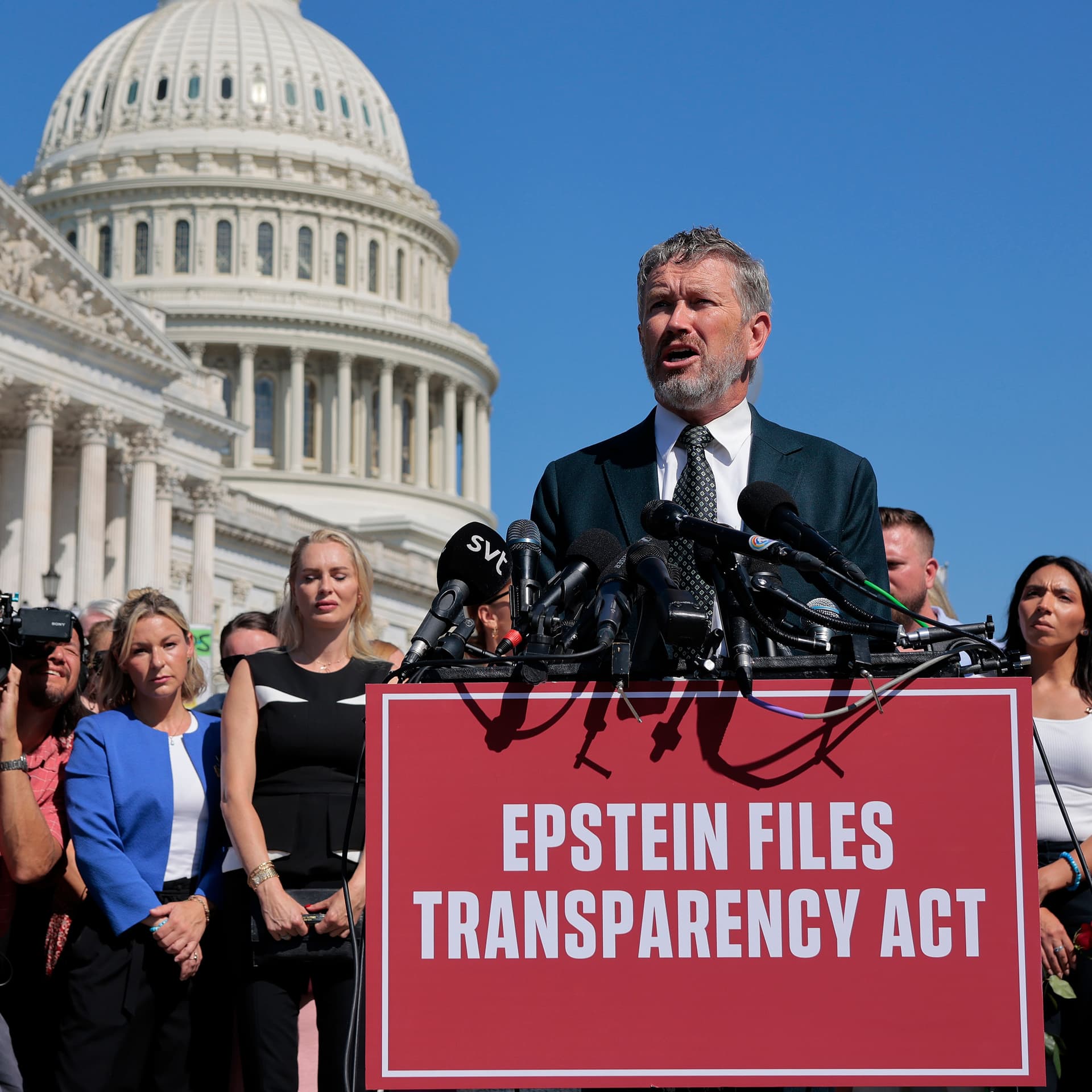
5:35You have to compel the Justice Department to release them all. And then we get to Wednesday. And that's where we saw some of Epstein's alleged victims take sides in this. There were about a dozen who joined Massey and Kana and also Republican Representative Marjorie Taylor Greene. And they held a press conference on Capitol Hill. They all said they support the discharge petition, which again is the thing that would compel the Justice Department to release all the files on Epstein. They even called on Trump by name. Let's listen to alleged survivor Anoushka DiGiorgio at the press conference. I am no longer weak.
6:10I am no longer powerless. And I'm no longer alone.
6:18And with your vote, neither will the next generation be. President Trump, you have so much influence and power in this situation. Please use that influence and power to help us. Naftali, what did you make of all that? Yeah, I think one of the things about having these women appear is it was very powerful. This is something that really happened to real people. And it was an attempt, I think, to remove it a little bit from the realm of politics. But of course, it is political in part. And Democrats see a real opening here. I mean, they've jumped on this because it's the first time since January 20th when Trump returned to the White House that he's really faced this political turmoil and that there's been some division between him and his base.
7:01We'll have to see if that division lasts, but there's no question that Democrats are going to keep pressing this. And while the discharge petition that Mariana talked about is bipartisan, we're talking about like four Republicans and all Democrats. So it's really something that Democrats are pushing, trying to lure just a couple more Republicans on to get the votes that they need. It's not going to become law in the sense that the Senate probably won't bring it to the floor. And Trump would have to sign it. So he's not probably going to. So it's not about that. It's about forcing every single Republican to vote one way or the other and to make life really difficult for them from the perspective of the Democrats.
7:35What was so interesting to me is that there was Massey, there was Conor, but there was also Representative Marjorie Taylor Greene who has long been a Trump ally. And she's out there putting pressure on the White House. Like, how did these three end up united on this? Yeah, it really has become a defining wedge issue among Republicans. You've seen the party splinter on this. And she's been someone who, for a very long time, has been demanding that the government release the files, you know, calling on the then-Biden administration to release the files. So this naturally was an issue that she herself supported.
8:12I think something to watch is, you know, the victims during the press conference, they mentioned that they have kind of cobbled together their own Epstein list. Of course, what the Epstein list refers to is that there is this belief that there is a list out there that the government has of very powerful, influential and wealthy people who may have been involved with Epstein's crimes. And Thomas Massey and Marjorie Taylor Greene have now both pledged to possibly go to the House floor at some point once that list is compiled. And they themselves name names. Massey tweeted earlier this week that he knows that the victims can't do that because they would probably be attacked, harassed, and they don't need to relive through that anymore.
9:07But they, being Massey and Marjorie Taylor Greene, they're public figures. They can go to the floor and actually do something like that. And I mean, the background of this is that the people on the right, for the most part, have been pressing for the release of these files for years. And that's why Trump is in such a difficult position, because this hasn't been so much of a Democratic or left-wing influencer argument that the file should be released. It's come from the right. And so for him now to say, we're not going to release the files, when one of the MAGA mantras, so to speak, is transparency.
9:35We're all about releasing documents. We're all about opening up government. We're against the deep state to now say, well, actually, we don't want to release the files. That becomes a very difficult political message, I think, not just for Trump, but for the Republican leaders in general. I mean, and there was reporting this week that I think it was a White House official said that, you know, Republicans that sign on to these things, it's a hostile act towards the towards the administration. That's kind of the position that the Trump administration is taking on this, which makes me think that they don't necessarily just see this as a distraction, but as a real political problem for him.
10:09Yeah, they do seem to be pretty worried about it. I mean, President Trump is going to a lot of lengths to explicitly and implicitly warn people that if they cross him on this, you know, he could bring some of his formidable political power, you know, to punish them. Who knows? But it is striking how much time, energy and effort they're putting on trying to tamp down this particular Fuhrer. And when there's so much else that they need to get done, right? I mean, how much does this derail them from the rest of their agenda? I mean, it has completely overshadowed everything else that they have to do, not just this month, but for the rest of the year.
10:47I mean, they were in session for maybe 72 hours this week. And all the questions that House Republicans were getting were on Epstein. Nothing really much on having to fund the government. Those conversations are happening behind closed doors. But, you know, this is a spotlight that none of them want to be in. But it's not just us reporters asking these questions. As Naftali mentioned, it is the MAGA base. It is the social media influencers trying to find out where does a House Republican lawmaker lie on this issue? Is there a chance, and I'm glad you brought up the spending, because we're facing what is like the real possibility of a government shutdown at the end of this month.
11:31Congress has until September 30th to fund the government. And we've seen over the last decade or so, Congress seems to consistently bring the government right to the brink in these funding fights. We know it's really hard to pass anything with bipartisan support in Congress. So, like, what are the battle lines here? What are you going to be watching over the next three weeks? Yeah. So I think in the next coming days, hopefully Republicans, both in the House and Senate, will have a plan asked how to fund the government. Because they don't have a plan right now. Correct. OK. A lot of the conversations are surrounding potentially having an extension of current funds that's known as a continuing resolution or a CR.
12:09So not the yearly appropriations process where, you know, you have to pass 12 bills to fund all the government departments. So this is just probably an extension that goes through December, giving lawmakers more time to hopefully get new bills done. However, you have members of the House Freedom Caucus who notoriously do not like these extensions. They would like to see a more robust funding effort. Democrats are absolutely needed in the Senate to make sure that the government is funded. And as of right now, Democrats are not really inclined to help out Republicans. And the reason why is because we've seen Trump and congressional Republicans claw back already appropriated funds throughout the year.
12:54Democrats are really not happy about that. There are also Republicans who don't love that as well. So as of right now, it's just very early. People are kind of just waiting for leadership, both on the House and Democratic side, to position themselves. But I think the closer we get to that September 30th date, there'll be a lot more answers as to how this looks and might be able to say more clearly how Democrats vote for this and how Republicans do as well. Well, one question I have, Naftali, is like, does the funding bills even matter anymore if Trump can just decide like, OK, that's been appropriated by Congress, but I'm just just not going to spend that money or I'm just going to kill that program, even though Congress authorized it?
13:37like Trump seems to be taking spending into his own hands anyway. I mean, I think that's a really basic question. And a lot of Democrats are now saying, why should we make a deal with Republicans when Trump's going to turn around and violate the deal at the drop of a hat? I mean, yes, Congress still does have to fund the government, even though Trump can turn around, or at least he is trying to, and claw back some of the money, cut the funding, or just not spend it in ways that are, of course, now being challenged in court. But I think that is the viewpoint of many Democrats is why should we even work with you guys on this when no deal that we reach is sacrosanct because the White House might turn around and cut it.
14:13So I think that's very much entering into the dynamic. Well, looking ahead to that end of the month deadline on government funding, I mean, I was up on the Hill covering the government shutdown in 2013 when Republicans refused to fund the government if it didn't also kill Obamacare. The public widely blamed Republicans for all that chaos, but then the Republicans went on to sweep the 2014 midterms. So who do you think would take the political fall if the GOP-led Congress can't get enough votes to keep the government open? And will that matter by next November? I mean, I think that this is a guess.
14:49Republicans usually take the hit for this kind of thing. I mean, there's just things that Democrats get blamed for, whether it's their fault or not, and things that Republicans get blamed for, whether it's their fault or not. And people really think the Democrats are more pro-government. And so I think that Republicans start off at a disadvantage. Secondly, they control the White House and the House and the Senate. And thirdly, President Trump was elected in part because he was supposed to be competent when it came to financial matters. He kept on talking about how incompetent Biden was and look at inflation and look at spending.
15:18I know how to run things. And so if the government shuts down on his watch, I think it's going to be a challenge. I mean, whether it'll matter in November 2026, I don't know. But if there's a broader narrative that, you know, the economy isn't great and the government's not in great shape, this could be one more data point that voters look at. So let's take a break here. And when we come back, I want to talk about the Democrats and their fight to win back the House in the 2026 midterms and how that's already shaping up. We'll be right back.
16:09When it comes to the big questions, who you ask matters. From breaking news to politics that impact your life to advice you can trust. Get answers you don't have to question with Ask the Post AI. Trained exclusively on post journalism with clear sourcing. And if we don't know the answer, we'll tell you. Ask the Post AI. Find it on WashingtonPost.com or in the app.
16:41So we are now in the fall of 2025, and that means that we're going to be talking about the fall of 2026, because the conversations around campaigning and planning started. Mariana, you reported this week that Democrats are deep in planning mode for how they can win back the House. So what did you learn in that reporting? Yeah, so Democrats, the party, are not in a good place. And it's up to House Democrats as well as Senate Democrats to try and not just obviously win back the majority, but to do that, win back voters. The Democratic Party actually has a voter registration problem. A lot of previously declared Democrats are now either registering as independents or Republicans.
17:28Obviously, the Democratic base is pretty depressed. They say there's no leader or, you know, congressional lawmakers aren't fighting back. So that is the hole that Minority Leader Hakeem Jeffries in the House is really trying to drag Democrats out of. He's really looking at this as like, what does the House need to do? And part of that is the redistricting question. We're seeing Republican states redrawing maps, Democratic states responding. He's been part of that effort and really does believe, well, if we don't have grounds to even compete, then we're not going to be able to win back the House.
18:04But back in the Capitol, you know, a lot of these members have pointed out that what should be their policy mantras, at least for now, is obviously talking about the economy, like affordability. talk about it as much as you can. Health care, which is an issue that Democrats have found success in over decades, just pointing out how the Trump agenda, the one big beautiful bill, is eventually going to affect people, especially when it comes to Medicaid beneficiaries. And then there's this interesting new plank, which is government corruption. Democrats for the last couple of campaigns have very much been projecting themselves and seen as the standard bearers of the institution.
18:50The problem is, is that a lot of voters are questioning the government. They really feel like the federal government is not helping them. So it's my understanding that Jeffries himself has told Democrats, you know, we should still be defenders of democracy, but maybe we should try and propose changes to the federal government. Things like banning law lawmakers from trading stocks, things like that. So this is just a start. There's going to be much more to this agenda that is going to be released earlier than usual because Democrats just need to get out there and tell voters what they stand for.
19:27Yeah. I mean, I think Democrats do have some things going for them. First of all, the president's party almost always loses seats in the midterm. I mean, almost always. There's a couple exceptions when something really extraordinary has happened. And there's this question that's come up a lot. Is it enough to just be anti-Trump And I guess I part ways a little bit with some people. I don't necessarily think you need a whole lot more than that. I mean, of course, you have to meet a relatively low bar. But again, voters almost always have buyer's remorse. Republicans really control everything. So I think they do have some advantages.
19:57And it shows that Trump is worried, I think, or at least suggests that he might be the fact that he's trying to redistrict, that he's going after mail-in voting. In fact, President Trump issued an executive order that seeks to do away with mail-in balloting. Now, because states control the method of voting, it's not clear that that will have any force, but it shows how serious he is about raising questions about the credibility of mail-in ballots. If he thought there's just a slam dunk, he presumably wouldn't be trying to change the rules of the game. Yeah, I mean, to both of your great points, he's taken on this redistricting effort, right?
20:29I mean, and for listeners that might be less familiar with it, it was Trump who basically ordered Texas to redraw their maps to guarantee that they would win more seats in that Republican state, which then has set off this kind of ripple effect. The new map in Texas was signed into law a week ago, and it could win them as many as five new Republican seats. Now you have California who wants to do the same to try to counter that. The redistricting situation alone suggests to me that Republicans and Trump really do think that Democrats have a chance to win back the House. I mean, you could say that he's just trying to make, you know, even more certain.
21:06But it does feel like if he weren't worried, he wouldn't be trying to kind of change the structure of the elections in those two big ways. One is redistricting and the other is being heavily critical of mail-in balloting, which he has also been. And I think most experts would say that that is groundless, that mail-in voting is perfectly secure, but he has attacked it. So he kind of is setting things up as though he's concerned that the Republicans may not do well. Well, and the thing with mail-in ballots, and it's something that I covered a lot in the lead up to this past presidential election, is that that's laying the groundwork for being able to say if he loses, everything was corrupt, this was an unfair election, you shouldn't trust the votes.
21:46Well, when was the last time you heard President Trump say, well, lost that one fair and square. Congratulations. I mean, that's not what he says. And so I think that should the Democrats be successful in the midterms, we can probably expect him to say that one way or another, it was rigged or cheating went on. That's been his pattern. I don't think he's ever deviated from it. Samaria, are there particular House races that you're going to be watching over the next year? I mean, we have a year, more than a year, that we should all start paying attention to now that could determine what party wins the House.
22:19Yeah, I mean, there's a number of swing districts in swing states. So we remember in 2024 how Trump swept all of the swing states. So I'm particularly curious to see a couple of swing districts in Pennsylvania, for example. You know, when you when you talk to House Republicans, I won't say this publicly, but privately very much acknowledge the fact that because Trump was on the ballot, he really helped get a number of Republican candidates across the finish line. And, you know, this is a big reason why the midterms tend to favor the minority party in Congress, because the top of ticket is not on the ballot.
22:56The top of ticket is hypothetically on the ballot based on the issues and how people are reacting. But there are a constituency of voters who just turn out for Donald Trump. Yeah, the voters that tend to be most motivated in midterms are the opposition party's voters that are really mad at whatever it is that the incumbent president is doing. President Trump does have a way of breaking a lot of political rules. So I also would not make any ironclad predictions here. But that's why some of those numbers about Democrats' polls being low, that is true. But the other thing that really matters is who turns out.
23:29And so even if Democrats maybe have fewer voters supporting them, if their guys turn out more than the Republicans, of course, they'll do well. So I think there's a lot of complications in this mix that have yet to be fully played out. And I think on the question of redistricting, too, it's not a guarantee that all five Republican districts now in Texas will go for Republicans. There's two Democrats in South Texas who have consistently won in Trump districts. So that might not be a solid five gain for Republicans. And if California redistricts, same kind of situation there. There's some Republicans in Democratic districts who just have continued to be able to win.
24:10And I think if we look at like Missouri and Indiana, those two Republican states, if they're able to redistrict, a lot of those lawmakers, despite them publicly saying, yes, we are for redistricting in our state, it could possibly actually create more swing districts. Still be districts in areas that Trump won, but it could become more swingy, which is interesting. So you're saying it could backfire. It could backfire. And Naftali, we've been talking about the House, but what about the Senate? Like, is that in play at all next year? Because they really do. The Democrats seem like they have some strong recruits.
Read the full transcript
24:46I mean, I think that it's, sure, technically in play. I think for all intents and purposes, it's all but out of reach. Just to remind folks, Republicans have a 53-47 majority. So Democrats would have to win four seats. And it just doesn't seem like there are that many seats in play. The Democrats do have a few potential pickup opportunities. For example, in Ohio, they managed to recruit former Senator Sherrod Brown to run again. He could conceivably win. In North Carolina, they recruited the former governor who was relatively popular, a guy named Roy Cooper. And in Maine, Susan Collins always faces a challenge because Maine is a relatively democratic or at least a purple state.
25:26So those are three places where they hope that they can perhaps make gains. But Republicans have potential pickups, too, in places like New Hampshire and Georgia, maybe Michigan. So Democrats would really, really have to run the table. So it's not impossible, but I think that it's unlikely. I know it's the other side of the Capitol for you, but you don't venture over to— What's over there? What is over there? What do they do? A really good coffee shop is on that side of the Hill. But what is your sense about the Senate? Yeah, you know, it's interesting being a House person. Just talking to Democratic strategists who both help Senate and House campaigns, they will say that the House has an easier chance of being flipped.
26:07And that is a big reason why so much pressure is being put on Jeffries and House Democrats to just come up with an answer for the Democratic Party. Doesn't mean that the Senate isn't trying to do the same thing. It's just more of an outlook that it's just harder in the Senate to be able to say, OK, let's put all of our efforts to make sure that the majority flips. It's just a harder game. Yeah. Yeah. So I wanted to end on one thing, and it's the fact that in the midterms, Democrats are going to have to figure out how to talk about crime and immigration. And here in D.C., obviously, we've seen Trump deploy the National Guard.
26:44We've seen a massive increase in immigration arrests. And he's now threatening that he's going to be sending troops to Chicago to try to clean up the alleged crime there. how are Democrats going to be able to talk about this in a way that makes them sound like they're not soft on crime, but that also opposes the actions that Trump has taken? I think it's really hard. I mean, the thing that Trump is very good at is putting Democrats in a position of defending the status quo, which is not where they want to be. But the message that like, well, we don't like crime either, but we just think what Trump's doing is too much.
27:21That's not a very effective message. So I think what they're going to be trying to do is come up with their own proposals for change, just that they're different than the Republican proposals for change, that they don't come off as like suggesting that things were just fine and that anything Trump does is bad. But it's a difficult political challenge, no question about it. Yeah, it's definitely difficult. I mean, even in the last couple of weeks with this question about crime in D.C., the reaction from Democrats, including Democratic leaders, was crime is so much better in D.C. than it was just a couple of years ago.
27:54Democratic strategists are like, you can't say that. Right. Because there is still crime. Right. Like you can talk about how acknowledging that reality and maybe proposing something else or mentioning, you know, I think it's extreme, et cetera, et cetera. But there is a call from lawmakers to really address those two issues. I've heard from the Progressive Caucus having conversations with the Blue Dogs, who are the centrist caucus within the House Democrats, and finding agreement on just being able to say, we do need to fund the border. The advice that Democrats have been giving each other is just talk about it.
28:31Just literally talk about it. If you're asked about border security, if you're asked about immigration, if you're asked about crime, talk about it. Because in the past, they were kind of running away from those issues or just completely trying to skirt the issues. And the Democrats really faced this problem in the last election. I mean, they spent a lot of time saying, but immigration really has been reduced at the border and, but inflation really has gone down. And they were right. I mean, that's the thing. And they're also right that crime has gone down dramatically in every major city, but it doesn't really matter because voters often don't feel that way when they say it doesn't matter.
29:04I mean, it doesn't matter politically. It doesn't matter substantively. And it's just a really tough message to send. People don't want to hear, well, it's better than it was. They want to hear that you share their concerns and you have a plan for making it better. And I think that's what the Democrats have to face. Well, let's leave it there. Thank you guys so much for this conversation. That's it for today's episode. Naftali, Mariana, thank you. Thanks for having us. Thanks. Good to be here.
29:38Mariana Sotomayor is a congressional reporter covering the House of Representatives for The Post. Naftali Ben-David is a senior national political correspondent at The Post. That's it for Post Reports. Thanks for listening. This journalism, Mariana's coverage of The Hill, Naftali's political insights, that's what you support when you become a Washington Post subscriber. If you don't yet subscribe, the Washington Post Labor Day sale is still happening. It's a great time to subscribe. You can get our core subscription for$20 for an entire year. This is billed as a single$20 payment for the first year, then renews at$120 per year thereafter, and you can cancel anytime.
30:20Go to WashingtonPost.com slash subscribe. That's WashingtonPost.com slash subscribe. We'll also include a subscription link in our show notes. Today's episode was produced by Arjun Singh and mixed by Sean Carter. It was edited by Laura Benshoff. Thanks also to politics editors Dan Egan and Rachel Van Doggen. Our team also includes Rina Flores, Ted Muldoon, Alana Gordon, Ariel Plotnik, Renny Siernovsky, Sabby Robinson, Emma Talkoff, Peter Bresnan, Thomas Liu, Renita Jablonski, Alahi Azadi, and Martine Powers. I'm Kolbie Echowitz. Have a great weekend.
31:25When it comes to the big questions, who you ask matters. From breaking news to politics that impact your life to advice you can trust. Get answers you don't have to question with Ask the Post AI. Trained exclusively on post journalism with clear sourcing. And if we don't know the answer, we'll tell you. Ask the Post AI. Find it on WashingtonPost.com or in the app.
From the publisher
Congress has less than a month to figure out how to fund the government. But instead of that pressing business, calls for greater government transparency over allegations against convicted sex offender Jeffrey Epstein dominated Capitol Hill this week. On Tuesday, the House Oversight Committee released more than 33,000 documents related to the investigation, most of which are already publicly available.. But other lawmakers say this effort doesn’t go far enough. Reps. Thomas Massie (R-Kentucky) and Ro Khanna (D-California) continued to push a competing effort that could force the Justice Department to release more files.
Host Colby Itkowitz sits down with Post congressional reporter Marianna Sotomayor and senior national political correspondent Naftali Bendavid to discuss this news as well as the looming government funding deadline and how Democrats are thinking about flipping the House in the 2026 midterms.
Subscribe to The Washington Post here.