In short
A night on U Street in Washington, D.C. after Trump announced a federal takeover of local policing, with National Guard and multiple federal agencies (ICE/HSI/FBI) increasing presence. The episode documents residents’ fear, confusion, and resistance while people still try to party.
Guests and backgrounds
The transcript includes interviewees rather than formal “guests.” Zaid (23, DC resident since on/off ~6 years) and friends describe intimidation but “joy is resistance.” Steven Rangel (Texas activist, now DC; protests ICE and tries to prevent detentions). Jacqueline McGarry (anti-tyranny, “America has no king”). Howard University students (Andrew Fraser; friends’ birthday; “cops every five steps”). Harry Wright (Service Bar general manager; immigrant/POC/queer staff feel least safe). Perry Singletary (Nellie’s Sports Bar, gay bar; mixed feelings). Jasmine “Chef Jazzy” Curtis (street food vendor; cooking for late-night crowd; keeping sons inside). Lavon Greer (clubgoer; notes immigrant delivery drivers usually fill a corner).
Key claims
Federal officers make the community feel unsafe; even routine MPD encounters feel “painted” by the federal crackdown. Crime stats cited: violent crime declining since 2023, despite Trump claims. Joy and nightlife are framed as resistance.
Notable examples
Protest signs (“If you support ICE, your mom is…”, “America has no king”), an arrest mistaken as linked to federal presence (bike stolen), HSI officers saying they’re “educating” on human trafficking and supporting MPD, Ben’s Chili Bowl staying open during 1968 riots, and a later Saturday incident where federal officers tackled a Venezuelan delivery driver (unmarked vehicle; stun gun alleged).
Written by AI. May contain mistakes. Listen to the episode to check what was said.
Chapters
Tap a time to open that second in VONight Out in D.C. Amidst Tensions
0:45 to 2:26
Young D.C. residents express their feelings about the current political climate while trying to enjoy a night out.
“That's just what I'm wearing, but my girls are also serving looks.”
Federal Policing Announcement
2:26 to 4:41
Discussion on President Trump's control over D.C. police and the presence of federal officers in the city.
“From the newsroom of The Washington Post, This is Post Reports.”
Protests and Activism on U Street
4:41 to 7:33
Protests emerge on U Street with activists expressing their concerns about ICE and federal law enforcement.
“And throughout the night, several of our producers will also join her.”
Community Reactions to Law Enforcement
7:33 to 8:52
Local residents share their mixed feelings about police presence and safety in the community.
“There's a bit of a split screen because on the one hand you have people that have been walking their dogs or going out for dinner or getting a drink dressed in dresses and kitten heels.”
The Party Atmosphere Amidst Fear
8:52 to 11:35
Even with increased police presence, people try to enjoy the nightlife in D.C.
“A crowd of people gathers on the sidewalk and spills into the street.”
Impact on the Service Industry
13:50 to 14:00
A bar manager discusses the anxiety in the hospitality industry due to federal presence and immigration issues.
“It's known for its cocktails and fried chicken.”
Impact of Federal Crackdown on Local Businesses
14:00 to 14:51
Learn how the federal presence affects the service industry in D.C.
“Harry Wright is the general manager here.”
Safety Concerns and Community Sentiment
14:51 to 16:49
Explore the mixed feelings about safety and police presence in D.C.
“And those are the people who feel the least safe in the city right now.”
Reactions to the Police Presence
16:49 to 19:06
Understand how heightened police visibility affects community interactions.
“It's a sentiment that comes up a lot this night.”
The Cultural Significance of Ben's Chili Bowl
19:06 to 21:07
Discover the historical and cultural importance of a local restaurant.
“and people's thoughts and feelings towards that.”
Show all 13 chapters
Late Night Street Vendors and Community Resilience
21:07 to 22:49
Hear from local vendors about their experiences and outlook during tensions.
“By this point in the night, other people besides Olivia and Alana had the same idea, a late night snack.”
Unusual Night on U Street
22:49 to 25:09
Analyze the atmosphere and events during a chaotic Friday night in D.C.
“We are once again on the corner of 14th and U.”
Controversial Arrest of Food Delivery Driver
25:09 to 27:39
Investigate the details surrounding a controversial police arrest in D.C.
“This was an unusual Friday night for U Street.”
Transcript
Automatic transcript. May contain errors.0:05Stop requested.
0:14That's Post Reports producer Alana Gordon. She was riding a city bus in Washington, D.C. on Friday night, and she was making her way to U Street, a popular nightlife corridor of the city. Sitting across from her was Zaid, Khalil, and two friends. It was around midnight, but their night was just getting started. We're all young and hot. How old are you? I'm 23. 24. 24. They were ready to dance. Zaid had on a crop top, cargo shorts, and cowboy boots. That's just what I'm wearing, but my girls are also serving looks. My girlies. I care. Yes, we are. And that is on the record. That is on the record.
1:00I've been living in D.C. for on and off for like six years now. And tonight I'm with my girls. And we're just going to go out and have some good time. Like, I'm not going to lie. We are somewhat intimidated by the changes that have been happening. And things that felt a little bit strange with the whole D.C. National Guard.
1:26Over the last week, Zaid and other D.C. residents have seen or experienced escalating tensions here in the nation's capital. Last Monday, President Donald Trump announced he'd be taking over D.C.'s police force and sending hundreds of National Guard troops into the city. By Tuesday, at least six Republican-led states have pledged their units to. Officers from several other federal agencies have also fanned out across the city. This includes officers from ICE, or Immigration and Customs Enforcement, Homeland Security Investigations, and the FBI. This is playing out all over the city, including in the U Street area.
2:09It's in the heart of D.C. While people there are used to seeing the city's police force, they are now seeing these federal officers. We're just trying to have our fun, as much fun as possible, because I personally do believe that joy is resistance. So, yeah, we're just on our way to go dance. Have a good night. Thanks. This is you, right? Yeah. Okay.
2:43From the newsroom of The Washington Post, This is Post Reports. I'm Elahey Izadi. It's Tuesday, August 19th. Today, we're going to be doing something a bit different on the show. We are going out to see what does Washington, D.C. feel like now. A team of producers and reporters spent all night out on U Street to witness these changes firsthand. We documented the neighborhood from dusk until dawn on Friday. and the first weekend since the federal takeover of D.C.'s policing. It's MPD going down U Street. Just one cruiser. Washington, D.C. is a federal city. It's home to the White House and Congress and federal agencies.
3:35But it's also a place with 700 ,000 residents who call the city home, including me. We're focusing on a five-block stretch of U Street. This is one of the main places in D.C. people go out to on a Friday night. When I was in college, I'd go to a record store off U Street for shows. And as an adult, I ended up living nearby. I'd go dancing at a club known for its reggae and Jamaican beef patties. And I'd perform or watch stand-up comedy up and down the block. The U Street corridor is also among the areas in D.C. that has had the highest number of crimes reported this year. President Trump says he needs to take over policing in D.C.
4:17because crime is out of control. But Citi's statistics show violent crime has been declining since 2023. Trump claims those statistics are fake. And the Justice Department has now launched an investigation. So in this episode, we'll be following reporter Olivia George. She covers the Trump administration's effects on the D.C. region for The Post. And throughout the night, several of our producers will also join her.
4:53We start at 7 p.m. Post reports producer Savvy Robinson and engineer Sean Carter arrive. They already see some protesters. I kind of want to go talk to him. Let's go talk to him. Okay, sorry. They see a guy holding a sign and a megaphone. So they ask him about it. Can you read your sign out for us? Oh, yeah. It says, if you support ICE, your mom is a b**** and you are too. His name is Steven Rangel. He's an activist who recently moved from Texas to D.C. He says that with the increased ICE presence in the city, he's been trying to stop agents from detaining people. That's what the megaphone is for.
5:31So yesterday I was protesting, came across border patrol agents. So I got on the megaphone, started informing immigrants, Like, hey, if your papers are questionable, go ahead and just stay where you are. Don't come out in the streets. Near Stephen, there's another protester with a sign that doesn't require a bleep. On one side, it says America has no king. And no is underlined twice to make sure we know that. The other side says all power to the people. This is Jacqueline McGarry. We've really, really lost the plot. We're not supposed to have kings for sure. So I think they kind of, you know, talk to each other.
6:09And it's also very anti-tyranny, which is, I feel like, what we're really going towards right now. This area has seen a lot of protests and federal law enforcement this past week. There was even a police checkpoint. Okay, a commotion just started happening nearby, so we're going to walk over. It's now 8 p.m. A large group gathers on the corner of 14th and U Streets. They had seen Stephen protesting and wanted to support him, so some people banked pots and pans.
6:47Then the group stops and goes on their way.
6:53U Street is not just a late-night hotspot. It's a storied part of D.C.'s history. This corridor had been the epicenter of Black culture, It was called Black Broadway for decades. It was the site of civil rights activism. Then, in the 1980s, when D.C. was the country's murder capital, this corner was known for open-air drug markets and prostitution. In more recent years, this neighborhood has undergone gentrification. Homes nearby are pricey, and it's an area with a lot of clubs, bars, and restaurants. It's gone dark. It's dark now. How would you describe the energy out here on the street right now?
7:35There's a bit of a split screen because on the one hand you have people that have been walking their dogs or going out for dinner or getting a drink dressed in dresses and kitten heels. but then at the same time we're witnessing what appears to be a very large MPD presence. Why exactly at this moment is unclear. Our crew meets up with our colleague Olivia. She tells them what she's hearing from people, that it's not unusual to see some D.C. police officers around on a Friday night. The local police force is called MPD, the Metropolitan Police Department. But tonight there are also federal agents.
8:23And this has put a lot of people on edge. Sirens, I hear. It's about 9 p.m., a block away from where they're standing. My colleagues see what appears to be about a dozen police officers arresting one man outside of a bar. It looks like they're arresting a guy who has a mask on. He's being held. And there are one, two, three, four, five, six, seven cop cars around here. A crowd of people gathers on the sidewalk and spills into the street. Several are filming on their phones. Eventually, we find out that this is all over a claim that a bike was stolen. But in this moment, there is a lot of confusion about what is happening.
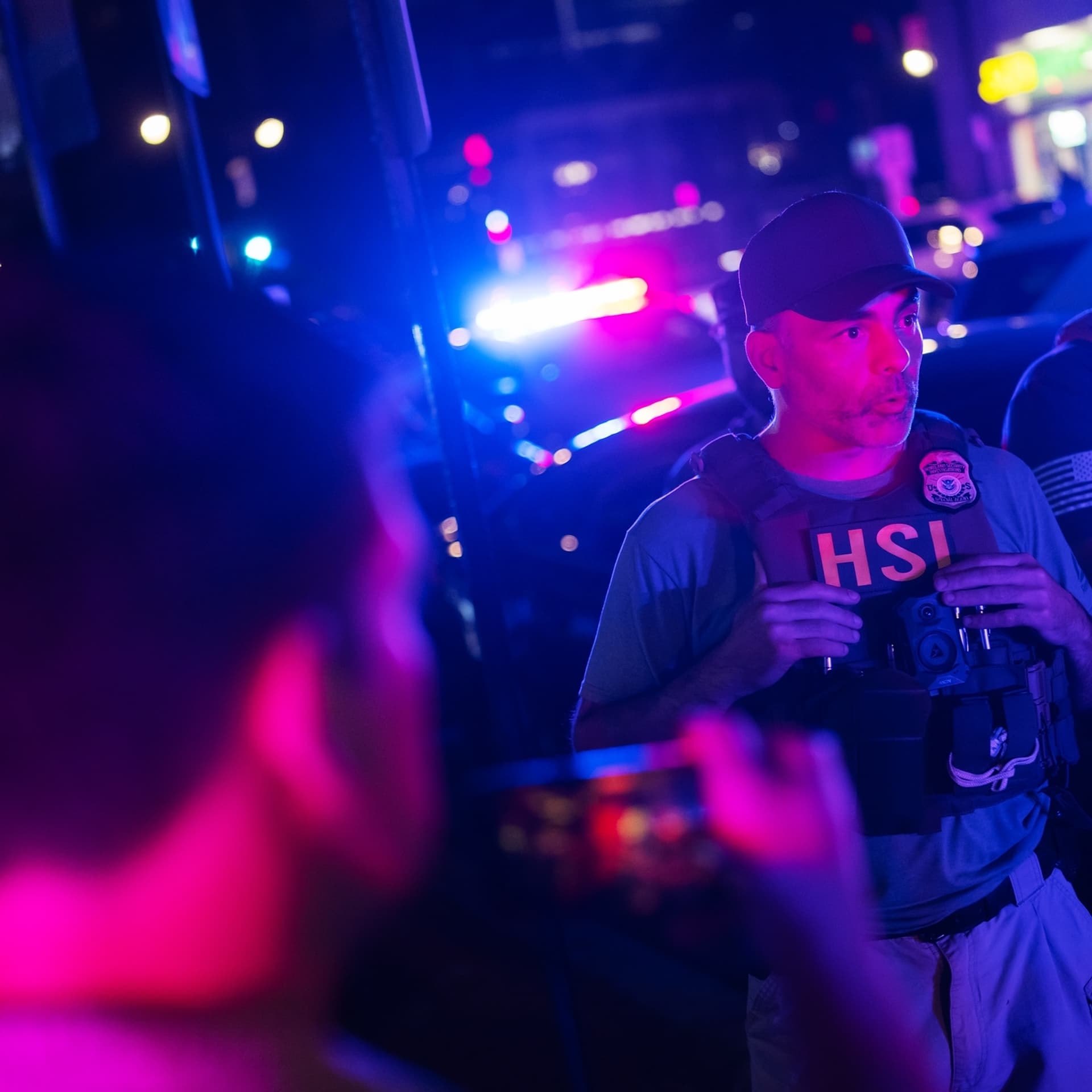
9:17Our photographer Craig Hudson then shows up, and he notices that there aren't just local police here. Well, there's also HSI with them, so. What's HSI? Homeland Security Investigation. Three officers are standing further down the block, and they look different from the local police who wear dark blue uniforms. Some of these officers are wearing green shirts and vests that read HSI. That stands for Homeland Security Investigations. This is a division of ICE. Olivia and the audio producers approach the HSI officers. And the protester Stephen has also walked down the block and questions the officers with other bystanders.
9:59Things are getting tense. His name is, what's your name? Just so we could talk. You guys don't have any actual questions. I'm trying to, I'm sorry. I have an actual question. I'll stop, I'll talk down. I'm sorry. Stephen and others ask what the officers are doing. One of them responds, well, we're educating people on human trafficking. And we're also tonight focused on helping the D.C. local police. I mean, we invest child sex crimes. We invest human trafficking, human smuggling, narcotics. You can Google it, Homeland Security, what our investigative mission is. Right now we're supporting in D.C., okay?
10:36But if you do the research, you know what we do. All the investigations we do are serious investigations against very bad people. This answer doesn't seem to satisfy Stephen. So do you think standing out here is actively investigating right now? Am I hurting anything right now? Well, yes, the community feels unsafe with your presence. The community feels unsafe with your presence. So yes, you are hurting the community. Where people don't feel safe to come outside. So law enforcement can't be outside? No, you are federal law enforcement. We don't care about MPD. MPD's done this their job. I work for Washington, D.C.
11:08Homeland Security. So I'm not allowed to be in Washington, D.C.
11:16It's nearly 10 p.m. And despite all this seriousness, there are still people trying to do what U Street does best. Party.
11:29Friday night feels like it's in full swing. Standing room only at the bar across the street. Lots of people teetering around in high heels, getting in and out of taxis and uvers. So let's keep walking down the block. Sabi and Sean leave and audio producer Rina Flores takes over for them. She meets up with Olivia, and they find a group of former and current students from Howard University. The historically black university is just off of U Street. And this group is standing in line outside of El Rey. A bar serving up tacos and tequila. Here's Andrew Fraser. We have fun, but we are black and having fun and loud and doing what we do.
12:14And there's cops every five steps, so it's a little disheartening. You know, it's... Did you ever think about not coming out tonight? It definitely did. We was like, is it worth it? But personally, it's my friend's birthday, so we can come out for her birthday. Happy birthday to her. Indeed. Indeed, we just, we don't want our way of life to be stopped before it has to be. Because, like, it's going that way that we're seeing. Like, it's dark, it's scary, it's getting real bad. But while we still can go out and be merry and have fun with our friends and just really enjoy ourselves, we want to. So we're trying our best.
12:57They aren't alone. People are out. It seems like U Street, business as usual. But it isn't that way for everyone. That's after the break.
13:18Olivia George:When it comes to the big questions, who you ask matters. From breaking news to politics that impact your life, to advice you can trust. Get answers you don't have to question with Ask the Post AI. trained exclusively on post-journalism with clear sourcing. And if we don't know the answer, we'll tell you. Ask the Post AI. Find it on WashingtonPost.com or in the app.
13:49It's still around 10 p.m. Olivia and Rina stop by Service Bar. It's known for its cocktails and fried chicken. How would you characterize it so far? Definitely quiet for a Friday. Harry Wright is the general manager here. He's standing outside under the bar's rainbow awning, and he explains the changes he's felt since Trump flooded the city with officers from ICE and other federal agencies. It's been a quiet week, I think. A lot of tension in the air, I think, for us in the service industry, where immigrants really drive...
14:37So much of the way we operate as a hospitality, food and beverage service industry, whatever you want to call it, is fueled by immigrants and people of color and queer people. And those are the people who feel the least safe in the city right now. You know, we, for a living, take care of people and work really hard to make others feel welcome in our space. You know, when I'm getting a call at 9 a.m. from one of my co-workers who doesn't feel safe to walk to work seven hours before his shift, that's insane. Homeland Security officers had stopped by some U Street businesses earlier in the week. They left flyers and tried to speak with staff.
15:26When we're here serving food, serving drink, creating hopefully like a happy, fun, welcoming atmosphere to everybody, putting on a happy face every day because that is what we do no matter what we're feeling or is going on in our own lives. Yeah, I mean, it's insane. It doesn't feel super real, even though, as I'm sure you've all seen walking around, it's very real. Most of the people who we talked to this Friday night, including Wright, say they do feel safe in the city. They also acknowledge D.C., like any big city, has crime problems. Earlier this summer, D.C. had implemented an 11 p.m. curfew for anyone under 18.
16:15The city said it was to combat juvenile crime. This area in general is just unsafe. You know, there's someone getting beat up. There's someone getting jumped. There's a fight. You know, you stand outside. There's carjackings or there's... My car was broken into less than two months ago in the neighborhood, so... This is Perry Singletary. She's hanging out at Nellie's Sports Bar. It's a gay bar that's been on U Street for almost two decades. Yeah, I mean, you're taking a risk when you're coming to U Street in general. It's a risk out here. At the same time, she's not sure whether the federal police takeover is the answer.
16:53It's a sentiment that comes up a lot this night. Can I ask just one quick question? When you sort of heard about Trump taking over D.C. police, like, what do you think? I understand you wanting to make D.C. a better place, you know. Anywhere can use everything to be better. Like I said earlier, U Street is just not a safe place to be. Some places in D.C. are not a safe place, but for you to federally take over D.C., I think that is very extreme. Just a heightened police presence. You know, I protested during Black Lives Matter, so just anything with a heightened police presence really just makes me uneasy.
17:37Perry has mixed feelings about this. I'm not going to say what he's doing is, I think what he's doing is very extreme, but it is nice to see a police presence outside because it's been quiet out here for the last week. And it's usually not, so.
18:01It's now around 11 p.m. Blocks away from Nellie's, Rena and Olivia see another commotion. And this keeps happening with the heightened police presence. It causes a kind of cycle of reactions. So we just watched what appeared to be an encounter between an MPD officer and a car that it looked like might have run a red light. So it doesn't, on its face at least, seem to be anything that is related to the increased presence of federal law enforcement in D.C. And yet you immediately saw people's heads kind of on a swivel. People have phones out, cameras are rolling, they're booing and yelling. This happens anytime federal and now local officers do police work in the neighborhood.
18:50And so it seems that even these more run-of-the-mill law enforcement interactions are being painted with the brush of what is happening with the federal law enforcement presence in D.C. right now and people's thoughts and feelings towards that.
19:11It's after midnight. Olivia meets up with producer Alana Gordon, who had arrived on U Street by bus. They walk around for a while.
19:26And after encountering more late-night partygoers, Olivia and Alana head further down the street for an important and necessary stop by this point in the night. It's 1 a.m. Where are we right now? Ben's Chili Bowl. What are you about to do? I'm about to order some fries. What time is it? 1.07. Hi! I would like some cheese fries, please. Chili? Cheese? I guess I—no, you're right, the chili cheese fries. Ben's Chili Bowl is a D.C. institution. It opened in 1958. A sign on the wall with photos and a caption nods to this longevity and everything that this area has been through. There's a sign here, and it's got some photos on it, old photos.
20:2068, Soul Brother, and it says, Following the assassination of Martin Luther King Jr. in 1968, riots erupted along the U Street corridor in D.C. Black activist Stokey Carmichael asked Ben to leave this restaurant open, this restaurant, during the riots. Ben's obtained permission to stay open past curfew and fed both the police officers and firemen working to impose order on the... The riots happened in 1968. There were similar ones across the country. In D.C., Black residents and police clashed, including the National Guard. The chaos left 13 people dead and more than 900 businesses destroyed. A lot of places closed during those days, but not Ben's Chili Bowl.
21:07That was delicious. I'm refueled. You really, yeah, you went through it. By this point in the night, other people besides Olivia and Alana had the same idea, a late night snack.
21:26Jasmine Curtis sets up her folding table two blocks away from Ben's. She has tinfoil trays with food and she is ready for the hungry late night crowd. She goes by Chef Jazzy. What food do you have with you? I have fried chicken tonight, macaroni and cheese, candy yams, green beans, yellow rice, honey jerk chicken. And yeah, that's about it tonight. I usually have more, but I did a simple night tonight. This is a simple night? Yeah. Jasmine loves to cook for people. She hopes to make enough money to one day have a food truck and then open a restaurant. She tells Olivia and Alana that she's been on edge all week.
22:10She's been keeping her two boys inside as much as she can. They're seven and four. What's this week felt like? Has it been different just with, like, the... I've been staying away from it. Like, staying in the house, staying safe. But as far as the young people going around being crazy, it's really their fault that we're going through this, because it's like, all you got to do is learn how to act like you have some common sense and we wouldn't be going through this. But hopefully all the younger kids will learn that, you know, just go straight in the house, do what you're supposed to do, and we won't have to go through this having people like the police walking around watching us 24 hours a day.
22:43Because who don't want to move around freely without that? You know what I mean? You're welcome. You guys have a good night. It is 2.30. We are once again on the corner of 14th and U. People are beginning to trickle out of bars. Some people are still trickling into bars. lots of taxis, bicycles, scooters. I think on the whole, the sense we've got from folks that we've spoken with tonight was a sense of heightened tension and uncertainty, and yet among many people that we spoke to, a conviction to still enjoy their Friday night. Whether that's getting a drink with a friend, celebrating a birthday, going to a club with people you went to college with.
23:53Despite everything that's happening in D.C. and in the world, people still wanted to hold on to those moments.
Read the full transcript
24:04Still, it's hard to ignore what's missing. Just as Olivia and Alana are about to leave, someone approaches them. Lavon Greer. He's been out at the clubs, but he has something to tell them. He points to the corner across the street. They wait there, and they're like, Oh, all right, I'm going up, I'm going down, up and around. But that's the spot. Usually, he says, this corner is filled with delivery drivers on mopeds. Many of them in D.C. are immigrants. And at this corner, drivers are usually picking up late-night food orders from McDonald's. I messed that up. There's a lot of money on that block.
24:52People that just want to serve the community. LaVon cannot help but notice that tonight, the corner is totally empty.
25:09It's almost 3 a.m. This was an unusual Friday night for U Street. Olivia and the rest of the crew head home.
25:30On Saturday morning, a few hours after Olivia and the rest of the crew headed home, several people saw police violently tackle a food delivery driver. The driver was leaving a nearby coffee shop with an order. He was walking towards his moped, and a witness said he started to run when he realized agents were following him. Our colleague, Dan Rosenzweig-Ziff, was there too.
25:58What agency are you guys with?
26:05Can you tell us what agency you're with? I'm impressed. I'm impressed. What agency are you with? I don't care, my guy. You don't care what agency are you with? I don't talk to the press. This incident involved six federal officers wearing police vests. The vests had no clear identification of their agencies. The officers tackled the man to the ground. They appear to use a stun gun. And then they drove him away in an unmarked black vehicle. A Department of Homeland Security spokeswoman later said they detained the man, a Venezuelan national. She said he had entered the country illegally in 2023 and a judge ordered his removal later that year.
26:46DHS said he had active warrants and repeatedly failed to appear for court dates in Maryland related to traffic crimes. Since the arrest, the Post has been unable to independently verify whether the man has a Maryland traffic record or whether he had previously applied for protection from deportation. DHS has not responded to requests for additional information. And it's not yet clear whether the detained man has a lawyer. This week, Trump has continued to defend his decision to take over D.C. police. He spoke about it from the Oval Office on Monday. They're fighting me on the fact that I've made Washington, D.C.
27:30safe. We're not going to get mugged, beaten up, or killed like all the people you've been watching get so badly hurt. In this show, you heard Washington Post reporter Olivia George. She covers the Trump administration's impacts on the D.C. region.
28:38Olivia George:We'll see you next time. Find it on WashingtonPost.com or in the app.
From the publisher
A team of “Post Reports” producers join Post reporter Olivia George for a Friday night out on U Street NW, a major hub for nightlight in the nation’s capital and an area that has experienced one of the highest number of crimes reported this year. They speak with businesses, partygoers and workers to hear their experience during the first weekend since President Donald Trump’s takeover of D.C.’s law enforcement. The changes in the nation’s capital are palpable.
Trump announced the police takeover last week. He also sent in 800 National Guard troops with at least six Republican-led states agreeing to send hundreds of additional Guard troops. As more federal law enforcement and immigration officers take to the streets, setting up check points, arresting and detaining people, tensions have been growing in the city.
Trump has described his federal intervention in D.C. as a crusade against crime. In its first week, the main targets have increasingly been immigrants and those experiencing homelessness. Videos of local detainments have reverberated through group chats and social media.
Today’s show was produced by Elana Gordon, Reena Flores, Sabby Robinson, Sean Carter and Thomas Lu with help from Rennie Svirnovskiy. It was edited by Reena Flores and Renita Jablonski and mixed by Sean Carter. Special thanks to Craig Hudson, John Ramsey, Kaitlyn Dolan, Katie Mettler and Dan Rosenzweig-Ziff.
Subscribe to The Washington Post here.