In short
Podcast Episode Notes: How to Launch a Second Act in Life, with Comedian Zarna Garg
Episode Overview
- Podcast Title: Post Reports
- Episode Title: How to Launch a Second Act in Life, with Comedian Zarna Garg
- Hosts: Elahe Izadi and Martine Powers
- Description: This episode features Zarna Garg, a successful comedian who launched her stand-up career later in life, alongside her daughter Zoya Garg, who plays a significant role in her business. The discussion touches on entrepreneurship, familial relationships, and the importance of embracing new beginnings.
Key Personas
- Zarna Garg: Comedian and entrepreneur; known for her humorous take on the immigrant experience and her family dynamics.
- Zoya Garg: Zarna's daughter and business partner; responsible for Zarna's digital strategy and overall production management.
Main Themes
- Journey to Comedy
- Zarna Garg's background includes:
- Immigrating to the U.S. as a teenager.
- Completing law school and being a stay-at-home mom for 16 years.
- Initially skeptical about stand-up comedy, prompted by her daughter Zoya's encouragement to try it at an open mic night.
- Comedy was always a part of Zarna's identity, but she did not see it as a viable career until later in life.
- Entrepreneurial Spirit
- Zarna has a history of starting various businesses before comedy, including:
- A tomato sauce company.
- Matchmaking services.
- Tutoring and a toothbrush company.
- Zoya describes Zarna as an entrepreneurial role model, recognizing her mother's unique personality that could translate well to the stage.
- Navigating the Comedy Industry
- Zarna's material often draws from her experiences as a mother and immigrant, resonating with a diverse audience.
- She aims to find common ground in her comedy, focusing on universal themes (like challenging mother-in-law relationships) rather than political divides.
- Family Dynamics in Business
- Zoya plays a vital role in Zarna's career by managing digital strategies and business operations, illustrating a modern twist on the "momager" dynamic.
- Their relationship has evolved through their professional collaboration, allowing for deeper bonds and shared experiences.
- Social Media and Comedy Evolution
- Zarna emphasizes the shift in comedy popularity with the rise of social media platforms like TikTok, where she began sharing her work, leading to widespread recognition.
- Zoya's brother initiated the idea to share Zarna's performances online when comedy clubs were hesitant to book her due to her being a mom.
- Controversial Performances
- Zarna participated in the Riyadh Comedy Festival, which sparked debate due to Saudi Arabia's human rights record.
- She defended her choice, expressing that her performance could empower women in that region who resonate with her humor.
- Advice for Starting a Second Act
- Zarna emphasizes the importance of taking risks and pursuing passions, especially for women.
- She suggests that it’s crucial to not shy away from opportunities and to continuously seek personal growth.
Key Takeaways
- Embrace Change: It's never too late to reinvent oneself and pursue new passions.
- Family Support: Engaging family in professional endeavors can strengthen relationships and provide mutual learning experiences.
- Cultural Representation: Stand-up comedy can serve as a platform for cultural expression and bridging gaps between diverse audiences.
- Entrepreneurship: The entrepreneurial spirit can manifest in various forms and is essential for personal fulfillment and family legacy.
- Courage to Perform: Engaging in controversial spaces can lead to meaningful dialogues and promote visibility for marginalized communities.
Conclusion This episode encapsulates Zarna Garg's inspiring journey from a traditional background to becoming a celebrated comedian and entrepreneur. With her daughter's support and their shared experiences, they challenge societal norms and advocate for women pursuing their dreams at any stage in life.
Written by AI. May contain mistakes. Listen to the episode to check what was said.
Transcript
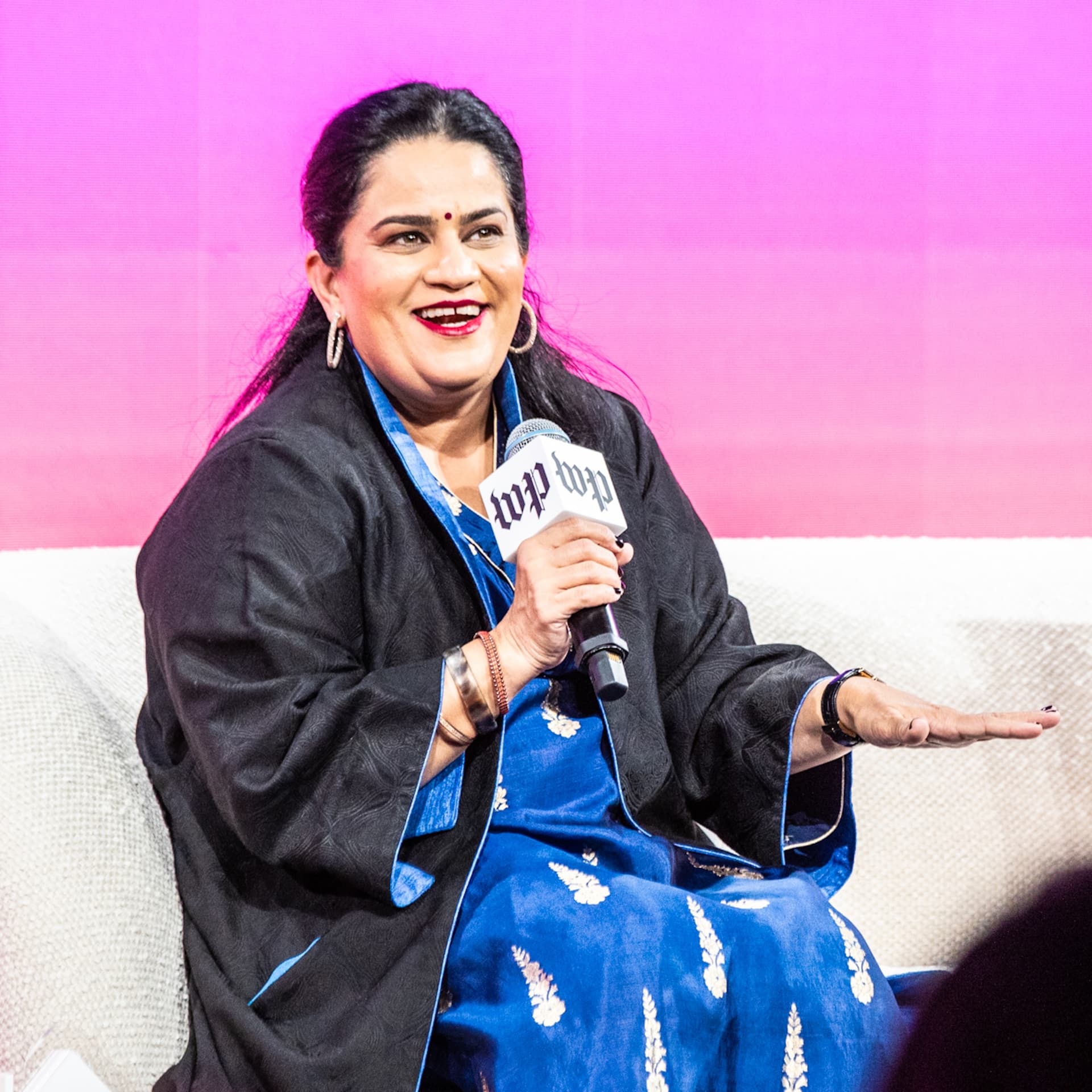
Automatic transcript. May contain errors.0:00Hi there, it's Ella Hay. Today I wanted to bring you something a little different for our weekend episode. Last week, I interviewed a comedian you've probably heard a lot about lately, Zarna Garg. She's got streaming specials, a best-selling book, and millions of followers on social media. And she only started doing this six years ago. I sat down with Zarna and her daughter-turned-business partner, Zoya Garg, at the Washington Post Global Women's Summit. We spoke before a live audience. It was a really funny conversation, but we also hit some serious notes. We talked about how they built her business, Zarna's decision to perform at the Riyadh Comedy Festival and the controversy around it.
0:49And also, I get Zarna's advice for anyone who wants to begin a second act in life. Okay, I hope you enjoy the show.
1:01I'm thrilled today to be joined by Zarna Garg and Zoya Garg. Zarna, Zoya, thank you so much for being here today.
1:12Thank you. Thank you so much for having us. Namaste, Washington Post! Namaste! Thank you so much for having us. Yes, and thank you for participating in the Washington Post Global Women's Summit. I want to first ask this question for you, Zarna. As the video showed, you came to the U.S. as a teenager. You put yourself through law school. You were a stay-at-home mom for 16 years. I would imagine stand-up comedy was not on your radar as a thing that you would do. But I now ask you, now that you have become a very successful stand-up comic in a relatively short period of time, looking back on your life, do you see that comedy was always present for you?
1:53Or did you come to and find comedy? So people always told me I was funny my whole life. And that is the worst thing you can tell an Indian woman. My parents were literally devastated. They were like, we didn't get the doctor. We didn't get the engineer. We didn't even get the accountant. We got the funny one? What do you do with the funny thing? My whole life, I was like, okay, I'm funny, but where is my math gene? Why am I not good at math? And so people have been saying I'm funny my whole life. I just didn't think it was a job until... I remember the open mic. My kids, my daughter made me go to this open mic.
2:38And the first time I was out there, I was like, white people do this? Well, on a Wednesday afternoon, this is their work. Yeah, like in a basement of a restaurant. In the basement of a Mexican restaurant. Indian people don't feel like they're at work unless they're like crying. Like there's like a heart transplant waiting to happen. That's like my cousins. You weren't stressed is what you were saying. Yeah, we've taken 10 exams and failed and had to take an exam again. So none of this made any sense, but I've been told I'm funny my whole life. Well, and so Zoya was the one who convinced you six years ago to try stand up.
3:19So Zoya, your mom is saying everyone's always told her she was funny, but doing stand up is different than just being funny. What convinced you that she could do it and how did you actually persuade her to do it? OK, so my mom has always been so entrepreneurial from a very young age. She raised me like a business. Like there was no, there was nothing about me that was accidental. Down to the baby carrot, everything was calculated. And so I was like, man, my mom is something special. She was starting all these businesses, a tomato sauce company, a matchmaking service, tutoring, toothbrush company too.
3:56Okay, we're going to have to circle back on that one. Yeah, and nobody would buy her products. even though the tomato sauce was outstanding i just want you to know yeah yeah but people it was inedible but but um people would buy just because they wanted to talk to her for an extra minute and i remember when i was 16 i was like you have the personality to go on stage and be is Seinfeld. And she was like, that's not a job. And I grew up here and I grew up with standup comedy being a big part of my life. I'm a New Yorker, public school, New Yorker, very proud of it. Yeah. And New York. And so I, yeah, I was just, I knew that she had this ability to make anybody laugh.
4:49I wanted her to get paid for it. Was that the thing that got her to say, yes, I'll do it. I can get paid. I was like, I don't see anybody else making mother-in-law jokes. And then, okay. Well, Zarna, I want to ask you your act for those unfamiliar. You have obviously like, yes, you make fun of your mother-in-law, but you, you, you focus on the joys and the complexities of the immigrant story and journey, which is very, everyone has a different immigrant story and journey, but I'm wondering your material, your comedy, are you finding it's resonating differently right now in this current moment that we're in?
5:25Yeah, I mean, every, you know, every year, there's some new stress out in the world. And that affects the comedy that affects the audience. But I think people are ready to laugh even at the whole immigrant situation. Like, there's so much anger. There's so many comics who do political comedy. So they focus on the politics of it all. And they like are, you know, pundits in their mind. I get the feeling that's not your vibe. I'm like, no matter what you believe in and no matter what you think of immigrants, you probably hate your mother-in-law. So let's just stay in that one area where we're all united.
6:06Yeah, you're looking for a common ground. And let's build from there. That's so... Wow. There might be a peace plan in this. so Zoya when I think about what you now do you do you do more than just convince your mother you run her digital strategy you are the COO of Zarna Garg Productions I almost think of it as the flip of the typical like momager you're like a dotager feel free to take that if you haven't used it already. You're welcome. How has working for your mother and being in this sort of role with her, how has that changed your relationship with her as a daughter? We could use an HR department.
6:56We could. We could. I've only recently started getting paid. So no, in all seriousness, it is the greatest gift to get to spend so much time with my mom. I think a lot of people graduate. I just graduated from Stanford. Thank you. Yeah. Tell them with what degree. Tell them. Because I'm going to die. They need to know. I got a classics degree. And? No, and, and. I also got a computer science degree. Thank you. Congratulations, Zarna. Why are you congratulating her? I know what happened. She knows. Listen, she wanted to do a classics degree because she's a great writer and all of that. Fine, whatever.
7:44And I was like, I'm not paying. It is so expensive. If you want to write, just stay at home and write. I am not paying. If you're at Stanford, you're going to learn computer secrets every day. I don't care. It's like if you go to the bathroom at Stanford, like make sure that if there's any secrets on the toilet paper, get them all. Okay, I just want to open it up to the audience. Do you guys think it's hypocritical that my mom, who is a professional artist, professional artist, does not want me to pursue my talents as a writer? Round of applause if you think that's hypocritical. Yep, I didn't pay them to say that.
8:22No, guys, I know she's my kid, but you don't have to agree with her. You can still love her and not agree with her. No, but yeah, I feel like a lot of graduates oftentimes say they don't get a lot of time with their parents when they graduate. They have to move to a new city and I don't have that problem. We spend all of our time together, 24 hours of the day and it's been so wonderful. I think if you want to get to know anybody, you should work with them. You'll get to know them in a different way for sure. Yeah, it brings out the good, the bad. Zarna's face. Zarna, okay, I have to say for those listening, your face, you're doing a lot with your face.
9:01You also get to know your Gen Z employees really well. Well, okay, it's not just Zoya. You also, your sons help with your social media. Your whole family is involved in this. Yes, because hashtag believe in child labor.
9:18There they are on the screen. I had a day of thinking, why am I the only one working? Like, what? But like on a serious note, also your husband provides financial advice. Why was it important for you to involve your family in your business? Because I think some people are like, I'm not going to do business with my family. Yeah.
9:41I have three kids, right? So it first started because I knew that leaving them home alone. I was a C &O mom for 16 years. The thought of leaving these kids alone, I had a moment of like, did they make me do comedy? so I'm out of the house nights and weekends? Because that was smart, right? The job is nights and weekends. And I was like, if I leave them home alone, they're going to be up to no good. You know that, right? Look at how cute my son is. Look at him. No comment. The older one. The older one has green eyes. I was like, no, no. Some girl is going to step in there and try to take my son.
10:17By the way, no regards or concerns about the daughter here. She was fine. Just the eldest son. So I started taking them with me. Honestly, I took my kids along because I wanted them to learn. You wanted to learn what? Learn how to build a business, like how to take rejection. They were with me every time my businesses before comedy failed. And I wanted them to be completely normal with the idea that most shots you take in life, you're going to fail at. That's a really interesting point because I think, especially with stand-up, there's so much failure built in. The only way you learn how to do it is getting in front of human beings and bombing, performing badly.
10:58And the fact you wanted your family to witness the ups and the downs, like you were methodical in wanting to build resiliency in them. It's an education and you have to learn. And they saw it. You know, it's still easier for you to take a shot and fail. It's very hard to watch your loved one. I could see my kids getting tortured. But I've had so many, not a lot, actually. a few bad shows a few bad shows wow and and i used to do shows for indian uncles like if you okay let me tell you something tough crowd like okay zoom comedy covid years that i was one of the first to go straight to zoom because i knew that's where the future was and for people who don't know it was like during covid there would you would instead of going to a live show you'd log onto a zoom and just see zarna talking into a computer screen so let me tell you in zoom the Indian uncles don't hold back.
11:51The chat is lit. She's not funny. She's not funny. That wasn't funny. You're still doing the show. You're reading the same chat. You're like, and as you're delivering the joke, the reviews are coming, like mid-joke. But they were all in the rooms with me because one was managing the lighting and one was managing. So they saw that surviving that and having to survive that is a part of building a business. And if it wasn't for how desperate we felt in the very beginning, because this didn't come out of nowhere. Like it is an honor to be in this room with all of you and like really surreal, genuinely, that it's only happened in six years.
12:31But when we started, no New York City comedy club wanted to give her minutes because she was a mom and that wasn't new. And at this time, social media wasn't such a big part of the equation. Like things were just getting started. And I remember a lot of standup comedians weren't comfortable with putting their standup online. Because you want to save your standup. You want to save those minutes for ticket buyers. And my brother, who was 14, was like, let's just put mom's set on TikTok. And my mom was like kind of hesitant, like, okay, I haven't really heard of TikTok, but we can try it. I mean, nobody else is giving me minutes.
13:07And I remember we put her joke about, I've never said I love you to my husband on TikTok. Which I would never. What's the joke? It's only been 26 years. What's the rush? Yeah. So you put that, and it went viral, right? And it was like 100 ,000 views, 200 ,000 views, a million, two million, from people around the world who were like, yes, I also have never said I love you to my husband. And after that point, it wasn't about whether or not the comedy clubs wanted to book her. It was about who wanted to see her. And I believe that she pioneered the beginnings of putting stand-up on social media. Now every stand-up comic is doing it.
13:51But six years ago, that wasn't the case. After the break, more of my conversation with Zarna and Zoya Garg. We'll be right back.
14:03Good journalism is even better when it's shared. With a premium subscription to The Washington Post, you get three extra accounts to share with friends and family so they can stay informed too. Right now, you can get a premium subscription to The Post for$6 every four weeks. Just$6 unlocks trusted reporting to share with other people in your life. After your first six months, it'll cost$19 every four weeks. You can cancel anytime. Head over to WashingtonPost.com slash subscribe and get premium access to The Washington Post today. That's WashingtonPost.com slash subscribe. vibe. There is this tension among many comics of wanting to preserve their material for the live show for the special.
14:48I mean, you already have two specials in six years in addition to a book that's like, pretty prolific, as far as comics go. And I remember years ago, first talking to you for a story precisely about this. And at that time, I was when I asked you that question of like, aren't you worried? Don't you want to preserve some of your material for your live shows? And I was really struck by how you talked about your audience and your fans. And at the time you told me, I'm selling a vibe here. Can you tell me a little bit more about how you knew like from the beginning, I'm I'm this is how I'm going to approach it.
15:21I'm not going to worry about this. I, I believe no one is going to a comedy club to hear a joke anymore. You want to hear jokes, they're available on YouTube for free. You can hear endless hours of jokes. You can even craft your own on chat GPT. You can be like. It's not very good though. I have to say. You can put your mother-in-law's photo up there and be like, write jokes about her. And in a minute, you'll get custom jokes. Wow. Technology is amazing. Whoever created that feature at OpenAI, thank you. I think I I believe that people who follow us and our journey follow us for more reasons beyond the jokes the jokes are fine the jokes are a way to open the door but we stand for a lot more than that I think a lot of moms follow me because they feel like they too can have a second act in life a lot of women follow me because they think oh maybe they can like brown women had never seen anybody that looks like them do what I do.
16:25You know?
16:30So you don't buy a ticket to go to a show because, oh, I wonder if there's going to be a new joke. Which, by the way, I write jokes every day. It's my business. That's the other thing. A lot of comics are precious about their jokes as if they're only going to create for a day or a month or a week. We're in the joke writing business. I write jokes all day long. I walked here, I wrote a joke. You know what I mean? But who gives her the material? now I see why you're the COO. Yeah. And you did build up this audience very quickly. And, you know, you brought up being a woman, woman of this, you know, you're a brown woman, you're a woman of this age starting out and you have reached a lot of people.
17:07I did want to ask you this other question, which is a couple of months ago, Zarna, you were one of, I believe, just three women who were invited to perform at the Riyadh Comedy Festival. And this was put on by Saudi Arabia. Since then, many of the comedians who participated in this festival have been criticized for their participation given the kingdom's record of human rights. And we should say that also includes journalists, including a Washington Post columnist. And I know some comics who participated since then have spoken about this. They've either defended their participation or they have since apologized.
17:43For you, why did you agree to do this? Why did you decide you wanted to do this and what do you make of the backlash now uh so the backlash was interesting because it was the mostly comics who weren't invited who turned that into a press tour and that was an interesting choice like jobs that we were not doing because i don't really involve myself in decisions that other comics make or don't make so i you know but whatever gets them the eyeballs i get it like i'm a content creator i get it um i personally understand i understand the anger especially at Washington Post given you know the history I completely understand it but I also understand that the women of Saudi Arabia are watching me so my jokes are being watched in secret by those women like believe it or not I'm like the bad comic because I'm like trashing my mother-in-law you know so they're watching me in secret and writing to me all day my inboxes are full my both my comedy specials were number one in the middle east and so all these women are writing me all the time they're like please come to us we want to see what you do we want our daughters to see what you do so i personally was caught between a rock and a hard place and i was like you know what i want to go there and see with my own eyes what what it's like what what are the people like what are we dealing with here because you know you read the news in america then i read indian newspapers every day because i'm indian and that's what i'm used to And today in 2025, how do we do we have any hope of moving forward in some way, even with the history of that regime?
19:21So I went with an open mind and the audience was all everyday women who've never they're like, we can trash our mother-in-laws. Yes. Yeah. I was like, yes, let's start there. You know, again, it's full circle going back to if I'm your Gloria Steinem on this topic. Let's go. But it is true. They had never seen this as a possibility in their lives. And I believe that even to effect any kind of change, you've got to fight for a seat at the table. You've got to show up and talk to people you disagree with, deal with people that scare you. Quite frankly, a little scary to go there as a woman. Like we don't know.
20:02I didn't know what it's like. I'd never been to Saudi Arabia. She didn't allow me to go. You didn't go with Zohia? No, she didn't allow me because I wasn't sure what this what the lay of the land is and you know there were a lot of moments where I was like should I be doing I get it I get why my fellow comics have their own feelings about it but I went for the women because I'm trying my best to advance women everywhere I go I'm trying my best to create more opportunities for women everywhere I go uh my opening act on my tour is a single mom who has MS. She tours with me all over the world and no club was going to give her a spot.
20:40But I don't want her to be stopped by this. So that's why I went and honestly like the person who was most excited I was going my mother-in-law. She was like go, go do your favorite thing. Give them all your opinions. They say don't drink, but have a cocktail or two. So when I came back, she was disappointed. She was like, you're back? And I said, yeah. And she goes, how was it? I said, it was great. I got a standing ovation. And she's like, they didn't put you in prison. They didn't reprimand you. I was like, no. In fact, I think they want me back. I had a sold out show. They want to hear more stories about you.
21:31So. Zoya, you've had this front row seat from the beginning to seeing what, I mean, I know it's not just your mother. There's a whole crew. It's a small crew. You're part of it. But it is her material. She's out there as an artist. Seeing her take on the second act and everything she's built and find her voice in this way. Although, you strike me, Zarna, as the type of person who always had her voice. You just brought your voice to us. How has that made you think differently about your path? You just graduated college, as you said, as you make your way in the world. I just I've never seen the fullest extent of what my mom could be until she took on the second act.
22:12There are so many parts of her identity that were so like nascent and kind of hiding under the surface. And then with every gig, with every appearance like this, with every opportunity she got, she got a little bit stronger and a lot of a little bit funnier. And her outfit, I mean, her outfit in many ways is a protest to what like a stand up comedian's outfit is. Let's talk about it for those just listening. Yeah. What do you mean by that? I mean, she wears a serva camise. Did I pronounce it right? Oh, my God. Every idea. Oh, my eye roll. There's an eye roll. Guys, I know Latin. I don't know Hindi.
22:48But, you know, she wears a bindi everywhere she goes and she proudly spreads her culture. I think a lot of people sometimes ask what's the most important job in the next 10, 20 years. I think stand up comic. You know, there are so few rooms left where we can actually push the political boundary of what's culturally appropriate and have these hard conversations. And I think a stand up club is one of those rooms. And so I just I feel in awe that I get to work with somebody so brilliant every day. But does it allow you? I don't know. This is streaming and my mother-in-law is watching as we speak.
23:25I can see her being like... Like rolling her eyes a little bit, unsure. I mean, but like, does it make you think of, like, you're in awe of her, but does it give you, does it empower you? Do you feel like a sense of, well, if my mom did this, like, what's to stop me from doing what I want to do? Oh, I'm constantly under threat. I mean... What do you mean? Meaning if I don't make this work, I'm getting fired. Oh, oh. there's there's there's no severance package oh no no it's very serious business I mean I she puts a lot of pressure on me in fact like my most recent accomplishment within our business was I led the New York Times best-selling campaign for her memoir this American woman um which you all are getting a copy of I believe um thank you surprise um it's very well documented Forbes did a story on it, how I used AI tools to help us get on the bestseller list.
24:19But I, in November of my senior year of college, wait, how did you do that real quick? Oh, I'll explain. Michael, hold up. It wasn't anything bad. I didn't do anything bad, but I was very strategic. But in November, I had just completed an internship at Apple and I was exploring technology a lot because I was in the heart of Silicon Valley. I mean, how could I not? I had this intense amount of FOMO around the AI boom. And my mom was like, go be an engineer. And I was like, oh my God, okay. And I didn't feel like my heart was really in it. And I remember I felt really lost. I was like, I don't know what I'm doing.
24:52I don't know what my role is. And her memoir was about to come out. And for many of you who might be unfamiliar with the book industry, pre-orders determine whether or not you make a bestseller list. Pre-orders determine whether or not bookstores stock your book. Pre-orders basically determine the success of a book. It's not about the sales afterwards. And so she looked at me and she said, hey, I need somebody to sell 10 ,000 copies of my book before it's out. It's going to be you.
25:20I was in my senior year of college and my mom looked at me. She was like, sell 10 ,000 copies of this book, figure it out, go. And I was like, what? I don't even know what a pre-order is. I don't know how to sell a pencil. I mean, I just didn't know what to do. And over the course of like nine months, I learned everything you could possibly learn about selling a book. I talked to AI models. I was like, how many books do I need to sell? I helped source leads for small businesses that we could collaborate on small bulk orders with. And now I've like advised incredible teams like Bobby Brown and Malala and their own book campaigns.
Read the full transcript
25:53And okay, so now you're like an AI book promoter. This is amazing. They tried to poach me, but she wouldn't let me. She wouldn't let you. So we're almost out of time. And before we wrap up, Zarna, I want to ask you this question. You touched on it, this idea of you're in your second act of life. What advice do you have out there for women and for anybody listening if they are a little nervous about taking a second act in life? My advice is the way my, you know, true to my voice. It's a little bit of tough love. You can't afford to not. You just have to. You can't afford, like, it's not an option.
26:32If you're living your life, you're well, you should be taking shots every day. Take shots and fail it doesn't matter nobody cares but you don't want to look back the way I saw it when I was losing every day I was like even if I win the day before I die I still won I still won and that's all you should be focused on and I think as women we cannot afford not to take shots we all have to roll up our sleeves and get involved in the world in creating in engaging in every way possible which is also exactly why I did reality it is not helping anybody for me to sit here and give a press conference. I got to go there.
27:102 ,000 women there saw what I do. 2 ,000 women there now know that a woman that looks like them can do what I do. And that's me. Your version could be different. Your version could be whatever other things that you want to try. But we need every human being with good intentions to get involved. And like, seek inspiration from the world we're in. People who should have imposter syndrome don't have it. One moment.
27:41Well, that's a great note to leave on. And they're running for president.
27:54You can start your chili business. It's good. Well, unfortunately, we have run out of time. So Zarna and Zoya, thank you so much for joining me in this great conversation.
28:33people in your life. After your first six months, it'll cost$19 every four weeks. You can cancel anytime. Head over to WashingtonPost.com slash subscribe and get premium access to the Washington Post today. That's WashingtonPost.com slash subscribe.
From the publisher
From starting a tomato sauce company to launching matchmaking services, Zarna Garg’s entrepreneurial spirit has always been on display. But when daughter Zoya Garg dragged her to an open-mic event and introduced her mother to the world of stand-up comedy, the older Garg seemed skeptical.
Fast-forward six years later. Now, Zarna Garg has streaming comedy specials, a best-selling book and millions of followers on social media.
Host Elahe Izadi spoke with Zarna and Zoya at The Washington Post’s Global Women’s Summit. Before a live audience, the three explore Zarna’s journey to finding comedy, the changing face of the industry on social media, and how it’s never too late to launch a second act in life.
Subscribe to The Washington Post here.