 Post Reports
10 Jun 2025 · 23m

 Add vo to ChatGPT or Claude to ask about everything you hear
vo listened to this episode to put together the overview and transcript, so there may be the odd mistake.
The Washington Post’s Post Reports explains how Trump’s 2025 travel ban was designed to be harder to overturn in court, contrasts it with the 2017 “Muslim ban,” and details who is affected and why reactions differ.
David Nakamura, an immigration reporter for The Washington Post, discusses policy rationale, visa categories, and legal strategy.
The administration says the ban targets national-security risks (terror links), weak criminal/passport controls, and visa overstays, tying the “overstay” rationale to a Boulder, Colorado attack by an Egyptian immigrant (though Egypt isn’t on the list). Advocates call it politically opportunistic and racially motivated; they argue the country-by-country logic is inconsistent with broader overstay data.
2017 airport chaos and lawsuits (ACLU and states like Washington); Supreme Court upheld a revised version in June 2018. This time, airports saw fewer disruptions due to lead time.
0:01Within days of becoming president in 2017, Donald Trump banned travelers from seven Muslim-majority countries from entering the U.S. This travel ban stunned a lot of people. It created mass chaos at airports. People showed up in droves to protest. Let them see their lawyers! Let them see their lawyers! This is what America looks like! This is what America looks like! The ban also sparked immediate legal challenges. Eventually, the Supreme Court upheld a version that stayed in place until Trump left office. Now, Trump is president again, and he's rolled out a new travel ban that went into effect Monday.
0:48People from a dozen countries are now barred from entering the U.S. And this policy seems much more carefully crafted to withstand legal challenges. So will this ban be here to stay? From the newsroom of The Washington Post, this is Post Reports. I'm Elajeh Izadi. It's Tuesday, June 10th. Today, I talk with immigration reporter David Nakamura about how the Trump administration crafted this travel ban, who will be affected, and why the response has looked so different this time.
1:33David, thanks for making time to join me today. Hi, Elahi. Thanks for having me. Okay. So, David, before we go any further, let's just talk about the basics of this ban. As I said, there's 12 countries. They are fully banned from entry into the U.S. It includes Afghanistan, Myanmar, Chad, the Republic of Congo, Equatorial Guinea, Eritrea, Haiti, Iran, Libya, Somalia, Sudan, and Yemen. So this means travelers from those countries cannot come into the U.S. But can you tell me more about the groups of people within that who will be most impacted by this? Sure. The broadest things are you could separate into two different categories.
2:14One is sort of family reunification visas. And these are folks who have some family members in the U.S. who are trying to come as legal permanent residents and eventually get green cards. So they apply and they sort of take their time to try to get here. That is completely shut down for all of these countries. So let's say there's someone who is a U.S. citizen and they have a family member from one of these countries like Yemen or Sudan and the family member wants to visit them, but they can't visit them in the U.S. anymore. Yes, there are some exceptions broadly to these, which we can get into.
2:43And for the U.S. citizens, if it's their spouse or minor children, they will be still allowed. But any other relatives, adult siblings, parents, things like that will be banned under this. The second group are basically folks who come temporarily under tourist visas. It's called B-1 or B-2 visas that allow people to work here for business reasons temporarily. Student visas also are suspended, as well as what are called J-1 cultural and exchange visas, which allow people to do educational and cultural activities for a temporary basis. And this is a pretty broad category, but these folks are also mostly not permitted to come.
3:18And then there's a partial ban, right? Which countries are included in that? Right. The partial ban affects the countries of Burundi, Cuba, Laos, Sierra Leone, Togo, Turkmenistan, and Venezuela. So the partial ban also blocks all family reunification, immigration visas. It also covers a great deal of the sort of temporary visas, but does allow some exceptions on those, including some temporary work visas, as well as other specialty visas and categories where we need certain kinds of workers or the U.S. judges otherwise that folks could come. And how many people are estimated to be affected by this?
3:52So there's no clear estimates. What some analysts I've talked to have looked at was the number that have come into this country from the 19 countries that are on this banned list in 2023. And if you look at that, the numbers range from about 25 ,000 to 30 ,000 family visas from those countries in one year. And then more than 100 ,000 if you add up the categories of, you know, tourist, business and cultural exchange and student visas. So 100 ,000 to 120 ,000. So it's a significant population. What is the reasoning from the Trump administration as to why travelers from these particular countries should not be allowed to come to the U.S.?
4:27Right. So the administration, when they announced this last week, offered a sort of a rationale. And so they're saying some of these countries have, you know, kind of connections to terrorists. They're not doing enough to stop terrorists around the world. There's another category, which I would say slightly, it's about terrorism, but it's slightly different as well. They said, look, there's countries that don't keep track of their own criminals. You know, it may not be full on terrorism, right, but these are criminals and they're just giving them travel passports. You know, they're coming into the United States.
4:52Trump talks about, as you know, sort of about immigrants who are coming in criminal gangs and to make mischief in American cities. That's another area saying they're not monitoring passport control as folks get a passport and then apply for a U.S. travel visa. The third category, though, was very new. It was not something that had at all been mentioned in his first term. And that is what's called visa overstays. People who get a U.S. visa, they come from another country. Maybe it's a 30-day or several-month visa, but suddenly it expires, but they remain in the country. What you heard the president do when he announced this last week was tie this to the situation with the attack on the protesters who were demonstrating in Boulder, Colorado, on behalf of Israeli hostages a couple weekends ago, where they were attacked by a man who the administration's accused of doing this, who was an immigrant from Egypt.
5:43The recent terror attack in Boulder, Colorado, has underscored the extreme dangers posed to our country by the entry of foreign nationals who are not properly vetted, as well as those who come here as temporary visitors and overstay their visas. We don't want them. And he had ultimately, it looked like, been here on a visa, temporary visa, and then he did overstay. Now, he apparently applied for asylum, which could potentially have allowed him to stay. But the administration said, look, this is a visa overstay. And Trump connected it to what his role of the travel ban, even though Egypt was not one of the countries.
6:18Egypt isn't one of the countries. So is it actually connected or is it more about the like the politics of the moment? I think that the advocates would say, look, this is a politics of the moment. In fact, some did accuse Trump said it was all about politics, looking for an opportune political moment to do this and scare people. But, you know, I think the administration would say and did say that Egypt has been, quote, working on, you know, these issues with the United States. So we're letting them off the hook, essentially. You talked about the reasons why the Trump administration said that these countries need to have travel banned from them, that it's national security and other reasons, right?
6:52Or they're not properly vetting travelers from these countries. What do we know about how true that is or not? So it's, you know, some of the analysts that we talked to and heard from the first days pointed out that the number of American citizens who've been killed by any sort of terrorist on this list, I think, was one. How do you judge how dangerous a country is based on its overall population? Is it based on incidents around the world, not necessarily in the U.S.? Is it fatal incidents? You know, I think advocates who are looking at national security but are sort of supportive of broader immigration in the United States would say this is too extreme.
7:30On the issue of vetting and areas around travel documents from some of these countries, people said, look, there's some truth to some of that. Some of these countries don't have the best controls and they should be improved. But is shutting down all travel from these countries the right way to go? And then the third thing is these visa overstays. If you look at the 2023 data, which is the last one we have from different countries around the world, how many of their citizens are coming here and overstaying visas? A number of countries that are not on the list, including Spain, had thousands of visa overstays, much more than Chad, which is on the list, was on the list the first time people were comparing the two and seeing that Spain seemed to have a lot more.
8:04So, you know, is this consistent? And could that then open up an avenue in a court of law to say, what is the rationale? And is that a legitimate rationale? out. And what do immigration advocates or people, you know, groups just focusing on human rights in some of these countries, what do they have to say about banning people from these countries coming to the U.S.? Yeah, they're outraged. I think it's, you know, political opportunism, inhumane. They think it's racially motivated. Others would say, look, you know, this is bad because these people are trying to do it right. They're trying to get a visa.
8:34They're going through the right channels. They're not sneaking over the border. They're coming through points of entry. And some are trying to be reunited with American family members or legal permanent residents who are here and that they've been waiting their turn in line and now they're suddenly just denied. And how have the countries that are on this list responded to the travel ban? You know, it's a good question because it's kind of run the gamut. You've seen some of the countries say, yes, we want to work with the United States. You know, we're going to do what we can and try to get off the list and help our citizens.
9:03But others have been more combative. I think Venezuela in particular was saying, you know, this is not, you know, something that in any way is supported by law and people don't want to come to the United States. I think, you know, you don't want us. We don't want you. Right. So there's been a mix of reactions in much the way you've seen with other Trump policies. And what's the best way to really, you know, sort of confront Trump. Right. And so it depends on the country's, of course, interest, its own standing and its own leverage. But, you know, I think the Trump administration thinks that the American public will look at a lot of these countries and say, OK, you know, we're supportive of this, you know, or at least his base, you know, and so they're not thinking so much about the reaction of these other governments.
9:42So this ban went into effect Monday. So how has it played out so far? What has been the scene at airports? Is there mass chaos and confusion? Right. There was a lot of outrage when this was announced last week. But the Monday when this went into effect, U.S. airports did not see major disruptions. There were some protests in places like Los Angeles, Chicago, Indianapolis, New York City. There was one downtown. But these were fairly modest-sized protests from what we've seen before. And another thing is that there was some lead time. So there were no travelers that appeared to be denied entry once they got here.
10:15I see. Whereas the first time there was some chaos because people were coming here. People were being detained and sent back. And there were, you know, lawyers for them rushing and their families rushing to the airports to deal with that. Right, right. You know, we are going to talk a little bit more about the first time President Trump did this, you know, back in 2017. And as we said, there was a lot of outrage and protests at that time. And it seems like a very different response this time. What do you make of the difference between the response? You know, a couple of things. The Trump administration did put in some lead time for people to be prepared.
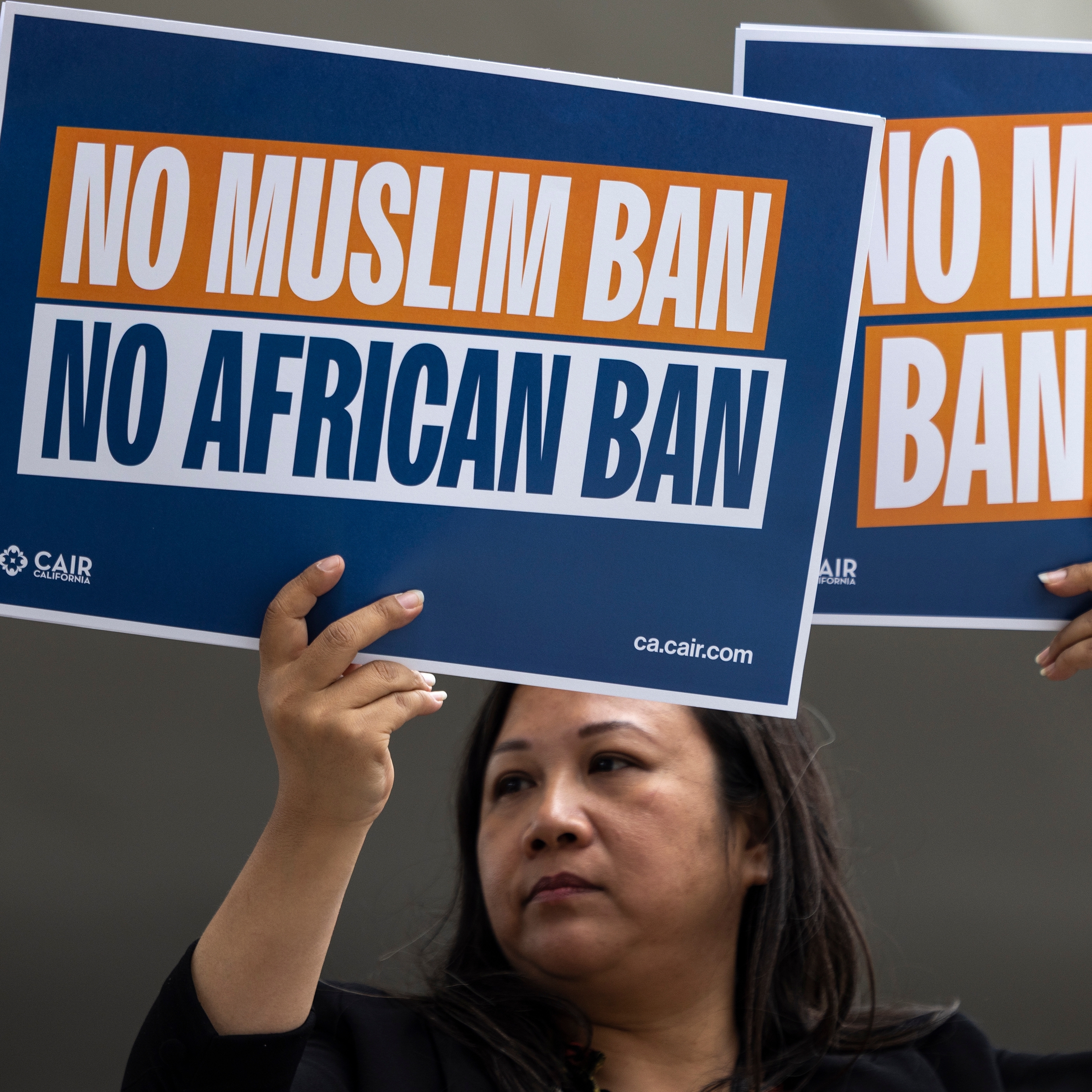
10:46But I think the other thing is, you know, that I talked to is people said, look, the president, you know, in his first day in office, the second term signed a number of executive actions just aimed at immigration. And he's rolled those out. And a number of them have been perhaps even more shocking than the travel ban had been the first time. And so, you know, one of the folks who was involved in one of the protests yesterday in Los Angeles, I talked to her on the phone. She's from CARE, a group that deals with sort of advocating on behalf of Muslim Americans. She said to me, look, you know, we can't have sustained outrage.
11:14It's hard to notch it up another level over this travel ban because we've seen so many extreme things in her view. And so even in Los Angeles, there's protests going on just down the way from the airport, right, based on, you know, what happened over the weekend with the ICE raids. And a number of the protesters at the airport were then heading over to join the other protests. So it's not that they're saving their outrage, but they're working on other areas. And this is part of it. But, you know, they're saying, look at the broader aspect. We have to fight so many areas. You know, this is coming at a time when Trump is trying to crack down on immigration in a variety of ways.
11:46You know, there's mass deportations, the attempts to ban birthright citizenship, the protests in Los Angeles this week and sending in the National Guard over the objections. of the California governor. How does this, what the Trump administration is doing with this travel ban, fit into its broader approach on immigration? Right. You're seeing them try to shut down as many avenues as they can, both getting into the country, obviously, at the border and points of entry, which this fits into, right? Shut down as much of that new immigration, while at the same time ramping up the deportations within the country.
12:18The Trump administration has been largely successful in really tamping down the number of border crossers coming in from over the U.S.-Mexico border. this area issue of points of entry. You've seen already reports earlier this year about, you know, green card holders and other students being stopped at airports, getting bigger screenings. I think they're overall, there's activists would say it's not only trying to stop it, but also get folks to sort of not want to come and essentially either self-deport and leave the country voluntarily if you're here as an immigrant who is not a full American citizen, or, you know, just decide you're not going to come.
12:49And that sort of ultimately gets to the goals of the administration, which is to say, you know, we're making this country for a native-born American. in America first.
13:01After the break, what a Supreme Court precedent means for this travel ban. We'll be right back.
13:19Rubrik is the security and AI operations company built for what happens after an attack hits, not just the moments before. AI has turned the threat landscape into quicksand, moving too fast for any human to fully predict. That's why an agentic cyber resilience platform matters. Automated recovery, clean data, a business that keeps moving no matter what hits. One platform, not a patchwork of stitched together tools and gaps. Don't wait for the next attack. Secure and accelerate your business at rubric.com. Again, rubric.com. Did you know you can play the Washington Post's games for free. Find the crossword, keyword, ridges, and on the record in the Washington Post app or at WashingtonPost.com slash games.
14:00No subscription required.
14:07So David, as we've said, President Donald Trump during his first term enacted a travel ban, and that very first one created a lot of chaos. Let's now talk about that first ban in 2017. Who did it affect? People will recall that was within the first week of his taking office, and it was a real shock. But, you know, they essentially were targeting Muslim-majority countries, and it was seven countries, all of them Muslim-majority. And, you know, it immediately shut down all pathways into the country from any travelers coming from those countries, including those who were in route, you know. And so this did not have a provision like the current order where it does allow folks who had already received a visa to arrive here.
14:45Yeah. And I remember while he was campaigning, he talked about a Muslim ban. So then when this was instituted, a lot of people perceived it as a Muslim ban because the countries were Muslim majority. Right. And President Trump was at the time, a candidate Trump back in 2016, was calling this a Muslim ban. He was saying, look, this is related to terrorism and we have to protect the borders, protect the country. Donald J. Trump is calling for a total and complete shutdown of Muslims entering the United States until our country's representatives can figure out what the hell is going on. And that was one of the first big moves out of the box for him.
15:24People then looked at that and said, look, you're discriminating. You're discriminating based on religion and not based on necessarily facts and figures about terrorist acts or how this is going to actually be about national security. So then what happened with that ban? So that ban was immediately challenged or very quickly challenged by a number of entities, including the ACLU, but also some states led by the state of Washington filed federal lawsuits. And it was immediately enjoined by the federal judges and they blocked it from moving forward. And so then that launched a fairly lengthy legal battle.
15:53And then where did that legal battle end up? The first Trump administration revised the ban and they tried sort of another version of it that was also challenged in another court and stopped. Ultimately, it went on for many, many months, and the administration adopted a third version, which added some other countries like North Korea and Venezuela, I think, to get around the idea that this was targeting religious groups. And ultimately, almost a year and a half later, in June of 2018, the Supreme Court did uphold the third version of the travel ban. The court said that as a whole, the president had the authority to keep the public safe and that this could be judged fairly as a national security issue, of which the president gets a lot of power from the Constitution to take those kind of actions, including on immigration.
16:34And so the court also agreed that the administration had made a number of changes to their initial version that sort of gave more specific reasoning as to why the specific countries on the list were on there. And then Joe Biden becomes president. And I know that he rescinded the travel ban on his first day in office in 2021. But all of that brings us to today, 2025. Did Trump promise on the campaign trail this time around that he would enact another travel ban? Yes, he talked about this as, you know, in sort of the broader areas of things they were going to do. When I returned to office, the travel ban is coming back even bigger than before and much stronger than before.
17:18We don't want people blowing up our shopping centers. We don't want people blowing up our cities and we don't want people stealing our farms. So it's not going to happen. It was not a surprise whatsoever to advocates that on his first day in office, he directed in one of his executive orders that he signed that first evening on January 20th, directed the State Department to undertake a study to look at how they may enact a new travel ban. That's fascinating to think about the contrast between 2017 and today, where in 2025, this Trump administration directed a study to do this. Whereas I remember from the first travel ban, the perception was this was hastily put together and rolled out, which was part of the reason it had to be revised a number of times before it withstood legal challenges.
18:07So, yeah, has this one been in the works for a while? It has been in the works. You know, actually, we heard some reporting suggested that this could have been dropped, you know, announced in February of this year. And we were a bit surprised they had not announced the travel ban. And when was it coming? And, you know, that's why some people point to the idea that after this Boulder attack, there was a window to say, oh, these are tied also to visa overstays. We're going to drop this. And the public would see that Trump's taking action, you know, sort of politically more palatable. We have not actually seen any report from the State Department that they apparently delivered to Donald Trump.
18:37You know, the White House said the president received a report and reviewed it from the State Department. And this is a report to see the impacts or how to do this policy. How to judge which countries should be on this, right? And so, and this is a changing list. According to President Trump, he said, you know, countries that make improvements to their vetting could be taken off. The list is subject to revision based on whether material improvements are made. and likewise new countries can be added as threats emerge around the world. But we will not allow people to enter our country who wish to do us harm.
19:10But, you know, there's been a lot made of the idea that we're in this moment of the boiling frog where things are getting hotter and the frog doesn't necessarily know it, right? And so the idea that there was all this outrage over the first travel ban and that's kind of muted now, we're kind of getting used to these kind of extremes, right? And so it has to be even more extreme for the public outcry, which you're seeing in Los Angeles. Mm-hmm. So given that the Supreme Court did eventually rule that the president can enact a travel ban, does that mean legal challenges to this ban are doomed? Yeah, you know, we talked to a number of lawyers from, you know, immigrant rights groups, as well as some of the Democratic state attorney generals who have sued this administration quite a bit over a number of their policies, including on immigration.
19:48And a number of them did say that this appeared to be much more carefully written. Someone said that the first one was sort of a statement of policy goals in the way that was written the first time. Or whereas this one is written a bit more as a legal document and sort of explaining exactly had rationales for each country, why they're on there with some statistics. It also had the exceptions that we talked about that made, I think, the courts look at this as a more favorable, you know, thought through policy. So advocates said it will be harder to win in court to shut down this entire thing. We haven't even seen any lawsuits that we know of yet.
20:20Really? Right. And so in the first term. That seems unusual because it just seems like anything that Donald Trump is doing these days immediately. It's almost immediately challenged. And they had a lot of time. The advocates knew this was coming. But one of them said to us, you know, this is bad, but not as bad as it could have been. You know, there was some reporting, like I said, early in the first few weeks about what this man could look like. A lot more countries. There was an idea it could be 30 or 40 countries. So the advocates had time to sort of think about their legal strategy. But they said that it could be harder to go after this policy and get it enjoined because of that Supreme Court ruling.
20:49It gave them broad latitude. This was written in a similar way. What one person did tell us was, look, this could maybe be challenged on an individual basis. You know, if this person is trying to come, you know, and they feel like they should be on the on exceptions list or the administration didn't do the right examination of their personal case, then they could try to sue over that. Now, that would potentially lead to a lot of lawsuits from individuals who hire lawyers and their families. But, you know, this idea of getting a national injunction that we've seen, a nationwide injunction we've seen in so many cases is one that could be harder here.
21:19Yeah. So what's next? What will you be looking at when it comes to the travel ban? I think if we don't see mass protests or mass problems or some sort of shutdown in the courts of the whole program, how is this being implemented? Because there's this idea the administration is also wearing away sort of the government offices that have personnel to do this kind of thing. As you see budget cuts and sort of redirecting immigration services away from services of immigrants coming more toward the deportation of immigrants. And so the idea that there are a number of cases could be bogged down, which are probably ones that people should be allowed.
21:52I think it also is interesting if Trump uses this as he likes to do with leverage of you could be on the list, you know, and sort of use that. Like for individuals or countries? No, not individual countries. You know, he did say there was a video the president put out on the night he announced this where he said this is a changing list. And depending on circumstances, you could be added, you know. And so, you know, so could this come up in other negotiations over economics or other interests that the president had? One of the things also that the administration was looking at was countries that accept deportation flights.
22:19So some countries don't want to take back some of their migrants who could potentially actually be criminals here. Not all are that they're being sent, but the administration is saying, you know, those who don't work with us on our immigration goals, they may be on this list, essentially. So now that could be challenging court because that's sort of broad and vague. But that's one thing they've hinted. Well, that's fascinating thinking of it as this is potentially a chip in negotiations. Bargaining chip, yeah. Well, you know, this president likes to make deals. I mean, he's doing economic tariffs.
22:44I mean, could this—immigration certainly falls in broadly to one of his most important goals politically. And so his administration has made clear they're going to do everything they can, including trying to force countries to take immigrants. They've looked, obviously, to third countries, El Salvador and others who are willing to take migrants not even from their country. So that carries favor. And so could you want to get off this list for one reason or another and you agree to do things that you might not otherwise do? That's possible. Well, David, thanks so much for taking time to explain all this.
23:12Sure. Anytime. David Nakamura covers immigration for The Post.
23:21That's it for Post Reports. Thanks for listening. If you want to show your support for the show, please subscribe to The Washington Post. Not only is it a great way to help us continue to do this work, but you can now get access to Washington Post podcasts ad-free in Apple Podcasts. Today's show was produced by Emma Talcoff with help from Renny Svarnovsky and Tadeo Ruiz Sandoval. It was mixed by Sam Baer and edited by Ariel Plotnick. Thanks to Christine Armario. I'm Elahey Izadi. We'll be back tomorrow with more stories from The Washington Post.
24:17and the options were closing in. There were paint rollers, satin and matte finish, angle brushes, and natural bristles. There were too many choices. What if I never got my living room painted? What if I couldn't figure out what type of paint to use? What if I just used Thumbtack? I can hire a top-rated pro that knows everything about interior paint, easily compare prices, and read reviews. Thumbtack knows homes. Download the app today. Did you know you can play the Washington Post's games for free? Find the crossword, keyword, ridges, and on the record in the Washington Post app or at WashingtonPost.com slash games.
24:54No subscription required.
On Monday, President Donald Trump restricted the entry of travelers to the United States from more than a dozen countries, resurrecting and expanding sweeping restrictions from his first term that are expected to draw swift legal challenges.
The travel ban has been criticized by immigrant rights groups for targeting several African and Muslim-majority nations, and for appearing to capitalize on a moment of public grief: Earlier this month, a man seeking asylum in the United States threw an incendiary device at an event organized by a Jewish group in Boulder, Colorado. Trump cited the attack in his announcement of the ban.
Today on Post Reports, host Elahe Izadi speaks with immigration reporter David Nakamura about who will be most affected by this ban, how the Trump administration crafted it to hold up in court, and why the public response to this iteration has felt muted.
Today’s show was produced by Emma Talkoff, with help from Rennie Svirnovskiy and Tadeo Ruiz Sandoval. It was edited by Ariel Plotnick and mixed by Sam Bair. Thanks to Lucy Perkins and Christine Armario.
Subscribe to The Washington Post here.
Scan the code with your iPhone camera
Listen in the app.