In short
The global “Labubu” blind-box plush craze and what it reveals about fashion-driven status, gambling-like consumer behavior, crime/counterfeits, and China’s “soft power” strategy.
Guests
Kelly Kasoulis Cho, Washington Post reporter/editor based in Seoul; previously covered the trend and discusses sourcing/authentication issues and related reporting.
Key claims
Labubu (Pop Mart) sells hand-sized plush/keychains (~$27 retail) via blind boxes with “secret rare” variants (about 1 in 72), driving hype, resale markups, and theft. Pop Mart sold $418M in 2024; overseas revenue rose 375% YoY. Counterfeit “Lefoufou” fakes are widespread; China is cracking down to protect the status value. U.S. CPSC warns knockoffs are choking hazards.
Notable examples
Rihanna and Naomi Osaka wearing them; Blackpink’s Lisa boosting popularity; a reported $30,000 Labubu recovery sting; Pop Mart UK pausing sales due to fights; a $500 South Korea resale; authentication via tag/box QR scratch code.
Written by AI. May contain mistakes. Listen to the episode to check what was said.
Chapters
Tap a time to open that second in VOUnpacking the Labubu Trend
2:47 to 3:19
Discussion on how the Labubu trend began and its evolution over time.
“Today, Kelly and I will unbox, see what I did there?”
The Origin Story of Labubu
3:19 to 4:59
Delving into the origins of the Labubu character and its creator.
“So I have to admit, Kelly, I really was not aware of what a labubu was.”
The Economics of Collecting Labubus
4:59 to 6:26
Insights into the pricing, scarcity, and market demand for Labubus.
“So originally in the U.S., they're about$27.”
The Appeal of Labubus
6:26 to 8:14
Exploring psychological factors driving the obsession with Labubus.
“What exactly is it about these things that makes them so popular and that people can't get enough of it?”
Counterfeiting in the Labubu Market
8:14 to 10:00
Discussion about the counterfeit version, Lefoufou, and its prevalence.
“but they can waste a hundred bucks on a labubu if it means getting that joy for a moment.”
China's Crackdown on Counterfeits
10:00 to 13:20
Examining China's efforts to control counterfeiting of Labubus and Lefoufous.
“but the QR code on the back of the box is like a scratch ticket.”
Soft Power and Global Impact
13:20 to 14:00
How Labubus represent China's cultural influence and soft power globally.
“And it seems like the government there just turns a blind eye to it and they have no recourse.”
Exploring China's Soft Power Through Labubu
14:00 to 15:54
Learn about China's use of Labubu as a tool for soft power and consumerism.
“kind of a charm offense, especially in the West and certainly in the East.”
Consumerism Trends and Environmental Concerns
15:54 to 17:46
Discuss the implications of consumer trends surrounding Labubu and environmental issues.
“Pop Mart website, there's a message that says that Pop Mart will cover tariffs for U.S.”
The Emotional Appeal of Labubu
17:46 to 19:16
Understand the emotional and psychological reasons behind the popularity of Labubu among adults.
“we're all short of for the most part, right?”
Show all 11 chapters
Consumer Product Safety Warning
19:16 to 20:31
Hear about the recent safety warnings regarding Labubu knockoffs from the Consumer Product Safety Commission.
“It's like saying that you scratched a scratch ticket and you got 700 bucks yesterday.”
Transcript
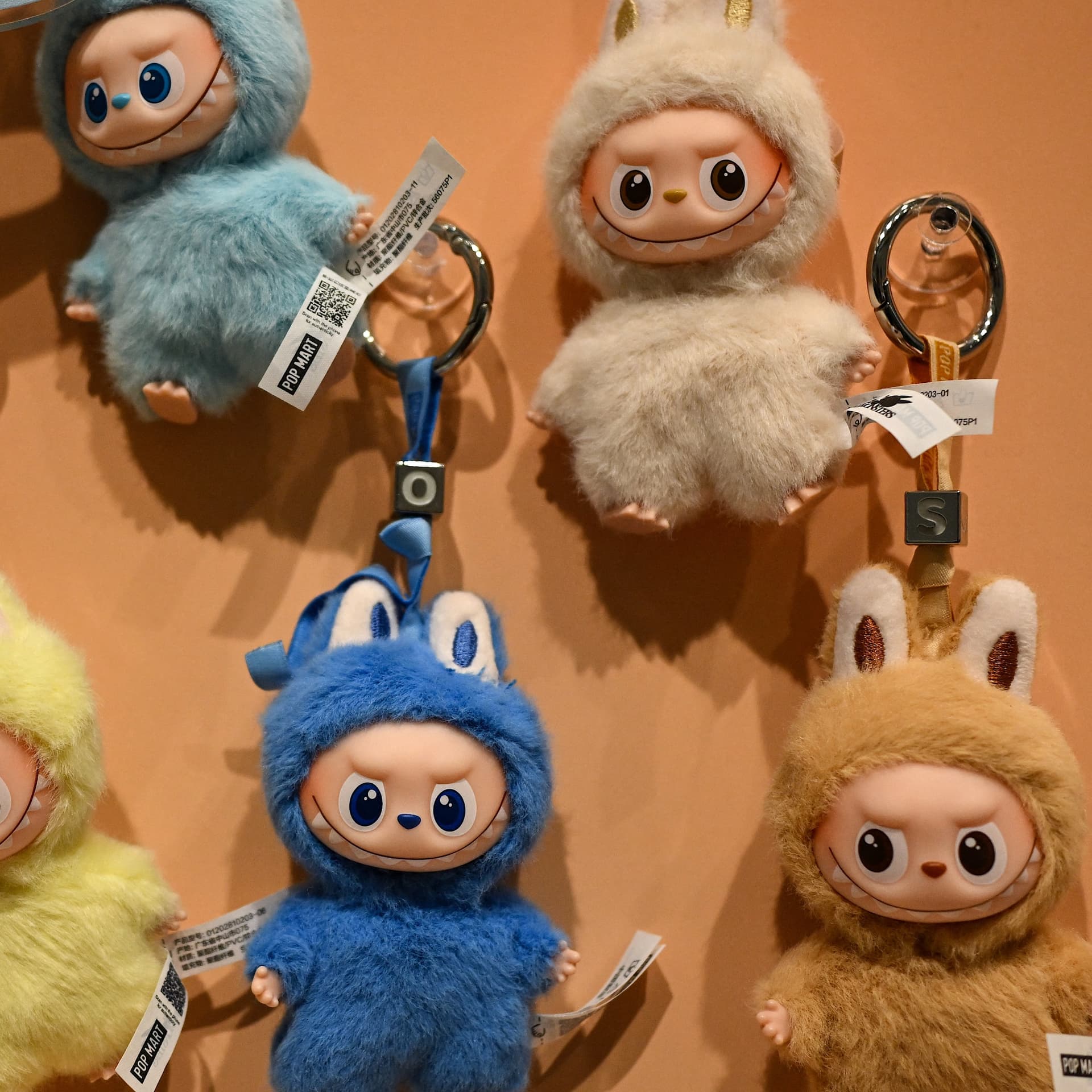
Automatic transcript. May contain errors.0:02I wouldn't say obsessed. I'm a little embarrassed, though, if I'm going to be honest. This is a safe space. I unboxed one on camera for The Washington Post for a video. And then after that, I became like a little addicted. And I was like, I'm feeling lucky today. I just want to buy one with my own money. That's Kelly Kasula's show. She's a reporter and editor for the Washington Post based in Seoul. And she's talking about a little plush toy that's taken the world by storm. The Labubu. A Lububu is a figurine of like an elf gremlin monster type character with bunny ears and nine fangs and like a human-like face with these big cartoon anime eyes.
0:56And it's like a doll about the size of your hand, but it's also a keychain that you can clip onto bags, kind of like a fashion accessory, if you will. The official retailer of Lububus is a Chinese company named Popmart. The dolls go for about 30 bucks a piece. And they come in a variety of colors. There are also some limited edition ones called secret rares. And those are coveted. But you don't get to just buy the Lububu you want. The process is sort of like gambling. You buy a Lububu box from Popmart. You open it up and you find out what you got. I actually got the secret rare on my first try.
1:39It's this gray character with the rainbow teeth. And I mean, people are, I saw one sell in South Korea for 500 US dollars on like our version of Craigslist. They're selling for about 400 in the US.
1:56Maybe you've seen videos of people unboxing LaBooBoos on social media. Let's unbox two LaBooBoos. Is it the pink one? No, is this a secret one, the black one? You got the secret. Can I have it? Absolutely not. She's black like my soul. Maybe you've seen photos of famous people sporting them, like singer Rihanna or pro tennis player Naomi Osaka. This is my LaBubu. She's named Billie Jean Bling. These toys are big business. Pop Mart has sold hundreds of millions of dollars worth of LaBubus. And the worldwide obsession with these toys has transformed them into the latest example of China's soft power push.
2:42From the newsroom of The Washington Post, this is Post Reports. I'm Elajei Izadi. It's Monday, September 1st. Happy Labor Day. Today, Kelly and I will unbox, see what I did there? The labubu phenomenon. We'll talk about why these ugly, cute little monsters are so popular, what they tell us about global economics, and the irony of China cracking down on its counterfeit cousin called the Lefoufou.
3:19Kelly, hi. Thanks for joining me today. Thanks for having me. So I have to admit, Kelly, I really was not aware of what a labubu was. But then my colleagues started talking about them, and then I saw them everywhere. So just to start, how did this trend begin? It's part of this kind of blind box phenomenon where people are buying figurines and opening up these boxes, and they're not sure what color or what design in a certain collection that they're going to get. It started as a weird kind of collectible that you keep on your desk actually 10 years ago. Oh, wow. And it really rose to fame when Lisa, who's the singer from the K-pop group Blackpink, kind of raved to the public about them.
4:06And then you started seeing Rihanna and Dua Lipa clipping them onto their bags, and it just soared from there. And where does it originate from? Is it part of a story or a movie? There's an artist named Kasing Leung, and he's from Hong Kong originally, but he actually grew up for many years in the Netherlands. And he said in previous interviews that he came up with the Le Bubu character in the Monsters series based on old European folklore that he was forced to read as a child because he had to learn Dutch. And so these Nordic tales kind of inspired the character, and he started illustrating them in little comic strips and graphic novels.
4:48And then a couple of years ago, he struck a deal with Popmart, which is the company that sells them, to join their portfolio of artists who sell these collectible blind boxes. And how much are they? So originally in the U.S., they're about$27. Okay. It's about that price point around the world. But the problem is they sell out within, you know, a second, if not a fraction of a second. I set an alarm and tried to buy a box of them. I did this twice. And both times I was waiting. I was counting down the seconds. I timed it exactly. And there was one time where I got it in my cart, but I accidentally hit the back button and it was done.
5:31I had no chance. And they're pretty much impossible to get in stores. So most people are paying anywhere between$50 to several hundred dollars for them. The popularity of Labubu is really actually driving a lot of crime. I saw it reported that$30 ,000 worth of Labubus were recovered recently in the United States in just one sting. It seems like they're starting to catch people who have participated in retail theft or theft, if you will, trying to get these and resell them. And I actually saw that Pop Mart in the UK for a while stopped selling Lububus because people were getting in actual fights, physical altercations waiting in line for them.
6:14Really? For this like stuffed animal? Yeah, absolutely. I mean, Pop Mart sold$418 million worth of Lububus in 2024, it's CEO said. Yeah, and its overseas revenue actually surged 375 % year on year.
6:37What exactly is it about these things that makes them so popular and that people can't get enough of it? Is it the character itself? Is it the kind of almost hysteria around trying to get one? Like, what is so appealing about these things? I think there's several factors to it. First and foremost, it's in fashion. And the exclusivity of the product, it's just so difficult to obtain, especially a real one. And it's so ridiculous to spend, say,$50,$70,$100 on a little plastic stuffed toy that probably costs nothing to make. That there's some kind of financial flex, if you will. It's a status symbol in some ways.
7:20part of what drives this trend is that there are say in a certain series of labubu six or so colors that you get very often but there will be one what they call secret rare labubu that is one in every 72 boxes you have a chance of getting and so people are constantly buying these trying to be the the cool person who has the secret rare clipped to their bag the other thing is that It's a way for people to connect with each other. It's been a social media craze where people are unboxing Lububu's left and right, connecting with other people online. It's a way to bond with your family members. And like Pokemon or Beanie Babies, it's a way to get kind of a dopamine hit, if you will.
8:07I think in today's economy, a lot of people feel like they can't, as adults, afford a house or a car. but they can waste a hundred bucks on a labubu if it means getting that joy for a moment. And there's almost this kind of gambling, casino-like effect to it where you get the blind box and you want a chance at getting the secret rare. So you keep buying them, you keep filling out your collection, trying to get every color, hoping that you're lucky today. And so I see a lot of appeal there and it actually appeals to adults just as much, if not more than to children. And Kelly, I mentioned earlier that the labubus have this counterfeit cousin called the Lefoufou, which has kind of come out because Lefoufous are just so popular.
8:51So how common are these fake Lefoufous, these Lefoufous? Oh man, Lefoufous are everywhere. When I was searching for a real Lefoufou because they were sold out at Popmart, I honestly could not tell which ones were real and which ones were fake. And I actually walked around this street market for like two hours trying to figure it out because some of them look really, really close to the real thing. Some of them look really, really bad. Yeah. Like how can you tell? Are there any telltale signs of a fake LeBubu? The old LeFouFous when it first started used to have 10 teeth sometimes instead of 9.
9:34So that's often a tip that people will give you. I found that the fakes, the Lefoufous, have gotten very sophisticated. So at this point, just because there's nine teeth doesn't mean that it's a real Lefoubou. And so you end up with this problem where the only way to tell is you rip open the box and you check the tag on the back of the actual plushie doll. It's attached to its leg. But at that point, you've already spent your money. The other thing is, and you can't do this until you buy it, but the QR code on the back of the box is like a scratch ticket. So you have to take a coin and scratch the back of it and it will reveal a serial number.
10:12And that's how you can authenticate it. But again, you can't really do any of this until you buy the product already. Yeah, and it sounds like it's hard to say how many fakes there are out there. I mean, we know that Chinese authorities have taken in at least 49 ,000 at various customs and border points in the last couple of weeks. That's actually a fairly old statistic. New ones haven't come out. So I'm assuming it's a lot more than that. In my own kind of weird investigation into this, I found plenty of LeFoufoo's being sold on AliExpress. And I think people are purposely buying them and putting them in their retail stores.
10:49So I'm guessing that at this point, there's probably hundreds of thousands of them. And there's actually a market demand for ones that are fake. Like, another offshoot of this is that we see people trying to almost one up each other on who has the ugliest or the most mangled lefufu. Oh, wow.
11:12After the break, China's crackdown on counterfeits and how China is using the labubu to bolster its cultural cachet abroad. We'll be right back.
11:28Thank you.
11:58with clear sourcing. And if we don't know the answer, we'll tell you. Ask The Post AI. Find it on WashingtonPost.com or in the app. What exactly is China doing to stop the Lefoufou? Chinese media has reported that, for instance, there are cops or authorities patrolling street markets in some cities that are known to sell Lefoufous and trying to seize them. At customs offices at various border points, they've seized thousands of Lefoufus. In its crackdown on Lefoufus, China's state broadcaster actually gave people guidelines on how to tell what is real and what is fake when they're trying to buy a Lefoufus.
12:47And so what we see with Popmart is that the Chinese authorities, even though they're famous for not protecting IP belonging to other countries. So in China, you can get fake Chanel bags and Louis Vuitton bags galore, but they really seem to be cracking down on Lefoufus or fake Lefoufus before Lefoufus no longer become a status symbol or something that's difficult to obtain. Because as we've seen, if things get counterfeited left and right and anybody and their mother can get them, they stop being cool. Right. Well, and also I have to underscore the irony of China cracking down on a counterfeit Libubu when, as you alluded to, there are plenty of American companies and other companies that, you know, their counterfeit and fake versions of their products are manufactured in China.
13:36And it seems like the government there just turns a blind eye to it and they have no recourse. So then why is China cracking down on these fakes now? China, I think, really sees Pop Mart's rise to fame, and particularly through Libubu, which has really skyrocketed the company's sales globally, as a form of soft power, if you will, kind of a charm offense, especially in the West and certainly in the East. I mean, the Libubu craze has taken over the entire planet at this point. Kelly, can you explain a little bit more about what you mean by soft power here? I think China recently has shown that it really embraces opportunities when it arises to improve its reputation abroad, particularly in the West.
14:26And so we saw this a little bit when Trump was ratcheting up tariffs or at least threatening to do so. You started seeing a lot of social media posts flooding my feeds that Chinese companies or maybe in some way China, they've really made an effort to change the reputation of products manufactured in China. China is a very export driven economy. It has a surplus of goods that it's manufacturing and consumption within China is down. So basically, to keep the economy growing at a good pace, you have to sell things abroad if you're a Chinese company. And what I've noticed is that I've seen more and more videos purportedly from Chinese company owners and manufacturers showing their products and basically saying, look, our quality is not bad.
15:20You know, we actually make some of the nicest stuff out there. And so what you see with Labubu is maybe this shift in mindset from made in China to made by China, essentially. This idea that the hot product that we want is actually something that comes from China and is a part of its soft power.
15:45With these tariffs coming from U.S. President Donald Trump, will that impact the cost of Libuboos for the consumer? Interestingly, on the U.S. Pop Mart website, there's a message that says that Pop Mart will cover tariffs for U.S. customers and they will not be required to pay any additional customs fees if they're ordering Libuboos directly from the website. But what's not clear to me is, one, when they wrote this, if they're talking about the current tariff regime that's in place, and two, if that will stand if the United States does really enact 145 % tariffs on Chinese goods. But, I mean, they're already prohibitively expensive for some people, and people still want them.
16:32They're still willing to go several hundred dollars deep to get them. You know, Kelly, hearing you talk like in some ways this just feels like a pinnacle point in consumerism. And I mean, we've seen it time and again, like we mentioned Beanie Babies and how at some point they were viewed as incredibly valuable on the resale market. People thought they had a lot of money tied up in these Beanie Babies and then the bottom fell out from under them. And it's just like this volatile thing around consumerism. And really, should we be like encouraging people to like buy these things and consider them to be so valuable when the value is just really tied up in the demand, which feels so fickle right now?
17:11Because like you said, it's on trend now, but it's an open question for how much longer are these things going to be popular? That is one of the biggest critiques I see of the trend that essentially a year from now, we're going to have landfills full of labubus, right? I mean, these things are made of plastic. The packaging is not great for the environment. And people usually don't just buy one. They buy many of them. And some people have even risen to fame on social media, unboxing hundreds, if not thousands of them. And you just wonder, what is the consequence of that? a lot of people also brand it as this very like cringe, excessive way of spending money that we're all short of for the most part, right?
17:59So I think there's a lot of criticism of the trend, but we see that with anything that young people go crazy for, for the most part. Yeah. Kelly, just stepping back and thinking about your kind of journey down the La Boo Boo rabbit hole, what are you left with in thinking about what these little creatures mean and say about us and also about the way the world is kind of organized right now? I've thought about this a lot. And considering how popular it has become with adults, for me, La Voo Voo's have kind of revealed an adult craving for childlike joy. You know, it's expensive. It's gratuitous.
18:43It's a little ridiculous. But at the same time, if it makes you happy for a day, then it makes you happy. And I also have felt that. At first, I told myself I would never buy one. I felt almost cringe when I actually did it. But, you know, whatever gets you through the day, right? And so I have wondered if when we're surrounded by a lot of worries and anxieties about the future, if this just gets us through the moment and if it allows us to feel like we're participating with something that's bigger than us. I have showed my secret rare labubu to my nieces and nephews who now think I'm the coolest person around.
19:23I've texted old friends about it. I mean, it's just like, it's funny. It's like saying that you scratched a scratch ticket and you got 700 bucks yesterday. It's just like a fun thing to talk about. Well, Kelly, I have to say after learning about all this, I'm still not going to buy one, but I get it why you and others would. Whereas before I was like, I'm not going to buy one and I don't understand why anyone would. So it makes a lot of sense. Yeah, I still haven't decided if I actually think they're cute or what. They're actually quite ugly. So I get it. Well, Kelly, thanks so much for joining me.
19:58I appreciate it. Thanks for having me.
20:03Kelly Kosoulis Cho is a reporter and editor based in Seoul. After I had my conversation with Kelly, the U.S. Consumer Product Safety Commission put out a warning about Labubu knockoffs. The commission said that the fake Lefufus are a choking hazard because they can break apart easily and release small pieces. They also said they're small enough to fit into a child's mouth and block their airway. The commission urged consumers to stop buying and using the knockoffs quote immediately. That's it for Post Reports. Thanks for listening. If you love the show, help other people discover it by leaving a rating on Spotify or a rating and review on Apple Podcasts.
20:46We really appreciate it. Today's show was produced by Thomas Liu. It was mixed by Rennie Svarnovsky and edited by Ariel Plotnik. Thanks to Anna Fifield. I'm Elahei Izadi. We'll be back tomorrow with more stories from The Washington Post.
21:32Thank you.
21:39or in the app.
From the publisher
Labubus — small plush toys that look like mischievous monsters — have taken the world by storm. Chinese toymaker and retailer Pop Mart has sold millions of dollars’ worth of Labubus. There’s even a booming resale market, on top of a thriving operation of counterfeits called Lafufus.
Host Elahe Izadi speaks with reporter Kelly Kasulis Cho about how Labubus became the latest trend, and why these little toys have become a symbol of China’s developing economic strategy.
Today’s show was produced by Thomas Lu. It was edited by Ariel Plotnick and mixed by Rennie Svirnovskiy.
Subscribe to The Washington Post here.