 Ask ChatGPT



The podcast’s first episode investigates the decades-old mystery of what happened to the bodies of Grenada’s executed revolutionary leader Maurice Bishop and seven others after his October 19, 1983 execution, and explores allegations that the U.S. government helped remove the remains during the U.S.-led invasion six days later.
The episode includes interviews and voices from many people rather than a single guest list. It features Martine Powers (Washington Post daily news host; investigative series reporter) and references a forensic pathologist in Grenada in 1983 (contacted for later reporting). It also quotes or interviews Grenadians and officials, including Don Rojas (Bishop’s press secretary) and mentions Grenada’s Prime Minister Deacon Mitchell.
Bishop’s remains were never recovered; prisoners convicted of the killings say they don’t know what happened to the bodies. The episode argues many Grenadians believe the U.S. denied involvement and likely disposed of remains to prevent Bishop from becoming a martyr/shrine, comparing it to how Osama bin Laden’s remains were handled.
A Grenada Broadcasting Network call-in show (“mystery in our history”) where callers debate U.S. involvement; Reagan’s 1983 “Star Wars” speech referencing Grenada’s airport; Bishop’s Hunter College speech defending the airport and alleging a “secret State Department file.”
Written by AI. May contain mistakes.
Investigating the disappearance of Maurice Bishop's remains after his execution.
“Did you ever see the body of Maurice Bishop?”
Exploring the chaotic events following the executions and missing bodies.
“From the Washington Post, I'm Martine Powers, and this is The Empty Grave of Comrade Bishop.”
Martine reflects on a commemorative ceremony held for the victims in Grenada.
“The people who went to prison for their murders say that they don't know what ultimately happened to the bodies.”
Learn about the local program and its chaotic charm.
“My mom was sitting on the couch watching TV with the volume about 30 % too loud.”
Explore the unresolved mystery surrounding the bodies from the revolution.
“As the topic says, mystery in our history.”
Hear various theories from callers about the disappearance of bodies.
“People on the show have different positions on that.”
Discuss speculations on U.S. government's role in the events post-revolution.
“The specifics of these allegations range pretty widely.”
Understand the context of U.S. interests in Grenada during the 1980s.
“has been dishonest about their role in this or that they've covered up their actions?”
Delve into Reagan's military strategy and its implications.
“It might help to picture how all of this was playing out in 1983.”
Explore Reagan's portrayal of Grenada as a threat in the Cold War context.
“and preserve our free way of life in a sometimes dangerous world.”
Learn about Maurice Bishop's reaction and strategy to U.S. accusations.
“They were learning that the highest levels of the U.S.”
Experience the powerful moments from Bishop's landmark address in NYC.
“We're not going to mess with what you're doing in the U.S.”
Understand Bishop's vision for Grenada amidst accusations of militarization.
“By the time Maurice Bishop took the mic in that auditorium, he was no longer in diplomacy mode.”
Discuss how Grenada's revolution changed its economic landscape and self-sufficiency.
“But what you need to know now was that the vast majority of Grenadians were the Black descendants of enslaved people.”
Learn how Maurice Bishop transformed Grenada through agricultural and educational reforms.
“Rather than relying on food imported from other countries, Grenadians were growing more of their own food, investing in new farming techniques, increasing production and exports, raising the GDP by 25 % in four years.”
Discover the implications of a supposed State Department report on Grenada's revolution.
“I should tell you that we asked the State Department's Office of the Historian if this report actually exists.”
Explore the circumstances and impact of Maurice Bishop's assassination.
“Grenada ain't nobody's backyard and in front of nobody's lake.”
Uncover the ongoing struggle for closure regarding Bishop's remains and legacy.
“And I must say that the effort to find them and to bury them in a proper and respectful manner in Grenada is an effort that is ongoing.”

Get the gist, explore an idea or ask about something said.
 Claude
On Post Reports, what are the key points of this episode?
Searching your listeningAutomatic transcript. May contain errors.
0:01John Deere is putting in work and putting up highlights. Oh man, look at those passes. Tillage, planting, harvesting. Three years in and these pre-owned machines are still at the top of their game. We're talking reliability, performance and long-term potential. And get this, these veteran machines can pick up the latest precision tech with ease. You know it and fans ready to add John Deere certified pre-owned equipment and more options to their lineup can shop at machinefinder.com. Booyah!
0:32Hey, everybody. Martine Powers here. So, Post Reports listeners, I just want to say how much I have been missing you these past few months. I'm about to start maternity leave. And before I do that, I wanted to take a moment to make sure that you know about my other podcast, our investigative series, The Empty Grave of Comrade Bishop. This is a podcast about a fascinating mystery on the Caribbean island of Grenada that has been unsolved for decades. And our attempt to try to get to the bottom of that mystery. It was a pretty incredible reporting journey. I think it's a pretty fascinating listen.
1:12So if you have the day off today for the Juneteenth holiday and you're looking for something to listen to, I really hope you'll check it out. And if you've already listened, I would be honored if you left a review, or even better, if you shared the podcast with a friend or family member. All right, so here's the first episode of our investigative podcast series, The Empty Grave of Comrade Bishop. Enjoy. So I just want to ask to be clear. Sure. Did you ever see the body of Maurice Bishop? No. You're sure? Absolutely.
1:52Did you see Maurice Bishop's body? No, I didn't see his body. Not at the fort? Not at all. Did you see the bodies of anyone else? I didn't see the bodies of anyone else. Do you remember speaking with any of the people who were involved in looking for Maurice Bishop's remains? None.
2:20Over the past two years, I've asked a lot of people some version of this question. What happened to the body of Maurice Bishop and the bodies of the people who died with him? No, I have no idea. What do people think happened? Well, people speculate, people said different things. But the people who were behind it never say, so you will never know.
2:50Going around and asking people about human remains is not usually my thing. Some people listening to this podcast might know me from my day job. I host a daily news podcast at The Washington Post. Which is to say, I don't specialize in crime reporting. I'm certainly not a true crime junkie. I mean, I can't even watch CSI without it giving me bad dreams. But then, a few years back, I learned about this mystery on the Caribbean island of Grenada. Forty years ago, Maurice Bishop, the country's beloved prime minister, was executed, along with seven other people. And to this day, no one can say what happened to their remains.
3:37Since I first heard about this mystery, I haven't been able to shake it. So I've been asking questions. At this point, I've interviewed more than 100 people. People who witnessed the killings. People who were convicted of the murders. And others who, for reasons I'll explain later, also have a connection to all this. Soldiers, diplomats, intelligence officers, even a member of the U.S. Congress. Can I ask, like, what do you think happened to the bodies? Like, if you had to guess, where do you think they are? I don't know. I mean, I really don't know. I have no idea. I can't even put two and two together on this.
4:19And these questions I've been asking have led to some strange conversations. No, the U.S. Navy is not in the body-snatching business, I can assure you of that.
4:35Still, I've kept asking, because the question of these missing remains matters. We'd have liked to have a body to bury and to respect. You know, so you live with your pain and sorrow and what have you. This mystery has been weighing on the family members of these victims for 40 years. It's also left a gaping hole in the psyche of an entire nation. And after two years of asking questions, we've gotten some new answers. Hello? Hi, my name is Martine Powers. I'm calling from the Washington Post. I'm calling because I'm trying to find a forensic pathologist who was in Grenada in 1983. Is that you?
5:31Yes, it is.
5:37These answers offer new insight into what happened to the bodies and the role that the U.S. government played in shaping this crucial part of Grenada's history. I've been involved in a lot of investigations, forensic investigations and criminal investigations. And I can tell you, in my words, this thing stinks.
6:05From the Washington Post, I'm Martine Powers, and this is The Empty Grave of Comrade Bishop.
6:18Episode 1
6:23Before we get any further, I should tell you how this all started. Six years ago, I got a phone call from my parents that every 20-something dreads. Martz, we are moving to a new place, we are selling our house, and you need to come pick up all your books and stuff that you've left here for the last decade. Well, that is not accurate. because that makes it sound like it was a spur-of-the-moment decision, which it absolutely was not. That is my mom, Francine. She's originally from Trinidad, but she spent most of her adult life in Miami, where I grew up. And when she and my dad got to retirement age, they started thinking about making a change.
7:05My dad wanted to be somewhere with less traffic and less noise, somewhere with beautiful views. For my mom, it was a little more personal. I was sort of tired of living in a foreign country, trying to sort of simulate Caribbean life while living in America. I wanted to get back to my own Caribbean roots. I really, quite honestly, wanted to deal with my own Caribbean people. So my parents decided to relocate to the island of Grenada, this former British colony right at the bottom of the Caribbean where they had some old friends. This island is stunning. Mangoes and cocoa and nutmeg just grow on trees on the side of the road.
7:52The beaches have the bluest, clearest water I have ever seen in my life.
8:01And when it gets dark out, it's so tranquil. There's just the sound of the breeze and these little frogs that come out at night and chorus all over the island.
8:14They're so loud that I can hear them through the phone when I'm talking with my parents. Right. Because we had reached retirement age and I always wanted to be back in the Caribbean. I really, hold a second for me. Joe, Joe, Martin is recording something with me. So could you not do the bottle, please?
8:40I share all this with you, including my dad scraping the last bit of horseradish out of a glass jar. Because it wasn't until my parents moved to Grenada that I started to learn more about the history of this country. And as part of that, I learned about this radical young lawyer named Maurice Bishop. In the late 1970s, when he was just 34 years old, Bishop led a revolution in Grenada. He overthrew a dictator. He became the prime minister, and he governed for four years. I learned about how this prime minister was adored by Grenadian people. Some of them knew him as Comrade Bishop. He identified as a socialist, believing that the government had a responsibility to provide education, health care, and jobs to all Grenadian citizens.
9:27But he was also controversial. Bishop spoke out against American imperialism. He was close to Cuban President Fidel Castro, who gave Grenada weapons and military training. And that put Bishop and Grenada right at the center of tensions between the U.S. and the Soviet Union during the Cold War.
9:52Then came the events of October 19th. You're going to want to remember that date because it's going to come up a lot. On October 19, 1983, Maurice Bishop was killed. He was shot, execution style, by members of his own army. Grenada's Marxist Prime Minister, Maurice Bishop, had been under house arrest by more hardline Marxist military leaders. Three cabinet members and four of his closest supporters were there too, killed in the same way, right next to the Prime Minister. There, soldiers commanded by Cuban-trained General Hudson Austin shot and killed Bishop and several of his cabinet ministers.
10:38Let me just underline here. The executions took place in the courtyard of a military fort in the heart of Grenada's capital, in broad daylight. Plenty of witnesses saw it happen. Even more heard it happen. Everybody knew who did it. Seventeen people were ultimately convicted, some for planning the murders and others for carrying them out. They spent more than two decades in prison. So there's no question of how this group of people died. And that's part of what makes us all so strange. Because shortly after the executions took place, this fact became clear. The remains of Prime Minister Maurice Bishop and his seven allies were missing.
11:23And like I said before, 40 years later, their remains still have not been recovered. Their families have never been able to bury them or hold a proper funeral. The people who went to prison for their murders say that they don't know what ultimately happened to the bodies. And here's another thing you need to know. Six days after the executions, the United States launched an invasion of Grenada. I'll explain more about that in just a second, But that's all to say, these bodies went missing during what was almost certainly the most chaotic and frightening week in Grenada's history. The bodies of all eight people who were executed are unaccounted for.
12:05Seven men and one woman. And the question of the whereabouts of these bodies has haunted Grenada to this day. The more I learned about all this, the more questions I had. And I wanted to get some answers. My mom warned me that this wouldn't be easy.
12:28She wasn't wrong. There are a lot of people who don't like to discuss this. But even more people do talk about it. They talk about it a lot.
12:48Martine Powers: So right now, we ask to do a roll call, and we're asking everyone, after each name that is called, to say present. Last year, around October 19, 2022, I was in Grenada. I was there to experience for myself this anniversary and how people remembered it. Evelyn Bolin, manager, M.A. Bolin & Sons Limited Insurance. Jacqueline Creff, minister for education. Norris Bain, minister for housing. I attended a ceremony that's held every year, commemorating the dead. This was at that old colonial fort where the executions took place. I stood right at the site where these people were killed. As we continue to request for any information, everyone who knows about the bodies of our loved ones, please come forward.
13:51And to me, one of the most revealing parts of that visit happened when I was just at my parents' house. It was Friday night, 8 o 'clock. The frogs were coursing outside. My mom was sitting on the couch watching TV with the volume about 30 % too loud. She had the local news on. And then this program started.
14:19This is a show on the Grenada Broadcasting Network that comes on every week.
14:23Martine Powers: Good evening, everyone, and welcome to We Culture for another Friday, the 21st day of October 2022. 2022. Well, I've got a big surprise for you. I've got a co-host. I've got my co-host in studio with me tonight. Every episode has a topic. Sports, music, politics. The host of the program is Godfrey Augustine. There's a panel of guests who join from different places. Viewers call in with their questions and their comments and their complaints. We have room for the rest. Yes, indeed. This program is both charming and chaotic in all the ways you'd expect from public access television. So there are people calling in with bad phone connections, people not knowing how to use Zoom.
15:14There's a guy standing outside under a streetlamp for some reason.
15:19Martine Powers: Well, let me say, I'm using the streetlight just so this fellow commented about the telephone post. And then they finally get into that evening's topic. Well, I am very excited about this evening's program. As the topic says, mystery in our history. The mystery, it says in a graphic on the bottom of the screen. Quote, where are the bodies? I was a child around the time of the revolution. And we need some perspective to know as much as possible the facts about everything. Every year we do this program and it seems like we never get enough. Yes, indeed, indeed, indeed. There's a lot. And one of the things that we hear about a lot is the issue of closure.
16:11Martine Powers: And how would we eventually bring closure to this mystery in our history? And October 19th was responsible for creating that mystery. What you don't hear in this program is an explanation of what happened on October 19th. They never even specify what bodies they're talking about because they assume everybody already knows. Instead, the conversation is all about answers or what the answers might be. No one knows for sure. So what you hear is a lot of theories. OK, let's go back to the telephone. We called you. Good evening. Hello. Good evening. In a grieving, Kola? Yes. It is very strange. People, there are people in Grenada who know what happened with the bodies.
17:05They must know they were part of the revolution, they were there. So why is it so difficult to get the truth from them? Thank you very much.
17:17Martine Powers: Thank you very much, Kola. Thank you very much indeed. All these listeners agree. There must be some conspiracy at work. Someone deliberately disappeared the bodies. But the question is, who? And why? People on the show have different positions on that. Some blame the Grenadians responsible for the murder of Maurice Bishop. So think about you. A prime minister is being executed. That is a deliberate plan. The person that has the most slogan would be the person that is instrumental. in doing that or leading that execution. That is the first point. So what this guest is saying is that the executioners would have had the most to gain by disappearing the remains, basically getting rid of the evidence of their crime.
18:03But most of the people calling in actually believe an entirely different theory about who's responsible.
18:09Martine Powers: I'm convinced that the Americans know somebody, definitely. It's simple. The United States government knows of the final movement and what happened to the bodies of our leaders in this country.
18:29Okay, as you can tell, people are really heated about this. And I think it's worth sitting with that for a second. So remember that invasion that I mentioned a little earlier? If you are an American under the age of 40, it is highly possible that you have never heard about this invasion. Most older Americans tell me that it's just a vague memory. But for Grenadians like the man that you just heard, they have never forgotten. Six days after Bishop and his cabinet members and supporters were executed, people woke up hearing the drone of a U.S. military plane and the sound of helicopters and gunfire.
19:10The U.S. was sending in thousands of troops, with the goal to restore democracy and protect the lives of a group of Americans living on the island. The fighting lasted just about three days. The U.S., assisted by troops from neighboring Caribbean islands, easily overpowered the Grenadian military, which had been backed by a small Cuban force. In reporting this podcast, I've spoken to plenty of Grenadians who were grateful to have the Yankees, as they called them, come in and bring back order. But Grenadians weren't naive. The U.S. was a superpower with its own political motives. And as years went by, many Grenadians became suspicious of whether the U.S.
19:53had anything to do with the disappearance of the bodies.
19:57Martine Powers: There's been a cover-up on the disposal of the bodies of the people killed there. And that's why you're hearing the people on this TV show get so worked up about this. The bodies were not buried here at all, but they were taken by the U.S. to some place that nobody knew.
20:21The theory you're hearing from these callers is that at some point during or after the invasion, the American government disappeared the remains of Maurice Bishop and others. The specifics of these allegations range pretty widely. Some people think American troops buried these remains in secret somewhere on the island. Some believe that the U.S. had them quietly cremated or thrown into the ocean. Some even think that the remains of Maurice Bishop and the others were brought back to the U.S. for testing, like still sitting in some lab in Washington or something. But why would the U.S. do something like that, hide the remains of a prime minister?
21:04That was my question the first time I heard these theories. And Grenadians have an answer because of what Maurice Bishop represented.
21:14Martine Powers: And I believe it was a deliberate attempt by the United States government at the time to not have any kind of inkling that a revolution occurred in Grenada, in which you had this man here in this cabinet who were all martyrs. Yeah? Somebody knows.
21:40As I said, Bishop described himself as a socialist who wanted to elevate the working class. But he was viewed by the U.S. government as a threat, a radical allied with the communist Soviet Union. So an underlying theory is that the American government might have been worried that Bishop's grave could become a shrine. or that if there was a big national funeral to lay him to rest, it could turn him into a martyr, inspire his surviving comrades to keep pushing his ideas against imperialism. The example you'll hear Grenadians bring up again and again is Osama bin Laden. The U.S. government knew that a shrine to bin Laden could be dangerous, so they buried him at sea, made sure those remains were never recovered.
22:27Martine Powers: They did it all over Latin America. No evidence, no shrine, no martyrs, no enemies. It's as simple as that. I just want to be clear. What you just heard from the people on this show, this isn't some fringe view. I can say from my many conversations with Grenadians over the last few years that it is a widely held belief that the Americans know where the bodies are. The country's diplomats, journalists, historians, many of them say that they are certain about this. Even the current prime minister of Grenada, Deacon Mitchell. Do you think that the U.S. has been dishonest about their role in this or that they've covered up their actions?
23:17Martine Powers: Well, the fact that we don't know certainly points to that. I mean, we have to be real. Grenada is a dot compared to the U.S. If you got here in six days after the execution of Morris and so on. And if you were able to relatively take control of the island, I think you probably would have some influence as to what would have happened and where the bodies were. So I certainly think they know.
23:43Grenada's leaders have been asking the U.S. government about this in one way or another for 40 years. Since the beginning, the U.S. has consistently denied having any involvement in anything to do with Bishop's remains. When I reached out to the State Department about this, they said what they've said several times over the years. We have no knowledge of or information about the remains of Prime Minister Bishop. In my interviews with people who were in the State Department or the White House or the military back in 1983, they've responded in a similar way. In fact, they think it's kind of ridiculous that the U.S.
24:22would care enough about the politics of this island to orchestrate some plot to abscond with the remains of a prime minister. But you need to understand. Back in 1983, it was the height of the Cold War. The U.S. was engaged in an existential battle against communism, which was seen as a threat to capitalism and American democracy. Ronald Reagan was in his first term as president of the United States. And he did care about Grenada. He cared a great deal. Grenada, we were told, was a friendly island paradise for tourism. Well, it wasn't. And as you'll hear after the break, Reagan was willing to sacrifice American lives, international credibility, and a massive amount of money to influence the future of this place.
25:15We got there just in time. We'll be right back.
25:48can pick up the latest precision tech with ease. You know it, and fans ready to add John Deere certified pre-owned equipment and more options to their lineup can shop at machinefinder.com. Booyah! Hey, Chicagoland. Wayfair's long weekend sale is on at the Wayfair store. From October 10th through October 12th, you can score up to 60 % off on everything home in person. Like up to 60 % off area rugs, up to 30 % off mattresses and major appliances, and up to 50 % off kitchen and dining furniture. Plus, you can take home the small stuff that day and get the big stuff shipped fast and free. Shop Wayfair's long weekend sale, October 10th through October 12th at the Wayfair Store at Edens Plaza in Wilmette.
26:40It might help to picture how all of this was playing out in 1983. In one corner, there was Ronald Reagan. My fellow Americans, tonight we're launching an effort which holds the promise of changing the course of human history. The American president, a conservative former actor and governor. At 72 years old, he was about halfway through his first term as president. In the other corner was Maurice Bishop. Long live the people of Free Grenada. A black revolutionary in his late 30s. He was the leader of a political party called the New Jewel Movement. It described itself as Marxist-Leninist and was allied with Cuba and the Soviet Union.
27:26On March 23, 1983, President Reagan delivered a speech from the Oval Office. It was broadcast live on national television, 8 p.m. on a Wednesday, right after Family Feud. My fellow Americans, thank you for sharing your time with me tonight. The subject I want to discuss with you, peace and national security, is both timely and important. Later, people nicknamed this address Reagan's Star Wars speech. That night, Reagan was laying out an argument to increase military spending. That budget is much more than a long list of numbers. For behind all the numbers lies America's ability to prevent the greatest of human tragedies and preserve our free way of life in a sometimes dangerous world.
28:09Among other things, Reagan wanted to spend billions on new technology that would zap nuclear missiles out of the sky. Hence the Star Wars reference. The message was, if I can paraphrase Reagan here, the U.S. military needs to get its mojo back. It is part of a careful long-term plan to make America strong again after too many years of neglect and mistakes. It had been almost a decade since the end of the Vietnam War. The U.S. was still hurting from that loss against communism. And now it seemed that the Soviet Union was gaining ground in the Cold War. They were building more weapons and sending those weapons to allies all over the world, including countries in America's backyard.
28:55They're spreading their military influence in ways that can directly challenge our vital interests and those of our allies. The Soviets had sent missile launchers to leftist revolutionaries in Nicaragua. They'd sent warplanes to Cuba, America's closest enemy. And then, about halfway through the speech, a photo comes up on the screen. An aerial photo of a runway. Two long strips of asphalt stretching diagonally across the screen. On the small island of Grenada, at the southern end of the Caribbean chain, the Cubans, with Soviet financing and backing, are in the process of building an airfield with a 10 ,000-foot runway.
29:35Grenada doesn't even have an air force. Who is it intended for?
29:42Imagine, at this point, a lot of Americans watching this broadcast had likely never heard of Grenada before. Or they had it confused with Granada, which is a city in Spain. So not only were they finding out that this island at the bottom of the Caribbean was, in fact, a country, They were learning that the highest levels of the U.S. government thought that this country was a threat. An airfield was being built by hundreds of military construction workers sent over from Cuba. This airfield could be used to bring in Soviet weapons and planes. The Soviet-Cuban militarization of Grenada, in short, can only be seen as power projection into the region.
30:22And it is in this important economic... This was genuinely worrying to a lot of Americans. They remembered what took place two decades earlier, the Cuban Missile Crisis, when the Soviets sent nuclear missiles to Cuba. For a couple of weeks, it seemed like the U.S. and the Soviet Union were headed for nuclear war, until the Soviets agreed to remove those missiles. So if something similar was brewing in Grenada, that could be very dangerous for the U.S. The rapid buildup of Grenada's military potential is unrelated to any conceivable threat to this island country of under 110 ,000 people and totally at odds with the pattern of other Eastern Caribbean states, most of which are unarmed.
31:08The fact that Reagan was talking about Grenada in a primetime speech on national television was a big deal. And it was a major escalation of Reagan's disapproval of what was going on in Grenada. The year before, in a speech in Barbados, Reagan had said that Grenada was helping to, quote, spread the virus of Marxism. And then in a speech to the National Association of Manufacturers, I know a good many people wonder why we should care about whether communist governments come into power. Reagan brought up again this country that, up until recently, was only known for exporting nutmeg. Grenada, that tiny little island.
31:45By the way, you know, it's never just Grenada, right? Like, it's always tiny Grenada or little Grenada, Grenada in America's backyard. That tiny little island is building now, or having built for it, on its soil and shores, a naval base, a superior air base, storage bases and facilities for the storage of munitions, barracks and training grounds for the military. I'm sure all of that is simply to encourage the export of nutmeg. And that's why, by this point, the U.S. government had taken steps to punish Grenada. They'd cut off diplomatic ties. They'd refused to recognize Grenada's ambassador to the U.S.
32:30They put a pause on economic aid to Grenada. And then they pushed international banks to also stop giving them money. It isn't nutmeg that's at stake in the Caribbean and Central America. It is the United States' national security.
32:51Of course, this rhetoric from Reagan wasn't just for Americans. Prime Minister Maurice Bishop was hearing this message too. I asked somebody in Bishop's government about how it felt to be on the receiving end of all this. We're very small. How could we possibly pose a threat? But what about the airport? What about the airport? Don Rojas served as Bishop's press secretary during this period. And Don remembers feeling outraged. The airport was being built for civilian purposes only. All right. And it proved to be the case. All right. They claimed that we were also building submarine bases in Grenada.
33:28There's absolutely no evidence of that. We in Grenada were the victims of disinformation 40 years ago, coming from the U.S. government. To many Grenadians, Reagan's statements seemed like direct threats. But at least in public, Bishop played it cool. His reaction was, all right, we'll fight those SOBs kind of thing. We'll take them on, small as we are. We will not compromise our dignity and our independence and our self-respect. That was his fighting response. And that was a way, of course, to also inspire us, those close to him, to stiffen our backs against this kind of pressure. coming from the U.S.
34:16So, he says Bishop came up with a strategy on how to deal with this pressure. They would make a visit to the U.S. for a kind of PR campaign, speak with influential groups, get out Grenada's side of the story, and hopefully get a meeting with Reagan, sit down face-to-face, president to prime minister, for the very first time, and just talk things out, de-escalate. Exactly. Lower the temperature. Absolutely. So if you were able to meet with Reagan in June of 1983, with all that stuff in your head, all this— What would we have said to them? Nothing to fear. We want to have cordial diplomatic relations with you based upon certain fundamental principles.
34:59You don't mess with what we're doing in Grenada. We're not going to mess with what you're doing in the U.S. Grenada doesn't pose a threat to the United States or to its so-called vital interests. So Bishop, Don, and a delegation from Grenada went to Washington. But he did not meet with you. Did not meet. He shunned us. Even Secretary of State, we said, all right, if we can't meet with the president, we meet with the Secretary of State. They also denied us a meeting.
35:33They did end up getting a meeting later with a deputy secretary in the State Department, along with a national security advisor. What they were told was, this is American policy. There would not be a higher-level meeting until Grenada cut ties with Cuba, which Bishop was not going to do.
35:55During this trip, the Grenadian contingent also went to New York City. And there, a lot of people wanted to get some face time with the Prime Minister of Grenada. An event was set up where people could hear him speak. It was held in an auditorium at Hunter College on the Upper East Side of Manhattan. The event itself was completely sold out, standing room only, and there was an overflow into the street. So they had to put up loudspeakers outside for, there must have been several hundred people who could not get into the auditorium waiting outside and listening to the speech. By the time Maurice Bishop took the mic in that auditorium, he was no longer in diplomacy mode.
36:37He was ready to throw some punches. Greetings from the free people of revolutionary Grenada.
36:51I've watched this speech dozens of times. It's his most famous address. And you can see and hear the qualities that made him someone that people were willing to follow. There's Bishop, standing at a lectern on the stage of this auditorium, members of his government behind him. Hanging above the stage was a big sign. Welcome, Prime Minister Maurice Bishop. Grenada is not alone. And may I also write at this very beginning, See how very, very pleasant it is to be in this great hall where there are so many of our sisters and brothers. And I will certainly report your warmth, your enthusiasm, and your revolutionary support for our process when I return.
37:40From the moment you see him on stage, it's clear. Whatever the look is that you need to be a successful politician, this guy has it. You know, he kind of reminds me of that actor from that TV show Atlanta, Lakeith Stanfield. He had a commanding presence. He was, you know, a good-looking guy with a small afro, light skin in color. He was probably 6 '2", 6 '3". He was impeccably dressed. Were you there for that? Were you in the room for that speech? I was sitting right up in the front row. This was in the eyes of the Grenadian and Caribbean diaspora community in New York. This was a truly historic event.
38:21There were all sorts of people in this audience. Students, activists, diplomats, young guys with dreadlocks, old women in church hats, almost everybody black. And I recall seeing people just spontaneously jumping to their feet and applauding and clapping at certain lines in his speech. particularly the more militant clients here now. As Bishop gazed out at the masses with a little smile on his face, you could tell that he knew. This was his crowd. And this was his opportunity to set the record straight on all these allegations made by President Reagan. This other allegation concerns the question of our international airport project.
39:09This one is, of course, the most comical one of all. According to the formulators of this famous theory, Grenada's International Airport is now going to become a military base and will now become a strategic jump-off point from from where we can launch an attack on the great, big, powerful, mighty United States.
39:41It looks like we have become a superpower.
39:50But the reality of the airport, of course, is well known to all those who make those statements. This airport is an ancient dream of the people of our country.
40:04Bishop explained that Grenada needed to increase tourism. There was an existing airport, yes, but the runway there was too short for any aircraft bigger than a prop plane to land. And yes, as Reagan said, this new airport was double in size. But the standard required length worldwide for any international airport was 10 ,000 feet. They have produced manuals saying what length of strip is required if their planes are to land. So unless we born big and stupid, you can't expect us to put down a strip that planes that can carry people, normal jet planes, won't be able to use. Unless we born big and stupid.
40:46I love that line because it's how Caribbean people actually talk to each other. And therefore what we want to do on the 13th of March itself is to open our international airport on that day.
41:01To have this room of people cheer like that for an airport, there is something else going on here. Because for the people in the audience, this wasn't about some big construction project. This was about Bishop, and it was about a revolution, a vision of what Black power could really look like. That revolution led by Bishop, it happened in 1979, four years before the speech. And there's a lot to unpack, which we'll do more in the next episode. But what you need to know now was that the vast majority of Grenadians were the Black descendants of enslaved people. And they were still very poor, part of the legacy of colonialism.
41:42Unemployment, hunger, malnutrition, disease, illiteracy. These are the crimes and the sins that have visited upon the poor developing countries of the third world, while the industrialized countries continue to exploit our resources and to keep the profits. But since Bishop's new government had taken over, that was starting to change. Rather than relying on food imported from other countries, Grenadians were growing more of their own food, investing in new farming techniques, increasing production and exports, raising the GDP by 25 % in four years. And by this time, the experts were saying, that is impossible.
42:27You don't have the resources, you don't have the management, you don't have enough tractors, you don't have enough trucks, you don't have enough engineers, you can't possibly do it. And then we gave them the secret. We told them that in a revolution, things operate differently in the normal situation.
42:49Grenada had also found friends who were willing to help, Cuba in particular. We see Cuba as part of our Caribbean family of nations. The Cuban president, Fidel Castro, saw Bishop as a son. Castro provided military support, but his government also sent over people to help Grenada. Teachers and doctors and nurses, and yes, airport construction workers. Because of all this change, many Grenadians began to have hope for the future. The government started to provide free education and affordable health care. It wasn't socialist yet. It was developing. It was on a path toward socialism. Unemployment rates began to go down.
43:33Literacy went up. Poor people could now afford regular checkups with a doctor, which, as Bishop pointed out, was not the case in the U.S. And that, Bishop said, was the truth why the American government was so worried about Grenada. Not because of an airport, not because of Cuba, not even because of communism or socialism. But because, in the words of Maurice Bishop, Grenada showed that Black people could do well for themselves without bowing to the power of the United States. They didn't need to play by America's rules to succeed.
44:14He really hammers this point home in this one part of the speech where he talks about what he calls a secret State Department file. Before I play this chunk for you, I should tell you that we asked the State Department's Office of the Historian if this report actually exists. They said they didn't have information on that question. We also requested it under the Freedom of Information Act. The estimated date when the State Department said they'd get back to us is January of 2025. So we're waiting. But Bishop describes this supposed file to the audience in great detail. There's an interesting one that we saw very recently in a secret report of the State Department.
44:51I want to tell you about that one. So you can reflect on that one. That secret report made this point, that Grenada is different to Cuba and Nicaragua, and the Grenada revolution is in one sense even worse, I'm using their language, than the Cuban and Nicaraguan revolutions, because the people of Grenada and the leadership of Grenada speaks English and therefore can communicate directly to the people of the United States.
45:31I can see from your applause, sisters and brothers, that you agree with the report. But I want to tell you what that same report also said, and said that also made us very dangerous. and that is that the people of Grenada and the leadership of Grenada are predominantly black.
46:21They said that 95 % of our population is black, and they had a correct statistic. And if we have 95 % of predominantly African origin in our country, then we can have a dangerous appeal to 30 million black people in the United States.
46:50Bishop was tapping into something powerful. He was challenging centuries of white supremacy. He represented what it meant to be a Black person striving for something more and demanding something more. It's why Grenada meant so much to so many Black people in the Caribbean and in America and around the world. This embodiment of pride and success and power. this vision of what a Black country could make for itself in a post-colonial world. They like to talk a lot about backyard and front yard and lake. Grenada ain't nobody's backyard and in front of nobody's lake.
47:44Four and a half months later, Maurice Bishop was dead. 17 Grenadians would be convicted for his murder. Yeah, October 19, 1983 is when he was assassinated. Do you think it's accurate to say that Maurice Bishop was assassinated during a coup? Yes, yes. It was a military coup. He was assassinated, cold-blooded. And not only him, there were a number of other ministers of his cabinet who were with him at the time. Horrible mistakes that led to horrible crimes. and exactly one week later, October the 25th, the U.S. invaded and, as I say, the rest is history. Early this morning, forces from six Caribbean democracies and the United States began a landing, or landings, on the island of Grenada in the eastern Caribbean.
48:43We have taken this decision.
48:45Martine Powers: United States power troopers have invaded Grenada with helicopter gunships. Our armed forces are engaging them in spare battle. All Grenadians report immediately to our respective militia bases. It lasts very long, a few days. I mean, things were under control militarily. I mean, how could you possibly put up a lengthy resistance to the strongest military force on the planet.
49:33How soon did people realize, wait, these remains, nobody has them, nobody knows where they are? It took a few weeks after things settled down. And I must say that the effort to find them and to bury them in a proper and respectful manner in Grenada is an effort that is ongoing. You know, there is no burial ground anywhere in Grenada at the moment where you could say, well, this is where Maurice Bishop lies. I mean, how much do you think about those families that have been waiting for 40 years to get some answers? It must be horribly painful for them. This is a question that will remain hanging without an answer.
50:19And I don't think that it is fair to the Bishop family, those that are still living, to all of Bishop's supporters in Grenada and around the world, and to the Grenadian people at large. I think this needs to be put to rest and I hope it does the time has come in my view for us to bring closure to this and to provide Bishop's life and legacy with a proper memorial that the time has come it's long overdue
51:01Next time on The Empty Grave of Comrade Bishop, we'll hear from some of those families, and we'll go back to the beginning of the revolution and tell you the story of Maurice Bishop's rise to power.
51:34Episode 2 is available now, so please go listen. And when you do that, make sure that you're following The Empty Grave of Comrade Bishop on your podcast app so you get the alert when new episodes come out. This show was reported and produced by me, Martine Powers, along with Ted Muldoon and Rennie Svarnovsky. Our editors are Sarah Childress and Renita Jablonski. Fact-checking by Nicole Pasolka. Mixed editing by Theo Balcom. Our series theme and music is by Keshav Chandrath Singh. Mixing, sound design, and additional music by Ted Muldoon. Our show art was designed by Lucy Nayland. Project editing by Casey Schaefer.
52:11Thank you to Nate Jones, the FOIA director at The Post, as well as Monica Campbell, for research assistance for this episode. Also, a special thank you to Alison Michaels. The recording of Maurice Bishop's Hunter College speech is courtesy of Caribbean Insight Television, additional archival tape courtesy of the Ronald Reagan Presidential Library and the Grenada Broadcasting Network. If you want to learn more about the history and reporting that you heard in this episode, check out the episode guide for this series. You can find it at WashingtonPost.com slash Empty Grave. You'll also find a link to become a subscriber to The Washington Post.
52:47That is the best way to support the investigative reporting that you are hearing on this podcast. And later in the series, post-subscribers will have access to early episodes. So stay tuned for more on that. Thank you so much for listening to The Empty Grave of Comrade Bishop, and see you in episode two.
53:18Check engine, ABS, or maintenance light on? Take the guesswork out of your warning lights with O 'Reilly Veriscan. The service is free and provides a report with solutions verified by ASE-certified master technicians. And if you need help, we could recommend a shop for you. Ask for O 'Reilly Veriscan today. O, O, O, O 'Reilly. Auto Parts. When it comes to the big questions, who you ask matters. From breaking news to politics that impact your life to advice you can trust. Get answers you don't have to question with Ask the Post AI. Trained exclusively on post journalism with clear sourcing. And if we don't know the answer, we'll tell you.
54:08Ask the Post AI. Find it on WashingtonPost.com or in the app.
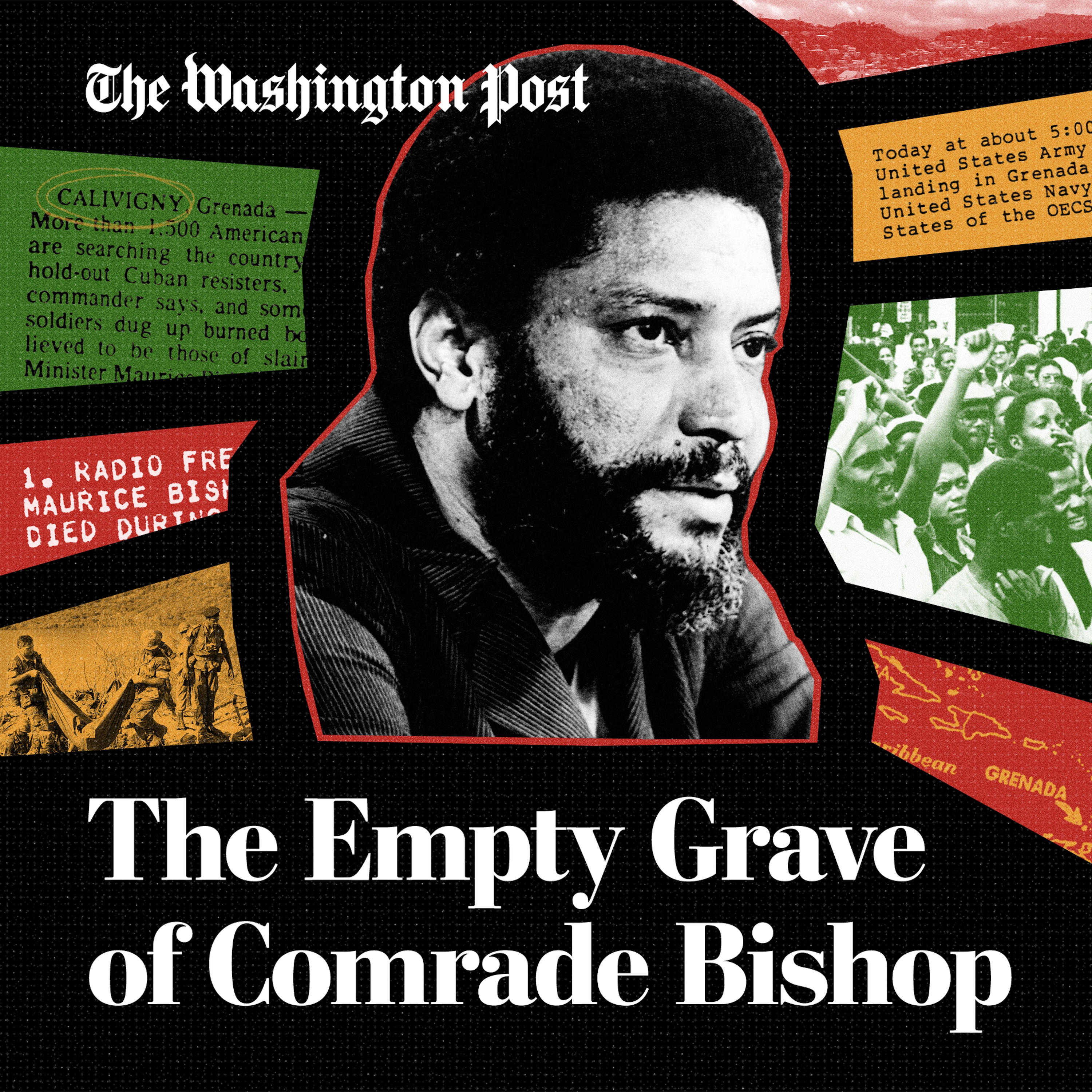
Every 19th of October, Grenadians mark a somber anniversary: the 1983 execution of the country’s former prime minister and revolutionary leader, Maurice Bishop, and others who died alongside him. The people of this Caribbean nation still have no closure more than 40 years later. The remains of Bishop and his supporters were never returned to their family members and are missing to this day.
In the first episode of “The Empty Grave of Comrade Bishop,” The Washington Post’s Martine Powers takes us on the personal journey that led her to learn about Grenada’s history. Martine delves into why Bishop was such an influential figure, what made the United States nervous about him and why the mystery of his missing remains continues to haunt so many on the island.
If you haven’t listened to the series yet, we hope you check it out on Apple, Spotify, or wherever you listen to podcasts. If you’ve already listened, we would be grateful if you shared it and left a review.
You can find photos and documents from the investigation in our special episode guide here.
Subscribe to The Washington Post here.