 Ask ChatGPT



The Trump administration’s plan to end Temporary Protected Status (TPS) for Afghans in the U.S., making thousands deportable, and the risks this poses to people who helped the U.S. during the Afghanistan war after the Taliban takeover in August 2021.
Abby Hauslener, national security reporter at The Washington Post.
TPS was granted after the 2021 withdrawal as Afghanistan was deemed too dangerous; ending TPS (starting July) will allow deportations for Afghans without clear status, even some who are asylum-eligible or special immigrant visa (SIV) eligible but stuck due to delays and missing documentation. The administration claims conditions improved, but the episode argues Afghanistan remains dangerous and targets people associated with the U.S. Veterans groups describe a “betrayal” of Afghan allies.
Hanifa Gurwal, a human-rights worker who fled Kabul; her father and brother were detained for 24 hours; she later reached the U.S. via Qatar, Germany, and Virginia but couldn’t apply for an SIV in time, relying on TPS/humanitarian parole. The episode also cites chaos at Kabul’s airport and document destruction during evacuation, complicating SIV proof.
Written by AI. May contain mistakes.
Discover the plight of Afghan immigrants at risk of deportation due to U.S. policy changes.
“As of next week, thousands of Afghan immigrants could be deported from the United States.”
Understand what Temporary Protected Status (TPS) means for Afghan nationals.
“Today, Abby explains why the Trump administration is moving to revoke protection for Afghans in the U.S.”
Examine the implications of the Trump administration's decision to end TPS for Afghans.
“Basically, it's a recognition that a certain country is too dangerous for its nationals who are currently in the United States to be forced to return to.”
Learn about the administration's rationale for revoking TPS despite ongoing dangers in Afghanistan.
“So the administration has said, you know, in theory, right, people who have legal permanent residents here, what we know as green card holders, you know, would not be affected.”
Explore how Afghans supported U.S. efforts during the war and the risks they faced.
“And we've touched on this a little bit, but I do think it's helpful to just root ourselves back even before the chaotic U.S.”
Understand the chaos and planning failures during the U.S. withdrawal from Afghanistan.
“that would have qualified them for special immigrant visas.”
Learn about the impact of destroyed documents on Afghan visa applicants.
“on TPS, on these other avenues to be able to stay.”
Examine the feelings of veterans regarding Afghan allies and their evacuation.
“You know, as we're talking about Afghans who helped directly or indirectly the U.S.”
Discuss the looming expiration of TPS for Afghans and its implications.
“So, Abby, TPS for Afghans is set to expire in July.”

Get the gist, explore an idea or ask about something said.
 Claude
On Post Reports, what are the key points of this episode?
Searching your listeningAutomatic transcript. May contain errors.
0:00Oh, oh, oh, O 'Reilly! Check engine, ABS, or maintenance light on? Take the guesswork out of your warning lights with O 'Reilly Veriscan. The service is free and provides a report with solutions verified by ASE-certified master technicians. And if you need help, we could recommend a shop for you. Ask for O 'Reilly Veriscan today! Oh, oh, oh, O 'Reilly! Auto Parts! Oof!
0:32As of next week, thousands of Afghan immigrants could be deported from the United States. Some of these Afghans had helped the U.S. military, either directly or indirectly, during the war in Afghanistan. Others were instrumental in human rights work, or they worked for the country's U.S.-backed government. But then came August 15, 2021. That's the day Afghanistan's fragile government fell and the U.S. left suddenly in a chaotic withdrawal. As U.S. forces were withdrawing, the Taliban swept back into Kabul and had took control of the capital city while U.S. forces were still at the airport. And that set off a massive panic.
1:20Abby Hauslener is a national security reporter. She says that this panic was especially acute for these Afghans who had helped the Americans or supported their causes. They knew they'd be the main targets of the Taliban. Many of them were supposed to have special immigrant visas to come to the U.S. You had people who were eligible for these visas, former interpreters, people who had been waiting and waiting and didn't have these visas yet. There were people who had the visas in hand and, you know, had yet to actually have a flight scheduled. There were various other people who worked for the Afghan government or the Afghan military or NGOs or whatever who were terrified of the Taliban.
2:03And all of these people together tried to get into the airport. It was chaos. Hanifa Gurwal was one of them. She had worked closely with the U.S. and Afghanistan, doing human rights work and working toward a peace deal. She remembers the day four years ago when Kabul fell. I left the office, leaving behind everything. And just for a moment, everything was replaying in my mind. And all the hopes we had that our generation would at least see a different Afghanistan. I remember my parents would be telling us the stories of how regimes would change in the past in Afghanistan and how dark the first era of the Taliban was.
2:56And we were really determined that we will change the situation in Afghanistan this time. And we will not let Afghan people, particularly Afghan women, to be faced with the same dark era again. But at that moment, I realized that a darkness is coming back.
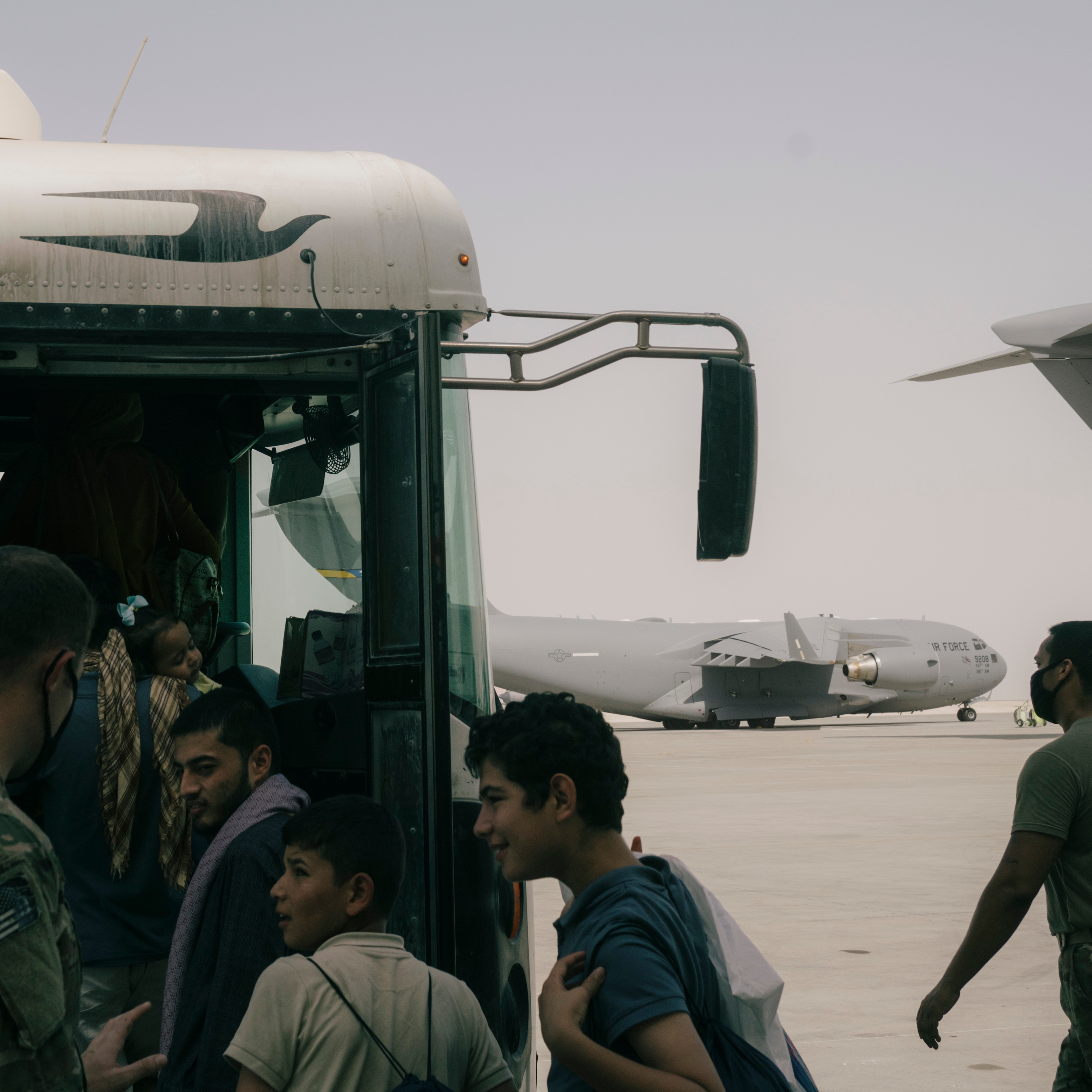
3:22Hanifa could not get on a plane. She went to her sister's house to hide from the Taliban. They came to my home on August 16. I wasn't at home, luckily, but they took my father and brother. They detained them for 24 hours. that whole week was very challenging, traumatizing. And yeah, it's quite difficult to even remember. And anything could happen. Eventually, Hanifa managed to get out on a U.S. military plane. She went from Kabul to a U.S. military base in Qatar, then to a base in Germany, and then to a military camp in Virginia. In the chaos of it all, Hanifa hadn't been able to apply for a special immigrant visa.
4:15Neither had thousands of other Afghans like her. Some of them, like Hanifa, ended up with humanitarian parole status. But many others were given this other blanket protection called temporary protected status, or TPS. That let them enter the U.S. legally and stay. But starting next week, the U.S. government will remove that protection. Hanifa says that could be a death sentence. They will kill and go after all the Afghans who stood alongside the U.S. in this long 20 years' war. From the newsroom of The Washington Post, this is Post Reports Weekend. I'm Elahay Izadi. It's Saturday, June 28th. Today, Abby explains why the Trump administration is moving to revoke protection for Afghans in the U.S.
5:10And why this is infuriating military veterans who say their country is betraying a sacred promise.
5:23Thank you, Abby, for taking time to join me today. My pleasure. Sure. Abby, you and I are here to talk about temporary protected status for Afghans. First, just what is temporary protected status or TPS? So TPS is sort of a blanket designation that the U.S. government can give to a country. Basically, it's a recognition that a certain country is too dangerous for its nationals who are currently in the United States to be forced to return to. And so we've seen over the years the U.S. has given TPS status to places that are in the midst of wars or have just experienced earthquakes or, you know, hurricanes or really sort of massive disasters that have made living there unsustainable for a particular period of time.
6:16And Afghanistan is one of these countries that received nationals from Afghanistan received TPS. Who gave that to them and when? That's right. So after the U.S. withdrew from Afghanistan in 2021, you know, in the process of doing that, the U.S. evacuated tens of thousands of Afghans to the United States, gave them a temporary status to stay here for a couple of years. Operation Allies Refugee, which I announced back in July, has already moved 2 ,000 Afghans who are eligible for special immigration visas. and their families to the United States. And then on top of that, President Biden gave Afghanistan TPS status, and that just meant that any Afghans in the United States could not be deported to Afghanistan.
7:03We're also expanding refugee access to cover other vulnerable Afghans who worked for our embassy, U.S. non-governmental agencies, or U.S. non-governmental organizations. And that was based on the fact that the Taliban, whom the U.S. had been fighting for years, had taken control of Afghanistan. It was deemed, you know, not a safe place. It was in the midst, still is, of just a massive economic and humanitarian crisis as well. So now walk me through exactly what the Trump administration has decided to do with Afghans who are here with this temporary protected status. So this spring, the Trump administration decided to end TPS for Afghanistan.
7:47And what that does is it means that Afghans are now deportable under U.S. law. As of when? That will start in July. And so who exactly then would be affected by this move? Like, do we know how many people could be affected by this? So the administration has said, you know, in theory, right, people who have legal permanent residents here, what we know as green card holders, you know, would not be affected. Immigration advocates say, you know, in theory, people who have pending asylum applications should not be affected or pending special immigrant visa applications. Those are for the Afghans who worked directly for the U.S.
8:27government in Afghanistan. But there's a whole lot of uncertainty. The people who would be affected are those who don't have a clear immigration status. So that means, for example, Afghans who might have been human rights advocates or teachers or former employees of the Afghan government that was backed by the United States, former members of the Afghan armed forces. These are all people who might have been evacuated here in 2021 or found their way here as evacuees afterward who are not eligible for the special visas for those who work directly with the United States. And so might be trying to get asylum, might be trying to apply for other visas, say they have family here, who knows.
9:10Those are the folks who could be deported and who they and their advocates and attorneys say would be very vulnerable to some sort of retribution or extreme danger should they return. Are there any estimates as to how many people could lose their legal status here? Immigration groups and advocates for the Afghans say it could be in the thousands. In the thousands. So what about people like Hanifa? She has asylum. Is she safe? I don't know. I have the fear, to be honest. The fear is always there, especially seeing the current changing policies. It keeps me awake in the night. Yeah, it is. It is frightening, to be honest.
10:03So if Hanifa has been granted asylum by the U.S. government, then she should be protected in theory because that would make her a legal permanent resident. You keep saying like in theory. Why that caveat? Well, it's a caveat that we probably wouldn't have been using much a few years ago, but we've seen in the past few months the Trump administration pursue immigration policies at times that seem to be in direct defiance of court orders. And so, you know, immigration advocates, I think, are very skeptical that they can rely on this administration to uphold the law. It sounds like what you're suggesting here, too, is that there might be one thing on paper, but once it's implemented, there are all these unknowns given recent history and recent actions by the administration that suggests that things could go in a way that is completely unanticipated.
10:58Exactly. And just we've seen a demonstrated willingness to defy the courts. We're talking so much right now about the like nuts and bolts of this policy. But what's also standing out to me is the idea that Afghanistan was given blanket TPS and in an acknowledgement at the time that conditions there were terrible, very bad under Taliban rule for many people, not just the people who were working directly for the U.S. government, but all sorts of other people in civil society. So what justification is the Trump administration giving now for revoking TPS? So the Secretary of Homeland Security, Kristi Noem, said that basically the administration is claiming that conditions in Afghanistan have improved and so that it no longer meets the standards to apply TPS.
11:57Obviously, regional experts, national security experts, immigration advocates and so on say that is fundamentally not true. We have not seen any indication that Afghanistan is any safer now for the folks who were evacuated, who fled, than it was a few years ago. There has been systematic targeting at times of people who worked for the U.S.-backed Afghan government, people who worked for the United States, minority and women's rights activists. They only see every individual who have arrived to the U.S. as one of their partners and allies who stood with the U.S. against the Taliban. So they see them as enemies, basically.
12:45They already killed many of those who were left in Afghanistan. And now deporting them back means sending them to death. And so it is very much still a very dangerous place to be, especially if you are someone who has associated with the United States. And Afghan advocates, you know, point out that for all of the people who have now spent time here, that's every single one of them.
13:15After the break, Abby explains why so many Afghans who supported the U.S. have struggled to get the legal status here that was promised to them. We'll be right back.
13:37Did you know you can play The Washington Post's games for free? Find the crossword, keyword, ridges, and on the record in the Washington Post app or at WashingtonPost.com slash games. No subscription required.
13:58I think it's important to take a step back in time to really understand why so many Afghans here have TPS and not other kinds of special visas. And we've touched on this a little bit, but I do think it's helpful to just root ourselves back even before the chaotic U.S. withdrawal from Afghanistan. In what ways did Afghans help the U.S. government during the war? Well, in every war zone, the United States depends heavily, essentially, on citizens of the country that they are in to help them to survive and to wage that war. So in Afghanistan, you know, that means they had interpreters. They would not, U.S.
14:45troops, U.S. diplomats, et cetera, would not have been able to communicate with the local population without interpreters at their sides at all times. And that means people, Afghans who were risking their lives on a daily basis to do that. The embassy and U.S. military bases in the country ran with the help and work constantly of local nationals, everything from, you know, trash collectors and housekeepers to construction workers and, you know, bureaucrats, paper pushers, you know, all sorts of different jobs. And then you also had, you know, the U.S. invaded Afghanistan in 2001 after the, you know, in response to the September 11th terrorist attacks.
15:33You know, in the 20 years that followed, the United States poured billions of dollars into trying to rebuild an Afghanistan with a government that was, you know, pro-democracy and favorable to U.S. interests. And so the government that came into existence was heavily supported from its inception. You know, the politicians, the infrastructure, you know, supported by the U.S. government. And so those folks also are just sort of intrinsically tied to America. One thing that stands out to me in what you're saying is there are Afghans who risk their lives to do this sort of work. Why did they risk their lives to do this sort of work?
16:20Well, I think I've heard, you know, a range of things. For a lot of people, you know, this was a job. When you, you know, in a war zone, the economy in a war zone is inherently not a great economy. It's hard to do business and to go to school and to have a job. And so for a lot of people, especially those who already had some English skills, this was the way to go. You know, this was a way to make money, to support their families. You know, in some places, this was the only real job around. And then there were others who, you know, really thought that the Americans were there to help their country, to help rebuild it, to make Afghanistan into a stable place with a stable government that could thrive.
17:08And they believed in that. And they did these jobs because they thought they were helping to rebuild their country. And is it like this sort of agreement that if you do these sorts of jobs, we will also protect you? Certainly in the case of people who worked for the U.S. government, yes. The U.S. government made a commitment to people who served as interpreters or who worked in the embassy or on bases that if people came to work for the U.S., the U.S. would protect them. that the U.S. valued these people, they were essential to the U.S. mission, and that they would therefore be entitled to these special immigrant visas that would give them and their families a permanent refuge in the United States.
17:52So then there was the withdrawal in August 2021. It was very chaotic. Just talk me through what that meant for people who did do this sort of work that would have qualified them for special immigrant visas. But, you know, they were caught up in this moment. Well, let's rewind a little bit even before that. The special immigrant visa program had been plagued by just crazy delays. You know, people would wait well over a year, sometimes years, to get these visas, sometimes being killed while they were waiting. You know, the program was heavily backlogged when this withdrawal took place. And then the Biden administration was pretty heavily criticized for the way it carried out the withdrawal.
18:40And that was in large part because they failed to plan and failed to execute on evacuating these essentially hundreds of thousands of people who were eligible or potentially eligible for these special visas. The State Department did not even request an emergency evacuation until after Kabul was surrounded by the Taliban. As a result, the airport was not secured until August 17th, two days after Kabul fell. As the saying goes, if you fail the plan, you plan to fail. And fail they did. Yeah, that clip is from a House hearing on the withdrawal. That's Texas Republican Congressman Michael McCall speaking.
19:28And we should say Biden did respond to some of those criticisms. I know there are concerns about why we did not begin evacuating Afghans, civilians sooner. Part of the answer is some of the Afghans did not want to leave earlier. Still hopeful for their country. And part of it because the Afghan government and its supporters discouraged us from organizing a mass exodus to avoid triggering, as they said, a crisis of confidence. Not only did they fail to evacuate masses of people who were vulnerable early and in a sort of a organized fashion, But the U.S. government also really failed to plan for the Taliban's very swift seizure of power in the country.
20:17It was a time of chaos, terror and uncertainty in the Afghan capital of Kabul. The scenes of crowds massed outside Kabul's airport desperate for a flight out shocked people around the world. And what happened was the people who, you know, those who ultimately made it inside the airport and made it onto these evacuation planes, in many cases it had nothing to do with how long they had served the U.S. government or whether they had or not. It was luck. It was, you know, it was sheer luck of managing to make it somehow into the airport at the right time. And so that is how we ended up with, you know, this population of tens of thousands of evacuees, some of whom were special immigrant visa eligible and some of whom were not and therefore came to, you know, depend, be dependent on TPS, on these other avenues to be able to stay.
21:11Well, and I also, talking about the chaos of that moment, would imagine just even getting your paperwork together, like the logistical element of it. Can you tell me a little bit about that? I'm glad you raised that. Yeah, so that's a major issue. One of the huge burdens in the SIV process is you have to show through this incredible amount of documentation and references that you are who you say you are, that you did this job serving the U.S. government in the way that you did. And the embassy, the U.S. government and military actually told people, people in this SIV pipeline to destroy their documents during the evacuation as they were trying to make their way from various parts of the country, from Kandahar, from Mazar Sharif, et cetera, to the capital to try to escape.
21:59You know, the U.S. government feared, I think correctly, that if these people were caught with this documentation, this proof of being associated with the Americans, that they could be executed by the Taliban. And so people destroyed these documents. They traveled to the airport with nothing. You also had the embassy burning documents, burning proof that these people worked there in an effort to protect them, you know, from the Taliban. But the result is, you know, you have lots of people in the U.S. who are SIV eligible who are now still struggling to prove their case because their documents are destroyed.
22:38Maybe the unit they worked for or maybe the company, the U.S. contractor they worked for is no longer in existence. Maybe they've lost touch with the soldiers they worked with and they can't track them down. It can be extremely difficult to try to piece this together now, especially if you don't have, you know, a dedicated and very, very skilled attorney working for you. Yeah. And so then it sounds like a lot of people who, because one argument is, well, if you did work directly for the U.S. government, you shouldn't be affected by revoking TPS because you're eligible for this other type of visa.
23:14But based on everything that you're explaining, it sounds like there are people who would be eligible, but because of all these complications, they aren't getting it and therefore they're reliant on TPS. Yes, exactly. That's one of the big, I think, misunderstandings that you hear between sort of what the administration is saying now and the reality on the ground as it's being relayed by attorneys and by Afghans themselves who are caught in this process. You know, as we're talking about Afghans who helped directly or indirectly the U.S. government or even the armed forces during the 20-year war, I remember during the fall of Kabul, there were a lot of veterans groups, American veterans groups who were coming out, speaking on behalf of these Afghan evacuees and actually were organizing evacuation flights and trying to get people out, their former colleagues on the ground.
24:07Abby, how are these military veterans now feeling about the Trump administration revoking TPS for Afghanistan? These veterans groups are furious. You know, a lot of these folks, you know, there are folks who got involved in the evacuation at the time and are still involved. So for the past, you know, four years, they have continued working, trying to get Afghan interpreters and others out of Afghanistan, because, again, there were thousands who were left behind. trying to help resettle the people who are here, trying to get legal services to the people who are here. You know, this has been sort of a continuing effort, and a lot of them are very angry.
24:48Why? Tell me about their anger. A lot of veterans of this war were angry at the way the withdrawal played out to begin with. There was this sense of betrayal, that they were betraying America's Afghan allies by not protecting them. And there is that sense now. There's a sense of betrayal and shame, I think, for a lot of people. And they feel like their country has an obligation to uphold its promise. Tell me more about that obligation and the promise, not just even in the context of Afghanistan, but I'm wondering what message does this send going forward? Well, certainly advocates for the Afghans and, you know, I'm including in that lawmakers who have been who, you know, supported the the evacuation efforts.
25:38You know, they would say this sends a terrible message to allies and adversaries abroad that this this says that, you know, if you come and work for the Americans in a war zone, you the U.S. is not going to have your back. You cannot depend on the U.S. to evacuate you if you face danger for that service. And, you know, U.S. military commanders will say that's a huge problem because they can't do their mission on overseas battlefields without local help. It just can't be done. Mm-hmm.
26:19So, Abby, TPS for Afghans is set to expire in July. What should we expect next to happen? That is a big unknown. You know, we have seen, you know, the administration has implemented a very aggressive policy of, you know, trying to round up people who are deportable, who do not have legal status, and deporting them as quickly as they can. And so I think the expectation from a lot of people is that Afghans will be targeted if they are deemed deportable. And so we could start seeing, you know, mass deportations of Afghans. And so how are advocacy groups and lawyers representing Afghans preparing?
27:08They are moving frantically to try to lodge asylum applications for people who don't have them, to try to appeal for people who don't have appeals going, so that, again, in theory, people can't be deported if they have pending application. And then you also have veterans groups who are calling Congress and lawyers, calling Congress, calling their lawmakers, trying to get as much information from the Department of Homeland Security as they can for their Afghan clients, trying to tell lawmakers this is a big deal, please stop it. And, you know, some folks who are saying, you know, we're going to try to fight this.
27:49We will physically show up to try to block ICE agents from taking, you know, Afghan allies away.
28:01Well, Abby, thank you so much for taking time to explain all this. I'm glad to be here. Thanks.
28:12Abbey House Loaner covers national security. That's it for Post Reports. Thanks for listening. Today's episode was produced by Renny Svarnofsky. It was edited by Maggie Penman and mixed by Sean Carter. I'm Elahey Izadi. We'll be back Monday with more stories from The Washington Post.
28:37Thank you.
29:06clear sourcing. And if we don't know the answer, we'll tell you. Ask the Post AI. Find it on WashingtonPost.com or in the app.
This month Homeland Security Secretary Kristi Noem announced the administration’s termination of temporary protected status, or TPS, for Afghans, exposing thousands, potentially, to deportation as soon as next week, when the policy is to take effect.
Today on “Post Reports,” national security reporter Abigail Hauslohner explains.
Today’s show was produced by Rennie Svirnovskiy and mixed by Sean Carter. It was edited by Maggie Penman. Thank you to Andy deGrandpre, Hasiba Atakpal, Spojmie Nasiri, Shala Gafary, Negina Khalili, Helal Massomi.
Subscribe to The Washington Post here.