In short
Podcast Notes: Post Reports - "The kids keeping go-go music alive"
Episode Summary In this episode of Post Reports, host Sabi Robinson and enterprise reporter Marissa Lang delve into the vibrant world of go-go music in Washington, D.C. They discuss educational initiatives aimed at preserving this local cultural treasure by teaching it to students. The episode explores the historical significance of go-go music, its evolution, and its current resurgence among the youth in D.C.
Key Concepts and Discussions
What is Go-Go Music?
- Definition: A genre that blends funk, jazz, hip-hop, R&B, and soul.
- Characteristics:
- Percussive Nature: Utilizes various drums and percussion instruments.
- Cultural Significance: Integral to D.C. culture, often present at community gatherings, events, and even funerals.
- Origins:
- Emerged in the 1970s.
- Chuck Brown: Known as the "godfather of Go-Go," he coined the term due to its continuous rhythmic flow.
Historical Context
- Early Days:
- Go-go began in live music venues and was primarily created by black teenagers.
- Initially criminalized by local authorities due to associations with violence and social issues.
- Rehabilitation:
- Over recent years, there has been a cultural shift that led to a more positive perception of go-go music.
- In 2020, it was officially designated as the District of Columbia's official music.
Current Educational Initiatives
- Programs in Schools:
- Schools are introducing go-go music into their curricula to engage students and preserve the musical legacy.
- Music teachers often have personal connections to the go-go scene and aim to pass on this heritage.
- Impact on Students:
- Students initially unfamiliar with go-go have begun to embrace the genre, finding connections to D.C. culture and history.
- Participation fosters a sense of community and belonging among students.
Student Perspectives
- Transformative Experience:
- Students express newfound appreciation for go-go, seeing it as "home" and "family."
- Many report a change in attitude, now actively listening to go-go outside of school.
- Cultural Connections:
- Learning go-go allows students to connect with D.C. history and feel part of a larger cultural narrative.
Impact on Youth and Community
- Positive Outcomes:
- Go-go programs serve as a constructive outlet, providing students with a creative way to engage with their community.
- They challenge negative stereotypes about D.C. youth, presenting an alternative narrative of youth empowerment and cultural pride.
- Long-term Significance:
- Encourages students to view themselves as contributors to their community’s cultural landscape, instilling a sense of responsibility towards their heritage.
Conclusion This episode of Post Reports highlights the efforts to keep go-go music alive through educational programs in D.C. schools. By instilling a love for this unique musical genre, these initiatives not only preserve a vital aspect of the city's culture but also positively influence the lives of young people, helping them forge their identities in a complex urban landscape.
Additional Notes
- Credits:
- Episode produced by Sabby Robinson, edited by Maggie Penman, mixed by Sean Carter.
- Featuring thoughts and insights from Marissa Lang, who emphasizes the cultural significance of go-go in shaping community identity.
Written by AI. May contain mistakes. Listen to the episode to check what was said.
Transcript
Automatic transcript. May contain errors.0:02Last month, I went to a public charter school in Southeast D. And I walked in through the building and into the back of the library into this tiny little music room where there were a bunch of kids getting instruments set up.
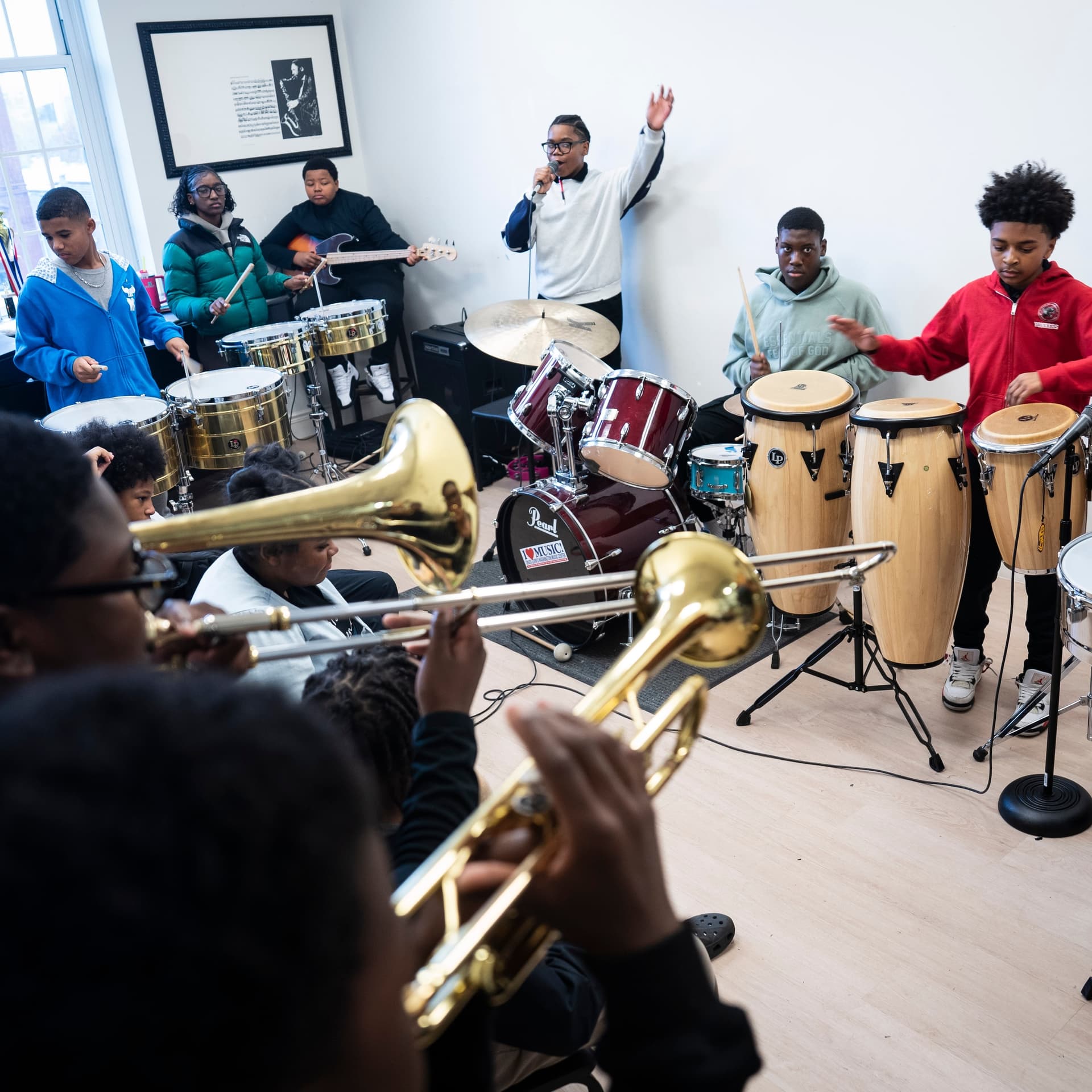
0:21That's Enterprise reporter Marissa Lang. She recently went to some schools around D.C. to check out their new music programs. So there were a handful of students. These are teenagers aging between 14 and 18 years old. And they were setting up drums and a keyboard, bass guitar. They were getting ready for band practice. This band is sort of unique because unlike a lot of public schools, they weren't setting up to play jazz or classical music. They were getting ready to play go-go. Go-Go is a type of music signature to D.C. It's beloved and well-known here, but it's also aging. The people who started it are getting older.
1:08So are its fans. But Marissa came across these students and others like them who are trying to keep Go-Go alive.
1:18Recently, as I was talking to some folks who were very big in the Go-Go scene in D.C., they were telling me about these youth bands, that there's this new groundswell of young people, as young as like 11 years old in D.C., who are joining up and making go-go bands and making go-go music, and in some cases, original music. And that was so compelling and interesting to me, and I wanted to get in there and see what these kids were doing.
1:54From the newsroom of The Washington Post, this is Post Reports. I'm Sabi Robinson. It's Wednesday, December 24th. Today, Marissa explains why schools are making an effort to get students playing go-go music and the impact it's already having.
2:14Hi, Marissa. Thanks so much for being here today. I'm so happy to be here. So you and I both live in D.C. and are, you know, more familiar with go-go music. It's kind of an iconic part of D.C. culture. But for those people who don't live here who are less familiar, how would you describe go-go? Go-Go is very funky. Go-Go is this blend of funk music, jazz, hip-hop, R &B, soul. It layers all of these together, and it's very percussive. There's different kinds of drums and percussion instruments. Sometimes there's a brass section, and it blends all of this together to create this very funky, syncopated sound.
2:59It loops and it goes and goes. That's why it's called Go-Go. It's music that you kind of can't help moving to. It's very much music meant to keep people on the dance floor. And in D.C., you hear it everywhere.
3:21Yeah, I feel like so many of the events that I've been to across the city, you just like, Go-Go is kind of like the track in the back. Totally. It's at cookouts. It's coming out of people's cars. It's at funerals. It's just parades, like any kind of block party. Go-Go is there. And when did it actually start in D.C.? So Go-Go comes out of the music of the 1970s. It really started appearing in live music venues. Go-Go is a music born out of performance. Chuck Brown, who is probably the most well-known Go-Go musician, he's known as the godfather of Go-Go, really made a name for the genre. And he's the one who named it Go-Go in part because he said it just goes and goes.
4:04So after the 70s, it took off. In the 80s and 90s, more bands started playing the music or putting their spin on it, incorporating new sounds, making it more hip-hoppy, making it more contemporary with the music of those decades. Mm-hmm. One thing to know is go-go was very much music that came out of D.C. public schools. A lot of the musicians who were creating this music, who were starting their own bands, were black teenagers. And in the 80s and 90s and early 2000s, the place that you could find go-go were these live music venues. Sometimes those were big clubs. Sometimes they were little backyard venues that would just attract crowds and crowds of people.
4:54A lot of the time you would have a room packed full of people dancing, sweating, the music kind of vibrating the floors. People who would go to go-go concerts back then describe the feeling of being in a go-go as this visceral, full-body experience. So today, GoGo is, you know, widely embraced by D.C. and D.C. politicians. But from what I understand from your reporting, that was not always the case. Absolutely not. When GoGo really hit the scene in the early days, it was very heavily criminalized. It was blamed by D.C. lawmakers, city council members, even the mayor, for a lot of social ills. Go-Go concerts were seen as this place where violence could break out at any moment, and police were often dispatched to break them up or to police music venues.
5:52Curfews were implemented that really hit Go-Go venues hard, that made it difficult for young people to be out late in certain parts of the city or to attend Go-Go's. The music was associated with gang violence, with drug use, with guns. It really got a reputation. And if you talk to folks now who were part of the scene then, they reflect that a lot of those problems were not something that came from the music, that were not something that came from the musicians. But rather, you have a big crowd of people and sometimes something would happen or a fight would break out. But as with these things, you know, as you send more law enforcement and then people are reacting to the law enforcement, it kind of creates its own weather patterns.
6:38And so, yeah, it was definitely not something embraced by the city of D.C., despite it being sort of this homegrown music. Yeah. That narrative feels so reminiscent, honestly, to some of the things we're hearing today. Under President Trump's orders, law enforcement are cracking down on teens in the district for what they're saying is violence caused by youth. Do you think that is an accurate comparison? Yeah, it's really interesting. As I was reporting the story, I kept coming back to this mirroring that you're describing that it felt so present with me that today I'm talking to black teenagers who are in D.C.
7:22schools about their participation in GoGo and these bands and the way that it's really being treated and seen by the adults in their life as a way for them to stay out of trouble. And a thing that they can do that's really productive and will give them tools like art and performance and maybe a way to make money that is actually pro-social and constructive. It allows them to hang out with their peers in a really safe setting. So GoGo right now is being seen as like this could be the solution for the kids, right? But, you know, decades ago it was seen as the opposite. And I think that a lot of the narrative that we're hearing about D.C.
8:04teens is that they're dangerous. They're out of control. They're running around in these chaotic packs of other teenagers and causing problems and committing crimes. And that is a very longstanding narrative that we kind of see appear over and over again over the decades in D.C. history. How did go-go music then become this thing that was not associated with the violence and danger in the city? Because it does feel like now it's a very vibrant part of DC events and that the city will have go-go music incorporated into their things. And so I feel like it does feel like that image has really shifted.
8:47shifted. Yeah, I think the rehabilitation of go-go has been pushed really heavily by the people who loved it as youth and have now aged into positions of prominence. I think you really started to see a lot of that five, ten years ago. There were city council members who introduced legislation to make go-go music the official music of the District of Columbia. It was officially incorporated as the official music of D.C. in 2020. Now there's a go-go museum in Anacostia. So it has really changed how I think people in the city talk about it. And that's really being led by a lot of folks who either were go-go musicians themselves or just like lifelong go-go fans who are now in their 40s and 50s and 60s and have more clout and more cultural cachet to make that change happen.
9:48After the break, what students told Marissa about why they love go-go? We'll be right back.
10:08Okay, so Marissa, I want to hear more about these go-go programs that are in schools now. Now, what did you hear from the administrators and the schools about why they decided that go-go was a thing that they wanted their students to learn? So first of all, something to know is a few of the music teachers that I talked to and a few of the school administrators that I talked to used to be involved in the go-go scene themselves. Oh, cool. Either they played instruments. At least one of the administrators over at that school in Southeast DC managed a go-go band in the early aughts. And they feel very connected to the genre and they feel very invested in ensuring that it lives on, that it doesn't just wither and die with their generation.
10:55For me, as a DC native, I feel like it's very important that I pass that lineage on because I'm a part of this community. I mean, I've toured with go-go bands. B.J. Simmons, who is the music director at Stuart Hobson Middle School, is himself a very accomplished go-go musician. And so he sort of sees himself as like the perfect vehicle to teach these kids go-go. So it just makes sense for me. It's an indigenous music. It just makes sense for it to be a part of my curriculum. So passing that down is important to me. And so in creating this go-go class, which in the middle school is a class, they get together and they play go-go every day at like 930 in the morning.
11:44So starting the day strong. That's such a good way to start the day, I'm sure. It really is. Yeah, it gets you up and going. And when I went to their go-go practice, it should be said like other kids on their way to class were grooving in the halls. So it is definitely, I think, appreciated in that school. But BJ told me that in trying to come up with a curriculum for GoGo, he wanted it to, yes, be about the music and, yes, be about the instruments and giving these kids the ability to try different things and try different music and understand the music theory behind the layering that happens in GoGo music.
12:19But also he's seeing it as an opportunity to teach about D.C. history, to teach about D.C. culture.
12:27I actually went to a band practice at Stuart Hobson Middle School and was able to talk to some of the students myself. And these are middle schoolers. So they're, you know, 11, 12, 13 years old. And I asked them, was go-go music that y 'all listened to before you started taking this class? And a few of them said, oh, yeah, you know, my mom likes it or my auntie likes it or my grandma likes it. But it wasn't really music that they felt connected to, that felt like it was their music. It was kind of something that was just in the water. It was around them all the time. A couple of them admitted they did not like go-go at all, that they kind of thought it was like not for them.
13:05They prefer, you know, hip hop or trap or some other kind of music genre. But when they started playing it and when they started to understand it differently, they've all totally come around. And they now say that they really love it, that they find themselves listening to it outside of class or looking up old videos or trying to come up with new ideas. And that they see that effect on their friends, too, that it's not just the kids who are actually in this go-go class, but it's kind of seeped out through the rest of the school. That now you have other 12-year-olds who are getting into go-go and that when they've put on concerts or they've had events, this go-go group out of the middle school, Panther Funk, has fans.
13:46And they've got like peers who come out and, you know, want to see them perform live. And so it really is shifting and changing the culture of that school. Yeah, I feel like one of the things that makes GoGo so unique is obviously the connection to the city. And so I'm wondering, does it make them feel more connected to D.C.? Yeah, I think so. One of the students I spoke to, Kevin Ivey, who is a senior at the Seed School of Washington, talked to me a little bit about how one of the things he found so enriching about the GoGo program and what he's been exposed to at the school was not just the opportunity to play music, but also to learn more about GoGo and its history and its contributions to D.C.
14:30culture. Being young and playing, like, music that's come down from generation to generation, it's actually, like, heartwarming to me because I can still learn where the roots were, how the music was created, and what made D.C. B.C. And I think one thing that I really noticed when I was reporting this story, I mean, I asked every kid I talked to, how would you describe Go-Go? And what I found so interesting was that to a kid, not one of them described music to me. None of them were like, oh, it's drums. Oh, it's this kind of sound. I got so many answers that were like, go-go is home. Go-go is family.
15:14Go-go is the music that I hear when I'm with my neighbors or I'm like at a party. I had one kid beautifully describe to me the way it makes him feel and that he said, go-go is like heart music, that it's music for your spirit. And he was like, you know, it's impossible to be sad when go-go is playing. Like, you just can't be sad when there are bongos. And I was like, you're right. You can't be sad when there are bongos. So true. Yeah. Yeah. So, Marissa, after you went to these practices and you've spoken with so many students and administrators, what do you think the impact of having go-go in these schools is?
15:53Like, is it making a difference? I think it really is making a difference. I can't speak to sort of the global questions of is having a go-go band in the school keeping kids out of trouble or preventing youth crime from happening. I think that's probably something we can't speak to right now and we certainly don't have the data for it. But what I think it is doing is it's giving these kids a different way of seeing themselves in the fabric of the city, that it's giving them exposure and an opportunity to imagine kind of a counter narrative that at a time when a lot of what you hear about D.C. youth and D.C.
16:36teenagers is negative, that they're, you know, roving the streets, that they're committing crimes. What these classes and what these groups are doing is they're allowing these kids to imagine that there is a different path and there's a different way that they can be successful and recognized and embracing it and seeing it as a way that they can leave their mark on this too. And so that kind of feeling that this is not just something of the past, but this is also something that they can contribute to and bring into the future and the responsibility that comes with like carrying a thing with legacy and with roots and with history and with that kind of cultural power, I think is something that even just reporting the story, I watched change some of these kids.
17:23And it's really beautiful to witness.
17:29Marissa, thank you so much for sharing this reporting. It was such a joy to be here.
17:38Marissa Lang is an enterprise reporter for The Post. That's it for Post Reports. Thanks for listening. Today's episode was produced by me. It was edited by Maggie Penman and mixed by Sean Carter. Thanks to Teresa Vargas and April Bethea. I'm Sabi Robinson. I hope you have a safe and warm holiday tomorrow, and we'll be back on Friday with more stories from The Washington Post.
From the publisher
Schools and community programs in Washington, D.C., are teaching students to play go-go music to help extend the legacy of the official music of the District.
Producer Sabby Robinson spoke with enterprise reporter Marissa Lang about the history that these students are keeping alive and the impact the programs are having.
Today’s show was produced by Sabby Robinson. It was edited by Maggie Penman and mixed by Sean Carter.
Subscribe to The Washington Post here.