
In short
The Washington Post’s Post Reports revisits the U.S. “presidential fitness test,” why it was created, what people experienced, and what science says about whether it improves children’s health. It also discusses President Donald Trump’s executive order reinstating the test and how it might differ from the old version.
Guest backgrounds
Gretchen Reynolds, The Washington Post health columnist; previously reported on exercise behavior and interviewed researchers about why people exercise or avoid it.
Key claims
Childhood obesity and inactivity are major problems (about 23% of children up to age 16 are obese; fewer than a quarter get recommended daily vigorous exercise). The original test (began under Eisenhower) emphasized athletic performance, so few earned awards (often 2–3%). Researchers say a once/twice-year test won’t reliably improve activity and can be aversive. Obama replaced it with Fitnessgram, which aimed for health-based “zones” and home reports, but obesity/inactivity still worsened.
Notable examples
Reynolds and many readers described humiliation from events like pull-ups, rope climbing, and public failures; some still carry negative feelings into adulthood, while others found specific activities enjoyable (e.g., biking, swimming). Reynolds notes she earned the award yearly but still felt bad watching friends fail.
Written by AI. May contain mistakes. Listen to the episode to check what was said.
Chapters
Tap a time to open that second in VOPersonal Memories of the Fitness Test
0:33 to 3:09
Explore personal experiences and feelings associated with the presidential fitness test.
“We all lined up on the basketball court and the dread sank in.”
The Return of the Presidential Fitness Test
3:41 to 5:25
Discuss the reinstatement of the fitness test and its implications.
“He called it a, quote, wonderful tradition that will help kids get in shape.”
Childhood Obesity and Health Issues
5:25 to 7:17
Understand the current state of childhood obesity and health concerns.
“the Trump golf brand for several years, and the National Football League kicker Harrison Butker, and I believe several wrestlers.”
The Origins of the Presidential Fitness Test
7:17 to 10:10
Discover the background and purpose of the presidential fitness test.
“The actual presidential fitness test began under President Dwight Eisenhower in the late 1950s.”
The End of the Presidential Fitness Test
10:10 to 12:05
Learn why the presidential fitness test was discontinued and its impact.
“So what it came down to is very few children passed.”
The Fitnessgram Approach
12:05 to 14:00
Explore the new approach to measuring fitness in children with Fitnessgram.
“Because I'm wondering, you know, we talked a little bit earlier about this problem of childhood obesity and just poor health and young people.”
The Rise of Inactivity in Children
14:00 to 14:22
Learn about the alarming trend of increased inactivity among children.
“Children now are often sitting at least 10 hours a day.”
Revisiting the Presidential Fitness Test
15:40 to 20:24
Exploring the implications and memories tied to the presidential fitness test.
“Will kids be out here doing toe reaches and climbing up ropes?”
Challenges of Childhood Activity
20:24 to 22:33
Discussing the obstacles to children’s activity in modern society.
“You know, this is such an intractable problem, or at least it seems like it.”
Creating Engaging Exercise Opportunities for Kids
22:33 to 24:09
Suggestions for encouraging children to enjoy physical activity.
“Most of the researchers I talked to said sports are not the answer to getting kids active.”
Show all 11 chapters
Personal Experience with the Fitness Test
24:09 to 25:52
A firsthand account of taking the presidential fitness test and its effects.
“If we can find ways to help kids expand on that, to just enjoy being in motion, not benchmark them against each other, show them ways to do it together, that they can play tug of war, tag, just have fun moving.”
Transcript
Automatic transcript. May contain errors.0:00Whether you're starting college for the first time, finishing the degree you began years ago, or ready to take the next step with a graduate program, NLU means business. At National Lewis University, our business programs are designed to fit your goals, your schedule, and your future with flexible options, expert faculty, and career-focused learning. Join us at an upcoming open house and discover where a business degree can take you. NLU means business. Visit nl.edu to learn more and register today. I remember it vividly. I was in sixth grade gym class. We all lined up on the basketball court and the dread sank in.
0:41It was time to take the presidential fitness test. We had to do push-ups, climb up a rope, run a mile, toe reaches, and pull-ups. Pull-ups! I failed miserably. My scrawny 11-year-old arms could not pull me up if my life depended on it. I felt like a failure. And this happened once every year. If you went to American public schools before 2012, that's when the Obama administration retired the program. You probably also experienced the presidential fitness challenge. For many students, this was just another day in gym class. But it turns out lots of people shared my feelings about it. Every time they announced, oh, we're going to do the fitness test again, it was just, you know, just feelings of dread.
1:34The Post recently put out a call to readers asking them what they remembered about the test. People responded by the hundreds, and we called some of them back to ask them about their vivid memories. The boys did the push-ups and the girls had to hold themselves up. and I had no upper body strength, and it was just absolutely demoralizing. All the girls, I guess, would have to do that hang on the bar. You have to get up there, and everyone is in a circle watching you. And I would get up there and just immediately fall down like a rag doll. I could never do it. And it was just deeply humiliating.
2:19It was demoralizing and it was traumatic, kind of, because kids would make fun of you. Because I was smaller than the other kids, I couldn't do things physically as well as they could. It always felt so embarrassing to me to be the kid who couldn't even come close to what the other kids were doing. I wish that they had done something to make us feel empowered by it and that we could be successful rather than once or twice a year. You just stood around and were a failure in front of all of your peers. And now I regularly work out in the gym now and now I can do that stupid hang. I just, you know, these things, they never leave you.
3:03You can never escape them.
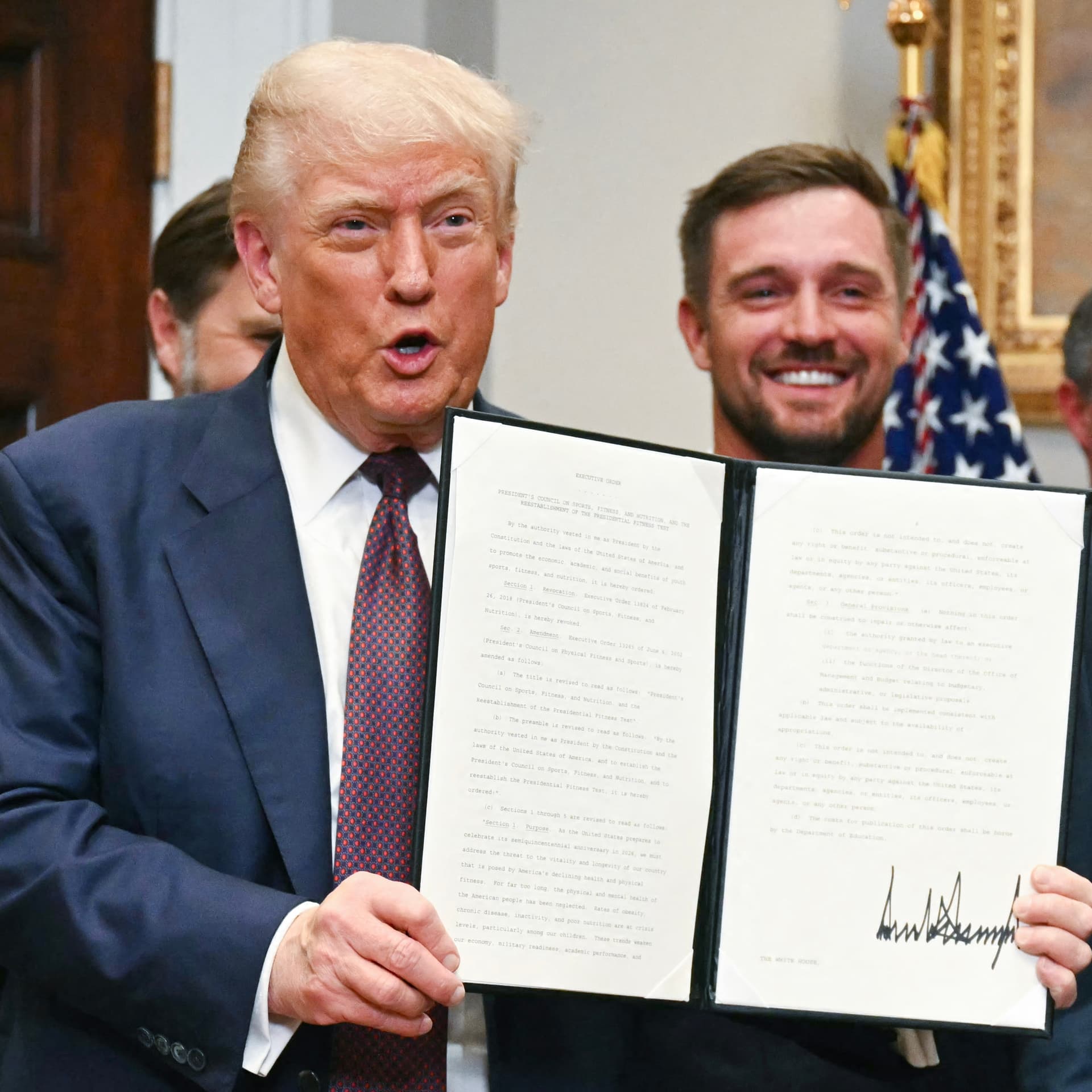
3:09Well, guess what? The presidential fitness test is coming back thanks to President Donald Trump. I'm pleased to announce that we're officially restoring the presidential fitness test and the presidential fitness award, and it's going to be a very big thing from the late 1950s until... From the newsroom of The Washington Post, this is Post Reports. I'm Elahey Izadi. It's Wednesday, August 20th. Today, we go deep on the presidential fitness test. Trump signed an executive order at the end of July reinstating the presidential fitness test. He called it a, quote, wonderful tradition that will help kids get in shape.
3:50I speak with The Post's health columnist, Gretchen Reynolds, who heard from so many people about what this test meant for them. And Gretchen walks me through where this fitness test came from. what researchers say about its effectiveness, and what a new version of the test could look like.
4:15Gretchen, thank you for joining me to talk about this, the presidential fitness test. I'm very glad to be back. So, Gretchen, as we said, President Trump is bringing back the presidential fitness test. Before we go in too deep about the old test, what did he say about why he's bringing this back? What he said was that the main reason was to help combat an epidemic of unhealthiness among children. Obesity, inactivity. They mentioned in the executive order military preparedness and that bringing back the presidential test would help to start making children healthier and presumably also help them to lose weight, become more active.
5:07There's no timeline, but presumably soon. and it would be overseen by a council of experts, who at this point are mostly athletes, most of whom have ties to Trump, including the golfer Bryson DeChambeau, who has represented the Trump golf brand for several years, and the National Football League kicker Harrison Butker, and I believe several wrestlers. I'm sure we could probably do a whole episode just about this question, but just how big of a problem is childhood obesity and poor health in young people at this moment? It's definitely a huge problem. No one disputes that. The most recent statistics that I've seen are that about 23 percent of children, and that is up to about age 16, I believe, are, in fact, they do have obesity.
6:03Beginning in about 1960, obesity was fairly rare, among children especially, and it has definitely increased, and so has inactivity. The most recent statistics from the Centers for Disease Control, they suggest that the official recommendation is that all children and teenagers get at least an hour of vigorous exercise, not just walking around, but vigorous exercise every day. At this point, less than a quarter of children and adolescents get even close to that much. So we have a definite epidemic of both obesity and inactivity among young children, and that does lead to a pretty significant amount of ill health.
6:50So yes, we have a problem. Whether the presidential fitness test is the answer is definitely a question. So let's talk more about this question. And, you know, as a kid, I never really thought about why I was even doing this presidential fitness test. It just seemed to be like this is just what everyone does in school. But I never really thought to look into why am I doing this and when did it start? What is the backstory to this? When did this fitness test begin? The actual presidential fitness test began under President Dwight Eisenhower in the late 1950s.
7:28And it was a very straightforward response to some emerging information that United States children were not as fit as children in Europe. And there really was concern that that would have effects on our military readiness, that we just were not keeping up with Europe. And so Eisenhower started this program where kids would be tested at school on their fitness, and presumably that would somehow motivate them to become more fit. Part of the idea was that the presidential fitness test would motivate children because if you were in the top percent, it was the top 15%, and actually got the award, you also got a patch.
8:17And usually you got to stand up in front of your whole school and assembly and have your name read. And the program expanded in the next few years under President Kennedy. A country is as strong, really, as its citizens. And I think that mental and physical health, mental and physical vigor, go hand in hand. who was a very big fitness advocate and made sure that the test was pretty much nationwide by the mid-1960s. And it remained in place in various forms. The actual parts of the test, the benchmarks for how well children had to do, those changed over the years. But the presidential test and the presidential award remained in place until officially 2012.
9:05So generally, how did it work? Because, you know, I remember doing specific exercises, as you mentioned, that the actual benchmarks changed over the years. But generally speaking, how did this work? Generally speaking, there were tests that measured kids' endurance, and that would be either the shuttle run or the mile run or both. They had to do sit-ups and push-ups and pull-ups, which measured strength. and the sit and reach, which was supposed to measure flexibility. And in order to get the award, you had to be in the top 15 % nationwide on every one of those tests. You had to have endurance, you had to have strength, and you had to be flexible.
9:53And that's really hard for grownups. That's really hard for athletes, but we expect it of kids. And there were times when the benchmarks, again, they changed somewhat from year to year, but sometimes they were really high. You had to do at least 40 sit-ups. You had to run a six and a half minute mile. Those are really high benchmarks. So what it came down to is very few children passed. Very few children got the award. It would be usually two to three percent of children nationwide. When these tests were developed, what a number of experts have said to me is basically they were developed around measures of athletic performance.
10:38That's really what they were looking at, which is not health. So what they were looking at is, would you be good on the baseball team? Would you be good on the cross-country team? That's not the same thing as are you fit and healthy? So what kids were hearing was, you are not fit, and they're 10, 11, 12 years old. So if the test was designed to make kids more fit, it's probably fair to say it was not accomplishing that. So this presidential fitness test came to an end. Can you tell me about that? The presidential fitness test formally ended in 2012 when President Barack Obama disbanded it. But even before then, some schools had stopped using it.
11:33There was a pretty clear understanding among exercise scientists that this was not working. If by working, we mean that it was making kids become more active and avoid obesity. So there were a lot of questions about whether this was an effective way to get children to be active. And President Obama basically said it's not and did institute a new approach to testing. Yeah. What is that new approach to testing? Because I'm wondering, you know, we talked a little bit earlier about this problem of childhood obesity and just poor health and young people. And I'm curious, how did this new program work and did it improve the situation?
12:19The new approach to testing was called Fitnessgram. And the idea with Fitnessgram was that you would try and test children on elements that were more related to health than just athletic performance. And some of the tests are still sort of the same. They still had a shuttle run. They no longer had the mile run. But they still did have some tests of your aerobic endurance and your muscular strength. But they were set up, at least they tried to set them up so it wasn't just competitive. It wasn't just children competing against one another and only a certain number did well. The idea was you started setting sort of these zones of what is healthy, and you told children sort of where they fit into that zone.
13:10And the important part of that, at least according to the researchers I talked with, was it was meant to have follow-up. So you would send home a little report card to the children and their parents that said, this is where your child sort of wound up in terms of endurance. Here's some suggestions for how they might improve that. It was meant to be part of a whole program where you would have PE classes that were designed to actually try and improve children's fitness. It's very important to say here that Fitnessgram and all the people involved with it had a lot of really good intentions. But after Fitnessgram was instituted, childhood obesity continued to climb and inactivity became even worse.
14:01Children now are often sitting at least 10 hours a day. That's not normal for kids. But in fact, the level of inactivity in children has been growing year over year now for just decades.
14:21After the break, what the science says about the best ways to keep kids healthy and fit, and whether a presidential fitness test is part of that. We'll be right back.
14:47Our business programs are designed to fit your goals, your schedule, and your future with flexible options, expert faculty, and career-focused learning. Join us at an upcoming open house and discover where a business degree can take you. NLU means business. Visit nl.edu to learn more and register today. When it comes to the big questions, who you ask matters. From breaking news to politics that impact your life to advice you can trust. Get answers you don't have to question with Ask the Post AI. Trained exclusively on post journalism with clear sourcing. And if we don't know the answer, we'll tell you.
15:30Ask the Post AI. Find it on WashingtonPost.com or in the app.
15:40so gretchen obviously as you've described this has been an ongoing problem poor health in children president obama tried to revamp the old fitness test and replace it with something else but you know we still have a problem so president trump is bringing a fitness test back and will it be like the old one that i did as a kid and other people have done as children? Will kids be out here doing toe reaches and climbing up ropes? There were no specifics in the executive order about the presidential fitness test, and I did not get a response from the press office at the Health and Human Services Department.
16:21So it's not clear what measures will be involved, whether there will be the dreaded mile run again, whether there will be pull-ups. Certainly, the president seemed very enthusiastic about sort of the original test, which did include push-ups, sit-ups, the pull-up, and the mile run. There also were no researchers or scientists so far who were part of the Presidential Council on Fitness and nutrition, which will be overseeing this. So it's not clear yet what tests will be involved. I'm just thinking also about this idea of like the old fitness test and how it wasn't really that effective. The replacement doesn't seem to have, you know, generated better outcomes necessarily.
17:13But like thinking about the old test and just the idea of like how much trauma even adults well into their 60s, 70s still carry from it. And can you just describe a little bit more about that? Like, what is it about the old test and how people interacted with it that led them to carry these lifelong memories? I did talk to researchers about this. And the funny thing is, the minute I said to a researcher, I'm writing a story about the presidential fitness test, they'd say, oh, no. And in particular, researchers who deal with exercise behavior, because we do have a better understanding of why people exercise and also why they don't.
18:00And the fact of the matter is, most of us don't. At least 75 % of us get almost zero exercise. And a lot of that, researchers now think, and some of this will sound almost cliched, but big, big studies have borne this out. the reason people decide to exercise or not is because they enjoy it. And again, that sounds almost facile, but that is how we respond. It is how we decide we want to do something. You have to like what you're doing physically to keep doing it, especially if you are a child and don't have a lot of other experiences to compare it to. So it looks like for a lot of young people, the presidential fitness test became associated with a really unpleasant experience.
19:02And that's what they took away from exercise. The number of people who responded and said, this all happened 30 years ago and I still hate exercise, really kind of astounded me. It made me really sad to read some of those responses. There were also a fair number of people who said, and I used to hate exercise, but I finally discovered I really like riding my bike or swimming is fun. And now they're doing it. Was there anyone who responded who liked it? Yes. Yes, there were. And I should be very clear about that. There definitely were people who said, this made me feel good about myself. I practiced sit-ups so I could do this.
19:46There are people who will respond to this kind of somewhat competitive approach. There also are people who are good athletes. They will do well. They will always enjoy something like this. And again, we're getting responses from people who remember this really viscerally. For a lot of people, it probably had almost no impact one way or another. But the group of people for whom it had an impact, particularly a negative one, is large enough that we really do have to think about the impacts that reinstituting the test could have. You know, this is such an intractable problem, or at least it seems like it.
20:28And it seems like, you know, maybe compared to when I was growing up or when you were growing up, kids are less active now because there's more screens. You know, they're preoccupied with things that we just didn't have. And isn't it good to just have them do at least something mandated by the government to get them moving and kind of measure where they stand? I'm just wondering about the counter argument to why it would be a bad thing to bring this back. And I should make it clear, I don't necessarily say that it is an unadulterated bad thing to bring this back, nor did the researchers say that to me.
21:10I mean, I think everyone is willing to try various things. What the researchers said to me was just having an isolated presidential fitness test once or twice a year is unlikely to have any beneficial effects for the vast majority of children and young people. And for at least some subset of them is likely to be quite aversive. It will not help them like exercise. But the bigger issue is it's not part of a sort of whole ecosystem of finding a way to make children more active and healthier. In the executive order, there's no mention of money that would go to schools to help them ensure they have physical education classes.
22:05An awful lot of schools have either reduced or eliminated PE classes altogether. There are no resources, at least in this executive order, for training PE teachers to help children like exercise. A lot of funding for things like after-school programs, which are a good way to keep children moving, have been eliminated in the new administration. The executive order mentions sports. Most of the researchers I talked to said sports are not the answer to getting kids active. Really? Oh, you have a tiny subset of kids who are good at sports. And the higher you go in age, the fewer that number is. Once you get into varsity sports, the number of kids who can play is tiny.
22:55And just on a very practical level, sports aren't necessarily a great way to get kids moving. Some kids are on the bench. A lot of sports, you're only active for a few minutes over the course of an entire quarter. You know, it's not really a great way to get kids more active. So, Gretchen, let's put our hypothetical hats on. Let's put you in charge of a task force to get kids to exercise based on all your years of reporting, your conversations with researchers and experts. What would you recommend here that kids do? The answers are in some ways simple, but not easy, because we do have to find ways to let kids play.
23:43And again, that is a little bit of a cliche, but kids love to play. If you watch them, if you really do just let them go out, don't give them a phone. They don't even have to have equipment. They will start playing. They'll play tag. They'll pretend they're animals. They'll do all kinds of stuff that they're just moving and enjoying how well their body can respond. If we can find ways to help kids expand on that, to just enjoy being in motion, not benchmark them against each other, show them ways to do it together, that they can play tug of war, tag, just have fun moving. Sit less, stare at a screen a lot less.
24:35That would be great.
24:42Well, Gretchen, thank you so much for joining and explaining all this. My pleasure. Thanks for having me. Oh, wait, I want to ask you this. I want to ask you this. Gretchen, did you ever take this test yourself? Yes, every year of my elementary and middle school. And I honestly, I'm almost embarrassed at this point to admit it, but I actually got the Presidential Fitness Award every year because I was very skinny and very fast and very bendy. I could always do the sit and reach. But it was terrible to watch. It was even terrible for you who was like at the top of... Because my friends didn't pass.
25:28They felt really bad. It didn't translate in any way to me being good at sports. I was still just terrible at softball, which was what, you know, the kids in my age group played. So I did fine on the test, and it made me feel bad about exercise.
25:52Gretchen Reynolds is a health columnist for The Post. That's it for Post Reports. Thanks for listening. If you love the show, help other people discover it by leaving a rating on Spotify or a rating and review on Apple Podcasts. Today's show was produced by Peter Bresnan. It was mixed by Sean Carter and edited by Ariel Plotnick. Thanks to Jennifer Sargent, Devin Bakum, and Julie Nelson. You heard them at the start of the show talking about their experiences with the Presidential Fitness Test. And thanks also to Emily Kodik and Teresa Tampkins. I'm Elahei Izadi. We'll be back tomorrow with more stories from The Washington Post.
26:57And if we don't know the answer, we'll tell you. Ask the Post AI. Find it on WashingtonPost.com or in the app.
From the publisher
At the end of July, President Donald Trump signed an executive order reinstating the presidential fitness test. The test was administered in public schools around the country from 1950 to 2012, when it was ended by President Barack Obama.
After health columnist Gretchen Reynolds heard the news, she put out a call to Post readers asking about their memories of the presidential fitness test. Hundreds responded, many of them sharing vivid memories of humiliation and shame associated with the test.
Elahe Izadi speaks with Gretchen about the origins of the test, what this new iteration of the test might look like, and what experts say about whether the test actually combats things like obesity and inactivity in young people.
Today’s show was produced by Peter Bresnan. It was mixed by Sean Carter and edited by Ariel Plotnick. Thanks to Emily Codik and Teresa Tamkins.
Subscribe to The Washington Post here.