
In short
The episode covers the Minneapolis shooting at Annunciation Catholic Church and its adjacent pre-K–8 school during the first week of school. It describes how a shooter opened fire at children and worshipers during Mass; the pre-K classroom was in the church basement, where a child heard loud banging and was carried by a police officer. Two children died (ages 8 and 10) and 17 were injured, including adults in their 80s; all were expected to survive. The FBI is investigating as domestic terrorism and a hate crime targeting Catholics; the shooter was identified as 23-year-old Robin Westman, who posted a manifesto later taken down. The episode also discusses gun-violence context (434 school shootings since 1999) and Minnesota’s gun laws (universal background checks, red-flag law).
Guests
Kim Belware (Washington Post reporter covering gun violence) and Reese Tebow (Washington Post reporter; interviewed parent Brooks Turner). Key examples include reunification scenes with parents, trauma support (crayons/markers), and debate over gun control vs. armed school staff.
Written by AI. May contain mistakes. Listen to the episode to check what was said.
Chapters
Tap a time to open that second in VOAyla's First Week of School
0:11 to 1:57
Brooks Turner shares the joyful start of his daughter's school year before tragedy strikes.
“It was the first week of school for his daughter, Ayla.”
The Shooting Unfolds
1:57 to 2:30
Details of the shooting incident at Annunciation Catholic School are revealed.
“From the newsroom of The Washington Post, this is Post Reports.”
Mayor's Response
2:30 to 3:16
Minneapolis Mayor Jacob Frey expresses the city's outrage and sorrow after the shooting.
“Hours after the shooting, Minneapolis Mayor Jacob Frey spoke to the public.”
Investigating the Shooting
3:16 to 4:25
Reporter Kim Belware provides insights into the investigation and context of the shooting.
“Kim shares what we know about the shooting so far.”
Casualties and Victims
4:25 to 6:41
An overview of the casualties and injuries resulting from the shooting.
“Earlier today, Minneapolis Police Chief Brian O 'Hara shared some details at a news briefing of what they learned in the aftermath.”
Identifying the Shooter
6:41 to 8:02
Details about the suspected shooter and the motives behind the attack are discussed.
“And Kim, at this point, what have police and other authorities, what have they said about the suspect?”
Community Response to Trauma
8:02 to 11:20
The emotional aftermath of the shooting and how the community is responding is explored.
“At the same time, Minneapolis Mayor Jacob Frey, he tried to neutralize some of this vitriol that he said was being directed at the trans community.”
Official Responses
11:20 to 14:00
Reactions from Minnesota officials and President Trump regarding the shooting are shared.
“And the response, you know, thankfully, is one that most people have in place and understand.”
Trump's Silence on Gun Violence
14:00 to 14:12
Discussion on President Trump's lack of response to a school shooting incident.
“Notably, President Trump did not call Governor Walz earlier this year when a Minnesota lawmaker and her husband were shot and killed by a gunman.”
Post AI Promotion
14:23 to 14:53
An introduction to Ask the Post AI as a resource for journalism.
Show all 15 chapters
The History of Gun Violence in America
15:06 to 16:50
Overview of gun violence, particularly school shootings, in the U.S.
“You know, gun violence in places of worship and in schools, this is not new for our country.”
Gun Laws and Political Tensions
16:57 to 18:56
Discussion on Minnesota's gun laws and the political debate around gun control.
“And given that Minnesota has strong gun laws in this country, I'm curious what debate will emerge out of this tragic event.”
Recent Federal Actions on Gun Control
18:59 to 20:45
Examination of recent federal actions regarding gun violence and school shootings.
“nothing really monumental or meaningful in terms of legislation emerged from there.”
Debate on Solutions to Gun Violence
20:49 to 22:02
Exploration of differing views on how to address gun violence in the U.S.
“If you think about the only way to stop a bad guy with a gun is a good guy with a gun.”
Closing Remarks with Kim Belware
22:06 to 22:21
Wrapping up the conversation with Kim Belware on gun violence reporting.
“Kim, thanks so much for taking a moment to share this reporting with us.”
Transcript
Automatic transcript. May contain errors.0:01Just a heads up to our listeners, today we're going to be discussing some details of a school shooting, which may be hard to listen to. Wednesday morning started off as an exciting one for Brooks Turner. It was the first week of school for his daughter, Ayla. She's a pre-K student at Annunciation Catholic School in Minneapolis. So I dropped her off at like eight, and she went straight in, seemed like excited for the day. And I called my wife just to be like, Ayla went in and was excited. He told this to post reporter Reese Tebow over the phone. After drop-off, Turner started driving to work. Then he got a call from his mother.
0:42There was a shooting at Ayla's school. Students had been sitting for mass. A shooter walked up and through a church window opened fire at the pews. The shooter killed an 8-year-old and a 10-year-old. 17 people were injured in all, 14 of them children. Turner frantically called the school. Even though I was told that all the preschool kids were safe, I was terrified. I also didn't know if that meant that the elementary kids were safe. Yeah, they were safe. Yeah, they were safe. Sorry, my daughter's sitting here with you. Is that Ayla? Yeah, this is her. Ayla wasn't attending Mass. Her classroom was in the basement of the church.
1:29So she heard the shooting happening above her. She told me that they heard, like, really loud banging, and it was like somebody was trying to break down the ceiling above them. She said that she was scared, and a police officer picked her up and carried her. And then I got down and ran. And then she got down and ran.
1:57From the newsroom of The Washington Post, this is Post Reports. I'm Elahe Izadi. It's Wednesday, August 27th. Today, the horror at Annunciation Catholic School in Minneapolis. The shooter is dead, and the FBI is investigating this as an act of domestic terrorism and hate crime targeting Catholics. These were Minneapolis families. These were American families. And the amount of pain that they are suffering right now is extraordinary. Hours after the shooting, Minneapolis Mayor Jacob Frey spoke to the public. And he conveyed the sense of outrage that so many in the city felt. Don't just say this is about thoughts and prayers right now.
2:43These kids were literally praying. It was the first week of school. They were in a church. These are kids that should be learning with their friends. They should be playing on the playground. They should be able to go to school or church in peace without the fear or risk of violence, and their parents should have the same kind of assurance. Today, I turned to another reporter covering this shooting for The Post, Kim Belware. Kim shares what we know about the shooting so far. and also where this tragic event fits in the scope of this nation's gun violence.
3:35Kim, thank you for taking a moment to join me today. Thanks for having me on. So you and I were sitting down to talk. I know that the details will continue to emerge in the hours and days to follow. but let's talk about what we know so far about this shooting. First, where did this take place? So this shooting happened at the Annunciation Church in Minneapolis. It's in a neighborhood on the city's southwest side, and this Catholic church is also affiliated with a pre-kindergarten through eighth grade school that's right next door. This is a private school of about 400 students, and today the students were in their first mass of the year to kick off the school year, which started on Monday.
4:24So then how did the shooting unfold? Earlier today, Minneapolis Police Chief Brian O 'Hara shared some details at a news briefing of what they learned in the aftermath. Earlier today, just before 8.30 a.m., our city experienced an unthinkable tragedy. Chief O 'Hara said that the shooter was outside of the church. He struck children and worshipers that were inside the building. This was a deliberate act of violence against innocent children. The sheer cruelty and cowardice of firing into a church full of children is absolutely incomprehensible. And then what happened next? What so far did the police chief share about that?
5:18By the time police were communicating more of the details out to reporters, they had described this as a contained threat. We later learned that the alleged shooter was dead from what's believed to be a self-inflicted gunshot wound. When asked about the kind of artillery that the shooter had in this particular situation, Chief O 'Hara noted that there were at least three weapons, a rifle, a shotgun, and a pistol. We have heard some hospital officials in the Minneapolis area that was treating patients describe injuries as those consistent with high-powered guns. We know that the shooter fired all three weapons and left dozens and dozens of rounds.
6:03And at this point, what do we know about the casualties? There are two children that are dead from today's shooting, an eight-year-old and a 10-year-old. The police chief said that they're not going to be releasing details about their identities in the near term, but the families have been notified. The other 17 people who were injured are all expected to survive. Three of those injured were adults in their 80s who were attending mass at the church this morning. The other injuries are all children. And they came into local hospitals with a range of injuries from non-life-threatening to critical condition.
6:40And at least four of those kids required surgery. And Kim, at this point, what have police and other authorities, what have they said about the suspect? In the first few hours after the shooting, police were keeping the details about the suspect pretty minimal. And then later in the day, officials were sharing more details that they had learned. The Washington Post has now confirmed the identity of the shooter, 23-year-old Robin Westman. Westman's father lives near the school, and police said that they have no more information about the motive. But the shooter did post a manifesto online, which the FBI took down.
7:19FBI Director Kash Patel also said that they're investigating this as an act of domestic terror because the incident targeted a Catholic church. One other detail that's drawing scrutiny is Westman's identity. Westman's name was legally changed to Robin in January of 2020. And court papers said Westman, quote, identifies as a female and wants her name to reflect that identification. So now we have several members in the Trump administration who are seizing on this detail. We have Homeland Security Secretary Kristi Noem saying that this subject is, quote, claiming to be transgender. and called this person monstrous.
8:00We expect this is going to be a topic of conversation for a while. At the same time, Minneapolis Mayor Jacob Frey, he tried to neutralize some of this vitriol that he said was being directed at the trans community. He said in a press conference this afternoon that he was denouncing anybody who was, quote, using this as an opportunity to villainize the trans community or any community. Do we know whether the suspect acted alone or not? At this point, authorities said they believe that this is just a sole suspect, that there were no other shooters. And what have police telegraphed so far about their response and investigation?
8:37Because, you know, at this point, they have said quite little about possible motives. After a mass casualty like this, you have all sorts of local, regional and federal response coming in. And we did see that early today. The FBI already said that they are aware and that they are assisting in this investigation, as is the ATF. That's the Bureau of Alcohol, Tobacco, Firearms and Explosives. Obviously, Minnesota police and state level law enforcement investigators are going to be trying to piece together more about the motive, the suspect and how this all came to pass. Kim, I want to go back to the victims here.
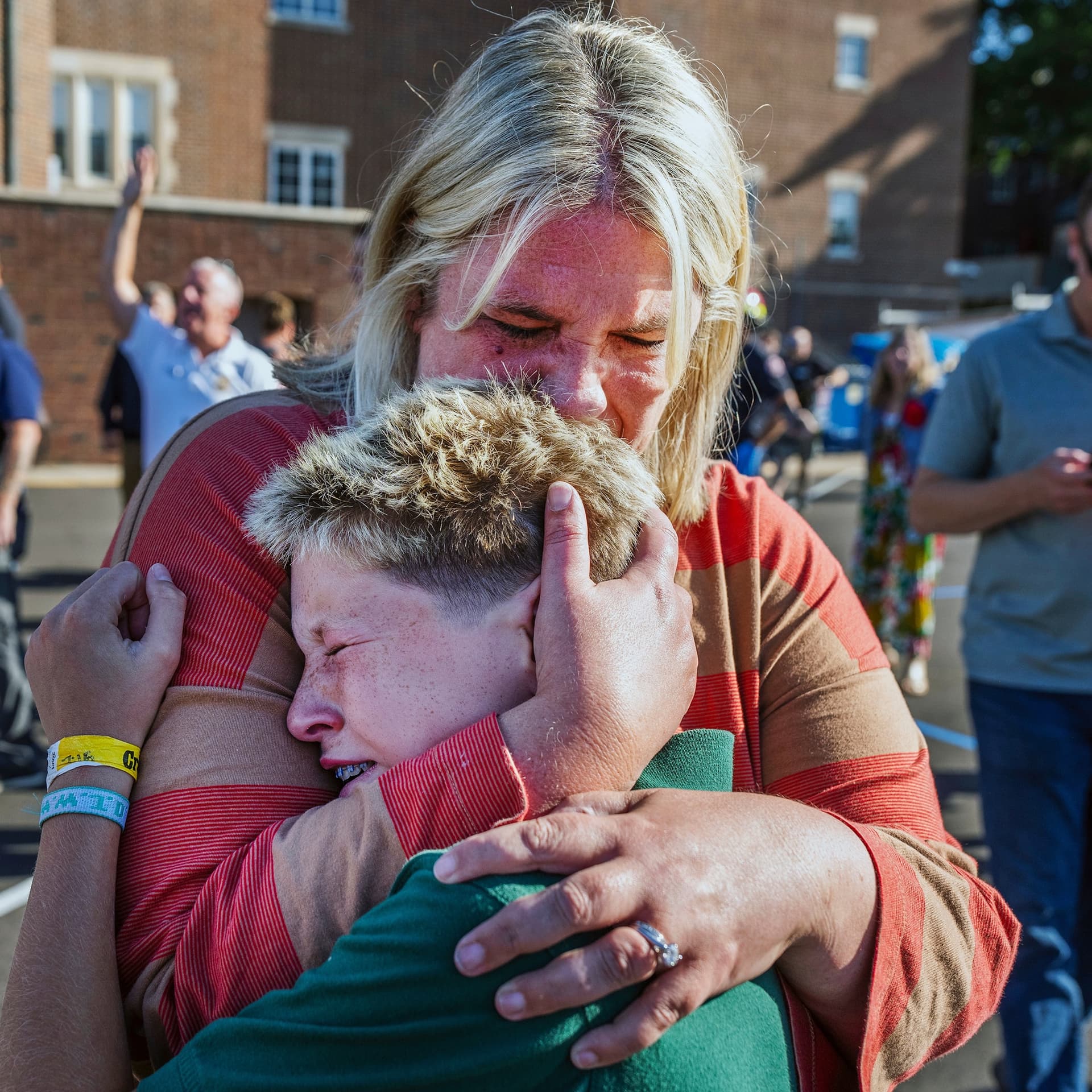
9:18You know, this is truly every parent's nightmare. What can you tell us about how parents were notified, how they responded? I mean, I can only imagine that this was such a heartbreaking scene. Well, like you said, this is every parent's worst nightmare. We saw in photos and videos that there were parents who were running out of cars, calling for their kids, asking where their children are. There were parents who had gone to the school where a reunification center was set up, and they did get their children, and they were seen walking away, holding on to these kids. They're still wearing their school uniforms, and kids in photos are sobbing.
10:00They're burying their face in their parents' arms. And this is just really an illustration of the incredible trauma that's inflicted on a community when something like this happens. We even heard from other reports that as parents were looking for their kids, they saw some who were bloodied and maybe not injured. And it's just a dramatic and really striking scene that was coming out from early this morning. Our colleague Hannah Knowles on the ground actually sent us a report from the scene. Let's take a listen. When I got to the scene of the shooting this morning, parents were still rushing to the school, trying to find their kids, figure out if they were okay.
10:41A lot of people were too distraught to talk. I also talked to people from around the Minneapolis area who had rushed to help. I talked to a chaplain who came, and he ended up going down to the reunification area and passing out crayons and markers for kids to draw with because he says that helps with trauma. I talked to a pastor who came here because he wanted to pray with people. You had a lot of people descending on the area. That just sounds like the kind of scene that we have heard about over and over again when there is a school shooting. This is something that, unfortunately, schools and communities have gone through a lot.
11:20And the response, you know, thankfully, is one that most people have in place and understand. And they understand that you have to address the trauma, the incredible trauma that these students are dealing with in the moment. But you can hear just how heartbreaking this is. Mm-hmm. Yeah. And also that, you know, when we're talking about an event like this, in some ways, you know, to think about how to quantify how terrible this is, we look at the number of casualties, but it doesn't account for all the other students who physically survived and physically were unharmed, but were still subjected to either witnessing or hearing this horror.
12:03like what we heard from Brooks Turner earlier and his daughter Ayla. That's definitely something that a lot of our colleagues at The Post have reported on in really powerful ways that, like you said, when there is a shooting, particularly at a school, it is not just those whose loved ones died or who were injured that are affected. It's the first responders. It's the people who are helping to manage the aftermath of the trauma. It's the survivors who are left to pick up the pieces after this community has been affected this way. Kim, just thinking about the official response in the aftermath to this shooting, what have Minnesota officials said thus far?
12:50The response from Minnesota officials has been swift. It has been very heartfelt, and it's been one that clearly telegraphs that there is a lot of pain around this. Minnesota Governor Tim Waltz quickly posted on Twitter saying that he had been briefed on the shooting. He said that he was praying for our kids and teachers whose first weeks of school were marred by this horrific act of violence. You also heard it in the clip of Minneapolis Mayor Jacob Frey. You can just hear his voice in how emotional he was in talking about this. He also said later on, he asked the community, don't think of these as other people's kids.
13:27think of these as your kids. Yeah. Do we know whether President Donald Trump has communicated with any Minnesota officials and what has the president said about this? President Trump did go on to his social media platform Truth Social earlier today to praise the response from law enforcement and said that the FBI was responding. President Trump also offered his condolences And we do know that he contacted Governor Walz to offer his sympathies and support as this shooting is investigated. Notably, President Trump did not call Governor Walz earlier this year when a Minnesota lawmaker and her husband were shot and killed by a gunman.
14:12So, Kim, let's take a break here. And when we come back, we'll talk about what our nation has and has not done to address gun violence. We'll be right back. Thank you.
14:53on post journalism with clear sourcing. And if we don't know the answer, we'll tell you. Ask the Post AI. Find it on WashingtonPost.com or in the app. Kim, I want to now take a step back. You know, gun violence in places of worship and in schools, this is not new for our country. Unfortunately and tragically, we have seen events like this again and again in recent years. Do we know how bad of a problem this is with school shootings in particular? It really boggles the mind, but there have been 434 school shootings since the Columbine shooting in 1999. This is according to a Washington Post database tracking these kinds of incidents.
15:42And before today's shooting, the most recent school shooting was in Michigan where a student was shot. And I know, Kim, that you have covered shootings like this in the past and also gun policy and have dug into these questions. I'm curious, do the Minnesota gun laws stand out to you in this moment? Minnesota is actually one of the states that has stronger gun laws. They're ranked somewhere in the top 15, according to groups like Everytown for Gun Safety, that does rankings based on if states have things like safe storage laws, if they require universal background checks. In the past three years, Minnesota did pass a universal background check law.
16:25They also passed what's called a red flag law where people can petition a judge to have firearms removed from somebody if they're believed to be a danger to themselves or other people. And even Minnesota Governor Tim Walz, who is a gun owner, had his NRA rating go from an A to an F on account of his stronger stance on gun control. So on the level, Minneapolis does have quite a few stronger protections than many other states in the country. I can only imagine that this conversation will emerge again in the coming days and weeks, because whenever there is a tragedy like this, it does bring up questions around what policies need to be in place to prevent other similar events.
17:10And given that Minnesota has strong gun laws in this country, I'm curious what debate will emerge out of this tragic event. What we've seen in the past is there are typically two parts of this debate. On one side, you have a pro-Second Amendment, very strong stance, often led by Republicans in Congress and President Trump, who don't want there to be any restrictions whatsoever on Americans' ability to possess guns, to buy them. They don't want any kind of speed bumps to that. And so they tend to focus on this being a more individualized issue. They are going to look at crime rates on the problems with the individual shooting suspect.
17:57On the other side, there are those who want stronger gun control and feel that things like a federal assault weapons ban, which we notably no longer have in the U.S., is one of the ways to increase safety, to just make it harder to possess weapons that can so effectively injure and kill people. And those two sides have always been in tension. And what we've seen is that even when there is a more pro-gun control majority in Congress, that it's not always easy to get these kinds of changes passed, even under President Obama. he had talked about how this was one of his great disappointments of his presidency, that after the Sandy Hook school shooting, there was not meaningful gun control reform made in Congress.
18:45It really has to happen at the congressional level. And given the current makeup of Congress, it's just unlikely that we're going to see big changes. You know, you mentioned the Sandy Hook shooting, which took place in 2012 and how nothing really monumental or meaningful in terms of legislation emerged from there. But has there been anything that's happened at the federal level in recent years to address this question of gun violence or school shootings? A lot of the changes have come out of the executive office. President Biden did make gun violence prevention a big priority during his administration.
19:23He created the first ever White House Office of Gun Violence Prevention. And during his administration, Congress was able to pass some gun laws that strengthened specific gun legislation around background checks. It also banned some people accused of domestic violence from buying guns. The Trump administration has taken a different tack. In fact, Trump rescinded a billion dollars in mental health grants in the Biden gun law package that was intended to reduce violence and has notably been in support of different tax laws and other executive orders that would really boost gun ownership and gun accessibility for people over 21.
20:07But then just to return to this idea of like, what is the solution here? And it does seem like there's this tension between these sorts of gun reforms versus, you know, what is going on with an individual, the mental health question. I just wonder, given Minnesota's strict gun laws and how the Trump administration has talked about gun violence in the past, where do you see this headed? We have seen tragedies in the past, like Sandy Hook, like Uvalde, that still, even after those, there was a lot of resistance to getting more gun control in there. And like you said, there's also this tension in what is the actual solution.
20:49If you think about the only way to stop a bad guy with a gun is a good guy with a gun. famously that quote from former NRA president Wayne LaPierre. Some states are thinking that more guns are the solution. States like Tennessee have passed laws in recent years that allow teachers and certain certified school staff to carry guns on campus, something that normally had been out of the question. And then on the other side, there are those who think the only way to stop the flow of guns is to stop making it so accessible in the United States to have a gun. There is some overlap on agreement that there needs to be more done to support people who might have some kind of mental health crisis that could lead them to want to hurt themselves or hurt other people with a gun.
21:43And there has been some agreement, but not a lot of productive legislation that's come out of that agreement. And it just seems like these two sides are going to continue to fight over whether the solution is taking guns out of the equation or adding them into it.
22:06Kim, thanks so much for taking a moment to share this reporting with us. I really appreciate it. Thank you for focusing on it.
22:16Kim Belware covers gun violence for The Post. That's it for Post Reports. Thanks for listening. Today's show was produced by Laura Benshoff, Rennie Sronofsky, and Thomas Liu. It was mixed by Sam Baer and edited by Rina Flores and Ariel Plotnick with help from Colby Ikowitz. Thanks to Reese Tebow and Hannah Knowles for their additional reporting. and thanks to Elliot Smilowitz and Gina Harkins. I'm Elahe Izadi. We'll be back tomorrow with more stories from The Washington Post.
23:05When it comes to the big questions, who you ask matters. From breaking news to politics that impact your life to advice you can trust. Get answers you don't have to question with Ask the Post AI. Trained exclusively on post journalism with clear sourcing. And if we don't know the answer, we'll tell you. Ask the Post AI. Find it on WashingtonPost.com or in the app.
From the publisher
On Wednesday morning, students from Annunciation Catholic School in Minneapolis were in church for an all-school Mass when a shooter opened fire through the church windows.
An 8-year-old and a 10-year-old from the private K-8 school were killed, and the shooter died after shooting himself. More than a dozen people were injured, and several remain in critical condition.
Minneapolis Mayor Jacob Frey (D) addressed reporters in a moving news conference about the shooting:
“Don’t just say this is about thoughts and prayers right now. These kids were literally praying. It was the first week of school. They were in a church. These are kids that should be learning with their friends. They should be playing on the playground. They should be able to go to school or church in peace, without the fear or risk of violence. And their parents should have the same kind of assurance.”
Reporter Kim Bellware joins host Elahe Izadi to walk through what The Post has learned about the suspect and about how the tragic event fits into the nation’s history of gun violence.
Today’s show was produced by Laura Benshoff, Rennie Svirnovskiy and Thomas Lu. It was mixed by Sam Bair and edited by Reena Flores and Ariel Plotnick. Thanks to Reis Thebault,. Hannah Knowles, Colby Itkowitz, Elliot Smilowitz and Gina Harkins.
Subscribe to The Washington Post here.