In short
One-year anniversary of Donald Trump’s July 13, 2024 Butler, Pennsylvania shooting; why investigators still lack a clear motive and how security failures by the Secret Service may have enabled the attack.
Guests
Carol Lennig, investigative reporter for The Washington Post; previously covered Secret Service lapses during the Obama administration and reported on security reforms.
Key claims
Thomas Matthew Crooks fits a “classic mass shooter” profile but left no manifesto/diary/email explaining motive. The U.S. investigated possible Iranian involvement using NSA signals intelligence and allied information; they also interviewed Iranian operative Asif Merchant (FBI sting) but found no evidence linking Crooks to Iran. Trump remains dissatisfied with the “lone actor” conclusion; the father’s hiring of a major Pittsburgh law firm is portrayed as fueling lingering suspicion. Security failures included insufficient protection of a vulnerable flank and candidate status reducing resources; NSC had warned Secret Service leadership that Trump needed extra protection due to Iran. Secret Service suspended six agents involved in Butler security.
Notable examples
Crooks’ explosives interest from age 16; Dean’s List grades; researching Biden/Trump events ~60 times; fertilizer bomb research; Trump ear graze and Secret Service countersnipers killing Crooks from the roof.
Written by AI. May contain mistakes. Listen to the episode to check what was said.
Chapters
Tap a time to open that second in VOSetting the Scene of the Shooting
1:28 to 2:03
An overview of the events surrounding the shooting of Donald Trump.
“Today, we're bringing you a special episode on the one-year anniversary of the shooting.”
Introduction to Investigative Reporter Carol Lennig
2:03 to 2:17
Kolbie introduces investigative reporter Carol Lennig to discuss the case.
“Oh, it's so good to be here with you, Colby.”
Profile of the Shooter: Thomas Crooks
2:17 to 7:42
Exploration of Thomas Crooks' background and investigation findings.
“And I say many ways because there's one way in which he's not.”
Investigating Potential Motives and Connections
7:42 to 10:46
Discussion on possible motives and connections related to the shooter.
“He didn't know who his son's co-workers were, if he was close to any of them.”
Trump's Reaction and Ongoing Concerns
10:46 to 13:00
Analysis of Trump's reaction and the implications of the shooting.
“And it's conceivable he could have tried to lie to them, right?”
Investigating Trump's Shooting Incident
14:43 to 16:38
Discussion on the investigation surrounding the shooting incident involving Trump.
“And as we've established, Crooks at least seems to have acted alone.”
The Secret Service Response
16:38 to 19:17
Examination of the Secret Service's actions and failures during the shooting.
“But whether Trump and his fan base will accept that is another question.”
Reflections on Security Lapses
19:17 to 22:18
Reflections on past security lapses and the ongoing risks for Trump.
“Because the FBI had been monitoring this Qayasif merchant.”
Potential Changes in the Secret Service
22:18 to 23:11
Discussion about possible changes in the Secret Service's approach to security.
“which ultimately allowed a jumper to get inside the building.”
Transcript
Automatic transcript. May contain errors.0:00Step into the world of power, loyalty, and luck. I'm gonna make him an offer he can't refuse. With family, cannolis, and spins mean everything. Now, you wanna get mixed up in the family business. Introducing The Godfather at Chumpacasino.com. Test your luck in the shadowy world of The Godfather slots. Someday, I will call upon you to do a service for me. Play The Godfather, now at Chumpacasino.com. Welcome to the family. No purchase necessary. VGW group void. We're prohibited by law. 21 plus terms and conditions apply.
0:33One of the days from last year that stands out most clearly in my mind is the day Donald Trump was shot. If you want to really see something that said, take a look at what happened.
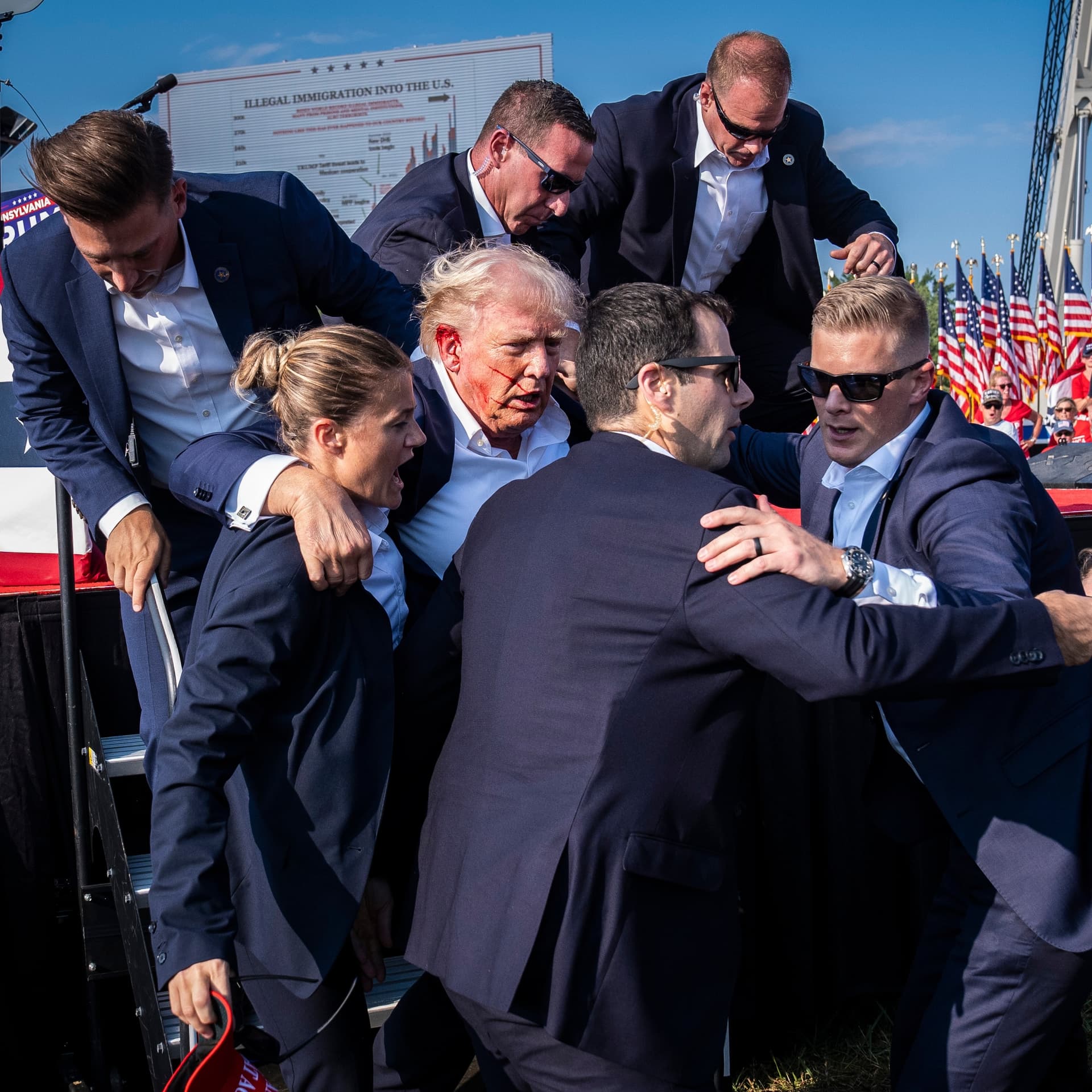
0:54Most of us have probably seen the photos from the rally in Butler, Pennsylvania, of Trump rising up, surrounded by Secret Service, pumping his fist in the air with blood smeared across his face. We would later learn that the gunman was 20-year-old Thomas Matthew Crooks. He grew up in Pennsylvania, not far from where the rally took place. And in the days and weeks following the shooting, it wasn't clear why he had done it or how he'd been able to get so close to killing the then former president.
1:27From the newsroom of The Washington Post, this is Post Reports. I'm Kolbie Echowitz. It's Sunday, July 13th. Today, we're bringing you a special episode on the one-year anniversary of the shooting. I spoke with my colleague, investigative reporter Carol Lennig, about why we still know so little about the gunman's motive and what we can learn from the security failures of that day.
2:03Carol, I'm so thrilled to have you on. Oh, it's so good to be here with you, Colby. So, Carol, in the last year, you've been looking into the gunman who attempted to assassinate Trump. What have you learned about him? In many ways, Thomas Crooks is the classic profile of a mass shooter. And I say many ways because there's one way in which he's not. The many ways, like a Hinkley, a John Hinkley who tried to kill President Reagan, like an Arthur Bremer, who tried to kill President Nixon and eventually shot and paralyzed George Wallace. These individuals were isolated men, loners, very disaffected and separate from their peers and colleagues, didn't have very many friends.
2:54They had something sad and torturous about their lives. And they also plotted a bold and violent act that would gain them enormous attention and really high-profile attention-grabbing headlines. But the way in which Thomas Crooks did not match this profile of a would-be assassin of a president or a mass shooter in a school was he didn't really leave a fingerprint or a manifesto that said, here's what I'm trying to do. So despite the entirety of the U.S. government's enormous resources invested in this investigation, they never found that manifesto. They never found that diary that explained or an email or a note that explained, here's what I'm trying to do.
3:53I imagine they interviewed as many people as they could. I mean, talk to me about what their investigation has looked like over the last year, the people they've talked to. Have they been able, what were they able to learn about him? Colby, this investigation spanned the globe, you know, from Butler, Pennsylvania to Tehran. Because of the concern that he might have been a recruit of a foreign adversary, particularly Iran, the U.S. government began sifting through NSA intelligence, signals intelligence. They began asking their foreign allies for information that they could collect about communications between the U.S.
4:34and Iran and different people in different places. They had an emergency interview in a Houston jail cell with an Iranian operative that they had just arrested on that Friday before the shooting without his attorney citing the urgent potential threat to national security and public safety. They interviewed him in the middle of the night right after the shooting. We're talking wee hours before dawn. And while they did not find these links to him connected to any foreign adversary, they began piecing together all of Thomas Crook's movements. Going back to when he was 16, they found a young man who became interested in explosives.
5:17And in the year before the shooting, had become fairly obsessed about taking shooting practice at a nearby range, had begun researching how to make a bomb from fertilizer, had on the one hand been leading a kind of double life that nobody noticed. He was an enthusiastic Dean's List kid with great grades, straight A's at a community college, hoping to transfer to a four-year college for an engineering degree. And on the other hand, he was researching Biden and Trump events maybe 60 times before he became fixated and hyper-focused on an event in Butler that Trump would appear at that was advertised on July 3rd.
6:04Which wasn't that far away from where he lived at the time. 50 miles from his little suburban and very sweet community in sort of South Pittsburgh. And in any of the communications that he had that they found, politics, like was he interested in politics? That was such a confusing riddle for the investigators on this case. He didn't have a very strong or strident ideology. He was at one point a proponent of some of Biden's policies. When he was young, he had donated$15 to Act Blue, a progressive organization. He was a registered Republican. His father was a registered libertarian and his mother was a Democrat.
6:51They had some Trump signs in their front lawn, which eventually disappeared before the shooting. But at some point they indicated some support for Trump. But his politics were not defining. And in fact, his father, in a curbside interview sometime after midnight after the shooting, told federal agents that his son just liked to debate back and forth the policies of Republicans and Democrats, Biden versus Trump, without taking a very firm stand. Did he have friends? The FBI could not find anyone that would define themselves as a friend of his. He had classmates. He had people he ran into. But his father, again, said in an interview with federal agents that he'd not heard his son mention friends or a girlfriend.
7:43He didn't know who his son's co-workers were, if he was close to any of them. So there was really no one in his life that he would have confided in or kind of shared any of his emotional burdens? Not that the FBI could find, which is such a good question on your part, right? Because one of the things people say about mass shooters and federal authorities will say this often is that there's always some sort of clue ahead of time. But nobody picked up his clue. Whatever it was, he didn't drop one. You mentioned Karel Aran, which is such a fascinating part of this story. Why did the government think that that could be a possibility, that Crooks could be some operative working for the Iranian government?
8:26It seems like a stretch, right? a 20-year-old in rural Pennsylvania. Sounds like a plot of a movie. Yeah. I don't want to make fun of it or light of it because it is completely reasonable why in the hours after the shooting, you know, sources that I spoke to at the time were very nervous that he could be an Iranian plant. On Friday, July 12th, The FBI in Houston secretly arrested a man named Asif Merchant. They had been monitoring him in an undercover sting since April of 2024. And the reason was that an informant came to the FBI and said that Asif Merchant, a friend of his, had tried to recruit him to find and help him find hitmen who would be willing in the United States to kill a quote-unquote high-profile U.S.
9:27political figure. The informant went to the FBI, who then arranged undercover agents to pose as hitman that a Sif merchant could meet with and potentially hire. The undercover agents met with him in a hotel room, and a Sif merchant on a napkin drew a map for them of a stage, potentially at a rally, a podium where a prominent figure might be standing, and how you could kill this person from close range, if it was indoors, or from long range, if it was outdoors with a long gun. And Merchant told the undercover agents that he would give them instructions about who they would kill and where when he left the country.
10:08But before that happened, the FBI arrested him on that Friday, July 12th, as he was planning to put his baggage in the trunk of a car and head to the airport for a flight, which they believed was going to Pakistan. Wow. So you can imagine how bizarre it was to then have someone try to assassinate Donald Trump the next day. I know they've found no evidence that connects this 20-year-old from Western Pennsylvania to Iran, but have they completely ruled it out? everyone I've spoken to who's been involved in this case has ruled it out in the words of one prominent investigator briefed on almost every element of this case if we didn't see it here it didn't exist you know they had turned over the earth yeah and they were looking at classified signals intelligence and of course that middle of the night interview uh Sunday morning just hours after the shooting, they questioned Merchant about this.
11:15And it's conceivable he could have tried to lie to them, right? But he said, no, no, no, not, I don't know this guy. But every other leaf they picked up, every other stone they turned over, there was no element, no evidence to connect crooks to Iran anywhere. So now I'm thinking, Carol, Trump has this fixation with Iran. He's been hellbent on destroying their nuclear program. He recently bombed several nuclear sites. And so does the fact that there were people in Iran, maybe still people in Iran that wanted to have him killed, is there some connection between that and Trump's fixation on the country?
12:00It's hard to know with absolute certainty, but having written a lot and reported a lot about Donald Trump. I know he is obsessed with Iran, and I know that the shooting changed him. You know, he has said at different times that God meant for him to live. But on top of that, it was terrifying and continued to be terrifying throughout the campaign for him and his aides. As you know, they took extraordinary measures to protect him, you know, all sorts of devices, including dummy planes and different kinds of armored cars and decoy motorcade routes. So he is extremely mindful that Iran, ever since he authorized the 2020 strike to kill the revered Iranian general, Qasem Soleimani, ever since then, and their plot to kill him, it is on his mind.
13:00It's hard to separate that. Does it affect his decision on, in his words, obliterating the nuclear capacity of Iran? It's hard to imagine it doesn't impact him.
13:15After the break, what the failures at Butler tell us about the state of the Secret Service and whether anything has changed to make presidents and candidates safer. We'll be right back.
13:57We'll be right back. with Chumba. Play now at ChumbaCasino.com. Let's Chumba. Sponsored by Chumba Casino. No purchase necessary. VGW Group Ford. We're prohibited by law. 21 plus terms and conditions apply. John Deere is putting in work and putting up highlights. Oh man, look at those passes. Tillage, planting, harvesting. Three years in and these pre-owned machines are still at the top of their game. We're talking reliability, performance, and long-term potential. And get this, these veteran machines can pick up the latest precision tech with ease. You know it. And fans ready to add John Deere certified pre-owned equipment and more options to their lineup can shop at machinefinder.com.
14:43So the government investigates this. And as we've established, Crooks at least seems to have acted alone. They've not found any link to Iran or another group or co-conspirators. Has that been a conclusion that Trump has accepted? Like, is he okay with the fact that there's just not really an answer? It strikes me that he's not satisfied with this. Really, why is it that the father of the shooter in the Butler instance has one of the best and most expensive lawyers in the entire state of Pennsylvania? How did he get to this expensive lawyer, big, big law firm, the biggest in Pittsburgh. Where did he get this big law firm from?
15:28It's sort of strange. There's something still gnawing at Donald Trump about this. And despite the evidence pointing almost exclusively to this conclusion, it's not sitting right with him. And it's certainly not sitting right with what you'd consider sort of MAGA land. There's still a lot of people pushing conspiracy theories about Iran or about a deeper political motive. And one way in which that came to the fore was when FBI Director Kash Patel and Deputy Director Dan Bongino went on to Fox News and sort of said, look, there's no there there. In fact, it was Bongino's words that like, hey, if there was something amazing, we'd tell you.
16:12In some of these cases, the there you're looking for is not there. And I know people, I get it. I understand. It's not there. If it was there, we would have told you. And I've heard that the current leadership of the FBI has reached the same conclusion that the Biden FBI reached, which is this was a loner, a lost soul, a person who was willing to shoot anybody really that was high profile for whatever mental health problems he had. That's what he was going for. But whether Trump and his fan base will accept that is another question. Carol, I have to say that that night of the shooting a year ago, I was on vacation with my family.
16:59I think we all kind of jumped into coverage, but the first person who popped into my mind was you, because no one has covered the Secret Service like you have. And it is, remains stunning to me that this guy was able to kind of survey the area outside the rally, get himself to a roof, and he was able to take a shot at the then former president. How? How did that happen? I remember that night really pointedly, too, because my editor, Peter Walston, woke me up. I was taking a nap. We had just finished like a marathon editing session on a different story. And he woke me up. He said, you got to get up.
17:45Trump's been shot. I immediately went to the videos, everything I could see. I called sources. Some Secret Service sources that were still on the job were just aghast, right? Because it was stunning that Crooks was able to graze Trump's ear, get off eight shots from a building that essentially was a billboard screaming in this open rally site that said, lone gunman on a high building. You know, this is how John F. Kennedy was killed. And this is something the Secret Service agents that I know stay up all night worrying about the day before an event. Have we made sure there is no line of sight where a long gun can pierce our guy?
18:34And to know that that flank was not protected was stunning. I remember looking at some of the pictures of the event that night and just calling my editor and saying, something's way wrong. Something went way wrong here. And add on to that the thing I didn't know that night but would learn later, which is National Security Council had warned the Secret Service in the days before this rally, Donald Trump needs extra protection right now because of Iran. Now, that wasn't told to everyone in the Secret Service, but it was told to leadership. It was told, be on your guard. We need extra protection for this guy.
19:17Because the FBI had been monitoring this Qayasif merchant. They knew he was trying to kill a prominent U.S. figure. They suspected strongly that he was trying to kill Trump. In fact, as a result of that second threat about Iran, the Secret Service director, Kimberly Cheadle at the time, arranges to send countersnipers at the last minute. If she hadn't sent countersniper teams, he could be dead. Because the countersniper is the one who kills crooks with one shot when he finally spots him on the roof. But to your question of how, the problem with the Secret Service that so many agents have warned me about is that it's very by the book.
19:55And Donald Trump wasn't a president. He was a presidential candidate. And so he automatically got a lot less help. He got a lot less security around him. And so this was just, in the words of one agent, just another event. We got to tick off and get through. As opposed to a place where it might happen. This might be the day somebody tries to kill him. I mean, Carol, when you were covering the Secret Service and its lapses during the Obama administration, you know, there was obviously, after your reporting, an effort to shore up the Secret Service, right? So that something like this didn't happen.
20:35And yet it did. And to your point, he wasn't president anymore, but he was a former president. Were you surprised given the fact that the Secret Service had been under such a microscope during Obama that then there was this massive lapse? I hate to say that I wasn't surprised. I was really disappointed. It was a call to arms in 2014 and 2015. agents risked their careers and some of them lost their careers talking to me to sound the alarm. And their repeated refrain to me was, he's going to be killed on my watch. That's what's going to happen. And that's why I'm talking to you. At that time, talking about President Obama.
21:22Exactly. They knew that threat matrix for him was really high. They knew the service was suffering from, you know, kind of a duct tape and glue approach sometimes to public events. And there weren't enough bodies. There wasn't enough of an investment in technology to really make him secure. And that just went on for an interminable amount of time, and they couldn't take it anymore. Unfortunately, it was the result partially of funding and partially of a slightly dysfunctional leadership, but all of the Secret Services weaknesses and vulnerabilities agents attributed to a budget cutting default mode that just kept cutting into the bone for resources, for technology, for replacing the alarm system around the White House, which ultimately allowed a jumper to get inside the building.
22:21And I fear, Colby, that if we don't get serious about protecting the president, which is ultimately about protecting democracy, if we don't get serious about it now, we're just courting disaster. Do you feel then that like in the year since this happened, has there been positive change or do you still think that there's a major risk out there? The Secret Service has said to me that they're doing this massive reorganization to channel resources more and more towards protection and presidential security. I have not seen that with my own eyes yet and verified it. But they say that's the reorganization direction they're headed.
23:09We'll have to test them on that. We'll have to make them show us. Carol, thank you so much for being here. It was such a serious topic, but a joy to have you on. Oh, it's nice to talk to you about it.
23:26Carol Lenig is an investigative reporter for The Post. We'll put a link to her story about the investigation into Thomas Matthew Crooks in our show notes, along with the rest of The Post's coverage of the Butler anniversary. Late last week, the Secret Service suspended six agents who were involved in security for the Butler campaign event. The agents were suspended without pay. That's it for Post Reports. Thanks for listening. Today's episode was produced by Sabi Robinson and mixed by Rennie Swaronofsky. It was edited by Maggie Penman. In case you missed it, check out our episode from Friday for a deeper dive into how the shooting in Butler changed Trump.
24:06and how that fits into the larger story of his rise back to power. That episode is with my colleague Isaac Arnsdorf, who has a new book out about the 2024 election. We'll put links in our show notes for the book and that episode, too. I'm Colby Ickowitz. We'll be back tomorrow with more stories from The Washington Post.
25:04Ch-ch-ch-ch-chumba. necessary. VGW group void. We're prohibited by law. 21 plus terms and conditions apply. John Deere is putting in work and putting up highlights. Oh man, look at those passes. Tillage, planting, harvesting. Three years in and these pre-owned machines are still at the top of their game. We're talking reliability, performance, and long-term potential. And get this, these veteran machines can pick up the latest precision tech with ease. You know it and fans ready to add John Deere certified pre-owned equipment and more options to their lineup can shop at machinefinder.com. Booyah!
From the publisher
One year ago in Butler, Pennsylvania, 20-year-old Thomas Matthew Crooks was able to get onto a nearby roof and take shots at Donald Trump. In the aftermath many wondered — who was this man who shot the presidential candidate, and how was he allowed to get so close to killing him?
Host Colby Itkowitz speaks with investigative reporter Carol Leonnig about the mystifying search for a motive and what she and others have concluded about what went wrong that day, one year later.
Today’s show was produced by Sabby Robinson. It was edited by Maggie Penman and mixed by Rennie Svirnovsky.
If you want to learn more about how the shooting in Butler changed Trump, our colleague Isaac Arnsdorf was on “Post Reports” on Friday to talk about that. His new book is “2024: How Trump Retook the White House and the Democrats Lost America.”
Subscribe to The Washington Post here.