 Ask ChatGPT

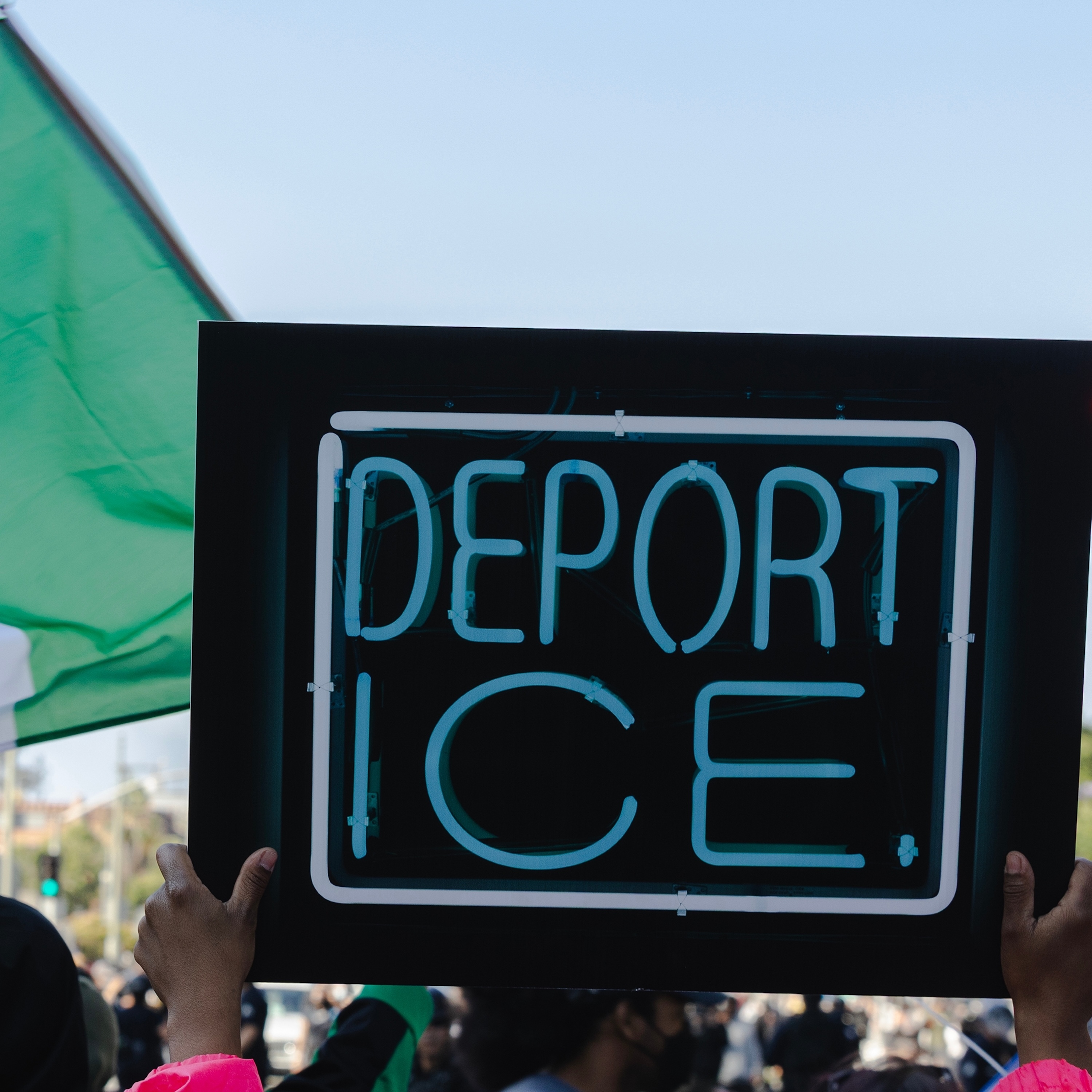
ICE raids in and around Los Angeles (including arrests at a Home Depot parking lot and a donut shop) sparked anti-ICE protests. The conflict escalated when President Trump federalized and deployed about 2,000 National Guard troops to L.A. over Governor Gavin Newsom’s objections, prompting clashes (fires, tear gas, stun grenades, rubber bullets) and a legal fight as California sues.
ICE agents allegedly arrested people without questioning or checking documents; California officials say local police controlled protests; legal experts say Trump did not invoke the Insurrection Act, limiting Guard law-enforcement powers; Trump may be testing legal limits and could later invoke the Insurrection Act; ACLU warns federal troops add fuel to protests.
protests downtown; LAPD praised protesters’ First Amendment conduct; Newsom called the deployment unconstitutional; potential expansion via Pentagon authority to other federal sites.
Aurelise Hernandez (immigration reporter, The Washington Post; on the ground in L.A.) and Justin Juvenal (Supreme Court reporter, The Washington Post; explains legal/power struggle).
Written by AI. May contain mistakes.
Discussion on the protests in L.A. sparked by ICE raids and the involvement of the National Guard.
“and how Trump is testing legal limits with his actions.”
Exploration of Trump's decision to deploy the National Guard against California's wishes and its legal implications.
“So what happened was local police, Los Angeles Police Department and other officials were controlling the protests.”
Overview of California officials' reactions, including Governor Newsom's statements and potential legal actions.
“In fact, the last time it happened was back in 1965, like about 60 years ago, when Lyndon Johnson, President Lyndon Johnson, called up the National Guard to protect civil rights demonstrators in Alabama.”
Discussion of the legal background regarding the federalization of National Guard troops and its historical precedents.
“So the president does have the legal authority to federalize National Guard troops and call them up.”
Analyzing the political motivations behind Trump's decision to deploy troops and its implications for public perception.
“They can't do other things that law enforcement on the ground normally does.”
Exploration of claims that the Trump administration's actions are intentionally provocative and the potential consequences.
“So this is clearly something that Trump has been wanting to do for a while.”
Learn about the concerns protesters have regarding the National Guard presence during protests.
“I mean, I think that's a point that we've heard from a number of people in and around the protests.”
Understand what to watch regarding Trump's potential invocation of the Insurrection Act and troop deployments.
“Do we wait to see whether Trump does invoke the Insurrection Act?”
Concluding thoughts and acknowledgments from the show's production team.
“So one thing I'll be watching for sure is whether, you know, this kind of troop deployment expands from Los Angeles to other cities where there might be protests going on.”

Get the gist, explore an idea or ask about something said.
 Claude
On Post Reports, what are the key points of this episode?
Searching your listeningAutomatic transcript. May contain errors.
0:02It's Monday, early afternoon on the West Coast. The standoff between California and President Trump continues.
0:13This all started on Friday with sweeps in and around L.A. by Immigration and Customs Enforcement, including at two Home Depots where day laborers often gather looking for work. Many undocumented immigrants. Witnesses say ICE officers arrested anyone they could grab as people standing in the parking lot began to run. One thing to keep in mind in these immigration arrests is what people are telling us is that ICE agents aren't necessarily questioning people or asking for their documents. They are grabbing people and taking them. Aurelise Hernandez covers immigration for The Post. She's currently on the ground in L.A.
0:53She says these ICE raids were shocking to people in the city, who then came out to protest the government's actions. Yesterday, I was downtown watching some of this unfold, and it was throngs of people of all ages, a lot of them wearing masks from COVID era, facial masks, but folks who came down to express their displeasure, in fact, their disdain for what's happening and a need to protect their immigrant neighbors. Our lease and my other colleagues who have been out reporting say these were pretty typical protests.
1:35The protests had been mostly peaceful, with some exceptions. The LAPD even put out a statement Saturday night thanking the protesters for exercising their First Amendment rights responsibly. Both the LA mayor and the governor of California said they had the situation under control. But on Saturday night, things escalated dramatically.
1:57President Donald Trump nationalized the California National Guard, deploying them to L.A. against the wishes of Governor Gavin Newsom. Something like that hasn't happened in more than half a century. The tension between protesters and law enforcement only intensified Sunday, after the first National Guard troops arrived. In several locations around the city, protesters set vehicles on fire, and law enforcement used tear gas, stun grenades, and rubber bullets to push crowds back. Over the weekend, Trump defended his decision. And today, he told reporters on the South Lawn that he would support border czar Tom Holman arresting Governor Newsom.
2:34Though for what, it's unclear. Newsom and other state and local officials in California say this is a Trump-created problem. And the state of California is now suing the president.
2:49From the newsroom of The Washington Post, this is Post Reports. I'm Colby Ickowitz. It's Monday, June 9th. Today, we turn to my colleague, Justin Juvenal, to talk about the power struggle between California and the president and how Trump is testing legal limits with his actions.
3:08Justin, thanks for being here. Thanks for having me on. It's great to be back. So, Justin, this was all unfolding over the weekend, And I kind of want to understand how it happened a little step by step. So what first sparked these anti-ice protests that have been happening in and around Los Angeles? Yeah, the protests were in response to ice raids that occurred in and around the Los Angeles area late last week. There was a raid on a donut shop and on a Home Depot parking lot. Where there were some day laborers, right? Day laborers, yeah. Yeah. And that sparked these protests, which began on Friday and then continued into Saturday and Sunday.
3:51Some of the protests got violent at times with some of the demonstrators lighting cars on fire and shooting fireworks. And law enforcement responded with stun grenades and also some tear gas. So things escalated quite a bit. And how did the National Guard get involved? So what happened was local police, Los Angeles Police Department and other officials were controlling the protests. And California officials said that they had no issues controlling the protests that were going on. But then late on Saturday, President Trump decided to federalize California's National Guard and call up 2 ,000 National Guard troops to deploy in the Los Angeles area because he said that the protests had gotten out of control, which was something that California officials said was totally inaccurate.
4:45Yeah, he spoke to Governor Gavin Newsom, as I understand, who told him, like, we have the situation under control. You don't need to federalize the National Guard. That's right. But Trump did it anyway. Yes, that's correct. So if the governor is telling the president that everything's under control, why does Trump still send in the National Guard? That's actually one really unusual aspect of the situation. Generally, in the past, when the National Guard has been called up, it's come at the request of the governor of a state saying, hey, I have a situation in my state where law enforcement is totally overwhelmed.
5:16We need help. We need to bring in troops to try to calm the situation. But what happened was Trump unilaterally used a rarely used authority under federal law to call the troops up himself over the objections of California Governor Gavin Newsom. And it's very unusual for the president to go over the authority of a governor and call up the National Guard himself. In fact, the last time it happened was back in 1965, like about 60 years ago, when Lyndon Johnson, President Lyndon Johnson, called up the National Guard to protect civil rights demonstrators in Alabama. Wow. And the governor there in Alabama did not?
5:56The governor did not request the National Guard. And why would Newsom be opposed to the National Guard coming in? Well, I think what Newsom has said is that there's no reason for the National Guard to come in. He said that local law enforcement has the protests under control. There's not major unrest like we've seen in the past with like the Rodney King riots, for instance. So I think he also thinks that actually bringing in troops who are well armed and have riot gear on that might actually inflame the situation and, you know, cause more violence. So after Trump sends in the National Guard, how have California officials like Gavin Newsom and maybe other lawmakers responded to this decision?
6:42Well, I mean, look, Donald Trump has created the conditions you see on your TV tonight. He's exacerbated the conditions. He's, you know, lit the proverbial match. He's putting fuel on this fire ever since he announced he was taking over the National Guard. So on Sunday night, Gavin Newsom actually sent a letter to the Trump administration requesting that they withdraw the National Guard troops. And he called what they were doing unconstitutional. Where's your decency, Mr. President? Stop. Rescind this order. It's illegal and unconstitutional. And I said it. I'll say it again. It's immoral. You're creating the conditions that you claim you're solving and you're not.
7:20And you're putting real people's lives at risk. So they're quickly moving into taking legal action over this. In a legal act, in a moral act, an unconstitutional act, and we're going to test that theory with a lawsuit tomorrow. Is it unconstitutional? Well, if you talk to legal experts, the situation is fairly unprecedented in a number of ways. So the president does have the legal authority to federalize National Guard troops and call them up. Trump used a section, a rarely used section of the law, which says the president can use and take control of states National Guard troops if there is a rebellion or a foreign invasion going on.
8:05So obviously, this is a situation that doesn't come up very often. Yeah, there's an interesting distinction here. Usually what happens in these situations is the president will use this law and then also invoke another law called the Insurrection Act. which people may have heard about. Trump, when he was on the campaign trail, when he was running for president, often talked about invoking the Insurrection Act to send troops into Democratic-run cities to enforce order. And basically what happens when you invoke the Insurrection Act is it allows National Guard troops to have law enforcement powers.
8:41So that means they can arrest people, they can conduct searches similar to the way local police officers would. So since Trump did not invoke the Insurrection Act in this particular case when he deployed the National Guard troops to California, most legal experts say they cannot do stuff that National Guard troops would normally do. They can't make arrests. They can't do searches. They can't do other things that law enforcement on the ground normally does. So basically, they're restricted to protecting federal facilities and protecting federal operations. So technically, they should not be out in the streets, you know, engaging in arrests or doing anything like that.
9:22Is it our understanding that they are, though? I have not seen any reports of that so far. OK. And so do we think it's likely that Trump will invoke the Insurrection Act to broaden the powers that the National Guard can use in Los Angeles? Well, it's possible he could, you know, some legal experts have said that his use of this federal law to call up the troops may be a prelude to him invoking the Insurrection Act. And that could still be coming. Some also, you know, surmise that maybe what's going on is Trump is trying to, you know, essentially invoke the Insurrection Act without invoking it by using this rarely used federal law.
10:02Because, you know, a lot of people have heard about the Insurrection Act. It's generated a lot of discussion and controversy, you know, during Trump's presidency and run for president. And some people think that maybe for political reasons and political calculations, He didn't want to invoke the Insurrection Act because it's so controversial. And why would invoking the Insurrection Act be so controversial? It's controversial because under U.S. law, the military is not generally supposed to be involved in policing protesters and doing law enforcement activities on U.S. soil. We also have a long, you know, tradition in the U.S.
10:41of not having the military involved in domestic action. A lot of people think it harkens to like authoritarian countries where the military is often used to put down dissent and protest. Trump is saying there's these violent protests in L.A. that require the National Guard. It's not understanding that they were, in fact, that violent. Why is Trump really doing this? Well, I can't get inside Trump's mind. But, you know, it's possible that, you know, as Trump said on the campaign trail, this is something he's been wanting to do for a while. He even cited Los Angeles on the campaign trail and in one appearance in Iowa where he said, you know, these Democratic run cities like New York and Los Angeles and Chicago, you know, they're full of crime.
11:27And when I'm president, I'm just going to act unilaterally and send in troops to take care of the situation and enforce order. New York City is a crime den. Chicago is a crime den. You look at these great cities, Los Angeles, San Francisco, you look at what's happening to our country. We cannot let it happen any longer. And one of the other things I'll do, because, you know, you're supposed to not be involved in that. You just have to be asked by the governor or the mayor to come in. The next time, I'm not waiting. One of the things I did... So this is clearly something that Trump has been wanting to do for a while.
12:04I mean, I think there's probably also a political calculation. You know, Trump, one of his major issues that he ran on was immigration enforcement. And I think he probably feels that the idea of having a showdown with a blue state and a major foe like Gavin Newsom over the immigration issue is a winning political move for him. I wonder, though, how the American public will respond to the militarization of a major city. It's not something we see in America very often is troops taking over. Yeah, it's a very unusual situation and one that, you know, hasn't come up very often in American history.
12:47The last time we saw a president call up troops, and this time it was with the authority and the blessing of the governor of California, was back in 1992 during the L.A. riots that followed the acquittal of the police officers and the beating of Rodney King. and that was a news event that generated huge amounts of coverage and interest. And the situation there was much more dire in terms of the amount of property damage and arrests and things that were going on than the current situation we're seeing in Los Angeles. And Justin, I also wonder what you make of the idea that this is an intentional provocation by the Trump administration.
13:29We heard that accusation leveled by Los Angeles Mayor Karen Bass over the weekend. We're working with officials, we're organizing resources, but what we're seeing in Los Angeles is chaos that is provoked by the administration. When you raid Home Depot and workplaces, when you tear parents and children apart, and when you run armored caravans through our streets, you cause fear and you cause panic. And deploying federalized troops is a dangerous escalation. Justin, what do you make of that argument? I mean, I think that's a point that we've heard from a number of people in and around the protests.
14:07Protesters have made that point. When you think about the National Guard behind you being deployed here. I mean, I think it's really a joke that there's armed individuals when we have signs, cardboard signs. So my colleague Molly Hennessy Fisk got audio of a protester named Estrella Corral making this point. And Trump is just trying to be inflammatory and escalate the situation and make us look out of control when really his ICE agents and military trucks are out of control, not us. And the ACLU also put out a statement yesterday saying that if you're going to bring in federalized National Guard troops, you're essentially going to be adding fuel to a fire.
14:51And you're going to not only put protesters' lives at risk, but you're going to put these National Guard troops at risk for a situation that doesn't necessarily warrant this kind of military deployment.
15:09After the break, Justin tells us what he's watching for next and why this deployment of troops might not just be limited to Los Angeles. We'll be right back.
15:46Morning Brew Daily and ready to take on the world around you. And some people are saying it's the best part of their morning. Because we know something you don't. Business news doesn't have to be boring. Join millions of monthly listeners and check out Morning Brew Daily wherever you get your podcasts. Did you know you can play the Washington Post's games for free? Find the crossword, keyword, ridges, and on the record in the Washington Post app or at washingtonpost.com slash games. No subscription required.
16:23So what next, Justin? Do we wait to see whether Trump does invoke the Insurrection Act? Like, what will you be watching as this continues to unfold? Yeah, I mean, I think there'll be a couple things that we'll be watching. One is if he does invoke the Insurrection Act. The other thing we'll be watching is how are the National Guard troops deployed on the ground in L.A.? Are they simply protecting federal facilities? or are they actually getting involved in arrests and more proactive activities? I think that'll be something to watch. There's one other aspect of Trump's executive order that's gotten a little bit less attention.
16:57That's also something I'm watching. In addition to deploying the 2000 National Guard troops to Los Angeles, Trump also gave the Pentagon the authority to send armed forces to any federal facility or federal operation around the country. And if you talk with legal experts, They said that this power can allow Trump to deploy troops around the country, not just to Los Angeles, but to other cities where there might be protests. So one thing I'll be watching for sure is whether, you know, this kind of troop deployment expands from Los Angeles to other cities where there might be protests going on. Wow.
17:35And he would do that only if there were protests? Uh, possibly, you know, presumably, but, you know, he could maybe preemptively deploy troops thinking that, you know, there might be protests that are going to erupt. Wow. Well, Justin, thank you so much for explaining all that to us. I really appreciate it. Thank you for having me.
18:01Justin Juvenal covers the Supreme Court for The Post. That's it for Post Reports. Thanks for listening. Today's show was produced by Rennie Svarnowski. It was edited by Maggie Penman with help from Lucy Perkins and mixed by Sean Carter. Thanks to Ariel Plotnick, Peter Bresnan, Afreen Hernandez Jr. and Susan Levine. Today we are also delighted to welcome our new intern, Tadeo Ruiz Sandoval. He's a recent graduate of the University of Missouri. He grew up in Mexico City and tells us he loves movies and coffee. We are so excited to have him here and we can't wait to work with you, Tadeo. I'm Colby Ickowitz.
18:40We'll be back tomorrow with more stories from The Washington Post.
18:53Did you know you can play the Washington Post's games for free? Find the crossword, keyword, ridges, and on the record in the Washington Post app or at washingtonpost.com slash games. No subscription required.
Demonstrators turned out in Los Angeles to oppose ICE raids. Trump called in the National Guard.
Read more:
Over the weekend, President Donald Trump ordered 2,000 National Guard troops to Los Angeles to intervene in protests over federal immigration sweeps.
California Gov. Gavin Newsom (D) called the move “unconstitutional” and on Monday sued the administration.
“Let me be clear: There is no invasion. There is no rebellion,” California Attorney General Rob Bonta (D) said in a statement. “The President is trying to manufacture chaos and crisis on the ground for his own political ends.”
Today on “Post Reports,” host Colby Itkowitz talks with Supreme Court reporter Justin Jouvenal about the move – the first time in about 60 years that an American president has taken such action without a governor’s consent, and a chilling sign that Trump is prepared to send troops into other cities in response to protests.
We also hear from reporter Arelis R. Hernández about the people detained by ICE, and the people who turned out to defend them.
Today’s show was produced by Rennie Svirnovskiy. It was edited by Maggie Penman, with help from Lucy Perkins. It was mixed by Sean Carter. Thanks to Ariel Plotnick, Peter Bresnan, Efrain Hernandez Jr. and Susan Levine.
Subscribe to The Washington Post here.