
In short
The episode explains endocrine-disrupting chemicals in everyday products (endocrine system basics; examples include BPA, PFAS “forever chemicals,” and phthalates), what the research says about cancer risk, and practical steps to reduce exposure without panic.
Guest backgrounds
Dr. Mikhail Sekharis (spelled “Sekers” in transcript) is an oncologist, professor, and cancer epidemiologist; chief of the hematology division and professor of medicine at the Sylvester Comprehensive Cancer Center, University of Miami. He also writes regularly for The Washington Post.
Key claims
Evidence linking these chemicals to cancer in people is weaker than for major risk factors like smoking, alcohol, sun/UV, and red/processed meat. Lab/mouse findings don’t necessarily translate to humans. He “lowers the freak out range” by comparing study sizes (endocrine disruptors: fewer cases; alcohol/smoking: tens of thousands+).
Notable examples
BPA from canned-food epoxy coatings and polycarbonate water bottles; PFAS found in dental floss and textiles; a Parkersburg, West Virginia PFOA study linked to testicular and kidney cancer; phthalates in shampoos/perfumes/hair dyes, with cohort studies (including ~46,000 women) linking permanent hair dye and straighteners to higher breast/ovarian cancer risk. Practical swaps: use metal/glass water bottles, glass food containers, PFAS-free cookware/utensils, avoid phthalates and strong fragrances, check plastic recycle codes (3/7).
Written by AI. May contain mistakes. Listen to the episode to check what was said.
Chapters
Tap a time to open that second in VOUnderstanding Endocrine Disruptors
2:10 to 5:28
Dr. Sekaris explains what endocrine disruptors are and their effects on health.
“Sekeris answers all my questions about endocrine disruptors in cancer.”
Common Endocrine Disruptors: BPAs and PFAS
5:28 to 7:39
Explore the prevalence and risks of BPAs and PFAS in everyday products.
“As we age, the endocrine system may not have that much activity.”
Phthalates and Health Concerns
7:39 to 10:13
Discover the use of phthalates in cosmetics and their associated health risks.
“So that's per - and polyfluoroalkyl substances.”
Assessing the Risks of Everyday Chemicals
10:13 to 14:08
Understand the evidence regarding chemical exposure and cancer risk.
“Is there a particular health concern or a set of research around this class of chemicals that we should be aware of?”
Understanding Chemical Exposure and Cancer Risk
14:08 to 15:03
Learn about the varying levels of evidence linking chemicals to cancer.
“Compare that to these studies that we're talking about with endocrine disrupting chemicals where we're talking about a few hundred people who are involved.”
Navigating Cancer Risks in Daily Life
15:55 to 18:11
Explore practical interventions to reduce cancer risk in everyday products.
“Three years in and these pre-owned machines are still at the top of their game.”
Healthy Living Strategies for Lowering Cancer Risk
18:11 to 22:55
Understand lifestyle choices that significantly reduce cancer risks.
“I love that caveat and that sort of foundation of us diving into this because I don't want to get into this like blame game thing.”
Moderation and Risk Management
22:55 to 25:00
Learn about the importance of moderation in dietary choices to manage cancer risk.
“from 1975 to 2020, smoking cessation programs have been estimated to reduce lung cancer deaths by almost 3.4 million people.”
Empowerment Through Knowledge
25:00 to 26:36
Feel empowered with information to better understand chemical exposures and health.
“And then the other risk that I think I keep being bombarded with these days is red meat.”
Introducing Ask the Post AI
28:16 to 28:46
Discover how Ask the Post AI provides trustworthy information.
“When it comes to the big questions, who you ask matters.”
Transcript
Automatic transcript. May contain errors.0:01John Deere is putting in work and putting up highlights. Oh man, look at those passes. Tillage, planting, harvesting. Three years in and these pre-owned machines are still at the top of their game. We're talking reliability, performance and long-term potential. And get this, these veteran machines can pick up the latest precision tech with ease. You know it and fans ready to add John Deere certified pre-owned equipment and more options to their lineup can shop at machinefinder.com. Booyah!
0:32The other day I was scrolling on Instagram and this chart popped up. It showed everyday items in my house that could actually be messing with how my body functions. Things like shampoo, floss, water bottles. The chart said all these items contain things called endocrine disruptors.
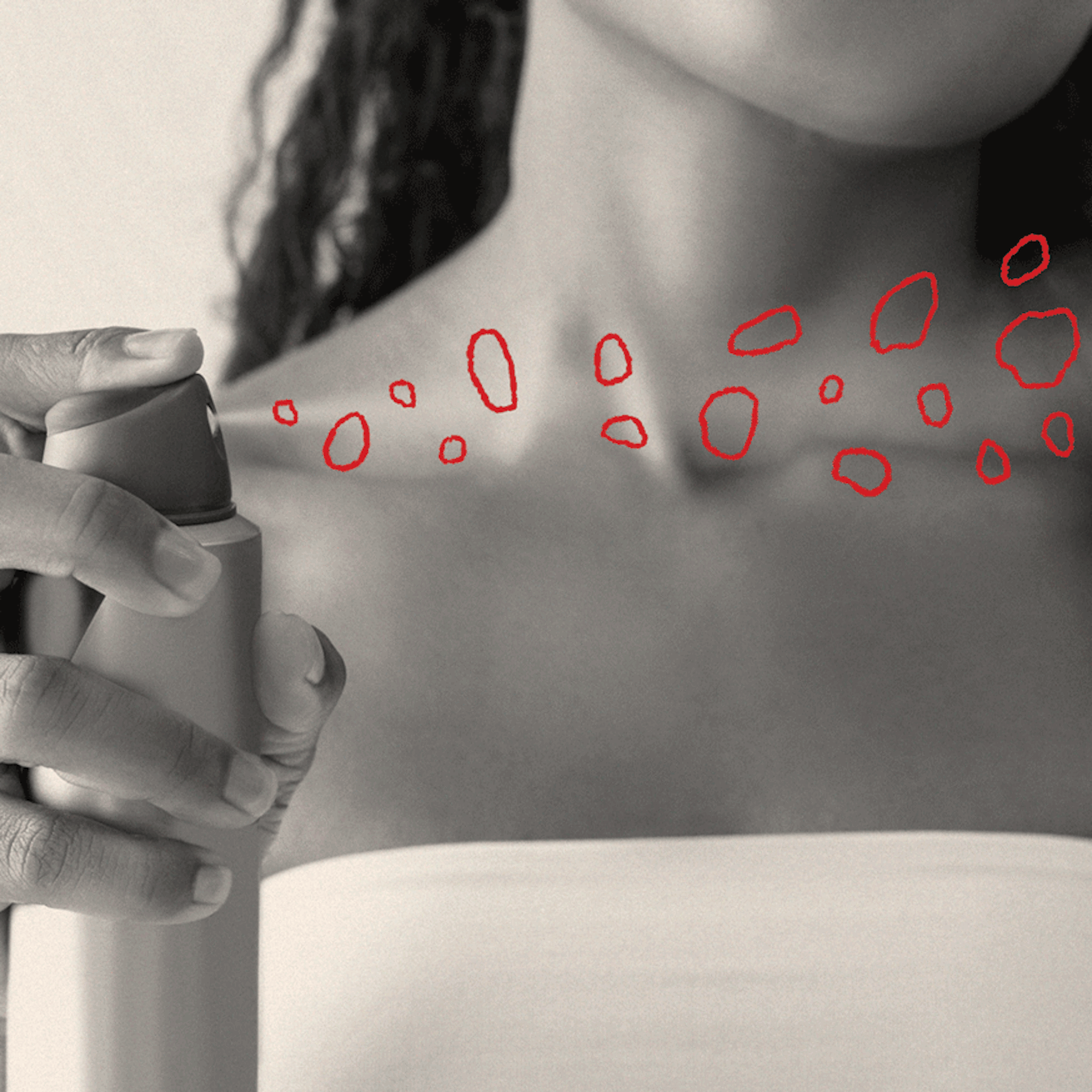
0:57Endocrine disruptors are chemicals that can interfere with the complex system that produces and interacts with our hormones. There's research linking some of these endocrine disruptors to a bunch of health problems. They can affect the reproductive system, our kidneys, and even increase our cancer risk. And these chemicals are everywhere. In our food, our hygiene products, our makeup, our pots and pans. This scared me. But rather than continuing to doom scroll, I thought, you know, let me talk to someone who actually knows the science and isn't getting all of his information from social media.
1:38That person is Dr. Mikkel Sekaris. He's an oncologist, professor and cancer epidemiologist. And as part of his research, he tracks potential links between environmental exposures and cancer. So we called him up to ask, how freaked out should I be? Let me try to lower your freak out range. From the newsroom of The Washington Post, this is Post Reports. I'm Elajai Izadi. It's Wednesday, August 6. Today, Dr. Sekeris answers all my questions about endocrine disruptors in cancer. He shares with me how he makes his own choices on what products to buy and avoid and how I can do the same. He's the chief of the hematology division and professor of medicine at the Sylvester Comprehensive Cancer Center at the University of Miami.
2:31He also writes regularly for The Post. And I have to say, I felt much better and smarter by the end of our conversation. So I hope you do too.
2:49Dr. Seckers, thank you so much for joining me today. I appreciate it. What a delight it is to be here. Thanks for having me. I am very much looking forward to this conversation. because on a personal note, I feel like every time I open up social media, my phone, look at the news, I keep getting bombarded with information about everyday products that are in my home that could actually be harmful for me. And the words that keep popping up are endocrine disruptors. So I would love to, with you, dig into some of the specifics of items I should be careful about and also thinking through how much I should be worrying or not worrying about this.
3:25But first, I think it's helpful to start with just big picture, the science of all this so I can calibrate my concern appropriately. I think that's a terrific intro to this. And typical Saturday for me is waking up in beautiful South Florida, putting on my biking clothes, getting out onto my bike, going for a ride, drinking adequate amounts of water from a water bottle, getting home, reheating some food in a Tupperware container for lunch and lounging on the couch. With those very simple, straightforward behaviors, I have invoked a number of potential exposures to endocrine-disrupting chemicals.
4:05And maybe a good place to start is to start with the endocrine system. The endocrine system are a bunch of glands that secrete hormones like estrogen, testosterone, cortisol. all. And those hormones then interact with targets, what we call receptors in the body, to regulate our growth, development, reproduction, metabolism, energy balance, and body weight. So is it sort of like it helps regulate functions within the body? Yeah, exactly. And you almost have to cross your eyes and think backwards when you're thinking about the endocrine system and how it works. You have a hormone that will then stimulate a receptor.
4:42And often that means it's stimulating cells to grow and to produce chemicals. And then it's always involved with a feedback loop, meaning that once your body has responded to that hormone stimulation, once it produces adequate amounts of what the body's looking for it to produce, it shuts off the initial trigger to produce those chemicals. And its activity differs as we age. So you can imagine the endocrine system is really active when we're little and we're growing. And, you know, we make the joke in our house, we have a 16-year-old son at home that he must have a hollow leg with how much he eats, right?
5:19He's constantly consuming food and we don't know where it goes. Well, because he's actively growing and his endocrine system is like on max capacity. As we age, the endocrine system may not have that much activity. Does it then follow that endocrine disruptors are things that disrupt that normal functioning of the endocrine system? Yeah, exactly. So chemicals that interfere with this complex communication system are called endocrine disrupting chemicals. And they work in a variety of ways, including overstimulating receptors, blocking receptors so that normal hormones can't interact with them, and altering hormone production or availability.
6:02There are over a thousand types of these chemicals, according to some estimates. So it's a tremendous number of chemicals. And some of these are formally listed by international organizations as being toxins. And they can be found everywhere from your nonstick pans to canned foods to your shampoo and even hair dye. I want to dig into what some of these endocrine disrupting chemicals are, the ones we most commonly encounter. I wondered if we could start with BPAs. That's an acronym that I come across often. What are those? So BPAs or bisphenol A is a chemical used in the production of polycarbonate plastics and epoxy resins.
6:44And it's structurally similar to synthetic estrogen. So it belongs to a larger class of chemicals called bisphenols. And the primary exposure for most people is through their diet. So BPAs can leach into food or drinks from the protective internal epoxy resin coatings of canned foods and from consumer products such as polycarbonate tableware, food storage containers. I mentioned in my little story as an intro that I go out biking, I drink from a water bottle. They can be in water bottles. I reheat food in a Tupperware. They can be in food storage containers. But the U.S. FDA has said they can no longer be used in things like sippy cups and baby bottles.
7:27Okay, there's another class of chemicals I think about in this conversation, and that is forever chemicals, which is a big umbrella. I've also heard them referred to as PFAS. Can you tell me about those? Yeah, PFAS. So that's per - and polyfluoroalkyl substances. These are chemicals used as oil and water repellents and coatings for cookware, food packaging, even carpets and textiles. So in my little story about going biking, I mentioned lounging on the couch, right? Well, that's a textile. They're known as forever chemicals because once PFAS are created, they persist in the environment because they don't break down like some other chemicals.
8:07They can be found in everything from dental floss to menstrual products as well. They contaminate drinking water near facilities where they're manufactured. And they've also been found on military bases and firefighting training facilities where foam-containing PFAS is used. So they can really be in a lot of different area. There's kind of a famous study that was conducted near Parkersburg, West Virginia, that found a probable link between a type of PFAS called perfluoroactanoic acid or PFOA exposure and a number of disease categories, including testicular cancer and kidney cancer. Wow, I mean, just to think that these chemicals are in things from floss to menstrual products really makes you think like everywhere I'm looking around my home or just anything anyone uses, you're gonna encounter these chemicals.
8:58Well, we're consumers, we're all consumers in the 21st century. So we have some pretty amazing things that we can use that we couldn't use two centuries ago, but a lot of these come from these sort of chemicals, preservatives, and plastic manufacturing. So sure, you're right. Tell me about this other class of chemicals when we're having this conversation. I probably won't be able to pronounce it. Can you, I'm going to try. Thank goodness for these other acronyms. Phhthalates, can you say that for me? Well, I pronounce it phthalates, but you're absolutely right. It sounds like it's a word that would be used in the national spelling bee.
9:36Yes, exactly. Something that Sylvester the cat would stumble over. So these are chemicals used in cosmetics and personal care products that make plastics more durable. They're also known as plasticizers. These liquids are colorless, odorless, and oily. They resist evaporation and function as solvents and stabilizers in products like perfumes, shampoos, hairsprays, hair straighteners, nail polishes, and cleansers. And probably the most common one in cosmetics is diethyl phthalate or DEP. That's used as a solvent and fixative in fragrances like perfumes. Is there a particular health concern or a set of research around this class of chemicals that we should be aware of?
10:21So with this one, there have been a couple of studies in sisters. So take a step back and think about epidemiologic studies. If you and I were to design the perfect study to study risk factors for developing cancers, we would randomize 100 ,000 people where half would be exposed to something like a phthalate and half wouldn't be exposed to a phthalate. We would follow them over 40 years and we would see who developed cancer at a greater rate. Well, of course, a study like that is inherently inethical and impossible to do. So what we turn to is the next best thing. And the next best thing in epidemiologic studies are what are referred to as prospective cohort studies.
11:02In other words, you take tens of thousands of people, in this case, tens of thousands of sisters, and you ask them, gee whiz, a whole bunch of questions about all their behaviors. Do you smoke? If you smoke, how much do you smoke? Do you go out into the sun? Do you use sunscreen? Do you not use sunscreen? What kinds of foods did you eat in the past week? a bunch of different types of potential risk factors for a variety of types of medical conditions. So in these studies, in this case, it was sisters were asked about their use of permanent hair dyes and then were followed over time for whether or not they developed breast cancer.
11:40And in one study that included more than 46 ,000 women, it found that permanent hair dye use was associated with an increased use of breast cancer, particularly among Black women, while frequent use of straighteners was linked to a higher risk of both breast and ovarian cancer.
12:00So kind of the takeaway I'm having from what you've described so far is that there are all these chemicals. They are all around our home. We interact with them every day. There is some research that indicates increased risk of cancer and other health problems with repeated exposure to some of these chemicals. But I'm also not hearing that if you are drinking every day from a plastic bottle, you're definitely gonna get sick. Is that accurate? Or how would you summarize the, I guess what I'm asking you, doctor, is how freaked out should I be? Let me try to lower your freak out range. Because my freak out range, of course, as soon as I read this stuff is to be pretty high.
12:41And then I go through the data and realize there's not as much evidence supporting the link between these chemicals and us developing cancer as there is for a lot of other behaviors that we can modify. So let's put this in context. Some of these studies, I mentioned the study looking at phthalates and development of breast cancer and mentioned a sister study of 46 ,000 women. Well, when you break it down to how many of those women actually were exposed to these dyes and then developed breast cancer, you're just talking about a few hundred, right? So it boils down really quickly to a much lower number.
13:19And these are probably the best data among all of the things that we've discussed for a link between an exposure and cancer in this class of chemicals. Compare that to the recent Surgeon General's warning about alcohol exposure and the development of cancer. In that warning, that included studies of tens of thousands, over 100 ,000 people with very detailed information about their exposure to alcohol and found a very clear link between that alcohol exposure and a variety of cancers. In fact, alcohol exposure contributed to 5 % to 6 % of new cancer diagnoses in this country and to 44 ,000 breast cancer diagnoses per year in the United States.
14:07Now that's based on studies of, as I mentioned, over 100 ,000 people. Compare that to these studies that we're talking about with endocrine disrupting chemicals where we're talking about a few hundred people who are involved. So the level of evidence about linking these chemical exposures to cancer is really much lower in actual people. I think what would get people stirred up is that there are some laboratory studies. So studies that take place in test tubes or in, for example, lab mice that show a link between exposure to these chemicals and the development of cancer in the lab. But as we've known for decades, that doesn't always predict development of cancer in people, just as lab and test tube studies of drugs to treat cancer don't always predict that they're going to work in people.
15:02After the break, Dr. Sechris explains which products to consider ditching and which ones aren't worth worrying about. We'll be right back.
15:23Thumbtack presents Uncertainty Strikes. I was surrounded. The aisle and the options were closing in. There were paint rollers, satin and matte finish, angle brushes and natural bristles. There were too many choices. What if I never got my living room painted? What if I couldn't figure out what type of paint to use? What if I just used Thumbtack? I can hire a top-rated pro that knows everything about interior paint, easily compare prices and read reviews. Thumbtack knows homes. Download the app today. John Deere is putting in work and putting up highlights. Oh man, look at those passes. Tillage, planting, harvesting.
16:02Three years in and these pre-owned machines are still at the top of their game. We're talking reliability, performance and long-term potential. And get this, these veteran machines can pick up the latest precision tech with ease. You know it and fans ready to add John Deere certified pre-owned equipment and more options to their lineup can shop at machinefinder.com. Booyah! Dr. Sekers, I think what you described about how to calibrate our concern around this is really helpful. And also, I think it's just important before we dive into the practicality of how to incorporate some of these findings into our day-to-day lives to remember that the environments we're in were complicated.
16:43Our bodies are super complex. Just because you're exposing yourself to one thing doesn't necessarily mean you have caused yourself cancer. I mean, I just think it's important to like caveat all that so that, I don't know, when I think about these things, I don't want to get into this loop of, oh, I'm making myself sick by using this shampoo. Like it's just really hard to know if you have cancer, like why that happened, right? Right, right. Absolutely. And, you know, one of the most common questions my patients ask me is what did I do to cause my cancer? And it's this very kind of moving moment in a relationship, I think, between me and my patients.
17:21And the exact same thing I would ask, because I think a lot of us are programmed to assume that we did something wrong to bring on cancer. Most cancer occurs by just dumb luck. Over the course of our living on this earth for decades and our cells dividing and reproducing and trying to make a perfect copy of themselves every single time they divide, statistically, one time out of thousands of divisions, they're going to screw up. So statistically, our chance of getting cancer is just random bad luck. It's nothing that we could have done to prevent it. But we have clear examples of exposures that we have where we can do something to intervene to lower our own personal chance of developing cancer.
18:11I love that caveat and that sort of foundation of us diving into this because I don't want to get into this like blame game thing. So let's start with the kitchen. You know, in the story you were saying, there's like the food and the water bottle. If I'm in my kitchen, I'm looking at the containers I store food in, the utensils I use, the plateware I use, or what I cook with. What are some things that I can think about avoiding, maybe swapping out? Where would you recommend I start? Yeah, a great question. I think there are a couple of easy interventions we can all make. So, number one, and these are things I've done myself.
18:45So like I said, I don't think the epidemiologic evidence is strong enough yet to say that, for example, drinking water from a plastic water bottle is going to lead to an increased risk of cancer. We don't know that yet. But if we want to try to be careful and make some easy interventions in our life, one that I've done is to stop drinking water out of plastic water bottles. I use metal water bottles or I use glass lined water bottles when I have a drink of water. Another thing that I do, I don't know about you, but I like to bring in my own lunch to work every day. It's my aspiration. I'll pack an extra one for you.
19:23Thank you. You know, I think it's a really good way to control what we eat and to avoid the easy trap of eating out or ordering food for delivery. So when I bring my food in, instead of using plastic containers for it, I now use glass containers and just, you know, cheapo ones that I buy from Target. You don't have to get fancy ones for something like that. So I do these not because, again, I want to emphasize this, the epidemiologic studies are not there yet to say that exposure to these substances definitely causes cancer. But, you know, I'm playing the odds that 20 years from now, there won't be a study that's published that says that it was a risk.
20:01And look, I modified my behavior 20 years ago.
20:06And what about pots, pans, spatulas, Teflon? I've read or heard, oh, I should look for ceramic or stainless steel when I'm thinking about pots and pans and spatulas to avoid plastic and find silicon. Is that what you would recommend as well? Yeah. So again, there's a practical aspect to this as well, and that is to buy cookware that states that it's PFAS free. I try to buy kitchen utensils also that are PFAS free if possible. I also try to, you know, I do my best to consume fresh food that isn't heavily packaged because the packaging itself can contain PFAS or that isn't ultra processed. Yeah.
20:46So let's go to the bathroom and just think about what are some items that maybe I should avoid or if I'm running out of something, rethinking my replacement. I'm thinking of, you know, shampoos, conditioners, and even, you know, makeup. And we mentioned floss, menstrual products. What are some places I could start? Yeah. Again, you want to try to buy substances that don't have phthalates in them. And sometimes they will actually state that they're phthalate free. And trying to avoid things that have strong fragrances to them. Because fragrances, again, may have that DEP in them that I mentioned earlier.
21:26So going for more natural products, looking at labels, being a little more attentive to that. Another thing is that sometimes these endocrine disrupting chemicals will be in bottles that have a recycle code 3 or 7 in them. Those may include BPAs or BPA-like substances. So something, again, to look for if you're really being rigorous about trying to avoid your exposures. Yeah, and that's helpful to also think about the recycling label. Like that's something so easy to just look at and see what number that is. Okay, so if I'm looking at the totality of my house and I'm trying to revamp it or think about where do I start, how would I think about it?
22:09What's a way I can start that does not feel overwhelming? So, and again, I don't go crazy about these things. I think we can only modify our lives so much. And as you heard, a lot of these chemicals are ubiquitous, right? They are everywhere. So it's impossible to avoid them entirely. But I think my biggest take-home message for this, in all honesty, is there are a heck of a lot of other behaviors we can give attention to that have really been shown to reduce our cancer risk unequivocally. Don't smoke. And if you do smoke, try to stop. Smoking is responsible for 86 % of lung cancer diagnoses, 50 % of cancers of the esophagus and bladder, among many other cancer types.
22:55over a 45-year period in the U.S. from 1975 to 2020, smoking cessation programs have been estimated to reduce lung cancer deaths by almost 3.4 million people. And the good news is that if you do smoke and then you stop smoking, the risk of lung cancer drops by half with 10 to 15 years of smoking cessation and actually falls to almost non-smoker levels for those who quit by age 40. So, right, that's a huge, huge inroad you can make to lowering cancer risk. Another approach, keep alcohol intake to a minimum. And I've written about this in the post about how, you know what, I do enjoy a beer or two when I'm outside in the sweltering sun and out at a baseball game, right?
23:39But I limit my intake to no more than one to two drinks per week. You want to try to keep that alcohol intake to less than one drink per day.
23:50Wearing sunscreen. I am fair-skinned. I freckle easily. Ultraviolet radiation from the sun is responsible for about 6 % of cancer cases in men and about 4 % of cancer cases in women. So sorry, but the sunscreen, it's interesting because I think that's also something that comes up for people like, oh, some of these sunscreens have lots of chemicals. It's better I don't even wear it. But is it better to wear a sunscreen or not to wear it if it's a chemical-based sunscreen? Yeah. So it's a terrific way that you ask that question. And without getting too controversial, it's like the debate about should you take a COVID vaccine or not.
24:22Let me tell you, the health consequences of getting COVID are tremendous. And we're only just at the tip of the iceberg of looking at long-term effects of people who've been exposed to COVID and who've had florid COVID. Compare that to the very, very low risks of getting a COVID vaccine. And there's no doubt about what the approach should be. You take the COVID vaccine to prevent the very real and very mighty risks associated with having COVID. The same is true with sunscreen. Very low risks that we know of, of the chemicals contained in sunscreen. Very high tangible risks of cancer with being exposed to the sun.
Read the full transcript
25:00And then the other risk that I think I keep being bombarded with these days is red meat. So just going back to what you were talking about, there are other things that really should be at the top of your list when you're thinking of reducing cancer risk. Yeah, yeah, yeah. So it turns out that research has found an association between colorectal cancer and consumption of red meat and processed meat, especially with low dietary fiber and calcium, to the point where processed meat has actually been listed as a toxin by international agencies, right? Just like some of the chemicals we just discussed.
25:35So I am an omnivore. I eat meats. I eat vegetables. But, you know, I remember an interview with Julia Child once where somebody said, gee, in this health conscious world we live in, how can you still cook the way you do? And she looked at the person and said, I don't eat the whole meal. I just eat a little bit. So, you know, her point though is always stuck with me. Everything in moderation. So do I enjoy a burger during the summer? Absolutely. How often do I have a burger during the summer? Maybe once a month, no more frequently than that. What about once a week? Can I have one once a week? I'm Persian.
26:05I like kabob. So yeah, if you love burgers, listen, everything is about relative risk. We can't be risk-free the way we grow up, right? But we have to choose our risks, choose our pleasures, and choose our tolerance of risk for developing cancer or heart disease. Well, I have to tell you, Dr. Secker, I feel a lot better. I feel more equipped to navigate the world. I feel like empowered that I understand a little bit more about what I'm interacting with and how to calibrate my concern appropriately. So thank you so much for taking the time to join me. I appreciate it. Oh my God, what a joy it was to be on here.
26:43Thank you for having me.
26:48Dr. Mikhail Sekharis is the chief of the hematology division and professor of medicine at the Sylvester Comprehensive Cancer Center, University of Miami. If you love the show, help other people discover it. You can do this by leaving a rating and comment on Spotify or a rating and review on Apple Podcasts. That's it for Post Reports. Thanks for listening. Today's show was produced by Thomas Liu with help from Reni Sronofsky, who also mixed this episode. It was edited by Ariel Plotnik. Thanks to Emily Kodik. I'm Elahe Izadi. We'll be back tomorrow with more stories from The Washington Post.
27:45We'll see you next time.
27:59We're talking reliability, performance, and long-term potential. And get this, these veteran machines can pick up the latest precision tech with ease. You know it, and fans ready to add John Deere certified pre-owned equipment and more options to their lineup can shop at machinefinder.com. Booyah! When it comes to the big questions, who you ask matters. From breaking news to politics that impact your life, to advice you can trust. Get answers you don't have to question with Ask the Post AI. Trained exclusively on post journalism with clear sourcing. And if we don't know the answer, we'll tell you.
28:41Ask the Post AI. Find it on WashingtonPost.com or in the app.
From the publisher
Endocrine disruptors are chemicals that can interfere with the complex system that produces and interacts with our hormones. Research suggests they can affect the reproductive system, our kidneys, and even increase our risk of cancer. There are over 1,000 types of endocrine-disrupting chemicals, according to some estimates, and we are exposed to them daily through things like kitchen utensils and makeup. So how worried should we be about inevitable exposure?
Host Elahe Izadi speaks with oncologist Dr. Mikkael Sekeres about the connection between endocrine disruptors and cancer. Dr. Sekeres also shares his advice on steps he takes to avoid these chemicals–and how he puts the risks into perspective.
Today’s show was produced by Thomas Lu, with help from Rennie Svirnovskiy, who also mixed the episode. It was edited by Ariel Plotnick.
Subscribe to The Washington Post here.