Ask ChatGPT


Q3 market recap through the lens of Steve Eisman’s AI-and-rates thesis: AI “doom” claims are a strategy to spur regulation and create moats/duopoly; AI companies face concentration risk (OpenAI/Anthropic), price wars, and heavy data-center financing pressures; high 10-year yields (around/above 5%) plus oil and deficit crowding can trigger corrections; off-balance-sheet debt and credit-rating games may be systemic risk.
Steve Eisman is a portfolio manager/investment analyst and “Big Short” legend; known for predicting/profiting from the 2008 subprime crisis. He founded Emris Partners and later joined Neuberger Berman.
AI is not near AGI; “Terminator” extinction probabilities are nonsense. Token-maxing ended as enterprises became cost-conscious; open-weight models gained share. AI business has “no moats,” leading to price wars. Market risk is dominated by narrative and concentration, not valuation alone. Off-balance-sheet vehicles preserve credit ratings.
Anthropic Reuters figures (2025 operating loss ~$8B; net loss ~$42B). Nvidia concentration via hyperscaler revenue. Meta’s ~$30B off-balance-sheet data center deal. Oracle’s force majeure notice re: Blue Owl’s New Mexico “Project Jupiter.” FICO short thesis via VantageScore gaining share (Rocket Mortgage adopting it).
Written by AI. May contain mistakes.
Discussion of major market events from the third quarter.
“Interrupted sleep, headaches, constant fatigue.”
Discussion of major market events from the third quarter.
“This week marked the end of the third quarter, and there is a lot to unpack.”
Steve Eisman's perspective on AI and market dynamics.
“Here is our conversation with Steve Eisman, investment analyst, portfolio manager, and big short legend.”
Exploration of AI companies' concerns and regulatory strategies.
“Talk more about what you mean by all of that.”
Discussion on Anthropic's financial performance and future outlook.
“So if I can manufacture a crisis where there's regulation and then the regulators come in and I can manipulate them so that we don't want the open weight models, all of a sudden I've got a duopoly.”
Steve Eisman analyzes market risks and the possibility of an AI bubble.
“That is how much they're losing or they lost last year just from day-to-day operations.”
Discussion on current valuations in tech and investor perceptions.
“You know, one day one model is up, next day another model is up.”
Learn about the increasing off-balance sheet debt issues facing AI companies and their implications.
“And I said, well, why don't you just get in the elevator, go down two floors and go talk to your own desk.”
Learn about the increasing off-balance sheet debt issues facing AI companies and their implications.
“Losing weight on your own can feel like a fight you're never going to win.”
Learn about the increasing off-balance sheet debt issues facing AI companies and their implications.
“Support for the show comes from BCX, the public ticker for private tech.”
Understand how rising yields can lead to market corrections and their effects on various sectors.
“actually a story of bonds or a story of yields and rates um you wrote that the five percent on the 10-year is the quote rubicon for the market could be nope nobody let's be clear Nobody ever knows until after the fact.”
A discussion on inflation, interest rates, and the impact of AI on treasury markets.
“Just in terms of macro, I mean, getting away from the AI stuff, we had inflation was lost at 3.4%.”
Exploring the market's resilience amid risks and the significance of the AI narrative.
“What steps are you taking to protect yourself?”
Exploring the market's resilience amid risks and the significance of the AI narrative.
“And for even more markets content, sign up for our newsletter at profgmarkets.com.”
Insights on market predictions for the fourth quarter and shorting strategies.
“Brussels clean up nicely at Sweet Green.”
Learn about the drastic price increase by FICO and its effects on the mortgage ecosystem.
“Well, like basically as long as it has existed.”
Discover Steve Eisman's investment philosophy and the importance of sleep in trading.
“and you're not going to have a monopoly.”
Examine the concentration risk in AI companies and their potential impact on the economy.
“And, you know, if the result is to sell something or take down some risk or short something just to make yourself feel more comfortable, that's what you should do.”
Hear insights on the valuation of AI companies and the influence of sci-fi on technology.
“People not being able to get their money out of the bank, that's the end of the world.”

Get the gist, explore an idea or ask about something said.
 Claude
On Prof G Markets, what are the key points of this episode?
Searching your listeningAutomatic transcript. May contain errors.
0:00Support for the show comes from Morgan Stanley's podcast, Hard Lessons. Some investing lessons only become clear after you see how a call plays out. On Hard Lessons, iconic investors sit down with Morgan Stanley leaders to go behind the scenes on the critical moments, both successes and setbacks that shaped who they are today.
0:16Steve Eisman: Watch or listen to Hard Lessons wherever you get your podcasts.
0:24Steve Eisman: Interrupted sleep, headaches, constant fatigue. For a lot of women, these aren't three separate issues. In perimenopause and menopause, they're often the same hormonal story, and you don't have to quietly push through. MIDI can help, because your symptoms have answers. Visit JoinMIDI.com with code VOX right now to book your first visit today. That's JoinMIDI.com, code VOX, to book your first visit. JoinMIDI.com, code VOX. Insurance coverage varies. Check with your plan for coverage.
1:00Fall has never looked or tasted this good. Sweetgreen's fall harvest menu is back with seasonal favorites dressed to impress and made to be devoured.
1:10Steve Eisman: Warm roasted sweet potatoes, crisp apples, maple glazed Brussels and crave worthy flavors in the autumn harvest bowl, maple glazed salmon plate and roasted bacon Brussels side. The season's most desirable menu has returned to Sweetgreen featuring fall's best dressed. Make your move. Order on the Sweetgreen app.
1:42Steve Eisman: Welcome to Prof G Markets. This week marked the end of the third quarter, and there is a lot to unpack. We had AI researchers warning that the technology could pose an existential threat to humanity. The Fed raised rates for the first time in three years. treasury yields hit multi-decade highs and we started to get a sense of what we're going to see in the Anthropic IPO. Those are just a few of the highlights. So we wanted to take a step back and break down what happened this quarter, what the biggest takeaways are and what we can expect heading into the final quarter of the year. So to help us make sense of it all, we are joined by a guest who has been helping us navigate this year's headlines and separate the signal from the noise.
2:25Steve Eisman: Here is our conversation with Steve Eisman, investment analyst, portfolio manager, and big short legend. Steve, great to have you back on the show. I want to start with a clip that you went very viral for. This was from your recent interview on CNBC, where you all were discussing all of these doomerous threats from these AI companies saying that, you know, there's a 10 % chance that humanity will go extinct because of AI or even higher probability ratings. You had a very interesting take on the matter. A lot of people heard it. I'm going to play it and we'll get your reaction. The idea that this whole Terminator thing is nonsense.
3:07So I think some completely different is going on. And what I think is happening is that token maxing is over. The open weight models are taking big market share. I think these companies are very nervous. They realize that there are no moats around their business whatsoever. And they're trying to manufacture a crisis that will create regulation and that they think they can then manipulate to create the moats, to create the duopoly that they want.
3:37Steve Eisman: Talk more about what you mean by all of that. I didn't know that went viral. Thanks for letting me know. It did. It did. You know, I grew up reading a tremendous amount of science fiction, like an insane amount. And I'm just amused by the fact that I think all these people who live in Silicon Valley basically read almost as much science fiction as I did. They just take it very seriously. And that's funny, but I think also true. I mean, the idea that AI, first of all, there's absolutely no evidence whatsoever that AI is anywhere close to AGI. None. Absolutely none. I mean, what AI is, is like a next word retrieval model.
4:27That's what it is. It doesn't think. And there's no evidence at all that it's ever going to think. Now, maybe one day it will. But even so, the idea that somehow that is going to literally create Terminator, I think, is insane. By the way, I rewatched Terminator 1 and Terminator 2. Still good. Okay? I enjoyed both movies enormously, even though the sci-fi effects obviously weren't so great anymore. You know, when somebody says that the world's about to end, I just don't take it seriously. So I ask myself, okay, if they really don't believe that the world's going to end, I mean, maybe some of them do, but I don't think any of the senior people really do, what's really going on?
5:19And, you know, what has changed in the last six months or so is, you know, if we were going back six months, token maxing was going crazy. I mean, employees at firms were basically told, use AI till you're ill and then use it some more.
5:43Steve Eisman: And we're going to track you and we're going to put you on a leaderboard. I'm going to track you to make sure that you were using AI 24-7. And what happened was they blew through their budgets within months. So sometime this summer, I think token maxing probably ended. I think everybody who uses AI, which is a lot of enterprises, have gotten a lot more cost-conscious. And at the same time, the open weight models have really come into their own. and as far as I can tell are starting to take very, very large market share. So if I was anthropic and open AI, I'd be nervous because I had everything to myself and now I don't.
6:26So what can I do about that? So if I can manufacture a crisis where there's regulation and then the regulators come in and I can manipulate them so that we don't want the open weight models, all of a sudden I've got a duopoly. And that's what I think this is really all about.
6:45Steve Eisman: Well, this is very relevant to the news that we just got this week, which is we now have some insight into how Anthropic is doing as a business. This was the reporting from Reuters. Who knows by the time this episode comes out, maybe the S1 will actually be fully out. But what we know about Anthropic as a company, last year they generated$4.6 billion in revenue, up more than 1 ,000 % from 2024, extraordinary revenue growth. But their operating losses came out to more than$8 billion. And their net loss, which has a giant caveat, which is that a big portion of this number was a non-cash charge tied to revaluing these financing instruments.
7:29Steve Eisman: But still, the net loss was almost$42 billion. $8 billion on an operating basis. So we should probably pay most of our attention to the$8 billion operating loss. Eight billion is bad enough. We don't need to pursue the 40. Yes. We'll stick with the eight because there are no asterisks there, no caveats. That is a real number. That is how much they're losing or they lost last year just from day-to-day operations. What do you make of those numbers? What does it say about the AI business? And does it confirm your suspicions related to this crisis manufacturer? I don't think the 2025 numbers matter.
8:14I think what I want to see is, I actually have another conspiracy theory, which is the reason why Anthropic is going public now. And I'm not 100 % sure I'm right here, but if I am right, it's a good one. which is that I think Anthropocos might be going public now because the first half of the year looks really good because of token maxing and the lack of open weight models. And maybe, maybe, when they report their third quarter numbers, which they won't have to report when they do the IPO because it's before the third quarter, it may be too early, the third quarter numbers might show something of a slowdown because of the end of token maxing.
9:01I actually think by the fourth quarter, we'll definitely see a slowdown. And so I think they needed to go public now. I'm more interested in comparing the first half of 2026 versus the second half.
9:11Steve Eisman: Do you take anything from the 2025 numbers or do you think that we purely need to understand what's going on right now? Because to be clear, we don't know anything about how they've done in 2026. We've heard some rumors in some of the reporting. There was, of course, the reporting that they might have achieved adjusted operating profitability on a quarterly basis. But then we kind of dig into what does the adjusted operating profitability actually mean? And there are some big questions there. I mean, what are you looking for right now? And is there anything we can glean from the current information that we have to understand how this business is actually doing?
9:53I don't think the current. The information that came out in Reuters about 2024 and 2025 is going to be all that relevant to people. People are going to want to look at 2026, and they're going to want to compare what the company is saying about the second half versus the first half of 2026. I think that's the most relevant.
10:10Steve Eisman: This crisis manufacturing, do you think that these companies are actually in trouble, or do you think that they think that they're in trouble? I really don't know. i think they're nervous you know how in trouble are they are at this point i don't know i think i think they see that they're losing market share um i think that you know you're starting to see signs of a price war breaking out by all the various players which is very bad i think what i said on cnbc that this business has no moats i think is really true you know google with its search had a moat that was insurmountable for decades. None of these companies have any moats.
10:53You know, one day one model is up, next day another model is up. One day Muse is up, the next day somebody else will be up. You know, there's nothing protecting what you're doing.
11:04Steve Eisman: Does that indicate then the possibility of a bubble? I mean, you are famous for predicting the bubble of 2008. um where are you in your in your perspective on the possibility of the existence of an ai bubble at this point what worries me is the concentration risk because i mean if you look at nvidia for example and you look at you know nvidia had revenue growth of over 100 but 70 of their accounts receivable were from five accounts you know if you look at the hyperscalers 70 of their AI revenue is from OpenAI and Anthropic. The whole chain basically flows to Anthropic and OpenAI. If those two companies succeed, we'll be back in a year from now and saying, wow, AI is really, really triumphing.
12:00But if there's a problem with those two companies, then I think the whole chain is in trouble.
12:05Steve Eisman: I'm wondering what you make of current valuations in tech? Because, you know, I have been thinking about and looking at this circular financing problem for a long time and the concentration risk problem, which to me, as you say, it seems like a very big deal. But I wonder the extent to which that is actually priced in. And something we've been talking about on the show is the fact that NVIDIA on a forward earnings multiple basis is actually quite cheap compared to the past several years. Do you think this is a dynamic that Wall Street understands quite well? Do you think that investors have their heads wrapped around these risks?
12:43Steve Eisman: And do you think that they are pricing it in? I love when people ask me that question because my answer to that question is, I have no freaking idea. I mean, my answer is like, we would need to have like a massive group therapy session where all one million of us are in a room and we pass the baton and say, hey, what are you thinking? I literally never know what is and is not priced into the market. Never. What I do think is that there's a narrative about AI that's positive, and then there's a narrative about AI that's negative. And it's not clear to me which one of those is going to succeed, but I do think at some point within the next six months we'll have a better idea.
13:23Steve Eisman: Would you not say that in 2008 you did have an understanding of what was priced into the market specifically, that there was a lot that wasn't priced in? Oh, absolutely. I learned this because I remember when Bear Stearns '— they had like this fixed income fund that blew up in May of 2007. And what that fund had done was invest in subprime paper. And I remember there was a sell-side analyst who I was very friendly, who he worked at a firm that was very heavily involved in subprime paper. He was a financial services analyst. And so he asked me what was going on. And I said, well, why don't you just get in the elevator, go down two floors and go talk to your own desk.
14:13And what I realized was that the reason that the equity people didn't know what was going on because it wasn't an equity story. It was a fixed income story. And unless you immersed yourself in the world of fixed income, there was no way you could figure out what was going on. That's not true here. You know, this is a tech story, which will, you know, I think everybody understands there's massive concentration risk. I mean, I think even the people who are very bullish would say that. And at the end of the day, I think the statement that, at least for now, it depends on open AI and Anthropik being successful, I think is true.
14:58Now, maybe it'll be successful and it'll all be okay. And then again, maybe not. I don't know yet.
15:05Steve Eisman: You've also talked about some of the off-balance sheet debt issues that are becoming more and more pervasive, it seems, in AI world, in data center world. Could you speak a little bit to what we're seeing there in terms of debt issuance, what the risks might be, and how systemic and important it is to the AI build-out right now? Well, is this something like$500 billion worth of AI debt being raised this year? You know, how much of that is off balance sheet? I don't know yet. I don't think it's insignificant. I think the reason why they're doing some of these off balance sheet shenanigans is the best way I could put it, is they're trying to preserve their credit ratings as much as possible.
15:56So if you can get it off balance sheet, it's like poof magic, it doesn't exist. And, you know, the ratings agencies won't count it. I've seen this movie before.
16:08Steve Eisman: You've been in that movie before. I've been in that movie. So I'm kind of appalled. I mean, there's a... Meta did a... Last year, did an almost$30 billion deal where they're building a data center in Louisiana. And they created some off-balance sheet vehicle where basically all$30 billion of debt or something like that doesn't show up on their balance sheet. And if you go into Meta's 10K, there's an entire three or four paragraphs where the auditor goes through a tortured description. I mean, torture doesn't even begin to tell you what's going on here. But a tortured description of this transaction and why it's off balance sheet.
17:00So in my rap for last week, I quoted the entire, all four paragraphs. I mean, it took me about three or four minutes to read the whole thing. And then I said to my viewers, let me translate this into plain English to tell you what's really going on here. What the auditor is really saying is, we really don't know if this thing should be off balance sheet or not. We probably think it shouldn't. But Meta told us that it's okay. We're really nervous about it. But Meta said, chill, bro. And so we said, okay, we chilled. And that's basically what the 10K said. You know, that's what happened in Enron.
17:41That's what happened in the sieves that Wall Street created to get a lot of stuff off balance sheet. Like I said, I've seen this drill before.
17:50Steve Eisman: I mean, presumably it doesn't end well. It seems that the problem, whenever something goes wrong, whenever there is a problem in the market, it's because there is a lack of accountability on anyone's part, whether it's the companies not taking accountability for their own, as you call it, shenanigans, or the auditors and the ratings agencies whose responsibility is to accurately assess what level of risk these companies are taking on. And if it's your view that the auditors are saying, we don't really know, they told us it's fine, so it's fine, I guess the question is, how large of an issue is that?
18:25I don't know how much is off-balance sheet at this point. That's my only caveat to it.
18:31Steve Eisman: Meaning you're not ready to determine? I don't know the size of it yet. I'm trying to figure out, you know, of the$500 billion, how much of it is off balance sheet and how much of it is on balance sheet. I don't know yet. And depending on how large that number is, what will that mean for your analysis? I think what it would mean is that these companies are very, very nervous about their credit ratings. And they're trying to do everything they can to preserve them. And if that means creating off-balance sheet vehicles that really shouldn't be off-balance sheet, but they get their auditors to agree that it's off-balance sheet, so be it.
19:09That's what I think it means.
19:11Steve Eisman: We'll be right back after the break. And we have some exciting news. We have been nominated for three Signal Awards. So please go vote for us at vote.signalaward.com. Type in Prof G Markets in the search bar, and there you can vote. We've been nominated for Best Money in Finance podcast, also Best Daily podcast, and also Best Video podcast. Please vote for all of them. We really appreciate it. We'll also leave a link in the description to make it easy for you.
20:07Thank you. moments that changed their thinking. You'll hear in their own words how they built conviction, what happened when certain calls didn't play out as expected, and what they learned from those moments. Watch or listen to Hard Lessons wherever you get your podcasts.
20:28Steve Eisman: Support for the show comes from HIMSS. Losing weight on your own can feel like a fight you're never going to win. Luckily, Weight Loss by HIMSS offers access to the FDA-approved Wagovi pill and Wagovi pen. Wagovi is the first ever GLP-1 weight loss medication available in a pill, and it also comes as a pen, so you've got options. With Wagovi, you can lose up to 20 % of your body weight. People lost an average of 14 % body weight at 64 weeks in a clinical trial Wagovi, alongside diet and exercise. To get started with Wagovi, just go to HIMSS.com and complete an online consultation with a licensed provider who will determine if a prescription is appropriate.
21:06Steve Eisman: HIMSS is more than just a prescription. Nutrition and lifestyle guidance are part of the plan, along with access to 24 by 7 messaging with your core team. So you've always got someone in your corner. Ready to reach your goals? Visit hims.com slash markets to get personalized, affordable care for weight loss, hair loss, sex, testosterone, and more. That's HIMSS.com slash markets. HIMSS.com slash markets. Individual results may vary and stopping treatment may result in weight regain.
21:39Steve Eisman: Support for the show comes from BCX, the public ticker for private tech. For generations, American companies have moved the world forward through their ingenuity and determination. And for generations, everyday Americans could be a part of that journey through perhaps the greatest innovation of all, the U.S. stock market. It didn't matter whether you were a factory worker in Detroit or a farmer in Omaha, anyone could own a piece of the great American companies. But now that's changed. Today, our most innovative companies are staying private rather than going public. The result is that everyday Americans are excluded from investing and getting left further behind while a select few reap all the benefits.
22:12Steve Eisman: Until now. Introducing VCX, the public ticker for private tech, now available wherever you buy stocks. VCX by Fundrise gives everyone the opportunity to invest in the next generation of innovation, including the companies leading the AI revolution, space exploration, defense tech, and more. Visit GetVCX.com for more info. That's GetVCX.com. Carefully consider the investment material before investing, including objectives, risks, charges, and expenses. This and other information can be found in the fund's prospectus at GetVCX.com. This is a paid sponsorship.
22:51Steve Eisman: we're back with prof g markets increasingly the story of stocks seems to really be a actually a story of bonds or a story of yields and rates um you wrote that the five percent on the 10-year is the quote rubicon for the market could be nope nobody let's be clear Nobody ever knows until after the fact. Yes. You said, quote, unless something happens that pushes rates back below 5%, a market correction seems imminent. Could you explain what you mean by that? Why is it that these high yields could result in a market correction? What does a 10-year at 5 % plus mean for everybody? So obviously it hurts housing because, you know, you were taking out a 6 % mortgage before.
23:48Now it's 7%, 7.5%. You're not taking out a mortgage so fast. You know, you're not going to buy a house. So that hurts the entire housing sector. Now the housing sector hasn't been doing too great anyway, but it's kind of like, you know, one more nail in the coffin. You know, then any corporation that's going to raise debt, it's more expensive. And, you know, all this data center debt, you know, Corweave raised debt six months ago at 9%. Today it'd probably be 11%. So things get more expensive. They just get more expensive. The economy gets creaky when rates start to go higher. So I think that's what's making everybody nervous because, you know, it makes the deficit bigger.
24:36and it makes AI debt more expensive. It makes everything more expensive.
24:41Steve Eisman: Do you see the AI debt problem as the largest problem in terms of how higher yields could affect the economy? Because as you point out, increasingly this AI data center buildup is becoming dependent on debt issuance. And I guess these companies have a lot of money, but there are companies like CoreWeave which have a lot less money than the big tech companies and the hyperscalers, the true hyperscalers. And so you'd have to assume that if they're paying more and more on interest for the debt that they're issuing to build the data centers, at some point that might not be sustainable anymore. No, I agree.
25:24I mean, think about it this way. Let's imagine a company that has an LLM model or an agentic A model. They've invested a ton of money in it, but they're expecting a return of multiples of what they invested. Otherwise, why do it? When you're building a core weave and you're building a data center, there's only so much you can charge to whoever is going to employ the data center. There's a return. This is real estate. This is a real estate transaction. So if rates are 100 basis points higher, it just makes the transaction more difficult. You know, you're going to have to charge your customer more.
26:08Is the customer going to want to pay? I don't know. But it just makes it more difficult.
26:13Steve Eisman: There was some other data center news that was quite interesting to us. One of them was the fact that Oracle sent this force majeure notice to Blue Owl that was building their data center campus in New Mexico. Project Jupiter, I believe, was the name of the data center. Yeah, Jupiter. What did you make of that news? Essentially, what it meant is that they're saying that if something bad happens, we're not liable, is my understanding. What did you make of that news? I think Oracle's petrified of their credit rating. Right now, Oracle's credit rating is BBB minus. BBB minus is one level above junk.
26:52Oracle does not want to get downgraded to junk. They do not. and they're going to try and do everything they can to protect their credit rating. I think that's what that was about.
27:00Steve Eisman: Is that company, would you say Oracle has sort of the weakest balance sheet in the AI trade right now? I don't know if it's the weakest. Amongst the larger companies, it's the weakest. If I were to compare it to CoreWeave or somebody else, I don't know if I would say it's weaker than those companies. But like I said, when you're rated triple B minus, things can get ugly. How close to those levels do you think some of these larger tech companies are? Because my understanding is they're pretty well off unless this off-balance sheet stuff is a lot larger than we think. My understanding is if you're Meta, Google, Microsoft, you're okay?
27:43Steve Eisman: I think at this point they are. I don't lose sleep over those companies. I worry about Oracle, CoreWeave, and all the other companies at this point. But like I said, if something bad ever happened to Anthropoc or OpenAI, there'll be no place to hide because they're just too important to the entire AI ecosystem. Just in terms of macro, I mean, getting away from the AI stuff, we had inflation was lost at 3.4%. We had our first rate hike. What were your takeaways from that rate hike? And it seems that we're probably going to get another one. What does it have you thinking about? Were you surprised by it at all?
28:31Steve Eisman: What are your reactions? You know, for a time, the inflation numbers were actually getting a little bit better. But, you know, oil prices are higher. So I think the Fed was basically taking out some insurance. They may take out some more insurance. I'm much more concerned by what's happening with the 10-year. And I think part of the reason why the 10-year is so high, other than that, you know, the oil prices are up and people are nervous, is that AI is a$500 billion issuance this year, and it's having a crowding out effect of the treasury markets. If there was no AI, none, the tenure would be much lower.
29:14Could you spell out why that would be the case for us? If you're Microsoft or Meta or Google, well, not Meta, but Google, and you're building a data center, That's a long-term project. You know, you're not raising overnight debt. You're raising long-term debt. You're raising 10-year debt, something like that. So, you know, the Treasury has a$6 trillion deficit this year. Now, I'd add on top of that$500 billion in AI debt, and there's a bit of a competition, which didn't exist before. So I think one of the reasons why the 10-year is as high as it is is because, like I said, there's a crowding out effect where AI debt is crowding out treasury, which is a crazy statement because nobody had crowded out treasury before, but now they are.
30:07And that's why Scott Besson tried to pull a rabbit out of the hat by trying to buy$6 billion worth of long-term treasuries in something called Operation Twist, where he would issue short-term debt to buy long-term treasuries. And it's failed miserably. So the Treasury Department has lost a lot of credibility because when he started, I think the 10-year was like at 4.75, and now it's at 5.21.
30:35Steve Eisman: Yeah, what do you make of his comments about that buyback program? Because his view is that yields were wrong, that the markets were incorrectly saying something about the sustainability of the U.S. economy that wasn't true, and he was trying to correct it back to the truth. Do you agree with him? What do you make of his comments? I think it's a weird argument. I mean, the Treasury markets are pretty efficient. They're more than pretty efficient. They're really efficient. So to say that they're wrong, what are they wrong about? I mean, there's a war going on. The oil prices are higher. You know, diesel fuel is at an all-time high.
31:22I mean, what exactly is he—I don't know what he's talking about. Because what is he saying? That inflation is about to come down? Well, if inflation is about to come down, then Treasury yields will come back down when that happens. I mean, I don't get the argument. I really don't.
31:36Steve Eisman: Just in terms of this AI bubble story, which has been around for a very long time at this point. Let's not get carried away. It's been around for six months. which in our world feels like an eternity. But in the scheme of human history, it's pretty short. I would put it to beyond six months. I would say maybe like a year ago was when people started to... All right, so it's a year. But like I said, it's not, you know, history is long. Yes. A one-year story, like I said, you know, because you and I are immersed in the markets every single day, a one-year story feels like an eternity. But clearly it's not an eternity.
32:17Steve Eisman: But I do think that for a lot of people who are interested in the markets, I mean, now that we're on social media all the time, we're listening to podcasts, we're watching CNBC, I would imagine that for a lot of listeners, it feels like it's been a long time to them as well. In bubble cycle terms, it is a blip. My question is, have you been surprised at all by the resiliency of this market despite these risks. And to be clear, none of the risks that we have been pointing out have been wrong. Everything, we've simply been stating facts that could lead to a correction. But we haven't really seen that.
32:57Steve Eisman: I'd be interested to get your views on whether this has surprised you, how resilient the market has been, or if this is sort of par for the course. Oh, it hasn't surprised me at all. I mean, the lesson, I think that people have taken since the dot-com crash is that nine times out of ten, the new, new thing becomes usually successful. Whether that's Amazon or it's Google or it's Meta or, you know, you name it. Whatever it is, nine times out of ten, it's a winner. and this is the new, new thing. And so everybody's just taking out the playbook and saying this is Amazon circa 2001 or pick your stock and let's play ball.
33:47And by the way, I've played ball too. I've invested in these companies. I've taken some risk down. But my nervousness about the story is the incredible, incredible, incredible concentration. Now, maybe a year, two years from now, that will no longer be true. It'll be much more diversified and it'll all be fine. And then again, maybe not. But I don't think anybody knows at this point.
34:19Steve Eisman: How have you reduced your risk in the past year or so? What steps are you taking to protect yourself? Well, in the past month, I took four of my AI-type stuff, and I just shorted part of it against the box. Would you recommend that as a hedging strategy? I'm not recommending that to anyone. What I did say to my viewers was that this is an option that you can do, but that if you do it, you have to unwind it by the end of January. because otherwise the IRS will treat it as a sale. Yeah, what do you make of valuations overall at this point across the S &P? Because we have the Chile Cape is around 41, second highest reading ever.
35:13Steve Eisman: The only time it was higher was in late 99. I mean, the market on certain valuation metrics does seem quite expensive right now. But at the same time, earnings are exploding. AI does seem to be, you know, advancing quite significantly. And there is a possibility that it could be, as Trump says, the golden goose. What do you make of valuations across the market at this point? I don't. That's not my bugaboo. I think that narrative is a far more powerful force in valuation. So if the AI narrative continues, the stock market will go up. And if the AI narrative breaks, the stock market will have a huge correction.
36:00And that it wouldn't matter what the valuations are, high or low, it would get crushed. So I think it's much more important to try and figure out what's going on fundamentally. And is the narrative going to change than to sort of sit there on your high horse and say, I think the market's too expensive, so I'm not going to invest.
36:19Steve Eisman: What are some of the ways that you personally check in on and analyze the narrative? What kinds of things are you focused on? I'm trying to figure out what share open-weight models are taking from the more expensive models. That's one big thing. And I'm dying to see the S1 of Anthropica so I can figure out what the hell's going on. We'll be right back. And for even more markets content, sign up for our newsletter at profgmarkets.com.
37:16Steve Eisman: Thank you. are provided by Morgan Stanley Private Bank, National Association, member FDIC. Terms and other fees apply. Investing involves risks. Morgan Stanley Smith Barney LLC, member SIPC.
37:35Steve Eisman: Interrupted sleep, headaches, constant fatigue. For a lot of women, these aren't three separate issues. In perimenopause and menopause, they're often the same hormonal story. And you don't have to quietly push through. Midi can help. Because your symptoms have answers. Visit joinmidi.com with code Vox right now to book your first visit today. That's joinmidi.com, code Vox, to book your first visit. Joinmidi.com, code Vox. Insurance coverage varies. Check with your plan for coverage.
38:12Steve Eisman: Brussels clean up nicely at Sweet Green. Maple glazed, roasted, and edges perfectly caramelized? Sweetgreen's fall harvest is back on the menu, and the season's most overlooked little green vegetable is dressed to be devoured. You know what to do. Order on the Sweetgreen app.
38:35Steve Eisman: We're back with Prof G Markets. As we enter the fourth quarter here, uh do you have any predictions for what we might see and also what are your reflections on 2026 looking back over the past three quarters what have been your biggest takeaways my biggest takeaway is that the market's been unbelievably resilient despite everything that's been thrown at it you know there's been a there's a war um there's more inflation and you know but u.s growth is still quite strong. So the market's been very resilient. It really needs to be respected. You know, what will happen in the fourth quarter? I have no idea.
39:16Right now, it's a very weird time in that the only two variables that matter are oil prices and interest rates. So, you know, the AI narrative is very important, but right now it's not as important. What's much more important is oil prices and interest rates. If the war were to ever end, I think we would get back to some sort of more normal narrative.
39:41Steve Eisman: Is there anything that investors can do or are there anything that we can act on as it relates to oil prices and interest rates? It's one of those things that it's so funny because the job of the investor is to kind of look at stocks and look at earnings, and then suddenly everyone's asked to be a geopolitical analyst because, as you point out, it really matters. But we're not geopolitical analysts. So I feel like there's a question for investors right now, which is like, what are you even supposed to do about any of this? I think you're supposed to do nothing. Because, I mean, if you went out on a limb and did something that would do well if oil prices went up a lot, let's just say, the war could end tomorrow.
40:27So you'd be screwed and vice versa. So I don't think anybody can predict this at all. So better to just hang tight. And if you want to reduce some risk, reduce some risk. But otherwise, I wouldn't do anything.
40:42Steve Eisman: So what does your strategy look like these days? I know that you are short one company. I'd be interested to hear more about that. I heard that on CNBC. Yes, well, something happened today. Yeah, tell us a little bit about how you're investing right now. I mean, look, I have some shorts. I'm mostly long. I took down some risk because I think like everybody else, I'm kind of nervous about the whole AI narrative. But I am not willing to make some major call that, you know, the whole AI story is going to implode. I'm just not willing to do that. I mean, it may. but I think making that call is premature.
41:24Steve Eisman: Could you tell us about your FICO short? That's what I heard about in CNBC. So FICO, for those of you who don't know, is a company where, let's say, you wanted to get a mortgage. The lender basically calls FICO on the phone and says, hey, what's this person's credit score? And FICO has a credit score for Steve Eisman, Ed Elson has a credit score for basically every single person in the United States of America. And depending upon what your FICO score is, you'll either get a mortgage or you won't get a mortgage. And that's basically the mortgage system. And FICO has had a monopoly on this forever.
42:03Well, like basically as long as it has existed. And the company got very, very greedy. You know, in the past, they didn't charge that much for the service. And over the past five years, they raised prices, get this, 1 ,600%. I'll say that again. They raised prices 1 ,600%. That's a lot of percent. Yeah. And I think they angered the entire mortgage ecosystem, including Bill Pulte, who's the regulator of Fannie Mae and Freddie Mac. And one of the great lessons in life that I have learned over the years is don't piss off your regulator because it's just really dumb. And so Bill Pulte has helped create an alternative score called Vantage Score.
42:51And the announcement last night, which he did on X, I love this guy. He puts out major announcements about the industry on X. To make a long story short, gives an advantage to VantageScore over FICO in terms of scoring. So, you know, right now, VantageScore probably has a market share of around 8%. and it's possible within a few months it could have 50 % because this morning Rocket Mortgage, which is probably the largest mortgage originated in the United States, announced that they were just going to use VantageScore from now on.
43:27Steve Eisman: Wow. So the stock's down, I think, almost 20%. It was down to almost 20 % before the market opened. I mean, basically, the short thesis is you had a monopoly and you're not going to have a monopoly. How do you identify short positions like FICO as an example? How did you discover that? And at what point do you decide to actually take that short position? Which is relevant because, as you point out, you're not taking a big short position on this AI trade. To you, we're not there yet. It doesn't warrant it. I mean, what's nice about the FICO short is that it's not economically dependent. It's not AI dependent.
44:08It lives in its own universe that literally has nothing to do with anything else in the whole world. What put me onto it was just many, many months ago, Pulte got on X and said something really obnoxious about FICO. I said to myself, you know, I've seen this. Once in a blue moon, a financial services company really angers their regulator, and the net result is never good. What he's going to do, I don't know. But then over time, it became clear that he wanted an alternative to FICO, and he was going to make sure there was one.
44:43Steve Eisman: You are generally long. This market would be the right way to describe your position. Just not as long. Do you think that that is a popular strategy at this point? I have absolutely no idea. I just know I sleep fine. To what extent does sleeping fine play a role in your investment strategy at this point? Oh, it's huge. It's absolutely huge. When I don't sleep, I start to go crazy. And so I need to do something to... You need to sleep. You need to be comfortable with your positions. You can't walk around all day in a panic. I think that's true for everybody. And, you know, if the result is to sell something or take down some risk or short something just to make yourself feel more comfortable, that's what you should do.
45:35Steve Eisman: How did you sleep in 2008? I generally sleep fine. It wasn't the sleep that was my issue. My issue was I literally thought planet Earth was going to burn. I swear to God people would come to my office and I would tell them what was going to happen and they would leave in tears I was that freaked out by how bad I thought things were and the thing that freaked me out the most and freaked out my partners as well is in 2008 we all said to each other surely the government knows what we know and if they know what we know they're going to do something. And it turned out we were wrong. The government did not know what we knew.
46:27They had no idea. They were completely ignorant. And that's why it got as bad as it got.
46:32Steve Eisman: It seems significant that you don't feel that we're at that moment yet. No, I don't. Is there anything that you would expect to see if we were to get to that moment? Like I said, you need to focus on Anthropic and OpenAI. If anything bad happens to one of those two companies within the next year. You know, if it's five years from now, the business will be much more diversified. But within the next year, given the concentration levels, you know, again, something like 70 % of AI hyperscaler revenue comes purely from Anthropic and OpenAI. That's incredible concentration risk. So if one of these two companies gets into trouble, everybody's in trouble.
47:16Steve Eisman: Could you see them developing some sort of too-big-to-fail positioning where the government says they can't fail? I certainly hope not. I really don't want to go down this road again. Do you think that it could, though? I mean, if the whole system is dependent on these two companies not going under. The whole system is not dependent upon these two companies. However, if—I'm not saying this is going to happen. Let's just say tomorrow, Anthropik went bankrupt. I think the U.S. economy would probably either be in or very close to a recession very quickly. That is not, though, systemic risk. That's just a recession.
47:59We'll be fine. It may take a year or two to get out of it, but it's not the end of the world. J.P. Morgan going down, that's the end of the world. People not being able to get their money out of the bank, that's the end of the world. You know, Anthropic or OpenAI going down is painful. Don't get me wrong, but it's not the end of the world. Anthropic will go public.
48:23Steve Eisman: People are saying around$2 trillion is the expectation. It would make it one of the largest, most valuable companies in the world. What do you make of that valuation? Would you have any interest in investing? Zero. I mean, it's like SpaceX. I had no interest in SpaceX, although I did find it amusing that it's been SpaceX. that one of the things that SpaceX wanted to do was asteroid mining, which I was very happy about that because there's a wonderful show on Apple called For All Mankind, which I recommend very heavily, where asteroid mining actually plays a major theme. And so I thought maybe Elon was watching the show and just had to shove that into the S1.
49:10Steve Eisman: I think that's probably right. I think that's how he comes up with it. Yeah. It's a fun story. You just find a giant pile of gold on some rock flying across the sky. Look, he's totally into sci-fi. That's the, you know, I don't know if you know the origin of Grok, the word Grok. I don't. Oh, I'll tell you. So, you know, so Grok is his AI company within SpaceX. So the word Grok, the origin of it was in the early 60s. it was a novel written by robert heineland who was a very famous sci-fi author called stranger in a strange land and stranger in a strange land was about a young man from mars human who comes back down to earth and is kind of like a messianic figure i read this in the 70s when i was in high school by the way and um grok in the novel basically means like some very very very deep understanding.
50:04That's the origin of the word. Heinlein made up the word himself, and Elon took the word and called his AI company after Grok.
50:11Steve Eisman: I think we're going to need to figure out some sort of commission fee for all these sci-fi authors, because they seem to be the real... They're all dead. Yeah, right. That's why it works out. Well, Steve, we always appreciate your time. Just a final question. Is there any advice that you would give to anyone who's thinking about all of this heading into the final quarter of 2026, anything you think that our listeners should be thinking about or paying attention to? I would just keep paying attention to the AI narrative and see which way it's going to go. I mean, the problem with the market outside of interest rates and oil, you know, if we went whenever we go back to a normal market is it's basically all one trade.
50:52You know, the only sectors that are not AI-ish, if it's the lack of a better word, I think would be staples in healthcare, which, you know, combined is something like 14 % of the S &P. So the remaining 86 % of the S &P, to one degree or another, is AI-ish. So that's the only narrative that matters.
51:18Steve Eisman: Steve Eisman is an investment analyst and portfolio manager with decades of experience in financial markets. He is best known for his pivotal role in predicting and profiting from the 2008 subprime mortgage crisis chronicled in the big short. Steve founded and managed Emris Partners, a long-short equity fund focused on fundamental analysis. In 2014, he joined Neuberger Berman as managing director and portfolio manager. Now, Steve is the host of The Real Eisman Playbook, a weekly financial podcast. Steve, really appreciate your time. Have a good day. This episode was produced by Claire Miller and Alison Weiss and engineered by Benjamin Spencer.
51:55Steve Eisman: Our video editor is Jorge Carty. Our research team is Dan Chalon, Kristen O'Donoghue and Mia Silverio. Jake McPherson is our social producer. Drew Burrows is our technical director and Catherine Dillon is our executive producer. Thank you for listening to Prof G Markets from Prof G Media. If you liked what you heard, give us a follow and join us for a fresh take on the markets on Monday.
52:20Lifetimes
52:25You help me In kind reunion
52:36As the world turns And the dark flies
53:14Steve Eisman: In love, love, love, love first visit today. That's joinMIDI.com. Code Vox to book your first visit. JoinMIDI.com. Code Vox. Insurance coverage varies. Check with your plan for coverage.
53:32Steve Eisman: Brussels clean up nicely at Sweetgreen. Maple glazed, roasted, and edges perfectly caramelized. Sweetgreen's fall harvest is back on the menu, and the season's most overlooked little green vegetable is dressed to be devoured. You know what to do. Order on the Sweet Green app. Hey y 'all, Kelly Clarkson here with Wayfair. You know my favorite compliment during the holidays? Your house feels so cozy. That's when I know everyone's comfortable enough to kick off their shoes, grab more dessert, and stay a little longer. Wayfair makes it easy with everything from dining furniture to festive guest room essentials all in one place.
54:10Steve Eisman: So whether you're hosting for an afternoon or all weekend, everyone feels right at home. Get holiday guests ready at Wayfair.com or on the Wayfair app today.
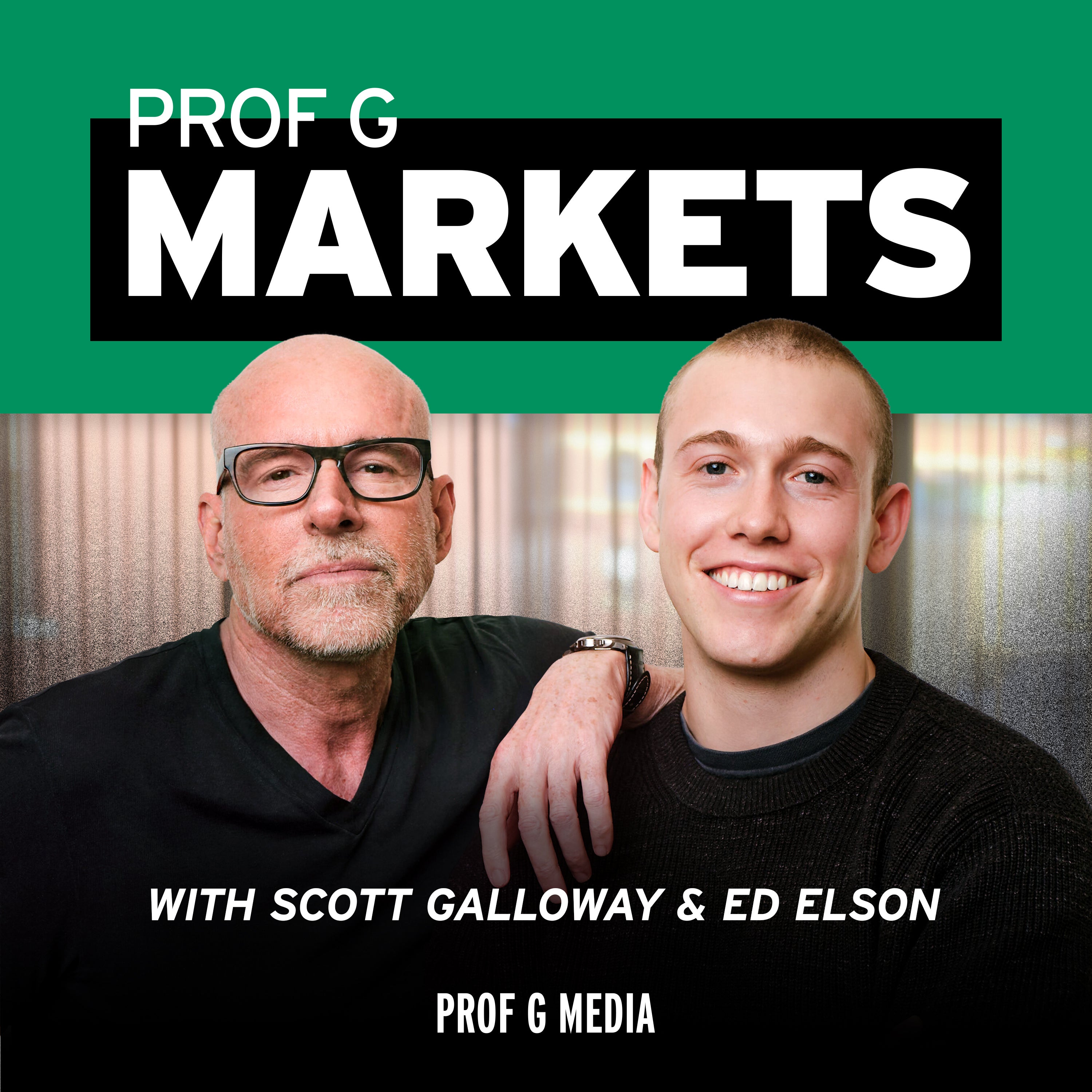
Ed Elson is joined by Steve Eisman to discuss why he thinks Anthropic and OpenAI are manufacturing a crisis. Steve explains why he wouldn’t invest in the Anthropic IPO and what he’ll be looking for when the S-1 finally drops. He also breaks down why he thinks high yields could result in a market correction, which company he is shorting, and what his investment strategy currently looks like.
Vote for Prof G Markets at the Signal Awards here
Subscribe to the Prof G Markets Youtube Channel
Check out our latest Prof G Markets newsletter
Follow Prof G Markets on Instagram
Follow Ed on Instagram, X and Substack
Follow Scott on Instagram
Send us your questions or comments by emailing [email protected]
Learn more about your ad choices. Visit podcastchoices.com/adchoices