
In short
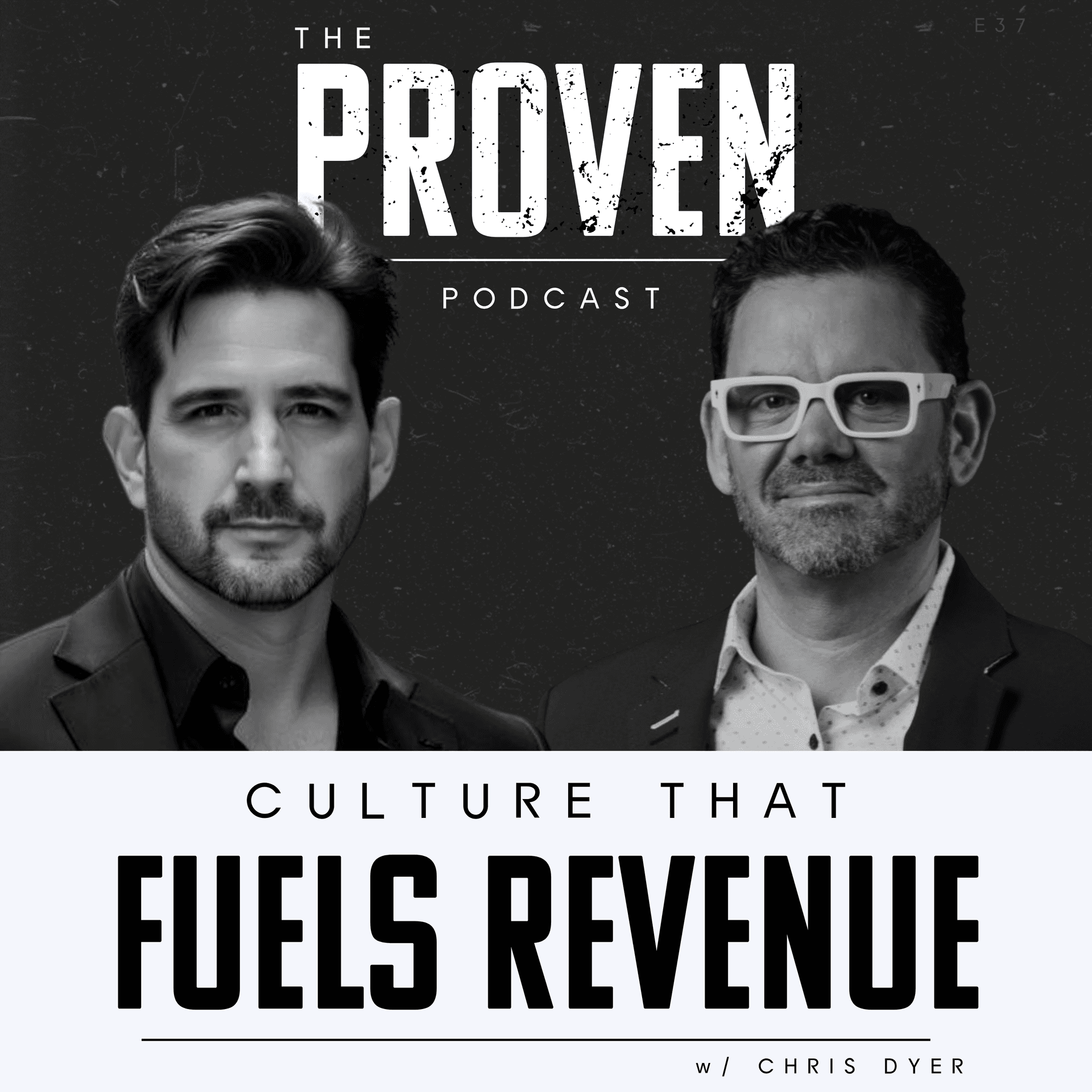
Proven Podcast Episode Summary: Culture That Fuels Revenue with Chris Dyer
Episode Overview In this episode of the Proven Podcast, host interviews Chris Dyer, who shares his transformative journey from a poor leader to a culture expert. Dyer discusses how leaders can create exceptional workplace cultures where employees thrive, emphasizing that culture is not merely about slogans or perks but about intentional leadership and alignment of values with actions.
Key Themes and Concepts
- The Importance of Company Culture
- Culture as a Science: Dyer emphasizes that culture isn't just a "touchy-feely" concept; it's grounded in scientific principles that can lead to improved performance and profitability.
- Common Mistakes:
- Leaders often assume their company culture is strong without verifying through evidence.
- Many neglect involving employees in shaping the culture, leading to a disconnect between stated values and actual practices.
- Employee Buy-In and Involvement
- Dyer argues that involving employees in defining shared values and goals is crucial for fostering a strong culture.
- Leaders should ask employees what they value and what a great company culture looks like to gain insights into their perspectives.
- The Seven Pillars of Culture Framework
Dyer introduces his Seven Pillars of Culture framework, which encompasses:
- Transparency: Sharing information openly to reduce anxiety and foster trust.
- Recognition: Celebrating employee achievements to boost morale and engagement.
- Positive Leadership: Creating environments where employees feel supported and encouraged to innovate.
- Uniqueness: Understanding and celebrating what makes individuals and the organization unique.
- Learning from Mistakes: Approaching errors as learning opportunities rather than occasions for blame.
- Measurement: Regularly assessing what matters to continuously improve culture.
- Listening: Actively seeking feedback and input from employees at all levels.
- Practical Strategies for Cultural Transformation
- Weekly Employee Surveys: Dyer advocates replacing outdated annual surveys with weekly one-question check-ins for real-time feedback.
- Radical Transparency: Sharing financial information with teams to foster trust and collaboration.
- Focus on Positivity: Encouraging a culture of curiosity about successes rather than just problems, thus fostering an atmosphere of learning and innovation.
Key Takeaways
- Transforming Culture Takes Time: Change doesn’t have to be radical; small, incremental steps can lead to significant improvements over time.
- Engagement is Essential: Employees must feel heard and valued for any cultural change to be effective.
- Resistance Can Be Beneficial: Those resistant to change can provide important institutional knowledge and help ground the organization in tradition.
Actionable Insights
- Leaders should initiate regular, informal conversations with employees to understand their perspectives on culture.
- Establish a recognition program to celebrate achievements at all levels within the organization.
- Implement a feedback mechanism that involves asking employees for their input on decisions that affect them.
Conclusion and Resources Chris Dyer's experience and framework provide a practical guide for leaders looking to enhance company culture. For more insights, listeners are encouraged to visit [Chris Dyer's website](https://chrisdyer.com) and check out his book, *The Power of Company Culture*, which details these concepts and offers case studies from various organizations.
Episode Timing Highlights
- 2:01 - Common Culture Mistakes
- 4:14 - Employee Buy-In
- 9:54 - Weekly Employee Surveys
- 14:39 - Seven Pillar Framework
- 19:57 - Sharing Financials with Teams
- 22:14 - Creating a Positive Environment
This episode not only highlights the importance of a strong company culture but also provides actionable strategies that leaders can implement to foster a thriving work environment.
Written by AI. May contain mistakes. Listen to the episode to check what was said.
Transcript
Automatic transcript. May contain errors.0:00Welcome to the Proven Podcast, where it does not matter what you think, only what you can prove. Everyone treats company culture like touchy-feely nonsense. Today's guest, Chris Dyer, proves culture is cold, hard science. The show starts now. Hi, everybody. Welcome back to the show. Chris, I'm ecstatic for you to be here with me. Thank you so much for joining. Hey, thanks for having me, man. Absolutely. So we were talking about a couple different things, about businesses and how to scale them. But one of the things you do better than everybody else is culture. So for the people who don't know you, which I can't imagine there's many that don't, for those who don't know you, can you give us a little bit of debrief on who you are and what you do better than everyone else?
0:34So I'm a serial entrepreneur who, you know, had a big company that I sold the end of 2021. And along the way, during my journey in managing thousands of people, I realized I was a crap boss and doing culture totally wrong and had to figure out what we were actually supposed to do. I thought I was doing it great. And then, you know, one day you look in the mirror and you're like, it's like saying, oh, I'm really healthy. And then you look in the mirror and you're fat, you know, and it's like, huh, I need to change. what I'm saying and what I'm doing are two different things. And so I realized I needed to change culture and, um, we did it.
1:12We did it really successfully. I worked with a lot of other big organizations to take it to them. And now I spend my time speaking and writing and, you know, helping companies make work, not suck for people. So, so when you go into that and people, Hey, I'm, I'm, I'm actually not as healthy. I am. I shouldn't probably be eating McDonald's and fast food. What are some of the things in culture that or there's the McDonald's fast food version of that. It's just catastrophic mistakes that people are making. Yeah, I mean, one of their really big mistakes that they make is that, first of all, believing they have good culture just because they say so, right?
1:46That's not how it works. You can't manifest a great culture. You can manifest many things in our lives, but I think you have to be far more intentional about culture. That's the first one. The second one is that they believe that if they just tell people that that is is enough right right we need people to be a part of this process it's great for the ceo or the senior leaders to create the vision and to to ultimately say people like us do things like this and don't do things like that um you know what was it google's theme used to be don't be evil right that was sort of like a baseline thing um but beyond that we need like our people to be a part of that process.
2:30And so usually companies leave them out. Right. Right. They completely ignore. They just say, this is what our culture is and you are lucky to be here. And that doesn't work. So a lot of that happens because of buy-in, right? And getting the people underneath your command or the people above your command, wherever you are in the chain, having that buy-in. Because simply writing down core values is not effective. So how do you, if you're going into this and you're starting to redesign your culture, What are some of the ways that you can get your employees or you get the people you work with in your culture to buy into everything that's going on?
3:03Well, first step is to ask them, ask them what they care about, ask them what they value, ask them, you know, when you do that, you start to pick up on themes and things that obviously overlap and connect. You're not going to get a hundred percent agreement on anything. But if you're saying, Hey, we really need to do X and you're asking your employees, well what do you think and they're generally saying x or mostly x i mean you're fine ways to connect the dots to make them see and understand that what you care about and what you want this company to be is ultimately aligned with what they're saying they want or you know sometimes you don't just ask what do you want like what do you think a great company culture looks like what is it in your mind if you know if we had the best culture in the world what does that look like what would we be doing and they ultimately will start telling you things that maybe they're not doing yet.
3:52Again, we can go back to the exercise. What's healthy? Well, healthy is I would be working out every day. I'd be eating good food. And you're like, we know you're not doing that right now. So, right. But you're getting that alignment on, we all agree what good looks like. And so we can start to work towards that. That's kind of a really good step one. Step two is there's this really interesting correlation between understanding and actually getting people to change. And so usually what leaders do is they just try to convince, convince, convince, and they try to push and beg, borrow, steal, yell, scream, whatever it is to get them to comply and to change.
4:38And all of that is a complete waste of time. All you need to do is to help people understand more and more and more about why it's important, why we're doing this, why it's good for them, why it's good for the company. Assuming it's a good idea, more understanding will result in more change and people being willing to do more of that. And eventually finding some people I call champions of change, people who are really love the idea and are really enthusiastic and will go carry, you know, will go out into the world with their virtual sword and shield and help you. Right. Do more of that. That's super important.
5:19And so we have to ask and then we have to really help inform people, not just once, but constantly. Right. Getting them to understanding. I think there's two things that people don't talk about is, you know, why is culture so important? and then why is it important to them individually because they don't have a good grasp of human behavior so first off why is culture so important and then we'll go into the second part well culture is how we get things done it's the norms it's the behaviors and so if you if we think about what's the most uh efficient what's the best way to get things done i think most people would say i want a collaborative company i want people who speak up i want people to give ideas i mean we talk about all these things we would want from people.
6:03And yet, if your culture is one where it's shut up and don't talk, don't speak out of turn, the senior leaders get to talk and you have to sit here and be quiet. You know, we don't we don't really care about ideas or, you know, if you give a good idea, the senior leader is going to steal it for their own. I mean, like there is what the reality of culture is. And then there's like what we think we want. And so culture is so important because we have, this has been studied. I could give people, I could send them a hundred studies right now if they wanted them that would, you know, we know that when you have a great culture, you have higher profits.
6:40We know when you have a great culture, you have higher performance. And we know when you have a great culture, you have higher productivity. Tell, give me the senior leader, give me the business owner who doesn't care about those three things. Right. Right. And I think that goes to the human needs, right? Because if we go in and say, hey, yes, I'm going to sell you this and it's going to feel foo-foo in its culture, they're probably not going to listen to it now. If you go down to a C-level individual or senior leader and say, listen, this is going to increase productivity. It's going to make your life easier.
7:09It's going to increase profits and everything's going to be more efficient. Whenever rolling out culture, they're like, oh wait, okay, now I want to pay attention to it. Maybe I do want to listen to Susie in the mailroom or I want to listen to Bobby the janitor or whatever it is. maybe I do actually want to hear their voice because at the end of the day, it's a win for me. And a lot of people don't understand that on a human needs level. So when it goes into this and you are evaluating this and you're talking to each individual employee and you're having these conversations and you go and you work with your clients, how much does human needs play into it, understanding where they go from?
7:40And then also what are the things that you've used to kind of amplify that when you discover their needs? Well, their needs are everything. Everyone is always out to figure out what's in it for them. I mean, people are only working for you essentially because they want fulfillment. They want to feel like they're part of something great, but they also need the money. They need to feed their families and all of that. So there's this basic contract in the beginning that I'm here because I need something from you, business owner, as the employee. Now, I'm here and I would much rather enjoy my time here.
8:15I'd much rather feel fulfilled and to do something meaningful with this work or else I could just go work at the local burger place and flip burgers and just not care. Right. And so there is that shift there. We need to think about they're not just showing up altruistically. That may happen in a volunteer organization, but we're talking about work. Right. That is huge. So what have we done? I used to send out a one question survey to all of my employees every single week. We ditched the annual survey, which I think is dumb and stupid. And if you're doing it, you probably belong back in the 1940s.
8:59It doesn't work. It never really worked, but it definitely doesn't work today. Instead, ask people one question every week. What's going great? Where are you struggling? Who's killing it for you? What client's driving you crazy? What resource don't you have? If you had a magic wand, what would you fix? What would you change in our software? You start asking people these things and they start sharing with you and you get great ideas, you get great insight on what they're dealing with, what's happening in their lives. And then, before you ask the next question the next week, you come back to them as their boss and say, this is what I heard and this is what I'm going to do about it.
9:36And at the end of the month, I would say these were the four questions or five questions we asked this month. Again, this is what I heard. Again, this is the update in progress and what we've done about it. And sometimes it was something good. You all said that Steve was the best employee ever this month. He's been helping everybody out. Like we, we sent, you know, Steve to go get a massage and gave him a day off. Like we did something cool for him. Or you're all telling me this one client is killing you. They are half of our tickets. They call constantly. They're driving you nuts. We've already interacted, you know, call conversations with them to figure out how we can better service them without them filling up our, you know, resources away.
10:17So like, and then they feel heard and we're actually solving their problems and we're making work better for them. Right. That's how you do it. Cause you mentioned, you know, Bob in the, Bob, the janitor or Susie in the mail room, like what's the mechanism to actually hear from them? Because you may not ever actually, as the senior leader, you may, you may never cross paths with that person. And so how do you extrapolate that knowledge and data and things from them, sometimes directly, sometimes through their bosses or their leadership in between you to actually enact change. There's a great study on this that says if you pay someone a certain amount of money, their happiness goes up.
10:58But sooner or later, you're going to pay so much money that that happiness correlation, that ramp, that incline just doesn't happen anymore. And I think the same thing happens with employees as well. At some point, they need to be seen that they have some sort of control of their destiny. there needs to be some sort of studies about this as you mentioned before tons of these where they need to feel like hey i'm not just coming in and punching a clock and sure you're paying me great money but that's that's not going to increase efficiency that's not going to increase the bottom line that's not going to increase productivity they have to feel like they're heard and i think for so many people they fail to do this across the board in relationships or in business or just across the board if the person doesn't seen isn't seen doesn't feel heard or doesn't say appreciated, it's important.
11:41And I think one of the things you said that was vital is if Susie, whoever it is, comes in and says, Hey, this client's an issue, I'm having problems and you don't immediately address it that week before you ask another question, her chances of speaking up again are now diminished, just like in a regular relationship. If your partner says, Hey, I really don't like it when you don't put the toilet seat down and you go, okay, great. And then you don't put the toilet seat down, probably going to have some issues because that person doesn't seem seen and heard, which by the way, completely side note, it's never about the toilet seat.
12:13It's always about being seen and heard and appreciated. It's never about the toilet seat. So for those of you listening, if the missus or anyone else is complaining about the toilet seat, you're screwing up somewhere else. I'm just saying, it is what it is. So when people go into this and you meet with cultures and you meet with senior leaders and they're like, okay, our cultures, or we're not productivity. We're not having any productivity. We want to increase our bottom line. We want to increase revenue. you have this weird culture thing you're talking about. And sure, it's backed by tons of science.
12:39How do you get them to buy in? Because that's a hard part. Because even if you have tons of science, like, hey, guess what? The earth isn't flat. There's still people you have to get them to kind of pivot over on that one. How do you get senior leaders to kind of come to you and say, hey, culture is important. This matters. Let's talk about it. How do you get that buy in from them? Yeah. I mean, they usually come to me for one of two reasons. One, they've got a giant headache. So they're looking for an aspirin, right? So that's one kind of client. And we have one approach for them. And then the other kind of client is like, listen, I know we're doing well, but I want to be next level.
13:10And so they're looking for a vitamin. They're looking for what are the activities and things I can do to continue to be healthy and sustain this growth or this company, whatever it is, for the long term. So the answer for both is I have a seven-pillar framework. And there are, we've proven that there are these seven things that if you do them well, you can have a great culture. In fact, you probably will have a great culture and you can move towards being a market leader. A lot of good cultures and good companies do some of these pillars well, but you have to do all seven in order to be great.
13:50So usually what I do is we look at the seven. I talk to them about the seven. And they begin to self-identify where they feel like they're doing well. That's really important. Where are we doing well? Because we don't want to stop doing that. And then where are we doing okay? And ultimately, where is this like, you heard me say that and you were like, uncomfortable in your seat. You're like, I know that is not what we're doing well. And then the struggle is they've got to go and fix the one that's the worst. that has to be the first thing we do. So what are the seven pillars when you talk about that?
14:26There's seven pillars of, of culture. What are the seven pillars? Sure. So in no particular order, uh, but I always say this one first. Um, but transparency is pillar one, positive leadership, positive, uh, having positivity in the organization is number two. Uh, then we have uniqueness, which is celebrating what makes us unique, understanding our unique value proposition. So it's people and D and I, and it's marketing, and it's like, you know, but uniqueness is a really important one. Then we have how you deal with mistakes. You know, are you yellers and screamers or are you, hey, let's learn from this.
15:07Let's figure out how we get better. Let's innovate. Measurement, measuring what matters, listening, and then finally recognition. So you have to have a great recognition program in your company in order to be great. So those are the seven. I can tell you which ones people typically are terrible at, but it's not universal. Like I've gone into companies and like, you guys do all these great things, but you don't have a recognition program. Like what do you, what? And it's amazing how small it's, and people don't understand how important recognition is. In military operations, if I give you a little metal thing on your chest, you're willing to go get shot for it.
15:42And people are like, wait, really? That's it? I'm like, yeah. If I give you this little stupid metal, you're going to willing to lose a limb. Recognition is huge in the human psyche. It just, it is what it is. Now I'm surprised that you said, you know, when you handle problems, the answer isn't just to yell and scream and punch people. That doesn't work? That's not how you deal with it? Dang it, I just thought. Might make you feel better, but it doesn't actually work. It's the end of your business really, really quickly. And what I love about this is, you know, people are going to listen to this and they're going to be like, oh my God, that's so foo-foo.
16:11That's so this, that's that. I'm like, okay, cool. Here's the science. Go look at the science and come back to me after you shut the up. It's just because this is a science. This is what works. Yeah, culture is a science. It is not an art. Yeah, this is, absolutely. And it's measurable. And there's, again, that's why, like, you have seven pillars. You didn't just invent these because you were bored one day. These are what science of personas do. So what are the ones that most people get? Like, they're like, okay, we're pretty decent on this. And then what are the ones that people just universally, they just screw up.
16:41Just like, wow, you're just, wow, okay. Right. Usually people have some mechanism for listening and usually they're OK at listening, but they don't they could do better. Right. We could we could do a question a week versus doing the annual survey. We could, you know, be serving our clients more often than what we're doing now. I mean, there's usually some way they could get better, but they tend to be doing something. It's pretty rare for people to be doing nothing. I think the one they struggle with the most that when we start talking about what transparency really means people get uncomfortable and they're like oh I don't know if we can do that and yet I would say when we got radically transparent with my organization and everyone I've ever consulted with or ever had getting radically transparent has made all the difference in the world because when I know a part of a story and then that part of that story worries me or puts me in a fear mode, I immediately will make up the rest of the story.
17:44I will fill in the gaps. And what do I fill in the gaps with? What I know from history. What I know it's happening in the news. What I know from my own previous negative experiences. All the negative stuff I know, my brain will go up. So today my boss, Bob came in and he didn't look at me and he didn't talk to me. And he's been a little weird the last week. And I know our numbers are down. I must be getting fired. I must be getting late. Like immediately, like you go to this crazy place. Yeah. Right. Instead, if we're radically transparent and my boss shows up and says, here's our P &L. Here's what's happening.
18:23Here's what we're doing about it. Right. Here's our plan. oh okay now my anxiety level goes down and i can begin to help immediately ah okay you want to do this thing you think that's going to help us save the business i can help you do that like i can go and do right so showing up with our pnls every month is something i highly encourage companies to do delivering the detailed part of the pnl that makes sense to different business units so they can really get dialed in into costs, understanding where synergies can happen, where we can merge vendors or figure out ways to save money. When we did this within a year, we had saved 35 % on our total operating expenses without me ever telling anyone you had to cut anything.
19:09We're doing a cost thing. We didn't lay anybody off. I just said, here's our stuff. right anyone has any thoughts has ideas i'm here talk to your boss talk to me and people started saying hey i didn't know we spent money on did you know we could do this instead right like they they understood and therefore they could come up with better ideas because they were closer to it but not only that they were bought into it they're like hey this is what's going on there's this there's this great video where it shows there's a there's a woman sitting with a shrink and she's like you know i i know he's cheating on me 100 he's cheating on me he goes and he disappears is in the garage and he's on the phone.
19:47Then he crawls into bed. He doesn't talk to me. He's clearly cheating on me. My husband is an SOB. And then, okay. And then the husband comes in the room and said, Hey, what's going on? I said, you know what? I have been on these phone calls trying to find this missing part from my motorcycle. And I keep calling people and I keep calling people and I can't find this missing part from my motorcycle. So it's that fiddling in the blank of the story. We go to our lowest, we go to our worst side of us, which is the fear and the anxiety and the doubt versus, Hey, this is what's going on. And if the employees and the people with you that are working on this are bought into it, and that's part of your culture, if they're bought in, they're like, Oh wait, you're using this.
20:24That doesn't make any sense. You should be doing this. And it's, it happens even on an IT level. When I used to run IT, I would sit there and I'd show them like, okay, what are you guys spending on email? I'm like, that's what we're spending in house. You do realize for like$3 a mailbox, we could cut our costs by a bazillion dollars like really yes so okay so that's transparency right what are the what's the next one because you know you you've done it really well but dividing this up and i again i get it you didn't invent these this is science love it thank you for using things that are proven what is number two that people run into that you have found that like you know what this is this is where you guys mess up on i wish you guys would do better yeah i i think they struggle with the positivity part.
21:05So being a positive leader, creating positivity in the organization. Now, I know there's someone out there right now who thinks I'm talking about toxic positivity, and I am not. I'm not talking about showing up and saying everything is great. No, it is a mind shift to do two things. One, if we create positive environments, We create environments where people feel supported. They feel like their ideas are being validated. They're being heard, whatever. They can be innovative. But we know it is impossible for a group of people to innovate if they are literally in this thing and they feel threatened and they feel like their things are negative.
21:45I mean, you can survive, but it's really hard to get innovative. So we want innovation to occur. We have to create these environments where people feel like they can succeed. but more importantly we want to remove this sort of like badge of honor of i'm a problem solver right because that means you're ultimately walking around the office looking for problems to solve instead you should be really curious and walking around the office or talking to people whatever your environment looks like and trying to find what's working and getting curious about why why does Susie get her work done in half the time as Bob?
22:29Why is Susie twice as efficient as Bob? They're both about the same thing. And why does Jason outsell everybody else? Why is he the only person who made his quota this quarter? You should be getting curious about that and go and talk to Jason and try to help figure out what is it that Jason's doing? and can Jason take any of that and share it with the rest of the team and not me saying, oh, well, clearly Jason makes 200 phone calls and then I go to everyone and say, you have to make 200 phone calls a day. No, do not do that. That is dumb. What you need to do is like, okay, well, Jason, clearly making a lot of calls is working for you and can you go back and teach the team about what your strategy is, why you do that many calls and then people can take from that what they think will work for them right right because one size fits one one right well that works for one person may not work for somebody else and and when somebody else teaches you how to do something better like your your your peer your co-worker you're like oh that's cool i want to try that that's interesting when your boss says hey jason does 200 phone calls and now you need to make 200 call you're like screw you dude i'm looking for a new job like this is not it's a competitive between you and jason right you're now in a resistance mode right as opposed to i'm cooperative i'm walking alongside jason he's telling me what he's doing and i'm going that's cool buddy high five i'm gonna go try that versus your boss coming in now we're both pushing up against each other we're resisting each other right and i'm saying you need to start making 200 phone calls you're like i'm not ever making 200 phone calls that's ridiculous that's not how i sell right we tell this with kids we're like you know go brush your teeth and they resist okay you win which one do you want to do first You can either brush your teeth or you can, you can go to the bathroom.
24:19I don't care. You win. And then I go, I'm going to go to the bathroom first, or I'm going to take a bathroom before I do it. So it's, it's simple human behavior. And we sit there and what we, I love how you talk about looking at what matters. And we talked about this where they did a study where they changed the lights in a factory. They're like, it's not going to increase productivity. And they lowered the lights and productivity went up. Well, maybe if we increase the lights, productivity will change as well. Maybe it'll go down. They, they increased the lights and productivity went up even again.
24:43They're like, what the hell? And so then they turned all the lights off and productivity went up again. and they're like, what the hell? It's like, what you're monitoring matters. They realized that this was matter and they realized that this was going on. So if you have the opportunity to monitor something that's positive and encourage, again, culture that they share with each other and they help each other. I love that you talked about that, that you went after looking at the work. And so out of that study, it always reminds me of this really simple saying that I remind leaders of all the time.
25:10What you focus on grows. Yes. They were focused on productivity in that particular plan. and looking at that. And guess what? Even though they didn't really do anything monumental, they made some changes to the lights as an interesting correlation. But everyone knew they were being studied, they were being looked at, and the focus was on them and on productivity and that grew. To your point, focus on what's not a problem solver, but what's working. So focus on, as you said, really articulating, focus on, hey, this is working. This is what I'm going to start focusing on and then having them share it as a unit.
25:44And I think when most people think, hey be a positive person they're going to think like hi everything's wonderful it's like no that's not what we're talking about this isn't foo-foo this is science this is what this is what works what are the um what is the one that no one gets like you go into every every one of your organizations and there's like oh wow they just totally moses every single time what is the one that they people collectively fail you know uniqueness is hard for people to get um and and And so uniqueness, again, goes in a couple different ways. On the business side, uniqueness is what is our value proposition?
Read the full transcript
26:20What are our features and benefits? How is it we do our product or service differently than our competitors? I mean, really good companies get that right so that they can market correctly. It's amazing how many fairly successful companies don't figure that out to the point where they could be market leaders by just articulating, right? i mean this may piss some people off but is the iphone that much better than like the samsung galaxy or what i mean you look at the top phones are they that much no but but apple's marketing is amazingly better yes at articulating culture right and it then built culture exactly remember i remember the commercials i mean you might not be older old enough for this but they used to have commercials like i'm a mac i'm a pc and there was this whole thing like oh i don't want to be a PC.
27:06PCs are dorks and they're losers and oh, it's gross. They built it a whole identity around it. It's kind of like if you go into the motorcycle world, there are significantly better motorcycles than Harley Davidson's. Sorry, guys, I've been riding for years. There are motorcycles that are just light years better than Harley's, but I'm not going to go be on one of those bikes because it's not a Harley and it's so moronic, but it's built in that uniqueness that you're talking about. Yeah, that culture and the uniqueness. And so, you know, that's one part of it, but the uniqueness pillar also goes into what makes our people unique because often what we do is we say well what makes us all the same they all show up in a meeting and it's like oh well we all what we all like the bears or we all like the angels i don't whatever it's like whatever stupid thing we're trying to find commonalities all the time to create connection and instead we need to get really interested about what makes us all different and what are the different qualities What are the different skills?
28:00What are the different abilities that we can bring to the organization? And so I don't really care that you and I maybe both are really good, let's say, writers, right? I want to know what is it that you can do that I can't do so that you can help me when I need it. And I can tell you what I'm really good at. So I can help you when you need it, right? There's an area that you just aren't that strong in. So for teammates, us really understanding what makes us unique is important. And that creates diversity of thought. And that will, and this has become very politicized more lately, and certainly some changes happening.
28:37If you really want to have a diverse workforce, whatever that means to you, whether that's diversity of thought, diversity in how people look or who they are, the way to do that is to celebrate what makes people unique. Because if you are ultimately reinforcing this idea that we care about, you know, Tom is the most amazing salesperson. let's go find five more toms well toms you know let's just say toms you know whatever his demographics are but he's from this particular school and he's from this particular part of the country and you end up hiring like five versions of tom that doesn't mean you're going to be successful i mean my top five sales people could not have looked acted spoke differently worked completely different approached sales completely differently and that was a huge value to us because one did all their sales on the golf course and the other one was like way into partnerships and the other one like made 500 phone calls a day and we just burnt you know knew everybody like having that skill set in many different people was very very valuable so i kind of find that people get this like a little mixed up sometimes um in the book i'll i can tell you a quick story if you want an example of how to do this um we had everyone in the company take the strengths finders the gallup strengths finders test you get your top five strengths i think that's all you need you don't need the other sorry gallup i don't think you need to pay the extra money for the other 34 or 37 or whatever it is you need the top five yeah and we asked everyone to take it we took their top five and i put them out on just because i i was curious and we put them all the strengths up top and we put all their names down this side on an excel sheet and then we just filled in the box wherever they had strengths and what was fascinating was we had so many people with overlapping strengths I mean my entire operation and research team all had responsibility in their top five which makes a lot of sense because they have to be responsible they were doing work that was really really important and if they were irresponsible people, like sex offenders get jobs at daycares and stuff.
30:48I mean, it was like they had to be that kind of type of person. But what was also interesting to me was we had all of these gaps. We had, I think, something like 12 or 14 strengths that we had nobody. Talking thousands of people, I have nobody. That's terrifying. With these strengths. And I was like, that's a problem. Yeah. For us. Right. And we had been trying to reach some particular goals with diversity to, you know, to create more diversity in the organization. And we had hit a ceiling. We kind of hit, hadn't really gotten any better. We didn't really know what to do. We were certainly committed to it, but like, you know, we didn't know what to do.
31:32so i just said this at the top you know pull this out of my butt i was like hey guys um the next time you you're gonna hire somebody i'm not gonna take a final interview and i will not hire them unless one of their top five strengths includes one that we don't have right now yes that's it that was my only requirement and it's a and it's a game changer it's kind of like saying hey we have a thousand eggs in our fridge, go to the store and buy more eggs. That's not going to make the damn cake. It's not diversity based on geographic or, or, or belief race or gender or sexual preference. Nothing. I just, I just said, yeah, give me people who don't, who are different than the people we have now.
32:18Like just by one strength, they can have the other four that are the same. So they're going to connect still with the organization and the people I started getting at the interviews and I gave no other instructions. The people were acted different. They spoke different. They had different backgrounds. They looked different, right? They talked different. Everything was different about them in a wonderfully positive way. And the organization just, and it was like a snowball. As soon as we suddenly had this new injection of fresh ideas and different perspectives, we never had to think about diversity again because we were now already, it was just going.
33:00It was like the momentum was there, right? And we weren't trying to solve all of society's ills inside of our organization. We were just trying to get people there that could think differently and have different perspectives so that we could argue more in a very collaborative and constructive way about how to solve real life issues. I don't think people are doing that. I don't think because they get stopped at the political side of this, which is just not the conversation we're having at all. It's a bit like going to go get sushi and then people are arguing about what we're going to get for dessert.
33:31It's not what we're talking about here. We're talking about sushi in this case. We're talking about skill sets. We're talking about how it helps out the culture. And I love that you brought in for your people underneath your command that you were working with. You're like, hey, this is all I want. You decide everything else. I'm empowering you to do that. So again, you're going back to the idea that they have control. They've got influence. They're deciding not only who's going to be in their org, but the people they're going to be working with every single day. It's like, I only just want to, this is my one requirement.
33:58You didn't get in their face about anything else, because if not, you just get a wall of the same thing and that's not going to create different, different results. You mentioned your book. What's the name of the book? The book, my most recent book is called the power of company culture. That's the second edition. and it's filled with, it's really a three-part book. Part one is like, what do you got to do not to suck? Like, what's the bare minimum you got to do to have a company culture, right? And then the middle is, how do you be great? And that gives you a breakdown of those seven pillars. And I've got case studies with NASA, Neiman Marcus, Gary Vanderchuck's company, lots of different organizations in there to be able to help give good examples, It's not just my company, it's not just my experiences, but, you know, what are they doing with those particular pillars?
34:47It's really interesting. And then the third part is, and this is, I think, really interesting for anybody on any topic, culture aside. Third part is, like, how do you actually do change? So it's my little mini guidebook of, you know, change management. So if you have a big change management issue and right now your culture is fine, you could literally buy the book and just open up the last third. And that's going to give you the framework on how to get people to change and not drag their feet and make it harder on you to really create that momentum you need to create. You mentioned some case studies in there, you know, Nina's Neiman Marcus.
35:25I'm so used to saying Needless Markup, but Neiman Marcus, and you have all these ones. What is it? What is a case study that didn't make the book that you're like, yeah, I haven't told the story. I want to tell this one because this would be something that the audience were like, okay, yeah, okay, that's cool. So what is one that isn't in the book as well? I was going to do a case study on Uber because they really screwed up diversity. Okay. How so? They had a lot of problems for a while. Now, they ended up riding that ship and they brought in some really key people to help them deal with this.
35:55But, I mean, they had a young boys club, essentially, right? They had sort of this, like, tech bro thing going on for a period of time. and they had some real problems and they had some lawsuits and they had some real, you know, legitimate concerns for people that didn't fit that, you know, this was years ago. And I remember like, I remember people like wouldn't drive with Uber. They would only drive with Lyft because they had heard about some of these real problems. I had kind of wanted to do a case study on them on like how that, what was going on with that. I, I, I, you know, shockingly, I couldn't get them to, to want to really talk about, they had done some real, I wanted to kind of show what their growth had been and show like what they had done to try to right that ship um they weren't interested in um i guess bring some of that because they'd kind of gotten over that pr hump i think so i think that would have been really really interesting to have learned and see what they learned and what they had actually ended up doing um i understand they didn't want to you know open open up the scab you know peel the scab away and re-injure the wound i think my favorite example of how you have to listen to everybody that goes through because you can't just have all the tech bros is when they did there's so there's a great movie it's called zero dark hundred it's about when they went after bin laden and they got that and they're they're they're going and they're doing the mock-ups and they've done this a bunch of times and the lowest seal that was on command it goes well what happens if the helicopter crashes they're like what do you mean they're like this helicopter's never crashed on any mission ever they're like yeah but what happens if it does.
37:29I don't know. You guys asked for something outside the box and they were like, okay, it's never going to happen. You know what? The rules are, we're going to have to role play. What do we do? How to prepare for it? And they adjusted how much C4 they brought and they did all this. And of course, sure enough, you know, they went in and they put the helicopter above it and that created a wind tunnel because of the walls and smashed it immediately right down on it. And it's amazing that this, the youngest seal, the most inexperienced brought it up and he was like, I don't know. What about this? So being able to your point, having those, those, those things, There's diversifications in there to get that.
37:59When you're talking about change and you're talking about serious change, how do people do that? Because again, I think most people know at this point, if you haven't at this point, you already know that, hey, you're screwing up and I haven't even touched the seven pillars. I think most people have listened to this one and listened to what you've done and going, well, shit, I need to change some ballgames. And then they get the rough idea of a seven pillars. But change is hard. You know, we're experiencing that collectively as a society right now. Some things are changing in one way that doesn't resonate with people.
38:27And some things are changing in ways that we wish it would resonate with people. It's about as political as I'm going to get on this call. So when you go into this and you're trying to implement change, what are the things that actually are sustainable when you're trying to implement change? Well, is it good change? That's number one. Right. So is it a good idea? This is always my terrible example. But if I came to you and said, hey, we should start selling meth. Right. no matter how much I try to get you to change your mind, and you're like, listen, Chris, I'm not getting into the meth business.
39:01No, thank you. I'm like, but listen, we can make a lot of money. I'm not much, I convince you, you're going to be like, no. Because if it's a bad idea, you're going to get resistance no matter what you do. So that's kind of like the first litmus test of like, is it a good idea? And are you certain that the change and the thing that you want to do is the right decision and it is a good idea and is good for everyone that's involved in all of that. Right. So that's like given baseline. And then we talked about a little bit earlier, helping people understand, deeply understand. So if I open a door and it's totally pitch dark in there and I'm a stranger, you don't know me, and you're happy to be walking past.
39:44I say, oh, excuse me, can you walk in that room? You're going to be like, hell to the no. Right. Because I don't know who you are. I don't know what's in there. I mean, it could be a million dollars. It could also be, you know, a monster that's going to eat you. Like, I don't know anything. My answer should be no. And that is the answer at work. I don't understand what you want me to do. I don't understand what is this. I don't. What is this? No, that's my that's my baseline is no. So I help you understand a little bit. Now you're aware. Hey, can you help me find the light switch in this room?
40:19I can't find it. I don't. I forgot my glasses. I can't. And now all of a sudden you have a little information. Oh, you're asking me for help. Well, I can reach my hand in there and probably find the switch without being in real danger. Right. So now I've given you a little information. Now you're willing to do a little bit more. Right. Now it's, hey, I need to find the light switch. I don't have my glasses. I, my, my grandson is lost in this room. Right. I need it. Now all of a sudden. It's a different conversation. Right. Now. So you're getting more and more and more information. I'm asking you to do this thing that might be weird or scary, but like, and so the more you move up that ladder of that X, you know, Y axis, anyway, whatever it is, the X axis, Y up the axis, um, I suddenly blanked on my X and Y's and forgotten all my geometry.
41:03um the as you go up the x axis the which is more and more understanding and more and more training more and more of them deeply getting it and some people are going to stop at they get it some people are going to go all the way up to like expert level they want to know everything right some people understand what chat gpt is and how to prompt it some people are using it to like deeply program and go like there's a spectrum of what people understand about that but as they go up then and again it has to be a good idea they begin to move along that y-axis to i'm gonna i'm gonna do something i will change i will help you get other people to change i will be a champion of change i will reinforce and like literally help you find the people that are do that so that that's sort of one tactic that leaders can take.
42:00The second tactic is I realized when we were going through this change that I had a group of people that were my champions of change that wanted to change. They were good to go. And everyone was like trying to convince the people in the middle to change, to go along with this, to why it was good for them. And I kind of was like, you know what? I don't think we need to worry about the middle group. And I've, I've actually seen this work over and over and over again. The middle group essentially gets pushed by the bottom group and the middle group actually ends up pulling the bottom group. So, and the, and the, and the, the champions of change kind of pull everyone along too.
42:47So I got the champions, the people who really got it to go and have lunch and go have coffee and go have side conversations with the people who were like, no, I don't like change. I don't want to do this. I used to call them the flip phone crowd, like the people who had those old flip phones. Remember, like the buttons were falling off and there was no way they were going to go to an iPhone. They were never going to give that thing up until finally like a broken. There was no more warranty. And they finally had to go to the Steve Jobs mafia. Right. Right. So like. But when I got those people that really got it to have these like converse peer conversations about what are you worried about?
43:27What's going on? What are you what are you fearful about? You know, let me tell you what I think is going to happen. Like, I know Chris has got all these crazy ideas, but like, I actually think these are good ideas. And let me tell you why. As your co-worker, as your peer. Right. I'm not telling you how to do it, but I think this is going to work. I think this is great. I think we're going to end up being happier. and when those people were like oh okay then they just started pushing the middle people forward because you if you're in the middle and you're like well i'll go along with what everybody else is doing it that's if that's your job as the middle that's really intuitively who you are and and and steve who like doesn't ever do any change is suddenly going yeah i'll do that and you're like oh well i guess it must be an amazing idea steve's on right so that you say steve i've got an uncle Steve who literally has a flip phone and his flip phone literally just died.
44:20And I was like, I'll send you a smartphone. I've got extra iPhones. I will send it to you. He's like, no, I just bought a new flip phone. I was like, mother Christ. Shout out to my uncle Stevie. We love you, but dear God, man. So, okay. So actually with that in mind, what do you do when you have those people like, no, I'm not changing. That's adorable. I'm still going to use a dot matrix. I'm going to use an abacus. I don't care if you give me a calculator. It ain't happening. How do you deal with that in a culture or is that toxic to that well i mean listen sometimes having people who are resistant to change is a good thing they help protect us they help us from running you know off a cliff because we see some shiny object and we want to run after it i mean we need these people in our lives too for for different reasons they usually hold institutional knowledge they help ground us in tradition.
45:13And so those people aren't all bad. It's just that when we find a good idea and we need them to come along, we want them to be a part of that journey. We've just got to figure out how to, you know, put it in their terms and help them so that they're not fearful and so that they understand why it's important and they ultimately decide it's good for them too to come along. I think there's so much in culture that we just don't understand and that we're slow to get into it and we're finally getting beyond the woo-woo. But there's so much more that needs to do that. So there's so many more conversations.
45:44There's so many more questions that I want to ask, but it means you'll be here for another seven hours, which would not be fair to you. What is the best way for people to track you down? What is the best way for people to connect with you? You mentioned your book. What is the best way that someone said, hey, listen, my culture shot and I don't want to do this for foo-foo reasons. I want to do this to increase productivity. I want to do this to increase efficiency and increase ultimately my bottom line so I can do that? If I'm trying to build a bulletproof culture that's built on the seven peers, how do I do that?
46:12How do they, someone get ahold of you to actually implement those things? First, if you are in the U S and you want to text three, three, seven, seven, seven, and just put my name, Chris is the message. I'll send you off, uh, some ideas about how to change your meetings. I'll send you 25 starter questions for that one question survey a week, and that'll get you on my newsletter. So you can, you know, get additional content. Um, as of the 16th here today in January. TikTok is still up and running. I'm on TikTok. I do lots of content there, but I also do it on Instagram Reels, YouTube. Happy to connect on LinkedIn.
46:45You can also go to my website, chrisdyer.com. But wherever you hang out on social media, I'm probably there if you want to connect. And then there's lots of stuff you can digest. Certainly, my book is really set up to be not woo-woo and not foofy. And it's meant to be really, this is how you actually do it. And it comes from me having to go through that myself and all of the other people that I've been able to learn from along the way that I know have had to go through that same journey. So the good news is you can make small incremental changes. You don't have to make a radical change tomorrow.
47:25Working on your culture doesn't mean, you know, we go back to this health example. It doesn't mean you have to start starving yourself. It doesn't mean you have to go through this painful thing. You can start doing small incremental things a little bit at a time that will, over time, have a huge, huge impact on your company, on your bottom line, on your happiness as a leader, and the happiness of your people. And I love everything is based on what's been proven. These aren't things that are made up. These are things that not only you've experienced, but science backs it. And you've also done it with all of your clients.
47:59Chris, I appreciate you for being on the show and for being able to give out and have people get access to it and write a book and spend the time with us. I really appreciate you being here. Thanks so much for having me. Stop theorizing about what might work and start measuring what actually does. Chris, just preach about culture. He transformed his own company, saved 35 % on operating expenses, and built a repeatable system that works.
From the publisher
Chris Dyer joins this episode to share his transformative journey from a self-proclaimed "crap boss" to a renowned expert in building exceptional company cultures. With decades of experience leading teams and consulting for top organizations, Chris offers invaluable insights for leaders looking to create workplaces where employees thrive.
Through candid stories and research-backed strategies, Chris reveals the pitfalls that leaders often face when trying to improve culture and provides actionable solutions to foster collaboration, innovation, and engagement. He explains why culture isn't just about slogans or perks but about intentional leadership and aligning organizational values with daily actions.
Chris breaks down his Seven Pillars of Culture framework, detailing how transparency, recognition, and positive leadership can turn any workplace into a powerhouse of productivity and growth. His no-nonsense approach demystifies the process of cultural transformation, empowering leaders to address challenges and drive lasting change.
Whether you're a leader looking to turn around your company's culture or an entrepreneur aiming to build a thriving organization from the ground up, this episode is packed with actionable takeaways. Chris's practical wisdom and relatable delivery will inspire you to rethink your approach to leadership and culture.
Key Takeaways:
* The Seven Pillars of Culture and how to implement them effectively.
* Why transparency is a game-changer for engagement and performance.
* How to cultivate buy-in from employees at every level.
* Real-world examples of turning culture into a competitive advantage.
Head over to https://provenpodcast.com/ to download your exclusive companion guide, designed to guide you step-by-step in implementing the strategies revealed in this episode.
KEY POINTS:
2:01 - Common Culture Mistakes: Chris explains the most frequent culture-related errors leaders make, including assuming culture is strong without evidence and neglecting to align actions with values.
4:14 - Employee Buy-In: Chris discusses the critical role of involving employees in shaping culture, highlighting strategies to engage them in defining shared values and goals.
9:54 - Weekly Employee Surveys: Chris introduces the concept of replacing outdated annual surveys with weekly one-question check-ins to gain real-time insights and foster a culture of continuous feedback.
14:39 - Seven Pillar Framework: Chris breaks down his Seven Pillars of Culture framework, detailing how transparency, recognition, and positivity can transform organizational culture into a competitive advantage.
17:03 - The Power of Recognition: Chris emphasizes the profound psychological impact of recognition in the workplace, showcasing how celebrating achievements boosts morale and engagement.
19:57 - Sharing Financials with Teams: Chris outlines how radical transparency in sharing financial performance with employees can reduce anxiety, foster trust, and encourage collaborative problem-solving.
22:14 - Creating a Positive Environment: Chris explains why positivity is essential for innovation and productivity, debunking myths about "toxic positivity" and showing how supportive workplaces drive success.