
In short
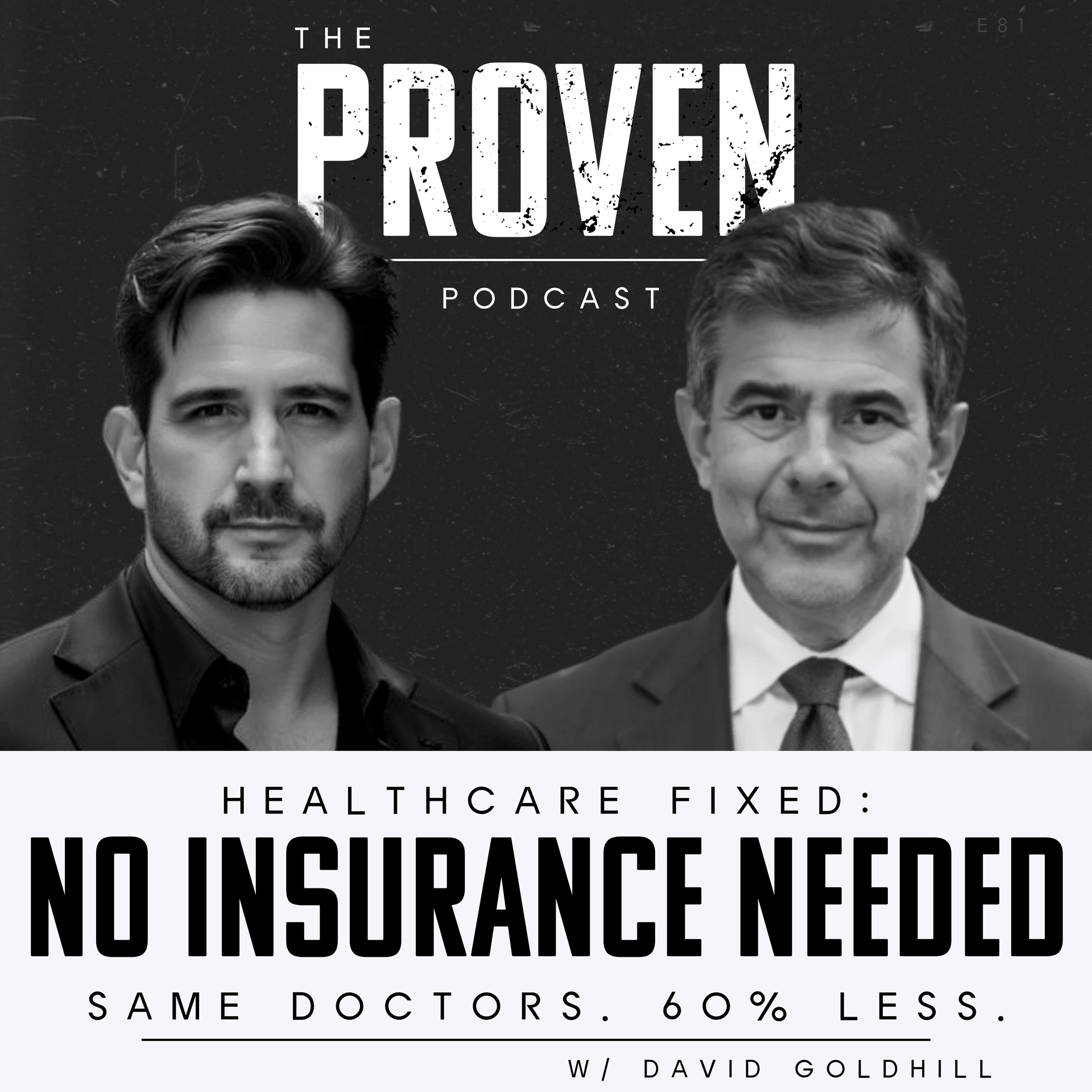
Episode topic: Why US healthcare is “broken” and unaffordable, how the US funds global innovation via high prices, and what Sesame (sesamecare.com) is building to lower costs without changing doctors.
Guest background
David Goldhill, founder and CEO of Sesame. Previously an entertainment executive (ran television at Universal Studios, ran Game Show Network, built a TV network in Russia, distributed shows, helped run a movie theater chain). Also spent eight years in hospice.
Key claims
- The US is ~40% of world healthcare spend despite ~3% of the population; innovation depends on the US market.
- Prices stay high because third-party payers negotiate “fair prices,” limiting competition; there’s no “Costco/Walmart of healthcare.”
- Insurance is often a bad deal for individuals even with major coverage; third-party payment distorts consumption.
- Government one-size-fits-all payment doesn’t match modern, personalized, proactive care; incentives matter more than ideology.
Notable examples
- Weight-loss drugs (GLP-1s): when insurers didn’t cover, prices fell.
- Open-heart surgery cited around $120k–$130k; family insurance premium about $35k/year.
- Sesame lists doctor consultations/procedures at cash prices lower than insurer rates; providers set time slots and prices.
- AI’s biggest near-term impact is revenue management (payer-provider pricing), not clinical care.
- “Geolocked” care (best doctors limited by location) should loosen via telemedicine and AI-enabled care delivery.
Written by AI. May contain mistakes. Listen to the episode to check what was said.
Chapters
Tap a time to open that second in VODavid Goldhill's Background
0:21 to 1:27
David discusses his career and transition from entertainment to healthcare.
“So for the four or five people out there who don't know who you are, can you kind of explain who you are a little bit about your background and then go from there?”
The State of US Healthcare
1:27 to 3:22
David explains how the US healthcare system is structured and its impact on innovation.
“It's one of the things that you and I are completely aligned on is that healthcare is just a show.”
Global Impact of US Healthcare Spending
3:22 to 4:52
Discussion of how US healthcare spending affects global healthcare quality.
“And you can say, if you've been to a crappy movie theater in the United States, boy, the movie industry in Brussels is much better than the movie industry in the United States.”
The Challenge of High Healthcare Costs
4:52 to 7:42
Exploration of the reasons behind high healthcare costs in the US.
“the United States is 40 % of world healthcare spend.”
The Need for Market Forces in Healthcare
7:42 to 11:48
David proposes bringing competition into healthcare to drive down costs.
“that's where we'll get 60 70 percent of our property from and if we can then sell to the British Null Rests.”
The Inefficiency of Insurance in Healthcare
11:48 to 14:00
David critiques the current insurance model and its inefficiencies.
“Yeah, and I think, you know, your point about being ideologically promiscuous, oh, it's okay if I call you promiscuous.”
The High Cost of Family Insurance
14:00 to 15:00
Discussing the exorbitant costs of family health insurance policies.
“Except my family insurance policy costs$35 ,000 a year.”
Exploring the Distortions of Third-Party Payment
15:01 to 18:00
Analyzing how third-party payments affect healthcare prices and consumption.
“a book on healthcare, catastrophic care in 2012, I looked at what an employee starting at my company would put into the healthcare system over her lifetime.”
The Role of Cash Prices in Healthcare
18:01 to 19:16
Introduction to Sesame's approach and how cash prices lower costs.
“Yeah, so I think that's the foundation of Sesame, which is there's a lot more spare capacity in the healthcare system than we often see.”
AI's Impact on Healthcare Costs
19:17 to 21:04
Discussing the potential and limitations of AI in revolutionizing healthcare.
“Because that's bringing the capitalism in.”
Show all 30 chapters
Consumer-Centric Healthcare Models
21:05 to 26:54
Examining how shifting the focus to consumers can improve healthcare experiences.
“if you're not getting the overall treatment.”
The Joe's Analogy: Understanding Healthcare Economics
26:55 to 28:00
Using the analogy of a popular restaurant to illustrate healthcare pricing dynamics.
“And compare it to the rest of the healthcare experience that most of us have.”
The Healthcare Dilemma
28:00 to 28:54
Explore the limitations of the current healthcare system and the desire for direct access to treatment.
“You don't go to Joe's without having to ice your way in.”
Comparing Healthcare to Joe's Takeaway
28:54 to 30:29
A discussion on how the restaurant model can inspire innovations in healthcare delivery.
“I have not been to Joe's the restaurant in 15 years.”
Disruption Through Telemedicine
30:29 to 31:35
How telemedicine is changing the way healthcare is accessed and its economic impact.
“And we're even getting to the point where we can see robotics.”
Changing the Market Dynamics
31:35 to 33:01
The implications of remote healthcare and the shift in market dynamics for providers.
“be in person, the doctor's happy to see you by video.”
The Cost of Care Crisis
33:01 to 34:24
An analysis of the rising costs of healthcare and the stagnation of doctors' incomes.
“I mean, I think, so I share that radical vision.”
Pharmaceuticals and Their Economics
34:24 to 35:56
Understanding the economics behind pharmaceuticals and their impact on healthcare pricing.
“If you look at what's happened with hospitals, the average number of days a patient spends in the hospital have been defining meaningfully almost no matter what they're diagnosed with.”
The Broken Healthcare System
35:56 to 37:18
Discussing the failures of the healthcare system and the need for human-centered approaches.
“So all of those things have happened in the last 20 years.”
Regulatory Challenges in Healthcare
37:18 to 38:37
The impact of government regulations on healthcare delivery and patient care.
“hey, muzzle, everyone's making money, the person has better quality, not quantity.”
Incentives and Human Behavior
38:37 to 40:15
How human behavior and incentives shape the healthcare system and patient outcomes.
“probably a better way to put it in healthcare.”
The Outdated Healthcare Model
40:15 to 42:01
Examining how the traditional healthcare model is misaligned with current needs and technology.
“And I think that speaks to humanity as a whole.”
The Broken Healthcare System
42:01 to 43:58
Learn about the inadequacies of the current insurance-based healthcare system and the need for change.
“than we ever did about our health, far greater ability to deal with it.”
Patient Empowerment and Proactive Care
43:58 to 45:55
Explore how patients are becoming more sophisticated and proactive in managing their healthcare.
“So what are the biggest changes you've seen for your patients or for the market now that, because you've been doing this for a while now, what are the biggest changes you've seen?”
The Shift in Doctor-Patient Relationships
45:55 to 48:48
Understand how the dynamics between doctors and patients are evolving, and the impact of insurance on practice.
“Outside of reimbursement rates, hospitals don't really have economies of scale or of scope.”
Consumer Responsibility in Healthcare
48:48 to 51:06
Discuss the importance of consumer responsibility and awareness in making healthier choices.
“Well, I want to actually comment on that because I think that's a really interesting thing.”
Challenges and Opportunities in Healthcare Innovation
51:06 to 55:18
Examine the challenges faced in healthcare innovation and the need for market-driven solutions.
“So I think that level of responsibility hasn't stepped into it yet.”
The Future of Personalized Healthcare
55:18 to 56:00
Learn about the future of healthcare as it moves toward more personalized and tailored approaches.
“So I think we're going to still have that demand.”
Personalizing Healthcare for Individual Needs
56:00 to 57:06
Explore how healthcare is evolving to become more personalized and market-driven.
“And I think that's what we're doing here.”
Connecting with Sesame Care
57:06 to 58:10
Learn how to connect with David Goldhill and Sesame Care for healthcare needs.
“So if someone's going around, David, and they want to track you down, they want to ask more questions, because I have access to you, so you and I get to have great conversations.”
Transcript
Automatic transcript. May contain errors.0:00Welcome to The Proven Podcast, where we don't care what you think, only what you can prove. America pays 40 % of the world's healthcare bill. We're 3 % of the population. Today, David Goldhill, founder and CEO of Sesame, joins the show to break down why that happens, why the system is broken, and what he's building to fix it. The show starts now. Hi, everybody. Welcome back. I'm excited for this one, David. Thank you for joining us. Great to be here. So for the four or five people out there who don't know who you are, can you kind of explain who you are a little bit about your background and then go from there?
0:34Please don't tell me that's 100 % of your audience. That's it. I know it isn't. But for the many people who don't know who I am, I'm David Goldhill. I'm the founder and CEO of Sesame, sesamecare.com, which is a marketplace for healthcare services. There you go. So what have you done before you got to Sesame? So people are like, all right, what are we walking into? What are your claims to fame? Well, I don't know I have any claims to fame, but I did have a long career as an entertainment executive, mostly in television. I ran television at Universal Studios. I ran the Game Show Network. I built a television network in Russia, which is now a very popular place, and made a bunch, distributed a bunch of television shows, also helped run a movie theater chain.
1:18So your classic entertainment executive goes to healthcare story. Yeah, I've heard it so many times because our healthcare system works oh so well right now. It's one of the things that you and I are completely aligned on is that healthcare is just a show. And it's my own show and I should be able to curse, but yeah, it's so, I should. So in this situation, healthcare is ridiculously broken. And I wanted to talk about that because there's, we pay more than anyone else and we subsidize the entire world. You know, I've had this conversation before we started recording. Let's get the audience kind of caught up on that.
1:51when we talk about that we're subsidizing the rest of the world? Let's walk through that for them. Well, it's a little complex because it's not what we first see, right? What we first see is people around the world seem to get health care for a lot less money than we do. And many of those systems, particularly in Western Europe, feel more universal and easier to exist than ours. That's terrible. Underneath it is something much more complicated, which is the United States has the only free enterprise healthcare system on earth, where we don't control prices and we don't have hospitals and doctors as either employees of the state or owned by the state.
2:30And a lot of people think that's bad. But the interesting thing is that's why almost all of the innovation in healthcare on earth is designed for the American market. Every innovator, no matter where they are, makes the bulk of their money selling to Americans in the American healthcare system, whether it's new drugs, which gets a lot of attention, or new devices, or new software. Even new treatment protocols tend to come from people practicing first in America. Why? Because you're free to do so. You have an incentive to do so. Even your local doctor is probably competing against somebody, so she's more likely to buy the latest equipment and get a start to that manufacturer trying to sell something.
3:12is a result of this. And again, not easy, not intuitive. Basically, the quality of healthcare everywhere else on earth depends on the United States. The example I like to use for my own industry is you can go to a movie theater in Brussels, and you can see the latest Marvel superhero film in a fantastic screen and a comfortable chair and great concessions and price the same. And you can say, if you've been to a crappy movie theater in the United States, boy, the movie industry in Brussels is much better than the movie industry in the United States. And you'd be wrong because all of the capital investment, all of the risk, all of the complexity is American there.
3:52And it's even more so in healthcare. So when we have that, you know, the audience is going to say, because we hear this all the time. And for those of you catching up, I spent eight years in hospice watching people die. So regrettably, I'm very familiar with this world. They're going to say, hey, you know, the same treatment in another country costs fractions of this. Where do we dispel that? How do we face that and face that argument? Yeah, so it's very difficult. I mean, I sort of compare it a little bit to NATO, right? Which is, you know, we're defending Europe and NATO. The European countries spend almost nothing knowing the United States is going to fundamentally be the force defending us, defending them.
4:33So, what do we do? We can say, we're not going to defend you, but that's not in our interests. We can say, defend yourselves, but they're all relatively small. And we've never been able to figure that out in NATO. Healthcare, strangely enough, is a bit like NATO. The quality of care on earth depends primarily on the American market. Just to put some numbers on it, the United States is 40 % of world healthcare spend. We're 3 % of world population, 40 % of world healthcare spend. No other country matters. Systems we talk about as being equivalent of 3%, 4 % of world healthcare spend, they're almost insignificant.
5:10So the U.S. is driving the most important thing in healthcare, which is the quality and level of care, innovation. And innovation, finding new treatments, new cures is what healthcare is about. We drive that. But we do it by bearing very, very high prices and all of the risk and reward of investment. It's been a tough nut to crack. I'm sorry, let me just stop there. Yeah, so I think, you know, what we talked about it before, you know, one of the great things about having the off-record calls is we go back and forth and we say things that we probably shouldn't say, but it makes it fun. But it's not recorded.
5:47One of the things, you know, we talked about is like, yeah, we can reverse this. You know, we can sit there and say, you know what, we're not going to be 40%. We're not going to spend all that money. Not a problem. We're just going to let all of our people die. And we're like, well, we're not going to do that because no one else is going to kind of step up and take that role. If we stop cutting the funding collectively across the world, it just drops because we're so used to this. I think it's a byproduct of what we did after World War II where we said, listen, I don't care who you are, where you are in the world, we're going to make sure that you can ship anything from one side of the planet to the other side of the planet and we're going to protect the oceans.
6:19We're going to make sure you can do that. That was the idea of us. Be a part of us. We're going to protect that. We're going to go against communism. We're going to, oh, here we are, America. We're going to do this and we changed that for the entire world. But we've done that, as your point is to NATO or to medicine, that we've stepped into the role of like, hey, we're going to take the hit here. We're going to pay all of this and we're going to do all this because we want this certain level thing. But we are at a point where the market doesn't fit that anymore because going in and going and getting a pill somewhere else costs a dollar.
6:46Here it costs$1 ,200. That system is creating this head bunny. And there's a specific reason about that. And I'd love for you to talk about why the system is completely and utterly broken and kind of how you're trying to fix it. Yeah. So on the one hand, it's a great thing that America benefits more from medical innovation than anyone else. So therefore, it pays more than anyone else. Not a great thing we're paying 70%, 80 % of the cost of innovation and getting, you know, three, four, five percent of benefit, maybe 10 % of the benefit. that's an imbalance the question is can you solve for one problem which is americans are paying way too much for health care without undermining this other great thing which is where the engine of world health care progress and just to be clear because some people often confuse this it's not that everything is invented in america far from it it's that everything is invented for america so researchers all over the world their business model is we'll sell to the americans because that's where we'll get 60 70 percent of our property from and if we can then sell to the British Null Rests.
7:50So the issue becomes, exactly as you frame it, which is, can we get at this one thing, which is, as people were paying too high a price, and the impact on healthcare, on our finances, on people's affordability, on the choices they have to make in the lives, has become enormous, as you would expect, when something went from 4 % to 5 % of GDP to almost 20 % of GDP in three generations. It's extraordinary. So this is a problem we have to solve without destroying the engine of innovation. If we just go to a sort of socialist system, a British style system, a Canadian system, we'll simply destroy the engine of innovation.
8:31There'll be no profits than innovation. And without American profits and innovation, there won't be any. So we can't do that. What can we do? And so the argument that I think I and others have made is that we can bring market forces into a lot of things in healthcare that bring competition around buying and selling and can drive price down. I mean, you know, there may be an argument that that pill should be$1 ,200 that first year when it's saving lives. Kind of hard to make that argument if you're out 10 years and there should be competitors. And that's something where... Yeah, we talked about this before.
9:08And, you know, like the first pill cost$9 million. The second pill cost a penny. The problem is the first one to get it right cost nine, because it took all the research and the studies and doing all that. I think where we'll get pushback is the idea like, well, yeah, it should cost everyone. They should also burden a great deal of this. They should pay for some of those costs. And how do we ship that? Because I don't think it's just, again, I don't think it's just a medical issue. It's across the board, to your point with NATO. We have this re-dynamic. Yeah, I mean, you're exactly right. But interestingly, the point you made is usually this is a tough business model.
9:47Because if I've got a business where the first one costs$900 million because I had to do all the regulatory testing and all of the applications for approval and developing the drug and all the ones that failed, and the second pill is a penny to produce, that's usually a terrible business model. In lots of other industries, that's a horrible business model. In healthcare, it works. Why does it work? Well, the reason it works is because instead of having people compete for customer business, we have third-party payers pay for everything. And what do they do? They walk in and say, what's a fair price?
10:25You don't want a fair price. That's not how capitalism works. What I want is a competitive price. and there's almost no corner of healthcare in which we let good old-fashioned competition drive people's prices down to marginal cost. And so what should be a bad business model winds up being too good a business model. They're protected in price. And I think this is where people are like, oh, are you a Republican or a Democrat or a liberal or conservative or conservative? Are you a capitalist or are you a socialist? And whenever I get asked that, because I get asked it all the time, my answer is always yes.
10:56Well, I'm sorry, what? I'm like, it depends on the topic. It depends on where we are. There's different structure, different folks. And we as Americans aren't capitalists or communists or socialists or liberals or conservatives. We're all of it. It just depends on what we're talking about. And I think there's a time and a place for everything. And I think the medical environment has gotten way out of control. I've taken lots of clients who are doctors. We've scaled them. They're like, I can't afford this. I just, I cannot survive anymore. I've got to go to a concierge-based environment or forget it.
11:25I'm just going to do a roll-up and we're going to take all these practices together. I'm going to exit and I'm going to go buy a bunch of Toros. and I'm going to go flood the fleet because it's just a broken model on every level. So I think your approach to it, this idea of bringing more capitalist, competition-based is viable, but I don't think the audience would fully understand that. So I have the benefit of talking to you. Can you explain what that model is and then in turn, why we don't think the government can do it on their own anymore? Yeah, and I think, you know, your point about being ideologically promiscuous, oh, it's okay if I call you promiscuous.
11:56Okay, don't say it too loud. It works really well in healthcare. Because what a lot of healthcare experts talk about is what's the one perfect way to pay for healthcare? Well, healthcare is 20 % of GDP. It includes things from drugs that have been in existence for 80, 90 years to miracle personalized cures that are going to be designed just for you. It includes things from the most complex surgeries to a regular checkup that involves sitting with someone for 10 minutes and talking. right the range of human activities and goods and services in that 20 percent of gdp are gigantic and the idea that they should all be paid for the same way should we use third-party insurance is absurd on its face yes some of those things you're going to get relatively little benefit from competition some of those things should be fully competitive right and the same way about the safety net aspect of it, right?
12:52We certainly don't want people starving in America, and we have all sorts of ways to make sure that people who don't have food get food. We have food banks, we have food stamps, we have explicit subsidies, but we don't say because of that, Michelin-starred restaurants should be paid for the same way. We're okay with a broad variety of ways of paying for barbecues and picnics and school lunches and luxury meals. And, you know, that's fine. And we understand that complexity everywhere in the economy, except for healthcare, where experts sit around and say, what's the one best way to pay for everything?
13:31The biggest thing I'm saying is everything shouldn't be done the same way. There are some things insurance does really, really well, which is cover you against unusual risk, something major, something rare, something. But before you say, well, every healthcare condition I have is unusual and rare. I had, uh, open heart surgery, um, a couple of years ago and the price of it was something like 120,$130 ,000, which is a gigantic amount of money for everybody. Right? Right. Except my family insurance policy costs$35 ,000 a year. so roughly every four years i pay for an open heart surgery and i guarantee you we're not using one every four years so here's someone who had a major thing right that the insurance system is designed to protect and insurance is still a terrible deal for me and we don't like to think about those numbers right we don't like to do that math it's uncomfortable to think about it but it is why health care so expensive i think those are the numbers that are going to get the audience the most excited.
14:37You and I talked about these numbers, how it's radically changed, not only in the last year, but in the last decade, in the last few decades before running up to it. You deep dive into this pretty intensely. Can you talk about those numbers more about how things are changing and the numbers that a single family is trying to deal with if they're employed versus unemployed and how it's astronomically bad? It is astronomical. I mean, when I wrote a book on healthcare, catastrophic care in 2012, I looked at what an employee starting at my company would put into the healthcare system over her lifetime.
15:13And I just included everything, her share of premiums, our share of premiums. Our share of premiums just come out of what we would pay her. So it's like that. But Medicare taxes, Medicare premiums, just everything out of pocket, just estimated over a lifetime. And I assumed she didn't get really sick. And I assumed she had a couple kids and had a partner, but the partner didn't work. And in 2012, the amount she would put into the healthcare system over her lifetime was$1.2 million into the healthcare system. There are very, very, very few treatments that can absorb anywhere near that type of spend.
15:51Well, where does it go? Well, a very large part of it, a shocking large part of it, goes to administer the payment system, which costs somewhere between 10 and 15 percent directly of the cost of care, which is astonishing. Several thousand dollars a year and at over 80 years of life, you're paying hundreds of thousands of dollars for the benefit of a third-party payment system just for its operations. But even beyond that, the distortion that third-party payment creates is enormous because it encourages people to consume things they otherwise would not. we've all been through this you have an auto accident the first thing that guy asks you is this an insurance job or not because that's a completely different price the biggest thing you have and when I say this people say but but and then they think about it and they realize it's right nobody in the healthcare system can make more money can be more profitable by lowering their prices so that's not true in any other business and the reason for that isn't because people wouldn't be happy to have lower prices and competition it's because third-party payment keeps up the level of prices and determines how many customers you have and so there's no costco of health care yet right there's no walmart of health care there's no you know none of the competition we see in anything else and for a lot of services there could be not for all of them but for a lot right and i think this is that goes back to your point things are changing um i don't think they're changing fast enough but you know i i get i've had because i grew up in florida and we have tons of mold i get sinus infections so to get whatever spray or whatever it is that i would need to offset that it used to be extremely expensive now and i'm not plugging walmart in any way shape or form i was like hey walmart i need this like oh yeah four bucks i'm like i'm sorry what just happened so there are there is movement there are there are things that are changing but i also noticed that when when you work because i've with a lot of doctors there is a lot of downtime there is a lot of like they're doing their patients they're trying to run them through and they're trying to do all this but there are pockets depending on the type they do with practicing not a gp normally but when they're doing this there is these pockets of downtime where they could monetize that and they could go into it and you could do it it was something that you brought up and i think is a core part of your business is we have these things where you have an audience that desperately needs fulfillment and you have someone who's literally just sitting there at his desk like i can fulfill because when i get sinus infections now i don't go see my doctor i'm very blessed with the insurance i have i just do teledoc and i get on like hey i might just pull up my record like oh you have a sinus infection i'm like okay have fun we're going to send it over and that doesn't cost me much i don't have to do that but there are doctors who are extremely elite and i want to talk about how ai is going to change medical because that's the thing that i'm the most excited to talk about but walk me through that and to what Sesame does that does really well?
18:46Yeah, so I think that's the foundation of Sesame, which is there's a lot more spare capacity in the healthcare system than we often see. And so what Sesame does is we list mostly consultations and appointments with doctors, but some other services, some procedures, labs, diagnostics, et cetera, at cash prices. and the physicians themselves or the clinics or some cases hospitals just put services on our marketplace at a cash price with a specific time and the patient buys it and the interesting thing about sesame is that those prices are much much lower than the prices that insurers pay and you know one of the theories of health care is oh these big insurers can drive prices down and Medicare, Medicaid drivers, we don't tell providers what to charge, but they have this basic principle we all know, which is, if I want to get patients, I got to leave with price.
19:45Right. Because that's bringing the capitalism in. It's bringing the capitalism, but it's also just bringing in normalcy, right? Which is, look, we just saw this with GLP-1s, with weight loss drugs. The price of weight loss drugs had declined in the last three years because insurers didn't cover them. So if you were Neva and Lilly, you wanted to sell them, I had to sell them direct to a consumer. A couple of other companies sold compound versions of their drugs directly to consumers. Guess what happened to prices? And if you listen to the way politicians and experts talked about weight loss drugs three years ago, it was these guys are going to keep their prices up.
20:22If we don't cover it with insurance, people won't be able to afford it. People won't get the benefit of these new drugs. What happened? The insurers didn't cover them, and the prices came down. There's an important lesson to that, right? It's a lesson we refuse to learn, which is that healthcare may not be so different from everything else because it's healthcare. Healthcare may be so different from everything else because we've structured it in such a crazy and bizarre way. I think we are having to be forced to listen to it, though, at this point. Because we're in a situation where it's so much of GDP, and it's so unaffordable, that things are starting to reverse.
20:56because people, there's many people I know who are just like, I'm just not going to have insurance. I'll just deal with it and we'll figure it out. And that's not a healthy model either. It's because we know how much that costs above and beyond if you're not getting the overall treatment. And we also don't reward it properly. We talk about AI. And for those of you playing at home, AI does not mean artificial intelligence. So AI does mean always incorrect. There's this fear that AI is going to wipe out everything. That AI is to humanity as the meteor was to dinosaurs. and that one of the things it's going to go after specifically is healthcare.
21:29And it's one of those things that you and I, even on our pre-call, I had an opinion. You were like, no, I don't see how it's going to go with that. And we had this little disagreement because I think AI is going to be this little thing in that you walk in, you put your finger down, it takes your blood test, and then, all right, congratulations, you have Ebola and your head's going to explode in 20 minutes. I'm like, oh, okay. And then Amazon drops a package in and I eat it. I'm like, that. So that's the me of where it's going to go. So and, you know, there is this idea of medicine is now no longer geo-locked.
21:59It was something you and I were talking about. I'd love to bring the audience into that conversation. So walk me through what you think AI is going to do and then what we're talking about with geo-locked. Well, I don't think AI is going to destroy and eliminate humanity. But obviously, if it did, that would solve the problem of health care costs. Refix it. Beyond that. Yeah, done. Next. Beyond that, I think AI is a great example of how healthcare is structured in such a strange way, right? There's a vision of AI that says we can meaningfully improve diagnostic results. We can meaningfully improve how doctors practice, how patients' records are kept, and how automatic our ability to treat them for the variety of conditions and to find things are.
22:47You can paint an AI-driven paradise in which cost decline, data improves, and ultimately outcomes improve. New drugs are created, new treatments are created, and they're more personalized. That's very possible. We can all see that. We can all see that vision. And doctors who look at AI at something other than as Luddites say, this could really improve the way I practice medicine and help patients. To date, the biggest impact on AI and healthcare has been in revenue management. period full stop because you can't get away so the revenue management is the negotiation between providers and insurers over to what a provider should get paid that's where it's been used right and what we see at cms is ai providers saying hey we need a layer of skim added because we're bringing ai to this in other words the exact opposite of what's happening in the right economy.
23:41And it's a reminder that, you know, economic incentives are what rule how new technologies get incorporated. You need to make a case of here's how AI is going to create a new type of healthcare company that could win customer dollars. And then remember who the customers are, their insurers and governments. They're not you and me. And that's important. And that's really important. And I think it's a differentiation between what Sesame does and what everybody else does where the sesame's customer is the consumer where most health insurance and most health providers the customer is the provider it's like oh your blue cross blue shield went out to deal with you your your your etna or whatever the heck it is we view it as that that's a huge differentiation because when we talk about innovation and to bring the audience along with this story walmart did not decide to bring organic foods into their stores until they saw that there was a profit to do so.
24:36When their consumers were doing it with their wallet, saying, I want to buy organic, you don't have organic, then Walmart decided, oh, we're going to be organic and we're going to protect the environment. They're not protecting the environment. They're driven by profit, period, full stop. And I think people don't understand that because you have to identify who the consumer is. It's such a great metaphor because so many people, I go to lots of healthcare conferences. They're certainly a lot more fun than the old entertainment conferences I used to go to. the parties are better, the celebrities are better.
25:07But no, I've given up so much to do this. I want you to know that. But, you know. I mean, I'm in L.A. right now. So I'm like, what are you talking about? I was just out in L.A. I'm like, what are you, mad? Anyway, I may well have been mad to do this. But your point is exactly right, which is that people at healthcare conferences say, okay, we're having cost-saving technologies exist. so prices will come down. And you're sitting there going, yeah, that's how it happens. Right? It's the business that causes us to do that. Sesame has three types of customers. We have people who don't have insurance at all, who have no coverage.
25:47We have people who have very high deductibles or high deductibles and are managing the deductible part of their spend, which for most families now is pretty much all of their annual spend. Yes. And then we have a third type of customer, which is somebody, and this sounds kind of crazy who's basically indifferent as to the price of routine services and wants it easy and fast and says i don't care about not using my insurance this is what i pay for a haircut and i can speak to that because that's me like i i have very good insurance with root cross-tree shield i've had it for a very long time it costs me an astronomical amount of money i just it's it's more than a damn mortgage payment sometimes i'm just like whatever it is what it is but when i want to get something done, I want to get it now.
26:32I want to wait. I want to click a button. And so one of the remarkable things for us, and I'd love to take more credit for it, but I think it says more about normalcy than anything else. Sesame has 95 % patient satisfaction rates. We have NPSs in the 80s. We trust pilots in the high floors. Why? It's our providers. We're not the ones providing care. We're a marketplace for providers to list. But if you're a provider listing on Sesame, you know that you've got to satisfy a patient as to ease of use, convenience, showing up on time, price, doing what you said you were going to do, and follow up and the data kept.
27:11You're just driven by normal things. And compare it to the rest of the healthcare experience that most of us have. And it's an extraordinary difference. And it's extraordinary just by being normal. okay there's a and i think this normalcy is important to exercise this so there's a there's a place in miami it's called joe's and it is the most profitable restaurant in the world it's called joe's scraps and my family goes there we've gone there for years i mean my family's from south florida in order to get a table you have to walk into concierge and you hand them a hundred bucks that's before you even get to sit down that's just the game it's how the game's played and then the The prices of the crabs are astronomically more than they should be and all that.
27:53But you're doing it. But that's the game. And as long as you know that those are the rules in the game, you don't trip to a football game wearing ice skates. You don't go to Joe's without having to ice your way in. And regretting the healthcare system, we haven't had this ability to pay to play. We haven't had the ability to cut out our insurance companies without it just destroying us. And it's one of the things, and it's probably the main reason I wanted to bring you on, and the fact that we hate each other. um we wanted to come in and we wanted to talk about what that looks like because you know if i want to have a certain level of treatment whatever it is i want to be able to go to a website and click click and then it's there and it's ironically not costing me as much as if i went through my health provider which is just mind-blowing for most people so the real reason you have to be honest because the year i lived in miami i lived one block from joe's and i can actually extend your analogy because it's really good joe's realized at some point 10, 15, 20 years ago, that there was a limit to their business model.
28:50Very high price, sit down. There was only so many diners they could accept. So what'd they do? They built Joe's takeaway next door. Yep. That takeaway. Yep. I have not been to Joe's the restaurant in 15 years. Like most people who are there regularly and not looking for a big night out, I go to Joe's takeaway. What happens at Joe's takeaway? I can get the really expensive stone crabs at a really expensive price, but they're not limited by how many people they could serve. It doesn't have to be, you know, tablecloth service and all the rest. And you look at that and you say, well, could we have that in healthcare?
Read the full transcript
29:22And then you remember, healthcare's tens of thousands of SKUs. What we've been lacking in healthcare is the competitive urge to serve different types of customers because there's been three customers, insurers, Medicare, and state Medicaid agencies. And those three customers actually don't demand the level of innovation that 330 million customers demand. But interestingly, those three customers also don't really well match what human beings need, the diversity of what works for us. I've made the argument that healthcare is too complex to be served by government. And the traditional expert argument is it's too complex to be a normal market.
30:03Now, I do think government's got a big role to play in healthcare. But I actually think markets will drive innovation around service. Let me use another example you just used. And Sesame's taken enormous advantage of this. Telemedicine and remote medicine generally are going to be extraordinarily disruptive to healthcare if we allow. because the number of things a doctor needs to physically be in a room or even lay hands on a patient to diagnose with a monitor is shrinking. Yes. And we're even getting to the point where we can see robotics. There's robotic surgeries being done in different continents.
30:44Now, when you think about what remote really means in terms of bringing the cost of care down, the resource cost of care down, it's gigantic. The need to see a doctor, by the way, doesn't just create difficulty for having to maintain offices, but the patient's got to lose half a day at work and take care of child care or parent care. It's enormous amounts of costs being taken out of the system. What I've argued is we need a health care economy that incents those costs to be taken out and to have it reflected in price. when you have cost plus payers, whether it's insurers who get 15 % of the amount spent or Medicare that has no actual budget and can spend whatever it wants, you're not going to drive that type of innovation.
31:32So places like Sesame does. So on Sesame, you know, if you don't need to be in person, the doctor's happy to see you by video. You're happier to be seen by video. Costs have been taken out of the system and it's reflected in the price. it's it's very much like this podcast you don't know if i'm wearing pants or not because i didn't have to go to the studio no i think this is what we talked about before we were allowed to wear pants to this you didn't tell me see for everyone who's not watching this we're both naked um so for this is where it talks about geolocked there and i mean this is nicest way possible you know you're talking about your travels i love switzerland more than i could possibly tell you there are great doctors in switzerland there really are there are great doctors i'm sure all over the world but predominantly the best doctors out there are here and now those doctors can literally turn on a webcam and service and be in support to anybody anywhere ever and that changes how we work look at health care completely because in the past it was well i know you've got a great doctor in new york but i'm down here in south florida i can't get to your doctor so i'm gonna have to deal with this schmuck that that lives down here that's going away we're getting ourselves in an environment where that's no longer a problem, where I can simply connect to you and we can do it remotely.
32:49And now I don't have to be under your plan or with your provider or anything else. That's going to change the market. It's going to make things easier to do because God knows we know the government can't do this. Yeah. I mean, I think, so I share that radical vision. I mean, I think you're right that changes are going to be far beyond what people think. all of these national health systems are based on helping people pay for care. But the way they work is that they've been able to geofence who could provide care. And I think that's going to change. I think no matter where you are in the world, you don't want to see the best oncologist in your neighborhood.
33:29You want to see the best oncologist you can possibly see for your condition. And we'll have to figure out ways for those people, instead of having a patient panel of a few hundred or a few thousand, to have tens and hundreds of thousands in different pyramid structures under them and probably involving AI and technology. But the most important thing, I think, about that is that these are business models where you've got declining marginal cost of care. And the question we should be asking, because I think we've had declining marginal cost of care for 20 years is how do we make sure that as the marginal cost of care declines it's reflected in the price we pay my belief is if we're going to rely on governments to pay the price it won't work because they will simply i don't think that's a belief data that's not a belief we've seen it we've already seen for 20 plus years for decades now that that hasn't been the case that it's only increased and it's getting worse and worse and worse and it's not that it's this getting worse because like oh it's going up therefore the doctors are making all this money doctors are broke and i mean this in the nicest way possible i've been working with them for two decades doctors don't make what they used to make they're they're nickel to dime and their insurance is astronomical so they're most of the doctors i know who have been doing it for a long time come to me and they're like hey how do you exit me out because i'm done i can't do this anymore i wouldn't make more money if i went and bought you know three apartment complexes and i'd make more rev so it's not just an opinion we know it's not working anymore so everyone so if you're in the audience you are usually during the cost of health care invariably increases and the more uh the better we get a treatment the better we get at science the more we bring in advanced technologies the more personalized we get it's going to get more and more and more expensive and that's the amount of money and then think about what you just said charles which is if you look at doctors incomes and it's really for the last generation they've been flat in some cases down with inflation.
35:25If you look at what's happened with hospitals, the average number of days a patient spends in the hospital have been defining meaningfully almost no matter what they're diagnosed with. If you look at the commanding heights of care, they've moved from things that were surgical and labor intensive almost entirely to pharmaceuticals, which have a very low, in some cases, zero marginal cost of production. The first pill is$900 million, the second pill costs a penny is true. So all of those things have happened in the last 20 years. And yet the price of care keeps going up. And it shouldn't. I mean, what you and I are saying is that wasn't necessary.
36:08That's not about healthcare. That's about how healthcare is paid for. Because the reality is in any other industry where we see those things happening, prices decline. And they didn't decline in healthcare, I would argue, because the payment system prevented it from. And what we're doing in sesame is saying okay for this corner of healthcare cash paying customers let's look what normal looks like and what happens prices decline yeah and service is fantastic and quality is regarded as very good and you know patients are helped because many most of the people on sesame are very price sensitive and are making tough decisions about affordability and what they're going to be able to pay for their family and the idea that healthcare treatment should invariably go up and up and up and up is a disastrous one.
36:56Yeah. And people shouldn't have to make that choice. Do I eat or do I get my kid his meds? We shouldn't live in a world that that even exists. And what we're trying to do is we're trying to pivot that. I remember when I was working at hospice, the average stay, the break-even point was, I think, six and a half days for a patient to come in when they were doing inpatient care. It was six and a half days. So you get them there, we get them to two weeks, hey, muzzle, everyone's making money, the person has better quality, not quantity. of life but better quality of life well then vitas came in and i was working for a not-for-profit and vitas came in and the doctors started realizing hey you know we could squeeze a little bit more out of this because again they're just trying to make their nut and survive and the patients went from being there for two weeks to being there for 47 hours that was the average intake that we would have when we would get a patient the person would be down to 47 hours and we left it was less than 16 hours because people were holding on to him to that point so they were transferring and and taking every dollar out.
37:52That's a broken system. That's an absolutely broken system, and there's no humanity to it. And while that has absolutely no humanity to it and just gives you the chills to think about, it's interesting that hospice, when Medicare first started covering it, had the opposite problem. They were paying per day, and people were taking hospice patients who weren't really dying, and Medicare had to extend a maximum number of days to hospice. And some of the hospice companies were keeping patients for the maximum number of days and then discharging them because they were still alive. And neither of it is a good human response.
38:27And this is something, again, for people at home who think there's a fundamental difference between capitalism and serving people well, and that's why it's scary to think of more capitalism or more markets is probably a better way to put it in healthcare. These results are not great results. Unfortunately, when your governments run these things, they have to have relatively simple one-size-fits-all rules. And here's the thing about healthcare. When we invented these systems in the mid-20th century, one-size-fits-all, probably okay. There wasn't a lot healthcare could do. One-size-fits-all, good.
39:00Now, it's catastrophic for a lot of families because it means that patient-specific needs are not being addressed. They're being driven by a rule. That's not good. And interestingly, as we get better at, you know, what used to be intelligence is now artificial intelligence, we have the ability to serve people in a much more personalized way if we give the economic incentives to do so. And I would love to sit there and completely bash, okay, it's the government and how horrible the government's done it and these healthcare providers and, you know, the insurance providers and look how bad they are and yada, yada.
39:36I will give an example that I will take no credit for. I was at an event and this individual, and I'm going to clear all the names and the nouns off of this, but basically he said, okay, the average number of people that were on welfare in this specific environment, kids, with five kids, that was the average that they had, the people who were on the system, they had five kids. And then they saw this radical change in less than 24 months that it rocked up to six. And they're like, what the hell happened? How did we go from the average of five kids to six kids? And what happened was the plan said, oh, we'll cover six kids.
40:08I'm like, oh, well, that's the case. Mazel. So they went and had another kid because they drop out another 40 to 60K in a year. Or whatever the numbers are. And I think that speaks to humanity as a whole. It's not always the system. It isn't always government. Sometimes we as humans kind of suck and we kind of abuse the system as well. So being able to face that as well, because it's not a single pill solution. It isn't a binary solution. It's not black or white. It's like, hey, we've got to get some gray in here. Yeah, and I think that's, I mean, I think that tone is so important because I'm personally, I'm someone who doesn't believe in villains, which is why I've made terrible films and televisions.
40:51But I don't just, but no, I just, that's not what, you know, the government's not evil, right? People who work in the government are trying to do well. People who work in insurance companies overwhelmingly are trying to do well. It's the problem is incentives always win. and we made a mistake in thinking that mid-20th century healthcare is what healthcare would always be like right when there were only a handful of things healthcare could do well most of the stuff that cost money was sort of urgent and pretty rare and so we said you know what we'll fund everything we'll fund it like insurance because that covers the bulk of anything anyway well guess what we're coming up on a world where the bulk of healthcare spend would have been seen in previous generations is preventive.
41:38It's managing chronic conditions and metrics you have that suggest you're going to have health issues down the road. My heart surgery was preventive in a sense. I had a valve that was going to fail. It didn't fail. It was going to fail some period of time, right? That's what the bulk of it is now. It's far more personalized. We each have far more information than we ever did about our health, far greater ability to deal with it. And a top-down insurance-based system no longer matches healthcare need. And so you've got all of these people trying the best they can, and I do believe that, to fit this system in something that's eight years old and out of date.
42:22And that's the problem. It's not the evil this guy and the evil that guy. I know it's fun and easy to talk about that, but everyone's trying to do their best. you just cannot get you know as a square peg to fit in a round hole and that's our health care and payment systems today it's it's outdated and it's broken and i want to speak to what you said about people are trying to do the best i've been in dc a lot a lot it doesn't matter what side has been in office the the lonely intern that the low level is running around with duct tape holding this thing together you would be shocked for if you to see how the sausage is made they're like wait If it wasn't for Susie, who's literally an intern, that wouldn't have happened?
43:02What the? Because that's just how the system's built. It's held together with duct tape. And that's just been humanity since the dawn of time. People are trying to do their best. You might ideologically disagree with one thing about them. But trust me, at the end of the day, they're trying to do their best. And it is a big ship to turn. And I think until we put in different factors into the market, until we bring in different providers or different solutions, it's never going to change. And what we have right now is all of us are sitting in a bus driving a thousand miles an hour straight into a wall.
43:34And we've got to sit there and say, hey, maybe we should turn to the left a little bit. And I think bringing in those different, because if not, we're all going to die. This isn't going to work. We've proven this hasn't worked for over a generation. We need to pivot. And it's once we get away from, oh, it's this political party or that political party or it's this evil empire or this one. Yeah, there is. That's just humanity. But until we sit down collectively and say, we need to have other options. than those options, much like the Walmart example I gave. It just won't do it. So what are the biggest changes you've seen for your patients or for the market now that, because you've been doing this for a while now, what are the biggest changes you've seen?
44:08Well, I think there's, on the demand side, patients are getting much more sophisticated about managing their own money, right? Deductibles had a lot to do with that, just the growth of deductibles, but recognizing that, I wind up paying for a lot more of this than I expected to. I need to think a bit more as a customer, I think, is one thing financially. I think a second thing is that people are willing to pay for convenience. Yes. Because convenience is— Well, but I mean, but a lot of people of a variety of economic circumstances say, this thing is so opaque that even if someone's paying for it, I'm not sure I got what needed.
44:54Yeah. And so the simple, and this helps us enormously, the simple English language communication of a bill, of your data, is something that people are willing to pay for. And then I think the third thing, of course, is people are becoming far more proactive about their health. The healthcare system in the mid-20th century was entirely reactive because that's all we can do. So the healthcare century of the second half of the 21st century is going to be entirely proactive, which is another reason this architecture won't work. On the provider side, one change is exactly what you mentioned, which is more and more doctors are no longer independently practicing, that being part of an institution is essential just for their sanity and often for their economics.
45:41I think another thing that's happening, though, is the big hospital chains, which have gobbled up a lot of these practices and are trying to do integrated care and all the rest, are not going to work. You know, I don't want to be – I do want to be a nerd. Let me be a nerd. Be a nerd. Outside of reimbursement rates, hospitals don't really have economies of scale or of scope. They're kind of a senseless institution. So they charge a ton of money. they get way too big a share of the healthcare pie, a share that hasn't gone down in 60 years, even though hospitals play much less of a role. They're all about their political power and their ability to drive reabriffments.
46:20But they can't be well run because they don't have economies of scale and economies of scope. And so over time, they're unlikely to win. And seeing how that plays out is really interesting. The general hospital I'm referring to, especially hospitals or somewhat different actually might be winners. But general hospitals increasingly just have a bad business model. And then the last thing I'd point out is that, particularly ironic when people hate their insurance company, the big insurance companies now are basically wards of the government. Their economics go up and down based on Medicare policy and Medicaid policy because a huge amount of their revenues come from running those programs for the government.
47:00and the government is in fact private insurance companies because Medicare and Medicaid are now run almost exclusively. Medicare is only 60%, but Medicaid now entirely through private insurance companies. So this thing all of us believe about how the healthcare system works is changing right in front of our eyes and most people have noticed this. I think one of the things we missed out on is that the consumer is now becoming significantly more sophisticated. Take something like true diagnostics or anything like that where you get your blood work. I know what's in my blood. I do it routinely every 30 days.
47:33We're doing blood work. We're checking things because I'm a hypochondriac. So we just keep an eye on this. Like, hey, what is this doing? What is that doing? And, you know, for those of you who aren't paying that much money when it comes to all these things, just be racist when it comes to putting anything in your mouth. If it's white, don't put it in your mouth. Sugar's bad for you. Don't put it in your mouth. White flour, bad for you. Don't put it in your mouth. This doesn't work. I think that's the basic. But you have this more sophisticated environment where consumers are coming in. It's just a matter of how long can the specialist doctors hold on versus these juggernauts.
48:03Because when I go see a specialized doctor for, like, I have a torn labrum, I'm not going to a hospital to have that conversation. I'm going to go to the person who helps major league pitchers. I'm like, hey, what do we do? And we have that. We also are, you know, stem cells is a thing. And I can't tell you how much I love stems. They're just absolutely amazing. My insurance won't touch them. But stem cells completely changed my ballgame. When you go in... Sorry, I was just going to say, I think that's really right, which is we're seeing that, which is the boundaries of what's healthcare and what's personal responsibility are changing very, very rapidly.
48:38And a lot of the more important things in healthcare are things like you mentioned, where the patient's going to do it on their own with or without medical advice. Because there's a ton of medical advice they can get from being online. but just remember AI does mean always incorrect because you know my AI is completely convinced that I need to have my uterus fixed and I'm very confused by that so I think there is this idea it's a different time and you know what whatever you want to identify as I think you know as we come into this and we have a more sophisticated because that's happening I would love to see the market have a more responsible consumer as well to take that ownership that self-ownership, but that's never happened in humanity.
49:24So I'll hold my breath on that one. Well, I want to actually comment on that because I think that's a really interesting thing. So one of the things you hear all the time in healthcare is you can't have consumer-directed economies because consumers don't know enough. They're not sophisticated enough. I don't think they're responsible enough. Not that they're not sophisticated enough. But here's the thing. Here's the thing. Consumer-driven economies aren't driven by consumers. They're driven by sellers chasing consumers. Correct. I don't walk into Walmart and or Costco and get a tube of toothpaste and say, I'm going to make sure this is the cheapest.
49:57Let me look at the ingredients and compare it to its costs. Right. They just say I'm pricing at the lowest possible price and you know I will. And that's why you're buying it. And what we forget is that consumers have to do a ton of work in our current health care economy. Third party payment doesn't take the work out of your hands. If anything, it makes it even harder. Consumer driven economies. I mean, if I look at Sesame, I have to look for the price on sesame because every provider on sesame knows i can't get a penny a business without posting my fixed price period full stop there's no requirement there's no law but who can sell anything without a price right and we we think that oh that requires consumers to do a ton of work it's less work yeah and it's also it's right there in front of you but i do think there is a sense of responsibility for example if you're going to sit there and you're going to kvetch or sorry for the going, you're going to complain about, you know, your health being so bad and you being obese or whatever it is, maybe just maybe don't stop at McDonald's.
50:59Just saying, maybe just maybe don't eat food that you know is just not healthy for you. Make better choices and don't just blame healthcare. So I think that level of responsibility hasn't stepped into it yet. Just get off the couch and go for a walk every once in a while. I don't think that's stepped in yet because there's so many people who, as I travel the world, and I know our food system is completely broken here in the United States. And you've got some travel coming up. I can eat gluten outside the United States. No reaction whatsoever. Here in the United States, it's not good. So we know that things are changing.
51:34We're becoming more aware. And awareness is great, but awareness without action creates problems. And I wanted to kind of circle that back into what you're doing because you're taking action and you're raising the level of awareness against some pretty intense juggernauts as a, as a founder, as someone who is a CEO that's running into this, you, this is working, you're proving this is working. What are some of the things that you've run into these walls of, okay, you're going to run, they're going to, you know, have some pushback that the market's given you. Yeah. I mean, I don't think the market's given us pushbacks, but I think some of the conventional wisdom in healthcare gives you pushback, right?
52:07Which is, I'll give you an example, which is, well, doctors aren't going to price less than insurance. Of course they do. Because insurance imposes an enormous amount of cost on a medical practice. And we take that cost away. The first one I heard is doctors are never going to be willing to post an actual price because there may be other services they need to do. And it's like, you know what? Tons of other professionals have figured this out. Doctors will figure it out too. Then there were things like, well, good doctors are not going to have this discount prices. But the interesting thing is more and more of the best doctors in the country say, how do I get out of the third-party payment system?
52:47Because I didn't go to medical school to spend 20 % of my time as an insurance clerk. And if you take insurance in your practice, your physicians, your nurses are spending meaningful amounts of time managing insurance. Not a great use of that education. And so what Sesame's benefited from is some doctors try to diminish the amount of third-party pay or just go cash pay. And for some nations, they're willing to offer discounts. For other patients, they have high-price concierge treatments structures. And others are in between, the point being, like we see in most markets, you price for different types of customers and different service, but you have no trouble saying, I'm happy to bring in a good customer who pays.
53:32One of the things Sesame saw on day one is we have our customers pay up front. Reducing the cost of collections for doctors is a gigantic gigantic administration for them and causes them to give the best price and yeah you know sesame customers are desirable customers already paid before you started your appointment um and i say that again reminding you we've got 95 satisfaction rates so it's um you know a lot of the conventional wisdom when you got a little marketplace out there moves wrong pretty quickly yeah it does i think one of the things that proves correctly all the time is you were rewarded for how much pain you eliminate in the market.
54:10Period. Full stop. That's what you're selling. You're selling for the elimination of pain. So if I'm a doctor and it's a Friday night and I'm on your patients, I flick on an app like yours. I flick on Sesame. I'm like, hey, let's, here, I'm going to do it for X, Y, Z bucks. You're good to go. Because at the end of the day, they don't have to deal with the insurance and the collections and all of that. It's just, it's a different mindset. And I think the more that people see this, that this could be a way to help fix the system. And is it, is it the way? No, I don't think there is a magic pill.
54:38I don't think there is that 900 million dollar pill that's going to save us all i think there's going to be lots of these very specific actions where we take that ownership back from a very broken system and what's great about it i think churchill said it really well he goes americans always do the best thing after doing everything else and i think that's the process we're in right now we've got to start trying these other things because we'll get there because i don't think americans are willing to have crappy insurance not a crappy health care i don't think that they're willing to do that. So I don't see the costs.
55:10I see the costs coming down, but I don't see the demand of standard coming down. Like I'm not going to go to a doctor and have them, instead of giving me a cast, he's going to write me a duct tape. I'm like, no, no princess. That's not happening. I want the cast. So I think we're going to still have that demand. We just have to get the spending under control. If not, we're going to lose it all because it will sink the ship. I think that's definitely right. And I think, you know, I would take what you said one step further, which is not only is there not a magic pill to solve the problem, there shouldn't be.
55:37Right. Healthcare is a massive industry that all of us are consumers of at different stages of our life, different elements of health, different needs, different preferences. Those industries are supposed to be complex if the service is going to match the broad range of consumer need. the attempt to do one size fits all doesn't just make it expensive and distortive and all the things that economists would hate it makes it less human it makes it less tied to the individual demand the reality is health care looks nothing like it did in the 20th century it's already far more personalized and it's going to be even more personalized it's going to be even more targeted recognizing the enormous differences in the way people live in their preferences as to how they live in the relationship between what they choose to do during that i mean there are going to be people who eat at mcdonald's they deserve health care there are going to be people who pay a lot attention to health they deserve health care probably different structures right probably different relationships to the system we got to be able to serve all of those people there is no one time no way to do so the only way we've ever figured out how to do so in complicated businesses is by having markets and letting people get paid for finding a consumer, a patient they treat well.
56:54And I think that's what we're doing here. And I think having the ability to change the ballgame that easily and that quickly, this is just going to speed up. Because people want to be able to control this. So if someone's going around, David, and they want to track you down, they want to ask more questions, because I have access to you, so you and I get to have great conversations. But if people want access to you or they want to learn more about Sesame, how do they do this? What's the best way to get a hold of you? Well, I mean, the best way to get a hold of me is just david.goldhill at sesamecare.com.
57:26Or you can just drop by my house. And yeah, that's how most people do it. 1 ,600 Pennsylvania out of here. Not quite. Not quite. But obviously, the best way to use Sesame is to use Sesame. You don't need to be a member of Sesame. You don't need to be a subscriber to Sesame. We have both, depending on what your needs are. Next time something comes up and you think, you know what, I'd love to talk to a doctor in the next five minutes and find out what this is, come use us. Come try us. I think you'll be surprised how easy it is, how great the doctors are and how good the value is. We have a lot of patients who come to us through Costco with whom we're partners, and it's a terrific relationship.
58:05I know a lot of people think that maybe we should let Costco restructure the healthcare system. I would vote for that, but we'd be a part of it, which is great. um as long as they stop moving things around when i'm shopping there because it was here and then they move it somewhere else i got run around the store i get the psychology but stop moving my stuff costco sorry moving on next time i meet them i will pass would you give me the particular item i will yeah they're never going to do it the buyer psychology is brilliant you move it and i got to run around the store and find other stuff i know why they do it it just pisses me off that they do it i would do the same thing but i think you know your model of it makes so much sense because it It isn't, trust me, give us a shot.
58:44It's, we already have all these proof. We already have these. This is already working. You can already see the reviews here. Give it a shot. This is a different model. I think people will be surprised, not just the price, but just how great the service is and how motivated the providers are. I'm aware the doctors and nurses and clinics are to be great at what they do for our patients. Thank you for taking the time out and trying to, my pleasure. this massive issue that's going on in our country and the entire world. I really appreciate it. Great to see you, Charles. Thank you. That's David Goldhill, founder of Sesame.
59:21If you want to talk to a doctor without the insurance mess, check out Sesame Care. Thanks for listening, and we'll see you next time.
From the publisher
Charles goes one on one with David Goldhill, founder and CEO of Sesame, former president of television at Universal Studios, and author of Catastrophic Care, to tear apart why American healthcare costs so much and what it would actually take to fix it.
They walk through why the United States covers 40 percent of the world's healthcare spending while making up just 3 percent of the population, why insurance companies and government payers killed normal pricing, and why the fix isn't one big policy swing. It's a shift back to treating patients like customers.
The conversation covers the real economics behind a $900 million pill, why Sesame borrows its pricing model from a stone crab restaurant in Miami, why hospitals are stuck with a broken business model, and why the doctor in your neighborhood is about to compete with the best doctor on the planet.
KEY POINTS:
00:34 – Entertainment executive to healthcare founder: David walks through his path from Universal Studios and the Game Show Network to building Sesame, and why Charles calls it a classic swap from one broken industry to another.
01:57 – America is subsidizing world healthcare: David explains why the US pays 70 to 80 percent of the cost of medical innovation while capturing a fraction of the benefit, and why cutting that funding would collapse care standards everywhere.
04:04 – The NATO of medicine: David compares American healthcare spending to defense spending in NATO, and lays out the number that stops most people cold. The US is 3 percent of world population and 40 percent of world healthcare spend.
09:13 – Why the first pill costs $900 million and the second costs a penny: Charles and David break down drug pricing, and why a business model that looks terrible everywhere else works in healthcare because normal competition never gets the chance to bring prices down.
14:42 – The real lifetime cost of healthcare: David shares the number that shocked him while writing his 2012 book, what one employee puts into the healthcare system over a lifetime, and where all of that money actually goes.
27:30 – The Joe's Stone Crab model: Charles and David use a Miami restaurant to explain how Sesame built a cash pay system that gives patients upfront pricing without insurance, and why doctors are lining up to join it.
31:33 – Telemedicine breaks the map: David explains why location is about to stop deciding who gets access to the best doctors, and how remote care strips real cost out of the system instead of just shifting it around.
37:05 – What happens when incentives go wrong: Charles shares a story from his years in hospice about a system that started rewarding shorter patient stays, and David explains why neither side of that story is really about good or evil people.
44:11 – The biggest shifts in the market right now: David breaks down why patients are getting more financially sophisticated, why doctors are leaving independent practice, and why big hospital chains are structurally unable to compete on cost.
52:09 – Fighting conventional wisdom: David walks through the assumptions people in healthcare kept telling him were impossible, like doctors posting real prices, and why more of the best doctors in the country are asking how to get out of insurance entirely.
KEY TAKEAWAYS:
- Why the US being 3 percent of world population and 40 percent of world healthcare spend is the number that explains almost everything else in this conversation
- How third party payers removed the pressure that normally pushes prices down as a product matures
- Why Sesame's cash pay, upfront pricing model is pulling in doctors who are tired of spending their time on insurance paperwork
- Why hospitals keep growing their share of the healthcare dollar even though they play a shrinking role in actual care
- Why personalized, proactive healthcare cannot run on a payment system built for a world where medicine could only react to problems after they happened