
In short
Proven Podcast: Episode Notes
Episode Overview
- Podcast Title: Proven Podcast
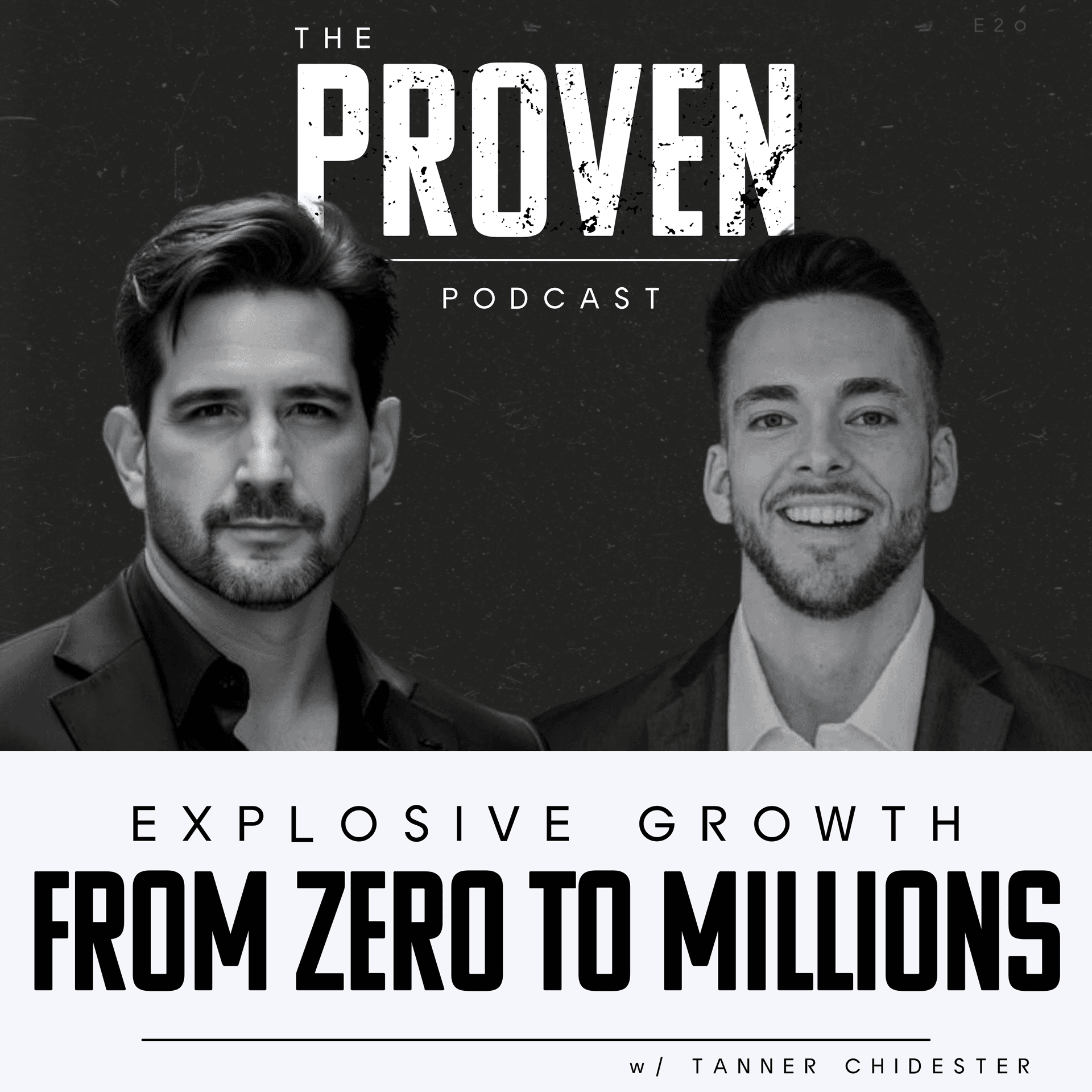
- Episode Title: Explosive Growth: From Zero to Millions - Tanner Chidester
- Host: Charles
- Guest: Tanner Chidester, Founder of Elite CEOs
- Description: Tanner shares his journey from an athlete to a business mogul, revealing strategies for scaling businesses and mastering high-ticket sales. The conversation delves into the importance of a Unique Selling Proposition (USP), advertising, and sustainable business practices.
Key Themes Tanner's Background
- Grew up in a religious household as one of seven siblings.
- Pursued a career in athletics, aiming for the NFL but transitioned to fitness after facing injuries.
- Developed business acumen through door-to-door sales and mentorship.
Business Growth and Strategy
- Unique Selling Proposition (USP): Essential for differentiating a business. Tanner emphasizes the importance of positioning and messaging.
- The 90/10 Rule: Concept introduced by Tanner to highlight prioritizing unique offers over mere marketing.
- Rapid Scaling: Tanner details his personal experience of scaling from zero to a million in just one year and the subsequent exponential growth.
Detailed Discussions Importance of a Good Offer
- A compelling offer is crucial. Many businesses fail because their offers lack uniqueness.
- Tanner shares how he positioned his fitness services in a way that appealed to clients' desires for results without extreme sacrifices.
Sales Techniques
- Objection Handling: Anticipating and addressing potential objections during sales presentations.
- Sales Foundation: Insights from Tanner’s door-to-door sales experience, emphasizing the importance of understanding human psychology and communication.
Marketing Strategies
- Comparison of inbound versus outbound marketing strategies.
- The effectiveness of paid advertising in driving growth. Tanner discusses scaling strategies while maintaining quality and personal enjoyment.
Mindset for Success
- The entrepreneurial mindset is crucial. Tanner advocates for enjoying the business growth process rather than solely focusing on financial metrics.
- The balance between personal fulfillment and financial success is explored.
Key Takeaways
- USP Significance: Crafting a compelling USP can dramatically enhance conversion rates.
- Mindset Matters: Success stems from enjoying the process, not just chasing financial goals.
- Lead Generation: Understanding the difference between inbound and outbound strategies can influence marketing effectiveness.
- Continual Learning: The need for continuous growth and adapting strategies as the market evolves is emphasized.
Important Points Discussed
- Tanner’s Origins: The journey from athlete to entrepreneur and the early struggles he faced.
- Unique Positioning: How Tanner differentiated himself from competitors in the fitness industry.
- Sales Metrics: Impressive results from Tanner’s methods and the metrics that define success.
- Community Model: The effectiveness of community-based models in a high-ticket sales environment.
- Further Learning: Resources for implementing Tanner’s strategies and developing skills for success.
Conclusion Tanner Chidester shares a systematic approach to achieving explosive growth in business, challenging conventional wisdom about entrepreneurship. The episode serves as a practical guide for both aspiring and established entrepreneurs seeking to scale their operations sustainably.
Additional Resources
- Website: [Proven Podcast](https://provenpodcast.com)
- Companion Guide: Available for download to implement strategies discussed in the episode.
Written by AI. May contain mistakes. Listen to the episode to check what was said.
Transcript
Automatic transcript. May contain errors.0:00Welcome to the Proven Podcast, where it does not matter what you think, only what you can prove. Everyone's trying to scale a mediocre offer with better marketing. Tanner Cheatester proves that's backward. The founder of Elite CEOs has generated over$100 million in sales across 50 ,000 clients by doing one thing first, creating offers so bulletproof they practically sell themselves. The show starts now. Today we've got Tanner with us. I am going to absolutely fangirl for a second. I have been following him for a really long time, so it's kind of special. I know his girl doesn't want me to feed his ego, but this guy is a damn superhero.
0:33bro. So I'm really impressed. Thank you so much for being on the lab. Yeah. Thanks for having me, man. I appreciate it. That was very kind. So for the, it's like the two people on the planet who actually don't know who you are, which is embarrassing, but can you give us a little bit of backstory, kind of like what your story was? I knew, you know, you grew up and then give me a little bit of a lead in to get everybody who you are and what's going on. Yeah. So I, one of seven kids, four sisters, two brothers grew up super religious, uh, you know, conservative household. And my dad was a teacher, mom would stay at home.
1:02So not a lot of cash, not a lot of money. And at a young age, I just remember, you know, telling my mom, when I'm rich, I'm going to buy those prepackaged meals and meal prep. And I was really into bodybuilding and sports. And then I wanted to go to the NFL, took it as far as we go, had a little stint at D1, got hurt a bunch, don't think I was good enough either. But I gave it my all. So no regrets. And that's been like a big thing in my life. I've been really proud of. And then I had to start figuring out what I was going to do. So, you know, I was in petroleum engineering. I had a 3.9 GPA. When football ended, I realized I hated school.
1:33I was like, man, I was here to play football. And I just went to class or so happened to. And I sat down with my mentor. My mentor was David Fry, who comes from the ClickFunnels world. He's actually married to one of Russell Brunson's cousins, I believe. And he just taught me about funnels. And so I started learning all these things. I didn't make any money for years, but I was learning all these intangible skills. And I did door-to-door sales and I was a server. But right before I was about to go back to school, because I wasn't making any money. I was almost 25 now. I kind of hit it off in the online fitness niche, blew up, had tons of trainers start asking me for help.
2:06That blew up. And then Elite Shields was born after that. And I've been doing that the last six years. We crossed 100 million in sales and 50 ,000 clients and all these crazy numbers. So that's kind of the long story short. So I like that you're being very kind with it blew up. Could you give a little bit more details of what do you mean by it blew up? because I don't think people understand what blew up means in your world versus my world. Yeah, blew. I mean, it grew very fast. So I went zero to a million in a year. That was actually my slowest year of growth, which is crazy to think. And then we went one to 10 and then we went 10 to 15 and then we jumped to like in the twenties.
2:44And it was, I'd say my biggest craziest year was one to 10, right? Literally 10 X in revenue in a year. And that's, you know, obviously a massive jump. So that's kind of what I mean by explosive growth is, you know, it's pretty explosive and pretty fast. I just needed to frame it for the people who are like, oh yeah, he made 20 bucks. No, he didn't make 20 bucks. It's a very different conversation here. There's a reason it's called elite CEOs. So if someone's coming into this and they're like, okay, holy Christ, what, what, what happened here? If someone comes into the idea of scaling, if you're like, Hey, this is the most important thing out of everything we do.
3:19This is what you have to identify first and foremost, when it comes to scaling your business? What was the first thing you would say they need to do? Yeah, so it's going to sound boring, but it's getting a good offer, right? Mosey has a great book on it now, right? $100 million offers. Most people's offers just aren't that good. And so there's really two ways you can do it. Either A, you have something that's so unique that no one else is doing it, like Facebook, right? That's an example. Or you have to have a unique selling proposition or USP. And so typically that's going to be in the health-wealth relationship niche, meaning let's say I'm a trainer and every trainer is essentially workout plan, nutrition plan.
3:55And so all the trainers are fighting on price because they don't know how to position it. So the number one thing they need to start with is having the unique selling proposition. What's the thing or the mechanism that makes what they do different? And a lot of people, they don't really understand what a mechanism is. They don't understand like how to make it different and they really don't know how to market it. And so that's like the number one thing I can walk through that if you'd like, but if they didn't get that wrong, it's the base of the pyramid. Okay. So I'll walk through it. So for example, I'll just go, I'll just talk about when I was a trainer.
4:24So when I was a trainer, I realized, look, at the end of the day, everyone wants a six pack and they want to eat donuts, right? It may not be right. It may not be the healthy. It doesn't really matter. It's that's what they want. So when I started trying to sell it to people, instead of saying what most trainers do is they talk about the features and benefits. So you get a nutrition plan, you get a training plan, you get accountability, you'll get an app, like no one cares. They just want to know they're going to get the result and it's going to be easy. So what I focused on is I'm a big proponent of calories, right?
4:52So calories in, calories out. Some people aren't, but that's, I'd say most trainers would agree with that. So with that being said, I said, okay, how can I position it in a way where I'm not lying, but it sounds attractive? Because most trainers would say, yeah, I'm going to put you on a diet plan or, hey, I'm going to teach you calorie counting. Boring. So what I would say for one of my pillars, like I usually have three, so it's two are the USPs. Like what is that I do different than one's why me, right? So one of them was how to eat whatever you want without sabotaging results. And what I would teach is I say, look, I'm going to show you how to eat whatever you want without sabotaging results.
5:24Because as you get older, you go to birthdays and parties, you're not going to just eat chicken and broccoli, right? On your birthday, you're going to eat cake, right? So it's not about cutting out bad foods. It's about how to eat bad foods and still look good. So people would buy that and like, oh, that sounds different. Same thing with the training. I'd say, look, 90 % of your results is nutrition, 10 % is training. So I don't care if you don't train at all. It's not as healthy, but I can still get you to lose weight as long as you follow the nutrition. They're like, Oh, okay, that makes sense.
5:49And then finally, when I would get down to their options, I'd say, so now that you understand you have to learn these things, you can either hire an in-person trainer who is paid for you to keep coming back to the gym. And they focus on training, which we already said wasn't most of your results. So that's not a good idea. You could get Beachbody, but they give everyone the same program. And it's just, you know, set to get as much results in the first 30 days for their pictures. And then you go right back off because you can't stick with it. Or you can hire me and I'm going to teach you how to do this for the rest of your life.
6:18And you only have to pay for it once. So by the time they got that concept, I was selling three, four,$5 ,000 fitness packages. And a lot of trainers that were probably better than me couldn't do it because they don't know how to position, right? It's all about positioning. It's not even necessarily being better you want to be, but it's positioning. And so that's the number one thing that most people fail at and they don't think about it long enough to be different or they think what they do is different, but it's not. It's just what everyone does. So they can't sell it at a high price. I love the subtle brilliance that was in it.
6:53You were defeating their objections in your pitch. You're going through and saying, listen, I know you're going to go over here and you're not going to do this. That's okay. And that's not going to work. Or, hey, you're not going to get it in the gym. You're going to just have diets. You're already, as you're going through it, their objections, you already know where they're going to be. You've done the research in advance and you're like, I'm going to build my pitch in my unique selling proposition of this. It's already going to defeat you. It's already going to go in and it's already going to negate it.
7:17So now you're at the point where you're begging to be sold to versus having to sell. It's a completely different narrative. Well, yeah. And the thing in sales is if you don't beat the objections in the beginning, they just come up at the end. So when you get a sales call that has no objections, all it means is you already beat the objections in the beginning. They just didn't bring them up. Right. But they had them. So as you're going through a sales pitch or a presentation, the point is to beat all the objections that they might have. And so it's just you being aware of what they are before they even bring them up.
7:48I'm a little upset that I can't eat donuts and have a six pack. So we're going to talk about that later. As you go through and you've had all the success and you've been doing this, you created something called elite CEOs. And a lot of people have pushed back. Well, you're just the fitness guy. Yeah, you did it over here. What do you know about XYZ? What do you know about car sales? What do you know about, you know, cardiologists? You've only done it over here. I, I completely disagree with that narrative. Tell me why that is not the right way to come through it. When most people say, Hey, if you can do it fitness, you can only do it in fitness.
8:20It's not a truthful statement. Why do you know it to not be a truthful statement? Uh, well, I mean, some of the concepts, I mean, it's a lot of the same concepts, right? I mean, so yes, when you're selling fitness, like it'll take fitness to like business consulting. Right. But yeah, there's differences in fitness for sure. Meaning the type of avatar will be different. It's going to be someone who's 30 pounds overweight versus maybe a super ambitious business owner, right? Certain terminology will be different. It's obviously like different niche, but the sales process is the same. Like the marketing systems are the same.
8:53The backend systems are the same. So, you know, I do think for more people, it takes more skill to be able to do different things. but in the grand scheme of things, like when I'm teaching people concepts, it's all similar. The people who do better though, they usually have more of those tangible tactical skills, meaning they know how to run ads, they know how to do sales calls. So all they need is a strategy. What makes it difficult is if you get a beginner who has no tactical skills, so messaging, sales, marketing, they don't understand that. Plus you have to give them strategy. So it just takes a lot more to actually move the needle, if that makes sense.
9:31Um, so for, for me, it was pretty natural progression because I didn't plan on doing this. It's just, I had success in fitness. Then I had a bunch of trainers ask and then I had a bunch of, so it just naturally progressed, but I never really planned on doing what I'm doing. I was just going to stay in fitness forever at the time. It's the same way I fell into it. I always own an IT company. We sold it. We had an exit. And then it was like, Hey, you did it. Can you do this with this and this? And I was like, well, I guess. And it just progresses into it. It's the same strategy. I'm like, okay, you're not selling computers and you're not a dork.
10:00but you're a cardiologist, so maybe it'll work. So it does go into those. Before we get into some of the higher end stuff, if someone's listening to this and they're like, you know what, I don't have the skills of messaging and I don't know how to do Facebook ads and I don't know how to write copy and I don't know how to build funnels and I don't know how to do all these wonderful things, where can someone go? Where do you reckon go? Go read this, go do this, maybe work for someone else. What is the best way that you found to start building some of those core skills so that you can lay the strategies on top of it?
10:28the best thing I ever did was nine months of door-to-door sales. And the reason was, I didn't know this at the time, but I wasn't a really good communicator and I didn't understand human psychology. But once I knocked on 100 doors a day for nine months, you learn very quickly how to pick up on facial expressions, body movement, like certain rebuttals they would have. And when you're selling door-to-door, they don't want you there and they don't know you're coming. so the rebuttals you would get I mean exponential there's a I mean you couldn't possibly memorize everything so you'd have to have frameworks so once I moved into high ticket sales or like online business there's only four objections time spouse need to think about it or they have a belief issue that's really it because you pre-framed and they want to be there and so if someone does door-to-door sales they almost always excel in business unless they're not willing to learn some of the technical side, like setting up ads and funnels, but they usually do very, very well because one, they face a lot of rejection.
11:33And two, it's just an easier sell. They actually want what you're selling. So there's a million things people could do. But if someone just wanted to go take three months, you can even do two months. Just go sell for a security company. It's 100 % commission. They'll let anyone do it. Just go sell alarms or go sell pest control even. And I'm telling you, like that will be probably worth four years of college right there. That's like one of the best things I ever did. It's the hardest, but it's probably one of the most beneficial things I ever did. When I was learning human behavior, I volunteered at a suicide hotline, taught me more in the months that I was doing that than anything else.
12:08Any of the books, any of the stuff I was exposed to, because you're just, you're in the fire. And luckily there was people to help out, but that's how I learned it. So very similar process. So you've got someone who, again, we don't help people grow their initial businesses. We help people scale them. So if you come into this environment and they want to be an elite level CEO, they want to be at this high enough level that they're like, Hey, we're doing this. And I've already got the basic skills. I understand that. I've already understand a basic idea of my product. It's somewhat successful when they get into your environment and they start doing this high end coaching with you.
12:38And they do this. What are the things? What is the process of the life cycle that someone goes through? So I give a client, if they come in as like a client, for example, if they come into your client what is the result they normally get and then what are the things you make them do because everybody has their different strategies and their techniques i mean like okay there's first we do this and then we do this what are the things that you make them go through by default so yeah i mean in terms of results um obviously they're going to vary per person but you know i i would say like 80 of our clients will make their first 10k in like 45 days uh it's pretty high because you know especially if you're selling something for three grand.
13:17We're only talking three sales. I don't think it's that crazy of a claim. It's just people got to be willing to do the work. So when they come in first, we assess where they're at. I think one of the key things I've learned over time is making sure that the strategy stays not consistent. You're able to adapt based on where someone's at. So for example, if someone comes in, they have no sales skills, no social media, no messaging, they're starting from scratch. We got to start them. Let's just get you a basic offer. Let's gets you like doing outreach. Let's get a couple of sales. If I bring somebody who's got 2 million followers on Instagram, I can monetize that immediately.
13:51So I'm gonna have a totally different strategy. They don't need to do any outreach. We just need to monetize what they have. So the first thing is like we assess where it is. They come in, they fill out a check-in form, client check-in form. I'll assess it. I'll do it like a 10 minute loom. My account manager sees it and they implement whatever that is. From there, let's say they're a beginner. We're going to come up with their pillars and there's usually three pillars. So kind of like I said, the fitness one, It's like how to eat whatever you want, how to train however you want. And then the third one I called lifestyle recalibration, which was like, who do you hire?
14:19We'll figure that out for their offers so they can use it in their marketing. They can use it in their sales pitch. They can use it in their emails. Like that's really the core message they have. So for years, one of the things we used for elite sales was conversion conversations, right? Which was when DM ads were new. It's not that it's not new anymore. But at the time, I was like, yeah, like, I'll show you how to get 50 % more conversions, doing conversion conversations versus a webinar. And like, we crushed for like two years, just running that angle. It was just like same angle over and over.
14:49So that's gonna be number two. And it's usually gonna be health, wealth, relationship niche, right? Like, if the offer doesn't fix one of those three things, people usually are not very interested, they got to make more money, have better relationships, we're getting better health. Once that's done, if they're starting from zero, then we got to start doing outreach. So like, you obviously have inbound or outbound. Inbound is going to be what I would call if you go to my Facebook profile, you can see like a two step I did today. So the two step was, hey, most business owners stuck at, you know, below or 20k a month or like they can't get to 100.
15:20They have the wrong strategy. I did a 45 minute call with someone, they doubled their revenue in 26 days. Here's the document comment down below, like that's inbound. And you can go see, like, I told people to message me, but they're still commenting. But there's like hundreds of comments already. And people are DMing me. And so that's like a lead gen strategy that we can teach clients how to do. The other way is outbound. Outbound is the worst. So it's like direct cold DMs or followers or likes or comments. The only reason you would do that is if you're low skill and you don't have money for ads, right?
15:49Because that's usually the fastest way or you don't have a big following. So we'll go through that process. Once they get a couple of sales, two or three clients, take that cash, we'll put it into ads, whether it's boosted post, DM, straight to page. And then we start scaling from there, right? And then it's just rinse and repeat that process until desired income level. Along the way, as they start to scale, we start teaching them like hiring, training, interviews, back-end systems. I would say most clients, they don't really understand hiring and training, and they don't understand back-end systems.
16:19Like the highest level clients, that's usually what they need help with. Lower level clients, it's, I don't know what to say in a message, or like, I don't know what to say on a sales call. So it's more of the tactical. As they make more money, it gets easier to coach or consult because you're just telling them the strategy and you know they can implement it so it's like telling michael jordan hey do five layups in the free throw versus you tell like a five-year-old like shoot a layup like the five-year-old can't even get the ball off the ground right so that's kind of that's kind of our process i can go into more detail but that's how it would possibly look for like a beginner and then someone who's a little more experienced yeah i'd love to have more of the beginning tactics where they go through because most people's messaging is horrible and most people have never made it to the 20k a month because again they're not either they're not willing to do it or their messaging is garbage when when you talk about you know there's only three areas to do health wealth you know you know we get into that environment health wealth relationships when you get into that environment if you have someone that comes in and says hey i want to sell grandma's cookies do you have that how do you have that honest conversation with them going no one cares about your grandmother's cookies when do you meet with them say listen you're just not my fit or hey i can't do you so that you can't scale it?
17:25Or what do you do in that environment? Yeah. So I'm a pretty straight shooter, fortunately. I think that's why a lot of people maybe listen to me. And I'll just tell them, I say, hey, so this is terrible. And the reason it's terrible is it's not unique at all. Right? I just got off a call with a guy, for example, and he has a really good offer, actually. But the way he was presenting, he's like, I'm going to give you accountability so you'll get one-to-one coaching. I'm like, every business consultant says that's not unique. It doesn't even matter if it's true. The issue is when someone's on a sales call, they think you're lying or they're looking for where you're trying to be dishonest.
17:56So saying, I give you one-to-one, every coach says that. It's not unique. His next one was, you know, all, what was it? It was, I'm trying to think, he set up their funnels, which was kind of okay, but then he had another one, which was, I'll like do, I'll give you like a good portal or it was something kind of weak. I can't remember what it was. So what we did is I said, what's unique about what you do? How do you help clients get sales? And he has something pretty cool where he said, so what I do is I teach them how to set up these called RPV, but it's like an interview. And then somehow, I don't know what he said in the call and so forth, but from the interview, they then would get them on another call and close.
18:38And so I looked at his stats. He tracked it. 16 % of the outreach is his clients did. These are brand new beginners booked a sales call. well for anyone who's listening three percent from any from paid traffic or cold you're killing it like you're getting three percent like you're freaking making tons of money so i was like man you're getting a 500 percent increase you're not even talking about it at all so that's like a great example of now that i spoke with him i was like look this needs to be your mechanism that you talk about in the ad so his ad headline could be book 400 more sales calls without ads or like book 400 % more sales calls without a cold DM or whatever.
19:17Cause that's what he was pitching. So that, for example, that's like an easy example, but that's what a most people miss. And so if they don't have that, I just tell them like, look, this sucks. You're not going to sell it. Just period. And then if they, if they don't suck and they actually have something decent, do you help them? Which most of them do. Do you help them write their copy? Do you help do their funnels or how do you, and then how do you write good copy? Cause there's so many people out there like i'll just chat gpt it i'm like well it's not gonna work yeah so how do you get in the situation where you know where do you get good copy do you outsource it is it something just experience how do people get to the point where they do good copy yeah so it in terms of what we do for our clients i mean we can do anything a to z depending on the package they pick so we have an in-house copywriter we have media buyers we'll set up the funnels we'll do the pixels i mean we'll do it all like and we've just had to over the years because um it's not only just giving them strategy but is trying to help them implement, right?
20:10Like people need that help. So that's number one. In terms of writing copy, where I start is what's the biggest thing I'm trying to get across, right? So if I'm writing an ad or a headline or whatever, it's the number one thing is what am I trying to show or what do I want them to understand? So for example, I just showed you or I just spoke about the last guy. How to book 400 % more sales calls using the RPB method. Creates curiosity. It's unique. one we use for years. Those are results. Yeah. Yeah. It's usually the result from it. Right. Um, how convergent conversations books me 57 % more sales calls or, um, how to like how to use the, uh, what's one we're running, uh, recently it's like, um, get X amount more return using the boosted funnel.
20:59And then it's like, well, what's the boosted funnel and stuff like that. So I think the first thing is what's going to draw attention and it needs to create curiosity. You don't want it to be so weird where it's like, you know, aliens are, you know, running across the earth at light speed, but you don't want it to not be too simplistic. So one that I always use as an example is bulletproof coffee. They don't say coffee with butter, they say bulletproof coffee. So it's like, well, wait, what's bulletproof coffee? And it's like, oh, you put the butter in and then use it to keep whatever. I don't care if it's true or not.
21:27That's not the point. The point is like, it works in terms of driving curiosity. Once I have that, the first line, if I'm writing the body is then who it's for. So it's like, if you're, you know, if you're this type of person with this type of struggle, this is for you. So I just call it out immediately. And then I go right into the problem, right? Then I'll relate back to them. So like, hey, you're this type of person. I used to be here too, until I started, you know, whatever I started XYZ method. And then this is the result and then a CTA. So that's usually how I'll structure the copy. And you know, part of it for me, I think over time, it's gotten easier, because the more you do it, the more you kind of know what's going to drive curiosity and attention.
22:10But to be frank, what's like, it's all the same. And something I get away from sometimes like more organic content is I get lazy. And so we're just like throwing reels out there. But whenever I get feedback from a consultant, he's like, bro, like, just like treat it like an ad. Like, what would you say in the first two seconds to get someone like to click on your stuff? I'm like, Oh, yeah, of course. So as long as you have like a catchy hook a good headline and then if it is an ad just for anyone listening people are looking at the ad then their eyes go to the headline then the copy so it's in that order of importance where the image or video needs to be like immediately catches attention and then the headline then the copy so if you have a follow-up let me know hopefully that hit all the cylinders no that that hit a lot of them so if you've got the people who are like okay clearly my message is garbage i need to make it more unique.
22:57I need to sell the result. Shit. Once we get that rocking and rolling, the next question I get off all the time, especially by my clients, they're like, well, how much do I have to be involved? And I'm a systems guy. I'm going to automate someone. And whenever I'm scaling businesses and brought in, I'm going to fire the person as quickly as possible. I'm like, you're in my way. You're the business owner. Get out of my way. You've been in my way. I can't scale it with you being here. But my businesses are significantly bigger than most people. I'm guessing some people who are these, Hey, I'm just a coach or I'm just a, I haven't made my first 20 K yet.
Read the full transcript
23:29Yeah. What do you tell the person? Can they bring in VAs? Can they bring in staff? Or do you say, you know what? I'm going to put your face against the grinder and we're just going to hunt and I'm going to make you work 80 hours a day. Let's go. Yeah. So full transparency, I think it depends on the person. So let's say someone who's had prior sales experience or business experience comes over here and they're like, I want to start this new business. Well, they can move a little faster, but they already have experience, right? Like it may not be the same business, but they have experience. The issue is if someone comes in and they're brand new and they want to hire everything out to start, the problem is they don't know what it should look like.
24:06And so the issue is like, you don't have to know how to do everything, but if you don't even know what it should look like and you don't know if someone's within KPIs or doing a good job, you can't do it. And so typically at the beginning, if it's a beginner, I don't like them to do that. Because I say, look, think about it, you're going to bring someone on who's not as skilled as you because you're going to pay less money, right? So you're wanting them to do something that you've never even done before. And they're not as skilled as you, you see the issue there. And so obviously not in every business, but I would say from like, mom and pop or a startup or something starting from zero, that's not a great idea because, you know, people get the wrong idea.
24:45They go, oh, I'm going to build a business and not have to do anything. It's like the people good enough to be able to run your business that way usually run their own businesses or they get paid a ton of money to do that for other people. And so you're trying to get someone to run your business for two grand or four grand. It ain't happening, man. So usually, no. If I start a new business now, yeah, like I could just start day one, like obviously like hire, hire, hire, do all that. But I have the experience. And I think a lot of people, there's nothing wrong with wanting to make a lot of money.
25:14And I think most of us actually start business to make a lot of money. I don't think we start to help people. I mean, it sounds nice, but I started a business to make a lot of money. Yeah, I like helping people now, but it took me a few years to get to that higher level of purpose, realizing that chasing money was stupid, right? It wasn't going to fulfill me. So I think a lot of people at the beginning, if I could go back in time, I wouldn't believe it now, unfortunately. but if I could go back and talk to my younger self, I'd say, dude, like, enjoy the process because the process is the reward, but I didn't understand that.
25:44And so I think if people would stop having the mindset of, well, I just want to build this and get out of it as fast as I can. The thing is, those are those people are never as successful because they're just working to get to a benchmark and then they stop. The most successful people, they enjoy the game. And that's why they always win, because they never stop no matter what result they get. And so I know that's not everyone's goal in life. I know not everyone wants to be like a me or like, you know, Hermose gets brought up a lot, right? He works all the time. But there is some truth in it where if your goal is just to get to a certain point and stop, I feel like those people have a harder time being successful because they're always looking to do the least versus someone like me is I'm doing the most, but I'm always worried what else I can do.
26:28Like I'll do a 16 hour day. I'm like, oh, what else could I have done? right? These people are doing like a, like four hours and they're like, Oh, that's enough work. It's just a totally different mentality and mindset. I also think getting to that mindset is a little challenging because I talk about this all the time. You can sing happy birthday, but if I put a grenade in your hand and take the pin out, you're going to have a much longer, harder time singing happy birthday. So step one, get the pin back in the grenade. Then we can talk about all the other stuff. And for most people, it's like, how do you just, how do you eat?
26:54How do you get to the point where you're like, okay, I got my rent paid for the next year. I have a wealth ratio that exceeds a year. Now I can start playing the ball game and I can start moving things around in a very different thing. So someone comes into elite CEOs, you've already told them that their message is caca and you're going to help them get their message better. You're going to help them with their copy. You're going to help them do outreach. When it gets to the point where like, all right, we've got this done. They're working in it. They understand it well enough. They're, they're hitting all their KPIs.
27:18What is the systems that you normally say? These are the ones that result really, really well. And these are kind of our next steps like okay we've done this we fix your stuff now we're gonna talk about systems we're gonna systematize this so we can scale it what are some of the things that you normally go into say hey you know what facebook ads are great or instagram posts are great or selling underwear is better whatever it is yeah well so something that's really simple but a lot of people don't know how to do is so we have our own white label version to go high level right we call it elite 360 uh same thing as go high level except obviously like our service behind it and like the funnels and tell us anyways.
27:54But the point is that a lot of clients, they don't know how to set up like simple automation. So if I do a what I consider a two step, a two step is where I say, you know, hey, I helped this client, you know, double their revenue in 30 days, comment down below to get the document, you can set it up where when they comment, it'll just fire the sheet immediately to everyone. And so for some people, they don't know how to do that. So they'll get 200 comments. And it takes them two days to have to go through it, or they have to pay VA. And I'm Like you just automate it. So that's like number one is just super simple.
28:23Like just get little automations out of the way or like an email campaign. You'd be shocked how many people, they don't have email campaigns or text campaigns. Like just one time you do the work and it's done. You don't ever have to do it again. So that's number one. From there, once they have a sales process that's working, then we just want to continue to drive leads with whatever method's better. So if it's Instagram ads, great. If it's YouTube ads, if it's like they can just do it organically, that's fine. I'm not, I don't care if clients use paid ads. I mean, I've ran about 30 million in paid ads.
28:54So people know like I'm a paid ads guy, but that's only because it works really well. If it doesn't work well, or you can do it organically, there's no point because 60 % of my expense in a month is ads. So if you take away 60 % of my expenses and I could just do organic, great. It's just, you need enough traffic to sustain that. So those are really the two, I'd say biggest things. It's just most people don't have very basic automations. And then once they have a consistent sales process, they're like, well, Tanner, I got to keep, I want to keep this going. I want to start over from zero every month.
29:25So whether that's organic or paid ads is fine. It's just most people don't have a big enough following. So they have to go more of the paid ads route. And when it comes to getting a bigger following, how important is social proof? There's some people like, Hey, I've never, nobody knows who I am. There's other people who were like, I was on dancing with the whoever's. How important is social proof? And if it is important, what's the best recommended way to get it? yeah so I have any perspective on this so for years I did like paid shout outs which is basically just a bigger page on instagrams like hey follow at tanner chitter blah blah blah and it worked probably two three years and now they don't work at all we don't do them anymore um and so I'll give you two sides of the coin like it's been interesting because part of it it was funny is it's just a money game so like I would pay let's say I pay 10 grand and I make 270 massive returns because you could get followers for like 50, like 10 cents.
30:19And on Facebook, if you get a lead for 10 bucks, right, it's like, that's great. So for years, that was cool. I would say the benefit of that was, as your number goes up, like some people look at like, oh, he has a bigger number of followers. But do you need that? I mean, and is and if the engagement's not there, it's not as good, right? Like, if you have a high number, but your engagement's not as good, like, I don't, I don't think it helps you in the long run. It might be a short term thing. But to answer your question, do you need a big social media presence to make money? No. Like I started from scratch.
30:53Most of the followers you see either came from like shout outs or like paid ads. Like I'm pretty transparent about it didn't come because like I have this, you know, great organic presence and stuff. That's actually something I'm trying to work better on. But there's there's two paths you can take. You can take the organic path, which is you have really good content, you get very high engagement and you drive a lot of sales from that or b you do the paid ads path which is one i opted for which is a little faster but it takes a little more skill right because i i just i didn't care about being popular i was like i just want to make money right i was like whatever's fastest way a to b when you merge both those two that's where you get like alex fromosey where you take like someone who's really good at paid traffic and you take someone who's like really good at branding and those are the people who become billionaires so the next step for me um personally is like i want to get much better at organic.
31:43Like I want to get a lot more traffic organically, but I'd say most people, 80 % are going to be better off running paid ads because building an organic audience takes time and you don't know if it's ever going to take off. And so I didn't want to build a method or teach people something where, okay, like, you know, you got to be good on video and you got to be good on camp because some people just aren't. And so it feels, it feels like better advice to teach people paid versus organic, if that makes sense. But that's kind of my view on both. yeah and when i originally i hated all of everything that came to social media i owned an it company i was like i worked very hard to make sure no one knew who i was and then sitting down at dinner someone bet me 10 grand that i couldn't grow 100 000 followers and i was like okay that's what it was like i bet you 10 grand you can't grow 100 000 followers in 90 days and he was right we did it in 39 days and we did the exact same thing which was you just you just do shout outs and pay that like this is a complicated stuff luckily i've been on stage for ears.
32:40So I could turn the camera on and like, blah, blah, blah. That was simple for me to do. The problem was once I did that, I became the Instagram guy. And I was like, and I literally went dark on my gram, completely. And then we started the podcast and the first week we were top 10. There's there. Jesus didn't walk on water. He just knew where the rocks were. So this is kind of the joke that we always say, there's ways to do this, but what doesn't happen very often, which is one of the reasons I wanted you on here was most people don't show up authentic. Most people are like, no, no, I never ran paid ads.
33:09I'm just special because my fart in a different direction. It's like, no, come on, be honest. Let's get into this. Let's really get into it. So we've gone through, you need to better have your USP. We've gone through the idea that you've got to work it. And we've done that. We've gone through some of the systematization processes. As you're getting into it, and as you're someone who's like, hey, you know, I've gotten this far and I want to scale and I really want to take this to the next level. What is elite CEOs? Why does it work? versus all the other stuff that's out there specifically for you?
33:39Well, yeah, I think first thing is there's a million things out there that can work. In terms of what I've done, I mean, it's been pretty simplistic and straightforward. I mean, it's hard, obviously. But, you know, again, you just take my methodology. You're starting at zero. You have no cash. I made a few first sales organically. Once I had that cash, I dumped it into ads. And then once you learn how to spend a dollar and make two, you just rinse and repeat. And the more I made, the more I spent, the more I made, the more I spent. And it's kind of been that cycle for the last six years. I think I make some of it look easier because I've been very experienced in sales.
34:13And I was a former athlete. And so I've learned how to do a lot of hard things. So I'm pretty resilient compared to the average person. But I mean, to be honest with you, it's how all businesses grow. Like you're either going to grow for free or you're going to grow with paid. And the free could be social media or referrals or affiliates. or the paid could just be paid traffic or paid shout outs or whatever. So, you know, most of the times when you see people talking about different methodologies and strategies, it's a different method, but it all comes down to the same thing. Like you need X amount of eyeballs, certain costs and in return, you deliver the service and whatever the difference is, is the profit.
34:50And so I don't think I've done anything quote unquote revolutionary. I just think, I just think I'm a little more tenacious than most people and I'm willing to do a lot more. and, you know, I did a couple of things, right? And then, you know, it's the other thing too, like in, you know, some people's defense is once you're successful, it's easy to keep being successful because, you know, like you'll see celebrities, like the more money they make, the more free shit they get. It's backwards. And so, you know, as you make more money, it's easier to win and you have more opportunities, more people want to meet you and collaborate.
35:20So I'd say the hardest is the beginning because no one knows who you are. No one cares. You're by yourself. But if you can get out of that hole, you know going zero to 10 is as hard as 10 to 100 and 100 to a million right a lot of people they don't understand zero to 10 is the hardest yeah because once the ball moving once you get the ball moving you start building confidence and then you have more opportunities that you know what works zero to 10 start showing you what works and what doesn't work because you're going to fail a whole lot more in the first zero to 10 correct what is surprising right now that what have you found that surprised you that's working really intensely like holy crap i didn't expect in 2024 before that this was it.
35:56Like we talked about before, doing paid ads and shout outs. We're like, holy shit, this worked great. It's a million years ago. It doesn't work anymore. It's dead. What works now that, at least in the Instagram world, what works now that really surprises you? And you're like, holy shit. Yeah, so the jury's still out because we're in the early stages. But what I've noticed that isn't working to answer that question first is like the high ticket space has gotten much more competitive. Like cost of acquisition is much higher. People are less receptive, more skeptical. you know back in 2020 21 whenever uh pandemic happened i mean i didn't even realize at the time like it was easy pickings like people were just like looking to move online so with that being said what's working now ironically is uh kind of the community model has been working really well for us and i think the reason it's been working and i was a little surprised at how well it's working even with cold traffic and the reason i think it's working well is they come in they're skeptical.
36:53So you're giving them something, you know, lower priced. And as they come in and they see value, it's been easy for me, especially if like they can see me on a call or they can see me giving value. And so I've always like, you know, I always like going straight to high ticket if I can. But I've been a little surprised at how well it seems to work right now and how receptive people are once they build a little bit more trust. I just didn't realize how low trust has been. So that's what is working really well for us right now. And our cost of acquisitions, like way down. We're getting a lot more sales.
37:25Um, it's even funny too, well, they'll, they'll buy certain packages and then it can kind of almost turn into a sales call and they'll buy more stuff. It's very interesting. So how do people track you down? How do they find you? How do they get access to you? How do they learn some more of this stuff? Yeah. Uh, leasales.com's our main website. Um, we have a couple other links, but I can't remember them off the top of my head. So you just go there, you get, yeah, you take out a bunch of testimonials and you can read more about me and so forth. If you want to book a call, you can do that, but that's our main website and has most of our information.
38:00I appreciate you coming on and giving really tactical stuff. Been a fan for a really long time. So I really appreciate your time, man. Yeah. Thanks for having me as you ask great questions and I'm glad to be here. Tanner just crushed every passive income fantasy out there. His zero to million blueprint isn't sexy, it's systematic. Success isn't about avoiding the grind, it's about becoming the person who thrives in it.
From the publisher
In this episode, Charles dives deep into the world of business scaling and high-ticket sales with Tanner Chidester, the dynamic founder of Elite CEOs. Tanner unveils his remarkable journey from a struggling athlete to a business mogul, showcasing how he transformed his fitness expertise into a $100 million empire.
Tanner challenges conventional wisdom about business growth, emphasizing the power of a unique selling proposition (USP) and the strategic use of paid advertising. Charles and Tanner explore the delicate balance between rapid scaling and maintaining quality, the art of crafting irresistible offers, and developing sustainable business strategies that prioritize both financial success and personal fulfillment.
Tanner's expertise shines as he breaks down his methods for creating high-converting sales processes, implementing effective paid advertising campaigns, and fostering a mindset of continuous growth. He underscores the importance of understanding your market, the strategic use of automation, and maintaining authenticity even as the pressure to chase quick wins intensifies.
Whether you're a budding entrepreneur struggling to find your niche, an established business owner seeking to scale your operations, or a professional navigating the complex landscape of high-ticket sales, this episode is packed with invaluable insights. Get ready to revolutionize your approach to business growth, client acquisition, and sustainable scaling.
KEY TAKEAWAYS:
- Uncover how Tanner leveraged his "90/10 Rule" to create a game-changing fitness marketing strategy
- Learn why crafting a compelling USP can dramatically increase your conversion rates
- Gain insights into aligning your passion with profitable business models for long-term success
- Understand the power of paid advertising in fueling exponential growth
- Explore strategies for scaling a business while maintaining quality and personal enjoyment
Head over to https://provenpodcast.com/ to download your exclusive companion guide, designed to guide you step-by-step in implementing the strategies revealed in this episode.
KEY POINTS:
2:00 Tanner's Origins: Delving into Tanner's background, from his childhood dreams to his early career struggles.
4:40 USP Significance: Highlighting the critical role of a Unique Selling Proposition in business success.
6:45 Innovative Positioning: Revealing Tanner's unconventional approach to fitness marketing that set him apart.
8:40 Objection Handling: Exploring strategies to preemptively address and overcome common sales objections.
12:11 Sales Foundation: Discussing how door-to-door sales experience shaped Tanner's business acumen.
14:19 Success Metrics: Outlining the impressive results Tanner's clients have achieved using his methods.
16:06 Lead Generation: Comparing the effectiveness of inbound versus outbound marketing strategies.
20:00 Closing Techniques: Sharing insights on conducting successful sales calls with high conversion rates.
22:00 Attention Grabbing: Explaining the art of creating curiosity in marketing to capture audience interest.
25:00 Team Building: Offering guidance on hiring strategies for new entrepreneurs scaling their businesses.
27:05 Entrepreneurial Mindset: Emphasizing the importance of enjoying the business growth process for long-term success.
29:40 Growth Strategies: Weighing the pros and cons of paid advertising versus organic growth methods.
33:51 Influencer Marketing: Reflecting on the effectiveness of paid shoutouts as a marketing strategy.
36:38 Community Building: Describing the success of community-based models in high-ticket sales.
39:00 Further Learning: Directing listeners to additional resources for implementing Tanner's strategies.