
In short
```markdown
Proven Podcast Episode Notes
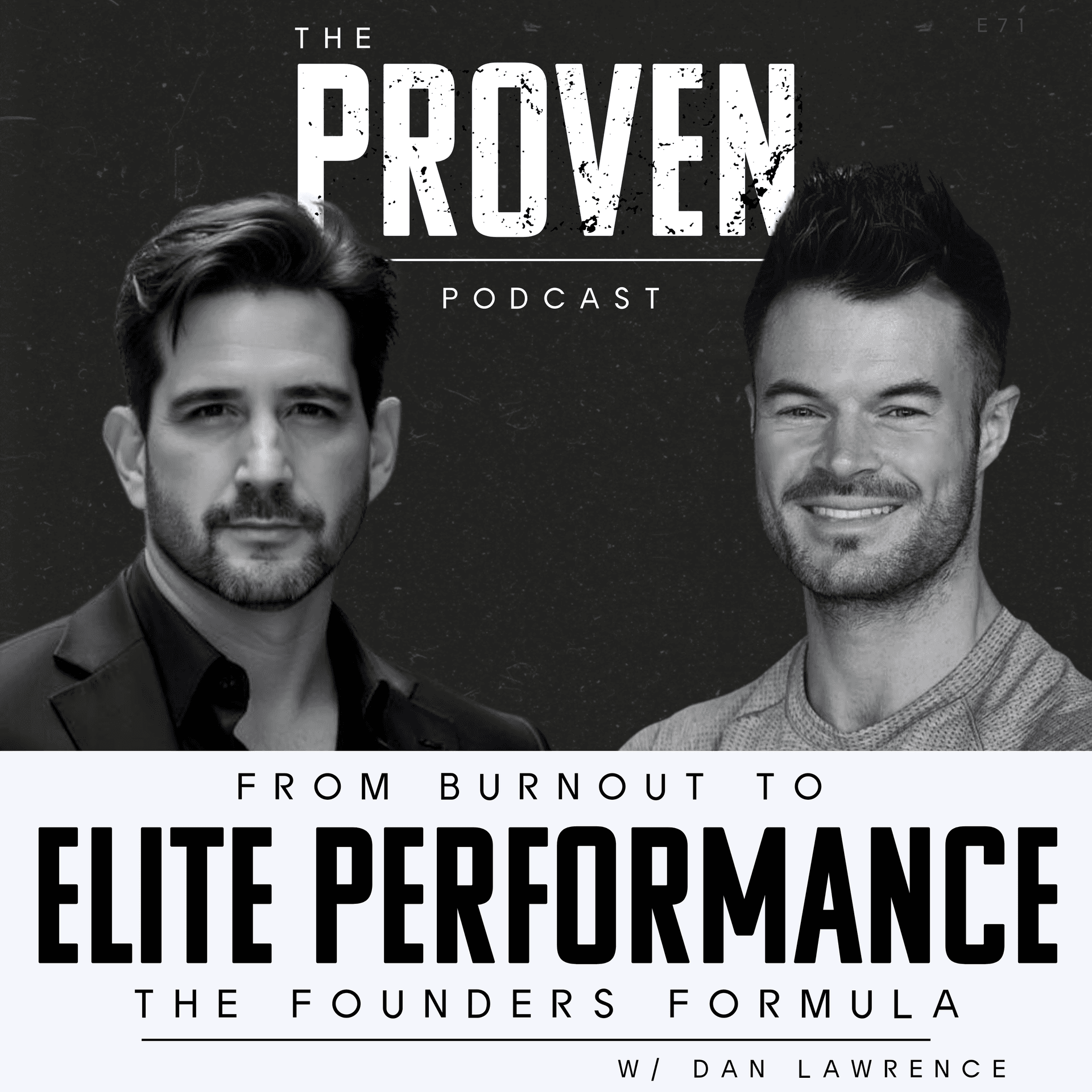
From Burnout to Elite Performance - The Founders Formula with Dan Lawrence
Podcast Overview Title: Proven Podcast Description: Focuses on actionable insights and proven strategies rather than opinions. Episode Title: From Burnout to Elite Performance - The Founders Formula Guest: Dan Lawrence, Human Performance Optimization Coach and Founder of Perform 365. Episode Description: Dan discusses the elite mindset, data-driven science, and identity transformation that drive the success of athletes and CEOs. He introduces concepts like daily non-negotiables, environment audits, and strategies to overcome setbacks.
---
Key Takeaways
- Start Where You Stand: Progress is grounded in personal reality rather than comparison with others. Understanding where you are is crucial to making meaningful changes.
- Application of Knowledge: The true barrier to peak performance lies in the application of knowledge rather than just access to information.
- Identity Transformation: To achieve high-level success, one must embody the traits of the desired identity before fully realizing it.
- Daily Non-Negotiables: Simple daily routines are crucial for fostering consistency and high performance.
- Environment Audits: Analyzing and curating one's environment can significantly impact motivation and success.
---
Episode Highlights
- Human Performance Optimization
- Dan Lawrence shares his extensive background in high performance, having worked with over 30 champion athletes and top-tier CEOs.
- The conversation focuses on the mindset needed for success in health and business.
- Information vs. Application (02:15)
- With abundant resources available, the challenge is applying information effectively.
- Dan emphasizes the mantra "start where you stand" to ground progress in reality, avoiding the trap of comparison.
- Shaping the Elite Identity (03:59)
- Discusses the importance of embodying the characteristics of the desired identity, including environmental factors and even superficial choices like clothing.
- Environment and Friction (06:18)
- Removing friction involves creating a supportive environment and identifying accountability partners to aid in achieving goals.
- Outcome vs. Process Goals (07:59)
- Highlights how winners and losers can have the same goals; success hinges more on the processes leading to those goals.
- Daily Non-Negotiables (08:53)
- Dan introduces concepts of consistency through daily non-negotiables, likening them to brushing teeth—actions taken without negotiation.
- Recovery and Non-Negotiables (15:23)
- Recovery is highlighted as essential for optimal training; basic routines like sleep and hydration should be prioritized.
- Reflect, Review, and Plan (19:03)
- Dan presents a framework for overcoming setbacks: reflect on the experience, review the lessons, and plan for future actions.
---
Additional Concepts Discussed
Data-Driven Performance
- Importance of comprehensive testing (blood panels, DEXA scans, metabolic testing) to create custom performance plans.
- Use of technology and data to track progress and inform strategies.
Lifestyle Adjustments
- Discusses the use of supplements, hydration strategies, and sleep hygiene to optimize health.
- Importance of maintaining a positive mindset and adjusting habits over time.
Reading and Learning
- Assigning educational resources to clients, including books and podcasts, to reinforce learning and personal development.
---
Conclusion This episode serves as a masterclass in building a resilient, optimized identity, ensuring that health becomes a competitive advantage. The principles discussed by Dan Lawrence provide actionable insights for anyone looking to elevate their performance, whether in athletics or business.
---
Resources
- Visit [provenpodcast.com](http://provenpodcast.com) for an exclusive companion guide to implement strategies from the episode.
- Follow Dan Lawrence on social media: Instagram/Twitter: @DanLaw365, LinkedIn: Dan Lawrence.
```
Written by AI. May contain mistakes. Listen to the episode to check what was said.
Chapters
Tap a time to open that second in VOSetting the Stage for High Performance
0:22 to 0:40
Discussion on the mindset necessary for succeeding in business and health.
“Dan, I'm excited to have you on here, man.”
Dan Lawrence's Background
0:40 to 1:16
Dan shares his experience as a high-performance optimization coach.
“For the four or five people who don't know who you are and the people that you've worked with, let's get the audience caught up.”
Challenges in Fitness Goals
1:16 to 2:04
Exploration of why people struggle to achieve their fitness goals despite available resources.
“There's some differences that exist now when we talk about fitness.”
Mindset and Accountability in Performance
2:04 to 2:56
Importance of mindset and accountability in executing fitness plans.
“exactly what to do, why aren't we doing it?”
Shaping Identity for Success
2:56 to 4:46
Discussing how to shape one's identity to align with goals and the importance of environment.
“I'm all here for making people better for sure, but the execution is always suboptimal.”
Incremental Changes for Lasting Impact
4:46 to 6:40
Strategies for making incremental changes to achieve fitness goals effectively.
“Lo and behold, I actually now live in Dubai.”
Daily Non-Negotiables
6:40 to 8:06
Importance of establishing daily non-negotiables for progress.
“point that actually then made me veer off track.”
Outcome vs. Process Goals
8:06 to 12:04
Discussion on the distinction between outcome goals and process goals in achieving success.
“One of my favorite quotes, Charles, if one doesn't know to which port one is sailing, no wind is favorable.”
Small Wins and Identity Reinforcement
12:04 to 13:20
The significance of small wins in reinforcing identity and motivation.
“But yeah, I think that identity is fundamental and leaning into the person that we used to become.”
Lessons from Elite Athletes
13:20 to 14:02
Insights into the daily habits of elite athletes and their non-negotiables.
“watch me absolutely fine you can come down to the gym alan then looked at the schedule and said four o 'clock we've got a game at four o 'clock um you're playing this game with these these other school kids or whatever.”
Show all 29 chapters
The Importance of Basics in Performance
14:02 to 17:04
Learn why mastering the basics is essential for both elite athletes and beginners.
“And he just watched and he couldn't get his head around what he was watching.”
The Role of Non-Negotiables
17:04 to 18:32
Discover how daily non-negotiables can transform identity and performance.
“And then they start believing in the self.”
Embracing Failure in High Performance
18:32 to 21:45
Explore the importance of failure and how to learn from it in various fields.
“When you've seen your high performers, and if you have any examples, it would be great.”
Reflect, Review, and Plan
21:45 to 25:56
Understand a simple three-step approach to overcoming failures and setbacks.
“he sat down with me, he looked at me, he goes, your stomach is your discipline.”
Data-Driven Health Optimization
25:56 to 28:06
Learn about the importance of a data-led approach for health and fitness optimization.
“So when we do the blood work, because I'm a huge fan of science, I don't have the gift of faith.”
Understanding Allostatic Load and Individualized Nutrition
28:06 to 29:25
Learn about allostatic load and how personalized nutrition is essential for optimal health.
“layman's terms, is accumulative stress goes into the same bucket.”
Adapting Fitness Approaches for Recovery
29:25 to 30:48
Discover how to adapt fitness approaches and manage recovery from injuries.
“Well, I think that's what makes you different than everyone else.”
The Importance of Education in Fitness
30:48 to 34:08
Explore how education and understanding biomechanics play a role in fitness success.
“So I, 13 years ago in London, in Harley Street, I had spinal surgery.”
Holistic Approach to Client Management
34:08 to 37:59
Learn about a holistic approach to client management that incorporates education and actionable steps.
“of us do, but certain people do, certainly some more.”
Establishing Goals and Assessing Progress
37:59 to 42:04
Understand the importance of establishing clear goals and assessing progress in fitness.
“and just reset their mindset sometimes, which we all need.”
Understanding Testosterone Interventions
42:04 to 43:10
Learn about the various interventions for optimizing testosterone levels and when they are necessary.
“you know, I've got a family, I'm running a business.”
Factors Affecting Testosterone Levels
43:10 to 45:03
Discover lifestyle and environmental factors that can negatively impact testosterone levels.
“based on normative scores, they're so low, then we do have a team of doctors who can advise around that, but that would always be monitored throughout the process.”
Improving Sleep for Better Hormonal Health
45:03 to 47:39
Learn practical steps to enhance sleep quality, which is crucial for testosterone production.
“We'll look at their natural sleep-wake cycle.”
Creating the Perfect Day Formula
47:39 to 51:15
Understand how to structure your day for optimal performance and hormonal balance.
“I wear an eye mask in the evening as well.”
Wearable Tech: Whoop vs. Aura
51:15 to 55:10
Explore the pros and cons of using Whoop and Aura devices for health tracking.
“It's important for you to bring your best self to every situation.”
Building Consistent Habits for Health
55:10 to 56:03
Learn the importance of consistency in building habits that support health and performance.
“The person who wins a tortoise and the hare is the one that just shows up consistently.”
Building Habits for High Performance
56:03 to 58:06
Learn how to effectively build habits that contribute to high performance.
“Because again, you're working with high performers.”
Understanding HRV and Stress Management
58:06 to 1:00:26
Discover how HRV relates to stress and performance management.
“Yeah, I think it comes down to it's you versus you and one of you has to die.”
Performance Optimization Program Overview
1:00:26 to 1:01:33
Explore the performance optimization program and how to get involved.
“You need to sit there and have what's the data saying?”
Transcript
Automatic transcript. May contain errors.0:00Dan Lawrence:Welcome to The Proven Podcast, where it doesn't matter what you think, only what you can prove. Today's guest is Dan Lawrence, a dealmaker and operator who has built, bought, and scaled businesses by mastering capital structure, acquisitions, and disciplined execution. Dan has proven that understanding how money, risk, and incentives really work is what separates operators from spectators. The show starts now. All right, everybody. Welcome back to the show. Dan, I'm excited to have you on here, man.
0:27Charles:Thanks for having me, Charles. Excited for the conversation.
0:29Dan Lawrence:There's few people in the world that actually succeed in success on both business and health and everything else. There's a mindset to it. There's a lot of different things to this, and we're going to break that down and talk about it. For the four or five people who don't know who you are and the people that you've worked with, let's get the audience caught up. Who are you? Who have you worked with? Just give us your resume real quick.
0:49Charles:20 years in high performance. I'm a human performance optimization coach. I've worked with over 30 champion athletes from NFL Super Bowl winners, undisputed boxing champions, and numerous Premier League footballers. I've now over the past five or six years taken that into a slightly different domain, working with some of the highest level CEOs across the planet, Royal Family, and just anyone who's looking to truly be optimized. We're in a world now where the word longevity is getting thrown around quite a lot. I was in this space before it was deemed cool. And for me, I'm just in this space to really help people to live a better, more fruitful life.
1:19Dan Lawrence:Love it. There's some differences that exist now when we talk about fitness. I've been a triathlete, I've been in shape my whole life. I played summer professional sports. Everything that's out there as far as it's a different world. You know, I bring this up because my father was senior vice president of GNC. He was senior vice president of Bally's Total Fitness. I've been around fitness for a really long time. The things that were just mystical before, we just tap into AI like, we're going to plan. And you magically go get it. And it's not, we're not getting the results. You know, by the time we're recording this, we just passed international fail day, which means, hey, you made your goal.
1:51Dan Lawrence:Congratulations. Your new year's goal. It didn't work. You've already failed. you get beyond that. You've got into people and you help them pivot around that, not with theory, but with hardcore science. I wanted to break down a lot of that as we go through it. And we're going to rip that apart, but I wanted to start with the most important, which is if we already know exactly what to do, why aren't we doing it? Why aren't we executing, especially as high performers, because we execute so well in other parts of our lives. We're not doing it here. What have you seen as the break?
2:18Charles:For me, mindset is the glue that holds everything together and accountability. You said yourself there, you've got AI, you've got YouTube, you've got all of these resources out there. In fact, probably too many that you can find the information. The information is readily available, but the application is what people struggle with. So I have a saying, start where you stand, identify where your feet are now, not where anyone else is. And comparison is the thief of joy, Charles, as we see in January, New Year's resis, New Year, new me, I'm going to make this change. And people are just looking left and right and focusing on what someone else is doing.
2:48Charles:Yet they should just focus on where they are in this moment because though the intention is pure, I want to make a change, I can absolutely champion that. I'm all here for making people better for sure, but the execution is always suboptimal. So I think having a very clear system and a system and environment that enables someone to make a change is vitally important. So if all your friends are going to the pub and you are the bar, I should say, in America, and four of your friends are, you're going to be that fifth friend. So maybe you need to have a bit of an environment audit to see really what you're looking to achieve.
3:23Charles:And is that environment aligned with the longer term goal of keeping you on track if you're looking to make a change?
3:28Dan Lawrence:One of the things you talk about all the time is not just auditing your environment, but auditing yourself. Setting a goal and say, this is the identity that I want to present. This is who I am. I literally wrote a book about this. How does a high-performing CEO show up? How does he dress? How do you do all of that? I wanted to rip apart more of the mindset side because everyone watched the David Goggins on there. Like, I'm going to get up at five o 'clock in the morning and run seven miles. No, you're not. You're not. You're not. It's horrible outside, especially if you're in the UK, there's this rain and it just doesn't work.
3:59Dan Lawrence:How do you remold your mind? Because that's where it all starts.
4:02Charles:Yeah. Shaping the identity is fundamental, leaning into the person that you wish to become even before you're there yet. So identifying one, what your goal is and two, what the identity of that individual of who you wish to become embodies. So if, for example, we've got a guy on our program, Nathan, he was a CEO of a pretty big company in the UK, a nationwide CEO, if you like, but he wants to become a global international CEO. So we took a step back, we sat with it and said, okay, well, what does that person look like? What traits do they embody? What do they wear? How do they carry themselves?
4:32Charles:How do they posture? How do they communicate? We went even as granular as this Charles, where do they stay? He lived up North. When he came down to London, he stayed at a hotel that may have been slightly above his remit as to where he was there, but it wasn't above the remit of an international CEO. Lo and behold, I actually now live in Dubai. He came to meet me here the other day, super proud of him as he is now an international CEO. So I think looking at the traits of that individual, but again, the environment order is fundamental because otherwise you're playing the game in hard mode. If your environment is not conducive to growth and success and you're getting pulled left, right and center by all of this distraction, irrespective of how disciplined one individual is, you're playing the game on hard mode.
5:10Charles:You're quite literally going upstream. So firstly, for me, it starts with, yes, knowing the traits of the individual that you wish to become. Yes, getting granular and specific with your goals and the outcome of where you're going, but then also auditing what you've got going on right now. I used to, believe it or not, I used to hate running, and that's a very strong word. And it started, my shift started by banishing the words of me saying that. I said, I've got to stop saying that. I coach people this. What am I doing? I'm shaping myself around an identity of someone who hates running. I stopped saying that.
5:40Charles:That was step one. Step two, this is when I lived in the UK, and you're completely right. The weather in the UK is very gray, very miserable. I knew that I was not going to start running at 6am in the morning in whatever rain, and that was not going to set myself up for success. What was going to set me up for success, however, was my friend Jordan used to pick me up, removed all friction, we drove to richmond park beautiful park great location if anyone's been there like lots of health conscious individuals either running or cycling so great environment we had a powerful conversation when we ran he's in finance he's got growth mindset as well so we had some really good conversations and then the end of the run we had a reward mechanism i'm a bit of a coffee snob charles so i like a nice bougie coffee so he had a nice coffee and then he dropped me home so you can see how i set that environment up remove friction and then we didn't start by running a half marathon.
6:27Charles:We started with a 5K and then we made incremental increases on the volume. So I wasn't hobbling around for three days. You get this acute spike in training loads, it increases injury risk, and I then anchor a negative thought process towards running. Well, actually it wasn't the running. It was the suboptimal strategy going back to our previous point that actually then made me veer off track. So again, start where you stand, environment audit, and then be around people who actually maybe are a little bit ahead of you. He was a better runner than me. So I thought, okay, he's going to pull me up to his level and I made it easy for myself.
6:55Charles:So that's just a couple of tricks and traits that we follow. Yeah.
6:59Dan Lawrence:I love that you had through with our accountability partner as well. You had someone who's going to hold you accountable. They bring you in, they bring out the fire. And we talk about this all the time. Things in your environment are either building your flame or pissing on your fire. It's that simple. And it goes through auditing. When we do this and the stuff that I've done is look at your toothbrush. Is that the toothbrush of the person that you would ideally want to be? Look at your watch. Look at your clothes. What is your underwear? I had a client before. I said, look at your toilet paper.
7:24Dan Lawrence:And he's like, what are you talking about? What is wrong with you? I was like, is that the toilet paper of the person that you would use? He's like, no, I hate my toilet paper. I go, then what are you doing? This is a$3 fix. And as you change those things in the environment, it'll start fortifying the mindset. So if we've changed our environment, we're having accountability partners, and you're out there, and you've got your buddy, and you're surrounding yourself by people at a higher level, what do you do when inevitably the motivation wears off? Because motivation isn't real, and it just doesn't work.
7:51Dan Lawrence:What are you doing before we get into the scientific back stuff, which is just magic with what you do? What are the things that you lock in on mindset and getting past that motivation failure and getting past those first failure?
8:03Charles:For me, it starts with where you're going. One of my favorite quotes, Charles, if one doesn't know to which port one is sailing, no wind is favorable. You're quite merely treading water. You're going around in circles. So we've got to know where we're going first and foremost. I'm going to talk now about outcome versus process goals. I do believe you need to know where you're going, but something we say in pro sport is winners and losers have the same goal. The goal is to win, right? Of course it is. But that doesn't get you any close to the goal. It's an intention. It's like if I say I'm going to run the marathon, brilliant, I'm going to run London Marathon.
8:30Charles:The intention is there, but that doesn't get me any closer. I haven't done any strength and conditioning. I haven't understood any running volumes. I haven't dialed in my nutrition to give me the fuel for the work required. So there is no strategy. So we've got to know where we're going. The outcome needs to be set, absolutely. But then we've got to reverse engineer the process and then put daily actions and daily steps in place that will get us closer to the longer term goal. Because in some instances, the outcome might be 12 months away. We work with people over a 12-month time horizon. So if we get really clear with where they're going, great.
8:58Charles:But they probably feel like it's so far away, it's almost unattainable in that moment. So that's where, like in business, we'd set quarterly goals, absolutely. We then set 30-day accelerator targets. But then we go as specific as we call it WTD, win the day. What does winning the day look like for you? And this is where daily non-negotiables come in. Simple things that you'll do on a daily basis without negotiation. You simply won't negotiate. Use the toothbrush analogy earlier. Well, it's like brushing your teeth, or at least I hope. Twice a day, we brush our teeth. So if that's a non-negotiable, well, let's start thinking about what the other things are.
9:31Charles:But you only know your non-negotiables, the process, when you know the outcome. So for more context, if the goal for someone starting in January might be they're at 25 % body fat and they'd like to get south of 20%, so 18-90 % body fat. So we know they want to improve body composition, they maybe want to increase their lean tissue by X to Y. So they want to make a shift and they get specific. It's not lose weight tone up, you can see I was quite specific with the targets there. And maybe they want to improve their VO2 max. Well we then link their daily actions towards that longer term outcome goal.
10:02So that might look like drinking two to three litres of water a day.
10:06Charles:It might look like having 2 grams per kilogram of body weight of protein per day. The World Health Organization's recommended allowance of protein is ludicrously low at 0.8 grams per kilo of body weight. Well, based on the work that we do with our nutritionist, Dr. James Morehan, he recommends anywhere between 2 and 2.4 grams per kilo of body weight, which is quite a huge shift. So we can link in daily actions that are aligned with a longer term goal. And going back to identity and mindset specifically, Charles, a lot of people who may join our program, some are absolute savages before they join our program without doubt.
10:38Charles:They're go-getters, they're high-level CEOs, they are high-performance, they embody those traits, but they always want to get to the next level. And we know that if we can unlock them for another 5 % to 10%, which we absolutely can, if not more, then that quite literally is another zero on the end of the deal, or it's quite literally they're maximizing each and every day. But there's also people who join our program, high-level CEOs who are very early on in their journey, very early on. And for those individuals, if we go back to identity, if we set too lofty a goal, an unattainable goal. What does that then do to this individual?
11:09Charles:This individual might be 40, 45 years old. They've tried for the last 20 years to make a shift and lose weight and start their health and performance journey, but they've always ended in failure. That's why they're here now. So we just start with small wins because if we can get these small wins going, like daily non-negotiables, we do that over a 30-day period. We're ticking them off as we go. We're championing them and saying, you know, you can do this. I had a guy today, won't mention the name, high-level CEO, started the journey at 132 kilograms, so he's a large individual, certainly a lot lower than that now.
11:39Charles:We had a performance strategy meeting here in Dubai yesterday, super proud of this guy by the way, because I was running today and he sent me as a signal of intent that he's going to be doing a 10K run with his team in London, in his London office. And that's the key as well, is when you have a conversation, you set your intention, do something right away that is going to bring you closer to that goal. So he's literally signed up to that, told his team, So now he's got an outcome performance-orientated goal to look forward to in September of this year. So a few things to unpack there. But yeah, I think that identity is fundamental and leaning into the person that we used to become.
12:14Dan Lawrence:I think it's everything. And one of the things that's important about identities is understanding that you're not normally in a world that most people are in. You deal with extremely high performers. You deal with elite athletes on the highest level. What are some of their non-negotiables? Because people are like, okay, what's the magic secret? I dealt with this when I was a kid. The Jordans came out and I'm six feet tall, about 204, thinking that I'm going to put on a pair of magic, you know, Michael Jordan shoes and I'm going to dunk. It's not going to happen. So please understand the audience who's listening to this, a pair of shoes is not going to make you Michael Jordan.
12:45Dan Lawrence:So when we go through these non-negotiables and these things that are working for these elite athletes, this is a very small part of the proven thing. So let me get that disclaimer out there in advance. But for this and what you're talking about, you know, what are some of the non-negotiables that these elite level individuals that you've worked with are doing?
13:02Charles:there's a great book by alan stein jr called raise your game i'm not too sure whether you're familiar with it but alan stein jr talks about the brilliant basics and he was at some practice kobe bryant was there he wanted to shadow him he wanted to see him in action so kobe said to him four o 'clock tomorrow fine come and watch me just you know don't get involved just just come and watch me absolutely fine you can come down to the gym alan then looked at the schedule and said four o 'clock we've got a game at four o 'clock um you're playing this game with these these other school kids or whatever.
13:32Charles:He said, oh, no, no, 4 a.m. All right. Okay. Fine. No issue. Allen Stein Jr. gets in the taxi, goes to wherever he was playing at probably 3.45, wanted to get there a bit early, make an impression. That's the standard. But he could see the lights were on. As he got closer, he could hear basketballs going, lights were on. What's going on? It's only 3.45 a.m. He told me 4 a.m. He goes in, Kobe's sweating profusely, evidently been there for probably 45, 50 minutes. And he's there with his notepad out thinking, I'm going to get the secret sauce here. I'm going to get all of these hacks now that I'm going to take into all of my practice moving forward with all of these youth athletes.
14:05Charles:And he just watched and he couldn't get his head around what he was watching. Basics, fundamental drills, each and every time, repetition, repetition, repetition. He spoke to him after and said, I've just watched you practice. And again, thank you so much for allowing me to do that. But I do have a question. Why is it all so basic? And his reply was, I paraphrased, something along the lines of, you never get tired of the basics. You have to do the basics because the basics work. So going back to your point of non-negotiables, even though these are supreme level athletes at the summit of the proverbial mountain, and they are high performance in everything that they do, daily non-negotiables reign true for someone starting their fitness journey at 132 kilograms, or someone like a Kobe Bryant, or in my instance, a Connor Ben.
14:53Charles:So for an American audience, Conor Benn is a supreme superstar athlete, boxer in the UK. He's just successfully beaten Chris Eubank Jr. Their fathers had a fight in the 1990s. This galvanized the British public. It was at Tottenham Hotspur Football Stadium in front of 62 ,000 people out to millions across the globe. For context, he's potentially fighting Ryan Garcia in the next fight in Las Vegas, providing Ryan Garcia gets through Mario Barrios on February the 21st, but that's for a world title at£147, just to paint the picture. In our training camp, before last, in Mallorca, Spain, Conor Benn was doing non-negotiables.
15:27Charles:There was a big media thing, it was in all the magazines and newspapers, sorry, because they came over for a press week, and I had on a whiteboard Conor Benn's non-negotiables. For context, Charles, just to showcase to the audience here that these could be used for absolutely everyone to great effect, no phones after 9pm. Well, why is that important? We know the blue light exposure is going to negatively impact melatonin production, which is therefore going to have a knock-on effect to sleep. Conor is very type A, million miles an hour. He does not know 60%. When I ask him to give 60 % in a training session, it's 100 % all in every time, which is a coach's dream.
15:59Charles:But knowing that, you've got to know your athlete, that recovery is fundamental. And something we say is you can only train as hard as to what you can recover from. So if your sleep is impacted because he's like this and looking at his phone at 11 o 'clock at night, well, that's going to be incredibly problematic to the recovery piece. So that's the first one. The second one was three liters of water a day. Well, in Majorca with higher perspiration rate, with an athlete who again, sweats a lot, trains a lot twice a day, six days a week, that's pretty important from a hydration point of view. 2 % drop in bodily fluid can lead to hydration issues or dehydration that then impacts muscle contractions, cognitive function, decision-making.
16:37Charles:Obviously with a boxer, CTE, they're getting punches to the head. That's very problematic. So you can see how the daily non-negotiables are linked into something that actually is incredibly important towards the longer-term goal of winning the fight. So to your question, there is no secret source, but these systems work for absolutely every human on the planet. Certain individuals like a Conor Ben, you give him non-negotiables, yes, they're very basic, but you then have to educate him to say that these are linked to this longer-term goal of winning. Brilliant. Okay, I'm in. But then people earlier on in their journey, they are so, so important because non-negotiables can quite literally shift one's identity from someone who always fails to someone who actually is now creating small wins and start shaping the identity to the person that they wish to become.
17:20Charles:And then they start believing in the self. And then we layer it. It's like habit stacking. We stack new wins on top of the old ones.
17:27Dan Lawrence:I want to talk about failure a little bit here, because it's vitally important. We fail, especially as entrepreneurs and high performers. We love it. We always talk about this all the time, fail faster. Fail as fast as you can, and let's rock and roll with it. When it comes to our physical performance, there's a different mindset there. We struggle with it sometimes. All of us do. It was like, okay, we're going to fail faster. And, you know, go to the point of failure in the gym and all of that. We don't do it as well there. And I know this because I'm around these guys. It just, it is what it is.
Read the full transcript
17:54Dan Lawrence:So, and again, for the audience who's playing at home, I probably have failed 70, 80 % of the time that I do business, but my other 20 to 30 % crush it. It just, it is what it is. So it's, I embrace it because I want to fail because I'm going to learn more from that failure and it's going to speed up my success. Yeah. We don't have that in our fitness journey. We don't have that. We don't value our health as much because people believe time is the most valuable asset we have, which it's not. I spent eight years in a hospice watching people die. Time doesn't matter because there's people who had polio who had 80 years, but they sat in a tin can.
18:27Dan Lawrence:They couldn't do anything but move their head. So health is beyond all else. When you've seen your high performers, and if you have any examples, it would be great. When they fail, how are the ways that these high-end CEOs, these high performers, be it their athletes or entrepreneurs or wherever it is, when you've watched them and when you've coached them, what are the ways that you get them out of that failed run? Whether like, oh, I can't do this anymore. Yada, yada. Or you know what? Hey, I'll just take a day off. We talk about this all the time. Missing one day, no big deal. Missing two days in a row, that's the beginning of a new habit.
18:56Dan Lawrence:So we talk about this. When you come into this ballgame and you have this hunt, where are you going with that? How are you helping them get out of it from that failure ratio?
19:06Charles:We've got a three-step approach. Very simple, Charles. Reflect, review and plan. Firstly, you have to reflect on that moment. And this is in with success or failure. And I'll mention Conor Bell again. For the listeners, he succeeded and achieved the outcome in the second fight. In the first fight, we actually lost. For context, he was stepping up two weight classes, never boxed in a fight of that magnitude. And it was steeped in family history. So there's a lot of pressure on that young man's shoulders. So the mindset was key. And he went in a bit gung-ho in that first fight. So after the first fight, we reflected, we reviewed, and then we plan.
19:38Charles:The second fight, calm amidst the chaos. I paraphrase here the Zenzu quote in The Art of War. It's not the hothead who wins the war. It's the calm, calculated warrior. That was what we took from fight one into fight two. And fight two was an absolute masterclass where he put him down twice in the final round. So that's a real world, very recent example of adapting and overcoming. So going back to my three-pronged approach, we have to reflect because otherwise we're blasé, and this is even in victory, even if we'd won, going into the next fight camp or the next game or the next boardroom meeting, whatever it is, you're driven by ego if you're not just sitting with your thoughts for a moment.
20:18Charles:We have to reflect in that moment to see that went well, but actually there were a couple of things that could have gone a little bit better there. So then we have to review it with our team. And then once we've done those two first phases, we can then plan ahead for how we can get better moving forward. So a very simple approach. I think it also comes with any high performer is that we're all very aware that it's not a linear path. We know that there's going to be many a hump in the road, otherwise we would have done it many moons ago. So it's having the accountability and the environment set up to know that when you hit a hump in the road, do you become downbeat and then fall off track?
20:50Charles:Or do you say, okay, this is part of the process. I've been coached by this. I can speak to my coach, my head of performance, whoever else around me to know that this was going to happen at some point. Annoyingly, it's happened a little bit sooner or annoyingly it's happened in this moment before this huge deal, whatever that looks like contextually to you. But we knew it was going to happen. So now I've got the coping mechanisms and the mindset to enable me to say, okay, I'm going to sit with this for a moment. I'm going to follow the same three-pronged approach of reflect, review, and plan. But you better believe I'm going to plow on and I'm going to overcome that hump to get closer to the longer term goals.
21:20Charles:So I think the self-awareness to know that it's not going to be easy. We're going to be putting out fires at times. I'm sure as any high-level CEO like yourself pulled left, right, and center at times. But that's why we build systems and frameworks to enable us to overcome these moments.
21:34Dan Lawrence:I also love the self-awareness because when we go into negotiations, when we go and meet with other people, understanding that they're evaluating us from our watch to the way we dress to everything else. And I had a mentor a long time ago, he sat down with me, he looked at me, he goes, your stomach is your discipline. Your arm is your ambition. And I was like, oh. And as a VC and as a high performer, when people walk in and I see the big gut and I see these tiny arms, I'm like, okay, I know how to interact with them. I just, all right, here we go. This is where they are. versus if someone comes in and they're in phenomenal shape.
22:04Dan Lawrence:I'm like, okay, this is a different mindset. This is a different thing. So there is a competitive advantage that absolutely correlates to your bottom line. This will add zeros to it. So this isn't just, I want to look pretty, I want to look good with my shirt off. There is, you are perceived differently. And a dear friend of mine sat there and goes, Jesus, look at Bezos. Look how good a shape he is. I was like, mm-hmm. There's a reason he's doing that. There's a reason. It isn't so that he can go and get more women. And I had to clean that up there. I tried my best to clean that up there on that part.
22:33Dan Lawrence:So when someone comes in, I think the audience knows we're, you know, we're 20 minutes into this at this point. We haven't even talked about workout plans yet. We haven't even done that. Let's get into the science now. You know, it's something when you had our, you and I had our first call, it was a little bit later in the evening and you're like, Hey, I'm pushing off, putting my blue blockers on. I was like, put your blue blockers on, man. You and I are a different type of work. Put them on so we can start doing that. Let's go into the science of this. You know, you don't start with, all right, let me take a picture of you and let's talk about your goals.
22:58Dan Lawrence:That's not who you are. You're someone who's backed by science. You go into blood tests and type two scans and all of that. Tell me why that's important and what are some of the things that the high performers in your world have learned when they get those blood results back?
23:13Charles:Yeah, great question, Charles. So we work with high-level CEOs. So these are people who know their P &L. They know where they're going from a business point of view. Something we say is like in business, what gets measured gets managed. We follow an objective-led, data-led approach. So that instantly gets them like, oh, I'm interested now. Because people, when it comes to health, just going to the gym or having a personal trainer a couple of times a week, is that really enough? If we're looking at the word optimized, does that ensure that you're truly optimized? Well, we don't know what's going under the bonnet at that point.
23:40Charles:You're quite literally, look, there's absolutely some benefits in going a couple of times a week to see a PT without doubt. But is it the strategy that's going to make you optimize? And we know in absolute, certainly it's not. So getting some data on the front end is really important. So again, similar to like we would in business. So some of the things that we do, we do a comprehensive blood panel. We have a doctor over in Australia who analyzes the bloods to really see where clients are at from blood lipid profile, testosterone, however many biomarkers that we look at. So that's step one. We have clinical labs in London, Dubai.
24:11Charles:We have partners all over the world in the US as well, where we do a DEXA scan, the gold standard test of body composition, looking at bone mineral density lean tissue limb to limb asymmetries it's absolutely incredible so that will formulate the nutrition plan we then do an rmr so resting metabolic rate test to see how many calories one burns at rest so then that as well with the dexa can feed into knowing exactly what the client should be doing from a fueling point of view that aligns with their goals we also do a vo2 max test which is the gold standard test for the cardiorespiratory system there's lots of research around reduced mortality rates and longevity that's really a big one that dr peter at here and Outlive has been certainly championing of the late.
24:47Charles:So we do that. We can either do that on the bike or the treadmill, depending on the client. Then we do strength diagnostics as well. So we do jump testing, profiling, power. For any dude who's getting older, we still want to be an athlete, so to speak. We want to have these qualities. We don't just want to be in the gym doing sagittal dominant movements, up, down, forwards, and back, bench press and bicep gills, which I absolutely love, by the way. But we still want to be moving in 360 degrees. That's how human movement is designed to function. For anyone north of 35 years old, we know that those niggles are going to be there at times.
25:18Charles:We can't train like the way we were at 18 when we have no understanding around training load management. We have a very simple traffic light system with my business, which is basically your red is like your high day. Let's push. Let's really go for it. I feel great. My whoop data or my aura ring data is saying I'm good objectively, but then also subjectively, I feel good. I feel really ready to go. I don't have any muscle soreness. I'm going to merge those two data collection points together and I'm going to really push. So that would be a red session. But we also know, Charles, that not every day is created equal.
25:46Charles:So some days we might have to have a green day and that might be some mobility work, some breath work, some zone two work on the bike. So we structure that accordingly, but we really use data to drive the decisions.
25:56Dan Lawrence:So when we do the blood work, because I'm a huge fan of science, I don't have the gift of faith. I'm a science stork all day long. I just went through with true diagnostics and we ripped everything apart. And then I went and had my SNPs analyzed for the DNA level. So it went to say, hey, this is what you react to. This is what your body can do on that level when it comes in. And for me, it's allowed me to have an aging rate of 7.3 versus one. So for every one year I'm having, it's only 0.73. So it just, it changes the ballgame. And we've seen with science that you can reverse that. You can make it even, you can bring it, you could slow those things down.
26:28Dan Lawrence:What are some of the things that you're using when you're analyzing this? Because I know you guys are pulling the same data and we're looking at the same blood work. So we know that, hey, this person will respond better to this food, to this interaction at this time, because we break it down on that granular level. Because this is the difference I don't think people understand is when you're running around and you're going on chat GPT or you're getting some sort of whatever it is from AI that says, you need to work out four days a week. You have no idea what you're doing. You have absolutely no idea.
26:52Dan Lawrence:It's the equivalent of taking a gallon of gas and throwing it at the windshield versus actually putting it in the car. It's ineffective. So it's one of the reasons that I wanted to have you on is because you break it down in that way. What are the things that you've seen food-wise? because people are going to ask this because, you know, food is your source. It is your healing thing. What are some of the things that you've seen where you're like, you know what? This is what everybody thinks it is. It's not. Don't do this. Universally, don't do this. This we've seen has a better performance ROI.
27:20Charles:Yeah. There's no, what I will say, there's no one size fits all approach. Unfortunately, it's not, you've got to do this. This is the limitless pill. Every human is, is different. And that's why we do all the tests because it's incredibly bespoke and individualized to that, that person. So we have our expert in Bloods, who is certainly far more knowledgeable in that specific area than myself. We then have our doctors in nutrition as well. So for context, our nutritionist is the head of performance nutrition with England Rugby. They're all PhDs in their respective areas. So we have experts across the board.
27:46Charles:So they'll work collaboratively with the blood work and the nutrition plan. But there is no real one-size-fits-all approach. I think the main thing that we tend to see from the Bloods around testosterone and free testosterone levels is with the guys that we work with who are anywhere between 30 and 60 years old, quite frankly, we talk a lot about allostatic load. If we're thinking allostatic load, we call it the stress bucket, if you like, for simplistic layman's terms, is accumulative stress goes into the same bucket. We could be looking at training stress. We could be looking at relationship stress.
28:18Charles:We could absolutely be looking at business stress, and then all of the other lifestyle and environmental stresses like travel. You know, I live in Dubai now. I flew back to London for a talk on some leadership summit last week. And, you know, that's an eight hour flight, 14 hours of travel. Well, I've got to be quite mindful that the bucket was quite full in that moment, but I still try to bring my best self there and then. So all of these things really need to be considered. So they will impact the bloods and the markers that we do have. So I can't really give a definitive do not eat this moving forwards, unfortunately.
28:49Charles:But what we would say is that everything that we do is truly individualized to that person. Just today, for example, we have a client here, an Indian trader, a big businessman out here. One of my nutritionists, he'd originally advised him to increase his vitamin D intake. Then our other nutritionist saw his blood panel and went a step further and challenged the other nutritionist on it and said, you're only asking him to have, I don't know what it was, like 2 ,000 IUs of vit D a day with K2. He said, I think with his markers, he's actually pretty low there. So he actually increased the dose 3X.
29:21Charles:So he's going to try that for a small period of time. So it is very individualized, but that's just one case today with this Indian trader out here that will make that intervention, but then we'll get his bloods done again to see how there's been a change.
29:34Dan Lawrence:Well, I think that's what makes you different than everyone else. In business, if something's not working, we're like, hey, go try this, run the marketing, do A-B testing, see what the ads come back. And we do that. But we don't expect to do that in our fitness. So someone comes in and says, hey, these are where my markers are. I'm doing your blood work. I'm keeping an eye on it all the time. I'm seeing this difference. Let's try this first, very specific period of time. So let's A-B test it, and then we'll come back. And if it doesn't work, mazel. That's fantastic. We'll now go do something else.
29:59Dan Lawrence:Because this is why I think you're getting the results and you're sought after versus other people are sought after because they're just, they're full of it. You're winging it. Sorry. You could, you could buy a DVD. It's not going to convert the same as if you actually break these things down. So when people do break down and they're in it and they're rocking and rolling and the things are going well because we're human and because none of us are 18 years old, which is depressing, but because we're not 18 years, we're going to get hurt. It's going to happen. It's just the nature of the beast. I've got a torn labrum in my left arm.
30:29Dan Lawrence:I have something called Hill-Sax injury. So if I adjust a certain way, there's certain free weights that may know my arm hurts out of socket. It is what it is. What are some of the ways that when someone does get hurt, which is going to happen, you're going to be sore. It is what it is. You're turning on engines that haven't been turned on in a while. How do you get them through that recovery process? Yeah.
30:49Charles:Adapt and overcome. So I, 13 years ago in London, in Harley Street, I had spinal surgery. I had a microlumbar disectomy, L4, L5, and I was in debilitating pain, Charles. So I can certainly speak on this. At the time, it was, whew, I want to jump off a building type stuff. But actually, it was the best lesson that I had. That was my hump in the road, so to speak. So now on a macro level, looking back in hindsight, it made me upskill in that respective area with a lot of the great work from Professor Stuart McGill of the Waterloo University in Canada and just incredible knowledge around lower back.
31:19Charles:So now anyone who comes to me, we can advise around things that I've seen and I continue to manage. So I'll probably get a lower back flare up. I probably shouldn't say this twice a year because I train, I'm 38 in a few weeks time and I train five, six days a week. I cannot train like I did when I was 18. I'm very aware of that. I like to think my knowledge is a little bit better than I was when I was 18 throwing aimless tin around the gym, but I do still love training. Training is part of my identity, showing up, setting a training time, getting it done, win the morning, win the day, and that really shapes my day.
31:50Charles:So that's a huge part of what I do. Of course, the volumes, loads and exercise selection is very, very different these days. But I also have an awareness piece that there will be the odd setback. Absolutely, there will. And when we do hit that hump again, if we're staying in the same terms and language here, we see where they're at at the moment and then we adapt the plan. We've got a guy out here, joined our program, high-level CEO, multiple exits, came to us with a lower back issue and a right knee issue. He was playing way too much paddle, way too much golf, lots of rotational sports, never did any mobility work, was very against sagittal playing, up, down, forwards, and back, bench press, and bicep curls.
32:27Charles:He'd then go through these high torque rotational sports that I've just mentioned, and his lower back was just letting him know about it. He had no real motion. He was quite locked and glued through the lumbar spine. So we then, and he was very negative towards any lower body loading because of his knee. He'd anchored a negative thought process due to previous experiences with other coaches that, oh, I can't really weight bear through my lower body. Lo and behold four weeks into the plan he didn't like it but we had to say based on the analysis from our chiropractor dr ron and out here in dubai we can't do paddle and we can't do golf for four weeks didn't like it but just trust the process so four weeks we pulled back from that of course no running in that time as well we solely focused on lower extremity loading building strength and stability around the knee mobility work as well for the thoracic spine to get his spine moving properly and he's in a great position now he ran for the first time the other day on the treadmill just so he had a bit of absorption there.
33:19Charles:Feeling great, no knee problems, and he's feeling a lot more stable. He even said to me two days ago, Charles, he goes, damn, my bench press and pull-ups have improved exponentially. And I'm like, yeah, no shit. You're a lot more stable through the whole kinetic chain. Everything's firing the right way.
33:33Dan Lawrence:So to my point is there will be setbacks on
33:38Charles:the journey. You expose your body to stress. At times, you will break down. But rest assured, if you're with a team of professionals who've worked at the highest level who truly understand biomechanics and truly understand environmental factors as well as we both shoot this here we're both sitting down what what what do we present as well our hips are short our glutes are not switched on our t-spine is rounded into in a forward flex position our shoulders are you said there about your labor we're in a protracted and internally rotated position our pecs are short and tight as are our lats well if we then spend eight hours a day in this position which i know neither of us do, but certain people do, certainly some more.
34:15Charles:You times that by five over the course of a week, that's a considerable amount of time then at that or times that by 12. These are the environmental constraints and factors that one has that shapes how they move. You then get them on a golf course or on a paddle court and they've never done anything other than sitting down and a bit of bicep curls and bench press. We can now, irrespective of whether we have an understanding around biomechanics, we can see logically that things are probably going to break down. So yeah, we have the appreciation that things may go wrong, but we build a plan that improves one's posture, stabilizes the shoulder joint, strengthens the glutes and posterior chain, builds midline control through the core.
34:53Charles:I liken the core to like a tree trunk. The trunk is the core, the branches are your limbs. So we want to, from Professor Stuart McGill, maintain proximal stiffness with distal mobility, lock the midline down, and then allow the limbs to function like a sprinter doing 100 meters, pumping their arms and legs, but the core is relatively stiff. That's a transfer center, transferring from foot through the body. So I think it's just having that education and understanding that when you're with the right people who understand you, you go through all the testing, you can then draw strength from that. So I could give you many other, that guy's name is Jimmy, he won't mind me saying, I could give you many other examples other than Jimmy of very similar scenarios where they come to us in a poor position, but over time we get them back to normative function and some.
35:37Dan Lawrence:So one of the things you talked about is the entire ecosystem educating them. Your stuff that I've done enough research on it, you give people homework, which I don't think I've ever heard any other trainer do this. You will assign them things to do. You will assign them things to read.
35:51Charles:Walk me through that.
35:52Dan Lawrence:What are the things you normally assign people to read as you're going through this? You just say, listen, it's great that you're out here and you're eating what you're supposed to eat and you're doing some of the exercise, but yours doesn't stop there. Because again, you're taking a scientific holistic approach. We're taking the entire system when you're doing this, just like we would in business. We're going to look at everything from A to B. If you're going to high perform here, take those same attributes, those same skill sets and put them here. So when you're doing that, what are some of the things which it blew my mind that you're like, hey, I need you to read this.
36:21Dan Lawrence:You're like, wait, what? Just go execute this and read on this. What are the things, what are the favorite books that you're assigning people to read?
36:28Charles:Firstly, we do have a self-awareness that high-level CEOs are very time thin. So we do understand that. We do an environment and daily action audit to see where we can claw back time. Absolutely, with systems like the Pomodoro technique and others. So we do do that. So we don't bombard the CEOs with 20 things to do. We're very aware of that because they'll just be like, well, that's way too much. But we do, each month, we'll give them a book to read or an audio book to listen to. I even have this with my athletes. Connor Ben listened to a Tony Robbins podcast a couple of days ago that I sent to him.
36:54Charles:I think it was with Lewis Howes. And he'd send me some breakdowns of what he learned from that. In the last training camp, we actually listened to the Raise Your Game by Alan Stein Jr. and he gave me a breakdown. We do this every month, whether it's Dan Martell, Buy Back Your Time, whether it's Who Not How by Benjamin Hardy and Dan Sullivan. We've actually got a 12-month framework. We call it the Mindset Mastery course with 60 modules, short modules, Charles, of like 90 to 120 seconds long, but around identity, around all of these kind of things that we've spoken about today that will help them get better.
37:26Charles:So I think I'm very mindful that I can't hold one's hand 24-7. So if we have these systems that can drip feed other educational resources that are aligned with our ethos that will enable someone to stay on track, then that's going to get close to the goal. Whether it's my voice, which can be very annoying at times, or whether it's someone else's voice saying something very similar, I don't really care as long as we get close to our goal. So some of the resources would be audiobooks. They'd be the odd podcast as well. I'm sure I'll be sharing this one after. But anything that really helps close the gap, keep them on track and just reset their mindset sometimes, which we all need.
38:03Dan Lawrence:So now we know the back end of it. Walk me through when you first get to a client. We understand, okay, this is what it is. We understand it's based on science. We understand this isn't stuff that's made up. You didn't invent any of this. I tell people all the time, I am not sourced on just synthesis. I didn't invent any of this stuff. This is how I digested this. And here's some. When someone comes to you, what is the first process? What do they do? How do they connect with you? What are the things that they're going through step by step by step? And I've got a ton of other questions about the science behind this, but the first kind of, what does the first week look like when someone gets ahold of
38:36Charles:you? It starts with an open, honest conversation of where they're at. We have to do a bit of an environment audit to see, okay, where are you at now? What's your existing habits? Talk to me through our four pillars. So our four pillars, very simple, Charles, are training, nutrition, recovery and mindset being the glue that holds the other three pillars together so you know what's your training like at the moment some might say you know i train like a savage six days a week some might say i'll be honest i haven't trained for six months so we've got to identify that first and foremost how can i formulate a plan if i don't actually know what their current tolerance to stress is we all have a threshold so charles's threshold might be here if i program something for you with high volume high intensity high frequency that's here well evidently it will only take a few days for you probably to break down.
39:18Charles:So that would be suboptimal. Whereas if I program something to here, is it enough of a stimulus and stressor to disrupt homeostasis and then for you to adapt? Maybe not. So we've got to really identify what that is. And that starts with where are we at now? What have we been doing? Where's your training? Where's your nutrition? Where's your recovery? What have you done for mindset? What's your environment like? So that's step one. Once we've unpacked all of that and I've obtained all that ammunition, if you like, or data, then we get clear with the goals. Okay, what does success look like for you?
39:47Charles:If you give me lose weight tone up, I'm going to peel that onion back further and that's me putting it nicely. I'm not going to be happy with that, shall we say, because we need something that's truly intrinsically driven. Because as soon as we hit that hump in the road, if you've told me lose weight tone up, where are we going to go? We're not going to go over the hump. We're going to go back to bad habits. Of course we are, because we haven't set a goal that is clear and has a deeper meaning to you. We at times, Charles, will link goals with someone's children. If someone is overweight and we've got a guy, again, I can't say who, we've got a guy on our program, very, very successful.
40:19Charles:Son is a racing car driver and he wants to be able to go around the track and have the fitness to go around the track with his son in the racing car. Well, that's a pretty important goal and that goes far deeper than just losing 10 kg. Yeah, we want to lose, in fact, the dude to this day has lost 22 kilograms, just for clarity, right? We've still got a bit of a way to go. We've had very, very clear goals. But him doing that, we link that goal to something that is very important to him. So I think that's what's really important as well, is getting clear with the goal, yes, but also linking the goal with something that has a deeper meaning and purpose that's bigger than the individual.
40:53Charles:So then environment audit, where are they at, get crystal clear with the goals, and then we go through our testing batteries. So they go to the lab, they get all the bloods done, all the comprehensive tests done that we've just spoken about. My team then analyze the data. They build a comprehensive report. We'll shoot loom recordings on the report as well, just to go through every metric. And then they start their process of, we don't overwhelm them, but step one would be doing a Zoom with me. I cover the mindset piece. Step two would be doing in week two, a Zoom with our nutritionist, Dr. James, or not Thomas, one of our nutritionists, to build their bespoke nutrition plan.
41:26Charles:Lots of our clients have chefs, so we can quite literally build a plan if needed there or frameworks for that individual. We also work with meal preparation companies. Again, we're trying to remove friction. We're trying to remove the cognition that goes into, oh, I've got to think about this. I've got to think about that. We make it so simple, Charles. That's really the key here is simplicity wins. And then we build the process from there. So some of our clients have in-person coaches as well. So we have teams all over the world in Switzerland, London, Dubai, Monaco, where we have in-person coaches with people.
41:57Charles:So it really is this full 360 degree approach, but we have a very carefully curated sequence because we're very aware that if I said, Charles, join our program, and then it's 30 things, you're like, whoa, you know, I've got a family, I'm running a business. This is a little bit too much. So we are very tactile about that. All right.
42:13Dan Lawrence:Let's get a lot more tactical here. As someone comes in, what are the things when the biomarkers come back? If you're seeing, you know, again, we brought up vitamin D earlier, there are testosterone hits, there are cholesterol issues. I'd love to get something where if people never hear you, but things that they could technically start doing again for everybody listening we already have the disclaimer in this this isn't medical advice this is a podcast talk to your medical professional so on and so forth but let's start with the basic stuff most of the people you're interacting with again high performers probably over 30 i'm guessing majority male testosterone is starting to peel off right it just it is what it is we're just we're seeing that are you an individual that says yes i want you to inject this crap in your body or are you a person that says hey I want you to do this, this, and this.
42:57Dan Lawrence:And what is those things that you've seen scientifically? Because again, you're not guessing. What are the things that scientifically you've seen to create results in testosterone?
43:04Charles:So the first intervention for us will never be just, okay, go and inject yourself with TRT. If, for example, the client's markers are so low based on normative scores, they're so low, then we do have a team of doctors who can advise around that, but that would always be monitored throughout the process. But that's only if they're quite literally off the Richter. They don't have any libido. They don't have any desire to train. They quite literally can't get up out of bed. Their cognition is so cloudy, they can't even execute in the border. So we've got to look at that first and foremost, but that would in most cases be a last resort.
43:37Charles:What we'd prefer to do if we're looking at testosterone, we'd look at the lifestyle and environmental factors that may lead to testosterone tanking. So we again would go back to an environment audit there and say, okay, right, let's look at the overall allostatic load bucket. Well, you've traveled six times across the globe in one month. Okay. How are you feeling? Dan, yeah. If I'm honest, I feel terrible. Every time I get into the boardroom, I have to gee myself up with two cups of coffee and some nootropics just to flipping get in the room. It's ridiculous. I'm not sleeping because of that. So there's this vicious kind of cycle because I've just said there about nutritional choices, caffeine, and sleep.
44:15Charles:Well, there's three big ones that if cleaned up can absolutely improve levels of testosterone.
44:22Dan Lawrence:So walk me through, how do you clean that up? How do we get tacked? What are the things you, I mean, you said before, no screens after nine. You know, we talked about that. We talked about, you know, getting the blue light blockers on there. When people talk to me about diet all the time, because they seem to go, what do you do? What is that? I'm like, well, I'm racist. If it's white, I don't put it in my mouth. It's really simple. If it's sugar, I'm not putting that in my mouth. I'm not putting white carbs in my mouth. It's really, and then obviously don't drink your calories and your, all of that.
44:46Dan Lawrence:But what are some of the tactical things? Like, hey, my testosterone is, but I guess the term you would use suboptimal. Say someone has a suboptimal and I don't want to inject shit in my butt. What are the things you're like, dude, you need to do yet? These are the three things you could do today. That'll start changing the ballgame.
45:02Charles:So we'll look at their perfect day formula. We'll look at their natural sleep-wake cycle. So I've been building this this week for a number of our clients here. What does their perfect day look like? And what time do they wake up? Okay. If their sleep-wake cycle is all over the place, i.e. some days they'll wake up at 6 a.m., some days they'll wake up at 10 a.m. Some evenings they'll go to bed at 9 p.m., some evenings they'll go to bed at 2 a.m., which can absolutely happen with a lot of people. Well, again, if we're looking at the hormonal response, that's going to massively impact testosterone because they haven't got a natural solidified sleep-wake cycle.
45:32Charles:So that would be step one, simple system around sleep-wake time. Try and pick a set time of when you go to bed and when you wake up each and every day. how do we go a step further than that well we look at the objectivity of aura or whoop to then monitor that and just see where their hrv's at so that's one clear metric that we can look at you know yes of course we can get the bloods done but we're not going to get the bloods done you know every single month to check these biomarkers we likely do that over a 12 month time horizon baseline testing month six month 12 what we can do throughout the journey is start looking at things like whoop and aura to see the hrv to you know to assess that because then we likely know that if all these markers are on the rise, likely that's going to then impact testosterone.
46:14Charles:And we can of course have subjective markers there around testosterone to say, wow, libido is now great. My energy levels are much better. So all of these things. So that would be step one, natural sleep wake cycle. Start with that without doubt. Then we can look at, okay, what leads into optimizing the sleep environment? We know the number one recovery tool, Charles, that costs absolutely nothing is sleep. So how do we then say, how do we improve that? For me to say to you, Charles, you've got to sleep more. Cheers, Dan. You may be the high performance guy. Yeah. Tell me something I don't know.
46:42Charles:Right. So then we take a step back and say, right, let's have a look at your room temperature. Let's have a look at whether you're using blue light glasses. Let's have a look at what time your last meal is. If we're looking at the autonomic nervous system with two subdivisions of parasympathetic, fight or flight, sorry, parasympathetic, rest to digest and sympathetic, fight or flight, we want to be starting to shift post 7pm into this parasympathetic division. So then we say, well, what occurs to enable you to do that? Well, if you're eating dinner at 9pm We know that that's not going to be the case because the metabolic processes are going to start trying to break that down.
47:12Charles:Well, that will shift you back into that go, go, go. Another point again is blue lights. Another point is, and I'm being terrible tonight because it's now 7.52 PM in Dubai and I have had a single shot of coffee because I wanted to try and get my cognition working for this. So these little things do play a role that then impacts the number one recovery tool, sleep. So we've got to start thinking about that as well, like even just the lights in the room. For context, I'll wear some Happy Years earplugs. I don't have shares in the company, but they are the best ones I've ever had. They quite literally cancel all noise.
47:43Charles:I wear an eye mask in the evening as well. I'm not talking cucumbers, just something to block the lights. I'm in Dubai. There's a lot of supercars going around, so I do have to be very mindful of that. But I really value my sleep. My sleep is fundamental. I can get away with one bad night, maybe two. If it goes into three or four, without doubt, my mood is impacted and my cognition too.
48:03Dan Lawrence:So let me talk about the fact that tonight you're going to have a bad night. We get that. You put caffeine there. I appreciate it. Sorry, brother. It is what it is. You're about to have a bad night. You know this. You've got the science behind it. Walk me through tomorrow morning. How are you like, okay, I had to deal with this schmark. I drank some coffee to deal with this podcast. Gosh darn it. How are you going to start your recovery process? I mean, you talk about having red days versus green days. I'm guessing tomorrow will be more of a green day. What is the things that you do to recover?
48:31Charles:Yeah, spot on. I had a long run today with a friend. My training loads have been high over the last few days. So tomorrow is always a bonus session. I may get on the stepper in the morning, but I've got a meeting at 10.30 a.m. about a property purchase over here. So it might be that let's just see what time I go down tonight. I'll check my scores on my aura ring later and I'll see how I feel. But the training session tomorrow, I know is not going to be a red day. I know it's not going to be getting in there and doing five sets of fives on back squat and trying to hit some PBs. Without doubt, it's not that.
48:57Charles:What it may well be is vertical step of 40 minutes, level 14, which for me is an average heart rate of 140 BPM. I'm okay with that. I'll put a podcast in and I'll just get it done. But let's wait and see. It's a bonus session for me because again, it goes back to your value hierarchy. This is important to me. I want to bring my best self. And normally, Charles, being honest, because I am so disciplined, wouldn't say I'm like a Ferrari or a fine-tuned car. But if I have caffeine at the wrong time, if I have alcohol, which I don't, it does impact me. It really does impact me. So let's wait and
49:27Dan Lawrence:see yeah i've learned that if i eat a meal after about 4 4 30 i'm not sleeping that night it just it is what it's just my body's like i'm done if i don't if i'm looking at a screen after nine o 'clock it's over i'm just not sleeping it's just yeah it's gonna be a two or three o 'clock in the morning
49:42Charles:run on that one and just on that charles and this is a really valid point is look i've moved my life to dubai i had a great life in london because i want to curate the life that i choose to help impact have impact on others i want to be selfish at times to be selfless so to do that i curate my days, and I know this is very different because you're in the US, so this was an outlier, if you like, and a well-worthwhile outlier in doing this. But normally, I would not go for business dinners at 8pm or 9pm in the evening. If they want to join me for a business chat, it's either a coffee in the day in a nice location or come with me for a run.
50:15Charles:And you better believe I've actually done that. So I am very tactile, and this would be a tip for any high-level CEO or anyone who's listening, is that if you have the ability to, providing you're not doing a nine to five, try and work your days out the way you want them to be. Because to your point, and the original point to this question was testosterone, we've now got to talk about and have been talking about lifestyle and environmental factors that will impact the hormonal response of testosterone and many other biomarkers. If you have the ability to set your day up and build your perfect day formula, we start with a sleep wait time.
50:46Charles:I'd even put your training session in as something that's very important to you. If you place value on it, talk's cheap, show us, put it in there like it's an important meeting and nothing gets in the way. Because we know with the high-level CEOs, if it's not in there and you say, oh, I'll do it later, I'll do it later, I'll do it later. With every hour that goes by, you're reducing your percentage likelihood of that session actually happening. Just get it done, eat the frog in the morning, do the hard shit first, and then keep it moving. So we have the ability to set our day up for success. And you could even be as specific like you are, if I'm having my last meal at this time.
51:16Charles:Why? Because it's so important to you. It's important for you to bring your best self to every situation. So people in this world, for me, Charles, are very reactive. They're puppets. They play to someone else's tune. They'll wake up in the morning. The first thing they'll do is look at their phone and check their emails. I have a very clear morning routine that doesn't involve looking at a phone for at least 30 minutes in the a.m. It does involve getting some natural sunlight, which in Dubai I can do, in London I couldn't. And it allows me to be at one with my thoughts and might sound woo-woo to many.
51:43Charles:I do a little bit of gratitude, a little bit of thought planning of what I want to be doing for that day. so I know that I'm in complete control. I also then have my hour of power where my team are not allowed to message me. Some might think this is a bit full on, but no, it's important to me. So between my training time, my 60 minutes, I'll let my head of operations, Jamie, know no messages. And I go in and I get it done. I've even just bought brick. I don't know if that's in the US, but it's a little device that it can basically block all of your kind of social channels and everything. So I can still listen to my music without any disruption because it's important to me.
52:14Charles:Then after that, it's go time and I'm ready to attack, but I've already done my non-negotiables at that point.
52:19Dan Lawrence:I would recommend a high-end VA as well, because that's how I got that off my plate. Because again, you're not making things up just because you want it. This is all based on science. This is what we know. I'd love to eat ice cream and cake at nine o 'clock at night and sit on a couch. That would be amazing. But I don't like cancer and I don't like diabetes. So that's the ballgame here. And people ask that all the time. They're like, why do you eat the way you eat? Why do you eat organic? Why do you do these things? I'm like, because it's cheaper than cancer. It's cheaper than chemo. And when you're doing this, it's a cost-benefit analysis on the highest level.
52:52Dan Lawrence:And you're doing things based off data. Two more questions before I get you rocking around here, because I know it's getting late there for you. If we're going to measure things, do you have a preference? Because again, this isn't sponsored. This will never be sponsored. It's not how I do things. Do you have a preference of Whoop versus Aura?
53:08Charles:Great question. I used to be an Aura guy and we launched a members club in London a few years ago and we then started advising everyone to get a Whoop. And the reason being because Whoop, if I'm honest, they did it all for us. So now with AI over the last couple of years, it's huge. But the conversation prior to the last couple of years was that we want to make things as easy as possible for us. And if something does it for you, then I'm all ears. And basically, Whoop, at the end of the month, did this comprehensive report for our clients where they just basically put all metrics onto a PDF. They showed incredible graphs.
53:39Charles:The gamification element was pretty cool with the visuals. So we then have, we've got Dr. Peter Tierney, part of my team, who is the former data analyst for the England FA, England Football and Chelsea Football Club. He'll analyze that and shoot a loom recording for our clients. So it's really cool. So that's why we moved away from Aura to Whoop. But I tell you something, Aura now are putting a lot of money into marketing. I think they made a big shift. If their customer service was not great back in the day, but I, yeah, I haven't got an aura at the moment. I do have a whoop. I actually don't have it on because of the training camp I've just been on.
54:09Charles:I had Connor's whoop on my phone. So that's just another thing for you, Charles. The athlete, there's obviously a physiological benefit, but there's a psychological thought that has to go into this as well, is that the negative drawback of this data world that we live in and wearables is that some people can get in their head. If they feel great, they bounce about to bed, they'll look at the data and they'll be like, whoa why am i in amber why is my hrv low and then they start you know if they don't have the strong mindset for example where they can override it they get in their head so the athlete had his on my phone and there may have been the odd little white light hold throughout training camp between us but um but yeah for me no either or at the end of the day you're utilizing data for one reason and one reason only and that is to make a better informed decision so it doesn't mean it's the be and end all, if you get your WHOOP score, and many people listening to this will have WHOOP or Aura, that's just part of the picture.
55:00Charles:That's not everything. If you take that and then that overrides everything that you do, for me, that's not the best strategy. It's one piece. It's an important piece, absolutely. But if we can merge the objective data from a wearable or a WHOOP or others out there, the subjective markers of what's my mood like, what's my energy like, do I have any DOMS, delayed onset muscle soreness, what is my desire like to train today, merge those two together and then use something like the traffic light system where we're aware that not every day is created equal if i'm great and i'm in the green on my wearables my subjective markers are like yeah i feel amazing absolutely go and do a red day but on other days just master the art of showing up and that might look like a green day we're in a world where everyone is always wanting to do the 10 out of 10 the 100 every time but fundamentally and we know this charles consistency will win the race just master the art of showing up it has not got to be the best session ever.
55:53Charles:The person who wins a tortoise and the hare is the one that just shows up consistently.
55:59Dan Lawrence:When does that consistency hook just become part of their organic nature? Because again, you're working with high performers. We're consistent all day long in this bucket, maybe not so much in this bucket. Me speaking personally, not so much in this bucket. When does that pattern become reality? When are you like, you know what? He's got it. He's got to execute it.
56:18Charles:Whether you believe the Harvard Business Study of 66 days of repetitive action, then it becomes a habit or not. There's evidently some truth in that. For me, there has to be some context around the habit you were trying to formulate. Some habits might be low-end habits. Some habits might be very challenging. So James Clear talks a lot about habit stacking. If you always forget to have your multivitamins or your vitamin D like we spoke about earlier in the morning, well, maybe put your sups next to your toothbrush because the chances are you're going to be brushing your teeth in the morning and that might trigger a new habit.
56:46Charles:And that's what habit stacking is. So whether it's 66 days or other, who knows? But what we do know is that when you do formulate a habit, it then starts becoming automated. And that's the key, is that if we're looking, going back to the identity conversation that we had, if we're looking to build identity, habits will help formulate identity over time. So there is no definitive, it will take X amount of days, in my opinion, whether you believe the Harvard study or not. But what we try and do is make habits easy to apply. So that's where things like habit stacking can really play a role. So environment audit, identify the habit you're trying to build, potentially use a system like habit stacking, and then roll with that habit for long enough that it then just becomes ingrained.
57:29Charles:Because people say to me, Charles, like, Dan, how do you
57:31Dan Lawrence:do it? How do you show up every single day?
57:35Charles:Very easily for me, Charles. I have a system and it works for me similar to your point of choose your heart you know choose your heart as David Goggin says you know is it terrible health issues like you alluded to or is it actually I'm going to spend a bit more money on organic food whatever you decide you know so I think for me it's just master the art of showing up and identify what you believe enables you to bring your best self to each conversation each negotiation whatever it looks like in your domain and just show up each day.
58:06Dan Lawrence:Yeah, I think it comes down to it's you versus you and one of you has to die. It's that simple. You got to get it. So when we're looking at our HRVs, if we want to get to an ideal score, and this will be my last question before I let you rock and roll, because at some point you need to go to bed. When it looks at HRV, if we want to head towards that ideal HRV, what are the things we can do? What's tangible and tactical?
58:25Charles:Yeah, definitely. I've got to sit, and sorry to repeat myself again, I've got to sit with the Alex static load bucket, right? And we'll go with the visual representation of this. So let's again go back to this. Stress. Everything goes into this bucket. Relationship stress, family stress, business stress, life stress, suboptimal sleep, having too much caffeine that leads to suboptimal sleep, poor nutritional choices, you're out, you have that poor food choice, whatever. That all goes into the allostatic load bucket. If that bucket is overflowing, that's when HRV tanks. When you don't then have an understanding around management of ballastatic load.
58:59As high performers, we have to push.
59:03Charles:Absolutely. This word balance, I don't believe in it. Of course not. We've got to go. You've got to be working in seasons and phases. And for a lot of the time, we've got to really be pushing. But when you are in a push phase, this is where the awareness around this bucket is so important. Knowing, for example, we've had a dude the other day, nine-figure exit, right? UK company got acquired by a US company. Well, for the period of that, as we know, an exit doesn't just happen after a month, right? There's a long time horizon that it takes for them to really do their due diligence on that company.
59:34Charles:Well, knowing that he's in a push phase there and then, his allostatic load is very, very high from the stress he's going through to quite literally change him, his family's life. When we look at training, do we then say, right, we're now going to go and crush your PBs in the gym. It's all about the training, five sets of five back squat, let's throw some deadlifts in, let's really try and get your marathon PB. Absolutely not, because we know that that's going to overflow. So in that moment, we've got to understand the macro picture, the bigger picture of what's going on in one's life. And then we start plugging and playing, pushing and pulling accordingly.
1:00:11Charles:So that will then impact your question, Charles, HRV. So it really does come back to, I'll never give you a blanket statement of do this. I'll always look at the overall bigger picture to then make better informed decisions. So looking at allostatic load and stress is key.
1:00:24Dan Lawrence:I think that's the magic of what you do. This is actually scientific data. This is all data driven. You're a unique snowflake. We're all different. You need to sit there and have what's the data saying? What happens over here? What happens over there? If someone's sitting down at home right now and they're like, you know what? This makes sense. This is why I've been failing and why I succeed so much over in the business world because I use my KPIs and I'm tracking everything, but I don't do anything. I don't even know what my baseline is. I have no idea what a DEXA scan is. I have no idea that what's blood work.
1:00:50Dan Lawrence:I have no idea what SNPs are and going through that whole DNA breakdown. If someone comes in and they're like, all right, this makes sense. I need to talk to Dan. How do I track down Dan? How do I get ahold of you? How does someone who is crushing it over here as a high performer work with someone that can trust, who is trusted by the most elite level? How do we track you down?
1:01:09Charles:Yeah. So we have a performance optimization program that works with dudes all over the world. We're not bound to geographical location. It's quite limited. We can't work with everyone. But if someone wants to improve, then that's who we work with and they've got the desire to do so. We're not looking for someone who is an elite level athlete or has trained six days a week if they're early on in their journey. Hopefully today wasn't overwhelming. What I try and do is I take the science, I take the research, I take the incredibly complex world of health, performance, longevity, whatever we like to call it, but I break it down into very simple systems.
1:01:41Charles:But the key takeaway is start where you stand. We identify where the individual is at and then we build a comprehensive plan based on that individual using our proven systems. So to find me, I suppose, social channels, DanLaw365, D-A-N-L-A-W-Law365, LinkedIn, Dan Lawrence, anything on there. And listen, even if it's just a bit of guidance, a bit of advice, I'm more than happy to share. We've got loads of resources out there, even if someone's not willing to start their program, but if someone is, then we're there for you.
1:02:12Dan Lawrence:Dan, I appreciate it. Thank you so much for coming on.
1:02:14Charles:Thanks for your time, Charles.
1:02:16Dan Lawrence:That's a wrap on another episode of The Proven Podcast. Deals aren't one with opinions, they're one with structure and execution. Stop talking strategy. Start understanding capital. While others chase headlines, you could be building real leverage. Remember, if your business model doesn't work on paper, it was never proven in real life.
From the publisher
In this high-performance episode, Charles sits down with Dan Lawrence. Human Performance Optimization coach and founder of Perform 365, to explore how elite mindset, data-driven science, and identity transformation fuel the success of top tier athletes and CEOs.
Dan breaks down his philosophy of start where you stand, revealing how the application of knowledge, rather than just the information itself, is the true barrier to peak performance. From implementing daily non-negotiables and environment audits to navigating setbacks with a reflect, review, and plan strategy, he shares what it takes to scale your physical health alongside your business.
Together, they dive into the granular science of optimization, why it requires comprehensive blood panels, DEXA scans, and metabolic testing to create a truly bespoke blueprint for longevity.
This isn't just a talk about fitness. It's a masterclass in building a resilient, optimized identity that ensures your health becomes your greatest competitive advantage.
KEY TAKEAWAYS:
-How Dan Lawrence helps people align their performance journey with their current reality
-The role of environment audits and identity in achieving high-level success
-Why daily non-negotiables are a tool for consistency, not restriction
-The discipline required to audit one's self and remove behavioral friction
Head over to provenpodcast.com to download your exclusive companion guide, designed to guide you step-by-step in implementing the strategies revealed in this episode.
KEY POINTS:
00:46 – Human Performance Optimization: Dan shares his background working with over 30 champion athletes and high-level CEOs , while Charles frames the conversation around the mindset required for success in both business and health.
02:15 – Information vs. Application: Dan explains that while resources like AI and YouTube make information readily available, people struggle with the application ; he introduces the mantra start where you stand to ground progress in reality rather than comparison.
03:59 – Shaping the Elite Identity: Dan breaks down how to embody the traits of the person you wish to become before you get there , while Charles highlights how environmental audits, down to one's watch or clothes, fortify this new mindset.
06:18 – Environment and Friction: Dan discusses removing friction by curating a conducive environment and finding accountability partners , while Charles reinforces that environment either builds your flame or puts it out.
07:59 – Outcome vs. Process Goals: Dan explains why winners and losers often have the same goals and emphasizes reverse-engineering the process , while Charles explores getting past the point where initial motivation fails.
08:53 – Winning the Day (WTD): Dan introduces the concept of daily non-negotiables and brilliant basics to create consistency , while Charles reframes these simple structures as the foundation for high-performance results.
15:23 – Recovery and Non-Negotiables: Dan explains that recovery is the ceiling for training, highlighting basics like sleep and hydration, while Charles emphasizes that health is a more valuable asset than time.
19:03 – Reflect, Review, and Plan: Dan shares a three-step framework for overcoming setbacks and failures , while Charles explores the competitive advantage that comes from having the discipline to maintain physical health as a CEO.