
In short
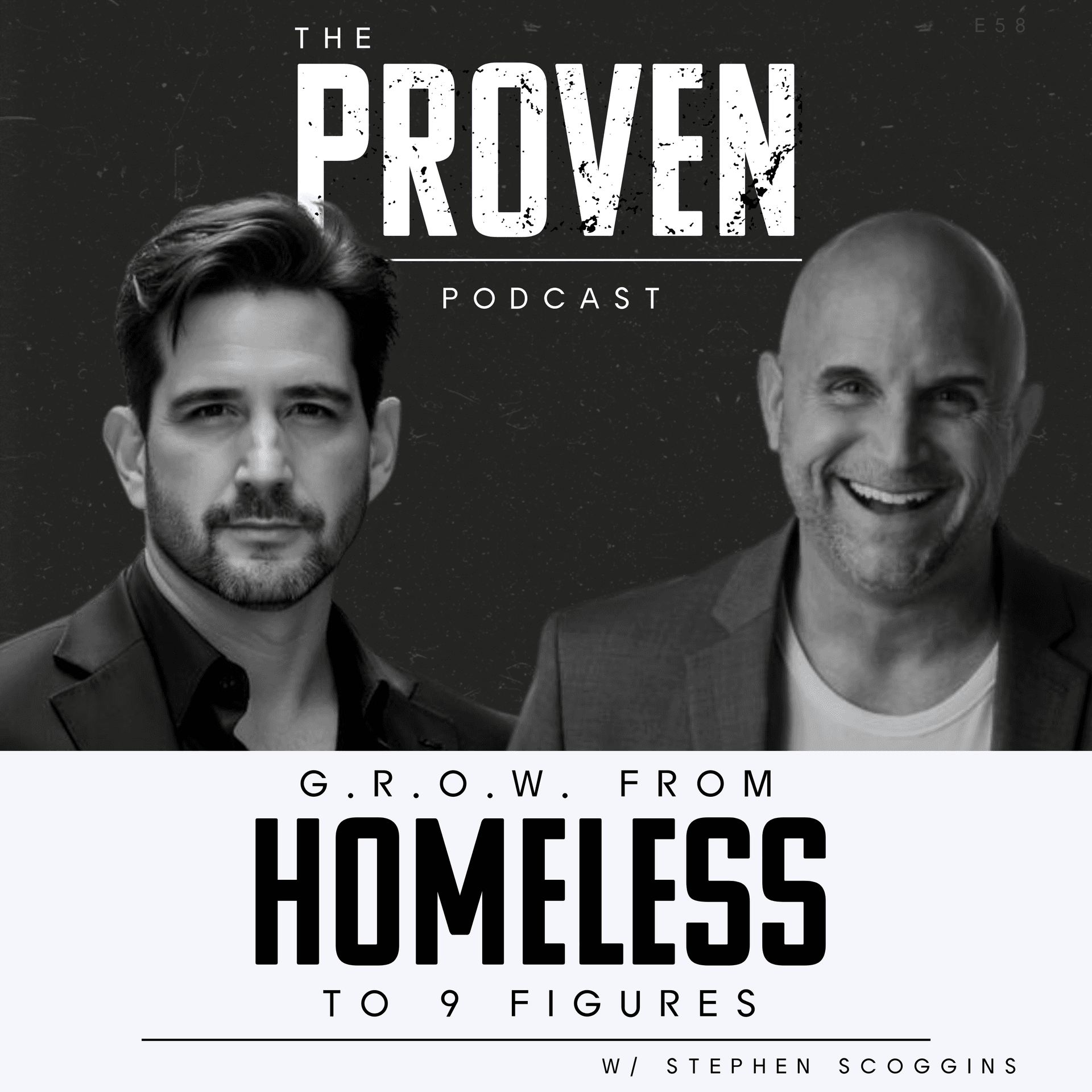
Proven Podcast: G.R.O.W. from Homeless to 9 Figures - Stephen Scoggins
Episode Overview In this episode of the Proven Podcast, host Charles interviews Stephen Scoggins, a serial entrepreneur who transformed his life from homelessness to becoming a successful 9-figure business owner. Stephen shares his journey, focusing on resilience, faith, and vision as key components of his success. This conversation explores the mindset shifts that differentiate those who remain stuck from those who rise to achieve their goals.
Key Takeaways
- Transformation Journey: Stephen reflects on his experience transitioning from homelessness to running multiple successful businesses in construction, real estate, and personal development.
- Foundations of Success: The discussion emphasizes the importance of faith, vision, and resilience in achieving long-term success.
- Mindset Shift: Stephen shares insights on transforming pain into purpose, viewing setbacks as opportunities for growth, and aligning business success with personal values.
- Building a Legacy: The episode underscores the importance of pursuing success that contributes to others and creates a lasting impact.
Episode Highlights
01:15 – From Rock Bottom to Rebuilding
- Stephen recounts his experience with homelessness, emphasizing how hitting rock bottom can lead to profound personal reinvention.
05:02 – The Role of Faith in Entrepreneurship
- Stephen discusses how faith provided clarity and strength in uncertain times, while Charles highlights the connection between belief and resilience.
08:40 – Turning Pain into Purpose
- The conversation explores how Stephen used his struggles as motivation for his mission, with Charles noting that setbacks can often hide the seeds of transformation.
12:18 – Building 9-Figure Businesses with Values
- Stephen shares principles for scaling businesses that prioritize both profit and purpose, with an emphasis on service to others.
16:55 – Identity Drives Destiny
- The importance of self-identity in creating lasting change is discussed, with Stephen asserting that personal evolution aligns with achieving goals.
21:30 – Consistency Beats Talent
- Stephen stresses that consistent action is more impactful than waiting for the perfect moment, highlighting that discipline compounds into significant results.
26:12 – Leaving a Legacy of Impact
- Stephen challenges listeners to envision success that benefits others, while Charles reflects on how true wealth is measured by lives changed, not just financial gain.
The G.R.O.W. Framework Stephen introduces a framework called G.R.O.W., which stands for:
- Gain Perspective: Identify areas of misalignment and understand your current situation.
- Recognize and Remove Roadblocks: Acknowledge what hinders your progress and work to eliminate those obstacles.
- Organize a Plan: Develop a practical plan that focuses on actionable steps toward your goals.
- Work the Plan: Implement your strategy with discipline and consistency.
Mindset and Personal Growth
- Radical Honesty: Emphasizing the need for self-awareness and honesty in recognizing personal limitations and triggers.
- Labels and Identity: Addressing how people often define themselves by past experiences rather than viewing them as lessons.
- Grace and Patience: Encouraging individuals to give themselves grace during the journey of personal development.
Tactical Advice for Action
- Start Small: Focus on one significant initiative that can create momentum for other goals.
- Mindfulness: Taking time for reflection and quietness to gain clarity and insight.
- Transformative Decisions: Recognizing that substantial change is often just one decision away.
Conclusion Stephen Scoggins emphasizes that true success is founded on aligning one’s identity, strategy, and mindset. By working on internal foundations, individuals can enhance every decision and partnership, leading to impactful outcomes in both personal and professional realms.
Additional Resources To explore the Integrated Alignment Method and take the quiz, visit: [StephenScoggins.com/alignment](https://www.stephenscoggins.com/alignment).
For more insights and daily motivation, follow Stephen on Instagram: [@stevenscoggins](https://www.instagram.com/stevenscoggins/).
---
This episode serves as a powerful reminder that the path to success is not just about external achievements but the internal growth we undergo along the way. Stephen's journey from homelessness to entrepreneurship provides a blueprint for anyone looking to break free from limitations and create a life of purpose and abundance.
Written by AI. May contain mistakes. Listen to the episode to check what was said.
Transcript
Automatic transcript. May contain errors.0:00Welcome back to The Proven Podcast. On this episode, Stephen walks us through exactly how he went from homeless to running a nine-figure business. An individual who teaches you how to grow, which will make a whole lot more sense in the episode. It's a step-by-step process to get realigned and to break through all the limitations that you have. I can honestly tell you this might be my favorite episode I've ever recorded. The show starts now. Everybody, welcome back to the show. Stephen, I'm excited to have you on, man. Bro, dude, I'm so excited to be hanging out with you, man. It's crazy. I know we're traveling like crazy.
0:32We're both in different states and all kinds of stuff outside of our normal studios and stuff. But great conversations just need to be had. Yeah, it's fun. I remember our first intro call. We just kept going. I was like, this is a no-brainer. This is easy. So for the four or five people out there in the world who actually don't know who you are, Gary, what have you done? What is your success? What's your story? Well, you know what's crazy is I'm probably most notably at this stage of the game known for being a bit of a life and business strategist. but more than anything else is kind of the story behind the story, right?
1:02The origin story, if you will. And grew up in a traditionally dysfunctional environment, which created dysfunctional Steven along the way. Found myself later on in a homeless journey for about 60 to 90 days. And that is actually a real homeless journey. Met my eyes in a mirror, remembered some key things that a mentor said, and that kind of, we were talking about off air, about got me unlocked and got me reawakened as kind of on a journey and then went on to build a nine figure business that had 400 team members across three states. I've been very fortunate and very blessed to exit that company in late 2023.
1:35And now I get to do what I love, which is hang out with amazing people and teach them amazing things. So that's kind of my heart behind everything else. So you went really quickly over some of that. And I'm going to make sure the audience caught that. You went from homeless to nine-figure company. That's most people go, don't have it that bad. Most people are like, hey, you know what? I'm doing okay. I did the normal route. I went to college, may or may not have gone to class. What? I don't know. And come through that. And all of a sudden now you're, you're completely, you went from shameless to sitting there having to focus on that to now you're running.
2:05And we were talking to off camera that when you're running those environments and you create that type of environment, there are some insecurities that come into play. There are some dysfunction that comes into play. There are some huge things. One of the reasons I want to talk to you is because you are as vulnerable as you are. You show off authentically. Hey, this is, this is the truth. So you talked about dysfunction. You talked about vulnerabilities. I want to kind of get into some of those. As you're building towards a nine-figure business, what does that take? You know, to go from homeless to nine figures, you know, what does that take for you to pull yourself out of that?
2:35Well, you know, it's funny. One of the things I tell entrepreneurs all the time is presence is important. So a lot of times, it's funny, I did this on a stage not that long ago. We've probably had, I don't know, a thousand entrepreneurs or whatever it was. And I was like, hey, by a show of hands, raise your hand right now if you think you should be further ahead than you actually are. and without question, 100 % of the hands go up. Right? So you very quickly realize that we're actually not that unique. Our circumstances are really not that unique. You might have a situational environment like I did that was unique from, you know, someone that maybe went to college, got a four-year degree or an eight-year degree or whatever.
3:12So different starting points. But at the end of the day, we're all facing what I've described as the five constraints. You know, history or statistics would tell you that lack of funding, lack of sales pipeline, lack of poor market penetration, poor leadership, which is important. But, you know, there's all these external tangible things that they say are the top five or seven things that a business fails for on a regular basis. And when I went back and looked at my journey, right, so the only place I can offer any insight from is my own journey, where I've been, where I've come from, the experiences I've had.
3:47which include the homelessness. It includes the suspected embezzlement, losing seven plus figures, being poor leadership, leading by insecurity, leading by fear. Simply and honestly, because I didn't know any better, one of the things I realized very early on is I really only faced really what I refer to as five major life gates, right? And at the element of each of these five major life gates are really five constraints. So if you can imagine one of our good buddies, E.T. Eric Thomas says, you got to want it as bad as you want to breathe, right? What we don't realize is what's actually constricting our airway.
4:26Right. So we, go ahead. So I was going to say, what are those five constraints that most people run into when it comes to that is constricting the airway? Because it's nice to say you want it as bad as you breathe. You know, it's fun to say it. It's cute. And E.T. does a great job with, you know, has condensed it into, you know, you want to have something as bad as you want to breathe, but no one gets that level. I talk to people all day long. I'm like, you know, do you, what do you want to make? How much you want to do? And they're like, Hey, I want to make a million dollars, whatever. I'm like, cool.
4:51I go on a scale from one to 10, how likely is you're going to get to that? And they give some random ridiculous number. I'm like, cool. I put a shotgun in the face of your mother. How bad are you going to do it now? They're like, Oh my God. And they stopped thinking of the number and they start thinking of ways to do it. So we can sit there and we can trigger it. But most people don't have that proverbial shotgun in the back of the head of their mom. So when we talk about Eric Thomas and what he's done about you, bad as you want to breathe, it's cute to say it. It's, it's adorable, but it doesn't get us there.
5:18So there's no, there's five things that are in the way. What are the five things that you've experienced that are constraining us? Yeah. So I'm going to run through them real fast and we can, we can come back and touch on it because any one of them we could spend a lot of time on. Um, so I would say that the five constraints are arrogance, ignorance, impatience, fear, and insecurity. And it doesn't matter where you've come from, where you've been. I mean, literally I see these same five things over and over and over. And I first, again, I first learned them myself. So let's talk about the polar opposite.
5:49So the opposite of arrogance is teachability. Okay. I'm sorry. The opposite of arrogance is humility. Opposite of ignorance is teachability. Opposite of impatience is not patience. It's actually presence. Okay. The opposite of fear historically is some form of faith, no matter what that means to you, right? It's a resilience piece, right? And the opposite of insecurity is authenticity. Very few of us will actually, or have done the work to date, to discover what makes us tick, which of those things that makes us tick can we lovingly respect, even though we may not like it very much and bring into our full integrated self to create an authentic self to then begin to build the other five areas.
6:32And leaders specifically, again, I've worked with eight, nine, 10 figure earners, and they all, all of us have struggled with each of those. And honestly, I would say that you, it's kind of like, you know, from zero to a million dollars, there's one form of battling those from the million to 10 million, there's another form of battling. You know, when I got to about$30 million in top line revenue, I really, really battled arrogance. I really did. And, and, and it's truest form, meaning I thought I was all that in a bag of chips. And, um, that's when I politely went through my little embezzlement struggle and realized that I wasn't all that in a bag of chips.
7:07And even the, even the most unlikely of us can easily be humbled really quickly, which is the, it turned out to be a blessing. I say that to say that each entrepreneur, each achiever, each person who's stepping out in faith to build something largely from scratch, um, needs to focus on the inside. I like to say you can't scale dysfunction, right? And the problem with scaling dysfunction is a lot of times the dysfunction that's actually happening inside of our business is a byproduct of what's happening inside of us. Right. So there's a lot of things that you went over there. I want to try and tap into it.
7:38One of us is doing the work. We talk about this all the time. This has become a placeholder. It's become almost a platitude. Go do the work. When you're scaling all those, because as you were going through the five, I was like, yep, yep, yep. I was like, score, I have a four. I got a perfect score. I got a perfect score, I have a law. So even though you see success, and I think everyone that I've ever worked with, ever, the high achievers that are out there, they all check all five boxes at some point and how we deal with those. Because I think everyone has them. How we deal with them, how we show it, how we pivot when that happens, be it through life punching us in the face and us really, you know, dramatically hurting people in our lives or embezzlement or whatever, you know, you run into.
8:16We all talk about doing the work. Now I know what doing the work means for me, and it's an ongoing process and it'll probably be something I do actually after I'm dead. That's how intense it will go beyond me. So when you talk about doing the work, what is the tangibles of that? Because we hear it all the time. It's like, okay, high achievers have done the work. What does that mean? Mm-hmm. You know, it is very abstract because I feel like a lot of times doing the work is very specialized. So for example, if I'm someone who, we'll say struggles with impatience quite a bit, right? Which is honestly me.
8:51I'm still to this day, I'm very impatient with business practices and stuff like that. I'm patient with people, but not business. I like to see things happen quickly, right? So the opposite of understanding that is the first of all, I had to figure out what the root cause was. What is the root desire? What is the root of why I feel the need to get things done quickly? What is the, what is my nervous system trying to say about that? Um, and for me, it was, it was a matter of safety. So if you go back in my, a little bit of my, my past, right, there was always an urgency to getting food, getting shelter.
9:24Like there was always an urgency to getting safety, right? And because it was always an urgency, it became a pattern that became a subconscious pattern that kept running and running and running and running, where it affected me in business and relationships specifically is it would cause me to rush ahead and actually respond. I'm sorry, react to situations rather than respond to situations or create emotional. In fact, I would say it this way. It's probably easiest way to say it. Almost every major decision or major result that I get that I didn't want, bad decision, bad result that I had came at a moment of emotional dysregulation.
9:58A hundred percent. When, when there was so much anxiousness inside of me that I was just like, this is a temporary, okay, just do that. Right. Thinking I can, and that one decision, ironically, from coming from that place would cause five more problems. Had I slowed down, developed some presence, sat in it, actually just got my breathing under control, making sure I was regulated. Had I done that, then what would have happened is I would have been able to make a data driven decision. And I don't care who you are. You hear all the time that if you can make a data-driven decision from a strategic vision mindset, then all of a sudden, the decisions start to make for themselves, and you start to grow and prosper and scale.
10:35Problem is, nine out of 10 entrepreneurs never break seven figures in top-line revenue, or maybe eight out of 10. But it's a vast majority of us. Historically, with the folks that I've worked with, in almost every case, there's a resistance, a complete resistance to going inside to figure out what makes us tick. So I had to stop what I was doing. I had to go and actually do some research. I started a journal practice a long time ago. I call what I hear you say is, whether or not you believe in God is irrelevant. It's a practice of listening rather than speaking, right? So I've discovered that starting your day with presence will help you end the day with presence, right?
11:15If you start the day with erratic behavior and anxious energy and just running out the door and just jumping around the place, You're going to cause yourself problems. So I feel like the starting point is radical honesty. Right? Can you be radically honest without guilt, shame, or condemnation? Right. I think a simple example is when people are driving. And I lived in South Florida. And the drivers are the best in the world. I swear, they're not a problem. It's not my experience. So I would sit there and I'd be driving back from work or going to the store or whatever I was doing. and listen to things like Rammstein or Metallica and all that.
11:52And all of a sudden I'm just like, I'm going to drive. I'm going to follow you home. You cut me off. I'm the light of a fish on fire. That's it. You're dead. Everybody dies. And I remember at one point it got to, it was so bad that I was shaking where I couldn't control the vehicle. So I physically pull over. I pulled over and I see the hazards on. I'm like, okay, what's actually going on? I was like, what is, what is actually going on? Stopping it and going, okay, I don't feel safe. And then having to go through and say, okay, because I'm a scuba diver and I've done this enough when I've had just freaked out underwater when you're 80 feet underwater.
12:19Like, I'm going to drown. You're like, wait, time out. Is your regulator working? Yes. Is your first thing working? Do you have air? What are you talking about? Just what? So we have time for a safety stop. Exactly. And also in the worst case scenario, can you spit and do an emergency ascent? If you can do that, can you spit out your rag and do an emergency ascent? Which please don't do that. They're not fun. I've had to do it. Not fun. So being able to pull over and to stop and run through the checklist and go to that root cause of, okay, am I actually in danger when I'm on the road? Am I in danger?
12:46Am I not safe? No. Okay, so is this a perceived reality or an actual reality? Being able to stop that. And to your point, every time I've run into problems with bad decisions, it's always driven by fear or emotional response. Some of the most successful people I know are absolutely on spectrum. They're autistic or anything else because they have this disconnect between emotions and not. everyone else I know, the high achievers out there who are not on spectrum have learned how to disconnect the emotional response to the logical response. So since we've already discussed that, I check all five, go me.
13:24Um, when you're running, me too, buddy, we've been there, you know, exactly. Yeah. It's like a mirror. It's awesome. So when, when you're running into these and, and you have these and you're working through these, how do you deal with the arrogance? How do you deal with that next one? You know, so here's the crazy part is, is if it's deeply rooted, so you have to realize that arrogance is deeply rooted, ironically, in the common denominator, the other constraint called insecurity. A hundred percent. It's inferior. Yeah. It's, it's literally, I feel like, and here's, I'll tell you where, I'll tell you where it showed up for me.
13:57This is, and this is probably just a simple phrase. For me, it showed up in the phrase chasing worth. I felt as if I needed to prove my worth in order to feel validated within self. And because of that, um, you go into, you know, we, we've been very forced. We've been in, we've been in beautiful rooms with amazing humans that are doing amazing things. Um, and you would go into the room and they would, you know, and inevitably what do you do for a living pops up? And then, you know, and then you kind of go down the, the, the laundry list or your credibility markers and yours. I started, I just, you know, I just finally decided at one point in time, I finally got to a place.
14:35I was like, every time I do that, while I've done pretty, pretty cool stuff and been very successful in some elements, what really makes me unique is now my ability to just have my worth based on me. Like I don't need to prove myself to anybody at this age in the game. I'm not here trying to serve because I think everybody should, if I can help someone understand things earlier at an earlier stage than it took me to, I can help them resist a lot of pain. Right. So I think in the, in the grand scheme of things, it comes a lot to chasing worth and in many respects, the five constraints in general are all about chasing worth or some sort or some form of validation.
15:10Right. So you feel like, you know, I, I, I'm a nine figure entrepreneur. Look at, you know, I've built a business. Woo. I'm just like, no one cares, dude. I'll tell you, I'll tell you when an entrepreneur cares, when I've come in contact with people, when they care. And again, you could be, you know, at, at a school or you could be in a major mastermind or whatever. When people care is when you're real. Yes. That's when people care. Like, are you willing to share from your scars? Like in that kind of thing. And I've got bazillions of them, it seems like. And you know, when I have an entrepreneur in front of me a lot of times, it doesn't, and I've had some that are making, have made quite a bit more money than me and they're trying to salvage their marriage.
15:48Yeah. You know, I can talk, I can talk to them about the difficulty of the relationships and things that I struggled with, right? You know, a couple of the clients were, you know, large, very large earners, and they were searching for purpose because they had gotten all the stuff and realized how empty it was, you know? So at the end of the day, I think, how quickly can each of us stop and slow down? I call it slow down to speed up. There's another format that I've heard before other people say, but essentially that's what it is. It's like I woke up this morning and I'll share this with you. Now, granted, I'm a person of faith by nature and people don't have to.
16:27Obviously, I love everybody in general, but my mantra is this. And I say it three times to myself every morning. And this actually was one of the one of the things that helped me slow down. I am healthy. I am wealthy. I am wise. I'm a steward of the most high and the most important one, which was the hardest one to say, especially staring at a mirror, was I love you, Stephen. And a lot of people can't do that. And it's funny you bring the I love you, Stephen, one up because when I do this exercise with the clients that I have very similar where I say, okay, who do you love the most in the world?
16:57Who's that one person? If you were going to die and you had to call someone in 10 seconds, who's that person? And we go, okay, they get that person, whoever that is. That space is cool. What does that person have to do to be worthy of your love? And they'll sit there and they're like, nothing. It's nothing. It's my grandmother. I love them. I'm like, cool. What do you have to do to be worthy of that person's love? And they're like, and they lock up. I'm like, it's the same answer. and once you get that because we have this broken equation that we're taught to like hey if you achieve these things especially as hire owners and entrepreneurs and achievers if you achieve this then i'll be enough and if i get enough then i'll be worthy of love and that's broken that it is yeah it's broken now it's a great driver if you had that wall of insecurity coming into you if you have that subconsciously feeding your patterns you will get into a situation where you will be radically successful.
17:45But I had a client who, this is nine figures, he's about to be a billionaire. Phenomenal. We were out working with our clients. They couldn't connect with him because he wasn't showing up authentically. And then his little girl came over and it was just a different thing. He just melted. Yeah, he just sat there and he held his little girl and she's sitting there and she was talking about her tooth was coming out because she was losing one of her teeth. And he's talking and all of a sudden he just turns into it and they stop and he goes, okay, cool. He goes, okay, I'll talk to you later. Daddy's got to finish this.
18:09Turns around and all of the other people that were trying to do a business deal was like art we're done we're something 100 what do you want we'll give you everything we have because they saw the version that he was too afraid to show up for an ability with to have that type of one like here's who i am and again when you're not in that version you are going to push everybody away you're going to make mistakes you're going to do all the things that again i think it's sanskrit that word you talked about earlier starts with the p patience that's sanskrit i think you're making shit up but as you're going through those i think it's fed really high on this subconscious level because everyone comes to on coaches like you and I, and they say, Hey, I don't make my triggers.
18:46Yeah. Well, this is this way. Go ahead. Sorry. No, no, go for it. I was, so I had this thought as you were sharing with that, that, that I want to piggyback off of what you shared because what you shared is absolutely true. Um, what I've discovered is whether you call it solar consciousness, it doesn't matter. Um, but if you're chasing worth, it's a commodity. So it becomes a transaction. Okay. If you're secure in your worth and your alignment and your purpose and your own vision for your life and the love for yourself and your willingness to show up for yourself, I used to self-abandon like crazy.
19:18I had the caretaker program. I would try to rescue anything and everything out of their own situations because of the pain that I went through. Right. So I didn't want the other people to experience the pain. But is your, is this solar consciousness, is it a commodity or a tool of connection to your point when you were just just describing that that story I've seen that a lot myself I've you know I was at an event not long ago and a gentleman massive heart like I saw him away from the event massive heart and obviously he was one of the folks who was presenting and as soon as he started presenting it was you know I've got this relationship I've got this thing I bought three of these I have four of those I have and I watched the entire audience kind of shut down yep Right.
20:02And I just felt like I remember being my 11 year old self in a 40 year old body with a similar transaction or similar mindset. And it just made me want to go embrace this guy and pull him and say, bro, bro, man, you're amazing without all that stuff. Right. Right. And so is it a commodity? Is it a connection point? Is it is it something you can tie yourself to? Or are you simply, and this is where we get in trouble. And you had asked this earlier when we first started talking. It's like, what is the essential element, the common denominator, essentially? And honestly, it's the child at its most injured state becomes the most anchored adult.
20:44Right? So if we're 11 years old, when that thing happens to us, we literally carry that 11-year-old through 12, 13, 14, 15, 16, 30, 35, 40, et cetera, until they meet someone like yourself, Charles, who can, who can, who can like slow them down and say, Hey bro, let me help you. And let me, let me help you see yourself clearer. Right. And the moment you can see yourself clear without shame, blame or condemnation, the moment you're awakening actually begins. And that's when the work begins. I will say that, uh, one of the reasons that I feel like the work is not done, um, was the same reason I avoided it for decades, uh, which is I was scared of it.
21:22I mean, you have, It's, it's, they call it shadow work for a reason. You have to confront things, uh, and bring things in your environment and, and kind of like show love to things that maybe you dislike about yourself. Absolutely. And that's a very difficult thing. Yeah. I learned this from the seal community. I've been blessed to be around those guys and they say, whatever your fear is, that's your short line. That's the next thing you need to do. That will bring you home. Find your fear. That's your home. But we don't want to do that. I'd love how you brought it up. You're like, Hey, I'm going to go help everybody else.
21:48Cause I can avoid then helping myself. and god i do that more than i could possibly tell you it's something i constantly work through on this day i'm like i know i need to work on this but i'm gonna go do this and a lot of people manifest even if you're not working with other people people like oh i need to go do this project i'm gonna go clean my house because at least that makes me feel like i did something i checked the box so a lot of people were listening to this i'm like all right we get it the two of you little you know high achievers fruity little they're gonna say it i'm gonna get the links it is what it is.
22:17I want to get them also something tactical. I know I need to do the work, but right now I need to feed my kids. I've got some business problems. How did this guy do this? Because I tell people all the time, you can probably sing happy birthday, please don't, really easily. But if I put a grenade in your hand and take the pin out, you're not going to sing happy birthday so well. So there's a lot of people listening to this and saying, listen, I want what's proven. Give me something strategic. Give me that pin that I can put back in the grenade so then I can go do this personal work and do the shadow work but right now you know i can't pay my bills the economy's collapsing we've got chaos right now going on when someone's sitting there going hey you were homeless nine figures homeless there's a lot of steps in between like because if i tell someone hey go do the work and go hug a tree and go do the shadow work and get into it and really face your fears and your doubts that's great because they can't eat they're like i got a business that's collapsing dude what are the things that in your experience because again you and i both know that i'll just say it for myself when people do the work the answers that they're looking for the tacticals they already know it comes out because they're already inside yeah they already know so for those of you who are listening i'm doing this for you guys because i know you want something tactical and i'm asking steven to get out and say here you go this is the tactical part of it but i can tell you if you do the work these tacticals that you already know will already be implemented on your own if you do the work.
Read the full transcript
23:40But the tacticals, if someone is sitting there and they're stuck and they need to start changing things because you've been in rooms and you've been very blessed to be in rooms with amazing people, people who far outranked you education wise and you still found a way to succeed. What are some of the tactical things in business that people do right now that have proven success? You know, it's really funny. I think they say ignorance was bliss, but it's not true. So step one, I think, is understanding are you in fact misaligned, right? So, cause you know, we could be, we could be talking right now and people are like, well, okay, it's a great conversation.
24:13What's wonderful and all, but I think I'm good. Right. So the symptoms of misalignment are burnout, overwhelm, and insecurity. Now it's, it's interesting how insecurity keeps popping up, right? So step one is like, just, am I actually misaligned? Cause when you're, when you're not misaligned, you're in a steady, a steady state of flow, right? You're very clear on your objectives. You're very clear with your relationships. You're showing up for yourself. You're not self-abandoning, right? So how do we go from misalignment to essentially a steady state of flow? So step one is first of all, identifying, am I misaligned?
24:47Okay. I think step two is like, okay, what area am I misaligned in? So I like to break things down in domains of life because I'll find that, and I'm sure you've found this as well. You'll have several folks that are really strong in their relationships, but their business is really struggling or they're very good in business, but their relationship or their health is struggling. Right? So we, I used to draw it out a quadrant. I used to call it the quadrants of conflict. So emotional, physical, financial, and spiritual. Um, and you can just literally scale a one to 10, one to 10, where would I rank myself right now in my emotional wellbeing?
25:18So emotional a lot of time, obviously is how you feel about yourself, how you feel emotionally. Do I feel out, burned out, overwhelmed? Do I feel like I'm going to study state of authenticity and just kind of use a rank and you say scale one to 10, 10 being the highest. Am I a seven, an eight, a three. And what'll happen is, is you'll all of a sudden get clarity on where you need to focus first. You mentioned to it just a second ago with your SEAL clients and the people we work with, the SEALs in that community is the greatest place of fear, right? Historically, the greatest place of fear will show up as the most common lowest number on that quadrant, right?
25:50Once you identify that, I think the next step is to actually go and get some help. When I say help, I mean, find someone who's really strong in that category, who can give you best practices to begin to work on that while simultaneously actually beginning to maybe backtrack a little bit. So I like to say it like this. One of the tools that I use to identify my roadblocks. So I used to use a framework called GROW. So gain perspective, recognize slash remove roadblocks, organize a plan, and work the plan. That's literally step one, two, three, four. So gain perspective is where am I shortcoming?
26:27Where am I not being honest with myself? Where do I need coaching? Where do I need mentorship? Where do I need training? Where do I need information? And where do I just need to sit with myself? So many times the gaining perspective is just sitting in quiet. So many of us can't even go to the bathroom without taking a phone with us. Right? So if that means you need to stop, that means your, your, your nervous system is already looking for a steady state of distraction. Right? Once you can get some perspective on what areas need to be focused on, then it becomes just ask one question. Where are the potential roadblocks?
27:00I guarantee your brain and your nervous system will put them in front of you. Well, you know what? These three relationships over here, they're actually probably not that healthy. They're actually pulling me away from my partner. They're operating in this environment of life. My partner's operating in this environment of life. And then you organize a plan. You get the key people around you that you need around you. You get the key information inside of you and then you have to apply it, which may require prayer, meditation, mindset shifting, belief management. You know, because limiting beliefs at the subconscious level are essentially guiding 90 was 95 percent of your behavior patterns.
27:37So I believe in focusing on subconscious matters more than conscious matters first, because I want to bring the subconscious to the conscious so I can address it. Right. So a lot of times the step by step framework is obviously step one. am I misaligned? Step two, where am I misaligned? Step three, what resources can I bring in to get aligned? And step four, how can I measure my overall alignment? And step five, how can I continue the process in its simplest form? Right. So when you're going through this, we talked about purpose a lot. And I think as people are going and they gain awareness, so they get to the G, which is, you know, gaining the awareness.
28:12A lot of people are going to realize some of their patterns that may have not been the best. It's the nicest way to say this. you know maybe you've done some stupid maybe you've broken laws maybe you've betrayed yourself maybe you've betrayed your partner maybe you've done these things and really gotten lost along the way a lot of people get stuck there and they don't understand that their path their past is not who they are their past was a lesson and you can be beyond that how do how do you get your clients to walk through that once you gain that awareness because that will lock them up like and again i agree with you a hundred percent silence is a gift when you know there's i've done silence retreats i've done completely quiet for a week i've done the ones where it's complete blackout you ever all the answers you're looking for are internal period so getting that silence but when you get that awareness you're like oh i'm whatever i i haven't worked out enough i haven't done what i needed to do i've lied about this i've betrayed these people i've failed here and you have all of this and this this wall of just shame which will feed the insecurity bug how do you get people past that?
29:15Because I mean, again, we all have this insecurity. We all have this, I'm not enough. Everybody I know, I don't care who you are. I've dealt with people who were literally on covers of magazines feeling insecure that they weren't attractive enough. I'm like, then you're the magazine cover. Okay. Awesome. So when you're going through that, how do you get past that initial, you know what? Yeah. I could have done ABC and I am lying to myself and I'm not doing what I need to do, or I have done these horrible things in the past. How do you get them past that? I think the key aspect is understanding you'll always be limited by your labels.
29:47Okay. So I'll give you an example. So labels, we talk in forms of labels. So I've been divorced. I've been cheated on. I've been addicted. I've lost my kid to suicide. I've like all these, these are all labels. These are all things we take on, ironically, that are actually experiences and lessons, but we take them on as identity. Right. Right. And because once we understand that we're limited by our labels, we become objective to our labels. So I'll give you an example. So a quick reframe. I can either say I am divorced, meaning I've been through a divorce, and that essentially and subconsciously can placate in my potential for future relationships.
30:33Or I can say I have experienced divorce. I have experienced embezzlement. I have experienced homelessness. I am not the homeless high school dropout that I was when that experience happened. I'm a very different person now. And there's a 25-year window from that moment to when I exited the company, right, with lots of things in here. And essentially, one of the exercises you can do is you can go ahead and list the top 10 labels that you've been living by. Okay. And what that does is that'll bring awareness to that. And then the next part of the exercise would be to take those 10 things and reframe them, reframe them as experiential elements that taught you valuable lessons.
31:17And then just like Viktor Frankl says, a man searched for meetings. Once you have the lesson, once you have the meaning behind the lessons, the pain, the discomfort, the shame, the guilt, everything associated with that lesson dissipates because now you have the meaning of why that lesson was so important. And when it comes to purpose, it ties directly to purpose because I believe that the reason humanity is so connection oriented is because we can all learn something from each other on a consistent basis. That means that by definition, whatever experience you've been through, whatever lessons that you've learned that offer value to someone else becomes a portion of your purpose.
31:57so on stage a long time ago and rory vade and i used to pick on each other all the time because we have similar quotes that have now been talked about but um i used to say the greatest purpose in life you'll ever have is serving the person you used to be but it's not just serving the person you used to be now it's serving the 13 year old version of yourself the 18 the 19 the 22 the 30 the whatever age group but you don't do that like you can't do that until you identify the labels, remove the limitation off the label via the lesson, and then begin to use that lesson to empower and encourage other people, whether that's in your family, whether that's in your business, whether that's in your community, whether that's at scale like we do.
32:37It's the same tool. Yeah. I think there's some magic in that moment where like, I'm not that 13 year old anymore. Everything I do is always trying to help at that 13 year old version of me. I'm like, okay. He was scared. He knew there was a way. And the running joke is Jesus didn't walk on water. He knew where the rocks are. I knew that there were rocks out there. I was like, where the hell are the rocks? And that 13 year old me was like, I knew there's rocks. I knew there's way to do this. No one's going to tell me how to do that. And that fear and that pain and that belief system I had to break, but I can consciously understand I'm not that 13 year old, just like I'm not the person I was five months ago or three days ago or six years ago or two years ago.
33:14We were on some world. So I think there's magic in that moment there to kind of pivot out. And whenever someone comes to me and they say, Hey, I just got divorced. I always say congratulations. I'm like, what? I'm like, congratulations. They're like, I don't understand. I was like, there's never been a couple that's been like, you know what? Oh my God, I love you so much. Oh my God, I love you too. You know what we should do today? Yes, we should get divorced. There's never been a couple that's ever said that in the dawn of time ever, ever, ever, ever. So if you had two people that are no longer compatible, mazel tov, congratulations.
33:41It's great. So you get that awareness and you pivot and you separate yourself from that. Now we go into the R. When someone gets trapped in the R section of grow, because I love this idea of grow, and I'm just going to double down on this because this is magical stuff. I still lead my life with it, so it makes sense to me. It's phenomenal. I think we could just do a master class just on grow. We could probably do a couple hours on this. So you gained awareness. You disconnected and understood, hey, I am no longer that person. I get that. Now let's get to the R. How do we go through that Well, first of all, you need to understand you cannot remove a roadblock that you refuse to recognize.
34:18This is where your ego and your arrogance can get in the way in a big way. The ego side of us statistically is essentially its core design is to keep us safe. Now, it does not have a barometer in many cases on what safe is outside of not reliving pain, whether that's being eaten by a lion or being avoiding a divorce or whatever um the ego unfortunately a lot of times will let the intellect get in get in your head such in mind lintel like whatever get in your head in such a way that you will talk yourself out of the very thing you should focus on like i can come up with this and you see this happen a lot if you pay attention to the words that are actually coming out of your mouth you'll see this happen a lot i know what happened for me um well if she'd have done blank blank blank blank or if they'd have done blank blank blank blank or if that that i have done that and what i thought was so interesting about what you just shared a minute ago and i think's powerful is people fully understanding that the only person that is going to rescue you is you it's you 100 all right and the only way you rescue yourself is to recognize the radical honesty what roadblocks are there and then begin a progress removing it now the removing of the roadblocks in many cases could take a year it could take a week.
35:36It could take an hour depending on how strong the radical honesty gives you kind of like the radical awareness. Cause sometimes radical awareness by itself was enough to shift, shift. Right. So I would say that, uh, the recognition piece is take a result, a negative result that you got. Okay. Take that negative result, follow back to the action in which we created that result. Whether that's in my case, I, I, I made it a point to apologize to my kids if I was wrong rather than I'm the parent. So no matter what I do, I'm not wrong. Right. Um, as an example, like, so take the result, take the action and then take the mindset, like what was going on internally and emotionally that made this the choice or this, the core action.
36:21Okay. That will give you like a little insight and then say, okay, well, where did this thought, this belief or whatever come from? And then sit with it in silence for, I don't know, for me on average, it can be anywhere from probably 10 minutes to about two hours before I'm like, and you'll have little flashes of your past that'll pop up. Okay. And then when those little flashes of your past pop up, then inevitably what you're looking for now is you're looking for what did that person, what, what did that version of me really need? What was he or she really looking for in that moment. Right. Um, you know, for me, for example, uh, growing up early on, uh, as a father, um, who came back in my life around 12 or 13 years old, but was still very much a drill sergeant early on.
37:08Like, why did I feel like I didn't want to speak up? Because a drill sergeant, when you speak up with a drill sergeant, you know, it comes, you know, this kind of things. So then you end up chasing your voice. See, these different elements will begin to show you where you're not showing up for yourself. And I'm a big believer that most of us who are struggling in life, um, essentially aren't showing up for ourselves. Let me finish with this one thing, this one thought and then I want to hear yours as well. About seven years ago, um, Harris, uh, time magazine with a Harris poll, uh, did a survey about 400 ,000 Americans.
37:44Okay. And they were specifically researching, um, essentially, joy, fulfillment, you know, kind of like feeling like you're living your best life. Okay. Over 70 % of all Americans that responded to that survey said they were not living that. Now, when you go through the article, you'll very quickly realize that the core reason that these folks feel like they're not living their best life is because they're not living their authentic life. They're living the life that someone told them they should live. 100%. so if you take that you understand okay these are the elements in which i felt unsafe these are the belief mechanisms that were shaped by that and this is how i changed my authentic self to conform to this version of my this identity when you can come in just and again it's i wish i could say it's like crazy easy everybody could do it like overnight right it's it may be a process depending on how sensitive the issue the issue is but if you can do that journey.
38:44And a lot of times you can do it with a notepad and a pen and a good friend, right? Do that journey together. And now you can say, okay, this is where the roadblock is. I'll give you a perfect example. One of my most recent roadblocks that I would do it. I'm 40. At the time I was 48 years old. I'm about to turn, I'm 49 now about turn 50 this coming year. At 48 years old, I had a relationship end unexpectedly for me. We're together for about 10 months. It ended unexpectedly. I'm like, what the F just happened? And that began the journal. And I did that same exercise with some coach, some key coaches of mine.
39:19And when I did that exercise, I very realized, dude, I've been trying to save people since I was nine years old. So some would call that the caretaker program. Okay. That's a major roadblock given the fact that I'm trying to serve at scale yeah i literally did this three years ago and instead of focusing on my own bullshit and being present with it and science on i was like i'm gonna save all these other people and then if i save these people i'll then be enough which all i did was betrayed everyone which was all driven by this including ourselves oh a thousand percent which was all driven by this desire this insecurity that i had that overcompensated with this level of arrogance because all it was was deep down insecurity of me not being up on my okay well if you don't think them enough you're right i'm better than you so it's hyper secure which was also so it's just this opposite loop which just ended up betraying everybody in there including myself and i think people don't understand when we say sit in silence the biggest thing i would tell people is sit in silence obviously don't have your phone don't be stupid but to sit down without judgment that's to me what sit in silence means sit down and if you're going to have things pop up understand that what's going to come out of your head some of it's going to be fear a lot of it's going to be untrue it's okay you're not a five-headed flamingo it's okay going through that and just listening and say okay what does this mean and just writing all out and sitting with signs because what will happen is different versions of yourself because to your point you're just trying to stay alive you're trying to avoid pain and it'll give you these false flags it's like oh you didn't do this you're never gonna do this you're never enough blah blah blah blah cool and then you just write it down and then every time it says it again you just put a little mark next to it okay you've said that nine times awesome yeah and just you know this is where i don't get into pronouns normally understanding that there are multiple versions of yourself and say okay this is what you did it's fine we all have multiple versions sitting down with it and saying okay this is what it is so silence means sitting without judgment and just being present in the process and the i've done again i've done silence retreats it will fundamentally change who you are as a human being sitting down and going through it but having that awareness that you did which would happen at you at 48 mine was a couple years ago where i went through going oh wow i'm trying to save others to avoid doing the work on my own, hugely profiling, hugely profiling.
41:30Yeah. I want to add one thing if I can to that, because that's genius and absolutely true. I want to invite people to give themselves, I can't think of any other word than grace. Grace to experience the journey, right? So when you sit down that first time to do the silence tool, nine things may pop up. Mm-hmm. At least. So, and yeah, so you got these, these things that pop up and you're like, holy shit, now I'm even more overwhelmed than I was before. Cause now I got to do all nine of these things. Right. Right. And my experience has been, it's like, give yourself some grace, snag one, work on one at a time.
42:11That will create a bit of a snowball, a snowball piece. Right. I'm convinced that people who are living a fulfilled life are not living a life of constant over-functioning. and the only way you avoid over functioning and trying to overcompensate and over deliver and just is you have to figure out why you're chasing it right and then once you figure out why you're chasing it you have to say is this an authentic chase because i believe um the fact that this is something i learned during that that season when i when i first realized that i was in this again having no bullshit about yourself anymore like dude i would come up with like no i mean she she had three kids.
42:49She had this. I was trying to serve. I was trying to help. 100%. You come up with all this BS, right? And the reality is, the truth is, I was over-functioning. Yeah, I. I was pursuing worth through. Yeah, exactly. I. It started with a selfish desire of I. It's I want to help her. This person's father's dying. I want to help her. She just got through a bad relationship. I want to help her. She's never had i it all starts and it's a selfish act and you think oh well no i'm helping someone else it's that you know i'm proud to be modest it's like wait what what what did you do it's like doesn't work like that so being able to have that awareness and i think you know something you said earlier of how fast these things could change and you know there's people who you know i spent eight years in a hospice watching people die when you're faced with that things change immediately boom people have these life or death experience and they change immediately if you're in a situation where you're not seeing radical changes if you're going through this and you're listening to this and like dude i thought i was going to learn about how to make nine figures and i thought this is what he was going to share with me this is going to be amazing and now you're you know whatever 30 minutes into this podcast and you're like what the hell are they talking about this is totally different if you're if you've gotten this far and like oh well you know there's a lot and i don't know how long it's going to take and it's going to take a couple weeks please and you might disagree with this please understand you're completely full of shit you are one decision away from a completely different life and i tell people all the time go go get an uber 15 20 minutes to an airport 15 20 minutes to a bus stop 15 20 minutes to a you know a train get on it let go of everything else you will have a completely different life in 24 hours so this because they're sitting there and they're holding oh i can't make these changes what will my wife think what will my husband think what i can't i don't care like second person I ever coached, he wanted to exit early.
44:39It's the nicest way I'm going to say it. He decided he didn't want to be here anymore. And when he came to me and I was like, congratulations, that's awesome. Let's do it. He's like, excuse me? I was like, let's do it. He's like, what are you, what are you, what are you talking about? I was like, congratulations, you're dead. And he's like, wait, what? I said, all right, what do you want to do now? He's like, huh? I said, do you want to still be married to your wife? He's like, I love my wife with everything I have. I said, cool. What about your kids? He was like, well, I said, oh, you don't like both your kids.
45:01he's like yeah one of my really fucking can't stand i was like cool i can't get rid of the kids chief he goes i go what about your job he goes man but i have to do it and i go you're dead you've already exited early it's over what about your job he's like i hate my company i was like cool then our job right now is to get you realigned to your point in the next six months what can we do to realign with your truth whatever that is and exit you out and we exit out of the company in 90 days and he went and they changed all the things but this idea that you're months weeks years away from a radical change completion complete bs you know we were talking about before we started recording i recently found black mold in the kitchen in my property yeah i it's gone i now am in a different environment and things are radically changing now whatever you want to call it god buddha ala the big bang the magic chicken came in so i added in there for you if you're coming in and you're in an environment and that change The magic chicken made that happen.
46:01It forced all these other changes. So please understand the people who are stuck as you're going through that process thinking, oh, this is going to take so long. No, it's not. It doesn't have to. It doesn't have to. It's directly correlated to how much you're willing to lean in. And in fact, the note I jotted down as you were sharing that I thought would piggyback really well with what you shared is I did this, in fact, as I was coming out the other end. I've called a bit of a rebirth, right? So I realized I was over-functioning. I realized I was over-giving. I was self-abandoning. I wasn't taking care of self.
46:36I wasn't showing up for myself. I wasn't loving on myself properly. I was giving all of that stuff away to other people, right? I go through a radical transformation myself. and then anytime I go through a radical life change, I always do what most people commonly call sabbatical. Okay. Sabbatical is just leaving your environment, is nothing more than leaving your environment with no agenda, going to a different environment and just being present with self. Okay. That's step one, two, three of a sabbatical. What are you doing? Who are you doing it with? If anybody, and where are you going essentially?
47:09Okay. So, um, I went to New Zealand for three weeks. Okay. Now, yeah, I love these. It's amazing. Now, most people, and I'm being honest, right? So I've been very fortunate now. I can take a sabbatical for that extended period of time and go to an exotic destination in some cases to experience that. There's a magic in that. Okay, great. What's most important is I went for three weeks to be with Steven. Steven, right? Not Steven, the business owner, not Steven, the author, not Steven to speak, Like just Stephen, the Stephen that, and I got to know Stephen so good. I'm like, I like this guy. He actually genuinely cares about people, but he also has now learned to, it's not my responsibility.
47:51Right. Like I'll brush it off in a heartbeat. The reason I say that is because most, most of us will never stop long enough to actually get the perspective we really need to shift. So again, we've said that numerous times in different ways. Step one is stop. just stop. So I discovered I've been doing the sabbatical approach for a decade, right? It started with an hour. Like I had go away for an hour because we always tell ourselves, well, the business or the family is going to fall apart in the 30 minutes I'm going to the bathroom. It's all BS. Again, it's the ego trying to keep you safe, right?
48:30So maybe you go take a weekend for yourself, especially before you make a major life decision. Like before you, you know, as you exit early or desire to exit early or choose to leave a relationship or choose to shut down your business or like it may, it's some of the exception of exiting early, but some of those other things may be more, may be what needs to happen. But at the end of the day, how sure are you? How do you know that you're making those decisions from a grounded place? So the bigger the decision, the more grounded I feel like I have to be. If I need to go put my feet on the grass and sit there for 30 minutes or stand there for 30 minutes to breathe and just get centered.
49:10I do that now where I did not do that literally a year ago. I love that you didn't say the right decision. You said the grounded decision because there is no right or wrong. There's just grounded decisions. And one of the things they teach, a friend of mine who's part of the IDF, people are like, oh, I can't find a moment. I can't find 30 minutes. They'll teach individuals who are in active combat engagements to disconnect, to completely detach from the environment while they're currently being shot at, find the seconds, get the clarity and move forward. So if you're sitting at home going, Oh, I can't do that.
49:41I can't find 30 minutes. These guys are finding it while in combat. So yeah, align to yourself, have, have that awareness and understand that there is a, it's a ball game changing and how we do it. So if they're going through and they're getting this awareness and when it comes to sabbatical, you know, one of the sabbaticals that I had, literally, it was a one, one efficiency in what was going to be a retirement home that wasn't opened up yet. And I just spent a week in this environment, in this not nice place, but it was arguably the greatest gift I've ever had compared to when I was in Galapagos or in that.
50:11So the environment doesn't matter as much as being present and letting go and being in silence as much as you can. And I tell people all the time, you should do silent weeks. You absolutely once a year do a silence weeks. If you can't do a silent week, just sit around. I started with a day. Thursdays used to be my silence day. My whole team would know it. Re-center. We get there. we've gone through g we've gone through r so we're getting there we've identified some obstacles we've gone through vice and in silence and going there i think people get stuck with working the plan they get overwhelmed or they're like oh well is this the right thing i'm going to do or this is not the right thing i'm going to do or what's the next when you walk people through working the plan whatever that is how do you get them unstuck how do you keep that momentum because motivation is adorable.
50:55It's ineffective. It's adorable. Um, discipline and consistency is going to win all day long, but that's a hard thing to get because it's a muscle you have to develop. People are like, Oh, I know I need to do a hundred pushups. I know I need to do a hundred squats. I know I need to go for a walk, yada, yada, yada. How do you get people to rock and roll and start working that path? I think the easiest thing for people to understand is, and again, this is from personal experience. I discovered, uh, I either would not take action or would not take efficient action if I was trying to do it all at one time.
51:28Rory, a mutual friend, says diluted focus equals diluted results. So I started thinking in terms of dominoes. One of the core attributes that I look at when I go to working at this, it comes part of organizing a plan. It's like, okay, what are my top three major initiatives? And on top of that, what is the number one of those top three that if I got that thing, moving progress got knocked down, that could essentially knock down the other ones behind us. What will have the biggest effect? Exactly. So it's, it's, it's, it's momentum. It's nothing more than it's, uh, yeah, it's nothing more than momentum, honestly.
52:03It's how do I create momentum? Um, you know, one of the most recent, well, not a recent example, but a number of years ago when I was starting the company, uh, the first thing I want to do was obviously get shelter, achieve that. Okay. Get consistent food, achieve that. Buy some new equipment so I could keep building the company, did that. And then the next major one was dig myself out of about$70 ,000 in debt at the time, which was a lot of money in the late nineties. Right. It's still, it's a lot of money now. Yeah. Um, and the only, and when I started tackling that, this was before I knew about Dave and Sharon Ramsey and all that stuff who are great people in their own right.
52:39Um, I actually went to, and I was like, okay, literally, I think I remember one of, one of my bills, like I had a bunch of them, right. But like one of the bills was like$30 a month, but like the whole balance was like 500. So I said, okay, cool. I'm going to attack that 500. Right. I'm like, I'm a, I'm going to have some delayed gratification for a hot minute. I'm going to save up, essentially say I'll keep making the minimum. And then I'm a chunk 500 bucks. Well, that released a hundred, that gave me like a hundred bucks a month now that I could then go after the thousand dollar thing. Then I saved up for the thousand dollar thing.
53:11Lo and behold, I was able to pay that debt off in a very short timeframe, uh, in the grand scheme of things. But it, because it was because I got singularly focused on the, the main thing, financial stability was a big, was a big thing for me. It was one of the things that generationally my family has never been really good at. and I wanted it to change with me. And all I had to do was change my behavior with money, how I thought about money, how I, and a lot of times relationships, your life, all these things are the core elements, which is why by understanding the area that you're most unsuccessful, I'm trying to be careful with my words, the area that needs the most attention.
53:51By understanding the areas that needs the most attention, you could come up with three strategic steps to attack that one thing until you've achieved a certain level of success based on whatever your parameters are. So I believe that if the number one thing is this preventing from actually taking action is trying to take action at too many things at once, the brain can't handle it. The brain loves clarity. If it has to spend a bunch of mental energy and firing neuro powers and the creatine it creates and all this kind of stuff to, to like, to chase all these things, it's going to just stall. Yeah.
54:23Right? However, if you can get singularly focused on one core objectives, that then becomes the pivot point. So if I have three objectives I'm trying to create, I'm going to say which one of these will support the other two and I focus right there. Right. I always think that like at the fair, when you have the little bottles that are on top of each other, the stack to germ in, and which bottle should I try and knock down? Well, if you knock down the top one, it's not going to be effective. Aim at the bottom and the rest of them will fall. It's this idea of how do you eat an elephant or the the common thing is you one bite at a time like yeah but first you gotta stop the elephant you gotta cook the elephant from moving so what is the one tactical thing you can do that will have the greatest impact and start that domino chain because everyone's good when they get stuck like i can only do this i only have so much time cool knock down the one pin that's gonna knock everything else or at least start the momentum and a friend of mine we were we were at it's called the renaissance fair down here in florida and we were trying to knock down the pins.
55:17And we found out later that the pins actually had bungees in them so they wouldn't knock over. I was cheating. But he sat there and I was like, what's the goal of the game? And he's like, I go to knock down the pins. And he's like, okay. He took his shoe off and he threw it at the base and he knocked the whole base. And I was like, okay, technically, yes. So for me, it's knocking over that base and really getting into it and moving forward in that way. So as you go through this grow process and you're going through it and you're gaining awareness and you're identifying the roadblocks and you're going through each and every one of these steps, I think a lot of people are going to be like, okay, this is amazing.
55:53What's next? So if people want to track you down and then say, is this stuff in a book? Do you have this written down in a course? How do people get more of this? Because this is arguably my favorite podcast that I've done and I could talk for another three hours. I love you, bro, man. Yeah. You and I could jam all the time. In fact, as soon as we have Safe if they haven't done, you have to come out to save Ava and hang out with me. I'll do it. Absolutely. After this, as soon as we stop recording, we're going to knock it down. But if someone wants to track you down and have more intel and to do this, where can they find your info?
56:24How do they track you down? How do they get more of this? Because I think if people came in and it was the rope-a-dope, which was a distraction of homeless to nine figures, all of a sudden, oh wait, now I have a tactical plan to make changes in any part of my life, be it my relationship, be it spiritual, be it anything. Now they have this grow plan. And that's only at the tip of the iceberg for what you offer. How do people track you down? What books, how do we do this? Yeah, well, if you think about the terms of clarity, right? So one of the things I've realized is people consume and change their lives with three different types of modalities.
56:56So visual, so some people like video, some people like kid aesthetics or putting their hands on things, some people like audio or listening, right? Everything that we've done is that it can be a gain or access at some point in time in any modality they choose. I think the simplest thing where there's no major ask is we build a tool that we call the integrated alignment method. And it's a quiz. It's seven or eight questions. It takes about six or seven minutes. That gives you a detailed report when you're done kind of taking the quiz. And the best part is, is we don't sell you. We're not trying to sell you anything.
57:30So it's just it's this is a tool that I wish that I had for myself back in the day that would have gotten me started sooner and got me on my path sooner. and your audience, if they, if they want to, can find that at Steven with a P H. So S T P H E N scoggins, S C O G G I N S.com backslash alignment. So stevenscoggins.com backslash alignment. It comes, like I said, it comes with a workbook at the end of it's 30 pages or so that you can literally, it's, it's how it's basically, it takes all the things that we've talked about as concrete as we could in a, in a very, in a podcast format and makes it a lot more concrete and you can go step-by-step at your speed and your level.
58:09And if you want to partner different ways after that, that's cool. But I mean, my heart right now is to just serve at scale and help as many people kind of get awakened and kind of shook and loose. So I would just start there. You can obviously find me on all the social platforms as well, and I'd love to connect with you guys. I'm personally probably most active on Instagram myself, which is steven__scoggins. Yeah, so I appreciate you actually asking. Thank you. absolutely thank you for coming on and having this real conversation that most people aren't ready for and actually giving a proven framework like hey do this don't worry about the other stuff today just do go go grow that's all i need you to do just go grow go spend you know the next 20-30 minutes go grow and get quiet turn your phone off just tell everybody you have a belly ache tell me you have food poisoning you got to sit on the toilet whatever you need to do go grow just go sit there and do it and i appreciate you so much for coming on bro i can't think for the opportunity to hang out with you and your audience, man.
59:06I love it to death and I hope we added some value today. Absolutely. Many founders chase revenue, but Stephen showed that real growth comes from aligning identity, strategy, and mindset. Stop focusing only on external tactics. Start building the inner foundation that makes every decision, every pitch, and every partnership more powerful. Success isn't just what you build, it's who you become in the process.
From the publisher
In this inspiring episode, Charles sits down with Stephen Scoggins—serial 9-figure entrepreneur, author, and speaker—to explore how resilience, faith, and vision can transform a life from homelessness to extraordinary success.
Stephen unpacks his remarkable journey from sleeping in his car to building multiple businesses across construction, real estate, and personal development. He shares the pivotal lessons learned along the way—how to turn pain into purpose, setbacks into stepping stones, and vision into a vehicle for lasting impact.
Together, they dive into the mindset shifts that separate those who stay stuck from those who rise: the power of faith-driven leadership, the discipline of consistent action, and the courage to pursue a calling bigger than yourself.
This isn't just a story about building businesses—it's a blueprint for anyone ready to break through limitations, reclaim their future, and build a life of both impact and abundance.
KEY TAKEAWAYS:
-How Stephen Scoggins went from homelessness to becoming a 9-figure serial entrepreneur
-Why faith, vision, and resilience are the foundations of long-term success
-The mindset shift required to turn pain and setbacks into fuel for growth
-How to build businesses that create both profit and purpose
Head over to provenpodcast.com to download your exclusive companion guide, designed to guide you step-by-step in implementing the strategies revealed in this episode.
KEY POINTS:
01:15 – From rock bottom to rebuilding:
Stephen opens up about his journey from homelessness to finding the courage to start over—while Charles reflects on how hitting bottom often sparks reinvention.
05:02 – The role of faith in entrepreneurship:
Stephen explains how leaning on faith gave him clarity and strength through uncertainty—while Charles highlights the timeless link between belief and resilience.
08:40 – Turning pain into purpose:
Stephen shares how his struggles became fuel for his mission—while Charles points out that setbacks often hide the seeds of transformation.
12:18 – Building 9-figure businesses with values:
Stephen unpacks the principles behind scaling multiple companies—while Charles emphasizes the importance of aligning success with service.
16:55 – Identity drives destiny:
Stephen reveals why lasting change begins with who you believe you are—while Charles ties this to the idea of becoming the person your goals demand.
21:30 – Consistency beats talent:
Stephen explains why showing up daily outperforms waiting for the "perfect moment"—while Charles stresses that discipline compounds into destiny.
26:12 – Leaving a legacy of impact:
Stephen closes by challenging listeners to pursue success that outlives them—while Charles reflects on how true wealth is measured in lives changed, not just money earned.