
In short
Proven Podcast Episode Notes
Episode Overview
- Podcast Title: Proven Podcast
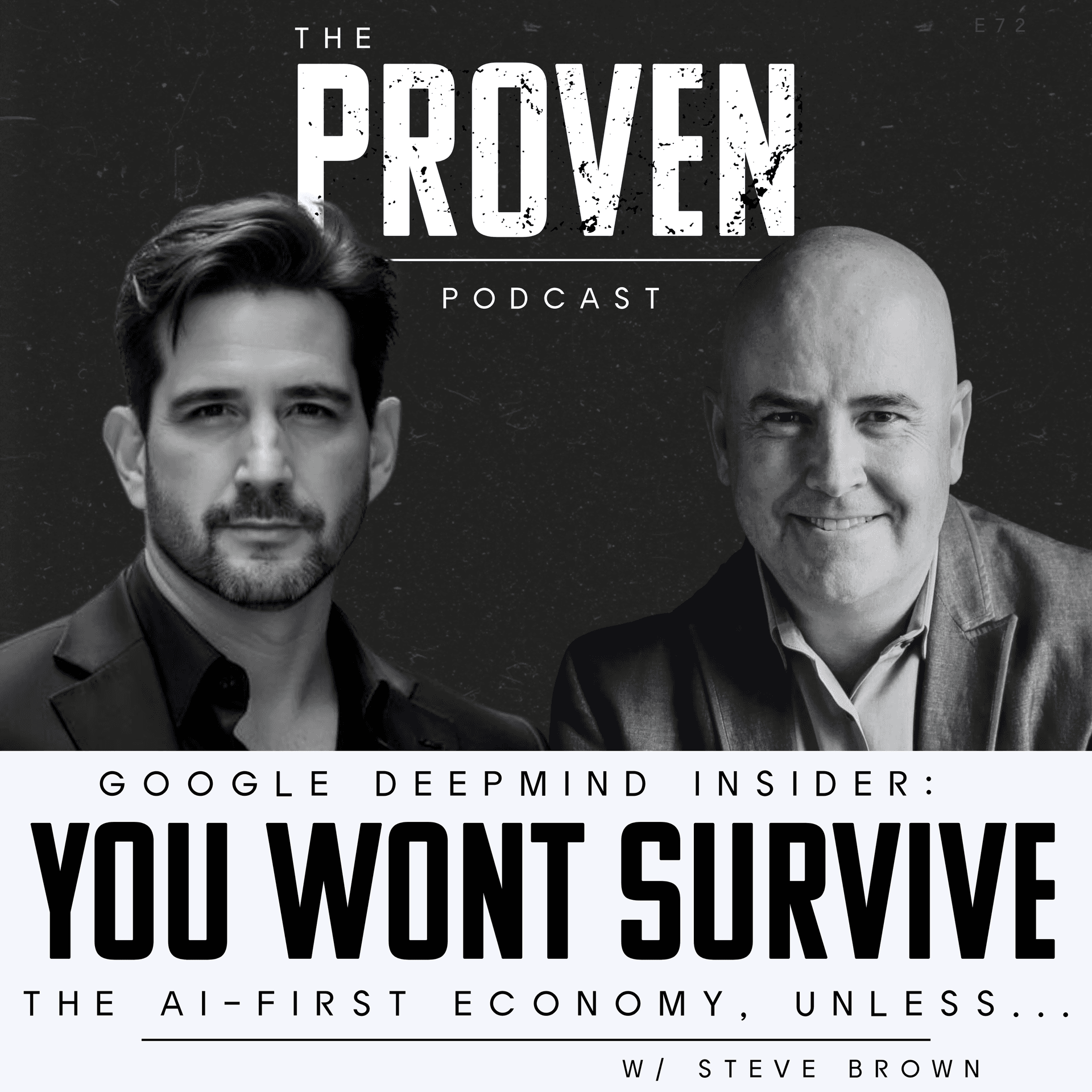
- Episode Title: Google DeepMind Insider: You won't Survive the AI-First Economy, unless... - Steve Brown
- Host: Charles
- Guest: Steve Brown, Former Executive at Google DeepMind and Intel
- Key Topics: AI's potential impact on business, education, and society; the transition to AI-first organizations; the mindset shift required to leverage AI effectively.
Key Takeaways
- Understanding Futurism:
- Futurists analyze trends rather than making predictions.
- The goal is to understand what is possible and how to prepare for it.
- Key questions: “What future do we want to build?” and “What future do we want to avoid?”
- AI's Transition:
- AI is evolving from tools to autonomous agents that change workflows and decision-making processes.
- There is a need to shift from fear of AI to strategic adoption.
- AI Amplifying Human Capability:
- AI is not meant to replace jobs but to enhance human performance—amplifying creativity and decision-making.
- Companies should focus on leveraging AI to create more value rather than simply automating.
- Becoming AI-First:
- Organizations must integrate AI into their daily workflows to stay competitive.
- Emphasizing experimentation over perfection is crucial.
- Identifying At-Risk Industries:
- Industries like accounting, driving, and legal services face significant disruption due to AI advancements.
- Those who adapt early will thrive.
Detailed Discussion Points
- The Role of Futurists
- Futurists do not predict but analyze trends to understand future possibilities.
- Importance of addressing both desirable and undesirable futures.
- AI Evolution
- Shift from tools to agents that alter productivity and decision-making.
- AI can augment human capabilities rather than replace them.
- Mindset Shift for Leaders
- Leaders must adopt a forward-thinking approach to leverage AI for growth and innovation.
- Emphasis on building AI-first organizations to thrive in changing markets.
- Strategies for AI Adoption
- Organizations need to consider practical methods for integrating AI:
- Experimentation: Encourage teams to experiment with AI tools.
- Education: Invest in training for staff on AI capabilities and applications.
- Frameworks: Develop frameworks for implementing AI strategies.
- Examples of Successful AI Integration
- Case studies of AI improving productivity in various sectors.
- Specific industry examples include:
- Medical research advancements (e.g., AI in drug discovery).
- Retail optimization through AI-driven assortment planning.
- Preparing for the Future
- Importance of lifelong learning and curiosity in an AI-driven market.
- Emphasis on understanding AI’s exponential growth and implications for the workforce.
Final Thoughts
- Vision for the Future: AI could lead to a transformative era where humans focus on creativity and problem-solving.
- Call to Action: Organizations must embrace AI, shifting from a fear-based approach to one that actively seeks to leverage AI for growth and improvement.
- Resources:
- Steve's upcoming book: *The AI Ultimatum: Preparing for a World of Intelligent Machines and Radical Transformation*.
- Companion guide available on provenpodcast.com to help implement strategies discussed in the episode.
Conclusion
- The episode emphasizes the necessity for businesses and leaders to adapt to the rapidly changing AI landscape and to leverage technology for strategic advantage. The future is not merely a challenge but an opportunity to redefine human potential and organizational success in the AI-first economy.
Written by AI. May contain mistakes. Listen to the episode to check what was said.
Chapters
Tap a time to open that second in VOUnderstanding the Role of a Futurist
0:22 to 2:37
Steve Brown explains what being a futurist entails and addresses common misconceptions.
“Steve, I'm excited to have you on the show, man.”
The Impact of AI on Employment
2:37 to 5:15
Discussion on the potential effects of AI on jobs and employment dynamics.
“flip sides of the same coin, but they're both important questions to address, of course.”
Transforming Organizations with AI
5:15 to 8:48
Steve shares insights on how businesses can adopt an AI-first model for growth.
“It's not like this may or may not happen.”
Steps to Adopt an AI-First Mindset
8:48 to 14:03
Practical advice on how organizations can pivot to an AI-first approach.
“different stages of AI for, and you said it really well, we've had AI for a really long time.”
Unlocking Employee Potential with AI
14:03 to 14:59
Learn how AI can amplify human talent by offloading busy work and unlocking capabilities.
“like, if my best employee could be everywhere all at once, what would that unlock?”
Types of Agentic AI and Their Applications
15:00 to 19:14
Explore the three types of agentic AI and how they can be integrated into the workforce.
“The second one is - Can you give us an example?”
Generative Design: Case Study of AI Collaboration
19:15 to 22:28
Discover how generative design technology enhances creativity and efficiency in design processes.
“The designer would not have come up with this thing on their own.”
Creating Abundance Through AI
22:29 to 24:22
Understand how to create organizational abundance by leveraging AI to reduce costs and time.
“What are the different flavors in there?”
The Evolution and Impact of AI in Daily Life
24:23 to 27:50
Learn about the historical context of AI and its pervasive presence in everyday applications.
“The example I give people is back in the day when Gmail was launched.”
The Impact of AI on Jobs
28:00 to 28:30
Discussion on how AI is transforming various industries and job roles.
“So having the idea that this is based off behavioral science, this is based off behavioral economics, AI is just leveraging all those tools.”
Show all 23 chapters
Identifying Vulnerable Industries
28:30 to 30:00
Exploration of industries that face disruption due to AI advancements.
“So, you know, eventually we'll get, we'll get, we'll get over it and get over our worries and do it.”
Retooling for the AI Era
30:00 to 31:40
Strategies for professionals to evolve and adapt in an AI-driven economy.
“I think you talk about this all the time, where your job might be evolving not eliminating.”
The Role of Accountants in the AI Landscape
31:40 to 33:50
How accountants can leverage AI to enhance their roles and business models.
“If they make AI, they become an AI-first accountancy, they put AI at the heart of their business, now they can maybe handle 10 times as many clients.”
Evolving or Becoming Obsolete
33:50 to 34:10
A stark reminder of the importance of evolution in the face of AI advancements.
“I know you have very specific NDAs that you cannot disclose.”
Investing in AI Acumen
34:10 to 36:20
The significance of boosting AI literacy among leaders and professionals.
“And God, I wish people wouldn't do this.”
Essential AI Tools for Success
36:20 to 38:10
Overview of valuable AI tools for various industries and their applications.
“They're not looking to replace their programmers at this point.”
Future of AI and Human Work
38:10 to 40:00
Predictions on how AI will change the nature of work and human interactions.
“Opus Clips sucks it in and creates lots of little clips in different form factors, drops in subtitles for me automatically.”
The Next Phase of Humanity
40:00 to 42:00
Exploring the potential evolution of humanity with AI at the forefront.
“You've been on the other side of the tidal wave you've talked about, and you've been in the rooms with Google and with Intel saying, Hey, this is where we're going to go.”
Transcendence in Maslow's Hierarchy
42:00 to 43:16
Explore the concept of transcendence in Maslow's hierarchy and its relation to AI.
“to be better to live better lives either for ourselves or for our children or both and we've been in this phase for a couple thousand years.”
Envisioning an AI-Driven Future
43:16 to 44:32
Discuss the potential of AI to transform society and eliminate work.
“we can move to an era from the survival era to the work era to the service era, where we're able to do service.”
Challenges of Transitioning to an AI Economy
44:32 to 45:25
Understand the challenges and disruptions of transitioning to an AI-first economy.
“In Star Trek, you never see somebody with money.”
Personal Responsibility in the Age of AI
45:25 to 46:04
Explore the importance of personal education and decision-making in an AI-driven world.
“I think, and we talk about this all the time, even when I was in college, we'd have psychology classes and philosophy classes.”
Connecting with Steve Brown
46:04 to 46:56
Learn how to connect with Steve Brown and access his work.
“What's the best way to interact with you?”
Transcript
Automatic transcript. May contain errors.0:00Welcome to The Proven Podcast, where it doesn't matter what you think, only what you can prove. Our guest today is Steve Brown, an AI futurist and technology strategist who helps leaders understand how artificial intelligence is reshaping business, work, and competitive advantage. Steve has proven that companies that learn to adopt AI strategically today will define the markets of tomorrow. The show starts now. Hi, Ria. Welcome back to the show. Steve, I'm excited to have you on the show, man. I'm glad to be here. We had a little pre-interview a couple of weeks ago, and I thought, oh, this is going to be a fun one.
0:33it's gonna be fun so for the four or five people on the planet who don't know who you are let's give them a little bit who are you what are the best things you've done uh let me see i spent 30 years or so in high tech good head of hair when i first started not so much now um i spent a long time working at intel when they were the company to be at because the leaders of the world the technological breakthrough people of the world stood on our shoulders um not so much these days sadly. And then more recently, I worked for Google DeepMind. At both companies, I got to be a futurist. So helping them to think about the world 5, 10, 15 years from now and how they want to try and shape it.
1:11And I've been on the speaking circuit now for, I don't know, 10 years or so. I've done over 500 keynotes on five continents, and I help people understand AI and the consequences and the opportunities it presents for transforming business, education, and society more broadly. So there's a lot you talk about there in that one second. We talk about a futurist, and one of the things you've said multiple times is you don't go hide in a room and smoke something and then come out of it. You're actually using... I wish that was what I had to do, yeah. It's so much easier. What does a futurist do if you're not going out there and just rubbing a crystal ball, or at least here in the United States, we had the magic eight ball that you spin around and that thing pops up and says, it may be possible.
1:53What is the difference between a futurist and someone who's just pulling it out of their tuchus? A futurist doesn't make predictions is the first thing. People think that futurists make predictions. What a futurist does is look at trends, how those trends play out over time, and then looks at how those trends will collide in the future to make things possible. So it's about understanding what will be possible in a certain time frame. It doesn't mean it's going to happen. It just means the technology trends are going to the point where this way possible, the people trends, the business trends, and you're looking at the confluence of those at some point in the future.
2:29And you're fundamentally trying to ask and answer two questions. What's the future we want to build? And what is the future we want to avoid? And they're flip sides of the same coin, but they're both important questions to address, of course. Perhaps if we had addressed that when we were thinking more about social media, People thought about the future they wanted to build. Oh, people will share information and recipes and didn't think so much about the future we want to avoid, which is the situation we're in today. Regrettably, people, when it comes to AI, do have a very specific future they're terrified of, that they're trying to avoid.
3:00Most people, when they talk to me about AI, they're thinking, oh, it's ChatGPT and I'm going to be fired and I'll have no jobs and I'm going to be living in a two-story Dorito bag. Let's get the elephant out of the room first and have that conversation. Is AI going to be the extinction of employees? Not in the short to medium term, long term perhaps, and maybe that's a good thing. And we can talk all about that. The opportunity, and it also, my answer depends on how leaders behave. um if leaders stay stuck in a 20th century mindset of well i use technology to cut costs improve productivity and automate as much as possible and that's what i need to do for the shareholders to create long-term value right which is their fiduciary responsibility they need to shift their mindset to instead be thinking how do i use ai to build an ai first company accelerate and elevate the people that I have and amplify the human capital so that I can I stop thinking about growing my company 10 or 20 or 30 percent every year but now I'm trying to grow 10x or 20x per year because I'm using AI as the engine and wrapping my people around that engine leaving scarcity behind because most leaders and managers, they're managing resources.
4:29That is their job, right? They're managing headcount, they're managing dollars, they're perhaps managing some capital and equipment, and they're trying to make the best results they can out of that. If you put AI at the heart of your business, make it the engine, now you can operate in this world of abundance. It's a different way of thinking that most leaders haven't got yet. If they stay stuck in that 20th century thinking and they just automate away the people, yeah, it's not a happy ending. But if we use AI to amplify the impact that organizations are able to have and to amplify people and to do more rather than thinking about how do I do the same with less, then medium to short term, I think things look pretty good for employment.
5:19Well, I think one of the things you just brought up there is important because you come into organizations not to teach people how to use chat GPT, but you teach people how to fundamentally change how they run organizations with an AI first model, because it's not a debate anymore. It's not like this may or may not happen. You know, one of the examples, and I still quite a few examples from you, and I will give you credit where credit is due, is you talk about that the robots that are made today and AI of today is the worst they will ever be. They're only going to get better going forward. And one of the examples you gave that I just fell in love with was there was a, I'll let you do it, the medical one that went from 10 days to two.
5:56Can you tell a little bit about that one? 10 years to two days. Yeah. So this was an AI from Google called Co-Scientist. And it's to help with scientific conjectures and trying to determine why something you're observing may be happening, what's the explanation for it. And one of the things that stumped scientists for quite some time was figuring out, in a hospital environment, where you get things like Mercer and other things, where you have these rigorous cleaning protocols, but you can't get this bug out, right? And people are still getting sick from it. why might that be happening? What's the phenomena?
6:39And it took scientists a decade to come up with this idea that maybe things like Mercer, they're forming chains, they're linking into chains, so they can actually crawl off surfaces and onto other surfaces. It's a bit like prisoners tying sheets, bed sheets together to get out of their accommodations, let's call them. same thing they were they were just using the forming in chains and then moving around and when they they presented this information this challenge to google co-scientist it thought for two days and came up with the same answer so you know you go from 10 years of humans thinking about something to ai being able to come up with it in a couple of days and you see many examples like this particularly in scientific research and discovery where another example from google i was at DeepMind when we were working on AlphaFold and doing the release of that to the scientific community.
7:38And that crashed the understanding of the structure of a protein. Normally it took four or five years. Basically it was a PhD of one person spending four to five years of their life trying to decode the structure of one protein. There are about 20 ,000 different proteins in your body. And it was now able to do it in seconds, accurately. And that information is now empowering the medical research industry for the next 10 and 20 years. And we will see new drugs and new therapeutics come out of it, perhaps understanding disease paths for Alzheimer's, Parkinson's, and other debilitating conditions.
8:19And we'll see breakthroughs in the next five to 10 years around that because this AI was able to do all this decoding. So this is just the start of what's about to happen. And the reason I ask is we turn 10 years into two days. You turn four years into seconds. And the reason I bring this up is if you're in business, if you're trying to scale, if you're trying to get moving forward, this is what's already coming. This is the tidal wave. You're already sitting on the beach. You're going to have to survive this. You're going to know how to serve this and do this. And people are looking for tactical ways to do this because we're in different stages of AI for, and you said it really well, we've had AI for a really long time.
8:55This isn't anything new. AI has been around for an immense amount of time, you know, spam filters, that's AI. That's just, it is what it is. When you're sitting there and you're looking at a business owner and you want them to be AI first, which is a completely different mindset, much like, cause I'm old. When the internet came out, there was a whole pivot that we had to do. We're in that same pivot. One of the tactical things that you're sitting down with your clients of the people you work with say, okay, this is where you are. It is what it is. The roads used to be made out of concrete. They're now made out of water.
9:24You're going to have to change how you show up. It just, there is no way around that. What are you sitting down? What are the first kind of four or five steps you say, okay, this is a reality. Let's start doing this. Yeah. Great question. So a lot of my clients, you know, I show up and they, they want to pat themselves on the back a bit and they'll say, you know, we, we, we have an enterprise license for co-pilot now. This is going to make a difference. And I said, well, good, that's good. That's great. But that's not, you're 1 % of the way there. The other 99 % of the opportunity is still on the table.
9:59So let's talk about what that is. And the first thing I do is start off with a thought exercise. Imagine an AI native company that is coming after you. They're well-funded. They have the people, the talent that they need. They have access to AI technology. And once I've explained the different types of AI, because there are many different flavors, as building blocks, like Lego building blocks that they can start to put together to make business solutions. Once they understand those, I say, well, okay, if you're an AI native competitor, if you left this business tomorrow and you went to this AI native company, what would you do to compete aggressively?
10:41What does that AI native business look like? AI native being you're building a business from scratch, knowing everything that you know about AI and knowing about its capabilities now and in the next two years. What would you build? Would it be the same as the business that you've just come from? Well, no. Okay. Well, let's talk about what that would look like. And then how are you going to start to build that inside your existing company? How do you become, You're not going to become AI native because you're not, but you can become AI first. And I give them the example of internet first businesses.
11:18Amazon, great example, right? They were an internet first business. They came after retail and started to eat retail's lunch. So what did retail do? They became not internet native, but internet first. and Target and Walmart and all of the big box companies that Amazon was coming after adapted and said they invented this whole omni-channel idea, right? Where you could buy online, return in store. And their focus was on, yeah, we're going to match Amazon capability for capability. We're going to go online and do all the things, but we're going to leverage the fact that we're not internet native.
12:01We're internet first. and that brings us some capabilities that amazon doesn't have and the mantra in the industry i used to do a lot of work with retail at the time was wacd what amazon can't do they don't have a physical presence and now they've bought whole foods and ironically they're now going to have big box stores of their own and go off to target um but there's there's something about using the physical value you have today. There's something good about the businesses you have. You don't feel bad about it. But how do you then embrace AI to become AI first? And that should inoculate you then against an AI native attack.
12:43And that's the way I start them off. So how does one do that? How does a company become AI first and do that pivot? Because yes, Target and Walmart and all of them adapted and they did have an internet presence. And this This is what we can do that other ones can't do. And other ones didn't, like JCPenney's and Sears and Kmart. They were too late to the game and they don't exist anymore, which is still wild to me. But it's going to happen if people don't adapt fast enough. What I'm trying to do here is give people that competitive advantage. And I think that's what you try to do as well. Absolutely.
13:14And it means you, first of all, have to let go of the past. You have to let go of today, the status quo. A good example of a company that didn't do that was Blockbuster. Netflix used to compete with them with DVDs. And then Netflix realized, oh no, we need to become a pivot to being an internet first company. And we're going to let go of mailing people DVDs, go online. We're going to upset some customers, but we're going to leave these blockbuster people behind. So that's what you're trying to do is think, given the new technology, how would I deliver value in new ways? What are the approaches I need to do that.
13:52And so to become AI first, there's three chunks of effort you need to go through. The first one is, how do I use AI to amplify my people? And you want to ask questions like, if my best employee could be everywhere all at once, what would that unlock? Because that's what you're trying to do. You're trying to use AI to amplify people, to use AI agents to mirror the abilities of your human talent and to amplify them so they can effectively be everywhere at once. So that's the first sort of question you want to ask. If I could use AI to offload all the busy work from my employees, what would that allow them to do that they don't have time to do today?
14:37So think about how do I use AI to unlock the latent abilities and capabilities of my human talent, not to replace them, but to amplify them. And with the goal of how could I have 10x the impact we have today, let's say a year from now or two years from now. So that's the first bucket of effort is amplifying your human talent. The second one is - Can you give us an example? Can you give me an example of that before we lose people? Like someone you've worked with, like this is what we actually did. um it might actually be too early to give a good example of this um just because agent technology is what we're really talking about here and we're in the early phase of agentic ai um and agentic ai is essentially it's a smart piece of software that that behaves like a digital employee.
15:35And they're going to get better and more capable over time. But what you're trying to do is pair your employees with agents. And there are going to be three types of agents, by the way. So let's talk about those and how you might put them into your workforce. The first type of agent is an offload agent. It does exactly what you'd expect. It offloads a task from your employee. This is the freeing them up from the busy work, booking meeting rooms, booking flights, that kind of stuff. So you're offloading. The two more interesting types of agentic AI are elevate agents and extend agents. Let's talk about the difference between those two.
16:15Elevate agents partner with a human being so that you pair them with them and they're collaborating to elevate the performance of the person. Now notice I very carefully chose my language. I didn't say elevate the productivity. That might be one vector, but elevating the performance, meaning their productivity, their efficiency, their effectiveness, their intuition, their creativity, their decision-making abilities, and so on. So you have to think multidimensionally there. So how am I elevating the performance of my employees by partnering them with agents? And then the third category, more rarefied air, but if you can get there, this is amazing, partnering a person with an extend agent that extends the human's capabilities so they can do something they could not do before.
17:08So let me give you a concrete example. This is not agentic technology, but at least gives you this idea of amplification, expanding creativity and productivity. Generative design technology. This has been around from Autodesk for some time. What it does is it takes the initial design that a human designer has created and riffs on it. And it comes up with hundreds or thousands of variants of that design. And the human designer said, hey, I'm trying to optimize for this or that. So a good example I talk about in my keynotes is the bulkhead design of an A320 aircraft. Now we're getting super concrete.
17:49The skeleton that's inside that bulkhead is this weird design. And when you see it, you think, well, that wasn't designed by a human. And it wasn't. But it also wasn't designed by an AI. It is the result of a human and AI collaborating together. What the human does, they create the initial design. They specify to the generative design software, which is AI-based, that I'm trying to, it needs to handle four and a half G's of tension, right? Because the bulkhead is there to hold the fuselage together, kind of important. But it also matters on a plane what the weight is. So there's a reason that we don't have peanuts on planes anymore.
18:32It's because pretzels weigh less and the airlines figured that out. United Airlines did a calculation that if every one of their passengers took Ozempic and lost 10 pounds, it would save them $80 million a year on fuel. So weight matters on a plane. So this generative design software then optimizes the design. It sort of riffs on it, comes back to the human designer and says, I put these all through simulation. The one that you want is this one because it optimizes for weight, cost, which is always a factor, and it still gives you the tensile strength that you need to hold the plane together. Now, what's happening in that scenario?
19:08A human designer might have the luxury of the time to come up with three to five options and then run them through simulation and then okay we'll pick the best one using genitive design now you can explore a much broader design space you can look at a thousand or two thousand or ten thousand options what you're doing is collapsing time and that's what you're trying to do in the second cache that i'll come in a second, but you're using AI to one, get you to a place you could never have got before. The designer would not have come up with this thing on their own. So it's somewhere in this elevate and extend area.
19:51But the AI would not have come up when it's on its own either. It is the collaboration of a human and an AI working together. So companies that use these types of tools to expand the design abilities of their engineers, for example, are able to explore much broader design spaces much more quickly and essentially collapse time and money. And that's the second thing that organizations need to do is how do you, as leaders, how do you create abundance in your organization? How do you create more time to do things by collapsing cost and time, reducing marginal cost of design, for example, but in any other realm so that you can free people up and get to the third stage, which is stop defending your existing business and start thinking about how do I develop new businesses to go serve new needs in the marketplace?
20:54I think right there, stop defending your existing business is important because I think the JC pennies and the Kmart's defended like, no, this is who we are. We're going to double down on this where the Kmart's and the targets and the Walmarts were like, nope, we have to change. Just, it is what it is. The rules have changed. Amazon's changed the rules. We need to, we need to change that for most business owners though. It is still like telling them, okay, I need your, you're a two-year-old. You're a toddler. Congratulations. I need you to dunk a ball. They're like, what the heck? They're begging for something proven.
21:24They're begging for something tangible that they can turn around and they're like, okay, well, I'm going to ask my 12-year-old what chat GPT is. I'm like, that's not going to work. you know so having that conversation telling them is it a is it a course is it a material is it where can they go where can they go into this idea and start learning and playing and understanding because i think we're at the point a bit like climate change where things are changing there's just nowhere the science points at it um you know if you if we want to be somewhat politically correct like no we didn't necessarily cause seasons but we definitely gave it a red bull to speed it the hell up but people are like well we don't know what what to do and i think it'll go into the idea of okay i know what i need to do but i what i'm not willing to do and that is a completely different conversation as far as the not willing people who are listening to this really simply you don't have to don't worry about it you'll be bankrupt you'll be gone you'll be you so don't change but for those who actually want to change they're looking for something tangible and i hear this all the time when i'm on stage or if i'm talking to people organizations owners business funders the people you interact with the people that bring you in and say listen we know this is coming there is a tidal wave coming how do we do this right now how do we educate our senior staff how do we educate our junior staff how do we survive so this is this is the need i identified a couple years ago it's why i created an online course for senior business leaders to help prepare them for this time and i wrote a book the ai ultimatum again designed for leaders to prep them on what are the different moving parts of AI?
22:56What are the different flavors in there? What is agentic AI? How do I deploy it? What are the things I need to worry about? How do I deploy it successfully? What are the gotchas that you can have? Why have 90 % of AI deployments today been judged a failure? Well, it's because XYZ, and I go into that and explain what you need to do to have successful deployments. What's the role of physical AI, robots, in your operations? If you have a physical component to your operations, and most companies do, unless they're a pure play SaaS company, you're going to have some sort of physical element. People are shocked at how fast robots have matured and how quickly they're coming into our lives.
23:43You know, people will be selling robots into homes, humanoid robots into homes this year for$20 ,000. You know, a lot of people haven't really figured that out yet. So it's coming much quicker than they realize. The other thing I try and help people think through is that you have to, you know, you mentioned earlier that one of my mantras is AI is as bad as it's ever going to be. Robots are as incapable as they're ever going to be. They're just going get better and better from here. There is an exponential curve that we're on. And exponentials, when you look backwards, look linear. And then there's this wall ahead of you, and you have to understand that.
24:23The example I give people is back in the day when Gmail was launched. People thought Google were nuts for giving people a gigabyte of free storage with their Gmail. And they're going to put themselves out of business. They can't possibly do that. It's going to bankrupt them? Well, because Google realized that they're on an exponential curve and a gigabyte was going to be nothing, you know, in five years time. So you have to understand this exponential nature and plan accordingly. I think that's what we talked about in the very beginning. What took 10 years took two days. And, you know, there's a lot of people who have resistance to having robots in their house.
24:59And we have this conversation all the time, like, oh, I'm not going to have a robot in the house. I'm like, you see that little hockey puck that vacuums your house? that's a robot so it just it's already happening and we just i don't i think that's one of the things that having listened to your keynotes and having read your book you talk about how ai is not new we've been with it for a while we talk about the junk mail and all that can you give examples to get people to kind of exhale a little bit because they're terrified of it right now what are some of the examples of ai that we've already had for some time well every time you open your email there is an ai that sorts the spam from your inbox and it's just making predictions based on having been trained on literally billions of emails.
25:38It knows the signs of spamminess and it makes a prediction about whether it should be put into the junk folder or your inbox. And it's good. It's accurate probably 99.9 % of the time. So you use that every day. Let me give you some other examples. When you post a letter and you handwrite a zip code on there, the post office for 15 years has used AI, a convolutional AI, that was what it was invented for by Jan LeCun back in the day, to read your scroll and turn it into numbers. So this sort of stuff has been around for a long time. I'll give you one more example. In the retail world, if you're a chain store in apparel, you have to decide what products are showcased in which stores, in which locations around the country or around the world, if you're global, and what colors in what sizes of what product lines am I putting in each store.
26:35And you're trying to optimize for sales out and you're trying to minimize returns and stuff moving into the bargain bucket, right? And being sold off for pennies on the dollar. The reason AI comes into play here is it's optimizing based on historical sales out data. And it's understanding innately that people in different parts of the country have different tastes and they're different size profiles. You can't just have a bell curve, that bell curve shifts depending on where in the country you are. And so it's called assortment planning and it's been used for 15 years. So, you know, AI in the form of machine learning to optimize business processes, it is running in the background of global business and has been for 15 years what's new is the generative ai stuff and that's what's got everybody's attention but ai has been around a very long time it's interesting you bring that up regarding the the size of clothes and all that one of my favorite ones of this is ironically target target would track using ai and using algos what you were buying they're like oh my god this person obviously is pregnant based on data and they would send something say congratulations you're yeah you know this example you're pregnant This is what's going to happen.
27:47People would freak out. They're like, Target knew I was pregnant before I knew I was pregnant. So their solution was they just lied to you. They sent you the same stuff. They just changed the catalog they sent to you that had random other things so that you're like, oh, look, it happened to have this in here because Target knew that. So having the idea that this is based off behavioral science, this is based off behavioral economics, AI is just leveraging all those tools. It's already been happening for a really long time. If you're just waking up to this, you're late to the game. So what are some of the...
28:15Yeah. So what are some of the industries or jobs specifically that you're like, no, it's over. You need to retool right now. And then we'll talk about how to retool in a second. I mean, the most obvious ones that are going to fall, let's say, in the next 10 years. Let's be generous with our timeline. That's very generous. Accounting is probably a big one.
28:45Driving is probably another. whether that is truck driving or you know taxi driving that's likely going to evaporate but they won't go completely there'll still be truck drivers who are driving in and out of the city because people feel more comfortable that way but they'll drop it off at a hub out of town it'll do the freeway journey a robot will do that and there'll be still be some taxis around because some people will not want to go into a self-driving car, but most people will do it because it's going to be one third of the price. So, you know, eventually we'll get, we'll get, we'll get over it and get over our worries and do it.
Read the full transcript
29:24So those are the, those are some big ones. Um, paralegals probably don't have much longer. Um, anything that is about passing through knowledge or doing routine, repetitive tasks is likely going away. But in theory, we should free these people who do these up to do different things. Accountants are very smart people, mostly. And why are they doing that kind of work that can be automated when those people could be showing up in society in different ways? I think you talk about this all the time, where your job might be evolving not eliminating. We're sitting there saying, Hey, I was an accountant.
30:11I'm going to use this form of AI that helps me perform better instead of replacement. So it's a performance thing, not a purge thing. So when you're going into that and you're having that conversation, how does an accountant, how does someone say, okay, this is what's going on. Because you've, you've been there, right? You've been a part of Google's. You've been part of Intel's. You're, you understand this better than most human beings. If I'm an accountant, which God bless you guys, your accounts. I don't care if I'm off by a penny. I just don't. I'll give you the damn penny. So, but if you're an accountant and you're like, Hey, or you're in an industry that is headed towards extinction, how do you leverage?
30:47How do you, what are the tools that you can use in order to fix that? I don't know what the specific tools are in the accounting world, but let's use it as a great example of how you might become an AI first accountancy business. at the moment the the engine is run by people accountants who you know they're using software tools but they're still you know going through entering things trying to figure out what goes where um that very quickly goes away and you're able to shift from the engine being people and you're being limited by the number of hours in a day you know my accountant is no longer taking on clients because they can't handle anymore because they only have a certain number of hours in the day and days in the year.
31:31So if you could then shift to the engine of that business, the AI doing all of the accounting stuff, creating all of the reports, now you can free the accountant for doing account management, working with clients, perhaps taking on 10 times as many clients because there's a consulting and advising and human connection part of being an accountant that is a smaller fraction of their job. But it's there. If they make AI, they become an AI-first accountancy, they put AI at the heart of their business, now they can maybe handle 10 times as many clients. And the accountants that do that first will put the other accountants out of business.
32:13Yes. So that's the thing. People worry about being replaced by AI. What you're going to be replaced by is other humans who've built an AI-first company to come after you and eat your lunch. So one of the examples that I love with the AI one is my accountant. We do, in my world, it's huge with cost seg. It just is what it is because we just don't like paying taxes. And there are many legal ways to eliminate that. And one of the ways that we do that is through something called cost segregation. And for those of you playing at home with cost seg, go look at 179 and you'll figure it out. But when it comes to cost seg, we're like, okay, I have this.
32:48I'm going to give this much money. And my ROI on that's going to be zero. I'm going to give a million dollars to the government. my ROI on that is zero. So it's horrible. It's a horrible investment. Or I can go do A, B, C, D, E, F, G and get that. The problem is they don't know or have access to A, B, C, D, E, F, G. So my accountant, we sat down and we said, Hey, this is people who have these opportunities with cost seg. This is the people who need cost seg. Why don't we use AI to compare the two and match, turn into a dating game. And then he evolved from just being an accountant to being a wealth creator and now it's business and how much he charges, right.
33:23Has exploded. So those are one of the tangible examples where you have to accept, cause he, he had a lot of resistance. I mean, my accountant who I love dearly, uh, is a little older than me. And he's like, I don't have to, I don't want to evolve. This is going to be painful. And we had a very frank conversation. I was like, what's more painful being homeless or evolving? And he's like, you have to take it that seriously. I'm like, yeah, you need to take it that seriously. So they're not doing that. So what are some tangible things that you've done when you've worked with your clients and you've seen that?
33:51I know you have very specific NDAs that you cannot disclose. I do agree with you that wearables are going to replace phones. I think that's, I cannot wait for that, but it means that everyone's going to be walking around with glasses. So it'll be an excuse for me to wear glasses, but you know, it's going to happen. God bless age. What are some of the things that you've seen that you're like, I can't believe, I wish people would know this and do this. And God, I wish people wouldn't do this. Yeah. Well, part of it, I mean, I mentioned one already, which is thinking a site-wide chat GPT or copilot license is, you know, you're there, you've done it.
34:30You know, some leaders, they think that's what it needed. They had to make this big investment to upgrade the seats they have with Microsoft and that that would be enough. Unfortunately, it's not. What are the things I wished people did? I think for me, you know, just building the acumen that the biggest thing any individual can do, and that means any leader can do right now, is to invest in themselves and boost their AI acumen. understand AI not at the technical level you don't need to do that but understand the different flavors of AI what they can do now what they will be able to do a year from now and try out AI tools so that you understand what the capabilities are and because if as a leader if you don't understand what AI can do today you haven't played with this stuff you haven't had your mind blown with this stuff, created an AI song, created AI video, you know, done something like that where you think, holy moly, then you haven't really fully internalized the moment.
35:45So that's the biggest thing I wish people would do is invest in themselves. Particularly if you're a leader, by investing in yourself, it's like put your oxygen mask on first so you can help others. if you want to be a good leader you have to show up completely differently in this moment and that means you have to understand what's going on right i think it's for me it starts with the two steps that you've outlined already which is this is here accept it just accept it and then you have to pivot to ai first you're an ai first company period full stop no matter who you are no matter what you're doing you're an ai first first organization what are some of the tools that you've seen that maybe people aren't using that you're just like go this right now for where we are when we're recording this in early 2026 this is these are great and these are some of the ones that i wish people would keep an eye on that there's just kind of these undiscovered gems yeah i mean it depends what line of work you're in um a lot of people like lovable as a way to create, you know, websites and code, decoding, codecs, if you're, again, if you're in the software world, if you're a leading software company, whether that's Apple or OpenAI or ServiceNow, you are deeply using AI coding tools to amplify the output that your software programmers can create.
37:18They're not looking to replace their programmers at this point. If you have a choice of, well, I can do 10 times the amount of code with a person now that I could a year ago, do I need one-tenth of the programmers or do I want to create 10x the amount of software? 10x the amount of software, please. So those sorts of tools, I think, are transforming anybody that is writing any kind of software. Um, and there are some leading companies that are saying they are either already to the point where every line of the code that they're checking in for their new piece of software, um, is AI generated, or they will be there by the end of the year.
38:03So if your organization has some or some software component and you're not on that timeline, not on that path, then you're behind. Other tools I would recommend. Here's a fun one for content creators. I really like Opus Clips. Are you familiar with it, Charles? I am. I am. My team's having me do it. I take a keynote. I point it to a keynote on YouTube. Opus Clips sucks it in and creates lots of little clips in different form factors, drops in subtitles for me automatically. I just pick the ones I like and stick them to social media and it does it automatically. You know, it saves hours and hours of time.
38:44And I couldn't believe how cheap it was to use. So I signed up immediately. So these are the types of things. And there's usually a tool for anything that people are doing. You just have to find it. Yeah. Google notebook is one of them that I love. I'll take, and I'm like, I do not have time or energy. Yeah. The end of my own. I do not have time or energy to watch thousands of YouTube videos anymore so i will use chat or whatever it is to tell me the top ranked or the most views regarding whatever that topic is i will then copy those links drop it into notebook i'm like make me a course make me a powerpoint presentation and it builds it all out for me and i'm like click click click i'm like oh cool so i'm condensing and i'm helping it with me performing and i think that's one of the narratives you talked about before is not purging of a performance and then well so we've Talk about what's coming.
39:30I was going to say that there's tools like Nano Banana Pro. People are using it to create slides now that look beautiful. Or there's a feature in Google Slides where you can beautify a slide. And it turns something that you've tried to create as best as you can into something that looks like it was created by a graphic designer. And makes you look slick and polished. So there's just little things everywhere. And this is just the beginning. right yeah i think ai is the original or the best performance enhancement we've ever seen from there we talk about you know this is what's coming and we've talked about the fear and we've talked about hey these are some of the things you can do to make it a little bit better the difference is you're in rooms and have been in rooms of where it's going versus okay how do i survive the tidal wave we get the for most of the gen pop we look out and we're like okay big tidal wave and we can't see beyond that tidal wave.
40:23You've been on the other side of the tidal wave you've talked about, and you've been in the rooms with Google and with Intel saying, Hey, this is where we're going to go. It's cute that they're trying to catch up with what we talked about and thought about doing five, 10 years ago. That's adorable. Let them try and catch up. This is where we're going in the future. I know you're limited on what you can share, but what are the things that most of the gem pop and the people like me who are like, Hey, I'm kind of doing okay. Have no idea about that, where we're going. What is that stuff as a futurist that you've talked about?
40:53This is what's next. So I've got good news and bad news. We'll start with the good news first. I suspect that, and we can talk about the timelines, but I suspect that we are moving to the third phase of humanity. And what I mean by that is the first phase was our survival phase. you know stone age um hunter gatherer subsistence farming you're just trying to get to the next day and stay alive thankfully we got out of that phase and we've now been in the work phase where we work to yes survive but also hopefully to to have a bit more than that right we have jobs careers we have a home if we're lucky um we may get you know you think about maslow's hierarchy we're trying to get up to the self-actualization at the top of the pyramid and we've been in this phase some time we have live in a capitalist society we have money um we're all striving to be better to live better lives either for ourselves or for our children or both and we've been in this phase for a couple thousand years.
42:14We might, with AI, be able to get beyond that. Maslow published a paper which was not released during his lifetime. It was released posthumously. And he talked about there being another layer in Maslow's hierarchy beyond self-actualization where he called it transcendence where we're able to get beyond thinking about ourselves and our own self-actualization and go to start thinking more broadly about other people as well and so I think the opportunity with AI if we can use AI to free us from work in the long term so that You free people to self-actualize at any level they wish, whether that is following artistic pursuits, scientific discovery, exploration, whatever it might be, whatever your thing is.
43:17we can move to an era from the survival era to the work era to the service era, where we're able to do service. We're able to come together in groups, look at big problems and figure out ways to solve them. Look at small problems and figure out ways to solve them. Take care of our elders. Explore the galaxy. I mean, the opportunity is huge if we can free ourselves from work. That's the sort of Star Trek vision, right? Where AI has cured all disease, or AI and scientists working together have figured out how to cure all disease. We all now have doubled our lifespans and hopefully vastly expanded our health spans.
44:06So we're living very comfortable, healthy lives into our 120s, let's say. Um, disease is kind of gone. Nobody wants for anything because the AI agents and the robots do all the work for us. The cost of goods and services crashes down to effectively zero. You don't need to have much money. If any money is still around to survive, that's the Star Trek vision, right? In Star Trek, you never see somebody with money. They're all helping each other out. Mostly. Um, the Gene Roddenberry view of the future, not the Terminator, James Cameron view of the future. That is within grasp. Maybe we could get there in the 2040s.
44:49Maybe. Have you watched the news recently? That doesn't seem really likely. I'm just saying. Yeah. But to get there, you have to go through a major adjustment. And we all have to let go of our lives as we know it. And it's going to be incredibly disruptive if it indeed happens. and how do you rewire the economy? How do you rewrite the social contract to make that vision possible? That is an enormous amount of work. And if it has to happen in just 10 or 15 years, I don't think we're ready for that. So what is the bad news? That's the bad news. Oh, that's the bad news. Okay. I was going to say, what's the bad?
45:34No, I agree. I think, and we talk about this all the time, even when I was in college, we'd have psychology classes and philosophy classes. And we're like, okay, imagine if we spent a third of the money we spend on trying to kill each other on trying to heal each other. Where would the planet be? What are we going to do? And we're just going to hit that point where you have to decide it's going to be left or right. And we just have to decide which path we're going to go on. And we can't control that. One of the things we can control is kind of how we educate ourselves, what we read and all that.
45:59So if people want to track you down and get access to that stuff and see those types of information and they want to find more access to you, how do they find you? What's the best way to interact with you? each is where to find me is on my website stevebrown.ai nice and straightforward and you can find my book on amazon it's called the ai ultimatum oh hang on i have one ta-da right there that's what it is so if you're looking for online you can see it perfect steve i appreciate you so much there's so many more questions i want to ask and have it deep dive in i think at this point we've kind of spooked the people enough they're like oh wait hold on there's a different way of doing it i didn't mean to some people are yeah they need to yeah it is what it is you don't sit there and say, hey, no, it's not a tsunami.
46:40Just sit here and make a sandcastle. No, it's a tsunami. You got to pivot. So I appreciate it more than you could tell. Go out there, get it. Thank you for giving me a copy of the book in advance so I could take a look at it and read it. That was unbelievably helpful. I appreciate it. And thank you so much for being on the show. Hey, Charles, it was a delight. I get to have lots of these conversations and spending time with you was a real treat. Thank you. I appreciate it. That's a wrap on another episode of The proven podcast the future isn't waiting and neither is ai stop fearing disruption start building with it while others debate what's coming you could be learning how to use it remember if your strategy ignores technology it was never built to win
From the publisher
In this forward thinking episode, Charles sits down with Steve Brown, a leading force in the conversation on artificial intelligence. A former executive at Google DeepMind and Intel, he helps people understand AI, its potential, and how it will shape the future of business, education, and society. His clients include Nike, Comcast, Bank of America, PepsiCo, and Disney, and he has been featured on CNN, the BBC, Bloomberg, and The Wall Street Journal. His book, The Innovation Ultimatum, is a how-to guide on innovation and digital transformation, and his new book, The AI Ultimatum: Preparing for a World of Intelligent Machines and Radical Transformation, will launch this fall.
Steve breaks down why futurists don't predict the future but instead analyze emerging trends to understand what's becoming possible, and what leaders must do today to stay relevant tomorrow. From building AI-first organizations to amplifying human performance rather than replacing it, he reveals the mindset shift required to thrive in an era of exponential technological change.
Together, they explore the reality behind AI fears, the industries most at risk of disruption, and the opportunities hiding inside the transformation already underway. Steve shares practical strategies for adopting agentic AI, rethinking how companies scale, and leveraging technology to unlock abundance instead of scarcity.
This isn't just a conversation about automation or tools, it's a blueprint for navigating the next phase of humanity, where AI reshapes how we work, create, and contribute.
KEY TAKEAWAYS:
-Why AI futurists don't predict the future, but analyze signals to understand what's coming next
-How AI is shifting from tools to autonomous agents that reshape workflows and decision making
-The mindset leaders need to move from fear of AI to strategic adoption
-Why AI will amplify human capability rather than simply replace jobs
Head over to provenpodcast.com to download your exclusive companion guide, designed to guide you step-by-step in implementing the strategies revealed in this episode.
KEY POINTS:
01:04 – What an AI futurist really does:
Steve explains that futurists analyze trends instead of predicting outcomes, while Charles reframes foresight as preparation, not prophecy.
05:18 – The shift from AI tools to AI agents:
Steve breaks down how AI is evolving into autonomous systems, while Charles explores how this changes productivity and leadership.
09:46 – Fear vs. opportunity in AI adoption:
Steve challenges common misconceptions about AI replacing humans, while Charles highlights how mindset determines whether disruption becomes threat or advantage.
14:32 – Becoming an AI-first organization:
Steve shares practical ways companies can integrate AI into daily workflows, while Charles emphasizes experimentation over perfection.
19:21 – Industries on the edge of transformation:
Steve identifies sectors most impacted by AI, while Charles reflects on how disruption often creates unexpected opportunity.
24:57 – Amplifying human potential:
Steve explains why AI should augment creativity and decision making, while Charles reframes technology as leverage for human capability.
30:08 – Leading through exponential change:
Steve discusses how leaders must adapt faster than technology evolves, while Charles connects adaptability to long-term survival.
35:44 – The future of work and collaboration:
Steve explores how humans and AI will collaborate, while Charles examines the skills needed to stay relevant.
41:12 – Preparing for the next wave:
Steve closes with advice on curiosity and lifelong learning, while Charles reinforces that the real advantage isn't AI itself, but how you choose to use it.