
In short
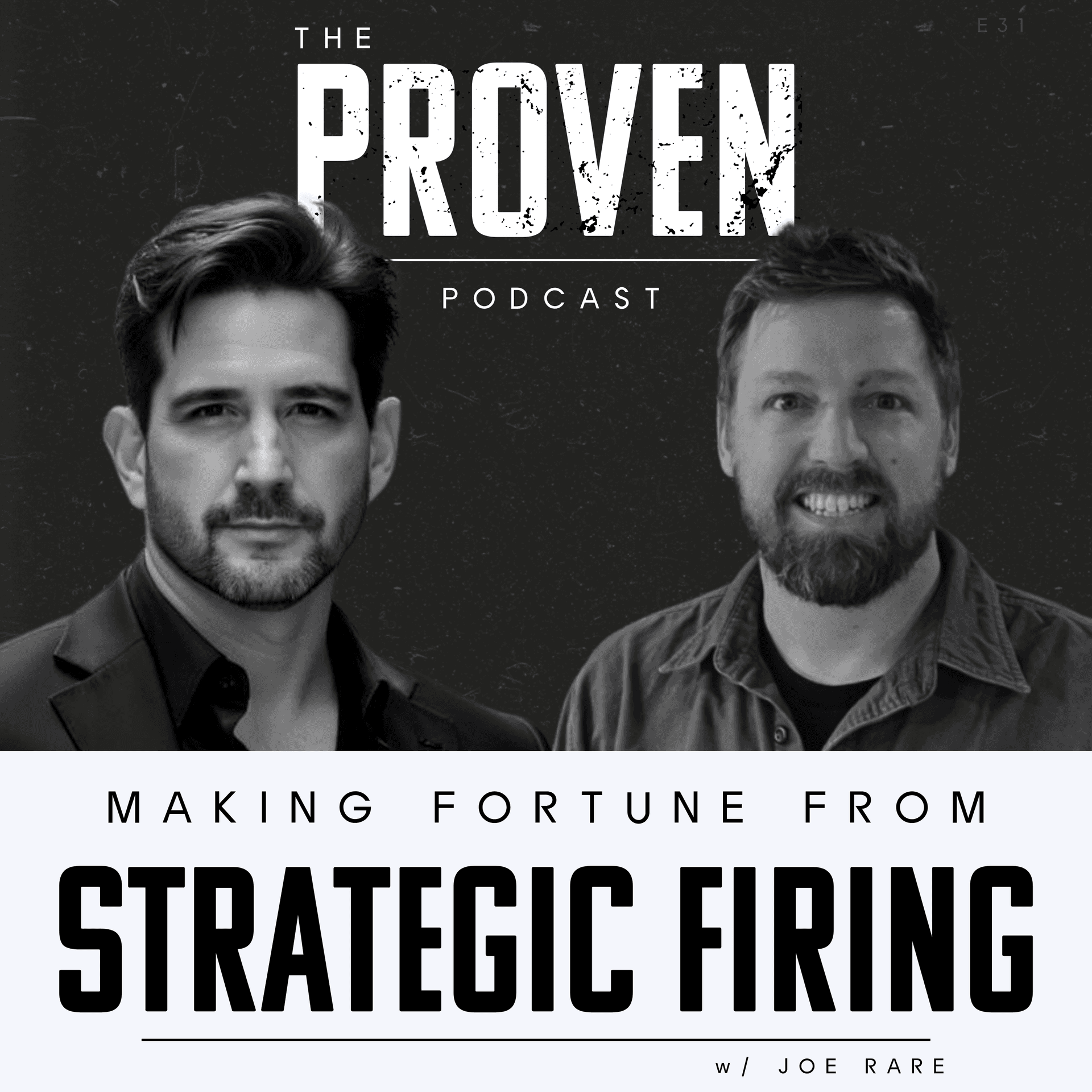
Proven Podcast - Episode Summary: "Making Fortune From Strategic Firing" with Joe Rare
Podcast Information
- Podcast Title: Proven Podcast
- Episode Title: Making Fortune From Strategic Firing
- Guest: Joe Rare
- Host: Charles
- Episode Description: Joe Rare discusses his innovative approach to virtual business scaling and how he built multiple seven-figure companies with entirely overseas teams. He shares insights into optimizing remote business operations and transitioning from traditional local employment models.
Key Themes and Insights
Joe Rare's Background
- Early Life: Grew up in a lower-middle-class family with a waitress mother and police officer father.
- Entrepreneurial Drive: Strong desire to control his destiny led him to entrepreneurship despite numerous early failures.
- Current Success: Operates four digital companies run entirely by virtual teams in the Philippines, generating over a million dollars in monthly revenue.
Innovation in Virtual Business Operations
- Scaling Without Local Employees: Joe discusses how he scaled to significant monthly revenues without hiring local staff.
- Direct-to-Talent Approach: He emphasizes hiring specialists from around the globe, leading to increased efficiency and reduced overhead costs.
Key Strategies for Virtual Team Management
- Daily Workflow Revolution: Joe implemented a two-part daily briefing system to manage communications effectively, removing himself from daily email management.
- Talent Testing Blueprint: Use of a multi-step verification process to ensure new hires are specialists who can directly contribute to business needs.
Importance of Clear Communication
- Hiring Specialists vs. Generalists: Joe advocates for hiring specialized talent rather than generalists to ensure quality and efficiency.
- Communication Protocols: Establishing clear communication protocols is crucial to maintaining quality while scaling quickly.
Overcoming Traditional Business Constraints
- Challenging Conventional Wisdom: Joe encourages breaking free from the "local talent only" mentality and embracing globalization.
- Work-Life Balance: His business model allows him to balance work with personal commitments, such as homeschooling his children.
Key Takeaways from the Episode
- Optimize Business Operations: Implement systems that enable seamless management of virtual teams.
- Scale Without Boundaries: Leverage time zone differences for continuous productivity.
- Transform Email Management: Outsource email management to maintain control without constant involvement.
- Build Freedom Through Systems: Create a business that operates independently of your daily oversight.
Critical Discussion Points
- Daily Workflow Transformation: Joe removed himself from email management, allowing his virtual assistant to summarize communications and prioritize tasks.
- Talent Acquisition Challenges: Identifying the right talent involves rigorous testing and verification to ensure candidates can deliver on their promises.
- Cultural Considerations: Understanding cultural differences and working conditions in the Philippines can help in hiring and managing a remote team effectively.
Suggested Tools and Resources
- Communication: Slack for internal communication.
- Project Management: Asana for managing tasks and workflows.
- Video Conferencing: Zoom for meetings and discussions.
Conclusion Joe Rare's insights into building a successful business with virtual teams challenge traditional notions of employment and productivity. His experience illustrates the potential for entrepreneurs to thrive by embracing global talent and modern communication tools, leading to increased efficiency and a better work-life balance.
Call to Action For listeners interested in exploring virtual team management, Joe encourages them to reach out through his company, Level Nine Virtual, to learn more about how to implement these strategies effectively.
Additional Resources
- Website: [Level Nine Virtual](https://levelninevirtual.com)
- Companion Guide: Available on the Proven Podcast website for step-by-step strategies discussed in the episode.
---
This summary encapsulates the key discussions and insights from the podcast episode, offering a structured overview that highlights important themes and actionable takeaways.
Written by AI. May contain mistakes. Listen to the episode to check what was said.
Transcript
Automatic transcript. May contain errors.0:00Welcome to the Proven Podcast, where it does not matter what you think, only what you can prove. Everyone says you can't scale without being everywhere at once. Today's guest, Joe Rare, proves that's backwards thinking. He's built four digital companies entirely run by teams in the Philippines, scaling to over a million dollars monthly while maintaining complete location independence. The show starts now. All right, everybody. Welcome back. I'm really excited to have Joe on here today. Joe, you're doing something that most people who are entrepreneurs don't even believe can be done, and they just don't have this resource.
0:30So before we get into all that, welcome to the show, man. I'm so excited for you to be here. Thank you. I appreciate you having me. So tell everybody a little bit about you because, you know, somebody don't know that how rare you are going in that situation. Tell us a little about you. Tell you about the success you've had. Yeah. I mean, I'm a kind of a lower middle class family guy. My mom was a waitress. My dad was a police officer. And so, I mean, we lived in a super small farm town and it was pretty, pretty, you know, kind of organic upbringing, lots of siblings and, and all that. But we had a, you know, nothing, nothing too crazy.
1:03It's not a rags to riches story, but it's a, it's a working class family, you know, and then I just knew that I wanted something different in life. And I knew that entrepreneurship was a way to go building my own thing so that I was, you know, in control of my own, you know, future and destiny and all of that. And so I've had more than my fair share of business failures. Lots of them, and those have converted into hopefully lessons learned so that I stopped making the same mistakes. and you know now we've built multiple companies i have four digital companies right now that are all run by a team in the philippines so i have an ungodly amount of free time uh i get to spend every minute that i want with my kids we homeschool our kids and do the homeschool hybrid thing and so we get to do kind of anything anytime we want and uh yeah we've created some really cool success most people can't even fathom that and one of the it's funny things you brought up and there There was a little bit of redundancy there.
1:57Like I failed all so many times, all these times. And then I'm an entrepreneur. I'm like, that's kind of the same. That's the same thing. You get that, right? Everyone is an entrepreneur. I'm pretty sure the definition of entrepreneur should have failure in it. It should. I think that's what it means. I think entrepreneur is an old Sanskrit word that means fail all the time. So just how it works. You mentioned the Philippines and everybody knows me knows that Christine is my virtual assistant. I cannot function as a human being anymore without Christine. She's been with me for six, seven years at this point.
2:26Everything gets done. She's my VA. She is my right hand. She's a gift. A lot of people look down on this. And you just mentioned that you've got four different organizations that your entire team is in the Philippines. Walk me through the day to day of what that like, because most people have an experience. They understand the idea of other people's time, but they don't really understand what this is, the workflow of this is like. Yeah. So it's actually quite easy. It's no different than somebody being here, you know, in the U S or whatever country you happen to be in. it's not that complicated.
2:55And I think that's where people over, they overthink this and think that it's just really, really challenging. And it's not, I mean, we do almost every single thing in our daily lives through our phone anyway. What's the difference between doing it through Slack or doing it through another, uh, you know, messaging medium. It's not that big of a deal, but for me, the, one of the core things that I took off my plate that has created kind of my routine is I used to get up in the morning and everybody does their thing. They check their email, right? I don't check my email and I have Martina who's my assistant.
3:26She checks my email. She categorizes everything. She responds as me to everything that she can respond to as me. And then she gives me a summary every morning and every late afternoon, evening, and tells me kind of what happened. Like, Hey, here's what's going on. These, you know, are the three key priorities. I can't answer them. You have to do it. Right. The only time I check my email is when there's something pressing that she can't act as me, or I can't just tell her quickly what to say to send it off. But that was a mind blowing change was putting that in place. Other than that, I mean, it's, uh, you know, kind of once a month, we'll have a meeting on each of the four companies.
4:07Uh, the team gets kind of a, Hey, here's what you need to do. Here's your battle plans. Go to it. Everybody's responsible for their own output. They manage their own teams. I mean, it's no different than any normal business with a ceo who doesn't do the actual work of the company but they kind of run the ship i stepped a little further away from that and became what i call a strategic advisor so i'm more of an advisor to the company and then we choose a long-term plan like here's what we're gonna do over the next 12 months here's what we're doing over the next five years and then we set that in motion and give people resources to go execute it and then we check back in?
4:45How's everybody doing? Do you need more resources? Do you need less? Are we over, under budget? Things like that. So the email one is a huge one for me. That's how it all started for me. You know, what would happen is Christine would go through everything and then she would sum it all up and then she'd give me a one line sentence pretty much on what each one of the emails were. And I would take out some sort of voice recording. I would send her some sort of voice message, which right now I do everything through Skype because it's easy and I'll just record everything. I'm like, okay, email number one to Joe, email number two to Bob.
5:16And that just took time. That took time to get her to train, to learn my voice, to do all that. Now loaded my entire voice and everything into chat GPT. So it'll just respond like me normally, but the team got to the point where they could do that like clockwork. And they, and I just, I don't check emails ever. I don't take social media ever. That's not me. If you're getting, if it has spelling mistakes in it, it's me. If it's actually spelled correctly, that's my team. That's what I always say. So as people do this and they're trying to do this, hiring someone, especially if you've never done it before, it makes it even more complex because they're overseas and you can't sit with them and all that.
5:52Where do you start looking for these people when you're going to do this? And what are some of the questions you want to ask? If I'm an entrepreneur at home going, all right, I clearly am overwhelmed. I need to be a strategic advisor, or not even the CEO, I need to step out because I can scale. What are the things that I'm walking into? Well, the places to look, I mean, you can go everywhere. There's Facebook communities all over the place that have options for you to find people. There's that. Uh, the second piece is, you know, online jobs, you know, a pH is, uh, there's tons of opportunity there.
6:22We, I own my biggest company is it just happens to be a virtual assistant services company. So we got really, really good at doing it for ourselves and then realize like, Hey, we have the opportunity to help our clients help other people. And then we built a business out of it. And then that's scaled and that became the biggest business. The, so, I mean, the easiest thing to do is find a company like mine, level nine virtual, and we support you in the process, find out who you need, what you need, why you need it. If it's the right fit, uh, you know, background checks, like some of the challenge is how do you find out if somebody's actually good or if they're just saying they're good and we've hired thousands and thousands of people to kind of know some of the red flags you know that that you should be looking for um some of the things you got to understand is that they're in the philippines so there was just a typhoon and that becomes a challenge right so backup power internet uh speeds backup locations if they have a problem where they are all of those things are things that we actually factor for.
7:23And we don't hire anybody who doesn't fit minimum criteria that we actually have, which includes if all hell breaks loose and you have to still work, you need to have a location you can go to when your power's down, whatever that might be. So those are some of the challenges there. But as far as you mentioned, you can't sit down with them and work with them. Well, yeah, you can. You just do it like this. And we do it via Zoom. And so we sit down with our team and we literally show them everything we need them to do in real time, record it. And if you're using something like a fathom recorder, it will literally transcribe the whole thing.
7:58It'll create bullet points. You can create an SOP without creating an SOP. And that's been unbelievably helpful over the years is using more technology, more tools, finding ways that we can replicate our processes, but finding people's easy. That's not the easy, the hard part. The hard part is actually getting down to actually testing their skillset, ensuring that, you know, they actually can do what they say. Um, they're a very positive, you know, if you're looking in the Philippines, they're very positive culture, right? They want to do right by people. They want to do well. So they sometimes believe they, you know, with a little bit of, of trial and error, I could figure some things out, but that's not what I'm hiring for.
8:39I'm hiring for expertise, specialization. And so I don't want somebody who kind of wants to learn and figure it out as we go. No. So we do a lot of testing to make sure that everybody that we offer to our clients, we've already run them through and made them work with me. They actually work on my businesses and prove that they can do what they do. And that's been a huge difference for us. So as they're going through this, you mentioned red flags. What are some of the simple red flags that immediately pop you up? like, Oh God, run. What are some of the ones that, that get you that you're like, those are, those are deal breakers over all the years and the thousands of people you've hired.
9:15What are the, some of them you're like, well, what are some of those? First things first, if you say, Hey, we're going to get on a video interview and then they don't get up on it on video, red flag. Um, you know, if they can't figure out zoom, like red flag, if they ask, you know, you ask for them to send over a portfolio of, of work that they've done, um, be diligent and actually understanding what you're looking at, like know what you're looking for. And if it's not right the first time, like people should put their best foot forward than when they're sharing. If it's not like qual, like what you're looking for done red fist, because you're not, it's not going to improve.
9:56There's a great saying. I don't know who said it. I want to give credit to the right person because I keep using it over and over again is that nobody has ever come into a business and, and like months and months and months turned into a rockstar. They show up as a rockstar. Correct. And you're like, Nope, this is it. This person is amazing. Done. They don't become a rockstar over time. Those people it's innate and you know it when you meet them. And that's why I have an operations director who can actually oversee nearly a thousand employees. She is amazing. And there's nobody like her. And so, you know, things like that, that's what you're looking for.
10:34But those real simple ones, oh, length of communication of lag. So if somebody wants a role with your company, they want to work with you, but it takes them a day or two days to get to you. Nope. You're gone. Because guess what that's going to do? It's going to compound over time when there's projects, expressing client stuff, it's only going to get worse. It's very similar. When I've tried to explain to people, it's like dating, trust your gut. My grandmother used to say, when you're dating someone, you know, within three weeks. And if you don't know, you know, I think the hiring process, it's even faster.
11:07I think as you get into the situation, it's like, Hey, we're going to give this a shot. Do you show up on time? Is your zoom? Are you professional looking? Are you responding quickly? You know, the things you want in an employee. And then I always tell them, like, give them a basic task. As you said, know what you want, have clear examples of the before and and then say, hey, give it a shot. I would rather hire six or seven people for one job because of those six or seven people, I maybe will get one. Normally I don't. Normally I've got to hire like six or seven more people because I don't have that.
11:36I don't, I didn't know you existed. So I'll just go to you from now on. It saves me time. So that, those are some of the little simple things. Now, if you are getting a VA there, some people don't understand two things. One, a typhoon for those in the United States, hurricane. Just so you understand, typhoon doesn't, We have no clue. It's a typhoon. I'm like, it's a hurricane. Um, and they have different levels of it and understanding the Filipino culture, which I've hired VAs all over the world. Yeah. Hands down. My favorite are the Philippines. Filipino. I love them. They're instinctively driven to want to please.
12:07And I love that. And that sometimes is the biggest thing. Like the only time I've ever threatened to fire Christine is when she won't stop working. I'm like, I swear to God, if you don't take a day off, I'm going to fire you. That is indicative of my experience of the entire campaign. So you've got to protect that as a boss. But everyone, when they're doing this, always is looking externally. And they completely fail to realize that they as an employer is also on trial. What are the things that if I'm looking to hire someone and I'm coming to you that you're like, listen, it's really cute that you want Susie to be superwoman and you want her to take over the entire world.
12:40That's really cute. You need to turn the mirror on and look at yourself. What are the things that you tell your clients? Hey, we got to get some things involved. How do we get some of those ducks in a row? Cause they need to show up as well to their best version. One of the biggest things to recognize first is like, what do you actually need? And sitting down and getting raw and real, like what, what is it you're trying to accomplish in your business or in your personal life, whatever that is, what are those things? Then you have to put them into buckets and figure out, well, what kind of a skillset is it?
13:10So an easy example is we get people every day, every single day, every single day. It's insane. That continue to ask us, can I have somebody who does, let's say on the marketing front, who's a graphic designer, who can build me a website, who can run my Facebook ads. And then I want them to onboard my clients. I'm like, oh, okay. So you're going to have somebody who's like a developer, who's going to be probably low on the kind of communicative interpersonal right skill set. They're going to be very low on that profile. And then you want somebody to do onboarding who's going to be client facing, who's probably going to be quite a bit more communicative, right?
13:47But then you also want them to be creative, but at the same time technical, but at the same time strategic. And you're asking for all of these spectrums all in one human. And I would like you to go find that person in the US, find out what that might cost you if it exists and then realize that it's impossible and come back. So we always say, look, find your core, find your core skillset. We don't want generalists. We don't want a bunch of mediocre people who can do like five things. Okay. We want somebody who can do one or two things really well. And then from there you can bring on another person because you have cost leverage when it comes to overseas hiring and things like that.
14:31There's cost leverage. And so that would be one of the first things I would say is get raw and real with what you actually need. So turn it back on you. We always want to just like keep like throw stuff off our plate, but what is it? And then what is that going to give you or your business? What's the output you're actually going to get? And if that isn't going to move the needle in a positive direction, meaning it might give me as the entrepreneur more time to focus on dollar productive activities. Okay. That's a really good thing. If somebody gave me that freedom. them. Okay, great. Now, what else am I looking at in front of me that's causing me not to be dollar productive?
15:06Let's get that off my plate. That's another person. So that's where I would start. So when you're going into this, a lot of people have the problem of my budget is only X and I have to hire someone. They have this illusion that I have to hire someone full-time. If I bring someone on, they're my full-time person. I need to commit to X amount of dollars a week, X amount of dollars a month. When you go into this and you're saying, hey, I need one person who can build me a house, make me sushi, build my car and build a space shuttle. And you're like, okay, no, it's very different skill sets. When you walk into that and a client comes to you, do you sit down and say, Hey, that's adorable.
15:42No, here's what this person's going to cost an hourly rate. Here's what this was. And do they have the ability to pick and choose in that? Sure. Yeah. And so we actually make it even easier. So we have a couple options. First of all, you can go part-time, which is 20 hours a week, or you can go full-time 40 hours a week, but we also rolled out a few years back what we call our projects on demand service. So it's very similar to like an Upwork or Fiverr. The difference being is that the tasks that we do, which are endless. I mean, there's, there's, um, we just have, you know, I mean, we have two, 300 employees that can just do projects for you.
16:18And so the varying skill sets, everybody's got a core skill set. So we don't ask the graphic designer to become a carpenter. We're not asking them to do things that are just completely out of their scope where they work within their bubble of their core specialization. We just happen to have hundreds of them so that you can assign a project and you know, it's going to get done by somebody with that specific skillset. So that takes a lot of pressure off of, I need to hire somebody because I have 90 different things that need to get done. No, you probably have one core thing you need internally in your business.
16:52Somebody to be there every single day. They need to be, you know, they're your right hand. They're with you. They need to learn the ins and outs of your company. That person should be a dedicated hire. That should be somebody who works directly within your business, part-time, full-time, right? Then all of the other stuff that's clouding your, you know, your ability to do dollar productive activities, start offloading that with project-based work and say, great, I've got these other things. It's like, we got this graphic design test. I haven't gotten done. I need this video edited for my, you know, website.
17:21I need to do this update over here. Assign that stuff and get it off your plate to a project-based service. And you can actually work both of them in tandem. And that really, really helps. And I think one of the things that really hits on people that they don't understand is if you're going to do this on your own, the hours, the hours, the endless hours that it takes to interview over and over and over and over and over and over and test. And this person and that person, this person, that person is going to chew you up. And what happens for most entrepreneurs is they say, well, then screw it. I'm not going to do it.
17:53I'm just going to do it myself. And I can guarantee you, if you're doing it yourself, you're never going to scale. You're never going to get to that next level. You're never going to run four or five companies at a time. You're never going to hit your financial marks, period. There's this myth of working hard. That was a great idea. And I really believed in the 1920s. When it's not the 1920s anymore. And it's not about leverage. It's about OPM and OPT. And people just aren't doing that. So what are the things that VAs are just amazing for? That's like, Hey, you know what, if you need this awesome.
18:22And then on the other hand, what are the things that don't outsource that? What are the, when did you look at those, the two sides of the spectrum there? What have you found out that worked really well? Yeah, pretty easy to tell. So it's easier to say what not to hire for. I don't love virtual assistance, meaning another, you know, Philippines, India, Pakistan, Latin America, all those things. I don't love that for sales. I don't love that for like phone support. I don't personally. correct um then uh strategy i strategy is not it if they were able to do strategy they would not be a virtual assistant exactly they'd be competing head to head with you yes but what they are great at is all things administrative all things marketing you know social media and all those things but again you take any of that stuff and if you force them to do the strategy you're going a break.
19:19Right. So if you come to the table and say, I've got, here's the strategy, here's what we're doing. Here's what we're trying to get out of this. And then I need all of these things done easy. So though, I mean, those are some of the areas that, and, and development and, you know, um, like real, like, you know, kind of techie stuff, fantastic and all that stuff. Yeah. I've learned that, you know, they're great at making funnels. They're great at being what we call hammers. Just say, Hey, there's a nail, go hit it. Let's go hit it. It'll be a hammer. when you ask them to think outside of a box, if they could think outside of a box, they would not be VA's.
19:52And that's okay. I could not function as a human being if I didn't have a Christine. I love sushi. Doesn't mean I'm going to ever learn how to make sushi and become a great sous chef. That's just not my job. I just go someone else who does it. It's no different when it comes to this. But idea that I'm special, that I'm unique, and that I'm the only person who can do that. And I think that creates some challenges. when they're looking at prices for this, what should they be prepared for? What are the things? And again, I know numbers change radically. We're in the end of 2024 here. I know what it was five years ago.
20:26Good God, what's at a different price? Things change. What are the things that realistically, if someone says, Hey, I need someone for marketing on a part-time thing. This is realistically where I should be. Here's an, you know, if it's a project versus a part-time versus, you know, what are the pricings on that they should be prepared for as they walk into? Yeah. I mean, I would, I would always expect to be paying 10 bucks an hour plus for really good quality, um, on a dedicated role. Um, if it's project-based stuff, you're going to have kind of more mediators in the middle, project managers, uh, people in, you know, in administrative roles.
21:02So the price can be a little bit higher because there's so much more, uh, logistics built into this project-based structure. However, like the way we do projects on demand, we call them pods on our side is that you just buy a block of hours and you get to use it over the course of an entire month. And so you say, okay, great. I want 40 hours to use over a month. You can assign 10 projects at one time and they're going to go to the people that need to get, that need to work them. And then those hours are going to get deducted as everybody's using them every day. And then we give you an update. I think it's like every week and you get a notification that says, hey, here's all the hours used.
21:37How many have left? Here's your next billing date. Those hours also roll over. So if you don't use them, you get to roll them over. That's really, really effective there. But I would say always go somewhere between expect eight to 10 bucks an hour for dedicated people in kind of a marketing front. You might get when you get into like operations or like project management, I'd be looking somewhere beyond kind of the 12 to 15. And this is kind of speaking mainly for the Philippines. and then I think that if you go in with that expectation, it's going to be phenomenal. You could take like a project manager and what would cost you maybe 12 bucks an hour in the Philippines or something like that, or working with a company like ours, that might cost you$80 ,000 a year in the US.
22:17Yes. As an example. So, I mean, that's kind of the comparison. And I always tell people when they hear numbers and they're like, oh my God, I don't have 12 bucks an hour and I have 15 bucks an hour. I always tell them, you're a Ferrari. You're not going to deliver pizzas. Stop delivering pizzas. stop doing the stuff like mowing your lawn just stop it there's no reason to do it figure out what your hourly rate is based on what you make and say okay my hourly rate 75 an hour 150 an hour 250 bucks an hour awesome every time you mow the lawn you're losing money i'm like oh shit so going through there and having that pivot is is so bodily important oh my god have them just have them just calculate time when they check their email how much time do you spend on your email every day even outside of that the stress of knowing that i don't have to check my email the when my thing goes bing, I ignore it.
23:00I literally turn off the notifications on my phone for email and for messages. I just, I don't have any of it. I'm like, I don't have little red circles that say I have a bazillion people to call me. I love it. It's worth every dollar I spend every single month. 100%. I used to say the first dollar I will spend is on marketing. That's not the case anymore. First dollar I spend is on outsourcing. It's getting my time back because I'm a better marketer and I'm better at dollar productive activities. I'm way better when I don't have to focus on things that don't matter. Correct. We're thinking your email, your email almost never matters.
23:32Correct. There's almost nothing in your email that is so important that it's your eyes only. And that was the long, that was probably the hardest part when I first got that. That was like the last thing that I wanted to get off my plate. I was like, yeah, I could still handle it. It's not that big of a deal. And there was one day when I'm like, okay, I'm really being stupid. This is, this is, this is dumb. Let me go through all these emails as far back as I can possibly go through in the next hour and figure out if there's anything that literally nobody else could see except me. Right. Nothing, nothing.
Read the full transcript
24:03I have, we all have lots of email addresses. It is what it is. My family knows to email me in a very specific location. If that emailed over else, Christine's going to be involved. It is what it is. I just don't let my family email me. Like if you need something, text me. Like that's it. So my family, that's it. Don't email me anything because I will not even know what it came through. It's kind of like social media, when we get messages inside social media, be it Graham or Facebook or all of that. 99.9 % of that is something that someone else can see and I don't have to address it. And what I'll do is I'll just, you know, I'll get a debrief of it all and we'll just record video messages or voice messages and we'll just send voice messages back.
24:41I'm like, okay, because I'll just sit there and I'll do a call very similar to this, which is why I want to ask you about tools next, where she'll just rapid fire it out, take the recording, crop it out, and then just send it off. And so people are getting this, wow, this personalized voice message from me. I'm like, I just sat there for three, two hours and just went, if it's that high of a level, the lower and stuff, yeah, have fun. So it just, you know, for example, the podcast has taken off. We probably get 20, 30 people a day requesting to be on the podcast. Right. Christine, go ahead and handle that, please.
25:11So there's a very normal thing that we're talking about. Christine is all we do. So yeah, we're just name dropping her all over the place. Please be nice to Christine. Those who are listening, be nice. Um, what are some of the tools that you have found to be unbelievably effective? Cause I use one that no one else use because it's me. I'm old school, but what are some of the tools that you love? Um, we communicate as an internal company through actually all of our companies, um, all of our client, you know, kind of, uh, the way that we just categorize everything down, we use a Slack for that. So internally we communicate from Slack because we have so many people that we couldn't use like Skype or something of that nature because there's just too many people and we have to be able to create channels for very specific things.
25:54So, um, I mean, there are hundreds and hundreds of people communicating in, in, uh, Slack. So that's where we do that project management tools. We use Asana. Uh, I know ClickUp is like a, you know, a better version or whatever, but when I actually went to ClickUp and said, Hey, here's what we do. This is what our company does. Here's how we use it. Gave him kind of an overview on showed him like how we use it. I said, sell me, like bring me to ClickUp, show me why I need to switch platforms. And he, he literally was like, yeah, it's just going to be a waste of time because all you're going to do is do the exact same thing in our platform.
26:26So we stayed with Asana. So we've been with Asana for a really long time. Uh, obviously bigger meetings. We do all those through zoom. Uh, we use the high level platform when within in our company for CRM, marketing, automation, all that stuff. So we use high level, um, big shout out. I was actually their very first customer. So that's pretty sweet. Uh, yeah. So that's sweet. Uh, let's see. I do pretty much everything else, uh, from my cell phone. And so I'm, I'm an Apple guy, so all things Mac and, uh, yeah, I'm trying to think what other, I'm like looking down the side of my bar. I'm like, what, what else do we use?
27:01Like that's, that's kind of we operate the entire company through that and it's funny how simple these things are now the reason we went with asana on our side because i don't care i was like what do you use that you can function in and you can flow in really really quickly yeah and get executed like we like asana i'm like asana the only pushback that i have on them is i do not let them use google docs because i hate google docs that's a personal thing i'm a i was a microsoft certified trainer. I was an MCSE. I ran IT divisions. I'm just more comfortable there. So I let them work in it, but they know if it involves me, yeah, you're going to be, you're going to not be in Google.
27:38And then I use Skype because it's just, it's easier. We're a smaller team. It's super easy. So people always want to know what I'm using and all that. Yeah, for sure. What are the questions that if someone's writing down that before they come to you, that you want them without a shot, we already talked about, you know, know where you're going, but let's get a little bit more detailed. What are the things that like, listen, I do this a lot. We brought a lot of people in. We got thousands and thousands of people. Have these three or four questions. Answer these before I get on the phone with you, before you bother me, before you jump on a call with me.
28:06Please, for the love of God, let's say it was about some time. What are the questions that you want to have answered immediately? So, well, I mean, back to know where you're going, know what you're actually after. So sit down and genuinely think through your day and identify all of the areas. They could be mundane. They could be kind of, you're like, man, I don't know if that's really anything that we should, we should hire for write it down, come to the table with, look, these are all the things that waste my time or that aren't as productive and somebody else could do them, write them all down, no matter how inconsequential you think they are, bring that to the table.
28:41Uh, the next thing is, what do you expect when you're going to hire somebody who's virtual, right? An outsourced staff member. What do you actually expect? What are you expecting a certain education level? Are you expecting a certain level of experience? You know, are you expecting a certain ability with certain platforms? Like, what are those things that you're expecting? So that's today. I want them to come in with this kind of core resume or, you know, experience level. Here's the big one. Where do you need them to be in two years? Because the problem that we see a lot, and this is something we've been addressing.
29:16I've been doing it through content and through communities. One of the core things that we run into is that outsourcing feels transactional to people and it doesn't feel like I'm hiring somebody for my company forever. If you go and you're going to hire a marketing executive or a CFO, you're not assuming I'm going to do this for like 60 days. No, no, no. This is like a five-year, 10-year investment in your business. You have to come to the table. If you're hiring dedicated staff, that's exactly the same thought process you should have, what you're going to end up with is a completely different candidate.
29:52Because on our side, when we go to work with the virtual assistant, we're going to say, Hey, okay, great. Let's see your, your resume and what you're, what you're all about. Tell us your experience and show us, okay, now prove it. We're going to test project. We do all those things. Okay, great. Here's where you are today. Where do you see yourself in two years? Where do you want to be in five years? And we start asking these questions and now all of a sudden they go, okay, wait a minute. Oh, this isn't, I'm just getting a gig for a minute. This is no longer the gig economy. This is a career. And the people that we bring on that have that are far better for everybody, for us, for you as a client and all that.
30:28So those are kind of the core three that I would say come to the table with. Yeah. I think it's one of the things that COVID taught all of us was that the minute everyone and companies realized, wait, we don't have to have people offices, we can be almost as productive and sometimes more productive. The game changed. The prices for VA shut up because obviously supply and demand. If you're sitting at home right now, if you're listening to this and you're like, oh yeah, this can't happen. I'm not going to have the same productivity if it's a VA or if it's outsourced. You're so unbelievably wrong.
30:57I'd love to say, I told you so. I want to shout, I told you so all day. It's like, well, we can't be as productive. We can't build as good of a business. And I'm like, I'll put my business up against yours all day. Absolutely. Yeah. I'm like, are you kidding me? Like, like, so, so just as an example, because a lot of people don't, don't really understand this piece of it. So I'm a college dropout. Um, I didn't have the ability to finish school. It didn't interest me. However, my lead developer on my team is a professor. So when you want to talk about what you can get as quality, people go, Oh, well, they're just not, you know, who are they?
31:30They're not that. No, no, there's some pretty dang amazing people out there. Right. We have team members who have 20 years experience in a core skillset. Yep. I don't have that. Right. So why in the, yeah. So I think it's, you know, I think that people need to step back. They need to humble themselves and realize that, you know, for, for the title of the book, the world is flat. You know, we're in a world where it doesn't matter where somebody is, right. There are no borders anymore when it comes to employee. And, you know, and if, and, you know, just as a side note, if somebody has that, well, you guys are shipping jobs overseas.
32:08Yeah, everybody's been doing it forever. And here's the interesting part of it. Most companies fail. Most businesses will fail. Part of their challenge is it. Well, most of the reason is capital resources. They just don't have access to capital. They don't have the ability to hire the right skillset to drive the business. Well, now they have the leverage to hire the right people. When the company can now afford to hire somebody local, they have the money to do it. And they did it because they used dollar leverage overseas outsourcing. Then they brought their business in-house. Now the company survives and outsourcing was the key to that.
32:46And so that is my argument against it all day. Yeah, we're employing all over the world. However, there's an opportunity. Somebody could just become successful enough to afford to hire local. So if that's your goal, fantastic, but it's an opportunity. Well, I also think there's huge hypocrisy, right? Like, oh, why would you send your money overseas or why you're, I'm like, cool. Tell me where your food came from. Tell me. Yeah. Yeah. Right. Yeah. No, it's true. In your car. Tell me who made your shirt. Tell me where the stuff that's in your shirt was grown. Walk me through this process. Walk me through any part of your house where everything was created here in one location.
33:18I wish we could do that. I wish everything would be here, but I don't want to spend$700 for a t-shirt. Sorry. It just, this is what it is. I got to make sure I can feed my family. Sorry. Until we automate this, this is the world we live in. I live in reality. Sorry, I like to eat. Food is good. In order for me to eat, I need to have money. Sorry, this is the game we play. So if people are going through this and they want to like, listen, I get it. I'm completely a noob to this. I don't know what to do. I'm terrified. I heard that you guys are doing it. I want to have that level of success. How can they get on the phone with you?
33:52How do they find you? How do they get in touch with you to say, listen, hey, I don't know if I'm ready to hire. I don't know what this is like. I'm really scared. You've had all this success. Obviously, Charles does it as well. How do they get a hold of you to track that down? And are you open to having a call with them? Yeah. So personally, I'm not going to lie. It won't be me on the call. But you have a fantastic team. Oh, no. I mean, we have a fantastic team of people who jump on calls and they support. And it's very consultative. So level number nine virtual dot com. Level nine virtual dot com.
34:23Top right corner is a big old yellow button. This is book a call. book a call, jump on, ask questions, bring those three, you know, items that we had talked about, right? Your clarity, knowing what is, is sucking your time, um, kind of where you need somebody to be when they come into your business and then where you see them in, you know, two years or whatever. But if you only need project-based work, then bring the list of stuff you want to get off your plate and we can help you with it. But our team is very consultative. It's one of the things that I will brag to the end of the earth about is that we are not hard sales ever.
34:57I don't care. We have plenty of clients. I don't need to hard sell you. If you don't think it's a good fit, like I always tell people, it should be a no brainer. You come in, you're like, I can't imagine not doing this because it's the right thing to do. And if you don't feel that, don't do business with us, go somewhere else. But I will tell you, we are so consultative. And for example, Dakota leads up, you know, our entire sales division, he jumps on the call and he'll spend serious time with you. He will text with you. If you have questions that pop up later, he's going to make sure that you feel very confident in the decision that you're making moving forward.
35:30So level nine virtual.com big yellow button in the top right corner. If there's, if you sat there and said, listen, you know, I, I get to homeschool my kids. I get to spend all the time with them as much as possible. I'm having the success I have. could you honestly and authentically have done what you've done without your VA and without level nine? I don't, I, I, I don't know how to, so I can, I can tell you this quick story, you know, before we wrap it up, um, I had a marketing agency that was filled an office filled with 27 U S employees. And there's some really kind of gangster stuff that you've got to realize goes on when you have a business that's local, right?
36:12For example, ergonomic chairs. I didn't know that there was a such thing that had to be, if somebody complains and they go, and now all of a sudden you got a workers comp issue. Yep. And I'm like, what? Wait a minute. This doesn't make any sense. Like I'm going to get in trouble because I didn't buy an$800 chair. Yes. That's insane. Yeah. Oh, the desk isn't the right height so that their monitor is sitting in the right. And I'm like, this is real. Like this is stuff, like stuff that companies deal with. And that company failed. And it failed because we couldn't get, we couldn't build the business how we needed to build it to be able to afford the staff, to be able to afford everything we were doing.
36:48And there were other factors as well. So it's not all a staff issue. But when I relaunched and said, okay, I'm going to relaunch an agency. I'm going to do it from zero, but it's 100 % run with virtual assistants. We went from zero to$109 ,000 a month in four months. We doubled in another four months. And then we hit over a million a month shortly after that. there is virtually and and there is zero people locally right now with that you just can't you know people ask yes people ask you know why did you sell your first company it was thriving we were getting 30 every quarter growth every single quarter employees 100 000 i sold my it company because the employees i would rather have a wall of christine's than the employees that work for me and that used to work for me at the it company and look they're fantastic like this is not a knock on people local or whatever this, the reality is, is the game is set up against entrepreneurs.
37:42It's set up against us. And I'm talking from a tax standpoint, a legal standpoint, this workers comp stuff is insanity. Insurance, all of it. It is. And it's just cost that doesn't have to exist if we all had common sense and we took care of ourselves. Correct. But we don't It's just the reality of it. And so I'd rather outsource and take stuff, you know, to people who actually respect the role, want the role. They are loyal to the company. They're not going to try to go stab me in the back and sue us for a worker's comp thing because they have the wrong, you know, desk height and so forth. It's like, no, like you set up your own thing and get your shit done.
38:25Like pretty easy. Like when you were talking about earlier that if a typhoon hits you, you need to have somewhere to go. I'm not paying for that. Get your butt over there. Get it done. Do your job. And I think the entitlement across the board that exists right now is eating us alive. No matter which side of the spectrum you're on, it's too much. It's gotten out of control. And this is what forced us to do these things. So no, I'm all in on outsourcing. I've done it for a really long time. I could not run my businesses. So if people want to get into this, again, how do they track you down? What's the best way to get pulled to you?
38:54Level number nine virtual.com and book a call. It's the easiest thing. Man, I really appreciate it, Joe. Thank you so very much. You got it. Yeah, thank you so much. Appreciate it.
From the publisher
In this episode, Charles delves into the transformative world of virtual business scaling with Joe Rare, an entrepreneurial innovator who revolutionized the traditional business model by building multiple seven-figure companies run entirely by overseas teams. Joe reveals his breakthrough approach to leveraging global talent, showing how he scaled from zero to over a million dollars monthly revenue without a single local employee, offering a masterclass in the art of virtual team building and remote business optimization.
From his humble beginnings as the son of a waitress and police officer to becoming a pioneer in virtual business operations, Joe's story demonstrates the power of breaking free from conventional business constraints. He shares how his virtual assistant service company evolved from a personal solution to a thriving enterprise, bypassing traditional overhead costs and office politics through an innovative direct-to-talent approach that spans multiple time zones.
Charles and Joe engage in an illuminating discussion, exploring the delicate balance between maintaining quality and scaling rapidly in a virtual environment. They unpack the crucial distinctions between hiring specialists versus generalists, the importance of clear communication protocols, and why understanding your core business needs trumps the traditional office-bound model. Joe's practical insights shine as he breaks down his journey from a failed traditional agency with 27 local employees to building multiple successful companies with virtual teams.
Joe's wisdom resonates with hard-earned experience as he details his company's evolution from startup to scaled success. He challenges conventional business wisdom, advocating for a radical shift from the "local talent only" mentality to building global, flexible teams that can operate efficiently across time zones and cultural boundaries.
KEY TAKEAWAYS:
• Optimize Business Operations: Discover the systems and processes that enable seamless virtual team management
• Scale Without Boundaries: Understand how to leverage time zone differences for 24/7 productivity
• Transform Email Management: Learn how to completely remove yourself from daily email operations while maintaining control
• Build Freedom Through Systems: Master the art of creating a business that runs without your constant involvement
Head over to https://provenpodcast.com/ to download your exclusive companion guide, designed to guide you step-by-step in implementing the strategies revealed in this episode.
KEY POINTS:
4:03 Daily Workflow Revolution: Reveals how Joe transformed his daily operations by completely removing himself from email management, implementing a two-part daily briefing system that saves hours while maintaining full control of communications.
8:30 Talent Testing Blueprint: Details the unique testing methodology that ensures every hire is a specialist, not a generalist, involving a multi-step verification process where candidates prove their expertise by working directly on Joe's businesses before being offered to clients.
15:01 Business Reality Check: Exposes the critical importance of getting brutally honest about your business needs, breaking down tasks into specialized roles rather than seeking impossible "unicorn" employees who claim to do everything.
19:20 Virtual Assistant Evolution: Demonstrates how virtual assistants have evolved from basic task managers to specialized professionals, showcasing roles from operations directors managing thousands of employees to professors leading development teams.
22:34 Pricing Revolution Formula: Breaks down the exact pricing structure for building a world-class virtual team, revealing how to secure top-tier talent for $10-15 per hour while achieving the same quality as $80,000/year local hires.
32:36 Freedom Through Outsourcing: Maps out how Joe transitioned from a failed traditional agency to generating over a million dollars monthly using virtual teams, all while having the freedom to homeschool his children and control his schedule.
36:40 Zero to Millions Blueprint: Chronicles the rapid scaling strategy that took his business from zero to $109,000 monthly in four months, then doubled it, and eventually hit seven figures - all through strategic virtual team building.