
In short
Proven Podcast Episode Notes
Podcast Title
Proven Podcast
Episode Title
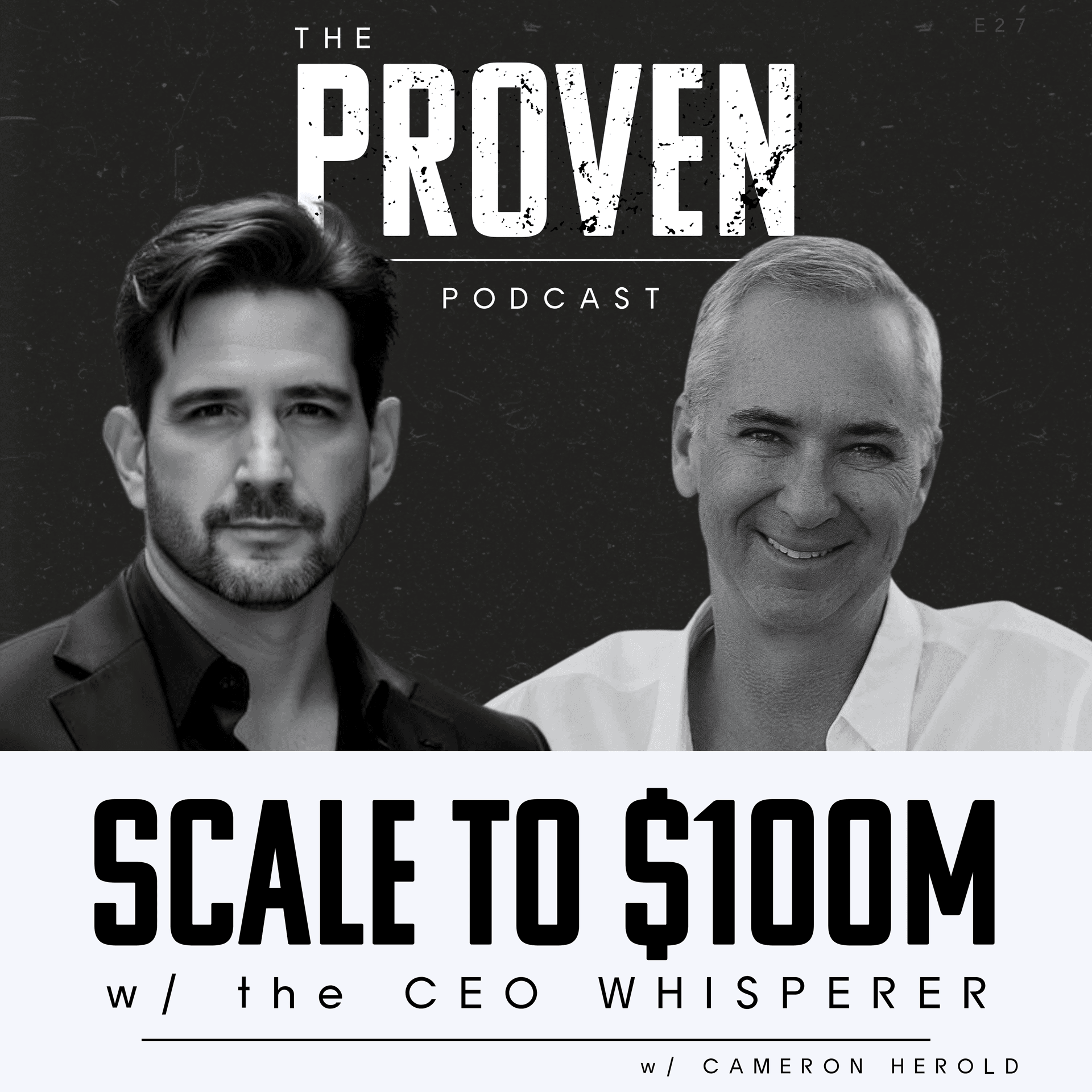
Scale to $100M w/ the CEO Whisperer - Cameron Herold
Episode Description In this episode, Charles engages with Cameron Herold, a renowned business consultant known as the "CEO Whisperer." Cameron shares insights on scaling businesses to achieve significant growth, emphasizing the importance of systems thinking and cultural engineering. The conversation dives deep into his "Vivid Vision" philosophy and the four pillars of scaling: focus, culture, systems, and leadership.
---
Key Takeaways
- Vivid Vision Technique: Aligns the organization for growth by creating a clear, compelling future vision.
- Firing Fast: Essential for maintaining a high-performance culture.
- First Team Concept: Encourages collaboration and breaks down silos within leadership teams.
- Situational Leadership: Adapting leadership styles based on the skill and confidence of team members.
- Simplifying Processes: Focus on streamlining complex business processes to achieve scalable success without compromising quality.
---
Key Discussion Points
- Cameron Herold's Background
- Early entrepreneurial experiences, including starting a house painting business at age 20.
- Growth of 1-800-GOT-JUNK from $2 million to $106 million in revenue.
- Experience in coaching and mentoring across multiple companies.
- Four Pillars of Scaling Strategy
- Focus: Importance of narrowing down on critical business objectives.
- Culture: Building a strong, engaging workplace culture that motivates employees.
- Systems: Developing repeatable processes that can scale with the business.
- Leadership: Growing leaders who can effectively manage teams and drive results.
- Unique Concepts Introduced
- "Slowing Down to Speed Up": The counterintuitive approach of taking time to strategize can result in faster growth.
- Cult-like Culture: Creating a strong company culture that encourages engagement and loyalty among employees.
- First Team: Emphasizing that the leadership team is the first priority, fostering teamwork and cooperation.
- Operational Strategies
- Emphasis on fixing broken systems rather than blaming individuals for failures.
- Use of situational leadership to adapt styles based on team dynamics and project needs.
- Strategies for ongoing skill development and training within organizations.
- Cameron's Recommendations
- Books:
- *Insanely Simple* - Concepts from Apple on simplicity in business.
- *The Hard Thing About Hard Things* by Ben Horowitz - Insights on operating during economic challenges.
- Online Course: Invest in Your Leaders, focusing on core leadership skills.
---
Episode Timeline
- 0:04 - Introduction to Cameron's approach to scaling businesses.
- 8:00 - Time management strategies for leaders.
- 10:03 - Importance of financial focus in business operations.
- 12:14 - Branding company culture.
- 14:32 - Explanation of the Vivid Vision concept.
- 19:01 - Discussion on working smart versus hard.
- 21:58 - The balance of dependence and independence in business.
- 24:07 - Importance of systems thinking.
- 27:54 - Leadership mindset development.
- 30:12 - Critical skills for leadership training.
- 34:14 - Necessity of ongoing training for success.
- 36:49 - Value of coaching in leadership development.
- 39:07 - Concept of the First Team in leadership.
- 43:57 - Cameron’s book recommendations for growth.
---
Final Thoughts The episode emphasizes that scaling a business effectively is less about luck and more about implementing robust systems and fostering a strong culture. Cameron Herold’s insights provide actionable strategies for leaders looking to make significant impacts within their organizations.
For more information and resources, listeners are directed to visit [Proven Podcast](https://provenpodcast.com/).
Written by AI. May contain mistakes. Listen to the episode to check what was said.
Transcript
Automatic transcript. May contain errors.0:00Welcome to the Proven Podcast, where it does not matter what you think, only what you can prove. Everyone thinks scaling is about finding the right business. Today's guest, Cameron Herold, proves it's about finding the right systems. As COO, he scaled 1 to 800, got junk from$2 million to$106 million in just six and a half years, then proved it wasn't luck by replicating those same systems across multiple nine-figure organizations. The show starts now. All right, welcome back to the show. This is one of those that I'm just unbelievably excited about. We have people who have gone in and scaled, you know, seven figures, maybe eight, but this is someone who's done this for nine-figure organizations.
0:33I can't tell you how excited I am to have you on the show. Welcome to the show. Charles, thanks so much. I appreciate this. For the audience that don't know who you are, and there's a bunch of stories that we want to get into, we were talking about before we got on camera. Let's get the audience caught up. Who are you? What have you done? Let's get all caught up on this. Wow. Who am I? I'm a Canadian. They'll catch that probably in the first 12 sentences because they'll hit me with some like out or about or a or something I'll say. So I'm Canadian. I was groomed as an entrepreneur. My dad was an entrepreneur.
1:02Both sets of grandparents were entrepreneurs, and they raised my brother, my sister, and myself to all be entrepreneurs. We've all been running our own companies for between 20 and 25 years. When I was 20 years old, I had my first 12 employees in a company that I started. I was running a house painting business. I was painting six simultaneous homes at the same time throughout the summer. So I learned basically how to run a business at quite a young age, like a real serious business. Since then, I had opened the West Coast of the United States for the largest house painting company in the world.
1:34It was called College Pro Painters. Back in 1993, I recruited, hired, and trained Kimball Musk, who's Elon's younger brother. I was a reference for Elon and Kimball in their first round of fundraising in January of 1995 for Zip2. So that was way before Tesla, way before PayPal. That was the first time I met Elon was in 95. Their cousin, Peter Rive, who built SolarCity, was also an employee of mine that I trained and coached him. by 1993 i'd coached 120 entrepreneurs and that was when business coaching was just starting the international federation of coaches and coach you started in 1993 and over the four years prior i'd already coached 120 real companies so i've been in the the business coaching space since before it was littered with you know business coaches um from there i opened up a chain of collision repair shops a family friend called me up he had seven auto body shops and asked me if I'd come on as a partner and open up the franchise business for them.
2:25We took it to 65 locations in four years. It's now called Gerber Auto Collision in the United States. It's called Boyd Auto Body in Canada. It's about a$2 billion revenue, legit largest collision repair chain in the world. I left there in 1998 and I was hired as the president of a private currency company. We built that company up and sold it two years later for$64 million to a US public company. we were doing what bitcoin is doing today but we did it 25 years ago we had 30 000 companies in the u.s and canada buying and selling using a digital currency that we created that was backed by nothing other than their promise to accept it with the anarch economy but we had starwood hotels avis renicar budget renicar bose stereo hard rock cafe the olympics all using our digital currency instead of the u.s dollar so that was 24 years ago now which is insane and then i joined my best friend Brian, who had started up a company called the Rubbish Boys.
3:17And he asked me if I'd come on and start coaching him. He'd just converted the name over. And I joined Brian as the 14th employee at a company called 1-800-GOT-JUNK. He'd taken 11 years to get to 2 million in revenue. And then I came on as the chief operating officer. And six and a half years later, we were at 106 million in revenue. So 11 years to go from zero to 2 million, six and a half to go from 2 million to 106 million. And I was the chief operating officer during that growth left there 17 years ago. And since then I've published six books. I've been paid to speak in 29 countries and on every single continent, including getting paid to speak in Antarctica three years ago.
3:54Um, I had no desire to be a business author or writer. And then I started up an online course called invest in your leaders. It's being used all over the world. And I also started a mastermind community called the COO Alliance, which is a large community globally of second and commands. Uh, so that's kind of some of the background, I guess. So basically you've done absolutely a lot and it's, you know, yeah, I'm slow. I'm also a dad. I'm a father. I'm a father of two boys, 21 and 23. Um, husband happily married and my wife and I are global nomads. We sold everything three years ago. We've been traveling around the world for three years.
4:29You were, you were talking about that kind of your flex. I want to get into it before I forget it. Let's talk about this flex that you and your wife are up to right now. It's really interesting. So I want to go back to when I was 16 to kind of explain the flex. I mean, we've all seen it on Facebook and on, you know, Instagram. I think the first was probably Tai Lopez. Like here I am with my Ferrari or my Lambo in my garage. Right. And then Tai's by the way, genius. Like he's literally world-class at analytics of data and marketing, you know, but then it's now become like everybody in their Lambo.
5:01And then here I am in my private jet. It's like, fuck, who cares? Like at the end of the day, when you die, none of this shit matters. So when I was 16, my dad took me to our, our golf course in Canada. And we were members of this private club. It was actually the first mastermind community that I really remember being in other than scouting. Um, he, he, he put us into this private club to meet all of the other successful people in our city. But we were at the golf course one day at 12 o 'clock to go golfing on a Wednesday and he started showing me all the people walking in to play golf. And it was like, that's Bruce McCullough.
5:31He owns a car dealership and that's Tom Ford. And he owns, you know, this accounting company and that's Carol. She owns a law firm and he was explaining all the people walking in who, who all these people were. And every single one of them was an entrepreneur and he didn't say anything else other than that. And we went out and played our 18 holes of golf and we came back and we were sitting on the balcony and I'm eating my typical fries and gravy and my cherry Coke and my dad's having a burger. And, and he, he starts showing me all the people coming into the golf course at five o 'clock on a Wednesday, you know, and this is like, you know, sunsets around 10 o 'clock in June.
6:02And he's showing me all the people coming in at 5 PM. And he's like, he works for a car dealership. He works for an accounting firm. He's a teacher, he's a minor. And he said, do you know the difference between everybody showing up to play golf now and everybody that came up 12 o 'clock? And I said, everybody that came to play golf at 12 o 'clock owns their own business. And my dad said, the number one reason you want to be an entrepreneur is so you can do what you want, when you want, without anybody having to give you permission. And he said, and if you focus on all the free time and all the fun and all the stuff that makes life worth living, all the money will follow.
6:36So that began my entrepreneurial journey of realizing that one quick example, even that summer, all of my friends were caddying and they were spending four and a half hours hauling golf bags around the golf course and getting paid virtually a fixed wage. What I would do is go and park myself at the bottom of the 13th hill on the 13th hole, there was this hill and I'd put a lawn chair there under an umbrella and I would run bags up and down the hill and collect tips. And I was making four times what my friends were making because I was kind of running my own business and I did it when I wanted to.
7:09So it just began that entrepreneurial journey. So I joke about it now saying that my Lambo flex is that my wife and I have been to 54 countries in the last three years with no real reason to stop. And I think that's what it's really about. Honestly, being able to have control of that time, because one of the things everyone hunts after, you know, as someone who's already made it into those eight, nine figure environments and done these massive scales is you'll find out that the most important thing you have that you'll never make more of is time. I spent eight years in the hospice watching people die.
7:38It's all about time. And most people don't know how to scale the way you have, or you've even remotely seen it. They've read about it. You're someone who's done it. What are some of the things that as people get into this, as you're talking to other chief operating officers, when you're sitting with the COO saying, Hey, we want to emulate what you've done. There's some important things. What are the massive mistakes they've done? And then what are the simple pivots they can do? So I think back to, you know, Jim Collins in the book, Good to Great, one of his concepts was about the flywheel, right?
8:06It was becoming that monomaniac with a mission. And if you just found one thing that if you kept putting all of your focus on that one thing, it would create the momentum and the momentum would create momentum and that momentum would create growth. I think so often entrepreneurs, entrepreneurial companies, leadership team members, they're very distracted. And now we're more distracted than ever since 2007 with the advent of social media there's we're just bombarded with things and opportunities and stuff we could be doing and but it's it's not necessarily going to propel the organization so i'll tell the story back to 1-800-GOT-JUNK even though it's a 20 year old story now in the first two or three weeks i was there i said to brian there's three things we have to do the number one is we have to raise our prices by about 40 percent and everybody in the company the other 13 people thought i was crazy like we're gonna go bankrupt i'm like we're going bankrupt anyway Brian's not making money.
8:59Franchisees aren't making money. Guys in the trucks, nobody's making money. So we're going to charge more so that we can afford to actually scale like we want to. So being that premium price product, focusing on, do I understand the P &L and budgeting and cash flow? If you don't focus on the numbers, none of this stuff matters. No great marketing, nothing matters. So focus around numbers and profitability. Second was, we had to build slightly more than a business and slightly less than a religion. I wanted to get into that zone of a cult. and if we could get that culture where our super happy employees were super engaged and were really having fun and they were really focused and really felt valued and really felt loved, they would take care of our customers.
9:38Most companies focus on revenue and profitability and customer success. I focused on employee engagement, like the employee net promoter score first, knowing that everything else would come from that. So we built a cult, so much so that we actually had tours of our office in Vancouver, Canada, virtually every Friday for four years, we'd have 20 to 35 business people on a Friday coming at 1030 for a 90 minute tour of our company. And that was because we were getting so much press about our culture. And that helped us with growth. It helped us with recruiting. It helped us with retention. It helped us with engagement.
10:12We got press from it. And that led to number three was we had no money for marketing. So we decided to go after free public relations, free PR, which is one of the six books I wrote. And we decided to start reaching out to, There were no podcasts back then, but we reached out to magazine writers and TV show hosts. We were on Oprah, major newspapers. We landed 5 ,200 stories about the company within six years prior to Facebook even launching. So we had nowhere to even amplify the press, but we were able to generate all this momentum and all this focus and all this free coverage that led to the credibility that once we had marketing dollars, we could take over the market.
10:50So it was focusing on those critical few things. I love that you pointed out that it, you know, if you're going to build a culture, you have to understand it starts with the first four letters, which is cult. And you need to build the cult in your org. What are some of the practical step-by-steps? Because we've heard it a thousand times, but getting it directly from someone who's done it, what are the things where we can do it? Okay. So there's a few things. One is you have to get rid of the assholes, right? You have to get rid of the cultural cancers that are inside that are putting the wrong energy into the cult.
11:18so we actually trained all of our franchisees in the movie the secret we made them watch it twice we made our franchisees watch it twice we cannot come out and say hey it's a little cheesy it's a little bit materialistic but understand quantum mechanics and energy and if we can bring in more of this positive energy the like attracting like that momentum will will be created so that was one or i guess to get rid of the cultural cancers understand quantum mechanics we started to brand everything, right? We had like the names on our rooms were branded. In fact, I was in a, a client that I coached here 12 years ago in his office in Kelowna, British Columbia the other day, and he was showing me all his boardrooms and they all had names, but there were no names on the glass windows.
11:57I'm like, say, put the names up, like brand these things so that people remember it. And they're reminded of it, like, and then create acronyms, right? Create these. So any of the little sayings and the acronyms and the phrases, they become part of the vernacular, part of the way that we do it we used to call it the 1-800-GOT-JUNK-WAY and every time you brand something it's kind of like the insiders have secrets and other people don't know what you're talking about so those branding of things like if I say the 10 commandments people want to go oh what are the 10 commandments right even if you're in another religion you kind of want to what's inside that religion well that's cult um and then it was all around like making sure that we stirred the Kool-Aid, you know, that we didn't focus on results all the time.
12:40We didn't focus on metrics all the time. We focused on keeping people happy, keeping people engaged, keeping people having fun. I think those would probably be some of the keys. Culture is not about the perks. It's not the free massages and the free lunches. Those are perks. The other thing that really drives culture, there's three. One is an alignment with a vivid vision, right? I call it that four or five page description of what your company looks like, acts like, and feels like in the future. One of my bestselling books ever is called Vivid Vision. And it's how a CEO describes what their company looks like, acts like, and feels like three years in the future so that everyone in the company, employees, suppliers, shareholders, accountants, lawyers, they can all see what you can see, and they're all going in that same direction.
13:22So it's alignment with the Vivid Vision. Second is alignment with core values. Again, that's firing the people that don't live the core values, recruiting and hiring people that already live the core values. They asked Herb Kelleher from Southwest Airlines, how do you get all your employees to be so happy? He said, we hire happy people, right? So hire people that already live your core values, and then you don't have to train anybody on them. They're already showing up that way. So it's that obsession about core values, the alignment with core values. The third is the BHAG, that big, hairy, audacious goal, right?
13:55The crush Adidas or democratize the world's information or democratize air travel or put a computer on every desktop. My BHAG is for Vivid Visions to replace vision statements worldwide so that culture is permeated when you have an obsession with that long 20-year stretch. And then the fourth is the core purpose, right? What's the Simon Sinek kind of why we exist as an organization? Everybody knows Simon Sinek and his book Start With Why. What they don't know is Simon used to sleep on my couch. Simon actually worked at 1-800-GOT-JUNK in our marketing group for about a year helping us as a consultant.
14:32He was on our board of advisors for a year, five years before he wrote the book, Start With Why. So we understood this idea with core purpose and how to have it permeate through the organization. My core purpose today is to help entrepreneurs make their dreams happen. It's why I say yes to your show and why I said no to two other podcasts yesterday and today was they're not aligned with entrepreneurs. One was very kind of corporate, one was like government agency stuff. I'm like, yeah, not worth my time. But for me, it's a full body F yes, when it's anything to do with helping entrepreneurs. So that's where culture permeates is an obsession and alignment with that kind of a stuff.
15:08So, and all that is tremendous. And I hope everybody's taking notes. One of the things that, that goes in as entrepreneurs is this idea that it's for lack of a better term, it's hustle porn. It's the idea that I'm going to get up at four o 'clock in the morning. I'm going to work out nine times. I'm going to have 15 meetings. Oh wait, it's 10 o 'clock. I need to work out 75 times more. You're clearly at a different place and you've clearly always been at the different place, even if it's watching your friends on the golf course, do one thing while you're running bags up. How do you teach entrepreneurs or especially COOs to say, listen, there is a balance here.
15:37There is a more effective way to execute. How do you get into their head and how do you get them to pivot? One of my biggest curses or things that hurt me in the world and in business was I was kind of emotionally abused by the school system for 18 years. right from kindergarten until the end of university, I was told to sit still and pay attention and try harder. And if I only focused harder, if I only worked harder, I could be as good as everybody else. And intuitively I knew I'm not wired this way. I don't get it. It's boring. None of this shit matters. I had a business and I'm only in grade six.
16:15Like this didn't make any sense to me as to, so I kind of started to ignore the work hard mantra, the Protestant work ethic. and what I decided to do is find the cheat sheets. I decided to work smart. I decided to kind of hack the system from a very young age. I realized that the teacher would tell me what was going to be on the test if I would merely ask them, what should I study on? What should I focus? I could find prior tests. I could find the actual copy of the test in his office when he was out at lunch. Like I did lots of stuff to figure out the system. But what I didn't do was be the fly trying to bang my head on the window all day.
16:50You know, we've all seen the fly trying to get out the window and they're going to work hard. They're going to keep banging their head on the window. They're going to work hard. They end up dead on the windowsill. I didn't want to work that hard because I was too busy doing other things. And I also realized there was a door that if I just turned and went out the door, I was free. So I always looked for the shortcut. I always looked for the cheat sheet. And I think that was what made me so successful in franchising was I developed systems that were easily usable by kind of the worst franchisee in the worst market, in the worst weather, and they could actually operate that system.
17:22So I would dumb down the system so that everybody, and that's how I see my business too. So I think while so many businesses are, as you put it, like that working hard and doing everything and grinding it out and getting up early, I'm like, pause, think, be strategic. What's going to drive that flywheel? What can I leverage? Even while you and I are doing this interview right now, I have a second camera that's here that films in 1080p that's getting me b-roll coverage from the left side so my team can actually take your content strip it so that i can have answers and i can actually use this on my youtube channel that gets stripped and placed into my social media i never do one thing for the purpose of one thing right so i say yes to being on your show but i don't say yes to being on just your show i say yes because oh i can get 17 different things from this it can be pulled into blog content, stripped, you know, images.
18:16So I think strategically about working on the critical few things. And then how can I get leverage off those few things? And I think most people are so busy working hard that they miss all of those extra opportunities. You talked about, you know, that the Protestant way of doing things is, you know, work really, really hard. And there's this, and it talks about the idea of a syphilis, which is a passcode that they would use in culture. And there's certain syphilis that work, these passcodes. And the minute you said systems, all of a sudden I was like, oh, thank God he gets it. I've always talked about this for years.
18:46Systems will set you free and people don't understand the difference between a system and a process. They're vastly, vastly different things. When people are going for, and they've lived in a culture where they've taught them, you're not supposed to hack the system. You know, the idea that, you know, you need to know how to walk on water versus let's find where the rocks are so you can go jump to jump. What are some of the things now where, as you get people to understand, yeah, working hard's not going to get me there. I'm never going to get there by working hard? How are the ways that I can hack this system?
19:11What are the tools that you've started to use? You know, cause everyone heard of OPM and OPT, other people's time and other people's money to get that. But what are the things that you can use on a practical level where someone's like, Hey, I've been, I've been into hustle porn for so long. I've just been a grinder. I'm burning out. How can I start hacking weight? What are some of the tools you use on a daily basis? Well, and I know some people are watching and some are listening. The people that are listening can't see me sitting here laughing to myself. The reason I'm laughing is when you said you have to hop from rock to rock, like I flashed back to a year ago, my wife and I were in Iceland on this crazy eight hour hike.
19:45And we were way off in the middle of nowhere. We were hiking across a glacial stream. I mean, it was glacial that you could see the glacier. And then we were hiking and it was like 12 feet across and we couldn't get our shoes wet. So we had to take our shoes off and hike across 12 feet barefoot. And we were going stone to stone. And I was like, this is so effing cold. I was dying. I'm like, sometimes you really got to focus on that system, man, because you missed that system and you're dead. So again, for me, it was about the cheat sheets. I would look to simplify the system. I learned it when I was 20.
20:18I bought a franchise at 20 years old of a house painting company called college pro painters, or I was awarded a franchise and they handed me a 330 page operations manual. Realized that the systems that they put in there were for my benefit. They weren't forcing me to do anything. And yes, if I followed those systems, I'd do more revenue and they'd make more money. But if I did more revenue, I'd make more profit. And I was so scared of failing that I just memorized the system and I did what they did. And then I recognized something that I now called interdependence, that I'm dependent enough that if a system exists, I'll follow up, but I'm independent enough.
20:56I'm entrepreneurial enough that if there's no system, I'll figure one out quickly and I'll run with it. I try to document, I was coaching a CEO about this the other day on his company. It's about a$50 million company. I was working with their team on developing some, some systems. And I said, if you can't document a system on a post-it note, like a simple, like two inch by two inch post-it note, you're not thinking clearly enough, right? You don't need like to, to, to process map this thing on a whiteboard for six days, like just knock it out so that the, the newest employee, who's the least trained employee in the hardest day that they're having at the worst, you know, period of their life can follow a system.
21:30And then how can we actually create systems that can remove people from the process? I'll give an example of this. Speeding in virtually everywhere in the world is a terrible system. They have speed limit signs. They have police with cameras. They've got like notifications on our cars beeping that we're going too quickly. And then you go to a golf course, you get in a golf cart and you know what you try to do when you go into the, into the parking lot, the car all of a sudden stops and goes like really, really slow through the parking lot because it's got little RFID chip and says, Hey, if you're in this zone, you can only go this fast.
22:03The perfect system for saving lives on highways and saving car accidents and saving speeding and getting all the police off the road is put an RFID chip in every car. So the car, when it hits a certain speed zone can only go X speed period. It's not complicated. Nobody wants to have the, but everyone wants to rely on people, right? So Michael Gerber, when he wrote the email said, people don't fail systems fail. I always look for the broken system and the missing system. Right. And I'll give you one last story on this. We as leaders often try to blame a person. Like, why did they do that wrong?
22:37Why did they miss this? Why did they screw that up? Or why is this broken? One of my mentors, and I mean, a serious mentor who was doing a one hour call with me every month for about two years. And then every quarter, a full day in person, I would either go to their office or he would come to my office. He was being groomed as the COO at Starbucks. This was back in 2004. So I'm effectively being groomed by the CEO at Starbucks or incoming COO. And he told me a story how when Howard Behar, who was I think the second CEO, it's after Howard Schultz, Howard Behar came in as a CEO. And Howard Behar called Greg one day and said, Greg, why is the letter B on the sign at 50th or 45th and Wallingford in Seattle?
23:15Why is the letter B on that sign not working? And Greg said, I don't care. Howard goes, what do you mean you don't care? Greg said, that's not the leadership question we should be asking. He said, the system question we need to ask is what system is missing that would ensure that every letter on every sign at all of our locations is always working? He said, that's a question I'll dig into, but I don't care why one sign has one letter out. And I think that's how we need to approach problems in a company is what system is missing. Now we call it like the first principles, right? Like what system is missing or broken?
Read the full transcript
23:47If we fix that system, it'll never happen again, right? Why is a customer unhappy? Let's fix the customer. No, let's fix the system so that no customer becomes unhappy. Right. And I think it's that systems thinking. And that's kind of like the fly. You know, what's what's that? That's just the way I think of things. And it's very different than most people think. People want to just fix that one problem. They don't want to make systems that are automated to get them out of it. You've mentioned. I have to think that way. I have to think that way because my ADD is so bad. I have 17 of the 18 signs of attention deficit disorder clinically diagnosed.
24:20My ex-wife said if I was paying attention during testing, it would have been 18 for 18. So I counter my ADD with a lot of OCD systems. I put these little systems in place to ensure that I don't screw up because I'm never paying attention or I'm always on go. Simple example of this. I'm in Kelowna, British Columbia, where Dan Martell, a really close friend of mine, lives. We've been friends for like 13 years. He runs a Tuesday morning hike up this mountain that's kind of right behind me. and I always know that if I'm meeting them at 6.30 in the morning, I have to be out the house at 6. I'm probably going to forget my water bottle.
24:52So what I do the night before is I put my clothes out for the hike and then I put my water bottle and key beside the door. So I can't get out the door without grabbing my water bottle and the key. Without that little system, I have to rely on me. And a human isn't as reliable as the system is. Correct. You're doing, just attaching your key to the water bottle, also really affected. One of the things I do is whenever I go somewhere and I have leftovers at the friend's house. Actually, yeah, just attach it to it. What I do when I go to people's houses and I don't want to forget the leftovers, I'll take my car key and I'll put it in the fridge or I'll put it in the bag with the food.
25:28My brother puts a car key in the freezer at anyone's home when he goes because he'll always know it's in their freezer, right? So if he's using modern day remotes, the modern fobs, it'll stop working. I learned this lesson the hard way. It freezes the battery and I'm sitting at the car going, Damn it, it doesn't open. So yeah, certain systems. I'll ask my brother if he's, yeah, I'll ask him if he's changed that system to now. Yeah, I usually put my keys in my shoe. So if I'm leaving someone's house, I know my keys are in the shoe. But those are examples that as companies, we need to teach the leadership team to think that way.
25:59See, a leader's core job is to grow people. Most entrepreneurs are so frozen in doing and in doing and busy and I have a to-do list and they forget that their to-do list doesn't have their name on it. If Bob is the entrepreneur, Bob can delegate everything on his to-do list and Bob can spend more time being strategic, thinking, inspecting what he expects, looking for the missing systems, looking for the broken systems, growing people's confidence, growing their skills. That's what we need to do more of as leaders. So we need to remember that most managers, especially first-time, second-time managers, have never been exposed to this kind of thinking.
26:36And all we're doing is teaching them how to use ClickUp or how to use Asana. Forget that. That stuff comes later. Teach them how to think and how to be leaders and then your company scales. Yeah, I think it's so contrary to what everyone's taught because everyone goes through school and they just grind it through and they push through and they regurgitate information instead of systematizing it. And it's just so unbelievably toxic. You've been mentored by some really big, powerful people. You've had people underneath your command that are really, you know, have gone on and done amazing things.
27:05You were 20 years ahead of Bitcoin when you were doing that. But what were some of the lessons outside of what you've gone over that you're like, that blew my mind? Kind of those light switch moments where you're like, okay, I get it. I've got 17 of the 1880Ds. When I saw this one, how I functionally did things. So I'll give you, there's a part A and a part B. So if I go back to College Pro Painters, and I need to kind of illustrate this so that people understand the size. College Pro went on to become the largest residential house painting company on the planet. So amazingly, I was on the leadership team of the largest house painting company in the world.
27:38the largest collision repair chain in the world and the largest junk removal company in the world, all from very early stages and actually the largest private currency in the world at the time. So, so college pro though, back in the eighties, every year had to go out and recruit, hire and train 800 franchisees and they were all university students. Okay. So imagine recruiting, hiring and training in four months, 800 students and training them how to run a business. And then in four weeks, in one month, those 800 franchisees had to go out and recruit, hire and train 8 ,000 university students to paint houses.
28:11So in a five month period, we had to recruit, hire and train 8 ,800 people. For the first three years, I was a franchisee. Okay. So I'm like in my milk, but I'm being trained and groomed on a lot of these systems for the next four years. I was on the senior leadership team recruiting, hiring and training. And I was in the top 30 people of the 8 ,800 person company for four years. so there's not a lot of companies on the planet that recruit hire and train 8 000 9 000 people a year there's not just not the military did that i was like how many people process through the military in five months so google google does like the paypals do but like that's it's very rare so when you're in the top 30 people you're getting trained on leadership systems and leadership skills that most people don't have access to so i was uh if i go back next to you i was 24 and I was being trained.
29:00And I mean like consultants coming in, watching videotapes on VHS, reading books, round table, role practicing, being coached, people watching me do the stuff in the field. And I was being trained on about 12 core skills. They're actually the skills that I put into my invest in your leaders course. It's called investinyourleaders.com. But I was trained on the one I'll talk about was situational leadership. I'll talk about that in a sec. I was trained in situational leadership, coaching, delegation, project management, time management, interviewing, one-on-one coaching, running effective meetings, classroom training, written communication, which would now be similar to email management, Slack.
29:39So when you get a lot of the skill development on hardcore leadership skills at a very young age, that leaves a real imprint around me that my job isn't to do work. My job is to grow people. So at a very young age, at 24 years old, I had 25 franchisees. Then at one point, 32 franchisees reporting to me. I was responsible for 320 people just in my part of that little microcosm. But I was getting groomed in all these leadership skills. So situational leadership is the one skill that I think most people have never even been exposed to. It's the skill that the book The One Minute Manager is based on by Ken Hersey and Paul Blanchard.
30:22that was written, or Ken Blanchard and Dr. Paul Hersey, it was written 40 years ago. The One Minute Manager is still used by all the best companies on the planet, by Google's, by PayPal's, by all of them. It teaches a leader to adapt their style of leadership on a project by project basis, even for the same human. So let's say as an example, I was training you on running a podcast. I probably wouldn't talk to you much about the podcast. I might talk to you the amplification of the podcast, or I might talk to you more about finding guests and getting PR firms to find you guests. I might talk to you about the stuff that you're not really thinking about, or I might talk to you more on like stuff that's not even related to your podcast, leading your team or coaching your team or having a bigger vision for your podcast.
31:03Because I understand that on some parts of your podcast, you have a lot of skill and a lot of confidence, but on other areas, you might either have no skill or some skill or lower confidence. So learning how to assess on a project by project basis based on the two things, skill and confidence, where a person sits and which of the four leadership styles to use makes me a very highly effective leader, which allows me to grow people and grow hyper growth companies. 1-800-GOT-JUNK, we were 100 % revenue growth six consecutive years in a row without giving up any equity and having no debt, and we ranked as the number two company in Canada to work for.
31:40That only happens because of the ability to attract people, retain people, and grow people, not by doing work. So I think that for me is a skill that I probably took for granted and really only recognized post 1-800-GOT-JUNK how powerful that was. When I started coaching really seasoned leaders of companies, they'd never even heard of this before. They were just in the default mode of coaching someone. And then the second part is, it's amazing to me how often people go to work every day without having the basic skills to do their job. I'll give you a couple examples. Almost everyone listening has interviewed and hired people.
32:20And to a person, they've probably had no training on interviewing and hiring somebody. Yeah, they might have done it a hundred times, but maybe they've done it wrong all hundred times. Maybe they've read a book. That's not training. It's reading a book. Training is watching information, reading information, working with the coach on it, practicing it, getting critiqued on it, role-playing, kind of stepping back and observing, looking at what you can do better, and then going through that training again. That's training, right? and you think about the best athletes in the world, they get training in their sport.
32:49Why aren't leaders not getting trained on how to run meetings? Why are they not getting trained on how to delegate projects? Why are they not getting trained on how to effectively manage projects in time? The shit that they do every day and no one's ever given them the skills. That's the stuff that I now go, wow, that's where the hyper growth comes from. So you do a lot of this training through either your books or your courses, your, your one-on-one of your private clients, what are some of the things that, and how long do these, do you normally see radical changing in these orgs? Cause obviously you've got to pivot the COOs, which is, isn't the usually, it's usually in the very first module that I can put them through that they go, holy shit, I get it.
33:30All this other stuff. I have no skill development. So I was coaching a CEO of a very, very effective company, 200 employees. And I asked him like, how much training have you had on interviewing people? And he goes, none, but I've hired a hundred. And I'm like, maybe you've done it wrong every time. He goes, he goes, okay, teach me. He's like, okay, teach me, give me something. Right. So I started giving him some ideas and he's like, fuck, I don't even know what you're talking about. So all of a sudden I created the gap where it was almost like I, he fell off the bicycle and he goes, okay, teach me how to, or he fell off the skateboard.
34:04He's that everything he knew wasn't necessarily the best way. You know, it's like, I didn't know until I was 50 years old that when you hold, when you're going to bat, you pull up your elbow, the back elbow kind of comes up. I didn't know. Nobody had ever taught me that before. You're Canadian. Meanwhile, there's base. Right, yeah, thank you. You're American, so you know this, right? I'm American, I get it. I was a pitcher, I played my ball. I didn't know this. Yeah, you get it, it's okay. I'm 50 years old and I didn't know this. Like, this is irresponsible of me to teach my kids how to swing a bat when I don't know how to fucking swing the bat.
34:34I don't even have to hold the bat, let alone swing the bat. But then why are entrepreneurs keep saying that business is difficult? Business isn't difficult. What happens is we would never send our kid off to Little League Baseball without teaching them the basics. You wouldn't send your kid off because Johnny would come home from baseball. He'd go, Daddy, baseball sucks. He's like, no, Johnny, you suck at baseball. Yes. And then all entrepreneurs come back and go, business is difficult. No, you're difficult because you're not because you suck at it. You're not learning this core skills and you keep repeating it.
35:03And then the last part of this is the baby boomers in Gen X that go, oh, I have 30 years experience. No, you have five years experience six times in a row. Yeah. Or you have all this experience, which you think is expertise and experience is not expertise. It's totally different. And they don't fucking get it. And that's why the best baseball players on the planet today still have coaches. They have mindset coaches. They have swing coaches. They've got fitness coaches. They have nutrition coaches. if entrepreneurs and their, and by the way, every entrepreneur that gets skill training for themselves, they have a coach for themselves, they're in a mastermind for themselves.
35:38That's great. What will really scale your company is get coaching and get your key employees into courses and growing them and getting into masterminds. If you grow your team, that's what scales your company. Growing yourself is like a one times one return. You grow the seven people on your leadership team, now you're getting a 700%. It's just incremental growth. So when you have a team, and there's a lot of things when you go into organizations, obviously getting rid of the CEO as quickly as you can, getting that ego out of the room. But when you come into this environment and you have this high-end team of radically different personalities, if you haven't hired effectively in the first place, and you have these very different personalities that aren't unified under one command, how do you unify them?
36:18How do you get these individuals who are like, hey, marketing's useless, but branding matters. IT is useless, but how do you unify them? relatively quickly. Two parts. Unfortunately, I can't use the baseball analogy here because it doesn't stand up as well as a football analogy. So do you ever watch any U.S. football? I do, regrettably. Okay. So the only reason I even say U.S. football is because I've been in 54 countries and for the rest of the world, football is soccer. So in U.S. football or American football, we have, let's say we have like the Dallas Cowboys, right? We have the offensive team, we have the defensive team, we have the special teams and we have the Dallas Cowboys.
36:52So let's say that you have the, you know, the wide receiver, right? The wide receiver. What's the most important team for the wide receiver? Offense. He's the offensive team, right? Yeah. He's offense. Yeah. Offense. That's the, that's the wrong answer. You just said, yeah, three, you said, yeah, three times. Let me give you, let me give you, let me give you the reality is the defense getting the ball back. So I would say collectively, all of them are the most important team. They have to work as a unified structure how about the most important team is the dallas cowboys yeah and see what you're saying is well of course but every leadership reaction was to go over here bingo so if you're now the head of marketing and i say what's your most important team what does the head of marketing say normally they say marketing marketing yeah head of finance finance my no the company you're running.
37:43So when I was the COO at 1-800-GOT-JUNK, my most important team wasn't operations or the call center or PR or sales that I ran. My most important team was the leadership team at 1-800-GOT-JUNK. That was my first team. And we called it our first team. To the outside world, we called it our leadership team. But the seven members on the leadership team, we called it our first team. Our second team was the functional area that we ran. So the head of finance knew that his first team was the leadership team and the head of finance knew, even though we had eight people on it, the second most important team was finance.
38:15When everyone's showing up with a company in mind, the vision for the company in mind, the core values in mind, the debate is for the good of the company in mind. That's where real kind of scale happens. And that's where everybody pulls together. I think that's number one. There was a second part. Repeat the, can you repeat the question? We're talking about how there's, you know, there's a culture that isn't unified against each other. How do you get them unified with each other? So that, so number one is remembering that your first team is your first team. You're right. That's the unification.
38:42The second part is by practicing gratitude and praise across functional areas when every, and it's kind of like when the offense is going back out onto the field, what are they doing? They're high five in the defense. They're slapping the defense on the ass. They're telling each other what they just, Hey, this guy beat you. Keep an eye open for that next time. That's because they recognize that my job is to praise and show gratitude and celebrate the other teams that are all on the same team. When you build that system into your company, massive growth happens. And then the cult, that flywheel, right, really starts to steamroll.
39:17To give you a baseball example in the future, New York Yankees, they don't put the names on the back of their shirts. In the old days, they refused to put the names on the back of the shirts because we only have one name and that's we're a Yankee, period. We don't put our individual names on the back of the shirt. So the Yankees had that in that culture. My family's from New England, so I can't sit there and praise the Yankees too much because they'll find me and they'll shoot me in the face with a bazooka. That's the pivot. That's the pivot there. When the Toronto Maple Leafs, the owner of the Toronto Maple Leafs, his cottage was next door or a few doors down from my family cottage.
39:46He took the names off the jerseys one year to sell more programs. I like the Yankees version better. The Yankees is a lot better than the Toronto. God bless them. well here's part two part two was they told harold ballard you have to put the names on the jerseys so you know what he did on the blue jerseys next year he put the names on in the same color blue as the jersey and then the so then in year two they said no it has to be in the opposing colors like dude the guy was a character man god bless him god bless i like the light but the yankees is culture yeah yankees all culture it's always been you know they were the last people to let people have facial hair.
40:24They really dug in really hard. They only wear jewelry on. It was amazing. Love it. When people are going through this and they want to start getting this level of training for the people who don't have access to you, who don't have access to some of the things that you have and don't have the ability to give to the team and want to be able to take the first step and say, hey, we're heading towards some changes economically. No matter what happens, whoever takes, who sits in the White House or anything else, we're heading some, just because the economy's breathing in and breathing out. What are some of the tools and resources that they can track down to start implementing?
40:56The first big one is, is you're not running a freaking country. You're running a business that's small in a microcosm in a city. Stop worrying about the global economy, the global financial crisis. Get, get away from your desk, get away from the news, get away from social media, start doing some sales, start doing some marketing, start taking care of your employees, start taking care of your customers. Business will grow. You're not running a trillion dollar company. You're not like, you don't have to worry about the global financial crisis. So stop creating your own doom loop, right? In every single economy, good and bad.
41:28Like it's why in these last couple of tough years, when so many companies were struggling, the top seven were crushing it. Guess which companies I've been buying stock in for almost 15 to 20 years. The top seven I've been buying stock in Amazon every two to three months since 2003. Nice. Why wouldn't I, it's not going anywhere. So, so focus on the critical few things and stop worrying about all the noise and all the distraction because none of that stuff matters. Tom Peters, when he wrote in search of excellence back in the eighties said that to be truly successful, you have to be a monomaniac with a mission.
42:01So that's that true soul focus, right? That's where, where the real growth is going to come from. And I think really good entrepreneurs can slow it down, take a breath, pull their team together and say, you know what? We're not marketing to the whole world. Like if I ran a restaurant, I got enough people like within view of this camera on my phone that I can market. I'll just market to them and I would be successful. I don't need to worry about what's happening in San Francisco or Chicago or, you know, Israel right now. Who cares? No, I agree. What are some of the - I can care as a human and out of curiosity, but it doesn't impact my business.
42:35It doesn't affect your first team at this moment. So when you're doing this, what are some of the books? You've mentioned a bunch of your material. What are books that someone can grab a hold of? And because everyone, when I'm always reached out to when they do this, they're like, hey, I want some tools. I want some strategies. And I'm like, hunt systems, not strategies, but I still want to feed the audience and give them what you want. I'll give two books that are not mine. One is called Insanely Simple. It's the 10 core simplicity systems that Apple and Steve Jobs use to scale Apple that are absolutely applicable to a 10 person, 50 person, 500 person company, super applicable.
43:11They're very, very easy to understand. And you can take those concepts and bring them into your company. So insanely simple would be number one. The second, and I think it's because it's very, very tied to a time period that we're in right now is called the hard thing about hard things, but Ben Horowitz, and it's about operating as a wartime CEO versus a peacetime CEO. They don't mean it in the physical, like actual military war. They'd be like, how do you run a business when there's an economic crisis, when you're in a period of stagflation, you're in this crazy chain of political, like, how do you run in that when you need to be super focused and leaders need to lead and you can't like get all fluffy with consensus?
43:43I would read that book right now too. And two last questions. One, where do you think overall, because you've tapped into different things, where we're going? And then I'll get to the next question after that. Where are we going? Where are we going economically? Where do you, what do you see the next four to five years? Where do you see things going? I've been calling stagflation for three years. So I've been calling the hyperinflation and recession for three years. And it's finally proven out to be right. I was off by, because I called it 2019-20, because when we started to print money for COVID, we delayed it.
44:11But we're in a period of stagflation, which is what happened in 1974. I've run businesses through three economic downturns. I was running a company in 08-09. I was running a company in 2000-2001, when the NASDAQ fell by 78%. And I was running another one back in 1991, when we had the big meltdown. So I'm used to this. I think where we're going is a period of stagflation for another 16 months, which is kind of till the end of 2025. Inflation still, even though the government's going to stop telling us it's inflation, like they used to say that 2 % or greater was too much. Now they're thinking that 3 % is a good threshold.
44:49They're basically allowing. So I think we're going to be a period of inflation where people are going to need more. Everything's going to cost more. I'm not Trump fan or not a Trump fan. doesn't matter to me either way. But if Trump comes in power, watch what happens. Stuff is going to get more expensive because he's going to become more U.S. protection. U.S. protection makes everything more expensive. Buying out of China, buying out of all these other countries is going to help us get cheaper goods and cheaper services. So stuff is going to get more expensive either way. And then I think we're going to have this period of inflation.
45:21And I think we have a period of inflation where consumers are basically tapped out. They're starting to live off credit cards. They're not going to Topgolf anymore. They're not going to movies anymore. We're seeing a switch from wine to beer. Um, we're seeing Amazon sales off. Like we're seeing stuff where the consumers aren't buying and that's going to start hitting the business. And then we're going to have the commercial real estate impact. Um, you know, where all these commercial real estates and banks. So I think we're going to have a period of recession and inflation for a period of another 16 months.
45:50Um, where do I go outside of that? I don't, I don't, I don't even care past that really like yeah 16 months yeah i'm not worried about when i all so for me for me it's like debt is good until it's bad right don't over leverage this anybody who's under 35 the big lesson for you is these interest rates today are normal sorry but like six and a half percent when i got a mortgage in 2000 for six and a half percent for five years i was doing my happy dance I was a little old man. Yeah. Cause I re I remember getting Canada savings bonds in 1982 at 18 and three quarters percent. So I remember when seven, eight percent was like an okay business loan.
46:30So I got news for you. Like we were in this very, very, very from, from 19, sorry, 2009 till 2022, that 13 year period, we had artificially low in, um, interest rates. So anybody who's 35, they don't know anything different. They think that's normal. That's not normal. It's not. So So I think we're going to get used to this as being normal again. It's not the new normal. It's the real normal. It's the way it should have been because that level of interest rates that low had never happened in economic history ever. Right. And it probably won't happen again. And it's birth rate. It's geopolitical this part.
47:06It's birth rate. That amount of money left the market. It is what it is. Lots of free money. So I think we're sitting in a period now where inflation is normal. We're going to have this kind of like period where we start to digest that inflation. It's like the snake swallowing the frog. at some point you've digested it. We'll digest that printing of money. It'll become the new normal. Interest rates will feel normal again and we'll get back to business. I think that's what's coming in 2026 is we're just used to this as the norm. Gotcha. If people want to track you down, if people want to find you and get more information and learn more about you and you talked about having the camera before for your social media, how do people find you?
47:41How do they get ahold of you? What's their next step? Yeah, so the main website they can find all of my products and services that is CameronHerald.com and it's H-E-R-O-L-D. So CameronHerald.com. All of my six books are available on Amazon, Audible, and iTunes. I have a podcast called the Second in Command Podcast they can check out. We're in the top hundred on Apple Business Podcasts. And then I have a course called Invest in Your Leaders. And that has all the core leadership skills that I've trained everybody in all the way back to Kimball Musk 30 years ago. Beautiful. All right. I really appreciate it.
48:11I think there's some insights and some things that even pivoted the way I looked at it, especially what team I'm on. Thank you for that. I appreciate you. You're welcome. Charles, you're very welcome. You just witnessed Cameron. I always speak quickly, but six shots of espresso. I'm wired today. And for those of you who aren't watching this, who are actually listening to this, go watch this. His background is absolutely stunning. And his Lambo Flex is amazing up there in British Columbia. I've just added it to my list. So I've got some flights coming up. All right. Thank you so much. All right.
48:41Thanks, Charles. At the end of the day, business isn't about having the perfect theory or the most sophisticated strategy deck. It's about building systems that work when you're not there, creating cultures that drive results and focusing on the critical few things that actually move the needle.
From the publisher
In this episode, Charles plunges into the high-octane world of business scaling with Cameron Herold, the behind-the-scenes oracle who's transformed startups into industry titans. Cameron strips away the mystique of hypergrowth, offering a masterclass in turning vision into nine-figure reality.
From his early days as a college entrepreneur to coaching the likes of Kimball Musk, Cameron's journey is a testament to the power of systems thinking and cultural engineering. He dissects his evolution from a young business owner to the "CEO Whisperer," revealing the DNA of his "Vivid Vision" philosophy that's catapulted companies to unprecedented heights.
Charles and Cameron engage in a no-holds-barred dialogue, exploring the four pillars of Cameron's scaling strategy: focus, culture, systems, and leadership. They unpack the counterintuitive approach of "slowing down to speed up," the magic of situational leadership, and why creating a cult-like culture trumps traditional management in today's dynamic market.
Cameron's insights crackle with practical wisdom as he breaks down his unique operational strategies, from the game-changing "First Team" concept to the "Vivid Vision" revolution. He challenges conventional business thinking, advocating for a radical shift from doing to leading and from short-term hustle to long-term systems building.
KEY TAKEAWAYS:
• Uncover the secret sauce of Cameron's "Vivid Vision" technique and how it can align your entire organization for explosive growth
• Learn why "firing fast" is crucial for maintaining a high-performance culture
• Discover how the "First Team" concept can break down silos and supercharge your leadership team's effectiveness
• Understand the power of situational leadership in developing a world-class team
• Explore strategies for simplifying complex business processes that can turn chaos into scalable success without sacrificing quality
Head over to https://provenpodcast.com/ to download your exclusive companion guide, designed to guide you step-by-step in implementing the strategies revealed in this episode.
KEY POINTS:
0:04 Exponential Growth: Cameron introduces his approach to rapidly scaling businesses.
8:00 Time Management: The conversation shifts to strategies for controlling and optimizing your time as a leader.
10:03 Financial Focus: Herold emphasizes the critical importance of understanding and focusing on business numbers.
12:14 Culture Branding: Discussing the power of branding every aspect of your company culture.
14:32 Vivid Vision: Exploring the concept of creating a clear, compelling future vision for your company.
19:01 Smart Work: The dialogue turns to the philosophy of working smart rather than just working hard.
21:58 Interdependence: Cameron delves into the balance between dependence and independence in business.
24:07 Systems Thinking: Highlighting the importance of fixing broken systems rather than blaming individuals.
27:54 Leadership Mindset: The conversation focuses on teaching leaders how to think strategically.
30:12 Skill Development: Herold outlines the crucial leadership skills that need training and development.
34:14 Training Importance: Emphasizing why ongoing training is vital for business success.
36:49 Coaching Value: The discussion shifts to the significant impact of coaching in leadership development.
39:07 Team Priorities: Cameron explains the concept of the "First Team" and its importance in leadership.
43:57 Book Recommendations: The episode concludes with Cameron's top book recommendations for business growth.