
In short
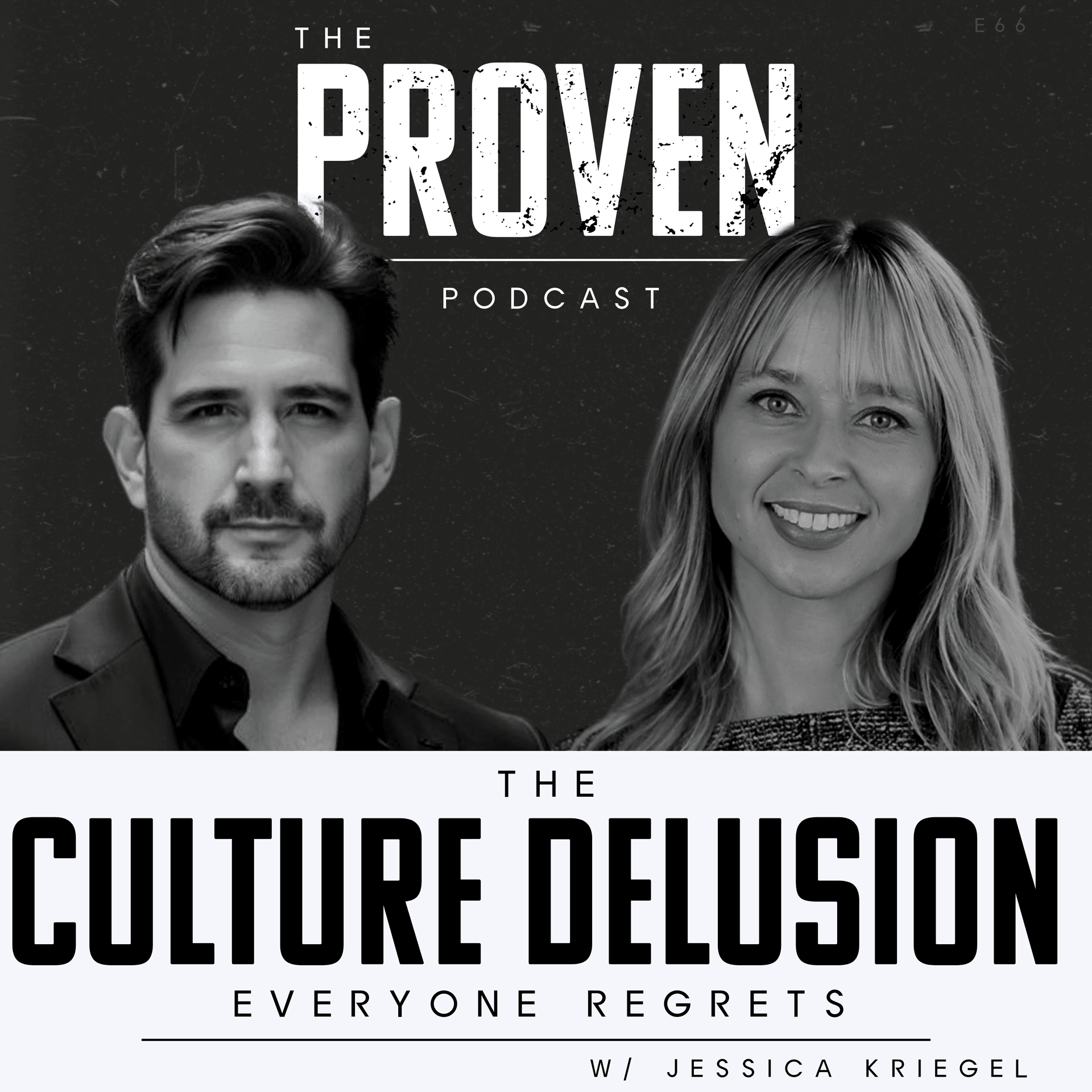
Proven Podcast Episode Summary: The Culture Delusion Everyone Regrets - Jessica Kriegel
Episode Overview In this episode of the Proven Podcast, host Charles interviews Jessica Kriegel, a culture strategist and author, to discuss the essence of workplace culture and its impact on organizational performance. Jessica challenges conventional beliefs about workplace culture, emphasizing that it is not merely defined by perks or slogans but is rooted in shared behaviors and belief systems.
Key Themes and Discussions
What is Workplace Culture?
- Definition: Jessica asserts that culture is fundamentally about how people think and act to achieve results.
- Misconceptions: The common notion that culture is defined by perks and slogans is debunked. Instead, it is about consistent behaviors and shared beliefs that drive performance.
Leaders' Role and Cultural Breakdown
- Unintentional Culture Breakdown: Leaders often inadvertently damage workplace culture during times of growth or pressure. Jessica emphasizes the importance of leadership behavior in shaping organizational culture more than mission statements do.
Values vs. Behaviors
- Importance of Values: Jessica posits that values are only meaningful when they translate into daily actions. There is often a disconnect between what companies claim to value and what they actually reward.
Culture as a Strategic Advantage
- Direct Impact on Performance: A strong culture correlates with improved performance and retention. Jessica advocates treating culture as a core component of business strategy.
Trust, Transparency, and Feedback
- Engagement through Open Communication: Trust and transparency are crucial in building high-performing teams. Feedback loops are necessary for fostering an environment of continuous improvement.
Modern Leadership
- Shift from Control to Connection: Leadership today should focus on building connections rather than merely exerting control. Empathy and accountability are integral to modern leadership.
Navigating Change
- Scaling without Cultural Breakdown: Businesses can grow without sacrificing their culture by maintaining consistency in their core values and adapting their strategies in alignment with those values.
Key Takeaways
- Jessica's Journey: Jessica shares insights from her career, including her time at Oracle and her research into generational dynamics at work, leading her to become a thought leader in workplace culture.
- Importance of Shared Beliefs: For organizations to thrive, leaders must align their teams around shared beliefs and create intentional experiences that nurture these beliefs.
- Practical Steps for Leaders:
- Clarity of Goals: Define clear outcomes for the organization so that all employees understand the direction.
- Align Beliefs: Identify the beliefs needed for achieving these goals and create experiences that reinforce those beliefs.
- Surrender Control: Leaders should allow their teams to take ownership of their roles, focusing on what they can control.
Conclusion This episode serves as a framework for leaders looking to understand and improve their organizational culture. By focusing on shared beliefs and aligning them with business goals, companies can create environments where employees thrive and organizational performance flourishes.
Useful Resources
- Jessica's Upcoming Book: "Surrender to Lead" - available for pre-order at [surrendertolead.com](http://surrendertolead.com).
- Companion Workbook: Available at [builder.surrendertolead.com](http://builder.surrendertolead.com) to help leaders implement these strategies in their organizations.
- Social Media: Follow Jessica Kriegel on LinkedIn, Instagram, or TikTok for insights on workplace culture.
This conversation reframes workplace culture as a strategic advantage, illustrating how intentional leadership and clear communication can lead to enhanced performance and employee engagement.
Written by AI. May contain mistakes. Listen to the episode to check what was said.
Transcript
Automatic transcript. May contain errors.0:00Welcome to the Proven Podcast, where we don't care what you think, only what you can prove. On this episode, Jessica and I attack culture. Culture by itself is a polarizing conversation. And that's exactly what this was. This was a conversation. There were agreements. There were disagreements. There were things we aligned on and things we completely viewed differently. But at the end of it, it changed how I view culture and it gave me more insights to be a better leader and to help scale everything that I've done in my life. With that said, the show starts now. All right, everybody. Welcome back to the show.
0:31I'm excited for today's guest. Thank you so much for being on the show. Thank you. Thanks for having me. So for the four or five people who are in the world who don't know who you are, can you tell a little bit about who you are, what you do, and all of that? You're giving me a lot more credit for being renowned than I actually am. Well, you've got a TEDx talk coming up, so I mean, it's got to be. It'll be my second. So yes, if you've seen my first one, which is called How to Get People to Give a Shit, then maybe you'll be interested in the second one. Or not give a shit at all. Yeah, well, I mean, I think a lot of employees today don't give a shit, which is a scratcher for leaders.
1:05Okay. So I am the chief strategy officer at a culture consulting firm called Culture Partners. And I'm also an author of an upcoming book called Surrender to Lead. Mazel tov. And so some of the stuff you've done, you talked about you've done TEDx Talks. What was your experience prior to what you're doing now? What are the things that got you here? How did you get to that journey? Just to give the audience an idea of like, why are we listening to her? What's happening? That's kind of what I'm trying to put on the Oracle. And at Oracle, I was the head of strategy for the head of cloud. So it was one person away from our CEO helping lead transformation efforts.
1:39So expert in change and culture. At the same time that I was at Oracle, I went and got my doctoral degree in educational leadership and management and wrote my doctoral dissertation. It was quantitative research on generational dynamics at work, talking about millennials. Gen Zers weren't even on the map back when I wrote this dissertation. And I went into that research thinking I was going to figure out what millennials want and how to engage and attract and retain them, which was what everyone wanted to know at that time. And what I came out with was the realization that that's a bunch of stereotyping BS and that ultimately we got to get away from talking about each other in those labels because they're actually limiting our ability to understand the underlying issues that are going on in the workplace.
2:23I wrote a book about that and that blew up. And so I started a keynote career, which was really a side hustle at first until it started making more money than my actual job at Oracle. And then I left and did that on my own, briefly enjoyed a job as a chief HR officer at a different technology company, and then ultimately sold my business to Culture Partners. And that's where I am now. So when we talk about this, I love that the idea of instead of being a broad sword using a scalpel when it comes to people. It's kind of like, oh, this person is a Boston Red Sox fan, therefore they're this. And it just never works that way.
2:59And having that, what are some of the things you've found out with millennials and with all of that that are just blatantly wrong? Like, listen, if you're applying this in your environment, in your workspace, and you're using this brush for millennials or Gen Z or Gen X, or which I'm a fan of Gen X because I am one. So we are the best outside of the greatest generations.
3:20What are the things that you found about millennials that people just are completely wrong about? The brush is the word millennial. So anything you associate with a generation, and it could be millennials or the greatest generation, even you saying maybe they are the greatest generation, you've already started brushing, right? So what I'm saying is that as a classifier is completely fabricated. I mean, first of all, the word millennial did not exist until 1990 when the grandfathers of this entire research, and I'm saying that with air quotes, research industry, invented the word. And the years that define the millennials have changed the stereotypes around them.
4:03The most common for millennials, which is my generation, so it's the one that hurts the most, is, you know, we're entitled. We're tech savvy. We're lazy. We want to save the planet. Gen Z is just millennials on steroids. They're ADHD. They have no interpersonal skills. They're completely addicted to technology. And so we all of that is inaccurate, right? What makes up a person's values and character and behaviors, it is the experiences they've had that lead to the beliefs that they hold that are going to motivate the actions that they take day to day. and that is going to be based on thousands of factors and hundreds of thousands of experiences and not the arbitrary age bracket that you happen to have been born within that for some it's a 20 year white age bracket for others it's 14 years and we understand that intellectually when we use other labels like you can't say well blacks are entitled and whites are tech savvy but we've been it's been drilled into us that race, for example, is an inappropriate stereotype and gender is an inappropriate stereotype.
5:08But for generation, it's just so socially acceptable that we don't even realize that's what we're doing. It's really ageism hiding in a generational label, and it's oversimplifying the complexity of human behavior. So it takes you down the wrong path. It's just stop. I would if we never said the word millennial again, I think that would be better. we'd be better off for it. Yeah, I think it goes with a human behavior wanting to have a shortcut. It's just at the end of the day, we want to shortcut things. We want to say, oh, you believe in this, you belong to this party, therefore it's this. It's post hoc, therefore because of it.
5:39It's like, we believe in this, therefore this is what it is. And it just, it doesn't work in any way, shape, or form. Yeah, Henry Hatchfeld called it in-group, out-group dynamics. I want to be part of an in-group. It makes me feel better. It gives me more self-esteem. In order to be in the group, there needs to be an out-group, and that's to other people. Let me just give you this test. No one has ever said, oh, I wish I was a part of that generation. It doesn't matter what generation you are or which one we're talking about. No one wishes they were a baby boomer or wishes they were Gen Z. Everyone always thinks their generation is the best generation, which makes you feel better about yourself that you're in the in group and everyone else therefore must be in the out group.
6:16And it's actually dysfunctional and destructive in the workplace. In Hebrew, we say goyim or Gentiles, which is the nicest term is then. That's the nicest way we can say it. When you say Gentile, it's the general. General, it's then. So it's that differentiation between it is what it is. It's not a good sign. It's not a good look. The next thing we're talking about is cultures and talking about not a good look, you know, it's 2025. We're wrapping up towards the end of it here. And as we walk into this, we've lost over a million jobs. And there's a lot of people in our space in entrepreneurs, in running big businesses, the people that come to people like you and I that say, hey, yeah, culture is important, but we don't know what culture is.
6:56And therefore, is culture more important than profit? How do they play off each other? Because I think at different levels, there's different answers to that. And I'm really excited to get into that with you. It's one of the most favorite part of this. I'm like, all right, we're going to rip apart this from an entrepreneurial side versus academia side versus a corporate side, because they are very different views towards culture. So for the people playing at home, what is culture? it's the way that people think and act to get results. Okay, that's simple. How important is culture now while things are on fire, when we're hemorrhaging jobs?
7:29Well, how important is it to you as an entrepreneur how your employees think and act to get results? I mean, it is the most important thing. And I sympathize with the leaders who think that people and profitability or culture and profitability are these two opposing forces that we need to balance and find the right equilibrium so that our profitability can soar and our people will thrive. That's the narrative out there because we think in extremes and people often advocate and evangelize in extremes. So there's a whole bunch of culture experts out there, quote unquote, that are really just, you know, bleeding heart, touchy feely, do the right thing folks that want you to make the world a better place.
8:13And so they're advocating for things like, bring your authentic self to work. My opinion, that's a terrible idea. Do not bring your authentic self to work. Bring your professional self to work, and your authentic self can talk to your husband about that, right? There's the people who are saying, we need to, you know, even the DEI thing, for example. Let's talk about DEI. The idea that we need to make people feel included is pretty no-brainer, right? The idea that we want diversity of thought in business is a no-brainer, but people have taken that, slapped a label on it, made it a program, hired a DEI head, given it a budget or not a lot of the time, and then run a bunch of metrics.
8:56And that doesn't change the way people think and act. And so if you care about DEI, it's about how do you get people to believe that that is important, and then you can move the needle on that. But these programs don't work. So culture people are out there saying, be your best self, do the right thing. The consequences may be a little bit of profitability, but that's the right thing at the end of the day. And business leaders are looking at those folks and saying, you guys have no idea what it's like to run a business. It's just not how it works. It's not how I want to run a business, because if I run a business that way, I'll be asked to leave eventually, right?
9:33I mean, as an entrepreneur, or maybe you can hold on with gritted teeth until the bitter end, but it's not going to help your business. So let me show you how the two can live in harmony and actually both can be better off together. So we know that results are what we're looking for in business. That's like the be-all, end-all. You could be the nicest, most humble leader on the planet, but if you're not getting results, no one's writing a Harvard Business Review case study about you, and no one's writing home about anything that you did, no matter how wonderful you acted, right? So results are the be-all, end-all of leadership success.
10:08We know the results come from the actions of people at your organization. So that's where most leaders stop. They actually just focus on what do I need people to do in order to get the result? And that's what leads to burnout and exhaustion and micromanaging and this illusion that you can just mandate people to take action at work and that that will get you a result. That's just bad leadership. you got to ask yourself the question what motivates people to take proactive action what moves people to offer that discretionary effort that you so much wish that they would give you at work and the answer is they're deeply held beliefs if they believe in the company and they believe in you as a leader and they believe in the product and they believe in their ability to impact the bottom line and that makes them feel good well then they're going to offer you all of the discretionary effort because they feel fulfilled by working here.
11:03And that's the level that you have to operate at. Tapping into people's beliefs. Going back to my TEDx talk, it's how to get people to give a shit. You have to get them to believe that they care about what your company is doing. And if they don't care, then they're just phoning it in and they've quiet quit and your profitability suffers. So as a leader, how you tap into that belief layer is all of our beliefs come from the experiences that we've had, right? The experiences we had with our teachers, with our family, at school, with our past employers, with you. Those experiences shape the beliefs I hold, and that's what gets them to take action, and that's what gets you a result.
11:42So you have to align all of those elements. You as a leader cannot really control your people, but you can control the experiences that you create for them. And when you create intentional experiences that will shape the right beliefs so that they take the right action that you want them to take so that you can get a result. You unlock, we studied this with Stanford, 4x profitability. I mean, the companies that were stuck in like that action trap of just what do I got to do, they grew on average in a study we did over three years, 10%. Companies that operated at the belief layer, they at the same three-year period grew by 42%.
12:19So it's 4x growth when you operate at that belief level. And oh, by the way, your people will actually be super fulfilled and interested in the work they're doing because it's what they believe. So here's where profitability and people or culture can both thrive instead of let's put a bunch of money into a Napa retreat where we're going to fly everyone in a hot air balloon and give them a pizza party and get wasted together so that they're, quote, happy. And then we go back to work and nothing has changed in how we actually impact results and actually cost you a bunch of money. So there's a lot to unpack there.
12:53And so you go into the idea of beliefs versus, hey, I'm going to throw you a party. My question is, where does ethos come into? Where does hiring come into? And also when we talked about DEI and all of that, when you get into a situation and you're a smaller business, when we've got a couple of people that they're nine, 10 people shops and they're doing a hundred million dollars a year versus these behemoths of companies that are just so inundated with ineffectiveness, right because at the end of the day it's the people who execute on in my world it's the people who execute we'll figure out the plan later we execute we're not going to sit there and say are you pretty are you nice you feel fulfilled we execute and we hire on that level so it's a completely different ecosystem and it's a completely different ethos because either we execute or i can't feed someone else in the organization it's very simple as we do this so like if you're fulfilled that's great that's adorable i love that i'm going to try my best to meet your needs even though there's a hierarchical needs that you might be driven by significance, why this one might be driven by certainty or wherever they are on that scope.
13:51As someone who runs organizations, I've got to be balancing that. But at the end of the day, if someone isn't fulfilled, it's more important for me to make sure that we're hitting numbers so I can feed that other person's kids. That's my job. I have to make sure that these people are, we hit our goals so I can make sure I pay for their things. When it comes into this - Yeah, but if you have someone who's not fulfilled working on your team, are they giving you 100 %? 100 %? So I don't ever expect anyone to give me 100%. I think that's the difference. So people in it, I don't think anybody ever would give 100%.
14:22Because if I walked in, and please correct me if I'm wrong, if an employee is absolutely 1 ,000 % giving me 100%, they probably are wearing a green hat and are about a foot and a half tall because they're a leprechaun. They don't exist. Most people are going in and they're executing, regrettably, enough to keep their jobs or to meet that next pain hit that they want to get rid of. So, hey, I want that next goal. I want that next thing. That's what they're trying to do because I will not be their first job and I probably won't be their last job. That's just the end of the day. Right. This is the language thing.
14:54Call it that. They're executing enough to keep their jobs. Right. Now, there's more that they could give that would be that discretionary effort, the extra proactive nature of idea generating or process improvement. the thing that goes beyond the scope of what they need to do to keep their jobs, which makes the A player, right? That's the top talent person that you want all of them to be like that, that are sometimes a little bit more difficult to manage because they expect more, because they produce more, right? So the people who are doing that are fulfilled in the work that they're doing. The people who are checked out are doing the bare minimum or not.
15:32So I'm not talking about fulfilled as in I love you, you love me. I'm talking about I want to fulfill the goals here. That's what moves me. And therefore, I'm going to do more than just the bare minimum. And that happens at their inner belief layer. You can't just control freak people into doing that. They're going to do the bare minimum until you call them out on it, right? So we're actually talking about the same thing. I think we agree. My question is when do we do it at the hiring level, right? At the hiring level, yeah. Right. So we talk about this in, when you talk about operators or in the seal communities or special forces operators or even small businesses, we hire very quickly.
16:14We fire faster. It happens very, very. And so in my world, I will incentivize people. If I hire you and you don't like it, I will pay you 90 days to go away because it will cost me more money than to deal with you. so we move through it very very quickly we hold people to certain expectations we walk through saying what do you think you're going to do this is what you like to do boom let's go there's this whole concept um that's a guy there's a book it's a great book by a guy named jacqueline willick it's called extreme ownership and it's pushing down decentralized command and what i have found is in high-end corporate environments it does it doesn't execute well because there's it's just such a big moving ship versus a smaller vessel.
16:58So I'm curious with the studies and the stuff that you've been giving back, because on my world, we don't worry about DEIs. We're not big enough. We're moving too quickly. We're going to hire the best person for the job at the time. And if they continue to execute, they get to stay. If they don't, I wish them the best on their journey. So we move very quickly. I'm curious with your research and what you've shown, because you've done our house stuff. You've done stuff at Oracle. These are big behemoths that you're moving around with a lot of different personalities, a lot of different moving pieces versus most small businesses that are less than 100 employees.
17:28Have you seen a difference between the two and how do you execute in that environment? Yeah, so there's obviously a difference because at scale, there are different problems that you need to solve for. And so it's more of a numbers game and you can be more, you can use a scalpel in a smaller organization. What I do, we're a small organization, right? We have 40 employees and then let's call it 40 employees. So when I'm hiring someone, what we've done is, first of all, we've completely abandoned the idea of culture fit. Because culture fit is what a lot of entrepreneurs think of when they think of, you know, they're thinking, who would I want to get a beer with?
18:07That's what they really mean when they're talking about culture fit. And that's a complete waste of your time. And also, it's probably going to have you end up hiring people that are just like you, which can be useful. But you already have you. Wouldn't you like to get someone not like you and you might learn something? Right. So we focus on purpose fit. So when I do an interview, the first question I ask is, what's your why? And then they usually will give me some kind of canned, you know, what sounds good based on what the job role is. You know, like I'm really moved by product marketing or whatever.
18:43And it's so BS. Right. So then I say, no, no, really, what is your why? Like, why do you wake up in the morning? What do you think the meaning of your life is? and I get them to open up at a deeper level about what their why is, then I tell them our why at the company level. So our company's purpose is to drive results by activating your change. If you were to join us at this company and help us try and achieve that purpose, do you see how it would tie to your why? Do you feel like you're fulfilling your personal mission by helping us with this organization's mission? And now we're talking about what really fulfills someone, what moves someone, where they're going to actually give a shit rather than just, okay, I'm going to be an execution junkie.
19:27And then eventually you get to burn out if you don't actually care about what you're working on, right? So it's how do you create, when we're trying to drive accountability within organizations, the first two questions I ask a leader is, number one, how are you doing on results? Because that's what matters more than anything. And then number two, and how's your energy level? Because for a lot of people to drive the results that they want to hit, it's incredibly draining and it's draining for you as an entrepreneur. Imagine how draining it is for the people who don't own the company. And so you have to find a way to take accountability that doesn't eventually run out.
20:05And that's really what we're about doing is creating that purpose as fuel. The purpose is what gets people to wake up in the morning and be like, I'm all in again. So do you have a filter that you use when you're hiring people because the wise stuff, boy, we could get in a battle on that one. I'm sorry. I don't need to be confrontational on this one. I wrote a book about it. I did. I had a four-star general Batman on this one. I will give you that if you want. But we can go into that. The question I have is, is there a filter that you have? When you're like, okay, I've gone through the hiring.
20:37I understand culture. I understand that culture doesn't make sense in any way, shape, or form. I don't want to hire someone like me because they're probably going to give me a similar answer to a problem. I need a different answer to the same problem. I need to have more aspects. I need someone to get in my face and say, hey, no, here's this other thing you haven't seen. I'm like, perfect. Thank you. That's what we're hiring for. But do you have an overall filter before you hire someone to say, look, this is our thing. If they hit this, that the people who are listening to this could use. Skills.
21:05I mean, what we don't do is, for example, degree requirements and all of these old school ways of measuring whether someone is, quote, qualified. You know, we do skills aptitude. And once we have that basic skills confirmed, then it's purpose fit. That is the filter. I mean, if they care about the kind of work that we're doing, I feel like I'm going to get a lot more out of them than if they're just, you know, just like me and seem nice and could be part of the crew here. Right. The filter we use is if you're hiring this person, if you're the hiring manager and you got sick, God forbid, and this person was needed to perform their job to make sure your children could eat, would you hire that individual?
21:46And we have found that adding that filter into our ecosystem has made our hiring process more effective. We keep people normally on an 80 to 87 percent rate when we started adding that filter versus our churn and burn that we used to do is making people look through that accountability. how do you check for that so it's a it's for less of a less scientific way by as you've gone through it you've asked about performance okay this is a problem how would you do it okay if this happens how would you fix that so instead of going after their why we go into what their effective resources are what would you do in this situation we do mocks then we give you tests so hey here's the thing we have this going on we'll pay you to do the test go run this get back to me on whatever that result you would think would be that result no matter what you do no matter who you are if you're the interviewer if you're the owner if you're ever you're never going to think the other person's result is a hundred percent it just is what it is that's okay they even if they get to 80 that's a win that's a that's a that's a grand slam because as you said before you know we label ourselves as hey i'm gen x i am the best or i'm a boomer i want to be that because i i would love to be in the greatest generation i was like that to me is they win all day long the problem is they didn't have air conditioning and the internet so i'm like okay time wise it's a little bit different on that but for me as you go into it it's going to say okay i'm always going to feel i can do better then i find someone who just completely kicks my butt and i'm like okay now how do i get this person as part of the team and this staff's going to become partners in the org or or something of that nature we run them through tests because if we're sitting about and we're talking about platitudes about how do you feel and what is why and those type of things we haven't tested their execution.
23:25So we've gone through and we've changed the hiring process saying, okay, if this is a real problem we have right now, how would you have fixed it? What would you have done? So you think that people's why doesn't matter in hiring? So I wish it was just me. Um, but the youngest for the, the first and highest decorated four star general, that was a female. There's only been 234 of them. Uh, we just did a talk. We were on stage and I asked her, I said, you know, I wrote a book about that. Who is more important than why? can you help me out with this you you directed people in situations where if i mess up we lose a couple hundred million dollars it's it's okay it's not the end of the world if she messes up we all die right so it's just the end of the ballgame i asked her i said what i go how important is why because i've had this battle multiple times and she goes who influences the why the why by itself is irrelevant so for example i was on stage and i will not say said person's name but this individual believed that the why was the most important thing and i was hot mic'd at the the time and i was walking off stage oh god and i was hot mic and he said what was that i was like oh i'm dude i am so sorry i apologize i'm gonna say no no you just crushed it i'd love to hear your insight i said no dude it's really disrespectful when i do this this is your life's work please let me go step over here and shut up and just be viewed as a complete a-hole and he's like no no i'd really love your insight my wife spent eight years in a hospice watching people die let's show our raise of hands how many but how many want to be in better shape and know why they want to be in a better shape all the hands went up i said cool how many people want to know why they want to have a better relationship better sex life all the hands went so cool i said how many people in this room know why they want to make two to five million dollars more than they're making right now all the hands went up i said cool how many people have actually done it and the hands went this is what it is and i'm like knowing your why doesn't change you have to change who you are so if you know why you want to quit smoking you're not going to quit smoking we have this we have the data on this if you change the identity to i am a non-smoker things change and you have a drive towards that.
25:21The why by itself gets influenced by the who. So who, regardless, is more important than why. To put it in her words exactly, of course, our general, who influences the why. The why by itself is wasted. So you're talking about a state of being rather than a state of doing? No, I'm talking about an identity. So for example, yeah, I'm talking about identity. So you're one version of you when you're executing in your job, right? you're another version of you when you're having naughty naked time whatever it is if you switch those up work is going to be really really interesting or inappropriate or naughty naked time is going to be really really boring right so that's the high level idea of it to get more into it there's a version of you that is an unstoppable force there's a version of you that if you're challenged will come out those are two different versions there's another version of all of us that don't think we're enough not tall enough not short enough not blonde enough not I don't know if it's not curvy enough, whatever it is.
26:15Each one of those have different whys, and they're both fed. Being able to tap into those on command is what creates the movement. Take Michael Jordan. Michael Jordan is an individual who operates a very specific way in very specific environments. He could turn it on and off and on and off. He doesn't need that version of him when he's eating or hanging out with his friends, right? It's a different version. Being able to turn it on and off on command will influence results more than what we have found a why. Because why's we found are platitudes. They don't work. Who you are as an identity has more power.
26:49Yeah. So that's interesting. So we did in our research at Stanford Graduate Business School, we wanted to measure the type of culture that wins the most. Is it an execution focused culture? Is it an accountable culture? Is it a people first culture? Is it, you know, there's eight kind of big categories of culture that we tested. And there was only one that was significantly correlated with increased revenue growth, and it was an adaptive culture. So if you zoom out, you realize it's not actually execution-focused or people-first or accountable culture. It is the one that is able to switch from one to the other and then back again.
27:26To be adaptive is to be able to pivot according to the context, the needs of the organization, whatever's going on with your competitive landscape, your funding circumstances, and so on. So when you can adapt, that is actually what wins. In the same research, though, we looked at 243 companies and their revenue growth over the course of three years to see, OK, we looked at their purpose. We looked at their strategy, which is the execution piece. And then we looked at their culture. And the ones that won the most were the ones that were aligned across those things. So when you have, maybe it's yes and, right?
Read the full transcript
28:05Maybe it's not why doesn't matter, execution matters. Right. I just think it's an order. I think it's a yes and, 100%. It's a yes and, right? It's when you have a purpose that aligns with your execution plan and aligns with the culture, which I define as the way people think and act to get results, you're unstoppable. Sometimes, though, what happens is your need to execute shifts, right? Technological advancement suddenly. Now we've got AI. We've got to change our execution style and plan and approach because we're in a brand new world. Well, if your culture doesn't shift or your purpose doesn't shift, well, now you're out of alignment.
28:41And that's what the research showed. There was three times stronger results growth over the course of three years when you had alignment versus non-alignment. So let's agree that perhaps they could both be important. You probably lean more heavily towards the execution. I am someone who, while at a personal level, right, if I spend the next 10 years trying to make the world a better place with better workplace cultures and I'm, you know, moderately successful, but I was able to fulfill my why, I would be more satisfied with those 10 years. at a personal level than if I was able to create a bunch of money creating electric cars and, you know, doing something that I don't really care about.
29:27Right. But that's just my personal preference. Whereas you're probably more focused on driving results. I'm a little bit more focused on surrender and the state of being and, you know, my spiritual connection. I don't know, but that's it feels different to me. What you're saying doesn't really appeal to me. And so the ability to adapt is probably the key, right? Close. I mean, there's a couple leaps that we did, a couple brushes that we did there. So for me, I focused on the identity of the individual and what they want. Some people want to make the world a better place. Love that. Some people want to buy ridiculous cars and make a bunch of money.
30:04Okay. Whatever feeds your cup, that's your thing. Whatever makes you happy. What drives me on a core when I work with stuff is I want to make it so that people who will never meet me, that I'm going to help a guy who helps a guy who helps a guy who maybe holds the door open for the guy that changes the world. I don't need the significance to fill my cup. That's just not, that's not what drives me. I fill my cup up in a very different way. Knowing each one of the identities of the people that I'm working with and what drives them. And if they are willing to bleed for each other, that becomes important for me.
30:34That's where I'm like, okay, you might want to go and make the world a better place and awesome. Or you might want to go make more money than you ever can possibly spend and then put a man on the moon. I don't care. I really don't care. As long as you're nice to people and you help them out and you're, I really don't authentically care how you get there. Just try and be nice to each other. But in a business, my job is to make sure that the people that have trusted me to give them a job is to make sure that I can feed them. At the end of the day, I want to make sure they can eat. I spent, again, I spent eight years in a hospice with 350 single moms.
31:08My job is to make sure that their kids could eat. so if someone is ineffective i'm like i'm sorry you don't get to stay i've got to make sure that susie can feed her kids i need to make sure that's so it's it's very driven by protecting the people underneath me that's why i am at my identity that's that's how i run that is what drives me so my because i have that identity that influences the why the rest of it the making a bunch of money i guess impossible i've done it okay it's next it's what what's the next thing with that so i think this goes into the question i was going to ask you before this which is when you talk about purpose.
31:40You talk about what is the org's purpose and you, and you do that. How do you identify the difference between an org's purpose versus an individual's purpose? Well, the org is the collective. It's the, why the business exists and the individual's purpose is what they find their personal. It's their prime mover. You know, that concept of prime mover, it's what is the thing inside you that's moving you? The, the origination of movement within you that that and mine has changed significantly it used to be money and power like i used to just want to be super rich and famous i mean for more than a decade okay now then i had a spiritual experience i'm also a volunteer at a well i you don't volunteer right you work there do you volunteer at the hospice or you were you so i so i work i work there and then i volunteered after and then i volunteer at other organizations a lot of it with nature and a lot of with uh people women who have been battered.
32:36It's a lot of what my volunteer works I'm into. Okay. So I'm an end of life doula and I volunteer at a homeless hospice. And so we have that in common. But that was something that old me never would have considered wasting my time at. It was like, ew, homeless people? No. Like dying? Ew. Right? Right. I had a spiritual experience that created a wildly new identity. I mean, I had a completely new personhood evolve and get created, right? And so then now, and I didn't really have anything to do with it. I think it was a spiritual experience that was like something happened to me, really. Now, my purpose is to serve God and others.
33:18And the making money and the being rich and powerful is like not the goal at all. And in fact, I think it's probably going to take me down the wrong path, you know. That I rely on. I have seriously considered giving up my entire career in this world because it feels like not spiritually aligned, you know. Oh, I love that. Going and working in a hospice environment. Then I think about, well, how can I best serve God and others? And I do have a platform and I do have the ability to influence. And maybe I'm here not by coincidence and I'm supposed to do something. You know, but maybe not. I'm getting a master's in divinity right now when I graduate.
33:58Like, maybe I will give it all up. We'll see. And I might have another radical transformation of my identity in the future. No, I don't. Yeah, absolutely. Who shows up? So I agree. And there's this great moment where Matt Damon, he had just won the Oscar. And he's sitting back in his hotel room and his date was passed out. This is his story, not mine. He was passed out on the bed. And he's sitting there looking at the Oscar and this pizza that was left over. And he had this moment where he fast forward, you know, 70 years in his life. And he's an old man. And he goes, imagine if I had spent my whole life trying to get this.
34:26How empty I would have felt. Because no matter how big the hole is inside me, this isn't going to fill it. And I have found that people who have been successful, who have made an enormous amount of money, they get to that moment, they're like, okay, that didn't fill me up. That's not what it was. And whatever it is, some people want to see Mother Teresa and volunteer at hospice, which please volunteer at hospice for those of you who are listening. Go do it. Just even for a week, it will fundamentally change who you are as a person. it will it'll help you face something that we all are going to have to do it is what it is i i may never go into an indian food restaurant because i don't like indian food but i'm gonna die so it's we all get to do that please do that at one point in your lives it will fundamentally shift who you are and some people want to give back some people just want to be left alone like it just is what it is i just want to live a life of peace and quiet other people want to become potus and do weird things to the white house so we have these different things but i think the journey you said you know a new identity showed up i'm finding that in life my identity changes pretty routinely now at this point every like five to eight years i'm like oh there's a new version of me and each time as i get older i think i tell people when i was 30 35 i thought i knew everything at 39 i knew i knew everything at 40 i knew i was the biggest idiot on the planet i had no concept even how to time my shoe and i was absolutely useless and the more i've experienced with life i'm like i don't know crap i'm like oh which is the main reason i do these which is like hey let's have these conversations let's this is what i think it is this is what you think it is awesome where's the truth because there's three sides to every story your side my side the truth and having the vulnerability and the authenticity to say hey listen i found this this is what this study said this is what i've found they don't match cool let's put some holes in it let's let's figure out how to do that and see how that comes from.
36:14Well, exactly. And I think that's one of the greatest pitfalls for leaders today is they think they know everything and they like direct people according to what they think is best. So they have a, you know, and it's, it's totally, so the new book I have coming out, Surrender to Lead is all about that. Surrender in this context is not to give up or to let go or wave the white flag. surrender is to let go of the illusion that you had control in the first place you didn't right and so when you understand that and you don't know best perhaps and you can surrender to the collective higher knowledge of the people on your team or as if you are spiritual surrender to a higher power that will guide you down the path that you need to go down even if it's completely different than you thought or whatever it is that you are you know whatever your belief system is that's actually the unlock that you know interestingly when i finally stopped trying to be rich and famous is when i started making more money and becoming more famous than every time every time right i don't know why but every time yeah it's something it's karma who knows it's also off-putting you can tell when someone is trying to get something from you or get something from the universe and it's like i'm not interested when they're not trying to get something from you You lean in a little bit.
37:37You want to learn more. And so it does make sense. Feels counterintuitive, but it is actually how you unlock that potential that you're currently not getting. It's surrendering the ego without getting too touchy-feely on this. It's just letting go and saying, you know what? I thought that we had to do ABC. I've hired this individual. I hired them. Well, let's find out what they did. And they did X, Y, Z. And I'm like, okay, it worked. I never thought of it that way. awesome and letting go of that that ego of saying all right life's gonna happen for me not to me and i'm gonna go through this process that is a very scary thing to do is have that unbelievable vulnerability and then on the other side is absolute strength and that ego mindset it's it's a scarcity mindset it's a fear-based mindset and that's the mindset that has taken hold in corporate america today it's why we've had over a million layoffs since the beginning of the year because people are scared and they're trying to get ahead of and control a situation that is not controllable.
38:36And the solution is now we will get touchy feely is the opposite of fear is love is to come from your heart is to be of service, giving rather than taking. And that's actually how you make a ton of money. Not to say you can't make a ton of money when you're running a fear based organization. I work for those organizations. Yes, we all have. What could be possible if you didn't and even if you didn't succeed like at the end of the day will you have lived a better life that's just for you you know it's a nice to have but yeah and it's the the idea that i know what to do more than anything else and or i know the answer once i got rid of that because i have a minor in theology and you're getting your master's and we talked about this a little bit before we got on the call the first time the idea that i don't know is a good answer that's okay if you If it's God, Buddha, Allah, the magic chicken, a dancing monkey, or a floating donkey, whatever makes you happy, awesome.
39:32I don't know also works. If you're like, I don't know. I think there could be something there. I also don't have any evidence of it. Do it. Are you being a good human being? Are you trying to help out other people? Are you trying to deliver a service? Are you trying not to be a dick? Then I don't care what you believe in. I don't care if you believe in a bowl of spaghetti. as long as you're kind of the people you meet and show up honestly and connecting to them hugely important so for the people as we've gone down the track i'll try to bring it back a little bit more for corporate america and for entrepreneurs out there who want things that are proven what are things that if they realize their culture is a little wonky if their ego has built it a little bit if there is that resistance and that challenge what are some of the things that they can implement immediately some steps they go hey you know what i screwed up on this i know i gotta let go I gotta release my ego a little bit.
40:22I don't necessarily love my employees. I definitely don't love what I do. I love the result. I love the fact that I can feed my kids or I can fly first class if we can fly anytime soon. But I gotta let go of this. What are some of the things that we know that no matter what organization you are, no matter what size you're at, these are proven you can do these things? Yeah. So the number one driver of results is clarity of those results. So number one, you may not have a team that is as clear as you think they are on what the number one, two, and three goals are for the organization. And I say this because I can tell you stories of being in an executive meeting with the C-suite of Fortune 500 companies.
41:02And I'm looking around the room at these very well-paid executives who are long-tenured, theoretically the best leaders in America. This is a true story. We're in a room, It was like a drugstore retailer, right? They had just come off of a struggle. They were having some struggles, let's just say financially. And so we get into the room and we said, okay, what's the number one goal here? What are you trying to achieve by the end of this year? And they were like, profit margin. Great. What profit margin goal do you have? And the CMO reads his hand and he's like, 3%. Great. And then the COO says, actually, no, it's 5%.
41:37We're like, oh, okay. The CFO goes, no, actually, it's 7%. So we look over at the CEO and it's awkward, obviously. And we say, so what what is the profit margin goal? And he says, well, it's somewhere between three and seven percent. Oh, God. Oh, my God. Once you're slapping. Well, those were all true numbers, right? One number is the number they told the board. One number is the number that they had set for employee bonuses. And one was what they actually put in their projections. I mean, so if your people don't know what you're trying to achieve, how can you hold them accountable? to achieving those things and how can they put their discretionary effort into that thing.
42:14You got to get clear on results, number one. Once you do that, the tendency is to then go into this action trap. What do we got to do? Right. OK, 5 % profit margin. We're super clear on that. What do we got to do? And that's the wrong that's the wrong approach. Ask yourself if cultures how people think and act, ask yourself, OK, what do we need people trying to get that profit margin at this company to believe in order for them to collectively use their intelligence and their discretionary effort to help us achieve that? What do they need to believe in order for us to get 5 % profit margin? So if you're trying to move people to AI, for example, what do you need them to believe?
42:55Well, you probably need them to believe that AI isn't going to kill them, their families, and take their jobs, right? A lot of companies are having trouble implementing AI because everyone is resistant to AI because of fear. So there's a belief that needs to shift if you actually want things to change. Once you figure out the beliefs, name them, identify what those beliefs are, label them, talk about them at the organization level so that we can get on the same page about, here's the shared beliefs that we need to hold. We own the outcome. You know, we standardize to scale. We, whatever the belief is that's critical for your success.
43:29And then you have to surrender your need to control people and create experiences because the only thing you can control is yourself. Create experiences that will drive those beliefs so that you can get people to take the action. And the kind of experiences you can start with, recognition, storytelling, feedback, right? So if someone is not owning the outcome, you have to give them the feedback about this, right? Let them know that they're not owning the outcome. If they are owning the outcome, recognize them for that. Then tell the story about it. Hey, Charles owned this outcome by doing the following thing.
44:06Let me tell everyone the story about it and explain to them how it will tie to the result we're trying to achieve. The lore or the narrative of organizations is a powerful motivator of behavior as well. So telling stories, recognizing people, giving feedback when they fall out of line or in line with demonstrating the actions you need them to demonstrate that align with the beliefs you want to nurture is how you ultimately get the results so as a leader as a manager so that come in and people listening to this how do you get them to let go how do you get them if they haven't had the spiritual awakening or had the experience or done the time in hospice please volunteer at hospice um if they haven't done those things how do you get someone to have the confidence to let go of the rope it's kind of like when someone does bungee jumping, they're going to test that line multiple times before they go.
44:56What is that testing of the line that they can do? So first of all, we help them understand that there is a reality in which we operate, right? And that reality is not something that you can change or influence. There's stuff that's within your control and stuff that's not in your control. We actually call it you're either above the line or below the line, right? So below the line is playing the blame game. It's victimhood. It's pointing fingers at someone. It's waiting and seeing. It's like, that's not my job. Someone will tell me what to do. And that's where a lot of people operate when it comes to accountability.
45:34We don't want to be held accountable in the corporate workspace because we usually are only held accountable when something goes wrong. And we're in competition with one another. So I don't want to be associated with something that went wrong because I'm hoping to get that promotion. So we operate in that place, but there's a better place to operate. So first, it's revisiting how we think about accountability. So if you go above the line and instead of being a victim, you ask yourself the question like, what about this can I control? Right. What is within the scope of my influence? And you focus there.
46:07Then you can take action there. And you have, without even realizing it, surrendered all the things that you're usually pointing the finger out. Well, the Trump administration, will the executive team set the wrong budgets? Well, the marketing team didn't get me what I need? Well, that's the blame game, which is focusing on all the uncontrollables, right? So if you just ask, here's four questions. When someone comes into your office with the problem, first question is what's going on? So then they tell you the problem. Second question, what about that can you control? Get them to tell you what is within their sphere of influence.
46:39Then, okay, well, what else could you try? And then get them to brainstorm and then say, great, what are you going to do by when? Now they have just surrendered all of the things outside of their control and you didn't have to use any touchy-feely language. You know, you're actually focused on what can you execute upon. And it's like magic, you know, when you think about accountability that way and you make that personal choice to focus on what you can control to drive results, well, now you've unlocked something at an organizational level. And I think the magic of what you just said also is you didn't tell them your plan and then make them go execute it because they're not going to.
47:14As they go through it, they came up with a plan. Therefore, when there has issues with it, they're like, oh crap, this was my plan. This wasn't Susie's plan. I have to change this crap. They're going to be more fluid with that because they're taking that ownership of that plan. Because again, you could have told them to do A, B, and C, but as they're doing A, B, and C, which worked for the last five years, it's not going to work now because things have changed because that's just Murphy's law. In the military, it's called the greedy weenie. It's going to happen. However, if it's their plan, they're going to adapt with it because they understand the result.
47:43And I love that you brought up the C-suite, how they didn't understand the same goals i love how as i've done in organizations and seen this that gets exponentially worse the farther you get away from the c-suite you walk into one org and you're like hey what is the goal and 15 different people give 15 different answers and you have that moment like come on guys and that that's where i think it's important the the leader or the person who's running that unit takes that ownership and says okay i have failed to articulate this and i think communication i'd love to ask you about this i have found that people don't communicate and speak the same language for example you and i both speak english but we don't speak the same way because i if you and i were in the car and we're driving and you go hey do you have to go to the bathroom you didn't ask me if i had to go to the bathroom you just said hey i really didn't go to the bathroom could you pull over go to the bathroom if that's how you speak versus if i'm in the car i'm like i gotta pee let's pull over type of thing it's we communicate differently it happens in couples all the time.
48:40If Susie's dating Jane, Jane doesn't speak Susie. Susie definitely doesn't speak Jane, even though they speak the same language. So in the org, how do you get past that? How do you build a culture that respects the fact that everyone speaks the same mother tongue, but not the same language in any way, shape, or form? Simplicity. You have to really simplify what is usually a complex set of documents and roadmaps, project strategy process maps right i mean there's you've got the the purpose of the organization which i do think is important you've got the strategy you've got the goals right and then you have the cultural beliefs that you think people need to hold in order to achieve all those things what usually ends up happening is you get this like mission vision values thing and then you've got 10 confidence keys and then you have eight different slide decks with the quote strategy, right?
49:38I mean, and they're changing all the time because oftentimes the strategy will change before the end of the year and you send out an email and you call it understood. So the first thing we do is to get clarity of results. We simplify what the results are. We make it meaningful, measurable, and memorable. And we actually put all of that on one slide. And we're like, this is the core narrative of who you are as an organization, when you'll join the company, they'll see the slide. When you're doing your town hall, they'll see the slide. We call the executives of the organization the chief repetition officer.
50:09Every single meeting that you have, start with that. Say the why we exist, what we're trying to achieve, are strategic drivers and the cultural beliefs. Say it every single time and you will feel like a fool and do it anyway because it's not about you. It's about making sure that everyone else is clear, right? And so without fail, if you start every meeting with that, people start to get that clarity that is usually lacking because it's posted on the intranet and you're hoping that they check. Right. Because they're never going to check. I think you said something really important there. If you feel like a fool and that's stopping you from doing something, you shouldn't be in a management position.
50:44You're operating out of ego. You shouldn't be there. Get out of the way. You're going to be. That's okay. Anything that goes wrong in the organization is 1000 % your fault. Anything that goes right in the organization is 1000 % their fault. So you always push that out and you take it. It is what it is. I'm curious because you've used result and results, right? So you've used the plural of that. When an org goes in this and you define purpose and you define results, have you found a difference between having a single result or results? How have you found that flux? Yeah, the best practice that we use with our clients is you have one result that is the longer term three to five year result that gives you the the the finish line for if you have executed on your purpose then that's where you've ended up right then we also identify three key results which are this year that will show you if you are on your way towards achieving that broader vision so there's the there's both one big result and then three incremental results which we call key results that will show you if you're on track gosh yeah we um love threes the three-legged stool i mean people remember threes that's in yeah and this was a balancing act i mean if it was as simple as you know you have to figure out how to grow revenue and cut costs and make the customer happy and those are competing initiatives so you have to have more than just one because it will honor the reality, which is that there are competing goals within different parts of the organization.
52:17Huh. Interesting. I've always, I'd love to get more information on this because we've always said you have one master. It comes from Walton who did with Walmart. You have one master. We serve that master. It's not me. It is not anyone in the organization. It's one master. We have whatever that one goal, one result is, we serve that at all costs. How do we get there? So let's give you an example of a company's one master. So Walmart. Walmart's was their master of the customers. They write the rules. We have to do whatever it takes to make sure that they are getting what they want at the best price.
52:48And everything else falls in line towards that. Just that's what we do. So that was their design for it. That's not a goal. That's like an idea, right? How will I know if I've achieved that? So in Walmart's situation was he had better prices, better availability, and better customer service through that one experience. So they wrapped up that master. Prices, availability, and customer service are three competing goals.
53:16Not when you serve the one master, which is a customer. Okay, but if I wanted a great customer service, I'll knock on your door, I'll white glove treatment it. But that's not Walmart's business model because they also have to be low prices, right? Right. So their goal was, their highest thing was, how do we serve them and give them the best price possible? because the only person that matters in that organization was a customer because they could fire us. Nobody else mattered. And since the customer could fire us, how do we serve them to make sure that they don't fire us? And Walton built out and built his empire using it.
53:48Okay, I think that's like, we're kind of, we are actually - We're saying the same thing again. We're saying the same thing, yeah. There's one big goal, and then you can measure that big goal through three separate goals that feed up to that one master, right? Right. And it's interesting how different orgs, once you give them this clarity, to your point of chief repetition officer is, okay, I love that you guys want to do this in marketing. Awesome. I love that HR. Okay. Never love HR. I love that, you know, finance is this. Sorry, HR people. We never get along. You have these things. Okay. I love that you want to do that.
54:21What's our one master? And then all of a sudden the plans change. Okay. Now we have to blog in now. And it just becomes that filter that we give everybody through. So if someone's culture is completely fried or they're worried about dei or they're worried about if they're woke or if they're maga or all the other labels that are just inundated right now which are just getting in the way um yeah how do you get someone to walk in and say listen jobs are hemorrhaging economy's collapsing tariffs are making things interesting it is going to get a lot bumpier than it's then it's going to be that it's ever been the ai innovation is nothing different than the industrial revolution which was nothing different than the dot-com boom this has changed this is just the next evolution of that change you're going to have to embrace it there are people who didn't embrace the internet they went bankrupt there are people going to embrace ai and you're just it is what it is the job i had in college did not exist three years earlier because that's just it was a dot-com boom it is what it is how do you help those people through it how does your organization and sit down and say, okay, this is what we do.
55:28Here's how we build your culture. So you do serve that goal, those three goals, that master, whatever it is for you. Yeah. It's through clarity, alignment, and accountability. So a lot of culture consultants will come into a company and what they want to do is dig up old drama. So they'll do some kind of assessment or survey or focus group or interviews, right? And they're like, what's wrong here? What's not working? How would you do it differently? And then they come up with this master list of all of the problems and present it to the executive team and say, like, don't worry, we can fix you.
56:02Right. Which is all backwards looking and a waste of time. Right. Yes. So we start by saying your culture is perfect. It is perfectly aligned to the results that you're getting right now. You are getting the results right now because of the actions your people are taking, which is because of the beliefs that they hold, which is because of the experiences they've had here. So if you want to get bigger, badder, better results, let's start there. What is the goal? Clarity of results, right? Number one. Then let's figure out what do we need people to do and what beliefs do they need to hold in order to get there?
56:38And what experiences can we create in order to drive those beliefs to get those actions to get that result? That's the alignment part. So you drive, you get clarity of results, and then you drive alignment by getting people bought in. You get them to believe in what the goals are and how you're going to go about doing that through the experiences you create. And then finally, it's accountability because that is the unlock. When people take accountability and they do it by focusing on what they can control to drive results rather than figuring out who's to blame for what went wrong, which is the bad approach to accountability and why it doesn't work in organizations and why managers don't even want to hold folks accountable because it feels mean.
57:18you know, then you start to see that that ownership that is where the alignment of towards those results really begins to snowball into success. There's a lot of moving pieces there. And I'm sure there's a lot of listeners right now that are like, OK, I need more access to this. I need access to a book or insights or I just need to pick your brain. How do people find you? How do they track you down? Because this for a lot of people, this is overwhelming because they thought prior to this conversation, culture meant one thing. No. And results meant no. They need someone to hold their hand. If they were wanting to track you down, if they wanted to get a hold of you, other than giving out your home address, please don't do that.
57:58How do people get a hold of you? How do they connect with you? Because they need more of this insight. So the entire process of driving clarity, alignment, and accountability is written in the book, which is coming out in January. It's available for pre-order now, and you can go to surrender to lead.com to get that for your listeners. I'll give you guys a workbook that we created, which is step one, that clarity piece and creating that one core narrative of your organization. If you go to builder.surrender to lead.com and that has, it's a workbook that will walk you through what you need to get clarity on, what the best practices around that, how you can help spread that message to your organization.
58:39and then eventually create alignment and accountability around it. But that would be step one that you should download, builder.surrendertolead.com. Gotcha. And if people want to connect you on social media, do you do that or you just prefer them to go there? Yeah, yeah. I'm on all of the socials. I've got LinkedIn. I've got a newsletter called This Week in Culture that comes out every Wednesday if you're interested in hearing what's going on these days. And you can find me on Instagram or TikTok or just look up Jessica Kriegel. Perfect. Thank you so much for coming on. I appreciate it. Thank you for pushing back on everything.
59:12I really appreciate it. Yeah, no, I appreciate the conversation. It was great. It's much more interesting than just being interviewed. We got into it. Yeah, absolutely. While many leaders are still debating generational labels or micromanaging actions, the culture leaders demonstrated that intentionally shaping employee beliefs and aligning individual purpose is the true engine for results. Stop implementing short-term programs and start designing the experiences that drive of discretionary effort and unlock four times profitability.
From the publisher
In this insightful episode, Charles sits down with Jessica Kriegel, culture strategist, author, and former Chief Scientist of Workplace Culture at Culture Amp, to explore how values, leadership, and intentional culture drive sustainable performance in modern organizations. Jessica unpacks what workplace culture really is, challenging the idea that it's about perks or slogans, and revealing how shared behaviors and belief systems shape everything from engagement to execution.
From helping companies navigate rapid growth and change to decoding why culture breaks down during moments of pressure, Jessica shares what it takes to build environments where people actually thrive. She explains how leaders can translate values into daily actions, create trust at scale, and align teams around a clear sense of purpose, without sacrificing accountability or results.
Together, they dive into the future of work, why culture must evolve alongside technology, how transparency and feedback fuel high-performing teams, and why leadership today is less about control and more about connection. This conversation reframes culture as a strategic advantage, not a "soft" concept, and shows how the strongest organizations are built from the inside out.
This isn't just a conversation about company culture. It's a blueprint for building workplaces people believe in, contribute to, and choose to stay part of.
KEY TAKEAWAYS:
-How Jessica Kriegel became a leading culture strategist by turning data, behavior, and psychology into actionable workplace insights
-Why company culture isn't about perks or slogans—but about consistent behaviors and shared beliefs
-How leaders unintentionally break culture during periods of growth, pressure, or change
-Why values only matter when they show up in daily decisions and actions
Head over to provenpodcast.com to download your exclusive companion guide, designed to guide you step-by-step in implementing the strategies revealed in this episode.
KEY POINTS:
01:10 – What culture really means:
Jessica challenges the idea that culture is about perks and slogans, while Charles reframes culture as the invisible system driving behavior, trust, and results.
04:55 – How leaders unintentionally break culture:
Jessica explains how growth, pressure, and misaligned incentives erode culture, while Charles reflects on why leadership behavior sets the tone more than any mission statement.
09:42 – Values vs. behaviors:
Jessica breaks down why values only matter when they show up in daily actions, while Charles emphasizes the gap between what companies say and what they actually reward.
14:28 – Culture as a strategic advantage:
Jessica reveals how strong culture directly impacts performance and retention, while Charles explores why culture should be treated like any other core business system.
19:36 – Trust, transparency, and feedback:
Jessica explains how open communication fuels engagement, while Charles highlights why feedback loops are essential for high-performing teams.
24:51 – Leadership in the modern workplace:
Jessica discusses the shift from control to connection, while Charles ties this evolution to empathy, accountability, and clarity.
30:14 – Navigating change without losing alignment:
Jessica shares how organizations can scale without cultural breakdown, while Charles reflects on the importance of consistency during uncertainty.