
In short
Proven Podcast Episode Notes
Episode Title
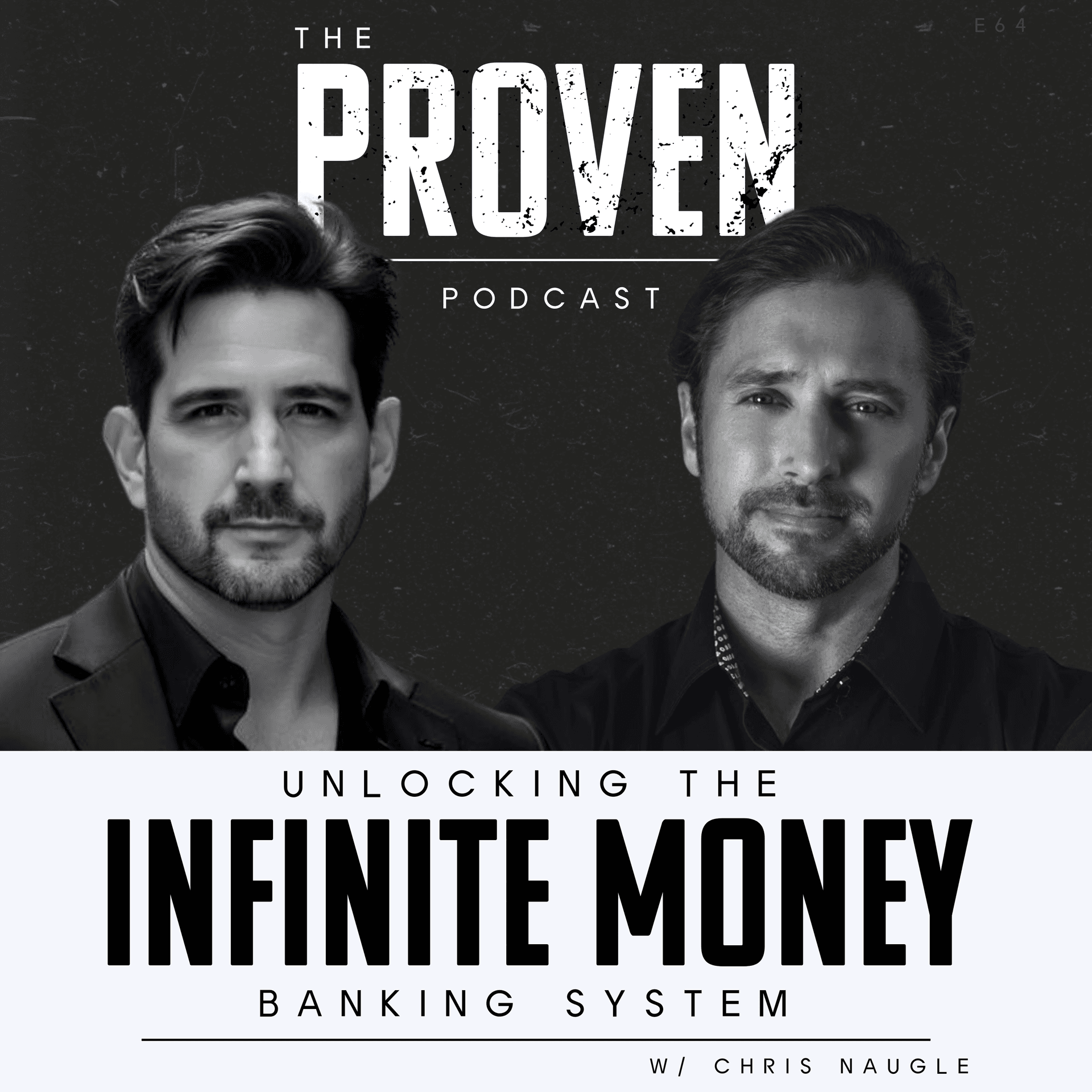
Unlocking the Infinite Money Banking System - Chris Naugle
Episode Description
In this episode, Charles speaks with Chris Naugle, a former professional snowboarder turned wealth strategist and founder of The Money Multiplier, discussing unconventional financial strategies to achieve true financial freedom. They delve into the concept of becoming your own bank through infinite banking, real estate investing, tax strategies, and the future of money.
---
Key Takeaways
- Chris Naugle's Background:
- Transitioned from a professional snowboarder to a multimillionaire wealth strategist.
- Learned hard financial lessons through personal experiences, particularly during the 2008 financial crisis.
- Infinite Banking Concept:
- The idea of "becoming your own bank" using a properly structured whole life insurance policy.
- Focuses on controlling your money and earning uninterrupted compounding returns.
- Economic Mindset Shift:
- It’s not about chasing high-risk assets like cryptocurrencies, but understanding how money flows.
- Emphasizes the importance of cash flow over net worth.
- Generational Wealth:
- Discusses passing down knowledge and financial literacy rather than just monetary wealth.
---
Detailed Discussion Points
- From Snowboarder to Wealth Strategist (01:12)
- Chris shares his journey, starting from a lower-middle-class background in Buffalo, New York.
- Persistence and determination led to success in snowboarding and entrepreneurship.
- Lessons from Financial Loss (05:40)
- The 2008 financial crisis served as a pivotal learning moment for Chris, reshaping his understanding of wealth.
- Understanding Money Movement (09:25)
- Chris discusses the principles behind infinite banking and why most people don't learn how money works.
- Becoming Your Own Bank (14:18)
- How to use whole life insurance to gain liquidity and control over finances while ensuring uninterrupted compounding.
- Reframing Debt (20:46)
- Challenges the notion that all debt is detrimental; discusses strategic leverage.
- Cash Flow Importance (26:10)
- Highlights that wealth is less about accumulation and more about the efficiency of money movement.
- Creating Generational Wealth (31:33)
- The necessity of teaching financial literacy to the next generation, alongside the importance of discipline and purpose.
---
Key Concepts Explained
- Infinite Banking:
- A financial strategy that allows individuals to utilize cash value from whole life insurance policies to fund expenses and investments, effectively acting as their own bank.
- Cash Flow vs. Net Worth:
- Cash flow refers to the movement of money in and out, while net worth is the total value of assets. A healthy cash flow can provide more financial flexibility compared to simply accumulating wealth.
- Debt as a Tool:
- Debt, when used strategically, can accelerate financial independence rather than impede it.
- Cost Segregation:
- A tax strategy that allows real estate investors to accelerate depreciation deductions, reducing taxable income.
Future of Money
- Chris discusses potential shifts in financial systems due to digital currency and the importance of adapting to these changes.
---
Conclusion
This episode presents a transformative approach to personal finance, emphasizing self-reliance through the infinite banking concept and strategic financial literacy. Chris Naugle's insights challenge traditional views on money management and inspire listeners to take control of their financial destinies.
---
Additional Resources
- Companion Guide: Visit [provenpodcast.com](http://provenpodcast.com) to download the exclusive guide for implementing the strategies discussed in this episode.
---
This structured overview captures the essence of the podcast and provides insights into financial strategies that listeners can apply to their own lives.
Written by AI. May contain mistakes. Listen to the episode to check what was said.
Transcript
Automatic transcript. May contain errors.0:00Welcome to The Proven Podcast, where it doesn't matter what you think, only what you can prove. On this episode, Chris breaks down from being a pro snowboarder all the way up to creating infinite banking, taxes, and crypto. Remember, everything on here has been proven, backed up by data in decades. The show starts now. All right, everybody, welcome back to the show. Today, I'm with Chris. Man, I'm super excited to have you here. Thank you so much for joining us. It's an honor. Thanks for having me on. For the four or five people who don't know who you are, can you tell people who you are and what you've done and kind of what you're known for?
0:27Yeah, I mean, I'm the guy that teaches people how to take back control of their money by teaching them how to be the bank. Essentially, we just teach banking 101, but privatize banking. Banks have really made my life miserable or made my life miserable back in the day. Ever since then, I've been on just this mission just to show people don't rely on the banks. Don't put all your eggs in the bank's basket. Take control of your money and learn how to be the bank yourself. At a core, that's what I do today, but that's not what I've always done. I was a pro snowboarder when I was a younger kid. I grew up in Buffalo, New York, to which that's where I'm still at.
1:03And this isn't the Mecca to be a pro snowboarder. I can tell you that we get a lot of snow, but we have hills, man. We don't have mountains. So the hardest thing for me when I was a young kid is, you know, I was always a dreamer. I grew up in a lower middle-class family. My mom raised me. And the funny thing is my mom always believed in me, but nobody else did. So when I told everybody I wanted to be a pro snowboarder, it was kind of like, you know, they were just laughing at me and family members. They're like, well, okay, great, you know, but let's get realistic. And I'm like, no, I'm being real.
1:32So it was really difficult and it forged who I am today. So I'm talking about when I'm a young teenager. Okay. This is when this happened to, to really take it serious. Two things had to happen. Number one, I had to realize I didn't have the resources to go to the resorts and get traveling and have coaches. So I had to do it the hard way. I'd watch videos in school. I would draw the vision boarding. I didn't know anything about it, but I would draw pictures of me doing the tricks that I saw in the videos in the magazines. At the end of the day, I had figured out, okay, I can't afford to go to the resort, but we had this country club by my school and mom would drop me off there.
2:07It was in a ravine. And I just, kids always sled there and I knew like they'd always jump the sand traps. So they'd go start at the top of the hill, go down, they'd hit the sand trap and they'd build jumps out of it. I'm like, perfect. You know, you got an in run to get speed and you got to outrun as a landing. So I started going to the backside of the country club and there was this one sand trap. I built jumps out of it and pretty big ones. I would get all these tricks and mom would drop me off. I had about an hour and a half, two hours before it got dark and I would drill one trick every day and I would hit it.
2:38And in my mind, I would like make little tweaks every time until I had it perfect over and over consistently and persistently. I did this. Then when I got to start competing, like my tricks were dialed. So it wasn't like I was learning tricks at the resort or at the contest. I had these things on lock. It was just a matter of, okay, what trick am I going to do here, there? So I very quickly became a snowboarder that was winning contest. I got noticed. I became an AM. And then as an AM, I got more opportunities to compete, which I was winning again. And I just loved it. And then I'll never forget.
3:11I still didn't think it was possible to really be pro from here, but I had the goal. I heard of these two pros, Blair and Shane. They were big Burton riders. They were going to be at the resort filming for this new video. So I asked mom, can I take the day off of school? And I drove, I had a car at this time. I drove down to the resort and I remember tailing these guys. There was nobody at the resort except for them. And the one guy, Blair, noticed me and he came up to me. I was so nervous. And he said, hey, you know, I see you're riding. Do you want to ride with us? It was like the greatest thing ever.
3:40So I got to ride with pros that day, but it wasn't riding with the pros that did it. It was the fact that these two guys were from Buffalo, Orchard Park, but it's a suburb of Buffalo. So if they could do it in my mind, I knew I could I just knew it would be hard and I know I spent a lot of time on that charles, you know, but that is everything in my life Everything in my life has been all about understanding that the only way to fail is to quit So i'm just not a quitter. We were talking about swimming before like I suck at swimming But i'm not going to quit because I just don't know how to And the second thing is I am just one of the most consistent and persistent constant idiots out there that will just keep doing something over and over and over until I master it.
4:23So with the snowboarding career, I couldn't have a regular job. You just didn't have time. So Charles, what I did is I remember I quit my job at 16. I thought mom was going to be so mad. And I told her, I have this idea to start a clothing line. And it was going to be called Fat Clothing Company, P-H-A-T. This is 1992, just so everybody knows, like, I'm dating us a bit, Charles, because we're the same age. This is a little bit here. yeah so you know i i had this art teacher mr mihalski i was really artistic and and he printed shirts so i would go there after school and i would print the high schools or the middle school shirts with him so this is kind of how i got used to screen printing and i just said to him i said hey if i come up with a couple designs can we print some shirts on you know my graphics and he said sure so i started doing this we print them after school and then i'd put them in my backpack the next day and i'd sell them to my friends i did this over and over again kid consistent persistent Then I was traveling to the East Coast of Vermont, New Hampshire, Maine snowboarding contest.
5:18And I would just stop off at all the places off the 90 that were snowboard shops. And I would sell my clothing to them or consign with them. So now I had distribution literally from Buffalo all to the Eastern, you know, seaboard. So I was doing well at 16, not crushing it, but I wasn't in business to make millions. I was in business just to fund my passion, which was snowboarding. that led to when I was 17, I got this idea because one of the shops that I was selling my stuff to that I needed my own shop because I needed that freedom. So in November of 1994, I opened fat man board shops in the Lockport mall, which is a small, tiny little rinky dink mall back in the day.
5:58And, uh, that only happened because I learned how to write business plans. So I would go to school. This is interesting. School for me was very different at this point. Most kids went to school just to get done with school and get their grade and move on. I went to school because school is how I learned how to run my business. I had my, my, my Mr. Crawley was my accounting teacher. Isn't it funny how like we, we remember the teachers that made marks in our lives. And this was what 30 years ago for me. Yeah. So, and I bet you every one of your audience listening to this can probably name that teacher that made a difference in their life.
6:31It's such an awesome thing to think about. Mr. Crawley, my, my business law teacher, Mr. Mahalski, all these people were pivotal because they were teaching me how to run my business. And I'm 16 years old. But school was very different because like, obviously, I had a whole different interest. I was learning and applying that night. And I did this straight through even the two years of community college. So when I opened Fat Man Board Shops, the only way it happened was because I had these teachers that taught me how to write business plans. Okay. And then the second part of it was my mom, who had nothing, you know, we grew up very, I'm not gonna say poor, but definitely just a smidgen above that.
7:08She got the house. It was a 700 square foot, two bedroom, one bath house in the divorce. And I remember everybody said no to me about this. I needed a loan to open the store. And everybody said no. My whole family, like my dad said, go get a job at the factory, blah, blah, blah. But my mom saw this happening. And, you know, I finally had an opportunity where one bank would lend me an SBA backed loan, but they wanted collateral. And I didn't understand collateral. I'm like, I got a KX 125 dirt bike and 86 Buick Skyhawk and a wicked baseball card collection. What do you say? And they're like, no, we're thinking like a piece of property.
7:41I'm 17. I'm like, I don't have a piece of property, but my mom did. And she was crazy enough to believe in me. And she put her house, our house, she called it on the line so I could get that SBA back loan. So the dream became real. I literally lived, we were talking about like a heavenly place being in the water in the morning when the sun's coming up. But like, this was my having heavenly place back then. And it lasted for a while, lasted all the way to the early 2000s when the dot-com crash, the recession, took hold. And it was the first recession of my life. And I was a business owner, highly leveraged.
8:13So when that recession hit, I couldn't afford things. I could barely make my truck payment, which was$199 a month back then. And I needed to find a job. So I put my resume out. My resume, just so everybody knows, isn't fancy like most of you listening. It was one page. I had high school. I had two years of community college, barely. And I was a business owner. But the unique thing was the people that responded were Wall Street. Now, think about that. I'm a pro snowboarder. Every day I wear a beanie and a hoodie to work. And then all of a sudden I put my resume out and the only people that want me to hire me is Wall Street firms, big ones.
8:55And I'm like, what the heck? So I had to figure out how to put a sued on and I had to figure all these things out, but I ended up entering wall street in 2003. And I spent 16 years, uh, you know, in that hell hole, but we won't really talk about that. I was very good at it. Uh, and I learned a lot. So let me dissect it. There's a lot there. There is a lot of information. So let's, let's, let's dissect it. There's two things that confused the hell out of me. I'm from Florida. So you kept mentioning, um, I don't know how to pronounce are practically snow. I don't know what the hell that is. So I don't know what that is.
9:29You snowboard. I don't know what you're talking about. That's the share off the bat. I'm from Florida. I don't know what snow is. We'll get back to that later. You also mentioned right off the bat that there was a way to monetize and be your own bank. So for most people, whether it was like, I don't care about snowboarding, man, how did you become your own bank? How did you? So what does that mean? What is that? So let's jump through a whole bunch of stuff. So I got into real estate because a wealthy client of mine was in real estate and said, you should be in real estate if you want to make real wealth.
9:55And I did. And I was in Utah snowboarding and this guy who was lending me money for my real estate deals, his name was Mike. He was super wealthy guy. You know, I was out there. I said, Hey, Mike, I got a deal I'd like to present to you. And I said, can we meet up? So we met at the Cheesecake Factory, downtown Salt Lake. And I remember talking to him and I just said to him, I said, Mike, how do you fund all these, these deals? And without a flinch, he says, I, I fund from my private bank. And I'm like, Holy crap, Mike's got a private bank. And I'm like, tell me about it. Cause I'm an advisor at this point.
10:23So I knew a thing or two and I just want to know, what is Mike's private bank? Well, first I thought it was an actual bank and he told me it wasn't. He says, but here's what it is. All I did, Chris, is I changed where my money went first. I put it into this account where I earn guaranteed interest for the rest of my life and it never changes. So I'm like, in my mind, I'm thinking guaranteed interest. Cool. And it never changes. So a savings account goes up and down. This one's guaranteed. So I'm like, what could that be? And then he says, and I get dividends every year. And then I am like, okay.
10:48And he said, and it grows tax free. So he's like saying all these things and I just keep my, my, you know, bullshit meter keeps flying up thinking, oh, there's no way this is even possible. But he gets to the final point after he tells me it's guaranteed, it's dividends, it's tax-free, it's protected from judgments and liens. And then he says, and when you come to me with a deal like this, what I do is I go to my private bank and I take a loan and I give that money to you. Call it a hundred grand, just for nature of the math. Give you a hundred grand and then you pay me 15 % interest on that. So then I take the interest you pay me monthly and I put it right back into my private bank.
11:21And the best part about this whole thing, and then he tells me, he says, all$100 ,000 that I had in my private bank is still in there earning guaranteed interest plus dividends in a tax-free environment while you are paying me money a second time at 15%. So I'm effectively making money twice on the same dollar. So just let that sink in for a second. So I had never been exposed to what you're going to hear in a second, but I heard this. As an advisor, nothing he said meshed. I couldn't fill the boxes because I had all these independent boxes that hit all the things he said. None of them worked as one.
11:57So I was just blown away. And then I said, Mike, I said, this is amazing, but what is it? And he kind of looks dumbfounded at me. He's like, you're a financial advisor. You know exactly what this is. And I'm thinking, oh yeah, yeah, I do. But what is it? And he says, it's a specially designed whole life insurance policy. And all of a sudden, And I'm like, that was like nails on a chalkboard. I'm like, no, no, no way. It doesn't work this way. But indeed it did. And he even told me how it worked. And I said, all right, well, I need to do this. I need to set this up. And he said, well, I can't help you.
12:27This guy, Brent did. So I called Brent on the way back to the hotel from where we were. And Brent said to me, you got to watch this 90 minute video before we can talk. I watched a 90 minute video reluctantly because I didn't want to. And in that 90 minutes, that it broke down how this has been used for hundreds of years. He broke down how the whole life is different. The design and engineering of the whole life is different than a normal whole life. And then he explained the keys, which is the banking component, and then all this, and it's all called the infinite banking concepts. So walk me through, because they're not going to spend 90 minutes.
13:02How can we do that in 90 seconds? Walk me through what specifically is it? How does it work? Let's go through that. We don't need to do that. Let me just give you an example, okay? Every one of us work for money and we save money and we put it into a bank account first. That's what we do. So let's just say all you did is you took the amount you were going to save and you didn't put it into the bank account. You changed one thing and that's where it went. You put it into a specially designed whole life. Now, on the other side of your budget over here, you've got bills. Most people have car loans.
13:27They have credit cards. Let's just pick on a credit card, right? Let's say you got a visa that you owe$5 ,000 every month. You pay$100 a month to visa and it's 20 % interest. Everybody's got that, right? That's normal. So over in this side, you save up$5 ,000 inside this whole life policy. And let's just say you do that in two months. What we do is we immediately would take a loan from the whole life. Think of a circle or a monopoly board. The money goes around the top part of the circle. You took the loan from the policy. Five grand now is in your hand and you use it. You pay off Visa. You were paying Visa$100 a month.
14:00That was your minimum interest and it was 20%. You no longer owe Visa 100, but now you owe your bank 100. So you write a check for$100 back to your policy. Okay, so the exact same dollars, your cash flow has not changed. Now let's unpack why that makes sense. First off, your$5 ,000 that you had in that policy is earning guaranteed interest plus dividends in a tax-free environment. And let's just call that 6 % because we can go anywhere between 5.5 to 6.4. So let's use 6. To borrow the money, it's going to cost us 5 because the insurance company is going to charge us 5%. So when you think of a bank, how does a bank work?
14:38You put money in a bank, a bank pays you interest. Let's call that 3 % by today's numbers. That would be high. But when you want to borrow money from the bank, does the bank charge you more or less than 3 %? Significantly more. Always more. So let's say six. The bank makes a 3 % spread. That's how banks operate. They make a spread, okay? And they do it with very little risk. To be your own bank, you're mimicking exactly what a bank does, but you have to get out of the banking industry and you got to get into somewhere where you can control your money. And that is the insurance world. That is the life insurance industry where you can do that inside this whole life policy.
15:08I didn't invent this. The Rockefellers and the Morgans and the Stanleys did way back when, but anyway. So now let's just keep going back to that. You started with five grand. You took five grand out, paid off Visa. You took the hundred you were paying Visa, you paid it back to yourself. What is your return on your money at this present point in time? 20%. It's 20 % because you were paying Visa 20, now you're taking back 20. So you're making 20. But you see, you're not just making 20. You're making 20 plus the spread. But here's the thing that most people need to understand. This is just mathematics.
15:39Everything I teach is math. If you're making six and you're paying five, okay? The spread would be hypothetically 1%, right? So we can all figure that out. You're making 1 % plus the 20 you're recapturing. But now every month you're paying the$5 ,000 down. So you're not paying 5 % on 5 ,000 anymore. You're paying it on 4 ,900, 48, 47. So every year you're driving or every month you're driving down the APR. So every time you're doing this, you're fully keeping liquidity because that hundred you're putting back in the policy becomes available the next day. And you paid the loan down to the insurance company.
16:13So now your APR is lower, which means your spread's getting bigger. And the one thing that I'm sure a lot of people are thinking, and let me just wrap this in. Sorry, I couldn't do it in 90 seconds. But the insurance company, when you needed the five grand, you didn't take your five grand. You used the insurance company's money. They literally advanced you$5 ,000 of your death benefit that you won't get. You will never get. Your beneficiary will get when you die. But they'll give you that money up front before you die, up to the amount that you have in your cash value as collateral. So five grand, you can use five grand of your death benefit.
16:46So that's how you're doing it. You're making uninterrupted compounding interest on all your money while your money's out working and making money a second time. That's the simplest way I can explain it. So let me try and dummy it down even more. Let's say you've got a half a million dollars and you need$250 ,000 of it to invest in a real estate deal that you're going to do because it is what it is. You go and you buy this whole life insurance. You have the money in there. You put all of this cash in there. You put$500 ,000 in there. you then go to them and say listen i'm going to go invest into this so my balance hasn't changed in my whole life they give me a loan which is that i'm guessing a certain percentage what is that percentage normally for that 250 000 in today's interest rate environment is about 5.25 today perfect so you take that out and you give that money to this investment that you're going to do you have to pay that 5.25 whatever the note is on that so it's x percentage you have to make that payment every single month.
17:44No, let me stop you. You don't have to make that payment every month. The insurance company charges the interest one time a year. So you basically have 12 months to use that money before any interest is ever due. Jesus. All right. So I take that money out. It technically isn't money. My balance is still there. Yeah. Your full 500 grand is still in the account. Perfect. I take this money. I invest it in my real estate. If I close on that deal, because real estate, most of the deals that we're doing don't make it more than 12 months. There's just no way you're going you're getting in and out of it you're basically taking that 250 000 which is now free money to you because you haven't paid the interest on that you do the deal the deal closes you get your 250k back out of the deal you get your nut back you get your principal back and if you're doing this with cost segregation and you're doing this off the taxes it is what it is you you offset it you had your 250 back you pay back the interest to your life insurance Well, you say pay back the principal.
18:40You'd give the$250 back. Yeah. Right. And then the interest do. And that was the next question. Whatever the interest is for those five to six months or that eight months, whatever has been exited from there, you can do that in an environment where the bill doesn't come due for another 12 months? That is correct. So what happens - The only time the insurance - Go ahead. Go ahead. Yeah. What happens if, for whatever reason, the real estate deal goes belly up or whatever? It happens. Then it happens. So you're still on the hook for that loan, and now you just got to pay it off at a 5 % interest rate?
19:15Well, yeah, you have a loan. The insurance company, this is a goofy thing, and this isn't going to make sense right now, but the insurance company will never ask you for the$250 ,000 back because the insurance company knows they're going to get it back the day you die. They would love it if you never paid them back the$250 ,000 because they're getting interest on that$250 ,000 the entire time if you don't pay it back. Now, you're thinking that that's terrible, but remember, your$500 ,000 is still there earning interest and dividends at a rate higher than what you're charged because there is an arbitrage.
19:44So in every year that goes on, because of compounding interest, your arbitrage gets bigger and bigger and bigger because you have more money that's compounding because it's interest, earning interest on top of interest, right? That's compounding. So if that happened, and listen, I've been in real estate since 06. It does happen. It does. Rarely will you ever lose a full$250 ,000. You'll never notice zero. Yeah. But yeah, you might lose some cash. Yeah. So let's just say you bought a deal for$250 ,000. You took the money from your policy. Something went sour. Now you only can put$100 ,000. You could sell it for$100 ,000.
20:16Fire salad, right? You take the$100 ,000. You put that back in the policy. So now you're still on the hook for$150 ,000 or the interest on the$150 ,000. Now that would be a bad scenario, right? Because you're like, damn, now I got this new expense. every year. The insurance company sends me a bill for this 5.25 on this 150 grand. That sucks. But on the flip side, you got$500 ,000 still compounding. So when you look at the interest and dividends you earned on that 500 ,000, then you compare it to the interest that's owed on that 250 or 150 ,000 left, you're way ahead of the game. You could just take the dividend and pay the interest with the dividend.
20:52This is important for the listeners. That's a great example. 100%. Yeah. If you're making X percent, let's just make up numbers because we're stupid and it is what it is. It's a plan. $500 ,000, you're making 10 % on it just to make life easier. That would be what? You want to run the numbers on that? Make a basic idea? 10 % on that 500 grand? Wouldn't it be 50 grand? Yeah. So let's say you're making 50 grand on it. Right. Just for this crazy numbers and please, for those of you playing it. Yeah, don't hold us to the math because it's crazy. Don't hold us to the math. We're giving you examples.
21:23We're trying to dumb this down. We're trying to get this on the kindergarten level. You're getting 50K coming back from that. You've taken 250K out. It goes belly up. You only get to put 100K back in. You're now paying interest on$150 ,000. And let's say it's 6%. My hallucination is, are you telling me it's lower than what I'm getting? Or is it going to be more than the 10 % that I'm getting? No, how could it be? It's just math. No, no, no. I'm saying no. Is the interest rate, is it higher? is the money, is the interest rate that I'm getting from my whole life insurance higher than the loan amount?
21:57Yes. Is the interest rate... Yes. And I don't know a single period of time back, you know, these insurance companies have all been around like 140, 150, 160 years. I don't know a single period of time ever in that whole period where the interest and dividends earned on the policy were less than the interest charge. Am I saying this right? Yeah. Or were less than the interest charge. Never. And today is the thinnest it's ever been because we're in a high interest rate environment. Okay. So it's the thinnest, but you're still making money. And as time goes by, you make more and more and more. Perfect.
22:28So, so in our study example, we're getting 10%. Again, don't hold us to this. Yeah. Cause you're not getting 10 % on from the, not what you're going to get. Please understand that we're dumbing it down for you to make life easier. Cause most of you are driving or walking or doing something else. I'm getting 50 K a year off my original 50 K bout of$500 ,000 bounce in this example. And I know I'm going to get comments where we did it wrong. I understand. Shut up. It's just, We're trying to break it down. I'm getting 50K. I pay back the 100K of my fire sale. It got screwed up. I got 150K note that I have to pay 6 % on.
Read the full transcript
23:02The note will be covered by default if I want by the interest that I'm making from my original 500K balance. That is correct. Is that what we're saying? Mm-hmm. That's freaking wild. So walk me through then. let's say um we have a crazy person that takes over office and the dollar goes kaboom what happens then what happens because most banks are backed by the ftc they'll give you 250k per institution that's an important thing don't put 500 grand in bank of america and expect all 500k of it just you know people in silicon valley bank got a hall pass you all think oh well in silicon valley listen there was a lot more behind the scenes you don't know about that and we don't have time to get into it.
23:48But please don't think that's going to happen to you. If you got more than$250 ,000 in a bank account, that bank goes to Insullivan, you are screwed. I'm sorry. Nobody's going to come rescue you. The FedEx has 99 years to pay you back. It's in their bylaws. They have almost a century to pay. You're not getting that money back. No, not at all. It's over. And I'm sorry to tell people that. It's over. But you're right. So now let's talk about the insurance industry. So the insurance industry is unique. It's actually much bigger than the banking industry. Do your own research. You don't have to believe what I'm saying.
24:18The life insurance companies probably own every one of the bank buildings in your downtown. When you look at Zion Bank, you look at Bank of America and those big skyscrapers, the insurance companies own those buildings because they have the money. Banks have your money and have fiat currency and fractional reserve banking insurance companies. They have the meat. Sorry, didn't mean to plug Arby's. So when you really are looking at the industries, the reason the Rockefellers, the Rothschilds, and the wealthiest families throughout history have used life insurance companies to store a big significant portion of their wealth is because of stability and safety.
24:53Don't think FDIC is coming to save you, okay? But the insurance companies, let's say they did go insolvent. Now, the mutuals, look it up, how many mutually owned life insurance companies have gone insolvent in the last hundred years? You'll be quite surprised. There's barely any. But then go one step further and say, how many clients lost money? Zero. And the reason for that is insurance industry is so big and so important that they have not just federal backstops, but they have state backstops. Every insurance company in that state feeds into a state guarantee fund that then will bail out an insurance company.
25:24And I've actually seen this happen firsthand, not with mutually owns, but with publicly traded insurance companies. During 2008, AIG went insolvent because of risky business. Now they're publicly traded, but they got bailed out. And you think the government bailed them out, which they kind of helped, but They were bailed out because of all the other insurance companies pulled together and bailed them out. So you got to really understand how this works. I don't know any scenario, and you could do your research, but I've never seen a scenario where anyone with a life insurance policy has ever lost a penny because of a company going bankrupt or insolvent, even how rare that is.
25:58So when you think about stability protection of your assets in the worst case scenario, you want your money at the insurance companies. Now let's talk about the dollar because this topic comes up all the time. If the U.S. dollar went kaput, could it happen? I don't know. Probably not in any time in the near future, but let's just say it did happen. What would happen? Well, first off, you have to understand that every single thing we do touch, invest in, buy, see, work for is denominated in U.S. dollars. So if that happened, you have much bigger problems to deal with. Yeah, and I want to talk about this because it is important because people say, hey, go invest in gold.
26:34Go keep gold. if we get to the point where the dollar explodes and you're sitting at a supermarket with a cheese grater grading off a little bit of gold please understand if we get to that level of apocalypse my lead is going to take your gold that's for sure understand that's on the high level if it gets to the point of apocalypse level stuff i'm just going to shoot you yeah so when people go oh invest in gold invest in silver guys if we get to the point where we have that level of collapse because most people have a level of ignorance about this. When you look at the last time we've had a reserve change, be it from the last time it happened was with the British pound over to the US dollar, UK was screwed really, really badly.
27:14So please understand, you're not going to be running around with bars of gold saving off some to buy milk. That's not what's going to happen. So please, and if you're like, oh, crypto's going to save us, da, da, da, da, da. No, I'm sorry. Charles, can we spend a second just to talk about like crypto and, you know, I'm on the same side as you are. I invest in things that have intrinsic value and crypto does not. But let me let me talk to you about something that just recently happened that literally did give us a pretty clear indication of the future of what it's going to look like from a monetary standpoint.
27:44You see, banks right now are really struggling. You'll never hear this unless you go to the right journals and the right places where you actually get the truth, which won't be mainstream media. Banks right now are running scared. They're running scared because there's trillions of dollars exiting fiat dollars. So your dollars, there's trillions of fiat dollars exiting banks going into stable coins more now than ever before in history. Okay. Stable coins. I'm not saying Bitcoin. I'm not, I'm talking stable coins. You have to understand them. So now Trump put in place the genius act or the Trump administration put in place the genius act.
28:18Please read it. It basically is the framework for the future because what it's doing is it's giving the regulatory and all the groundwork for stable coins being able to be deposited in traditional banks. Now, this poses a really unique situation because banks, they're so big and they have so much legacy software built into them that they can't just pivot and all of a sudden open up the mechanisms for, well, safely, the mechanisms for stable coin deposits. So I tend to be a big thinker, okay? Maybe sometimes crazy, but you know what Steve Jobs said, the crazy ones are the ones that change the world.
28:53I have created with all my companies. We're the largest in the country for BYOB, Be Your Own Banker. That's what we explained earlier. We also have a company called PrivateMoneyClub.com, which is like a dating site for money. People with money meet people that need money for real estate deals. It's just a community. There's no one in the middle. Literally, when I saw the Genius Act and I read it, I thought to myself, I thought, you know what? Somebody's going to have to create the solution to solve the bank's problems for this this digital exchange, this place where this can happen. Now, in the life insurance industry, there's been some unique case studies that have happened where, you know, life insurance cash value, one of the safest places to put money, can be brought to the blockchain.
29:34A coin, we'll just call it a coin, okay, can be created that has the backing that is backed not by dollars, but by cash value life insurance, which is denominated in dollars. So let's be real about that. So now you've got a coin that is backed by cash value life insurance. Now you've got something that literally eliminates all the risks that you have in the safest investment called treasury bonds, which is interest rate risk. You don't have that with cash value life insurance. So this case study has already been done. It's been proven. It worked. So now what I am thinking is I'm thinking, you know what?
30:08I literally have created a kind of a privatized banking system where we've got the depository, the BYOB deposits in the whole life. Then we've got the product, which is PMC, which is your lending division, okay? And then we've created the software called The Vault, which basically is the operating system for your personal banking. And then all I did is I got some really smart engineers and some people that really understand this world. And I started to think, we literally, with very little effort in coding and someone that's really smart with AI and blockchain, we literally can create the solution for banks.
30:41And then all of a sudden you start to think, okay, how much would a bank pay for something like this? Well, probably as much as much as you ask because they need it and they can't do it themselves in time that they want to do it. So I say that because the genius act back to the original thing paints the framework for what potentially will be the future of our monetary system. Now, you got a lot of hurdles to get over. You got the Fed and you're seeing that every single day, the bantering back and forth with the Fed and, you know, all that. But you're seeing progress move on the digital side. But I just don't want anyone to think that, oh, well, I'm going to put all my money in Bitcoin and I'm going to ride off and sail off into the sunset.
31:19I'd be very careful with that. There's too much volatility. There's too many unknowns there. But I just want you to understand that, like, the digital currency age is on us now. With quantum computing and AI, we're already there. it's only going to go faster and faster so if you really want to see what the future is just don't have to look very far right i do think there is because i learned very quickly from melvin signer who's no longer with us he was the 64th richest person on the planet and his first billionaire i ever met he goes don't invest in things that you don't fully understand oh my god the third law of wealth yeah um it's we sat there and you know when nfts came out like that makes no sense to me and when when bitcoin came out one of the guys used to work for me he's like hey there's this coin that it's like 100 bucks you've got to invest in it and i was like it's world of workup money this doesn't make any sense to me i don't understand it and bitcoin took off it's 120k i still don't fucking understand crypto we still don't understand how this makes sense because if you got the chinese government that has been manipulating their currency as a weapon of war because that's what they've been doing it's because they're not going to fire nuclear weapons and manipulating their currency and now you're saying hey congratulations to the rest of the world we're taking away your currency which isn't real anyway it's fiat money it's not real we're going to take this away from you you really think countries are going to let you take away that reserve to take away that power it's never made full sense to me now for some people they will come after me like oh my god crypto is great i love that for you i don't understand it i don't invest in things i don't understand everything that people invest in this is why I've had arguments with my VC friends.
32:5870 % of all VCs, if you're good, will fail. All your venture capital stuff, all your individual investors, they will go to fucking zero. There has not been a single real estate deal that I've ever been part of, ever, that's gone to zero. Because it can't. Because it almost can't go to zero. It's a tangible, it's a tangible asset. So that's why for me, I invest in things because my last name is Schwartz. We're coded into us. We don't like losing money. It's just a survival mechanism. It buys our way from not being put on trains and turned into so. That's why we love money. It's not from people with money.
33:32It's because we need to get the heck out of Dodge. That's where this comes from. So when people are talking about this and they're talking about crypto and we can have a much longer conversation about this for probably hours as a whole. Please understand the act did not protect Bitcoin. That's not what it's designed to do. So it was like, oh, Trump is so pro-Bitcoin. No, he's not. No, he's not at all. Absolutely not pro-Bitcoin. He's the complete opposite of that. So for those of you who are going to come at me. Oh, dude, you are the first person that ever gets that. Yeah. Please come after me.
34:07See, you read his hat. Covered a couple of plus. And then read the Clarity Act next, please. Read Genius Act, then read the Clarity Act if you really want to understand it. So like when people come after me after the Affordable Health Care Act, and they're like, oh, it's horrible. Cool. I'm like, cool. How many pages is it? They're like, excuse me? I'm like, how many pages of the Affordable Health Care Act? They're like, well, I have no idea. I said, cool, so you've never read it. So what you're regurgitating to me is shit that you came off the news. You didn't read all 614, 600 whatever it is, pages of the Affordable Health Care Act.
34:36So before we get in an argument, please go educate yourself. So if you want to have a conversation with me and you want to yell at me on my thing and make nasty comments, I welcome the conversation after it's educated. Because I could be wrong. I'm wrong all the time. Just ask any one of my exes. they will tell you that I am wrong all the time. So with that said, back to banking, back to what we're doing here. I'm sure the crypto bros, you will come after me. I'm glad you guys have all made a million dollars and billions of dollars. Marvel tough unto you and to your families. I love this for you.
35:07If you can sit down and you want to have a conversation with me about crypto, send my team a message. We'll have a conversation. You want to talk about it in the comments? I'm just going to block you because you're annoying. Charles, I have to just say something on what you just said. First off, you are spot on. First off, no one should invest in things that they don't know, like and understand. It is not just us telling you that it is the third law of wealth. Read the richest man in Babylon about the seven laws of gold, then parallel that back to the six laws of wealth. OK, so that's the first thing.
35:37Second thing, I know we just talked about a whole bunch of complicated stuff that a lot of people didn't understand. But I want everybody to know the same thing as Charles. I don't have one red cent of my money in any crypto at all. And I know some of you are like, you're an idiot. Zero. No, no. You see, I have rules to my investing and intrinsic value is very important. Fundamentals are very important. I have zero dollars in the stock market right now. I have money in real estate. I have lots of money in treasury bonds, long-term treasuries, because I understand how they work, the inverse relationship with interest rates.
36:05And I'm going to make a lot of money risk-free there. But I just want to be clear that even though we just talked about stable coins and blockchain and everything, we did not talk about Bitcoin. And if you thought we were talking about Bitcoin or crypto, you clearly just don't understand it at all. We were talking about attack. We're not taking the time to read the actual material of what the governments are doing. The people who have all the power, the people who have made a fortune legally or illegally, ethically or not having the conversation about if POTUS is legal or ethical, if you like him, if you're into orange chinos.
36:37I'm not having that conversation with you. I don't care. What I'm trying to say is please spend more than 37 seconds watching CNN, MSNBC, Fox News, any of that. Please stop doing that and research and read the actual act. Go through it. It's very boring. It's written in lawyerese on purpose. Please don't go on a conspiracy spin out. Read what it actually is. Or in today's world, go to AI and just ask it to paraphrase and give you the bullet points and the high levels of the Genius Act. That's maybe more realistic for most of the people. Yeah, that's just the beginning. And then we can have an educated conversation.
37:15Turn it up when you're on the toilet instead of playing Candy Crush and actually read because we're talking about your wealth. But I agree with you. My number one rule when it comes to money is don't lose money. That's number one. Number two, don't invest in things you don't understand. People understand crypto better than me. I love that for you. Mazel tov. I don't. I buy real estate. We're in the process of buying two hotels right now. That's what we do. It's a different conversation. Because you can't lose all your money. You can lose money. You can't ever lose all your money. And as you know, like, and understand it, your chance, your risk mitigation is done.
37:44Okay. Because you understand real estate and you understand the risks with it. You can mitigate risk out of real estate extremely easily. Right. But what I like what we're talking about with the infinite banking idea and what you do about becoming your own bank is this concept of I take a half a million dollars. I invest into one of these investments. Specially designed whole lives. Yep. Specially designed whole life. New stuff for me. I invest in that I rip out 250k out of it and even if the deal goes perfectly and I'm stuck in it and I can't get my initial nut out I can't go the interest alone of my 500k will pay for my 250k.
38:20That's correct. Yay to that. And we've created like some people are listening to this and maybe they think they know about the industry and they're like that isn't true okay just like you were saying when you understand it please call me I don't care how smart you think you are I will debate you and I will win 100 % of the time do you know why? because it's not my opinion, it's mathematics. And we have created software that mathematically solves every scenario. So Charles, you could come to me with your example and say, hey, show me what this would look like. I have software, I could build his entire model.
38:48He could be as specific as he wanted with his real estate investment. We can build the modeling in our loan officer and it will literally show us how the, it will show two scenarios, we can even get three, where do it from a bank account, here's what it would look like. Do it from your policy, here's what it would look like. And it will show you the economic value of using the infinite banking concept and this stupid specially designed whole life versus just doing it the way you do it now. And you can see for yourself the mathematics behind it. You see, it's no longer a conceptual idea. It's no longer my opinion.
39:18It is just mathematics. That is all we do day in and day out is prove hard, difficult problems, solve them with math using very unconventional privatized vehicles like the stupid whole life policy. But it is, again, I can't preface this enough. It is not a whole life you would buy from your brother-in-law. These are highly specialized and designed from a contractual level. So this isn't normal life insurance, okay? It's designed and engineered to do what we're talking about. Because Charles, you could put$500 ,000 in and you could take probably 90 % or 85 % out immediately in the first 30 days.
39:54You won't find a regular whole life anywhere in the world that can do that. And how long does this take to normally set up? Is it days, weeks, months? No, it's usually like 30 days because there's underwriting. They got to make sure that you look as good on the inside as you do on the outside. They want to make sure you're healthy and they're not going to have to write a big check for the death benefit in three months or three years. They want to make sure you live a long time because that's how they win. So yeah, it's going to take at least 30 days. Our average runtime start to finish is 42 days right now.
40:23And what is the cost to set one of these things up? Zero. There's no cost. So we don't charge anything to build the policy, to set it up, to run the mathematics. Now let's talk about the policies or the cost inside the policy, because there are some. Number one, there's a policy service fee. So every whole life policy has a policy service fee. It's$50 to$100 per year, depending on which company we go with. So check that one. Well, it's something, but it's, yes, it's nothing. Secondarily, there's a commission. So if we build your policy for you, we get paid a commission. That's how we get paid.
40:51But here's a unique thing. The way we design and engineer these requires us to put the lowest death benefit on the policy, which cuts our commission down. So if I tell you, Charles, that you're going to have 90 % access to your capital in the first 30 days, right off the bat, you need to know that I'm reducing my commission by 90 % to design it that way. Because listen, there is no hocus pocus magic here. It is somebody has to give so somebody else gets. This is why most people don't know this. Your advisor doesn't want to give. I get it. But this is just our business. This is how it works. I have to reduce my commission with the way I design the policy so that you have high early cash value and access to your money.
41:25So that's the commission. Okay. The third thing is the cost of insurance. Make no two ways about it. They're not just handing out death benefit for free. There is a cost for that. That cost is based on your health, your age, and a couple other factors. So there is a cost per thousand dollars of death benefit. And you might be saying, well, how much is that? Well, I don't know. If you could tell me all your specifics, your BMI and everything else, maybe I could get close. What is the average in those normal? Well, it just depends. I mean, it depends on how. So when we design a policy, we're not selling you a death benefit.
41:53Well, you're going to come to us and you're going to say, just like you did, you're going to say, hey, listen, I've got this deal, this real estate deal. It's 400 ,000. How much money would I have to put in the policy in order to basically fund that if I had to close in 30 days? I would say, okay, you probably have to put, if you need 400, maybe 480, 500 ,000 has to go in if you need the money immediately in 30 days. So you do that. You dump in 500 ,000 bucks into the policy. So right there, then what we do is we figure out what's the lowest death benefit we can build into this policy by IRS guidelines called the max seven pay.
42:21I know I'm getting complicated here, but we do that and we put that low death benefit. We support it with a term rider. So usually term insurance rider, because it's cheap insurance to get us over that IRS guideline. Because see, here's the thing. Remember I said it's tax-free growth. It's tax-free growth because the IRS views it as life insurance. Now, if we exceed their limits, now all of a sudden it's an investment and you're taxed every single year on the gain. So we build it really precisely within these seven pay rules. So now that gives us a death benefit. Now I can tell you what the cost is.
42:51But until I know what you want to save, how much money you want to put in and what problem you want to solve, I can't tell you what the cost is. I can tell you there's$50 to$100 policy service fee. I could get, once you give me the dollars, I could tell you what our commission will be right to the penny. And then I can kind of back into the death benefit. But that's the last thing. Can you ballpark those figures for listeners? Oh God, I don't know. Like how you're 48. So I'm trying to use one of mine because I'm the same age. Oh, let's see. I did one of this just became the old man podcast. Well, yeah.
43:21So I did one. Okay. It's with MassMutual. I put 30 ,000 into it. It got me a death benefit of about 700 ,000. The commission on that was about a thousand bucks. Okay. So you're doing math. It was about a thousand dollar commission. the policy service fee with mass i think was fifty dollars a year and the death benefit at five hundred thousand was supported with some terms so let's say the term rider is two thousand dollars a year and then the rest so probably all in five thousand bucks let's call it for the cost of insurance for you put 30 in you got five six hundred thousand in death benefit probably around five grand but but again that's for us old guys at 48 years old yeah i love that you threw us both under the bus there.
44:04I appreciate that. I did. I'm never going to do that myself. I'm bringing you along. So thank you. I get to go with you here. We're old. We have to change our... I don't feel old. I know you don't feel old, but hey, listen. No, I definitely don't, but good God, I didn't think this was what 48 was going to look like. So, surprise. So going in, you spend your dues 5K, you pay the 50 bucks, whatever it is, you go through that process. Now you've got this ability to functionally get free money. It's fun... Not free money, but you can call it what you want. I can't come from compliance. I can't call it free money.
44:36You have compliance things. I'm not, I'm a podcast. I don't care. I'm just a dense. After your arbitrage. Yes. And in like a three year period thing, you have to understand is in the first year to three years, depending on the policy design, you're going to be running a deficit. So because of those costs all up front, you have no compounding happening right off the bat. You are at a loss. Okay. So you have to understand that there's going to be one to three years where you're going to not have a hundred percent of what you put in, but then think about at this. We're 48. We're young. See, I'm flipping this now.
45:04We're young. How long are we going to live? 100? 95? So from 48 to 95, that's a long time. So if I got to give up three years of gains, okay, to make money guaranteed for the rest of my life, and I'm guaranteed that every year, I'm going to have more than I had the year before. In other words, let's just use it this way. Let's just say you put your money into a policy. The third year is your efficiency year. So you gave you gave up a little bit, not a lot, 5%, 10 % for three years of what you put in. But then in the third year, let's just say you make a deposit of$30 ,000 into your policy. That year, you will take more than$30 ,000 out of the policy.
45:39So you put in 30 and you're going to have more than 30 to take. Now, the next year, you put in another 30. Now you're going to have even more. It might be 40 ,000 you can take out and then 45 and then 50. Listen, folks, this isn't semantics. This isn't guesswork. This is compounding interest. And because your money never, ever is interrupted, These numbers are precise as it gets. They only can change based on dividends because everything else in the contract is guaranteed. The dividend is not. But right now, the dividends have been very stable for about 140 years. We haven't seen a whole lot of movement in dividends.
46:11They've gone up. They've gone down. But today, they're actually at one of the lowest points they've ever been at. It's one of those conversations when you talk about depreciation and cost segregation. And for those of you. And I love this building right here. We just completed our cost. So I do want to mention that cost seg is one of the greatest things in the tax code, if you know how to use it. Right, 100%, if you know how to use it. So when you're doing cost segs, everyone's like, well, you know, there's this risk. I'm like, it's better than zero. When you go to the IRS and say, here's my$500 ,000 because I made X, Y, Z dollars and I need to pay 40 % on it.
46:42And there's only so much I can avoid. You're still going to have to pay Social Security and all of those other things. But when you're running into cost seg, it's still better than zero. Because if you give it to the IRS, you get nothing. But with cost segs, you roll it into some sort of investment. How I'm making this is, wait, I now found a way to fuel my cost segs where it costs me functionally nothing. Oh, I see how you're doing this. My stuff is protected. So now you see where I'm going. I know exactly where you're going. You are absolutely correct. It's just how much of that would your audience understand, which is where I'm trying to kind of go.
47:18I'm on the other side. I know where you're at because I know how cost segs work. So yeah, you are absolutely correct. Yeah, so I'm going to try and kindergarten level this down for those of you playing at home. And then I want to have people just track you down because this is a conversation I think you're never going to have for a while offline. For those of you playing at home, there is legal ways to offset your tax liability. There are legal ways to offset how much you have to pay. Hire an accountant. This isn't legal advice. Talk to your lawyer. Talk to your accountant. Have a nice day. when it comes to cross segregation when when you have trump's new bill you go through and i'm not i refuse to call it what it's called because it's a stupid thing but when you come in and you do this thing i'm not telling you anything that you can't snap gpt or google i'm not telling you anything it's a law out there you can hire someone that does it with you or you can hire people who do it for you there are ways to do it but the basic idea is instead of going to the government and saying, hey, I owe you$500K.
48:17I'm going to say, hey, I'm going to invest that$500K in a very specific vehicle that gives me very specific deductions, which off-stack. So you have two options. Take$500K, give it to the government, lose it, or take that same$500K, put it into this asset that will produce an outcome for you, which will kick you back your original nut, but then you have to constantly re-roll it in, so on and so forth. If you want to learn more about that, go Google it. It's called cost tech. What I'm looking at with what you're talking about is, wait, I'm going to take that 500 grand. I'm going to dump it into your insurance idea of infinite banking, rip out the part that I need, put it into my cost seg.
48:57And now that balance is fully protected. It's going to offset itself at some level, at some point. And I still get my cost seg benefits. Is that something that's possible? Yes. Not only is it something that's possible. It's something I could mathematically prove with our software and show you the absolute part of it when it comes down to what would this look like from a math standpoint. Because listen, like both of us, we can have opinions. We can kind of go into our ideas. But you know, the one certain in life is math. Don't believe that. Ask Elon Musk. How do you put a rocket on Mars? Mathematics.
49:33It's because it's the one universal certain. And that's what we've done. Because in this industry that I'm in, it's always been conceptual until we finally developed software. And it was very hard to do. And I needed very smart people, way smarter than me, breed who, not how, and you'll figure out like how I did that. And I found them and they were just brilliant. And they mathematically solved it with software. And AI. And AI. Right. And AI. So sometimes AI means artificial intelligence. Also, most of the time it means always incorrect. So please understand when you're playing with that, it's a different ballgame.
50:06for those of you who are playing at home the same where we went over and we went after bitcoin it's the same conversation we're having here what is backed what is math what makes logical sense what is the law saying because at the end of the day i don't have a nuclear sub so if i can go up against the government all i want but they have nuclear weapons so i'm going to lose that fight so for those of you who are playing at home going holy crap i've learned more in the last 40 50 minutes, listen to Chris and Charles talk, please understand I'm not the expert in this one. You want to track down Chris.
50:39So for the people who do want to track you down, how do they find you? How do they get in touch with you? How do they continue this conversation? Yeah, I'm extremely easy to find to just go to this thing called Google and type in the Chris Noggle. It's N-A-U-G-L-E. My YouTube will come up. All my social will come up. My website, chrisnoggle.com will come up. I am everywhere. So then you just watch a 90 minute video. And I know, some of you're like, I'm not watching a 90 minute video. Fine. Watch whatever video you want and book a call. Every one of those links will, every one of those places will have a place where you can book a call with my team.
51:09And then we're going to only do one thing on that call. What problem are we solving for you? Like I know Charles's problem. I'm super excited to solve that problem. I love that stuff. Tell me what you want to solve. You want to learn how to get all the money back for every car you ever buy, drive and own. I'll show you how to do that. I'll show you how I paid for my entire Porsche collection, not bragging, but how I get all the money back for every single one of them. So it really doesn't matter what I pay for the car. I get it all back over time. But most people just want to be out of debt, okay?
51:36So we can show you how to pay off your debt in a fraction of the time using mathematics and this system. But we could even get really crazy and talk cost seg. We could talk about private foundations and how I can take the money, put it into this whole life, take the money out of the whole life, put it into my private foundation, get a tax deduction on 100 % of the money I put in there, but then still earn interest on all of the money. Because the worst part about a foundation is when you put the money in there, it's the foundation's money. It's no longer yours. You get the tax deduction, but it's no longer there to serve you.
52:05It serves greater cause, which is the best possible thing you could ever do. But imagine if you just can't wrap your head around that and you're like, oh, I just want to, I can't give up that money. I can't give the opportunity cost up. Okay. You're still earning interest in dividends on all of the money because you put it into this stupid whole life policy first. And then you put it over there. Then you take the tax deduction, which would be significant. And then you figure out how you roll that back into your private banking system. And you see, there's so many ways to do this, whether it's tax planning or just trying to get out of debt or just simple things like instead of using the bank and giving them money, principal and interest for the rest of your life.
52:36Why don't you just be the bank and just do exactly what banks do every single day, but you do it yourself. It is so simple. I really appreciate you coming on, sharing some of this stuff. Hopefully there's a couple of people now who are having arguments over the cooler. Some people are just like, what the heck is this even possible? This is the stuff they're not teaching you. So Chris, man, I appreciate it so much. Thank you for coming on. Oh, my pleasure. Thanks for having me on. All right, everybody. That was the show with Chris. A lot of you are going to have questions and a lot of you are going to have comments.
53:04If you have data and you can prove it, send us an email. If it's opinion, I don't care. Remember, it's a proven podcast. I don't care what you think. I only care about what you can prove.
From the publisher
In this eye-opening episode, Charles sits down with Chris Naugle—former pro snowboarder turned wealth strategist and founder of The Money Multiplier—to unpack the unconventional mindset behind true financial freedom. From humble beginnings in Buffalo to building a career on Wall Street and beyond, Chris shares how a series of hard-won lessons led him to one radical idea: become your own bank.
Together, they break down how infinite banking works in plain English—why it's not about chasing crypto or timing the market, but about understanding how money actually moves. Chris reveals how he helps entrepreneurs, investors, and everyday people recapture control of their finances, earn uninterrupted compounding returns, and build wealth that's protected from market chaos.
They go deep into real estate investing, tax strategy, and the future of money—from cost segregation and private banking to how digital currency and policy shifts could reshape financial systems forever. Through it all, Charles and Chris challenge traditional beliefs about debt, risk, and what "security" really means.
This isn't just a conversation about money—it's a blueprint for reclaiming control, mastering cash flow, and building generational wealth that works for you, not against you.
KEY TAKEAWAYS:
-How Chris Naugle went from pro snowboarder to multimillionaire wealth strategist
-Why the "infinite banking concept" can help you become your own source of financing
-The difference between saving money and making money work for you
-How to recapture interest you're giving away to banks and lenders
Head over to provenpodcast.com to download your exclusive companion guide, designed to guide you step-by-step in implementing the strategies revealed in this episode.
KEY POINTS:
01:12 – From snowboarder to wealth strategist:
Chris opens up about his early days chasing adrenaline on the slopes—and how a career-ending fall pushed him into the world of finance. Charles draws parallels between risk on the mountain and risk in money.
05:40 – Losing it all—and learning the rules of money:
Chris shares how the 2008 crash wiped out everything he'd built—and how it became the turning point that led him to rethink everything he knew about wealth.
09:25 – The money multiplier mindset:
Chris explains how he discovered the principles behind infinite banking—while Charles explores why most people never learn how money actually works.
14:18 – Becoming your own bank:
Chris breaks down the strategy of using properly structured whole life insurance to create liquidity, control, and uninterrupted compounding—while Charles connects it to entrepreneurial freedom.
20:46 – Breaking the myth of debt:
Chris challenges the belief that all debt is bad—while Charles highlights how strategic leverage can accelerate financial independence.
26:10 – The power of cash flow over net worth:
Chris shows why it's not about how much you have, but how efficiently your money moves—while Charles dives into how mindset determines financial destiny.
31:33 – Creating generational wealth:
Chris unpacks how families can pass down knowledge, not just money—while Charles emphasizes the role of discipline, education, and purpose.