
 Ask ChatGPT

- Podcasts
- Reconstruction: The Unfinished Promise
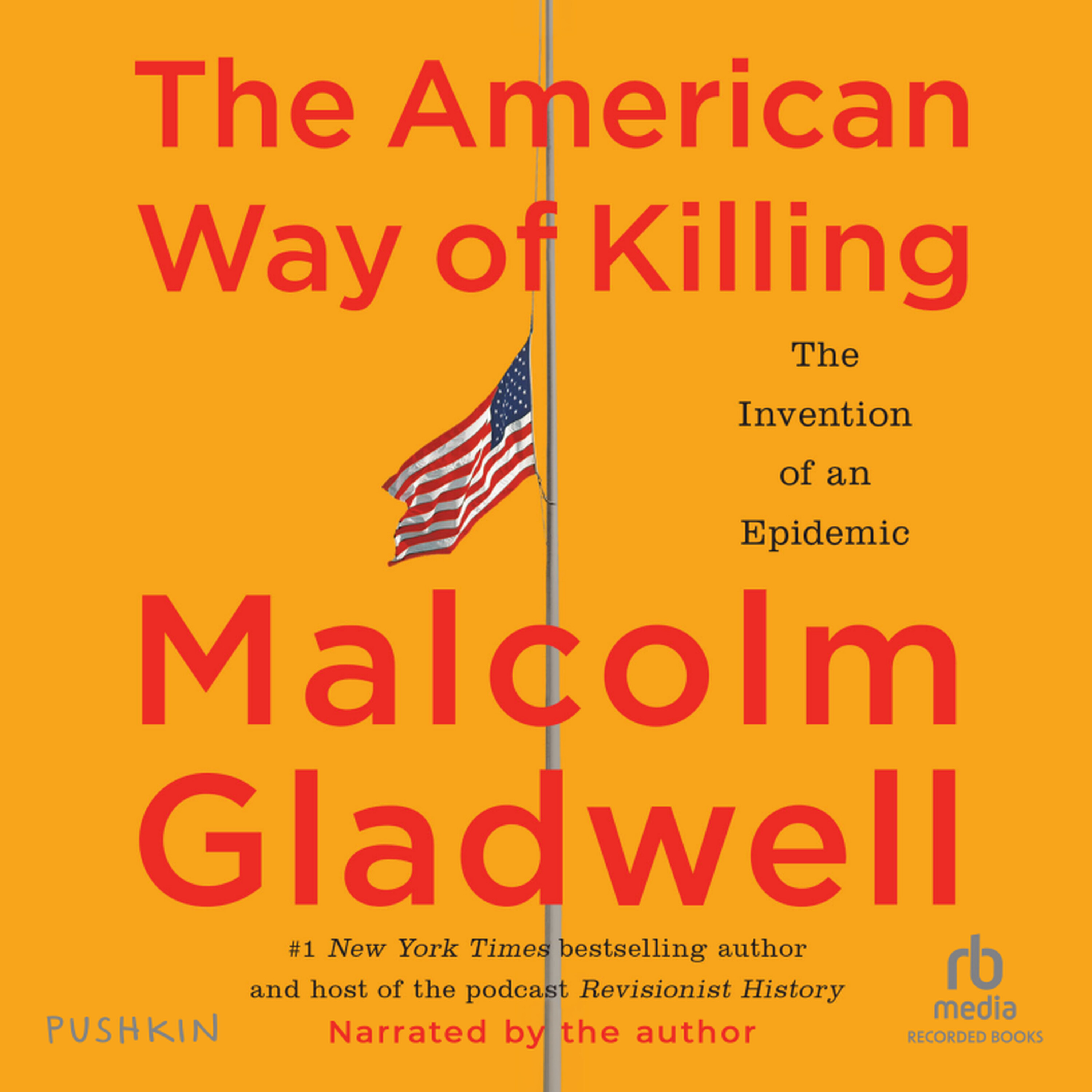
- The American Way of Killing
In short
Malcolm Gladwell’s audiobook excerpt/book, The American Way of Killing, about how the U.S. experienced rising violence after the Civil War and why the country struggles to understand and fix its gun violence. He argues America’s homicide rate is far higher than peer countries and that Americans misdescribe and misdiagnose the problem.
Guests/people featured
No traditional podcast guests. The excerpt centers on Dr. Abdullah Pratt, an American ER doctor and Chicago native who works at the University of Chicago Medical Center and runs community training.
Key claims
The U.S. talks “dishonestly” about gun violence; misunderstanding prevents solutions. Gladwell frames the issue as an “elephant” problem—different people focus on different “parts.”
Notable examples
Pratt’s story of 15 close friends/family killed by gun violence; his fourth-grade training using A-B-C steps (call 911, stop bleeding, compress wounds) and trauma kits; a 16–17-year-old student using a kit after a shooting in front of her house.
Written by AI. May contain mistakes.
Chapters
1:20
Musical Connection to Gun Violence
The author discusses his collaboration with musician Drew Holcomb and the song 'Troubles'.
“Pushkin Industries and Recorded Books, an RB Media audio brand, presents The American Way of Killing, The Invention of an Epidemic.”
2:44
Abdullah Pratt's Story
Abdullah Pratt shares his experiences with gun violence and its personal toll.
“On a cold and rainy winter's day not long ago, I went to see a man named Abdullah Pratt.”
6:30
The American Way of Violence
Malcolm discusses the cultural differences in violence between the U.S. and Canada.
“And you prepare yourself for the worst walking into any shift, especially when you grow up in a neighborhood.”
11:30
Teaching Fourth Graders about Gunshot Wounds
Abdullah Pratt teaches elementary students how to respond to gun violence.
“But before we get to any of that, let's go back to Abdullah Pratt and see what the elephant looks like through his eyes.”
14:00
A Disturbing Encounter with Gun Violence
Listeners will learn about a young girl's firsthand experience with gun violence and her response.
“I'm like, girl, you lost your kit already?”
14:49
The Uncommon Role of an ER Doctor
The segment discusses an ER doctor's unique approach to educating children about gunshot wounds.
“An American ER doctor who has lost 15 close friends and his older brother to gun violence is going out to local elementary schools on his afternoon off and teaching fourth graders how to stabilize a gunshot wound.”

Ask about this episode
Get the gist, explore an idea or ask about something said.
 Claude
On Reconstruction: The Unfinished Promise, what are the key points of this episode?
Searching your listeningTranscript
Automatic transcript. May contain errors.
0:00Malcolm here. On this show, we tell the story of the years after the Civil War, when America made a promise of freedom and equal citizenship, and then watched violence rise to break it up. The question of how a country lives with its own violence is at the heart of my new book, The American Way of Killing. America is the richest country in the world, but its homicide rate is much higher than any of its peers. Why? To find out, I went looking in some unexpected places. A shooting range in North Carolina, the south side of Chicago, an old plantation house in Alabama. I dug into stories that seem unrelated until they aren't.
0:35A young gunshot victim in Washington, D.C., a 17th century English knight in legal trouble, and a European police chief who watches a graduation at an American police academy and simply cannot make sense of it. What I found is a picture of a country that does not understand its own problem. And if you don't understand a problem, you can't fix it. We're dropping an excerpt of the audiobook in this feed today. If you want to hear more, find it on Pushkin.fm or wherever you get your audiobooks. Or buy the book wherever books are sold.
1:20Pushkin Industries and Recorded Books, an RB Media audio brand, presents The American Way of Killing, The Invention of an Epidemic. Written and narrated by Malcolm Gladwell. Dedication for my mother.
1:41When I finished the first draft of this book, I sent it to my friend, the musician Drew Holcomb, and said, do you have any music that fits the themes of this book? And he wrote me back and said, I do. Once after a mass shooting where a teenager killed 18 students at an elementary school, I dropped my own kids off at their elementary school and went home and wrote a song called Troubles. And Drew said, I could use it because there is something in this song that will help you make sense of everything you're about to hear. You're going to hear snippets of Troubles throughout this audiobook. and then at the end, you'll hear the song in full.
2:18By then, I hope you'll understand why I wanted you to hear it.
2:28I want to float like a bird, slow and low. I want to follow the river wherever it goes.
2:44Introduction. Fifteen funerals. On a cold and rainy winter's day not long ago, I went to see a man named Abdullah Pratt. Big beard, thick black plastic glasses, built like a linebacker. He grew up in a struggling neighborhood in Chicago, the kind that can be found in countless cities across the United States. So I think I wanted to be a doctor since the time that I was a child. I remember having the Fisher-Price bag at Christmas and, you know, being three, four years old and stuff. We sat in a small room in the basement of the University of Chicago Medical Center, where he now works. He was wearing scrubs, taking a break from his shift.
3:24I grew up in the museums. I did my first dissection of a squid at the age of like seven or eight. Those things fueled a passion for science, a passion for anatomy. me. And after growing up in a completely 100 % African-American community, I was in programs where I'd be the only African-American, but I was winning awards for being the best. So it taught me that I could compete and that I could make change. He went to college, then medical school. He had a chance to leave his hometown, start a new life somewhere else. But he chose to come back to Chicago and practice medicine in the same neighborhood where he grew up.
3:59How many people from growing up, do you know, who died? I've got, I rank them by closeness to me. Because if I said everybody, it'd probably be like in the 30s, 40s. But yeah, seriously. Seriously, if everyone that I knew, like knew, talked with, shared time with at some point, so I really keep it to close friends, right? So if I say close friends, people who I still have the text messages in my phone, people who I know their family members, their mothers, their fathers, prior to all of this, 15 friends. My older brother is the one family member. Abdullah's brother's name was Rashad. He was Abdullah's best friend and protector.
4:40He was killed when he tried to stop some kids from stealing a car. My closest friend in the world, the day that my brother died and I said, hey, I lost my brother and you're the closest thing I got to, brother, that person was murdered. And all of them are leaving behind children. All of them were great fathers who I, literally, I think many of them, of our last conversations were about parenting and fatherhood, close teammates, right? So I've had three close teammates just from my one high school team all be murdered. I've had youth that I mentored with some of the teams that I coached that were murdered.
5:13And many of them pronounced dead right in this trauma bay once we were finally able to get a trauma center. Take out your phone. Make a list of 15 people you have texted with on a regular basis over the last few years of your life. Now imagine that every one of them was shot dead and that you attended every one of their funerals. Some of these close friends I had to pronounce dead myself. I had to tell their own family members that their loved one was no longer here. And as you can imagine, just to paint the picture for you, imagine, you know, walking into a room, you prepare yourself to tell this family member of your close friend that they're no longer here.
5:53And the first thing that family member says, they see you and they light up. They forget why they're there for a second. They say, oh my goodness, Abdullah. Oh, hey, Dula. You know, hey, we were just talking about you. How are you? They forget that their son or daughter was shot. And then now the first words out of my mouth, which is the evidence-based way to do it, is to say they did not make it. They unfortunately, so now they go from the highest to highest to the lowest of lows. I've had to do that about five times in the last three years. Only one time have I been forced to stop working the shift.
6:25But usually I finish these usually early in my shifts and I keep working because if I stop, then you think about it all. And you prepare yourself for the worst walking into any shift, especially when you grow up in a neighborhood. When I was a child growing up in rural Canada in the 1970s, the only real knowledge I had of the giant country to the south was life, a big glossy American news magazine that came in the mail every week. I would read every page and look at every picture and cut out articles and advertisements that caught my attention. America was rich. America was enormous. But crucially, America was dangerous.
7:04That was the overwhelming lesson from thumbing through the pages of Life magazine. In 1975, when I was 12 years old, there were 701 recorded murders in all of Canada, a country at that time of 23 million people stretching from the Atlantic to the Pacific and all the way up to the Arctic Ocean. In that same year, just in New York City, there were 1 ,645 homicides. That was more than half a century ago, but little has changed. Today, the murder rate in the United States remains nearly three times higher than Canada's and five times higher than the United Kingdom and much of Western Europe. I've never lost my puzzlement over this fact about America, not even after living in the United States for most of my adult life.
7:55My first book, The Tipping Point, was inspired by the sudden and seemingly inexplicable drop in crime in New York City in the 1990s. My second book, Blink, told the story of the tragic death of a young man named Amadou Diallo at the hands of New York City police officers. I then went on to write about police and crime in my fourth book and my fifth book and in countless episodes of my podcast Revisionist History. I am drawn to stories about criminals and criminality because I think issues of life and death, deviance and punishment, reveal something important about the values a society lives by.
8:34But I'm particularly drawn to American stories of criminals and criminality because you cannot cross between the United States and Canada, as I have done six or seven times a year for nearly half a century, and not be struck by how peculiar America is. The people on both sides of the border drive the same cars, watch the same television shows, listen to the same music, eat the same food, and worship the same God. If I dropped you in the middle of Buffalo or Toronto, Seattle or Vancouver, it would take you more than a beat to figure out where you were. And yet, in one of those places, a young boy like me can grow up without any firsthand experience of lethal violence at all.
9:17And in another, a young man can bury more than a dozen of his closest friends by his 30th birthday. Why? What's so different about the United States? That's what the American way of killing is all about. This book is divided into three parts. Part one is about the fundamentally dishonest way that Americans talk about gun violence. Part two is about how Americans misdiagnose the nature of the violence that plagues their streets. Part three is about the moral recklessness of the course the country has chosen. There is nothing technical or academic in what follows. This will not be a criminology textbook.
10:01Instead, the American Way of Killing will approach these questions through a series of stories about people, and places and moments. From the miracle of a young gunshot victim in Washington, D.C., to the legal travails of a 17th century English knight, from a professor in Alabama with a terrible secret to a famous town in Kansas that Americans have been lying about to each other for 100 years, from the slave plantations of the South Carolina Lowcountry to a prison in Germany that would be unrecognizable to any American. In the famous parable of the blind man and the elephant, each man touches a different part of the animal and draws a different conclusion.
10:43One touches the trunk and decides the elephant is like a snake. One touches the animal's leg and concludes the elephant is a tree. One touches the tusk and says the elephant is like a spear, and so on. This is the American problem. the source of the conflict and misunderstanding that marks so much of the ongoing argument over what to do about the country's violence. Everyone looks at a different set of statistics or zeroes in on one particular fact. The American way of killing has chapters on the trunk and the leg and the tusk. And at the end, my hope is that by seeing all the parts in one place, you will finally get a sense of the whole elephant and understand that what seems from the outside like an intractable problem need not be intractable at all.
11:35But before we get to any of that, let's go back to Abdullah Pratt and see what the elephant looks like through his eyes. As we talked, he was about to leave for a community training session at what he called the most notorious housing project in the city. Yeah, yes, it's in the heart of Parkway Gardens, a.k.a. DeWick, a.k.a. Oblock, We'll be there. We're going to teach them actually how to deal with gunshot wounds and do CPR. His audience? A group of fourth graders at an elementary school. It wasn't his first visit to that school, and he said he would always start his presentation with the same question.
12:11How many of you all have lost a loved one, a father, mother, brother to gun violence? When we've asked that school before, 100 % of their hands go up, and that's rare. So for these fourth graders, they're going to be asked that. These hands go up. I'll show you the pictures and videos of it happening. Usually we get like 50%, 60%, and that's high. That's extremely high. But when it's 100 % of the hands that go up and they can name, oh, it was my brother, it was my sister, it was my father, it was both my uncles. When it's like that, now we're going to say, well, we're here today to help you all know what to do in that situation.
12:44How many of you all, if you knew something about how to help them, would have helped? And then 100 % of those hands go up. He was going to teach the kids how to be first responders, broken down in a way that a fourth grader can understand. A, B, C. A means alert 911. Call 911, tell them you need an ambulance, what's happened, where you are, and importantly that the shooter has left the scene. So that's A. B stands for bleeding, find the bleeding. So now you have to see what's injured. So if that means ripping open a pants leg or a shirt or something like that to find the hole, It's important because if you start putting tourniquets and holding pressure on a hole, and that's not where the hole actually is, you're actually not even helping them, and you could be creating more harm for the person.
13:27C is for compress the wound. You're probably not going to have gauze available, but be practical. Does someone have a tampon handy? Use it. Maxi pads and absorptor pads are going to be at your fingertips. That's what you need. You need to be able to pack these wounds to help absorb, to give this person time. Then he hands out trauma kits to everyone. We try to keep it simple. We're not trying to teach them how to be a trauma surgeon. We're trying to get them to feel confident enough to act, do something, call 911 early, sit there with the person, and then 911 will actually walk you through these things.
13:59This past summer, we actually had a young lady, a young Latina lady who, one of my best students, and she came to me week two, and she's like, Dr. Pratt, I need a new kit. I'm like, girl, you lost your kit already? I'm like, okay, I'll go get you a new kit. She's like, no, I didn't lose it. I promise I promise I didn't lose it. I said, what happened? She said, I had to use it. And I was like, well, what do you mean you had to use it? She was like, oh, man, they shot someone right in front of my house. She said, I got it on video. It shows me the video. She did everything right. Literally, she has the pictures and videos of them using everything in that kit.
14:29The tourniquets, the gauze, the everything, strewn out, used. And so, of course, she got her another kit. And I was so proud of her for being a judge. This young lady was either 16 or 17. She wasn't even a senior yet. So this was like a sophomore, junior. This is nuts. Yeah, yeah, yeah. An American ER doctor who has lost 15 close friends and his older brother to gun violence is going out to local elementary schools on his afternoon off and teaching fourth graders how to stabilize a gunshot wound. This does not happen anywhere else in the developed world. I want to figure out why.
15:13That was an excerpt from The American Way of Killing. Get the print copy online or whatever bookstore you frequent. Get the audiobook on Pushkin.fm or wherever you get audiobooks.
From the publisher
Malcolm Gladwell returns to share a preview of his new audiobook, The American Way of Killing: The Invention of an Epidemic. The United States has far more homicides than any of its peers around the world. Why? Malcolm explores the American “peculiarity” — how the world’s wealthiest country came to suffer from a problem typically only seen in the world’s poorest countries. Drawing on original interviews, archival and social science research, and his trademark insight, Gladwell approaches the American paradox through a series of stories. What can we learn from the miracle of a young gunshot victim in Washington, D.C.? How have the legal troubles of a seventeenth-century English knight influenced American attempts at gun control? Why would a European police chief be baffled by the graduation ceremony at an American police academy? Traveling from a shooting range in North Carolina, to the South Side of Chicago, to an old plantation house in Alabama, Malcolm paints a picture of a country that does not understand its most pressing social problem, and as result, does not understand how to fix it.
Get the full audiobook at pushkin.fm/audiobooks or wherever you get audiobooks.
See Privacy Policy at https://art19.com/privacy and California Privacy Notice at https://art19.com/privacy#do-not-sell-my-info.
More from Reconstruction: The Unfinished Promise
All episodesWe use cookies.They keep VO running smoothly and help us improve it. Privacy policy