 Ask ChatGPT

The episode traces how Ted Kennedy’s son’s 1973 bone cancer and the 1974 Nixon State of the Union created a brief “window” for a major U.S. health-care reform, why Kennedy initially joined Nixon’s compromise, and why the deal collapsed after Watergate—setting up decades of failed attempts until later Massachusetts reforms.
No podcast guests appear in the transcript. The episode includes named figures as historical participants: Ted Kennedy, Richard Nixon, Stuart Altman (Nixon health staffer), Barbara Suliotis (Kennedy’s Boston office), and labor leaders from the UAW/AFL-CIO.
Ted Jr.’s experimental treatment (initially free, later $2,700 per session) exposed the cruelty of uninsured care and propelled Kennedy toward universal health insurance. Nixon’s 1974 plan included employer mandates. Kennedy and Nixon nearly reached agreement via secret church basement meetings, but Nixon’s resignation ended the opportunity.
Ted Jr.’s amputation and chemotherapy; families mortgaging homes for treatments; secret meetings at St. Mark’s Episcopal Church; Kennedy later regretting not “jumping on that.”
Written by AI. May contain mistakes.
Overview of The Big Dig and its exploration of Massachusetts history.
“When I started working on our Staten Island series, I had three guiding lights.”
Discussion of Ted Kennedy's struggles with his son's cancer diagnosis.
Exploration of the emotional impact on Ted Kennedy during his son's treatment.
“I think it started when his son got cancer.”
Highlighting the financial struggles faced by families during cancer treatments.
“so the president could wish him well before the operation.”
Ted Kennedy's advocacy for universal health insurance based on his experiences.
“receiving the shots, waiting for this new wonder drug to do its work.”
Discussion on the rare moments when significant policy change can occur.
“Something I've come to appreciate about politics in America is that there are windows of opportunity in which major change can happen.”
Examination of Richard Nixon's 1974 health care proposal and its implications.
“And when the door opens, everyone has to be ready to rush through it.”
Explore Nixon's call for bipartisan cooperation amidst Watergate chaos.
“In the closing lines of his speech, Nixon explicitly asked the Congress to work with him, to put the chaos of Watergate aside and do something together that they could never do on their own.”
Dive into Kennedy's perspective on Nixon's health plan and political pressure.
“At worst, Nixon's bill was a threat, something that could suck energy away from true, meaningful reform.”
Understand the behind-the-scenes negotiations between Kennedy and Nixon aides.
“With all this pressure building, Kennedy decided to call a meeting with leaders from the United Auto Workers and AFL-CIO to try and bring them along.”
Analyze the urgency and pressures surrounding health care negotiations.
“But the negotiations would have to go underground.”
Reflect on Kennedy's regrets about the missed opportunity with Nixon.
“As late as July 8th, 1974, one month before Nixon's resignation, Kennedy was still on the phone with Nixon's health secretary, who was still telling him a deal is possible.”

Get the gist, explore an idea or ask about something said.
 Claude
On Revisionist History, what are the key points of this episode?
Searching your listeningAutomatic transcript. May contain errors.
0:00This is Jacob Goldstein. When you're a business owner interested in expanding to new markets, there's a lot to consider and countless questions to answer before making the call. The most important one being, are you ready? That's where ChatGPT comes in. Give it a goal, add your files, and ask Chat to help you map out different scenarios for the future of your business. So when growth is on the table, you've got an expansion plan ready to implement. Get started today at ChatGPT.com. This is Malcolm Gladwell from Revisionist History. In military families, service is more than a job. It's a legacy.
0:35At American Military University, that legacy can help open new doors through education. If someone in your family served in the military, you could be eligible for reduced tuition. Take the next step with flexible online programs built for real life. Learn more at amu.apus.edu slash military. Terry. Chronic migraine means 15 or more headache days a month, each lasting four hours or more. Botox on a batch of linem toxin a is a chronic migraine treatment that prevents headaches in adults. It's not approved for adults with migraine who have 14 or fewer headache days a month. Botox prevents on average eight to nine headache days and migraine, probable migraine days a month versus six to seven for placebo.
1:16I'm having fewer headache days this month. Prescription Botox is injected by your doctor. Effects of Botox may spread hours to weeks after injection causing serious symptoms. Alert your doctor right away as difficulty swallowing, speaking, breathing, eye problems, or muscle weakness can be signs of a life-threatening condition. Patients with these conditions before injection are at highest risk. Side effects may include allergic reactions, neck and injection site pain, fatigue, and headache. Allergic reactions can include rash, welts, asthma symptoms, and dizziness. Don't receive Botox if there's a skin infection.
1:41Tell your doctor your medical history, muscle, or nerve conditions, including ALS Lou Gehrig's disease, myasthenia gravis, or Lambert-Eaton syndrome, and medications including botulinum toxins, as these may increase the risk of serious side effects. Ask your doctor. Visit BotoxChronicMigraine.com or call 1-800-44-BOTOX to learn more. Hey, Revisionist History listeners. Ben here. When I started working on our Staten Island series, I had three guiding lights. Robert Caro's The Power Broker, Mike Nichols' Working Girl, and WGBH's The Big Dig. My favorite podcast. The Big Dig is hosted by the journalist Ian Koss.
2:18Each season, Ian does a deep, deep dive into some story from Massachusetts history that has surprising national implications. In this season, they're looking at the history of the Massachusetts battle over a historic health care reform that set the stage for everything that was to follow with Obamacare. Like every season of The Big Dig, he's got amazing archival tape, incredible characters and interviews all knit together with Ian's fantastic writing and music. And okay, maybe I'm biased because I'm from Massachusetts, but these seasons are works of art, and they will change how you think about politics well outside the Great Bay State.
2:57Today, we've got the first episode for you. It begins during the Watergate scandal, with a worried Richard Nixon, a grieving Ted Kennedy, and a slim window of opportunity when the entire history of our country almost took a different turn. You can find the rest of the series over at The Big Dig, wherever you get your podcasts.
3:55I think it started when his son got cancer. And that was really a turning point, I think.
4:10In late 1973, Senator Ted Kennedy was faced with what he later called the hardest thing I ever had to do, telling his son he had bone cancer, that it was serious, that they would have to amputate his leg. Ted Jr. was 12 years old, and for a time, the child was quiet. He put a towel over his face so no one could see him, while his father, who was usually so full of life, so full of energy, simply held the kid in his arms and said over and over again that everything would be okay. Eventually, the phone in the hospital room rang. It was the President of the United States, Richard Nixon. The senator picked up, then handed the phone to his son, so the president could wish him well before the operation.
5:04at 8 30 the following morning the doctor removed ted jr's leg it also happened to be the day that bobby kennedy's oldest daughter was getting married and ted as the last of the kennedy brothers still alive had to be there to walk his niece down the aisle just think about that leaving your son's hospital bed to go walk your murdered brother's daughter down the aisle at her wedding. Ted went straight from the hospital to the church and back to the hospital. He never changed his suit.
5:48A few months later, in early 1974, Ted Jr. began his chemotherapy treatment at Boston Children's hospital. He was not out of the woods yet. And he had to have experimental treatment every three weeks for three days. And the senator flew up for every one of those treatments, stayed in the hospital with him. Barbara Suliotis ran Kennedy's Boston office, so she would see the senator on these trips as he anxiously watched his son, Teddy Jr., suffer through nausea, fever, terrible pain, waiting to see if the treatment would work. This was on an experimental research basis. This was an experimental research basis.
6:29Ted Kennedy himself described this period in an oral history interview a few years before he died. And he remembered how, at first, this experimental treatment was completely free. While it's an experiment, it's paid for by the company. But then, a few months in, the clinical experiment ended. The good news was that the results were extremely promising. a 90 % survival rate for a condition that used to have more like a 20 % survival rate. Truly the difference between life and death. So that was enormously encouraging. The bad news was that families would now have to pay for it. And it's$2 ,700 a treatment.
7:07That's what it cost. None of the insurance would cover it except mine.
7:15In this hospital, Teddy Jr. was one of the lucky ones. His father had U.S. government health insurance, the kind all Congress people get. So Teddy Jr. could keep coming back every three weeks, receiving the shots, waiting for this new wonder drug to do its work. Ted Sr. would wait there, too. And when Teddy was sleeping, he would walk the car and talk to parents who couldn't pay for the treatments. Some had to mortgage their houses. Basically, they go bankrupt because they had no health insurance. These families Kennedy met would tally up all their savings, all their assets, to see if they could cover even just a few more months of treatment, hoping that would be enough to save their child's life.
8:06And they would ask him, what if we can only do one treatment? You know, would that help their kid? Because they couldn't afford it. And he said, this should not be happening in this country.
8:25Walking the corridors of that cancer ward, Ted Kennedy fully embraced what became the cause of his life, universal health insurance. He knew it was a complicated and divisive issue. He wasn't naive, but he couldn't possibly know just how hard it would be, how long he would have to fight. The issue before the American people isn't can we afford national health insurance, is can we afford not to have it? Through the 70s, the 80s, the 90s, the 2000s. Comprehensive, universal, every child in America and every adult too. On the Senate floor, on convention stages, in forums, in town halls around the country, Kennedy voiced the outrage he felt in that hospital ward.
9:08It is a national disgrace. This was the issue Kennedy just kept coming back to again and again over his nearly 50-year career in the U.S. Senate. Because even for one of the greatest dealmakers that Chamber has ever known, this was the issue that just kept on eluding him. The cause endures, the hope still lives, and the dream shall never die.
9:41Something I've come to appreciate about politics in America is that there are windows of opportunity in which major change can happen. I'm talking about change on the scale of a Social Security Act or Civil Rights Act, laws that redefine what it means to be a citizen of the nation. These windows of opportunity are like celestial events, far beyond the control of any one individual, even an individual as powerful as Ted Kennedy. They're the rare moments when public sentiment, political power, pent-up frustration, that perfect mix of personalities and incentives, all these things click into alignment to open up a door.
10:25And when the door opens, everyone has to be ready to rush through it.
10:35But the tragic irony of Kennedy's nearly 40-year healthcare crusade is that his first and best opportunity to make it happen came too soon, before he was ready. This opening came without warning, even as his son was lying in that cancer ward in 1974. And it came from Nixon himself. Mr. Speaker, the President of the United States. When Richard Nixon rose to give his State of the Union address in January of 1974, he was speaking as a man desperate to change the subject. Anything but Watergate. And the subject he chose was health care. Turning now to the rest of the agenda for 1974, The time is at hand this year to bring comprehensive, high-quality health care within the reach of every American.
11:31He didn't want to call it national health insurance. We had to call it universal health care. Stuart Altman was a staffer in the Nixon administration, and he basically wrote the president's plan specifically for this speech. I never had so much power. And it was around Christmas time because I remember saying to others, including my wife, don't count on me for Christmas. The final plan included measures that today would seem wildly progressive, especially for a Republican president, like a mandate on all employers to either provide health insurance to their workers or pay a penalty. Again, that's a government mandate on businesses to provide health insurance.
12:14That is what Nixon himself proposed in 1974. A real, serious national health reform plan. That will assure comprehensive health insurance protection to millions of Americans who cannot now obtain it or afford it. So you might think Ted Kennedy would be over the moon. I mean, a Republican president talking about universal health care. But for Kennedy at that time, Nixon's plan did not go far enough. And when you watch the footage of the 1974 State of the Union, there's a moment where you can see this tension play out. And doing it as well as I possibly can. Right as Nixon makes his case for universal health care, the camera cuts to Ted Kennedy out in the chamber.
12:55He's leaning back comfortably with a wide checkered tie and that strong Kennedy chin jutting straight out. His eyes are locked on Nixon. But when the congresspeople around him burst out in applause, he just sits there. Because laced into Nixon's grand vision was a not-so-subtle critique. Now I recognize that other plans have been put forward. You should know that even before his son's cancer, Kennedy was already a leading voice on health issues. And just the year before, he had put forward his own sweeping health reform bill. It would have created a true national health insurance system, European style, run by the government, what gets called single payer or Medicare for all.
13:40And that would put our whole health care system under the heavy hand of the federal government. Nixon was clearly not ready to go that far. But in 1974, desperate for anything that could change the course of his doomed presidency, he was willing to go pretty far, farther than many of his own advisors wanted him to go, and farther than any other Republican president in recent memory. But my colleagues, this I believe. In the closing lines of his speech, Nixon explicitly asked the Congress to work with him, to put the chaos of Watergate aside and do something together that they could never do on their own.
14:19In that moment, the celestial alignment I talked about started to come into view, that narrow path forward. The question was, would Kennedy join Nixon on that path? And the support of the American people, we can and we will make the year 1974 a year of unprecedented progress and a new prosperity without war in the United States of America.
14:49After the break, health care reform goes underground.
15:09This is Jacob Goldstein. With ChatGPT, you can do more than get answers. You can get things done. When you're running a business and looking to expand, you need a clear view of the landscape before making any decisions. ChatGPT can help you prepare. Connect your Google Drive, point to relevant files and reports, and ask it to research competitors, industry forecasts, and market signals. It can turn the findings into a strategic deck in your team's template that you can review before presenting to your leadership team. Growing a business is ambitious, and ChatGPT can help you do it with confidence.
15:43Get started today at chatgpt.com. This is Malcolm Gladwell from Revisionist History. In military families, service is more than a job. It's a legacy. At American Military University, that legacy can help open new doors through education. If someone in your family served in the military, you could be eligible for reduced tuition. Take the next step with flexible online programs built for real life. Learn more at amu.apus.edu slash military. This is Malcolm Gladwell from Revisionist History. We spend hours researching products online and deciding what to buy. But there's a split-second decision that can make or break a sale.
16:27Do you have the trust to hit the buy now button? The way we discover and compare things is evolving, happening faster and influenced by new forms of intelligent advice. But the underlying trust question doesn't go away. If anything, it's more important than ever. That's where PayPal comes in. For more than 25 years, they've been a trusted way to pay. And now PayPal can make the agentic era of commerce work for merchants, letting them maintain control of their brand, their customer relationships. So even as the way we shop changes, the moment that matters most still feels familiar and deeply dependable.
17:05PayPal is built for all business. Get started at paypal.com slash business. Purchase and seller protections on eligible transactions only. Terms apply. See paypal.com slash risk dash management for details.
17:25Kennedy saw Nixon's bill as a half measure at best, a tweak to the system that rewarded the private insurance companies. At worst, Nixon's bill was a threat, something that could suck energy away from true, meaningful reform. Senator, what does this mean for your bill? Well, first of all, we have to understand that... So politically speaking, Kennedy had plenty of reasons to deny Nixon's invitation and stick with his own bill. I believe that the statements that the president... But then in April, so a couple months after the State of the Union, Ted Kennedy surprised everyone. He linked up with the most powerful congressman in the House, the chair of the Ways and Means Committee.
18:05And together they said, we're willing to work with Nixon's plan. And they announce we would like to work with the administration and the president to pass this legislation right away. We're going to build upon the existing strengths of our system. Which just sent signals all over the place. Front pages of the New York Times and the Washington Post that we're going to have national health insurance. It seemed like a done deal at that point. The issue of national health has been before this country for many years, almost since the turn of the century. That spring Kennedy himself told reporters a new spirit of compromise is in the air.
18:47Wow. You know, the president, the most powerful senator, all agree. Now all we have to do is find the cure. But the challenge wasn't just Kennedy and Nixon themselves. It was also their more hardline allies who didn't want them talking in the first place. On the right, the pressure came from Nixon's own cabinet, who again were not on board with the plan he had just proposed to Congress. And they were all screaming at him. We just read this thing. This is socialism. What have you done? Meanwhile, on the left, the pressure came primarily from organized labor. From the unions and from liberal groups saying, what are you doing?
19:27Remember, Nixon was wounded at this point. Impeachment hearings were about to begin. He was fighting for his political survival. And you want to throw this guy a line? You want to work with his plan? With all this pressure building, Kennedy decided to call a meeting with leaders from the United Auto Workers and AFL-CIO to try and bring them along. The tricky part of this is that for many working people, getting health insurance was a big part of the reason to join a union and support your union. So for the big labor groups, any kind of health reform was bound to be a sensitive issue. Now, those labor leaders were in Kennedy's office, a whole group of them, and they were furious.
20:15The way they saw it, Democrats would probably win a landslide in that year's midterms. They could soon have big majorities in both houses. Nixon could be gone entirely. And that would be the time to pursue true reform. Not this hodgepodge compromise Nixon was offering. Kennedy began fuming, and he grabbed a copy of the congressional directory and just started reading out the names of all the senators who would never support anything like a single-payer plan, asking again and again, what are you going to do about him? and him and him. Finally, one of the top lobbyists in the room hurled back an almost unthinkable insult, which was also a threat.
20:59He said to Ted Kennedy, you are, quote, a traitor to labor for even entertaining a deal with Nixon. At that, Kennedy stood and opened the door for his guest to leave, saying, well, you're just going to have to call me a traitor.
21:21What Kennedy understood was that desperation, Nixon's desperation, could be the key ingredient for dealmaking. It forced him to do something rather than nothing. But the negotiations would have to go underground. So we formed a secret war group. One day in June of 1974, Stuart Altman took a short cab ride to the corner of 3rd Street and A Street, St. Mark's Episcopal Church. He paused for a moment to glance around and make sure no one was on the street who might recognize him. Then he stepped through a side door of the church and down a steep flight of stairs to a room known as the pub. They actually had nights of beer.
22:08Remember, Altman was one of Nixon's health aides. And there waiting for him in the empty pub was a top health aide for Ted Kennedy. Given the level of tension between these two men and the forces pulling them apart, this was like sending a secret envoy to the Soviet Union. Top secret. We met in the basement to not have all these people down our throats. So the two aides got to work, trying to hone in on that acceptable balance of government control and free competition. To see if we could find common ground. But outside that church basement, the time for a deal was running out. Mr. Butterfield, are you aware of the installation of any listening devices in the Oval Office of the president?
22:52Watergate was now a national obsession. Formal impeachment hearings were underway in the House and broadcast straight into American living rooms. Those who wanted seats had waited through the night on... The story was everywhere, all-consuming. And so there is tonight a real, persistent, and substantial question of whether the president can, in fact, carry out his responsibilities.
23:21Somehow, the secret church meetings continued through June and into July, with the two sides inching ever closer together on a health care bill. Even as Ted Jr. received his cancer treatment and began to recover, even as Nixon's Oval Office tapes were handed over to prosecutors, down at St. Mark's, they were talking about payroll taxes and insurance rules. Because Altman and others could still see the historic opportunity, the narrow opening before them. You're never going to see anything more liberal than this. This is the best health insurance plan you're ever going to get. I said, we got to get this done.
24:11As late as July 8th, 1974, one month before Nixon's resignation, Kennedy was still on the phone with Nixon's health secretary, who was still telling him a deal is possible. If you get it to his desk, Nixon will sign it. But soon after that call, Kennedy sat down with his top aide, the one in those basement negotiations, and they truly took stock. It was a tough situation. Kennedy was looking at how much ground he had given up already, how far there was still to go, and how fiercely his own allies were trying to pull him back. He said to his aide, they're ready to crucify me out there. For Kennedy, it ended quietly.
24:57There simply was no next meeting, no next phone call. He just let it go. Good evening. This is the 37th time I have spoken to you from this office. On August 8th, Nixon addressed the nation directly. This was more than two years after a group of burglars was arrested at the Watergate Hotel, and finally, the never-ending drama was over. Nixon was resigning. As I recall the high hopes for America with which we began this second term, I feel a great sadness that I will not be here in this office working on your behalf to achieve those hopes in the next two and a half years. May God's grace be with you in all the days ahead.
25:57That day in August of 74, a doorway closed. And it stayed closed for a long time. Health insurance went kaput. It just disappeared.
26:15How did Ted Kennedy reflect back on the summer of 1974? I got to meet him, and he said several times, I thought we were going to do it, Stuart. I thought we were going to make it. We should have done it. We should have got it done.
26:40Many years later, in a speech, Kennedy said, to every cause, there is a moment. But how can you know it's the moment when you're in it? How could Kennedy have known that he would never again get an opportunity this good, a chance to pass something so ambitious? How could he have known that after Watergate, trust in government would only fall, that the appetite for new government programs would only shrink, and that with time, bipartisanship itself would only get weaker? How could Kennedy have known he would spend the next 30 years fighting tooth and nail to get even close to what Nixon was offering?
27:23Of course, he couldn't. Kennedy would say many times that failing to seize that opportunity with Nixon was the greatest regret of his political life. Several years later, he said, we should have jumped on that. He told Barbara Suleotis the same thing. It haunted him. He just regretted that he couldn't get it done.
27:51But Ted Kennedy, over his long career in politics, would get another shot at his dream. A moment when the planets once again aligned, when an unlikely partner once again reached out, and when Kennedy would once again have to choose whether to make a deal.
28:18My name is Ian Koss, and in the new season of the Big Dig podcast, we tell the story of that second shot, the one Kennedy would not miss, the one that would transform American health care forever. And no, I'm not talking about Obamacare, at least not quite yet. I'm talking about a little statewide health care bill here in Massachusetts that was the template and inspiration for Obamacare. To me, this is one of the great under-told stories in our health care debate today. I mean, where did the actual ideas in the Affordable Care Act come from? Why was that the moment they exploded onto the national stage?
28:57And why did they become so deeply, deeply divisive? Follow those questions far enough, and you will find yourself, like me, in Massachusetts.
29:17In part two, Ted Kennedy meets his new negotiating partner, and not on the best of terms. Senator Kennedy, my impression has been that you have followed a campaign of trying to divert the voters' attention from the issues at hand and instead making personal attacks on me. His name is Mitt Romney. When will this end? To hear that story, search for The Big Dig wherever you listen. The new season is called Mitt and Ted.
29:56And another night
30:02And when this rain Stops coming down
30:09You go your way I go mine And you said That things would be different You said Things would be different Things would be different when I got home The Big Dig is produced by Isabel Hibbard and myself, Ian Koss. It's edited by Lacey Roberts. The editorial supervisor is Azita Garamani with support from Ryan Alderman. The executive producer is Devin Maverick-Roberts. If you want to hear the other seasons of this podcast produced by the same team, Just search for The Big Dig wherever you listen, and you should see, at the very least, seasons one, two, and three, as well as four. Archival sound for this episode came from the Richard Nixon Presidential Library and Museum, as well as the Miller Center at the University of Virginia.
31:07The artwork is by Bill Miller. Our closing song is Things Will Be Different by The Shads. The Big Dig is a production of GBH News and distributed by PRX. When I get home.
31:26When I get home. When I get home.
31:39When I get home. With ChatGPT, you can do more than get answers. You can get things done. Whether you're leading a big project, planning an elaborate trip, or trying to balance work and life. ChatGPT can help. Give it a goal, plus things like files, notes, or project plans, develop a trip itinerary with daily updates, or create a prioritized schedule so you can spend less energy sorting out the details and more on bringing your biggest ideas to life. Get started at ChatGPT.com. This is Malcolm Gladwell from Revisionist History. We spend hours deciding what to buy, but there's a split-second decision that can make or break a sale.
32:18Do you have the trust to hit buy now? Agentic Commerce is testing that moment more than ever. That's where PayPal comes in. With 25 years of checkouts, 400 million consumer accounts globally, and the benefit of purchase and seller protection, all of which make sure wherever a purchase starts, it ends with trust. PayPal is built for all business. Get started at paypal.com slash business. Purchase and seller protections on eligible transactions only. Terms apply. See paypal.com slash risk-management for details. Tell me I'm not the only one who loves a good holiday glam moment. The outfit, the hair, the makeup, every detail has to come together.
33:02And the outfit doesn't just set the palette. It sets the whole mood. Are we dressing up to step out or keeping it cute in the living room? Either way, Old Navy has holiday styles for me and the whole family. And yes, we can match too. Slay the season. Shop Old Navy in-store or online at oldnavy.com.
Healthcare is the problem American politics cannot solve. It’s the subject of screaming matches at town halls, the cause of the longest government shutdown in U.S. history, the justification for political assassination in cold blood.
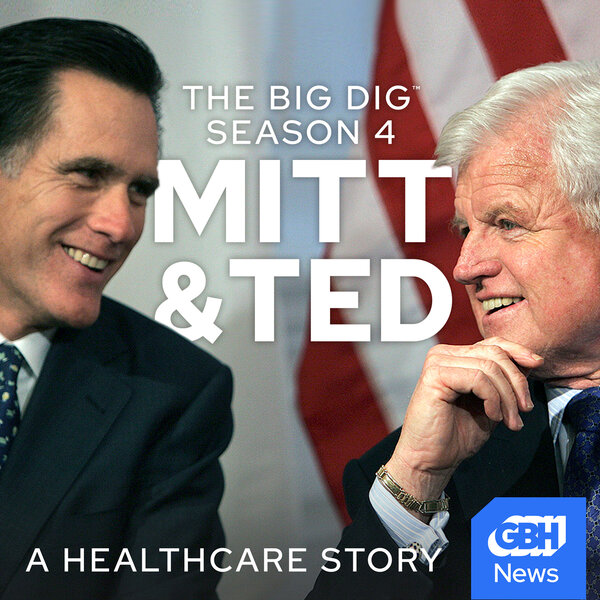
Mitt & Ted, a Healthcare story, the new season from The Big Dig, looks at how Mitt Romney and Ted Kennedy began their political journeys on opposite sides of the issue—and they ended once again on opposite sides—but for a brief period in the middle they worked together to pass a groundbreaking law: one that promised to finally transform the politics of American healthcare. So what brought this odd couple together, and what ultimately pulled Mitt and Ted apart?
Here's a preview of Mitt & Ted. Find Mitt & Ted from The Big Dig wherever you get podcasts.
See omnystudio.com/listener for privacy information.