In short
Podcast Episode Summary: Right About Now - Legendary Business Advice
Episode Title
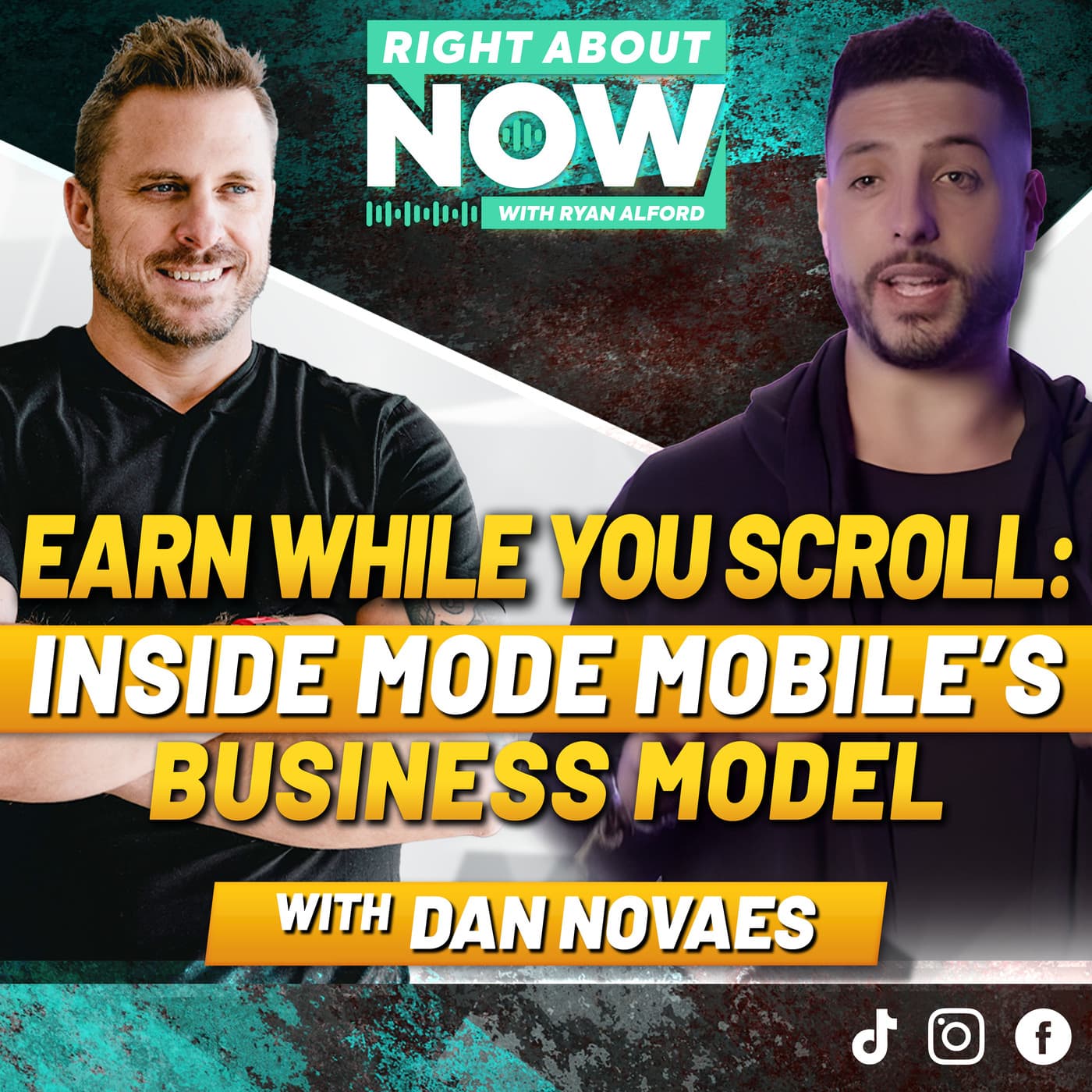
Earn While You Scroll: Inside Mode Mobile’s Business Model with Dan Novaes
Podcast Overview Host: Ryan Alford Guest: Dan Novaes, Co-founder and CEO of Mode Mobile Theme: The episode focuses on entrepreneurial insights, the evolution of business models in mobile technology, and the monetization of user attention.
---
Episode Highlights
- Introduction to Mode Mobile:
- Dan Novaes shares his journey from childhood hustles to establishing Mode Mobile, a tech company focused on rewarding users for engaging with their phones.
- Mode Mobile has quickly gained traction, becoming Deloitte's fastest-growing North American software firm.
- Evolution of Entrepreneurship:
- The discussion dives into the background of entrepreneurship, exploring the origins of Dan's entrepreneurial spirit through early experiences of buying and reselling products.
- Dan reflects on the balance of nature versus nurture in entrepreneurship, emphasizing curiosity and resourcefulness.
- Business Model Insights:
- Mode Mobile’s innovative approach of incentivizing user engagement through the "attention economy."
- Users earn rewards for activities on their mobile devices, like listening to music, playing games, or shopping.
- The concept of micro-gigs and how they can provide supplemental income for users is discussed.
- Challenges and Learnings:
- Dan recounts the challenges of launching hardware, the importance of adaptability, and the need for a long-term vision in growing a business.
- The conversation touches on the transition from rapid growth to sustainable profitability, especially in the changing market conditions post-2022.
---
Key Concepts Discussed
- Attention Economy:
- The idea that user attention is the new valuable commodity, akin to "the new oil."
- Companies leverage user data combined with attention to create valuable advertising and marketing opportunities.
- Innovative Business Models:
- Mode Mobile’s strategy of turning smartphones into revenue-generating devices for users.
- The difference between simply providing data and encouraging user engagement to create value.
- Market Dynamics:
- The gig economy's role in providing users with flexible, supplementary income opportunities.
- The importance of understanding consumer behavior and demographics when developing business strategies.
- Future Growth Strategies:
- Mode's plans to license technology to major brands, enabling them to offer similar user reward systems.
- Potential for scaling operations through partnerships and expanding product offerings.
---
Takeaways
- Entrepreneurial Mindset:
- Resourcefulness and adaptability are critical components of successful entrepreneurship.
- Learning from early experiences can shape business acumen.
- Consumer Engagement:
- Innovating how businesses interact with consumers can lead to significant growth opportunities.
- Understanding user behavior and motivations is essential for crafting effective business models.
- Sustainable Business Practices:
- The shift from growth at all costs to a focus on profitability emphasizes the importance of long-term planning.
- Brands must adapt their marketing strategies to engage with a more financially aware consumer base.
- Technological Integration:
- The integration of technology and user engagement strategies can lead to a more profitable business model and enhance customer loyalty.
---
Conclusion This episode of "Right About Now" provides a wealth of insights into the evolving landscape of mobile technology and entrepreneurship. Dan Novaes' story illustrates the potential of innovative business models in the attention economy, emphasizing the importance of adaptability and a user-centered approach in building successful enterprises.
Written by AI. May contain mistakes. Listen to the episode to check what was said.
Transcript
Automatic transcript. May contain errors.0:00The most valuable thing that we have as humans is our attention. There's nothing more that's more important. And it's the new oil. It is the data, your data and your attention is that. But what people are really shocked and surprised is that the data is actually by itself not that valuable because companies like Facebook and so much have so much of it. And then you're basically, if the product's free, you're the product. They're not incentivized. But why are those companies worth trillions of dollars? Because of your data. But when you actually put it out, it's not worth more than$100 a year. But when you mix data plus attention, like action, that's worth a lot.
0:30This is Right About Now with Ryan Alford, a Radcast Network production. We are the number one business show on the planet with over 1 million downloads a month. Taking the BS out of business for over 6 years and over 400 episodes. You ready to start snapping next and cashing checks? Well, it starts right about now. Hello and welcome to Right About Now. We're always talking about how you could stay right and what is happening now. We could talk about last week. We could talk about yesterday. We could talk about next year. No, it's now, today. Everything's moving quick, but you got to take advantage of the here and the now because you live in the moment, people.
1:10That's why we're here. That's why we're number one because you made us that way. And you know why we're number one? Because our guests, they're kick-ass. They're badass. They are. Dan Novias, he is a co-founder and CEO of Mode. Mobile, topic I love to talk about. Mobile, cell phones. They are the 2023 Deloitte's number one fastest growing North American software firm. I got that all in. What's up, Dan? What's up, Ryan? Thanks for having me. Hey, man. I'm ready. Ready to talk mobile, how I make money carrying this thing around. I like this topic a lot, Dan. It goes down a lot of avenues. Number one, mobile.
1:42Number two, breakthrough technology. Number three, teaching people how the markets work and how we are in the attention economy. We're going to get some more mobile customers. And better yet, maybe some smart people that will recognize that own businesses that need attention, that need to be partnering with you. That's where I'd say the bigger opportunity is for them and for you. But talk to me. What else is happening in Naples? Naples is very hot right now. It's a good time. Naples or Miami, always a good time. We used to be based in Chicago. That's where we started the company. And we were sick of the winter.
2:12We moved our way to South Florida and hang out all about these areas. I definitely want to trade the 110 degree heat with the humidity from the negative 30 that we were getting in Chicago back in the day. I spent one winter in Chicago. That's all this Southern boy needed. That was it. It's pretty miserable in the winter, but it is a great city. But the cost of living and the taxes, man, at the end of the day, that's also a difficult thing to swallow. Just by moving to Florida, you see your paycheck go up because you don't have the state taxes to deal with. I can't complain. Nice. No complaint.
2:39You're obviously a hustler in the most respectful way. We've made hustling a bad term somehow in America, but it's not a bad word in my book. I saw this story flipping$1 ,000 in birthday cash into a$2 million business by age 20. That was the first thing that got my attention. The first thing I want to ask, Dan, is it nature or nurture for guys like you? You just born that guy or did something mold you into it? I would say my first business I started was reselling items and stuff on eBay. And I ended up becoming like a titanium power seller, which at the time that you were doing over, I think, a million a year on it.
3:08And that was before that whole dropshipping stuff. I mean, there's been so many courses, like some last 20 years I see these people doing. I was like, dude, I was doing this stuff 20 years ago. But even before then, I didn't know what entrepreneurship was as a word. I don't know, like these Pokemon cards. That was a big opportunity that everyone really loved. And I definitely fell into the Pokemon ideology of collecting them. But then I was always looking at how do I get better opportunities? And then I was always really into Japanese snacks. And there was a Japanese grocery store in town in Indiana that I grew up in.
3:35And my mom brought me there and I saw these like Japanese Pokemon cards. And they were totally different than any Pokemon I'd ever seen. But they had these different holographics. And then I would buy them and then I'd take them to school. And then I would tell these narratives about what this Pokemon card did. Even it was all in Japanese. And all you could see was a number. That was the only thing in English writing. And I was able to get these kids to trade me their best cards, their Charizards, effectively. Then I'd take the Charizards and I'd sell them at the card store for 60 bucks. And I did that for a while until some kid in my neighborhood told his mom and said I was taking advantage of them and had to refund them the money because my parents were pissed.
4:05I wasn't like trying to scam. Here's a trade. You want to do it. That's kind of how my brain thinks. Another situation where it kind of got in trouble. So I think that the entrepreneurship sometimes turns into mischievousness is how it's viewed in society. But it wasn't. I wasn't purposely trying to do these things. I'm from Brazil originally, but I grew up in Southern Indiana. And my whole life, I would go between these two countries. Very different places, for sure. Because, you know. Yeah, Indiana and Brazil. And I'm from Sao Paulo, Brazil. Top 10 biggest cities in the world type stuff. Brazil, it's kind of, it's more chill, more chill culture.
4:31So you can go, for example, this is like the late 90s. I'm 10 to 12. You know, kind of like in New York City, they have those little like stores on the street corners that you can buy magazine, kind of a newsstand. And they have Playboys there. And as long as you have the money, you can just buy it. In the US, that would never happen. I didn't even know where you could get it back then. a friend of mine's dad had a subscription. At that time, I was like, wow, this is insane that I have access to this. So I bought three of them at the time. And then I would sell the pages to kids at my school for 20 bucks each.
4:58I mean, 20 bucks in 1990, that's like 100 bucks. Like, you know what I mean? Now Howard Hughes at middle school. Right. And then finally, when I got caught and got in trouble was this kid traded me for all of them. And he basically gave me a tennis racket plus 300 bucks and a pair of Kobe's. And I remember thinking like, wow, that was like such a great trade. And then he got caught because he stole the 300 bucks from his parents, you know, so it's a similar situation. And then again, I got so much trouble because then my mom's like, everyone's gonna think it's your dad's porn. I didn't even you don't even think about that.
5:24That wasn't even in my brain. So then I kind of just took a pause. I guess I didn't like purposely do that. But that's how I make money up until I was 12. And then I found out about working the concept of working when I started working at polo store, I was about 1516 years old, I just got in a car. And my dad, he was cool, because he financed the car for me, but I had to pay the payments. And then any upgrades I wanted to do, then I had to pay for that. It was just reasonable. And then I was like, okay, I'm going to just work at the polo store. I had a factory outlet mall by my house and worked there for two weeks.
5:49And it was the worst thing I had ever done. It was a lot of work. I got my first paycheck and it was 75 bucks. And I was literally so shocked that it was so hard to make$75. I had completely blacked out and forgotten all about the Pokemons and the Playboys and all that stuff. But after that first week, I was like, that's insane. Anyways, but I kept there for another week. Fortunately, I was dating a girl there at the time. So that was another incentive. So I was like, okay, It's not that bad. But then this big tour bus of Japanese tourists came because there was a Toyota plant that was being built in my town.
6:15And they bought literally 60k worth of stuff on a random Sunday. No one was there. The store was about to close. Me and one other dude were closing up and we handled the entire sale. And I'm thinking, okay, we just ripped 60k for the store. They're for sure going to give us a commission or something. That's a lie. And they gave us a$5 Arby's gift card. And I'm thinking this is ridiculous. The 40 % discount that I got, which was a good perk to get. I was like, if I gave them half, I could have ripped 20 or 12k. And then that's when I had the aha moment. And then I was like, oh my gosh, you were in smartphones.
6:43So you knew like back then I had a Palm Trio. It was one of those Palm pilots that you can write and all this stuff. It was the cool thing at my school because very few kids had that. And I was taking pictures of everything and I'd cross reference on eBay. And then I found the perfect item. It was like this leather jacket. They'd sell it at the outlet mall for like 180 bucks after my discounts, 140, 150, you know, selling on their store for 380. You can make 200 bucks a jacket. So I just bought three on my dad's emergency credit card that he had given me in case I ever run into an emergency. But I kept the receipt because I knew we had a 30-day return policy, no questions asked, as long as the tags were on.
7:14And then I listed them that day and dude, all three sold in one night and I made 650 bucks. And I was like, wow, that's insane. And so then I just rinse and repeated that for three or four months. I had everyone in the store buying those jackets for me. I'd pay them 25 bucks and some managers were cool with it, some were not. And so I left and before I did, I made like 35K in four or five months. And that was my seed capital to get started and found this opportunity of arbitraging high-end electronic products, iPods, MacBooks, other stuff in other countries. Started selling them in Brazil, started selling them in the UK, Australia.
7:44And you play with the currency and things are more expensive. It's like a thousand dollar phone here, thousand pounds in the UK. But if you add the currency value, it's 1600 bucks. And there's usually a lag of when it comes out. So that's kind of what I was doing. I started all through high school. And then by my freshman year, I was doing about 2 million a year in revenue and all bootstrapped. My mom was shipping all these packs One of the post office knew my mom, FedEx people, all that stuff. And that's how it all started. I love this. Amazing. Story number one. I like you. I liked you before we started.
8:10Now I really like you. I just like very resourceful people. And if I'm in a bunker somewhere, I want the most resourceful people with me. So Dan Navias is invited to my bunker. If we're ever in a bunker, hopefully never, because I have a feeling two of us could do some damage. The reason I asked sort of this nature and nurture, I'm curious because I have four boys and all smart kids. And a couple of them are definitely have that sort of entrepreneur side to them. They kind of figure it out. They're resourceful. And, you know, they have a good life. We don't give them everything they want, but they don't need anything.
8:41And I'm not saying I don't know this. I'm not saying whether you did or it doesn't matter if you grew up with money or even having anything. But your parents were giving you a decent life, it sounds like, regardless of you. So where does the want to come from? This is like a common theme for me lately. I like to get into this nature versus nurture thing. Like, can it be taught? or I think you know where I'm going with this. So I'm going to let you talk. I never had to like scrounge for food. There was always a meal at my table. I would say I grew up in a middle class, probably middle class to that upper, like in that threshold.
9:11You weren't the rich kid, but you weren't a poor kid. And that's a luxury. I mean, that's an extreme luxury to have that because I only had to focus on myself and I had to focus on them. My parents, they weren't entrepreneurs. My dad worked for a company. I was just like always very curious as a kid. I'd ask weird questions to people, not in like a weird, awkward way. For example, when I was playing baseball, I would ask one of the dads was driving the whole team. And I noticed that because we were van shopping and I wanted to get the best value. And so I was like, hey, I noticed this is the luxury Windstar, like the Ford Windstar.
9:38How much does that set you back? Did you get this used? I feel like he's like, you don't ask that question. It's adults. He actually said that to me. Kind of scolded me. I'm just trying to figure out how much the monthly payment is on this car. That's just how my brain operated. And one thing I've started realizing, it definitely started creeping up much more through later high school years, is that if I were to rely on my parents, I have limitations of what I can do. And then when you start that first job, even though it was like not a long period of time, that one week or two weeks at Polo really put a shock into me where I was like, dude, like that was so hard.
10:09That was so hard for me to fold clothes, do all that stuff. And it was backbreaking work. And there's a lot of that. And there has to be a better way of doing that. And then in college, I then had another realization of that. I went to business school and all my friends were getting internships and it was the hype thing to get an internship at Goldman Sachs. these like name brand consulting things. And I got all of those because I had very good grades and I had a business and everyone's like, why are you even applying? It's like, well, I just want to make sure that this isn't for me. And I had a nice interview and all that stuff.
10:34And I got it the first week where they wind and dine you. Excellent. But then when you like go and actually do the work, I was like, dude, this is horrible. I'm just sitting around doing PowerPoints all day and I'm just getting hazed because I'm just an intern. It sucks. Then I really came to that realization. It's like, Hey, I think I'm an entrepreneur. Like, I think that's what I need to do with my life. And I came to that realization really as I would say coming into my senior year, junior to senior year of college, where I really fundamentally do it in my soul. That's what was my destiny. And that's what I enjoy doing because like where I get my most energy is kind of like idea and creativity.
11:03Mark Cuban says it's like, you know, he likes the sport of business. Some people are really passionate about certain things. They really like to play music or they like to paint or whatever. And my passion is I really like entrepreneurship. I like creating. That's my version of art. And so I think that that nature and then there are things that you nurture. I think the downside of my personality of people that are innately entrepreneurial is they have to learn the lesson of thinking long-term and scaling and you will make a lot of mistakes. Like you might have all these ideas and stuff, but then those people tend to be solopreneurs.
11:33They have limitations. They think they know everything. They don't think they have short-term gains. There's a lot of hustlers that kind of can't get out of that. I call it zero to 0.1. You know, it's like, fine, you're doing okay. And it depends what you want. And then I also learned, it wasn't just about money. For me, I thought like up until was 25, I was very focused on that. I like to have money, but that's not like what motivates me on a grander scale. And I think you learn these lessons. I like it. I think that's important. Now let's talk Mode Mobile. And I see security token sales. I see all this stuff around tokenization, raising capital right around COVID time.
12:04I'd be curious. Number one, what formed the idea for Mode Mobile? And then enlighten the audience with a little bit of that story of building that come. Most people think that you're going to come up with some grand idea and you're just going to scale it and everything so that you're going to fly off into the sunset. And rocket to Mars. And I must say it's not possible. It happens, but not in my experience for myself, at least. But I've only seen that happen to others. Mode was born out of a series of pivots, I would say. And I think that's my number one skill in life is constantly pivoting. The better I've gotten at pivoting, the better I can dial in what actually complements my business and is able to scale.
12:41Mode kind of really came out with this idea. We had launched, I got into software after college, one of my warehouse got robbed and then like almost took me down. But then I got into software and I was like, wow, you can really scale this much better way without all that cash that you need to basically have these items. Met my co-founder at the time he was in high school and I was in college and five, six years apart. Started building a bunch of apps and never had a major exit. I would say it had a lot of small, like little 500k kind of app sales. And then we had this big idea and Mode, this is where it was kind of born.
13:08We had a user's product that basically we were aggregating a bunch of music services into one place, did not get any traction, but we had one type of person using it. And it was lower income people that had a lot of time, not necessarily money. And they liked the fact that we were aggregating all these music services in one place and didn't have to pay for it. We interviewed them. She always talked to your customers. And then effectively we were like, well, what if we paid you to listen to music? I guess, how interested would you be? Would you do tasks for that? And they were like, yeah, for sure.
13:34And so we threw up like a banner, get paid to play music and had like 300 ,000 people a month to sign that up. We launched it. And then we noticed it was really hard to make money off of paying people to listen to music. And so we moved into other stuff, playing games, shopping, charging. And the business started scaling from there. And then as you mentioned, 2019 was the first year we generated revenue under that business model is maybe slightly under 100k total revenue or something in that range. And by 2022, we had done just over$25 million. And that's where that 32 ,000 for journey 1 % growth rate comes.
14:03And throughout that time is when that really kind of development of this idea came to fruition. We started seeing it's like, hey, what we're really building is an ERNOS is what we call it, which is an operating system for everything you do on the phone. People are spending a third of their waking life. And in younger generations, a half of their waking life, there's 168 hours a week. If you're sleeping eight hours a day, there's 112 left. And then if you look at your screen time, it's about 30 to 40 hours that people are spending on average on their phone. And then younger generations, 50 to 60.
14:28So if you add this up, it is insane. And the cost of these devices are going down. The service is getting better and faster. And the first screen is now the phone screen. It's not the desktop screen anymore. It kind of just made sense from a standpoint of the business. And then we basically launched that app where you can take your smartphone, turn it into your phone. And then I had this idea, hey, we're going to launch a phone. And everyone's like, don't launch a phone. That is a very bad business to get into. How do you even do that? And so I just flew to Hong Kong. I didn't even have an appointment.
14:51I just hit a couple of people up. I would have told you not to do that too. Yeah. I'm curious if you still think you did the right thing. I don't know, but I would have told I think it was necessary to get where you wanted to go, even if it wasn't perfect, then fine. But the way I thought about it at the time was we're living in a very low interest rate environment, effectively zero interest rate. The biggest issue with hardware is just putting up the capital to do that. The market's very, very much changed over the last five years. I was like, look, we could run a test and we get our users to buy this service.
15:21And the thesis I had was like, people will use a phone that will pay them more than downloading an app. I use this example quite often. And when you're at a restaurant and a waiter brings you a water versus you ordering an Aquapana or a Pellegrino, you're more committed to the Pellegrino and the Aquapana because you spent four bucks on it. And it's like a token amount, but people will drink more of it than they will the tap water. And so the thought process I had is if you buy a phone whose premise, because all phones at about$100 price point, we're the same. It's like, you can't really differentiate.
15:45They're all the same thing. But one phone pays you. One phone doesn't pay you. Which phone are you going to choose? The one that pays you, especially if you're budget constrained. If you're dropping a$2 ,000 on a phone, you don't really care. But most people aren't. There's like 1 billion iPhones out there. There's like five to six billion of everything else. So I was able to figure out how to launch only 5 ,000 phones. We sold out of that first batch, did another one. And then I was like, okay, yeah, maybe we're going to do these phones. And I was like, well, actually, it's really hard to make a phone.
16:09And you didn't get it perfected and all that stuff. And all of our money is made on the software. But what I really needed to do is I needed to prove out that the model was possible and that the numbers made sense. And we were able to prove that out. Like the retention was much better. People earn way more. And so now we're kind of in this business of starting to license this technology to the motorolas and the samsungs and the verizons of the world so that they can launch earned phones and launch basically the world's first free phone plans that's where we're going all signals point to like free and it's possible we're the closest company to making it possible and so would i do it again i probably just would have launched one phone i wouldn't have launched two and i would have partnered with someone on the second one moving going back in retrospect you learn live and learn these lessons because it's like totally different than the core business our core business is a software business and then you have to think about logistics and shipping stuff and just all the support that comes with it.
16:55But ultimately, it still brought us to where we are today. And so I'm happy that I kind of went down that path. But as markets change, you have to pivot as a business as well. And that's why in 2022, our growth was insane. It's because it was this idea of growth at all costs. That was what the market was rewarding. Everyone's IPOing, everything was booming. And then now the market's really focused on profitability. And so we're focused much more on profitability. So you kind of learn these lessons as you go. And they ultimately bring you into the right place. Everything, I think, is meant to be the way it's supposed to be.
17:20There's not any good or bad. It is what it is. And you'll find the bigger picture if you keep looking. It's a fascinating story. And I want to focus on the business model for a moment. You think about how much money over the years people have spent for cable TV and direct TV and all these things for the right to watch commercials that get sold and you spend$100,$200 a month. What you're doing is the equivalent of people didn't pay cable and they got paid to watch cable. I'm saying the right analogy. Essentially that because attention has gotten so valuable and so scattered that this is what people will do that they want people doing these things.
17:55So there wasn't a question there as much Dan is making sure validating that I'm explaining to our audience to understand this correctly. But here's where the question lies. And it's this, where's the arbitrage here? Because whether it's music or games, and they're willing to pay for people to listen or to play, if it's motivated for them to pay or play, it doesn't mean that they were naturally interested in it to begin with. They get paid, you get paid. Why do those publishers or games makers want monetary motivated audiences to play the games? And where's the arbitrage size? Is it because eventually they'll get addicted to it and they'll stick with it and they'll spend money?
18:33That's the idea. And it's not necessarily they have to spend money. It's like, look, just because people don't have any money or have some money doesn't mean they don't have any money. There's a big difference on the two. But the game makers want them playing in hopes that they keep playing. Exactly. It's the same thing that like why free samples work. Send someone some lotion and then they might have never bought that lotion. But once they tried it, they kept using it. Right. It's the same component. We're like, why do you get a three-month free trial to Apple Music? What do they want? They want you to keep paying after that three-month.
19:01That's the thing. We're optimizing to some sort of target that that advertiser has that aligns value in some capacity. So like a Robinhood is an example. Robinhood, what do they want? They want you to deposit$5 into a brokerage account. I think that's their minimum deposit to open up an account. That's worth a hundred bucks to them. And because they have some sort of calculation on their end, what the LTV of a user is and some sort of payback period that they know. And so basically it's okay. If you're willing to pay a hundred bucks for someone to deposit five into an account, then we might give like 50 to that user.
Read the full transcript
19:31And then now that person deposits five, they get 50. Robinhood also will give them another like 25 or 30 bucks in free stock. So now this person has an$85 stock portfolio, but Robinhood hit their goal in the hundred bucks. And now you're incentivized to buy stocks and see your portfolio grow and get involved in that. That's kind of like the idea is why the incentive mechanism works. It's not going to work for every brand. I'm not going to see Louis Vuitton run a campaign inside of our product. I would be really shocked, but it'll work for most things, most everyday things. And then what's happening is that we're also seeing more of an affluent audience because we now opened up this like crowdfunding concept where anyone can invest in the company, But the people that are investing, they're more fluent.
20:10They're not necessarily my target market. We have a lot of older individuals, 50 and 60 plus, especially that 60 to 70 demographic, like those boomers, like my parents' age. They're not using my product. They are not my target customer. It's not like my biggest age distribution. But they're actually my biggest investor base. And why? Why is that? Because they've seen what the smartphone has done for their kids, their grandkids, resonates with that audience. And they see the opportunity and the potential because the world has completely changed over the last 20 years. Smartphones were introduced.
20:37we've started thinking about, I was like, okay, well, what is our core business? If you really distill down what's my business, my business is I'm in the business of helping people earn to save money. I'm not in the business of just like the smartphones. I was like, sure. Yeah, that's what we do. And that's the vehicle of which we use to make that happen. And so we started thinking like, okay, could we create products that are interesting to more fluid individuals? Because everyone wants to earn to save money. It doesn't matter if you're a billionaire or not. And so we started to kind of really think other opportunities to offer solutions for them.
21:04They don't have to necessarily do it through our phone. Maybe that's through email and through other mechanisms that we do that. And so that's how the business is starting to scale in other ideas and how we're also getting other advertisers that are much higher end, I would say, interested in our audiences and how we're expanding our business line. But that's not something that we had even two years ago. That's something that's kind of new over the course of this last six to 12 months, I'd say. For brands, is this a marketing channel in a way? It's a very unique one. I don't even know if marketing is the right word.
21:31It's a trial channel in a way. Trial. So should they think of this as a way to grow existing audience or as a way to tap into new audience? I.e. demos, things like that, obviously. Yeah, yeah. I would say probably new. It's like the campaigns are just, you need to kind of structure them a little bit differently. Like we buy a lot of it. Yeah, what does campaigns look like? It might look like, it might be something along the lines of like, if it's a game, for example, it's going to be tied to a certain amount of the level you get to. Or it might be a reward. We don't pay you to install an app because what would happen?
22:02You'd install and then you stop using it. Never play. So we might pay you over the course of a week to play a game like a Candy Crush. We get every day some sort of amount. And so you want to basically give them enough, like a little bought in, and then they might find an interesting product. But we also get a lot of information on what people are doing on their phones. So we know, hey, this person has Bank of America installed. Chime has a$400 offer. If you open up, I'm just making this up, but a$400 checking account offer. I'm pretty interested. If I'm banking with Bank of America and I can open up a free checking account and get a$400 bonus, that's pretty interesting to me.
22:32even me as this person right now. And I know a ton of those opportunities available. So the idea here is how can you take your directing that attention? And that's what you were saying, the most valuable thing that we have as humans is our attention. There's nothing more that's more important. And it's the new oil. It is the data, your data and your attention is that but what people are really shocked and surprised is that the data is actually by itself not that valuable, because companies like Facebook and so much have so much of it. And then you're basically if the product's free, you're the product.
23:01They're not incentivized. But why are those companies worth trillions of dollars? Because of your data. But when you actually put it out, it's not worth more than$100 a year. But when you mix data plus attention, like action, that's worth a lot. Because now you are taking an action to get involved in that. And that's what we've gotten really good at is mixing those two, knowing what are you interested in? What do you do? And then here's an action that you could take if this product's interesting to you based on the things that you're already buying or doing or seeing. And then that's worth a lot to brands.
23:27And that's how you can make thousands of dollars a year without necessarily having to spend money to do so. I keep coming back. Is this Thumbtack or is this a little bit of like my head gets in these weird, a little few different spaces? I think you know what I mean by that, because it's Thumbtack is the marketplace where you get paid for your services or whatever. Service here is giving away as attention and or data. Is it a marketplace for that? I had get scrambled a bit on all that. I think it's micro gigs. We can hear a lot of Uber did this for cars or Uber did it for home. But not everyone owns either of those two assets, but everyone owns a smartphone effectively.
24:00Giving people opportunities. These aren't full-time jobs. It's on that click. I have to be a handyman to be able to qualify for that. Not everyone's a handyman. You know, not everyone's willing to lug around. You have to actually have a skill. Yeah, you have to have a skill. And here's the thing. There's a lot of people that have free time. Also, there's people that are kind of in situations where down on the rock, something's happening at the time. And then here's an easy win. Momentum is everything. A small win transforms a bigger win. It transforms something bigger. We create those opportunities.
24:23Is Mo going to fully supplement missing income if you just lost your job? But is it capable of paying for your phone bill? Is it capable of paying for gas for you to get to work? Is it capable of being able to be a meaningful addition, especially given that we are at the highest amount of credit card debt this country has ever seen? It's no better overseas for many of these countries. Inflation is really hitting the lower middle class and lower. And people don't have a thousand bucks in their savings accounts. This is a stat from 2022. And the economy was good in 2022 for the first half, where 22 % of people or 56 % of Americans on a thousand bucks in their savings accounts.
24:57It's even worse now. It's not better because we had just all that COVID stimulus money. In a world like that, you need solutions like this. And so I think that that's like, you know, the thesis of kind of like where the business is going and what we're able to provide and always kind of going up in the sense of attracting more fluid customers with other types of solutions. And also we're starting to acquire a lot of assets internally and kind of building them into our ecosystem where instead of us sending them to a Candy Crush game, maybe we send to a solitaire game that we own. And then now we're able to capture revenue there as well and the lifetime value that comes with that.
25:25And so that model really works really well. It's kind of the PE playbook and that's something that we're applying into our business and it's going quite well for us. Is the future OS or Fiverr? Is your future an app or is it as an OS? We built the ecosystem on top of Android. It's almost like a UI on top of Android, I would say. But I think the Fiverr component is always going to be into it because like how do you generate the rewards? There has to be an action that has to be taken. I think it's not one or the other. I think that it's more, what we'll see more of is us using distribution through partnerships in various different countries, through phone brands and carriers around the world.
26:02That'll be much more of a focus. Yeah, more as like an OS, like you might see a Verizon earphone is what we would love to see. We're powering that for those brands in multiple countries. And then we have our own kind of direct consumer solutions. And then we have a suite of portfolio of products that we own, mostly in the mobile space, but some in other medians as well as like newsletters and web properties that make sense with our broader model. And that's kind of like where the future of the business is really heading. It's kind of a mixture between the PE playbook and like the venture capital growth and LTV to CAC model.
26:33But we want to build a profitable business. We're really focused on profitable growth and not growth at all costs. That's my one takeaway from running a business up until 2022, because it almost killed our business by kind of growth at all cost. That'll be a big focus as we still continue building the business into the future and ultimately for a potential IPO that we have our eyes set on. I know a few people at Verizon, probably already talked to a few. They, you know, they always had indirect channel and also set up their mainstream mind. They had to pay as you go for like credit challenged in, Hey, the earn as you go phone.
27:02We own the trademark for that, by the way. It's funny that you say that. Yeah. Yeah. I basically own every trademark for anything you could think of like earning or a phone that makes money or anything like that like money versus save did that get weighed did it get weighed at all save as you go save phone yeah we didn't sound as good they do say earnings and savings um but yeah it's just like kind of a mouthful um you know uh i mean we might own something around that i think we own like 12 different marks associated to that because you could do a spinoff that's exactly the same thing some kind of banker like it'd be your ip or anything like that they just want it to be all about like kids growing up hey it's not the earned phone it's the save phone for younger adults yeah yeah i mean college fun i mean we have actually a lot of people that get the phones and then they give it to their kids to earn a little bit extra change you know so that's smart it makes sense i see a million this is so brilliant and so smart with where things are at where attention is the currency of today and a way to give back to people for taking actions and putting a little money in their pocket, man.
28:11Kudos to all your growth and success so far, man. Yeah, man, I appreciate it. Thank you. Keep up with everything that's going on, new advancements where they can get themselves earnings and savings phone. They can check out our apps, obviously. It's called EarnApp and the Play Store. If they put EarnPhone into Google, they can check out our website and it's in Best Buy and stores like that as well. If they're interested deeper in the more of the business side of the company and becoming a shareholder, joining the 50 ,000 or so shareholders that we have, They can check out invest.modemobile.com.
28:41We have a lot of information on the company and what's possible there. And you even have some programs where we give out$15 in free shares in the company. I have a very unique model that we got qualified where people can become shareholders with their points even that they earn. So maybe they don't want to invest. That's where they can learn, but they do want to invest. Those are the opportunities. I was raised just under about$60 million through crowdfunding. One of the largest crowdfunders in America. That's the best place to keep up with the news and our webinars. We have a lot of interesting guests.
29:06We had Steve Wozniak a month ago. And so it was cool to talk to the co-founder of the world's largest tech and phone company. Yeah, they had a little company. Yeah. And so it was pretty awesome to chat with him and learn all about some of the Steve Jobs early days and kind of how we thought about Apple and some of the perks that we give to our shareholders. We'll have all the links of that in the show notes and on the website. Dan, it's been a pleasure, man. Let's do a V2 down the road. We could get underneath a few more topics, but I really appreciate your time. For sure. Thanks for having me, Ryan.
29:37I really appreciate it and enjoying it. Hey, guys, you know where to find us, RyanIsRight.com. You'll find highlight clips from today, the full episode, the YouTube link, and of course, links to Earn Phone. We appreciate Dan for coming on the show. We appreciate you for making us number one. We'll see you next time, right about now. This has been Right About Now with Ryan Alford, a Radcast Network production. Visit RyanIsRight.com for full audio and video versions of the show or to inquire about sponsorship opportunities. Thanks for listening.
From the publisher
Right About Now with Ryan Alford
Join media personality and marketing expert Ryan Alford as he dives into dynamic conversations with top entrepreneurs, marketers, and influencers. "Right About Now" brings you actionable insights on business, marketing, and personal branding, helping you stay ahead in today's fast-paced digital world. Whether it's exploring how character and charisma can make millions or unveiling the strategies behind viral success, Ryan delivers a fresh perspective with every episode. Perfect for anyone looking to elevate their business game and unlock their full potential.
Resources:
Right About Now Newsletter | Free Podcast Monetization Course | Join The Network | Follow Us On Instagram | Subscribe To Our Youtube Channel | Vibe Science Media
SUMMARY
In this episode of "Right About Now with Ryan Alford," Ryan interviews Dan Novaes, co-founder and CEO of Mode Mobile. Dan shares his entrepreneurial journey from childhood hustles to building a multimillion-dollar tech company. The conversation explores Mode Mobile’s innovative model of rewarding users for engaging with their phones, the challenges of launching hardware, and the shift from rapid growth to sustainable profitability. Dan discusses the attention economy, micro-gig opportunities, and Mode Mobile’s partnerships with major brands, offering insights into the future of mobile technology and consumer engagement.
TAKEAWAYS
- The evolution of entrepreneurship and personal journeys in business.
- The significance of the mobile technology market and its impact on consumer behavior.
- The concept of the attention economy and its value in today's digital landscape.
- Innovative business models in mobile technology, including incentivizing user engagement.
- The challenges and strategies involved in launching hardware products in a competitive market.
- The role of data and user attention in creating value for advertisers and businesses.
- The dynamics of the gig economy and opportunities for supplemental income through mobile platforms.
- The importance of adaptability and long-term vision in scaling a business.
- Insights into consumer demographics and market trends affecting product development. Future growth strategies and potential partnerships for mobile technology companies.