In short
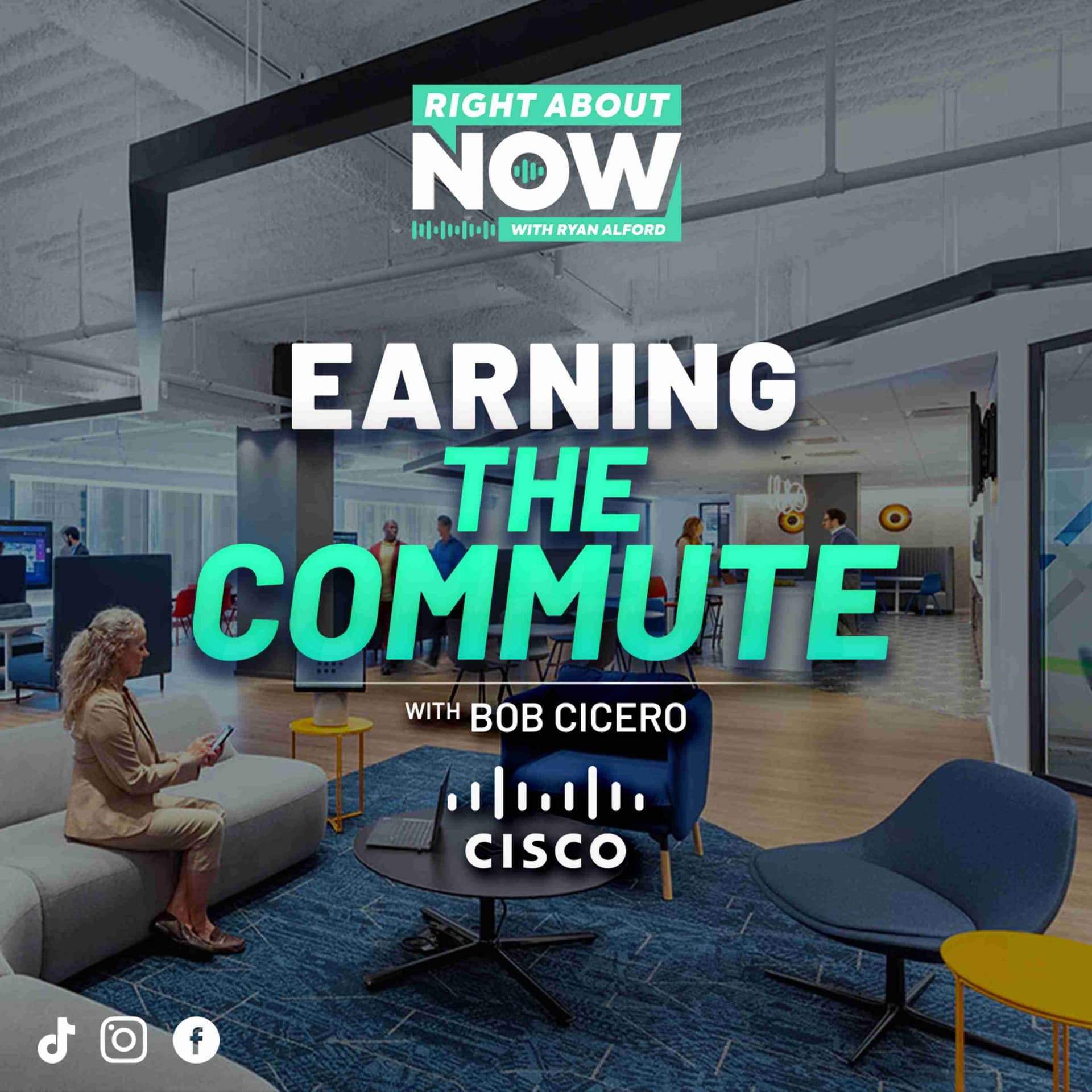
“Earning the Commute” argues offices should be redesigned to attract employees (“magnet, not mandate”) by using AI/data plus physical space to make in-office time more valuable than working from home.
Guests
Bob Cicero, America’s Future-Proofed Workplace Director at Cisco. He leads Cisco’s workplace/space strategy; the effort began in 2019, accelerated during COVID, and now spans 14 sites globally (e.g., Penn One in NYC).
Key claims
RTO mandates haven’t worked; people will return when the office is inviting and frictionless. Leadership must drive continuous change management. AI will automate routine tasks, increasing the need for humans to collaborate in differentiated “we space.”
Notable examples
Cisco flipped space mix from 30% collaborative/70% focus to 70% collaborative/30% focus; uses NVIDIA-powered tech to count people in rooms and tailor experiences. He cites “mixed presence” needs (physical + virtual) and notes employees use 5–6 different space types daily.
Written by AI. May contain mistakes. Listen to the episode to check what was said.
Chapters
Tap a time to open that second in VONavigating the Future of Work
1:32 to 2:20
Bob Cicero discusses the evolving landscape of the workplace post-COVID.
“This is Right About Now with Ryan Alford, a Radcast Network production.”
The Importance of Human Interaction in Hybrid Work
2:20 to 4:25
Exploring how in-person collaboration enhances productivity and engagement.
“And South Carolina has been a different place in many regards than the rest of the world.”
Generational Perspectives on In-Person Work
4:25 to 6:34
Bob shares his observations on leadership attitudes towards office presence.
“and truly earning the commute, if you would, around the space that they occupy?”
AI's Role in Future Work Environments
6:34 to 8:00
Discussion on how AI will impact workplace dynamics and task management.
“We think that AI is going to take 8 billion people on this planet and make it seem like 80 billion people.”
Reimagining Workspaces at Cisco
8:34 to 14:00
Bob explains how Cisco is transforming its workspaces to foster collaboration.
“Bob, talk to me about like your daily role.”
Designing Collaborative Workspaces
14:00 to 17:08
Learn about the importance of intentional office space design for collaboration.
“I envisioned the floor plan with W's and M's.”
Change Management and Leadership Engagement
17:09 to 18:42
Explore the role of engaged leadership in managing change within organizations.
“You've got a little bit of this disconnect.”
Earning the Commute: Creating Value
18:43 to 20:58
Understand the concept of 'earning the commute' by making office spaces appealing.
“It's it's we think that you're competing with the home for you to compete with the home.”
Transforming Office Spaces Post-Pandemic
20:59 to 22:50
Discover how office spaces have evolved and the importance of diverse environments.
“But then I'll say the other day, hey, you got to roll up your sleeves and work, baby.”
Impact of AI on Office Design
22:51 to 24:56
Learn how AI is changing the landscape of office design and usage.
“fundamental chain in space, for us as an organization, no one has their own space anymore.”
Show all 11 chapters
The Future of Work with Cisco
24:57 to 26:53
Gain insights into the future of work as shared by Cisco's leadership.
“But then we think about a space, a four-walled space.”
Transcript
Automatic transcript. May contain errors.0:00When people turn to telehealth or weight loss, they're looking for real support. That's why more people are choosing orderlymeds.com. Orderly Meds connects you with real doctors and access to proven GLP-1 medications like semaglutide and terzeptatide. No guessing, just a more supportive experience. And all shipped directly to your door in discreet packaging. Do your research, ask questions, then visit orderlymeds.com slash podcast for an exclusive offer. That's orderlymeds.com slash podcast. Individual results may vary. Now medical advice eligibility required. See site for details. Dentists and dental professionals.
0:33This podcast is for you. Check out Thank You for Flossing from the Association of Dental Support Organizations, where we bring you candid conversations with the leaders shaping dentistry today. DSOs, technology, workforce challenges, policy shifts, and more. No fluff, just real insight from people building the future of the industry. Subscribe to Thank You for Flossing wherever you listen. I fundamentally believe when you think about the impact of AI, we think that AI is going to take 8 billion people on this planet and make it seem like 80 billion people. But some of the tasks that we do every single day from the 8 billion people, it's going to be driven by AI.
1:14It's going to be this confluence of people that are going to come together more because that's really what's going to happen when the standpoint of some of the rogue tasks and all those other pieces that you think about on a daily basis go away. It can be done by the digital worker. And how do you really think about that from the standpoint of bringing humans together more is what's actually going to happen over time. This is Right About Now with Ryan Alford, a Radcast Network production. We are the number one business show on the planet with over one million downloads a month. Taking the BS out of business for over six years and over 400 episodes.
1:48You ready to start snapping next and cashing checks? Well, it starts right about now. Companies are still trying to figure out what to do with the office. Bring people back, stay remote, or something in between. But most of the conversation is missing the point. Bob Cicero is America's future-proofed workplace director at Cisco and is working on what the next version of the workplace actually looks like. Combining AI, data, and physical space. Bob, welcome to Right About Now. Ryan, thank you. It's great to be here today. Thanks. I'm excited to talk about this because it's been on my mind. And I have condensed my team.
2:24And South Carolina has been a different place in many regards than the rest of the world. But there's certainly corporations here that have had the same challenges and issues of making the workspace somewhere where people want to be. I always said, this is going to be a hard genie to put back in the bottle. Philosophically, what are your thoughts on all this? It is a hard genie to put back in the bottle. You think about COVID, March of 2020, just passed, I can't believe, six years ago. And you think about it, everyone went home for two years. And habits formed. and lifestyles were formed. And how do you put that genie back in the bottle to effectively get people back to the office?
2:59And it really depends on your view in terms of where work truly happens. And you think about the changes that we've undergone since COVID, what's happening from an AI standpoint and thinking about the capabilities on the digital worker side for us to all interface with. And how do you solve that problem? And people really wanting to be in a space and not being forced to be in a space. Because we've seen this shift in the past four years of mandates and from a return to office standpoint, RTO standpoint, mandates haven't worked. And so what we've seen is, is that people want to go to places that are inviting, that have all the technology components they need to operate.
3:33And really, that's really where that genie is out of the bottle. But we need to work with the genie when it's out of the bottle. As an entrepreneur who's very innovative and thought that I'd be like, it didn't matter where we worked, my team different things. I've done a complete 180. It actually matters a lot. We do remote still, but it's hybrid. I mean, I'm a small business owner and have a handful of people that work for me. So it's not the same as Cisco or large corporations, but in some ways though, I thought that we could do things remote, but it's really important to be together. It's important that we tackle this the right way.
4:04But as someone that owns a business though, that's innovative and it's not just because we always did it that way. It actually is important. That's been something, a learning lesson for me because I thought I was going to be the other way. But then I was like, We work better when we're together in a lot of ways. When you think about the changes we've been over in the past four years, it's folks that I'm 100 % remote, but there is value in people getting together. The value becomes is that, is it forced to come together or do people want to come together and truly earning the commute, if you would, around the space that they occupy?
4:33But people are coming together, whether it's to solve problems, to brainstorm, to socialize. At the end of the day, it's human interaction is important for people to also feel fulfilled about the work that they do, be part of something bigger than themselves. That doesn't happen through a screen. That happens when you're physically together. It's that balance though. Is it five days a week? It depends on the organization, but there is a balance from a hybrid perspective in terms of people coming together. But when they come together, it has to be valuable. They have to have the tools there that they need to be productive, just not for themselves there, but also for any remote participants.
5:05But it is finding that balance for the organization, for yourself. You said a small business, it makes sense for you all to be together at times, but there's times you do remote work. Cisco is the same way. It's the same in terms of balance from the standpoint of what actually makes us most productive. What have you seen from senior leaders as far as the general consensus around these things? It's easy maybe to go, well, the older guys just want us here in person for no reason. I don't know if that's necessarily the case, but I have to think there's a bit of that on some level, but I'm just curious.
5:35You're at a large corporation, probably seen others, talk to others in your field. What is the general climate with leadership in this area? It totally depends on the industry. And you talked about the generational gap. Older leaders feel more comfortable because they've been doing it that way forever in terms of folks being in C. But it's also industry dependent. There are some industries that I call the apprentice-based model of work. Someone doesn't become a great lawyer by sitting behind a screen. It's an apprentice model. An associate works with a partner, learns that trade. Same thing in finance.
6:05So it really depends on the type of work that you're doing and the way that you learn. And a lot of times it is that apprentice model, which drives an in-person culture. What's interesting is, is that leaders that are uncomfortable with the fact that folks might not be together are really achieving the goals that we have as an organization. And then how do you put a model together that you can achieve the goals of the organization, but also cater to what people want? You talked about that genie coming out of the bottle. The genie's out. You got to cater to what people want. But at the same time is we need to prepare for the future.
6:33I fundamentally believe when you think about the impact of AI. We think that AI is going to take 8 billion people on this planet and make it seem like 80 billion people. But some of the tasks that we do every single day from the 8 billion people, it's going to be driven by AI. It's going to be this confluence of people that are going to come together more because that's really what's going to happen when the standpoint of some of the rope tasks and all those other pieces that you think about on a daily basis go away. It can be done by the digital worker. And how do you really think about that from the standpoint of bringing humans together more is what's actually going to happen over time.
7:03We're on like a wavelength here. You're like reading my brain. When you were talking, I'm sitting here going, the AI is perfectly situated to literally do the tasks that we were doing at home. Maybe they were more conducive to that. The humans are needed to sort of get in the room and have some ingenuity and some creativity together. For sure. And you think about, sure, AI and thinking models that are out there and models are going to get better over time. But it's really the value of humans getting together and really thinking through an issue that the machine might not be able to do. or provide some creative thought to come together.
7:36But to your point of tasks that you did were done at home, is the digital worker going to do that for you? Maybe, probably. When we first started this, we were thinking about how do we amplify humans with the intersection of people, space, and technology? Now we have this added component on it that's clearly coming at us from a technology perspective when we think about that. It's still that, but some of the tasks are going to be taken away and it's really going to be this further amplification, I believe, of the value of space and what is actually happening there with the humans that are occupying it.
8:06Interesting. Industry is changing fast. Keeping track has never been harder. That's why you have to check out the Thank You for Flossing podcast. It comes from the Association of Dental Support Organizations and delivers unfiltered conversations with executives, innovators, and clinicians driving the industry forward. From DSOs and innovation to workforce and policy, it's the smart listen for dental professionals who want to stay informed and ahead of the curve. Search Thank You for Flossing and subscribe today.
8:40Bob, talk to me about like your daily role. What does Bob Cicero do every day? What problems is Bob solving? We started this journey before the pandemic, quite honestly, as a company. If you look at Cisco and our heritage here and our history is dot-com boom, and we were wiring the world for the internet. And then we were catering to employees that want to work remote. many, many years ago, and then the pandemic hit. In 2019, we actually came together as a group, and as part of that group inside the organization to really rethink the value of space and what you actually need to put into that space for humans to do their best work.
9:14Started that effort in 2019. Pandemic hit in March of 2020. Gave us a lot of time to think as we were sort of stalled in terms of what the world was going to be. We reimagined our workspaces and workplaces and really wanted to bring to the market something unique and different in terms of the space that we all occupy. There's a lot of operational burden and costs that goes along with it. You think about real estate inside of most organizations, it's not trivial from a dollars and cents perspective. A lot of times it's number two cost. Then can we take sort of an IT view and bring that to the built environment in terms of thinking about notion of platform across all this to amplify that intersection of what I talked about before, people, space, and technology.
9:53Dream redraft the market, our space. And then now from a customer standpoint, customers, it's really interesting to see. You think about real estate in general, it's long tail. It's a long time to make decisions. And you think about most corporate leases, 10, 15, 20 years options, et cetera. The industry doesn't move fast, but it's being forced to move fast in terms of what's actually changing. Also work with customers and my team work with customers every single day to really start re-imagining space, but thinking about technology enabling the experiences where before it was really about the architectural elements, which are still obviously important, but it's a tech piece that was forgotten.
10:26We have to bring that forward with that data mindset we talked about a little bit for us to get prepared for the future. Give me an example of what that looks like, maybe even through the lens of Cisco. How have this technology and space, give me like a real world example of a space at Cisco that may have changed or something that we could put our wrap our head around with what that looks and feels like. Work started in 2019. It was really for a key project for us in New York City, our Penn One space. That was really reimagining space. And if you look at space types and space mix, as an organization, traditionally, folks have a lot of focus workspace where it's a desk because you're going to come in, you're going to sit at your desk and that desk is assigned to you.
11:08Yes, sure, you might've done hot desking or telling, but then you had a group of their spaces that were really for collaborative moments for the we side of the world. You think about the me is focus, we is the collaborative space. We took that approach and we flipped it. We used to do 30 % of we and 70 % me. We flipped it on its head. 70 % we, 30 % me. And at the time, people were like, I in the world, do you need all this collaborative space? And we felt like it was that fundamental moment that it was going to be about groups of people getting together, not about sitting at your desk. And as we fast forward here over the past four years since we've opened, we've got 14 of these sites around the globe.
11:43And it's interesting, there was just a large architectural firm that released a report today that talked about space type, space mix, collaborative space. That's the future of it. We see that. We saw it early on. But I think what the uniqueness was is our ability to have data about the space and really thinking about how do you count people inside of a room, as an example. With the technology that happens to be powered by NVIDIA and our technology, we're able to count people. We know what's happening and we can cater to that and really bring that forward from the standpoint of employees to be able to enjoy the space.
12:13But it was that fundamental shift on just not space type. But we really wanted to think through what else was important to the organization. How do we think about energy from the standpoint of electrification and changing the way we electrify? We're thinking about the network. If you think about Cisco from a core technology standpoint, we're known for the network element. Well, network is just not about data. It's also about power. We're re-electrifying everything in the built environment. light shades, mechanicals, et cetera. Thinking about health and wellness, health and wellness matters. The amount of natural daylight that we get every single day, the air quality that we breathe, it matters every single day.
12:46The noise levels inside the environment, because all of us are unique and different. You think about neurodiversity, 20 % of the world is neurodiverse. How do we bring all that to space? And then ultimately, all of this for us is really underpinned by data. When you think about space and place, that industry never thought about data. They thought about badge swipes, swipes of someone walking into a building. I swipe in. That's great. Someone's there. Fantastic. What are they doing inside? We really wanted to bring that forward in terms of this notion of having all this digital footprint, if you would, of the intersection of people, space, and tech and the tech providing that.
13:21But we also knew that the world was developing AI. And so when you think about AI, AI is three pieces. It's data, it's a model, and there's the compute to make all that stuff happen. If you don't have the data, you're never going to have a good model. For us, it was really preparing for that future view. And you think about real estate as that long tail. That's why we started this five years ago. I love talking to smart people, highly intelligent people, breaking down complex things into actually simple ways. The me, we thing is so simple, but it totally reframed my mind around, okay, the team environment.
13:51It's like BDI and CDI back in the day when I used to do branding for Verizon and Apple and Samsung. I was like, dang, I get it. The you, the me and the we. I envisioned the floor plan with W's and M's. Literally, I was thinking through that. What people fail to realize is there has to be intention when you build something and you have space. My dad used to always say the unintended consequences of decisions. If you set up an office the way you've always set it up, everyone goes to their cubicle or their office. It's a lot of me. But open floor plans and thinking through, okay, it's going to be a lot more important that we're collaborating, that we're meeting, we're doing these things using the technology and the grid.
14:29It is a simple concept. We and me. The old adage of there's no I in team. It's the we space because that's where we're going to get people together to accomplish the goals of any organization. And that's going to make people want to come back to work because they're not going to want to come back to work to go sit in their cubicle to do what they could do at home. And if we're going to have AI doing a lot of that work, then we need to have people together collaborating on the things that push the company forward. The human aspect that drives what we do, the ingenuity, whatever it is for your industry.
14:59That's super key to get people who want to come back. Absolutely. One of the biggest things you heard after the pandemic when people were going back is, why am I going back and sitting at a desk on a pick your platform of choice on the meeting side? Could be WebEx, could be Zoom, could be Teams, etc. They're sitting at their desk on meetings with people that are on the same floor. Why are we doing that? You point it to their meeting space. One is they don't have enough WeSpace. You go into their WeSpace, it doesn't have the right technology for them to be efficient. Thinking about space layout and how do I get to those spaces?
15:28Are they on the other side of the floor? At the end of the day, people are humans-like patterns in terms of how we work. And every single day, you're programmed to wake up and you might get a cup of coffee and have some eggs or whatever your morning routine is, workout, etc. But we didn't provide that for employees. And we were wondering where everyone's shocked around. Well, why are people sitting at their desk? Well, you go into the rooms. They don't have the capabilities they need. Now, even so today, people are like, oh, great. We got together. We're in the room. But everyone brought their laptop as they're on the same meeting.
15:53And everyone has speakers muted. And maybe one person has speakers on. But it's like we don't have the right makeup of just not the space, but all the components that go inside. The way that space is envisioned and designed and built. Unfortunately, technology was last in the process. Technology was never first. We're not saying it needs to be first. We're saying make it your second choice. And then the tables and shapes and all these pieces should follow. So you have a great experience for the week because that's the reality of the world. It is about we. It always was tech last. It's like you designed it.
16:26Architecture. Paint even comes before the damn tech. It's like what color the walls are going to be. Does that cabinet look right? Does this table look good? And then, OK, well, let's make sure we might can run an Ethernet cord underneath the table. It always came last. The industry of technology has a view of being complex. As developers of technology, I like to think that we invent a future in terms of what we do at Cisco. From our core business is we have to make it easier. There's this pursuit of making it super easy. And we think about sort of how do you design space and how do you make it better, faster, more cost effective.
16:59You build it. All these pieces need to work. And it's like an orchestra. They need to come together for it to just be amazing when you're done the effort. We're talking about the space, Bob. It's also about the communication. You've got a little bit of this disconnect. Let's just call the spade a spade. You've got leadership that feels a certain way. You've got middle management that feels a certain way. You've got daily employees that feel a certain way. There's some amount of disconnect going on because a lot of people don't have Bob Cicero's directing the show. Where does the space and the messaging align as far as internally with connecting all of these dots?
17:34We're very fortunate at Cisco. Our CEO, Chuck, believes space is a magnet and not a mandate. So how do you make it to a space of magnet? Fundamental difference shift on the viewpoint of that. But when we think about the ability to people to get together and how do you actually have that change happen, it's change management at the end of the day. When you think about change management, what does that mean? I need engaged leaders. None of this works unless you have engaged leadership. Engaged leadership is just not from the top. It's engaged leadership from the bottom up as well. Everyone that's in a leadership role, it's just not about leading people and leading the purpose and all the other elements.
18:09It's about leading the ability for people to get together and the value of the space that comes together. What happens is that manifests itself and sort of gets this word of change management around it. But it's continuous. It's not a one, it's not a point in time. You do a big change management effort and I walk away and everyone just gets it. It's this constant evolution and change that needs to occur that these engaged leaders really need to drive from an organizational standpoint. We've had a lot of success inside of the company because we've had those engaged leaders, those engaged leaders to really drive that change as an organization.
18:41I picked this term up, earn the commute. What does that mean in practice? Earn the commute. It's real. It's it's we think that you're competing with the home for you to compete with the home. People have their own home set up that's to their tastes and likes, but also they have a commute that's standing in front of them to get into the office. And we think every given day, people are going to wake up and be like, okay, they're going to run a little equation in their head that says, what's the return on commute? What's my return on commute value if I go into the space? This earning the commute notion, it's really about having space be differentiated.
19:13It's not about the same color walls and how do I build it for the cheapest price that I can, which oftentimes you think about in times of space, it is a huge cost, but how do you invest in the right components to be able to make it inviting? But then more importantly is, is that what we think is the differentiating factor is thinking about this technology infused space where people just come in and it just works and it's everywhere. It permeates the entire space. People can roam about that when they come in. It's a delightful experience. It's not about a barista. It's not about free lunch. It's not about people have amenitized their spaces.
19:46When you think about landlords amenitized their spaces, people are like, I'm going to bring free lunch in. That's great. But the reality is, is that it's really about how do you take friction out of the workday? for when people come inside of the space. That's what we fundamentally believe, think about when we say, earn the commute. We want to earn the commute when people wake up in the morning, do that equation in their head and they're saying, I'm making that commitment because there is value. But when I go in to be with my colleagues and others inside the organization, it is just a delightful experience when you come in.
20:19Talk with Bob Cicero. He is the America's Future Proof workplace director at Cisco. My mind goes in a lot of different places. And part of me, I'm going to be honest right here, Bob. This is an honest moment here on Right About Now. And everybody that listens to my show knows I'm honest at all times, direct to a fault. Where does it rubber hit the road a little bit with, it's called a job, damn it. You get paid to do work and work isn't fun and work isn't playing video games at home. The evolution of the workspace needed to happen. We needed Bob Cicero's of the world changing this to make it conducive for people to want to go, but also to recognize that it's adding value to the job that they do, which is, I think, a lot of what we've been talking about.
21:00But then I'll say the other day, hey, you got to roll up your sleeves and work, baby. That's just me being direct, Bob. It's work always fun? No. But at the end of the day, it's for us to get together and drive this notion of this great work experience. Part of it was, is that not just reimagining the workspace, but it's within an industry that moves slow. It was a really small step changes. And over time. We're like, yeah, maybe it's a big change in two decades. But at some point, you had to draw a line in the sand. And it's like, okay, yes, we're coming in to get a job done, depending on what your line of work is.
21:32Hopefully, you feel like you're part of something bigger than yourself. But we had to change an industry that moves very slow. And this radical transformation that we did as an organization was people looked at us and said, I can't believe you all did this. Now, here we are four years later, the industry is agreeing with it. We're 14 sites in as an organization. And we're taking this show on the road from the point of view of for us as an organization globally. We've got space in Milan. We've got space in London. We've got space in Paris around the globe for us to execute as an organization. But I think there is something fundamental too, is that you can make the work more enjoyable for individuals depending on the space that they're in.
Read the full transcript
22:10It's why do they like the home? It's because they're comfortable there. It's them. It's a piece of them in terms of what they like. We think through that. It's yes, at some point it's you redirect get back to work sure but also when you get there you got to feel good about it not just the work that you're doing but also the space that you're occupying just no nap pods bob no nap we have no nap pods that's where it cuts off for me i'm like come on you know you take a break take a break we got a basketball goal in the back bob we got xbox but no naps no nap take a rest siesta you know five minute mind ease i just can't handle the nap pods i don't know if they still exist at Google or not, but supposedly they did at one time.
22:49They certainly did. I don't know about today, but what we've seen is that when you think about this fundamental chain in space, for us as an organization, no one has their own space anymore. I don't have an office with my name on it, but it's the different types of spaces. And what we see is that people will migrate throughout the day to different space types. And we typically see them touching five to six different space types throughout the day. And you think about that. And I think about the history of the past six years that we've been through is that when COVID hit, personally, I didn't sit in one space the entire day.
23:21I roamed around the house and I went in the kitchen, went into the living room, went in the back deck. We're seeing that that's how human beings want to be. And now we're providing those capabilities and we're proving it. We see it in the data. It is five to six different spaces that people touch every single day. How is AI actually impacting physical office space? When we see AI from a physical AI standpoint, that notion of physical AI, what we're starting to see is that if you have the data, you can create a great model. What we're seeing now is that we have, as an example, out of our pen locations, 5 ,000 data points every second coming up.
23:54So we have this treasure trove of data to really influence design. Some of the things that you're thinking about is on the design side, if I have all this data, I mentioned five to six different seating settings a day. I mentioned 70-30 split. How should you program space for organizations? If you have this data, how do you program the space, how do you look at things visually? We're producing tools as an organization. You can design. One of the biggest aha moments was when you're thinking about mixed presence, physical and virtual coming together. An architect is trained for physical. It's what they went to school for because this notion of mixed presence was never talked about.
24:27But in order for you to absolutely have a phenomenal mixed presence experience, you think about technology forward, as I mentioned before, table selection, angles of table, all these other components became super critical to have a great experience. We had to turn it into a tool. And so this journey of AI, when we think about AI, where it is today, data is informing language models or tools that are coming out in the marketplace for space planning, et cetera. How do you program the space? But ultimately, when we think about this world of agentic, the industry talks about this agentic AI. Who knows?
24:55We might have 10 digital workers. We might have a hundred digital workers, each of us. But then we think about a space, a four-walled space. That's going to have an agent. You think about a place that's going to have an agent. And then agents are going to operate on all sides of the house of IT, the real estate side. All these agents are going to be consistently communicating together. That's where the industry is heading. But when we think about where it is right now, people have to get the data right. You have to have the data to inform. And now we're seeing all these models come out with space design, et cetera.
25:23And so you see like Nano Banana and all those other models that are out there from like a Gemini perspective, and you can add texture and the type will type all these other components. That's just going to accelerate. You think about the changes that's occurred since the first time you logged into maybe chat GPT and used it. You're like, wow, this is amazing. And now you see where it's going is we're creating images that way. We're animating space. We're working on a project right now as an organization where we created the vision, if you would, with AI, and then we animated it to put humans in it with AI all in 24 hours.
25:53What's happening is, is that when you look at yes data to models, but it's this rapid pace of change and people are going to expect you to build faster and drive this change faster with the AI tools that are coming to market. It's really mind blowing how many data points I'm thinking doing the math, like what you're talking about, how many data points there are. Bob, where could everybody keep up with you? What you guys are doing at Cisco? Give me some links, some social, anything like that. On LinkedIn, most active for that as a company, right? Cisco, follow us on all the major social media elements is where you can find us in terms of what we're up to because we're not stopping.
26:27We're actually accelerating, which is the exciting part. Hey guys, look, it's not about whether people should go back to work or not. It's about being a magnet. Bob used his CEO's words best. That really struck with me. You got to be a magnet, not a mandate. I love that. I'm going to use that moving forward. We really appreciate Bob. We appreciate Cisco. We bring on a lot of their leadership, an amazing company doing amazing things to push us past what we used to do in to the future. We'll see you next time on Right About Now. This has been Right About Now with Ryan Alford, a Radcast Network production.
26:59Visit RyanIsRight.com for full audio and video versions of the show or to inquire about sponsorship opportunities. Thanks for listening.
27:23of dental support organizations and delivers unfiltered conversations with executives, innovators, and clinicians driving the industry forward. From DSOs and innovation to workforce and policy, it's the smart listen for dental professionals who want to stay informed and ahead of the curve. Search Thank You for Flossing and subscribe today.
From the publisher
In this episode of Right About Now, Ryan Alford sits down with Bob Cicero from Cisco to break down what the future of work actually looks like—and why most companies are still missing the point. As AI begins to take over repetitive tasks, the real value of work is shifting back to human connection, collaboration, and creativity.
From the post-COVID workplace reset to the rise of hybrid models, this conversation explores why forcing people back to the office isn’t working—and what companies should be doing instead. The key idea? Offices need to become a magnet, not a mandate, offering real value that employees can’t get at home.
Bob shares how Cisco is reimagining workspaces with a “me vs we” model, flipping traditional office design to prioritize collaboration over individual desks. Combined with data, AI, and smarter environments, the workplace is evolving into something far more intentional—and far more human.
If you’re navigating hybrid work, managing teams, or thinking about the impact of AI on your business, this episode will completely reframe how you think about where—and how—work gets done.
🎯 Topics Covered
Why AI will amplify human work—not replace it
The shift from remote vs office to hybrid balance
“Magnet vs mandate” and why return-to-office policies fail
The “me vs we” workplace model and collaborative design
Why human connection and in-person work still matter
How AI is changing productivity and daily work tasks
Designing offices that people actually want to go to
The concept of “earning the commute”
How data and AI are shaping the future workplace
🤝 Connect with Host & Guest
Ryan Alford (Host)
Website: https://ryanisright.com
Instagram: https://www.instagram.com/ryanalford
LinkedIn: https://www.linkedin.com/in/ryanalford
Listen to Right About Now: https://podcasts.apple.com/us/podcast/right-about-now-with-ryan-alford/id1562875066
Bob Cicero (Cisco)
LinkedIn: https://www.linkedin.com/in/bob-cicero
Company: https://www.cisco.com
Learn More About Cisco Workplace Innovation: https://www.cisco.com/c/en/us/solutions/collaboration/index.html