In short
Right About Now - Legendary Business Advice
Episode Title
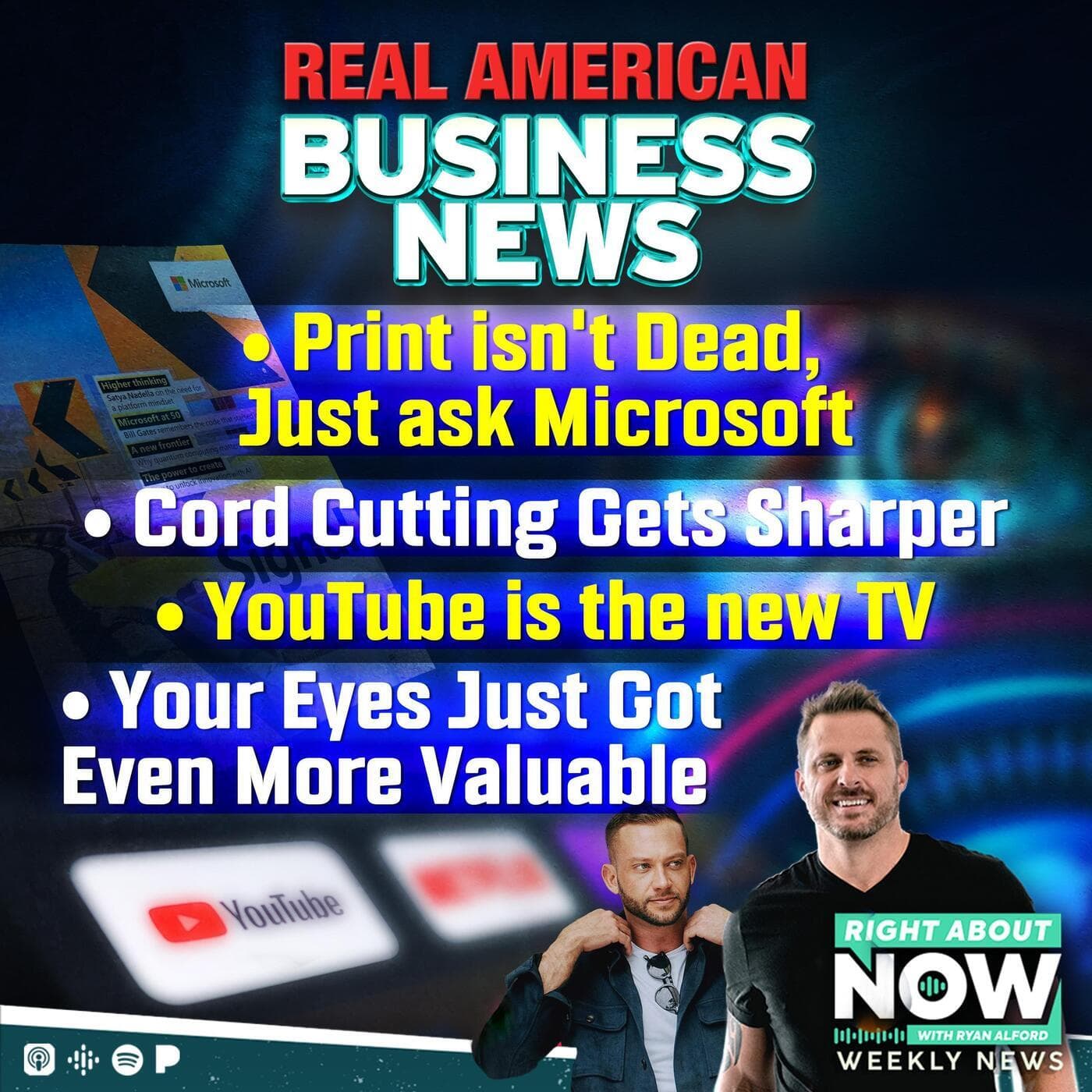
Real American Business News: Print isn't Dead, Just ask Microsoft - Cord Cutting Gets Sharper - YouTube is the new TV - Your Eyes Just Got Even More Valuable
Episode Overview In this episode of *Right About Now*, host Ryan Alford navigates the latest business trends and innovations that are reshaping the landscape. The episode features discussions on Microsoft’s transition to digital media, the NBA's streaming deal with Amazon, and the implications of new biometric technologies. Special guest Gary Vaynerchuk provides insights into the exploding collectibles market, particularly in trading cards. Key themes include the enduring relevance of print, the pivot from cable to streaming, and the necessity for businesses to innovate continuously.
---
Key Discussions
Microsoft’s Shift from Print to Digital
- Transition: Microsoft has phased out glossy print magazines to focus on digital media.
- Implications for Branding:
- Targeting niche audiences, particularly older demographics.
- The use of storytelling in magazines to engage high-value customers.
- Importance of creating a brand narrative through quality content.
NBA’s Streaming Partnership with Amazon
- The Deal: Exclusive streaming rights for NBA games on Amazon Prime.
- Impact on Viewership:
- Shift from traditional cable to streaming platforms.
- New opportunities for direct consumer engagement through integrated shopping while viewing.
Sam Altman’s Eye-Scanning Technology
- Biometric Advances: Introduction of eye scanning as a means of online identity verification.
- Concerns:
- Potential privacy issues and identity theft.
- Balancing security with user consent and data protection.
The Collectibles Market
- Trading Cards: A significant resurgence in the trading card market, driven by nostalgia and technology.
- Gary Vaynerchuk's Insights:
- Collectibles as a powerful expression of fandom.
- The merging of physical and digital trading cards—both have value in the market.
- Growth projections for the trading card market, expected to reach $52 billion by 2027.
Major League Baseball and Digital Collectibles
- New Initiatives: MLB's foray into digital trading cards.
- Market Potential: Recognizing the value of both physical and digital collectibles.
Apple’s Manufacturing Expansion to India
- Strategic Shift: Increased production in India as a response to geopolitical tensions and supply chain challenges.
- Global Supply Chain Implications: A move towards diversification to reduce reliance on China.
---
Key Takeaways
- Print Media is Not Dead: There remains a significant audience for quality print materials if targeted correctly.
- Streaming is Dominating: The move away from cable is accelerating, with major sports leagues embracing digital platforms.
- Identity Verification: Innovations in biometrics could revolutionize online security, though they come with concerns.
- Collectibles Boom: The trading card industry is thriving, merging physical nostalgia with digital innovation.
- Adaptation is Essential: Companies must innovate and diversify to stay competitive, as seen with Apple's strategy in India.
---
Conclusion This episode of *Right About Now* provides valuable insights into the evolving business landscape. Ryan Alford emphasizes the need for businesses to remain adaptive and forward-thinking in a world where consumer behavior and technology are rapidly changing. The discussions offer practical advice and highlight trends that business leaders should pay attention to in their strategies.
For more information and insights, visit [RyanIsRight.com](http://RyanIsRight.com).
---
Privacy Note: See Privacy Policy at [Art19 Privacy Policy](https://art19.com/privacy) and California Privacy Notice at [California Privacy Notice](https://art19.com/privacy#do-not-sell-my-info).
Written by AI. May contain mistakes. Listen to the episode to check what was said.
Transcript
Automatic transcript. May contain errors.0:28This is the story of the one. This is Right About Now with Ryan Alford, a Radcast Network production. We are the number one business show on the planet with over 1 million downloads a month. Taking the BS out of business for over 6 years and over 400 episodes. You ready to start snapping necks and cashing checks? Well, it starts right about now. What's up guys? Welcome to Right About Now. It's our weekly business news here on Friday, May 23rd, 2025. Hey, hard-hitting week this week. Lots of topics crossing the gamut. We've got business news, pop culture. Hey, we covered the gamut of trading card business, the hobby.
1:13Everything happens here on Right About Now as we keep it real, we keep it raw, and we go hard right here every week on our news episode. So this week, Microsoft drops glossy print magazines. The NBA makes a play for streamers. And Sam Altman wants to scan your eyeballs. I don't know about that. Plus, YouTube goes full Hollywood. MLB launches digital trading cards. And Home Depot prices. And, of course, iPhones in India. All that and more here on Right About Now. All right, guys. First up today, I did want to give you a little teaser of what's going on in our hobby trading card series. Rule the hobby, baby.
1:58We're telling you everything from the top to the bottom, from retail to wholesale. Had some amazing guests and more to come. Again, telling you about the business that is trading cards, the investment opportunities, and of course, where it's all headed. We've had some amazing guests. Gary V, everybody knows that name. Brian Ludden. He is the founder of LudX. and several other friends, colleagues, and big players in the industry. Here's just a little sample of what that series is bringing to the table. What the biggest thing is when you open those cartridges, what do I have? That's the question.
2:33Because you know you got something good. My kids know, but they're like, they don't know how good. And Ludox is kind of the gateway to knowing what you have. Yeah, it's knowing what you have and knowing what it's worth. Those are the two pillars that we kind of go off of. And, you know, it's technology, so it's never done. It's never completed. But, yeah, I mean, really, that's what we want to be. We don't want to be an authority in anything. What we want to be is we want to be an information tool to help people enjoy this industry and this hobby. I think VFriends is probably going to end up being the biggest business I ever built.
3:09You know, I feel like it's a very substantial intellectual property, collectible business. I think the characters represent the things I most care about in the world. So I think these 250 characters are going to allow me to extend all these things I want the world to know about. I've done a lot as a human and put myself on the map, but I'm not going to reach all 8 billion people. Meanwhile, a VFriends cartoon that talks about tenacity and hustle and kindness can be dubbed in Italian and be running on Netflix Italy in five years. and I'll be accomplishing the same ambition, which is my whole life has been about really a framework of selfish and selfless behavior, right?
3:51Selfishly, I'm an entrepreneur. I want to build things for me and my family. I think I'm allowed. I think you're allowed. I think everyone's allowed. However, I do like leaving a positive impact. I get pumped when entrepreneurs come up to me that basically make more money than me taking my learnings and applying them. I'm like, good for you. That makes me happy. That doesn't make me unhappy. So that's kind of the goal with the framework here. 35 % of us are genetically predisposed to want to collect stuff. Sort of remnants of Hunter x. Yeah, the human condition a little bit. You know, like that fine language in collecting and hoarding.
4:26I think the tide is rising on collecting because collecting is the ultimate expression of fandom. And fandom is one of those last safe spaces where we can all come together and cheer on a team and not be angry at each other for something else. What made you go from breaks to retail? You know, when I was breaking, I was happy. I had no overhead. And I was doing really good financially. But I got tired. I'm a people person, Ryan. Yeah. I got tired of sitting in the house by myself, running back and forth from this room to that room. I wanted to be around people again. The only time I was around people was when I went to a show, which was once every month or two.
5:14I really liked the element of the face-to-face interactions, getting to know people, bonding with people, learning people. Like you said, you know my family. You have a great family as well. And it's been an honor and a pleasure for me to meet your family and become a part of you. I'm an extended part of the family. I love it. First up today, Microsoft drops Glossy Print Magazine. Seriously, are you kidding? This made a lot of sense to me, actually. And I think here's the punchline. There's a lot of niche audiences that are hard to reach. And for whatever reason, we always think there's like one size fits all.
5:53Like, you know, digital media has proliferated, but there's still a lot of people that read print magazines and that like the physical touch. Look, we're doing a freaking trading card series right now. My kids love it. Physical media isn't completely dead. It's just there's a lot of synergy and a lot of efficiency that happens with digital media and knowledge spreading digitally on your phone. But people still like to spend time with printed materials, collect those things. People are reading. People are trying to put the phone down even. So it makes a lot of sense, especially with Microsoft's target being a little older.
6:29So I love this for a couple of reasons. Number one, it's niche marketing at its best. But number two, it's also signals a way for Microsoft to build brand. It's getting harder and harder to build brand and sort of this performance marketing land that, you know, everything's for sale. What's the feature? What's the price? Well, Microsoft isn't just telling you about every feature of a computer. They're doing it through the lens of a magazine that tells story, has journalistic content that people actually want to read. And so, again, they've done it in a really slick magazine form here to a target that has a lot of spending power.
7:07They're targeting a lot of CEOs, CXOs, people that buy a lot of computer software, different things. They're trying to reach them. And this is the way to do it. It's hard to hit these targets sometimes because they're not scrolling on Facebook all day like some other people. And they're not always in these digital mediums. So you get them in a space of comfort and somewhere where they're spending time with a product in a magazine. And you can tell brand narrative stories that, again, are building your story through a funnel of getting them through the purchase cycle. And you're not always hitting them over the head with a price point.
7:42I think physical media still has a place in 2025, but it needs to be done in the right way for the right audiences. and they've done, I think it's 1 ,500 copies of this. So it's limited. This is a very small audience. But again, you're going to see this on coffee tables in some of the wealthiest homes. This isn't something that just gets thrown away like a circular. This is way deeper than that with the storytelling and the way that they're bringing to life the technologies and the partners through the magazine. So I love this. It plays into a little bit of that surprise and delight as well as the novelty of something that might even be collectible.
8:24Signal Magazine is actually doing the printing. So high quality piece. Smart move here by Microsoft. Next up, NBA is jumping into streaming with Amazon. Hey, guys, we've been talking about this every week. The cord cutters, we've been talking cord cutting for 10 plus years, but it's officially coming for cable. You've got apps. You've got these gigantic platforms, Google, Amazon, Apple, these huge, huge platforms where people are already existing every day, shopping every day, watching content every day. You've got Prime Video. You've got Prime Shopping. You have the integration of that. We've talked about that.
9:06And now the NBA is eking this deal with Amazon for exclusive games. Makes a ton of sense. You can see it in Amazon Prime. We saw this a little bit with Netflix as we play in the NFL space. You're going to see more and more crossover across all of these different apps and communities that are already built where people are already spending time. Again, I'm not going to get the remote control out. I'm going to go from phone to big screen, casting in the living room, and the cable box is going out the window. It's going to be an app world. It's going to be streaming world. All of these things are starting to come together as people buy and engage with the content that they want to, and not just the 400 channels that have been curated, of which 390 you don't watch.
9:55So, again, Amazon is growing every single day, behemoth, but they need that younger tech-savvy audience. So, this attracts them in because, again, you've got a lot of moms, a lot of people that shop on Amazon every day. So, they've got to keep it relevant with the content that they're bringing in. So that's where the NBA play is. And then the NBA has got more audience, more reach across the Amazon universe. Makes a lot of sense. I can see totally alignment. Here's where it gets real interesting. You're watching the game and the jersey that they're wearing, a little button flashes up. And you can order that and get it the next day or even in two hours to your house straight from Amazon.
10:35Don't think we're that far from that. We are here. This integration for this shopping giant with the media makes it a perfect play for commerce and entertainment coming together. So big deals. ESPN last week, Amazon this week, NBA jumping heavy into streaming. This next one gets into that space of sci-fi a little bit. I'm thinking back into the days, watching Star Trek, different things, scanning. We know it's coming. Biometrics have been out there. Fingerprint scanning. Now, Sam Altman, one of the founders and original players with ChatGPT and always in the ring with Elon Musk. Sam Altman and Elon Musk don't like one another.
11:21If you were, cool you in. Let's just get over it. Let's get a UFC fight going already. Anyway, Altman has got eye scanning. Look, I saw this device. It literally, and look, let's say why they're doing it before we get into sort of the scary part of it. You know, you have all this deep fake, all this personal, you know, like fake everything happening where you don't know what's real and what is. You don't know what identity is or isn't because you don't know if someone's just really the video of them. The eye scanning creates literally it's like the fingerprint. You know that this is the person that you're doing with so that whenever you're doing activity online, if it scans your eye, it's identified you.
12:04and again, it can be part of creating safety and assurance online. Also, when you're going into a store or different places. Now, you can go down the rabbit hole that a lot of people do, which is, okay, you start scanning your eye. It's going to allow you to do things or not do things. It's going to create gatekeepers because, hey, you can't. I'll stop short of that. I will just say, how do we control how this information kind of gets out? Once there's this eye scan and it's out there, can it be protected? I'm sure they've thought of all of these things, but that's where my mind goes. And it's one thing, defake, and then someone steals your perfect iris pattern and they're going around impersonating you and doing things.
12:54So I don't know. We'll see. I think you could go down the privacy nightmare or the smart future. It's hard to say which one is right or wrong. I don't know. I don't have a crystal ball, but maybe your eyeball is the crystal ball. It's all about blockchain. Deep thinking here. Blockchain is where this all ties into. It's ID. So again, I'm going to start short of all the code and everything that's involved with blockchain. I don't want anyone's eyes or ears to go crazy. But this is the future of identification. It's not going to be a future where we're scanning our driver's license off of our iPhone app.
13:37There's got to be a more safe and secure, identical way to verify identity. It's getting really important because in a world where you don't know what you're watching is real or fake, We want to have that identity guarantee. So that's where I agree with it. It's just in whose hands and when and how is it used. We'll see where it goes. But Sam Altman sees this as the future. And as if it takes off, it being the worldwide standard for which identification is measured and deployed. Hard to believe YouTube's turning 20 and is officially declaring itself TV. TV. It's funny how we classify things. TV, video.
14:19What is television? Is television on your phone? Is it the location? Is it in the living room? Or is your TV, your phone, sitting in the shopping line? It's hard to know, but officially, YouTube's taking off the gloves, saying, we are the TV. And I think what we're really talking about is what we said before, which is cable. It's the way with which content is delivered. And the app, the web, etc., for how content gets delivered to your phone or your TV doesn't really matter. But what does matter is more 18 to 49s are watching it than all of linear TV, which is TV that plays on its own schedule and not yours.
15:04Not hard to see that that was coming, but YouTube has also made it where you can discover more content. I mean, think about how hard it is even today. I have YouTube TV and I want to know what's on. So I'll go to the guide. Going to the guide is like the death by a thousand pinpricks. Oh my God. What is on? What's not on? Okay. I'm done. I'll just watch sports again. I've already seen this game. I'm still watching it because I don't want to go back to the guide. Shoot me now. YouTube, you can discover new things. They have an algorithm. them. They know what you've watched. You think cable TV has figured out in 45 years how to show what I am actually interested in?
15:42Hell no. It's showing me lifetime movies when I log on. Maybe my wife was watching them. I don't know, but she doesn't have time to watch them. So this is about ease of discovery, removing friction. You should apply, this could apply to any industry. You want to know why things die? Because people, services, apps, any insert product here comes along and removes friction, solves a problem, makes it easier. YouTube makes it easy to find what you're looking for. Quick search, quick find, and it's learning constantly. Just like that TikTok algorithm that's got you staying up till 2 a.m. down the rabbit hole.
16:21Similar to sitting here with YouTube. So TV's not dead. Friction is dead. That's what YouTube figured out. That's why they're winning. That's why people like me don't want to go. Hey, don't let friends go to the TV guide. I'm telling you, you'll thank me. I can't stand it. That's why people are watching more YouTube. That's why podcast discovery is happening faster on YouTube than anywhere else. It's not necessarily that watching content and video or TV, none of that's dead. All of that is alive and well. What is dead is friction and making it hard and staying with old solutions that don't solve new problems and new expectations.
17:08Expectations have changed. We don't live with things that get in our way to find what we want. We watch when we want, watch what we want, when we want, how we want it. That's what YouTube mastered and that's why they're winning and that's why it's going to be a while before anyone replaces them. We've been talking trading cards. Why don't I go write it again? MLB is launching digital collectibles. We talked to Gary Vee recently and look, it's not and. Is it physical trading cards? Or excuse me, it's not or, it's and. It's not physical trading cards or digital cards. It's one or the other. You can do either one.
17:45Neither one of them is killing the other because they both still have value. And again, the MLB is leading into this and leading into both the nostalgia of trading cards, but leading into the digital aspect of online trading. So again, MLB has seen it. They want to get in on the game. They watch all these other companies making tons of money in the arbitrage that is the hobby, and they're getting in with their own digital collectibles. iPhone, hey, all this tariff stuff, people start making moves. Big companies start making moves. Costs, diversification, and Apple is no different. They're leaning into getting stuff made and put together in India, leveraging the incredible workforce they have, the size and scale of India, and again, getting less reliant on China.
18:33Hey, if you make it hard to work with you, you raise costs and you have all this government oversight, at a certain point, companies aren't going to keep dealing with that. So China's going to have to recognize that. They're going to have to realize that you can't have it both ways. All this control, but still want all this world money coming to you. And Apple recognizes it, leaning into India, becoming a real player in the tech manufacturing space at the same time. They've got a huge population. They can scale these kind of things. And good for them. They're an ally of the U.S. And it's great for business to diversify.
19:09Apple teaching us the way. Let's talk about some key takeaways from today. Print isn't dead. There's a time and a place for everything, niche audiences, print included. Again, it's not about printing everything. It's about printing the right thing for the right audience. Sport leagues are ditching cable like it's 2013. Look, we've been talking cable cutting forever. It's going fast. And look, I don't want to watch the same 400 channels, 390 that I don't like. It's about choice, yes, but it's about the right choice when you want it, where you want it, how you want it. Same thing with YouTube. That's your takeaway.
19:46Remove friction and realize that the ways of doing things in the past, what people would deal with, isn't the same. You got to get that stuff out of the way if you want to advance. Baseball cards, still cool? Yeah. Digital? Yeah. Physical? Yeah. Lots of money? Hell yeah. Finally, Apple wants less China, more India. Point noted. That's your episode for today, your business news, business trends, and all the highlights that you need to get ahead. The stuff you need, none of the fluff you don't. We remove the spin. We take it where you want to go right now. This is Now Media. This is Right About Now.
20:30Billions of dollars, millions of collectors, one booming industry. Trading cards aren't just back, they're taking over. projected to hit$52 billion by 2027. The hobby has evolved into a full-blown business with culture, cash, and clout all at the center. From the vault to the back room, we're talking to the heavy hitters right in the future of the hobby. We feature Brian Ludden from LudX, the fastest and most accurate trading card scanning app. Gary Vaynerchuk, CEO of VaynerMedia and creator of vFriends. South Carolina card king, Matty Rich, one of South Carolina's largest retail store owners, and SI Collectibles contributor and sports executive, Jeremy Eisenberg.
21:14Plus, some other surprise guests. This isn't just about collecting. It's about investing, scaling, and ruling the hobby. Right about now, we're making the hobby make sense. Massive dollars. Don't miss this incredible series. Go to RyanIsRight.com. Find highlight clips, all the episode information, links to social media, YouTube, all the good stuff. None of the bad stuff. We appreciate you. See you next time. Right about now. This has been Right About Now with Ryan Alford, a Radcast Network production. Visit RyanIsRight.com for full audio and video versions of the show or to inquire about sponsorship opportunities.
21:53Thanks for listening.
From the publisher
SUMMARY
In this episode of Right About Now, host Ryan Alford breaks down the latest business trends shaping the future. He explores Microsoft’s strategic pivot from print to digital media, the NBA’s groundbreaking streaming partnership with Amazon, and the implications of Sam Altman’s eye-scanning technology. Special guest and entrepreneur Gary Vaynerchuk shares insights on the growing value of collectibles and how technology is transforming the trading card industry. The conversation also covers Major League Baseball’s move into digital collectibles and Apple’s manufacturing expansion into India. Key takeaways include the lasting relevance of print, the accelerating shift from cable to streaming, and the critical need for innovation and diversification in today’s business landscape.
TAKEAWAYS
- Microsoft's transition from print to digital media and its implications for branding.
- The NBA's streaming partnership with Amazon and its impact on sports consumption.
- Sam Altman's eye-scanning technology and its potential effects on online security and privacy.
- The significance of collectibles and technology in the trading card industry.
- The resurgence of trading cards and the role of nostalgia in collecting.
- Major League Baseball's initiative in digital collectibles and the merging of physical and digital experiences.
- Apple's strategic shift to increase manufacturing in India and its implications for global supply chains.
- The importance of adapting to changing consumer engagement methods in media and collectibles.
- The projected growth of the trading card market and its cultural and financial significance.
- The need for companies to innovate and diversify to remain competitive in a dynamic business environment.
See Privacy Policy at https://art19.com/privacy and California Privacy Notice at https://art19.com/privacy#do-not-sell-my-info.