
In short
Right About Now - Legendary Business Advice
Episode Summary
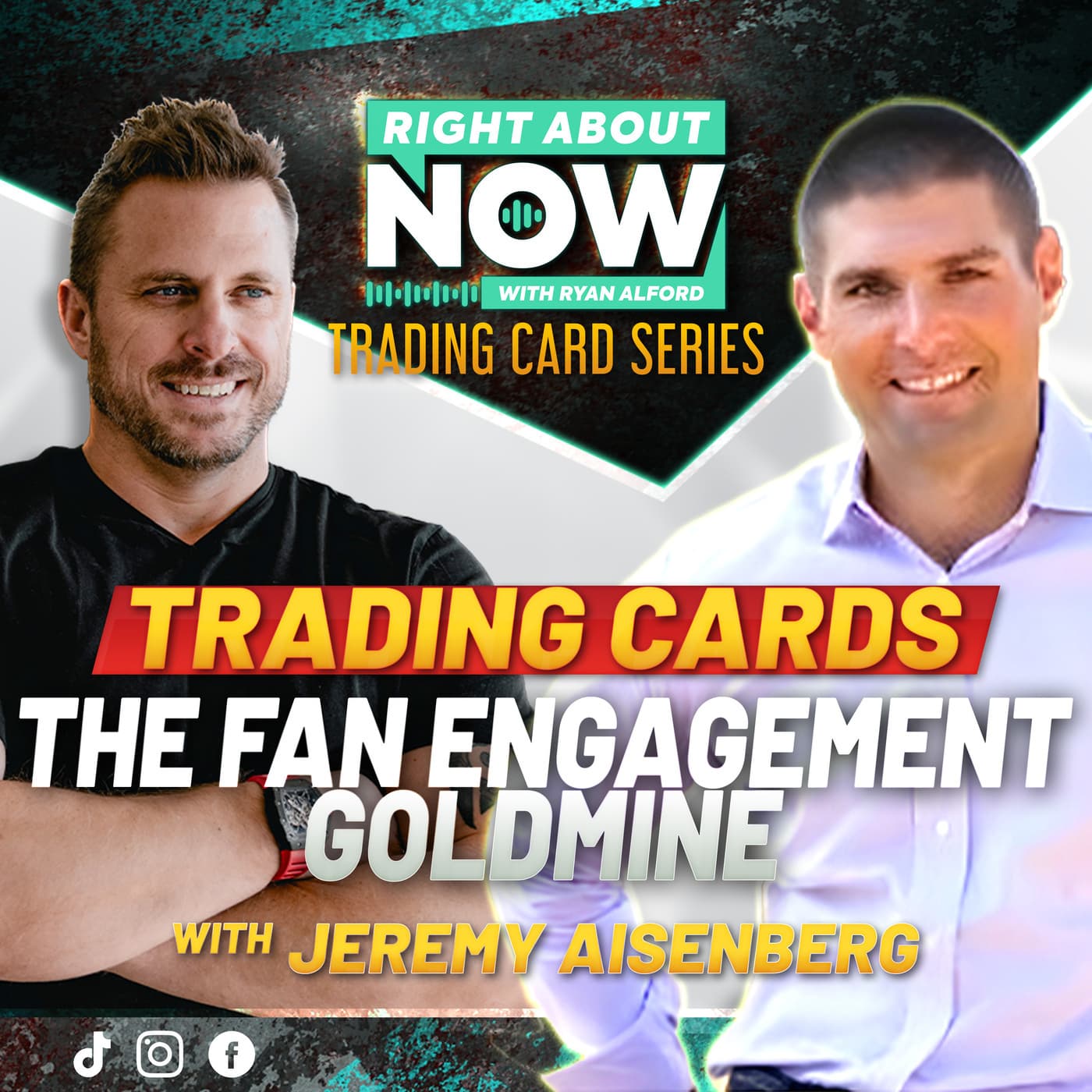
Trading Cards: The Fan Engagement Goldmine with Jeremy Aisenberg
In this episode of Right About Now, host Ryan Alford engages Jeremy Aisenberg, founder of Talent Brand Labs and a significant figure in the trading card industry. The conversation dives deep into the evolution, cultural impact, and future of trading cards, emphasizing how they foster sports fandom and community engagement.
Key Topics Discussed
- Resurgence of Trading Cards:
- The trading card industry is projected to reach $52 billion by 2027, marking a significant resurgence.
- The evolution from hobby to a full-blown business with culture and cash involved.
- Cultural and Community Impact:
- Collecting trading cards enhances sports fandom and creates a sense of community among fans.
- Aisenberg shares personal anecdotes about his journey in collecting and the influence of sports figures on this hobby.
- Digital Transformation:
- The impact of digital media on the collector's experience.
- Discussion on the rise of digital collectibles and NFTs within the trading card space.
- Grading and Trust in Collecting:
- The significance of grading in building trust within the collecting community.
- How grading addresses subjective condition issues that were previously roadblocks for collectors.
- Future of Collectibles:
- Innovative approaches to collecting, including online breaks and repacks.
- The competitive landscape of the industry and the implications for innovation.
Key Takeaways
- Growth Potential:
- Collecting is recognized as a key pillar in making fans stickier to their teams and leagues.
- The trading card industry has immense growth potential, especially with the involvement of major brands.
- Engagement with Younger Fans:
- Engaging younger fans through collecting is essential for the industry's future.
- Collectibles can serve as a bridge to bring families together through shared interests.
- The Role of Technology:
- The discussion encompasses how emerging technologies, including blockchain, can enhance the collecting experience.
- The importance of adapting to digital trends while maintaining the excitement of physical collecting.
- Building Community Through Collecting:
- Sports fandom can unify diverse groups of people and create a space for shared experiences.
- Collecting is not just about the items but about the stories and connections formed through the hobby.
Notable Quotes
- "Collecting is the ultimate expression of fandom."
- "If you have the goods, you can achieve a lot."
- "The thrill of opening a physical pack and holding the cards is hard to replace."
Conclusion
The episode offers a fascinating look into the world of trading cards, illustrating how they serve not only as collectibles but also as a means of enhancing fan engagement and community. With the evolving landscape of both physical and digital collectibles, the future of the trading card industry appears promising and full of potential.
For more insights and episodes, visit [Right About Now](https://www.ryanisright.com).
Written by AI. May contain mistakes. Listen to the episode to check what was said.
Transcript
Automatic transcript. May contain errors.0:00Part of how we grow the hobby and bring more people into this as a way to make fans stickier to their teams and the leagues and sports is collecting. When the licenses were being held by Upper Deck and Topps and Fleer and Donruss in the 90s, it sparked a lot of innovation. You think about some of the great vintage insert sets of the late 90s and early 2000s are some of the most collectible cards on the planet. Billions of dollars, millions of collectors, one booming industry. Trading cards aren't just back, they're taking over. projected to hit$52 billion by 2027. The hobby has evolved into a full-blown business with culture, cash, and clout all at the center.
0:49From the vault to the back room, we're talking to the heavy hitters right in the future of the hobby. We feature Brian Ludden from LudX, the fastest and most accurate trading card scanning app, Gary Vaynerchuk, CEO of VaynerMedia and creator of vFriends, South Carolina card king, Matty Rich, one of South Carolina's largest retail store owners, and SI Collectibles contributor and sports executive, Jeremy Eisenberg. Plus, some other surprise guests. This isn't just about collecting. It's about investing, scaling, and ruling the hobby. Right about now, we're making the hobby make sense in massive dollars.
1:25Don't miss this incredible series. What's up, guys? Welcome to Right About Now. We're always talking about how to learn more about business and get Right. And, you know, we could talk about last week. We could talk about two years ago, but we want to make it topical for today. And, you know, I can admit when I'm doing guilty pleasure, but I'm doing guilty pleasures that you need to know about because this is part of our trading card series. We had Brian Ludden from Luddex on. We've got one of the biggest collectors in the southeast that's coming on. We've got some other big names, and that's why I went to Jeremy.
2:01Jeremy Eisenberg. He is not only an OG trading card guy, talent brand labs founder, and I think just a sports junkie. Is that what it is, Jeremy? Yes, that's fair. Sports has been a big part of my life as long as I can remember. Yeah, man. octagon uh any of any of our agency crowd will know some name drops that'll get in here um we compared some more stories of agency life a little bit uh before we got started both kind of coming up through that jeremy i i do i did go through like your background and brian shared a little bit but i was like you know and i got blessed to work on you know verizon some big names we did some sports sponsorship stuff, but it wasn't to say that my backgrounds in sports brand marketing, all that would not be painting the, I'd say more wireless and tech, but I read yours and I go, who wouldn't grow up and go, I will, I want to be that.
3:03That's what I thought when I was reading through your kind of bylines and everything you've done. I've been lucky, man. That's all I can say. I, uh, I didn't necessarily, it wasn't the plan. I was, uh, get a PhD in genetics and took us a leave of absence and ended up, uh, working for one of the most influential people in golf. And, uh, that was a quick PhD in business and, and, uh, where, where that, uh, entrepreneurial first step has taken me in the last 20 years is someday I'll write a book. It's been, I pinch myself. It's been amazing, amazing journey. You need to name that name, though. And our listeners that knows if you're in golf and maybe not golf, you'll recognize this name we talked before.
3:49Might be one of the first influencers in golf, wasn't he? David Letbetter. Yeah. When I think about, I was lucky enough to go work for a guy who recognized that his opportunity to leverage his influence and the attention he was able to generate across his own channels and through businesses he owned and controlled. He built an instructor certification business, a brick and mortar academy business, a product licensing business, a product development business, a content distribution business, and all before the introduction of social media. And so I took that experience working for David and, you know, learning from him and seeing how important it was to over deliver value.
4:34I took all these great lessons and got to work over 18 years for one of the largest agencies in the world and apply that personal branding to this explosion of digital and social content and democratization of distribution. And it's it's it's taking me in all sorts of exciting directions, some of which hopefully we'll get to chat about. Yeah, man. I'm glad you brought up the democratization of of content and distribution. And that's what's so damn impressive about what David did, you know, but is before, you know, even that time, you know, like talking about mad respect. Like he didn't even have the benefits that like there's no excuse for anyone now.
5:18Like if you've got, if you've got the goods, you got the goods, you got to have the goods. You do have to have that. But if you have that, nothing's in your way with the way social media. And if you throw YouTube in there, it's social, but whatever content distribution. And, and, you know, we can talk about wall gardens and all that stuff. Don't let that get in your way. Like you have an ability to reach millions, you know, like I, I, people throw that around. I'll throw it around sometimes. And look, I'm building a podcast network. I don't always love the walled garden thing. However, I'm not going to smack the hand that feeds me in.
5:56It's got a built-in user base of billions. So it is what it is. But I think it's been fascinating for me. But I think especially for you, I'm sure, Jeremy, that whole journey, watching what's happened in this explosion of all these channels, You know, TV, online, social media, YouTube, now TikTok, Instagram, all these things with the people and brands that you've worked with. I'd love to dive down that little bit, you know, telling kind of your story because you kind of came up through it all. Yeah, that's that's I appreciate that perspective. I always felt like I was representing challenger brands, so to speak, because I wasn't representing the agency that I work for Octa.
6:40We had Michael Phelps. We had Steph Curry. But I was representing coaches and broadcasters in golf. Now, where golf had this great advantage was the people who distribute content related to playing better golf have an outsized amount of influence over their audience. You know, if someone is promising, you know, better, better scores, lower handicap, more fun playing golf, they're basically promising them, you know, a dopamine high. Right. So I was able to it's what I've said to a lot of big technologists is golf is this incredible test kitchen for new innovative technology. You know, when Microsoft was looking at how the augmented reality world might come into play in business, they used golf courses as the way to visualize and bring that to the business community through a PGA Tour partnership.
7:32But, you know, you're able to use HoloLens and see how, you know, this holographic type interface works. And it was a great example of where golf's influence and the pyramid of that influence is so, so powerful and why I've been able to be, you know, as someone like Hank Haney was written up in Wall Street Journal in 2011 as the most authentic user of Twitter in the world. Not just the golf guy, but in the world, because we were out there trying to find ways to showcase our content in as many channels as we could. And whether that's through augmented reality or whether that's through podcasts or through OTT subscriptions, Hank had a very significant eight-figure business, 10 million-plus business a month doing online content subscriptions.
8:33because, again, that insatiable appetite for game improvement is undying. So the premise has held true, and guys like Gary Vee have been both friends and sort of influences as well, is the bottom line is you've got to put your message in as many places as the potential audience might be. And the gatekeeping makes sense in certain spots, But really, you know, ubiquitous omni-channel content distribution authentically and organically is is the answer. And then if you've got the goods, you know, you can you can achieve a lot. How did the trading card thing come? I mean, where did that enter? Obviously, and you'll talk about, you know, as a kid and stuff, you know, like we a lot of us have the kid stories.
9:21But where did that intersection happen in the career? Yeah. So I collected like everybody. I stopped collecting. I was born in the late 70s, collected in the mid, late 80s, sort of put them all away in the early 90s and got into Nirvana and Pearl Jam and went to college and got married and had kids and started a career. Sounds familiar. And then I woke up and I was 30 something and I maybe my my folks made me take more of the cards home. But like probably right about the time I got to Octagon, 2006, 2007, I sort of saw cards lying around the office. And, you know, we started representing big stars.
10:01And I'm thinking, I wouldn't mind getting a basketball signed by David Robinson. And I started kind of, you know, I'm in the sports marketing business at this point. And I've been, you know, on private jets with Hall of Fame athletes and, you know, mayors not to ask for autographs. So it's sort of, it's this, you know. Hey, you want to go get the benefit while you're there, right? I have a great story and it just shows you what an amazing human this guy is. And everybody's probably got a good one of these with Charles Barkley. But I was so talk about like a Forrest Gump kind of life. But I was very fortunate to get to become very good friends with Charles when Hank Haney filmed the Haney project.
10:41I was on site for most of the production days over six months and ended up being Charles's dinner date for quiet nights after a long day of filming. And, you know, Charles used to say when somebody would be coming up to the table, he'd be like, yeah, I finally I said, you're so you're so kind to these guys. You never say no. You're always chipper. How do you do it? And he goes, man, it's going to take me the same 15 seconds either way. And this guy is going to go around for the rest of his life and say I was either a jerk or I was a great guy. And for me, it's the same amount of time to blow him off or to be nice.
11:21And, you know, that just gives you a lot of respect for how hard it is for them to find, you know, peace and quiet. And, you know, the bigger the star, the harder that is. And I got to see that up close and personal. But at the same time, collecting is such a fun, fun aspect of being a fan. And so I got that. It just got scratched again. And, you know, I might have mentioned this when we were chatting. I mean, Michael Rubin deserves all credit in the world for his identifying collectors as the best fans. And in order to, you know, I really believe that this hobby is in its infancy from a growth perspective.
11:55And I, yeah, well, at Octagon, we did some really cool research into the hobby to illustrate that part of how we grow the hobby and bring more people into this as a way to not just grow the hobby, but to make fans stickier to their teams and the leagues and the sports is collecting. And it's clearly acknowledged now by, I was talking to the NHL about the opportunity to engage young fans through collecting. It's sort of identified now as one of the pillars. And the growth trajectory for collecting in general is pretty exciting. And, you know, one of the things we'll talk about is what we've built in partnership with Sports Illustrated and Authentic Brands Group and Minute Media, who are our partners in the Sports Illustrated collectibles business.
12:50Yeah. Everybody's got their hands. They know, like the collectibles, you know, realm and the trading cards. They see the smart people are connecting the dots and building units, you know, around how you connect all these things together and how you leverage it to, you know, keep fans being fans. And, you know, I think the smart the winners are going to, you know, not that they'll necessarily be losers. I don't know if there's any losers. I won't go that far, but there's definitely going to be some big winners. and it's hard not, it's had some rocky moments, I think, the Fanatics and Topps. There's been some stuff, but you can't deny that it feels directionally right, is my observation.
13:40They're opening the tent wider, right? The Fanatics Fest, we went to the first Fanatics Fest. It was awesome. Couldn't have been a more fun, entertaining experience for casual sports fans. there were plenty of areas that they were the first to recognize they can make improvements on. I'm excited for what they'll do in the event space. I think healthy competition is good and Panini is not going anywhere and Upper Deck is not going anywhere. Did that deal need to happen though? Pardon? The Panini tops. Did that deal need to happen though? Would it have been better for the industry? It's a great question.
14:21I think it would be better for the industry to have more than one license. I think competition is great. I think when the licenses were being held by Upper Deck and Topps and Fleer and Donruss in the 90s, it sparked a lot of innovation. You think about some of the great old vintage hold, you know, insert sets of the late 90s and early 2000s are some of the most collectible cards on the planet. You know, that's the that's the pinnacle of upper decks, you know, early work in in memorabilia cards and autographs. And, you know, still to this day, when I show some of the trading card innovation to people who've been out of trading cards for a while, they're blown away by what's happened.
15:12And, you know, the collectability and the tentacles, you know, into art and, you know, into, you know, serious game use memorabilia, you know, to museum quality pieces and investment funds looking at this stuff through the lens of alternative asset classes. It's, you know, not related to my background as a geneticist, but 35 % of us are genetically predisposed to want to collect stuff. Sort of remnants of hunting. Yeah, the human condition a little bit, you know, like that fine line between collecting and hoarding. I think the tide is rising on collecting because collecting is the ultimate expression of fandom.
15:59And fandom is one of those last safe spaces where we can all come together and cheer on a team and not be angry at each other for something else. Yeah, I know. Everything is so polarizing. It's black and white. You know, like, I mean, but in sports, you kind of it feels like you can. I mean, you're always rooting for one team or the other, but it just it's different than, you know, the shit that's out there that is just maddening and polarizing. Yeah, I don't feel like fandom is polarizing. It's just fandom. Almost every Republican and Democrat in Boston can agree on the fact that they want the Red Sox to kick the crap out of the Yankees.
16:42Yeah, exactly. They come together and where you can start to bring people together, you can find the opportunity. So sports has been that. And like I said, I've been so fortunate to be able to be on the journey I've taken. And this platform we built with Sports Illustrated, I chased the SI leadership for years. you know, they are an iconic brand, not just in sports, but also in collecting. And the thing that I observed through my years at Octagon, where I mentioned I did some consulting work for Topps, we identified that lapsed collectors were this huge universe of people coming with kids and ready to rediscover the hobby.
17:33You know, I was able to help broker the deal between Gary Vaynerchuk and Topps to create a, uh, to create a insert set within, uh, 2019 Topps series two around, uh, the best entrepreneurs in baseball. And Gary was very adamant. He wanted Topps, um, we proposed to Topps developing a collaboration with Gary around a, uh, what they were doing, branded sets, direct to consumer custom branded sets. And they launched the first one with Bryce Harper. It was a big success. And they were looking at subjects to do the next one with. And we said, well, maybe you should take a look at Gary Vaynerchuk. He's obsessed with cards and now could be a perfect opportunity.
18:19And they took it and put a really fun set together that unlocked Gary's universe to the latest and greatest of modern sports cards. And lots happened since then in the hobby as well. But, you know, one of the things that was missing all through that journey, long-winded here, was a major sports media platform that was paying attention to the hobby. And that's what we were able to convince SI to move forward with. Talk to me about, you know, what SI is doing. You know, like I think, when you think about the collectibles, it's so ironic. Old Sports Illustrated magazines, One of the most collected things for sports fans especially.
19:04I've got – I'm not even – just in the last six months have gotten back into collecting cards. But I wouldn't consider myself like a lifelong collector. But I am when I go – I've got like 10 or 20 Sports Illustrateds that I've hung up over the years. And some are autographs. I went to Clemson, so I got some Dabo Sweeney and Deshaun Watson. You know, like that, that meant more a few years ago, but we won't go down that road. But anyway, it is what it is, but it's, it just fits. So talk to me about what Sports Illustrated and you've been doing. What is that division exactly? Well, so, so, you know, when Sports Illustrated said, yeah, we're, we're into the idea of building a hobby vertical.
19:53The first thing we did was, was built out a team and we, we hired a, so I have two partners in this collaboration with SI, a guy named Chris Perrone, who had previously been the general manager of SI at Arena Group and was my partner in helping us to launch the idea initially. And then come full circle, Minute Media was interested in the opportunity to do the same thing. And we were able to launch SI.com slash collectibles. And, you know, why that's significant is that the SI.com domain is one of the oldest and most trafficked on the Internet and most has the highest one of the highest domain authorities on the Internet.
20:37You know, sort of how Google ranks sites and drives traffic. So what is it? 99? It's really high. Yeah, I'm sure it starts with a nine. And so we just get traffic when we have interesting content. So our challenge was just making content about the hobby that people would be interested in reading. And we've built a staff of now over 15 really dedicated, talented writers, all hardcore hobbyists that have expertise in different verticals. And we're publishing on average 10 pieces a day. We're up to now over half a million unique readers a month and to 750 ,000 to a million unique article views a month, which are good numbers.
21:26And we're only into our fourth or fifth month, but it's the largest by a factor of 10 among hobby content channels, just again, because of the nature of the domain authority. And so that's given us the opportunity to invest even further in original content. We're developing series featuring collectors and really celebrating people's collections. And we're going to give us a dad and his four sons. Like that sounds like a story or a video or something. You know what, Gene Black is going to be a great editor. I'll email you after the call. And especially if your collection is featured in Linux. Yes, exactly.
22:05We can showcase that. Yes, it is. that's exactly what we're doing there and um yeah yeah we're doing fun things with the you know the journey of collectibles from sort of discovery so think about sports collectible version of antique roadshow uh so we're we've got some fun ideas um in the hopper for video and um you know a lot of things up our sleeve that we're excited about yeah it super smart jeremy um yeah it's like, okay, this just fits. There's sometimes you hear something and you're like, okay, I don't know about that. This is just like, uh, it wasn't already happening. It was really surprising, man.
22:47Yeah. Yeah. The very first sports illustrated had a whole, you know, pull out of 1954 tops design in the issue, the famous issue of Eddie Matthews, 1954. So collecting is sort of in the, in the DNA of the brand. And, you know, we all, have heard or collect the Sports Illustrated for Kids cards that, you know, are the first appearance of so many icons that, you know, don't necessarily get a card in the traditional releases. You know, the hobby's done a great job of making cards for all of these alternative sports athletes coming in from different directions. And, you know, fortunately, they paid a lot of attention to women's sports.
23:33So a lot of the great legends of women's sports have cards. Some of their only rookie cards or early appearances were in SI for kids, which is unfortunate, but at least they had cards thanks to Sports Illustrated, which is part of SI's legacy. Yeah, I remember those. I don't have any of those. There's still some good ones. As I understand it, Victor Webinyama's card from a year and a half ago or so is still pretty pricey. For our audience that's either in maybe collectors or hearing more about this industry, it's hard. And Brian and I talked about this, but just how big this industry is and just how popular.
24:16And at the same time, it'll make your head spin, try and get your head around every parallel. like everything else like good grief it's like i don't even know where to start with the actual cards themselves but they it's uh it's fun yeah that's that's part of what s i's going to be doing here um with content is celebrating collectors and celebrating their individual collections and showcasing all the different ways that collectors collect and that's that's a pretty broad spectrum of of embodiments of collections i personally collect vintage Red Sox guys. So I collect Ted Williams and Carl Yastrzemski.
24:58And if you ask, what are the cards I would never part with? It's about 100, give or take, vintage Red Sox cards. And the rest is sort of fun stuff that I like to own. I think I've got some Roger Clemens rookies. I mean, that was in my come up time. We're also, when they got overprinted a little bit, so I don't know. So pretty good condition now, right? Yeah. We took good care of them. And that's another whole element that's, you know, there was a lot of resistance to grading when I remember first coming, you know, into the scene in the early nineties, you know, when I was still an avid collector without a driver's license.
25:43But, you know, it was sort of like, what is this, you know, third-party grading, but it's really, it's, it's done. It serves such an important role in the growth of collecting because of the trust factor that it's injected into what was previously a pretty challenging environment when it comes to trust in cards and collecting. Subjective condition grading. It was really a big roadblock to the growth that's happened. I started my eBay account in 1998. so I guess I was still dabbling in college with buying and selling collectibles but the cards you would purchase in lots I thought I had it beat, mine's 2001 400 % feedback and 2001, my kids saw that when we got back into it and we were selling and buying a few things on eBay, they were like you know, doing, I mean my kids are, you know, four boys under the age of 15 and it's like see in 2001 So my eBay account was started.
26:48It's hilarious. Yeah, it's a great date stamp. It's one of those fun, like, you know, what's your Uber rating? Yeah, exactly. I don't know if it just ages us. It's definitely some cred in the buying circles. Yeah. Gary Vaynerchuk and I talk about the AOL chat rooms. I used to buy and sell them there in 1992 and 93. uh you know 90 90 yeah 92 3 um i grew up in northern virginia where aol was it was headquartered and they put they put a dvd in your mailbox every oh yeah back then i remember that my parents got it i was loading it on their computer i remember it you know and that that noise oh that dial-up man yeah yeah little did we know what was on the other end of that dial-up line yeah yeah exactly Where do you see the industry going and what's your thoughts on the NFTs and the digital space?
27:44Like, you can't fight it. It's coming. I like to think it's an or, you know, like and not like, I don't know, make your choice. I mean, but I'll let you hit on it. Yeah, it's a complicated one. And there's so many different directions to pull it into. I think that these digital worlds, digital communities, the success of platforms like Roblox and where that's going to be headed and the worlds that can be built within these platforms. You know, I'm reluctant to cast judgment on a lot of this tech that is, you know, just really being understood how it can be used effectively. I hate to don't hate.
28:34I, you know, Gary's Gary's definitely an influence on me, but, you know, he he made a big point with with his NFT launch to bring real world tangible value to his buyers because he he was certain of one thing. And that was that, you know, the journey of these things was going to be was going to be long and and bumpy. And he wanted to make sure that there was value extended no matter what. So, look, I think that blockchains, I know enough about cybersecurity to understand the value proposition of blockchain and why that's a new security protocol that people like and can rely on and can provide things that security experts like, like chain of custody kind of insight.
29:20But yeah, I'm hardly an expert on predicting what the commercial markets will look like. I think, you know, I come back to, you know, what is the evolution of the fan experience and how is it actually impacting fans now and how will that change? And there's a lot of real things. There's, you know, ticketing uses. There's definitely collectability. That's a legacy of, you know, what happened during the explosion. And it's starting to come back through some types of utility. I think it's early, early days. You know, I'm sure that, you know, people will start putting back puzzles that they were working on with the interconnectivity of these worlds as they start getting traction.
30:06There was a really interesting group in golf that was selling one of these distributed network owned membership organizations. And you were going to have access to a golf course. And I think they went out and bought a golf course. But your ownership was embodied through the NFT. You know, I think that I'm excited to see where that goes and excited to see how I might be able to test it in some of the work that I do. Yeah, I mean, I see the value that my kids put in digital things. I mean, you know, we've got the physical cards and I don't think it's replacing. Like I said, I don't think they're choosing one over the other.
Read the full transcript
30:46But I have been surprised because I kind of panned when the whole metaverse and all that stuff was happening during COVID. I panned all of it. And I don't want to say I was right, but I was right in that moment that that was a flash in the pan. It's not that I didn't think it's coming one day. You can't fight technology and progress. But I think a lot of that stuff's crashed and burned because it didn't really have a core, solid core. It was just kind of very glitzy in the moment. But I do see the value, even in like Fortnite, what their character has on and how much they'll spend for that. And that cachet means something.
31:31And so there's value even in digital assets that the younger generation have, right? It's part of youth culture now for sure is some digital expression, you know, what they're sharing on their social channels, on their TikToks and, um, and who they're interacting with and, you know, that community of influence that they've, you know, embraced, uh, you know, in, in their content consumption patterns, you know, where, where they're going for content and who they're going for, to, for expertise. And, yeah, I think that that continues to evolve. And I think there's a big place for digital stuff in the future of our of our population.
32:17I think smart companies and smart creators are going to find ways. But I'll tell you what, there's nothing like the thrill opening that physical pack and, you know, holding the cards. I mean, call me old school, but, you know, and now how beautiful the cards are and the designs and all that. That's a hard experience to replace. I don't know that it has to replace it. I think it's, you know, again, and not or, you know, in that regard. You still open packs? Are you following what they're doing with sort of these real world repacks that you open online? I'm not sure if it's Arena Group or one of the arena clubs.
33:05Oh, yeah. Like, literally. I mean, the breaks and whatnot and all that. Yeah. I mean, we have our own whatnot channel. Like, we've sold 500 items already. Like, we're in it, man. We are in it. That's why Brian's sending me the Ludox crew. We're going to get our whatnot sponsored by Ludox or something. You know, that's why we get SI involved. Like, you know, the Rad Collective. That's us. The Rad Rips. Rad Collective and I own BreakingRad.com. Are you kidding me? We need to talk. So we are working on a really cool breaking content initiative with one of the biggest companies in the world. And we should talk about what we can do.
33:48Yeah, man. That'd be fun. It's a fun industry. And it's brought my sons and I close. I mean, I'm an entrepreneur to have all these companies. And my kids know I do podcasting. no, I have like some influence online and all that, but like, they don't have it really cared. But once we got it, I'm teaching them business through the sports cards now, you know, like how we got our own Shopify site that I've built and showed them how to build and like e-com and social and then whatnot and all like, you know, it's like giving me an avenue to teach them things that I would have liked to teach them through what I do every day, but it's meeting them on, you know, grounds that they like.
34:28Yeah. Yeah. My buddies, uh, at big night entertainment group, uh, started card vaults a few years ago. Uh, you know, sort of, it, it, it was a fun side project during the pandemic. They had all these nightclubs and bars that were shut down and they figured they could entertain people by doing breaks on these stages and they built a business and lo and behold, they're now partners with Tom Brady and scaling Car Vault by Tom Brady all over the country. And that'll bring so many new collectors to the game who will see that name and the way that they're merchandising the hobby. And next thing you know, we've got a new collector going on their own fun journey and embodying their passion for their sport.
35:19So it's a really exciting time. A lot of big companies, private equity, venture capital are putting resources into the space. I think it will continue. It's one of the true ubiquitous passions that's enjoyed globally. It really truly is a global hobby. The MBA is collected in just about every corner of the connected world. So, yeah, man, it's exciting stuff. Jeremy, where can everybody keep up with what you're doing with Sports Illustrated and you in general? Yeah. On Instagram, I'm J A I S E N B E R G at Jason Berg at Talent Brand Labs, www.talentbrandlabs.com. And, you know, just keep an eye on SI.com slash collectibles for all sorts of fun new content.
36:15I love it, man. Made a lot of sense. They were smart to listen to you and, you know, the rest of your team that was kind of pushing this. So it makes a lot of sense and can't wait to kind of keep up with the content that you guys are doing. And hey, maybe maybe the Rad Collective fits in there somewhere. I think we should talk about that. Have your people call my people. I know. I think I know. We'll exchange numbers. Yeah, we definitely should. Hey, guys, you know where to find us. Ryan is right.com. We'll find the highlight clips, the links to all of Jeremy's social, his website, you know, brands, sponsorship, partnerships.
36:50Hey, you need to call. You need to call Jeremy. And, look, go check out Sports Illustrated's new backslash collectibles. SI.com backslash collectibles. Hey, it just fits, man. That is where it is. It fits. And I love seeing what everything's happening in the industry. As part of our trading card series, the business, you need to know. So, hey, find me at Ryan Alford on Instagram. Thank you for making us number one. See you next time. Right about now. This has been Right About Now with Ryan Alford, a Radcast Network production. Visit RyanIsRight.com for full audio and video versions of the show or to inquire.
From the publisher
Right About Now with Ryan Alford
Join media personality and marketing expert Ryan Alford as he dives into dynamic conversations with top entrepreneurs, marketers, and influencers. "Right About Now" brings you actionable insights on business, marketing, and personal branding, helping you stay ahead in today's fast-paced digital world. Whether it's exploring how character and charisma can make millions or unveiling the strategies behind viral success, Ryan delivers a fresh perspective with every episode. Perfect for anyone looking to elevate their business game and unlock their full potential.
Resources:
Free Podcast Monetization Course
Subscribe To Our Youtube Channel
SUMMARY
In this episode of Right About Now with Ryan Alford, Jeremy Aisenberg — founder of Talent Brand Labs and a seasoned veteran of the trading card industry — unpacks the evolution and cultural impact of trading cards. Ryan and Jeremy explore the hobby’s remarkable resurgence, the way collecting fuels sports fandom, and how digital media is reshaping the collector’s experience. Jeremy offers insightful personal stories, including his own journey into the world of collecting and his groundbreaking work with Sports Illustrated to launch a collectibles vertical. The episode captures the dynamic intersection of physical and digital collectibles and paints an exciting picture of the industry’s future.
TAKEAWAYS
- The growth and projected value of the trading card industry.
- The evolution of the trading card hobby and its transformation into a business.
- Personal experiences and journeys of collectors in the trading card space.
- The role of collecting in fostering sports fandom and community engagement.
- The impact of digital media and technology on the trading card industry.
- The significance of grading in enhancing trust within the collecting community.
- The emergence and potential of digital collectibles and NFTs.
- Innovative approaches to collecting, including online breaks and repacks.
- The competitive landscape of the trading card industry and its implications for innovation.
- The future of collecting and the importance of engaging younger fans.
See Privacy Policy at https://art19.com/privacy and California Privacy Notice at https://art19.com/privacy#do-not-sell-my-info.