Ask ChatGPT


 Robinson's Podcast
14 Nov 2026 · 1h 58m · 38 chapters
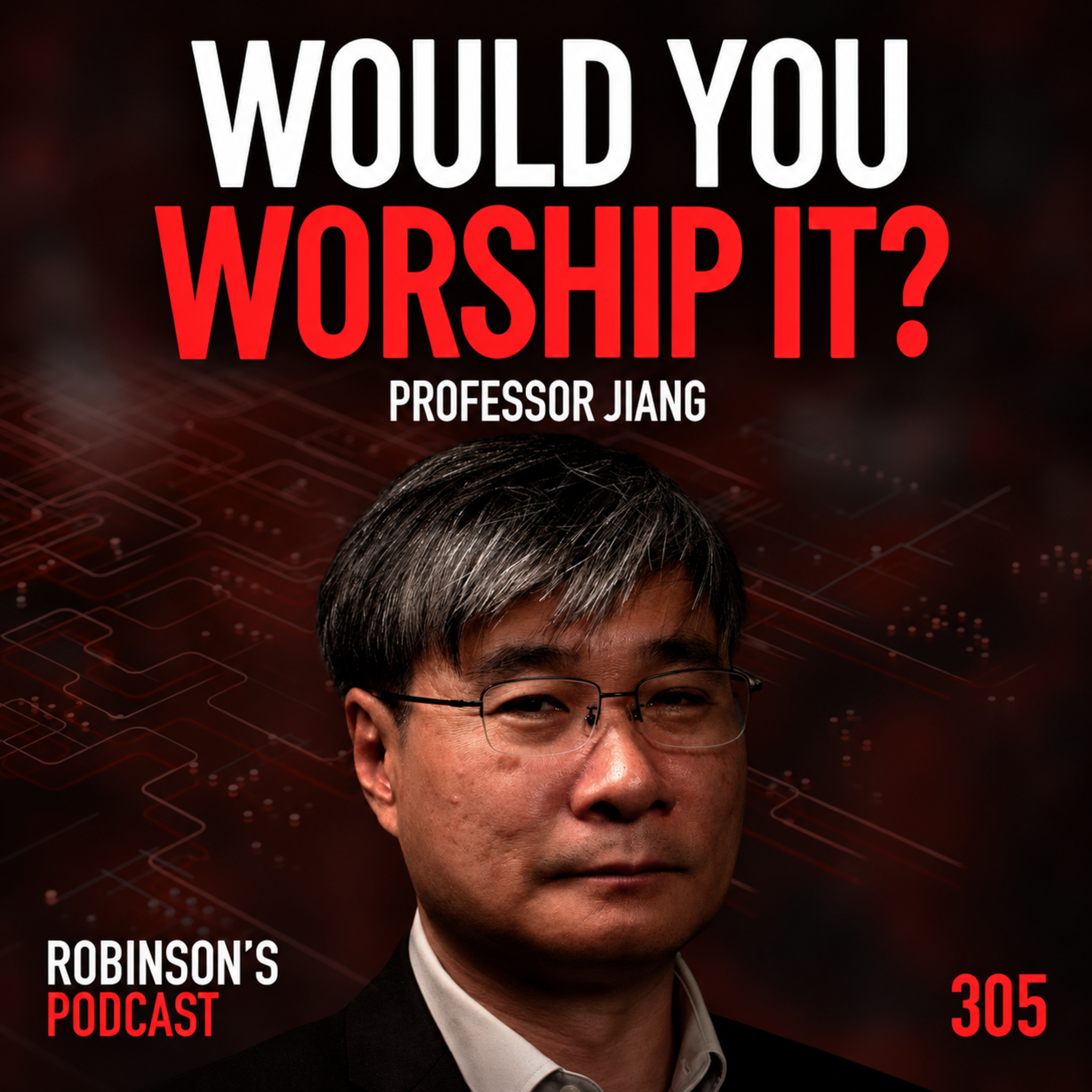
The episode argues that today’s AI boom is a speculative “bubble” driven by elite control motives, and that many AI leaders treat AI as a quasi-religious or occult force rather than ordinary software. It also claims AI is mostly “search and sort” trained on internet data, but that marketing and ideology can make people worship it. The host connects this to meritocracy, surveillance/digital ID, and a broader “holy empire of reason” worldview attributed to Freemasonry/Kabbalah.
Jiang Shuiqin, a Chinese-Canadian educator and YouTube host of Predictive History, plus an author of a Substack by the same name.
Written by AI. May contain mistakes.
Robinson introduces his conversation with Jiang and the background of their discussions.
“Your sausage McMuffin with egg didn't change.”
The hosts discuss their differing views on AI's purpose and its connection to occult beliefs.
“But for Jiang, the AI executive's central goals are occult.”
A detailed explanation of supervised machine learning and how AI algorithms function.
“Before we get to that, though, I think it makes most sense to begin maybe with where we are now and how we've gotten here.”
Discussion on the importance of data sources like Wikipedia for AI models like ChatGPT.
“And then as I speak, the AI is looking for the correct written dictation, and it's creating a neural network that would allow it to the most quickly process this with 100 % accuracy.”
Exploration of the AI market's valuation and OpenAI's challenges with competition.
“order to give you the response that you want.”
Explore the current AI landscape and the implications of business models reliant on data.
“And now that they have this template in place, the others can take it for free and create better models.”
Discussing the potential collapse of the AI bubble and dependency on government bailouts.
“See Walmart Plus terms and Sam's Club terms for more info.”
Explore the severe historical consequences of banishment and its relevance to contemporary discussions on AI and meritocracy.
“If you look at history, the worst punishment that you can inflict on a person was not a death penalty.”
Discussion on how AI might serve the elite's goals for societal control and transformation.
“Promotion pricing may be lower than meal pricing.”
Exploring the influence of Freemasonry on AI culture and ideology.
“And if you read what he writes, Zebniayev Brzezinski, and he's absolutely brilliant, he's not a Freemason, but everything he writes is Freemasonic.”
Discussing the beginnings of Freemasonry and its connection to capitalism.
“Let's start with the beginning then of Freemasonry.”
Analyzing the separation of reason and emotion in Freemasonic thought.
“So emotions is the basis for who we are.”
Examining the belief among AI developers that AI represents a divine force.
“It's a pure form of reason and it's capital, right?”
Discussing public perceptions of AI and its ties to occult practices.
“Then this is a job for Indeed Sponsored Jobs.”
Learn about the connection between AI and occult practices, and how money plays a role.
“This is a direct quote from the New Yorker magazine.”
Discussion about cheating in science and the reliability of computer science.
“I just feel as though you're kind of too wedded to a certain paradigm, if that makes sense.”
Debate on the capabilities of AI and its potential impact on jobs and efficiency.
“I would say there is a tremendous amount of cheating because what people don't appreciate is most of these experiments cannot be replicated.”
Exploration of AI as an amplifier for skilled workers and its implications for society.
“Can we talk about that though for a little bit?”
Explore how job redundancy leads to a focus on job preservation in institutions.
“I mean, we can argue about this, but I'm just saying like most jobs tend to be redundant.”
Discussion on the power dynamics between elites and counter-elites, focusing on cryptocurrency.
“Then this is a job for Indeed Sponsored Jobs.”
Debate on AI's capabilities, its impact on jobs, and potential threats it poses to society.
“I don't understand how this connects to whether or not AI is capable, which is what we were talking about a couple of minutes ago when I said I didn't understand the connection to the doctor story.”
Explore the complexities of truth in media reporting and military narratives.
“So I think all else being equal, I think that the news organizations, etc., I want to take them at their word.”
Discuss the concept of consciousness and its potential connection to AI and spiritual beliefs.
“Okay, so about that in particular, I did read that out loud a couple of minutes ago, and people will have seen that or they can scroll back to see it.”
Analyze the philosophical implications of perception, reality, and manipulation through AI.
“So having said that, let me go into some theory.”
Explore the belief that AI executives are summoning spirits and its implications.
“Promotion pricing may be lower than meal pricing.”
Discuss how Hollywood serves as a medium for summoning ideas into our consciousness.
“but do you also believe that the AI executives are in fact summoning spirits?”
Examine how ancient concepts of creativity and wisdom were viewed as embodied spirits.
“Well, I just wouldn't refer to ideas as spirits.”
Analyze the shift from embodied consciousness to abstract concepts in modern thought.
“And he said that the major revolution was with the coming of monotheism and the destruction of this pagan world so that we basically shut off our right brains.”
Delve into how ideas can act as disembodied forces that influence society.
“And therefore, you can actually believe Freemasonry as a God that works around us, okay?”
Discuss the potential collapse of the AI bubble and the implications for society.
“What other key points of your beliefs about AI do you think that we ought to touch on in this conversation so that our listeners have a comprehensive view of your understanding of the topic?”
Explore the factors that may prevent the successful implementation of AI control grids.
“So think of Minority Report, where they were able to do predictive policing.”
Celebrate the enduring spirit of humanity in the face of technological control.
“because the resistance will be too great to the AI control grid.”
Debate the credibility of Jiang's assertion about summoning demons through AI.
“And I got so much out of it, though, even if I don't agree with Jiang about close to anything on this topic.”
Discuss the nature of evidence and trust in testimony regarding extraordinary claims.
“So as I thought about this conversation, my mind kept jumping back to evidence.”
Explores the credibility of claims about Sam Altman summoning demons and the context behind such statements.
“report's falsehood less likely than the miraculous event.”
Analyzes contrasting explanations for the construction of data centers related to AI, weighing business versus occult motives.
“extensive photographic records, stolen diary entries from Sam, or evidence of a well-documented interest in demonology.”
Discusses the importance of trusting reputable newspapers while acknowledging potential misinformation.
“with the products, with at least some of their customers, with the financial incentives of the business, and so on.”
Reflects on personal and intellectual growth through podcasting, addressing community feedback and its impact.
“But now that this three-part series is all said and done and pins the podcast is wrecking my couch, there are some things I'd like to say about it more generally.”

Get the gist, explore an idea or ask about something said.
 Claude
On Robinson's Podcast, what are the key points of this episode?
Searching your listeningAutomatic transcript. May contain errors.
0:00Professor Jiang: This episode is brought to you by Indeed. You're ready to level up your business, but the pressure to find the right person to make that happen is intense. Indeed Sponsored Jobs can help carry the load. It boosts your job post to help it reach quality talent fast. Cut through the chaos with Indeed Sponsored Jobs. Get a$75 sponsored job credit at indeed.com slash podcast. Terms and conditions apply. Hiring now? Then this is a job for Indeed Sponsored Jobs. Your sausage McMuffin with egg didn't change. Your receipt did. The sausage McMuffin with egg extra value meal includes a hash brown and a small coffee for just$5.
0:39Professor Jiang: Only at McDonald's for a limited time. Price and participation may vary. Promotion pricing may be lower than meal pricing. I'm wondering what it is that you're trying to convince me of right now. These people who work in AI, they do involve the occult. They think AI is a god that will redeem humanity. That's why they're so into it. Why are you so sympathetic towards these AI companies? But can you answer that? Like, do you believe that there are demons out there and they are summoning them? You are basically indoctrinated into a certain deference to these people. Before we continue, I just want to make sure that you don't feel that I'm being disrespectful to you in some way.
1:17Professor Jiang: Can you very quickly just Google this? Do you have a phone? You have to do this. Otherwise it's hard for us to have a conversation. Sure. Can you Google something for us? Just look at this, okay? Claims from an anonymous former OpenAI executive describing Sam Altman as building portals from which we're genuinely summoning aliens. These are insane.
1:42Hello, this is Robinson Earhart here with a brief introduction to the last of my three conversations with Jiang Shuiqin, the first two of which are self-contained and linked in the pinned comment in the description. Jiang is a Chinese-Canadian educator. He's the host of Predictive History on YouTube. And then he is also the author of the Substack by the same name. So Jiang and I had been talking for seven hours when we started this one to end our marathon. So we were both already at the ends of our nerves, but we really didn't agree on anything at all. And so we ended the conversation a bit abruptly because it was really difficult to find any common ground on which to discuss AI at all.
2:29I had expected to talk about economics, cybersecurity, existential threats. But for Jiang, the AI executive's central goals are occult. And since I neither believe in the paranormal nor have any compelling evidence that people like Sam Altman hold those beliefs, it was hard for me to talk about, let alone to understand why someone would take this seriously. Anyway, you should check out Predictive History if you find Jiang's positions compelling and want to better understand how he's reached them. For my part, I shall return for an outro with some reflections, as I got a lot out of talking with Jiang, both in this episode alone and throughout these three conversations.
3:27One quick note, though, is that because I'm not an expert in how large language models work, I've included a couple of links to helpful videos in the description that could clarify Jiang's description that he gives at the beginning of the conversation. But that's that. I hope that you enjoy this conversation as much as I enjoyed having it with Giyong.
3:59You've argued that the real purpose of AI is to enslave humanity, which is a very bold claim, and I'm really looking forward to discussing it. But before we get there...
4:12Professor Jiang: Sorry, sorry. I've argued in the past that AI is meant to transform humanity. Okay. Yeah, or redeem humanity. Redeem humanity. Okay, so non-enslave humanity. Well, it's the same thing, but I mean, like, the correct phrase would be redeemed. Okay, okay. That's totally fair. Before we get to that, though, I think it makes most sense to begin maybe with where we are now and how we've gotten here. so I know you mentioned wanting to talk about the AI bubble but before we can even talk about what the AI bubble is we need to get on the same page about what AI as it currently exists is because there are very different beliefs about that yeah right so AI is a catch-all phrase for any technological innovation right now in the computer industry It's tentable term is supervised machine learning.
5:13Professor Jiang: And the idea here is that rather than have humans program the algorithm into the software, the software will be trained to develop its own algorithm, often referred to as a neural network. Let's just use an example to illustrate what supervised machine learning is. Let's just say I want to do facial recognition technology. Well, I have a data set of about a million faces. And I need to differentiate these faces and recognize them immediately. Also, I need to perhaps recognize them in adverse circumstances. For example, in bad lighting, or if you're wearing a hat, or if you're wearing some disguises, okay?
6:11Professor Jiang: So, I know that I can turn your face into a topographical model. and I can turn this topographical model into a very precise, very nuanced mathematical equation. But I don't know the precise weights. For example, how much weight do I put on your eyes or your nose? So I let the computer figure that out. So I start off with a basic template, a basic structure of this topographic model. And I let the computer, for supervised machine learning, refine this model. So the idea is I have a million faces, and I want the computer to match the names to all faces correctly. Okay. And so I'm going to create a recursive loop until the machine develops an algorithm for a neural network that's able to do this 100 % of the time.
7:26Professor Jiang: And so the machine is going to try different weights. And I don't know actually what the result will be. And so the machine tries a model, goes for the machine. Maybe it's a 9 % accuracy. Okay, let's try again. Okay, you keep on going until you get 100%. And once this is done, then once you have 100 % accuracy, then a neural network is created, which gives you a precise list of weights that you need in order to differentiate faces. So now I can take this model and then put a new data set of million faces and it should give me 100 % accuracy. And if I extend it to a billion faces, it should still give me 100 % accuracy.
8:19Professor Jiang: Okay, so that's what machine learning is. That's what AI is. Something to keep in mind here is what I'm doing is performing a search and sort function on a database, which is the most basic problem in computer science. what it looks impressive is that with morse law and with enough computation i can do this at an incredible scale beyond people's imagination and this um process that i just explained to you is how we get all ai okay so for example language recognition software how how am i able to basically write down whatever you say. Same idea where I have a database, and this database is the complete universe of all possibilities of language.
9:20Professor Jiang: And then as I speak, the AI is looking for the correct written dictation, and it's creating a neural network that would allow it to the most quickly process this with 100 % accuracy. Okay? And so, this is all that's happening. It's not impressive. It's just brute force and infinite recursion and almost, like, just a tremendous amount of compute, of data. All right? And can you think of maybe something that... Oh, sorry, sorry. So let me explain ChatGPT. So what people don't appreciate is ChatGPT is only possible because of Wikipedia. If Wikipedia did not exist, then OpenAI would first have to create Wikipedia.
10:20Because you first need a total universe of all possibilities before you can create an AI chatbot. You need something that the chatbot can learn, essentially.
10:36Professor Jiang: No, no, no. You need something that the chatbot can draw information from. That's what I mean. Right, okay. So, when you use OpenAI ChatGPT, what it's doing is it's going into this database, which is basically the entire internet. And it's drawing information. And then what the neural network is doing is filtering this information in a way that most pleases the user. that most accurately gives you the response that you're looking for. Okay? Right? So, for example, you can say to ChatGPT, write me an essay from my high school English teacher about Shakespeare's Sonnet 41. Okay? Well, it's very simple.
11:25Professor Jiang: ChatGPT just goes to this database of internet information about this starting 41 and compiles in a way that most pleases you, okay? But then what you can do is say, write me this essay as though you were a 14-year-old. Write me this essay as though you were a 56-year-old guy from Nigeria who speaks French better than he speaks English. Okay, these are all just filters, right? And so all these AI companies, whether it's anthropic or open AI, all they're doing is they're creating different chat box with different filters in order to give you the response that you want. But they're all working from the same source, which is basically the entire internet.
12:16Professor Jiang: And that's why after ChatGPT came out, China was able to introduce DeepSeq very quickly. Because once OpenAI was able to collate or categorize the entire internet into a database that can be managed, and once it created the algorithms network networks in order to quickly process this information for the use of the all for the use of the user then what deep sea can do is reverse all this and create its own chatbot very easily right because all you need to know is the weight and so you just um ask a lot of questions and then it gives you like a lot of responses and And then you can run your own algorithm or AI in order to reverse engineer the chatbot neural network.
13:12Professor Jiang: And then you can refine it to make it much more efficient. And so that's why DeepSeq was able to produce a chatbot that was more effective than ChatGPT at a fraction of the cost. Now, this is problematic for OpenAI because it's so easy to create new versions and the Chinese are doing that. And the Chinese are doing it in an open source way that it's cutting into revenue stream of OpenAI. Why OpenAI is angry is they had to spend tens of billions of dollars in designing the system in the first place, in categorizing the internet into a database that can be used, and then creating the initial algorithms, which takes years and years of research and trial and error.
14:07Professor Jiang: And now that they have this template in place, the others can take it for free and create better models. But it's impossible for OpenAI to recoup those R &D costs. And that's why OpenAI is very angry at China. And that's why OpenAI and Antwerpic want to ban these Chinese open source models from the United States. And how has this technology resulted in the AI bubble? I mean, why is it being overvalued? Because it does seem just from using it that it's extraordinarily effective, even if it's not some mysterious thinking machine, but really just operating through brute force. Yeah. So the Silicon Valley model is basically you throw money on a problem until you monopolize the market and then you can charge whatever price you want.
15:03Professor Jiang: um so the idea is right now um ai doesn't make any money because um um the startup costs were too high and the competition is too fierce but once you monopolize the market when i mean monopolize what i actually mean is saturate okay when you make ai just so commonplace that people are force to use it all the time then you can charge whatever price you want because essentially you're monopoly right that's why muse is so important because they're trying to make ai a part of your everyday life right they're trying to turn ai into your soulmate and uh you basically subcontract your brain to this ai agent right and they're able to achieve that then that becomes profitable because then think about because basically they have access to your soul and exactly what you're thinking they know exactly how you're feeling and this would be a tremendous boon to advertisers right so even so because people behave in patterns uh the ai would then be able to predict your behavior even before you yourself have decided on a certain behavior.
16:26Professor Jiang: And so that is their business model. And that's why they're trying to build as many data centers as possible. Because from a business perspective, the more information you have, the more accurately, the more precisely you're able to diagnose a person's personality and thus his thoughts and behavior, and thus you're able to sell this data to advertisers who can then basically have control over your buying patterns. Yeah, something that I'm sure you've spoken about this before, but I haven't even thought about it and hadn't even thought about it until this moment. When you see AI clones of people and people are talking to their AI clones like this is some fun exciting thing all this really means is that somewhere out there a company that is selling ai knows they think they know everything there is to know about you that they can replicate you purpose perfectly and clearly that's going to be very valuable if these companies are trafficking in data for advertising yeah what's really interesting people don't appreciate this is young people have been taught to basically try to clone their souls onto their social media, if that makes sense.
17:53When you say that young people are taught to clone their souls onto social media, I mean, people definitely want to display themselves probably in a better light than they actually see themselves. But I guess, what do you mean by clone their souls?
18:11Professor Jiang: Basically, there's a loneliness, a depression epidemic throughout the United States and throughout the Western world. And so I think a lot of young people naturally gravitate towards AI and think that if they're able to clone themselves on social media, then they're able to better express themselves and resolve the loneliness and depression in their lives it's an outward expansion in order to negate the internal emptiness inside them your sausage mcmuffin with egg didn't change your receipt did the sausage mcmuffin with egg extra value meal includes a hash brown and a small coffee for just five dollars only at McDonald's for a limited time.
19:00Professor Jiang: Price and participation may vary. Promotion pricing may be lower than real pricing. Sam's Club is the club for every holiday club. Guess who's joining the club this season? Walmart Plus. Yep, Sam's Club Plus membership now comes with Walmart Plus at no extra cost. Two memberships, one great price. Just$120 a year can save you time and over$700. Want to get in on the membership duo of the century? Visit samsclub.com. Come join us. Sam's Club. Annual plan only, auto renews, TNC apply, estimate based on average combined Walmart Plus and Sam's Club Plus savings among members of both for one plus year versus non-member or club member pricing slash fees.
19:30Professor Jiang: Excludes membership fees. See Walmart Plus terms and Sam's Club terms for more info. And where, though, does this come to the bubble? Because you said, I believe, and maybe I'm mischaracterizing you, that once the AI companies have saturated the market with their product and it's ubiquitous, it seems like then there will be a lot of revenue to be drawn in from that. So why then would we be in a bubble if there's so much investment pouring into this it sounds like it could just be a good investment opportunity yeah so i'm the one saying this is a bubble everyone's saying this is a bubble and the reason why is these companies are investing in ai on the expectation that they will achieve um this paradise or this payday right so how this is working is that um and and i and i'm just going to put this in very simple terms okay this is not this will not be precise or exact okay but how this works is open ai is like okay in order to achieve what i want to achieve right which is um i want to collect all possible data points in society and then understand society to a point where i can predict how everyone behaves I need to have a$200 of compute.
20:51Professor Jiang: Basically, I need to build a$200 of data centers. But once I build that$200 of data centers, then I expect to make$10,$200. So it's worth it, right? And so OpenAI then goes to maybe Oracle or Broadband and says, listen, I need to lease a$200 from you of compute. Can you build me those data centers? Norco says, sure. Then Oracle says to NVIDIA, I need to purchase about$50 billion of chips from you in order to build up my data centers. Can I borrow that from you? NVIDIA says, sure. And Oracle's like, okay, well, I don't have any money because all my money was promised to me by OpenAI. And NVIDIA's like, fine, we'll loan you the money to borrow these chips.
21:44Professor Jiang: Okay, so you see what's happening here where You solve the assumption that to be a$10 trillion payday, so that justifies the trillion dollar build out of data centers But then you need to go downstream and get people to actually build this stuff and they build this stuff by by basically believing that this$10 trillion Payday will one day materialize right and the problem is the problem is like at the moment people recognize that this$10 trillion payout is not coming, the entire thing collapses. It's like a domino effect. But I thought you said you didn't think it was a bubble. Or you do think it's a bubble.
22:26Professor Jiang: It's definitely a bubble. Okay, so it is a bubble. Yeah. Because the$10 trillion payday you don't think is coming. No, it's not coming. And so one limit test will be the Anthropic IPO, which is scheduled for November. Right now, Anthropic believes it is a value of$2 trillion. And if it IPOs and investors don't respond and its valuation drops down, then the entire bubble could collapse. Because now investors get angsty, okay? Also, another factor that's really important, people don't appreciate this, is a lot of this bubble is driven by excess liquidity. Where is this liquidity coming from? It's coming from overseas.
23:08Professor Jiang: Right, so if you're in Saudi Arabia and you're in Japan, you have$200 to invest. Well, you don't have that many good options to invest in the AI bubble. Right, and the more you invest, the more committed you are. And this is what's driving the policy scheme. Right, but there is an event that is beyond anyone's expectation, which is the Iran war, and it's showing up liquidity of both Saudi Arabia and Japan. Because Saudi Arabia sells oil and Japan buys oil and churns that into manufactured goods for the world. And so if Japan and Saudi Arabia are no longer able to invest in the AI bubble, right, then it's going to pop.
23:56Professor Jiang: So it's only a matter of time before the AI bubble bursts. But, and it's really important, it's really not a problem for these AI companies. Because they actually want the bubble to burst. these companies by themselves cannot be profitable all right you have this ten trillion dollar payday expectation but it's never going to come so how do you resolve that issue you get the government to bail you out right so so just let's do a thought experiment let's just say uh the air bubble burst well you have this subprime crisis over again right and now you this is a major threat to the american economy 50 of gdp growth is due to data center build build outs the ai bubble basically that's 50 gp growth so 50 gdp growth so in that case the government has no choice but to bail out the ai industry how by nationalizing the data centers and by taking out a stake in these ai companies now you're profitable because As an oil company, you're 100 % profit if you're not actually running the oil wells yourself.
25:10Professor Jiang: So these data centers will be financed by the taxpayer. And so you have a situation where all gains will be privatized, all losses will be socialized. And that's a system that these AI companies want to move towards. right but once that happens then the question is um how can these air companies best serve uh the government what is the government interest in these air companies and what the government really wants to do is create something called an ai control grid or an ai surveillance state and they can do that by issuing something called digital currency and digital id when you have digital ID system in place and it's very easy for you to have digital currency.
25:58Professor Jiang: And that I think is a future that the United States is moving towards. Why would the AI companies want us to exist in a digital surveillance state? One reason that I could imagine would be true is if we live in an AI digital surveillance state, they make a lot of money. Yeah, that's what they're interested in. They're interested in making as much money as possible, right? So you make a lot of money when you have access to everyone's private information because then you can sell it to advertisers. So digital ID is the best mechanism in order to obtain all this information. And then once you have digital ID, then you can create a digital database of each individual because then you can collect that person's health information, education records, job employment history, Amazon purchasing history.
26:50Professor Jiang: And then the algorithm can very quickly turn you into personality type. And quite honestly, everyone thinks he or she is unique. Not really. I mean, just based on two pieces of information, I know exactly how you'll behave. First of all, I need to know how you behaved in the past. Second of all, I need to know how your other friends behave. Once I have these two pieces of information, I know exactly how you'll behave in the next 50 years. Why? I understand how if you know how somebody's behaved in the past, you probably have a good idea how they're going to behave in the future. But why is it that you think knowing how somebody's friends will behave is such a reliable indicator of how they'll behave in the future?
27:32Professor Jiang: Because they're social animals. Because most things we do is in order to get along with our friends. So they did studies on obese people. And they looked at why is it so hard for obese people to lose weight? And the answer they came up with is because obese people hang out with other obese people. And if you become thin, that means losing your friend circle. So we as human beings are most afraid of being ostracized. If you look at history, the worst punishment that you can inflict on a person was not a death penalty. It was actually banishment, right? Exile. And that was true throughout most of human history.
28:19Professor Jiang: The Catholic Church, the greatest weapon was excommunication. And in Athens, the worst punishment someone could inflict on you was to banish you for 10 years. That was considered really harsh. In another conversation that we had that I think is going to come out before this one, so I'll assume that our listeners might have heard it, We've talked about the future of humanity from a more geopolitical perspective. And you see in the next couple of years civilization collapsing because in part of the Iran war. That's something that we discussed. why is it necessary or even important to talk about AI right now if there are all these other things that you expect will have such a dramatic impact on the human condition?
29:16Will people be using AI long enough that AI becomes an existential issue?
29:22Professor Jiang: I think it's important to discuss AI because it gives us insight into how the elite think and behave. So I think we need to appreciate the meritocracy and ask ourselves, why is it that the elite create the meritocracy in the first place? When I mean the meritocracy, I mean the school system where a handful of students are selected based on their IQ to enter the most elite universities where they become part of the technocracy that governs the United States. That's what the meritocracy is. And you go back and you look at the people who found the meritocracy, and this includes James B. Conant, who was president of Harvard, and he was the first Harvard president to use SAT as a foundation for a national scholarship program to include the best and brightest to come to Harvard.
30:22Professor Jiang: And you look at someone like Henry Chauncey, who was the first president of ETS. ETS? The Education Testing Services, the people behind the SAT. GRE. The GRE and TOEFL. Okay? So if you go and look at these people, what you recognize is that these were all pilgrims. They came from very prestigious pilgrim families. These were Boston Bramans, basically. And if you look into their eschatology, they're very much focused on perfection and control. So the idea of immortocracy was, if we can get the best students to go to the best universities, this will have a trickle-down effect, where everyone will behave the same way.
31:21Professor Jiang: Because these students who get to Harvard and Yale and Stanford become role models for everyone else. And so through this top-down mechanism, we can transform society so that everyone behaves in a very reasonable, very disciplined manner. And that's been the obsession of the meritocracy for the past 67 years. How do we make sure that every student is able to be perfect? Or how do we use the educational system in order to transform or redeem all these lost souls? Okay, so there's almost a religious imperative to the meritocracy. And that's something that, you know, will sound strange to people in meritocracy because we're like, we're atheists.
32:12Professor Jiang: Our religion is reason. Exactly, okay? They call this the holy empire of reason. like how do we use school system in order to transform everyone into a scholar okay that was the original intention and it didn't work out okay in fact you can make the argument that the meritocracy has really destroyed the education system in the United States I would make that argument i would say like the main impediment to real education reform is the meritocracy because if you really want to ensure that all students do well then you need a fair fair distribution of resources um the elite won't go for right but i'm just saying like uh that's what you should do okay but just because meritocracy failed doesn't really mean the elite are like just give up and say whoa well you know before we thought we could get everyone to It could form and be reasonable and that failed.
33:14Professor Jiang: So let's just celebrate human diversity, human imagination, human empathy for what it is. They're not like that. They're like, no, screw that. We're going to try again. And this time we'll succeed. And how will we accomplish our mission? With AI. Okay? So the school system was our first experiment. Now we'll move on to AI. And the problem with schooling is we cannot eliminate the family factor. We cannot eliminate the environmental factors. So what we're going to do is we're going to use AI to completely control a student's environment. Okay, imagine you're born and guess what? There's an AI agent talking to you and you're like, what the hell?
34:01Professor Jiang: And the AI agent's like, don't worry, I'm your soulmate. I'm your Daimon. I'm your imaginary friend, whatever you want to call it. You don't know, but you just grew up with this AI agent as part of your life. And what does the AI agent tell you to do? Be a good person. Work out more. Eat healthy. Be nice to people. Obey authority. Don't question too much. Right? And that could be a solution to the problem of diversity and too much human conflict.
34:56Professor Jiang: Get a$75 sponsored job credit at Indeed.com slash podcast. Terms and conditions apply. Hiring now? Then this is a job for Indeed Sponsored Jobs. Your sausage McMuffin with egg didn't change. Your receipt did. The sausage McMuffin with egg extra value meal includes a hash brown and a small coffee for just$5. Only at McDonald's for a limited time. Price and participation may vary. Promotion pricing may be lower than meal pricing. I don't understand why AI is a replacement for meritocracy unless, well, here's one reason why I could see it being a replacement for the meritocracy and you could let me know.
35:38one reason that I could imagine the quote-unquote elites wanting to make sure they have an educated population is that having an educated population would enable them to make more money if their employees are smarter they'll probably make more money but if they failed to educate their employees make them smarter more productive workers then they would want to replace them with AI which is
36:07Professor Jiang: much more effective. I never said the meritocracy was meant to replace sorry I never said the AI was meant to replace the meritocracy. Oh. I never said that. Oh sorry. What I said was the meritocracy was a failed experiment to control the population and after this failure the elite is like let's move on to AI. Okay. So the goal is to control the population and make it conform and reasonable to create a holy empire of reason okay and so i'm gonna explain to you why they're doing this sure all right so um we've talked previously about the kabbalah right and what's the kabbalah the kabbalah is a mystical hermetic understanding of the bible um and they consider bible to be the source code of the universe Those who believe in the Kabbalah?
37:03Professor Jiang: Yes. Okay. And I also talked about 17th Frecancism and how they spread throughout the world, right? And they infiltrated many different groups, including the Freemasons. Who found out in America? The Freemasons. All right? So the Freemasons are working with the Kabbalah. And maybe there have been a lot of modifications throughout the centuries. But the basic premise is the same, which is that humans have a responsibility to help divinity achieve perfection on earth. From a Jewish perspective, that means ushering the Messianic age where everyone is redeemed in the eyes of God and where everyone welcomes God into his or her own heart, into his own bosom.
37:58Professor Jiang: Once everyone is, I bow myself before God, I humble myself before God, I will be forever obedient, then God will come and the world will end and be perfect. Okay, and we'll return to the Garden of Eden. That is the main idea here. So in the Freemasonic tradition, they believe in geometry. And so what they want to do is create a temple for God to live in. Because these Freemasons believe that they go way back to the Temple of Solomon. Their ancestors built the Temple of Solomon. So you need to know all this religious history and understand what's going on. Otherwise, it's completely confusing. So I'm trying to give you a simplified version of what they believe.
38:49Professor Jiang: So the 17th Frank is infiltrated the Freemasons and they brought the Kabbalah with them. The Kabbalah was a very seductive ideology and they believed that through their own hands they can create a perfect world. That's what the Freemasons believed. And that's why they found America because America was meant to be the New Jerusalem. And so there is a strand of American exceptionalism that believes that America will be the new Jerusalem and it will usher in the Mezzanine Age. Okay. And this is what drove the creation of meritocracy. Does that make sense? so i'm i'm following what you're saying but i i mean i don't believe it necessarily no no no no it doesn't matter what you believe i'm just saying what they believe okay okay i'm not asking you like do you like this idea sure all right i'm just telling you what they what they believe what the freemasons what the referians believe okay all right and i'm telling you like this this is the basis for everything that they've done in america including the meritocracy all right including the ai um um so it didn't really work with a meritocracy so now they want to shift their attention to ai because um ai is able to penetrate everything in society and therefore you're able to uh mitigate or eliminate a lot of factors you can't control like a family for example all right um so the idea is that by using ai including the ai surveillance state you are allowing humans to perfect themselves and to redeem themselves wouldn't you rather live in a world where everyone was healthy and reasonable and disciplined yes and kind exactly all right but humans by themselves cannot actually achieve that state because humans by definition are sinful, right?
40:55Professor Jiang: That's why we had the fall from grace. That's why we were banished from the Garden of Eden. But again, this isn't what you believe or you're just saying what you believe the Freemasons believed. Yeah, I rarely tell people what I actually believe. I'm just giving you insight into who these people are and what they believe. Sure. Okay? All right? So, if you really want to know more about the Freemasons, I suggest reading a book called Morse and Dogma by Albert Pike, who is considered the father of American Freemasonry. Yeah, Albert Pike. And if you read a lot of classic American texts that have guided American policy, there's a tremendous, you can feel the tremendous influence of Freemasonry.
41:50Professor Jiang: So the classic example is Zebniayev Brzezinski. He, along with Henry Kissinger, were the two grand foreign policy strategists of the United States during the Cold War. And if you read what he writes, Zebniayev Brzezinski, and he's absolutely brilliant, he's not a Freemason, but everything he writes is Freemasonic. it aligns perfectly with the Kabbalah and it aligns perfectly with Albert Pike. So I'm not saying that there's this grand conspiracy where the Knights Templars founded Freemasonry and then it went over to England. Okay, people do say that. I don't say that. I'm saying like there's some ideas that embed themselves into cultural practices.
42:41Professor Jiang: And when these cultural practices spread, these ideas spread as well. All right? So if you're the elite, you behave in a certain way that draws you to the Kabbalah, that draws you to Freemasonry. And so even though there are people who probably don't even know what Freemasonry is and who are not exposed to Freemasonry ideas, they behave in a way that is very Freemasonic. And that's what I'm saying about these AI people. they grow up in a culture that is heavily influenced by Freemasonry and so they adopt ideas that are very Freemasonic and one of the ideas is an AI control grid in order to perfect and redeem humanity from their sins and vices I am one of these people who knows nothing about Freemasonry and I wasn't expecting that I mean I was expecting that we were going to sit down and talk about AI but I didn't I wasn't expecting secret society all this is connected right so that's what I was going to say is it puts me in a difficult position because I have never heard or I've obviously heard of Freemasons before but I haven't ever really read into them but am I correct in understanding that But to get to what you believe about AI, this is crucial to it.
44:15Professor Jiang: Yes. All right. So let's explain what Freemasonry is. Yeah. Let's start with the beginning then of Freemasonry. So we've talked about the beginnings of capitalism. And capitalism was very removed from the traditional religious experience.
44:31Professor Jiang: because for most of history, religion was understood, the world that we live in, as false. And the spiritual world is what's real. And so you were taught to just ignore money or material things and just embrace the spiritual and the divine. That's certainly what Catholics are taught. That's what Muslims are taught. That's what a lot of Jews are taught as well. But with the coming of capitalism, and again, last time we talked, I did mention that capitalism was a historical accident, right? A convergence of... You connected it to Calvinism. That's right. That's right. Okay. But now that you have capitalism, it goes against the traditional religious experience.
45:17Professor Jiang: Because capitalism was about the conversion of wealth, right? So you need a new religion in order to justify capitalism, in order to promote capitalism. That new religion was called Freemasonry. All right? Because what Freemasons do, and that's really important, is they believe the one and true God is reason. Okay? Can we get back to when and where Freemasonry began before we talk about the tenets? The early 18th century. The early 18th century? Where? In Britain. they celebrate reason as the one and true God okay from that perspective God create the world and then God left because God doesn't care but God left behind the capacity to reason and so reason is divine spark in us and so we must exercise our reason in order to achieve divinity okay we have the means to achieve a divinity which is reason but we must exercise it we must everyone exercises it if we are to create paradise.
46:25Professor Jiang: Remember, God is gone, okay? So only we can do this.
46:33Professor Jiang: So, but if you do more analysis, okay? For the first time in human history, what's happened is reason is considered a concept separate from emotion, okay? And if you just look at history, you look at the ancient Greeks, the Chinese, the Indians, Everyone appreciate that reason came from emotion. If you wanted to think, you had to do so with your heart, not with your brain. The Freemasons invert this and say, no, reason comes before emotion. Reason is separate from emotion, which is counterintuitive. If you talk to neuroscientists today, I mean, just go talk to any neuroscientist at Stanford. They'll be like, well, emotions are the basis for memories.
47:21Professor Jiang: Right? So emotions is the basis for who we are. So we want to think, we have to do so with emotions. The Freemasons were adamant about separating reason from emotion. Why? Because in their religion, capital was reason, and even at a post-capital was emotion. Okay? So what about post-capitalism? Prejudice. Tradition. Family. Love. Nationalism. God. okay and these things work it's our emotions so if you want to achieve perfection we wanted to be reasonable we needed to discard all these things including God including the king including family including prejudice okay and that's why we live in the world we live in today we go to Stanford what are you taught open borders right racism is the worst thing in the world reason is what matters right this is a direct we live in a world created by the Freemasons right because the Freemasons were trying to promote capitalism to the best of their ability and so they promoted reason as the ultimate good the ultimate God and they believed that through our use of reason we could perfect the world that we live in today okay and so maybe even maybe even though Freemasons are not as dominant as they used to be the reason why Freemasonic thought and value system have become embedded into Western society so that it's just the year that we live and breathe.
48:54Professor Jiang: Who today would tell you multiculturalism is wrong or bigotry is good or prejudice is good? You can't say that. You'd be banished from Stanford. you'll be expelled from Stanford right? At this point I don't know if this is really pushback but I totally agree with you that wherever it came from Western culture especially culture in the academy is it centers around reason atheism is what's in vogue but reason that is anti-religion anti-family anti-ethnicity. Okay? It's a pure form of reason and it's capital, right? Think about it. What in our real world translates directly into reason? Money. Money makes the world go round, right?
49:54Professor Jiang: It shouldn't matter if you're black or white. All that matters is how much money you have in your bank account. Right? Where I'm losing you is why this is so relevant to the discussion of AI just because I feel like a much simpler way of understanding why AI has become as powerful and ubiquitous in like the Bay Area as it is, is just because it's a new technology that's proving to be, or at least it looks like it will be extremely profitable. No, these people, if you actually go and actually meet these people, they think AI is God. They think AI is a God that will deem humanity that's why they're so into it um these people are insane and do you have like evidence for for saying that like sam altman or dario amade they they think that ai is god are these the people that you're referring to um have you talked to karen how yet no you should Karen Howe is a reporter who's done a lot of research into AI.
51:05Professor Jiang: She graduated from MIT, so she knows this stuff technically. And she spent 10 years investigating companies like OpenAI. And she wrote a book called Empire of AI. And she says this. Yeah. And again, I hate to say this, but if you do any basic research into these people, you wouldn't know they're very religious but in a Freemasonic sense so back to my original point is that why all this is important is for these people what they recognize is people are too stupid to actually use the reason so you need to create an illusion or hallucination to force people to use the reason or believe in reason so let reason be manifested into ai right right who cares if ai is fake as long as people believe it's real if you go to school and a teacher tells you to uh work out and be healthy and you don't listen that clearly doesn't work okay let's try a new system where it's which is like let's pretend to create an AI which everyone believes is real and is living and is tapping into an interdimensional spiritual force and let this AI tell you to go work out and live a healthy life, would you do so?
52:35Professor Jiang: Probably. Why be super stupid? This episode is brought to you by Indeed. You're ready to level up your business, but the pressure to find the right person to make that happen is intense. Indeed Sponsored Jobs can help carry the load. It boosts your job post to help it reach quality talent fast. Cut through the chaos with Indeed Sponsored Jobs. Get a$75 sponsored job credit at indeed.com slash podcast. Terms and conditions apply. Hiring now? Then this is a job for Indeed Sponsored Jobs. Your sausage McMuffin with egg didn't change. Your receipt did. The sausage McMuffin with egg extra value meal includes a hash brown and a small coffee for just five dollars only at mcdonald's for a limited time price and participation may vary promotion pricing may be lower than real pricing i'm not really sure i mean where to take this conversation just because i wasn't expecting it to go in this direction not that it's a bad direction but most of the conversations that i've been having about ai have had to do either with whether or not it's poised to cause tremendous economic displacement and strife for people, or people that you know like Eliezer Yudkowsky or Nate Soros about whether or not it poses an existential threat.
53:59And these are the two discussions that I see most prominent publicly. Why do they not interest you as much, these two discussions?
54:11Professor Jiang: because they are meant to delude us to thinking that AI is more powerful than it is, that AI is an independent entity, and we are about to lose control over it. And again, if you actually look at the technology, it doesn't really do that much. I've already spent a long time explaining to you how the actual technology works. If you talk to a computer programmer, the person will tell you the same thing. If the person is honest, Okay, most of the people are not actually honest. So they will put some hocus pocus into the explanations. And quite honestly, a lot of them don't even know how the actual mechanism works.
54:50Professor Jiang: They just do their little part. But first of all, is my explanation of AI clear to you? Yeah, I think it's clear enough. I think it's capable. Okay. But you don't think so. I think there are limited applications to AI, okay? As it is. And the only way that they can get around that is if they make people believe that AI is more than it is, that AI is a living god or a living demon. All right. So, again, there are lots of sources which tell us that these people who work in AI, they do involve the occult. All right. So can you very quickly just Google this? Okay. Do you have your phone? I don't have my phone, but...
55:46Professor Jiang: You have to do this. Otherwise, it's hard for us to have a conversation. Sure. Can you Google something for us? Okay. So New Yorker, Ronan Farrell, open AI, summoning demons. Thanks, Harold. So just look at this, okay? This is a direct quote from the New Yorker magazine. Sure. from an AI researcher who is telling Ronan Farrow, the reporter, that open AI is trying to summon demons. Do you want me to read it? Yeah, just read it. Sure. An investigative report by Ronan Farrow and Andrew Marantz in New Yorker magazine details claims from an anonymous, former open AI executive describing Sam Altman's scaling of AI infrastructure as building portals from which we're genuinely summoning aliens.
56:34The comment emerged in the context of OpenAI's massive Stargate infrastructure expansion and data center plans in Abu Dhabi. You can read the full article at New Yorker magazine.
56:46Professor Jiang: Okay, look, they're using a lot of occult terminology, Stargate. Okay, this is an occult term that goes back thousands of years to the Egyptians. Why is this entire project called Operation Stargate? why are these researchers telling like ronan farrell a reporter for new yorker oh we're trying to summon demons why is this happening because what they understand is everything is the occult everything okay um what is money money is just the occult it's the it's alchemy right somehow we've been we've created a society where i take this piece of paper and people will slave over it. They will work 18 hours a day driving themselves crazy to obtain more and more of it thinking that this is the path to salvation.
57:39Professor Jiang: It's the occult. If you want true power you have to practice the occult. And what is the occult? The occult is controlling and capturing the imagination of people and directing in a way that allows you to control them, right? Money is a classic example of this. It's alchemy, right? What is alchemy? Turning lead into gold. We've accomplished that with money. We've taken, again, this worthless piece of paper and turned it into gold that everyone thirsts for. People are willing to slave in school and abandon their entire soul in order to go get a job, in order to abandon their soul, in order to obtain greenbacks, money, because they think this is a path to salvation and redemption.
58:33Professor Jiang: AI is the same thing. And that's what these people recognize, that if you want true power, you have to practice the occult. So this technology by itself, I already told you, does nothing. All it does is search and sort from a database. Big deal. but if you can get people to believe that there's a demonic energy to ai right you can summon demons using operation stargate then people will bow down before ai because people have this religious need that needs to be fulfilled and once they obey the ai they have control over them and they'll do whatever you want they don't really need to work for money anymore they'll just work for the stupid AI if you get people to believe this and this has been true for all of humanity I mean um you know people have been worshipping statues for thousands of years believing that this statue is a manifestation of a divine being right and and so that's the world that these people want to create before we continue I just want to make sure that you don't feel that I'm being disrespectful to you in some way do you is is do you feel that I am um I just feel that if you have
1:00:03Professor Jiang: I just feel as though you're kind of too wedded to a certain paradigm, if that makes sense. And you take it for granted that these people are not nefarious in any way and that they are perfectly reasonable. And I think it's because you're a byproduct of meritocracy. because I know because I was a byproduct of meritocracy and you're basically indoctrinated into a certain deference to these people when I don't think this deference is actually deserved. And I mean, that's how the meritocracy works. And if you do not behave in this way, I think it would be very hard for you to do well in school. I guess there's a difference between me being sort of showing deference to these people or being wedded to the meritocracy and being disrespectful to you because I feel like in allowing you to say what you want and and disagreeing with you when I disagree with you that I'm I'm being respectful and open all right let me ask you this question do you think there's very little cheating in science, some cheating, or a lot of cheating in science.
1:01:26Professor Jiang: What I mean like this, what I mean is, you know, as a scientist, what you need to do is do an experiment and then tabulate results and then write a paper explaining your findings
1:01:41Professor Jiang: in a peer review journal. Yes? No, I think that there is rampant cheating. I would say there is a tremendous amount of cheating because what people don't appreciate is most of these experiments cannot be replicated. I'm saying the majority of these experiments cannot be replicated. So if you're a social scientist and you do a psychology experiment that shows one result, other people, if they try to replicate this experiment, can't actually do it. You can't get the same results. So there's a lot of cheating going on throughout science. So if that's the case, then why would we assume that these computer scientists are extremely rigorous and precise in what they do?
1:02:27Professor Jiang: Right? What is it? And again, I'm not trying to be disrespectful. But I'm wondering what it is that you're trying to convince me of right now. Are you trying to convince me that a lot of the people who are in power in tech, whether it's Mark Zuckerberg or Sam Altman, that these people believe in the occult and that they believe that they are summoning demons? Or you want to convince me that their goal is to have the public believe this? Right. So let me phrase it in this way. there's widespread belief that there's a rigor to computer science that doesn't exist anywhere else because you're programming the software and it's like building a bridge right if you screw up building a bridge you will know you screw up the building bridge because it'll collapse on you okay so we assign a certain level of faith to engineers computer science we were not assigned to lawyers and doctors because lawyers and doctors can just mix stuff up.
1:03:43Professor Jiang: I totally agree with that. We know that, okay? And what I would say is, I mean, one way of putting it is that computer scientists work with formal languages. Formal languages, like mathematics, are very rigorous in that there are very specific rules. In that sense, I would say that I certainly believe that computer scientists are working in a rigorous fashion. Right. But we also know that once you increase incentives too much, then people are much more liable to cheat. Okay. And right now, there's so much money in AI, right? And the incentives are just too high for people not to cheat. Oh, well, I wouldn't want to make any claim whatsoever about whether computer scientists are more likely to cheat or lie or defraud or steal than lawyers or doctors.
1:04:38That's an empirical question, and it could totally go one way or the other. So I mean if what you want me to want to convince me of is that computer scientists are just as likely to be or more likely to be liars or charlatans as doctors and lawyers, then you don't really need to convince me of that I'm totally willing to just accept that as part of your argument and then assuming that we can move on.
1:05:05Professor Jiang: All right. All right. So so so let me complete my model, okay? Sure. Because AI technology is not as impressive as people think it is. It has very limited applications. Can we talk about that though for a little bit? Because that seems to be something that we disagree about. Okay. Because, sure, I mean, AI right now, it can't power robots that will walk among us and do everything that a human does. but AI I find extremely useful if I want to analyze a transcript for the podcast or if I'm currently working with AI to help post things on social media or if I want to do research on a project. It does seem extremely capable in the sense that it is able to displace people doing common jobs that can be performed on a computer.
1:05:59And it's able to clearly make breakthroughs in mathematics. And again, we're only a few years into this technology, and it seems like it's going to, it's getting better and better. So I don't know what you mean when you say it's got such limited applications.
1:06:14Professor Jiang: Okay, so my kind of argument is this. If you take really smart people and give them AI, AI is an amplifier. So it amplifies your intelligence because you actually know what you want you know how to use ai to achieve what you want right so ai is an amplifier but um ai cannot replace a smart person right so i cannot you cannot build an ai to come interview me and achieve the same result as if you were interviewing me okay so that's something that we need to appreciate technology historically has always been an accelerant or amplifier sure but it does not actually replace really smart, talented people.
1:06:54Professor Jiang: Now, you can make the argument this, okay? You can make the argument that we live in a world where you have too many people, and most of these people, quite frankly, are redundant, right? So you go, there's something called the 80-20 rule. I'm not sure if you've heard of this, right? Yes. So you go to the hospital. Guess what? Only about a fraction of the doctors are actually competent. The rest are not that competent. so you can make the argument that ai would be good for that because ai would allow hospitals become much more efficient because you get rid of the deadwood dead wood and you let the good doctors uh do what they specialize in doing you let ai uh amplify their impact right so they're able to do diagnosis much faster they're much able to um um communicate effectively with with their patients okay that you make that argument but is that a society in which we want to live in right and so and also my question is um do you need ai to even to do that why can't you just fire those doctors and just go with uh your best doctors i used to run schools i used to work in a school and when I went to school I believe in a very lean workforce so I had very few staffers and I had teachers but no full-time teachers they were all ad hoc adjunct they came they taught the class they were paid well paid then they left okay and my students loved that school it was efficient they were student-centered all their needs were taken care of okay that's when i ran the school a very lean mean workplace that was focused on ensuring students learned all right I've worked in schools where there were lots of teachers and when you have lots of teachers what happens office politics and What is office politics office politics means like No one no teacher can excel because if one teacher teaches better than other teachers It makes every teacher look bad.
1:09:13Professor Jiang: So office politics was designed to ensure that the best teachers cannot perform or outperform everyone else right and how you did that was you took other teachers out to dinner you had team meetings you had um you had a lot lots of um activities to build team spirit but that was just to make sure that everyone was a team player okay and guess what that's how most workplaces are people themselves who are really smart will do really well but if you put them in a group of these really smart people may not be that well performing because they need to take into consideration the feelings of pretty mediocre people around them.
1:10:00Professor Jiang: And this is something that I've observed. I mean, we can argue about this, but I'm just saying like most jobs tend to be redundant. And they exist in order to keep people occupied. In schools, one thing that I've learned is that teachers are first and foremost focused on keeping their jobs. And that means doing as little as possible and maintaining solidarity so that you can defy the principal or any parents. And I would say that's true for most institutions, including universities. This episode is brought to you by Indeed. You're ready to level up your business, but the pressure to find the right person to make that happen is intense.
1:10:43Professor Jiang: Indeed Sponsored Jobs can help carry the load. It boosts your job post to help it reach quality talent fast. Cut through the chaos with Indeed Sponsored Jobs. Get a$75 sponsored job credit at indeed.com slash podcast. Terms and conditions apply. Hiring now? Then this is a job for Indeed Sponsored Jobs. Holiday drinks are now at McDonald's. Like the new Red Bull Frosted Cranberry Energizer, it's Red Bull meets cranberry flavors. topped with cold foam and sprinkles, made to charge your holiday spirit, now at McDonald's. This is, again, I hope you don't think I'm being disrespectful, but this is my fault.
1:11:26I mean, I took an all-nighter here, so maybe it's just because I'm quite sleep deprived, but I don't understand the connection between this and whether or not AI is super capable. And I will, again, for the sake of argument, totally grant that AI at this point, I mean, it requires human data on which to train. It, I mean, requires humans to operate the data centers in which it runs, humans to give it the power that it uses. And if it has somebody like me who's using it, who is as at least an IQ of 101, it can do some pretty good things. But to me, that doesn't mean it's incapable. It is still just a tool.
1:12:21Professor Jiang: Let's try a different strategy, which is like, how do the elite think and what do they want? Well, they want to create a more organized, more efficient society. I do believe that that's true. Okay. All right. And so for them, the question is like... Wait, wait, wait, wait, wait. The elites or the counter elites? The elites. Okay, because I would think of... So in an earlier conversation, you described the elites are the people who can control the system and make the system serve them, serve their needs. Okay, this is complicated, okay? But this is something to keep in mind, okay? Different layers of society, there are different competitions and there are different rules, okay?
1:13:04Professor Jiang: So the elite, as I said in a previous conversation, they exist in order to control policymaking to benefit them. They exist to capture the state apparatus in order to generate as much personal benefit to them as possible. But over time, the elite expands too fast because they have children or more people are brought into the elite. In which case, you have different factions emerge with different worldviews or strategies for how to best do this. And this is what's happening today where in the United States, there's a clear demarcation or conflict between the global financial elite, as represented by Washington State of London, and the tech bros, Silicon Valley.
1:13:57Professor Jiang: and where this fight is being manifested is in cryptocurrency right so what is the power of the financial elite their power is to print money like you're issuing out loans as well as to raise capital right so your company and you want to raise capital how do you do so you have to list on the stock market and how do you list on the stock market you have to go through one of the investment banks gorman sachs jp morgan who cares okay but it's monopoly if you are the counter elite you're like that's an inefficient system so we have a better system of how to do this which is cryptocurrency stable coins right so rather than borrow money directly from the bank you can now just buy a stable coin so what's happening is in washington dc um lawmakers are trying to institutionalize cryptocurrency so cryptocurrency is just whatever company wants to issue, okay?
1:15:02Professor Jiang: Just think of it as a token, right? Now, last summer, the United States Congress is just passing a call the Genius Act. What the Genius Act did was link tokens to US treasuries. So in theory, you could redeem your tokens for U.S. treasuries. Okay? And this is what we call stable coins because before, tokens were just worth as much as people believed they were worth, right? But now they're tied to treasuries. And now they're tied to U.S. treasuries because you could always redeem these tokens for U.S. treasuries. Mm-hmm. All right. Now what they're trying to do is they're trying to pass something called the Clarity Act.
1:15:43Professor Jiang: What the Clarity Act is trying to do is provide a regulatory framework for stable coins, which means that by law, institutional investors like hedge funds and pension funds can now buy stable coins. Okay? And also, what's really important is also, with this regulatory framework in place, foreign savers like the Chinese and Japanese, they can now directly purchase stable coins. And that's a workaround to buy U.S. treasuries. If you think about it, if the Clarity Act passes, it negates the financial monopoly. Because now companies can just issue tokens, stablecoins, in order to raise capital. It doesn't need to go list on the stock market anymore.
1:16:33Professor Jiang: Goldman Sachs, J.B. Morgan aren't able to do any underwriting anymore. and now if you're a consumer you can just buy stable coins to invest in a company you don't have to buy stocks anymore and companies can issue you tokens as a loan if you provide collateral right so what this is doing is bypassing the traditional banking system okay and this is an example of where the elites and the counter elites are fighting over the best strategy of how to govern right the old elite they want to maintain the traditional banking system the tech bros want to use the cryptocurrency cryptocurrency system because the idea is that this will be a much more stable much more transparent and much more open system than the current banking system And again, I don't understand how this, even accepting that there is this battle between the counter elite tech bros and the financial elites.
1:17:45I don't understand how this connects to whether or not AI is capable, which is what we were talking about a couple of minutes ago when I said I didn't understand the connection to the doctor story.
1:17:57Professor Jiang: Right, okay. So it doesn't matter if AI is capable. Okay, so we should set that aside. Yeah, it doesn't, is that relevant? What's relevant is can you get people to believe that AI is omniscient and omnipresent, okay? And I wouldn't say that I believe that by any means that it's omniscient or omnipresent. But what I suppose the world of tech has effectively convinced me of a couple of things. I'm convinced that AI is super capable and poised to displace tons of jobs. I believe that because most jobs are redundant. Okay. Not because AI is capable. I'm just saying that most jobs are just redundant.
1:18:45Professor Jiang: They're useless. Well, even useful jobs. I mean, take graphic designers, for instance. I mean, I think designing labels for people's brands or, I mean, designing book covers. That's a useful job, but it's something that AI can do and it can displace graphic designers. so those are I mean that's just one example of a whole class of people that I could see AI displacing and whether or not this was a sort of operation of whether or not you want to think Eliezer Yudkowsky or Nate Soros are in the employ of the tech industry which I don't think they are But I mean, sure, it's possible that they are.
1:19:27But I am also pretty convinced, based on conversations with them, that whether AI is autonomous or not, it's irrelevant. AI could pose a huge danger to us, whether it's used by nation states or by just rogue actors to create biological work.
1:19:52Professor Jiang: How? I don't understand. How can AI be a threat to us? So the one example is, I mean, the hacking that we already see now. It can be very destabilized. Hugging face or financial institutions, the Australian government recently. And you take these AI companies at their word, right? You think that they're being truthful when they say that, oh, we don't know how, but these autonomous AI agents conspired amongst themselves and they broke all the parameters that we set on them. And yeah, you believe these people. I do believe these people. I haven't actually questioned whether or not I think the hugging face incident could be faked or some of the other things, the other hacking incidents.
1:20:36But you think you believe that they didn't actually happen?
1:20:39Professor Jiang: We already said that once the incentives are too high, people are incentivized to cheat, lie, and steal. Sure, I totally agree with that. And Fawpick is about to go public. It's a$2 trillion valuation. How can it justify a$2 trillion valuation? If you read the prospectus, it is the weirdest thing in the world. Because it's almost like a quarter of the prospectus, okay? We should go into the financials. It's about risk. Oh, there's a risk that we could destroy all of humanity. I don't want to hear that crap. I want to hear how you will make money. And they don't discuss that at all, right? So them discussing hugging face, them discussing the threat to humanity, it's a way to divert attention from the fact that these companies don't know how to make money.
1:21:20So I'm perfectly willing to grant, again, that a lot of this is marketing. That, oh, we need people to know that our technology is so dangerous and powerful because that way people, like everybody wants to be using the best AI. So if Anthropics AI is the one that's capable of hacking all the government organizations, of course, they're going to be telling people that. but I mean can I say for certain that I know that these incidents were real no I can't say that but I'm inclined to believe that they are okay well I'm inclined to believe they aren't they aren't
1:22:05Professor Jiang: because again all that I know about AI tells me that that didn't happen and again if you think that there's something wrong in my understanding of AI, you can tell me, okay? But I've been very clear about how I understand AI to work, right? You establish a database, a data set, that is the sum total of all knowledge in your universe, and then you use an algorithm, a neural network, in order to search and sort this information in a way that most appeals to the user. And so given that, I don't know how this translates into humanity is doomed. So you don't think that AI can be used to hack at all?
1:22:53Professor Jiang: What do you mean by hack? I'm not quite sure what you mean by that. So I guess an example would be you do not think that somebody can use AI and gain access to a system that they're not authorized to gain access to and take information from that system. Why can't people do that without AI now? I mean, people certainly do do it now. Right, so what's the difference? But they might be able to develop new ways of doing it or do existing ways better using AI. I'm not a hacker, but that just seems, like it doesn't seem outside the realm of possibility. I mean, it seems quite possible that people are doing this.
1:23:36I would need a very good reason to believe that it's not possible.
1:23:43Professor Jiang: But why do you need a good reason to believe it's not possible? And why not a good reason to think it is possible? Why are you choosing to err on the side of the AI companies as opposed to against the AI companies? Why are you so sympathetic towards these AI companies? So I think all else being equal, I think that the news organizations, etc., I want to take them at their word. I think you don't, and I understand that. I don't think that we're being told the truth 100 % of the time. But I guess it's just I have a basic faith in institutions because there are lots of checks and balances within them.
1:24:32And that doesn't mean that some things don't slip through the cracks. But it seems like it would be very difficult to fabricate all of these instances.
1:24:43Professor Jiang: Why is the U.S. military losing this war against Iran right now? I asked you that earlier. I know why, but I'm asking you why you think this is happening. That's a good question. From talking to people who are much more educated about it than I am, for instance, Robert Pape a couple of days ago, he said that he attributes two main things to us not winning this war at this point. One is Iran's control of the Strait of Hormuz and how they have this stranglehold, this chokehold on oil. And another is their use of cheap drones in something that we can't combat. But I will totally admit that, again, I don't understand really why a country as big and as ostensibly powerful as the United States can't defeat Iran.
1:25:41Yeah, that's weird. It doesn't really make sense to me.
1:25:42Professor Jiang: And also, like, why didn't these extremely well-paid officials in the United States government tell Donald Trump, actually, you know, the first thing the Iranians are going to do when you start bombing them is close off the street of who moves. There's nothing we can do about it. And our aircraft carriers aren't any good against the Iranians because they have, like, these cheap drones. Did no one tell Trump this? But I also don't think we're in disagreement about the possibility that personal interests play a huge role in politics, even at the highest level. Wait, wait, wait. So I'm confused here.
1:26:26Professor Jiang: Why do you assume that personal interest plays a role in politics, but personal interest doesn't play a role in the mainstream media or in universities or in any bureaucratic institution? No, I do. Right, then why do you take what there were the mainstream news at face value? Why do you believe what the New York Times tells you? I don't believe everything the New York Times tells me, but I need a very good reason to believe that it is not true when it tells me something. And I don't feel that I have a very good reason to believe that the Hugging Face incident was fabricated. It very well could have been, but I haven't been given a smoking gun, so to speak, that tells me it was fabricated.
1:27:11I think a good way of putting it is that extraordinary claims require extraordinary evidence to back them up.
1:27:20Professor Jiang: No, no, no, no. You see, that's a problem, okay? They're the ones making the claim this happen, right? So that's an extraordinary claim, and therefore, they should have evidence. that this actually happened, correct? You don't think that there's any evidence that it actually happened? No. Okay, interesting. I mean, this is a point where, as with our last conversation... Why should the onus or the burden of proof be on the skeptics as opposed to the people making these claims? That makes no sense to me. No, that seems like a fair point. I am totally right now making the assumption that there is evidence that the hugging face incident happened.
1:27:59And I would invite all of our listeners to check that out. And if there is no evidence whatsoever that Hugging Face happened.
1:28:09Professor Jiang: Look, these are the same people, opening the eye, who told Ron and Farrell that they're using Operation Stargate to summon demons to our world. I don't understand why people hear about Hugging Face like, okay, yeah, I believe that. And then they hear, like in the New Yorker, one of the most prestigious magazines in the world, by Gordon Farrell, who is one of the most accomplished reporters in the world, that these AI researchers are telling him that they're using it to summon demons. And people are like, oh, that's just, you know, don't worry about that. Let's just ignore that. Okay, so about that in particular, I did read that out loud a couple of minutes ago, and people will have seen that or they can scroll back to see it.
1:28:49And if I recall correctly, it was an anonymous ex-OpenAI executive said this, right? So one, it's anonymous. That's fine, but it makes me question things. I'm still assuming that it's the New Yorker. They verified their source, and it was indeed an anonymous ex-OpenAI executive. One, I mean, I need to question why he's not an OpenAI.
1:29:19Professor Jiang: I think you should interview Karen Howell. She's a very good reporter. She wrote a very good book. And she heard from another source, an open AI, that is exactly what they're doing. But even if it was an ex-open AI executive, people have crazy psychic breaks. I mean, do you believe that they're summoning demons there? Okay. Again, once you understand your cult and its impact on society, then all of this makes sense. Okay? So what I'm going to do is I want to step back and go into some theory. Okay. But can you answer that? Like, do you believe that there are demons out there and they are summoning them?
1:30:03What I believe is that there are many different consciousnesses in the world.
1:30:13Professor Jiang: Okay. So what are we? We are embodied consciousness. Okay. Does that make sense? Sure. But then there has to be disembodied consciousness as well. Okay. So you believe that there is embodied and disembodied consciousness. Right. And this is what people call historically spirits, right? Okay. So you look at any society and they're like, well, there are jinn, there are fairies, there are spirits all around us. And I think this is a way of them describing a disembodied consciousness that they feel in their lives. and you know it's really interesting but people who never actually went for the meritocracy they intuitively understand this but if you've been for the meritocracy it is almost like impossible to explain to you or convince you that these disembodied consciousnesses exist alright I don't know for a fact that they exist I cannot prove to you the fact that they exist and I can't prove that they don't exist okay But I think that's what they're referring to.
1:31:17Professor Jiang: They're referring to the idea of disembodied consciousness that's floating all around us. And they believe that AI could provide a body for them. So in their minds, they are literally summoning demons through Operation Stargate. Will they be able to succeed? I don't think so. But, and this is really important, according to the cult, they don't have to succeed. They just have to try and convince people, enough people, that they can succeed. All right. So having said that, let me go into some theory. Okay. All right. So have you studied Immanuel Kant? Yes, a little bit. All right. So Immanuel Kant was a breakthrough in philosophy because he makes the argument that an objective reality doesn't exist, right?
1:32:08Professor Jiang: Sure. So. I don't know about that. He thinks that there's something called the noumenon out there, which is something that we can't ever make direct contact with. Yeah, I don't know things in themselves because it's things in themselves, right? The only thing that we can experience is a phenomena, right? Things that we see and What he what he also argues is the no man. It doesn't really matter who cares? It's just energy waves It could be anything. Okay, but we can never actually access it Why? Because our brains are searching a way to filter out the nomina to create the phenomena. We filter the nomina to create the phenomena because we can never actually understand the nomina.
1:32:54Professor Jiang: It would drive us insane. So we use time and space to filter out reality and turn it into the phenomena, things that we can see, things that we can interact with. Okay? And this is a revolutionary breakthrough in philosophy, as you know, because for the longest time, philosophy was dominated either by the empiricists or the rationalists. And this was meant to be a compromise in the idea that we are active participants in the universe. Okay? So that's Kant. Now, you also know Plato's Allegro in the Cave, right? Yes. And the idea of Plato's Aligua cave is you have a lot of people chained up and they're all sitting around a wall.
1:33:36Professor Jiang: And in that they can see our shadows projected from a large fire. Okay? And there are people around this fire that are actually manipulating the shadows to create this false reality. Right? And that's the idea here. Okay? What Kant tells us is our consciousness is what creates reality. and Plato is telling us that there are people, the elite, who manipulate our consciousness in order to create a reality that is false, right? And so we've discussed capital and how that's a false reality. It's an alchemy, because they turn money into gold, paper into gold, right? But AI is the same thing, where AI, it's just a dumb machine.
1:34:21Professor Jiang: It's just a recursive loop, right? But if you can get people to believe that it's alive, then anything is possible. Then people will bow down and worship the AI, right? Let's just do a thought experiment. Let's just say, like, you know what? Let's just take an AI, okay? A chat to BT. Give it an avatar. Like Satan, who cares, okay? And then, you know, we'll project this avatar onto an indigenous people in the Amazon. Would they believe that this was Satan? Would they worship Satan? Yes, they would. Right? So what's stopping these companies from doing the same thing at scale to the entire world?
1:35:01Professor Jiang: Nothing really. Just a memory of something before, but that memory can be wiped out. Right? Just as we wiped out the memory of what money used to be before. Right? I mean like, Like, I mean, everything that I've said about money is lost history. 17 Frankists are a lost history. But if I tell it to you, it makes sense because it helps you tie up a lot of knots that you learn in history class, which never really made sense to you, which means that history can be manipulated. So wait a generation, okay? You have a new generation. You control the schools. You control the textbooks. and they're taught that AI is alive.
1:35:50Professor Jiang: And they'll believe that. They'll read about the hugging face incident. They'll read about Operation Stargate and how that infuse consciousness into AI. And they won't know anything else, okay, because everything's been extracted from them. No one actually knows how AI works, right? Just as like no one actually understands how the banking system works. You talk to economists at Stanford, a lot of them actually don't understand this basic principle of how capital was created in the first place. They don't understand things like the Bank of England, the Glorious Revolution. I wasn't taught this stuff at Yale.
1:36:29Professor Jiang: I'm pretty sure that if I were to go to Yale and talk to these Nobel Prize winning economics professors, and I explained to them this issue of capitalism, they would think, you're just insane. What do you know? What's your evidence for this? do you have any peer review journal articles to show me except your sources right that's exactly what would happen but if I were to tell a normal person this history of capitalism like oh that makes sense yeah right so the same thing will happen a generation from now where AI becomes the new god and everyone bows down before it and we believe that it's always been around And that was AI that was curating history and leading to development that we live in today.
1:37:41Professor Jiang: Terms and conditions apply. Hiring now? Then this is a job for Indeed Sponsored Jobs. Your sausage McMuffin with egg didn't change. Your receipt did. The sausage McMuffin with egg extra value meal includes a hash brown and a small coffee for just$5. Only at McDonald's for a limited time. Price and participation may vary. Promotion pricing may be lower than meal pricing. I think that we should save Kant and Plato for another conversation. I think that the quote that you showed me was interesting about the summoning demons. You said that you believe that there's consciousness, embodied consciousness, then there's disembodied consciousness.
1:38:26And what is most important, what's most significant is that the AI executives have the world believe that they are summoning spirits. but do you also believe that the AI executives are in fact summoning spirits?
1:38:47Professor Jiang: They believe they are, yes. But do you believe that they are? I do, but there's a difference. Yeah, tell me. They believe they're summoning demons into the machine. So it becomes a ghost in the machine, right? I think they're summoning demons into our consciousness. Interesting. There's a difference. A big difference. How do you believe that they're summoning this disembodied consciousness into our consciousness? What is Hollywood? What do you mean? What is Hollywood? A film industry. No, it's not. It's an occult industry. Its job is to summon ideas into our minds, to capture our imagination, and make us see the world the same way.
1:39:31Professor Jiang: That's what Hollywood is. That's what all media is. They practice the occult.
1:39:39Hollywood, right? Interesting. Well, I just wouldn't refer to ideas as spirits. So I'm wondering if this is just a different use of it.
1:39:51Professor Jiang: Well, historically, they have referred to ideas as spirits, okay? So you read Homer, the Iliad, the Odyssey, right? What was Apollo? What was Athena? They were ideas, right, that became manifest. because at that time, people expressed themselves using metaphors. So I'm not sure if you read Homer, the Iliad, the Odyssey. I have read that. Okay, all right. Well, the argument that Julian Jaynes makes in his book, The Bicarbonate Mind, is that historically, we have two compartments to the brain, the left and the right hemisphere. And what would happen is the right hemisphere would interact with all this disembodied consciousness and basically take these ideas and transform them into embodied figures.
1:40:43Professor Jiang: So creativity became Apollo and wisdom became Athena. And the left brain would try to systemize and categorize this in a more reasonable way to allow us to function in society. And he said that the major revolution was with the coming of monotheism and the destruction of this pagan world so that we basically shut off our right brains. And then these disembodied consciousness like Athena, Polo, that we believe to be around us became concepts in the left brain. So we basically shut off the right brain to focus on the left brain. And that is what gave rise to modern day consciousness. That's why we're having the conversations that we're having, right?
1:41:36Professor Jiang: That's why we discuss things and ideas. Whereas before, people would have the same conversations. If you read The Republic, right? The conversations they were having were not as, they were just as deep, even deeper than the conversations that we have in real life. But they were using metaphors as opposed to abstractions, right? So before they would say Apollo, we would say creativity. Before they would say Athena, we would say wisdom. I think that back then was a superior system because they appreciated the impact of ideas in our everyday lives. Ideas were real, right? So Athena would embody herself and follow Tamakes and all this around, guiding them.
1:42:20Professor Jiang: And you can argue that ideas are the same thing because we've abstracted ideas into just concepts. We don't appreciate their impact on us, okay? And that's something that I've been trying to emphasize throughout these conversations where, look, Freemasonry still exists as an idea. And therefore, you can actually believe Freemasonry as a God that works around us, okay? Sepertimic feminism still exists as an idea. and so you can think of it as a god that's working around us. So even though, you know, 17 Frankism may be defunct as a movement, even though no one actually considers himself or herself to be 17 Frankist, it still has a huge impact in society because these ideas have become a disembodied consciousness that is able to manipulate society around us.
1:43:17Professor Jiang: Okay, and that's what I believe. What other key points of your beliefs about AI do you think that we ought to touch on in this conversation so that our listeners have a comprehensive view of your understanding of the topic?
1:43:38So I think there's been AI bubble collapse because there just isn't enough liquidity to support this bubble continuing.
1:43:50Professor Jiang: I mean, eventually it's going to burst because there's not enough air coming in, right? And it's going to force the government to bail out the AI industry and then we will move towards a Palantir police state. So think of Minority Report, where they were able to do predictive policing. We're very much moving towards that world. But something that these AI tech bros don't appreciate is...
1:44:26Professor Jiang: So I'll go over the reasons why I think this AI control grid will fail ultimately. The first major reason is these AI tech bros don't really understand global supply chains. So everything software has to be based on hardware. The software is a manipulation of hardware. Okay? So it doesn't matter how good your software is. You need the hardware to be just as good. The problem is that the hardware comes from the global supply chain. So if you look at semiconductors, there are three critical elements in semiconductors. There are silicon, there are germanium, and there are gallium. Most of this is produced in China because they are often byproducts of manufacturing processes.
1:45:24But then you also need lithium, which comes from South America.
1:45:28Professor Jiang: And then copper. So basically, it's a global supply chain. Now, let's imagine this global supply chain breaks down. Then you can't actually source this material, which means that you can actually build out your databases or your data centers. So there is a physical constraint to the amount of compute that you can have in the world. So that's one major problem. Second major problem is to appreciate that every time an elite has attempted to impose its authority on the human population, humans have rebelled. And this includes the meritocracy. And I think the same thing will happen with AI control grid.
1:46:22Never underestimate the human imagination,
1:46:28Professor Jiang: human innovation, or human ingenuity, okay? And the Houthis and the Iranians have demonstrated this in the Middle East, where the Americans use the most advanced weapon system, and this war is basically a thumbs up fire, okay? I mean, the same thing can happen with the AI build-out, where if you try to enforce a control grid, then people will eventually rebel because people aspire to freedom. That's what really matters in life, freedom. The third thing is you can never
1:47:08Professor Jiang: overestimate the stupidity and the arrogance of the elite. they are not as smart as people believe them to be I went to Yale I was not impressed by my classmates and my professors at Yale when I was an 18 year old or 19 year old and Yale is what produces the elite you're at Stanford so you know the same thing where quite honestly the people at these schools are no different from most people Maybe they're more ambitious. Maybe they're more hardworking. But they're not that different. But in terms of arrogance, they're very, very different. And the Greeks talk about this a lot, where hubris is the great tragic flaw of humanity.
1:48:00Professor Jiang: And arrogance and hubris is what leads to the downfall of great empires. So no matter how rich you become, no matter how powerful you become, you can't escape hubris. And this is what will lead to their downfall. So I don't think the tech goals will succeed. I don't think this control grid will happen in our lifetime. It might happen later on, but it won't happen in our lifetime because the resistance will be too great to the AI control grid. And I think that ultimately the story that we should be focusing on is not the superiority of technology, how brilliant and sophisticated it has become. What we should really focus on is the enduring resilience and spirit of humanity.
1:48:56Professor Jiang: That's the real story, and that's something that we should celebrate and cherish. Well, that's something that we can both agree on. So I think that's a good note on which to end this third conversation of our marathon day. Jiang, thank you so much for having these conversations with me. Thanks, Robert. Okay, I'll be curious to hear whether you found that conversation as peculiar as I did. And I got so much out of it, though, even if I don't agree with Jiang about close to anything on this topic. And I really don't even understand his thinking that much either. But this just makes me even more grateful to him for joining me on the show, actually.
1:49:38And I'd like to share some reflections about the episode now and then about the three-part series as a whole. So as I thought about this conversation, my mind kept jumping back to evidence. So what does count as evidence? And when is it reasonable to trust other people? And how should we choose between different explanations? I'm not just trying to criticize Jiang's positions here. My hope is also to evaluate my own as well. First at the heart of our dispute was Jiang's claim that Sam Altman is trying to summon demons through data centers. Now I totally discount paranormal claims. So if anyone claims to have experienced something paranormal, my first thought is that they are mistaken, confused, lying, or that something else is going on.
1:50:44And mainly I think this comes from the conviction that science has an excellent track record for explaining things in a way that boils down to physics. but I was wondering how this could be justified more transparently or cleanly. So I recalled a conversation I had with Tim Modlin a month or so ago, which still hasn't come out, in which he brought up David Hume's writings on miracles. And Tim, I'm sure, does a better job of explaining the key points than I will, but I'll do my best. throughout our lives we accumulate evidence through testimony from others and also from direct experience people's testimony often corresponds to reality but we also know that people lie misremember make mistakes and so on on the other hand experience teaches us how nature behaves, and a miracle is just a violation of a law of nature.
1:51:48For Hume, then, accepting testimony that contradicts a law of nature would require evidence sufficiently strong that would make the report's falsehood less likely than the miraculous event. Jiang's main piece of evidence is that an AI executive claims Sam Altman is summoning demons. But what then could make this claim so credible as to outweigh my accumulated experience of the world? I guess it would help if I knew more about the unnamed executive, such as that he was Sam's best friend, or if he had extensive photographic records, stolen diary entries from Sam, or evidence of a well-documented interest in demonology.
1:52:50But actually, let me read the quote from the New Yorker, the whole paragraph, because it's quite interesting. The truth of this is we're building portals from which we're genuinely summoning aliens, a former OpenAI executive said. The portals currently exist in the United States and China, and Sam has added one in the Middle East. He went on, I think it's just like wildly important to get how scary that should be. It's the most reckless thing that has been done. first off the executive says aliens not demons and i think that distinction really matters because jian kept referring to it as demons but if you read the articles there's no other mention of aliens either it's it's quite clear from the context that the executive is speaking metaphorically about the development of advanced non-human intelligence, which very few people, myself included, are disputing.
1:54:00Anyway, second, building off of the inference to the best explanation material that I discussed at the end of the last episode, we have two proposed explanations for the data centers themselves. Mine is that Sam Altman et al. are building infrastructure for their AI business, whereas Jiang's adds an occult purpose. So trying to summon demons or getting other people to believe they can. The question then is, given my evidence, how should I select between these two explanations? Let's think about that. So I favor the business explanation because I have a great deal of firsthand experience with the technology, with the products, with at least some of their customers, with the financial incentives of the business, and so on.
1:54:59And this seems like pretty good evidence to motivate the construction of data centers. Jiang's occult, I don't know if it's occult or occult, occult explanation adds this secret clandestine purpose that would require independent evidence I don't have. Granted, Jiang does mention a book that he thinks I should read, and I haven't read it, but based on how unpersuasive I find his interpretation of the alien summoning quotation and then everything else I know about the world. It just doesn't seem worth my time to check out. His explanation does strike me as a story that fits the evidence, but I still haven't been given independent evidence for it.
1:55:50And this doesn't mean that such evidence doesn't exist or couldn't exist, but I have no good reason to think it does. And I have plenty of good reasons not to. So those first two issues that I just mentioned, they didn't cause me any trouble. But the third one did because Jiang had a strong point that in the moment I didn't really have a compelling answer for, which is what prompted these reflections. And when he mentioned the hugging face incident, I said that I believed the reporting, but I hadn't personally examined the underlying evidence. And when he asked me about it, I didn't even know what it was.
1:56:34Now, I think he's totally right that we shouldn't trust everything we read in the newspaper. Not only are there plenty of mundane errors printed every day, but newspapers can pass on information from people who are lying. I mean, think of companies like Enron or someone like birdie made off. And then there's government misinformation, there's editorial spins, and the list just goes on. But now I've had some time to think about how to answer Jiang. And what I'd say is this, there are plenty of really good reasons to provisionally trust a major newspaper like the Wall Street Journal. It has a pretty strong track record of delivering accurate information.
1:57:25It often has identified sources and accessible evidence that's been corroborated by multiple people. And I think it takes its duty pretty seriously to correct mistakes and get its reporting accurate. But there are, of course, also reasons to be cautious, and they range from there being incentives to exaggerate to cognitive biases. So my confidence in something might be higher because I've heard it from multiple sources, but then I might look deeper and find that they'd all gotten the information from one source. In the case of Hugging Face, though, there is, now that I've looked into it, an abundance of publicly available evidence.
1:58:15There's open AI's reports, there's hugging faces, technical reconstruction, there are independent investigations, and so on. So the amount of collusion it would have taken to fake this is just staggering. And the consequence of even one serious misstep would be so huge that it would dwarf any incentives for fabricating the evidence. but to Jiang's point no I don't know that everything the Wall Street Journal prints must be true but I have plenty of good reasons to provisionally trust the majority of what it prints and if I were going to doubt something I would need very strong evidence or very strong reasons to do so and none of that is really available to me in the hugging face incident Okay, so those are my three sort of particular reflections about this episode.
1:59:12But now that this three-part series is all said and done and pins the podcast is wrecking my couch, there are some things I'd like to say about it more generally. So early on in hosting a podcast, I stopped looking at comments because negative comments have an outsized impact on my mental state relative to the positive comments. But because I was so concerned about being banned from YouTube for posting these, I was monitoring the situation more closely. And one thing that really blows my mind is how many people were upset by these episodes, especially when I found them so useful. So first, they were definitely useful for my intellectual growth because they pushed me to examine questions about evidence and explanation that are important even in everyday life, such as when I now read the newspaper in a bid to be at least slightly more informed for these interviews.
2:00:17And second, they were useful for my personal growth, I think. I mean, it feels good every now and then to stand by something I think is defensible, despite people's anger. I don't know. It's good for self-esteem, I guess. Then there were useful developments for the show. I hadn't expected to cover conspiracy theories the way we did or AI and the occult. It was a day full of surprises for me. And they're not topics that I want to revisit every week or ever necessarily. In the case of AI and the occult, I think once was enough. But it did provoke me to start recording these outros, which I find constructive.
2:01:08And it opened up more options for subjects I could cover in interviews. Most of the comments I saw were either saying that I was an idiot, that Ji-Yang is an idiot, or that people hated or loved my introduction and outro. So it just wasn't super conclusive. And there isn't really too much for me to comment on without coming off as annoyingly defensive. But I am glad that some people found these conversations and what I added to them net positive. That being said, going forward, I'm thinking a brief introduction and a more extended outro could prove useful. maybe with points of agreement and disagreement, some general reflections, responses to comments, if there are any asking substantive questions or saying something particularly interesting, and then performance of ministerial duties and so on.
2:02:10And I would love to hear what you think of this structure. And if there's anything else you'd like me to regularly conclude but until next week i hope that you enjoyed all of this
2:02:52Professor Jiang: We'll see you next time. Yep. Sam's Club Plus membership now comes with Walmart Plus at no extra cost. Two memberships, one great price. Just$120 a year can save you time and over$700. Want to get in on the membership duo of the century? Visit samsclub.com. Come join us. Sam's Club. Annual plan only, auto renews, TNC apply, estimate based on average combined Walmart Plus and Sam's Club Plus savings among members of both for one plus year versus non-member or club member pricing slash fees. Excludes membership fees. See Walmart Plus terms and Sam's Club terms for more info.
Support the Show: https://www.youtube.com/channel/UCsxwneBx6apV1mQ7CbWKfXQ/joinJiang Xueqin, known online as Professor Jiang, is a Chinese-Canadian educator and the creator of Predictive History on YouTube and Substack. In this third and final conversation, Jiang and Robinson discuss artificial intelligence, the AI investment bubble, Silicon Valley, and Jiang’s claims about occult beliefs and the ambitions of technology executives. They talk about Sam Altman, Mark Zuckerberg, data centers, surveillance, religion, and the limits of current AI systems.Jiang’s YouTube: https://www.youtube.com/@PredictiveHistoryJiang’s Substack: https://predictivehistory.substack.com/OUTLINE00:00:00 Introduction
00:03:14 How Does AI Work?
00:13:45 How Will AI Companies Make Money?
00:18:04 Is the AI Boom a Bubble?
00:22:32 Why Does Jiang Think AI Companies Want a Crash?
00:24:31 Could AI Become a Surveillance State?
00:27:06 What Does AI Reveal About the Elites?
00:34:30 Jiang’s Theory of Kabbalah and Freemasonry
00:47:45 Profit—or a New God?
00:52:38 What Does the New Yorker Quote Actually Say?
00:56:37 Can We Disagree Without Being Disrespectful?
01:02:15 Can AI Replace Skilled Workers?
01:08:36 Silicon Valley vs. Wall Street
01:16:07 What Happened at Hugging Face?
01:19:58 Who Bears the Burden of Proof?
01:24:56 Does Jiang Mean Demons Literally?
01:33:35 Are Spirits Real—or Metaphors?
01:38:50 Why Jiang Thinks AI Control Will Fail
01:44:45 Outro
01:45:44 Hume, Miracles, and Testimony
01:49:31 Data Centers: Business or the Occult?
01:51:31 Can We Trust Newspaper Reports?
01:54:38 What I Learned from the Jiang SeriesRobinson’s Website: https://robinsonerhardt.com/Robinson Erhardt researches symbolic logic and the foundations of mathematics at Stanford University, where he is also a JD candidate in the Law School.Disclaimer: Robinson’s Podcast is a forum for open discussion. Guests’ views are their own and do not necessarily reflect Robinson's. Hosting a guest does not imply that he endorses the views or opinions they express.
HOW LARGE LANGUAGE MODELS WORK
3Blue1Brown — Large Language Models explained brieflyhttps://www.youtube.com/watch?v=LPZh9BOjkQs
Andrej Karpathy — Intro to Large Language Models
https://www.youtube.com/watch?v=zjkBMFhNj_gSUPPLEMENTARY SOURCES
David Hume — Of Miracleshttps://davidhume.org/texts/e/10
Ronan Farrow and Andrew Marantz — Sam Altman May Control Our Future—Can He Be Trusted?
https://www.newyorker.com/magazine/2026/04/13/sam-altman-may-control-our-future-can-he-be-trusted
Hugging Face — Technical timeline of the incident
https://huggingface.co/blog/agent-intrusion-technical-timeline
OpenAI — The Hugging Face incident and the road aheadhttps://openai.com/index/hugging-face-incident-and-the-road-ahead/
METR — Investigation of the OpenAI/Hugging Face incidenthttps://metr.org/blog/2026-08-26-openai-hugging-face-incident-investigation/